


(click to view full)
In its 2009 White Paper, Australia’s Department of Defence and Labor Party government looked at the progress being made in ship killing surveillance-strike complexes, and at their need to defend large sea lanes, as key drivers shaping future navies. These premises are well accepted, but the White Paper’s conclusion was a surprise. It recommended a doubling of Australia’s submarine fleet to 12 boats by 2030-2040, all of which would be a new successor design that would replace the RAN’s Collins Class submarines.
The surprise, and controversy, stem from Australia’s recent experiences. The Collins Class was designed with the strong cooperation of ThyssenKrupp’s Swedish Kockums subsidiary, and built in Australia by state-owned ASC. The class has had a checkered career, including significant difficulties with its combat systems, issues with acoustic signature and propulsion, major cost growth to A$ 5+ billion, and schedule slippage. Worse still, reports indicated that the RAN can only staff 2 of its 6 submarines. High-level attention led to a report and recommendations to improve the force, but whether they will work remains to be seen. Meanwhile, the nature of Australia’s SEA 1000 future submarine project – and its eventual cost – remain unclear, with estimated costs in the A$ 36-44 billion range. This FOCUS article covers Australia’s options, decisions, and plans, as their future submarine program slowly gets underway.
Australia’s SEA 1000 Future Submarine Program
Structure & Timeline

There is widespread skepticism that the Australian can handle this proposed project, especially after the failure of the Collins Class. Worse, a number of expert reports have pointed out that the next generation of submarines needs to be in the water before the Collins Class wears out. Many believe that the Collins’ original 2024 – 2031 range for safe and effective service is too generous (vid April 21/12 entry, below), which left very little time as of 2009.
Australia’s Labor government didn’t approach the problem with that level of urgency. The breadth and severity of problems with the Collins Class led to a number of reports covering failures in current submarine operations, and lessons learned. The good news is that this has given Australia a better foundation for its decisions, and improved the government’s understanding of its real needs and responsibilities. The bad news is that this approach delayed action on the May 2009 White Paper for almost 3 years. It’s likely to be 2017 before there’s a serious contract to build the new boats, and the schedule announced in May 2012 has already slipped slightly:
2012: The Government will make a decision on design and test facilities, including the Land Based Test Site, and will receive the Future Submarine Industry Skills Plan. Actual: That skills plan wasn’t publicly unveiled until May 2013.
2013: The Government will receive the results of the design, technical, and capability studies, and will make a decision on the combat systems, torpedoes, sensors and other weapons systems. Actual: The studies were received, and the combat system was decided on in May 2013, but not the other elements.
2013/2014: First Pass approval was scheduled for late 2013/early 2014. This would presumably involve a picked design. That hasn’t happened yet, and the new Liberal Party government is rethinking the entire short list.
2017: Second Pass approval is scheduled for around 2017, with construction expected to begin afterward.
These delays and replacement realities have forced to government to state that the Collins Class can operate safely and effectively to 2031 – 2038. Whether that’s true remains to be seen.
Submarine Choices
(click to view full)
Australia’s Labor government delayed making its decision, as it considered 4 broad options for the future diesel-electric fast attack submarines. By May 2013, however, it had decided to go with the riskiest 2 options for a purchase that’s supposed to be the RAN’s future centerpiece. If they get this wrong to the same degree that they botched the Collins Class, they will have crippled Australia’s future naval posture for a generation.
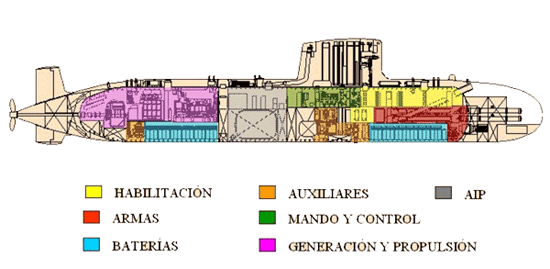
Off-the-Shelf. An existing design available off-the-shelf, modified only to meet Australia’s regulatory requirements. Australia looked at the AM-2000 Scorpene, U214/U216, S-80, and Soryu Class – see Appendix A for details. This option was eliminated in May 2013.
Picking this option would have ensured rapid delivery for the RAN’s strategic centerpiece. It also would cut the risk of technical failure by deploying proven systems, and offered greater cost certainty and savings. The price of this approach is that the submarine chosen might not fit Australia’s exact vision. Which leads to the question of how much that vision is worth, when the extra cost is judged by what else it could buy Australia. If the answer is “their entire future fleet of 72 F-35A stealth fighters,” decision-makers are going to stop and think carefully.
Modified. One way to get most off-the-shelf benefits is to buy existing design and make minor changes to incorporate Australia’s specific requirements, especially the RAN’s chosen combat systems and weapons. Accepting off-the-shelf choices for a new submarine class would force Australia to stock and maintain new types of torpedoes, anti-ship missiles, electronics, etc. Which could be done, but is expensive. Hence the potential attraction of a modified buy. This option was eliminated in May 2013, but it’s resurfacing under the new Liberal government.
Either Japan’s Soryu Class or TKMS’ U218SG would require some modifications along these lines. The Soryus would need to modify their combat system to be compatible with Australia’s chosen AN/BY-1G combat system and with its Mk-48 heavy torpedoes. The U218SG is less defined, but Singapore uses Finmeccanica WASS Black Shark torpedoes in its Archer Class, so unless Singapore plans to switch to torpedoes and use the American AN/BYG-1 combat system, switching the U218SG’s combat system and weapons will take similar design work.
Note that the ultra-cramped nature of a submarine’s internals means that modifying a submarine’s internal electronics is a bit more than a minor design swap-out, and carries expenses and risks of its own. The German/Singaporean U218SG and Sweden’s potential A26 would add the risks inherent to a new design. Hence Australia’s growing focus on Japan’s Soryus. There is talk that the entire set of 10 subs may now be built abroad; a weaker option would use the common approach of having 2-3 boats built in the foreign shipyard with Australian workers on site, and the rest built in Australia following that hands-on skills transfer period.

(click to view full)
Evolved. An evolved design that enhances the capabilities of existing off-the-shelf designs, or of the current Collins Class design. Groups like ASPI suggest that Australia is moving toward an Evolved Collins Class design, but first, they had to remove a key roadblock noted in RAND’s December 2011 report (q.v. Dec 13/11 entry):
“One problem that hindered the Collins program was the lack of the intellectual property (IP) rights to the design of the basic platform and much of the fitted equipment. Not having the rights to Collins IP on future designs may constrain the design effort for the new submarine class that will replace the Collins. Although Kockums and the DoD reached a settlement in 2004 that provided ASC and its subcontractors access to Kockums’ IP, it still protected Kockums’ proprietary information to the point that no intellectual property from the Collins can be used in a new Australian submarine design [implied: absent negotiations & licensing].”
A May 2013 agreement with Sweden’s FMV procurement agency has settled that issue, but an Evolved Design option remains inherently risky, precisely because it’s so easy to pretend that the structural and electronic modifications to an existing class won’t really create much risk. Experiences in a range of Australian and Canadian programs show that this simply isn’t true. Both technical and cost risks can become serious problems, as demonstrated by the fact that the Collins Class was itself begun under those same auspices. Worse, ASC’s performance regarding Collins construction, and metrics far below global norms while building Australia’s new Hobart Class air defense destroyers, may be raising the risk profile so high that it destroys the Evolved option. Nevertheless, an evolved variant of the Collins Class remains on the table as a possibility.
One possible way to sidestep the Evolved Option’s issues is to choose DCNS’ SMX Ocean Class, a 4,000t+ design that’s evolved from France’s Barracuda Class nuclear submarines. That takes care of a big chunk of the R&D costs and risk, and offloads most of the rest to the vendor. On the other hand, Australia would still be the initial and only customer for a new design – one that will require replacement of its combat system, its standard weapons, and other key technologies.
New. An entirely new developmental submarine, designed in Australia.
The “New Developmental Submarine” option is, of course, the riskiest option of all. It’s also by far the most expensive, as a large amount of R&D must be financed. Since export sales from Australia are deeply unlikely, any R&D expenses are simply money down the drain.
With that said, the Swedish government may have a very interesting offer to make. They have broken off talks with Germany’s TKMS following accusations of bad faith in TKMS’ management of Kockums, which designed the Collins Class. In response, they’re working to revive a Swedish submarine industry at Saab. One possible solution is to continue taking those steps toward a Swedish submarine industry, but buy Australia’s ASC as well, and design their planned A26 successor submarine as a co-development project with Australia (q.v. April 12/14 entry).
Contracts and Key Events
2015 – 2016
October 4/16: Lockheed Martin will provide combat systems for Australia’s new fleet of submarines. The move is said to increase interoperability with fellow Lockheed system-user the US Navy. French firm DCNS won the $38 billion Australian submarine contract back in April defeating Germany’s ThyssenKrupp Marine and Japan’s Mitsubishi Heavy Industries and Kawasaki Heavy Industries. Since then, the company has been dealing with the aftermath of a 22,000 page data leak of submarines they are building for India, drawing a warning from Australian defense officials.
August 29/16: French shipbuilder DCNS has been warned to beef up its security measures by Australian defense officials following a massive leak at the company. DCNS had just previously been contracted to build a fleet of submarines for Canberra, valued at $38.13 billion. In response, DCNS said that the leak, which covered details of the Scorpene-class model, and not the vessel currently being designed for the Australian fleet, bore the hallmarks of “economic warfare” carried out by frustrated competitors.
April 28/16: France’s DCNS has been announced as the winner of the $38.7 billion Australian Future Submarine contract. The hotly contested tender for the 12 new subs also saw offers from Germany’s Thyssen-Krupp Marine Systems and the Government of Japan to carry out the build. The new design will be based on DCNS’s Shortfin Barracuda A1 submarine design, a conventionally-powered derivative of the nuclear-powered Suffren-class submarine now under construction for the French Navy. US made combat systems integrator and weapons systems will be installed by either Lockheed Martin or Raytheon in contracts expected to be announced shortly.
January 26/16: Japan and France are the front runners in providing Australia with its next submarine fleet. Germany’s ThyssenKrupp Marine Systems had also been considered, however recent worries over technical concerns may have them out of the running for the $34.55 billion contract. Japan has offered a variant of its 4,000-ton Soryu boats made by Mitsubishi Heavy Industries and Kawasaki Heavy Industries, where as France’s state-controlled naval contractor DCNS has proposed a diesel-electric version of its 5,000-ton Barracuda nuclear-powered submarine. The final decision will be made within the next six months ahead of Australian elections, with a slowing economy to be the main issue among voters. All competitors have agreed to build the new fleet in South Australian shipyards.
Feb 12/15: Bids to be competitive, just not too competitive. Japan is expected to be disappointed that Australia will have a competitive process for choosing submarine vendors. But it won’t be too competitive. Russia and North Korea have been excluded.
2014
New center-right gov’t and its supporters rethinking the program; Interest in Japan’s Soryu Class accelerates; Swedish sub turmoil could be Australia’s big opportunity; France steps in with SSN derivative; ASC may be losing its grip on sub construction.

Dec 02/14: Love Me Tender. Treasurer Joe Hockey brushed aside the idea of running an open tender for new submarines as “a speculation process” that Australia no longer had time for. The opposition in return stuck to its support of local construction. This comes a week after Defense Minister David Johnston said that he wouldn’t trust ASC “to build a canoe”, a statement that he and his boss David Abbott only softly backpedaled later. In other words the government is clearly not softening the substance of its position, which is widely interpreted as favoring Japan as the closest thing to an off-the-shelf option.
Sources: The Australian: Joe Hockey rules out open tender for new submarines | Sydney Morning Herald: Defence Minister David Johnston ‘regrets’ his shipbuilder ‘canoe’ comments.
Nov 19/14: France. The CEO of France’s DCNS opens a DCNS Australia subsidiary during an official visit to Australia by French president Francois Hollande. DCNS can tout its FREMM frigates for Australia’s ASW program, but recent decisions pointing to the Hobart Class hull as a base give them few options. On the other hand, they are specifically touting their submarine:
“Xavier Mesnet (Submarines Marketing Director at DCNS) told Navy Recognition: “SMX OCEAN is more than a concept ship, it is a concept ship near to be realized”.”
The design’s touted 14,000 mile range would help Australia meet the recent promise of a sub with “longer range and endurance than any diesel/electric submarine currently available off the shelf” (q.v. Nov 12/14), and its SSN heritage removes some of the risks associated with a new boat. On the other hand, Australia is insisting on an American combat system and weapons, which would require design modifications. Then, too, several key technologies, like the propulsion system and fuel cells, come with all of the standard risks accompanying new technologies. Sources: Naval Recognition, “DCNS opens a subsidiary in Australia to better market its SMX OCEAN SSK for the RAN”.
Nov 18/14: Politics. The South Australian Economic Development Board commissions an analysis from the independent National Institute of Economic and Industry Research, to assess the economic ramifications of purchasing 12 submarines overseas versus building them in South Australia. The report finds no cost difference from building in South Australia, and a lot of negative economic impacts from building outside it. What a shock.
ASPI runs an article that attacks the study’s core assumptions. Past projects’ cost blowouts show that skill differences in Australia’s industry have predictable effects, and an unrealistic economic impact model assumes the highly-skilled people involved have no other job options. The Chair of the South Australian government’s Advanced Manufacturing Council replies, defending their costing model and shifting the argument about the input-output model to a discussion about spillovers from new knowledge – with a reference to Sweden’s JAS-39 Gripen fighter program. Sources: Government of South Australia, “New expert economic report supports an Australian submarine build” [PDF] | ASPI, “On economics and submarines” | ASPI, “Submarines: reader response.”
Nov 17/14: Politics. A Labor Party dominated Senate committee says that there aren’t any off-the-shelf submarine options for Australia, and pressures the government to adopt a competitive global tender.
The reasons behind the Liberal Party’s distrust of this option have been discussed (q.v. Sept 11/14), but their own defense minister may have given away their case this week by agreeing that no off-the-shelf option is possible. He’s narrowly correct, in that even Japan’s Soryu would need combat system and weapon swap-outs. On the other hand, there’s a difference between a contention like that, and a belief that the Australian design would be wildly different. The government hasn’t managed its message in a way that makes this clear. Sources: Melbourne Herald-Sun, “Give up on Japanese sub plan: committee”.
Nov 16/14: Germany & Japan. Australian media report that the TKMS proposal to biuld 1 submarine in Germany, and 11 more at ASC in Adelaide, is gaining traction within the Australian government.
If Australia can’t buy the Soryus, or Japan blocks the transfer of key technologies, the government is reportedly looking at having Japan build an evolcved version of the Soryu Class, then have it refitted in Adelaide. Sources: The Advertiser, “New German hope for multibillion-dollar submarine build at Adelaide’s ASC shipyards”.
Nov 12/14: Politics. The Minister for Defence speaks to the Submarine Institute of Australia Biennial conference. Sen. Johnston highlights the view that 2009 should have seen full approval for the next-generation submarine, and highlights the urgency of Australia’s shrunken replacement schedule:
“I am advised that by 2030, half of the world’s submarines will be in Australia’s broader strategic region…. the Government’s priorities are sustaining Collins, followed by the Future Submarine capability, schedule and cost. And I highlight the issue of schedule as being the most challenging constraint as I can not solve for time I don’t have…. Australia’s next submarine will have longer range and endurance than any diesel/electric submarine currently available off the shelf.”
That last quoted line is seized upon by the media, because it shifts the playing field against any off-the-shelf buy. That, in turn, makes anything other than a competitive procurement hard to justify. Which cuts the throat of efforts to keep the replacement schedule on an urgent track, or to build the boats much more quickly abroad. Sen. Johnston does make arguments about the industrial end, but they aren’t widely reported:
“There has been almost $1 billion worth of Defence procurement and sustainment work being undertaken in South Australia this year, and over the next four years, there will be up to $4.2 billion in Defence spending for building and sustaining defence materiel in South Australia…. It is well over 20 years since a submarine was designed for Australia and already over a decade since the last Collins class submarine was launched.”
The government also mentions that they are committed to the processes laid out in the Kinnaird Review, with 1st and 2nd pass approvals, but explicitly avoids committing to any kind of competition. The question is whether the minister has fatally undermined the sole-source option, even so. Sources: Australia DoD, “Minister for Defence – Opening address to the Submarine Institute of Australia Biennial conference, Fremantle WA” | The Australian, “Subs boost for SA — Defence Minister David Johnston rules out ‘off the shelf’ submarine purchase”.
Nov 8/14: Saab bids. Saab CEO Hakan Bushke will be unveiling Saab’s offer to Australia at the Submarine Institute of Australia’s centenary conference, but Australia’s government confirms that it has already received the unsolicited bid. At this point, all the report will say is that:
“It includes a lower price than its competitors and a smooth flow of Japanese submarine [propulsion] technology from the Soryu Class boat, because Sweden is a partner in the Japanese project. There will also be substantial technology transfer and industrial offsets for Australia, including jobs in Adelaide during the build phase.”
The question is whether there will be an open competition. Australia’s government has been handed a program that’s already badly behind, and an existing Collins Class fleet whose cost-effective and performance-effective lifecycle is being questioned. Japan’s Soryu Class is already designed, built, and in service, unlike its German and Swedish competitors. Meanwhile, state-owned ASC has lost this government’s confidence as a shipbuilder, and delays in awarding a contract make it harder to reduce ASC’s role. Sources: News Corp., “Australian jobs promise as Sweden’s Saab Group bids for Navy’s $20 billion plus submarine project”.
Oct 28/14: Enter France? DCNS unveils its 4,750t SMX Ocean concept design at EuroNaval 2014. This diesel-electric attack submarine design is much closer to reality than past SMX concepts, because it’s based on the basic SSN Barracuda nuclear fast attack submarine’s layout, masts, and combat system. Meanwhile, shifts in the global market toward the Pacific and Indian oceans are tilting requirements in favor of larger conventional submarines, with more range and endurance.
Switching out the nuclear reactor does create a bit more space, even with 2nd generation fuel cell technology added to give the submarine a submerged endurance of 3 weeks. A cable-and-collar “saddle” system can be added for deployment and retrieval of UUVs from a mid-body chamber, and a detachable mobile pod aft of the sail can carry a special forces swimmer delivery vehicle. Behind the UUV bay, a 6-shooter for vertically-launched cruise missiles like MBDA’s MdCN/ Scalp Naval is complemented by internal frontal space for 28 weapons in any combination of heavyweight torpedoes, Exocet anti-ship missiles, A3SM anti-aircraft missiles, or mine packages. Items like the Vipere tethered communications and surveillance buoy round out the package.
The key caveat is that this isn’t a prototype, or even a detail design that’s ready for manufacturing. If DCNS wants to compete at this level of capability in markets like Australia or India, they have an advance investment decision ahead of them. Their competitor TKMS already has a contract for the large U218SG, and Australia has also been discussing Japan’s 4,000t Soryu Class. Sources: DCNS, “DCNS unveils SMX-Ocean, a new blue-water SSK with expanded capabilities”.
Sept 15/14: Japan risks. As it becomes clear that Japan is the odds-on favorite, discussion of that choice’s particular risks is coming up. If Australia picks the Soryus, the risks it will accept include some level of opacity with respect to key technologies, like special steels for hull strength. Time will tell, but Japan is also said to be reluctant to transfer all of the boat’s key technologies to Australia. Noise reduction designs in particular transfer naturally, as part of giving Australia full local maintenance capability, but are highly sensitive.
These issues, and the complex nature of these technologies, have industrial implications. The ability to actually build the submarines at ASC would leave no middle ground regarding technology transfer. Worse, experts like Kazuhisa Ogawa and ex-submariner Toshihide Yamauchi estimate that an ASC build could double the cost to the full planned A$ 40 million. This compares rather unfavorably with TKMS’ reported bid submission, but that design promises serious performance and timeliness risks, along with the potential for unexpected costs. Pick your poisons.
Other risks are geopolitical. Hugh White is not a fan of local construction, but his questions go to the heart of the strategic risks:
“How sure can we be that within that time [of the submarines’ delivery and entire service life] Japan will… be a US ally? That it will not have restored its long-standing ban on defence exports? That it will not have become a compliant neighbour of a predominant China, or on the other hand have become China’s bitter enemy? What would happen to our new submarine capability in any of these contingencies?”
Fair questions. Does Australian participation in a project of this magnitude make some of these outcomes less likely? How much less likely, and what role will other macro trends play? Someone needs to be doing this kind of analysis, and Australia’s DoD hasn’t shown great proficiency in the past. Sources: Australia’s ABC, “Soryu submarine deal: Japanese insiders warn sub program will cost more, hurt Australian jobs” | Canberra Times, “Japanese submarine option odds-on favourite”.
Sept 11/14: Germany & Sweden. The Australia Financial Review says that they’ve “confirmed that German submarine builder ThyssenKrupp Marine Systems (TKMS) has submitted a bid for a joint venture with Adelaide-based ASC that comes in at under $20 billion.” What they don’t say are which model of submarine the proposal used, and how cost risk for going beyond that budget would be handled. For instance, an A$ 20 billion bid with 100% escalation risk to the government is effectively an open-ended contract for any amount; vs. an A$ 20 billion contract with a 50/50 sharing arrangement for cost escalation and a $30 billion government cap, which is an A$ 20-30 billion contract. Or a straight A$ 20 billion purchase and delivery contract, which remains at A$ 20 billion unless the government changes the design or decides to negotiate for other reasons. The details matter.
Australian Labor Party leader Bill Shorten has been invoking World War II a lot in his opposition to a built in Japan deal, which makes a collaborative offer from the other former Axis power a mite awkward. Meanwhile, Sweden is committed to making a strong bid, if there is an open competition. Saab CEO Haakan Bushke says that they’re willing to design a 4,000t submarine for Australia, and take ASC and Royal Australian Navy engineers and technicians to work on its new A26 design. He adds:
“As of July 2, Saab completed a full takeover of Kockums which is now Saab Kockums and the Swedish Kingdom now controls the intellectual property for… [Australia’s currently-serving] Collins class submarines…. If there is an open competition, Saab Kockums will be in it.”
The publicity and lobbying builds pressure toward an open tender, which would create 2 distinct policy problems for the Abbott government. One is a policy angle. The Soryu Class is a proven and built design, while TKMS and Saab’s offerings aren’t. This creates a real risk that the new submarines will be delayed (q.v. Sept 8/14), amid questions concerning the Collins Class’ costs and effective lifespan. The 2nd problem is political. Opening competition delays the contract, allowing ASC, unions and the Labor Party to spend a lot of time and effort lobbying. That raises the odds of having the contract outcome and costs dictated by political forces outside the government. Against those negatives, one must weigh the potential for really great competitive offers, which could avoid a complete breach of the Liberal Party’s pre-election commitment to building the boats at ASC. Sources: Australia Financial Review, “Germans undercut Japan on Australia’s submarines” | Australia Financial Review, “Swedes launch desperate bid for Oz submarine project” | Business Insider Australia, “Germany Joins The Race To Build Australia’s New Submarine Fleet” | Business Insider Australia, “Australia Could Get A Great Deal On Its New Submarine Fleet If Tony Abbott Wants It” | Manufacturers’ Monthly, “German company wants to build Australia’s submarines”.
Sept 8/14: Japan. News Corp. reports that the government is fast-tracking their pursuit of Soryu Class submarines, because of growing concerns about the $2+ billion cost of maintaining the Collins boats beyond 2026; some estimates put that cost at more than $2 billion. The government also seems focused on a proven solution; TKMS’ U218SG isn’t, and neither is Saab’s A26. DCNS’ Scorpene, meanwhile, lacks the size and range Australia wants. Hence Soryu, especially given Australia’s urgency:
“The Government cannot afford a submarine capability gap and every day past 2026/27 when Collins class is due to begin decommissioning, adds days of risk,” a senior defence source said.”
Controversy. A second consequence of the government’s risk and cost aversion is that ASC Pty’s performance on the Air Warfare Destroyer project may have relegated them to a service role for the future submarines. In other words, construction in Japan. ASC and the Labor Party are understandably unhappy, arguing that the industry is strategic and that the Collins Class’ reported 21,300 km range is 88% better than even the Soryus. Australia would also need to either modify the Soryus to use American torpedoes, or switch as a fleet to the class’ natural weapon set of American UGM-84 Harpoon missiles and Japanese Type 89 torpedoes.
Cost. A Japanese build would be a big, big geopolitical deal, but the headline’s A$ 20 billion figure is unreliable because it’s based on a statement by Germany’s TKMS, regarding a different submarine. Another report costs a program for 10 Soryu Class boats at A$ 25 billion. Note that even A$ 25 billion is just 69% of the original A$ 36 billion projection for ASC. For perspective, this inherently optimistic build cost means that switching to Soryus leaves about enough money to cover current official costs for Australia’s 2 Canberra Class LHDs and 3 Hobart Class Air Warfare Destroyers. If build-out cost in Australia were to hit A$ 40 billion, which is very possible, savings from a Japanese build would pay the estimated A$ 15 billion cost of Australia’s F-35A stealth fighter program.
Politics. Does that level of cost savings negate the political blowback from cutting out ASC? It might, but there are risks. Australia is a Parliamentary system, but Abbot’s government relies on a coalition of 4 parties in the House. If the Liberal Party’s partners don’t bolt the coalition over the issue, and the plan goes forward, the question becomes whether Parliamentary maneuvering can force an issue vote in the Senate. There, the government would need 6 of 8 non-Labor and non-Green votes outside of its own coalition.
Basing. To make things even more interesting, there are also reports that Australia is considering a basing shift to HMAS Coonawarra, up near Darwin in the north. That would drastically improve deployment into theater, as the sailing difference between HMAS Coonawarra and the current submarine base in Australia’s southwest at HMAS Stirling is almost 5,000 km / 2,700 nmi. Unfortunately, HMAS Coonawara is currently just a patrol boat base, and creating a full submarine and support base would be expensive. Especially if the natural harbor isn’t super-deep. The other problem is that basing the RAN’s most strategic assets near Darwin makes it much easier to reach them with weapons like cruise missiles. A forward base near Darwin is possible for refueling and minor service, and it would basically cancel the range difference between the Collins and Soryu classes, but a full basing switch is unlikely.
Sources: News Corp., “New Japanese submarines to cost Abbott Government $20 billion” | Australia’s ABC, “Submarine policy: [Independent Sen.] Nick Xenophon urges PM to ‘end the uncertainty’ over SA project” | The Australian, “Submarine plan a threat to national security: Labor” | 7News, “Darwin submarine base ‘won’t happen’, Australian Defence Association chief Neil James says”.
Japan buy: key issues
July 8/14: Japan. Australian Prime Minister Tony Abbott and Japanese Prime Minister Shinzo Abe sign the “Agreement between the Government of Australia and the Government of Japan Concerning the Transfer of Defence Equipment and Technology” at a ceremony in Canberra.
It isn’t the full security cooperation policy mooted in previous reports (q.v. May 28/14), but it’s an immediate step. As expected (q.v. April 6/14), they’re leading off with a joint Marine Hydrodynamics Project between Australia’s Defence Science and Technology Organisation (DSTO) and Japan’s Technical Research and Development Institute (TRDI). In English, they’ll analyze propulsion and water resistance around submarine hulls – and, implicitly, torpedoes. Sources: Australian DoD, “Minister for Defence – Defence Minister David Johnston hails defence science and technology accord with Japan”.
May 28/14: Japan. Reuters reports that Japan is warming to the idea of selling submarines to Australia, but what they want in return is something Australia will need to think about:
“Japan is considering selling submarine technology to Australia – perhaps even a fleet of fully engineered, stealthy vessels, according to Japanese officials. Sources on both sides say the discussions so far have encouraged a willingness to speed up talks…. Japanese military officials and lawmakers with an interest in defense policy have signaled a willingness to consider supplying a full version of the highly regarded Soryu to Australia if certain conditions can be met. These would include concluding a framework agreement on security policy with Canberra that would lock future Australian governments into an alliance with Japan, the [Australian] officials said.”
China’s likely reaction would create diplomatic complications, and limit Australia’s future political options. On the other hand, the Japanese have the one proven design that meets Australia’s needs. Just don’t expect rapid decisions. That isn’t usually the way things are done in Japan. Sources: Reuters, “Japan & Australia consider submarine deal that could rattle China”.
April 12/14: Swedish option? The Collins Class was built around a Swedish design, News Corp Australia says that Saab and the Swedish Government have been engaged in secret talks around a joint submarine effort. That proposed approach may have the potential to cut through many of the dilemmas faced by Australia’s government, and Sweden’s as well. Here’s Australia’s problem, as explained in the SMH:
“This week the Australian Strategic Policy Institute hosted a conference billed as the “Submarine Choice” – but the arguments simply shot past each other. Nothing connected. The Navy stressed its strategic need for submarines without reference to the budget; industry obsessed about the business case without worrying about how such massive expenditure would severely unbalance the forces; while politicians agonised over the need to save jobs and save money, despite the fact these objectives stand in direct contradiction to one another. In the meantime, the bandwagon rolls remorselessly onwards.”
The reported Swedish solution would buy ASC, and embark on a fully cooperative joint design for Sweden and Australia’s next submarines. Australia would receive a design that’s explicitly built for Australia’s needs – a necessary compromise for Sweden, whose needs are different. It’s also worth noting that the Japanese Soryu Class propulsion system that has attracted so much interest from Australia’s Navy is part Swedish. From industry’s point of view, making ASC part of Saab removes any conflict of interests with a foreign firm that acts as the project lead, and creates both development jobs/skills and production work. From the politicians’ point of view, a program that includes Sweden and Australia offers the added security of shared risk, and shared acquisitions. As a starting point, Saab soon buys Kockums from TKMS, after hiring away many of its engineers. Read Saab Story: Sweden’s New Submarines for full coverage.
April 8/14: Minister for Defence Sen. David Johnston gives the speech, but says that the government is still evaluating options and has made no decisions. Since his party had campaigned on building 12 submarines in Australia, he also needs to qualify his way out by invoking his statement that “…if anything the Minister has said is based on fantasy, we’ll tell you and we’ll revisit this.” He does put industry on notice that the priority is performance rather than jobs, and adds that the priority isn’t X number of submarines, but a stable submarine capability that matches what Australia can afford and operate.
Taken as simple logical propositions, both points are extremely sensible. The government can expect to face strong lobbying from the shipyard and its associated unions, and that’s already starting, but the sheer size of the price tag involved means that the unions’ traditional allies on the left aren’t going to fight very hard alongside them. Observers are speculating that that the minister’s framework means 6-9 submarines, but no-one knows at this point. Sources: Australia DoD, “Minister for Defence – Speech – Address for the ASPI conference” | Australia DoD, “Minister for Defence – [Q&A] Transcript – ASPI Conference” | ASPI, “The Submarine Choice: ASPI’s International Conference, Canberra” | State-owned ABC, “Submarines off-the-shelf would breach promises to South Australia, says Penny Wong” | The Age, “Why do we need more submarines?” | The Australian, “Cheaper submarines ‘risk the lives of sailors’”.
April 7/14: Rethink? Looks like the stirrings of discontent earlier this year (q.v. Jan 29/14, Dec 17/13) are about to become more real. Minister for Defence Sen. David Johnston is scheduled to make a speech at ASPI on April 9/14, and there’s considerable speculation that he will change the submarine program in 3 important ways. One, he may choose to cut the program from 12 boats to 9, on both cost and operational capacity grounds. Two, he will force ASC to make a case to win the work, saying that the Navy’s strategic centerpiece “is not a job-creation program”. Third, there’s the clear implication that if the ASC case isn’t good enough, some or all of the submarines may be built abroad. As a final wrinkle, talks continue with Japan regarding their large Soryu Class boats, shortly after Japan relaxes their restrictions on exporting weapon technologies:
“When asked yesterday what aspects of the Japanese boats might be included in an Australian design, a senior government source replied: “Everything.”…pressed on whether that included buying the boats off-the-shelf from the Japanese the answer was an emphatic “yes”.”
The usual approach is to build the first few boats aboard, with some local workers sent to participate, and then begin production locally. That would create an industrial timing problem for ASC, but if the government replaces 3 submarines with a 4th Hobart Class air defense destroyer, it could enhance Australia’s naval and missile defense options while covering the industrial gap. Sources: News Australia, “Australia in talks to buy Japanese submarines to upgrade fleet” | Sydney Morning Herald, “Coalition casts doubt on plan to replace Collins Class submarines”.
April 6/14: Japan. Jane’s reports that Australia and Japan have agreed to start talks on creating a framework for defense technology co-operation, with an initial project involving joint research into marine hydrodynamics.
“An official at the Japanese Ministry of Defence (MoD) told IHS Jane’s said this would include the analysis of propulsion and water resistance around submarine hulls.”
The message to Jane’s also suggested that the propulsion technology that so interests in Australians was deemed too sensitive. Instead, Japan’s Technical Research and Development Institute and Australia’s DSTO would begin collaboration here. Japanese decision making processes are slow, especially in an area so likely to create tensions with China. Will they be too slow for the decisions Australia needs to begin making? Sources: IHS Jane’s Defence Weekly, “Japan, Australia agree to joint research on submarines, hydrodynamics”.
March 6/14: Evolved Collins. It isn’t new to say that Australian politicians seem to be leaning toward an evolved Collins Class submarine, given the riskiness of designing a new boat. The political dynamics at work are more interesting:
“An evolved Collins-class has emerged as the favoured option for Australia’s next generation of submarines amid signs the much maligned existing boats will remain in service beyond 2030…. Few sources close to defence believe it will opt for a new design given the risk of having an orphan boat class. Treasurer Joe Hockey is said to be uneasy with the mooted pricetag of $36 billion. Defence Minister David Johnston has also cast doubt on whether Australia will double its fleet to 12, saying the number first mooted in the former prime minister’s 2009 white paper has never been justified.”
The report also says that decision makers are more comfortable leaving the Collins Class in service until 2030 – ironically, because they’ve been defective so often and spent so much time out of water. Sources: Australian Financial Review, “Evolved Collins favourite but timing unclear”.
Jan 20/14: Political pushback. The A$ 30-40 billion size of the future submarine project guarantees political scrutiny, but that won’t really begin until it’s a near-term project rather than just funded studies. The Sydney Morning Herald decides to start as the new center-right Liberal Party government prepares its 1st budget, and it’s coming from a right-wing source:
“Whatever one may think of [new Board member] Mirabella [q.v. Dec 17/13], she is an economic dry and does not shirk the dirty work of confronting spendthrift bureaucrats, military brass and trade unions, all of whom have treated the Australian Submarine Corporation and the Defence Materiel Organisation as a giant honey pot.
Both organisations are impervious to competence…. The idea that Australia should produce a dozen submarines in South Australia, at a projected cost of about $3 billion a vessel, is madness…. The new submarines will have a unit cost that dwarfs the Collins-class subs if built here, or roughly three times the cost of acquiring the submarines from foreign shipyards. The navy disputes this disparity but history does not.”
As many observers have noted before: please tell us how you really feel, Paul Sheehan. More seriously, this is an early sign that Abbott’s traditional allies may not be solidly behind the program as currently conceived. Meanwhile, the Labor Party is no longer in power, and hence no longer really bound to defend a program that will demand many more dollars for national defense. Sources: Sydney Morning Herald, “Future Submarine project a farce that has missed a mention”.
2013
Combat system picked. Potential work with Japan?
Dec 17/13: ASC Board. Former Liberal Party MP Sophie Mirabella, a 12-year incumbent who was the only party incumbent to lose her seat in the recent election, is appointed to ASC’s Board of Directors by Prime Minister Tony Abbott, alongside new members Peter Iancov and Paul Rizzo.
Ms. Mirabella does have qualifications as the Coalition’s Shadow Minister for Innovation, Industry and Science while they were in opposition, and is known as a strong opponent of public sector waste. It’s arguable that ASC could use both, given the scale and importance of the projects they’re handling, and will soon begin to execute. Prime Minister Abbott could certainly use a critically-minded loyalist on the inside, to avert problems or at least give him advance warning of any nasty surprises. Now he has one. Sources: Minister for Finance, “Appointment of Three New Board Members to ASC Pty Ltd” | Sydney Morning Herald, “Coalition appoints Sophie Mirabella to board of government-owned shipbuilding firm”.
May 16/13: IP deal. Australia’s government signs a deal with Sweden’s FMV procurement agency, Intellectual Property rights for submarine design and technology. As RAND’s 2011 report had noted (q.v. Dec 13/11), this was a major stumbling block for any sort of Evolved Collins design.
The agreement covers use of Collins Class submarine technology for the Future Submarine Program. It also creates a framework and principles for the negotiation of Intellectual Property rights, if Australia wants to be able to use and disclose other Swedish submarine technology for an Evolved Collins solution. Disclosure is included because there are sub-contractors et. al. who require some level of disclosure in order to work on the project. Defense Ministers Joint Communique | Australia DoD.
Swedish Intellectual Property Agreement
May 2/13: White Paper. The Labor government’s 2013 defense white paper rejects the safer and quicker options of buying or modifying an existing class from abroad. Instead, they’ll focus on options #3 & 4: an evolved design of the Collins Class, or a completely new Australian design. As part of that decision, they’re going to continue with the American AN/BYG-1 combat system as their standard. It equips every class of American nuclear submarines thanks to a combination of initial installs and systems modernizations, and a BYG-1(V)8 variant was inserted into the current Collins Class as Project SEA 1439 Phase 4A.
This is a decision that exacerbates both the performance risks so amply illustrated by the Collins Class to date, and the risks of delayed in-service date for new boats. Which is why it shouldn’t surprise anyone that the government has extended their estimates of how long the Collins Class can serve. Unless they want a gap where Australia loses its submarines entirely, or operates with a much-reduced force, delays and decisions to date mean that the government can’t say anything else. Whether their study’s carefully-couched conclusion is true in an operational sense is a different question.
On the topic of performance risks, even with the new Submarine Propulsion Energy Support and Integration Facility, the submarine skills plan, and government plans to improve productivity in Australian shipbuilding, the new submarine decision expands almost every possible risk facing the Australian Navy’s future strategic centerpiece. It may be that a new propulsion system can fix some of the Collins Class’ problems, but the boats’ problems over the years have stemmed from a wide variety of defects and failures, across multiple systems. There are conflicting reports regarding the extent and success of the fixes tried to date, and one can be forgiven some skepticism that the same organizations responsible for the present situation can create or insert new designs that solve all of their previous mistakes. Since the systems will be new, or at the very least not proven in operations with the boat they’re inserted into, it’s also more than possible that “unforeseen” delays will make it hard to get new boats into service before the existing fleet becomes unfit for purpose.
In exchange, of course, the government gets to promise more spending with a state-owned firm (ASC) and its sub-contractors, on behalf of a Labor Party whose political standing is shaky, a few months before an election. Future Submarine Industry Skills Plan | Australia DoD release | ASC | ASPI | ASPI Shipbuilding timeline.
2013 White Paper, Combat System picked
Feb 13/13: Japan. The New Pacific Institute reports that Japanese media are now openly discussing a Soryu Class deal with Australia, and chronicles the process so far. Bottom line: If a deal is consummated, it’s going to be a delicate process of mutual trade-offs, not a straightforward transaction:
“The article did not offer much additional detail about how the process from here is likely to unfold, although it did frame the technology transfer as part of a supposedly mutual desire to balance against Chinese naval activities. It nevertheless suggests that defense officials are still considering the plan and that the chances are good that something will come out of the process notwithstanding any domestic or international backlash. The main issue for the Japanese side likely revolves what level of information and access to provide to the Royal Australian Navy.”
The relaxation of Japan’s export laws was meant to support joint development projects like the SM-3 Block IIA, rather than a 1-way transfer of technology to a foreign shipbuilder. Japan sees submarines as a strategic technology for its own preservation, and must weigh the risk of dissemination against the potential benefits. NPI doesn’t believe that complicating China’s life is enough of an inducement all by itself. Meanwhile, Australia knows that it wants a large diesel-electric sub, and believes that Japan has a reliable propulsion system design. Cooperation that stops short of full-scale licensed submarine construction might be an option for both parties.
2012
Initial studies budget; Is the project about pork-barrel politics, at the expense of defending Australia? Japan’s Soryu Class enters the mix; Kokoda’s shoddy study.
(click to view full)
Nov 15/12: Requirements. David Feeney, Parliamentary Secretary of Defence, speaks to the Submarine Institute of Australia Biennial Conference. He describes regional trends that could see A$ 44 billion spent by 2021 and up to 150 diesel-electric submarines operational, offers a naval “sea control” doctrine formulation straight from Sir Julian Corbett, and adds more clarity to his government’s expectations for the future submarine:
“Denial retains a place, but sea control operations ensure that Australian response options are not constrained and our freedom of action is not threatened. It is inconceivable that Australia can achieve sea control – a requirement for successful maritime power projection – without submarines.
Government is resolved that the Future Submarine will have greater range, longer endurance on patrol, and expanded capabilities (i.e. communications) as compared to the current Collins Class submarine. The Future Submarine must be able to carry different mission payloads such as uninhabited underwater vehicles (UUVs)… conduct strike operations against military targets, including an adversary’s operating bases, staging areas and critical military infrastructure.
Relative to other nations that operate diesel-electric submarines, the Future Submarine must operate across exceptionally vast distances… Asia-Pacific possesses numerous critical maritime nodes – notably the Malacca Strait, Sunda Strait, and Lombok Strait- all of which are critical to the global economy. These nodes are 2,000 or even 3,000 nm from [naval base] HMAS Stirling.”
The problem is that those requirements amount to a unique requirements set that will add massive costs to the project, along with risk that the next batch will fail like the Collins Class. Industry infrastructure is acknowledged to be shaky. Could the same money be used to buy an existing design, along with the sub tenders needed to give it all of that range and more? Or a set of submarines plus other critical sea control forces (like maritime aircraft)? Very likely. But the “made in Australia” rhetoric is all about jobs and perceived government largesse first, and defense second. Australia DoD Transcript.
Nov 14/12: Jobs justification. Jason Claire, Minister for Defence Materiel, speaks to the Submarine Institute of Australia’s 6th Biennial Conference. He begins by justifying the need for large submarines, on the grounds that they need to operate at long ranges. There are other approaches which could address this issue, but it makes for a useful uniqueness justification when he gets to the speech’s point – justifying his decision to build all of the submarines in Australia.
That approach significantly raises the risks of program failure, and of failure to replace existing boats in time. If the submarines really were a strategic priority, an approach that had the first 2-3 subs built abroad with Australian engineers on site, and the rest built locally as expertise grows, would be the obvious plan. Note, too, Claire’s use of the word “design,” indicating that despite government assurances, use of an existing submarine design isn’t getting serious consideration from this government:
“…will create thousands of jobs and work for hundreds of Australian companies. More than this it will create a new Australian industry… It will take decades to build 12 submarines, and by the time the last is built the first will need to be replaced. It’s not a short project. It will go on and on. It will create an industry that could last for a century or more. That industry should be here. That industry also has flow on benefits. It will build skills useful for other industries and technology… also build the capabilities and skills of our universities and our technical colleges… it is important we have an indigenous capability that can design, develop, build and maintain submarines.
That is not something we can or should do on our own… But we also can’t, and shouldn’t, outsource the whole task… Acquiring nuclear powered submarines… [means] outsourcing the construction, maintenance and sustainment of the submarines… built overseas, they would have to be fuelled, docked, defueled and disposed of overseas. That means tens of billions of dollars for acquisition and sustainment over decades that could be invested in Australia, spent overseas.
We have got a valley of death between the last AWD and the start of construction of the first future submarine. It’s a valley where jobs are lost and the skills we need will disappear… We need to fix this. This is the job of the Future Submarines Industry Skills Plan that I will receive next month.”
Sept 6/12: Infrastructure. Australia’s government announces that the Future Submarine Systems Centre will be based in Adelaide, South Australia. There had been some concern that the work might migrate elsewhere, but this is where Australia’s naval shipbuilding infrastructure is located.
The Systems Centre is set to formally open in 2013 as the home of the Future Submarine program, much as the AWD Centre in Adelaide has been the home of the A$ 8 billion Air Warfare Destroyer program. There are already staff working on the project, but they are based at state-owned shipbuilder ASC. Once they move, the center will be used to conduct evaluation of options, design work, program management, engineering, logistics and production planning. Over the next few years, it will grow to include hundreds of Defence personnel from Navy, the Defence Materiel Organisation (DMO), the Defence Science and Technology Organisation (DSTO), and defense contractors.
There has also been a steady drumbeat of criticism over Australia’s slow decision-making, and the government’s readiness to choose an industrial structure that will roughly double the program’s cost to A$ 36 billion or more, and introduce significant risk. Even as the RAN has extreme difficulties sustaining and manning its existing fleet of 6 Collins Class subs. The government is sticking to the 2009 plan of 12 new submarines to be assembled in South Australia, with the same 4 options under study, etc. The minister adds that this commitment will be reinforced as part of the 2013 Defence White Paper.
Aug 28/12: Where’s Coles Review 2? Liberal Party opposition defense critic Sen. Johnston releases a statement:
“Part 2 of the Coles Review of the Sustainment of Australia’s Collins Class Submarines was expected to be handed to the Minister in April, but in spite of the Minister declaring Collins Class sustainment was at the top of the Government’s Project of Concern List, it is still nowhere to be seen… I can see why the Defence Minister isn’t exactly pushing down Mr Coles’ door as Part 1 of his report was a damning indictment… Senator Johnston said this year alone taxpayers will spend close to $1 billion on maintenance and sustainment of the Collins Class with only one, sometimes two out of six submarines operationally ready at any one time.”
The review doesn’t arrive until mid-December 2012.
July 25 – Aug 3/12: Breakdowns & delays. After reporting a successful torpedo firing and sinking exercise during RIMPAC 2012, Australia’s DoD reveals that a leak is forcing HMAS Farncomb to return to port immediately. The Liberal Party’s shadow defence minister, David Johnston, reminds Sydney Morning Herald readers that these kinds of breakdowns are all too common, while highlighting the timing problem that could leave Australia without a viable fleet. The time for a decision, he says, is now:
“The ASPI report described the gap between when all the Collins Class have been retired and the time it would take to build a replacement as “nothing short of catastrophic”… three years “of no submarines at all”… After some prodding the Minister also declared [in May 2012, 3 years after the White Paper] a final decision on the replacement would not be made until late 2013 or 2014 – in other words, not until after the next election… all against the backdrop of our submarines being so operationally fragile that competing in exercises with allies becomes a case of going in with fingers crossed… We also have our submariners reluctantly leaving the Navy because they simply don’t get time at sea doing what they signed up to do.”
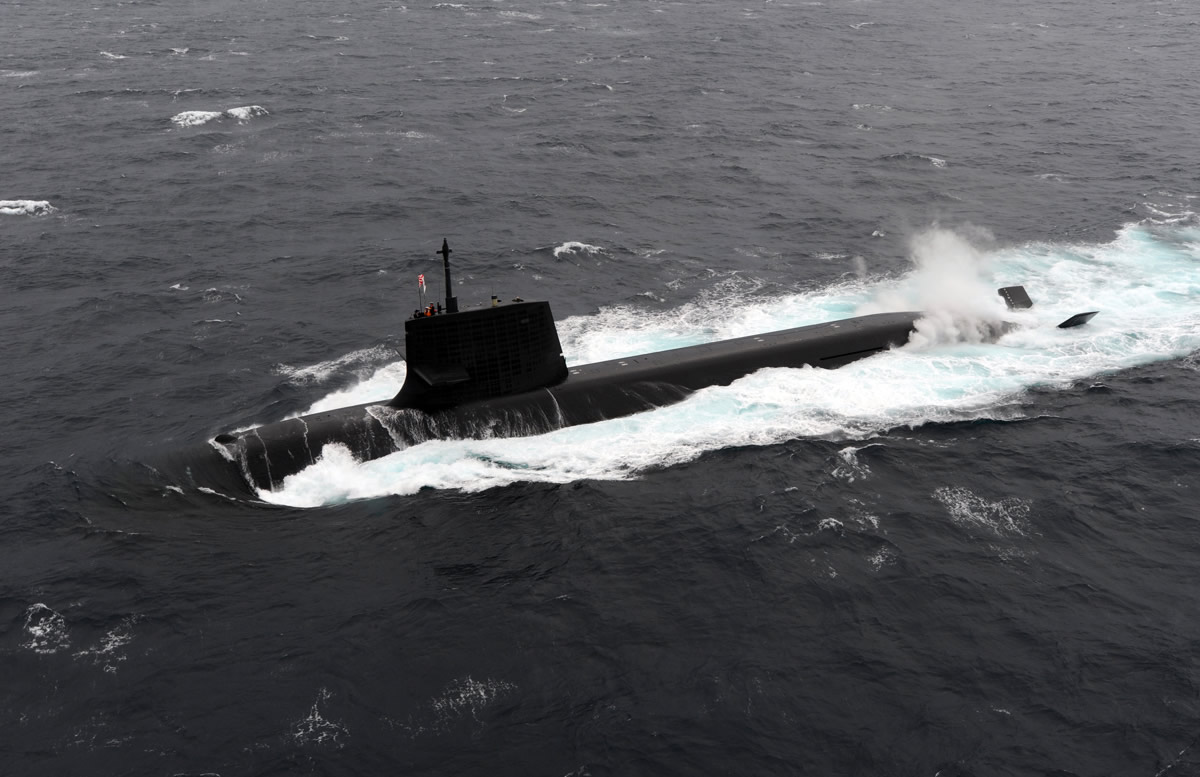
July 9/12: Japan’s Soryu? RAN Future Submarine Program head Rear-Admiral Rowan Moffitt, and DMO Chief Defence Scientist Dr. Alexander Zelinsky are traveling to Japan to look at the country’s new 4,200t Soryu (“Blue Dragon”) Class/ 16SS submarines.
Japan relaxed its ban on weapon exports somewhat in December 2011, which opens up the possibility of an Australian-built submarine derivative. On the flip side, the previous ban means that Japanese firms lack the same kind of technology transfer and off-site quality control experience that has been earned over the years by Germany’s HDW (Greece, India, South Korea, Turkey), and France’s DCNS (Brazil, India).
The Soryus have a Stirling Air Independent Propulsion system, and began service just 3 years ago. They’re also much larger than competitors like France’s 2,060t MESMA AIP equipped AM-2000 Scorpene. That makes the Soryus attractive to Australia, and some think they might have the range and capacity Australia needs. It’s worth noting that smaller submarines like Germany’s 1,830t U212As have traveled thousands of miles while submerged, and technically have a longer range than the Soryus. Still, bigger is better to some. The Japanese subs do offer a lot more space for weapons, and a similar submarine design might offer interesting opportunities for Australian-Japanese operational cooperation. Adelaide Now | Sydney Morning Herald.
May 3/12: Initial budget & plans. Australia’s Labor Party government announces a budget of another A$ 214 million for the next stage of the Future Submarine Project, and appoints Mr. David Gould as the DoD’s General Manager of Submarines, working within the DMO and reporting directly to its CEO. The initial budget will pay for detailed studies and analysis to inform the design choice, the cost/ capability tradeoffs, and the workforce skills requirements to build them in Australia. Those funds are on top of the government’s December 2011 RFI, and the contract with Babcock for a land-based propulsion testing site.
Overall, the Government announces that they’re considering 4 broad options for diesel-electric fast attack submarines, as outlined above. with respect to the studies and work conducted:
Scientific and technological studies will be conducted primarily by the Australian DoD’s Defence Science and Technology Organisation (DSTO).
The off-the-shelf studies will be undertaken with same trio of firms who were sent the December 2011 RFI: DCNS (Scorpene), TKMS HDW (U212A/214), and Navantia (S-80). TKMS Kockums will perform the evolved design studies for the Collins Class, as they were its original designers.
An interesting 2nd look will happen within the AUSMIN framework agreed in November 2010. US technical cooperation will involve capability modeling for both off-the-shelf and evolved Collins options. Systems Performance and Analysis, and GD Electric Boat, will do that work under a US Foreign Military Sales case.
The workforce skills plan will be developed by a team be led by the DoD’s Defence Materiel Organisation CEO, Mr. Warren King, and supported by an Expert Industry Panel headed by Mr. David Mortimer, AO. The Expert Industry Panel will include representatives of the Navy; DMO; the Department of Industry, Innovation, Science, Research and Tertiary Education; Skills Australia; unions; the CEOs of ASC, Austal, BAE Systems and Forgacs Engineering; and the Australian CEOs for local subsidiaries of Lockheed Martin, Raytheon, Boeing, Thales, Saab Systems and BAE Systems. Australia DoD.
Budget & Studies
April 23/12: An interview with Minister for Defence Stephen Smith touches on the Collins Class’ ongoing problems, and the decisions to be taken regarding Australia’s future submarines. An excerpt:
“So there are capability issues [with the operating ranges required for Australian submarines] but no decisions have been made other than the Government ruling out a nuclear [propulsion] option… Australia does not have a nuclear industry, and if we acquired nuclear submarines that would effectively see the outsourcing to another country of our maintenance and sustainment… We remain committed to 12 submarines assembled in Australia.
“…Whether there is a gap in capability will in the end depend upon the decision that we make about the new submarine, firstly; secondly, the length of life or the life of type of the Collins Class Submarine. That is currently not known… one of the studies we have currently under way is a study trying to better define the life of type of the Collins Class Submarine… it would have been in my view wrong – indeed, irresponsible – to have leapt into a Future Submarine Project without trying to address the long-standing endemic, systemic difficulties that we’ve had with the Collins Class Submarine.”
April 21/12: Captain’s Critique. Commander James Harrap, a 20-year navy veteran, resigns from the RAN after commanding both HMAS Waller and HMAS Collins. While the boats and their crews had “serviced the navy well and achieved much,” the media obtain a copy of his overall assessment. It is stark and scathing: scrap the class.
“I don’t believe the Collins-class are sustainable in the long term and many of the expensive upgrade plans which have been proposed would be throwing good money after bad… Over the last two years, I believe these problems have become worse… Throughout my command of both Collins and Waller, full capability was never available and frequently over 50 per cent of the identified defects were awaiting stores… Collins has consistently been let down by some fundamental design flaws, leading to poor reliability and inconsistent performance. The constant stream of defects and operation control limitations makes getting to sea difficult, staying at sea harder and fighting the enemy a luxury only available once the first two have been overcome.”
The submarines’ diesel engines come in for special criticism, but they are far from his only target. His final conclusion has special relevance to Australia’s next-generation program: “I do not believe we have the capability to independently design and build our own submarines.” The Australian.
Jan 19/12: Kokoda criticized. The Kokoda Foundation releases its study “Sub Judice: Australia’s Future Submarine,” written by former ASC employee Brice Pacey. It concludes that no off-the-shelf conventional submarine can meet Australia’s requirements, and that a nuclear submarine program is unaffordable and unmanageable. Instead, it recommends “an evolution of the Collins design,” and claim that “the cost of building the submarine will be markedly less than some published estimates… there is no cost penalty for an Australian build.” These statements are from the foundation’s release; the full document itself is a for-fee publication.
While there is widespread agreement that nuclear-powered SSN fast attack boats are not a realistic option for Australia, the foundation’s other 3 conclusions draw fire. First, submarine-builder ASC’s sponsorship of the paper has led several observers to question the study’s seriousness and objectivity. The critics add that requirements themselves are arbitrary, unless the gaps involving current state-of-the-art submarines create serious mission problems, and the cost to field a 100% solution is acceptable. Given the demonstrated capabilities of submarines like the U214, they see the capability gap as too small, and the price gap as too large.
On which topic, reports indicate Kokoda estimates of just A$ 18 billion for the 12 boats, which is, indeed, significantly less than other published estimates. The history of the Collins Class, with respect to both build costs and performance, is not overly encouraging, and the credibility of this estimate has been deeply doubted. ASPI analyst Andrew Davies summed up this view with a Carl Sagan quote: “Extraordinary claims require extraordinary evidence.” Kokoda Foundation release [PDF] | Canberra Times | Lowy Institute for International Policy.
2011
German “Type 216”?; Learning from other submarine programs – including Australia’s.

(click to view full)
Dec 28/11: Type 216? HDW has released details of a 4,000t “Type 216” concept design, which appears to be targeted at Australia’s SEA 1000 future submarine program.
Australian sources have expressed concerns that the U214, and other boats investigated in the RFI, may not have the size and range to meet Australia’s specification. This may or may not be accurate, but a larger design could conceivably appeal to customers like Australia, India, and possibly Canada one day.
With doubts growing that an Australian-designed successor to the Collins class boat cannot be ready by the 2025 deadline, HDW might find some traction with a large submarine that offered 10,400 nm/ 19.240 km notional range, Air-Independent Propulsion for long underwater patrols; and the ability to launch cruise missiles, a special forces swimmer delivery vehicle, or UUVs. The flip side is that first-of-class boats can be problematic, even if the class is designed by a very experienced and skilled firm. The Greek experience with the 1st of class Papanikolis (U214) is instructive here. Canberra Times | Navy Recognition (incl. drawings).
Dec 13/11: Studies & Contenders. The Phase 1 Coles Review into the Collins Class’ difficulties is released, and goes as far as calling Australia’s approach to managing submarines “unfit for purpose.” The same day, Australia’s DoD releases RAND’s requested report of lessons learned from US, UK, and Australian submarine programs, and discusses the class options they’re investigating:
“Options for the Future Submarine range from a proven fully Military off the Shelf design through to a completely new submarine. All options are being considered, other than nuclear propulsion which the Government has ruled out… The Government has approved the release of Requests for Information to three overseas submarine designers… [to] provide a better understanding of the capabilities of off-the-shelf options.”
The list deals a blow to recent reports, as it’s made up of France’s DCNS (Scorpene), Germany’s TKMS HDW (Type 214), and Australia’s biggest shipbuilding partner, Spain’s Navantia (S-80). TKMS’ Swedish Kockums subsidiary, who worked with Australia to design the Collins Class, didn’t see its developmental A26 Class make the list.
The government isn’t stopping there. Australia’s DoD has signed a contract with Babcock Australia to study a land-based propulsion systems test facility, and the Defence Materiel Organisation has been ordered to develop a Future Submarine Industry Skills Plan, in consultation with Australia’s defense industry. Meanwhile, the Government refers to the discussions and agreement with the USA at AUSMIN 2010, regarding Australian-United States cooperation on submarine systems, which “will extend into future submarine acquisition program.” That could add one more advantage to Navantia, whose S-80 uses a number of American technologies. Australia DoD | RAND Report | Coles Review, Phase 1 [PDF].
Coles Review & RAND Report
Oct 15/11: The Labor Party government’s leader in the Senate, Chris Evans, indicates that components and possibly modules of Australia’s future submarines are expected to be built beyond South Australia, and even overseas. This is not a surprising plan, given the history of the Collins Class, but it creates political sparks. ASC, of course, is lobbying to keep everything it can in-house. The Australian | Adelaide Now.
Oct 15/11: Australian media report on the Collins Class’ annual costs, and future sub competition:
“Figures obtained by the Herald Sun, show the six Collins subs cost about $630 million a year – or $105 million each – to maintain, making them the most expensive submarines ever to put to sea… A US Navy Ohio Class nuclear attack submarine – more than three times the size of a Collins boat – costs about $50 million a year to operate.
The cost figures are revealed as Defence officials say at least two possible contenders for the navy’s new submarine fleet – the Spanish S-80 and French-Spanish Scorpene class boat – have been ruled out of the future submarine project.”
If true, one wonders what’s left. Sweden is just beginning to design a new A26 Class, and Germany’s HDW has its U214. Russian designs aren’t a realistic option. The other possibility is that Australia might seek, once again, to design its own submarine. Herald Sun | Courier Mail, incl. infographic | Australia’s Daily Telegraph.
July 25/11: The Australian reports that Australia’s DoD:
“…will seek US help with Australia’s plan to build 12 big conventional submarines to replace the navy’s six troubled Collins-class boats… After initial problems with the Collins fleet a decade ago, the US provided a state-of-the-art combat system and the latest technology to improve the subs’ propulsion systems and make them less noisy.”
July 19/11: Coles Review begins. Labor Party Defence Minister Stephen Smith admits that there are “long-term difficulties” with the Collins Class submarine fleet, and announces a full independent review led by British private sector expert John Coles. The Minister cites too many stretches where only 1-2 submarines have been available, and there are reportedly doubts that the subs’ diesel engines are robust enough to last until 2025 as planned:
“These problems are significant and highly technically complex. At times we have seen as few as one Collins Class submarine available for operations. This situation is unacceptable but will not be addressed simply by continuation of the status quo… As a consequence, the Government will conduct a review into the optimal commercial framework for the conduct of Collins Class Submarine sustainment… My ambition is that the Coles Review will do for the Collins Class Submarine what the Rizzo Report has done for our amphibious fleet capability: a clear sighted path to improve the sustainment and availability of the Collins Class Submarines… Without having confidence in our capacity to sustain our current fleet of submarines, it is very difficult to fully commence, other than through initial planning, the acquisition program for our Future Submarine. This is consistent with the absolute necessity to work very hard in the early days to get projects right and thereby avoid, reduce, and minimise project difficulties down the track.”
The Coles Review has been asked to provide an interim report by December 2011, and a final version by March 2012. The key questions are how long this will delay Australia’s future submarine program, and whether the review will include political-structural weaknesses in the program, or confine itself to procedures. Minister for Defence ASPI transcript | ASC release | Adelaide Now | Australian Broadcasting Corp. and ABC AM radio | Canberra Times | Queensland’s Courier-Mail | Sydney Morning Herald | The Australian.
May 15/11: Australia’s Kokoda Foundation releases “Under the Sea Air Gap: Australia’s Anti-Submarine Warfare Challenge. The study “attempts to identify issues surrounding Australia’s Anti Submarine Warfare capabilities that will require greater scrutiny in the period leading up to the 2014 Defence White Paper.”
Author Brice Pacey is concerned that the design for Australia’s next-generation submarines might not be complete until 2019, and the first boat might not be ready until 2030. With the Collins Class scheduled to begin retiring in the mid-2020s, that would present a problem. Australia would need to either extend the lives of a class that has not performed well or reliably, or accept a vestigial submarine fleet even as it neighbors build up their capabilities. See also Adelaide Now.
April 14/11: Australia’s ASPI think-tank releases “The once and future submarine – raising and sustaining Australia’s underwater capability.” Based on past acquisitions, beginning the future submarine program immediately would only deliver the 1st boat in 2025; further delays would create timing issues with the Collins Class’ retirement. On which subject:
“…the boats have spent so little time in the water due to maintenance and crewing problems that the hulls have not been pressure cycled anywhere near to the extent anticipated. However, a life-of-type extension for the Collins is not an especially appealing prospect for a number of reasons. To start with, the drive train in the Collins has been problematic since day one, and attempts to keep the fleet going into the late 2020s would almost certainly require work to replace the highly problematic diesel engines (which are already ‘orphans’ in the world of maritime diesels). That alone is an undertaking requiring major engineering work, not to mention a lot of money. It is a simple fact of geometry that the engines can only be removed by cutting the pressure hull. Given that less complex mid-cycle dockings are taking 100 weeks to complete (against an anticipated 52 weeks), this exercise would result in considerable downtime. It could be that every five years of additional life would come at the cost of one or two extra years out of the water and/or conducting sea trials for each boat being upgraded. This would further exacerbate the already disappointingly low availability of the fleet.”
2009 – 2010
Australia’s White Paper sets an ambitious target.

(click to view full)
Jan 27/10: Australian DoD:
“There have been inaccurate reports today that the Rudd Government was reconsidering its decision to build our future submarines in Adelaide[, Australia]. These reports are false. The Rudd Government is fully committed to building our new future submarines in Adelaide.”
Jan 25/10: The Collins Class submarine HMAS Farncomb encounters a generator failure, which reduces Australia’s operational Collins Class submarine fleet to 1 boat in 6. The cost of repairs is not yet predictable, and the mechanical issue could extend beyond HMAS Farncomb.
Continuing issues with the class also lead to questions concerning the feasibility of, and proposed strategy for, Australia’s next-generation submarine program. Read “Australia’s Submarine Program in the Dock” for full coverage.
Nov 5/09: Acting Minister for Defence Greg Combet highlights the major challenges facing Australia’s next generation submarine project in a speech to the Sydney Institute. Excerpts of “From Collins to Force 2030: The Challenge of the Future Submarine“:
“…the White Paper recognises that the aim of establishing sea and air control in our primary operating environment does not entail a purely defensive or reactive approach. Rather, we must be able to conduct proactive combat operations at a distance from our shores. This demands a mix of intelligence, defensive and strike assets to ensure both deterrence and, if that were to fail, an ability to impose unacceptably high costs… Put simply, we need to be able to take warfare to an adversary’s front door. Submarines are able to stop an adversary from deploying its’ fleet by maintaining sea denial. By imposing disproportionate costs on an adversary, submarines represent an asymmetric threat well suited to Australia’s defence.
…In planning for the future submarine, we need to consider a range of engineering and production solutions, ranging from the acquisition of a Military Off The Shelf (MOTS) design, options consistent with the Kinnaird/Mortimer reforms, to a developmental solution designed indigenously… Electric Boat have a rule known as the ‘law of 1:3:8’, that is, a task that takes an hour in module construction takes 3 hours when the hull has been assembled and 8 hours when the submarine is in the water. In other words, make sure the design is mature before you start cutting steel.
…Studies have shown that 90 per cent of the discretionary decisions that affect the outcome of a project are made in the first 7 to 12 per cent of the project’s life. There are three things that we must get right… adequately define the operating concepts and requirements for the future submarine… develop a sophisticated acquisition strategy [which may include rolling production or batch buys]… understand the interaction between capability and the acquisition strategy. It is often the interaction between these two processes that leads to trouble.
One of the matters that we will need to tackle early in the project is the need to invest in and develop a sustainable industrial base that is capable of designing, constructing and maintaining 12 large submarines [which will include cooperation with US Navy facilities].”
Nov 3/09: RAND study commissioned. The Sydney Morning Herald quotes Acting Defence Minister Greg Combet, who says that the USA’s RAND Corporation will be conducting a study related to the submarine project, due in February 2010:
“(Defence) is undertaking a number of studies to identify and explore all the options to ensure we have the appropriate design capability to support our submarines throughout their life.”
See also SpaceWar article.
Oct 29/09: The Australian Strategic Policy Institute releases “Strategic Insights 48 – How to buy a submarine: Defining and building Australia’s future fleet.” ASPI projects an $A 36 billion (currently about $32.6 billion) cost to field 12 built-in-Australia diesel-electric submarines – a sum comparable to buying 12 of the USA’s most advanced SSN-774 Virginia class nuclear fast attack submarines. OIt adds:
“As described, the resultant boats are likely to be the largest, most complex and, at $3 billion each, the most expensive conventional submarines ever built. The industrial capacity and capability to produce these vessels does not exist in Australia at the moment. By the time construction commences, it will be over fifteen years since the last Collins-class submarine was launched. Hard-earned lessons from that process will need to be re-learned in many cases and the required engineering and construction skills will have to be built up to the required level… This paper, authored by Sean Costello and Andrew Davies, surveys the complexities that have to be negotiated and suggests a way ahead that makes best use of the resources available to government.”
See also Full report [PDF].
May 2/09: Australia’s 2009 Defence White Paper is released. One of its goals is a fleet of 12 non-nuclear diesel-electric submarines with Air-Independent Propulsion, capable of launching land attack cruise missiles, to be assembled in South Australia. Design to be determined. ASC is not guaranteed the contract, however, something Fitzgibbon had pledged during the election.
The subs could be upgraded versions of the existing Collins class, or a foreign partnership around a sub like Spain’s S-80, which will already be designed to launch Tomahawk missiles.
The Collins class will also receive sonar and other upgrades during their lifetime.
White Paper
Appendix A: Foreign Contenders

(click to view full)
Once Australia decided to field new submarines, the next question was “which submarines”? Off-the-shelf designs, or a modified variant that kept the structure but used Australian combat systems and weapons, were 2 of the 4 options under consideration until May 2013.
The 4 contenders that evaluated as potential off-the-shelf or modified design buys were:
* DCNS’ Scorpene, which has been bought by Brazil, Chile, India, and Malaysia. It includes an option to add the MESMA AIP(Air-Independent Propulsion) section, for longer underwater running time.
* Navantia’s S-80. So far, only Spain has bought it, but it’s designed for size, range, and compatibility with American systems & weapons. Navantia is also the RAN’s biggest shipbuilding partner, with very deep experience and partnerships thanks to the Air Warfare Destroyer and LHD projects.
* TKMS HDW’s U212A/U214, which has been sold to Germany, Greece, Italy, South Korea, and Turkey. South Korea’s world-leading shipbuilding firms can even build the design under license, which may create interesting collaboration opportunities in Australia. The class comes with AIP built-in, and has undertaken some long trips in German service. A larger 4,000t U218 design has also been discussed by TKMS, and sold to Singapore.
* Japan’s new 4,200t Soryu Class, which is far larger than any of the European submarines. It’s also an AIP submarine, using a Stirling system from TKMS in Sweden. Japan changed some of its laws in December 2011, allowing it to export some items to vetted allies.
Additional Readings
* Australia DoD – Defence Capability Plan 2009 Public Version: SEA 1000.
* DID – Australia’s Submarine Program In the Dock. Covers issues with the Collins Class.
* The Submarine Institute of Australia. Wide-ranging work in this general area, and on this program specifically. See their May 5/11 “FAQ for the Future Submarine,” among others.
* Project Gutenberg – Some Principles of Maritime Strategy by Sir Julian Stafford Corbett. His theories of naval power are similar to Australia’s goals and vision for their submarine force.
Official Reports
* Australia DoD (May 2013) – Government releases 2013 Defence White Paper.
* Australia DoD (May 2013) – Future Submarine Industry Skills Plan.
* Australia DoD (July 2012 – Dec 2012) – Coles Review: The Study Into the Business of Sustaining Australia’s Strategic Collins Class Submarine Capability.
* DID – Australia’s 2009 Defense White Paper.
Other News & Reports
* The National Interest (Sept 18/14) – U.S. Submarines: Run Silent, Run Deep…On Diesel Engines? Suggests buying a squadron of Soryus for the USN. Tremendous obstacles, but the author is a US Naval War College professor, and co-author of a defining work analyzing the Chinese naval buildup: “Red Star Over the Pacific”.
* Naval Technology (Feb 19/14) – Sink or swim: Sweden’s new A-26 next-gen submarine in doubt.
* Wall St. Journal (March 23/14) – Dispute Threatens ThyssenKrupp’s Submarine Business.
* SvD Naringsliv (March 18/14) – Sverige tar tillbaka ubåtarna. Mentions Australia and Poland as potential collaborators on a Swedish submarine design.
* Defense News (March 2/14) – Saab Maneuvers To Buy Swedish Submarine Maker. Following a late February decision by Sweden’s FMV to give Saab a $3.87 million contract. The point? To study Saab’s ability to produce Sweden’s next-generation submarine, instead of Kockums.
* Sverige Radio (Feb 27/14) – Osäker framtid för Kockum. “Uncertain future for Kockum”.
* The Local – Germany (Nov 29/13) – Poland gives thumbs down to German subs. “…but sources have told The Local that on the back of a landmark naval deal between the two countries, Poland is likely to lease two subs anyway.” Over the longer term, could Poland become a partner?
* Polish MON (Nov 15/13) – Okrety podwodne – rozmawiajmy o faktach. Excerpt Trans.: “The Polish Navy, according to the approved Technical Modernisation Programme 2013-2022, is expected to receive three new submarines. Two will go to its facilities by 2022 – a third by 2030.”
* Sydney Morning Herald (Aug 3/12) – Time for talking on new submarine is over. Explains the program’s timing issues, and also ongoing problems with the Collins Class.
* Kokoda Foundation (January 2012) – Sub Judice: Australia’s Future Submarine [PDF, Release]. A number of observers weren’t impressed, questioning its seriousness, objectivity, and conclusions – see Jan 19/12 entry.
* RAND 2011 – Learning from Experience: Lessons from the Submarine Programs of the United States, United Kingdom, and Australia. Covers SSBN/SSGN Ohio, SSN-21 Seawolf, and SSN-774 Virginia programs in the USA, Britain’s Astute SSNs, and Australia’s Collins Class SSKs (Volume IV).
* Australian DoD (Dec 13/11) – Collins Class Sustainment Review Phase 1 Report [PDF]. Also known as the “Coles Review”. Delivered to government Nov 4/11.
* Kokoda Foundation (May 25/11) – Under the Sea Air Gap: Australia’s Anti-Submarine Warfare Challenge. “This study attempts to identify issues surrounding Australia’s Anti Submarine Warfare capabilities that will require greater scrutiny in the period leading up to the 2014 Defence White Paper.”
* ASPI (April 14/11) – “The once and future submarine – raising and sustaining Australia’s underwater capability.
* Australian Defence magazine (April 1/10) – Size Matters, by Rex Patrick. A wide-ranging and educational look at trends in submarine warfare.
* The Australian (Feb 9/11) – Nuclear or not, we’ll need prefab subs. Amidst calls for SSN nuclear-powered fast attack subs, the article looks at the shortcomings of existing diesel-electric SSKs – and of Australian submarine experiences to date.
* ASPI in Brisbane Courier (Feb 1/10) – Royal Australian Navy lumbered with sub-par hardware.
* ASPI (Oct 29/09) – Strategic Insights 48 – How to buy a submarine: Defining and building Australia’s future fleet.
* DID (May 25/09) – ADF: An “Aren’t Deployable” Force?.
* ELP Defens(c)e Blog – Defence White Paper Fantasy. About the most critical coverage of the 2009 White Paper that we found.
* Australia DoD (July 1/99) – Mcintosh-Prescott report. Covering the shortcomings and issues with Australia’s Collins Class submarine program.
* Naval Technology – Collins class submarines.
Potential Contenders
* DID – Saab Story: Sweden’s New Submarines. Began as the A26; how will it end up?
* Spanish Navy – Submarine S-80.
* DID/DII – S-80: A Sub, for Spain, to Sail Out on the Main. Technical issues remove it as an export option until they’re fixed.
* Naval Technology – SSK Scorpene. India and Malaysia will operate this in the neighborhood.
* Naval Technology – SS Soryu Class Submarines, Japan.
* Naval Technology – U212/ U214 Type Submarines.
* TKMS – Type 216. About 4,000t, much larger than all but Japan’s Soryu. A customized version will become Singapore’s U218SG.
* Defense Update (Dec 5/13) – Singapore’s Type-218SG – Forerunner of a new Submarine Class? Says the U216 is designed to be scaled up or down.
Regional Developments
* DID/DII – India’s Multi-billion Dollar Scorpene Sub Contract. Includes a snapshot of Chinese developments.
* DID – Scorpene’s Sting: Liberation Publishes Expose re: Malaysia’s Bribery & Murder Scandal.
* DID – KSS-II: South Korea Orders 6 More U-214 AIP Submarines. They can build/assemble them, and may be about to begin exporting them.
& DID – Submarines for Indonesia. South Korean built, reportedly modified Chang Bogo Class U209s.
* DID – Thailand’s New Second-Hand Submarines. Reportedly 6 of the 500t U206As – but Thailand ended up backing out.
* SLD (Jan 9/14) – From Dynamic Defense to a “Comprehensive Defense Architecture”: Japan Re-Shapes Its National Security Strategy. The changes affect Australia’s plans, and expand the windows for cooperation.
* Senang Diri (Dec 4/13) – Republic of Singapore Navy Type 218SG submarine buy caps 18-year journey in underwater warfare.
* Singapore MINDEF (Dec 2/13) – MINDEF Signs Contract to Acquire Two Submarines. The U218SGs.
* TKMS (Dec 2/13) – ThyssenKrupp Marine Systems receives major submarine order from Singapore. For its U218SG. Switches them away from traditional provider Kockums, after TKMS blocked attempts by their subsidiary to sell new submarines to Singapore.
* The Diplomat (July 16/13) – The Submarine Race in the Malaccan Strait.