


(click to view larger)
As part of a significant re-balancing of Britain’s immediate-term defense spending, Gordon Brown’s Labour Party government planned to buy 10 new CH-47 Chinook helicopters for delivery in 2012-2013, with the intent to buy another 12 Chinooks later. The RAF’s Chinook fleet would increase in size from 48 – 70 airframes, including 8 “Mk3 Chinooks” which will finally enter service after a costly and controversial program, plus replacements for 2 Chinooks destroyed during operations.
Those plans survived mostly intact after the new coalition government replaced Labour. The new Chinooks will displace the Medium Helicopter Replacement project, which aimed to field successors to 46 or so H-3 Sea Kings that are still operated by the British Army and Royal Navy, as well as Britain’s 34 Puma HC1 medium helicopters when that type goes out of service in 2022. Britain’s decisions to buy the Chinooks, and make a number of other immediate adjustments to planned defense spending, stemmed from 2 difficult imperatives facing its defense establishment.
Britain’s Helicopters: Fuss and Futures
(click to view full)
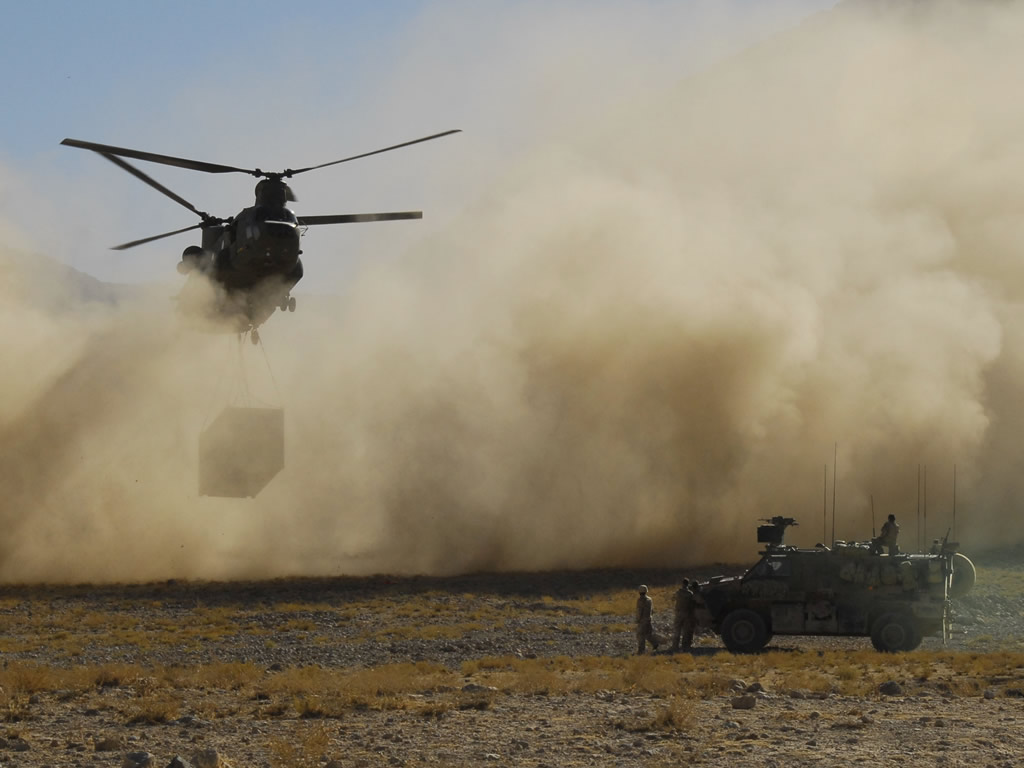
One is the criticism they have received from both official and unofficial sources over the shortage of battlefield support helicopters in Afghanistan. That country’s difficult terrain, poor roads, and a growing threat from enemy land mines all place a premium on larger helicopters that have the lifting capacity to operate in high-altitude and/or hot conditions.
The British government, like their counterparts the Canadians, have been slow to react to this reality. Events and politics have made that approach less tenable, however, and the October 2009 death of Lt. Col. Rupert Thorneloe, MBE, after he had written a series of scathing reports decrying lack of helicopter support, made helicopter support a major public controversy. In recent years, as this pressure has built, Britain has taken an escalating series of steps in an attempt to improve its battlefield helicopter inventory.
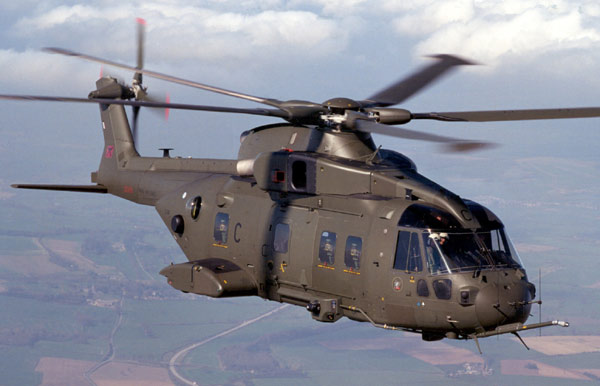
One temporary fix involved buying 6 operational Danish EH101 helicopters in June 2007, and paying the cost of refitting them for British use and replacing the Danes’ machines with future production models. In October 2007, it was revealed that this effort cost about GBP 176 million total, or GBP 29.33 million (about $47.7 million) per helicopter. Those helicopters have reportedly been held up by shortfalls in RAF C-17 heavy aerial transport capacity, and reportedly have yet to reach Afghanistan.

(click to view full)
After much to-ing and fro-ing, which even included an RFI for privatized battlefield helicopter services, Britain decided in September 2009 to spend about GBP 300 million upgrading its existing fleet of about 34 AS330 Puma HC1 medium utility helicopters, and lengthening that fleet’s safe service life to 2022.
Engines on its existing Lynx and Chinook fleets are being improved, under a pair of independent programs.
The RAF is trying to extend the flying times of its existing helicopter fleet, which will wear them out faster and is made difficult by their platforms’ low readiness rates.

(click to view full)
The net effect of these particular decisions is that Britain will eventually have a helicopter fleet made up of just 4 helicopter types after 2022, with fleets of 65-75 each:
The heavy CH-47 Chinook. Following the loss of 2 RAF Chinooks in Afghanistan in August 2009, the British fleet stood at a total of 38. Adding 10-22 Chinooks was seen as the replacement for 34 Puma HC1s and about 25 RAF Sea Kings. Replacement of the 25 Royal Navy Sea Kings, often used by Royal Marine Commandos, is a question mark.
The newest “CH-47 Mk.6” Chinooks appear to be a highly customized CH-47F baseline, and the August 2011 buy will bring the fleet to 60. Meanwhile, a broad GBP 408 million upgrade program now underway will upgrade the existing fleet’s engines to the CH-47F standard, while improving their avionics.

(click to view full)
The medium-heavy EH101 Merlin in its HC3 transport (28) and HC1 naval helicopter (44) variants.
The transport HC3s are already serving beside the Sea Kings and Pumas, however, so the net effect if the MHP program is canceled will be a long-term reduction in helicopter transport capability for the Navy and Army. The Army substitutes fewer heavy-lift Chinooks for rather more Pumas and Sea Kings, which might still offer advantages if they can evolve doctrines based on those added capabilities. The trend toward mine-protection, and hence heavier vehicles, does give Chinooks added value.
At sea, meanwhile, the Navy’s 25 Sea Kings are compatible with a number of existing Royal Navy ships. Chinooks are compatible with none, except in “lily pad” roles from the decks of larger ships, and are not “navalized” to withstand salt water well. This might be alleviated slightly if the 65,000t Queen Elizabeth Class aircraft carriers are used to embark Chinooks for the Navy, but the navalization issue would remain.

(click to view full)
The AW159 Wildcat/ Future Lynx – about 62 in naval helicopter (28), army light utility (34), and armed scout (all) functions. Replaces the existing fleet of about 163 (64 navy, 99 army) Lynx helicopters in these functions.
British AH-64D Apache Longbow heavy attack helicopters (67), known as AH Mk.1 in Britain. In effect, the successor and sharp upgrade to about 98 Gazelle light utility and armed scout helicopters, which are being retired.
Despite statements that the Sea King fleet will be retired early, the unique fleet of 13 Royal Navy Sea King ASaC7 Airborne Early Warning helicopters, with their bulbous sidearm mounted radars, have no immediate substitute, and cannot be dispensed with. Until a substitute is found, they will remain in service.
Britain’s Helicopters: The Silent Influencer

(click to view full)
The other imperative facing Britain is a looming budget crisis. A 2009 report by the National Audit Office, said that shortfalls could add up to a GBP 36 billion gap between programs the Ministry of Defense was committed to, and what it could fund with current budgets.
Of course, the NAO’s 2009 Major Projects Report does note that Parliament bears its share of that responsibility, since it often elects to ‘economize’ by stretching production out rather than canceling programs. The result is higher fixed costs, which means higher lifetime costs for the programs Parliament targets to ‘save money.’ This complicates acquisition planning for future projects, which are needed to replenish other key assets as they wear out, but have their potential budgets damaged by stretched major programs from the past.
None of these dynamics are unique to Britain. On the other hand, these problems are sharply exacerbated by the combination of large-scale, expensive foreign wars; and a deep economic crisis that stems from, but reaches well beyond, the 2008 financial crisis.
Britain would likely have ended up paying more for a larger number of medium helicopters, bought in a competition that emphasizes cost-raising proprietary requirements and accompanying R&D, than it will for a smaller number of large helicopters bought under an existing design set. It also ends up addressing a critical battlefield and political weakness sooner rather than later.
Could Britain’s MoD have spent less on some of its helicopter upgrades and emergency buys, taken an American approach, and supplemented with chartered helicopters for less dangerous tasks in Afghanistan over the next few years, in order to deliver extra capabilities into the Afghan theater faster? Possibly. The Daily Mail certainly thought so in October 2009, when it wrote that:
“Only last month the Ministry of Defence turned down another offer of helicopters which could double Afghanistan flying hours for British troops fighting the Taliban. The Mail has independently confirmed that former RAF pilots offered to supply 25 helicopters within three months to back up the Chinook fleet which is stretched to breaking point.
The deal would have cost the MoD just [GBP] 7million a month – a relative drop in the ocean – but the offer was rejected because the RAF did not want to share a role with private contractors.”
What the UK MoD could have had is a matter for proper debate and examination, within an accountable and democratic polity. Clearly, however, a bought fleet of 60 total Chinooks is what Britain will have now.
Contracts an Key Events
2012 – 2015
1st flight; Deliveries begin.
(click to view larger)
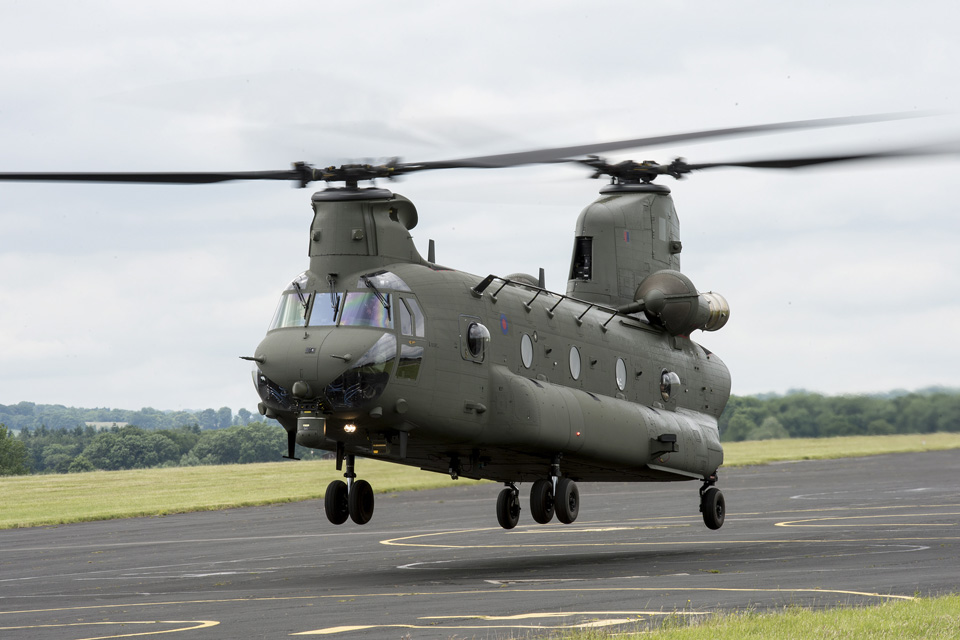
December 9/15: The UK Royal Air Force (RAF) has received the final of their 14 ordered Mk 6 Chinook helicopters from Boeing. The delivery marks the 35th anniversary of Chinook operations in the UK. The latest batch was ordered back in 2009 with first deliveries taking place in June 2014 as part of a $666 million uplift of the fleet. At present, 60 Chinooks are in operation in the RAF with the latest orders to be operational by early 2017. Boeing has been looking to increase their market share in Britain as of late. It was recently reported that they attempted to purchase Britain’s last helicopter manufacturer Westland off parent company Finmeccanica. Unfortunately for Boeing, it was an offer the Italians could easily refuse.
June 16/14: Delivery & Support. The UK MoD announces a new GBP 115 million support agreement with Boeing Defence UK, who will maintain the Honeywell engines aboard the RAF’s entire future fleet of 60 Chinooks. That fleet has all been upgraded to the same T55-714A engines that equip the CH-47F/ Mk.6. The new deal replaces 5 existing support contracts with one arrangement, and the MoD claims that it will save over GBP 20 million.
At the same time, the first 3 of 14 new Chinook Mk.6 helicopters have now been delivered on time, and training has begun at RAF Odiham. All 14 new aircraft are scheduled for delivery before the end of 2015, and are on track to be fully operational by early 2017. Sources: UK MoD, “RAF flying high in new Chinook helicopters” | UK RAF, “RAF Flying High In New Chinook Helicopter”.
1st deliveries; Engine support contract
March 15/13: 1st flight. First flight of the British CH-47 Chinook Mk.6 takes place successfully at the Boeing helicopter facility near Philadelphia.
“The Mk6 Chinook features advanced technology including UK-specific avionics, a forward-looking infrared system, and interoperable communication and navigation equipment. It is undergoing comprehensive testing in Mesa, Arizona in the US, before delivery to the UK later in 2013.”
Sources: Rotorhub, “New RAF Mk6 Chinook completes first flight”.
2009 – 2011
SDSR plan to Order for 14.
(click to view larger)
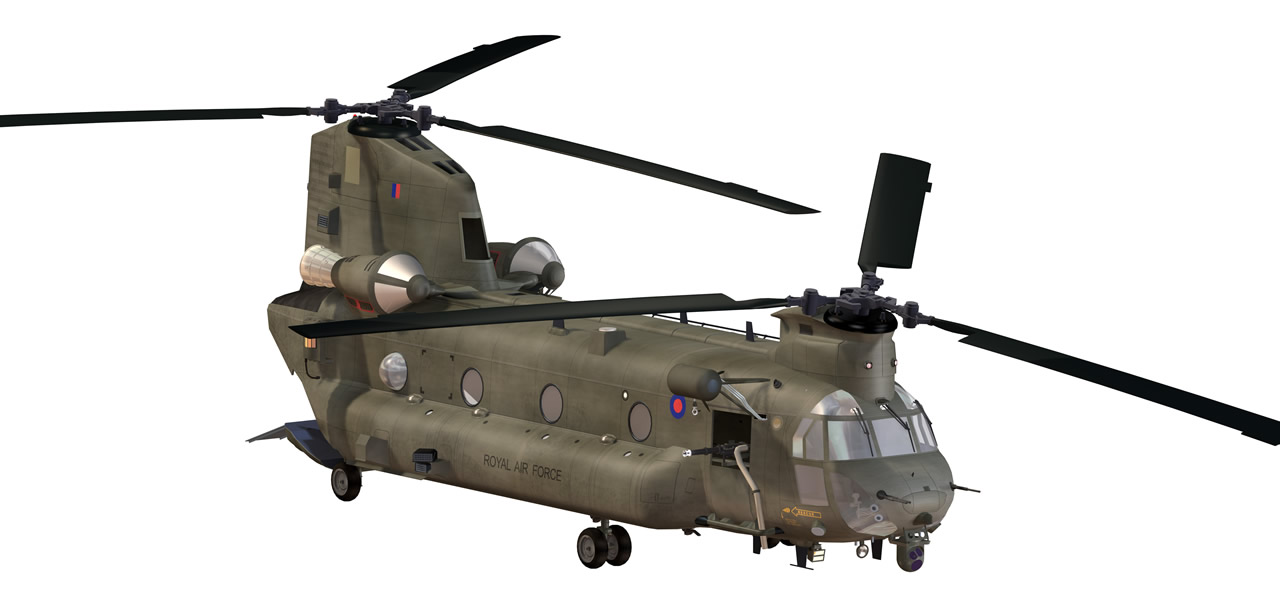
Aug 22/11: The UK MoD signs a GBP 1 billion ($1.64 billion) contract with Boeing for 14 new “CH-47 Mk6” Chinook helicopters, plus associated support for the first 5 years.
Boeing confirmed that these are new-build helicopters, which use the same T55-GA-714A engines that are installed on the F model, and being retrofitted to existing UK Chinooks. The CH-47F is also known for its use of large, single-piece components, and the UK advisory touts a “new, machined monolithic airframe.” That appears to be a CH-47F base airframe, but key changes and additions include UK-specific avionics, communication and navigation equipment; forward-looking infrared surveillance turrets; a rescue hoist; and defensive systems against guided missiles. Canada made similar changes to the CH-47Fs it bought.
The RAF will receive the 1st MK-6 aircraft for initial trials and testing in 2013, to enter service in May 2014. By early 2015, 3 CH-47 Mk6 helicopters are slated to be ready for operational deployment, and delivery of all 14 helicopters is expected to finish by the end of 2015. The RAF intends to have all 14 operational by early 2017, bringing their total Chinook fleet to 60 (barring further losses). UK MoD | Boeing.
14 Chinook Mk.6
October 2010: Britain’s new coalition government introduces its Strategic Defence & Security Review [PDF]. It proposes to use one of Britain’s forthcoming Queen Elizabeth Class ships as a super-size helicopter carrier, and says that:
“Battlefield helicopters will be vital for the range of missions set out in the National Security Strategy. We will buy 12 additional heavy lift Chinook helicopters. We will extend the life of the Puma helicopter to ensure that sufficient helicopters are available for our forces in Afghanistan. The Merlin force will be upgraded to enhance its ability to support amphibious operations. Taken together with the continued introduction of the Wildcat helicopters for reconnaissance and command and control purposes, this programme will deliver a properly scaled and balanced helicopter force to support our troops into the future.”
Spin Ghar delivery
(click to view larger)
March 29/10: The UK MoD announces that:
“Progress is also being made towards the delivery of 22 new Chinook helicopters and the MOD has signed a contract with Boeing to begin the work necessary to deliver the first ten aircraft in 2012 and 2013.”
Dec 15/09: Gordon Brown’s Labour Party government and the British Ministry of Defence announce plans to buy 10 new CH-47 Chinook helicopters for delivery in 2012-2013, with the intent to buy another 12 Chinooks later. Note that this is not a formal contract yet. UK MoD re: purchase plan | UK MoD re: overall defense budget changes.
Nov 9/09: Defense News reports that Britain is planning to cancel its Future Medium Helicopter competition, and order Boeing Chinooks instead. The proposed move is part of a Ministry of Defence helicopter strategy called “Vision 2020,” which still requires approval by government ministers.
Additional Readings
* DID – The New Chinooks: Boeing’s Modern H-47 Heavy-Lift Helicopters. Focuses on the CH-47F, but closely related helicopters like the MH-47G, British Chinook Mk.6, Canadian CH-147, HH-47F, etc. are included.
* DID – UK Beefs Up Chinook Fleet to Handle Rough Afghan Terrain. Includes fleet refits of the uprated T55-714A engine, which is common to CH-47F/ Mk.6 variants.
* RAF – Chinook HC2/2A/3.
Related Programs
* DID – Britain’s New CVF Future Carriers.
* DID – Britain Prepares to Modernize Its Puma Helicopters.
* DID – Britain’s Billion-Pound Future Lynx Helicopter Program.
* DID – Allies Absent in Afghanistan – Helicopters Hired.
* UK Prime Minister’s Office (Dec 14/09) – Statement on Afghanistan & EU Council.
* Britain’s NAO (June 4/08) – Ministry of Defence: Chinook Mk3 Helicopters.
News & Views
* UK MoD (Nov 30/09) – RAF Merlins begin operating in Afghanistan. Reportedly not the Danish aircraft.
* UK MoD (Oct 15/09) – Gray Report of UK defense procurement. See also accompanying release.
* UK MoD (Dec 11/08) – More helicopter capacity for Afghanistan in rebalanced equipment programme. Refers to Lynx Mk9 engine upgrades, and the promised deployment of new Danish Merlin airframes.
* DID (May 22/06) – British Search-and-Rescue: A Billion Pound Partnership? A public-private partnership to replace the Sea King mk5s in the search-and-rescue role; it ends up choosing a mix of S-92As and AW189s.