
 providing Search and Rescue (SAR) services for the United Kingdom mainland, with the Royal Navy scheduled to follow suit next year, with the responsibility then falling to a civilian government agency and private contractors through a GBP1.6 billion contract awarded in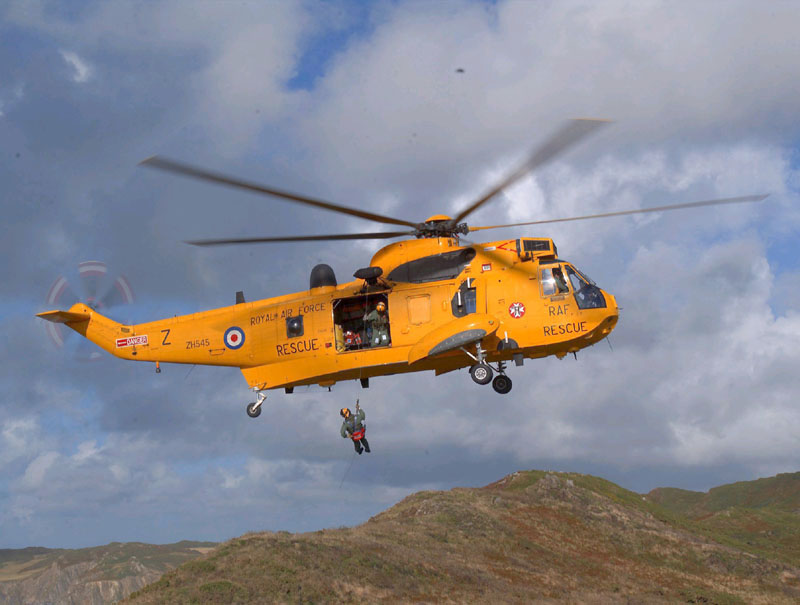
(click to view full)
The UK Ministry of Defence (MoD) and Maritime and Coastguard Agency (MCA) provide a 24-hour military and civil helicopter Search and Rescue (SAR) service for the UK and local regions from 12 bases, typically at 15 minutes notice. A wide range of air and naval assets could be pressed into use in emergencies, but the core of Britain’s SAR services are provided by a combination of about 40 Royal Navy and Royal Air Force Mk.5 Sea Kings, and by a handful of civilian helicopters under contract to the MCA. These machines must cover 11,000 km of coastline, and 3.6 million square km of ocean.
There has been a global trend toward public-private partnerships to perform some Coast Guard and SAR functions, including Australia’s billion-dollar Coastwatch program. Now Great Britain is jumping into the fray with a related approach.
Britain’s Helicopter Search and Rescue: SAR-H and Beyond
The Current Fleet

(click to view full)
Britain’s Mk 5 Sea Kings are 40-50 years old. They’ve been upgraded several times, and the Sea King is renowned for its extreme stability and precision. To demonstrate, a TV show once had a SAR rescuer lowered down to a man holding a champagne glass in place, whereupon the rescuer successfully poured a glass of champagne while the Sea King hovered. Nothing lasts forever, though, and Britain’s entire Sea King fleet is set to retire by 2016.
The Royal Air Force currently operates 6 of Britain’s 12 search and rescue bases (Chivenor, Wattisham, Valley, Boulmer, Leconfield and Lossiemouth), and the Royal Navy operates 2 more (771 Sqn at Culdrose and HMS Gannet at Prestwick). All use Sea Kings. The year 2005 saw 441 callouts, and 370 people rescued via the Royal Navy’s SAR groups alone. Those figures aren’t unusual.
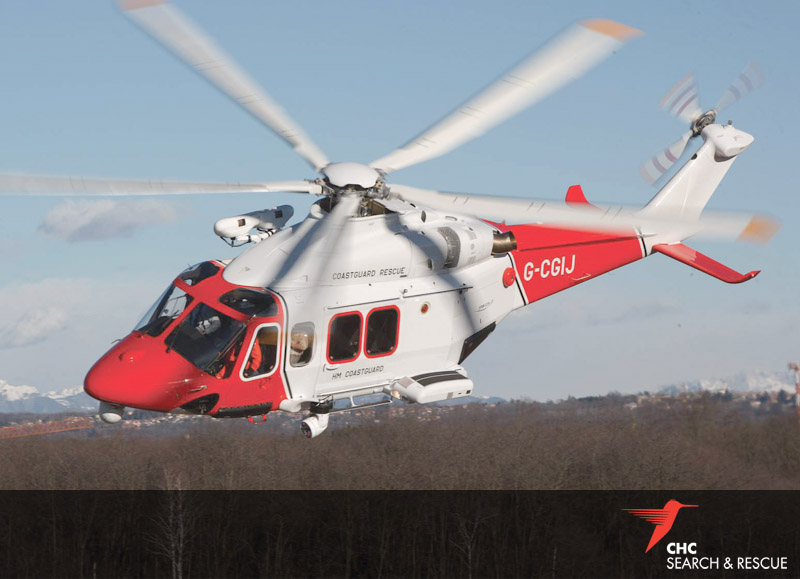
The UK Maritime and Coastguard Agency (MCA) runs the remaining 4 bases (Lee-on Solent and Portland in the south, Sumburgh and Stornoway in the north), where Canadian-based CHC Helicopters began operating in July 2007 under a 5-year contract worth GBP 20 million per year. CHC’s AW139s will continue operating in the south until SAR-H is fielded, but CHC’s S-92s in the north will be replaced by Bristow Helicopter Ltd. S-92s as of mid-2013.
SAR-H
(click to view full)
In line with its extensive public/private partnering background and penchant for long term deals, The UK’s Ministry of Defence and Department for Transport initially envisioned the Joint Search and Rescue – Helicopter (SAR-H) Project as a GBP 1 billion ($1.89 billion at current conversion) joint MOD/MCA Private Finance Initiative competition in cooperation with the MCA, though some reports placed its value as high as GBP 6 billion.
Faced with these recapitalization costs, the decision to examine a public/ private partnership approach is understandable. A joint MCA and MOD Integrated Project Team (SAR-H IPT) based at DPA Abbey Wood, was charged with implementing it, even as the UK government began a debate about the proper role of the rescue services. Including the hot topic of whether they should be given a direct role to help deal with inland emergencies, when rescue workers need rapid access.
Issues were sorted, and by February 2009, the UK MoD had a preferred bidder, with a preferred helicopter. Before Sikorsky’s S-92 could become Britain’s future SAR mainstay out to 2037, however, the incoming coalition government suspended the program in June 2010, pending review. Then, a bombshell struck, as the winning bidder reported that it had discovered a conflict of interest within its team. SAR-H was canceled in February 2011.
The idea was reborn at the end of November 2011, as a 10-year service contract open to competition from across Europe, and beyond. This would be a fully privatized service, similar to that run by the Maritime and Coastguard Agency (MCA), who will now run SAR-H.
SAR-H: The Solution
(click to view full)
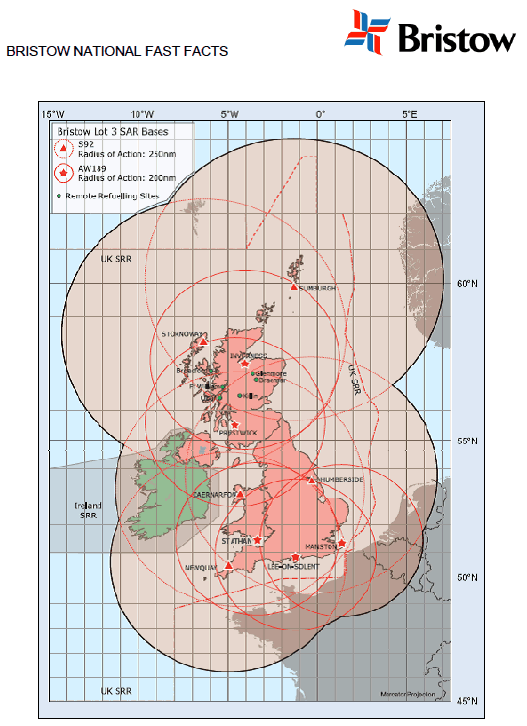
Under the winning bid, a fleet of 4 Bristow S-92 helicopters will continue to fly from existing MCA bases at Stornoway and Sumburgh in northern Scotland, where they’re already serving as the gap-filler service. Bristow will round out coverage by adding 6 new S-92 helicopters at facilities around the UK: Newquay, Caernarfon and Humberside airports. The S-92 can carry its crew of 4, plus 3 stretchers and up to 10 passengers, to an operational radius beyond 250 nautical miles.
A fleet of 10 smaller AgustaWestland AW189 twin-engine helicopters will operate from Lee on Solent and Prestwick airport, and from new bases at St Athan, Inverness and Manston airports. The AW189 can carry its crew of 4, plus 2 stretchers and up to 6 passengers, to an operational radius beyond 200 nautical miles. It’s a new type, and will be assembled for the global market at AgustaWestland’s factory in Yeovil, Somerset.
Each base will host 2 SAR helicopters, which will be on-call at all times, and are expected to be fully serviceable. No machine has a 100% readiness record, but Bristow will manage those details per the contract. The fleets described above seem to presume 1 spare helicopter of each type as the gap-filler, given a declared Bristow fleet of 22.
These base locations are strategically placed near areas with high SAR incident rates. Based on historic incident patterns, the government estimates an average flight time of 19 minutes instead of the previous 23, and believes that the new service will raise the percentage of high-risk areas reachable within 30 minutes from 70% to 85%.
SAR-H: RFP Structure
The total value was estimated at GBP 2.0 – 3.1 billion, and there would be 2 coverage zones to bid on, singly or together – so a firm or consortium could offer a combined bid, plus 2 individual bids for evaluation.
The Lot 1 area will include the vicinity of MCA Sumburgh, MCA Stornoway, RN Culdrose, RAF Leconfield and RAF Valley. Minimum rescue capacity per aircraft is 8 casualties/survivors (2 of which could be stretchered) and minimum radius of action is 200 nm/ 370 km, and 250 nm/ 463 km at MCA Stornoway. The Lot 1 contract would run for up to 13 years, including including an implementation phase of up to 2 years, a 10-year operational delivery phase, plus an additional 24-month option at each base [DID: we know, that doesn’t necessarily add]. Estimated value range is GBP 1.2 – 1.8 billion.
The Lot 2 area will include the vicinity of MCA Lee-on-Solent, RAF Chivenor, RN Prestwick, RAF Lossiemouth and RAF Wattisham. Minimum rescue capacity per aircraft is just 4 casualties/survivors (2 of which could be stretchered), and minimum radius of action is just 170 nm/ 315 km. The Lot 2 contract would run for up to 11 years, including an implementation phase of up to 2 years, an 8-year operational delivery phase, plus an additional 24-month option at each base [DID: we know, that doesn’t necessarily add]. Estimated value range is GBP 800 million – 1.3 billion.
The MCA’s original information page regarding the initial SAR-H solicitation noted that Falkland Islands SAR capability remained a potential option for inclusion within the harmonized program. As one might expect, the Falklands are not mentioned at all in the new civilian framework.
Contracts & Key Events
2012-2015
Bristow wins SAR-H v2.0; Interim northern SAR contract shifts to Bristow.

(click to view full)
October 16/15: The Royal Air Force has ceased providing Search and Rescue (SAR) services for the United Kingdom mainland, with the Royal Navy scheduled to follow suit next year, with the responsibility then falling to a civilian government agency and private contractors through a GBP1.6 billion contract awarded in March 2013. The RAF’s H3 Sea King helicopters used to conduct SAR operations are being retired as the Maritime and Coastguard Agency and private company Bristow Helicopters Ltd are phased-in to replace them. The latter will eventually become wholly responsible for the mainland UK’s SAR coverage.
July 18/13: Sub-contractors. Bristow signs a contract with AgustaWestland, to provide 11 AW189 helicopters. The firm places their share of the SAR-H contract at over EUR 275 million.
The 11 AW189s will be built at AgustaWestland’s Yeovil facility in Britain, with a phased introduction to service with Bristow between 2015 – 2017. AgustaWestland.
July 1/13: Gap SAR. Bristow Helicopters S-92s officially take control of the Search and Rescue (SAR) helicopter service from Stornoway airport in Scotland’s Hebrides to the west, as part of the UK Gap SAR contract (q.v. Feb 8/12). That places full implementation precisely on schedule.
Bristow reports that their crews have been carrying out mission training across northern Scotland for the past 4 months from both Inverness airport and Sumburgh airport, adding that Sumburgh crews have completed more than 10 successful Search and Rescue missions since they took over from CHC on June 1/13. Bristow.
June 1/13: Gap SAR. Bristow Helicopters S-92s officially takes control of the Search and Rescue (SAR) helicopter service from Sumburgh airport in Scotland’s Orkney Islands to the North-East, as part of the UK Gap SAR contract (q.v. Feb 8/12).
The handover marks a return to delivering SAR helicopter services in the north of Scotland, as Bristow had run the MCA service from 1983 – 2007. Each station will have 2 S-92 helicopters. Bristow.
March 26/13: SAR-H winner. The UK’s Department for Transport awards Bristow Helicopters Ltd. the SAR-H contract, giving them a GBP 1.6 billion contract to operate 22 SAR helicopters from April 2015 – 2026. The service won’t become fully operational until summer 2017.
Bristow Group Inc. in Houston, TX has a long history of SAR services through its UK subsidiary, beginning in 1971 and extending to 2007, when CHC took the Coast Guard’s contract away from them. Over that history, their helicopters have flown more than 44,000 SAR operational hours in the UK, and conducted over 15,000 SAR missions.
Bristow will continue to operate S-92 helicopters as their long-range fleet, but their other fleet will eventually replace CHC’s existing 7-tonne AW139s with 8-tonne AW189 machines. The AW189 is a new type, launched in June 2011 as a bigger and more robust offering for the oil and gas industry, SAR roles, etc. The AW189’s assembly center will be at Yeovil in Somerset facility, and Bristow expects to have 350 jobs in its SAR-H team. UK Government | UK Dept. for Transport | AgustaWestland | Bristow, incl. Press Pack [PDF].
Bristow wins SAR-H with S-92s, AW189s
March 7/13: MCA Northern Gap. Two Bristow S-92 helicopters have begun training flights from Inverness airport, as they prepare to take over from CMC under the 2013 – 2017 MCA bridging contract for northern Search And Rescue. A pair of S-92s will now begin SAR operations from Sumburgh on June 1/13, and another 2 machines will begin operations from Stornoway on July 1/13.
Bristow is touting their helicopters’ technology, “some of which has never before been used in commercial search and rescue aircraft”. Their S-92s are touted as the 1st European (civil) SAR aircraft certified for Night Vision Goggle operations, and the NVGs they bought were advanced enough to need a US military technology export license. The firm also touts “improved” day/night surveillance turrets, a ‘much improved” external loudspeaker system, 230 volt interior electrical fittings for advanced medical equipment, interior lighting that will allow medical procedures to be carried out onboard, a medical zone intercom so the team can work without interrupting the aircrew, and a Trulink wireless system that lets winchman rescuers communicate with the helicopter and with nearby ships. Bristow.
Jan 3/13: CHC out. Aviation Week cites a leaked email by CHC’s COO, which says that the firm’s Soteria consortium is no longer a finalist for SAR-H. CHC S-92s will continue to operate from Scotland until their existing MCA contract expires in July 2013, and their AW139s will continue to patrol the southern coasts until SAR-H is fielded.
“In the email, Bartolotta also reveals that one of the other bidders has tendered a bid some 20% lower than that of CHC’s, adding: “We don’t have insight to the financial or other motivations of competitors. But we know that the economics at a price 20 percent lower than our interim bid simply aren’t right for CHC.”
June 12/12: New direction confirmed. Minister for the Armed Forces Nick Harvey enters the following statement into the UK House of Commons Hansard:
“The Defence Rotary Wing Capability Study… is now complete… the findings include no major changes to our previously announced plans… The study confirmed the following plans:
…to move the MOD’s rotary wing capability to four core fleets, the [CH-47] Chinook, [AW159] Wildcat, [AW101] Merlin and [WAH-64D] Apache helicopters… confirmed the end of MOD provision of Rotary Wing Search and Rescue at the remaining eight military bases upon withdrawal of the Sea King in April 2016. This will then be performed by a contractor through the Department for Transport, as the Secretary of State for Transport announced to Parliament on 28 November 2011, Official Report, columns 52-53WS.”
Feb 8/12: MCA Northern Gap. The UK MCA issues a 4-year contract for northern SAR services, as a follow-on to the July 2007 deal with CHC. Bristow Helicopters Ltd.’s fleet of 4 S-92s will begin operating from Stornoway and Sumburgh in July 2013.
UKMCA SAR from Scotland
2010 – 2011
CHC consortium picked as preferred bidder, but their honesty cancels the competition; Sikorsky announces S-92 SAR upgrades; Long S-92 rescue; 2nd SAR-H RFP released.
(click to view full)
Nov 28/11: Son of SAR-H. Britain’s Secretary of State for Transport, Justine Greening, announces a new competition, for a fully-civilian service:
“The Royal Air Force and Royal Navy will continue to provide search and rescue coverage until the replacement for this capability is in place… [but they will still] retire [all] Sea King helicopters by March 2016… Bidders for the future service will be able to put forward options which will utilise a mixed fleet of modern helicopters… capable of delivery by different contractors providing complementary services…I intend that this procurement will be undertaken using the competitive dialogue procedure… [and] run the competition using lean procurement principles during some stages… I expect to award a contract in early 2013…”
The actual mechanisms are interesting. The total contract set is estimated at GBP 2.0 – 3.1 billion including VAT taxes, with a 2-year implementation phase, an operational delivery phase lasting 8-10 years depending on the area, and a 24 month option. There will be 2 zones to bid on, singly or together – so a firm or consortium could offer a combined bid, plus 2 individual bids for evaluation. The ability to use mixed helicopter fleets mirrors CHC’s existing contracted services, which use long-range S-92 helicopters in the north, and smaller AW139s in the south.
The proposed contract involves 10 bases, not 12. The interim arrangements with CHC at MCA Portland will be allowed to expire entirely as they finish, and in 2015, SAR operations will cease at RAF Boulmer. Other operations at RAF Boulmer will be unaffected, but the area’s MP is predictably unhappy with the decision. UK DfT statement | UK MoD release | Berwick Advertiser || EU Solicitation.
Do-over RFP
July 12/11: Waypoint AirMed and Rescue reports that the UK aims to maintain coverage from its 4 existing SAR bases for up to 5 more years as a stopgap, after the 2007 contract expires in 2012:
“The existing MCA helicopter fleet, operated by CHC, is set to transfer to the Republic of Ireland in 2012… Philip Hammond, UK secretary of state for transport, announced to parliament on 11 July that to ensure the continuity of services from Portland, Lee on Solent, Shetland and the Isle of Lewis, the Department for Transport will run a competition to procure an interim service for a period of up to five years.”
May 4/11: Long rescue. A CHC S-92 based at Stornoway flies a 9:21 SAR mission with 2 refuelings, covering a total distance of 971.6 nautical miles. The SAR crew were sent to a medical incident on board MV Stena Perros, and evacuated the patient to medical care in Sligo, Ireland. CHC.
Feb 8/11: SAR-H Canceled. The cause? Not budgets, but misconduct during the bidding. From the UK MoD:
“In mid-December, the preferred bidder in the SAR-H competition, Soteria, voluntarily came forward to inform the Government of irregularities regarding the conduct of their bid team which had only then recently come to light. The irregularities included access by one of the consortium members, CHC Helicopter, to commercially sensitive information regarding the joint MOD/DfT project team’s evaluations of industry bids and evidence that a former member of that project team had assisted the consortium in its bid preparation, contrary to explicit assurances given to the project team at the time.
…It would be inappropriate to comment further on the details of the investigation until it has finished. However, even without the outcome of that investigation, the Government has sufficient information to enable it to conclude that the irregularities that have been identified were such that it would not be appropriate to proceed with either the preferred bid or with the current procurement process.”
See also The Telegraph’s expose | Think Defence.
Canceled.
Jan 13/11: Lobbying. Turns out that Prime Minister Cameron has been lobbied by an unusual source, who wants to keep the search and rescue services within the military. That would be Prince William, who is currently flying as a SAR pilot from RAF Valley, on Anglesey, north Wales. The Telegraph.
June 17/10: Suspended. The SAR-H initiative is suspended by Britain’s incoming coalition government, following a review into spending decisions made by the previous Labour administration. UK Treasury Chief Secretary, Danny Alexander makes the announcement in Parliament. Shephard Group.
Feb 22/10: Sikorsky announces a new set of upgrades for the S-92, including a Search and Rescue Automatic Flight Control System, and a load-sensing cargo hook that automatically updates aircraft weight and balance readings. Beginning in October, Sikorsky plans to introduce a strengthened main transmission housing developed for the military H-92, after it clears the certification process. The new housing is designed for longer life, and is intended to “reduce unscheduled maintenance by eliminating such possibilities as the foot-mount cracks recently experienced by some operators.”
(click to view full)
Feb 9/10: Preferred bidder. Britain picks a preferred bidder to provide helicopter search-and-rescue (SAR) services. The Soteria Consortium of helicopter operator CHC, helicopter maker Sikorsky, sensor manufacturer Thales, and the Royal Bank of Scotland, will use S-92A Superhawk helicopters to replace the existing RAF and Navy Sea Kings. This maintains CHC of Vancouver, Canada’s place as the largest supplier of civilian SAR services in the world.
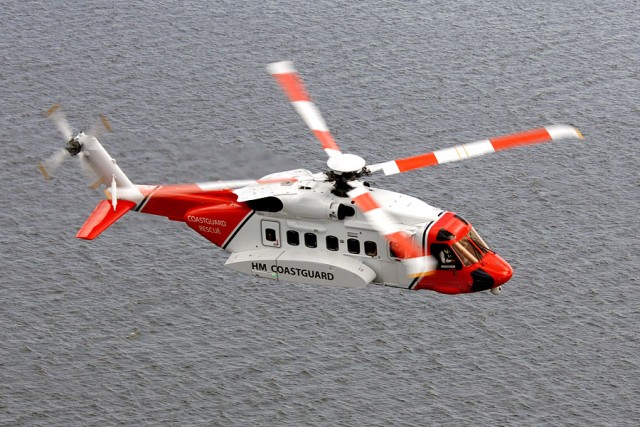
The team beats a group led by VT Group, which planned to use Eurocopter EC225 helicopters, a civil version of the EC725 Cougar. The EC725 does have a combat search and rescue version, which is deployed by France.
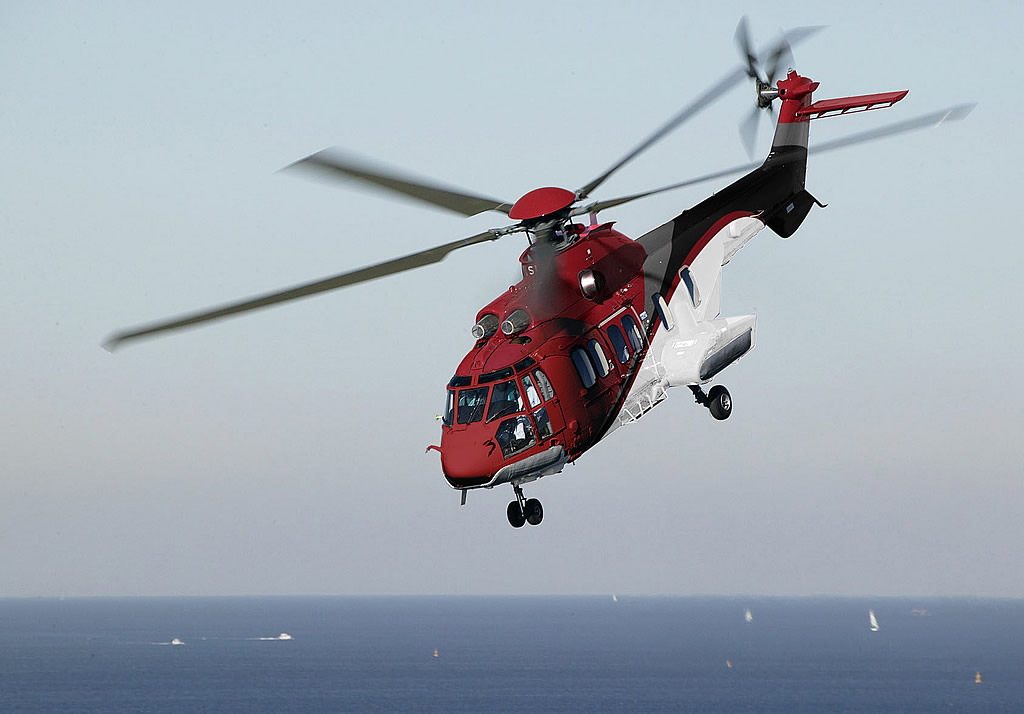
The S-92A SAR-H has a fully equipped purpose-built paramedic station, including piped oxygen and an electrical power circuit within the cabin. A larger derivative of the popular H-60 helicopter series that uses more corrosion resistant composites and features a rear ramp, the S-92 is well known in the offshore oil and gas sector, and is already providing MCA SAR services around the difficult areas of Shetland and the Isle of Lewis in northern Scotland. It is 30% faster than the Sea Kings, and has 130 km more range. A pair of side-by-side high speed winches are used by its 4 aircrew to assist in rapid rescues, and the 1.7m high cabin can carry 6-10 seated persons and 1-2 stretchers.
The SAR service contract is expected to run for 25 years, and will be phased in over the next decade through a single contract placed with the Soteria consortium. The Telegraph places its eventual total value at around GBP 6 billion.
If implemented, some military aircrew will work alongside civilian aircrew as part of the new service, which is expected to begin in 2012. SAR efforts will continue to be managed jointly by the UK Ministry of Defence and the UK Maritime and Coastguard Agency. The 4 MCA bases will transition first, to be followed by the 8 MOD bases. The detailed timetable will be finalized as part of concluding the contract, which the UK MoD and Department for Transport expect will happen later in 2010. UK MoD | CHC | The Telegraph.
Preferred bidder.
2007 – 2009
SAR-H announced; Interim contract to CHC; S-92 accident in Canada highlights defect.
(click to view full)
March 23/09: S-92. Sikorsky announces that it had furnished replacement studs and tools to all S-92 operators, and that 50 of 91 aircraft had been reworked already.
March 20/09: S-92. Canada’s Transportation Safety Board identifies a broken titanium stud as part of the downed S-92 helicopter’s gearbox oil filter assembly. Sikorsky had previously recommended that this stud be replaced with a steel stud in all serving S-92s, within one year or 1,250 flight hours. CBC News.
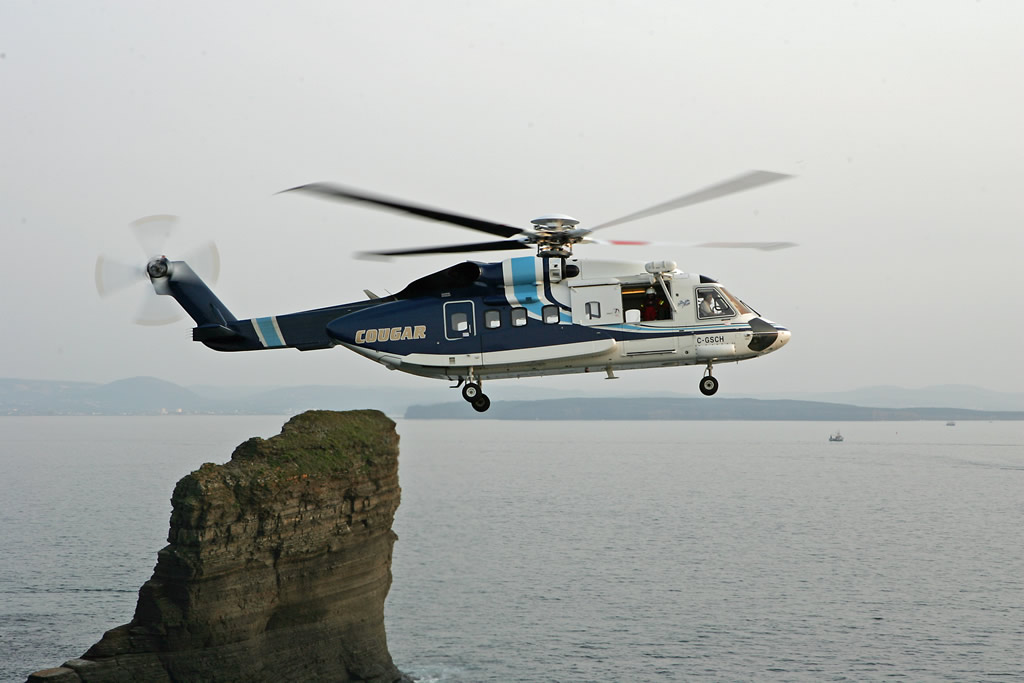
March 11/09: S-92 crash. An S-92 operated by Cougar Helicopters goes down in the sea with 18 people aboard, while ferrying workers to one of the offshore oil rigs off of Newfoundland, Canada. In the end, only 1 of the 18 passengers survives. Standard procedures give all passengers immersion suits, but winds were running between 25-35 knots, with a 3m/ 9-10 foot swell, and water temperatures near freezing. The Globe and Mail | See also CBC and Flight International report & photos. re: later Canadian TSB findings.
Nov 29/07: SKIOS & SAR. Another public-private partnership reaches into the SAR sphere, as the SKIOS through-life maintenance contract for the UK’s Sea Kings extends to search and rescue helicopters in Phase 2. See: “SKIOS for Sea Kings: Availability Contract Covers Through-Life Maintenance.”
Oct 14/07: UKMCA Bridging. The UK Maritime and Coastguard Agency announces that the first of 4 brand-new Sikorsky S-92 helicopters (a civilian version of the H-92), configured entirely for search and rescue (SAR), completed its maiden mission today for Stornoway Coastguard.
The new helicopter is being operated on behalf of the Agency by CHC Scotia, who won a July 2007 deal for commercial search and rescue helicopter services from 4 civilian-operated bases – Sumburgh, Stornoway, Lee-on-Solent and Portland – for a 5-year period from July 1/07 – July 1/12. The service provides a 24 hour coverage at Stornoway, where the S-92 is based, and also bases the S-92s from Sumburgh. In the south, CHC will use 3 AW139s.
CHC Scotia’s S-92 helicopters are fitted with 2 internal auxiliary fuel tanks of 210 gallons each, improved AFCS with auto-hover capability, Forward looking infra red (FLIR), dual rescue hoist, bubble window, cargo hook, search-light and loud hailer. The cabin can be arranged for installing triple medical litter kits, 1-2 extra fuel tanks, folding utility seats, and/or storage. The designated operator console provides search data including FLIR.
CHC’s 3 AW139s are fitted with high-speed dual hoists, a day/night surveillance turret, a search-light, a Maritime Automated Identification System (AIS), direction finding equipment, satellite communications, and Paramedic advanced medical equipment. UK MCA release.
UKMCA contract
May 9/06: The UK MoD and UK MCA make the initial announcement concerning the SAR-H project. UK MoD | UK MCA.
Additional Readings:
* UK Department for Transport – UK Search & Rescue Helicopter Service. New solicitation, posted in in the Official Journal of the European Union.
* UK Maritime and Coastguard Agency – Search and Rescue Framework for the United Kingdom of Great Britain and Northern Ireland [PDF].
* CHC Helicopters – Search and Rescue
* Sikorsky – S-92 Helicopter
* AgustaWestland – AW189
* AgustaWestland – AW139
* Financial Times (May 10/06) – Talks To Begin Over £1bn Contract For Search And Rescue Helicopters
* DID (Feb 9/06) – Britain Prepares to Outsource Royal Marine Auxilliary Service. Helicopter SAR isn’t alone.
