


(click to expand)
Over the last decade, a belief has taken root in global naval circles that shallow littoral chokepoints for maritime trade, operations in and around failed states like Somalia, and expeditionary stabilization operations, will become key foci for many deployments. That realization has driven a number of approaches to naval construction. In the Netherlands, Royal Schelde’s Sigma Ships are designed in block modules, which can be added or subtracted to build anything from an offshore patrol vessel to a large frigate. Denmark is already building its Flyverfisken Class and Absalon Class ships, which leverage the mission module concept and can be used in roles ranging ranging from mine or sub hunting, to anti-ship warfare/ land attack, to carrying troops. Sweden’s Visby Class stealth corvettes helped to inspire the American concept of the Littoral Combat Ship – which has been criticized both for its cost, and for having fewer and less flexible high-end weapon options than any competitor.
Germany’s response has been the F125 frigate, which might best be described as an “expeditionary frigate” design. It doesn’t use the Danish or American mission module concept. Instead, it includes a number of features aimed at making it a strong contributor to long international deployments in littoral environments, and to naval support for stabilization operations.
The F125: Key Features
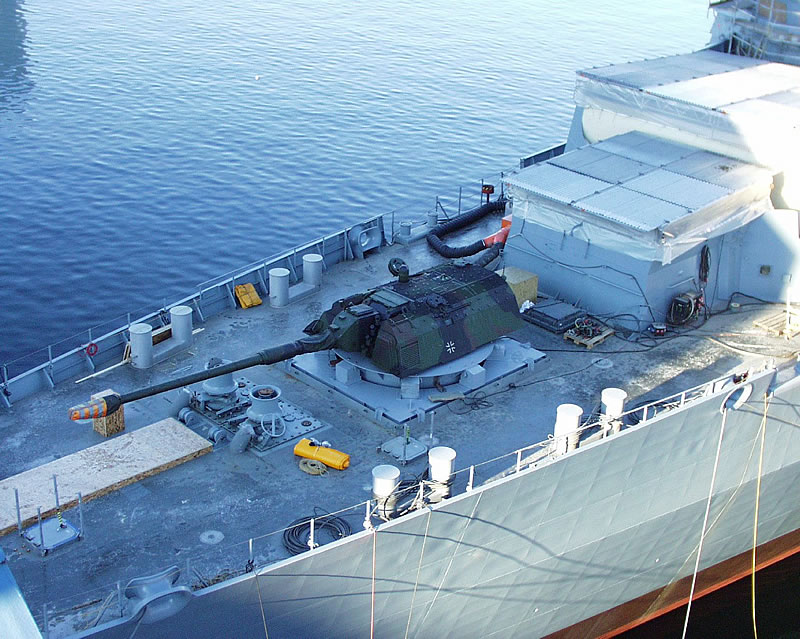
MONARC, FGS Hamburg
(click to view full)
One of the F125’s most challenging demands was the benchmark of a ship that can deploy for up to 2 years away from home ports, while maintaining an average time at sea of more than 5,000 hours per year (almost 60%). Meeting such challenging targets affects a number of design decisions, but it is certain that these targets cannot be met unless they are used to pick the propulsion system.
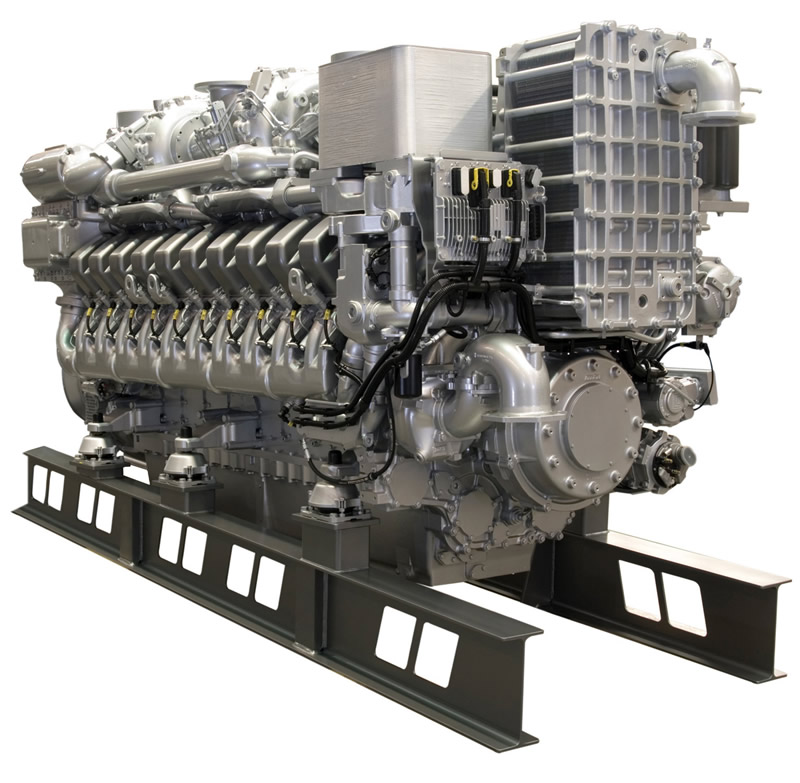
Propulsion: The new ships will use a CODLAG (COmbined Diesel-eLectric And Gas) system that offers more distributed power generation, as well as quieter operation. On each F125 vessel, 4 MTU 20V 4000 M53B diesel engines and generators offer 3,015kW /4,100 hp each, producing a total of 12,060kW/ 16,400 hp for the ship’s on-board power supply system, and/or provide diesel-electric propulsion power for 2 electric motors that power cruising speeds of up to 20 knots. An equivalent power output is about 14,500kVA. These diesel engines only require major overhaul after 24,000 operating hours.
For high cruising speeds, GE’s popular LM 2500 gas turbine with a power output of 20MW can be activated, in order to take the frigates up to a speed of 26 knots/ 48 km per hour. MTU is the overall power & propulsion integrator, with Siemens handling related control systems.
Survivable Design: Another contributor to availability is the dual redundancy/ “two island” principle, ensuring that key items are present in at least 2 different locations in case of breakdown or battle damage. The superstructure itself is split into two larger pyramidal deckhouses, as a partial reflection of this principle.
Sensors: Guidance and surveillance will involve EADS Cassidian’s TRS-4D active array radar, which will mount 4 fixed ‘faces’ divided between the 2 deckhouses. In addition to offering dual-island resiliency, an active array system offers all of its corollary improvements in reliability, sensitivity, and multi-targeting capabilities over passive phased array radars. Various electro-optical systems will be used to perform passive short-range surveillance that cannot be picked up by enemy sensors.

127/54 LW, firing
(click to view larger)
Weapons: The F125 frigates’ main armament will be an Oto Melara 127/64 caliber lightweight gun, which has the ability to fire GPS-guided Vulcano long-range attack rounds with a range of up to 100 km/ 54 nautical miles. For naval gunfire missions, the ATLAS Naval Combat System includes a very advanced onshore tactical picture and artillery weapons control system.
GPS-capable Harpoon Block II missiles will provide the ship’s initial set of longer-range naval and land strike punch, until and unless a successor system is chosen.
The F125 ships were originally slated to mount naval versions of the Bundeswehr’s M270 MLRS rocket launcher, and PzH-2000 155mm mobile howitzer. The MONARC system solved some of the challenges with recoil management aboard ship by using an intricate shock-absorbing mounting; nevertheless, the amount and cost of work required to modify these Army systems to fit in a frigate sized ship, and to cope with the hostile naval environment, eventually doomed both concepts. The Vulcano offers similar reach, and shells with dual-mode precision guidance options are under development.

(click to view full)
On the defensive front, 2 stations can mount the German-American MK44 Rolling Airframe Missile system for for short-range protection against anti-ship missiles, aircraft and helicopters. For very close-in defense, each ship will mount 5 of Mauser’s 27mm MLG remote-controlled cannons, and another 5 of Oto Melara’s 12.7mm/.50 caliber Hitrole-NT RWS. These guns can counter small boats, and other asymmetric threats likely to be encountered on anti-piracy and stabilization operations. A couple of manned 12.7mm machine guns will be used as a last-ditch backup in case of power failure or other issues, and the ARGE consortium is looking at the option of mounting non-lethal weapons such as water cannons, ultra-high intensity lights, etc.
The ships’ most unusual and potent weapon, however, may well be human. The F125 is designed to support up to 50 special forces, along with space for 2 NH90 helicopters and/or 2-4 armed small boats.
Training Infrastructure: In order to maintain on-station time without returning to home ports, German doctrine aims to take a leaf from the US Navy by leaving the ship in place at a friendly foreign, port and bringing new crews to the ship. Those operations will require fewer resources than other German ships, however, as the F125 frigates’ small 120-person crew continues a naval trend. The flip side of that trend is the need for greater cross-training, and for higher quality recruits. MTU already plans to train F125 crews to offer broader on-site care for the ship’s propulsion system, and the German government’s availability demands are likely to push other vendors toward similar expectations.
Industrial Team
The F125s will be the Baden-Wurtemburg Class, after the first ship of class. The other 3 ships will be the FGS Nordrhein-Westfalen, FGS Sachsen-Anhalt, and FGS Rheinland-Pfalz. Note that “Federal German Ship” prefixes are used outside of Germany, not by the Deutsche Marine. Industrial partners include:
* ARGE F125 (overall management, ThyssenKrupp Marine Systems and Fr. Lürssen Werft)
* TKMS Blohm + Voss (shipbuilder)
* Atlas Elektronik (combat system, datalinks)
* Diehl (SIMONE infrared security system)
* EADS (TRS-4D/NR AESA radar, command & control, and weapons deployment systems)
* Boeing (Harpoon II missiles)
* MTU and GE Marine (CODLAG diesel and gas turbine: LM2500 turbines, MTU 4000 diesels)
* Oto Melara (127/64 caliber naval gun, 12.7mm RWS)
* Rockwell Collins (CS-3600 R-ESM suite)
* Siemens Marine (automation and control systems)
Delivery of the first frigate, Baden-Wurtemburg, was scheduled for 2014, but won’t arrive until. The 4th ship, Rheinland-Pfalz, was slated for delivery by 2017 and is obviously going to be very late.
F125: Contracts and Key Events
2012 – 2013
1st ship will be delayed due to construction problems; Radar development progress; Diver sonar; Ability to fire Vulcano extreme range shells confirmed.

(click to view full)
Dec 12/13: #1 christened. “Baden-Wurttemberg” is christened at TKMS’ Hamburg site. The firm goes on record saying that delivery is scheduled for November 2016. Sources: TKMS, “German Navy frigate “Baden-Württemberg” christened”.
Dec 2/13: Late. The Kieler Nachrichten reports that problems with the first F125 ship, Baden-Wurtemburg, will push delivery back a year to 2017. That has now been confirmed by the defense ministry.
Apparently, a flame-retardant coating has peeled off the ship’s hull. To fix it, some segments that had already been welded have to be re-opened. The question is who will pay the EUR 100 million additional cost. The German government believes that shipbuilders ThyssenKrupp’s Blohm + Voss and its partner Luerssen Werft should shoulder the additional costs. Sources: Maritime Executive, “New German Navy Frigate Delayed”.
Jan 23/13: Radar. EADS Cassidian announces that their TRS-4D ASEA ship radar has successfully passed the first factory acceptance test, which was carried out by German BAAINBw procurement authority and Blohm + Voss Naval. The first unit will equip a land-based system in Wilhelmshaven, and is scheduled for delivery in February 2013. The first TRS-4D for the Baden-Württemberg is scheduled for delivery in August 2013. EADS touts TRS-4D as:
“…the first surveillance radar to make full use of the advantages of AESA technology (AESA = Active Electronically Scanned Array), which is based on multiple independent emitters [using] the very latest gallium nitride (GaN) technology…. Cassidian is the European leader in this technology.”
AESA radars are far more software-driven than their phased array predecessors, and the loss of few T/R modules among thousands doesn’t affect the radar’s overall performance. This gives them exceptional reliability, along with 2x-3x the range or resolution of previous generation radars. GaN technology is also an important step forward, offering noticeably better performance than conventional Gallium Arsenide (GaAs) circuits at the same power ratings. The Baden-Wurtemburg Class will use a 4-face fixed TRS-4D array, but it’s possible to mount a less powerful single face rotating array on smaller ships.
Oct 8/12: Weapons. A very confusing news release addresses the 5 Oto Melara 127/64 Light Weight naval guns bought for the F125 program (vid. April 4/07 entry): 4 aboard ship, and 1 that has just been delivered to Germany’s naval school in Parrow.
This release also confirms that the EUR 70 million order includes a Vulcano module, for operations with Oto Melara’s long-range, rocket-assisted 127/64 caliber Vulcano shells. These GPS-guided shells can hit targets up to 100 km/ 54 nm away, and variants with dual-mode GPS/IIR guidance are reportedly in the works. That’s a longer range than MLRS rockets, which may help to explain why Germany was willing to abandon plans for a naval MLRS system and MONARC naval 155mm gun on board. Oto Melara release
July 17/12: Sensors. Atlas Elektronik announces that will deliver 4 Cerberus Mod2 portable Diver Detection Sonars for Germany’s Type F125 frigates, and a 5th system for training purposes. Cerberus is placed in the water to protect military vessels from under-water threats by alerting the operators to the presence of divers, swimmers, autonomous underwater vehicles (AUVs) or Swimmer Delivery Vehicles (SDVs). The system can be operated remotely from the ship’s bridge, as well as from a processing and display unit below deck.
The Cerberus Mod2 sonar was developed by Atlas’ UK subsidiary, but this will be the first Diver Detection Sonar installed on a NATO vessel. The first system delivery is scheduled for 2012.
2009 – 2011
More equipment chosen; All frigates named; Blohm + Voss almost becomes UAE-owned.
(click to view full)
Dec 20/11: Naming. Germany names its last F125 frigate, with all 4 named after German states. The F125s will be the Baden-Wurtemburg Class, after the first ship of class. The others will be the Nordrhein-Westfalen, Sachsen-Anhalt, and Rheinland-Pfalz. Deutsche Marine [in German].
Named
Nov 2/11: Keel laying-down for the first F125 frigate takes place on schedule, at building dock 12 in the Hamburg shipyard. Production actually started on May 9/11, but block construction means that the keel is actually a 23 x 18 x 7 meter, 300 tonne ship block.
This marks the end of the 3-year design and management phase. Delivery of the 4 ships is still planned from 2016-2018. German BWB | TKMS | Your Shipbuilding News.
1st keel-laying
Sept 14/11: Radar. EADS Cassidian officially introduces its TRS-4D AESA ship radar, which will equip the F125s. Ship systems will also be configured to make full use of a key AESA technology advantage: simultaneous multiple beams. Other advantages include improved range and resolution, and much lower maintenance costs:
“TRS-4D enables ships from patrol vessels to frigate size to exert the different detection tasks of a ship-borne medium range surveillance and target acquisition radar, in blue waters and also in complex littorals with high target densities. It performs faster, more accurate and against a wider scope of targets than in the past.”
May 10/11: TKMS announces the official beginning of construction on the 1st F125 frigate, as German BWB VP Reinhard Schütte starts the laser welding and cutting plant in Blohm + Voss’ Shipbuilding Hall 3.
Keel-laying for the 1st F125 ship is expected to take place as early as November 2011, and delivery of the first vessel is planned for 2016.
Nov 22/10: Sensors. EADS Cassidian announces a contract from TKMS Blohm + Voss for for 4 naval TRS-4D/NR radars, and 1 land-based system.
The new radar is a fixed, active electronically-scanned array that replaces the rotating TRS-3D model. Each of the 2 ship masts will carry 2 of the TRS-4D panels, which have the standard AESA advantages of very low maintenance, simultaneous tasking, and improved detection.
Nov 2/09: SATCOM. EADS Astrium Services announces a contract from F125 ARGE to deliver the ships’ satellite communication system. The firm’s SCOT 6 system will provide secure high bandwidth communications over Germany’s forthcoming SATCOM BW2 and other allied networks, and is capable of operations at SHF (X-Band) with dual X-Ku band growth options.
Astrium is partnered with the EADS/TKMS joint venture Atlas Elektronik for service.
Oct 15/09: Merger? ThyssenKrupp Marine Systems and Abu Dhabi MAR sign a key Memorandum of Understanding, which will make the UAE firm an 80% stakeholder in TKMS’ surface shipbuilding. All parties will now hold further talks and negotiations based on the MoU, with the transaction still subject to the approval of German supervisory bodies and the regulatory authorities. Read “German Shipbuilding Restructured: UAE’s Firm Buys Blohm+Voss” for the full story.
Oct 20/09: ESM. Rockwell Collins announces a contract to provide Radar Electronic Support Measures (R-ESM) suites for Germany’s F125 frigates. ESM suites collect and analyze electromagnetic emissions, with a focus on radar. This can helps the platform in several ways, from improved understanding of who and what is in the area, to collection and analysis of potentially hostile signals in order to develop countermeasures, to the use of analyzed signals by protective jamming systems on board.
The F125 agreement calls for Rockwell Collins to provide its CS-3600 R-ESM system, which contains the CS-3001 Pulse Analyzer Unit (PAU), CS-5998 wideband tuners, CS-5020 microwave tuners, IFMR-6070 Instantaneous Frequency Measuring Receiver (IFM) and the CS-6090 PRISM (Precision Intercept Spectral Monitoring System). Work will be performed at the firm’s Electronic Warfare and Intelligence Solutions unit in Richardson, TX, and deliveries are scheduled from 2010 – 2013.
Sept 23/09: Engines. GE Marine makes the expected announcement that it will supply MTU with one LM2500 gas turbine to power the German Navy’s sole F125 frigate to date. They’ll also power subsequent ships, so DID won’t repeat the news’ as each ship gets its turbine.
The LM2500 gas turbine will be manufactured at GE’s Evendale, Ohio facility, and will be delivered to MTU’s Friedrichshafen plant in March 2010 for placement into its propulsion module.
The Baden-Wurttemberg class will use a COmbined Diesel eLectric And Gas turbine (CODLAG) system featuring a LM2500 gas turbine and 4 MTU diesel engines and generators. Through MTU, GE’s LM2500 turbines are now operating in CODOG/CODAG configurations aboard Germany’s F122 Bremen class, F123 Brandenburg class and F124 Sachsen class frigates. To date, there are nearly 30 GE LM2500 gas turbines operating or slated for service with the German Navy.
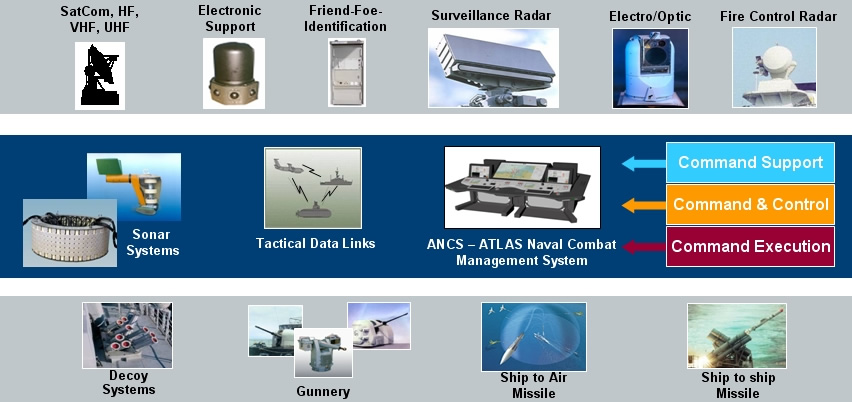
Sept 7/09: Electronics. ThyssenKrupp/EADS joint venture Atlas Elektronik announces that the ARGE F125 consortium (ThyssenKrupp Marine Systems and Fr. Lurssen Werft) has signed a contract to equip the F125s with the Atlas Naval Combat System, direct the modelling of the combat system, and integrate all sensors and weapons. The amount was not disclosed.
The ATLAS Naval Combat System (ANCS) is a modern open-architecture and distributed-architecture computer system, designed to provide a clear and automated tactical picture from all ship sensors, and coordinate defensive responses. In addition to these standard tasks, ANCS integrates an onshore tactical picture and artillery weapons control system to a degree that has previously been true only or army systems. This will allow the F125s to conduct more sophisticated on-shore surveillance, and even engage land-based targets in coordination with army units.
ANCS will join the ATLAS Tactical Data Link System (ADLiS) on board the F125. ALDiS allows the ship to use a variety of datalinks to share what it sees with German and allied forces, including the key NATO standards Link-11, Link-16, and Link-22.
2006 – 2008
Build contract; Initial sub-contracts.
(click to view full)
Oct 27/08: Engines. The Tognum Group in Friedrichshafen, Germany announces a contract to deliver diesel generation sets and gas turbines for the future F125 frigates. Amounts are not specified. MTU has been responsible for the systems aboard Germany’s F122 Bremen Class, F123 Brandenburg Class and F124 Sachsen Class frigates. Like the F124 air defense frigates, the F125s will use an MTU/GE CODAG propulsion system, hooked to a diesel-electric propulsion drive.
MTU’s Engine Series 4000 is based on commercial engines which were originally designed for continuous power, then specially optimized to fulfill the requirements of naval vessels. They were picked for their performance in partial-load operation, as well as their low life-cycle costs. For naval applications, the gensets are equipped with shock-proof mounts and encapsulated in acoustic enclosures to reduce noise emissions. GE’s accompanying LM2500 gas turbine may be the most frequently used warship propulsion system in the world. MTU has also designed a new maintenance concept, which will include training ships’ crews to undertake proper and independent engine maintenance.
Oct 14/08: Sub-contractors. Siemens Marine announces a EUR 50 million (currently about $67 million) order from the ARGE consortium of Krupp Marine Systems AG and Fr. Lürssen Werft GmbH & Co. KG. Siemens will equip 4 German F125 Class frigates with propulsion equipment and integrated automation and control systems. The F125s will be Germany’s first ships to use a CODLAG (COmbined Diesel-eLectric And Gas-turbine) electric propulsion system
Siemens products will be related to its SINAVY product line, and include the electrical propulsion system, consisting of 2 4.5 MW electric motors with the associated converters, the electronic control unit and the medium-voltage switchgear. For control and monitoring purposes, an integrated control and automation system for on-board ship equipment (ILASST) will be installed, including a battle damage control system (BDCS) and an on-board training system (OBTS). The firm claims that even after delivery, these systems will help them provide comprehensive life-cycle support for the frigates. Siemens release.
June 26/07: The German Federal Office of Defense Technology and Procurement (BWB) signs the construction order for 4 F125 Class frigates. The contract is awarded to ARGE F125, an industrial consortium formed by ThyssenKrupp Marine Systems and Fr. Lürssen Werft.
The initial batch of 4 ships is estimated to cost about EUR 2.2 billion ($2.96 billion). BWB release.
F125 build contract

(click to view larger)
April 4/07: Weapons. Finmeccanica subsidiary OTO Melara announces [PDF format] a EUR 80 million (currently about $108 million) pair of orders for naval gun systems to be mounted on Germany’s F125 frigates. The first contract worth EUR 70 million is for the supply of 5 of its 127/54 LW (Light Weight) gun systems: 4 for the frigates, and 1 for training. The Germans had originally looked at mounting their MONARC 155mm howitzer on the F125s, but this order appears to mark the definitive end of those plans.
Germany has also selected the remote-controlled Hitrole 12.7mm remote-control turret in the new Naval Tilting (NT) version. OTO Melara will provide a total of 25 12.7mm Hitrole-NT systems under the ER 10 million contract: 5 on board each of the 4 frigates (TL = 20) and 5 on land for training purposes. The Hitrole RWS is currently serving with the Italian finance police and the UAE and Mexican navies, among others.
March 10/06: Electronics. EADS announces that the “Workgroup for the F125 Frigate” chose them to supply the command & control and weapons deployment system (Fuhrungs und Waffeneinsatzsystem – FUWES), including development and delivery of the complete software, hardware and infrastructure, and performance verification for all 4 ships.
FUWES is based on the technology used for EADS’ Advanced Naval Combat System (ANCS) which is already being successfully used in Finland’s Hamina class Fast Attack Craft. It adds components that are already successfully deployed on Germany’s new F124 Sachsen Class air defense frigates and K130 Braunschweig Class corvettes. EADS release.
Additional Readings
Readers with corrections, comments, or information to contribute are encouraged to contact DID’s Founding Editor, Joe Katzman. We understand the industry – you will only be publicly recognized if you tell us that it’s OK to do so.
* TKMS – Blohm+Voss Class 125 Frigate.
* German Navy – Fregatte Klasse F125 – Ein neues Schiff fur neue Aufgaben.
* Oto Melara – F125. Discusses the guns they’re supplying; 2012 snapshot.
* noticiarionaval (July 7/08) – LCS- So why doesn’t USA clone Absalon? Offers a 4 way comparison of the F125 with the Danish Absalom Class and the USA’s LCS-1 and LCS-2 designs, going through air defense, surface warfare, small boat defense, shore bombardment, seakeeping, littoral agility, helicopters, and logistics support capability.
* Aviation Week Ares (July 8/07) – Germany Orders F125 Frigates.
* German Navy MarineForum (November 2005) – Marineforum: Neue Wege fur die nachste Fregattengeneration der Marine [PDF, 336K].
* German Navy Strategie und Technik (November 2005) – Fregatte Klasse 125 – Innovative Konzeption [PDF, 78.7K].