

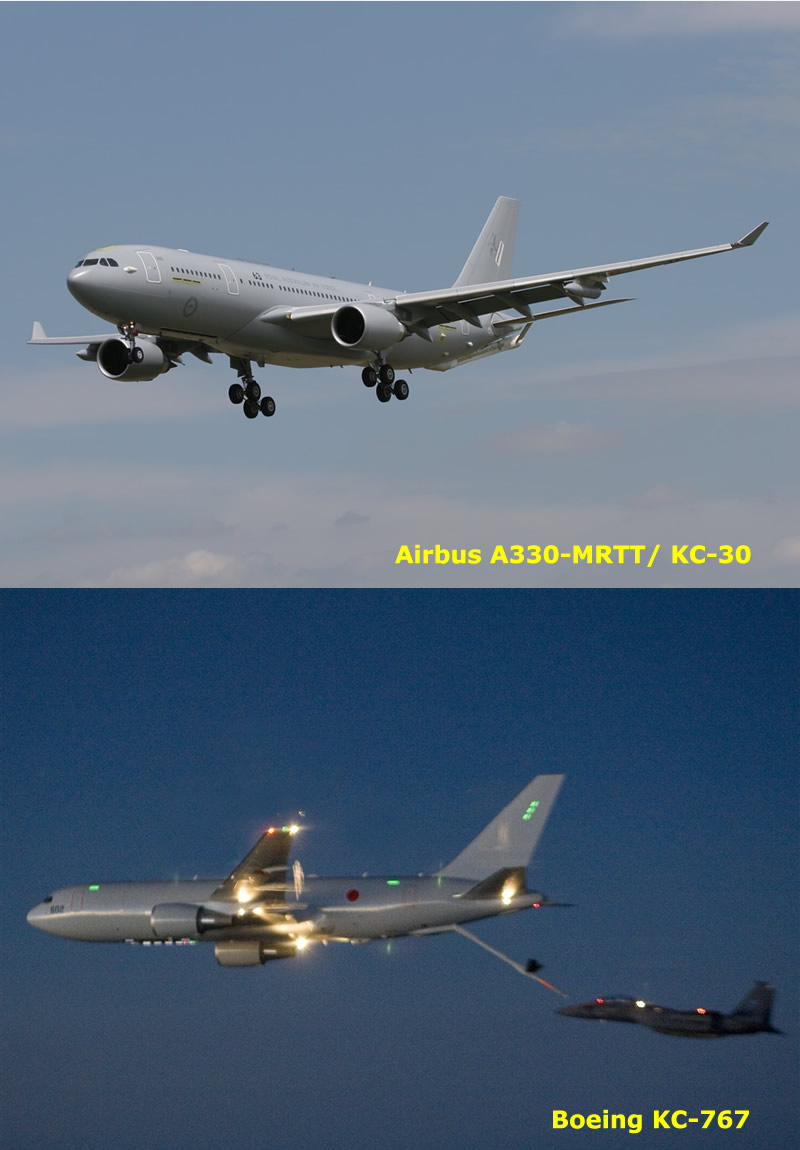
(click to view full)
As the $35 billion KC-45 tanker purchase flies into the teeth of Washington’s political battles, the Lexington Institute think-tank discusses the relative ratings of each contestant in the USAF’s aerial tanker competition. This is a bit unusual, as even Boeing has yet to hear the official debrief – a fact that has them somewhat upset. DID would not normally consider a report of this nature credible, but the think-tank has a wide range of contacts in Washington, and has been focusing on this deal for some time. Their broad assessment also mirrors commenets made by Sen Richard Shelby [R-AL], so it is possible – but not certain – that their report is correct.
Lexington defense analyst Loren Thompson contends that the Airbus/Northrop Grumman proposal would be able to deliver 49 operational tankers by 2013, whereas Boeing would have been able to deliver just 19 aircraft within that timeframe. That’s an interesting calculation whose basis DID would be interested in viewing, but public access may be an issue as it was attributed to USAF reviewers. Beyond that, Thompson concludes that Boeing lost out on 4 of 5 key measures, and tied on the 5th. Of course, sharp-eyed DID readers will recall that they were 9 Key Performance Parameters listed in the RFP…
# Air refueling capability
# Fuel offload and range at least as great as the KC-135
# Compliant Communication, Navigation, Surveillance/Air Traffic Management (CNS/ATM) equipment
# Airlift capability
# Ability to take on fuel while airborne
# Sufficient force protection measures
# Ability to network into the information available in the battle space
# Survivability measures (defensive systems, Electro-Magnetic Pulse (EMP) hardening, chemical/biological protection, etc)
# Provisioning for a multi-point refueling system to support Navy and Allied aircraft
Mission Capability. These 9 KPPs, taken together, define the minimums for “mission capability.” Both aircraft met the requirements, but Thompson says Airbus won based on superior airlift and fuel capacities at 1,000 and 2,000 nautical mile range, which is especially important to the USA’s Pacific Air Force and to Air Mobility Command. The KC-30’s superior airlift capability in particular was reportedly deemed “compelling,” not surprising given that many long-range transport missions these days involve lifting troops into dangerous areas. The Boeing KC-767’s advantage in being able to use shorter runways, and hence more bases that might be closer to the mission area, was not mentioned by Thompson as a factor. That may be because set locations et. al. were specified in the…
FEV. The “integrated fleet aerial refueling assessment”/ Fleet Effectiveness Value (FEV) measure was designed to measure overall capability under 5 set wartime scenarios. Neither team protested when these scenarios were first unveiled. Northrop Grumman claimed a higher score based on its own calculations for both sides, but it’s the USAF’s calculations based on submitted bids that matter. Thompson says that the Airbus proposal won this category in part by being able to show fewer planes used to accomplish some of the missions. The scenarios are not spelled out, but it would be interesting to compare them to mission records for tanker and transport aircraft, in order to examine how representative they are of actual current use dynamics, as well as the needs of potential future conflicts.
Proposal risk. Thompson says this was deemed a tie. DID reader are aware that both tanker models had unfinished testing: Boeing with the hose-and-drogue system, Airbus with the main refueling boom. While the 767 has a long production history, Thompson adds that Boeing’s decision to make the KC-767-AT an amalgam of many different 767 models (767-200ER fuselage; 767-300F freighter wing, landing gear, cargo door and floor; 767-400ER flight deck and flaps) ended up forcing the company to add development time and stretch out its delivery schedule in later proposal iterations, while raising Boeing’s total program costs.
Past performance. Northrop Grumman’s team reportedly won with higher-rated subcontractors, and 6 satisfactory comparable programs, while Boeing reportedly lost points due to execution issues in 3 relevant programs. Thompson does not report how many of those unsatisfactory programs the Airbus/NGC team had, or how many satisfactory programs Boeing had.
Cost/price. Boeing reportedly created difficulties in the eyes of reviewers by failing to adequately explain its development cost assumptions. This is said to have hurt the confidence rating of its projections, which reportedly led to a lower life cycle cost rating. US News & World Report goes further:
“Air Force officials complained that Boeing was evasive on cost data and other key metrics. “Northrop was viewed as a model contractor, highly responsive,” says one insider familiar with the negotiations. “Boeing was quite difficult.”
For readers unfamiliar with the process, even a better deal with a lower confidence figure can equal a lower rating.

If that seems counterintuitive, the mathematical concept of Expected Value may help. Let’s say you have 2 job offers, each with a salary and a pure yes/no pay bonus opportunity. Job A pays $60,000 salary, and there’s an 80% chance of a $10,000 bonus to total $70,000. Job B pays $50,000 salary, and there’s a 30% chance of a $50,000 bonus to total $100,000. Expected Value says that Job A is the better bet, despite the lower upside. $60,000 + ($10,000 x 80% odds) = $68,000. For Job B, ($50,000 bonus x 30% odds) = $15,000 expected value, which adds up to just $65,000.
You might personally decide to take the risk of Job B, of course. After all, that $3,000 expected value difference may not be critical enough to your family’s survival or happiness to turn you away from the potential to make $100,000. Governments who measure a decision in tens of billions, however, and who make many such decisions, tend to find that probability wins in the end when enough bets are being placed. For that reason, and because quantifiable criteria gain extra emphasis in accountable governments, they tend to gravitate toward decisions that weight expected value outcomes far more highly than potential upsides.
Additional Readings
The June 18/08 GAO ruling sustaining Boeing’s protest and recommending a do-over has no enforcement teeth, but it blows the political debate wide open and throws Airbus’ victory into doubt. See DID’s members-only Insider article “The USAF’s KC-X Aerial Tanker RFP” for full coverage of the RFP, the decision, and subsequent events.
* Lexington Institute (March 3/08) – Tanker Competition: Northrop Won By A Wide Margin
* US News & World Report (March 4/08) – How Boeing Blew the Deal of the Decade
* CBS WKRG 5 News (March 3/08) – Sen. Shelby Shoots Down KC-30 Critics. Note that Mobile, AL is the big industrial winner of the KC-30 selection.
* DID (March 2/08) – KC-X Winner: The Airbus A330 MRTT
* DID FOCUS – The USAF’s KC-X Aerial Tanker RFP
* DID FOCUS – US Debating Aerial Tanker Types, Mix