

In December 2006, France’s Defense Ministry awarded a contract for nuclear-propelled fast attack submarines to state-owned warship builder DCN and nuclear energy group Areva-TA. The contract’s total value could be as high as EUR 8.6 billion, and it is set up as an initial EUR 1.0-1.4 billion contract (reports vary), followed by 6 options (tranches conditionnelles) to cover development expenses, the production of more submarines, and through-life support during their first years of operational service.
All ships wear out over time, and the repeated squeezing and relaxing experienced by submarine hulls make their replacement times less negotiable. The USA began introducing their new-generation NSSN Virginia Class fast attack boats in 2004, and Britain’s problem-plagued SSN Astute Class followed in 2010. Now, it’s France’s turn to renew its SSN fleet, as DCNS works to supply 6 Barracuda Class submarines between 2016-2027.
The Barracuda SSN Program

The program’s total value was initially set at EUR 7.9 billion (then $11.13 billion), but has since risen to EUR 8.6 billion ($12.32 billion in 2011). The contract was set up as an initial EUR 1.0-1.4 billion contract (reports vary), followed by 6 options (tranches conditionnelles) to cover production of the other boats, development, and support during their first years of operational service. Subsequent orders have not revealed costs per boat, however, just inferences about creeping overall program costs.
The first Barracuda Class submarine is still expected to enter service in 2017, with the other 4 following every two years (2019, 2021, 2023, 2025) and then the 6th and last boat due to be commissioned in 2026-2027.
Within the DCNS/Areva TA consortium, DCNS will act as the submarine prime contractor, including responsibilities as overall architect, platform and propulsion system prime contractor, systems integrator, nuclear safety studies coordinator and through-life support prime contractor. The Barracuda Class will be built at DCNS’ Cherbourg shipyard.
Areva TA will act as prime contractor for the nuclear powerplant, and NucAreva will take around 15% of the contract’s value. The nuclear propulsion unit, derived from that developed for the “Le Terrible” SSBN nuclear missile submarine, will be supplied by Areva TA under the prime contractorship of the French atomic energy commission (CEA). Other contractors include:
* Colfax-Imo Pompes (oil pumps & fluid handling)
* EADS Astrium (life support)
* GE Oil & Gas subsidiary Thermodyn (turbo-generators and propulsion turbines)
* Sagem subsidiary Safran (surface detection system – radar & optronic masts)
Per the planned dates above, the team has yet to launch a submarine, let alone deliver one. Submarines under construction or on order include:
* Suffren
* Duguay-Trouin
* Tourville
Other named submarines of class include:
* Duquesne
* Dupetit-Thouars
* De Grasse
Replacing the Rubis: The Barracuda Class SSN

(click to view full)
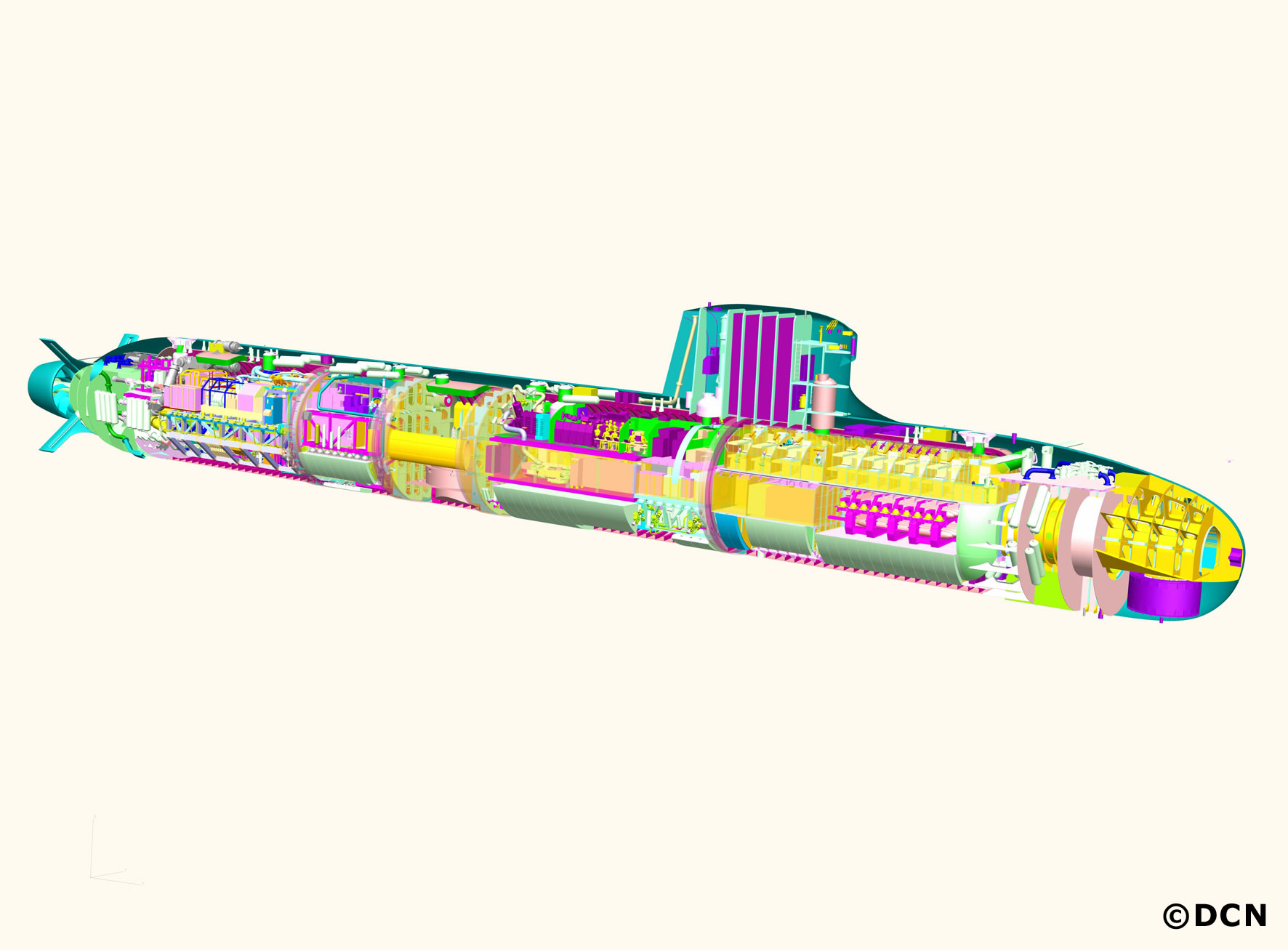
The Barracuda program will meet the French Navy’s operational mission needs by providing replacements for its 6 current-generation nuclear attack submarines. Displacing 5,100-5,300 tonnes submerged, at 99m long and 8.8m in diameter, the new Barracuda Class will be about twice as large as the Rubis Amethyste Class boats they will replace. Indeed, they are roughly the same size as the Royal Navy’s existing SSN Trafalgar Class boats. They are designed to remain smaller than the USA’s new 7,300t Virginia Class SSNs, however, or the new and slightly larger British Astute Class SSNs.
Despite their relatively modest size, the Barracudas will have sharp teeth. A set of 4 x 533mm launch tubes will be able to fire its stored armament of up to 20 heavy weapons, in whatever combination of new short range F21/Artemis heavyweight torpedoes, medium-range SM39 Exocet anti-ship missiles, A3SM (Mica) anti-aircraft missiles, and stealthy long range MdCN Scalp Naval cruise missiles is on hand. The class will also be able to accommodate mines or carry 12 commandos, whose equipment can be carried in a mobile pod attached aft of the sail. One key unanswered question will be the type’s ability to launch and retrieve UUV robots, beyond options that can be launched and recovered via torpedo tube.
[youtube:v=gJZf7scDnQ0]
A diving depth of over 350 meters (about 1,150 feet) and a top speed of over 25 knots are both forecast by DCNS. The Barracuda Class’ regular crew level will be 60, and the boats will be designed for operational cruises of up to 70 days, in contrast to the current Rubis Amethyste Class’ 45 days.
As a final advantage, Barracuda’s K15-based nuclear propulsion is designed to offer 2 substantial advantages over existing French boats. The first advantage is that instead of requiring refueling once every 7 years, the new design will extend its time between RCOHs (refuelling and complex overhauls) to 10 years. This translates into higher at-sea availability over the life of each ship. The USA’s Virginia Class, whose reactors aren’t forecast to need refueling over the boat’s expected 30-year life, are significantly ahead in this respect. Nevertheless, the Barracuda’s propulsion will have a second advantage that Virginia Class boats won’t share: it plans to use same nuclear fuel that powers French civilian nuclear power stations. Given France’s significant use of nuclear power, this commonality is expected to drive fuel costs down sharply.
SMX Ocean: A Conventional Export Derivative
[youtube:v=ug6RakSBuzQ]
At EuroNaval 2014, DCNS unveiled their 4,750t SMX Ocean diesel-electric attack submarine concept. It’s much closer to operational reality than past concepts, as it’s based on the basic Barracuda layout, masts, and combat system.
Switching out the nuclear reactor does create a bit more space, even with 2nd generation fuel cell technology added to give the submarine submerged endurance of 3 weeks. A cable-and-collar “saddle” system can be added for deployment and retrieval of UUVs from a mid-body chamber, and a detachable mobile pod aft of the sail can carry a special forces swimmer delivery vehicle. Behind the UUV bay, a 6-shooter for vertically-launched cruise missiles like MBDA’s MdCN/ Scalp Naval is complemented by internal frontal space for 28 weapons in any combination of heavyweight torpedoes, Exocet anti-ship missiles, A3SM anti-aircraft missiles, or mine packages. Items like the Vipere tethered communications and surveillance buoy round out the package.
[youtube:v=UisrynhPOJ0]
The submarine is touted as a complement for carrier battle groups, but the truth is that their speed requirements tend to stretch the SMX Ocean’s capabilities, which top out at 20 knots and lose efficiency well before that. It would fare rather better as a companion to slower amphibious assault groups, but its real markets may be more specific.
Australia is looking for a long-range fleet of modern submarines, and their push to negotiate directly with the Japanese for the 4,000t+ Soryu Class may be forced toward competitive bids for political reasons. Meanwhile, India has just approved a “Project 75i” program to add 6 locally-built submarines beyond their forthcoming Scorpene fleet. A relationship extension based around Barracuda hulls would build on already-proven industrial relationships and training, and allow for excellent weapons commonality with the Scorpene fleet. It would also complement both the scope of India’s maritime interests, and local work fielding and refining their own nuclear submarine design.
Contracts & Key Events
2011 – 2018
Order for submarine #3; Cruise missile test; Progress reports; 4,750t conventional derivative.
(click to view full)
May 10/18: One more for Paris The French government will buy a fifth Barracuda class nuclear attack submarine. A spokesperson for the Armed Forces Ministry confirmed in a statement that the Defense Minister Florence Parly made the decision on May 2nd. The draft multiyear budget that is set to run from 2019-2025 includes the funding for six Barracuda class submarines, delivery of which is scheduled for 2025. The Barracuda SSN program started in 2006 when France’s Defense Ministry awarded a contract for nuclear-propelled fast attack submarines to state-owned warship builder DCN and nuclear energy group Areva-TA. The Barracuda program will meet the French Navy’s operational mission needs by providing replacements for its 6 current Rubis Amethyste class nuclear attack submarines. The Barracuda’s are roughly the same size as the Royal Navy’s existing SSN Trafalgar Class boats, and twice the size of the current vessels. The program’s total value was initially set at then $11.13 billion but has since risen to over $12.32 billion.
Feb 11/15: Interview with program manager.
Navy Recognition managed to get the Barracuda product manager to answer a few questions in a brief interview. Expected improvements anticipated over the Rubis class: maneuverability, stealth, detection capabilities.
Oct 28/14: SSK Ocean. DCNS unveils its 4,750t SMX Ocean concept design at EuroNaval 2014. This diesel-electric attack submarine design is much closer to reality than past SMX concepts, because it’s based on the basic Barracuda layout, masts, and combat system. Meanwhile, shifts in the global market toward the Pacific and Indian oceans are tilting requirements in favor of larger conventional submarines, with more range and endurance. See above for details. Sources: DCNS, “DCNS unveils SMX-Ocean, a new blue-water SSK with expanded capabilities”.
Nov 6/12: #3: The DCNS Cherbourg centre has completed the 1st pressure hull ring (Ring #7) for the Tourville, France’s 3rd Barracuda Class SSN. The milestone comes almost 1 month ahead of schedule. DCNS.
Dec 19/11: #2. DCNS mates hull sections 12 & 13 for Duguay-Trouin, the 2nd Barracuda Class submarine, using butt-welds along their entire circumference. A new controlled-atmosphere technology cut 15% from weld time, while improving quality, allowing the 30t sections to be welded in less than 2 months.
These hull sections will house the ops room, including the boat’s main command, navigation and operations systems. Of Duguay-Trouin’s 21 hull rings, 2 have been completed and joined, 10 have been completed, and 8 are under construction. Hull ring mating work will continue until early 2013.
June 28/11: #3 ordered. The DGA formally orders the 3rd Barracuda class submarine and its nuclear reactor from DCNS and AREVA. This is the Tourville.
Costs are not described in releases or subsequent reports, though the total program cost now lists at EUR 8.6 billion. Hull assemblies for the Suffren and Duguay-Trouin continue at Cherbourg. French DGA [in French] | DCNS.
3rd SSN ordered
June 8/11: Weapons. The DGA holds a test launch of the SCALP Naval / MdCN (Missile de Croisière Naval) at its Ile du Levant missile test center in the Mediterranean, using an underwater platform simulating the launch conditions on the future Barracuda SSN. The change from water to air, and subsequent launch/flight, is one of the most difficult and important steps for any such missile. When fully operational, the Storm Shadow’s MdCN cousin is expected to offer a stealthy sub-sonic strike missile with long reach: over 1,000 km/ 540 nautical miles.
When combined with a successful 2010 vertical-launch test from an above-water platform, MBDA believes that its SCALP/MdCN program is now synchronized with the planned entry into service of the FREMM frigate (2014) and Barracuda submarine (2017) platforms. French DGA [in French, incl. test video] | MBDA.
March 18/11: #2. DCNS announces that the 1st hull section of the 2nd boat of class has left the prefabrication hall at Cherbourg on schedule. Duguay-Trouin’s aft section #7 is just 1 of about 20 hull sections and 4 “interface points.” The 40t hull section is made of steel alloy, and measures about 9 meters in diameter by 4 meters. It will sit immediately behind the nuclear reactor compartment, and will eventually contain the submarine’s electrical distribution plant.
DCNS adds that construction of the 1st-in-class Suffren in also on schedule in Cherbourg, with the first equipment integration phases set to begin in the next few months.
2007 – 2010
Development & orders for 2 submarines; Sub-contractors picked.
[youtube:v=C7FhWAS1S-M]
Oct 27/09: Colfax Corp. announces that its Colfax-Imo Pompes Business Unit in France will provide oil pumps and other fluid-handling systems for France’s Barracuda class nuclear submarines. They will deliver the first pumping systems to DCNS in late 2010 – early 2011. Colfax will continue to provide service, training, parts and documentation for its systems during the service life of the vessels. Daniel Joslin, managing director of Colfax’s business in Tours, France:
“Submarines need to operate as quietly as possible to avoid detection, and the French Navy accordingly specified its pumps should produce low noise levels and vibrations… Our Colfax Defense Centre of Excellence in Tours [DID: one of 3, located in Tours, Mumbai, and Warren, MA] has the staff and equipment capable of meeting those demanding requirements to ensure the pumps provide years of quiet, reliable service.”
June 26/09: #2 ordered. The French DGA procurement agency orders the 2nd Barracuda class boat Duguay-Trouin from DCNS and Areva-TA. At present, the DGA is forecasting EUR 7.9 billion for the total Barracuda program, and 2028 as the program’s finish date.
The same day saw assembly of the lead boat, Suffren, begin, with the welding of the first 2 aft hull sections. DGA release [in French].
2nd SSN ordered
April 3/08: Sub-contractors. What does the International Space Station have in common with a nuclear submarine? Both are enclosed environments that must provide breathable air, which includes removing carbon dioxide as well as replacing used oxygen. Both also have very tight space limitations, and power limitations as well since the life support systems must be the last system to fail.
EADS Astrium in Friedrichshafen, Germany developed a binding carbon dioxide (CO2) regenerative process for the International Space Station’s European Columbus lab module, which was docked on Feb 10/08. Now DCNS in Cherbourg, France has ended a 4-year competition among established naval firms by awarding the life support contract to… the space firm EADS Astrium. EADS release.
Jan 25/08: Sub-contractors. GE Oil & Gas announces that their Thermodyn subsidiary in Le Creusot has been selected to provide the turbo-generators and propulsion turbines for the French Navy’s 6 new Barracuda Class nuclear fast attack submarines. The DCNS award continues Termodyn’s history if supplying such systems for France’s nuclear submarines, and for the nuclear-powered Charles de Gaulle aircraft carrier as well.
The contract covers 2 turbo-generators and 1 propulsion turbine for the first-of-class FNS Suffren, which is scheduled to enter service in 2016, as well as for each of the other 5 boats ordered under optional contracts. GE’s propulsion turbine drives the propeller, and supplies the required mechanical power to the submarine when at top speed. The 2 turbo-generator-rectifiers supply electric power to the propulsion and auxiliary systems, keeping the sub’s electronics powered and allowing quieter slower speed movement. GE’s project partner Jeumont Electric is supplying the generator-rectifier equipment for the turbo-generators, and this first set of turbo-generators and propulsion turbine is scheduled for delivery between October 2010 – February 2011.
As noted above, Areva TA is the prime contractor for the shipboard nuclear power plant, which powers Thermodyn’s systems and thus the submarine. A submarine’s need for stealth means that these Thermodyn condensing-type turbines are highly customized to fit a submarine’s small space, while ensuring very low noise and vibration levels. The Le Creusot facility even operates a special anechoic chamber to test the equipment’s noise levels prior to delivery. GE also will provide assistance in the packaging of its equipment within the propulsion main frame, and in site tests. GE release.
Sept 6/07: Sub-contractors. SAFRAN Group subsidiary Sagem Defense Securite has won a competitively-bid contract from DCNS as prime contractor for the surface detection system (DAS) on France’s future Barracuda class nuclear submarines. The surface detection system for Barracuda class submarines comprises a radar mast and two optronic masts, which integrate a passive electromagnetic detection sensor. The optronic sensors of the system will provide day/night surveillance, detection, tracking and sighting functions.
A value was not announced, but the contract does includes a firm order for the first submarine in the series (FNS Suffren), as well as conditional orders for following vessels. Sagem will deliver the first system to DCNS in 2010. Sagem Defense Securite release.
June 1/07: Named. The ships of the Barracuda Class has been officially named by the French Ministry of Defence. The first-of-class will be the Suffren. It will be followed by the Duguay-Troin, Dupetit-Thouars, Duquesne, Tourville and finally the De Grasse.
Construction will begin in the summer of 2007. French Navy release [en Francais].
Namings
Dec 22/07: Development. DCN announces the contract for the new nuclear-powered attack submarines of the Barracuda Class. The contract’s total value could be as high as EUR 8.6 billion, and it is set up as an initial EUR 1.0-1.4 billion contract (reports vary), followed by 6 options (tranches conditionnelles) to cover development expenses, the production of more submarines, and through-life support during their first years of operational service. Sources: DCN, “Barracuda contract awarded” | Associated Press, “France awards submarine deal to DCN, Areva”.
Core Contract
Additional Readings & Sources
* French DGA – Le sous-marin d’attaque futur Barracuda [in French].
* French Marine Nationale – Sous-marins nucleaires d’attaque.
* Naval Technology – SSN Barracuda Nuclear-Powered Attack Submarine, France.
* DCNS – SNA Barracuda. 2011 snapshot. See also their accompanying English language success story feature: “Stealthy, far, fast and for long.” They seem to have left out “full of seamen”.
* Naval Technology – SSN Rubis Amethyste Class Attack Submarine, France. The class it’s replacing.
Ancillary Equipment
* DCNS – Subtics: Submarine Tactical Integrated Combat System.
* DCNS – F21 Torpedo: The French Navy’s new heavyweight torpedo.
* MBDA – Exocet SM39.
* MissileThreat – SM39 Exocet.
* MBDA – Scalp Naval.
* DCNS – Contralto S. Torpedo countermeasures.
* DCNS – Nuclear propulsion.
News & Views
* Foxtrot Alpha (Nov 3/14) – Is This Jumbo Diesel Electric Submarine A True Nuclear Alternative?
* Atomic Insights (Feb 24/06) – Ask Atomic: What limits reactor fuel burnup?