


(click to view full)
India’s submarine fleet currently consists of 16 boats: 10 Russian SSK Kilo (Sindhugosh) Class, 4 locally built SSK U209 (Shishumar) Class, a leased nuclear-powered Improved Akula Class SSN from Russia (INS Chakra), and its own INS Arihant SSBN. Most of the Kilos have been modernized, but readiness rates for India’s existing submarine fleet sits below 40%, and the U209s will have trouble lasting much beyond 2015. With Pakistan acquiring modern submarines, and Chinese submarine building exploding, expanding India’s submarine fleet became an obvious national priority.
In 2005, India confirmed that it would buy 6 Franco-Spanish Scorpene diesel submarines, with an option for 6 more and extensive technology transfer agreements. Unfortunately, 7 years after that deal was signed, “Project 75” has yet to field a single submarine. A poor Indian procurement approach, and state-run inefficiency, are pushing the country’s entire submarine force toward an aging crisis. This DID FOCUS article covers the Scorpene deal and its structure, adds key contracts and new developments, and offers insights into the larger naval picture within and beyond India.
The Scorpene Class
[youtube:v=OugghHerWcE]
click for video
The SSK Scorpene Class diesel-electric fast attack submarine was jointly developed by DCN of France and Navantia of Spain, and incorporates advancements that stem from being developed about 10 years later than DCN’s Agosta 90 Class. Many of the Scorpene’s internal systems and weapons, however, are shared with Pakistan’s Improved Agosta 90B.
Displacing 1,565 metric tonnes, the standard CM-2000 Scorpene Class is 71.7m (219 feet) long with a submerged speed of over 20 knots, and submerged range at 100% battery usage and 4 knots speed of 134 hours or 536 miles. This new submarine class incorporates a high level of system redundancy to achieve an average 240 days at sea per year per submarine, and the endurance to undertake a 50 day patrol before being resupplied. In addition, its maximum diving depth is 300 meters (about 1,000 feet), giving the commander good tactical freedom for a conventional submarine.

The Scorpene’s SUBTICS combat management system, with up to 6 multifunction common consoles and a centrally situated tactical table, is co-located with the platform-control facilities. The vessel’s sonar suite includes a long-range passive cylindrical array, an intercept sonar, active sonar, distributed array, flank array, a high-resolution sonar for mine and obstacle avoidance and a towed array. Each Scorpene submarine features 6 bow-mounted 533mm torpedo tubes, and stores 18 weapons divided between torpedoes, missiles, and mines (stacked, up to 30).
India was leaning toward Finmeccanica’s Black Shark, the same heavyweight torpedo used in Chile’s Scorpene subs, but that decision has been put on hold by corruption allegations. Fortunately, a contract for the MBDA SM-39 Exocet was signed along with the original submarine contract. The Exocet SM 39 variant is launched from a submarine’s torpedo tubes using a VSM (Vehicule Sous Marin), a self-propelled and guided container that will maneuver before surfacing so as not to reveal the position of the submarine. Once it surfaces, the Exocet missile leaves the VSM and proceeds to the target like a normal surface variant of the missile.
In addition to these regular weapons, the Scorpene platform also offers advanced capabilities for mine warfare, intelligence gathering and special operations.
Scorpene subs can hold a total company of 31-36 men, with a standard watch team of 9. The control room and the living quarters are mounted on an elastically supported and acoustically isolated floating platform, really a ship within the ship.
The India order brought the number of committed Scorpene submarine sales on the international market to 10. Scorpene orders worldwide now sit at 14, and include Chile (2 O’Higgins class CM-2000 with split Navantia/DCN production, both delivered); Malaysia (2 with split Navantia/DCN production); and now India (6 from DCN-Armaris and local manufacture, 3 each CM-2000 and AM-2000 AIP, delivery expected 2015-2020). Brazil would later undertake its own project, which will build 4 SSK Scorpenes and 1 nuclear-powered SSN fast attack submarine.
India’s Submarine Programs
Current Project 75 figures:
* Submarines: 6 CM-2000 Scorpene Class, #5-6 may have AIP, but that’s unlikely.
* Contract signed: 2005
* Schedule: Delivery from 2015-2018. May not even begin until 2017.
* Cost: INR 235.62 billion
Project 75 had a pre-priced option for 6 more Scorpenes, but India as decided to pursue a follow-on “Project 75i” as a separate program instead. It could field 6 more Scorpenes, or it could field a very different design. The sections below provide more details.
Project 75: Schedule, Cost & Plans

(click to view full)
The Scorpene deal had simmered on the back-burner for several years, and media reports touted a deal as “close” in 2004, but nothing was finalized until late 2005. The cost had been subject to varying estimates over the life of those multi-year negotiations, and continued to change after the contract was awarded, but the final figure for the first 6 boats is now generally accepted as being about $4.5 billion.
India’s long-term objective is full made-in-India design, development and construction of submarines. Construction is the first step, and “Project 75” Scorpene submarines will all be built in India at state-owned Magazon Docks Ltd. (MDL).
That insistence on local production, rather than having the first couple built at their home shipyard with Indian workers present on exchange, has cost India. There have been issues involving technology transfer and negotiations, but it’s also true that MDL simply wasn’t ready. Expected delivery dates for the first 6 were set at 2012-2017, until everyone had to bow to the obvious and begin promising 2015-2018. Given the record to date, and the difference between schedule slippage of 1st vs. final deliveries, it’s reasonable to expect deliveries stretching beyond 2018. Recent reports are even suggesting that deliveries may not begin before 2017.
Meanwhile, costs are growing.
Planned costs for the Project 75 deal had a range of reported figures, until a contract was signed. In the end, the reported figure was Rs 15,400 crore, or $3.5 billion converted equivalent at the time. Subsequent auditor reports indicated that the program would actually cost about Rs 18,798 crore (about $4 billion), and escalations to Rs 20,798 crore/ $4.38 billion and then Rs 23,562 crore/ $4.56 billion have followed. That makes for about a 25.4% cost increase from the auditors’ baseline.
Tracking actual contracts is more difficult. Contracts signed as of August 2009 totaled INR 207.98 billion/ Rs 20,798 crore. The contracts were signed at different times, and will be paid over different periods, so a true currency conversion is difficult. A weakening American dollar and Euro have cushioned the increases somewhat, but most of the project’s cost involves local currency purchases. Contracts reportedly include:
* Rs 6,315 crore contract with DCNS’ predecessor for transfer of technology, combat systems and construction design.
* Rs 1,062 crore contract with MBDA for sea-skimming Exocet missiles and related systems
* Rs 5,888 crore contract with MDL for local submarine construction
* Rs 3,553 crore set aside for taxes
* Rs 2,160 crore for other project requirements
* Rs 2,000 crore added in March 2010 to cover added finalized costs of the “MDL procured material (MPM) packages”
* Rs 2,764 crore unaccounted for yet in public releases, but envisaged in final INR 235-237 billion program costs.
Project 75: Industrial
[youtube:v=OugghHerWcE]
click for video
On the industrial front, the Scorpene deal will enable India to reopen its submarine building assembly lines. The initial plan was for all 6 boats to be built entirely in India by Mumbai-based Mazagon Dock Ltd. (MDL), whose submarine lines had been shut down after they finished manufacturing German HDW Type 209 diesel subs in 1994. That plan has remained steadfast, despite delays created by MDL’s work.
The French firm DCNS (Thomson CSF became Thales, which became the Armaris naval JV, then DCNS) was set as the overall industrial prime contractor for this program. DCNS is also in charge of the technology transfer and delivery of all services and equipment, and DCNS subsidiary UDS International will supply the combat systems with help from Thales. An ancillary contract signed between DCNS’ predecessor Armaris and MDL provides for a team of French technical advisers during the construction of the first 2 submarines.
Tracking contract value for foreign firms is challenging.
The key foreign contractors for the Project 75 Scorpene buy are DCNS and Thales, who will provide the “MDL procured material (MPM) packages” of propulsion, sensors, weapons systems etc. that fit into the hull. When the initial contract was signed in 2006, Thales revealed that India’s Scorpene contract was worth nearly EUR 600 million (USD $736 million) to their company, in return for key subsystems for the submarines’ 6 UDS International SUBTICS integrated combat systems, underwater sensors, communications and optronics, and electronic warfare equipment. A corresponding DCN news release put the total value to all members of the DCN Group at EUR 900 million, but did not address possible overlaps with Thales.
Finalized supplier contracts changed overall totals, which increased by EUR 300 million to about EUR 1.8 billion total. The allocations also changed, since Thales sold part of its naval business to DCN in 2007, creating DCNS. Some of the Thales products destined for the Scorpene became part of the DCNS Group when the merger took place.
A variety of Indian subcontractors, such as SEC, Flash Forge, Walchandnagar Industries, et. al. are involved in the submarines’ construction, manufacturing and delivering specific parts for incorporation into the vessels.
By late 2010, delays at MDL led to reports that Scorpene construction might be altered to include other Indian shipyards, and even DCNS in France. That shift to other shipyards hasn’t happened for Project 75, but it is planned for the follow-on Project 75i. Whether that plan can survive rent-seeking lobbying by India’s state-owned industries remains to be seen.
Overall Timeline, Plans & Options
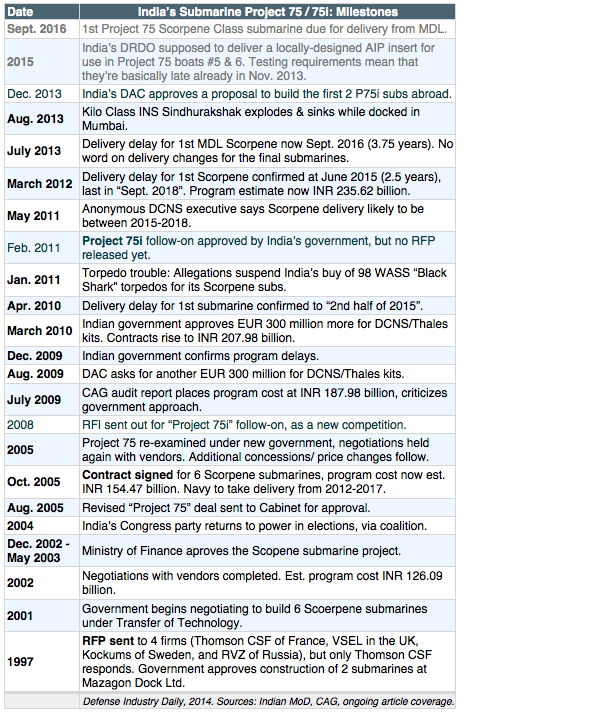
A March 8/06 release from the Indian Ministry of Defence gives the long history of the Type 75/ Scorpene contract’s genesis. After numerous delays, final negotiations were held with vendors in 2005. This reportedly cut INR 3.13 billion from the 2002 negotiated position, and involved other concessions. Even so, India’s program budget had to rise in order to accommodate the final contract.
As is often true in India, some of this was self-inflicted. In 2009, India’s Comptroller and Auditor General (CAG) reported that the government’s delays in finalizing a deal had probably raised the project’s cost by 2,838 crore, or about 15% of the project’s total cost – and that was before the additional Rs 2,000 crore contract to DCNS was finalized in 2010.
“Project 75” had options for another 6 submarines, but that was replaced by a 6-boat “Project 75i” competition in 2007. Introducing another competition risks slowing India down, and may add industrial disruption from a new design and new partners, in order to add improved technology. Key requirements reportedly include an Air-Independent Propulsion module, and the ability to launch supersonic BrahMos cruise missiles from vertical launchers. As of 2014, however, there isn’t even an official RFP.
The AIP Option

Like many modern diesel-electric submarines, the Scorpene class is exceptionally quiet. It can also be equipped with an additional section that holds a MESMA brand AIP (air-independent propulsion) system. A CM-2000 Scorpene can operate underwater for 4-6 days without surfacing or snorkeling to get oxygen to recharge its batteries. An AM-2000 Scorpene AIP, in contrast, will be able to operate underwater for up to 18 days depending on variables like speed, etc. Each AIP section costs around $50-60 million, and adds 8.3 meters (27 feet) and 305 tonnes to the hull section. The resulting AM-2000 Scorpene AIP is 70m long, and displaces 1,870t.
Naval Chief Admiral Arun Prakash has said that the agreement gave India the option of incorporating AIP technology after delivery of the 3rd Scorpene submarine. India’s Navy appeared to be opting to do this in Scorpenes 4-6, but the state-run DRDO research organization made a typical play to develop their own AIP “hull plug” for the Scorpene. They’re now talking about fielding only submarines 5 & 6 as AIP boats, if DRDO’s technology is ready.
The need to test such systems extensively after they’ve been developed means that DRDO has effectively defaulted on their future 2015 delivery target, even as Pakistan fields all 3 of its Agosta 90B boats with mature French MESMA AIP technology inside.
India’s specifications for Project 75i boats are expected to require pre-installed AIP systems.
Sub-Par: India’s Underwater Plans & Realities
(click to view full)
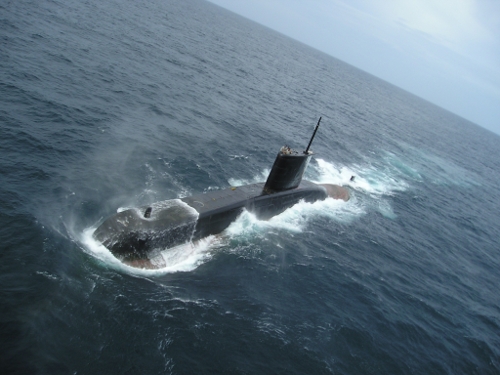
If India can overcome its government’s own obstacles to fielding an effective submarine force, reports by Indian media have described a long-term desire to manufacture up to 24 submarines in a phased manner. In the mid-200s, Admiral Prakash publicly stated an objective of “24 subs in 30 years.” A more likely outcome involves cutting the current operational fleet roughly in half by 2025, and returning to the current inadequate fleet size by 2030 – 2035.
Most of the Project 75 delays, and many of the cost increases, are attributable to India’s slow decision making and lack of readiness. Meanwhile, India’s existing fleet continues to age, and the size of India’s submarine fleet will become a serious concern by 2016 or so. The situation is fast approaching a crisis, especially given India’s general Anti-Submarine Warfare weakness. Key risk factors that are creating the crisis include:
Risk: Age-out. Based on a 30-year safe lifetime for submarine hulls due to the constant pressure squeeze and release from diving, India will need to start retiring its first 2 U209/ Shishumar Class submarines around 2016 – 2017, or find a good reason to extend them past that 30-year lifespan. At the same time, 3 of the Navy’s early Kilo/ Sindhugosh Class boats would also be at or beyond a 30-year lifespan by 2017, for a total of 5 boats at risk. By 2020, the figure will be 9 boats: 2 U209s, and 7 Kilo Class. By 2025, all 4 U209s and 8 of the 9 remaining Kilo Class submarines would be past 30 years of service.
If 33 years is the service cutoff instead, the fleet would drop by 3 boats in 2019 (2 U209, 1 Kilo), 2 more in 2020 (2 Kilo), 2 more in 2021 (2 Kilo), 1 in 2022 (1 Kilo), 1 in 2024 (1 Kilo), 1 in 2025 (1 U209), 1 in 2027 (1 U209), and 1 in 2033 (1 Kilo).
Risk: State Firms. Poor performance by state-run firms has gone from a risk to a crisis. Project 75 was supposed to begin Scorpene deliveries in 2012, but that may be delayed to 2017. Since placing a new submarine type in operational service can take up to 2 years of trials and exercises, it could be 2019 before India fields its 1st new operational boat.
Risk: India’s Government. India’s 4th-World class procurement process adds even more risks. The risk of delay has already materialized. Despite initial solicitations in 2008, the 75i RFP still pending in 2014, and even declaring a winner isn’t expected before 2017. India’s navy has given up on its sensible risk-mitigation plans to have the first 2 boats built abroad. Worse, India’s government wants to add state-run Hindustan Shipyard Ltd. (HSL) in Visakhapatnam as a submarine builder. This is the same yard that destroyed the Kilo Class INS Sindhukirti in a bungled refit, which does not inspire confidence. There is marginal comfort in the fact that the Modi government intends to open Project 75i to private industry, and substituting inexperience for demonstrated issues of competence may be an improvement.
The bottom line? India is unlikely to field any Project 75i submarines before 2025. Even this date assumes that the 75i competition won’t become bogged down in unsubstantiated allegations and process freezes and fail to deliver anything.
DID reminds our readers that long term plans for major capital acquisitions have a way of shrinking over time as budgetary tradeoffs are made – 32 DD (X) destroyers for the USA became 12, and then 3. The difference is that submarines are the strategic platform of the 21st century, and India needs a strong presence in the Indian Ocean if it intends to be a significant strategic actor. Meanwhile, the buildup of China’s submarine and naval forces is likely to keep the importance of Indian submarines front and center.
Time will tell if actual budgets, shipbuilding execution, and political performance can match the Navy’s appetites. So far, the record isn’t encouraging.
India’s Scorpene Project: Contracts & Key Events
2014-2019
DAC clears Project 75i, but conditions set by India’s political class cut the throat of their submarine force structure; Sindurakshak raised as inquest continues; Other Kilo Class accidents; New government takes action on batteries for existing fleets; Still no action on Black Shark torpedoes.

(click to view full)
September 23/19: Delivery India’s Mazagon Dock Shipbuilders Limited (MDL) has delivered another license-built Kalvari or Scorpène Class diesel-electric submarine to the Indian Navy. The vessel, which will be in service as INS Khanderi once commissioned, was handed over on September 19 at a delivery ceremony in Mumbai. Khanderi is the second of six boats ordered under an $3.2 billion contract signed with Naval Group (then known as DCNS) in October 2005 under India’s Project 75 submarine program. The program’s first-of-class, INS Kalvari , was commissioned in December 2017.
July 17/19: Next Generation Missile BrahMos Aerospace is currently working on a next generation missile to meet Indian Navy requirements for a fresh set of submarines being developed under Project 75 I. First test-firing of the sleeker and lighter „BrahMos-NG“ could take place within two years. It can potentially be a prime submarine weapon and could also be launched from torpedo tubes. India’s Project 75 I is following Project 75 Kalvari Class for the Indian Navy. Under the project, India wants to acquire six diesel-electric subs, which will also feature advanced air-independent propulsion systems.
June 27/19: Requests for Expression of Interests India’s Ministry of Defense has sent Requests for Expression of Interest (REoIs) to local shipyards inviting them to participate in the long-deferred Project-75 India that aims to domestically construct six diesel-electric attack submarines equipped with air-independent propulsion (AIP) systems for the Indian Navy. The REoIs were sent out on June 20. The shipyards have two months to respond to the REoI. Project-75I is the second project after the procurement of 111 armed light naval utility helicopters and 24 naval multirole helicopters, under the MoD’s SP model. The Defense Acquisition Council, the Indian MoD’s principal procurement body chaired by the country’s defense minister, has approved the procurement of the six new SSKs back in January.
June 18/19: Postponed Commissioning Jane’s reports that the Indian Navy has postponed the commissioning of the second of six Kalvari or Scorpene Class diesel-electric attack submarines (SSKs) after they discovered apparent manufacturing defects. The Navy has therefore asked the government-owned Mazagon Dock Shipbuilders Limited (MDL), which is building the boats in collaboration with France’s Naval Group, to fix the deficiencies found in the submarine. Commissioning will be delayed for several months. The sub is called Khanderi and began sea trials in 2017. Khanderi was initially scheduled to enter service by the end of 2019. It is part of the Indian Navy’s Project 75 Program for six Scorpene Class boats,
May 16/19: INS Vela launched The Indian Navy’s fourth Scorpene Class submarine, INS Vela, has launched on Monday. It is one of six Scorpene Class stealth subs built by Mazagon Dock Shipbuilders as part of Project 75 under a technology transfer partnership with Naval Group. As part of the technology transfer pact, Naval Group offers technical support to MDL in the field of construction, integration and tests of submarines in India. The Scorpene Class Ships can be used to perform various tasks, including anti-surface, anti-submarine warfare, long-range strikes, special operations or intelligence gathering. Prior to delivery to the Navy, the submarine will be put through trials and tests, both in harbor and at sea. After the tests, equipment and machinery on-board will be integrated.
August 26/16: Leaked documents in relation to a new naval submarine for the Indian Navy were stolen from French manufacturer DCNS. The French government made the statement; adding that the information so far showed only operational aspects of the submarines. Both France and India have downplayed the security risk of the leak which has caused concerns over the future of a recently agreed upon $38 billion deal with Australia.
August 25/16: An inquiry into a leak of sensitive technical information of France’s Scorpene attack submarine is being planned by the French government. The leak surfaced in a report by an Australian newspaper who received 22,400 pages of ship builder DCNS’s company data on the six Scorpene boats it’s constructing for the Indian Navy. The company fears that such a leak may harm the company’s deal with Australia to design and build the Shortfin Barracuda A1 diesel-electric submarine.
October 30/15: The Indian Navy kicked off trials of the first of its Scorpene-class submarines on Thursday, with the future INS Kalvari launched from Mumbai shipyards to begin ten months of testing. Six Scorpene (also referred to as Project-75I) boats are due for delivery by 2020, with the Kalvari slated for commissioning next September. Indian state-owned Mazagon Docks Limited partnered with France’s DCNS to develop and build the submarines through a $3.6 billion contract signed in October 2005.
October 9/15: Janes reported that Indonesia is in talks with French shipyard DCNS over the possible sale of a Scorpene 1000 diesel-electric submarine, despite reports that the country’s parliament approved the acquisition of Russian-built Kilo-class boats in September. The Indonesian defense ministry is thought to be considering a purchase of five Russian subs, with the Indonesian Navy currently operating two South Korean-manufactured submarines, with another two on order. The littoral capabilities of the French design may be the reason for a split purchase, with the Russian boats intended for use in deep water. DCNS signed a partnership agreement with Indonesian shipyard PT Pal in November, which included marketing of the Scorpene 1000.
September 29/15: French and US firms have also reportedly begun discussions with the Indian Defence Ministry over possible collaboration for the Indian Navy’s future fleet of six nuclear attack submarines, known as Project-75(I). The discussions are reported to have taken place in July, with the Indian Defence Ministry now in a position to select a NATO partner over Russian assistance in the project. The country’s government is also considering whether to lease another Akula-class boat from Russia, with the Indian Defence Acquisition Council approving the acquisition of six new submarines in October 2014.
July 9/15: India is<href=”http://economictimes.indiatimes.com/news/defence/india-in-talks-with-russia-to-lease-new-modern-world-class-nuclear-attack-submarine/articleshow/47980078.cms”> reportedly engaged in talks with Russia over a possible nuclear submarine leasing agreement. The topic is scheduled to be included on a list of topics to be discussed between India’s Modi and Vladimir Putin when the Indian PM visits Moscow next week. It is likely that instead of leasing a third Akula-class attack sub from the Russians to complement the existing leased subs, the Modi government will look to lease a more modern Yasen-class sub, or a customized variant of a different class. Russia recently announced that it will upgrade its own Akula-class fleet, also recently laying-down a fifth Yasen-class boat.
May 4/15: The Indian-manufactured INS Arihant nuclear SSBN is progressing well with sea trials, according to the Chief of the Indian Navy. Launched in 2009, the sub’s reactor went critical in August 2013 and is thought to have begun shakedown voyages from March last year. Based on the Russian Akula-1 design, the INS Arihant is India’s first indigenously-manufactured nuclear sub and a critical component of the country’s pursuit of a nuclear triad capability. In related news, the Indian MoD has restricted all future shipbuilding to domestic yards, with private shipyards having a potential workload of $3.2 billion over the next fifteen years.
Oct 24/14: Project 75i. India’s top-level Defence Acquisition Council clears INR 900 billion in acquisitions, including INR 530 billion for Project 75i to build 6 AIP submarines in India. The government intends to identify capable shipyards for the foreign partnership within the next 2 months, from among 7 major shipyards (4 of which are state-owned).
Wouldn’t it be better to have the outside partners identify their preferred shipyards, since their primary incentive is directed toward contract performance rather than the results of political lobbying? One might add that if the chosen submarine vendor ends up disagreeing with India’s shipyard choice, it’s only going to prolong negotiations whose late timing and contract structure already guarantee a force crisis for India’s submarine fleet.
Other DAC clearances today include 2 SDV underwater commando delivery vehicles; up to INR 32 billion to buy and license-build about 300 Spike family launcher systems and 8,000 missiles; INR 20 billion to have the state-owned Ordnance Factory Board build about 360 more BMP-2 tracked IFVs under license; and INR 18.5 billion for 12 more license-built Do-228NG short-range transport and maritime surveillance aircraft from HAL. Sources: NDTV, “6 Made-in-India Submarines for Navy for 53,000 Crores” | IANS, “Defence ministry clears Israeli anti-tank missile, six submarines”.
DAC Approval: Project 75i
Sept 7/14: Project 75i. Indian policymakers decide to cripple their strategic posture:
“Frustrated with seven years of debilitating delay in even kicking off the process to select a foreign collaborator to help make new-generation stealth submarines, the Navy has junked its long-standing demand for getting two of the six such vessels directly from aboard…. all the six new submarines, armed with both land-attack missile capabilities and air-independent propulsion for greater underwater endurance, will be constructed in India with foreign collaboration under ‘Project-75-India’….
Once the global tender or RFP (request for proposal) for P-75I is issued, it will take at least three years to first select the foreign collaborator and then finalize the project with it. It will thereafter take another seven to eight years for the first submarine to roll out.”
So, no tender. When there is one, we’re at 2017 for a winner. India will need to start retiring U209/ Shishumar Class submarines by 2016, or find an excuse to extend them past a 30-year safe lifespan. At the same time, 3 of the Navy’s early Kilo/ Sindhugosh Class boats would also be at or beyond a 30-year lifespan, for a total of 5 boats at risk this way before a Project 75i winner is even declared. Waiting another 8 years after a winner is declared brings us to 2025 for the 75i rollout, by which time all 4 U209s should be retired, and 8 of India’s 9 Kilo Class boats would have ages ranging from 34 – 39 years. Only INS Sindhushastra would be under the 30-year mark. That could leave India with its submarine force cut in half, when its current fleet of 13 is already acknowledged as inadequate to India’s strategic needs.
In contrast, here’s what strategic urgency that forced the original plan plus urgency looks like: an 2-phase RFP issued in late 2014, with an expeditious evaluation and a winner in 2015. There’s a commitment to build the first 2 boats abroad, with some Indian workers present on exchange, and a target for Indian participation that can be finalized while construction begins. That would add 2 more submarines to India’s fleet by around 2019; even if service cutoff is set at 33 years, India’s total fast attack submarine fleet would still have dropped from 13 to 11 boats. By 2025, if the 1st Indian-built Project 75i boat rolls out as planned, the type has already been through their long trials and exercise period, and can enter operational service before INS Shalki must decommission. It also sails into a reduced but modern fleet that has held steady at 10-12 front-line submarines: 6 Scorpene submarines, the Kilo Class INS Sindhushastra, the U209 Shankul and the soon-to-depart U209 INS Shalki, 2 Project 75i boats with fully trained crews, and a possible renewal of the nuclear-powered INS Chakra’s lease. Sources: The Times of India, “Delays force Navy to drop demand for foreign submarines”.
Program timelines and India’s sub fleet
June 23/14: Batteries. India’s government new has decided to take swift action to replace submarine battery stocks, as India works to keep its existing fleet in the water until 2016.
The Navy has issued an RFP to buy 7 Type-I battery sets (248 batteries each) for Russian-made Kilo-class submarines, plus 2 sets of Type-II batteries (540 batteries each) for their U209 Shishumar Class. They’re also buying new cables. The Kilo Class submarine INS Sindhuratna needs those cables to become operational again, and the belief that old and dangerous battery sets may have played a role in Sindhurakshak’s sinking (q.v. Feb 26/14) has made it clear that the red tape blocking new buys needed to be cut.
What the report doesn’t say is whether a resolution was found for the fact that “the Defence Ministry had stopped purchases from a particular vendor.” One supposes that we won’t know until the RFP responses come in, but these sorts of considerations should have planners attention for the future Scorpene fleet as well. Sources: Mail Online India, “Centre rushes to buy new submarine batteries as Navy suffers shortage”.
June 5/14: Sindhurakshak raised. Resolve Marine Group begins raising INS Sinhurakshak (q.v. Jan 19/14), which has lain at the bottom of Mumbai harbor since explosions sank the Kilo Class submarine on Aug 14/13. After the harbor was dredged to be 8 feet deeper in that area, Resolve used a twin-barge technique that raises the boat using chains, sinks the carrier barge beneath the raised boat, lowers the submarine onto the sunken barge, then refloats the barge and carries the submarine away.
The is important to the entire fleet, and not just because it clears critical space in Mumbai harbor. If forensics reveal that the explosion was terrorism, India will need to overhaul its security procedures. If the problem involved unstable batteries that MoD couldn’t replace in a timely way (q.v. Feb 26/14), then the risk to the entire serving submarine force rises until this can be dealt with, and India’s naval crisis is even worse. Sources: India Today, “INS Sindhurakshak lifted from Mumbai harbour floor in massive salvage operation”.
June 2/14: New Man. The BJP’s Shri Arun Jaitley takes over as Defence Minister, while also holding the ministries of finance and corporate affairs. He himself says that MoD will be a temporary assignment, leading many observers to wonder what’s going on. The answer may lie in the Ministry of Finance’s repeated sabotaging of military modernization project approvals. The Times of India writes:
“The finance ministry is often blamed for being a “big obstacle” for military modernisation plans. But with Arun Jaitley straddling both MoF and MoD as of now, there is “hope” the “detailed action plan” for the submarine fleet will be swiftly cleared. Jaitley, on being asked by TOI if there was “a conflict of interest” in handling both the ministries, replied, “Well, I see it as supplementing of interest”…. Navy is down to just nine operational diesel-electric submarines, with another four stuck in long repairs and refits. All the 13 submarines are over 20 years old, while eight of them have crossed 25…. Though this over Rs 50,000 crore project[75i] was granted “acceptance of necessity” in November 2007, the global tender to select the foreign collaborator is yet to be even floated…. “Since early-April, it’s now again with MoF. The tender or RFP (request for proposal) can be issued only after first the MoF and then the cabinet committee on security approves it,” said a source.”
If a unified minister can get the Project 75i RFP out, finalize the Black Shark torpedo buy, and make a decision about India’s M-MRCA program, he could do a tremendous amount of good for India’s defenses in a very short time. Sources: Indian Gov’t, “Arun Jaitley takes over as Defence Minister” | India’s Economic times, “BJP men, others fail to find logic in alloting defence to Arun Jaitley” | Times of India, “Modi govt must act fast to save India’s depleting submarine fleet”.
May 15/14: Torpedoes & 75i. Ajai Shulka writes that the absence of a torpedo contract needs to be a priority for the new BJP government, if they want to avoid a situation where India’s new Scorpenes are defenseless against enemy submarines:
“Consequently, when the first Scorpene submarine is commissioned in 2016, it will be armed only with the Exocet anti-ship missile. Were it to be challenged by Pakistan’s silent new Khalid-class submarines – the French Agosta-90B -the Scorpene will have empty torpedo tubes. Even if the new government signs the contract quickly, delivery would be unlikely before 2017…. A top-level navy planner laments the MoD’s lack of accountability, contrasting it with how former navy chief, Admiral D K Joshi, took responsibility for warship accidents and resigned.”
Meanwhile, no upgrade and life-extension has been approved or contracted for India’s aging U209 boats, and Project 75i has no contract. When 75i is underway, it plans to entrust construction of 1 of 6 submarines to state-owned Hindustan Shipyard Ltd, Visakhapatnam (HSL) – the same yard that destroyed the Kilo Class INS Sindhukirti during a bungled refit. Building Project 75i in 2 Indian shipyards would also mean paying double for transfer of technology (ToT). On the other hand, it may speed badly-needed deliveries. If you can trust the 2nd shipyard to perform. Sources: India’s Business Standard, “Scorpene subs to join fleet without torpedoes” | See also March 11/13, Dec 23/13 re: torpedoes.
April 10/14: Sabotage? The Sindhuratna Board of Inquiry is reportedly recommending the court martial of a Commodore, and a notation of “severe displeasure” on the records of 2 mid-ranking officers. Another change at the top may be on the way, courtesy of India’s electorate. dna India, “Sindhuratna mishap: Navy Board of Inquiry recommends action against officers” | PTI, “Top Navy officer may face court martial in submarine mishap”.
April 9/14: Sabotage? A preliminary Board of Inquiry still isn’t ruling out sabotage, which was an immediate conclusion when the Kilo Class boat INS Sindhurakshak sank in August 2013. While the initial, minor explosion could have been an accident, malfunction, or human error, the major explosions are attributed to the torpedoes. Those supposedly can’t trigger without human intervention, but the old saw about making things foolproof always applies. More can’t be known until the submarine is fully salvaged around August 2014, and forensic tests can be performed. Sources: The Hindu, “Sindhurakshak may have been sabotaged: probe” | Hindustan Times, “INS Sindhurakshak fire: ‘Sabotage’ angle in report is disturbing”.
April 6/14: Kilo Fire. The Kilo Class boat INS Matanga catches fire while undergoing a refit at Mumbai’s Naval dockyard. It’s a minor incident, involving a contractor performing steel welding in the Sewage Treatment Plant compartment and causing insulating material in the adjacent compartment to smolder. This isn’t something that would happen at sea, and they put the fire out immediately. Deccan Chronicle, “Fire on board INS Matanga at the Naval dockyard in Mumbai, no causalities reported”.
Feb 26/14: Kilo Fire. The Kilo Class submarine INS Sindhuratna experiences a fire during training near Mumbai, killing 2 officers and felling 7 sailors unconscious due to smoke inhalation. The problem was a smoke build-up in the Kilo Class submarine’s battery compartment – a problematic area that has been subject to procurement delays. The Times of India explains:
“TOI has learnt that the batteries on INS Sindhuratna were old and had not been replaced. “The batteries were not changed during its refit (maintenance) that was done in December 2013. The submarine is a diesel-electric vessel, which runs on battery power provided by 240 lead acid batteries weighing about 800 kg each. These batteries tend to release flammable hydrogen gas, especially when they are being charged, and submarines have safety systems to address emergencies arising out of this. Old batteries are even worse,” the source said.”
The submarine wasn’t fully loaded with weapons, which was extremely fortunate for all involved. Reuters adds:
“One former senior submariner describes a gridlock in which bureaucrats make “observations” and note their “reservations”, but make no decisions to buy or replace equipment for fear of being implicated in corruption scandals. “No one wants to touch the damn thing,” he said, noting that delays also cause procurement costs to escalate.”
In response, chief admiral DK Joshi resigns. Joshi is known as a very upright character, and he’s upholding an important tradition by his actions, while also reportedly expressing his own dissatisfaction with the MoD. It’s certainly convenient for some politicians to have him take the blame, but that may not be where the real problem is. Sources: Hindustan Times, “INS Sindhuratna mishap: Navy chief resigns as 2 go missing, 7 injured” | Firstpost India, “INS Sindhuratna: Report on battery system overhaul will haunt AK Antony” | NDTV, “Two officers died in fire on board submarine INS Sindhuratna, confirms Navy” | Reuters, “UPDATE 1-Navy setbacks show defence challenges facing next Indian govt” | Times of India, “Major mishap averted as INS Sindhuratna wasn’t fully loaded”.
Feb 6/14: Project 75i. Russia’s Rubin Design Bureau says that they’ve made progress adding vertical launchers to their newest Amur-1650 submarines, in order to incorporate Klub-S (SS-N-27B/30B) missiles that offer various combinations of subsonic and even terminal supersonic anti-ship, land-attack, and anti-submarine variants. Chief designer Igor Molchanov believes that they could install tubes for Brahmos missiles, without compromising the submarine’s capabilities.
He also made a pitch for Rubin’s own AIP solution, which cracks diesel fuel to obtain its hydrogen instead of storing the highly explosive gas on board. The Amurs are expected to compete against France’s Scorpene, Germany’s U214 or stretched U216, and Spain’s S-80. sources: RIA Novosti, “Russia Prepared to Modify Submarines for Indian Tender”.
Jan 19/14: Kilo Salvage? India has reportedly received 2 RFP responses for a DSRV rescue submarine, in case there’s another submarine emergency. Meanwhile:
“After an exhaustive study, an empowered committee of the Indian Navy has submitted to the Ministry of Defence (MoD) that to salvage the sunk, Kilo-class submarine INS Sindhurakshak, will cost upto [sic] Rs 300 crore. However, the MOD is yet to respond. It was learnt that a final decision on this is now being awaited since the MoD is ‘vetting the entire proposal’. It was also learnt that the navy has recommended a particular firm in its report to the MoD.”
That’s about $50 million, and even after paying it, the boat probably can’t be returned to service. On the other hand, no salvage means that the Board of Inquiry is stalled, which matters because there are strong suspicions that she was sunk by a terrorist attack (q.v. Aug 14/13). The sunken sub is also taking up an important berth in Mumbai’s crowded naval base.
Resolve Marine Group subsidiary Resolve India ends up winning the order in February 2014, with a bid described as “under Rs 240 crore” (around $40 million). Sources: India Today, “Salvaging INS Sindhurakshak to cost upto Rs 300 crore, navy tells MoD” [sic] | Times of India, “Indian arm of US company wins Sindhurakshak salvage
bid”.
Jan 19/14: Accident. The Kilo Class boat INS Sindhughosh runs aground while trying to enter Mumbai Harbour. Its entry was delayed, and by the time it was cleared, the tide was too low. Salvage efforts rescue the sub by floating it off as the tide rises.
The Indian Navy is initially saying that there was no damage, and that the submarine remains operational. It’s hard to see how this can be determined without a drydock examination, but so far, no decision has been made to do that. Or to launch a Board of Inquiry. Sources: India Today: “Navy salvages submarine INS Sindhughosh stuck off Mumbai coast” | Calcutta Telegraph, “Armed sub scare”.
Kilo aground
Jan 18/14: Torpedoes. India’s DAC may have cleared the INR 18 billion buy of 98 WASS Black Shark heavyweight torpedoes, but the Ministry of Defense has cold feet after the Jan 1/14 cancellation of fellow Finmeccanica Group AgustaWestland’s AW101 VVIP helicopter contract, and is “doing a rethink.”
Finmeccanica won’t be blacklisted, because it would affect too many other Indian programs and fleets. State-sector delays have already pushed the initial Scorpene delivery back to September 2016, so the MoD can afford to dither. Even so, the AW101 court case will take a while, and a decision will probably be needed while it’s still in progress. The Indian Navy is just lucky the submarines weren’t delivered on time, then forced to go without torpedoes. Which may still happen, unless the Ministry is forced into action. Sources: Times of India, “Defence ministry reviews move to buy torpedoes”.
2013
More costs, and more delays, all preventable; BrahMos can launch underwater, just not deploy; Torpedo buy hung up; China buying more advanced Russian subs.
[youtube:v=D5CBUSYJykY]
click for video
Dec 23/13: Torpedoes. India’s Defence Acquisition Council (DAC) approves an INR 18 billion proposal to buy WASS Black Shark torpedos for the Scorpenes. The decision comes a week before the government decides to cancel a different Finmeccanica group contract for AW101 VVIP helicopters, which is about to become a strongly-contested court case. Sources: The Week, “Proposal to buy torpedos from AW’s sister company”.
Dec 17/13: Project 75i. With its submarine force waning, the Indian MoD announces that 2 of the coming Project 75i submarines will be built abroad:
“Based upon the Naval HQ proposal, Defence Acquisition Council has taken a decision that P-75 I project will have 4 submarines (out of six) built within the country (03 at Mazgaon Dock Limited, Mumbai and 01 at Hindustan Shipyard Limited, Visakhapatnam, on Transfer of Technology, and two to be built in collaborator’s yard abroad.”
Nov 30/13: Scorpene supplemental. France is reportedly offering India an interesting deal. DCNS would build 2 Scorpene submarines in France, for delivery that would coincide with the induction of India’s 1st locally-built boat. In 1 stroke, they’d give India’s navy enough working modern submarines to meet naval commitments, until the rest of the Scorpenes arrive in service.
France is also reportedly pushing to have India make a 2nd-generation fuel cell MESMA system India’s official “Plan B,” in case DRDO can’t meet its 2015 delivery commitment for an indigenous Air-Independent Propulsion supplementary system. Extensive testing requirements for AIP systems all but guarantee that DRDO’s AIP is already late, but DRDO insists as usual that they’re on track this time. Their preferred approach is to wait until official failure in 2015 before beginning any decisions. Which would, of course, hold up construction of submarines #5 & 6, further crippling India’s submarine fleet, while India’s bureaucrats and politicians take their customary years to make a decision.
DRDO is correct to worry that acceptance of MESMA AIPs in the last 2 contracted boats would badly damage hopes for a DRDO-led AIP retrofit of the first 4 Scorpenes. It would also strengthen DCNS’ position for Project 75i, of course, by offering fleet commonality, while proving that MDL is already trained to accomplish MESMA AIP fit-outs. Sources: Livefist, “France Offers 2 Quick Scorpenes, DCNS ‘Worried’ About DRDO’s AIP”.
Aug 26/13: Project 75i. In the wake of the Sindhurakshak’s sinking, Indian media report that the country may look to lease a 2nd nuclear submarine from Russia. On the SSK front, the Times of India reports that defense minister A K Antony may be rethinking the Ministry’s slowness, and consider compromising his own renewed push toward an all-indigenous procurement policy.
In India, this consists of asking bureaucrats to kindly expedite the Project 75i building plan, 14 years after the program was approved to go forward. The paper reports that a Draft CCS Note with required specifications, concrete building plans, etc. will be sent to the Cabinet Committee of Security in “a month or so,” and that it contains the Navy’s requested provision that the 1st 2 submarines would be built abroad. If CCS approval leads to a fast contract, it’s entirely possible that India could have 2 operational Project 75i submarines before it has 2 operational Project 75 Scorpenes. That would shore up the submarine force quickly, but it would also be embarrassing.
The rest of Antony’s reaction consists of chest-beating about no more schedule slippages at state-owned Mazagon Docks Ltd., and calls for better and “faster” refits and maintenance for the shrunken 13-sub fleet – 11 of which are 20-27 years old. Can the Minister guarantee either outcome? No. Are they even technically achievable? If he knew, he would have been doing it already. Sources: Times of India, “Submarine shock: Antony fast-tracks projects”.
Aug 14/13: Sunk. An explosion and fire sink the Kilo Class INS Sindhurakshak while the boat is docked in Mumbai, killing 18 people on board. Firemen manage to contain the blaze to the submarine, so it doesn’t end up sinking the submarine docked next to it as well. The explosion happens the day before India’s independence day, and the comprehensiveness of the damage leaves observers inside and outside India considering the possibility that it was a terrorist plot.
Whether it was or it wasn’t, India’s fleet just lost its 2nd newest submarine. Sources: India’s Business Standard, “INS Sindhurakshak crippled; experts blame battery fire and ammunition explosion” | The Hindu, “Submarine blasts due to ‘possible ignition of armament'” | Hindustan Times, “Russia distances itself from India sub disaster”
Explosion
July 23/13: Late, again. MDL Chairman and Managing Director Rear Admiral Rahul Kumar Shrawat (ret.) confirms to The Hindu that “We have set a new target of September 2016 for delivery of the first Scorpene,” instead of the already-late date of 2015. Deliveries were originally slated to begin in 2012, and the latest confession won’t win many fans in the Indian Navy. The Hindu:
“The Navy, however, is livid over the yard’s persistent disregard for deadlines. Top Navy officials rue that by the time the Scorpenes are commissioned, they would be obsolete. The first three Scorpenes will not even have air independent propulsion (AIP)…. MDL’s long-drawn procurement processes and sluggishness in technology absorption gave the projects hiccups at the start itself. Meanwhile, the project cost grew exponentially from the original Rs.18,798 crore to Rs. 23,562 crore in 2010 with a renewed timeline.”
May 14/13: The Hindustan Times illustrates the dire situation facing India’s navy, due to mismanagement of India’s submarine programs:
“As reported first by HT on April 9, a confidential defence ministry report had warned that India had never before been poised in such a vulnerable situation and its undersea force levels were “at a highly precarious state.” …China operates close to 45 submarines, including two ballistic missile submarines. It also plans to construct 15 additional Yuan-class attack submarines, based on German diesel engine purchases.
The size of India’s submarine fleet will roughly be the same as that of the Pakistani Navy in two years…. merely six to seven submarines, including India’s first and only nuclear-armed ballistic missile submarine INS Arihant.”
That may be a bit pessimistic. The 4 U209s will need to begin retiring, leaving 10 Sindhugosh (Kilo) Class submarines that began entering service in 1986. At least 8 of those have been refitted under Project 08773, and can be expected to serve for several more years. That makes 9 submarines, but at Indian operational levels, that leaves just 3-4 boats available for missions. On the other hand, China’s fleet is venturing into the Indian Ocean more often, and bases like Hambantota in Sri Lanka and Gwadar in Pakistan will make that easier and easier. Keeping up with Pakistan won’t be enough, and the article is correct to point out that India is barely clearing even that low bar. Hindustan Times.
April 15/13: More delays and costs coming. The Times of India reports that bureaucratic delays by the Ministry of Defence may force Scorpene submarine deliveries to start in 2016, even as costs are set to rise again:
“According to sources, Mazagon Dock Limited (MDL) has informed the Navy that the project would be delayed by another 18 months…. Consultants from Navantia, the Spanish shipbuilding company, left the project in the last few days. The technical assistance pact for Navantia and DCNS, the French partner in the consortium, expired on March 31, sources said. With MDL failing to get the defence ministry’s approval in time, about 10 Spanish consultants working on the submarine project left India…. DCNS leadership is expected to meet with MDL top brass this week in Mumbai and present their own demand for additional technical assistance fee.”
Every problem listed here was preventable, and so is the crisis coming to India’s submarine force. A contract that built the first 2 boats abroad, with Indian engineers and specialists working at the foreign shipyard before transferring home to build the last 4 at MDL, would have cut technical assistance requirements, while delivering working submarines to the navy on time. India’s Navy has learned that lesson, and is lobbying hard for an analogous arrangement under Project 75i. Based on reports to date, the ministry hasn’t learned anything, and is resisting. Its political leaders would rather have the vote bank of state run jobs, and their associated financial arrangements up and down the supply chain. Even if that costs more, and leaves India strategically vulnerable. Somehow, that isn’t corruption.
March 20/13: BrahMos underwater. India successfully tests its supersonic PJ-10 Brahmos Mach 2+ cruise missile from a submarine. BrahMos joint venture CEO A Sivathanu Pillai describes it as the 1st underwater firing of a supersonic cruise missile anywhere in the world, and the missile successfully hit its target 290 km / 156 nm away.
Here’s the catch: none of India’s current submarines can fire the new submarine-launched missile. It’s too big to launch from a torpedo tube, and will need to use a vertical launch tube with the correct diameter. India’s Project 75i submarines are nearly certain to add this modification, but they won’t be ready until 2023 at the earliest, a decade after a submarine-launch Brahmos conducted its 1st test firing.
New Indian Express editorial director Prabhu Chawla attributes this disconnect to poor planning in the MoD. The truth is that there has been no shortage of planning, or lead time. Solicitations for the follow-on Project 75i reportedly began in 2008, and there is still no RFP. Likewise Air-Independent Propulsion was discussed in 2006, but the ball has been dropped and it’s unlikely to appear in any of the 6 ordered Scorpene submarines. What has been in short supply is timely execution, thanks to a combination of delays stemming from MoD practices, industrial failures, and hindrances put in place by politicians. No amount of planning can trump that. Times of India | Chawla op-ed.
March 18/13: Legal. India PIB:
“A complaint was received alleging financial irregularities against the then Director in-charge of Scorpene Submarine project in a Defence Shipyard. The complaint is under enquiry.”
March 11/13: Torpedoes. Defense minister Antony offers a written Parliamentary reply to say that India still hasn’t finalized a contract for torpedoes. A Special Technical Oversight Committee (STOC) was convened to review the complaints about the proposed Black Shark buy, and approved it as fair and to procedure. In other words, no wrongdoing. The high-level political Defence Acquisition Committee accepted the report in September 2012 (6 months ago), and has done… nothing. The purchase has now been delayed for over 3 years.
Welcome to India. Part of the reason involves allegations that WASS’ parent firm Finmeccanica paid bribes to secure a contract for 12 AW101 VVIP helicopters. In Italy, its CEO is facing bribery charges, and has been deposed. That sort of thing could get the parent firm blacklisted, which would also scuttle the torpedo buy, and could make it difficult for India to build its Vikrant Class indigenous aircraft carriers. As of March 11/13, Finmeccanica subsidiary AgustaWestland has been given a ‘show cause’ notice regarding cancellation of the AW101s, but did not have the contract cancelled until January 2014. No blacklisting will follow. See also Jan 12/10, Jan 31/11, Oct 28/12. India PIB.
March 8/13: China. An analysis piece in The Hindu by Vladimir Radyuhin points out that China continues to build a modern submarine fleet – including the most advanced conventional subs from Russia. The problem may be a pervasive one, stemming from poor Russian delivery and support on one hand, and India’s red-tape slowness and inability to make decisions on the other:
“At the end of last year, Russia concluded a framework agreement with China for the sale of four Amur-1650 diesel submarines…. It will also mark the first time that Russia has supplied China with more powerful weapon platforms compared with Russian-built systems India has in its arsenals. In the past, the opposite was the rule…. India risks being eclipsed by China on the Russian radar screens. As Russia’s top business daily Kommersant noted recently, even today, Russian officials from top to bottom tend to look at India with “drowsy apathy,” while Mr. Putin’s visit to India last year was long on “meaningless protocol” and short on time and substance.”
Jan 4/13: Investigation. India’s Central Vigilance Commission (CVC) has launched an inquiry against Commodore (ret.) Gopal Bharti, who heads up Project 75. The inquiry is in response to an unnamed internal whistleblower. The financial irregularities which include train fare reimbursement and taking his son abroad at public expense, aren’t earth-shattering. On the other hand, the CVC is investigating allegations that Bharti deliberately refused to place orders for 170 critical items, and are curious about the disappearance of 15 high pressure specialized underwater valves from his department.
Innocent until proven guilty, but the range of allegations are pretty broad. Times of India.
2012
India gambles on own AIP system – will it even be ready?; Kilo Class upgrades done; Project 75i gets official OK, but no RFP; India looking for land strike missiles on 75i subs.
[youtube:v=PtRTnq-gF10]
click for video
Dec 4/12: AIP. StratPost offers an AIP system update from Indian Navy chief, Admiral D.K. Joshi
“AIP plugs for the fifth and sixth of (Project) 75 are under consideration. [DRDO’s Naval Materials Research Laboratory (NMRL)] has been tasked to develop that. It is doing so. What is to be seen is whether the… timeline Matches the delayed production timelines of (Project) 75. In case this comes online in conformity with the fifth and sixth ones they will be put into place, but if for some reason they are not ready at that point in time we would not delay the production timelines…. This would [also] become an option for any of the subsequent indigenous options [Project 75i]…. The next line will have an AIP plug.”
Meanwhile, all 3 of Pakistan’s comparable Agosta 90B submarines will include DCNS’ mature MESMA AIP technology.
Dec 5/12: Project 75i. India’s cabinet Defence Acquisition Council (DAC) has accorded Acceptance of Necessity (AON) for buying “Project 75i”, India’s next 6 submarines. A global RFP is reportedly due “very soon,” and the Indian government has reportedly decided to spend up to $10 billion/ Rs 55,000 crore on India’s future submarine force.
Project 75i diesel-electric SSK subs will have air-independent propulsion, and India is also looking to equip them with conventional land attack missiles. DCNS could offer the AIM-2000 Scorpene with the MESMA AIP, and might be able to offer integration of MBDA’s developmental MdCN cruise missile. The MdCN is already slated for DCNS’ SSN Barracuda Class nuclear fast attack submarines, and the right electronic commonalities could give any French proposal a notable advantage over German and Spanish competitors.
If India prefers its own BrahMos missile, on the other hand, 2 things will happen. One is that the playing field will be level. The other is that any submarine chosen would have to be a modified design, with vertical launch tubes sized for BrahMos. Indian government | Zee News.
Oct 28/12: Torpedoes. More headaches for India’s Black Shark torpedo buy. As if their direct competitor’s complaint wasn’t enough, a probe is now underway into India’s EUR 560 million purchase of 12 AW101 VIP helicopters. AgustaWestland is also a Finmeccanica company, and there are several cases of India’s blacklist laws being invoked against firms on the basis of mere corruption allegations, with no available proof.
The Rs 1,700 crore buy of 98 torpedoes for the Scorpene fleet was expected to be followed by a similar buy for Project 75i’s 6 submarines, and possibly a 3rd buy to plus up stocks and equip the new SSBN Arihant Class of nuclear-powered ballistic missile submarines. That could mean a total of up to Rs 5,100 crore, or about EUR 733 million / $947 million at risk given current conversions.
As for Atlas Elektronik’s claims that the torpedo bid was rigged (vid. Jan 31/11 entry), the Indian MoD’s Acquisitions Wing, Central Vigilance Commission (CVC), and Minister of State for Defence MM Pallam Raju have all rejected the claims, despite strong circumstantial evidence. India MoD | India’s Business Standard.
July 17/12: Sub-contractors. SEC Industries and DCNS today officially inaugurate new 1,500 m2 of workshop facilities at SEC’s Hyderabad facilities, and formally deliver cofferdam door coamings after successful Factory Acceptance Tests. The work was done under a September 2011 sub-contract between SEC DCNS India Pvt Ltd., and a second sub-contract for additional work was signed in 2012 (vid. March 23/12 entry). DCNS.
June 23/12: Kilo Class. Russia completes its set of 7 mid-life refits and modernizations of India’s Kilo Class submarine fleet, which were delivered from 1986 – 2000. Russia handled repairs and modernization for 7 boats, while Indian shipyards have delivered 1 and are working on another 2.
This last boat, INS Sindhurakshak ended her mid-life refit in Zvezdochka about 15 years after she was built. A submarine’s expected safe lifetime is usually about 30 years, but India may be forced to contemplate a 2nd refit series. Ortherwise, they may not be able to keep their overall submarine fleet at acceptable levels, while they wait for Scorpenes and Project 75i boats arrive. Additional refit efforts generally cost more for each additional year of safe service delivered. The Hindu.
June 11/12: Industrial. DCNS signs a strategic partnership for bringing DCNS technologies, methods and skills into India’s private Pipavav Defence & Offshore Engineering Company Limited. Pipavav is a shipbuilder, repair & dry-docking firm, and were recently chosen by MDL to form a Joint Venture to build warships for the Indian Navy. DCNS.
March 23/12: Sub-contractors. DCNS India announces a Scorpene sub-contract and transfer of technology with SEC Industries Pvt Ltd of Hyderabad, India. The deal for hull hatches, cofferdam doors, knuckle hoses, ballast vent valves, High Pressure air cylinders, weapon handling and storage system is worth about Rs 310 crore/ EUR 50 million. To make this work, DCNS will provide SEC with full plans for the components, training for over 40 SEC personnel at DCNS facilities during 2012-2013, plus 5 years of on-the-job training and support for manufacturing and quality control at SEC in Hyderabad.
SEC is known in Indian defense circles as a manufacturer of missile airframes and components, and signed a deal with Israel’s IAI back in 2008. The company’s previous experience had been with heavy pump set and road-roller equipment. DCNS.
March 19/12: Delays. The 1st Indian Scorpene sub is now confirmed as scheduled for delivery in June 2015, barring further delays, and program cost is now confirmed at Rs 23,562 crore (currently about $4.56 billion).
The original schedule was for delivery by December 2012, with submarines arriving each year until December 2017. The new official schedule has deliveries beginning 2.5 years later in June 2015, with submarines arriving every 9 months until September 2018. Costs are up about 25.4% from the original CAG-audited cost of Rs 18,798 crore after the deal was signed, or 87% over the program’s initial 2002 figure. Indian MoD | New Kerala | PTI.
Jan 14/12: Fleet readiness. The Hindu reports that construction of India’s 2nd Arihant Class submarine, Aridamana, leaves it slated for launch in late 2012 or early 2013. Fabrication of the 3rd ATV submarine has begun. Meanwhile, unnamed sources in the Indian Navy continue to express concern about the country’s silent service:
“The decline in the operational availability of submarines [as low as 40 per cent] has seriously compromised the force’s vital sea denial capability. The absence of Air Independent Propulsion… is another debilitating factor.”
What this means is that if India has 12 operational submarines (9 Kilo, 4 U209, 1 in refit at any time), it would only be able to field 4-5 boats in an emergency situation.
2011
Inquiry into Black Shark torpedo buy; Scorpenes will be late; Do India’s U209s need life extensions now?; Navy wants Project 75i to be a mix of foreign and locally-built, in order to be on time; State-run stranglehold on Indian defense industry; MDL-Pipavav public-private JV to build and service warships.
Sept 13/11: Industrial. Private shipbuilder Pipavav Defence & Offshore Engineering Company (PDOL) and state-owned Mazagon Dock (MDL) agree to form India’s first public-private partnership venture to build warships and submarines for the Indian Navy.
Mazagon Dock Pipavav Ltd will be held 50/50, and it will help MDL fulfill existing orders while competing for future defence contracts in India. Pipavav chairman Nikhil P Gandhi is quoted as saying that it’s “primarily to fast-forward the process of warships and submarine contracts held currently by the MDL.” India’s Financial Express | Indian Express.
July 29/11: Rear Admiral MT Moraes takes over as the Assistant Chief of Naval Staff (Submarines) at Delhi, to look after the planning and acquisition of submarines.
Rear Admiral Srikant is also slated to take over as Flag Officer Submarines (FOSM) based at Visakhapatnam, this is the indian Navy’s class authority on submarines, responsible for defining standards, policies and procedures for their operations and maintenance. Rear Admiral G Ashok Kumar will take over as Flag Officer Sea Training (FOST) at Kochi. India MoD.
June 8/11: Sub-contractor. DCNS India Pvt. Ltd. signs an undisclosed contract with Flash Forge India Pvt. Ltd., an ISO 9001:2008 certified manufacturer of customized special material forgings based in Visakhapatnam.
This first contract with Flash Forge for the manufacturing of mechanical equipment is the conclusion of a long process for DCNS, which involved identification of potential partners, audits of the manufacturing and quality processes, qualification, and then a competitive Request For Proposal (RFP). With a lot of the advance work out of the way, DCNS expects to announce other local contracts in the near future. DCNS.
June 6/11: IANS relays a report in the May 2011 issue of India Strategic, quoting DCNS India Managing Director Bernard Buisson to say that 2 Scorpene combat systems have been delivered to Mazagon Docks Ltd. (MDL). They’re in the process of integrating the first one.
Buisson reportedly said that there are about 20 – 25 French engineers assisting in technology transfer, and added that DCNS has had technical discussions with the Indian Navy on installing MESMA air independent propulsion (AIP) systems on board the last 2 submarines. That move would raise the subs’ cost, and DCNS said they are (still) awaiting the Navy’s response. IANS | India Strategic.
May 18/11: Delays. The Times of India reports that 2 Indian naval crews will be going to France “after some months” to train for operating the SSK Scorpene fast attack submarines. The article notes that by 2020, India’s fleet will comprise just 5 Kilo Class and 4 U209 Shishumar class boats available, and quotes an unnamed official:
“We now hope to get the first Scorpene by August 2015. Each submarine will have just a 36-member crew since automation levels in them are very high,”… “The first Scorpene will be ‘launched’ into water in 2013, and will be ready for commissioning by August 2015 after extensive harbour and sea trials,” said a top DCNS official. “The target is to deliver the sixth submarine by 2018, one every nine months after the first one in 2015. The third and fourth submarines are already under construction at MDL…”
April 6/11: Stretch the Shishumars? The Scorpene project’s lateness, and uncertainties around Project 75I award and delivery dates, have led India’s Navy to talk with Germany’s HDW about upgrading the capabilities, and extending the lifespans, of its existing U209 Shishumar Class boats, inducted from 1989-1994. Zee News.
Feb 16/11: P75i. Indian media quote Indian navy chief Admiral Nirmal Verma, who reiterates that the follow-on program to the Scorpene deal is already cleared by India’s government. The result could add 6 more Scorpenes to the order books, or it could result in a parallel program to build another model. With 7 of India’s 14 active submarines due for retirement by 2015, and the Scorpene program 3 years late because of self-inflicted delays, the Indian government’s unwise choice to avoid building any Project 75 Scorpene submarines in France has created a looming crisis for the Navy.
Verma says that the Navy is going through responses to the September 2009 RFI, and hopes to be able to issue a tender in 2011. Responses have reportedly included DCNS (Scorpene AIP), Germany’s HDW (U214) and its Swedish Kockums subsidiary (several options, incl. the forthcoming A26 design), Navantia (S-80), and Russia’s Rosoboronexport (Amur 1650), He adds that Project 75i is looking for an improved combat management system, better sensors and detection range, and the certain inclusion of Air Independent Propulsion (AIP) technology. Reports place the order total at $11 billion, but that seems high even if it includes both the current $4.38 billion for Project 75’s 6 subs, and a Project 75i program for another 6 diesel-electric boats. Time will tell.
The current plan is for India to order 2 submarines built at the winning foreign shipyard, and build 3 at Mazagon Docks Limited (MDL) in Mumbai, and 1 at Hindustan Shipyard in Visakaphatnam. That’s similar to the Project 75 plan pushed by India’s Navy, who wanted 2 boats built abroad because they feared that delays and performance issues might create problems for the Scorpene. Political favoritism overruled that request, and the feared scenario has come to pass. This time, the government is showing slightly more flexibility, by approving the plan to have 2 submarines built abroad in order to avoid a complete crash in fleet numbers. On the other hand, the Defence Acquisition Council (DAC) refused to accept the recommendation the Project 75i avoid MDL, due to that shipyard’s existing workload. Instead, the government assumes that it would be able to build 3 more submarines, which may even be of a different type, on an accelerated production schedule, while still delivering all 6 Project 75 Scorpene boats to the revised schedule. Yeah, right. IANS | Times of India.
Jan 31/11: Torpedo trouble? India’s Central Vigilance Commissioner has opened an inquiry into Project 75’s planned buy of 98 heavyweight torpedoes, after Atlas Elektronik GmbH executive director Kai Pelzer reportedly lodged a direct complaint. The complaint refers reportedly refers to irregularities in the conduct of the procurement process, including specific charges of corruption. The CVC inquiry was ordered in December 2010.
Atlas Electroniks’ complaint is straightforward: the competition was rigged. The RFP makes the torpedo vendor responsible for seamless integration and/or interface of the torpedo with the SUBTICS combat system. The Finmeccanica/DCNS Blackshark is the Scorpene’s default torpedo, but Atlas had to have their plan approved by the MoD’s Technical Evaluation Committee (TEC). That approval was given, but Atlas’ integration proposal was failed in the user trials. India’s DPP, Para 13, doesn’t allow requirements that “prejudice the technical choices by being narrow and tailor made.” The TEC’s approval escaped that trap, but Para 70a allows only one remaining vendor after trials. Atlas says this was the Navy’s intent all along.
The inquiry suspends India’s planned buy of Black Shark heavyweight torpedoes from Finmeccanica subsidiary Whitehead Alenia Sistemi Subacquel (WASS), until this can be sorted out. Atlas Elektronik Gmbh was offering their DM2A4 Seahake. Both torpedoes feature advanced seeker heads, and can be controlled by a trailing fiber optic cable. Defense World | Economic Times of India | Subsequent Business Standard coverage.
Jan 18/11: Industrial. India’s Economic Times sums up the latest revisions to India’s Defence Procurement Policy, amid hopes that the stranglehold of state-run firms on major Indian defense contracts might be loosened:
“…(DPP) 2011 has made it clear that the state-owned companies will get preference while awarding major defence contracts. Private sector will get certain concessions, but the situation has not gone down well with the players… According to DPP 2011, foreign defence vendors can now discharge their offset obligations in the civil aviation, internal security and training sectors, compared to the earlier mandate of discharging the same in the defence industrial sector only… The minister also brushed away concerns that the new policy guidelines related to the capital intensive shipbuilding industry favoured the defence PSUs, in spite of the demonstrated ability of private sector companies, such as Larsen and Toubro (L&T) and Pipavav Shipyard in recent years… L&T, which has invested millions on its state-of-the-art shipbuilding facility at Hazira, was promised a critical role in developing and manufacturing India’s second submarine line, Project 75I, along with the state-owned PSU Mazagon Dock, but was later sidelined… The new policy – which has divided procurement into two different sections – mandates that the DPSU shipyards will be given contracts on a nominated (non-competitive) basis, while the private shipyards will have to participate through a competitive bidding process. Further, it remains the government’s call to decide which contract should be open to competitive bids in the first place, raising questions of whether the government is queering the pitch further.”
2010
Costs rise, delivery slips; India picks WASS Black Shark torpedoes.
December 2010: Torpedoes, etc. WASS (Whitehead Alenia Sistemi Subacquei) has launched its first subsidiary in India: Win Blue Water Services (WBWS)/ It will focus on naval equipment, market research and analysis, supporting offset and supply chain management, and creating a service hub for the Middle East and Asia.
WASS has operated in India since 1975. Their A244/S light torpedo recently received an Indian contract to upgrade their stocks to Mod 3, and their Bharat Dynamics Ltd (BDL) partnership is producing the C303 anti-torpedo countermeasures system, which is already 50% indigenized. The firm sees opportunities in artificial underwater targets, underwater surveillance systems for strategic areas and offshore energy production, etc. The more work it does, the more value it can count toward Indian requirements for industrial offsets, and the more it can compete with “indigenous” products for the Indian Navy. WBWS is planning to start joint ventures for its different domains, and is in the process of discussions with Indian companies including Larsen & Toubro. India Strategic.
Dec 2/10: Delays. The headline reads “After delays, Scorpene submarine now on track: Navy chief.” Unfortunately, the IANS article doesn’t offer many specifics to support that contention, so it’s hard to evaluate.
Nov 30/10: P75i. India’s PTI reports that Russia’s Rosoboronexport will offer the latest Amur-1650 class submarines to India for Project 75i, the follow-on tender for 6 new submarines that will either extend or complement the current Scorpene contract.
The Amur is known as the Lada class in Russia, and renaming it the “Amur” for export is probably a good idea, in case anyone still remembers those infamous Lada automobiles. The new class was developed by the Rubin Central Design Bureau of Naval Technology as an improvement to the Project 636 Advanced Kilo-class diesel-electric fast attack submarines, and is said to be even quieter. The 1,765t Amur 1650 variant is larger than the Amur 950 model, and has an option for air independent propulsion. It lacks the 950’s 10 vertical launch tubes, relying instead on 6 reloadable torpedo tubes.
Sept 29/10: Industrial. An Asia Times article, “Leaks in India’s submarine strategy,” says that the submarine construction program has changed:
“India is in the process of getting six Scorpene subs… to be built at the Mazagon facility in Mumbai… but this procurement is experiencing a slowdown. Mazagon Docks in Mumbai will construct three of the six, Hindustan Shipyard Ltd in Visakhapatnam will construct one, and the other two may be procured from foreign sources or built by another private shipyard in India.
“The delivery of the first of the French Scorpenes, which was supposed to enter service in December 2012, has been delayed. Antony addressed this situation in parliament only a few weeks back. This will clearly impact upon India’s undersea force levels,” said [Observer Research Foundation senior fellow Dr. Rajeswar] Rajagopalan. “India has about 35 private shipyards, of which L&T [Larsen & Toubro Ltd] and Pipavav are believed to be competing to build the two submarines, of the six planned.”
The report adds that shrinkage of India’s operational submarine fleet may even force 2 submarines to DCNS shipyards, so they can be delivered and become operational in time. As of March 2012, however, India has done none of these things – just added more overhead and reports, and pushed delivery back.
March 10/10: Costs. DefenseWorld reports that the Indian government has approved another Rs 2,000 crore for the Project 75 Scorpene submarine program, to cover the purchase of contractor-supplied MPM equipment packages for the Project 75 Scorpene submarines.
Negotiations over the price increase have been stalled since October 2005, which has delayed the Project 75 program by 2 years.
Extra for equipment packages
April 26/10: Delays. Sify News quotes a Parliamentary response by defence minister Antony regarding the Scorpenes:
“A programme of construction of six Scorpene submarines is currently underway at Mazagon Docks Limited (MDL) under transfer of technology from a French company. As per the contract, the first submarine was scheduled to be delivered in December 2012 and thereafter one each every year till December 2017… There has been a delay due to initial teething problems, absorption of technology and augmentation of MDL purchased material. The first submarine is now expected to be delivered in the second half of 2015… The delay in scheduled delivery of submarines is likely to have an impact on the envisaged [submarine] force level… However, the gap in submarine capacity has been addressed by modernisation with the state-of-the-art weapon and sensor fit on the existing submarines…”
See: Sify News | Indian MoD – less detailed.
March 30/10: WIL partnership. An Indian PR Wire release by Walchandnagar Industries quotes DCNS Chairman Patrick Boissier, who was speaking after the unveiling of the “Vinod Doshi Technology Center”:
“Said that the company which was Europe’s leading company in , ship building , off shore patrol vessels and Submarine manufacturing and valued at Euros 2.5 billion had signed an MOU with WIL last year manufacturing of critical technical parts for Scorpene” submarines for the Indian Navy… Walchandnagar Industries was identified for the project after we scouted for strategic partners and we were convinced that they would provide us the with High level technology for critical manufacturing components, he added “Talking about our future plans is premature, but it is possible in the long term to work with Walchandnagar Industry for world markets after our project in India is completed as we have a 30 % market share in Submarine manufacturing.”
While the release adds a piece to the industrial puzzle, careful reading of Mr. Boissier’s statement shows no commitment made.
Jan 12/10: Torpedoes. India’s MoD picks the DCNS/Finmeccanica WASS Blackshark heavyweight torpedo to arm its Scorpene Class submarines. The Blackshark is the standard torpedo offered with the class, and already serves with Malaysia’s Scorpene. India’s total buy is projected at 98 torpedoes, for Rs 1,700 crore, but there is no contract yet.
Their competitor was Atlas Elektronik, who supplies the SUT-B torpedoes that arm India’s upgraded U209 Sindhugosh Class. Atlas’ new DM2 A4 Seahake, which has demonstrated very long range engagements, would have been the torpedo used on the Scorpenes. Source.
Torpedo picked
2009
CAG auditors unimpressed with Project 75; More money needed; India’s submarine readiness problem.
Dec 2/09: Delays. The Indian government confirms earlier reports, via a written reply to a Parliamentary question:
“As per contract signed with Mazagaon Docks Limited (MDL), first Scorpene submarine is scheduled to be delivered in December 2012 and thereafter, one each every year till December 2017. On account of some teething problems, time taken in absorption of technology and delays in augmentation of industrial infrastructure and procurement of MDL purchased materials (MPM), slippage in the delivery schedule is expected. Delay in scheduled delivery of submarines is likely to have an impact on the envisaged submarine force levels [for the Navy as a whole]. Loss on account of the delayed delivery is difficult to quantify at this stage.
This information was given by Defence Minister Shri AK Antony in a written reply to Shri Prabhat Jha and Shri Prakash Javadekar in Rajya Sabha today.”
Aug 29/09: Costs. The Times of India reports that the Defence Acquisitions Council has decided to approach the Cabinet Committee on Security to approve a EUR 300 million (about Rs 2,000 crore) cost spike for the French ‘MDL procured material (MPM) packages,’ from a EUR 400 in 2005 to EUR 700 million now. The MPM packages go inside the hulls being produced by Magazon Docks Ltd., and reportedly include virtually all major systems connected with sensors, propulsion, and other systems.
Contracts signed to date include the October 2005 Rs 6,315 crore contract with DCNS’ predecessor for transfer of technology, combat systems and construction design; the October 2005 Rs 1,062 crore contract with MBDA for sea-skimming Exocet missiles and related systems; a Rs 5,888 crore contract with MDL for local submarine construction; Rs 3,553 crore set aside for taxes; and Rs 2,160 crore for other project requirements. Total: Rs 18,798 crore. India Comptroller and Auditor General reports that the government’s 9-year delay in finalizing the deal has probably raised the project’s cost by 2,838 crore, or about 15% of the project’s total cost before this price rise.
July 20-27/09: CAG report critical. India’s Comptroller and Auditor General releases a report critical of the Scorpene acquisition, and Defense Minister A K Antony admits to India’s Parliament that the project is running about 2 years behind schedule, due to “some teething problems, absorption of technology, delays in augmentation of industrial infrastructure and procurement of MDL purchased materials (MPM).”
The CAG report criticizes the fact that the submarine requirement was approved in 1997, but no contract was signed until 2005, and then for only 6 of the envisioned 24 boats. Overall, the project cost had increased from Rs 12,609 crore in October 2002 to Rs 15,447 crore by October 2005 when the contract was signed. Once it was signed, the CAG believes that “the contractual provisions resulted in undue financial advantage to the vendor of a minimum of Rs 349 crore.”
The overall project, which includes a submarine construction facility at Mazagon Dockyards Ltd. (MDL), is placed at Rs 18,798 crore, or 187.98 billion rupees (currently about $4 billion). The Times of India believes that the final program cost will be over Rs 20,000 crore (currently about $4.3 billion), as the cost of key equipment that MDL shipyards needs is rising quickly. Rediff News notes other excerpts from the CAG report, adding that an accompanying Rs 1,062 crore deal for Exocet anti-ship missiles will have issues of its own:
“But even before the missiles becomes operational on the submarine, the warranty period of first two batches of the missiles supplied by the company would have expired, it added. India also extended to the [submarine] vendor “Wide ranging concessions” on warranty, performance bank guarantee, escalation formula, arbitration clause, liquidated damages, agency commission and performance parameters…”
See: Times of India | Rediff news
CAG report & costs
Jan 13/09: Sub-standard force. A CNN-IBN TV program highlights the case of the Kilo Class submarine INS Sindhukirti, whose repair schedule reportedly ran for 10 years, and which “has been in dry dock at Vizag for a refit programme for close to five years now.”
A confidential Indian CAG report is said to have found that only 7 of India’s 16 submarines are available for combat at any time. That’s not an unusual percentage for a submarine force, but if 10 of the 16 are due for phase-out by 2012, the impact on force levels is obvious. To maintain current numbers, one submarine would need to be inducted every 2 years, but there have been no additions since 2001. Source.
2006 – 2008
Deal for subs signed; India considering AIP propulsion addition; Scorpene unlikely to make 2012 deadline; India begins soliciting for follow-on Project 75i submarines.
May 28/08: Delays. The Hindustan Times reports India’s navy may not be able to induct the first Scorpene submarine by the 2012 deadline, as the French have yet to part with crucial details including design and drawing documentation. “A senior navy official confirmed to HT on Tuesday that the project had been delayed by a year.”
The Scorpene project is not the only Indian naval project with delivery issues, and these situations have begun to create combat power issues for India’s navy. The article states that by 2015, India’s fleet will have shrunk from 16 submarines to 10 Kilo Class plus the Scorpenes. See also subsequent Financial Express report.
Feb 28/08: P75i. “India Looking for Additional Submarines.” The Project 75i RFP is reported to be worth about EUR 3 billion/ $4.5 billion, and responding firms are apparently Spain’s Navantia (S-80 confirmed), France’s DCNS (unknown, Scorpene or Marlin Class that’s under design), Russia’s Rubin (Improved Kilo), and Germany’s HDW (unknown, U212A or U214).
Project 75i RFP
March 22/06: Costs. India’s MoD responds to Scorpene-related financial and security breach allegations:
“No contract or contracts were signed with French firms for Rs. 16,000 crore for the Scorpene project. The total cost of the two contracts signed with the two French firms, M/s ARMARIS and MBDA, for the project is Rs. 7,197 crores.
The Government did not pay an extra amount of Rs. 4,500 crore than what was negotiated earlier. On the contrary, after the present Government came to power, it re-examined the project even though all negotiations had been completed in 2002 and the Ministry of Finance had accorded approval to the project in 2003. The present Government held negotiations and was able to achieve a reduction of Rs. 313 crore in the contracts with the two French firms from the negotiated position in 2002… As a result of the negotiations, the Government was also able to achieve several long-term concessions. These included the revision of the escalation formulae to the advantage of the Indian side by adjusting the fixed element in the ARMARIS contract and placing a cap on escalation in the MBDA contract. A cap was also placed on the Exchange Rate Variation (ERV) for calculation of profit for the Public Sector Undertaking, Mazagon Docks Limited (MDL).
Besides the contract with the two French firms, the only other contract that was signed was with the Defence Public Sector undertaking, Mazagon Docks Limited (MDL), for Rs. 5,888 crores for the indigenous construction of the submarines. Therefore, even taking into account the value of contract signed with MDL, the total value of all contracts signed for the Scorpene project is Rs. 13,085 crores out of the sanction accorded for Rs. 18,798 crores towards the project. Out of the balance amount of Rs. 5,713 crores, Rs. 3,553 crores is for payments towards taxes and Rs. 2,160 crores towards other items to be acquired during the project period for which only preliminary steps have been taken. No contract or contracts have been signed for the items under this head. A Technical Agreement was also signed between India and France to ensure the continued support of the French Government to the “project.
The Integrity Pacts signed to ensure transparency of the project, contain, severe penalties in case of breach of any of its provisions. The safeguards include cancellation of the contract, recovery of all advances with interest at a rate of 2% higher than the European Inter Bank Offered Rate or EURIBOR, non-payment by the buyer of any dues on any other contract to make such recoveries, imposition of Liquidated Damages and the recovery of all sums paid to any middleman or agent… The French company that has been accused of committing to pay commission to the alleged middleman has denied all the allegations and has stated that all the e-mails published in the articles in a journal that carried this story are fake and fabricated… The French company has since been reported to have filed a case in the Delhi High Court on 24th February 2006 against the journal which first made the allegations.
…Some press reports also sought to establish a link between the Scorpene project and the breach of security that had occurred in the Directorate of Naval Operations in the Naval Head Quarters… However, the leaked information did not pertain to the Scorpene project.”
March 1/06: AIP? “India Looks to Modify Scorpene Subs With MESMA AIP Propulsion.” Submarines 4-6 will include the MESMA system, according to reports. Those reports are contradicted by later reports, which make it clear that no AIP submarines are contracted yet.
The article also includes information about competing AIP systems.
Oct 7/05: After 4 years of delays, India has finally signed a $3.5 billion submarine deal for French-Spanish Scorpene SSKs, to be manufactured under license by Mumbai-based Mazagon Dock Ltd., and delivered to the Indian Navy between 2012-2017. A contract signed between Armaris and Mazagoan docks provides for a team of French technical advisers during the construction of the first 2 submarines.
The government also awarded global missile systems group MBDA the contract to supply its Exocet SM-39 anti-ship missiles, to arm the Scorpenes. Indian Express.
Scorpene deal & Exocets
Appendix A: India’s Current Submarine Force, and Rival Navies
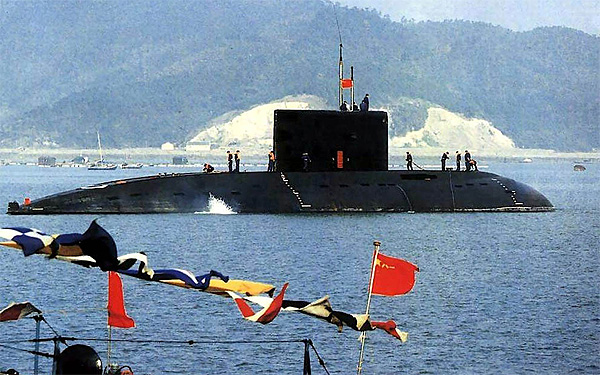
(click to view full)
India’s two most prominent competitors are Pakistan and China.
Pakistan currently owns 5 submarines. Their 4 French Daphne submarines (Hangor Class) were retired in 2006. A pair of French Agosta 70 submarines (Hashmat Class) acquired from the French Navy were modified to fire Harpoon anti-ship missiles in 1985, but they won’t last much longer. Three updated Agosta 90Bs (Khalid Class) are also in service, commissioned in 1999, 2003, and 2008, respectively. PNS Hamza has a MESMA Air-Independent Propulsion system that lets the submarine stay underwater for much longer periods of time, and the other two Agosta 90B boats are getting MESMA retrofits. On balance, this will make them slightly more advanced than India’s new Scorpenes.
Pakistan had an opportunity to add to its diesel-electric fleet, but they’re reportedly pursuing nuclear submarine technology, while shelving a plan to more than double their advanced SSK fleet. On balance, that’s good news for India.
As of 2008, China owned about 66 submarines; 18 of them were Type 035/33s, which are Chinese derivatives of the 1960s-era Romeo Class. The Romeos were based on 1944 U-Boat designs, and even the 17 Type 35s aren’t expected to last much longer, or retain much of a role beyond training. If one leaves out all SSBN/SSGN nuclear missile submarines, all 5 of China’s problem-plagued Type 091 Han Class SSN nuclear powered attack subs, and all of the Romeo derivatives, China’s attack sub force alone still stood at 36 boats in 2008: 4 Type 093 Shang Class SSNs, 12 Kilo (Project 636) & Advanced Kilo Class (Project 877) SSKs, 13 Type 039 Song Class SSKs, and 7 Type 041 Yuan Class improvements of the diesel-electric Song Class.
China continues to build Shang Class SSNs and Yuan Class SSKs, which means that overall fast attack fleet numbers can be expected to grow.
As noted above, India currently operates 16 submarines, but only 12-14 can be said to be in service, and the fleet could face a noticeable decline beginning in 2015 or so:
Shishumar Class: 4 German Type 209 SSK submarines, built locally and delivered between 1984 – 1994. The vessels are expected to reach their end of service life between 2016-2024. The United News of India (UNI) reported on Sept 6/04 that Siemens of Germany has offered the Indian Navy an upgrade for the Shishumar Class submarines, which will involve the installation of their Air Independent Propulsion (AIP) system. As of 2014, India has only managed to approve the idea of a non-AIP refit for 2 subs.
Sindhugosh Class: 10 Russian Kilo Class/ Project 877 SSKs, built (1986-1991, 1997, 2000) under a contract between Rosvooruzhenie and the Indian Defense Ministry. They’re very quiet submarines, but there are reports that the Indian Navy considers them underpowered. Most of these subs have received mid-life refits in Russia, but the quality of those refits has been a subject of dispute. Key components of these mid-life refits and upgrades have include tube-launched Klub-S cruise missiles, plus a hydro-acoustic “USHUS” complex, a CCS-MK radio-communication system, and Porpoise Electronic Support Measures to locate radar emissions. A couple of these submarines are still undergoing work in India.
INS Sindhukirti was incapacitated by a bungled refit state-run Hindustan Shipyard Ltd. (HSL), and has been laid up since 2007. INS Sindhurakshak was destroyed by an in-harbor explosion in August 2013, leaving 8 operational subs.
Scorpene Class: 0 built or in service. Earliest expected in-service date is now 2015 for the 1st boat, and that date could slip to 2018. The entire fleet of 6 may not be operational until after 2020.
INS Chakra: 1 Improved Akula Class nuclear-powered fast attack submarine, owned under a 10-year lease from Russia. Its primary purpose is to train nuclear submarine crews for the Arihant Class, but INS Chakra is fully capable, and could be pressed into operational service. The former K-152 Nerpa was handed over in January 2012, but as of January 2013, the boat had issues with readiness.
Arihant Class SSBN. 1 boat in trials, with 3 others under construction. Designed and built in India, this nuclear-powered submarine has a limited ability to launch nuclear-armed ballistic missiles. Arihant was launched in July 2009, and conducted her 1st K-15 missile firing in March 2012, but hasn’t been commissioned yet. The Indian Navy hoped to do so in 2013. See “India’s Nuclear Submarine Projects” for further details.
Additional Readings & Sources
Background: India’s Submarines
* DCNS – Scorpene.
* Naval-Technology.com – Scorpene Class SSK.
* Deagel.com – Scorpene Basic, or CM-2000 | Scorpene-AIP , or AM-2000 | Scorpene Compact-AIP.
* Rediff.com (Sept. 12/05) – What is the Scorpene?.
* GlobalSecurity.org – Project 75/Scorpene.
* Bharat-Rakshak – Shishumar [Type 209] Class. First 2 boats commissioned in 1986, next 2 in 1992 and 1994.
* DID – Upgrades At Last: Keeping India’s U209 Subs Afloat. So far, they’ve only committed to upgrading the last 2.
* Bharat-Rakshak – Sindhugosh [Kilo] Class. 8 commissioned from 1986-1991, other surviving sub commissioned in 2000. One destroyed, one the victim of a screwed up refit, leaves 8 seaworthy out of 10 bought.
* Bharat-Rakshak – Kalvari Class (Foxtrot Class). All decommissioned now.
Background: India’s Nuclear Submarines
* DID FOCUS – India’s ATV SSN Submarine Project. Covers the INS Chakra lease from Russia, and India’s Arihant Class SSBN.
* GlobalSecurity.org – Advanced Technology Vessel (ATV).
Background: Related Technologies
* DCN – MESMA AIP.
* Undersea Warfare Magazine, via Wayback (Fall 2001) – Air Independent Propulsion: AIP Technology Creates a New Undersea Threat. Very good overview of various AIP technologies.
* Navy League of the United States, Seapower Magazine (December 1999) – The AIP Alternative.
* Wikipedia – Exocet missile.
* Finmeccanica WASS – Black Shark. India’s chosen torpedo, standard on the Scorpene Class.
Additional Readings: News and Events
* Rediff News – Scorpene project archive.
* India Strategic (June 2012) – Indian Navy to select Wake Homing Torpedo.
* India Strategic (May 2011) – Indian Navy’s second Submarine Line will witness strong competition. Discusses the decline of India’s submarine force, and Project 75i.
* Asia Times (Sept 29/10) – Leaks in India’s submarine strategy.
* BBC (Oct 23/09) – Crucial Indian defence deals delayed. These include the Navy’s submarine and aircraft carrier projects, advanced trainers for the air force, and coastal surveillance plans. “For its part, the government has been slow in responding to criticism – even from its auditing organisation. When it comes to defence issues in India, speed does not seem to be of paramount importance.”
* CNN-IBN (Jan 13/09) – Are We Battle Ready: Submarine repair that takes forever. Describes an overhaul of INS Sindhukirti, one of the Navy’s Kilo Class subs. It has been drydocked for 5 years, and the reapirs at Hindustan shipyards, which has no experience in this area, are expected to take a total of 10 years instead of the 1-2 years that would be expected elsewhere.
* IBN Live (Oct 25/08) – Indian Navy’s submarine fleet in poor health: CAG. “The Comptroller and Auditor General (CAG)… states that no more than 48 per cent of India’s submarine fleet is available for waging war, should India be attacked… “The Indian Navy currently hold just 67 per cent of the force level envisaged in its 1985 plan,” the report says.”
* India Defence, via WayBack (Oct 19/08) – Indian Navy Project-75A: RFIs Issued for Six Advanced Submarines; Rosoboronexport, Armaris, HDW in the Fray. These would be a follow-on to the original Scorpene purchase. AIPs and land-atack capability are both requirements.
* Rediff News/PTI, via WayBack (Oct 7/05) – India signs Scorpene submarine deal.
* The Indian Express (Oct 7/05) – Scorpene Deal Inked in Delhi.
* Times of India (Sept 13/05) – Scorpene Ahoy! Also contains a paragraph concerning India’s intention of building a nuclear submarine.
* Rediff.com, via WayBack (Sept 12/05) – India to Buy 6 Scorpene Submarines.
* Times of India (Sept 12/05) – Scorpene: India’s Latest Weapon.
* DCN Release re: Chilean Navy (Sept 12/05) – DCN Delivers First New-Generation Submarine to Chilean Navy [dead link].
* The Tribune of Chandrigarh, via WayBack (Aug 11/05) – Admiral Arun Prakash: Scorpene Deal Awaits Cabinet Nod. Good set of additional naval updates in this article. Note that the Scorpene deal discussed here of 2 buy, 4 build is different than the deal being reported now.
* DID (Dec 14/04) – India Close to Deal on Scorpene Sub Technology. Depending on what the meaning of “close” is…
Additional Readings: Rival Navies
* Naval-Technology.com – Agosta 90B SSK.
* Official Pakistani Navy Site – PN Dimensions: Submarine Force Agosta 70 and Agosta 90B, the latter equipped with AIP and German DM2A4 Heavy Weight Torpedoes.
* GlobalSecurity.org – Hangor Class (Fr. Daphne).
* Pakistani Post Office – Brief History of Submarine Construction in Pakistan.
* GlobalSecurity.org – China/ Ships.