


(click to view full)
Over a development timeline measured in decades, India’s indigenous “Akash” and “Trishul” programs for surface to air missiles have failed to inspire full confidence. Trishul was eventually canceled entirely. Akash had a a long, difficult development period, but seems to have found customer acceptance and a solid niche in the rugged terrain of the northeast. India still needed longer-range advanced SAMs to equip its navy and army, however, and decided to try to duplicate the success of the partnership model that had fielded the excellent Indo-Russian PJ-10 BrahMos supersonic cruise missile.
In February 2006, therefore, Israel and India signed a joint development agreement to create a new Barak-NG medium shipborne air defense missile, as an evolution of the Barak-1 system in service with both navies. In July 2007 the counterpart MR-SAM project began moving forward, aiming to develop a medium range SAM for use with India’s land forces. Both missiles would now be called Barak-8. In between, “India to Buy Israeli “SPYDER” Mobile Air Defense System” covered India’s move to begin buying mobile, short-range surface-to-air missile (SAM) systems for its army, based on the Python and Derby air-to-air missiles in service with its air force and naval aircraft. These projects offer India a way forward to address its critical air defense weaknesses, and upgrade “protection of vital and strategic ground assets and area air defence.” This DID FOCUS article will cover the Barak-8 and closely related programs in India, Israel, and beyond.
The Barak, and Barak-8
Genesis: Barak-1

(click to view full)
Barak is a supersonic, vertically-launched short range air defense system, with an operational range of about 10 km/ 6 miles. That pushes it past the standard ranges of shoulder-launched options with naval counterparts, like the MBDA Mistral/SIMBAD or Saab Boofors’ RBS-70, but short of other small vertical launch options like the RIM-162 Evolved Sea Sparrow. Its closest western competitors on the international market are probably Raytheon’s horizontally-fired Amero-German RIM-116 Rolling Airframe Missile, and MBDA’s flexible Crotale VT-1/NG. Key attributes include a compact 8-cell vertical launching system that weighs just 1,700 kg, coupled with an equally compact 1,300 kg fire control system. This makes it easier to install in small ships, and to retrofit into older vessels.
Barak-1 reportedly in service with at Israel, Chile, India, Singapore, and Venezuela.

(click to view full)
India bought over $300 million worth of these missiles as a substitute for the indigenous but long-delayed Trishul (“Trident”) missile project, and Barak systems now equip India’s lone aircraft carrier INS Viraat, all 6 Project 16/16A Godavari/ Brahmaputra Class 3,850t frigates, 2 of 6 Rajput Class 4,974t destroyers, and the 3 new 6,200t Shivalik Class frigates. Current missile stocks aren’t adequate to cover that, and readiness requires regular training launches against live targets. Barak-1 missiles are also supposed to be part of upgrades to India’s 3 Delhi Class 6,200t destroyers, in order to remove the hole created by the Russian SA-N-7C ‘Gollum’ air defense missile system’s limited firing arc.
Barak-1 missiles are also supposed to be part of upgrades to India’s 3 Delhi Class 6,200t destroyers, in order to fix the SA-N-7C ‘Gollum’ air defense missile’s limited firing arc. The missile’s fast response time, effectiveness against missile threats, and compact size are considerable assets, but they are currently offset somewhat by its short range.
Next-Gen: Barak-8
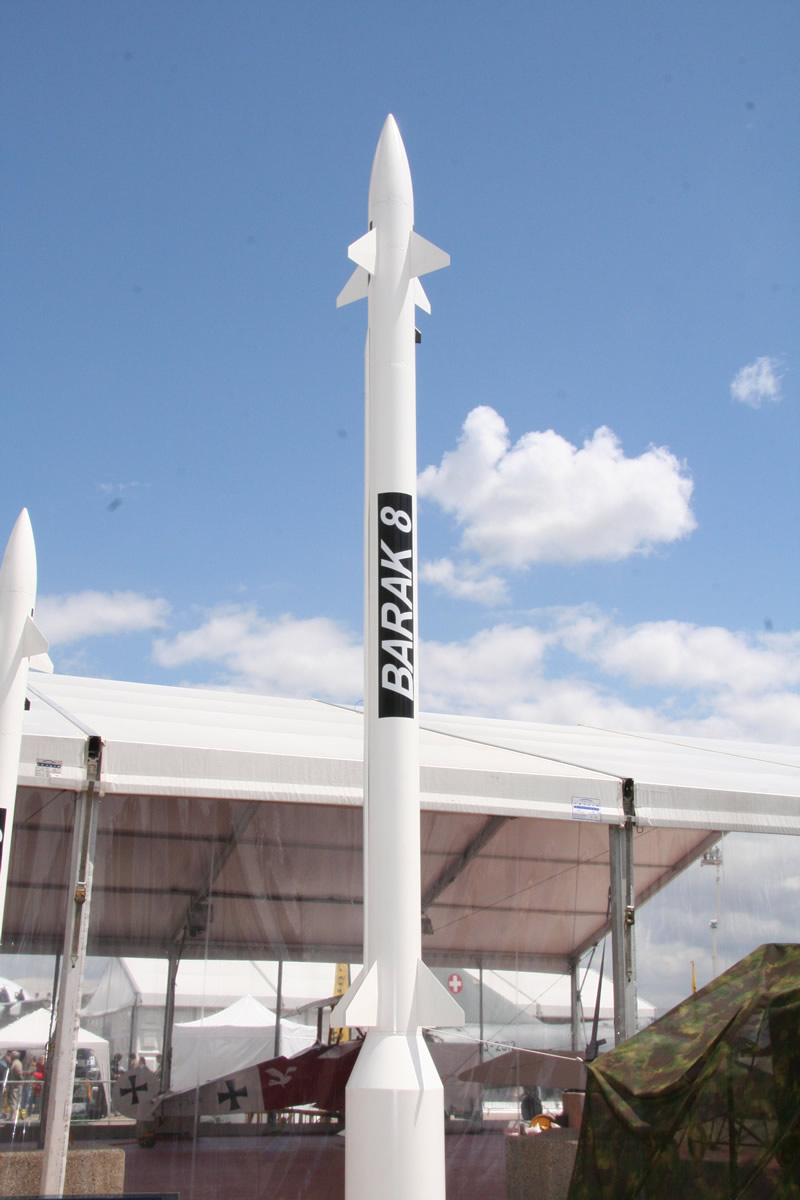
(click to view full)
The Navy’s Barak-NG/ LR-SAM project aimed to give India’s naval defenses a much longer reach, with the intention of eventually making it India’s primary naval SAM. The project was later renamed Barak 8, and aims to deliver 60-70 km/ up to 42 mile range, thanks to a dual-pulse solid rocket motor whose second “pulse” fires as the missile approaches its target. This ensures that the missile isn’t just coasting in the final stages, giving it more than one chance at a fast, maneuvering target.
The missile’s most important feature may be its active seeker. Instead of forcing its ship or land-based radar to “paint”/illuminate its target at all times, the Barak 8 can be left alone once it is close to its target. This is an excellent approach for dealing with saturation attacks using older ship radars, which can track many targets but illuminate just a few. It’s also very useful for land-based systems, which will survive longer against enemy anti-radar missiles (ARMs) if they can turn themselves on and off to confuse enemy seekers, without worrying that they will lose all of their effectiveness.
That kind of performance vaults the Barak 8 past widespread options like the RIM-162 ESSM, or entries like VL-MICA on land. Though the Barak-8 may compete globally with those systems, a better comparison would be naval missiles like Raytheon’s SM-2 Block IIIA and MBDA’s Aster-15, or land-based options like the Patriot. The Barak 8’s active seeker would even give it a performance advantage over the SM-2, and corresponds more closely to the SM-6 currently in development.
The naval Barak-8 reportedly maintains its principle of using compact launchers and systems. Its ancillary capabilities will always depend on the radar and combat system aboard its ship.
One wild card is the Barak’s potential use in a point defense role against ballistic missiles, a role that can be played by some of its more advanced competitors on land or sea. This capability is implied in the land-based system’s name, but hasn’t been discussed publicly, or validated in publicly announced tests.
The land-based Barak 8 Air and Missile Defense (AMD) system includes several components:
* RAFAEL supplies the Barak-8 interceptor missile, which remains vertically launched.
* The battle management, command, control, communication and intelligence center (BMC4I) is produced by the MBT Division of IAI’s Missiles, Systems, and Space Group; it offers both stand alone operation for a single fire unit, and joint task force coordination (JTC).
* IAI ELTA Systems Ltd. supplies the Land-Based Multi-Function Surveillance, Track & Guidance Radar (LB-MF-STAR), a rotating S-band digital Active Electronic Steering Array (AESA) Radar System that can deliver an accurate, high quality arena situation picture, and extract low radar cross section targets like stealthy cruise missiles, even in the toughest environmental conditions. The naval MF-STAR is expected to be part of Israel’s next-generation missile frigates.
In Israel, the Barak-8 is slated to equip its next-generation frigates, and may find its way to other roles. India expects to field the missiles on land and sea.
Beyond those 2 countries, export prospects beckon for a missile that may offer a value-priced naval alternative to Raytheon’s Standard-2 and MBDA’s Aster-15. According to Defense News, the Barak-8 project features funding from American military aid dollars, as well as Indian cooperation and private/governmental funding in Israel. An Israeli source, on the other hand, has told DID that the USA has no claim on the Barak-8’s intellectual property. DID has been unable to verify he exact situation; but if the USA has no IP or significant American-made components in the Barak AMD system, it would have implications for both procurement funding sources and export policy.
India’s Barak Programs
The Navy: LR-SAM

(click to view the rest)
India has 2 different programs that could use the new longer-range Barak missile. The naval Barak-NG, or LR-SAM deal, was the first. Signed in 2006, it’s worth INR 26.06 billion (about $591 million at then-conversion) as of December 2009.
India’s Navy has decided as a matter of policy that it will only mount medium-long range surface-to-air missile systems on future warships, as opposed to depending on short range systems that might protect a ship, but don’t offer layered defense for the rest of the fleet. This was an early sign of its transition to a more of a “blue water” navy that can reach into high-threat areas, and a logical complement to India’s establishment of a serious carrier force beginning with INS Vikramaditya (ex Admiral Gorshkov).
Hence the 2006 Barak-NG naval agreement, which gives India an upgraded version of a familiar system, extends India’s technological capabilities, fosters economic ties and integration at sub-component levels, and helps the Israelis build a new system that meets some of their own emerging requirements. The new system would reportedly have a range of 50-60 km.
Making that happen required some loosening of bureaucratic constraints on India’s defense industry. Based on projections of need and the high cost of air defense systems, India’s Ministry of Defence began initiatives under which Indian state-owned agencies can forge joint co-development and co-production ventures with foreign companies. The rationale is that under these partnerships, much of the underlying technology will remain in India. Israel has risen to become one of India’s largest defense industry partners, and may be on its way to surpassing Russia as India’s largest partner.
That rise, India’s previous positive experiences with Barak, and the opportunity to help develop new technologies instead of buying them, all led India toward Israel for its next-generation naval SAM partnership.
Israel Aerospace Industries will be the key partner, and will contribute most of the applicable technology, just as Russia did for the BrahMos by offering its SS-N-26 Oniks missile as the base platform. 2011 Barak-8 materials show Indian firms contributing the dual-pulse rocket motor, associated motor arming/safing mechanisms, and the pneumatic actuation system. On the other hand, India Defence reports that IAI and its Israeli partners have agreed to transfer all relevant technologies and manufacturing capabilities to India.
The LR-SAM project is now slated for completion by December 2015, which would be about a decade from its 2005 project approval to fielding. Israel will be ahead of that schedule, as they began steps to field Barak-8 in their navy in mid-2013.
Land-Based: MR-SAM

(click to view full)
The Barak-8’s follow-on project involves a land-based system, intended to replace old Russian systems. Most reports place MR-SAM’s desired capabilities at 70 km/ 42 mile range effective range, with 360 degree coverage, plus the ability to engage multiple targets simultaneously. As The Times of India put it, in 2007:
“The project is crucial because, as highlighted by TOI earlier, there are still “many gaping holes” in India’s radar network and the armed forces only have near-obsolete air defence units like Russian Pechora [DID: upgraded SA-3], OSA-AK [DID: SA-8B, scheduled for interim upgrades], and Igla [DID: SA-16 shoulder-fired] missile systems.
Sources peg the MR-SAM project as an extension of the ongoing DRDO-Israel Aerospace Industries (IAI) project, launched in January 2006 at a cost of $480 million, to develop a supersonic 60-km Barak-NG (new-generation) missile defence system for Navy.”
India Defence and the Israeli newspaper Ha’aretz also reported that MR-SAM would be an extension of work done on the Barak-NG deal, and this seems to be the general consensus.

(click to view full)
The DRDO Defence Research and Development Organisation (DRDO) will be the ‘prime developer’ for the MR-SAM project, which will reportedly have a Rs 2,300 crore (INR 23 billion, about $445 million at signing in 2009) indigenous component within an estimated Rs 10,075 crore (INR 100.75 billion, about $1.95 billion at signing) total. The 4-5 year project aims to provide India’s military with 9 advanced air defense squadrons, each with 2 MR-SAM firing units. Each MR-SAM unit, in turn, would consist of a command and control center, an acquisition radar, a guidance radar, and 3 launchers with 8 missiles each.
MR-SAM’s total would therefore be 10 C2 centers, 18 acquisition radars, 18 guidance radars, and 54 launchers, armed with 432 ready-to-fire missiles. Some reports have placed total missile orders as high as 2,000, which would add a significant reserve stockpile to replenish missiles in any conflict.
Indian sources estimated a 4-year, $300 million System Design & Development phase to develop unique system elements, and produce an initial tranche of the land-based missiles. As of its approval by the Cabinet Committee on Security in July 2007, MR-SAM surpassed the BrahMos project in size, and may be the largest joint defense development project ever undertaken between India and any other country.
The MR-SAM project reportedly has a “probable date of completion” by August 2016, which would be around 7 years from its 2009 approval.
Contracts & Key Events
2014 – 2021
In service in Israel; DRDO challenges; Successful intercept test.

(click to view full)
March 23/21: Live-Fire Israel Aerospace Industries (IAI) completed a series of successful live-fire tests of the Barak air defense system. The tests were carried out to evaluate the system’s capability to deal with a range of scenarios and threats, including the interception of a ballistic target by the Barak ER (extended range) interceptor. The Barak ER missile, part of the Barak family of interceptors developed by IAI, is capable of intercepting ballistic and non-ballistic threats at a range of 150 kilometers. The extended range is made possible in part by adjusting the interceptor and the missile system’s MMR radar to a 150 km range, according to the company.
October 25/18: Protection Israel Aerospace Industries (IAI) is being contracted to supply India’s navy with additional air and missile defense systems. The deal is worth $777 million and covers the delivery of several Barak-8 systems for seven Indian warships. The navalised Barak-8 project aims to give India’s naval defenses a much longer reach, with the intention of eventually making it India’s primary naval SAM. The missile can fly to ranges of up to 42 miles, provides 360° coverage and can engage multiple targets simultaneously. State-owned IAI, Israel’s largest defense firm, said worldwide sales of the Barak-8 system now totalled more than $6 billion. India, which has longstanding territorial disputes with neighbors China and Pakistan, has signed several big-ticket defense deals since Prime Minister Narendra Modi came to power in 2014.
July 4/18: New family member Israel Aerospace Industries (IAI) is adding a new missile to its Barak family. The Barak-MX is a modular and scalable networked air/missile defense system that links various sensors, launchers and Barak effectors in a single architecture that can be scoped and optimized to meet specific customer mission requirements. Barak MX is essentially a building block solution. It enables one to retain the central C2 capability but adds longer-range air defense sensors and Barak effectors to scale up the system. The Barak Battle Management Center (BMC), which creates and manages a unified multi-senor aerial picture, coordinates the force operation networks and manages the launch arrays. Barak BMC is available in mobile, transportable and stationary versions. The interceptors are vertically launched and support 360° coverage, quick reactions, short minimal ranges and active high-end RF seekers for targets with low radar cross sections and high maneuverability.
March 30/18: More missiles please Israel Aerospace Industries and Rafael Advanced Defense Systems have been contracted by the Indian Ministry of Defense to supply additional Barak-1 short-range surface-to-air missiles. The contract is valued at $70.5 million and includes 131 Barak-1 shipborne, point defense missiles to be delivered to the Indian Navy. The Barak-1 is a supersonic, vertically-launched short range air defense system, with an operational range of about 6 miles. That pushes it past the standard ranges of shoulder-launched options with naval counterparts, like the MBDA Mistral/SIMBAD or Saab Boofors’ RBS-70, but short of other small vertical launch options like the RIM-162 Evolved Sea Sparrow. Its closest western competitor on the international market is probably Raytheon’s horizontally-fired Amero-German RIM-116 Rolling Airframe Missile, and MBDA’s flexible Crotale VT-1/NG. Key attributes include a compact 8-cell vertical launching system that weighs just 1,700 kg, coupled with an equally compact 1,300 kg fire control system. This makes it easier to install in small ships, and to retrofit into older vessels.
May 22/17: Israel Aerospace Industries (IAI) has been awarded an additional contract by the Indian government to supply air and defense missile systems for four ships of the Indian navy. Valued at an estimated $630 million, the agreement will include local state-owned firm Bharat Electronics Ltd, who will serve as the main contractor on the project under New Delhi’s “Make in India” initiative. The deal follows a $2 billion one signed with IAI last month to supply India’s army and navy with missile defense systems. The Barak-8 system is a joint development effort between IAI, India’sDefence Research & Development Organisation (DRDO), Israel’s Administration for the Development of Weapons and Technological Infrastructure, Elta Systems, and Rafael, while Bharat produce the system’s missiles.
April 9/17: The Indian government has given the go ahead for the $1.8 billion purchase of the Medium Range Surface-to-Air Missile (MRSAM) from Israel Aerospace Industries (IAI). A land-based version of the Barak-8, the MRSAM was developed by IAI and India’s Defense Research and Development Organization (DRDO) in collaboration with Rafael and IAI/Elta, and worked with various Indian companies including BEL, L&T, BDL and other private vendors, and will be operated by the Indian Army. The company will also supply additional LRSAM air & missile defense systems for the first build in India Indian aircraft carrier.
March 2/17: Israel and India will co-develop and produce a medium-range surface-to-air missile for the Indian Army. Contracts for the deal are expected to be awarded later this month with the value of the project estimated at over $2.5 billion. Known as the MRSAM, development of the missile will be undertaken jointly by India’s DRDO, Israel Aerospace Industries (IAI), and will be produced by state-owned Bharat Dynamics Limited (BDL) in partnership with other state-owned and private defense companies. It does, however, remain unclear who will own the Intellectual Property Right (IPR) for the missile as well as the ownership of the data package for the technology.
July 5/16: India successfully tested the land version of its Barak-8 anti-air missile twice on Friday at India’s Integrated Test Range. Conducted by a team from India’s DRDO and Israel’s IAI, naval versions have already been fitted and tested aboard Indian Navy warships. The long-range rocket can identify and hit an air target within a range of 70 kilometers, or some 43.5 miles.
January 4/16: India has completed its first naval test of the Barak-8 long range surface to air missile (LRSAM). Developed jointly between the Indian Defence Research & Development Organization (DRDO) and IAI Israel, the recent test follows November’s successful testing on board an Israeli naval platform. The maiden firing consisted of the missile intercepting aerial targets at extended ranges up to 70km. Apart from the missile, the system includes a Multi Functional Surveillance and Threat Alert Radar (MF STAR) for detection, tracking and guidance of the missile. When completed, the missiles will be fitted on board all Kolkata class destroyers and major warships in the Indian Navy.
November 30/15: The Israeli Navy has announced the successful first test of the Barak-8 air defense system. The interceptor missile was launched from a Sa’ar-5 Corvette against a UAV target representing a threat against a ship at sea. The system has been jointly developed with India and aims to cater for the long range missile defence for both countries with India also planning to test the system before the end of the year. It is hoped that the system will have reached initial operational capability within the next two years.
November 16/15: India’s Barak-8 will be test-fired between now and the end of the year after it was announced that preparations are being made on board the INS Kolkata for the test which the Navy hope to have installed on all future warships and retrofitted on its current Kolkata class destroyers.
Mar 2/15: Indian interest renewed for MRSAM. Defense News reports that an Indian Defence Ministry official confirmed that the medium-range (MRSAM) variant is a go for joint development with Israel, with an initial expected order of $1.5 billion. Rafale and IAI would work with Indian firms Bharat Dynamics Tata Power SED and Larsen & Toubro.
Nov 10/14: Testing. A successful test of the Barak-8 “Air & Missile Defense System” acquires an incoming target drone using the system’s radar, fired the missile to an interception zone, and had the missile successfully acquire and kill the target using its own seeker. Indian officials were there, including DRDO chief Dr. Avinash Chander, and Israeli and Indian releases both pronounced their satisfaction with all aspects of test performance.
The Israelis already have the missile deployed, so they’re happy. What the releases didn’t say, is whether DRDO’s rocket booster was used in the test (Aug 14/14). It’s likely that they did, and the next step is warship trials for India. DRDO hopes to begin deliveries by the end of 2015. Sources: IAI, “IAI Successfully Tested the Barak-8 Air & Missile Defense System” | India MoD, “Successful Flight Testing of LR SAM Missile”.
Aug 14/14: INS Kolkata. Media reports indicate that India’s new 7,500t air defense destroyer INS Kolkata, which is set to be commissioned on Aug 16/14, will be armed with Barak-1 missiles until the Barak-8s arrive. The article doesn’t explain whether the vertical launchers are compatible, or whether the Barak-1 has been integrated yet with the IAI Elta MF-STAR active array radar that equips the new destroyer class. With respect to the Barak-8s:
“The missile is ready, but [DRDO’s] boosters to propel the missile [upon launch]… have failed.”
Hence the importance of the forthcoming tests, if DRDO can get its rocket boosters to Israel (q.v. Aug 11/14). Meanwhile, India is likely to have 3 Kolkata Class destroyers ready to go by the time they’re done testing the Indian LR-SAM. They’ll need to do something in the interim. Sources: oneindia News, “INS Kolkata, the Biggest Naval Destroyer, is the weakest link in Defence”.
Aug 11/14: Force majeure. India’s Business Standard explains how the recent battles in the Gaza Strip are affecting the LR-SAM program, which was already 2 years late:
“The DRDO confirms that the rockets, filled with highly combustible propellant, were despatched [sic] on a commercial airline, Korean Air, for trials in Israel. After the rocket motors reached Seoul – Korean Air’s global hub, from where they were to be routed onwards to Tel Aviv – the launch of Israeli airstrikes on Gaza on July 8 caused Korean Air to cancel all flights to Tel Aviv…. Consequently, a crucial and secret sub-system of the world’s most advanced anti-missile defence system has been languishing in a Korean Air warehouse in Seoul.”
Actually, the cancellation came on July 20/14, after Hamas rockets struck near the airport. Note that Iron Dome is programmed to ignore rockets that don’t threaten its priority areas, and many airlines have already reassessed the situation and resumed flights. Korean Air, on the other hand, won’t begin flights to Tel Aviv again until Aug 28/14. India’s DRDO is “monitoring the situation,” and could choose to request help from India’s Air Force, whose IL-76 heavy jet transports could pick up and deliver the missiles.
Once the Premier Explosives Ltd. rocket motors are delivered, they will be integrated with the IAI-built front section, and then undergo full homing trials at an Israeli range. After that, warship trials will begin, and DRDO hopes to begin deliveries by the end of 2015. By then, 3 new Project 15A Kolkata Class destroyers, and the aircraft carrier INS Vikramaditya, will all be waiting to receive their primary air defense weapons. Sources: India’s Business Standard, “Indian missiles languish in South Korea due to Gaza conflict” | Israel’s Globes, “Korean Air cancels all Israel flights until August 28”.
May 13/14: Israel. A Sa’ar 5 Eilat Class corvette has already been outfitted with IAI Elta’s MF-STAR S-Band AESA radar, and Barak-8 air defense missiles. The other 2 are set to follow.
The MF-STAR, or “Adir,” has been bought by India for its new Project 15A Kolkata Class destroyers. They are also expected to employ the Barak-8. Sources: The Jerusalem Post, “The Israel Navy is quietly enhancing its capabilities for precision, long-range missiles”.
2010 – 2013
Barak-8 development & testing continues; Azerbaijan sale?; Akash missile expands Indian footprint; Indian RFI for immediate MR-SAM option.

(click to view full)
Dec 23/13: DAC OK. AK Antony and the Defence Acquisitions Council (DAC) clear the Indian Navy’s intent to buy 262 more Barak-1 missiles, in order to replenish their fast-dwindling stocks. The paper adds:
“The naval LR-SAM, approved in December 2005, is now slated for completion by December 2015. The MR-SAM project, sanctioned in February 2009, in turn, has a “probable date of completion” by August 2016.”
Read “Indian Naval Air Defenses: Another Avoidable Crisis” for full coverage.
Dec 17/13: Update. India’s Ministry of Defense provides updates regarding a number of DRDO projects, including LR-SAM. The development program’s original delivery target was May 2011, but the Probable Date of Completion is now December 2015: 4 1/2 years late, and well after it becomes fully operational in Israel. Sources: India MoD, “DRDO Projects”.
Nov 14/13: Stall. India’s LR-SAM and MR-SAM projects are stalled, even as Israel moves to deploy the Barak-8 at sea. The Barak-8 was supposed to be delivered for LR-SAM by 2012, and is supposed to go to the IAF as MR-SAM by 2017. Unfortunately, drawings for components aren’t enough to let Indian firms produce them properly, and:
“Frankly speaking, right now, not much is going on in the joint venture due to various issues between the two sides. Expecting Israel to share its technology with India is unfair. But such things should have been clarified before the joint venture was entered into,” said an official…. DRDO officials are also attributing the delay to a complicated and long procedure involving shuttling between India and Israel for various stages of development of a system etc… [DRDO] also reportedly found itself helpless on problems in propulsion system and other related issues while a significant number of parts or systems are yet to be tested following a delay in manufacturing.”
So, to sum up: contract terms that didn’t provide clear mechanisms to enable Indian production from the baseline they’re actually at, Indian DRDO bureaucracy sitting in the way of development and not delivering on key items, and manufacturing issues that have created Indian testing delays. While Israel fields the missile. DRDO Director General Avinash Chander wouldn’t comment on LR-SAM, which is already late, but he said MR-SAM remained on schedule for 2017. Sources: Times of India, “India-Israel joint venture to manufacture missiles fails to take off”.
July 31/13: Israeli installation. India may give the Barak-8 LR-SAM’s date of probable completion as 2015, but Israel intends to have the missile installed on its 3 Sa’ar 5 Eilat Class corvettes before the end of 2013.
The move is reportedly being made in response to Syria’s deployment of SS-N-26/ P-800 Yakhont supersonic anti-ship missiles, with a range of up to 180 miles. Some of the missiles reportedly survived a major Israeli strike, and Hezbollah’s leading role in the Syrian Civil War sharpens concerns about a transfer to Iran’s 21st-century Condor Legion. Incoming supersonic missiles will compress the Barak-8’s range, but its 60-70 km base range remains a large improvement over the Barak-1’s base 10-12 km. Arming the Eilat Class with the navy’s first wide-area air defense technology is a good backup move while Israel looks to determine the true state of Syria’s P-800 missiles, and if necessary, to target them for a final strike. Israel HaYom | UPI | China’s Xinhua.
Israel deploying Barak-8
March 18/13: An India MoD release offers a list of late DRDO projects, along with a voluminous list of excuses. Credit of some kind is due for not using “the dog ate our blueprints,” but every other issue one normally expects in projects of this nature can be found. LR-SAM is one of the listed projects, and its Probable Date of Completion has slipped from May 2011 to December 2015.
Dec 18/12: LR-SAM. India’s MoD offers quick year-end reviews for a number of key programs. With respect to LR-SAM, it says that:
“Control and Navigation Tests (CNT) for LRSAM, a joint development Programme between DRDO and Israel Aerospace Industry (IAI), to develop an Advanced Naval Air Defence System for Indian Navy) were conducted on 16th and 18th July 2012. All Planned mission objectives were fully met in both the tests. The missiles showed good navigation and control performance. DRDO is the Prime Development Agency and IAI the design authority for supply, installation and final acceptance.”
Development was pegged at 5 years under the original 2006 LR-SAM deal, so they’re late. MR-SAM isn’t mentioned, but LR-SAM missile tests are also effectively MR-SAM missile tests.
Dec 5/12: LR-SAM MoU. Israel Aerospace Industries and India’s state-owned Bharat Electronics Ltd. sign a memorandum of understanding (MoU), concerning their cooperation on future LR-SAM ship-defence system projects.
IAI already has a number of arrangements in place with Indian firms. Under this MoU, BEL will function as the Lead Integrator, ultimately taking over DRDO’s role once the missile is developed, and will produce major sub-systems. IAI will continue to act as the system’s Design Authority, and to produce sub-systems as a main sub-contractor of BEL. IAI.
Feb 26/12: Azerbaijan. Israel and Azerbaijan sign a government to government deal for a range of military equipment, including UAVs and “missile defense systems.”
The Caspian Sea’s gas and oil resources are increasing tensions in the region, and Russia’s recent hostility with Georgia has also roiled the waters. From 2008 to the present, SIRPI’s database confirms that Israel has become a significant supplier of military equipment to Azerbaijan, including artillery, UAVs, and anti-tank and anti-ship missiles. Russia and Ukraine are even more significant suppliers, transferring attack helicopters, artillery, missiles, armored vehicles – and long-range S-300 air defense missile systems.
Subsequent reports from SIRPI indicate that this $1.6 billion deal may contain up to 75 Barak-8 missiles, and an EL/M-2080 Green Pine long-range radar. That diversity of long-range systems would complicate planning for an attacker, and offers some insurance. Israel may even get more than just money from this. Depending on that Green Pine radar’s positioning, it should be able to see a long way into Iran’s airspace. Ha’aretz | News.Az.
Azeri deal?

(click to view full)
June 3/11: Industrial. Livefist shows an India DRDO presentation that helps break down technology responsibilities within the Barak-8. Indian firms will contribute the pneumatic actuator, dual-pulse rocket motor, and motor arming/safing technologies.
April 13/11: MR-SAM gap-filler RFI. IANS reports that India’s MoD has issued a request for information (RFI) from global and domestic missile manufacturers, asking them if they could supply the medium range air defense missile within a short time-frame to the Indian Air Force (IAF), for defense of vital installations. Submitted systems must be capable of all-weather, all-terrain, day/night operation with a 3.5 km altitude ceiling, and able to engage multiple targets that include a range of aerial enemies.
The RFI is ahead of a tender for the purchase of medium-range surface-to-air (MRSAM) missiles, and the emergency buy would reportedly be over and above the 18 MR-SAM units that India is buying from Israel in the 2009 deal. The near-term timeline would appear to disqualify the Barak-8, preventing tri-service acceptance. Obvious Air Force contenders would include India’s own Akash, and offerings from MBDA (VL-MICA), Kongsberg/Raytheon (SLAMRAAM/NASAMS, possibly Patriot PAC-3 as well), Russia (TOR-M2E, SA-20/S-300 PMU2 possible), and IAI/RAFAEL (Spyder MR-SAM variant, complementing the SR-SAM variant India has already ordered).

(click to view full)
Aug 9/10: Defence Minister Shri AK Antony updates the status of various missile programs, in a Parliamentary reply to Shri SB Wankhede and Shri AP Shivaji. Trishul and Akash aren’t mentioned at all; the former presumably owing to its cancellation, the latter because it may no longer be a development program. LR-SAM’s ballistic flight trials was undertaken in May 2010. MR-SAM’s preliminary design has been carried out, along with “pre-tender briefing to all prospective vendors.”
Feb 2/10: Akash up, opportunity down. India increases its Akash SAM buy to 1,000, and will deploy them in the rugged terrain of the northeast as SA-3 replacements. The INR 42.79 billion (about $925 million) contract will buy 6 squadrons of Akash medium-range surface-to-air missiles (SAMs) from state-run Bharat Electronics Ltd (BEL). This 750 missile order follows an INR 12.21 billion (about $250 million) order for 2 initial squadrons with 250 missiles total, back in January 2009.
Delivery under this order is expected between 2012-2015, stabilizing Akash as a shorter-range complement to the MR-SAM and affirming the IAF’s confidence. That confidence doesn’t endanger the MR-SAM project, but it removes the expansion possibilities that would have been created by full cancellation, or a limited 2-squadron Akash program. The Hindu | Indian Express | Times of India | Times Now | Bloomberg | India’s Business Times.
2006 – 2009
LR-SAM and MR-SAM deals signed; Budgets; Competition by the back door?

(click to view full)
Dec 14/09: Confirmed. Defence Minister Shri AK Antony offers a program update, in a written Parliamentary reply to Shri Asaduddin Owaisi:
“Defence Research Development Organization (DRDO) has undertaken joint development of missiles, Long Range Surface-to-Air Missile (LRSAM) for Indian navy and Medium Range Surface to Air Missile (MRSAM) for Indian Air Force with M/s Israel Aircraft Industries (IAI), Israel. The cost of project for LRSAM is Rs. 2606.02 crore and cost of project for MRSAM is Rs. 10075 crore. Both the missiles being developed are comparable in performance and cost to missiles available in their class in the world market.”
Given conversion rates at contract time, that means $1.95 billion for MR-SAM, and $560.8 million for LR-SAM.
Indian deals & budgets
Nov 9/09: MR-SAM. Reports surface again that Israel and India have signed a deal for the Barak-8 missile system, which appears to be the Army’s MR-SAM project. Indian reports quote an Israel official, who says that India signed a $1.1 billion contract in April 2009, with delivery expected by 2017.
Islamabad’s The Daily Mail claim that the deal is $1.4 billion, and involves 2,000 Barak-8 missiles for land and naval forces. India has significant industrial offset laws, and The Daily Mail repo