

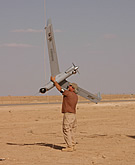
ScanEagle is a relatively low-cost robot aircraft at $100,000 a copy – but then, it was originally designed to find tuna schools not terrorists. The U.S. Marine Corps is currently using an upgraded version of the aircraft in Iraq, where its performance in Fallujah and along the Syrian border has drawn interest from other services and a recent $14.5 contract from the U.S. Navy.
The Marines already use the Pioneer UAV (Unmanned Aerial Vehicle) and have access to other UAV information via man-portable Dragon Eye systems et. al. The ScanEagle’s combination of range, long loiter time, and small logistical and operational footprints makes it somewhat unique. Unlike the much larger Pioneer, which requires a runway, C-130s to transport the system, and a large logistical “tail” of technicians, operator, and maintenance, the ScanEagle requires just a few people and the aircraft, launch system, skyhook, et. al. can be carried in just four HMMWV jeeps. Unlike the smaller Dragon Eye, this 4-foot aircraft with a 10 foot wingspan can keep its sensors on target for 10-15 hours without requiring an operator to control it.
The Marines contracted with Boeing for the militarized version of ScanEagle in June 2004, along with some contractors to run it. Four Boeing employees answered the call, and ScanEagles were soon flying preparatory reconnaissance missions for Operation Al Fajr, the joint forces’ September assault on Fallujah.
The ScanEagle is described as a “launch-and-forget” system, guiding itself by GPS to an specific area and loitering in a designated area of interest until it’s time to come home. Its upgraded electro-optical or infrared cameras have enough definition to identify individuals and show if they are carrying weapons, then provide specific targeting coordinates via the Global Positioning System. The system can also track moving targets, and offers commanders at several different levels real-time video of the area under surveillance. A catapult launches the 40-pound aircraft, which was originally designed by Insitu Group to be launched and recovered by tuna boats; the aircraft operates autonomously, and can stay airborne for 10-15 hours. Future planned variants will have an endurance of more than 30 hours. At the end of the mission, GPS guidance brings it home and it’s retrieved with a skyhook where the UAV catches a small, suspended rope.
In addition to improved sensors, several modifications have been made to improve the militarized ScanEagle’s performance and survivability. For instance, the mufflers have been pointed up so that the enemy couldn’t track the aircraft by sound. Nevertheless, it is audible and some Marines have noted that the slow buzz of its two-cycle engine can be enough to keep potential terrorists off the streets all by itself. The Marines operate the aircraft at a very low altitude and lost only one to enemy fire during the weeks of intelligence gathering leading up to Operation Al Fajr.
But its real worth was giving Marines a real-time picture of the enemy and helping them close with and kill insurgents without becoming casualties.
“ScanEagles’ imagery gives the Marines an idea of how to attack,” said Staff Sgt. and intelligence analyst Aracely J. Dewald of VM-22. “We provide an overhead picture to prepare the troops, and a better view of what is coming.”
* U.S. Marine Corps – ScanEagle patrols Iraq: VMU-2 deploys unmanned system
* American Forces Information Service: ScanEagle Proves Worth in Fallujah Fight