

(click to view full)
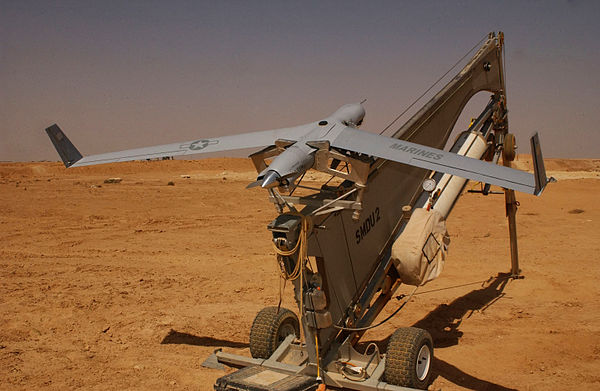
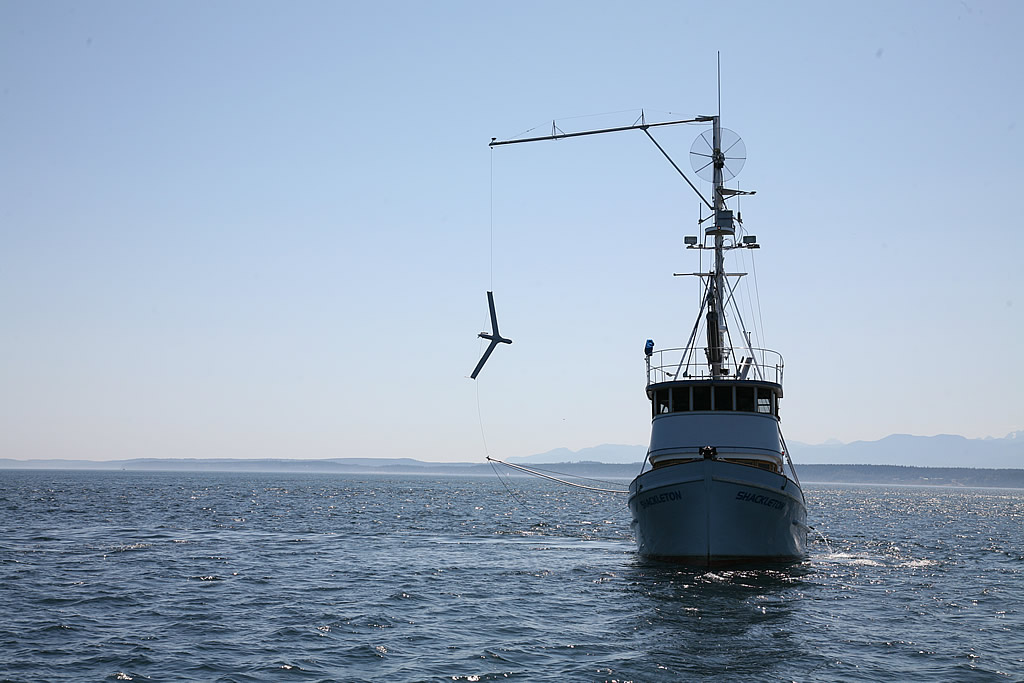
ScanEagle’s base Insight UAV platform was originally developed by Washington state’s Insitu, Inc. to track dolphins and tuna from fishing boats, in order to ensure that the fish you buy in supermarkets is “dolphin-safe”. It turns out that the same characteristics needed by fishing boats (able to handle salt water environments, low infrastructure launch and recovery, small size, 20-hour long endurance, automated flight patterns) are equally important for naval operations from larger vessels, and for battlefield surveillance. A partnership with Boeing took ScanEagle to market in those fields, and the USMC’s initial buy in 2004 was the beginning of a market-leading position in its niche.
This article covers recent developments with the ScanEagle UAV system, which is quickly evolving into a mainstay with the US Navy and its allies. Incumbency doesn’t last long in the fast-changing world of UAVs, though. Insitu’s own RQ-21 Integrator is looking to push the ScanEagle aside, and new multiple-award contracts in the USA are creating opportunities for other competitors. Can Insitu’s original stay strong?
The ScanEagle Family
(click for alternate view)
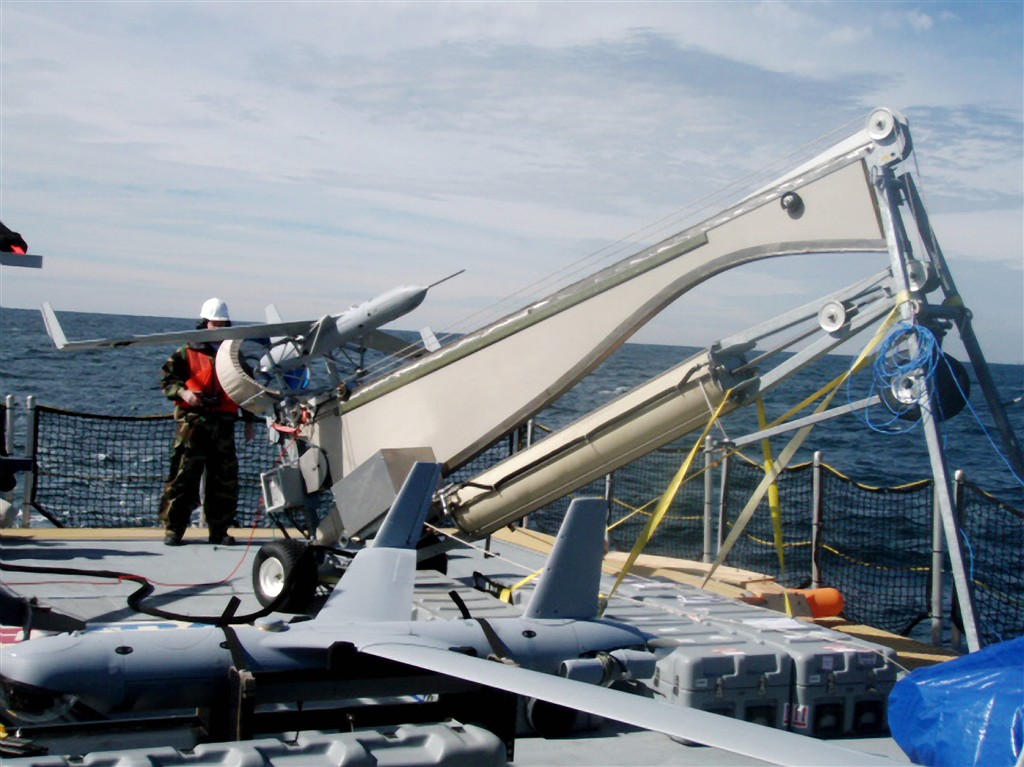
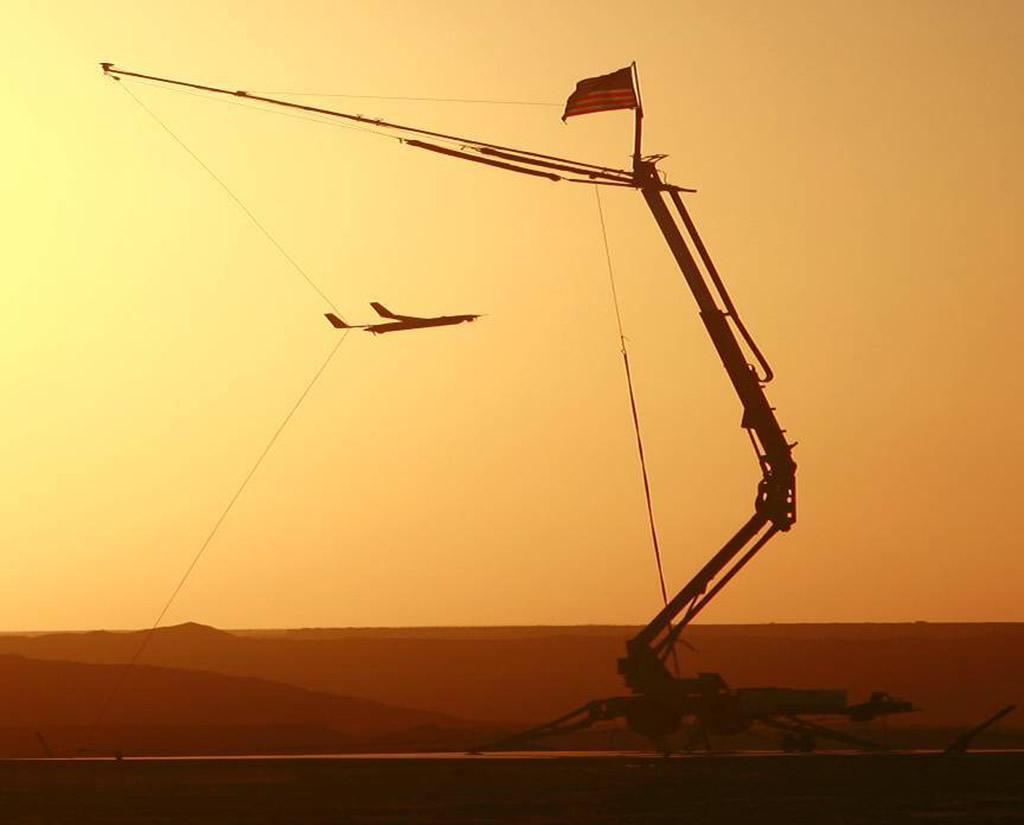
The ScanEagle is solidly based on Insitu’s original “Insight” platform, with different variants distinguished by their payloads and accompanying equipment rather than their aerodynamic design. The UAVs are launched by catapult, and autonomously recovered using a folding “skyhook” and catch-line. These UAVs fill a niche between hand-launched mini-UAVs like Aerovironment’s RQ-11 Raven or Elbit’s Skylark I, and runway-capable tactical UAVs like Textron’s RQ-7 Shadow, Aeronautics DS’ Aerostar, or IAI’s Searcher II. Its long endurance is actually superior to its tactical UAV competitors, but its payload weight limit is significantly smaller.
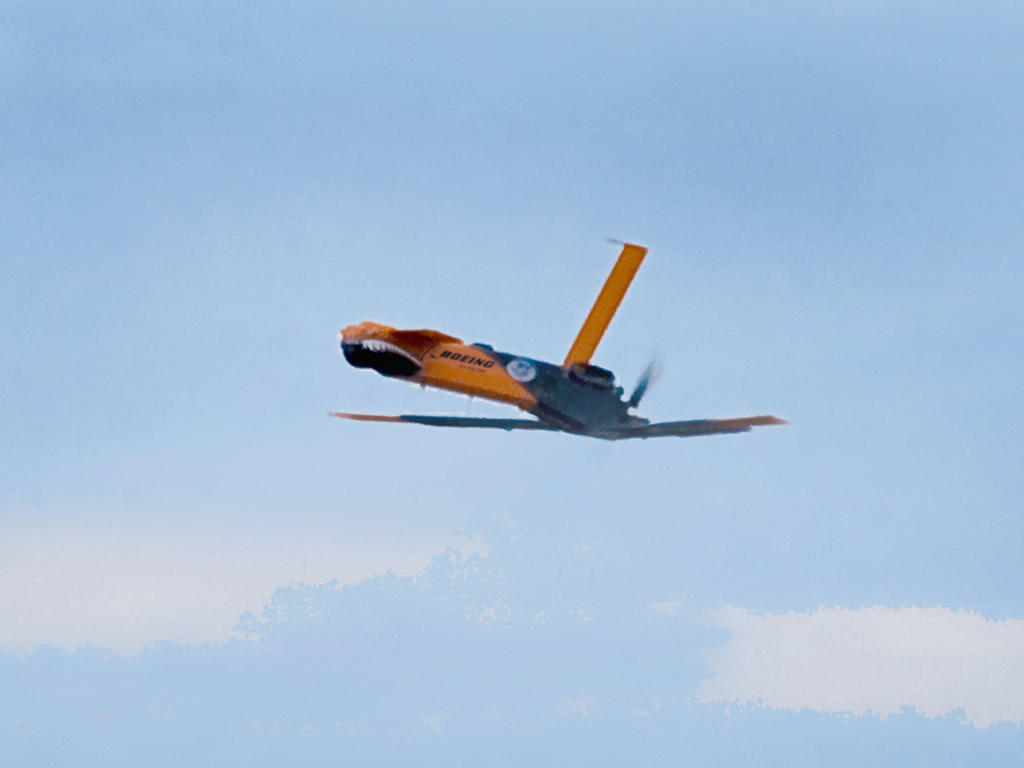
ScanEagle has been demonstrated or used from a wide variety of ship classes and types, and the family includes a number of specialty variants from sniper locator, to bio-warfare agent detection (BCAS). The base UAV has even been used successfully as a firefighting aid. A NightEagle conversion kit adds a different front end with thermal imaging sensors, and allows field conversion of ScanEagle aircraft in 2-3 hours. More drastic modifications are found in the ScanEagle Compressed Carriage (SECC), whose smaller fold-out wings allow it to be launched from an aircraft pylon, or a submarine.
[youtube:v=6wSQSDi__-Q]
click for video
In October 2014, Insitu introduced a new model, the ScanEagle 2. Compared to the original ScanEagle, v2.0’s most obvious physical difference is the payload holder at the front, which borrows from the larger NightEagle configuration and can combine day and night sensors with a laser marker. Wingspan is still about 10.2 feet, but the UAV is longer (5.1 feet to 5.6 feet) and heavier (base weight rises, payload beyond the sensor set rises from 7.5 to 7.7 pounds, max. takeoff weight rises from 48.5 to 51.8 pounds). Speed is unaffected (50-60 knot cruise, max. 80 knots), but endurance drops from 24 hours to just 16 hours for ScanEagle 2.
In Exchange, ScanEagle 2 features the first reciprocating internal combustion propulsion system designed and manufactured specifically for small UAVs, with real-time diagnostics built in. Inside, the UAV has an Ethernet-based architecture, a fully digital video system, upgraded navigation systems, and improvements that reduce electromagnetic interference to enable more sensitive payloads. Electric power available to those payloads rises from 60W to 100-150W.
ScanEagle 2 uses the same Mark 4 catapults, SyHook recovery system, and Insitu Common Open-mission Management Command and Control (ICOMC2) as the RQ-21 Integrator/ Blackjack.
(click for alternate view)
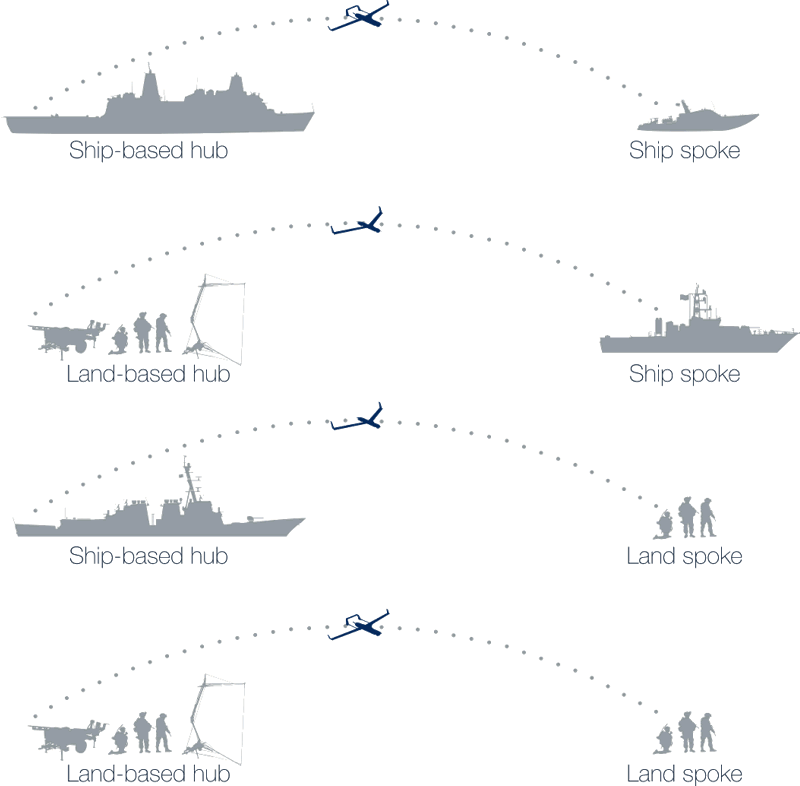
The ScanEagle family’s combination of versatility, long endurance, and small size appears to be succeeding in the global defense marketplace, without really impairing the market for tactical UAVs.
Boeing has had field representatives in theater for a few years now to support and operate the ScanEagle UAV from ships and ashore, receiving high battlefield praise and a fairly regular stream of contracts from the USA and Australia. Canada and Malaysia have also signed on for battlefield surveillance services, the Colombian, Iraqi, Tunisian, and UK Royal navies are using ScanEagle, and so are the Czech Republic, Italy, Lithuania, Poland, Romania, Singapore, and Yemen. The Dutch are using ScanEagle as an interim UAV, Japan is testing it, and other customers wait in the wings. Reported interest includes France, Pakistan, Kuwait, and other Gulf States.
Competition from Without – and Within

(click to view full)
The UAV field continues to change quickly. The latest US Navy ISR contract will have ScanEagle competing against the Aerosonde-G for naval buys of UAV services, and against both AAI’s Aerosonde G and Arcturus’ T-20 for land-based surveillance missions. SOCOM’s MEUAS contracts have also become a de facto competition with AAI’s Aersonde.
Insitu’s flagship product will also have to contend with an internal competitor. The firm has begun to offer a next-generation “Integrator” platform, which was picked as the US Navy and Marine Corps’ next-generation RQ-21A Blackjack Small Tactical Unmanned Aircraft System (STUAS-II). It’s also reported that service contracts with other countries will begin incorporating the RQ-21, either as a main UAV or as a switch-in option.
The RQ-21A Integrator boosts endurance to over 24 hours, and raises maximum payload to about 50 pounds / 23 kg. Wingspan rises to 15.8 feet/ 4.8m, and body length rises to 7 feet/ 2.1m. Its sensor package will be a bit more versatile, too, with TV zoom and mid-wave infrared cameras, plus an infrared marker and a laser rangefinder (but not, yet, a target designator), all in a single package instead of the original ScanEagle’s swap-in options. Launch and recovery methods are the same as the ScanEagle’s, and use the same Mark 4 and ICOMC2 equipment.
Integrator will not be covered in this article except for contracts that shift away from the ScanEagle to the new platform, and equally significant milestones that affect ScanEagle’s future.
Contracts and Key Events: 2008 – Present
[youtube:v=26NNrKpl8Kk]
Unless otherwise noted, contracts are issued by the Naval Air Systems Command in Patuxent River, MD. As of July 2008, Insitu Inc. is a Boeing subsidiary. Note that RQ-21A Integrator contracts won’t be covered here, unless they have a substantial impact on the ScanEagle’s future.
FY 2016 – 2024

(click to view full)
April 12/24: Insitu Inc. won a $84 million modification, which increases the contract ceiling to procure six RQ-21A and 20 ScanEagle unmanned air vehicles (UAS) including payloads and turrets; support equipment; spares and special tooling. Additionally, this modification procures services to include training, site surveys, engineering and technical and repair of repairable in support of the RQ-21A Blackjack and ScanEagle UAS platforms. Work will be performed in Bingen, Washington (88%); and various locations outside of the continental U.S. (12%), and is expected to be completed in June 2026. No funds will be obligated at the time of award; funds will be obligated on individual orders as they are issued. Naval Air Systems Command Patuxent River, Maryland, is the contracting activity.
September 16/22: Blackjacks And ScanEagles The Navy awarded Insitu a $191.8 million modification, which procures 13 RQ-21A Blackjack air vehicles, 25 ScanEagle air vehicles, 48 RQ-21A and ScanEagle payloads and turrets, support equipment, spares and sustainment spares and tools in support of RQ-21A Blackjack and ScanEagle unmanned aircraft platforms for the Navy, Marine Corps, and Foreign Military Sales customers. Work will take place in Washington. Estimated completion will be in June 2026.
July 21/22: Software Insitu won a $160 million deal, which provides training, test and engineering, development of engineering change proposals, operations support, organizational level maintenance, field service representatives, land and ship surveys, hardware site activations, hardware installs, repairs, and development of noncommercial software and data in support of RQ-21A Blackjack and ScanEagle unmanned aircraft platforms. Estimated completion will be in June 2026 Work will take place in Washington.
October 15/21: From US To Philippines The US government has given four ScanEagle unmanned air vehicles to the Philippine Air Force on October 13. The ceremony was attended by Chargé d’Affaires, ad interim (CDA) Heather Variava and Commander of US Indo-Pacific Command Adm. John Aquilino. Representing the Philippine government at Clark airbase was Secretary of National Defense Delfin Lorenzana and Philippine Air Force Commanding General Lt. Gen. Allen Paredes.
June 22/21: Support Insitu won a $12.5 million modification, which increases the ceiling to provide additional air vehicles, support equipment and spares in support of the RQ-21A Blackjack Unmanned Aircraft Systems (UASs) and ScanEagle UAS for the Navy and Foreign Military Sales customers. The Blackjack can be deployed in persistent maritime and land-based tactical intelligence, surveillance and reconnaissance, data collection, target acquisition and dissemination missions. ScanEagle has a range of 1,500km and an endurance of more than 28 hours. The air vehicle can operate at speeds between 80km/h and 126km/h and the cruise speed is 90km/h in level flight.
November 26/18: MEUAS / ISR The US Special Operations Command is modifying a contract with Insitu. The additional $18 million cover mid-endurance intelligence, surveillance and reconnaissance services under the MEUAS 1.5B program. Insitu will use its ScanEagle as an advanced intelligence, surveillance and reconnaissance (ISR) solution in order to provide the US military with the capability to effectively execute a number of deployment operations. The ScanEagle is an unmanned aerial vehicle that can hover over areas for over 24 hours at a maximum altitude of 19,000 feet and carry several kinds of sensor payloads and other equipment. The modification increases the ceiling value of the contract to $250 million in an attempt to bridge gaps in ISR services as orders transition to MEUAS III.
September 19/18: Integrator ER UAV manufacturer Insitu is currently pitching a new variant of its RQ-21A Integrator to the US Air Force. The Integrator ER is a medium-altitude UAV that will have either an endurance of 10h on station after traveling 200nm or or 6h on station after having traveled 300nm. During an Air Force conference, Esina Alic, Insitu president and CEO, said the UAV can be controlled at greater distances using a jam-resistant satellite link, instead of a line-of-site radio link, which typically limits small UAVs to ranges of 50nm to 70nm. The body of the Integrator-ER is based on the company’s Blackjack system, a system that is valued by the Marine Corps. Insitu is pitching it as contractor owned and operated, with roughly 12 people needed to run the system.
August 23/18: USMC The US Marine Corps is adding more unmanned aircraft systems to its inventory. Insitu is being contracted to provide the service with four Lot 2 RQ-21A Blackjack drone systems. The firm-fixed-price contract also includes the delivery of eight attrition air vehicles, of which seven are reserved for the USMC and one for Poland, which will receive the vehicle as part of a US foreign military sale. The order has a total value of $53.9 million. The Blackjack belongs to the family of Small Tactical Unmanned Aircraft Systems (STUAS). The drone can be deployed in persistent maritime and land-based tactical intelligence, surveillance and reconnaissance, data collection, target acquisition and dissemination missions. One UAS consists of five air vehicles with multi-mission payloads, two ground control stations and ancillary equipment. Work will be performed at Insitu’s facilities in Bingen, Washington and Hood River, Oregon. The systems are expected to be ready for delivery by June 2019.
August 10/18: Sustained operations The US Special Operations Command is determined to keep its incumbent MEUAS II-B program running. Insitu is being awarded a $5000 minimum, $232 million maximum additional task order for maintaining its mid-endurance unmanned aircraft systems intelligence, surveillance, and reconnaissance services. MEUAS II-B is a fee-for-service or “power by the hour” contractor-owned and operated UAV network deployed in support of SOCOM operations. The catapult-launched mid-sized ScanEagle provides SOF units on the ground with intelligence, surveillance and reconnaissance information.
July 26/18: Afghan FMS The Islamic Republic of Afghanistan is set to receive a boost to its UAV fleet as part of a US foreign military sale. Insitu Inc. is being awarded a modification to a previously issued firm-fixed-price delivery order, that provides for the production of 27 ScanEagle UAVs and 37 payloads at a cost of $10.8 million. In March Insitu had received a contract valued at over $47 million to support Afghanistan’s surveillance efforts. The payloads are housed in the nose section. The operators can swap the payloads in the field in a few minutes. The sensors installed in the turret allow the operator to track stationary or moving targets without having to re-maneuver the air vehicle. The payloads include electro-optical and infrared sensors, biological and chemical sensors, laser designators and a magnetometer for identification and locating magnetic anomalies. Work will be performed at the company’s location in Bingen, Washington, and is expected to be completed by December 2019.
July 25/18: Spares Insitu Inc. is being tapped to provide essential parts needed to keep its RQ-21A system flying. The company will procure various quantities of spare and sustainment parts in support of the UAS under this firm-fixed-price delivery order valued at $8.9 million. The RQ-21A is the Navy’s and USMC’s next generation Small Tactical Unmanned Aircraft System. The RQ-21A Integrator boosts endurance to over 24 hours and raises maximum payload to about 50 pounds. The standard payload configuration of the RQ-21A includes electro-optic imager, mid-wave infrared imager, laser rangefinder, infrared (IR) marker, and automatic identification system (AIS) receivers. The sophisticated payload allows military units to quickly address the emerging threats. Work will be performed at the company’s location in Bingen, Washington, and is expected to be completed in March 2019.
July 16/18: Scanning Indonesia The Indonesian Navy is establishing a new squadron primarily tasked with UAV maritime surveillance missions. The Skadron Udara 700 will be based in Juanda Surabaya and will operate the ScanEagle UAS. Indonesia is currently anticipating the delivery of four Insitu ScanEagle UAVs and associated equipment, from the US government. The UAVs are being provided under a grant by the US government under a capacity-building program for Southeast Asian navies known as the Maritime Security Initiative (MSI). The ScanEagle is solidly based on Insitu’s original “Insight” platform, with different variants distinguished by their payloads and accompanying equipment rather than their aerodynamic design. The UAVs are launched by catapult, and autonomously recovered using a folding “skyhook” and catch-line. The Indonesian MSI package seeks to specifically improve the country’s maritime patrol capabilities, intelligence, surveillance, and reconnaissance integration, and equipment maintenance capacity.
July 4/18: FMS to Lebanon The government of Lebanon is set to receive several UASs as part of a US foreign military sale. The $8,2 million deal between the US DoD and Insitu provides for the production and delivery of six ScanEagle UASs to Lebanon. The contract also includes related support equipment, training, site activation, technical services, and data for the government of Lebanon. One UAS typically comprises up to 12 air vehicles as well as associated pneumatic launchers and Skyhook recovery apparatus, meaning that this latest contract could cover as many as 72 ScanEagle unmanned aerial vehicles (UAVs). The ScanEagle is solidly based on Insitu’s original “Insight” platform, with different variants distinguished by their payloads and accompanying equipment rather than their aerodynamic design. These UAVs fill a niche between hand-launched mini-UAVs and runway-capable tactical UAVs. Lebanon is understood to have received an initial batch of ScanEagle UASs in 2015, although no details were disclosed at the time or since. Work is expected to be completed in June 2020.
May 9/18: Spares for the Integrator UAV manufacturer Insitu has been awarded a firm-fixed-price delivery order against a previously issued basic ordering agreement. The $11 million contract provides for the procurement of spare and sustainment parts to maintain the RQ-21A Blackjack unmanned aircraft system in support of the Marine Corps. The RQ-21A is the internal competitor to Insitu’s flagship product, the ScanEagle. The RQ-21A Integrator is the company’s next-generation UAV platform. It boosts endurance to over 24 hours and raises maximum payload to about 50 pounds. Its wingspan rises to 15.8 feet and body length rises to 7 feet. Its sensor package will be a bit more versatile, too, with TV zoom and mid-wave infrared cameras, plus an infrared marker and a laser rangefinder, all in a single package instead of the original ScanEagle’s swap-in options. Launch and recovery methods are the same on both platforms. Work will be performed in Bingen, Washington, and is expected to be completed in January 2019.
March 30/18: Dolphin hunter goes inland The US government is procuring 8 ScanEagle unmanned aircraft systems (UAS) in support of the government of the Islamic Republic of Afghanistan. Insitu Inc. has been awarded a contract valued at over $47 million. ScanEagle’s base Insight UAV platform was originally developed by Washington state’s Insitu, Inc. to track dolphins and tuna from fishing boats. Its characteristics make it equally suitable for naval operations and for battlefield surveillance. A partnership with Boeing took ScanEagle to the defense market. The ScanEagle is launched by catapult, and autonomously recovered using a folding “skyhook” and catch-line. These UAVs fill a niche between hand-launched mini-UAVs like Aerovironment’s RQ-11 Raven and runway-capable tactical UAVs like Textron’s RQ-7 Shadow. The drone can be modified to speciality variants, from sniper locator, to bio-warfare agent detection. The ScanEagle is currently in service in Canada, Malaysia, Colombia, Iraq, Tunisia, the United Kingdom, the Czech Republic, Italy, Lithuania, Poland, Romania and Singapore. The deal also includes spares, other support equipment, 17 field services representatives plus site surveys and activation teams. The majority of work (95%) will be performed in Afghanistan with the remaining 5% being completed in Bingen, Washington. Work is scheduled for completion in March 2019.
March 15/18: Scanning the Philippines The US Embassy to the Philippines has overseen the transfer of a Boeing Insitu ScanEagle Unmanned Aerial System (UAS) comprising of six drones to the archipelago nation. The transfer was overseen by US Ambassador Sung Y. Kim and Philippine Secretary of National Defense Delfin N. Lorenzana during a ceremony at Villamor Air Base, Pasay City on March 13. An Embassy statement said the package is worth $13.2 million and is financed by the Foreign Military Financing grant program. The ScanEagle system will be operated by the 300 Air Intelligence and Security Wing (AISW), out of Antonio Bautista Air Base, Palawan.
February 26/18: Scanning the Seven Seas An anonymous source in the Indonesian Navy has said the service will receive four ScanEagle unmanned aerial vehicles (UAVs) this summer, Jane’s reports. The UAVs along with their support equipment are being procured by a grant provided by the US government under a capacity building program for allied Southeast Asian navies and coastguards known as the Maritime Security Initiative (MSI), with Vietnam, the Philippines, and Malaysia also involved. The scheme aims to help boost these nation’s capabilities to defend and survey their maritime territories and economic resources, as well as allowing them to better contribute to regional maritime security.
July 28/17: Insitu has been contracted by the US DoD to deliver five ScanEagle UAS systems, along with their support equipment, operators, spare parts, site activation services and management for the operation of the UAS for the government of Afghanistan. The work will primarily be conducted in Afghanistan and Bingen, Wash. with a projected completion date of April 2018. The $19.6 million order is being covered under Afghan Security Forces funding. ScanEagles provide intelligence, surveillance, target acquisition, and reconnaissance data with high endurance of over 24 hours.
January 12/17: UAV manufacturers are off to a busy 2017, with branches of the US Armed forces commissioning new orders and sustainment works. Washington firm Insitu has been contracted $70 million for the provision of six additional Lot I RQ-21A Blackjack unmanned aircraft systems to the Navy, comprised of unmanned aircraft, ground control stations, multi-mission plug-and-play payloads, and additional supporting equipment. The Army, meanwhile, has contracted Textron to perform sustainment services for the Army’s RQ-7 Shadow tactical unmanned aircraft system. Valued at $ 206 million, Textron will provide engineering, logistics, field service operations, depot materiel repair and post-production software support to the Army’s fleet of 117 Shadow aircraft.
July 18/16: Maritime surveillance capabilities of the British Royal Navy are to experience a setback in 2017 due to budget constraints. It’s been reported that the service will lose its ScanEagle capability and Type 23 warships will not have any UAVs on board. It had been hoped that UAVs could have been procured under the Flexible Deployable Unmanned Air System (FDUAS) program but failed to secure funding in this year’s budget cycle.
April 21/16: Afghanistan’s National Army has launched its first ScanEagle unmanned aerial vehicle (UAV). The first operational site is in the often volatile Helmand province, and there will be a total of eight sites situated across the country. The systems will provide the Afghan National Army with airborne intelligence, surveillance, and reconnaissance (ISR) capabilities as it conducts security missions against militants operating within its borders.
January 22/16: The USMC has declared that the RQ-21A Blackjack UAV has achieved Initial Operational Capability (IOC) with deployment of the system to commence this summer. Formerly known as the Integrator, the Blackjack has been developed by Boeing as part of a low rate production of a small tactical unmanned air system (STUAS) for the US Navy, and uses the same same launcher and recovery system as the Scan Eagle system. One hundred systems of five vehicles each are planned for the USMC by 2017.
November 30/15: Afghanistan has ordered eight sets of the Insitu ScanEagle UAS from Boeing worth $70 million. The sets contain 65 of the ScanEagle UAVs and work is expected to be completed by 2018. Initially developed to track dolphins and tuna from fishing boats, the ScanEagle is operational in several countries and provides a range of surveillance, tracking and mapping abilities. The purchase comes at a time of increased defense spending from Kabul who has spent $1.8 billion this year. It is expected defense spending will reach $3.4 billion by 2020.
FY 2015
ScanEagle 2 unveiled.
July 27/15: Also announced on Friday, the Navy awarded a $78 million contract modification for six low rate initial production RQ-21A Blackjack UAVs. Also known as the ScanEagle, the Boeing-owned manufacturer Insitu Inc. unveiled a new version of the UAV in October last year, the ScanEagle 2. The first version has seen significant export success, in countries as diverse as Colombia, Yemen, Japan and the Netherlands, with Iran producing an unlicensed version known as the Yasir.
Oct 29/14: ScanEagle 2. Insitu unveils the ScanEagle 2 at Euronaval 2014. It features the first reciprocating internal combustion propulsion system designed and manufactured specifically for small UAVs, with real-time diagnostics built in. Inside, the UAV has an Ethernet-based architecture, a fully digital video system, upgraded navigation systems, and improvements that reduce electromagnetic interference to enable more sensitive payloads. Electric power available to those payloads rises from 60W to 100-150W.
Compared to the original ScanEagle, v2.0’s most obvious physical difference is the payload holder at the front, which standardizes on the larger NightEagle configuration that can combine day/night sensors and a laser marker. Wingspan is still about 10.2 feet, but the UAV is longer (5.1 feet to 5.6 feet) and heavier (base weight rises, payload rises from 7.5 to 7.7 pounds, max. takeoff weight rises from 48.5 to 51.8 pounds). Speed is unaffected (50-60 knot cruise, max. 80 knots), but endurance drops from 24 hours to just 16 hours for ScanEagle 2.
ScanEagle 2 uses the same Mark 4 catapults, SyHook recovery system, and Insitu Common Open-mission Management Command and Control (ICOMC2) as the RQ-21 Integrator/ Blackjack. Sources: Insitu, “Insitu Announces ScanEagle 2 – the Next Generation of the ScanEagle Platform” | Defense News, “Insitu Launches New ScanEagle 2 UAS” (incl. existing customer list).
ScanEagle 2
FY 2014
Buyers: Yemen, Iraq; Opportunities: Japan, UAE partnership, USCG; Fielding in UK Royal Navy; New CEO.
[youtube:v=YwoCiShzMwg]
click for video
Sept 29/14: Yemen. Insitu Inc. in Bingen, WA receives an $11 million firm-fixed-price delivery order from Yemen for 9 ScanEagle Electro-Optics and 3 NightEagle UAVs. This order also provides for one 12-month/3,600 flight-hour sustainment package with acceptance testing, spares, technical manuals, and training; a site activation team; field service representative; and protection for the support team. All funds are committed immediately.
Work will be performed in Bingen, WA (50%), and Sanaa, Yemen (50%), and is expected to be complete in September 2015. The US Navy’s Naval Air Warfare Center Aircraft Division in Lakehurst, NJ acts as Yemen’s contract agent (N68335-11-G-0009, DO 0007).
Yemen buys
Sept 29/14: Czech. Insitu, Inc. in Bingen, WA receives a $6.8 million firm-fixed-price delivery order from the Czech Republic for 7 ScanEagle electro-optics and 3 NightEagle UAVs, to be used by their troops in Afghanistan. All funds are committed immediately.
Work will be performed at Bingen, WA (50%), and Afghanistan (50%), and is expected to be complete in September 2015. The US Navy’s Naval Air Warfare Center Aircraft Division in Lakehurst, NJ acts as the Czech Republic’s contract agent (N68335-11-G-0009, DO 0006).
Czech Republic buys
Aug 6/14: Leadership. Insitu CEO Steve Morrow (q.v. April 28/11) is retiring, so Boeing names SVP Insitu Programs Ryan Hartman as the new President and CEO, effective immediately. Sources: Insitu, “Boeing Names Ryan Hartman Insitu President and Chief Executive Officer”.
New CEO
June 22/14: UK. The Royal Navy is now using drones from its ships on operations:
“Just 7 months after the Ministry of Defence ordered the system from Boeing Defence UK, footage released today, 22 June, shows ScanEagle taking flight from [the Type 23 frigate] HMS Somerset in the [Persian] Gulf.”
Sources: UK MoD, “Royal Navy’s new eyes in the sky”.
June 2014: USCG. The ScanEagle’s performance with the US Coast Guard may yet make it the service’s 1st ship-borne UAV, after successful drug busts aboard one of the new frigate-sized National Security Cutters:
“At a joint House Transportation and Foreign Affairs Committee hearing looking at maritime drug interdiction efforts, Adm. Robert Papp, commandant of the Coast Guard prior to his retirement in May, said the service is continuing to test ScanEagles…. The Coast Guard will pursue an acquisition program, he confirmed.”
Sources: NDIA National Defense magazine, “Coast Guard Closer to Acquiring Ship-Based Drones”.
May 13/14: Firefighter. Insitu Pacific touts a successful ScanEagle demonstration for the Australian New South Wales Rural Fire Service over the Wollemi National Park, 150 km northwest of Sydney, where fires have burned more than 35,000 hectares of bushland since December 2013.
The trial was trial a collaborative effort between Insitu Pacific and General Dynamics Mediaware, whose D-VEX next-generation video exploitation system streamed full-motion video imagery alongside geo-location information in near real time. This combination was used to monitor and report on the movement of the fire front at night, which is generally done at low altitudes that are unsafe for manned aircraft. It’s also possible to do this job using more advanced sensors on full-size UAVs like the MQ-9 Reaper, but ScanEagle is a far more affordable option. Sources: Insitu, “Insitu Pacific Demonstrates Fire Management Assistance with ScanEagle Unmanned Aircraft”.
Jan 12/14: Japan. Japan’s Maritime Self-Defence Force is looking for ways to improve surveillance, in the wake of Chinese provocations and aggressive territorial claims. Their constitution bars aircraft carriers, but they’d like to try small UAVs that can be launched from destroyers. ScanEagle is already being trialed in Japan, which makes it the natural choice if Japan wants to trial live flights during the FY 2014 budget request’s YEN 2 million research (about $23,600) research phase.
If the JMSDF goes ahead, they’ll buy up to 19 systems. Textron’s Aerosonde can offer a competitor, Northrop and Raytheon have BAT UAVs, and even Boeing has a 2nd UAV up their sleeve in the RQ-21 Integrator. Sources: Japan Times: “MSDF looks to deploy drones on destroyers”.
Jan 7/14: Iraq. Now that Prime Minister Maliki’s sectarian approach to governing has produced predictable rebellion and insurgency in Sunni areas, the USA is shipping Iraq some weapons and equipment, even as heavier equipment finds itself blocked by Sen. Menendez [D-NJ], and many other senators are voicing concerns. Army Col. Steven Warren:
“We’re expediting delivery of 10 operational ScanEagles for part of the original purchase, as well as an additional four nonoperational ScanEagles, which will be sent to help facilitate maintenance of the original 10.”
They’ll act as Iraq’s high-end UAV, compared to the 48 Raven mini-UAVs slated for delivery in the spring. Sources: Pentagon, “DOD Speeds Delivery of Surveillance Assets to Iraq” | The Daily Beast, “Congress to Iraq’s Maliki: No Arms for a Civil War”.
Nov 19/13: UAE. Tawazun subsidiary Abu Dhabi Autonomous Systems Investments (ADASI) expands on a previous marketing and training teaming agreements with Boeing Insitu (q.v. Feb 18/13, Nov 15/11), and taken the next step: they’ll be able to operate and maintain Boeing’s ScanEagle and its larger Integrator UAVs as a service for the UAE military, and for “neighbouring allies.” That gives them complete service authority with the UAV, from marketing, to training, to operation.
ADASI aren’t newcomers to the UAV world. Under the UAE’s Al Sabr program, the firm performed final assembly of the country’s Schiebel S-100 Camcopter small helicopter UAVs, have been conducting R&D to expand the VTUAV’s range of carrying platforms, and service the UAE’s fleet. Sources: ADASI release, Nov 19/13.
FY 2013
SOCOM MEUAS contract; UK buys ScanEagle; Japan begins trial; Iran copies it from crashed UAVs; Kestrel agreement solidifies moving target detection; Sensor cueing from land robots; Launch & recovery improvements.
(click to view full)
Sept 17/13: Poland. Insitu Inc. in Bingen, WA receives $7.3 million for a firm-fixed-price delivery order covering ScanEagle system hardware repairs and modifications for Poland. It includes spares, operations and maintenance training, and technical UAS publications.
Work will be performed in Bingen, WA and is expected to be complete in September 2014. US Naval Air Systems Command in Patuxent River, MD acts as Poland’s agent within the FMS framework (N00019-12-G-0008, #0016).
Sept 16/13: SOCOM. A maximum $300 million, 3-year firm-fixed-price, indefinite-delivery/ indefinite-quantity contract for ScanEagle UAVs, operator services, and maintenance services in support of US SOCOM’s naval special warfare operators.
Work will be performed in Bingen, WA, and the contract will run until September 2016. $85 million in operational and supplemental/OCO funds are committed immediately, and will expire by Sept 30/13. Interestingly, the Pentagon says that the “contract was not competitively procured pursuant to FAR 6.302-1,” which is the “only 1 responsible provider” exemption. That significant language, because Textron subsidiary AAI’s Aerosonde 4.7G won the MEAUS-II competition (q.v. March 5/12). ScanEagle pushed back in with a $190 million, 25-month “unusual and compelling urgency” MEAUS contract in February 2013, and this award appears to firmly nail down its position as SOCOM’s go-to UAV (N00019-13-D-0016).
US SOCOM
July 26/13: FAA. The US Federal Aviation Administration issues its 1st UAV Restricted Category Type Certificates, which include the ScanEagle X200. A “major energy company” wants to fly ScanEagle in international waters off of the Alaska coast, surveying ocean ice floes and migrating whale patterns, in order to assess potential Arctic oil exploration areas.
Experimental Airworthiness Certificates have been used for non-government UAV operations in the past, but they don’t allow commercial use. The FAA says that US military acceptance of the ScanEagle and Puma designs was an important factor in granting the new Restricted Category certificates, which do allow commercial operations.
That’s going to be a hotter area for UAV manufacturers over the next few years, and for the FAA as well. The Federal Aviation Administration Modernization and Reform Act of 2012 mandated that the FAA integrate UAVs into domestic airspace by 2015, but a key deadline establishing 6 pilot sites by August 2012 wasn’t met. These type certificates are a small step forward, within a larger framework. Sources: US FAA | NDIA’s National Defense magazine | Seattle Times.
(Restricted) Commercial USA in USA
July 12/13: Industrial. Insitu breaks ground on a new 120,000-square-foot production facility near its headquarters in Bingen, WA. The building is expected to be done in August 2014. Sources: Insitu, July 12/13 release.
July 2/13: USCG. The Coast Guard has been pondering its UAS options and requirements for years (vid. Dec 1/09 entry). They recently completed the 2nd of 3 planned demonstration phases. They used a ScanEagle during a 2-week deployment aboard the Bertholf cutter. That led to 90+ hours of flight time, during which the UAV helped with a the interception of a cocaine-loaded vessel. That gave them the opportunity to test the daytime camera, the combination electro-optical/infrared camera, and auto detection software.
The 3rd phase will gather quantitative data aboard a National Security Cutter in early 2014. USCG.
June 20/13: Britain. The Royal Navy signs a GBP 30 million (about $46.9 million) contract to buy ScanEagle UAVs, for use from Royal Fleet Auxiliary ships like the Bay Class amphibious landing ships, as well as surface combatants like Britain’s frigates, destroyers, and helicopter carriers. This is the Royal Navy’s 1st sea-launched UAV, and it will be a big help to a fleet whose number of ships has dwindled, even as it abandoned maritime patrol aircraft.
ScanEagles can also serve as targeting assets for the Royal Marines, and for Navy ships if Britain buys naval weapons that use laser precision guidance. Raytheon’s new Excalibur laser/GPS guided shell is one such naval option. MBDA’s proposed maritime adaptation of the British Army’s Fire Shadow loitering missile is another. UK MoD.
Britain’s Royal Navy buys in
May 14/13: Japan. Insitu Pacific delivers a ScanEagle Unmanned Aircraft System (UAS) to its partner Mitsubishi Heavy Industries (MHI) of Japan, for a 12-month operational evaluation by the Japanese Ground Self Defence Forces (JGSDF, see July 11/12 entry). Insitu.
April 24/13: OEF, etc. A $7.8 million firm-fixed-price contract modification to exercise an option for ScanEagle/ Nighteagle services until March 2014, in Afghanistan and around the world. $3.6 million is committed immediately.
Work will be performed in Bingen, WA, using FY 2013 Navy wartime supplemental operations and maintenance funds (N00019-11-C-0061).
April 24/13: NanoSAR next. ImSAR LLC in Springville, UT receives an $8.8 million cost-plus-fixed-fee contract modification, for “research services in support of the ultra-small aperture radar” (q.v. May 29/12 entry). This brings the contract’s cumulative value to $32.8 million.
ImSAR are the makers of the NanoSAR and Leonardo radars. US Army Contracting Command in Natick, MA manages this contract (W911QY-12-D-0011, 0006).
March 8/13: OEF. Insitu, Inc. in Bingen, WA receives a $7.8 million firm-fixed-price contract modification, exercising an option for ScanEagle operational and maintenance services in Afghanistan, including both day and night operations.
Work will be performed in Bingen, WA, and is expected to be complete in January 2014. $3.6 million is committed immediately, all of which will expire at the end of the current fiscal year on Sept 30/13 (N00019-11-C-0061).
Feb 18/13: UAE. Boeing broadens their ScanEagle support and sustainment agreement with the UAE’s ADASI (vid. Nov 15/11 entry), adding marketing services within the Middle East and North Africa, training services, and the new Integrator UAV. Boeing VP Debbie Rub reiterated to Gulfnews that this is:
“Not a contract but an agreement to work together. No particular value right now but the region needs this capability so they are working together so that we can grow this sort of business. There are intensions [sic] with Adasi to establish this as the centre in the Middle East for the ScanEagle and Intergrator contracts.”
See: Boeing | Arabian Aerospace | Gulfnews.
Feb 8/13: Iranian copies. The regime’s PressTV is now showing photos of a production line for ScanEagle UAV knock-offs.
Back on Dec 17/12, Commander of the Islamic Revolution Guards Corps (IRGC) Navy Rear Admiral Ali Fadavi had said that Iran was producing copies of the ScanEagle, based on drones it had captured. The Iranian regime says a lot of things about its military capabilities, most of which are fodder only for comedians and the credulous. This report, on the other hand, was plausible.
Iran has significant aerospace reverse engineering expertise, which it has built up to keep its fleet of American fighters and helicopters in the air. They also have some UAV expertise, and Iranian UAVs launched from Lebanon have been shot down over Israel. Iranian copies may not have the same performance and features as ScanEagle, but it’s reasonable to conclude that for once, Iran is making a military claim in line with its demonstrated capabilities. Iran’s PressTV.
Feb 6/13: MEUAS, Too. Insitu Inc. in Bingen, WA receives a 25-month Mid-Endurance Unmanned Aircraft System (MEUAS) indefinite-delivery/ indefinite-quantity contract from US SOCOM, worth $1 million – $190 million. MEUAS involves contractor-owned and operated equipment on the front lines. Work will be performed in Bingen, WA, and “overseas.” US Special Operations Command at MacDill AFB, FL manages the contract (H92222-13-D-0005). FBO.gov justifications for the award shed some light on the contract, which is pursued under FAR 6.302-2, “Unusual and Compelling Urgency”:
“Due to unforeseen circumstances beyond the Government’s control, there is an immediate requirement to mitigate a critical ISR services gap. This proposed contract action is to ensure continued operational capability.”
The interesting question is whether this new contract also provides for RQ-21 Integrator services, to match the USMC’s new STUAS-II UAV buys. Insitu was asked, but said that they were unable to comment. Meanwhile, there has also been a steady expansion and extension of Insitu’s original H92222-09-D-0015 MEUAS ScanEagle contract, when it became clear that its $250 million would run out long before April 27/14. FBO.gov announced on Feb 7/13 that:
“Program efforts were initiated in October 2010 to establish the competitive follow-on MEUAS II contract. A Justification and Approval (J&A) document was approved on 10 June 2011 to increase the existing contract ceiling by $50,000,000 for a revised contract maximum of $300,000,000. This allowed for the continuation of mission essential operations during the source selection process of the MEUAS II follow-on requirement. A second J&A was approved and issued on 16 July 2012. This action increased the contract maximum by $35,000,000 for a revised contract maximum of $335,000,000. This was to assure continuous operational capability during the transition from the MEUAS contract to the MEUAS II [won by AAI’s Aerosonde UAV] …. [Now we’re announcing a raised] dollar ceiling of the MEUAS contract (H92222-09-D-0015) by $10,000,000 for a revised contract maximum of $345,000,000.”
Bottom line? MEUAS could end up being worth as much as $535 million to Insitu, more than double its original amount. From the government’s point of view, it now has 2 MEUAS vendors, with contracts that will both expire in March 2015. FBO.gov re: Revised Contract | FBO.gov re: revised contract maximum | Insitu.
US SOCOM MEUAS
Nov 16/12: OEF. Insitu Inc. in Bingen, WA receives a $12.1 million firm-fixed-price contract modification for pre and post deployment operations and services involving ScanEagle UAVs in Afghanistan. The contract mentions both electro-optical and mid-wave infrared imagery, and in 2013 the new MWIR/EO turret will let the company offer both of those options, without requiring the UAV to land and switch (q.v. Aug 7/12 entry).
Work will be performed in Bingen, WA, and is expected to be complete in August 2013. All contract funds will expire at the end of the current fiscal year, on Sept 30/13 (N00019-11-C-0061).
Nov 16/12: AOL Defense calls attention to Insitu’s business model of providing turnkey services, as the US military prepares to cut in-theater deployments and surveillance, standardize its UAVs, and bring operations and maintenance in house.
Meanwhile, the civilian market isn’t ready yet. That’s partly because of issues around certification in civil air space, and partly because all Insitu UAVs must be sold as weapons through the USA’s ITAR process. As an example, oil companies who want to use ScanEagle are told that they can’t have any non-US citizens aboard the operating platform. Things are going well in Australia with government agencies and civil fight authorities, but that won’t be enough.
Insitu is trying to get a version of the ScanEagle designated as a commercial commodity, and they estimate that the RQ-21A Integrator program will be worth $500 million over 10 years. Even so, AOL Defense is probably right that the Boeing subsidiary is about to take a financial hit.
Oct 30/12: UAV + UGS. Insitu Pacific in Queensland, Australia announces that integration between ScanEagle and McQ’s iScout Unattended Ground Sensor (UGS)/ OmniWatch technologies is complete. McQ’s UGS is in widespread service with the U.S. Department of Defense, Department of Energy and “a range of international customers.”
The project enables UGS target detection alerts to be automatically displayed within ScanEagle’s Insitu I-MUSE multiple UAS controller software. The iScout sensor automatically sends a notification to I-MUSE, displaying the target location, detection type (seismic, magnetic, acoustic or infrared) and other relevant information. The operator is then able to automatically focus the ScanEagle’s sensors on the new contact to verify the data provided by iScout and OmniWatch, and to continue to track the target once it has moved beyond the OmniWatch camera range. Insitu.
Oct 23/12: Kestrel agreement. Insitu Inc. announces a long-term licensing agreement with Sentient in Melbourne, Australia, to integrate Kestrel land and maritime automated detection software into Insitu’s ScanEagle and Integrator systems.
Kestrel software is currently deployed as a separate add-on that specializes in detecting moving targets within the field of view of the UAV’s electro-optical (EO) and infrared (IR) sensors. There are land and maritime versions, which have been used by the U.S. and its allies in Iraq and Afghanistan. Insitu | Sentient.
Kestrel MTI agreement
Oct 10/12: Compact CLRE. The US Office of Naval Research is funding tests of the ScanEagle Compact Launch and Recovery System (CLRE), which combines the Skyhook recovery system with a compressed air launcher for the UAV. The end result is more compact than the traditional piston launcher/ skyhook combination, which is a big advantage for smaller boats and ships. ONR adds that:
“The system currently is trailer mounted for testing and ease of towing behind ground vehicles, but Insitu is exploring modifications of this version for rapid deployments. Its turntable base allows for mounting to a variety of integration structures.”
2012
New USN contract introduces competition, but assures ScanEagle’s future; Key US SOCOM loss; Wins in Singapore & Malaysia; Dutch buy ScanEagle services, but look to Integrator; Japanese evaluation; Integrator gets closer; Research into new tiny ground-scanning radar.
(click to view full)
Sept 26/12: Upgrades. Boeing subsidiary Insitu, Inc. in Bingen, WA receives a $12.4 million delivery order for the hardware required to modernize the ScanEagle and its ancillary equipment. See Aug 7/12 for more details of what the upgrades entail; the hardware contract also includes replacements, using upgraded air vehicles and components.
Work will be performed in Bingen, WA, and is expected to be complete in May 2013. All contract funds will expire at the end of the current fiscal year, which is almost immediately. The Naval Air Systems Command, Patuxent River, Md., is the contracting activity (N00019-12-G-0008).
Sept 17/12: OEF. Insitu Inc. in Bingen, WA receives a $7.7 million firm-fixed-price contract modification for pre and post deployment operations and services involving ScanEagle UAVs in Afghanistan. The contract mentions both electro-optical and mid-wave infrared imagery, and in 2013 the new MWIR/EO turret will let the company offer both of those options, without requiring the UAV to land and switch (q.v. Aug 7/12 entry).
Work will be performed in Bingen, WA, and is expected to be complete in August 2013. All contract funds will expire at the end of the current fiscal year, on Sept 30/12 (N00019-11-C-0061).
Aug 21/12: OEF. Insitu in Bingen, WA, is awarded a $23.4 million firm-fixed-price contract modification for additional ScanEagle operations and maintenance in Afghanistan, using both daytime EO and IR night sensors. Work will be performed in Bingen, WA and is expected to be complete in August 2013 (N00019-11-C-0061).
Aug 9/12: Netherlands. A Dutch ScanEagle is launched on its first anti-piracy operation in the Gulf of Aden, from the amphibious ship HNLMS Rotterdam. The LPD embarked the UAVs, catapult, and command station, plus a 19-soldier Army contingent. Dutch MvD [in Dutch].
Aug 8/12: Comms. relay. Boeing touts a smaller, lighter version of its Tactical Compact Communications Relay (TCCR). The 1.6-pound TCCR extends the range of line-of-sight military handheld radios from under 10 nautical miles to more than 150, and has been operating in Afghanistan. The new 1-pound version does the same, and will fit into a 5″ x 5″ x 1″ slot in the ScanEagle’s payload bay.
The new TCCR has been tested on several other UAVs, including the Schiebel Camcopter S-100, and Boeing plans to demonstrate a civilian set that could support emergency response or other commercial applications.
Aug 7/12: Netherlands. Insitu Inc. announces that the Dutch military can now fly the ScanEagle under a limited military aircraft type-classification certificate from the Military Aviation Authority (MAA) of the Netherlands.
The Dutch needed that, because they intend to operate the UAVs over their own country as well as abroad. Both sides were motivated, so the certification milestone was achieved in just 4 months. Note that this isn’t a full civilian certification, but it will definitely help. Insitu.
Aug 7/12: Sensors. Insitu Inc. announces that it’s conducting field evaluations of 2 new turrets for ScanEagle. Both turrets will be available in the first half of 2013, and better power draw will help make switch-ins easier.
The new Hood Technology Corp. Vision MWIR/EO turret means customers won’t have to choose any more between zoom cameras or mid-wave infrared thermal imaging on their ScanEagles. Insitu’s larger RQ-21A Integrator was already offering both modes, and competitive pressure makes it an important advance.
Hood’s SuperEO turret has already been in service for about a year, providing 5x better stabilization than its predecessor. The newest SuperEO Enhanced turret lets operators track, zoom and focus while maintaining positive identification, thanks to a sophisticated gimbal mechanism and a picture-in-picture display. Losing the target of interest when the camera moves has long been an annoying problem for many UAVs, especially small ones.
July 12/12: Australia. The Army’s contract for ScanEagle services has ended, but the Navy is interested. Insitu Pacific in Queensland, Australia is still using the Army’s contract, just extended and expanded to include trials with the Royal Australian Navy (RAN). ScanEagle will be installed on a number of RAN vessels, and a first-of-class flight trial from a Frigate is expected in September 2012.
The RAN’s endorsed Aviation vision, NA2020, is to have a UAS dedicated unit by 2020. That’s awfully slow, given the pace of change, but the embarked trials will begin moving them in that direction. As American experiences have shown, UAVs as a service can work as a shipboard offering. If the RAN decides to adopt ScanEagle as an “interim UAV” service, there would be almost no changes from the arrangement it has just signed. Insitu.
RAN extends Army deal
July 11/12: Japan. Insitu Pacific in Queensland, Australia announces a contract from Mitsubishi Heavy Industries, Ltd. (MHI), to deliver ScanEagle systems for comprehensive operational evaluation by the Japanese Ground Self-Defense Force (Army).
It’s more than just an evaluation, as the ScanEagles will be operated by the JGSDF during this period to assist in disaster recovery, as well as intelligence, surveillance and reconnaissance (ISR) missions. Having said all that, it isn’t a long-term win yet, either.
July 9/12: Singapore. Insitu Pacific in Queensland, Australia announces a contract from the Republic of Singapore Navy (RSN), to equip its 6 Formidable Class (Lafayette Class derivative) missile frigates with ScanEagle systems. Insitu Pacific will also provide training, logistics and ship installation, as well as specialist in-country maintenance support.
This decision has been a while in coming, vid. the March 2/09 entry detailing ship trials. Insitu.
Singapore
May 29/12: NanoSAR next. ImSAR LLC in Salem, UT receives a $24 million firm-fixed-price and cost-plus-fixed-fee contract to build, test, and assess a lightweight ultra wideband Synthetic Aperture Radar for use on small unmanned aerial vehicles. ImSAR makes the NAnoSAR, and this looks like the contract to develop its successor.
Work will be performed in Salem, UT with an estimated completion date of May 31/17. One bid was solicited, with one bid received by US Army Contracting Command in Natick, MA (W911QY-12-D-0011).
May 20/12: Iraq? Reuters confirms that Iraq will be using UAVs to protect its southern port and associated oil platforms. The logical candidate is Insitu’s ScanEagle, which is already operating in this role (vid. Feb 9/12 entry):
“Iraq’s navy has purchased US drones to protect the country’s oil platforms in the south, from where most of Iraq’s oil is shipped,” said an official from the Office of Security Cooperation in Iraq, which is part of the US embassy. The OSCI did not give further details of the number or type of unmanned aircraft. But Iraqi security officials confirmed plans to use drones to protect oil infrastructure.”
Iraq?
May 15/12: Insitu, Inc., Bingen, WA receives a $35.5 million firm-fixed-price contract modification for additional ScanEagle and NightEagle services in Afghanistan.
Work will be performed in Bingen, WA, and will run to December 2012. All Contract funds will expire at the end of the current fiscal year, on Sept 30/12. US Naval Air Systems Command in Patuxent River, MD manages the contract (N00019-11-C-0061).
May 4/12: Over in Australia. The ScanEagle has made its last flight for Australia, and its leased services are being replaced with Textron’s RQ-7B Shadow UAVs bought under Project JP129.
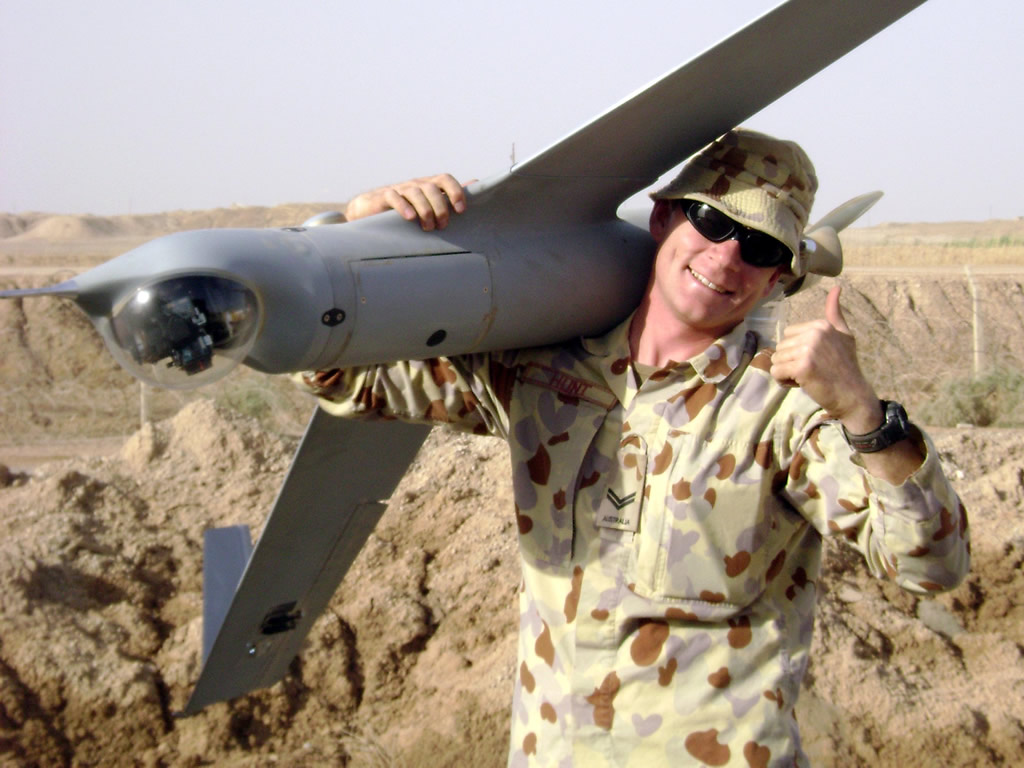
While Boeing contractors provided assistance and operational services, about 180 Australian Defence Force personnel deployed in support of the ScanEagle, mostly from 20th Surveillance and Target Acquisition Regiment, with elements from 16th Air Defence Regiment, Defence Imagery and Geospatial Organisation, 1st Topographic Survey Squadron and 16th Aviation Brigade. During its 5 years in operation in Afghanistan, ScanEagles flew about 32,000 hours in more than 6,200 missions. Australian Army | Ottawa Citizen.
April 17/12: Malaysia. Insitu Pacific and Composites Technology Research Malaysia (CTRM) announce a contract for Insitu Pacific to deliver its ScanEagle to CTRM, to be operated by CTRM’s subsidiary Unmanned Systems Technology (UST).
Insitu Pacific has confirmed to DID that “CTRM will utilise the ScanEagle system to augment UAS Services provided to the Malaysian Defence Forces under an existing contract.”
Malaysia
April 4/12: Hydrogen-powered. Boeing’s Insitu announces that the ScanEagle has completed a hydrogen-powered test flight, using a 1,500-watt fuel cell by United Technologies and a hydrogen fueling solution by the US Naval Research Laboratory. They add that this ScanEagle is lighter than the traditional model, which means more room for equipment. On the other hand, the release didn’t discuss the effects on range and endurance, which are more critical traits for this UAV. Earth Techling.
March 19/12: Dutch contract. Insitu announces a contract with the Dutch MvD to use its ScanEagle “both domestically and abroad.” Specifically, they’ll provide:
“…an ISR capability during the second half of 2012, replacing a program [DID: Sperwer UAVs] that ended in the middle of 2011. Looking forward, Netherlands MOD and Insitu plan to continue to explore the potential for multi-mission ISR capabilities using a next-generation Insitu UAS that carries multiple ISR sensors and enables rapid, robust payload integration.”
Which is to say, their RQ-21A Integrator platform. Both of the interim ScanEagle systems (3 UAVs each) are expected to achieve operational capability by late 2012, with 1 available for overseas deployment, and the other used for training and domestic tasks.
The permanent Sperwer replacement will involve 5 systems, by late 2014: 3 for deployment, 1 for missions within The Netherlands, and 1 for training. The RQ-21A has the required integration with ScanEagle ground systems, and has been chosen to enter service with 107 Aerial Systems Battery in 2014. Insitu | Dutch Defence Press.
Netherlands
March 5/12: MEUAS-II loss. Textron’s subsidiary AAI wins the 3-year, maximum $600 million follow-on to US Special Forces’ MEUAS contract, using its Aerosonde 4.7G UAV. Insitu’s MEUAS contract had been slated to expire in 2014, but the somewhat-imprecise wording of public statements and solicitations suggest that MEUAS-II will fully replace the old contract.
With its technology validated by 2 huge American contracts, AAI’s Aerosonde UAVs can be expected to be a much more visible competitor around the globe. Meanwhile, ScanEagle has gone from the sole-source solution in 2 major American contracts, to forced competition in UAS-ISR and an uncertain position in MEUAS. ScanEagle UAV still has important advantages in its array of specialized variants, and the larger RQ-21A Integrator UAV is on tap as a follow-on offering. Even so, the MEUAS-II setback may leave Boeing and Insitu pondering the need for further investment in, and upgrades to, their core ScanEagle platform. Textron’s AAI | UV Online.
US MEAUS-II
Feb 29/12: USN ISR. US NAVAIR issues their 5-year, $864 million UAS ISR contract, which can include services for US military allies, alongside the US Navy and Marines. Insitu submits the ScanEagle instead of the RQ-21A Integrator, and their selection as an eligible bidder for task orders would seem to protect ScanEagle’s near term future.
On the other hand, the umbrella contract introduces competition to an area that ScanEagle used to have to itself. Textron’s Aerosonde G will compete with Insitu’s ScanEagle for naval and land task orders, while Saab’s small Skeldar heli-UAV will become a 3rd competitor on land. Read “ScanEagle, Aerosonde & Skeldar: The USN’s UAS-ISR Contract, 2012-2017” for full coverage.
USN ISR
Feb 9/12: Exports. An AOL Defense report offers an expanded list of ScanEagle operators, as well as 3 more potential export clients:
“Navy leaders are considering foreign military sales of the Scan Eagle to Kuwait, Pakistan and the Netherlands, according to a presentation by Marine Corps Col. James Rector, head of the small tactical unmanned aerial systems division at Naval Air Systems Command. Aside from the U.S. Navy, the Scan Eagle is being flown by naval forces in Colombia, Tunisia, Poland and Iraq, according to PowerPoint slides from Rector’s speech at the Association for Unmanned Vehicle Systems International’s annual program review in Washington yesterday.”
The Netherlands is already using ScanEagle as an interim UAV; presumably, Dutch discussions represent long-term lease or purchase options. Previous reports have suggested that Boeing is offering ScanEagle leases with provisions to switch part-way through, and use the larger and more advanced RQ-21 Integrator platform (vid. June 16/10 entry).
Jan 25/12: NightEagle. Insitu, Inc. in Bingen, WA receives an $20 million firm-fixed-price contract modification, exercising an option for ScanEagle operational and maintenance services. These services will provide electro-optical/infrared and mid-wave infrared (NightEagle) imagery in support of Marine Corps operations in Afghanistan. Work will be performed in Bingen, WA, and is expected to be complete in May 2012. All contract funds will expire at the end of the current fiscal year, on Sept 30/12 (N00019-11-C-0061).
Jan 22/12: Closing time approaches. First flight of an Early Operational Capability (EOC) RQ-21A STUAS Integrator UAV at the USMC’s Air Ground Combat Center in Twentynine Palms, CA, 16 months after the contract is awarded. USMC UAV Squadron VMU-3 will deploy the RQ-21A within the USA, while a government-contractor team works with the system, and develops tactics, techniques, and procedures on the way to formal Initial Operational Capability (IOC), and then Full Operational Capability (FOC).
As those milestones are reached, Insitu’s ScanEagle will fade from use. US NAVAIR: “RQ-21A will eventually replace the Navy and Marine ISR services contract in which current ISR missions are conducted in Iraq, Afghanistan and shipboard.”
2011
CEO shift; Dutch pick ScanEagle; Arctic & Libyan operations; Swarm flight; Comm relay test.
(click to view full)
Nov 28/11: Insitu, Inc. in Bingen, WA receives an $12 million firm-fixed-price contract modification, exercising an option for ScanEagle operational and maintenance services. These services will provide electro-optical/infrared and mid-wave infrared (NightEagle) imagery in support of Marine Corps operations in Afghanistan. Work will be performed in Bingen, WA, and is expected to be complete in January 2012. All contract funds will expire at the end of the current fiscal year, on Sept 30/12 (N00019-11-C-0061).
Nov 15/11: UAE. Insitu Inc. announces a partnership with Abu Dhabi Autonomous Systems Investments Company (ADASI), to perform joint support and sustainment activities on Insitu’s ScanEagle and Integrator UAS.
Oct 6/11: Canada. Insitu Inc. announces that its Canadian clients have successfully used ScanEagle UAVs during Operation Nanook in Canada’s Northwest Passage. The exercise focused around an Arctic major air disaster (MAJAID) simulation, and ScanEagle was deployed by Insitu and its partner ING Engineering to identify traversable ground routes, watch for polar bear threats, and monitor day-to-day iceberg movements. Insitu and ING UAS operators launched and retrieved the aircraft, then handed control over to the Canadian Forces and stood by to provide technical assistance as needed. Commanders in tactical operations centers (TOC) at 74 degrees north and troops on the ground received real-time video.
The exercise itself is not as significant as ScanEagle’s proof of use in polar environments. Insitu | Canada DND on Operation Nanook 11 | Canada DND Nanook 2011 photos.
Sept 30/11: Insitu, Inc. in Bingen, WA received a $7.6 million firm-fixed-price contract for major end items and parts to be used in the ScanEagle system. Work will be performed in Bingen, WA, and is expected to be complete by January 2012. This contract was not competitively procured by the US Naval Surface Warfare Center Panama City Division in Panama City Beach, FL (N61331-11-C-0011).
August 15/11: Libyan operations. Insitu discusses ScanEagle’s performance over Libya, from the Arleigh Burke Flight II Class destroyer USS Mahan [DDG-72]. The operation began shortly after an Insitu team had been aboard Mahan to analyze the way ScanEagles were used, and made recommendation to expand its uses. Mahan put those suggestions into effect once Operation Unified Protector began, flying the ScanEagles in strong winds and forwarded secure imagery transmission to the task force used Boeing’s Secure Video Injection system:
“What happened over that period of time, no one expected,” said ScanEagle Detachment Officer in Charge Lt. Nick Townsend. “ScanEagle was locating contacts of interest that no one else could find. After the dust settled, ScanEagle was credited with locating a host of contacts of interest due to its ability to capture superior image quality and to operate covertly at relatively low altitudes.”… Later coordinating with an AWACS team, the USS Mahan ScanEagle team drew on ScanEagle’s 24-hour endurance to support additional phases of the mission, including battle damage assessment: ScanEagle delivered real-time, full-color imagery… “They (operational commanders) say ‘put the camera here’ and we put the camera there without going through layers of complex coordination. We get essential information directly to the decision makers fast,” said Insitu ScanEagle Site Lead Samuel Young.”
Libya experience
May – August 2011: Comm relay. Boeing announces successful May and August demonstrations of ScanEagle’s new narrowband communications relay, using an Insitu ScanEagle and AeroVironment’s Puma AE mini-UAV. During the multiservice demonstrations, held in California, the UAVs flew at a variety of altitudes while linking handheld military radios dispersed over mountainous regions, extending the radios’ range tenfold.
Larger RQ-7B Shadow UAVs have also been used in this role, but those are generally controlled at the battalion level or above. Narrowband relays small enough to work on mini-UAVs would represent an important step forward, especially for Special Operations forces.
July 7-10/11: UAV Swarm. Boeing conducts successful autonomous UAV swarm missions over the rugged terrain of eastern Oregon, using 2 ScanEagles and a Procerus Unicorn UAV from The Johns Hopkins University Applied Physics Laboratory (JHU/APL). Boeing Advanced Autonomous Networks program director and team leader Gabriel Santander described it as “a milestone in UAV flight”; in this case, that’s a reasonable label.
The JHU/APL developed the UAVs’ Mobile Ad Hoc Network and swarm technology, which let them work together to search the test area through self-generating waypoints and terrain mapping, while simultaneously sending information to teams on the ground. A broader demonstration is planned for the end of September. Boeing.
Swarm flight
June 30/11: Netherlands. The Dutch will use ScanEagle UAVs as an interim front-line replacement for Sagem’s much larger Sperwer system, which has just been retired. Dutch MvD | Aviation Week
Dutch pick
May 31/11: Insitu, Inc. in Bingen, WA received a $46 million firm-fixed-price-contract to provide deployment services and flight hours, including electro-optical/infrared and mid-wave infrared imagery in support of Marine Corps operations in Afghanistan. In practice, this means both ScanEagle and NightEagle platforms; looks like the April 9/11 short-term contract went well.
Services will encompass both operation and maintenance of the ScanEagle UAS, to provide real-time imagery and data to USMC personnel. Work will be performed in Bingen, WA and in the field, and is expected to be complete in May 2012. All contract funds will expire at the end of the current fiscal year, on Sept 30/11. This contract was not competitively procured, pursuant to FAR 6.302-2 (N00019-11-C-0061).
June 2011: Insitu’s inception. The Smithsonian Institute’s magazine profiles the story behind Insitu and the ScanEagle, as part of a feature describing the evolution of UAVs toward civilian roles. Boeing bought the firm for about $400 million, in July 2008. Read “Drones are Ready for Takeoff“.
May 26/11: Insitu, Inc. in Bingen, WA received an $83.7 million indefinite-delivery/ indefinite- quantity contract for operations and maintenance services to support government-owned ScanEagle systems, including: multiple training courses ranging from system pilot training, maintenance and operations, to mission coordinator and payload operator; multiple kits for sustainment, payload and engine module kits; and multiple spare parts.
Work will be performed in Bingen, WA, and will run until May 2012. $62.7 million will expire at the end of the current fiscal year, on Sept 30/11. There’s only one ScanEagle manufacturer, and this contract was not competitively procured, pursuant to FAR 6.302-2 (N00019-11-C-0012).
April 28/11: CEO shift. Boeing executive Steve Morrow becomes Insitu’s new President and CEO, succeeding co-founder Steve Sliwa, who retired April 1/11. That’s always a big inflection point in a company’s history.
Morrow holds a B.Sc. (electrical) Engineering from the University of South Carolina, and an M.Sc. Aeronautical engineering from the Naval Postgraduate School in Monterey, CA. He most recently served as Director, Stand-off Strike, leading long-range weapons programs including *GM-84 Harpoon and SLAM-ER missiles, the USAF’s Tomahawk ALCM, the Next Generation Cruise Missile, and Boeing’s portion of the Aegis Ballistic Missile Defense program. He joined Boeing in 2002 following his retirement as Navy program manager for Tomahawk-related programs. His Navy aviation experience came in P-3 sea control aircraft. Insitu.
New CEO
April 14/11: Insitu awards small business qualifier ArgenTech Solutions a contract to provide field service representative (FSR) services, at locations worldwide. It’s an initial 1-year contract that includes options for 2 additional years.
April 9/11: Boeing receives a $12.3 million firm-fixed-price contract modification for “additional Mid-Wave Infrared Unmanned Aerial Systems, intelligence reconnaissance surveillance services in for the 1st Marine Expeditionary Force combat missions in support of Operation Enduring Freedom.” Sounds like an order for NightEagle services in Afghanistan.
Work will be performed in Bingen, WA (65%), and St. Louis, MO (35%), and is expected to be complete in May 2011. The US Naval Air Warfare Center Aircraft Division in Lakehurst, NJ manages this contract (N00019-08-C-0050).
Feb 22/11: Boeing receives a $5.7 million firm-fixed-price indefinite-delivery/ indefinite-quantity contract modification for “additional persistent unmanned aerial vehicle intelligence, surveillance, and reconnaissance services in support of naval maritime missions.” ScanEagles featured prominently in the April 2009 rescue of an American vessel from Somali pirates, for example.
Work will be performed in Bingen, WA (65%), and St. Louis, MO (35%), and is expected to be complete in November 2011. All contract funds will expire at the end of the current fiscal year, on Sept 30/11 (N00019-08-D-0013).
2010
Polish order; New Integrator UAV for USMC; Weapons for ScanEagle?; FAA test; Heavy fuel; NanoSAR ready; ScanEagle SECC variant.
(click to view full)
Dec 30/10: Boeing receives a $14.5 million firm-fixed-price contract modification for additional “persistent intelligence, surveillance, reconnaissance unmanned aerial vehicle services in support of Marine Corps combat missions.”
Work will be performed in Bingen, WA (97%), and St. Louis, MO (3%), and is expected to be complete in February 2011. All contract funds will expire at the end of the current fiscal year, on Sept 30/11 (N00019-09-C-0050).
Dec 28/10: A $68.3 million firm-fixed-price contract for “full-motion video from commercial un-manned air intelligence, surveillance and reconnaissance platforms across Iraq. Work will be completed in Baghdad, Iraq, with an estimated completion date of Dec 31/11. The bid was solicited through the Internet with 2 bids received by U.S. Central Command in Baghdad, Iraq (M67854-07-D-2052).
Dec 3/10: Weapons? Aviation Week reports that the US Navy is working on weapons that could give even the ScanEagle UAV hunter-killer capability. The 2 pound next-generation weapon management system (WMS GEN2) has been tested in the lab, and the development team is now looking at using the WMS GEN2 with the 5 pound NAWCAD Spike mini-missile, the Scan Eagle Guided Munition (SEGM), and a GPS-Guided Munition (G2M, likely the RCFC).
Sept 27/10: Boeing in St. Louis, MO receives a $5.7 million not-to-exceed indefinite-delivery /indefinite-quantity contract modification for 2,100 hours of persistent UAV intelligence, surveillance, and reconnaissance services in support of US Navy and USMC missions.
Work will be performed in Bingen, WA (94%, Insitu subsidiary) and St. Louis, MO (6%), and the contract will end in September 2011. All contract funds will expire at the end of the current fiscal year, on Sept 20/10 (N00019-08-D-0013).
Sept 23/10: It took a while, but Boeing subsidiary Insitu, Inc. in Bingen, WA gets a $7.2 million modification to an American firm-fixed-price contract (N00019-09-C-0005), for Poland’s order of 10 ScanEagle systems. ScanEagle would join Aeronautics’ Orbiter mini-UAV and Aerostar tactical UAV, as UAVs available to Polish forces.
Work will be performed in Bingen, WA, and is expected to be complete in September 2011. $3.5 million will expire at the end of the current fiscal year. US Naval Air Systems Command in Patuxent River, MD manages the contract on Poland’s behalf. See “Polish Equipment Issues and Consequences” for more in-depth coverage of the issues and pressures behind Poland’s purchase.
Poland
Aug 24/10: NightEagle. Insitu announces that its NightEagle conversion kit is now fully integrated into combat operations after successfully completing fielding of an upgraded mid-wave infrared (MWIR) imager payload. Insitu responded to an urgent, mission-critical request, using its deployed operations representatives to beat the schedule. The new configuration consists of upgrades to ground support equipment, new software, and specialized in-field training.
NightEagle

(click to view full)
July 29/10: No ScanEagles for STUAS-II. Boeing subsidiary Insitu, Inc. in Bingen, WA wins a $43.7 million cost-plus-incentive-fee contract to provide its new Integrator UAVs under the USMC’s the small tactical unmanned aircraft system/Tier II unmanned aircraft system III (STUAS-II) competition. But the UAV that beats competitors like Raytheon’s KillerBee 4 is not a ScanEagle. Instead, it’s Insitu’s new Integrator UAV – which may herald the beginning of the end for ScanEagle. Integrator also uses catapult launch, and is recovered using the same Skyhook recovery systems as ScanEagle.
We won’t be covering other Integrator contracts in this article, just milestones that are relevant to ScanEagle’s future.
Work will be performed in Bingen, WA (46.7%), Hood River, OR (45.6%), and Melbourne, FL (7.7%). Work is expected to be completed in September 2012, but $788,931 will expire at the end of the current fiscal year, on Sept 30/10. This contract was competitively procured via an electronic request for proposals, with 4 proposals received by the Naval Air Warfare Center Aircraft Division in Lakehurst, NJ (N68335-10-C-0054). Insitu.
June 16/10: Poland. Reports surface that Poland has joined the customer list for Boeing’s leased ScanEagle UAV services, but details are scarce. At 15-20 hours endurance, ScanEagle offers longer on station time than leased Aeronautics DS’ Aerostars’ 8-12 hours. On the other hand, the Aerostar offers 110 pounds of payload, while ScanEagle offers just 13 pounds.
Shepard Group adds that Insitu has qualified a Mk4 catapult launcher, which will be compatible with both ScanEagle and Integrator, and is “ready to ship the launcher to an undisclosed customer in Afghanistan.” The Insitu spokesperson told them that around 35 ScanEagle systems of 5-10 UAVs each were operational with Australian, Canadian, Polish and US forces.
Aviation Week reports that Boeing is also in talks with a number of European countries to lease ScanEagle UAV services, with the option of an upgrade to their Insitu subsidiary’s slightly larger and more advanced Integrator UAV later on. Aviation Week | Shepard Group | StrategyPage.
June 12/10: Boeing receives a $59.5 million ceiling-priced modification to a previously awarded firm-fixed-price contract (N00019-09-C-0050) to provide 3,300 flight hours of persistent intelligence, surveillance, reconnaissance UAV services to the U.S. Marine Corps.
Work will be performed in Bingen, WA (97%), and St. Louis, MO (3%); and is expected to be complete in December 2010. $29.75 million will expire at the end of the current fiscal year, on Sept 30/10.
June 8/10: FAA tests. Boeing subsidiary Insitu Inc. signs a cooperative research development agreement with the USA’s Federal Aviation Administration (FAA), in order to guide the development of recommendations for UAV use in civil airspace. The research will be managed by the FAA’s Research and Technology Development Office and conducted at the William J. Hughes Technical Center in Atlantic City, NJ. Insitu | FAA Fact Sheet.
Insitu will provide a ScanEagle system, related support hardware and data, and UAV training for FAA pilots and maintenance staff. Insitu will also supply documentation related to ScanEagle, including an open invitation for FAA personnel to visit Insitu.
June 2/10: Canada. Insitu announces that its ScanEagle has logged more than 17,000 combat flight hours and 1,700 sorties with the Canadian Forces, as part of a “rent a drone” service operated by their Canadian partner ING Engineering. ScanEagle has been deployed with the Canadian Forces in theater since 2008 and has completed a successful maritime flight demonstration aboard the Kingston Class patrol vessel HMCS Glace Bay.
May 13/10: Insitu Inc. announces that it has demonstrated its heavy fuel engine-configured ScanEagle UAS to the U.S. Army Aviation Center of Excellence, in conjunction with the Joint Systems Integration Laboratory (JSIL). The tests at Fort Rucker, AL demonstrated interoperability between ScanEagle video with metadata and the U.S. Army’s One System Remote Video Terminal (OSRVT), a digital video encrypted data feed, a mid-wave infrared (MWIR) sensor for night scans, and Insitu’s stabilized airborne target tracking system.
May 12/10: SECC. Boeing tests its ScanEagle Compressed Carriage (SECC), whose 132-inch wingspan and folding aero surfaces let it be carried in a container and launched from an aircraft pylon, or a submarine. It’s recovered using the same SkyHook system as a regular ScanEagle.
ScanEagle SECC is powered by a 6 hp heavy-fuel engine. The test launched it from a ground vehicle, whereupon it flew an autonomous 75 minute flight plan at various altitudes, and provided streaming video to a nearby ground station. Boeing | Boeing feature w. video.
April 29/10: Insitu Inc. announces that its ScanEagle UAS recently exceeded 300,000 combat flight hours since its 1st operational flight in 2002, and accounted for approximately 22% of the 550,000 hours that American UAVs flew in 2009.
April 14/10: An $11 million modification to a previously awarded firm-fixed-price contract (N00019-09-C-0050) to provide 6,600 flight hours of persistent ISR (intelligence, surveillance, reconnaissance) unmanned aircraft vehicle services in support of naval maritime missions. Work will be performed in Bingen, WA (97%), and St. Louis, MO (3%), and is expected to be complete in June 2010. All contract funds will expire at the end of the current fiscal year.
March 16/10: Boeing subsidiary Insitu, Inc. in Bingen, WA received an $8.6 million firm-fixed-price contract for technical services, to support intelligence, surveillance, and reconnaissance services. In addition, this contract covers 6 critical spare kits and 9 SkyHook recovery system modifications.
Work will be performed in Bingen, WA, and is expected to be complete in December 2010. Contract funds in the amount of $8.4 million will expire at the end of the current fiscal year, on Sept 30/10. This contract was not competitively procured pursuant to FAR 6.302-2 (N00019-10-C-0045).
Feb 23/10: Sensors – NanoSAR. Insitu Inc. announces that after 4 years of work with ImSAR LLC and 2 years of flight testing, the NanoSAR ground-scanning radar has moved out of development, is now available as a payload for its ScanEagle dual bay and follow on “Integrator” UAVs. See May 28/08, Jan 7/08 entries.
NanoSAR
Feb 19/10: A $6.1 million not-to-exceed modification to a previously awarded indefinite-delivery/ indefinite-quantity contract (N00019-08-D-0013) to provide 300 hours of persistent UAV intelligence, surveillance, and reconnaissance services in support of naval maritime missions.
Work will be performed in Bingen, WA (65%) and St. Louis, MO (35%), and is expected to be complete in July 2010. All contract funds will expire at the end of the current fiscal year.
2009
US SOCOM MEAUS order; Canada SUAV order; Maersk Alabama rescue; E-737 AEW&C’s UAV control; ASW MagEagle?; Bandit & Enerlink datalinks.

(click for alternate view)
Dec 18/09: Bandit datalink. Boeing subsidiary Insitu Inc. announces that a flight test with L-3 Communication Systems-West’s Bandit digital data link worked “well in excess of range requirements.” Insitu is integrating the Bandit digital data link into its ScanEagle, NightEagle and Integrator UAVs. Bandit is Advanced Encryption Standard (AES) capable and ROVER 4/ 5 compatible. This test was conducted using the Integrator UAV, but tests also happened on a ScanEagle earlier in 2009.
Dec 1/09: USCG. Aviation Week reports that the US Coast Guard is still considering its UAV options:
“As part of its ongoing analysis, the service has participated in numerous exercises with other platforms [beyond the MQ-8B]… including Boeing’s A160 Hummingbird, an AeroVironment vehicle and ScanEagle tested on board a National Oceanic and Atmospheric Administration ship.”
Nov 25/09: The University of North Dakota (UND) receives its ScanEagle UAS, to be used in Department of Defense (DOD) contracted research providing data for UAS national airspace integration. UND is a designated State Center of Excellence for UAS Research, Education and Training, and funds for this project were provided by a USAF research contract. UND Associate Professor of Aviation and Director of Program Development for the UAS Center of Excellence, Douglas Marshall, in Insitu’s Press release:
“To date, the university’s only fully trained operators and maintenance technicians are UND employees and primarily flight instructors. We hope to integrate a ScanEagle system into our curriculum and allow students to fly the system against a radar test bed, while learning to operate the UAS itself.”
Nov 24/09: Canada. Boeing subsidiary Insitu Inc. announces a successful ScanEagle flight demonstration aboard Canada’s Kingston class coastal patrol vessel HMCS Glace Bay [MM 701]. The demonstration was conducted by the Canadian Forces Maritime Warfare Centre (CFMWC), and included an in-flight handoff of the ScanEagle by Canadian Navy personnel aboard HMCS Glace Bay to a ground control station (GCS) operated by Canadian Army personnel at Naval Base Halifax.
Oct 19/09: ScanEagle wins C4ISR Magazine’s 2009 C4ISR Platforms Category Award. Insitu release | C4ISR Magazine.
Sept 28/09: Sensors – MagEagle? Boeing receives a $275,000 contract from the US Naval Air Warfare Center Aircraft Division (NAWCAD) to study of the magnetic noise associated with the heavy-fuel propulsion system on Boeing’s MagEagle Compressed Carriage (MECC) ScanEagle variant. The MagEagle is being designed and built to be magnetically quiet, in order to help it locate, track and attack submarines using a magnetic anomaly detector (MAD) system that picks up the changes in earth’s magnetic field caused by large metal objects.
Boeing envisions MECC as another UAV extension of the manned P-8A Poseidon aircraft, launchable from the aircraft itself. They will begin testing the MECC sensor system, vehicle integration, and magnetic noise reduction in 2010. Boeing.
Aug 11/09: Insitu announces that ScanEagle recently surpassed the mark of 200,000 operational flight hours since 2004.
Aug 5/09: Insitu marks more than 2,500 combat flight hours and more than 300 shipboard sorties with its heavy fuel engine (HFE) ScanEagle since flight-testing began in 2006, which. ScanEagle HFE has been deployed aboard the destroyers USS Mahan and USS Milius, and uses the same JP-5 kerosene-based diesel fuel commonly used in jet aircraft engines, as opposed to the more flammable and dangerous auto gas. Other advantages include simple starting and operation, a wider weather envelope, improved reliability and increased endurance.
Insitu developed the engine in partnership with combustion system experts Sonex Research, Inc. in Annapolis, MD.
July 9/09: #1,000. Insitu Inc. marks delivery of its 1,000th ScanEagle, and announces that it is expanding its UAS manufacturing capacity.
May 27/09: Canada. Boeing announces $25 million in contracts to Canadian industry, as part of its $30 million industrial offsets commitment following Canada UAV services order. See also April 6/09 entry.
Winners include: ING Engineering Inc. (field services), MKS (MKS Integrity software and consulting services for program life-cycle management), and NovAtel (ScanEagle GPS).
May 22/09: The SEALs must have really liked what the ScanEagle did for them during the Maersk Alabama incident, and been satisfied with past experiments involving launches from their MkV boats and trials on other Navy ships. Boeing announces a 5-year, $250 million contract from US Special Operations Command for:
“Intelligence, Surveillance and Reconnaissance (ISR) services… Boeing and its subsidiary Insitu Inc. will operate, maintain and support ScanEagle systems for the Special Operations Forces Mid Endurance Unmanned Aircraft System (MEUAS) program….”
Boeing VP of Boeing Defense & Government Services Greg Deiter says that Boeing’s past performance on ScanEagle battlefield surveillance contracts was a significant reason for their win. That kind of record will become a valuable competitive asset as new designs like the blended-wing KillerBee 4 begin competing in ScanEagle’s niche.
US SOCOM MEAUS
April 13/09: The Boeing Co. in St. Louis, MO received a $45.4 million ceiling-priced, unfinalized contract to provide persistent UAV services from land bases on the Afghan front.
Work will be performed in Bingen, WA (65%) and St. Louis, MO (35%), and is expected to be complete in December 2009. Contract funds in the amount of $22.7 million will expire at the end of the current fiscal year. This contract was not competitively procured, pursuant to FAR(Federal Acquisition Regulations) 6.302-2 (N00019-09-C-0050).
April 9/09: Maersk Alabama rescue. The US Navy releases some stills from videos of the Maersk Alabama’s 28-foot closed lifeboat, taken by ScanEagle UAVs. The hostage incident ended a couple of days later, when Cmdr. Frank X. Castellano of the USS Bainbridge [DDG-96] ordered Navy sharpshooters to kill the Somali pirates who were holding Capt. Richard Phillips hostage. Photo 1 | Photo 2 | Photo 3.
Maersk Alabama
April 6-12/09: During this week, ScanEagle UAVs flew their 150,000th hour in service with the U.S. Marine Expeditionary Forces, U.S. Navy, U.S. Special Operations Command, Australian Army and Canadian Forces. Boeing release.
April 6/09: Insitu receives an award to provide “small unmanned aerial vehicle (SUAV) services” to support the Canadian Forces in Afghanistan, and elsewhere. See also Nov 6/08 entry. The initial contract is worth US$ 30 million, with options for another US$ 31 million.
As part of the Request for Proposal, Insitu Inc. must provide 100% industrial and regional offset benefits. Its association with Boeing, which has substantial Canadian operations, should make that easy. Canadian government.
Canada
April 1/09: Boeing subsidiary Insitu, Inc. in Bingen, WA received a $20.9 million firm-fixed-price contract to supply ScanEagle hardware for 4 operational sites, 3 spare/operational float packages, and critical spares kits in support of the missions in Iraq and Afghanistan.
Work will be performed in Bingen, WA, and is expected to be complete in July 2009. This contract was not competitively procured, pursuant to FAR 6.302-2 (N00019-09-C-0005).
March 16/09: Australia – AWACS compatibility. Boeing’s two-fer. Australia’s Project JP129 failure has created an opening for Boeing’s ScanEagle UAV, but its flagship “Wedgetail” E-737 AWACS faces questions. Boeing responded by linking 2 birds with one datalink: a live demonstration in which a not-yet-delivered Wedgetail aircraft flying over Washington State, USA controlled and received sensor data from 3 ScanEagle UAVs.
The 3 ScanEagles were launched from Boeing’s Boardman Test Facility in eastern Oregon, approximately 120 miles/ 190 km away from the airborne Wedgetail. Using the company’s UAS battle-management software, airborne operators issued NATO-standard sensor and air-vehicle commands via a UHF satellite communication link and ground-station relay. Operators tasked the UAVs with area search, reconnaissance, point surveillance and targeting, while the UAVs sent back real-time video imagery of ground targets.
Boeing will conduct a follow-on demonstration for the Australian government in early May 2009 at RAAF Base Williamtown in New South Wales. A Wedgetail will take control of ScanEagles operated by Boeing Defence Australia personnel at Woomera Test Facility in South Australia, approximately 1,080 miles/ 1,730 km from Williamtown.
March 2/09: Singapore. Boeing announces that Singapore has been putting their ScanEagle UAV through ship-based trials, including flight from the helicopter decks of an LST amphibious support ship and a frigate. Boeing Defence Australia provided a complete maritime ScanEagle system for the successful trials, including a ground control station, communication links, launcher and SkyHook recovery system. They were complemented by a Boeing/ Insitu support team that was deployed to Singapore.
Jan 21/09: EnerLinks datalink. Viasat subsidiary Enerdyne Technologies Inc. signs an agreement with Insitu Inc. to supply its EnerLinksII DVA digital data link technology for use in the ScanEagle UAV. The EnerLinksII DVA is a small 3″ x 5″ x 1″ module that’s placed between the ScanEagle’s sensors and the RF transmitter, using less than 8 watts and weighing under 0.5 pounds.
The concept of a DVA (Digital Video over Analog) system involves simple conversion of older FM analog video links to encrypted digital links, without replacing any of the RF equipment in either the aircraft or the ground. EnerLinksII’s improved digital performance improves both UAV video link range and bandwidth use by a factor of 4, and can transmit 2 Mbps of IP data simultaneously with compressed FMV (Full Motion Video). Features include H.264 compression, IP multiplexing, AES encryption, FEC coding, and modulation waveshaping.
Jan 7/09: Boeing subsidiary Insitu announces that its ScanEagle unmanned aircraft system has just completed its 1,500th shipboard sortie in service with the U.S. Navy.
2008
US Navy win; US SOCOM, Canada place initial orders; Australian subsidiary; Shot locator, SWIR camera variants; NanoSAR.
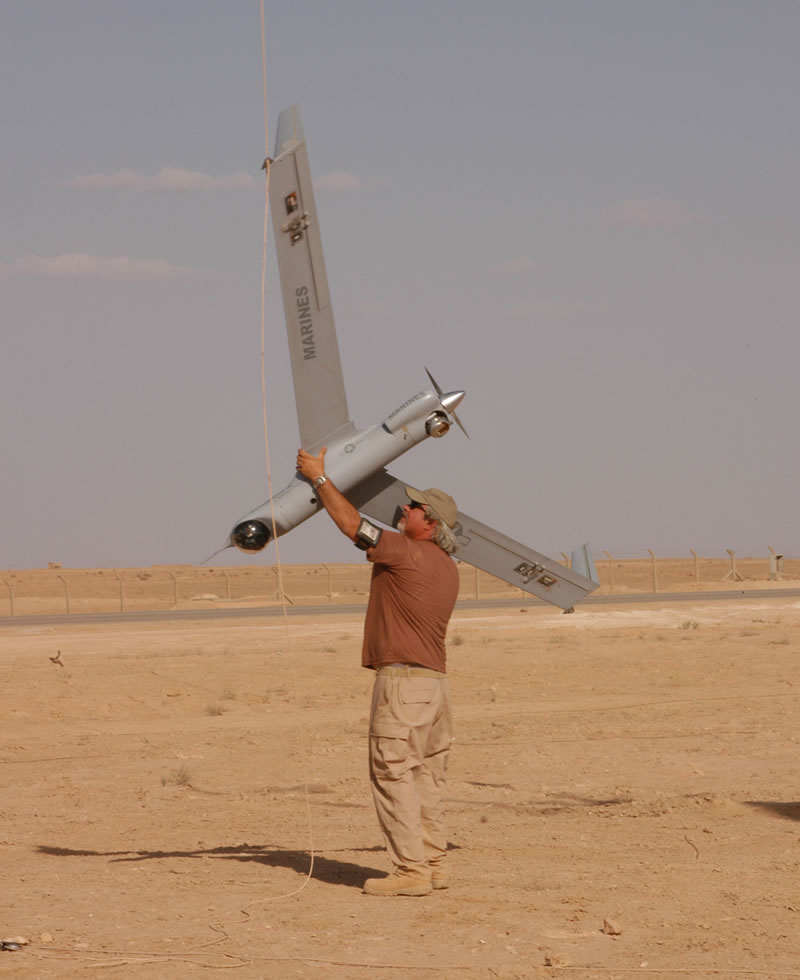
(click to view full)
Nov 26/08: Sensors – shot locator. The US Office of Naval Research and Naval Surface Warfare Center Dahlgren Division discuss a Navy Expeditionary Overwatch (NEO) program exercise, which involved US Navy Expeditionary Combat Command (NECC) sailors deploying a ScanEagle UAV, a manned Humvee with “Gunslinger” shot location and counterfire system, and an unmanned surface vehicle (USV) on a successful mission to detect and engage fictional insurgents over a 10 square mile radius.
The Gunslinger Humvee’s remote-control gun is operated by a gunner who sits at a control panel in the back seat. The Mk 45 weapons system is hooked up to video and infrared cameras connected to a set of sensors designed to detect gunfire, including a device that watches for muzzle flashes and listens for gunshots. It then points the remote-controlled weapons system on the Hummer’s roof at the source of fire.
At the Potomac River NEO demonstration, warfighters in the Humvee used the Gunslinger’s acoustic detection package and infrared sensors to determine the location of hostile fire and automatically move the weapon in the direction of the fire for friendly force response. The 36-foot-long semi-autonomous USV was also equipped with a Gunslinger payload and a range of sensors and communications systems. US Navy release | The Register re: Gunslinger..
Nov 12/08: Boeing receives a $65 million estimated value modification to a previously awarded indefinite delivery indefinite quantity “Interim UAS” contract, exercising an option for “persistent unmanned aerial system intelligence, surveillance, reconnaissance services in support of Global War on Terror, Operation Iraqi Freedom and Operation Enduring Freedom sea-based deployments and land-based detachments.” That’s milspeak for contractor operation and maintenance of ScanEagle UAVs in Iraq and Afghanistan.
Work will be performed in Bingen, WA (65%); and St. Louis, MO (35%), and is expected to be complete in November 2009. Contract funds in the amount of $6.8 million will expire at the end of the current fiscal year (N00019-08-D-0013).
Nov 6/08: Canada. Canada issues a MERX solicitation (W8486-09MGSL/A) for a leased small UAV service. Canada is already leasing ScanEagle UAVs that can fulfill the MERX requirements: 90% operational availability, 12 hours on station, ability to gather and transmit high quality imagery from a distance of 50km.
Aug 6/08: Sensors – SWIR. Boeing and Goodrich Corporation announce that they have successfully flight-tested a ScanEagle unmanned aircraft equipped for the first time with a short-wave infrared (SWIR) camera. A SWIR camera can see more effectively in fog, rain or when little or no heat is radiated, which makes it especially useful for maritime surveillance. Boeing release.
July 22/08: Merger. Boeing buys its partner Insitu, which will operate as a wholly owned subsidiary of Boeing’s Integrated Defense Systems’ Military Aircraft division. Subsequent reports place the price at around $400 million:
“Insitu’s key technologies and advanced capabilities in rapid prototyping and manufacturing are driving its revenue to an anticipated $150 million this year, 70 percent higher than in 2007, and have it well positioned for the future… Terms of the cash transaction were not disclosed. This transaction, anticipated to close by the end of September following regulatory approvals, does not affect Boeing’s financial guidance.”
Insitu, Inc. retained investment bankers Houlihan Lokey for the acquisition, and terms of the sale were not disclosed. Insitu’s investors are led by Battery Ventures, Second Avenue Partners, and Pteranodon Ventures. Boeing | Insitu | Wall Street Journal (subscription reqd).
Boeing buyout
June 2/08: Boeing received an estimated $65 million indefinite-delivery/ indefinite-quantity contract to “provide persistent Unmanned Aerial Vehicle Intelligence, Surveillance, Reconnaissance services supporting the Global War on Terror, Operation Iraqi Freedom and Operation Enduring Freedom sea-based deployments and land-based detachments.” The language above refers to their ScanEagle operation services, which are undertaken in cooperation with Insitu.
Work will be performed in Bingen, WA, (65%); and St. Louis, MO (35%) and is expected to be complete in May 2009. Contract funds in the amount of $7 million will expire at the end of the current fiscal year. This contract was competitively procured by electronic request for proposals, with 2 offers received (N00019-08-D-0013). Boeing release | Insitu copy.
Interim UAS win
May 28/08: NanoSAR. The NanoSAR test program continues, as Boeing, ImSAR and Insitu Inc. achieve real-time processing of Synthetic Aperture Radar (SAR) data aboard a ScanEagle UAV which is also equipped with a standard inertially stabilized electro-optical (EO) camera. The tests marked the first time SAR and EO capabilities have flown together on such a small, lightweight platform, and involved real-time SAR processing with streaming radar images displayed on the ground station. Creating real-time images onboard ScanEagle eliminates the requirement of either processing imagery on the ground after flight or using high-speed data links to a ground station. Insitu release.
May 26/08: Australia. Insitu, Inc.partners with the Queensland state government in Australia to announce the formation of its wholly owned subsidiary, Insitu Pacific Pty Ltd. The release adds that:
“Insitu, along with Boeing Australia, is proud to be part of the experienced team that has delivered more than 13,000 surveillance and reconnaissance flight hours to help protect Australian troops in Iraq and Afghanistan.”
Insitu Pacific
April 29/08: Insitu announces that the ScanEagle has now surpassed 50,000 combat flight hours with the U.S. Marine Expeditionary Forces (MEF) in Iraq and 1,000 shipboard recoveries with the U.S. Navy.
April 22/08: Testing. Insitu announces that it has flown Heavy Fuel Engine (HFE) equipped ScanEagles in Iraq, in cooperation with the US Navy. Heavy fuel refers to the kerosene-based fuel used in diesel and/or jet aircraft engines such as JP5, JP8, or Jet-A. ScanEagles flying in Iraq are using naval JP5 fuel, which is designed to be safer aboard ships.
The effort involved Insitu, Boeing, and Sonex Research Inc. in Annapolis, MD. The effort took 2 years of development and included over 2000 hours of testing, including a new ScanEagle flight endurance mark of 28 hours, 44 minutes using JP5. Insitu release.
April 18/08: Recall the Feb 7/08 launches from a Navy SEAL MkV boat, and demonstration by AFSOC at Hurlburt Field, FL.
Insitu Group, Inc., of Bingen, WA receives a firm-fixed price contract with a not-to-exceed value of $24 million for unmanned aircraft system information gathering, target surveillance, and reconnaissance services in support of U.S. Special Operations Command. The work will be performed in Bingen, WA and 3 other undisclosed locations using FY 2008 operations and maintenance funds (H92222-08-C-0022).
US SOCOM
March 25/08: Canada stands up an SUAV (Small Unmanned Aerial Vehicle) Troop. After live flight training in New Mexico, SUAV Troop deploys to Afghanistan to operate leased ScanEagles, which are referred to as “Interim SUAV”. Source: CASR.
Canada
Feb 7/08: US AFSOC. Air Force Special Operations Command, as the lead command for small unmanned aircraft systems, highlights the capabilities of the Scan Eagle during a demonstration at the Eglin Air Force Base test range. AFSOC has been training with the 820th Security Forces Group from Moody Air Force Base, GA since September 2007, to employ the system. AFSOC release.
Feb 7/08: USN SEALs. A Scan Eagle unmanned aerial vehicle is launched from a MK V naval special warfare boat off the coast of San Clemente Island. This is the first time a Scan Eagle, used for various applications such as intelligence gathering and battle damage assessment, has been launched from this kind of platform. Insitu photo links.
Jan 14/08: USN’s Interim UAS. Jane’s reports that:
“Industry rivals are waiting to hear if they have ousted the Boeing/Insitu ScanEagle unmanned aerial vehicle (UAV) from its role as provider of intelligence, surveillance and reconnaissance (ISR) support for US Navy ships at sea. A decision on the interim UAS contract, which will provide ISR imagery services to warships and to the US Marine Corps into the next decade, is expected in late January or early February 2008.”
Other competitors are thought to include AAI Corporation’s long-endurance Mk 4 Aerosonde, Aurora Flight Sciences’ vertical take-off and landing GoldenEye 80, BAE Systems’ Skylynx II, MTC Technologies’ Spyhawk T-16 and Raytheon/Swift Engineering’s Killer Bee. Insitu link.
UPDATE: the decision took until June 2008, and ScanEagle won.

(click to view full)
Jan 7/08: Sensors – NanoSAR. Boeing, Insitu, and ImSAR conduct a successful flight-test for the tiny NanoSAR Synthetic Aperture Radar aboard a ScanEagle UAV. The NanoSAR is a 2-pound system about the size of a shoebox, which is a couple orders of magnitude lighter than most SAR systems. As a sign of the times, “import to Google Earth” is an option for the system.
As a comparison, the I-Master SAR aboard Britain’s new Watchkeeper UAVs is considered small at 65 pounds. SAR radars aren’t an all-purpose replacement for ScanEagle’s existing electro-optical sensors, but they’re a very important complement because of their ability to see through fog, dust, et. al. The issue for NanoSAR will be providing acceptable resolution and coverage despite its tiny size.
Targets for the 1.5 hour test flight at the Boardman, OR test range included vehicles, structures and corner reflectors. Data collection worked as planned, and SAR imagery was later created on the ground. The next step in flight testing will be to create imagery aboard the UA in real time. Boeing release | ImSAR on NanoSAR | Insitu re: NanoSAR.
Additional Readings
* Insitu – ScanEagle System. ScanEagle is closely derived from the “Insight” base platform.
* Insitu – ScanEagle Imagers.
* Insitu – ScanEagle 2 The Limit.
News & Views
* Smithsonian Magazine, via WayBack (June 2011) – Drones are Ready for Takeoff.
* DoD Buzz, via WayBack (Oct 6/09) – FAA Acts or Drones Stop Flying. “Army drones will have to curtail training and operational flights by fiscal 2012 in the United States unless the FAA approves some form of UAS deconfliction, a top Army UAS official says.”
* IEEE Spectrum, via WayBack (January 2009) – Winner: Radio Eye in the Sky. Covers the concept of ultra-small SAR surface-looking radars.
* DID (June 12/07) – Boeing Operating ScanEagle UAVs for Australia. The rent-a-UAV concept gains another customer.
* Flight International, via WayBack (June 6/07) – Evergreen alliance with Insitu for civil UAV market. “Semi-civil” might be a better way of putting it. They will use Insitu’s Insight platform.
* DID (Jan 26/07) – ScanEagle + ShotSpotter = Sniper Spotter.
* Inc. Magazine, via WayBack (June 1/06) – How I Did It: Steven Sliwa, CEO and president, The Insitu Group
* DID (June 8/06) – ScanEagle to Detect Biological Agents. The program is called ScanEagle BCAS.