
(click to view full)
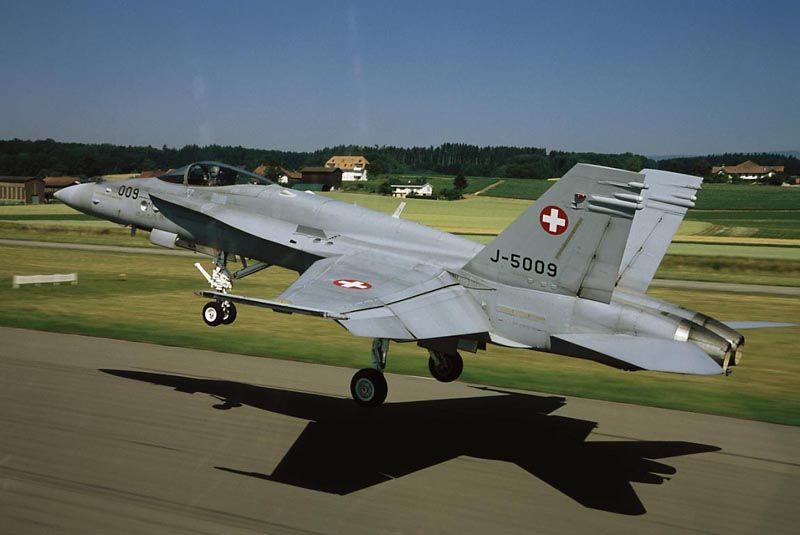
While F-5 owners like Brazil, Chile, Thailand, et. al. have opted for comprehensive refurbishment and upgrades, Switzerland is looking to replace 3 of its 5 Tiger II squadrons with new aircraft under its Tiger-Teilersatz TTE program. The new fighters will partner with the 3 squadrons of upgraded F/A-18 C/D Hornets that make up the rest of its fighter fleet.
An initial evaluation RFP was issued to 4 contenders, but Boeing’s withdrawal narrowed the selection to Sweden’s Gripen, France’s Rafale, or EADS’ Eurofighter Typhoon. A 2010 suspension of the competition was followed by a measured revival, thanks to the latest budgets – and then by a provisional winner in Sweden’s Gripen. But as one might expect, Switzerland’s left worked hard to derail any purchase. Once the necessary legislative hurdles were overcome, the new Swiss fighters faced a national referendum just like Switzerland’s 1993 buy of F/A-18 Hornets. The difference is that the new acquisition failed to convince voters. DID presents the background, the candidates, and what may come next.
The Swiss Competition: Rationale and Process
TTE’s Rationale

(click to view full)
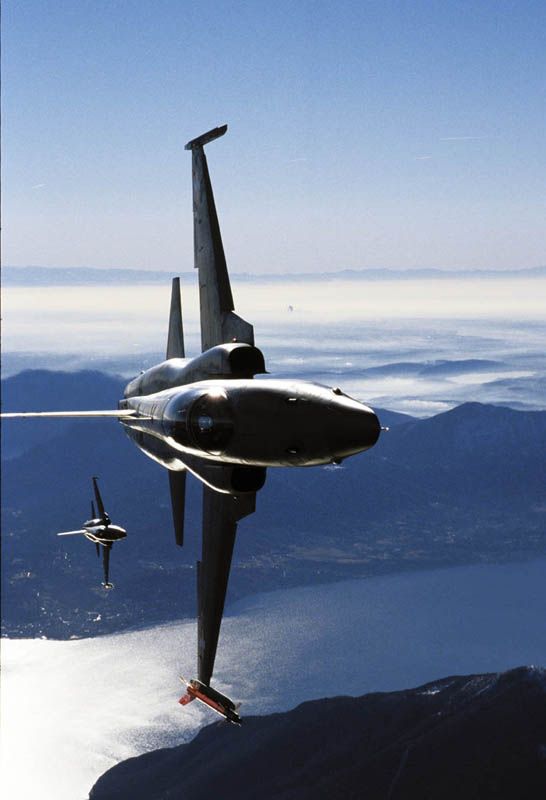
Switzerland is just under 360 km/ 215 miles wide at its widest point, and its firm neutrality keeps its air force from deploying elsewhere. Their focus to date has been on aerial defense with lightweight fighters. Accordingly, they bought 72 F-5E/F Tiger II fighters in 1976, and another 38 in 1981, for a total of 110 (98 single-seat F5E, 12 two-seat F-5F). Even then, the F-5 wasn’t cutting edge technology. Rather, it was a follow-on upgrade to the wildly successful F-5 Freedom Fighter, a low-budget aircraft designed to capture the lower tier of the non-Soviet global fighter market in the 1960s and 1970s.
A number of countries still operate F-5s, but the airframes are very old. Switzerland’s force now numbers about half its former total, at about 54 F-5s. A squadron of 12 was leased to Austria while that country awaited their Eurofighters, and 44 other F-5Es were sold to the US Navy.
All airframes have a limited safe flying hour limit, however, and older aircraft spend more time in the maintenance hangar for each hour of flight. In this case, the tick-tock of time isn’t Switzerland’s friend. As the available F-5s dwindle in number and then retire entirely, Switzerland’s air force must either replace them, or withdraw from some aspects of its protective role. The Schweizer Luftwaffe explained in its Jan 17/07 release that without new aircraft, the ability to maintain full sovereignty air patrols would soon decline to just 2 week intervals. At best, 24-hour patrols might be maintained for more than 14 days over an entire year, at the cost of shortening the 24-hour coverage periods to just a few days at a time, and staggering these periods over the course of a year:
“Sans le remplacement des F-5 Tiger, la capacité de maintenir la sauvegarde de la souveraineté sur l’espace aérien, d’assurer le service de police aérienne et de la défense aérienne serait massivement réduite. Avec seulement 33 F/A-18, une presence permanente (24 heures sur 24) de 4 appareils en vol ne pourrait être assurée que pendant deux semaines environ.”
As the February 2014 highjacking demonstrated, emergencies don’t always plan themselves according to your schedule. To remedy the coming gap when the F-5s retire, the Swiss needed numbers, availability, and new capabilities.
As advances in electronics have driven multi-role capabilities down to lightweight fighters, the Swiss have begun moving toward a more-multi-role air force, which could also support its ground forces with precision weapons in the event of an attack. The Schweitzer Luftwaffe also flies 33 F/A-18C/D Hornets, for instance, whose recent Upgrade 21/25 modifications offer significant improvements in aerial combat, and new precision strike capabilities.
The Hornets, too, will eventually fade from service, and so Switzerland wanted the same kind of capability in its new fighters. Unfortunately for the Swiss, the TTE fighter replacement program’s expected budget was just CHF 2.2 billion (in March 2009, about $1.95 billion/ EUR $1.45 billion), which had to cover both 22 new fighters and 6 PC-21 turboprop trainers. That wasn’t enough. As the realities of the modern fighter market asserted themselves, the trainers became their own separate buy at 8 aircraft, and a low-cost bid for the fighter buy was submitted at CHF 3.126 billion.
TTE: Process and Pitfalls

(click to view full)
Switzerland’s new fighter purchase has been an involved and convoluted process. Extensive testing of each model was undertaken by the Swiss air force, using several scenarios. With testing complete, Dassault, EADS and Saab were all invited to submit a second bid offer in January 2009, with bids due in April 2009. May 2009 was supposed see the release of the evaluation report prepared by armasuisse, and the Chief of Armament would consult with the Head of the Federal Department of Defence, Civil Protection and Sport (DDPS) and the Commander of the Swiss Air Force to decide. A winner was expected in July 2009, and the Partial Tiger Replacement was expected to be approved by the legislature alongside Armament Program 2010.
Instead, Switzerland’s fighter pick was postponed by the government, with no report or announcement of any kind until 2010. It wasn’t until 2011 that the political logjam broke, and the Swiss government elected to re-open bidding, make their fighter choice, and begin the political process of confirming it. The JAS-39 Gripen was picked in December 2011.
Approval of the proposed acquisition is expected as part of Armament Program 2012, if the government’s choice survives a current controversy over its suitability for the role. Developments in mid to late 2013 appear to indicate that it will.
Even that won’t be the end of it. Whichever competitor won could always expect to face more political difficulties after their victory, and that remains true for Saab now. Switzerland’s purchase of 34 F/A-18 C/Ds, for instance, required a 1993 referendum organized by Switzerland’s socialist and Green parties. The deal passed, but Group for a Switzerland without an Army (GSoA) and their political party allies continue to try to block any fighter sale, from ballot proposals to ban “peace-time flights of combat-jets in tourist areas,” (making it almost impossible for the Schweizer Luftwaffe to train its pilots), to the May 2014 national referendum on the F-5 TTE program’s final contract.
A convictionless non-defense of the fighter purchase’s necessity and legitimacy ensured that the TTE program’s opponents won the referendum, by about 53% – 47%. Even if the referendum had passed, a secure contract was going to take until mid-2014 at least.
The Competitors
The competitors to supply its next generation fighters were all European 4.5 generation fighters: BAE/Saab (later just Saab – JAS-39E/F Gripen), Dassault (Rafale F3+), and EADS (Eurofighter Typhoon Tranche 3 P1E).
Saab’s JAS-39E Gripen (winner)

(click to view full)
The 3rd competitor was a single-engine lightweight multi-role fighter, rather than a medium sized twin-engine jet. Saab was always seen as offering the lowest price aircraft, with interesting options on tap like the lease-to-buy alternatives already in place in Hungary & The Czech Republic, and a strong record of success with industrial offset deals. Data from operating air forces has confirmed that the designers were also successful designing the Gripen for low maintenance and operating costs. Despite its size, the JAS-39 is a solid multi-role performer, with a good array of potential weapons; indeed, it’s pretty close to the current epitome of what a lightweight fighter should be.
For Switzerland, this fighter also offered unique commonality benefits. Gripens are delivered ready to use the LITENING reconnaissance and targeting pods that Switzerland is buying as upgrades for its Hornet fleet, and would use a GE’s F414, a more advanced engine with the same supply & training relationships as the GE F404/RB12s powering Switzerland’s Hornets. The Gripen’s corresponding range handicap, which has often been a limiting factor in fighter competitions against its twin-engined opponent, shouldn’t matter much in Switzerland. Though it did affect the plane’s evaluated air superiority scores for some reason.
Given the DDPS’ implicit need for numbers, the industrial offsets, and the potential political bonus of a sale from another neutral country, the Gripen always appeared to be very well positioned in this fight. The firm’s Jan 17/08 release was already stressing some of these factors – and the Gripen’s eventual selection in December 2011 validated that confidence.
A leaked 2009 report shook that confidence, as it revealed that the Gripen finished below the Rafale and Eurofighter in almost all areas, and was rated as not meeting competition specifications in key areas like air superiority. Swiss authorities countered that the JAS-39E version offered in the 2010 RFP was fully compliant, and subsequent ratings did give it a “good enough” score. It would have been Switzerland’s cheapest and most appropriate choice, but the government lost the May 2014 national referendum.
Dassault’s Rafale
(click to view full)
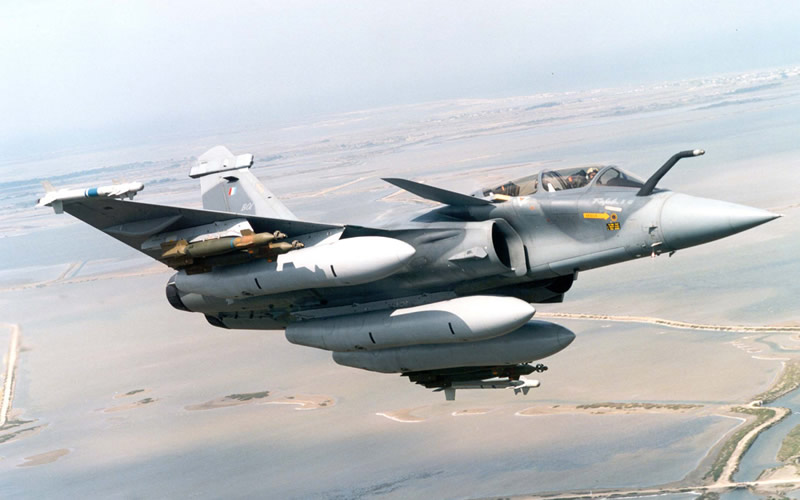
The Rafale offers a comparable set of capabilities to the Eurofighter. It’s generally considered to be an inferior air superiority fighter, but it has good ground attack capabilities, and an array of integrated equipment that makes it a better multi-role aircraft. Operations over Libya in 2011 were an excellent advertisement for the Rafale, but its spotty integration with the American weapons used by the Schweizer Luftwaffe was a potential issue.
This multi-role balance served the plane well, and it finished at the top of Switzerland’s 2008/2009 evaluations, winning in all 3 categories. Rafale was rated ahead of the 2nd-place Eurofighter in air superiority tasks, and far ahead with respect to strike and reconnaissance. Even its French-only equipment proved to be a plus, as its scores in key areas were boosted by vertical integration with high-end French products: its Thales SPECTRA electronic warfare system, for instance, seems to have fared much better than Eurofighter’s DASS.
One would have thought that consistent losses in export competitions would keep the pressure on France to offer a very attractive deal. Could Dassault keep its price low enough, including initial training and spares, and offer weapon integration relief? The answer was apparently “no,” as Dassault’s December 2011 release conceded that their proposal offered fewer aircraft within the required budget, relative to the winner. They didn’t get really serious about price until after the winner was announced, then tried to get the Swiss to break the rules and change their contract. That worked about as poorly as you’d expect it to work.
EADS’ Eurofighter Typhoon

(click to view full)
The Eurofighter offers top-tier air superiority capabilities in an advanced fighter design; indeed, the twin-engine Eurofighter’s first challenge was to avoid the perception of over-budget overkill. It does offer commonality with Switzerland’s German, Austrian, and Italian neighbors, which could help with maintenance agreements and training costs, but overall cost is definitely an issue for this fighter. Neighboring Austria’s EUR 2 billion buy of just 18 Eurofighters was later reduced to EUR 1.63 billion for 15 Tranche 1 models, with very limited precision ground attack capability.
In discussions we had with EADS Cassidian, they would say only that they were not the cheapest or the most expensive offer submitted, while confirming that “more than 18” Eurofighter Tranche 3 models were offered, with full multi-role capabilities. That put paid to speculation that they might submit a lower-priced offer, using existing Eurofighters from a core partner nation. Some of those nations had reportedly been considering sales of their earlier models, as a way to pay for Tranche 3 order commitments.
In the Swiss Luftwaffe’s evaluations, The Typhoon got good marks for its air-air capabilities, but the design’s low investment in other areas cost it once again, as it was rated below requirements in both strike and reconnaissance. Surprisingly, it also got low marks for its sensor integration and DASS defensive system, two areas that had been promoted as a strength.
Bowed Out: Boeing’s Super Hornet

(click to view full)
Boeing’s F/A-18 E/F Super Hornet offered the advantage of some commonalities with Switzerland’s existing F/A-18C/D Hornet fleet, even if the actual commonality rating is under 30%. It’s also a mid-tier aircraft, with likely flyaway costs of $60-75 million for a new customer. It was difficult to imagine a scenario in which the original Swiss budget yielded enough Super Hornet aircraft, and as is often the case in Europe, opposition to sales from American firms was expected to be a factor.
Concerns were also expressed about the ability to fit these aircraft into the Swiss aircraft shelters, many of which are carved into mountainsides; indeed, there had been rumors that the Super Hornet would be excluded from the competition on those grounds alone.
The Super Hornet offered solid performance, and was a legitimate competitor, with pricing that could match or beat competitors like the Rafale and Eurofighter – but it was flying into strong headwinds. In the end, the questions became moot. Boeing looked at the RFP requirements, and bowed out.
Contracts & Key Events
2014-2015
Swiss government makes every effort to lose the referendum – and narrowly do, killing the deal.

(click to view full)
April 23/15: Switzerland is again looking to replace its F-5E light fighters from 2017, with the problem-hit fleet recently seeing a third of its aircraft retired prematurely. When an additional six F-5Es taken offline for repairs return, the Swiss Air Force will have only 54 combat aircraft available for frontline service, 32 of these being F/A-18C/D Hornets.
Oct 28/14: F-5 retirement. The DDPS clarifies that they have recommended retirement of Switzerland’s 54-plane F-5 fleet in 2016, but the “Niederberger motion” to decommission the F-5s, “Model 87” Leopard 2 tanks, and M109 self-propelled howitzers wasn’t taken up by The National Council on Sept 22/14.
Nothing will happen until the revised Armed Forces Act comes into effect, which would formalize the Niederberger motion. At that point, the DDPS could submit a new notification to Parliament. Meanwhile, the 54 F-5s will continue to be maintained and fly. The DDPS also explicitly denies negotiations or sales to Uruguay, though DDPS is allowed to accept offers from other countries. They just aren’t allowed to conclude any sales until the decommissioning is formally approved. Sources: Swiss DDPS, “Parlament entscheidet uber die Zukunft des Tigers F-5”.
May 27/14: Scorpion? Textron is getting some extra publicity for its privately-developed Scorpion light attack and patrol jet, before its debut at Farnborough and RIAT this year. Textron Airland president Bill Anderson reportedly told the Swiss Tages Anzeiger newspaper that they could offer Switzerland their jet for “less than $20 million” each.
Good news: Even assuming an extra 40% in stand-up costs, that would be about CHF 515 million for a fleet of 22, vs. CHF 3+ billion for the Gripen. The Scorpion is in a totally different class, being closer to an armed PC-9M turboprop but with better cruise speed and payload. That would suffice for most of Switzerland’s day-to-day air policing and surveillance needs, however, and for use in combined arms exercises. It might even allow Switzerland to cut F/A-18C/D flying hours, preserving the jets over a longer service life.
Bad news: We talked to Textron. They haven’t made any sort of offer; indeed, they can’t. All they said was that if Switzerland put out a compatible set of requirements, then of course they’d be interested. The Swiss haven’t issued any requirements, Scorpion development isn’t done, weapon testing hasn’t even started, and American arms export clearance has to begin after those things end. The questions could also be raised: Why not buy British Hawk jets for under $20 million each, as a long-proven design with plenty of global customers, and off-the-shelf weapon integration options?
Alternatively, if a Scorpion’s performance represents an improved PC-9M, why couldn’t Switzerland just begin a program to fully arm the PC-9/21, have all development and manufacturing done locally, and call the problem solved? The answer to those questions, and the beginning of Textron’s interest, must start with the Swiss. Do they want anything at all? If so, what are their needs?
Sources: Textron Scorpion site | Switzerland’s The Local, “US firm pitches ‘budget’ jets for Swiss air force”.

(click to view full)
May 18/14: Referendum loss. Unsurprisingly, a tepid and convictionless defense of the Gripen fighter deal results in a referendum loss, with projections showing about a 53.4% no vote. The only surprise is that the margin was this narrow, indicating a winnable vote. Compare and contrast with the September 2013 referendum, which resulted in the Swiss keeping conscription. Or the government’s success in the referendum that ratified their F/A-18 Hornet buy.
While some governments in Europe will re-run referendums until they get the result they like, the Swiss aren’t like that. The TTE fighter buy, and the unrelated referendum proposal to implement a SFR 22 (about $25)/ hour minimum wage, are both history. Switzerland will need to depend on French and Italian jets for basic airspace protection, and Sweden is very likely to end up buying Brazilian Super Tucano trainers instead of Swiss PC-21s. Sources: Swissinfo, “Swiss Reject $3.5 Billion Gripen Purchase in Blow to Saab” | Deutsche Welle, “Swiss referendum turns down minimum wage and new fighter jets” | Reuters, “Swiss voters narrowly block deal to buy Saab fighter jets: projection”.
Referendum kills TTE fighter buy
April 2/14: Espionage. Saab Switzerland spokesman Mike Helmy confirms that “Secret services have attempted to intercept our communications,” driven by unnamed states on behalf of their industries.
They’re a very logical target. A new customer for an advanced weapon, busy sharing a lot of industrial data as they look to line up manufacturing partners, gives new meaning to the phrase “I’d tap that.” Sources: Swiss RTS, “Le groupe suedois Saab, constructeur du Gripen, se dit victime d’espionnage”.
March 31/14: Referendum. A major push by referendum opponents begins, focused on the costs of maintaining, equipping, and flying the Gripens as well as the purchase price. All true, though the referendum itself is solely about buying the planes.
Beyond that, a group that has previously proposed to abolish the armed forces entirely can’t be taken seriously when they try to make fiscal arguments on the subject. Unless, of course, their opponents cede the field. Sources: Swiss RTS, “Les opposants a l’achat des avions Gripen entrent en campagne” | Sweden’s The Local, “Swiss fighter jet deal could triple in cost”.
March 28/14: Swedish PC-21s? Pilatus and Saab have reportedly signed a Memorandum of Understanding to sell Sweden about 20 PC-21 advanced turboprop trainers, which would replace the aged SK-60 jet trainers. They also intend to set up a joint software development center and a new production center in Switzerland, and all the planned measures could generate orders worth about CHF 500 million ($564 million) over the next 8 years.
The catch? They’re all contingent on Switzerland buying the JAS-39E. Otherwise, don’t be shocked if Sweden ends up flying EMB-314 Super Tucanos from Brazil instead. Sources: Swissinfo, “Swiss-Swedish plane deal fires up vote campaign” and “Fighter jets await green light from voters”.
March 11/14: Referendum. Swedish JAS-39 Gripens are withdrawing from an air show at the Alpine Skiing World Championships in Lenzerheide:
“Sources told Sveriges Radio (SR) that the Swedish participation had been cancelled because the Swiss government did not want to be accused of trying to sway public opinion in favour of the Jas Gripen. The government is facing a citizens-initiative referendum that will have final sway over whether the country should buy the Swedish jets…. Saab headquarters in Sweden told SR that the company was not engaging in any marketing activities in Switzerland whatsoever ahead of the plebiscite, which is scheduled for May.”
Translation: the opposition has succeeded in forcing Sweden, Saab, and Swiss political leadership off of the playing field. We’re going to double down. The question isn’t whether the Swiss government will lose the May referendum, the question how big the margin of loss will be. Sources: The Local, “Swiss cancel Swedish fighter-jet air show”.
March 4/14: Sub-contractors. Switzerland’s RUAG receives a CHF 68 million ($41.1 million) contract from Saab to develop and produce payload mountings for the JAS-39E’s hardpoints. The order reportedly includes 4 work packages, with CHF 15.5 million ($9.4 million) committed immediately for design, system development, and prototypes for 3 JAS-39E test planes. RUAG is already soliciting sub-contractors within Switzerland.
An option for series production would make up the rest, but Saab can award it elsewhere if the Swiss referendum fails. As appears likely. Sources: RUAG, “RUAG wins contract for SAAB Gripen E payload mountings” | UPI, “RUAG making payload mountings for Gripen fighters” (their currency conversion is wrong) | Saab’s Gripen Blog, “Swiss Technology Group RUAG Collaborates With Saab”.
Feb 17/14: Hijack hijinks. The co-pilot on Ethiopian Airlines FLT ET-702 from Addis Ababa to Rome locks himself in the cockpit while the pilot goes to the bathroom, announces a hijacking, and flies the Boeing 767 jet into Geneva, Switzerland at 6:02 am. It lands with just 10 minutes of fuel left, and 1 of its 2 engines flamed out.
The plane’s hijacking beacon went off over Egypt, and the Swiss Air Force was informed of the situation. They just couldn’t respond, because their air bases are only open from 800 am – 12:00 noon, then 1:30 – 5:00 pm. The reason? Swiss airforce spokesman Laurent Savary cited insufficient fighters, insufficient budgets, and insufficient staff, which isn’t expected to be fixed until after the Gripen buy in 2020. Instead, Italian Eurofighters intercept the plane, and hand it off to French Mirage 2000s who escort the plane into Geneva. While Italy and France are reportedly authorized to fly their planes into Swiss airspace under such circumstances, neither is authorized to actually do anything.
Needless to say, the Swiss become a global joke. Motivated and committed political leadership could make this a turning point in the referendum. The question is whether Switzerland has any of that on the “yes” side. AFP, “Swiss Air Force’s weekdays-only schedule kept fighters grounded during hijacking” | San Francisco Gate, “Swiss Clock-Punching Air Force Relies on France for Hijacked Jet”
Feb 15/14: Referendum. Switzerland’s Christian Democrats withdraw their party leadership of Switzerland’s “Gripen – yes” vote, without withdrawing the 2 party representatives serving as campaign co-chairs, or altering their party’s position in favor. They cite lack of clarity regarding Sweden and Saab’s participation in campaign financing (q.v. Jan 22/14, Feb 12/14).
The PCU finished in 4th place during the 2011 lower house elections, with 12.3% of the vote and 28/200 seats in the lower house. They’re the #1 party in the Council of States upper house, however, winning 13/46 seats during that same election period.
DID is going to go out on a limb and predict that the government will lose this referendum, derailing the fighter purchase. Polls show a slight current edge to the “no” vote, and the “yes” side keeps imposing terms on itself that amount to surrendering the legitimacy of their argument. Which makes betting on a flip a very dubious proposition. Sources: PDC Party, “Le PDC renonce au « lead » de la campagne de votation sur le « Gripen »” | The Local, “Swiss party tells Sweden to butt out over Gripen”.
Feb 12/14: Referendum. “Swedish Radio News has obtained documents outlining Sweden’s plans to impact a referendum in Switzerland…. A number of defence authorities, several members of the Swedish Cabinet Office as well as seven Swedish ministers have been made aware of the plans.” The concrete allegations don’t amount to much:
“The Swedish embassy would arrange an exclusive interview with Bildt and place positive articles about Sweden in Swiss media. Sweden would also arrange a series of concerts and seminars. [Ambassador] Thöresson wanted Swiss television to cover Maurer’s participation in this year’s Vasa ski race in Sweden. And Maurer wanted to arrange regular air shows with Gripen jets in Switzerland, including during the Alpine Ski World Cup in March. The idea is to give the Swiss people as positive an image as possible of Sweden.”
As opposed to their usual activities that present Sweden as a terrible place, and publicly blame its leaders for Abba? All of these are normal cultural and trade activities that take no public position on the referendum. Or are they supposed to neglect and alienate a country that might become an important security partner? The real story is that Swedish politicians won’t stand up and challenge a blatantly foolish premise. If this isn’t the stupidest “expose” we’ve ever read, it’s a top 3 contender. Sources: Radio Sweden (Sverige Radio), “Sweden’s plan to impact Swiss Gripen deal” | Swissinfo, “Leak reveals Swedish interest in Gripen vote” | The Local, “Sweden has ‘secret plan’ to tip Swiss Gripen vote”.
Feb 11/14: Referendum. The Swiss DDPS publishes its official referendum statement, advocating the Gripen-E purchase. It underscores the F-5 fleet’s average age of over 30 years, describes Gripen as a security investment lasting until 2050, and lists the air force’s inability to cover the country without the new planes:
“A partir de la mi-2016, sans l’acquisition du Gripen, la Suisse n’aurait plus que 32 avions de combat, et la securite ne pourrait plus être suffisamment assurée dans des situations extraordinaires. Il ne serait plus non plus possible de garantir la surveillance de l’espace aerien 24h sur 24 et 365 jours par an. Enfin, la Patrouille Suisse [DID: Swiss aerobatic team] ne pourra etre maintenue qu’avec l’achat du Gripen.”
Cost is described as just CHF 300 million per year from 2014 – 2024, about 0.5% of federal expenditure that will come from within the army’s regular budget. In exchange, DDPS cites CHF 2.5 billion in offsets, involving work at the leading edge of manufacturing technology. Sources: Swiss DDPS, “Le Gripen fait partie du paquet global de l’armee” | Defense World, “Gripen Purchase Only Option To Save Aerobatic Team, Says Swiss MoD”.
Jan 22/14: Referendum. Political controversy erupts in Switzerland over Saab’s financing of advertising and promotion related to the referendum. On the one hand, this is legal in Switzerland, and it isn’t particularly remarkable for defense firms to advertise in markets that even propose to buy their equipment. On the other hand, Saab is stepping into a direct political fight, and has to expect to be treated as a combatant by people like Swiss Social Democratic MP Evi Allemann.
Can Saab win this fight, and will those on its side stand with the firm or distance themselves? So far, it’s the latter. FDP party leader Philpp Muller is calling any support from Saab “counterproductive,” and telling the Blick newspaper that “It makes it harder for us centre-right politicians to convince people of the importance of the Gripen purchase”. Source: The Local.se, “Swiss fury over Saab ‘meddling’ in Gripen vote”.
Jan 17/14: Referendum date. Switzerland’s Federal Council announces that the TTE program’s national public referendum will be held on May 18/14, as a yes/no vote re: the Swiss Gripen Fund Law approved by Parliament. The opposition still has to collect 50,000 signatures first, but an organized group is unlikely to fall short of that goal on a high-profile issue, while supported by sitting political parties, in a country of 8 million people. Sources: Saab, “The Referendum is Scheduled for 18 May”.
2013
Political setbacks delay approval, but an end is in sight.
(click to view full)
Sept 18/13: Political. The Swiss upper house (Ständerat, or Council of States) votes 27 – 17 in favor of the fighter deal. That completes elected political approval, and the referendum is expected to happen in May 2014. Sources: SBC’s SwissInfo: “Gripen go-ahead: Fighter jets given parliamentary all-clear” | Saab Group, Sept 18/13 release.
Sept 11/13: Political. Lawmakers in the Swiss National Council (the larger lower house) have voted 119 – 70 – 5 in favor of the deal for 22 Gripen jet fighters, then approved a financing package. This was expected following the Committee on National Security Policy vote, but this deal has seen political surprises before (q.v. March 5/13).
This isn’t the last Parliamentary vote, but the political path for the fighter deal appears to be clear now. The referendum will have the final say. Sources: Dow Jones, “Swiss Lawmakers Vote in Favor of Saab Gripen Fighter Jet Deal”.
Aug 27/13: Political. The Swiss Committee on National Security Policy votes 14-9 to approve the government’s JAS-39E Gripen purchase, and the financing package also wins a majority. The security committee of Switzerland’s lower house of parliament supported the government’s proposal to purchase the fighters by 14 to 9 votes, Committee president Chantal Gallade told journalists that “reassuring information on arbitration procedures and penalty payments” helped, and that the Swiss have agreed on a 40% down payment with Saab.
The National Council (lower house of Parliament) will discuss the deal on Sept 11/13, and it’s believed that they’ll follow the recommendation. Sources: Reuters, “UPDATE 2-Swiss parliamentary committee backs buying Gripen fighters”.
May 13/13: Saab makes its industrial benefits pitch to Switzerland, and explains how the process works. Saab Gripen Blog | Full presentation [PDF].
April 9/13: Political. The Swiss Committee on National Security Policy votes 20-3 to table consideration of the JAS-39E Gripen purchase, and votes 12-12 not to resume in August, with the committee chair tipping the balance. That means they won’t take up the issue until the fall session, which could throw a wrench in the planned schedule.
The committee reportedly maintains a 16-9 favorable outlook for the concept of a fighter purchase, but they may wish to revisit some key contract terms. They want to ensure that Switzerland doesn’t pay more than a 15% deposit, and want to fix the price in Swiss Francs to avoid risks of a rising Swedish Kronor. Each fighter delivered would have an 8% withholding, with 4% paid per fighter on acceptance, and the last 4% for all fighters paid with the final invoice. Finally, the committee wants a closer look at the bridging lease plans to fly earlier model Gripens, and expected costs from 2016.
The last issue involves industrial offsets. Saab’s announcements reportedly amount to SFR 200 million so far, but the deal has a requirement to deliver 30% of contract value. That usually finalizes over time, however, so it isn’t at all surprising to be short at this early date. Swiss Parliament [in French] | RTS Info [in French] | Geneva Lunch | Bloomberg.
April 2/13: Industrial. Saab announces that they’ve set Swiss workshare for all future JAS-39E fighters, but haven’t set their exact industrial partnerships yet. They’ve committed to the armasuisse policy of having 5% of their industrial benefits in Italian-speaking regions, 30% in French speaking regions, and 65% in German speaking regions.
Swiss industry will become sole suppliers of the fighter’s rear fuselage, tail cone, air brakes, pylons, and external fuel drop tanks.
March 5/13: Yes & No. The Swiss Senate votes to approve the Gripen purchase by a narrow 22-20-1 margin with 2 absences. By Swiss law, however, it requires an absolute majority to disburse funds over CH 20 million, or CH 2 million in recurring payments. That means 24 votes in the Senate, or 110 in Parliament. That vote narrowly failed, 23-19.
The failed vote was a surprise, as prior debate hadn’t made the level of opposition obvious among some members of the libertarian-leaning FDP, or among the CVP Christian Democrats. Unlike the left-wing parties that want Switzerland to disarm, they might be convinced, and the deal will go to the National Council for further debate in June 2013. The Senate votes won’t stop the deal, but they will make its passage more difficult than it was. With a referendum coming, sharpened debate in Parliament could even be a positive thing – but only if proponents of the TTE fighter replacement project win by making a case, as opposed to winning by party discipline. Neue Zurcher Zeitung [in German] | Sweden’s The Local.
2012
Deal for JAS-39Es in conjunction with Sweden; Post-final offers to no avail; Accusations that Gripen doesn’t meet Swiss requirements; 2009 evaluation report.

(click to view full)
Dec 10-13/12: Testing. Swedish and Swiss pilots successfully test the Gripen-F Demo, and its new AESA radar, at Linkoping in Sweden. Swiss DDPS [in French] | Saab’s Gripen blog
Nov 14/11: The Swiss Federal Council formally approves and proposes the JAS-39E purchase for Switzerland’s TTE, with an appropriation of CHF 3.126 billion. To become an order, Switzerland must pass and retain a Gripen Fund Act Federal Law, and this special fund is subject to an optional but probable referendum. Swiss DDPS [in German]
Aug 28/12: Contract terms. The Swiss government reveals the details of their Gripen deal. Their 22 planes will all be single-seat JAS-39Es, delivered from 2018-2021 at a firm-fixed-price cost of CHF 3.126 billion (currently $3.27 billion). That total is guaranteed by the Swedish government, and includes mission planning systems, initial spares and support, training, and certification.
As a bridging step, Switzerland will replace its F-5 fleet beginning in 2016 with 11 rented Gripens (8 JAS-39Cs, 3 JAS-39Ds) from Sweden, on an initial 5-year lease. They will fly beside Switzerland’s 33 F/A-18C/D Hornets, and their CHF 44 million per year cost is CHF 10 million more than the current cost of maintaining the F-5E/F fleet.
This deal will now go to the Swiss Parliament, with the aim of passing the PA12 budget, as well as a specific law covering the Gripen purchase, by November 2012. The first half of 2013 will involve further legislative reviews and reports, and if there’s no referendum, the goal is a formal contract in autumn 2013. There will almost certainly be a referendum, of course, which would push a contract signing out to mid-2014 – if and when the referendum campaign against the fighter purchase fails. That signing would be accompanied by a A CHF 300 million advance payment. Swiss Government release [in French] and presentation [PDF, in French] | Swedish-Swiss Framework Agreement [PDF, in French] | Bloomberg | Flight International.
Here’s the deal
Aug 26/12: EADS’ Ave Maria. According to German Sunday newspaper Der Sonntag, Germany and EADS are offering 33 used Eurofighter jets to Switzerland for CHF 3.2 billion, or about 11 more planes in comparison with the Gripen deal. The German Air Force planes were made in 2003. There is no corroboration from official sources yet.
Back in December 2008, armasuisse said it would consider used offers but they were doubtful of their chances to succeed for a likely lack of fit with technical expectations. Early model Eurofighters would be an almost certain failure, given their limited multi-role capabilities, unless they received significant upgrades. Reuters | Der Sonntag [Swiss edition, in German] | Aargauer Zeitung [in German].

(click to view full)
Aug 25/12: Agreement in principle. Sweden’s government announces that they are committed to buying 40-60 next-generation JAS-39E/F fighters, as part of a joint effort with Switzerland who will buy 22 more. To fund this effort, they’ve agreed to raise the defense budget by SEK 1.8 billion (currently almost $273 million) by 2020, which is the date development is supposed to end. That would be very cheap, but the Gripen Demo interim prototype is already flying, many key components like the radar are already being financed, and the final amount remains unclear because the system development contract hasn’t been signed yet.
At the same time, the Swiss government issues a statement that there is an agreement in principle between armasuisse and Sweden, completing a Memorandum of Understanding signed on June 29/12. The countries will reportedly share support and upgrade costs under an umbrella model. Final details of specifications, delivery dates, prices, equipment and infrastructure have reportedly been settled, pending final approval from Swiss political authorities. The FDP Party is currently wavering, but if they can be convinced to approve the deal, it will go on to a national referendum. Swedish government Release [in Swedish] & Video | Svenska Dagbladet – full statement from 4 party leaders [in Swedish] | Swiss government [in German] | Saab Group || Sweden’s The Local | Expatica Switzerland | Agence France Presse | Aviation Week | Bloomberg | Reuters re: FDP.
JAS-39E/F joint program
Aug 20/12: Parliamentary report. The Swiss federal parliament’s under-commission tasked with reviewing this competition releases its report. They have met 10 times since February 2012, and deplore the many leaks that occurred since late last year. They find that military requirements were pretty vague. They can’t corroborate allegations from the losing firms that armasuisse had been conducting privileged technical discussions only with Gripen. However they regret that when the program was postponed, the acquisition failed to explicitly say that the Gripen E/F could now compete, since the NG (as the next-gen Gripens were originally known) had previously been ruled out for timing reasons. Overall they see a pattern of unhelpful miscommunications and misunderstandings.
They conclude that the Gripen E/F choice bears the most technical, financial and political risks, not to speak of timetable slippage risk. The commission notes that political issues are still present in Sweden and Switzerland; in the absence of a finalized purchase contract, it isn’t clear which country is waiting for the other one to signal its final intent.
Overall, the commission voted 16-9 against canceling the award, as they find it has gone through a “correctly handled” process, but if anything goes wrong in the Swede/Swiss joint acquisition, or in case of a pricing and/or schedule slip for what is for most purposes a new aircraft, they will be in a position to say “we told you so.” The Swiss press conveys a fairly critical reading of the situation, with Gripen clearly on the defensive. The German-language press notes, however, that Switzerland can now point to the weaknesses outlined in the report as a way to strengthen its negotiating position with Sweden. Full Report [PDF, in French] | Sweden’s The Local | Swissinfo.
May 2-4/12: Test flights. Swiss test pilots come to Linkoping, Sweden for simulator training and 4 test flights in the Gripen Demo. The test flights focused on air defense and air policing mission profiles, with dummy weapons that included Diehl’s IRIS-T, Raytheon’s AMRAAM, and MBDA’s Meteor air-to-air missiles. Flight profiles extended to 40,000 feet and Mach 1.35, during the maximum performance intercept to high altitude. armasuisse | Saab.
April 12/12: Postponed. Swiss Defence Minister Ueli Maurer says that they will postpone their order of 22 JAS-39E/F Gripen jets, so they can co-ordinate its purchase with Sweden. The minister promises that the bill will remain below SFR 3.126 billion/ $3.43 billion.
Sweden is looking to buy 60-80 next-generation Gripens, and full coordination will probably require agreement on many aspects of aircraft configuration. It will also require political coordination. Sweden’s parliament is expected to vote on its jet purchase in September 2012, and the Swiss parliament is scheduled for October 2012. Delays in Sweden could make for rough sledding in Switzerland. The overall delay also gives Swiss opponents of the deal more time to mobilize. Reuters.
Feb 14/12: Swiss defense minister Ueli Maurer offers a more active defense of the Gripen deal, and clarifies his stance. He also refers to the 2009 report as “outdated”, and emphasizes the Gripen’s superiority in terms of long term costs. Even so, the revelations are still creating controversy on both sides of Switzerland’s political spectrum. Left-wing parties opposed to any fighter buy have called for an immediate suspension of the acquisition, supposedly to clarify the details of the defense ministry’s evaluation procedure. Centre-right parties are also concerned, however, and want answers regarding the acquisition policy and the JAS-39’s suitability. With respect to Maurer’s knowledge of the evaluations:
“… he acknowledged that, contrary to an earlier defence ministry statement, he did know the contents of documents leaked to the Sunday press but had initially believed that the reports were based on new documents.”
Saab’s release focused on the fact that Saab and Switzerland were in discussions “optimizing the complete package and preparing for the acquisition of Gripen E/F,” and emphasized the type’s reconnaissance role during the recent Libya campaign. But Maurer took a sideways step in public, telling reporters that Switzerland remained open to other formal offers. If true, it effectively creates another round of bidding. Swiss government release [in German] | Saab release | Swissinfo | World Radio Switzerland | Reuters.
Feb 13/12: Swiss 2009 evaluation leaked. Earlier accusations (vid. Jan 26/12) are given concrete form, as the confidential 2008/2009 Swiss Air force evaluation results are publicly leaked. What makes them explosive, is that they directly contradict earlier statements from Swiss military and political leadership that all 3 planes met Switzerland’s specifications. If all finalists meet specifications, then relative capability doesn’t matter, and the best deal among the eligible contenders wins. The report says that the Gripen did not, however, leaving the entire basis of the Swiss selection open to question.
The 2009 Eval Report. According to this report [PDF], France’s Rafale was the only plane to meet Swiss requirements in all 3 areas – an assessment that would have created significant problems for the competition. The JAS-39C/D Gripen failed to meet Swiss threshold requirements in all 3 areas of Counter-air, Reconnaissance, or Strike roles; though overall performance for Reconnaissance was assessed as “satisfactory, with comments.” The Swiss Luftwaffe also concluded that after a “credibility factor” was used to discount future promises, the JAS-39NG/ “MS21” would still fall short of a 6.0 score in all 3 areas. It would come very close in the Strike category, and was assessed as bringing the design “close to the expected capabilities” overall, but the report adds that “the risk involved in redesign of the aircraft is rated high”. This reflects prudent uncertainty until that final Gripen configuration is set, produced, and tested.
The underlying basis for these conclusions remains murky, because that aspect was not leaked, only the end scoring and some comments. Those comments are quite interesting, however, as the report’s 2nd-ranked Eurofighter Typhoon also failed to meet requirements for Reconnaissance and Strike, even with modifications in the proposed Tranche 3 P1E version offered to the Swiss. Highlights include:
* Vertical integration adds cost, but helps in some contests. The Rafale benefited from the high performance of its ancillary French equipment, in gaining its high ratings. GPS-guided bombs and its SPECTRA EW suite helped improve its strike score, and equipment like its high-end Reco NG pod enhanced its reconnaissance score. In contrast, the “basics at low-cost” market positioning of RAFAEL’s ReeceLight pod was seen as insufficient in the Eurofighter and Gripen.
* Got GPS strike? For strike missions, the Swiss valued engagement of multiple targets in one pass. GPS-guided weapons are the obvious method for that. Even in 2008, the French had worked to add Paveway GPS/laser guided bombs to its Rafales, which were followed shortly thereafter by France’s own GPS-guided AASM. Both competitors are integrating GPS-guided weapons, but they were well behind both the Rafale, and the Swiss evaluation period. This cost both competitors. Saab’s Gripen was specifically cited with “Multiple targets were not able to be engaged during strike missions.” Inquiries to Saab reveal that the EGBU-12 GPS & Laser guided bomb wasn’t qualified on Gripen until 2009, which explains the report’s verdict. Current Gripen fighters can indeed hit multiple targets in a single pass, using the 500 pound EGBU-12/GBU-49 Enhanced Paveway. The Eurofighter is still qualifying Paveway IV and EGBU-16 Enhanced Paveway dual-guidance GPS weapons.
* Specifications matter. The core JAS-39C/D Gripen was rated behind current upgraded F/A-18C/Ds for air-air warfare. “Range/combat radius and its aircraft performance” was the cryptic reason, though the report says they “cannot be improved without a change in the structure of the aircraft.” This seems to indicate that the Swiss requirements were tilted toward the capabilities of larger fighters, but Switzerland is a small country with a defensive-only posture. It will be interesting to see if and how this question plays out in debates, and which details emerge.
* The Swiss saw the JAS-39NG “MS21’s” notional performance as “insufficient to get the air superiority against future threats (2015+)”. The rationales behind that assessment, and behind the scores comprising it, are critical to the coming Swiss debate – but aren’t yet public.
* The Swiss rated the Gripen’s electronic warfare suite as a strong point, and so were its 3 large mission displays, but the report faults the lack of integration between the Gripen radar and Electronic Warfare/ defensive suites. It remains to be seen if the Gripen NG’s new ES-05 Raven AESA radar and EW upgrades will be more integrated.
* Saab did get a top score among the competitors for operations and maintenance arrangements, with one option involving spare parts pooling for all Gripen fleets assessed at a “Swiss perfect” 9.0.
* HMDs matter. The Rafale’s biggest weakness was seen as its lack of a helmet-mounted sight (HMD) system, which would allow it to take full advantage of modern missiles. Switzerland’s F/A-18 Hornets already have this combination via their JHMCS HMD and AIM-9X Sidewinder missiles, which nullifies many of the Rafale’s close-combat maneuvering advantages. All competitors were actually weak in this area in 2009, with the Gripen (Cobra HMD), Eurofighter (Striker HMD) just remedying this defect now.
* The report cites Eurofighter supercruise at Mach 1.4 without afterburners. This is a useful public data point, but seems to have been done without weapons. Eurofighters used armed supercruise during Libyan operations, but this was only possible with low-drag “4 + 2” air-to-air missile configurations, at high altitude, and to about Mach 1.2.
* Despite a lot of engineering and publicity effort expended on Eurofighter’s sensor fusion quality and DASS electronic warfare suite, the Swiss evaluation cited them as weak points.
* “Before 2025 (at the latest), a stock (small number) of Meteors [DID: long-range air-air missiles, scheduled for employment by all 3 contenders] shall be part of the Swiss inventory.”
Swiss defense minister Ueli Maurer stated that he had not seen this report, and emphasized long term costs as a heavy influence on their decision. The Gripen’s suitability for Switzerland as of the final decision period was backed by armasuisse officer Ulrich Appenzeller (who is independent of the military), as well as armed forces chief Gen. Andre Blattmann. Expatica Switzerland | Swissinfo | World Radio Switzerland | AP.
Test report leaked
Feb 8/12: Gripen discount? The Swiss daily Tages-Anzeiger quotes Saab’s Switzerland director Anders Carp, who says that “The price will be less than [SFR] 3.1 billion. It’s understood Saab wants to challenge a reported counter-offer by Dassault, and sources cited by the newspaper suggested that the new price could be between SFR 2.5 and 2.8 billion. Swedish MoD official Hakan Jevrell adds that Switzerland can sign the Gripen contract directly with the Swedish government, which would act as a guarantor in the event of any difficulty in delivering the aircraft. Sweden’s The Local.
Jan 29/12: Post-final offer?!? Dassault makes Switzerland a new offer: 18 Rafale fighters for SFR 2.7 billion (EUR 2.24 billion, $2.96 billion), instead of 22 Gripens for SFR 3.1 billion.
On a per-plane basis, that’s 17.5% less than Dassault’s reported final offer of SFR 4 billion for 22 Rafales. The Swiss could be forgiven for asking what has changed, and why the previous offer was so high. Meanwhile, submitting offers after a competition is done doesn’t win many friends in military or ministry circles. in this case, however, the audience is the Swiss parliament, which is supposed to begin discussing the fighter buy on Feb 13/12.
Hans Hess of parliament’s security commission confirmed to Le Matin Dimanche that he had received the letter, but Swiss defence minister Ueli Maurer told the Sonntags Zeitung that he wasn’t aware of the offer. If that’s true, it reflects very poorly on the responsible Dassault executives’ judgement. While continued lobbying is expected by all parties until a contract is signed, that sort of tactic goes far beyond standard and expected behavior. Which can turn the process from a standard political affair, into a set of powerful enemies, with personal grudges that are held for quite some time. AFP via Yahoo | France 24 | Bloomberg.
Jan 26/12: Anonymous accusations. An anonymous letter from a “Groupe pour une armee credible et integre” alleges that Switzerland’s benchmark fighter tests had their results manipulated. The accusations are seen as being detailed and specific enough to prompt Switzerland’s parliamentary sub-committee for security policy to investigate further. Switzerland’s 24 Heures [in French].
2010 – 2011
Competition postponed, but new budget re-opens TTE competition, Gripen picked as the winner; 2 more PC-21 trainers.

(click to view full)
Dec 27/11: Switzerland’s Current Concerns runs an interview with Swiss Chief of the Armed Forces Gen. Andre Blattmann. Asked about the proposed Gripen deal, he says that all 3 planes met Switzerland’s specifications, that the entire cost package was the determining factor, and that Armasuisse’s separation from the Swiss military makes bribery very unlikely. He continues to urge a referendum to settle the political issue, and adds that:
“All three vendors must compensate the purchase price to one hundred per cent. Say: Swiss companies, above all small and medium sized businesses (KMU) in the high-tech area, must get export possibilities up to the financial extent of the fighter plane price. That is part of the deal… compliance to this obligation is supervised by a joined office of Armasuisse, of Swissmem and the group of entrepreneurs GRPM in Western Switzerland… All three aircraft manufacturers have already issued compensation deals of roughly 500 million francs in total.”
Dec 3/11: Socialists opposed. To no-one’s surprise, the Social Democratic Party of Switzerland (SPS) passes a resolution saying that it will launch a referendum campaign against any fighter buy. If that fails, it will seek to delay any purchase until 2025. AFP.
Dec 1/11: JAS-39 Gripen Picked. Switzerland announces their choice – and it’s Saab’s JAS-39 Gripen. Swiss Defence Minister Ueli Maurer estimates the cost of the envisaged deal at up to CHF 3.1 billion (currently $3.5 billion, probably more by 2014), for 22 planes. The DDPS explicitly stated that Gripen also won because it offered lower maintenance costs that made it affordable over the medium and long term. If the contract goes through, Switzerland will join Sweden, the Czech Republic, Hungary, South Africa, and Thailand as Gripen operators.
Dassault wasn’t very happy, though they did concede that the Gripen beat them on price:
“The RAFALE’s capacities would enable the Swiss Confederation to meet its operational requirements with a smaller number of aircraft [emphasis DID’s] at an equivalent or lower cost, as was demonstrated during the assessments… The “Swiss-tailored” GRIPEN only exists on paper. Its technical development and production risk significantly increasing the financial efforts required of the Swiss Authorities to accomplish the country’s fighter aircraft program. RAFALE INTERNATIONAL extends its sincere thanks the 250 Swiss companies that took part in its industrial partnership project in the 26 cantons of the Swiss Confederation.”
The next step is for the DDPS and Saab to negotiate a draft contract, including details of the required matching value (100%) industrial offsets program in Switzerland. Contract options are scheduled for presentation by February 2012, whereupon the package will be proposed to the Swiss national parliament as part of the 2012 weapons plan. The catch is that the buy requires about CHF 600 million in savings from elsewhere. The government’s strategy is apparently to tie that savings program to the fighter order if a referendum is required, and even the proposal isn’t expected before 2013. This means that it’s likely to be 2014 before Saab has a production contract they can rely on. Swiss DDPS in French | German | Italian || Saab Group | Rafale International | Agence France Presse | Flight International’s The DEW Line | Sweden’s The Local.
Gripen picked
Nov 20/11: Swiss Chief of the Armed Forces Lt. Gen. Andre Blattmann has gone on record in favor of a referendum over F-5 TTE program. His stance reflects confidence, saying “Si nous n’arrivons pas a convaincre le peuple, ce sera de notre faute,” but Parliament has already decided that its fighter purchase would not be validated by a referendum.
Under Swiss law, it’s possible to force one anyway with 50,000 signatures across at least 8 cantons, gathered within 100 days. The Swiss Green Party and their allies have stated that they intend to try. Swissinfo [French].
Nov 14/11: Aviation Week reports that the Swiss government is expected to announce the F-5 replacement program winner around mid-December 2011.
Sept 14/11: Budget re-opens TTE. A long and concerted lobbying effort by defense minister Mauer leads to approval by the Swiss House of Representatives and Senate for a SFR 5 billion per year armed forces budget, instead of SFR 4.4 billion. The difference is about $682 million per year, and some of that will reportedly be used for Switzerland’s fighter purchase.
Other funds will address army readiness, and keep the minimum number of soldiers in the Swiss militia army at 100,000, instead of dropping to just 75,000. As recently as 1990, the number of soldiers was 625,000, in line with Switzerland’s doctrine of pervasive, total defense. Swissinfo.
TTE back on

c. Gripen International
(click to view full)
Aug 27/10: Suspension. With all of the contender evaluations done, Switzerland suspends the competition. Swiss Defence Minister Ueli Maurer confirms earlier rumors, saying that the defense and finance departments will work together and create a set of requirements for a purchase by 2015.
With respects to the Swiss evaluation process, the minister claims that the actual cost of replacing 22 F-5s would reach an estimated CHF 3.5 to 5.0 billion (EUR 2.7-3.8 billion, or $3.4-4.8 billion), between 50-100% more than the advertised budget. Meanwhile, the Swiss firm RUAG, who currently maintains the F/A-18 Hornet and F-5E/F fleets, is the only winner so far. defpro | Space Mart | Flight International.
TTE suspended
Dec 17/10: More PC-21s. The Swiss air force orders another 2 Pilatus PC-21s for its Jet Pilot Training System, in a CHF 30 million deal that brings their total fleet to 8. Since 2009, Swiss pilots have transferred directly to the F/A-18 Hornet from the PC-21, after basic training on the PC-7.
Funding for the PC-21 and F-5 TTE program were originally grouped into a single account, but this eventually changed. Australian Aviation.
2 more PC-21s
2009
Updated RFP; Recommendation delay; Revised bids in; Competition to be dropped? Swiss F-5s to US Navy.
(click to view full)
Dec 28/09: The Swiss DDPS admits that defense minister Ueli Maurer has asked the cabinet to suspend the new fighter purchase, in order to devote funds to the Army instead. A decision is expected in spring 2010. From the DDPS release, French version:
“Il n’est pas contesté que les 54 F-5 Tiger doivent être remplacés parce qu’ils sont âgés de plus de trente ans. Comme planifiées, les évaluations entreprises en vue de l’acquisition d’un nouvel avion de combat ont été achevées à la fin de cette année. Cependant, le conseiller federal Maurer estime que les moyens financiers prévus pour le remplacement du Tiger devraient être utilisés dans un premier temps pour « remettre en état » l’armée. Il a donc demandé au Conseil fédéral en octobre 2009 de renoncer pour le moment à l’achat de nouveaux avions de combat. Le Conseil federal prendra une decision au printemps prochain.”
Nov 6/09: Revised bids in. Armasuisse announces [in French] that all 3 competitors have submitted revised bids. Switzerland’s lengthened decision deadline requires corrections for inflation, and also for new technologies.
In related news, the Swiss DDPS plans to announce the results of the 3 competitors’ 2008 noise measurement tests in an upcoming press conference.
Revised bids in
Oct 21/09: The Swiss Federal Council decides to maintain the timing of the partial replacement of the Tiger (TTE) competition, in spite of the proposed national referendum. It wants TTE plans and budgets included as part of the wider national defense review in Spring 2010, and plans to continue the evaluations in the meantime so as to be ready for budgeting in the 2011 Armament program. armasuisse [in German].
Oct 15/09: Swiss media report that Defence Minister Ueli Maurer asked the cabinet to drop the F-5 replacement project and spend the money on other equipment, logistics and military buildings instead. There are also reports that a recent defence ministry document concluded that even 22 planes would be difficult to purchase within Switzerland’s existing budget.
Swissinfo gives a rumored figure of about 12 planes maximum, but given known fighter costs for some of the contenders, that seems low. The Netherlands has been quoted $4.9 billion for 85 operational JAS-39NGs, for instance. Assuming even $2 billion of the planned $2.2 billion is available to the Swiss, and assuming a higher percentage of fixed costs given the smaller order, a comparable deal would still translate into about 33 aircraft.
A Swiss defence ministry spokesman would only say that the cabinet would take a final decision on the jets as planned in January 2010. Swissinfo | Reuters. Re: Gripen costs, see: KRO reporter video [Flash, in Dutch with some English] | Defense Aerospace KRO partial translation.
June 8/09: Referendum. The Group for Switzerland without an Army hands in 107,000 signatures to the federal authorities, in support of a referendum initiative to block replacement of Switzerland’s fighter jet fleet.
A national referendum in Switzerland requires 100,000 signatures from eligible voters, in a country that had about 7.4 million residents in 2004. SwissInfo story.

(click to view full)
May-June 2009: F-5s’ fate. US Defense Acquisition University’s Defense AT&L Magazine runs “Sharpening the Spear Through Innovative Acquisition: The F-5 Adversary Program” [PDF]. It describes the US Navy and Marine Corps’ purchase of 44 Swiss F-5s from 2003-2005, in a “reverse Foreign Military Sale.”
Switzerland had originally purchased 70 F-5E/Fs from the USA in the late 1980s, but sharp cuts to the Swiss Air Force had left them with surplus planes. The Swiss aircraft had far lower flight-hours per airframe (average flight hours: 2,500) than American aggressor training squadron F-5Es (average flight hours: 7,000). They also added a number of useful improvements: an improved inertial navigation system, new radar warning receiver capability and chaff /flare capability, added anti-skid capability, improved airborne radar capability, and standardized cockpit configuration.
With Northrop Grumman’s close cooperation, the entire program was accomplished within a $43 million budget, avoiding a situation in which 73% of the Navy and Marines’ F-5 aggressor aircraft were expected to drop out of service by FY 2007 due to spiraling maintenance costs. The ex-Swiss planes can be identified by their new designation: F-5N.
March 25/09: Recommendation delay. Armasuisse announces that it will not deliver its fighter replacement recommendations until after December 2009. The Swiss Federal Council has instructed its DDPS defense sub-ministry to submit a report on security policy by that date, and armasuisse will not deliver any recommendation before that report is released.
Reuters UK and some local Swiss media are speculating that the decision is linked to pressure from Germany and France to end Switzerland’s iconic bank secrecy laws. The logic seems flawed; if retaliation was the motive, simply selecting Sweden’s Gripen as the winner would more than suffice. If retaliation is not the motive, however, in could mean that the program as a whole is in trouble. Defence minister Ueli Maurer’s statements that the government would wait for the report then decide on whether it needed the new planes, adds weight to that interpretation. Armasuisse [in French] | defpro | Reuters UK.
Jan 15/09: Updated RFP. Armasuisse announces an updated RFP, in which the manufacturers are asked to do 2 things: The first is to submit an offer for 22 aircraft. The second is to explain how many aircraft can be delivered for the budgeted CHF 2.2 billion. Maintenance costs will also be evaluated, and the bidders now have a chance to refine that aspect if they wish.
The new RFP incorporates the results of the ground and flight tests, notes functions and performances which do not meet the military’s requirements, and offers an opportunity for additional improvements. Armasuisse also wants the manufacturers to arrange training for Swiss pilots at a base in the manufacturing country, and to submit proposals for cooperation with Swiss industry that enables Switzerland to participate in further development of the chosen fighter. The manufacturers now have until mid April 2009 to submit an updated offer.
Updated RFP
2006 – 2008
PC-21s bought; TTE Testing program; No buying used; Boeing bows out; Expect a referendum.

(click to view full)
Dec 9/08: Buy used? Proposals have apparently been floated to replace Switzerland’s fighters with used models of newer fighter types. The Swiss procurement agency armasuisse says that doesn’t make sense given the overhaul and upgrade requirements, and the aircraft’s short useful life. Armasuisse says that it would accept a used aircraft offer if it were submitted, but that offer would be evaluated on the same basis as the existing Eurofighter, Gripen, and Rafale bids.
While the issue has been discussed in terms of used F/A-18s, the most likely used aircraft candidates are actually the Eurofighter and Gripen. Eurofighter partner nations who do not wish to pay the penalties for canceling Tranche 3 purchases may find it expedient to sell their Tranche 1 aircraft as an offset, if re-export customers can be secured. The Swedish Air Force has been contemplating a sharp reduction in its JAS-39 fleet, and might also be interested in a government to government sale. Aviation Week Ares.
Dec 2/08: Testing. Tests with the three candidates for the Partial Tiger Replacement (TTE) are now complete, and the go-forward schedule is declared. Armasuisse.
TTE flight tests done
Nov 12/08: Referendum. Reuters reports that the left-wing GSoA (Group for a Switzerland without an Army) continues to organize a referendum aimed at killing the new jet purchase. GSoA secretary Patrick Angele:
“The purchase is unnecessary from a security-political point of view. Fighter jets make too much noise and are damaging to the environment… We have already secured 55,000 signatures [of the 100,000 required]. A representative poll by Demoscope shows that 66 percent of all voters are against the purchase. We are confident for the referendum.”
GSoA lost the previous anti-Hornet referendum 57% to 43%. Reuters.
Nov 6/08: Testing. The Eurofighter Typhoon lands in Switzerland to begin trials. Eurofighter GmbH.
Oct 10/08: Testing. Dassault’s Rafale fighter lands in Switzerland to begin trials. Armasuisse release.
Aug 4/08: Testing. Armasuisse announces that flight tests of the JAS-39D Gripen are underway and on schedule.
July 2/08: Saab announces that it has submitted its proposal to Switzerland. They also announce conditional industrial cooperation agreements and possible joint programs with Rheinmetall Schweiz AG for “defence and civil security” projects, and with Pilatus Aircraft for design and manufacturing of aircraft components, development of composite structures, et. al. Bid submission release | Industrial cooperation release.
June 17/08: Flight test process. Armasuisse details the selection testing process for the Partial Tiger Replacement (TTE) program. Trials will take place at the Emmen airbase for the most part, though Meiringen, Sion and Payerne will also be used.
Each manufacturer will supply a 2-seat version of their fighter, to accommodate both a manufacturer test pilot and a Swiss pilot. Each candidate aircraft will then undertake about 30 flights, including night and supersonic flights. Swiss Hornet and Tiger fighters will also participate, executing about 50 flights overall as simulated targets and formation flying partners. The test scenarios are identical for all three candidates, with Saab JAS-39 Gripen going first from July 28 – August 22, Dassault’s Rafale’s trials from Oct 13 – Nov 7, and EADS Eurofighter finishing the series from Nov 10 – Dec 2/08.
All manufacturers will be invited to submit a second offer after the flight and ground tests, whose evaluation data will be added to procurement costs per aircraft, maintenance costs, infrastructure costs, and generation of noise. After submission of the second manufacturers’ offers and the subsequent evaluation report in May 2009, selection of the winning aircraft is planned for July 2009.

(click to view full)
April 30/08: PC-21 program underway, explained. Armasuise announces that they have carried out acceptance tests with the first 4 of their new PC-21 aircraft, at Pilatus Aircraft Ltd in Stans, Switzerland:
“With Armament Program 2006, the Swiss Parliament approved the purchase of the modern PC-21 training aircraft manufactured by the Swiss company. The system is to be used primarily for the training of jet pilots. Since the Hawk jet aircraft were decommissioned, this gap had to be filled by using the F-5E/F Tiger… At the moment the air force will take over four aircraft and in the end have six aircraft in its inventory.”
In current Swiss budgetary proposals, the PC-21 and F-5 TTE replacement programs are grouped together under the same total spending limit.
4 PC-21s
April 30/08: Boeing out. A Boeing release announces that they won’t be bidding:
“After a thorough review of Switzerland’s requirements for partial replacement of its Tiger fighter aircraft, Boeing [NYSE: BA] has decided not to enter the competition due to the disparity between the requirements for an F-5 replacement aircraft and the next-generation capabilities of the F/A-18E/F Block II Super Hornet. Boeing values its long-standing partnership with Switzerland and looks forward to continuing its support and modernization of the F-18C/D as the Swiss Air Force moves into the future.”
See also Armasuisse release:
“The Department of Defence, civil Protection and Sport (DDPS) regrets the decision of Boeing, since the 33 F/A-18C/D of the same manufacturer have proven to be of excellent value in Switzerland. Boeing assured that despite the fact that it will not submit an offer for the partial Tiger replacement, the company will continue to provide its full support for the operation and modernisation of the C/D models. This particularly applies to the current supplementary equipment (Armament Program 03) and to the planned maintenance of capabilities (Armament Program 08).”
Jan 7/08: The competition begins. The competing firms are invited to submit their first offers by the middle of 2008, with in-flight evaluations to take place in Switzerland later in 2008. The DDPS will then propose a winner and budget to the federal Council, and Parliament will be asked to authorize acquisition of the new fighters as part of Switzerland’s 2010 budget.
The costs of acquiring the Tiger replacement aircraft, as well as additional Swiss Pilatus PC-21 advanced turpoprop training aircraft to add to the 6 already ordered, is estimated at approximately 2.2 billion francs (currently about $2 billion/ EUR $1.36 billion). DDSP release [French] | Gripen International release, where the Swedish competitor was quick to emphasize its own advantages:
“[Gripen International Sales and Marketing Director for Switzerland] Manne Koerfer also emphasized that Gripen is the independent choice, resulting in less dependencies, and that the offer to Switzerland will also include industrial co-operation characterized by partnerships of equals.”
TTE competition begins
March 23/06: Swiss sub-contractor. Saab Aerosystems appoints Swiss firm RUAG as single source supplier for drop tanks to the Gripen. At the same time, an initial EUR 4 million order for more than 60 export drop-tanks was announced, with first deliveries scheduled for August 2007.
Additional Readings
TTE Program
* Schweitzer Luftwaffe – Tiger-Teilersatz TTE [in German].
* Saab Group – Gripen and Switzerland: An Ideal Partnership.
* Swiss DDPS (Feb 11/14) – Le Gripen fait partie du paquet global de l’armee. Official referendum statement.
* Schweitzer Luftwaffe (November 2009) – SAF OT&E Evaluation Report NFA Flight Test 2008 [PDF, via Sonntags Zeitung].
* International Relations and Security Network (Sept 15/08) – Swiss acquisition ambitions. In-depth analysis of the F-5 replacement, and its possible political/ referendum hurdles.
Existing Fleets
* Schweitzer Luftwaffe – Northrop F-5E Tiger II [in German].
* Schweitzer Luftwaffe – Northrop F-5F Tiger II [in German].
* Air Force Technology – PC-21 Turboprop Trainer, Switzerland.
* US Defense Acquisition University’s Defense AT&L Magazine (May-June 2009, pp. 15-19) – Sharpening the Spear Through Innovative Acquisition: The F-5 Adversary Program” [large PDF]. Details the Navy’s repurchase of F-5s from Switzerland.
TTE Contenders
* Air Force Technology – Eurofighter Typhoon Multi-Role Combat Fighter, Europe.
* DID FOCUS Article – The JAS-39 Gripen: Sweden’s 4+ Generation Wild Card.
* Air Force Technology – Gripen Multi-Role Fighter Aircraft, Sweden.
* Air Force Technology – Rafale Multi-Role Combat Fighter, France.
* Naval Technology – F/A-18E/F Super Hornet – Maritime Strike Attack Aircraft, USA.
* DID Spotlight – The USA’s 2005-2009 Multi-Year Hornet Procurement Contract. Covers the Super Hornet variants and their contracts.