

sub that counts…OK, it is
No, not Tango Uniform – Tango Bravo, as in “technology barriers.” The Navy and the Defense Advanced Research Projects Agency (DARPA) plan to pour $97 million between 2004-2009 into a new joint project known as Tango Bravo, asks what technologies would be required for a new attack submarine that could have all the capabilities of the current Virginia Class boats, but at half the size and half the build cost. As a comparison, SSN-774 Virginia Class attack submarines are 377 feet in length, and have a 34-foot beam. They cost approximately $2.0-2.5 billion each.
Tango Bravo grew out of a joint Navy-DARPA study that ended in May 2004. It looked at a number of factors that affect the size and cost of hull, mechanical and electrical systems on a submarine. Led by Naval Sea Systems Command’s Program Executive Officer for Submarines, Tango Bravo is a demonstration project aimed at bringing fundamental change to future U.S. submarines, while maintaining or improving their current capabilities. This updated DID Focus Article offers a snapshot of DARPA’s program, and looks at the contracts and winners that are beginning to shake out…
Tango Bravo: The Program

(click to view full: Large!)
“Tango Bravo,” or “TB,” stands for “Technology Barriers.” Whether DARPA can ultimately create the building blocks for a sub that meets its ambitious goal is questionable, but the research could still pay large dividends even if only a few aspects turn out to be successful.
The BAA solicitation stated that “Total program funding for this BAA is currently estimated at the following amounts: $19.0M for FY05, $28.0M for FY06, $30.0M for FY07 and $20.0M for FY08.” Overall, 5 key technology domains will subjected to intensive scrutiny during the Tango Bravo project:
# Propulsion concepts not constrained by a centerline shaft;
# Externally stowed and launched weapons (especially torpedoes);
# Conformal alternatives to the existing spherical sonar array in submarines’ bows, such as hull-adaptable sonar arrays;
# Technologies that eliminate or substantially simplify existing submarine hull, mechanical and electrical systems – for instance, fitting future subs with a retraction system for the bow planes with no associated hydraulics, a major change from current submarine designs; and
# Automation to reduce crew workload for standard tasks – for instance, an automated attack center.
The two agencies planned to fund a variety of technology demonstration projects, but reserved the right to choose not to fund some of the above requests in light of the submissions received. When the program started in May/June 2005, DARPA chose to fund development efforts in only 3 areas.
One was shaftless propulsion. In a February 2005 Seapower article, former submarine commanding officer Nicholas Nicholas L. Flacco of Arete Associates in Sherman Oaks, CA explained the importance of the shaftless propulsion initiative:
“Submarines have always been sized around the propulsion plant, and if you get rid of the reduction gears and the shaft, you’re talking about many tons of weight and cubic yards of space, which drive down the size that you need.”
The second initiative was external weapons stowage and launch, which would free up a lot of space currently occupied by large torpedoes and anti-ship missiles. As a bonus, stowing weapons outside the hull could make them far easier to reload since one does not have to finesse the torpedo into its proper place inside from a position outside the ship’s hull.
The third initiative was “radical ship infrastructure reduction,” which is likely to joint the “all-electric ship” trend of replacing many of the sub’s hydraulics and pneumatics with smaller, quieter electric actuators.
DARPA’s Strategic Technology Office hopes to be able to decide by late 2006 on what concepts to move into prototype production, and has begun doing so. They hope to follow up with full-scale demonstrations in early 2008, and at-sea demonstrations in 2009. Concepts that are deemed sufficiently promising “may be incorporated into a future submarine design,” according to DARPA.
Tango Bravo: Contracts & Events

Unless otherwise specified, all contracts are issued by The USA’s Defense Advanced Research Projects Agency (DARPA).
July 26/07: Northrop Grumman announces a contract to support the assessment and development of “future submarine technologies such as external torpedo launchers, electric ship systems to replace current hydraulic systems and other potential improvements.” Design work may also be performed on the Large Scale Vehicle, Cutthroat (LSV2), a scaled-down submarine test vehicle used to evaluate new concepts. The contract is valued at approximately $16.9 million, and an additional $5 million funding option could also be awarded in the next 12 months.
March 8/07: Northrop Grumman announces $12.7 million in funding from the Defense Advanced Research Projects Agency (DARPA) and the U.S. Navy to continue developing and testing a new system for future submarines to carry and launch torpedoes outside the hull. The team successfully tested their prototype from the June 2005 contract, meeting all of the program’s criteria and winning the Phase I competition against the GD Electric Boat team.
Under the new contract, the Northrop Grumman-led team will spend the next 18 months working on Phase II, continuing to develop the full-scale modular launcher and performing additional full-scale testing.
Feb 8/07: MarineLOG reports that “The joint Navy and DARPA “Tango Bravo” initiative to investigate and remove technical barriers to future submarine design continues in the FY 2008 budget.”
July 6/06: General Dynamics Electric Boat won a $20 million, 18-month contract to continue development of shaftless propulsion technology for submarines. After reviewing both teams’ proposals, DARPA has selected Electric Boat to build and test a series of small-scale and large-scale technology demonstrators to validate the performance predicted for its design.
Electric Boat also reports that they have won two other technology demonstration contracts under the Tango Bravo program – one to develop externally mounted submarine weapons, and the other to radically reduce ship infrastructure.
Additional details split the initial GDEB contracts into 3: the 2 contracts noted below for May 26/05, and a $4.7 million to develop technology to radically reduce ship infrastructure.
(click to view full)
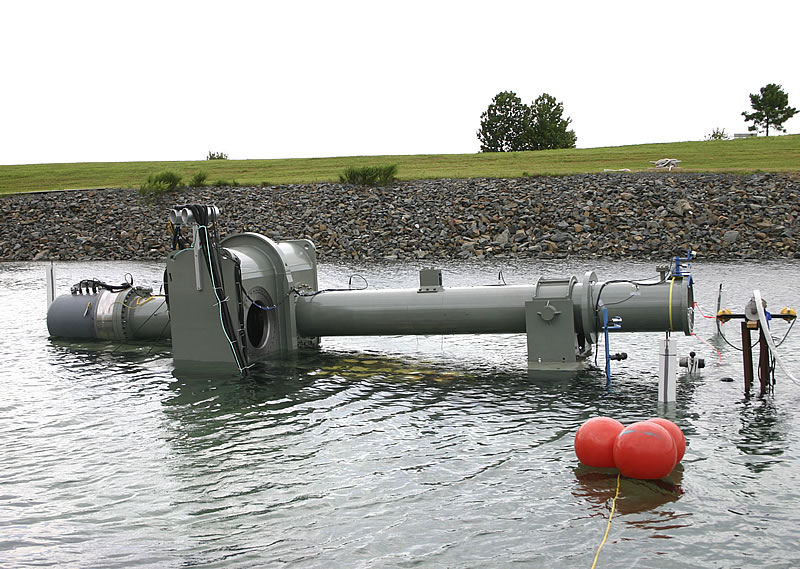
June 2005: Northrop Grumman Newport News receives a $10.4 million, 18-month contract to design and build a full-scale prototype of a modular torpedo launcher concept, and compete in Phase I of the Tango Bravo project. The concept is based on eliminating the submarine’s torpedo room from inside the ship’s pressure hull, and moving the launchers outside the pressure hull. This change would eliminate complex machinery, and free up valuable space inside the hull.
The Northrop Grumman-led team includes Penn State Applied Research Laboratory, Special Devices, Inc., Naval Undersea Warfare Center (Newport) and BBN Technologies.
May 26/05: General Dynamics Electric Boat Division in Groton, CT won a $9.5 million cost-plus-fixed-fee completion contract for research and development in support of the Defense Advanced Research Projects Agency (DARPA), Advanced Technology Office (ATO), external weapon stow and launch proposal. Work will be performed in Groton, CT, and is expected to be complete by November 2005. The contract was competitively procured and advertised via Broad Agency Announcement 05-03, with 31 offers received by The Naval Undersea Warfare Center, Newport Division in Newport, RI (N66604-05-C-3181).
“The contractor will develop and demonstrate an external weapon launch system that can stow, communicate with and deliver an unencapsulated MK 48 Advanced Capability torpedo from outside the pressure hull.”
May 26/05: General Dynamics Electric Boat Division in Groton, CT won a $6.3 million cost-plus-fixed-fee completion contract for research and development in support of the Defense Advanced Research Projects Agency (DARPA), Advanced Technology Office (ATO), shaftless propulsion proposal. Work will be performed in Groton, CT and is expected to be complete by May 2005. The contract was competitively procured and advertised via Broad Agency Announcement 05-03, with 31 offers received by the Naval Undersea Warfare Center, Newport Division in Newport, RI (N66604-05-C-3180).
“Contractor will develop and demonstrate a propulsive system that does not require a shaft to penetrate pressure hull.”
According to Defense News, DRS also received a $5 million award. Other companies on the General Dynamics Electric Boat shaftless propulsion team include Curtiss-Wright Electro-Mechanical Corp., BBN Technologies, the Penn State Applied Research Laboratory, the Naval Surface Warfare Center’s Carderock Division, and SatCon Applied Technology.
(This article was originally run on April 15, 2005. Updated as new information and developments came in.)
Additional Readings & Sources
* DARPA – TANGO BRAVO Site. The project is currently under DARPA’s Strategic Technology Office.
* DARPA – Tango Bravo solicitation FAQs
* IDILOGIC – BAA05-03 – TANGO BRAVO. Baseline solicitation.
* Military.com SoldierTech – UPSIZING TECH, DOWNSIZING CREW: The Tango Bravo Sub Project
* Navy League, Sea Power Magazine (February 2005) – Navy, DARPA Seek Smaller Submarines