

(click to view full)
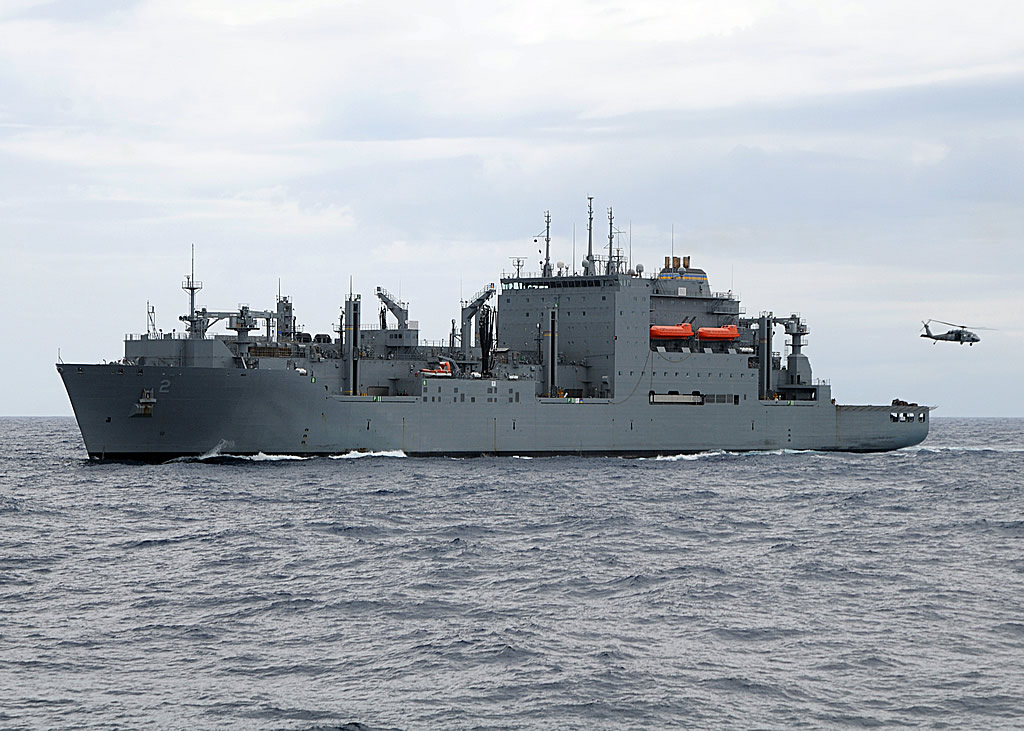
Warships get a lot of attention, but without resupply, an impressive-looking fleet becomes a hollow force. The US Navy’s supply and support fleet has been aging, and needed new vessels. T-AKE is part of that effort, and the ships have also found themselves performing “naval diplomacy” roles.
The entire T-AKE dry cargo/ ammunition ship program could have a total value of as much as $6.2 billion, and a size of 14 ships, as the US looks to modernize its supply fleet. How do T-AKE ships fit into US naval operations? What ships do they replace? What’s the tie-in to US civilian industrial capacity? How were environmental standards built into their design? And what contracts have been issued for T-AKE ships to date?
T-AKE Ships: Mission & Capabilities
(click to view full)
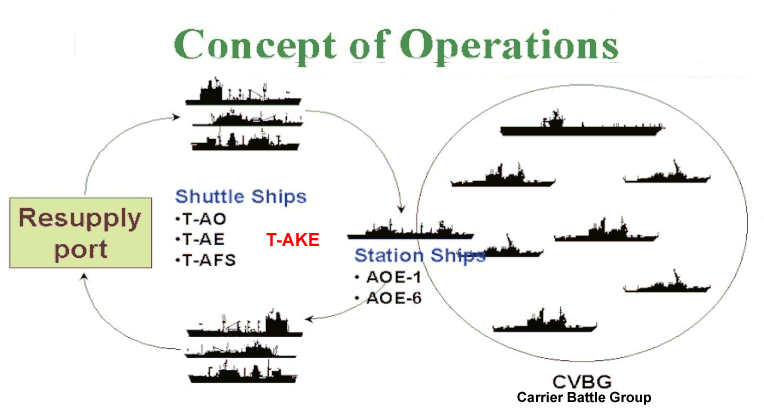
T-AKE multi-product fleet replenishment ships will provide logistics lift to station ships and other ships operating with naval forces from supply sources such as friendly ports, and at sea from merchant vessels. In other words, their primary mission is to provide a steady stream of ammunition, spare parts and provisions (dry, refrigerated and frozen) to naval forces at sea in their role as a shuttle ship.
As a secondary mission, they may operate in concert with a T-AO oiler as a semi-substitute for one AOE-1 Sacramento Class, or with AOE-6 Supply Class fast combat logistics support ships if the situation so dictates. Given the T-AKE’s fuel capacity, it would certainly require at least a T-AO oiler as well in order to service any Carrier or Amphibious strike group.
The AOEs are also referred to as “station ships.” They offer a form of one-stop shopping by carrying dry stores (food, consumables, spare parts), ammunition (bombs, missiles) and fuel (oil, jet fuel), and are able to transfer them all simultaneously. Often, shuttle ships simply resupply the AOE station ship.
(click to view full)
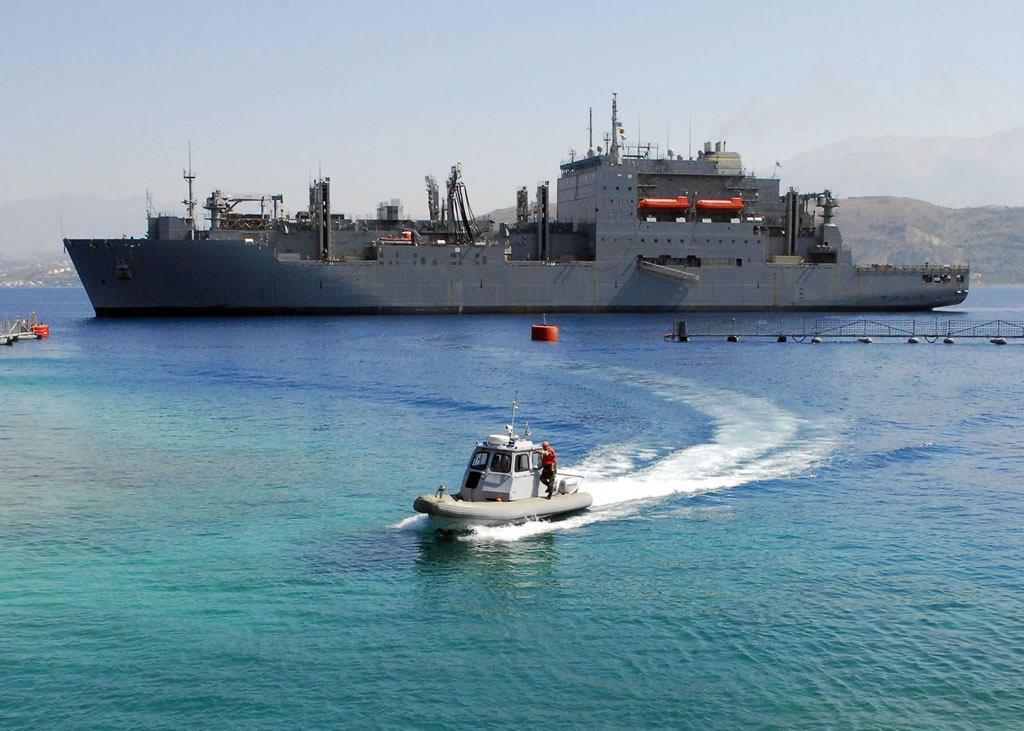
Lewis and Clark Class T-AKE dry cargo/ammunition ships are 210 meters (689 feet) in length and 32.2 meters (105.6 feet) in beam, with a design draft of 9.12 meters (29.9 feet). They displace 41,000 tons, and the ships can carry almost 7,000 metric tons of dry cargo and ammunition and 23,500 barrels of marine diesel fuel. The specifications demanded that the transfer rates for ammunition and stores must be at least equal to those of the AOE-6 Class. Maximum speed is slower, however, at around 20 knots of burst speed.
The T-AKEs will provide a 2-product (ammunition; and combat stores – including dry stores, frozen and chilled products, spare parts, and consumables that may include drinkable water) shuttle ship replacement for US Military Sealift Command’s aging Combat Store (T-AFS 1 Mars Class) and Ammunition (T-AE 26 Kilauea Class) shuttle ships. They are designed to be fully inter-operable with all US Navy and North Atlantic Treaty organization ships capable of underway replenishment, using standard US Navy Underway Replenishment (UNREP) equipment, or improved systems developed by industry.
(click to view full)
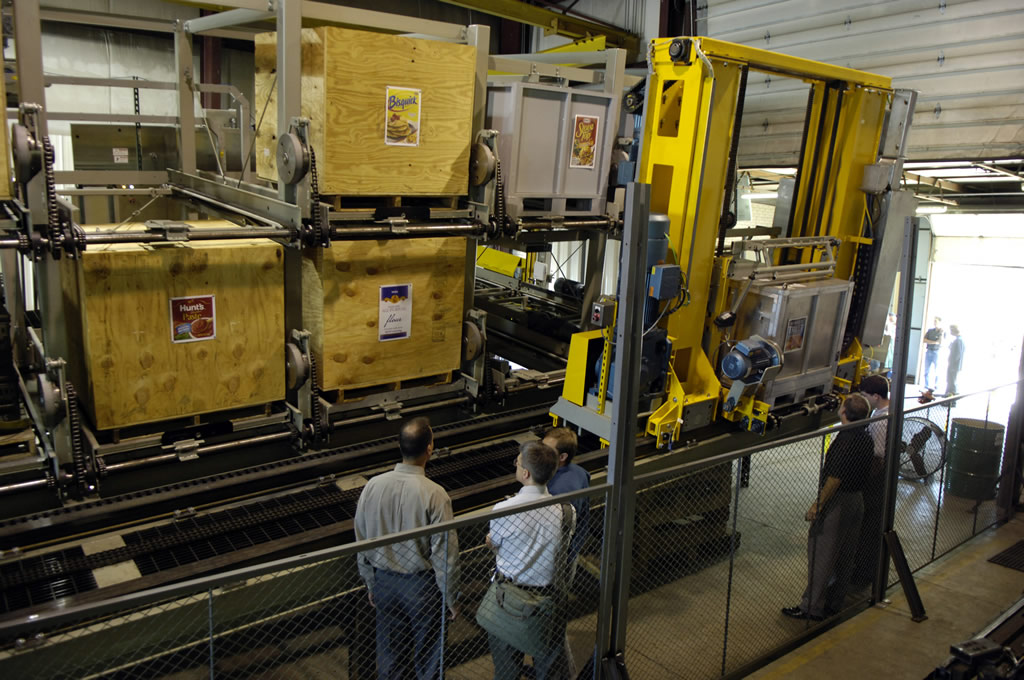
As one example, the US Navy is testing the Automated Storage and Retrieval System (ASRS), an automatic shipboard storeroom system that can be configured to store Navy-standard pallets, Joint Modular Intermodal Containers, or any other packaging container, offering faster performance, less work, and fully selective offloading. ASRS is intended to be a low-maintenance system that can operate in Sea State 5 (waves up to 7 feet, just under Small Craft Advisory), and survive to Sea Sate 9 (hurricane force winds and/or waves well over 14m/45 feet, “hey isn’t that Laird Hamilton out there?” conditions). With their single propulsion screw (mariners do not call them “propellers”) and single rudder, however, mechanical problems can become disabling more quickly than is the case for multiple screw or multiple rudder designs.
T-AKE ships are the US Navy’s first full-size all-electric ships, with diesel-electric generation that can be used for propulsion or for internal systems. The use of electric drive creates more internal redundancy in the event of damage. It also eliminates the need for drive shaft and reduction gears, which brings benefits to the ship’s internal space and makes for a quieter ship that’s harder to find using sonar. The ship class’ 4 Fairbanks Morse/MAN B&W 9L and 8L 48/60 diesel generators can generate up to 35.7 MW of power for use around the ship, compared to just 7.5 MW of power generated by the DDG-51 AEGIS destroyers to run internal machinery and combat systems.

(click to view full)
T-AKE ships have a crew of 124 CIVMARs – civilian mariners who function under Secretary of the Navy instructions, and are Excepted Service employees of the US government. Military Sealift Command’s Naval Fleet Auxiliary Force serves as their program manager, but the ships are assigned to Fleet Forces Command. As such, these ships are given the USNS (name) designation and “placed in service,” unlike Navy warships which are given the USS (name) designation and commissioned. The T-AKE’s military detachment is 11 Navy sailors, who provide operational support and supply coordination.
Another effect of this CIVMAR difference can be seen in the ship’s air assets. T-AKE ships are capable of landing, fueling and maintaining up to 2 utility helicopters like the CH-46D Sea Knight or MH-60S Knight Hawk, with hangar space for 2 machines. In practice, however, they do not carry US Navy helicopters. Instead, they carry contracted Eurocopter SA330 Puma medium helicopters, which are used to help transfer personnel and cargo in VERTREP (Vertical Replenishment) operations. Other Navy helicopters may land on T-AKE ships and assist, of course, but they are not part of the T-AKE ship’s native complement.
The T-AKE Program

& USNS Carl Brashear
(click to view full)
As noted below, the initial October 2001 contract called for the design and construction of the lead ship and the 1st follow ship, with additional follow-on ships included as contract options. At the time, the total cost if all options were exercised and 11 ships were built was projected at $3.75 billion (presumably in FY 2001 dollars). In April 2007, the Pentagon’s Selected Acquisition Report placed total actual and estimated program costs at $5.715 billion, based on 12 ships, with inflation rates included over the project’s entire lifetime. Thanks to a multi-year agreement hammered out in August 2007, the T-AKE program now has the potential to produce a total of 14 ships to be awarded through 2011, with a total value of $6.2 billion. Named USNS ships of the T-AKE Lewis and Clark Class all have a strong exploration bent; named ships to date include:
* T-AKE 1 USNS Lewis & Clark
* T-AKE 2 USNS Sacagawea
* T-AKE 3 USNS Alan Sheppard
* T-AKE 4 USNS Richard E Byrd
* T-AKE 5 USNS Robert E. Peary. No disrespect, but this should have been USNS Dave Brubeck.
* T-AKE 6 USNS Amelia Earhart
* T-AKE 7 USNS Carl Brashear
* T-AKE 8 USNS Wally Schirra
* T-AKE 9 USNS Matthew Perry
* T-AKE 10 USNS Charles Drew
* T-AKE 11 USNS Washington Chambers
* T-AKE 12 USNS William McLean
* T-AKE 13 USNS Medgar Evers
* T-AKE 14 USNS Cesar Chavez
Of these 14, 12 will serve in the classic logistics lift role. Another 2 T-AKE ships will go into the Maritime Prepositioning Service with a different cargo loadout, to support the US Marine Corps. The BOLD ALLIGATOR exercise’s February 2012 landing of an MV-22 Osprey aboard USNS Robert E. Peary is connected with that role. It means the Marines can lift ammunition directly from a T-AKE ship to shore, rather than using further transfer to other ships. Turning this test into an operational capability will take more work and testing. Having 2 T-AKE ships in the MPS should provide plenty of opportunity.
T-AKE Ships: The Civilian Industry Angle
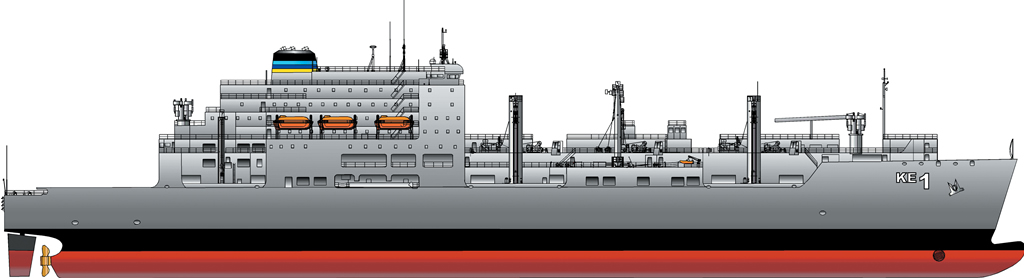
(click to view full)
As a deliberate design decision, T-AKE ships have been built to commercial standards to the extent that this was practical. The commercial standards approach removes the potential bottlenecks of military standards, and removes the need for commercial shipbuilders to follow a whole different set of procedures and requirements. This minimizes costs, allows the USA to take advantage of industry innovations and commercial best practices (which can reduce life cycle cost and improve efficiencies), and allows the shipbuilders to build up their civilian industrial capacity.
That last item was especially important to the T-AKE program.
In recent decades, the US Merchant Marine has declined, most civilian shipbuilding has migrated away from the United States to nations like South Korea, and ship ownership has migrated strongly toward direct and indirect ownership by Chinese firms. This has obvious implications for the overall sustainability of the US shipbuilding industry, and raises national security self-sufficiency concerns for the world’s pre-eminent naval power. GlobalSecurity.org notes that the ADC (X) program (which eventually became T-AKE) was seen as especially critical to demonstrate America’s ability to produce affordable and flexible container-type ships without going overseas. The idea was that ships would contribute to America’s overall shipbuilding infrastructure because their design would be a common hull having tremendous application to the civilian shipbuilding industry. So T-AKE’s goal was really two-fold: re-capitalization of the Navy’s sealift needs, and implementing a program that would impact America’s ability to competitively build ships on the civilian market.
NASSCO’s Jan 31/06 release noted that the exercise of the option for the 9th T-AKE ship brought NASSCO’s backlog to 10 ships, including the 9 T-AKEs and the 4th of 4 double-hull oil tankers being built for BP Shipping Company of Alaska. The question is what will happen when T-AKE construction ends, which is due to happen soon. Building the USA’s Mobile Landing Platform ships will take up some of that slack, but it’s a small class.
T-AKE Ships and the Environment
The existing T-AO Kaiser Class Fleet Oilers are not all double-hulled like the T-AKE – only the last 3 T-AOs are double-hulled. The Kaiser Class will need to be updated to meet international oil pollution conventions, and to address the wear being placed on them by the current high operational tempo.
Given the inevitable reductions in active T-AO ships during the refit period, T-AKE vessels will be particularly welcome in the fleet. For several reasons.
GlobalSecurity.org notes that this new class of T-AKE ships was envisaged as the first Navy Environmentally Sound Ship of the 21st century built with protection of the marine environment as a design objective. Performance requirements were crafted in the T-AKE ships’ System Specification that would ensure compliance with environmental regulations projected for the next 20 years.
Central themes are compliance with international and national regulations, adaptation of pollution prevention measures though elimination of pollutants at the source (design them out at the onset), establishment of a hazardous material prohibition list, and a second list of materials that may only be used with government concurrence. USNS Lewis and Clark is the first Navy ship designed to be Ozone Depleting Substance free. It is also capable of performing mid-ocean ballast water exchange to minimize introduction of invasive species, and incorporates a combined sewage/graywater treatment system, and a double hull around cargo fuel areas to afford port access. Analysis of total pollutant loading between the T-AFS and T-AE ships and the T-ADC (X)/ T-AKE design showed a drop of 95% in total pollutants being introduced into the marine environment.
Management of the Environmental Protection Program rests with the Assistant Project Manager, and the government/ industry team is responsible for ensuring environmental performance through the Environmental Protection Working Group.
The T-AKE program received a Secretary of Defense Environmental Award on May 1/02.
T-AKE Ships: Contracts & Key Events
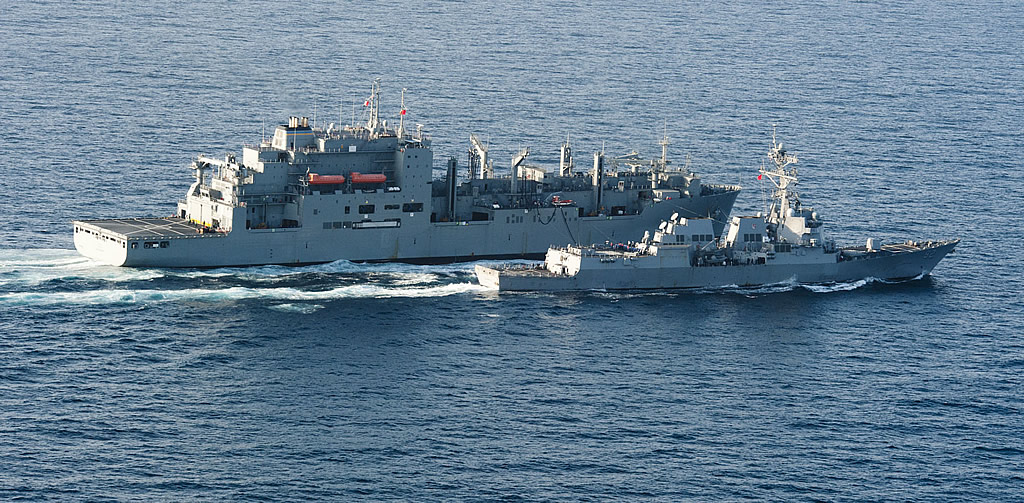
USNS Alan Sheppard
(click to view full)
Thanks to a multi-year agreement hammered out in August 2007, the T-AKE program is now slated to produce a total of 14 ships, with a total value of up to $6.2 billion. Unless otherwise specified, US Naval Sea Systems Command in Washington, DC issued these contracts and modifications to General Dynamics subsidiary National Steel and Shipbuilding Co. (GD NASSCO) in San Diego, CA.
FY 2021
(click to view full)
September 7/22:Pacific Vanguard 2022 The BQM-177A subsonic aerial target achieved full operational capability during a launch and intercept as part of Pacific Vanguard 2022 (PV 22) in the Philippine Sea on August 28. The US Navy’s next-generation target was launched from Lewis and Clark-class dry cargo and ammunition ship USNS Alan Shepard (T-AKE 3) for a SM-2 intercept exercise for USS Barry (DDG 52) and Royal Australian Navy Anzac-class frigate HMAS Perth (FFH 157).
May 17/22: Berth 2 Black Construction won an $83.7 million deal for design and construction of wharf improvements at Naval Base Guam. The work to be performed includes the renovation and modernization of Berth 2 to provide full capability to support two loaded T-AKE vessels with the proper depth of water, sufficient wharf length, and power and utilities. The Lewis and Clark Class T-AKE is a dry cargo/ammunition ship, totaling 14 ships. Designed to operate independently for extended periods at sea while providing underway replenishment services, the T-AKE directly contributes to the ability of the Navy to maintain a forward presence. Work will take place in Guam. Expected completion date is in September 2024.
FY 2019
FY 2013
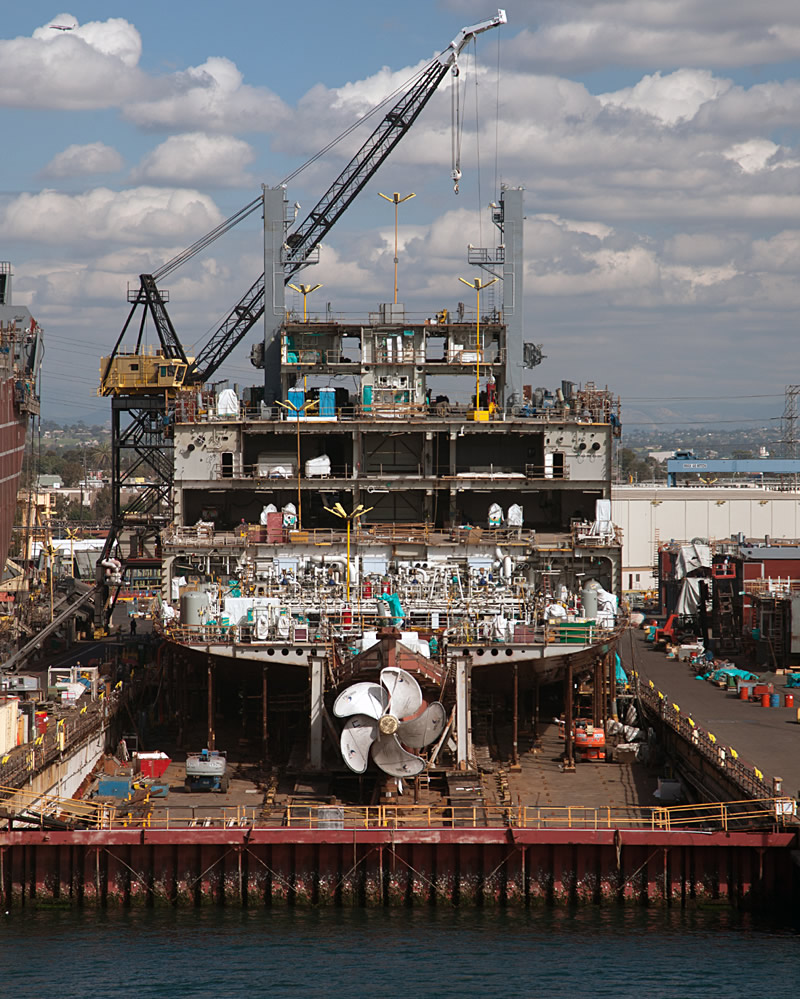
July 5/13: T-AKE 7 drydocking. BAE Systems San Francisco Ship Repair in San Francisco, CA receives a $10.8 million firm-fixed-price contract for a 56-calendar day regular overhaul and dry docking of USNS Carl Brashear. All funds are committed immediately, but the contract includes options which could bring its total value to $12.3 million.
Work will include inspection of the propeller shaft and stern tube, cleaning and painting of the hull, inspection and polish of the bow thruster propeller, installation of the cloropac unit and overhaul of the seal valves. Work will be performed in San Francisco, CA, and is expected to be complete by Sept 25/13. This contract was competitively procured, with proposals solicited via FBO.gov, and 1 offer received. US Military Sealift Command Norfolk in Norfolk, VA manages the contract (N32205-13-C-3015).
Feb 5/13: TAKE-5 drydocking. Detyens Shipyards Inc. in North Charleston, SC receives an $8.5 million firm-fixed-price contract for a 55-calendar day regular overhaul and dry docking of USNS Robert E. Peary. Improvements will include installing a reverse-osmosis system to produce fresh water; inspecting the propeller shaft and stern tube; overhauling sea valves; installing a chlorpac unit; and cleaning and painting of the underwater hull. It’s not quite the same as T-AKE 4’s list, which explains why the price is so different. The contract includes options which could bring the total value to $9.9 million.
Work will be performed in North Charleston, SC, and is expected to be complete by May 2013. All contract funds are committed in FY 2013, and will expire at the end of the current fiscal year of Sept 30/13. This contract was competitively procured via FBO.gov, but just 1 offer was received by Military Sealift Command Norfolk in Norfolk, VA (N32205-13-C-3010).
Jan 17/13: DOT&E testing. The Pentagon releases the FY 2012 Annual Report from its Office of the Director, Operational Test & Evaluation (DOT&E). T-AKE is included, and most of the type’s previous deficiencies now list as corrected.
One deficiency that popped up is potential vulnerability to hackers. Category I vulnerabilities were found during an Information Assurance audit, and a subsequent Red Team effort gained system access.
The other 2 are related to T-KAE’s protection measures again chemical, biological or radiation attacks. Corrosion in the Countermeasure Water Wash Down’s (CMWWD) mild carbon steel piping system is still a problem, and the new IPDS-LR alert system doesn’t automatically activate the ship’s general or chemical alarm. The crew must manually activate this alarm, unlike US Navy ships. IPDS-LR still works, and isn’t formally on the “fix it” list, but it is worth noting.
Nov 21/12: TAKE-4 drydocking. BAE Systems San Francisco Ship Repair in San Francisco, CA receives $13.4 million firm-fixed-price contract for a 53-calendar day regular overhaul and dry-docking of T-AKE 4, the USNS Richard E. Byrd. Improvements will include freeze chill decking structure support and repairs; installing a reverse-osmosis system to produce fresh water; inspecting the propeller shaft and stern tube; cleaning and painting of the underwater hull; and replacing the flight deck foam sprinkler piping. The contract includes options which would bring the total to $15.1 million.
Work will be performed in San Francisco, CA, and is expected to be complete by Jan 17/13. Contract funds will expire at the end of the current fiscal year, on Sept 30/13. This contract was competitively procured via FBO.gov, with 1 offer received (N32205-13-C-3012).
Oct 24/12: T-AKE 14 delivered. Military Sealift Command accepts delivery of its newest and last T-AKE ship, USNS Cesar Chavez, during a short ceremony at the General Dynamics NASSCO Ship Yard San Diego, CA. US MSC
Final T-AKE
FY 2012
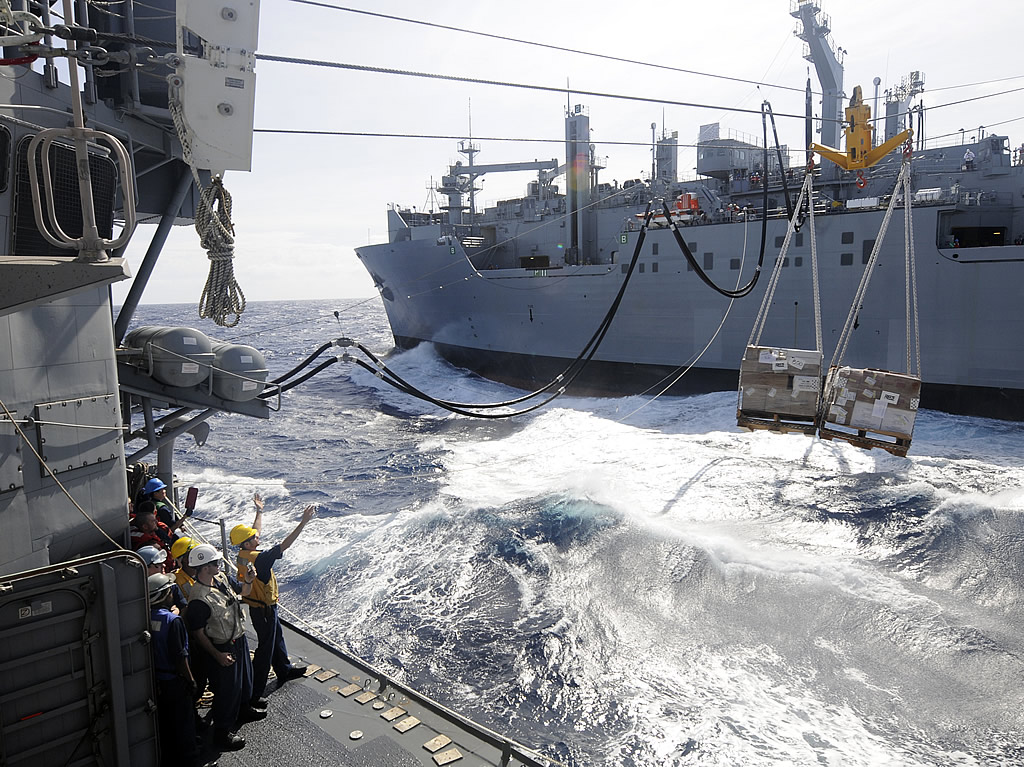
Osprey lands; T-AKE 13 launched with greatly reduced labor hours, then delivered; T-AKE 3 drydock.
(click to view full)
Sept 28/12: T-AKE 14 trial. The future USNS Cesar Chavez completed its Integrated Acceptance Trial which should lead to delivery later this (civil) year. NAVSEA.
April 24/12: T-AKE 13 delivered. US Military Sealift Command accepted delivery of T-AKE 13 as USNS Medgar Evers, during a short ceremony at General Dynamics NASSCO in San Diego. US MSC | US Navy | GD NASSCO.
March 16/12: T-AKE 3 drydock. BAE Systems San Francisco Ship Repair in San Francisco, CA receives a $12.3 million firm-fixed-price contract for a 55-calendar day regular overhaul and dry-docking of the USNS Alan Shepard [T-AKE-3]. Some of the major work items include dry-docking and undocking the ship, repairing interior decks, structural repairs, overhauling the main diesel generators, and inspecting and refurbishing the propeller shaft and stern tube. This contract includes options, which could raise it to $14.3 million.
Work will be performed in San Francisco, CA, and is expected to be complete by May 28/12. Contract funds will expire at the end of the current fiscal year, on Sept 30/12. This contract was competitively procured, with 1 offer received by US Military Sealift Fleet Support Command in Norfolk, VA (N40442-12-C-3011).
Feb 9/12: Osprey landing. A USMC MV-22 Osprey tilt-rotor aircraft from VMM-266 makes the 1st landing aboard a T-AKE ship, on USNS Robert E. Peary [T-AKE 5]. The Osprey landed aboard Robert E. Peary while conducting an experimental resupply of Marines during exercise Bold Alligator 2012. US Navy photo release.
Nov 12/11: T-AKE 13 launched. USNS Medgar Evers [T-AKE 13] is christened at NASSCO’s San Diego, CA shipyard. She is named in honor of the African American civil rights leader from Mississippi, who was assassinated on June 12/63 in the front yard of his Mississippi home, by Ku Klux Klan member Byron De La Beckwith. Evers had tried to end segregation at the University of Mississippi in the 1950s, and was appointed Mississippi’s first NAACP field officer in 1954. He held the position until his assassination, working for economic boycotts and peaceful protests against “Jim Crow” segregation laws. His widow, Myrlie Evers-Williams, christened the ship.
NASSCO says that its culture of continuous improvement has as reduced the labor hours required to build T-AKE 13 by 67%, compared to T-AKE-1. The ship is due for delivery to the US Navy in Q2 2012, after at-sea testing. US MSC | GD NASSCO.
FY 2011
Cam Ranh return; T-AKE 11 delivered; T-AKE 12 launch & delivery; T-AKE 13 keel laid; T-AKE 14 named & keel laid; T-AKE 1 drydock.
(click to view full)
Sept 28/11: T-AKE 12 delivered. General Dynamics NASSCO delivers USNS William McLean to the U.S. Navy, during a signing ceremony at its San Diego, CA shipyard. US MSC | GD NASSCO.
Aug 23/11: Cam Ranh Bay. USNS Robert E. Byrd [T-AKE-4] leaves Cam Ranh Bay, after becoming the 1st US Navy vessel to visit the southern Vietnamese port in over 30 years. She spent 7 days at Cam Ranh Shipyard for routine maintenance and repairs that included underwater hull cleaning, polishing of the ship’s propeller, repairing shipboard piping, and overhaul of the salt water cooling system.
MSC Ship Support Unit Singapore routinely contracts shipyards throughout Southeast Asia to conduct maintenance and repairs, reducing transit times and hence the amount of time these ships are off-mission. US MSC.
May 19/11: T-AKE 14 named. Secretary of the Navy Ray Mabus announces that T-AKE 14 will be named USNS Cesar Chavez. Chavez served in the Navy from 1944-1946, then became a leader in the American labor movement, and a civil rights activist who co-founded the National Farm Workers Association union. The choice ends up focusing unfriendly attention on Mabus’ politicization of ship names. US MSC.
May 10/11: T-AKE 14 keel. General Dynamics NASSCO hosts a keel laying ceremony for T-AKE 14 at its San Diego, CA shipyard. Construction began in October 2010, and the ship is scheduled to be delivered to the U.S. Navy in Q4 2012. GD NASSCO also touts shipbuilding progress to date:
“During the course of the decade-long T-AKE Program, General Dynamics NASSCO has implemented more than 20,000 ideas to drive down costs and improve quality as part of its continuing commitment to the efficient production of world-class ships for the U.S. Navy. These enhancements are the result of ongoing process improvement initiatives, Lean Six Sigma projects, facility investments of more than $300 million since 2000 and capturing and rigorously applying lessons learned… In just five years, NASSCO has reduced the labor hours required to build a T-AKE by more than 60 percent, while completing construction in half the scheduled time required to build the first T-AKE ship…”
April 17/11: T-AKE 12 launched. GD NASSCO launches the USNS William McLean [T-AKE 12] dry cargo/ammunition supply ship at its San Diego shipyard. William Burdette McLean was a Navy physicist who conceived and developed the heat-seeking Sidewinder missile. NASSCO began building the USNS William McLean in September 2009. Following its at-sea testing phase, the ship will be delivered to the Navy in the 3rd quarter of 2011. GD NASSCO | US Navy pic.
March 25/11: T-AKE 1 drydocking. Detyens Shipyards, Inc. in North Charleston, SC wins a $7.3 million firm-fixed-price contract for a 55-calendar-day regular overhaul of USNS Lewis and Clark [T-AKE 1], including options which would bring the cumulative value to $8.8 million. This regular overhaul will include dry-docking and undocking the ship; underwater hull painting; main engine overhaul; propeller shaft inspection; cleaning and gas freeing tanks, voids and cofferdams; tank structural surveying and testing; and non-skid renewal.
Work will be performed in Charleston, S.C., and is expected to be completed by June 2011. Contract funds will expire at the end of the fiscal year, on Sept 30/11. This contract was competitively procured and posted to the Federal Business Opportunities Web page, with 3 offers received. The U.S. Navy’s Military Sealift Fleet Support Command manages the contract (N40442-11-C-3049).
Feb 23/11: T-AKE 11 delivered. US Military Sealift Command accepts delivery of its newest T-AKE dry cargo/ammunition ship, the USNS Washington Chambers [T-AKE 11], following successful sea trials. US MSC | GD NASSCO re: trials.
Jan 26/11: T-AKE 11 trials. GD NASSCO begins contractor sea trials for the Washington Chambers [T-AKE 11], before a scheduled return to the shipyard on Feb 3/11 for additional work. NASSCO spokesman Jim Gill told Sign-On San Diego that the ship:
“…goes out 20-plus miles… They test all the systems, including drop anchor and hauling it back up. This is usually done just off Coronado Roads (Silver Strand). Take the engine through all its configurations. Test the cranes, test the replenishment equipment (cabling, winches), run the fluids through the lines. Test the radar, fire fighting systems, top side sprinkling systems.”
Oct 26/10: T-AKE 13 keel. General Dynamics NASSCO lays the keel for T-AKE 13, the Medgar Evers. The ship is named in honor of the African American civil rights activist whose 1963 murder prompted President John F. Kennedy to ask Congress for a comprehensive civil rights bill.
NASSCO also cites a number of improvements since launching T-AKE 1, aimed at driving down costs and improving quality. These improvements involved facility investments, workforce training and capturing and applying lessons learned. For example, design enhancements feature an electronic sensor-triggered fire extinguishing system that eliminates a mechanical arrangement. This results in fewer parts, and hopefully higher reliability and lower costs.
Oct 21/10: T-AKE 14 begun. General Dynamics NASSCO begins construction of the 14th T-AKE ship, which is scheduled to be delivered to the U.S. Navy in Q4 2012. Source.
FY 2010
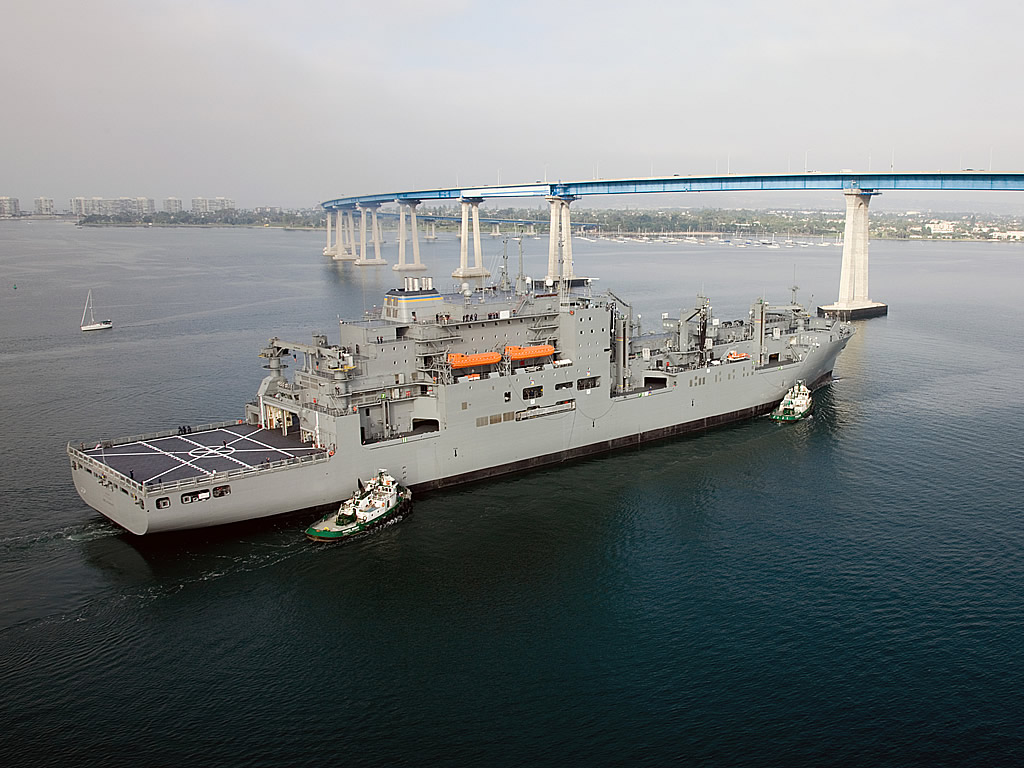
T-AKE 9 delivered; T-AKE 10 launched & delivered; T-AKE 11 launched; T-AKE 13 & 14 ordered; T-AKE 13 named.
(click to view full)
Sept 11/10: T-AKE 11 launch. General Dynamics NASSCO launches the USNS Washington Chambers [T-AKE 11], during a christening ceremony at the shipyard, on San Diego’s working waterfront. NASSCO.
July 14/10: T-AKE 10 delivered. General Dynamics NASSCO delivers USNS Charles Drew [T-AKE 10] to the U.S. Navy, formally completing construction work that began in October 2008. Like other T-AKE ships, she is crewed by 124 civil service mariners, and 10 U.S. Navy sailors.
The ship is named in honor of Dr. Charles R. Drew (1904-1950), the African American surgeon and hematologist who pioneered the procedures for the safe storage and transfusion of blood. US MSC | GD NASSCO.
May 14/10: Small business qualifier Pacific Ship Repair & Fabrication in San Diego, CA will handle post-shakedown availability contracts for USNS Matthew Perry [T-AKE 9] and USNS Charles Drew [T-AKE 10]. The multi-ship solicitation contracts include options which would bring the total contract value to $18.9 million, if exercised.
Post-shakedown availability is a normal process for ships, in order to fix and tune problems found on the initial shakedown cruise. This one will include work on the lube-oil-tank, second-deck-cargo and galley modifications; cargo hold overhead insulation; and deck air compressor and radar installation.
Work will be performed in San Diego, CA, and is expected to be complete within 75 calendar days, once work begins for each ship. This contract was competitively procured on a set-aside for small business basis, and posted to the Military Sealift Command, Navy Electronic Commerce Online and Federal Business Opportunities Web sites. A total of 4 offers were received by US Navy Military Sealift Fleet Support Command in Norfolk, VA, and they issued the contracts using funds from US NAVSEA PMS 325 (N40442-10-C-3020 for the USNS Matthew Perry; N40442-11-C-3000 for the USNS Charles Drew).
March 26/10: T-AKE 12 keel. General Dynamics NASSCO lays the keel for T-AKE 12, the William McLean. It’s named for the research scientists whose accomplishments include the iconic AIM-9 sidewinder short-range air-air missile. NASSCO.
Feb 27/10: T-AKE 10 launch. General Dynamics NASSCO launches USNS Charles Drew [T-AKE 10] at its San Diego shipyard. Dr. Charles Drew researched and developed methods of blood collection, plasma processing and storage. US Navy | General Dynamics release.
Feb 26/10: T-AKE 13 & 14 ordered. A $824.6 million modification to a previously awarded contract (N00024-02-C-2300) for construction of T-AKE 13 and T-AKE 14; the contract modification also includes design and construction, technical manuals, special studies, analyses and reviews, engineering and industrial services, and data.
Work will be performed in San Diego, CA and is expected to be complete by December 2013 for T-AKE 13 and November 2014 for T-AKE 14. See also Dec 12/08 long-lead items buy, GD NASSCO release.
Feb 24/10: T-AKE 9 delivered. General Dynamics NASSCO delivers USNS Matthew Perry [T-AKE 9]. GD release.
Oct 9/09: T-AKE 13 named. Secretary of the Navy Ray Mabus, a former governor of Mississippi from 1988-1992, announces that the Navy will name a dry cargo ammunition ship after the civil rights leader Medgar Evers. The Mississippi native’s 1963 murder, and the subsequent deadlock of 2 all white juries, prompted President John F. Kennedy to ask Congress for a comprehensive civil rights bill. Evers’ murderer, Byron De La Beckwith, was finally convicted in 1994 based on new evidence. US Navy.
FY 2009
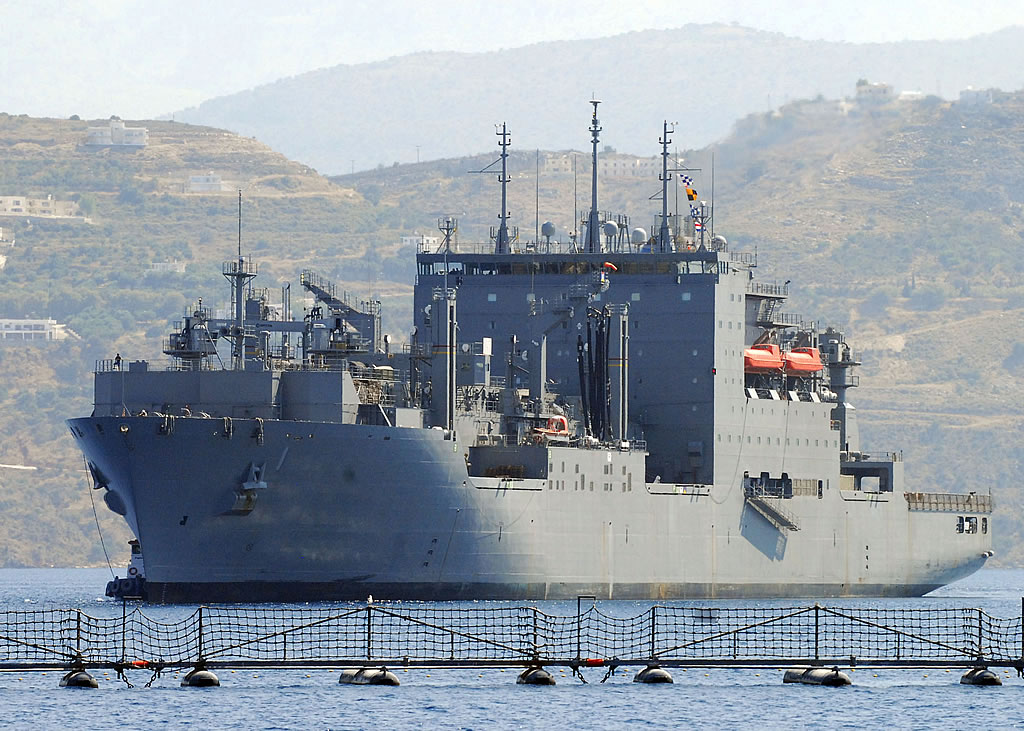
T-AKEing an expanded role; T-AKE 6 delivered; T-AKE 7 delivered; T-AKE 8 launched; T-AKE 9-12 named; T-AKE 9 launched; T-AKE 10 keel laid; T-AKE 11 & 12 ordered; T-AKE 11 begun.
(click to view full)
Sept 16/09: Expanded role. USNS Richard E. Byrd [T-AKE 4] has to make some changes, in order to serve as the lead Pacific Partnership 2009 vessel instead of the Austin class amphibious assault vessel USS Dubuque [LPD 8]. Dubuque’s crew had begun to come down with flu symptoms, raising concerns about H1N1 transmission.
The US Navy describes the shifts on board the Byrd, including substitution of outside personnel for some crew, bringing in Army cots, adding a reverse osmosis water purifier on deck, carrying full fuel and 3 months worth of provisions for the ship’s own use, adding cargo for medical needs, adding and deploying 4 small 7m RHIB boats, etc.
Aug 17/09: T-AKE 9 launched. The US Navy christens T-AKE 9 Matthew Perry, named after the famed South Pole explorer. GD release | US MSC release.
May 6/09: US MSC announces that USNS Lewis and Clark [T-AKE 1] foils a pirate attack off the coast of Somalia. Once shipboard lookouts spotted the 2 suspected pirate skiffs, the ship conducted evasive maneuvers and increased speed to elude the pirates. The pirates fired small arms weapons from approximately 2 nautical miles toward Lewis and Clark, which fell 1 nautical mile short of the ship’s stern. Lewis and Clark continued to increase speed and the skiffs ceased their pursuit.
March 19/09: T-AKE 11 begun. GD NASSCO begins construction of the future USNS Washington Chambers [T-AKE 11]. The Washington Chambers is scheduled to be delivered to the Navy in the first quarter of 2011. Source.
March 17/09: T-AKE 10 keel. GD NASSCO lays the keel for the future USNS Charles Drew [T-AKE 10]. Construction of the Charles Drew began in October 2008, and the ship is scheduled to be delivered to the Navy in the 3rd quarter of 2010. General Dynamics release.
March 8/09: T-AKE 8 launched. The US Navy christens T-AKE 8 Wally Schirra, named after the American astronaut and command pilot of Apollo 7, the first manned flight in the Apollo program. US MSC | San Diego Tribune | San Diego Navy Compass | General Dynamics release.
March 4/09: T-AKE 7 delivered. US Military Sealift Command accepts delivery of USNS Carl Brashear, after a series of tests and trials prior to delivery. MSC release | General Dynamics release.
Feb 8/09: Gannett’s Navy Times offers a profile of life aboard the USNS Robert E. Peary [T-AKE 5]. The ships do have some limitations compared to their predecessors, and their electronics can be a source of adjustment and extra work, as well as improved performance:
“He remembered serving aboard an Arctic-class ammunition ship, powered by gas turbines, and being able to keep pace with a carrier strike group at 30 knots or more. The Peary and its siblings can make a top speed of 20 knots, but not for very long. Where earlier ships had twin screws and twin rudders, affording better reliability, the Peary has a single screw and a single rudder, rendering it all-the-more vulnerable to engineering problems.
When the Peary needed to get underway for a week’s worth of qualification trials in late January, the ship’s engine systems were acting up. Just as computer users have done for years, the Peary’s engineers shut down the engine system and re-started it, temporarily solving the problem. But the touchy plant forced Karavalos to cancel a day’s worth of practice unreps so his technicians could locate problems in the propulsion system.”
DID would add that despite the article’s description of pleasant quarters and dispensed formalities compared with Navy ships is partly reflective of the fact that MSC mariners are away from home over 70-80% of the time. The ships are home, and the lack of duty seamen to do trivial work means that everyone must pitch in.
Jan 27/09: Cascade General in Portland, OR won a $13.9 million firm-fixed-price contract for post-shipyard work on USNS Amelia Earhart [T-AKE 6] and USNS Carl Brashear [T-AKE 7]. Work involves ship alterations, including the lube-oil-tank, second-deck-cargo and galley modifications; cargo hold overhead insulation; and deck air compressor and radar installation. Naval Sea Systems Command (NAVSEA PMS 325) provides the funding for post-shipyard work, and this contract includes options which, if exercised, would bring the total contract value to $17.9 million.
Work will be performed in Portland, OR and is expected to be complete within 75 calendar days. Contract funds will expire at the end of the fiscal year. This contract was competitively procured, with 2 offers received by U.S. Navy’s Military Sealift Fleet Support Command, a field activity of Military Sealift Command (N40442-09-C-3009).
Dec 12/08: T-AKE 11 & 12 ordered. A $940.3 million modification to a previously awarded contract (N00024-02-C-2300), exercising 2 construction options for T-AKE 11 Washington Chambers and T-AKE 12 William McLean. Earlier this year, NASSCO received a total of $200 million to purchase long lead time materials for these ships.
These funds also cover $200 million for engines and other long lead time materials and components for T-AKE 13 and T-AKE 14. GD NASSCO expects a contract that fully funds both ships by February 2010.
Work will be performed in San Diego, CA and is expected to be complete by February 2012 for T-AKE 11, January 2013 for T-AKE 12, December 2013 for T-AKE 13 and November 2014 for T-AKE 14. Se also GD NASSCO release.
Dec 2/08: T-AKE 9-12 named. Secretary of the Navy Donald Winter announces the names for the next 4 Lewis and Clark class T-AKE ships. All still have exploration theme, but some of these namings involve different kinds of pioneering and exploration. NAVAIR will be especially pleased by 2 of the names.
T-AKE 9 honors Navy Commodore Matthew C. Perry (1794-1858), who is most famous for sailing a naval squadron to Japan and opening it to trade. Ford, Chrysler, and General Motors executives are probably wishing that he had stayed home.
T-AKE 10 honors Dr. Charles R. Drew (1904-1950), a physician and medical researcher whose pioneering work in the late 1930s and early 1940s led to the life-saving discovery that blood could be separated into plasma. Dr. Drew was African-American, and has a medical university named after him in south Los Angeles.
T-AKE 11 honors Navy Capt. Washington Irving Chambers (1856-1934), who arranged the world’s first airplane flight from a warship on Nov 14, 1910, when Eugene Ely flew from the light cruiser the USS Birmingham [CL-2].
T-AKE 12 honors William Burdette McLean (1914-1976), who conceived and developed the iconic Sidewinder short-range, heat-seeking air-to-air missile while serving as a physicist for the Navy. As NAVAIR’s release notes, he also pioneered the testing facility at China Lake, CA.
Nov 24/08: NAVFAC Marianas announces the 2nd increment of an $83 million firm-fixed price contract to the IBC/TOA Corporation Joint Venture based in Barrigada, Guam. The $43 million increment will be used to complete expansion of U.S. Naval Base Guam’s Kilo Wharf, used for ammunition. Cmdr. Matthew Suess, executive officer for NAVFAC Marianas:
“The extension is to accommodate the new T-AKE class of ammunition vessels, meet current seismic standards, and provide for containerized cargo operations with the installation of new crane rails.”
The project is scheduled for completion in 2010. US Navy release.
Oct 30/08: T-AKE 6 delivered. The USA’s Military Sealift Command accepts delivery of the USNS Amelia Earhart [T-AKE 6] in San Diego. In early December 2008, the ship will go on a short “shakedown cruise” where the ship’s crew will test a range of shipboard operations. Earhart will operate mainly in the Pacific Ocean out of Guam, and is anticipated to begin conducting missions for MSC in summer 2009. US MSC | GD NASSCO.
FY 2008
Revised program SAR (to 12 ships); T-AKE 4 delivered; T-AKE 5 delivered; T-AKE 6 launch; T-AKE 7 named & launched; TAKE 8 named; T-AKE 10 ordered; T-AKE 12 long-lead.
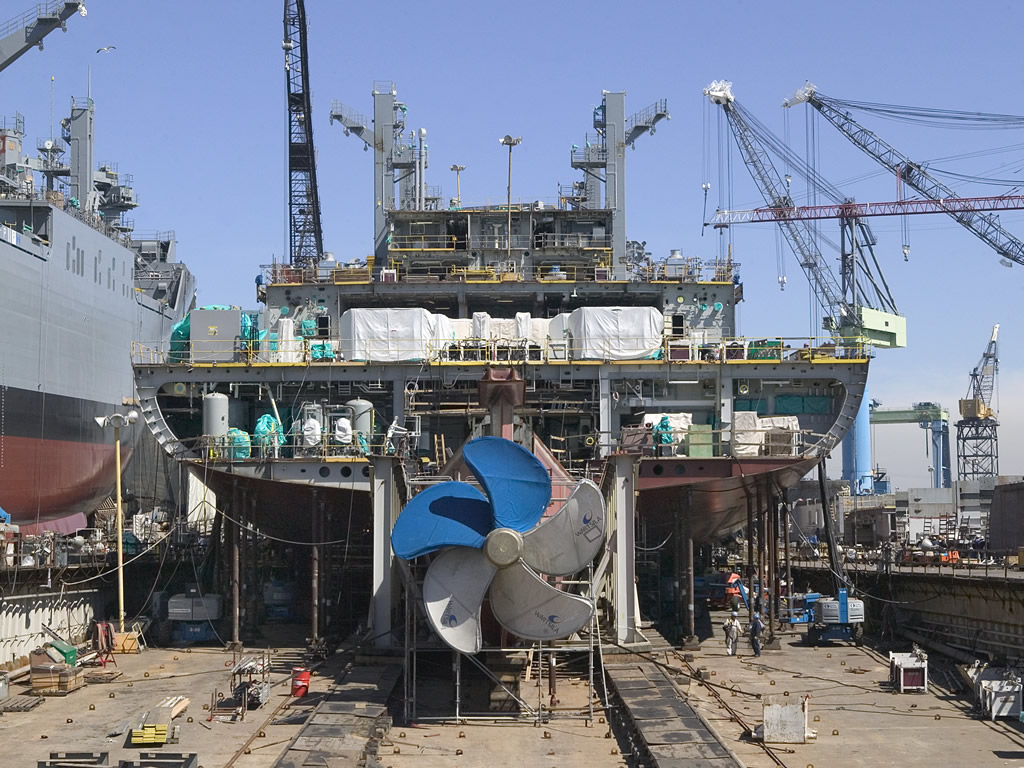
Ken Wright, GD NASSCO
(click to view full)
Sept 18/08: T-AKE 7 launched. USNS Carl Brashear [T-AKE 7] is christened and launched during a morning ceremony at the General Dynamics NASSCO shipyard in San Diego, CA. After a series of tests and sea trials, the ship will be delivered to the Navy’s Military Sealift Command for operations in 2009.
The ship honors Master Chief Petty Officer Carl Brashear, who joined the U.S. Navy in 1948. See March 3/08 entry for more on Carl Brashear. MSC release.
Sept 10/08: Detyens Shipyards, Inc. in Charleston, SC won a $7.4 million firm-fixed-price contract for a post-shipyard availability of Military Sealift Fleet Support Command dry cargo/ammunition ship USNS Robert E. Peary [T-AKE 5]. This shipyard availability is primarily for ship alterations, including lube-oil-tank, second-deck-cargo and galley modifications; cargo hold overhead insulation; and deck air compressor and radar installation. The contract includes options which, if exercised, would bring the total contract value to $9.1 million.
Work will be performed in Charleston, SC and is expected to be complete within 75 calendar days. Contract funds will expire at the end of the fiscal year. This contract was competitively procured via Military Sealift Command, Navy Electronic Commerce Online and Federal Business Opportunities websites, with 2 offers received by the U.S. Navy’s Military Sealift Fleet Support Command (N40442-08-C-3011).
June 10/08: T-AKE 12 long-lead. A $100 million modification to previously awarded contract (N00024-02-C-2300) to exercise an option for long lead time material for T-AKE 12.
Long-lead material includes items like engines et. al. These items take time to make, but must be delivered early or else construction will be delayed. Work will be performed in San Diego, CA and is expected to be complete by January 2013. See also GD release.
June 5/08: T-AKE 5 delivered. USNS Robert E. Peary [T-AKE 5] is officially accepted by the U.S. Navy.
At the end of July 2008, the ship will go a short ‘shakedown cruise’ where the ship’s crew will test a range of shipboard operations. By the end of the summer, Peary will depart for her homeport in Norfolk, and soon deploy on its first operational mission. Navy release | GD release.
April 7/08: SAR. The Pentagon releases its Selected Acquisition Reports for the period up to December 2007. T-AKE is included due to cost increases:
“Program costs increased by $1,086.4 million (+23.5 percent) from $4,628.8 million to $5,715.2 million, due primarily to the addition of one ship from 11 to 12 ships (+$471.0 million), associated outfitting and post delivery costs (+$84.5 million), and cost growth on previous ships (+$520.6 million).”
April 6/08: T-AKE 6 launch. USNS Amelia Earhart [T-AKE-6] is launched and christened at the General Dynamics NASSCO shipyard in San Diego. See also May 28/07 entry. US Navy release.
March 14/08: At a House Armed Services Seapower subcommittee hearing, chairman Rep. Gene Taylor [D-MS] says:
“Although I put the T-AKE in the list of programs which are healthy, I would like our witnesses to address why the T-AKE [ship] that was requested and funded in fiscal year 2008 is not being put on contract. The subcommittee understands that the money that was requested to purchase a ship was instead used to re-negotiate contract terms. I understand the Navy thinks they can do this because the money is in a working capital fund called the National Defense Sealift Fund or NDSF.
I assure you that it is not the intent of the Congress that money authorized and appropriated for a specific purpose, in this case the procurement of a ship, would be used for any other purpose without further authorization or reprogramming.”
Read “US Navy’s 313-Ship Plan Under Fire in Congress” for more.
March 7/08: Pacific Ship Repair & Fabrication in San Diego, CA won an $11 million firm-fixed-price contract for a post shipyard availability of the USNS Richard E. Byrd (T-AKE 4). This contract is designed to take care of post-construction alterations, including conversions to the bakery, galley and scullery, as well as modifications to the 2nd deck cargo hold and bow thruster chilled-water piping system. The ship is expected to deploy on its first operational mission this summer, and the contract includes options that could bring the total contract value to $12.7 million.
Work will be performed by Pacific Ship Repair & Fabrication at the General Dynamics NASSCO shipyard in San Diego, CaA and is expected to be completed by June 2008. Contract funds will expire at the end of the fiscal year. This contract was competitively procured, with 3 offers received by the U.S. Navy’s Military Sealift Fleet Support Command (N40442-08-C-3004).
March 3/08: T-AKE 7 & 8 named. Secretary of the Navy Dr. Donald C. Winter announced the naming of the 7th and 8th Military Sealift Command ships of the Lewis and Clark-class Auxiliary Dry Cargo ships (T-AKE) as Carl Brashear and Wally Schirra.
Master Chief Boatswain’s Mate (Master Diver) Carl M. Brashear joined the United States Navy in 1948, and became its first black deep-sea diver, first black Master Diver, and the first U.S. Navy diver to be restored to full active duty as an amputee, almost 2 difficult years after a salvage operation went awry. Brashear was the subject of the 2000 movie “Men of Honor,” starring Cuba Gooding Jr.
Wally Schirra was of the original 7 Mercury astronauts profiled in the movie “The Right Stuff,” and holds the distinction of being the only astronaut to fly in each of the Mercury, Gemini and Apollo programs. USN PEO ships release.
Jan 31/08: T-AKE 10 ordered. General Dynamics, National Steel and Shipbuilding Co. (NASSCO) in San Diego, CA received a $459.8 million modification to previously awarded contract (N00024-02-C-2300), exercising an option for construction of T-AKE 10. See the July 20/07 entry, which involved $100 million in long-lead time items for T-AKE 10. This $459.8 million contract also includes technical manuals and data, special studies, analyses and reviews, engineering and industrial services, and an unspecified value of long lead time material for T-AKE 11 like engines et. al.
Work will be performed in San Diego, CA and construction of T-AKE 10 is scheduled to begin in January 2009, with delivery to the Navy’s Military Sealift Command (MSC) in Q4 2010. Construction of T-AKE 11 is scheduled to begin in the Q1 2010, with delivery in Q4 2011. GD release.
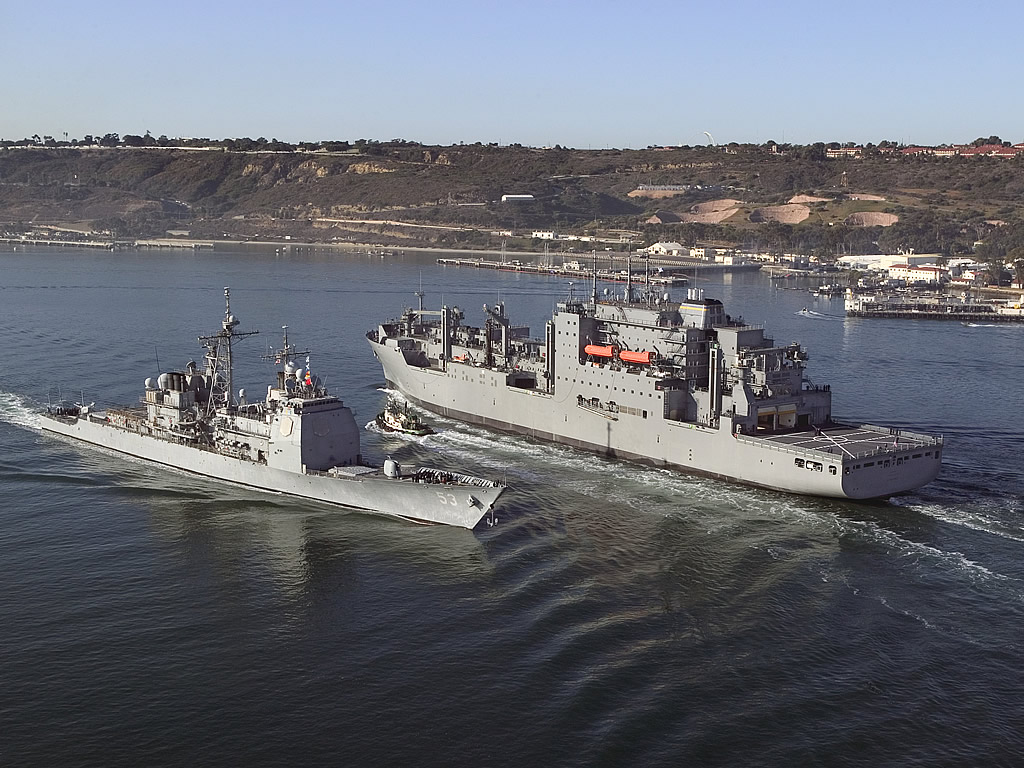
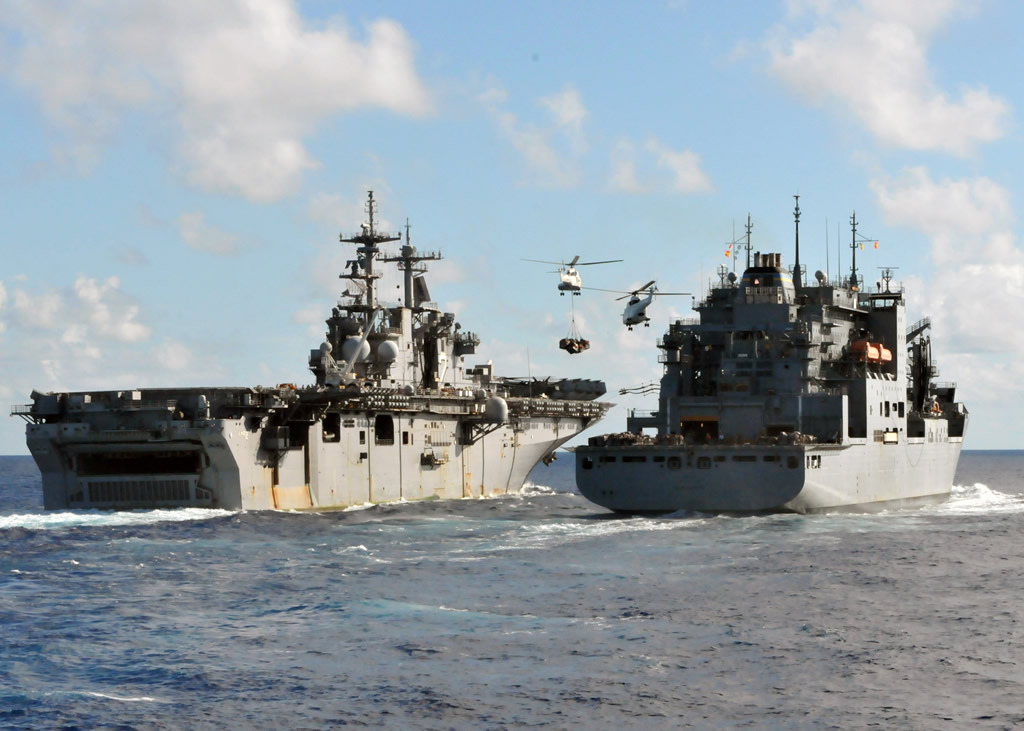
and CG-53 Mobile Bay
(click to expand)
Dec 19/07: Cascade General Portland Shipyard in Portland, OR won a $9.1 million firm-fixed-price contract for a 70-day post shipyard availability (PSA) of Military Sealift Fleet Support Command’s dry cargo/ammunition ship USNS Alan Shepard [T-AKE 3] “to undergo a number of modifications that could not be economically accomplished under the ship construction contract.” NAVSEA PMS-325 provided funding for the alterations to be completed during the PSA, and the contract includes options which, if exercised, would bring the cumulative value of this contract to $10.8 million.
Work will be performed in Portland, OR and is expected to be complete by Apr. 2008. Contract funds in the amount of $10.8 million will expire at the end of the current fiscal year. This contract was competitively procured, with 3 offers received by the U.S. Navy’s Military Sealift Fleet Support Command, a field activity of Military Sealift Command in Washington, DC (N40442-08-C-3003).
Nov 14/07: T-AKE 4 delivered. General Dynamics NASSCO delivers USNS Richard E. Byrd [T-AKE 4] to the U.S. Navy. See May 15/07 entry for information about the ship’s namesake. In 2007, NASSCO delivered T-AKE 2 USNS Sacagawea in February, T-AKE 3 USNS Alan Shepard in June, and now USNS Richard E. Byrd. T-AKE 1 USNS Lewis and Clark was delivered in June 2006, and the 5th-8th ships of the class are currently under construction for deliveries through the third quarter of 2009.
General Dynamics NASSCO employs more than 4,600 people and is the only major ship construction yard on the West Coast of the United States. In addition to the T-AKE program, the San Diego shipyard is building the first of 9 commercial product carriers for U.S. Shipping Partners LP. GD release.
FY 2007
Multi-Year deal could order 9-14; T-AKE 2 delivered; T-AKE 3 launched & delivered; T-AKE 6 named & keel laid; T-AKE 10 long-lead.
Aug 23/07: Multi-Year Deal for #9-14. GD NASSCO announces a multi-year agreement with the U.S. Navy for options to build up to 5 additional T-AKE dry cargo ammunition ships. Contracts for the ships, valued at approximately $2.5 billion if all options are exercised, and are expected to be awarded over the next 4 years. Including the 9 ships previously under contract, this agreement means the San Diego shipyard would build a total of 14 T-AKE ships for the Navy. GD release.
July 27/07: T-AKE 3 delivered. Military Sealift Command accepts delivery of dry cargo/ammunition ship USNS Alan Shepard [T-AKE 3] in San Diego, CA. MSC release.
July 24/07: “The US Navy (USN) and General Dynamics’ subsidiary National Steel and Shipbuilding Company (NASSCO) are “very close in negotiations” to restructuring its T-AKE combat and logisitics support ships contract to buy two additional vessels, USN Deputy Assistant Secretary Allison Stiller told Jane’s…”
July 20/07: T-AKE 10 long-lead. A $100 million fixed-price-incentive modification under previously awarded contract (N00024-02-C-2300), exercising an option for long lead time material and associated labor for the 10th ship of the T-AKE Class (T-AKE 10). The contractor will perform material sourcing, material ordering, vendor interface, and material quality assurance for the ship’s engines and other components that have significant manufacturing lead times. Work will be performed in San Diego, CA and is expected to be complete by September 2009.
A contract that funds full construction of the 10th T-AKE ship is expected to be awarded by January 2008. Construction of T-AKE 10 is expected to begin in the first quarter of 2009, with delivery scheduled for the first quarter of 2011. GD NASSCO release.
May 30/07: T-AKE 6 keel. General Dynamics NASSCO holds a keel-laying ceremony for T-AKE 6. A keel-laying ceremony is a shipbuilding tradition that signifies important milestone as full-scale production begins. In recognition of that milestone, event honoree, Darlene Costello, deputy director for Naval Warfare in the office of under secretary of defense for Acquisition, Technology and Logistics, welded her initials into the keel.
The Amelia Earhart is scheduled to be delivered to the US Military Sealift Command (MSC) in the fall of 2008. GD release.
May 28/07: T-AKE 6 named. The US Navy declares that T-AKE 6 will be named USNS Amelia Earhart.
Amelia Earhart became a household name in 1932 when she became the 1st woman – and 2nd person – to fly solo across the Atlantic, flying from Harbor Grace, Newfoundland, to Londonderry, Ireland. That year, she received the Distinguished Flying Cross from the U.S. Congress, the Cross of Knight of the Legion of Honor from the French government, and the Gold Medal of the National Geographic Society from President Herbert Hoover. In January 1935, Earhart became the first person to fly solo “across” the Pacific Ocean from Honolulu to Oakland, CA. Later that year she soloed from Los Angeles to Mexico City and back to Newark, NJ. In a tragedy that cemented her legend, Earhart and her Lockheed 10E “Electra” vanished utterly in 1937, during an attempt at an around-the-world flight.
USNS Amelia Earhart will operate out of Guam when she is put into service. Hopefully, modern GPS technology will prevent her from joining her namesake in the South Pacific. US Navy Newsstand.
May 15/07: T-AKE 4 launched. The US Navy christens the USNS Richard E. Byrd. The launching ceremony was held at the General Dynamics National Steel and Shipbuilding Company in San Diego, CA. Mrs. Bolling Byrd Clarke, Byrd’s oldest daughter and the ship’s sponsor, christened the ship by breaking the traditional bottle of champagne against its bow. GD release | a US Navy release describes the accomplishments of the ship’s namesake.
May 11/07: Infrastructure. Healy Tibbitts Builders, Inc. in Aiea, HI received a $12.6 million firm-fixed price Task Order 0016 under previously awarded indefinite-delivery/ indefinite-quantity multiple award construction contract (N62742-04-D-1300) to dredge West Loch Channel at Naval Magazine, Pearl Harbor, so it will accommodate a T-AKE vessel. Construction dredging in the West Loch Channel will provide access and berthing facilities at Wharves W1, W2, and W3 for the T-AKE vessel. The project will also undertake horizontal directional drilling construction of a water line under West Loch channel, and bank stabilization along the dredged/excavated shoreline along Baltimore Point by slope control.
Work will be performed in Pearl Harbor, HI and is expected to be complete by October 2008. Contract funds will not expire at the end of the current fiscal year. The Naval Facilities Engineering Command, Pacific in Pearl Harbor, Hawaii received 3 proposals for this task order.
May 10/07: House Armed Services Committee Chairman Ike Skelton (D-MO) has announced that H.R. 1585, the National Defense Authorization Act for FY 2008, has been reported favorably by the committee on a vote of 58-0. The proposed bill includes $456 million for a second T-AKE ship in FY 2008, bringing the fleet to 12 – though this figure would not cover all of the internal systems etc. that must be added to make it operational. MarineLog report.
Feb 27/07: T-AKE 2 delivered. After completing sea trials off the southern California coast, dry cargo/ ammunition ship USNS Sacagawea [T-AKE 2] was delivered to the U.S. Navy’s Military Sealift Command. See Navy release.
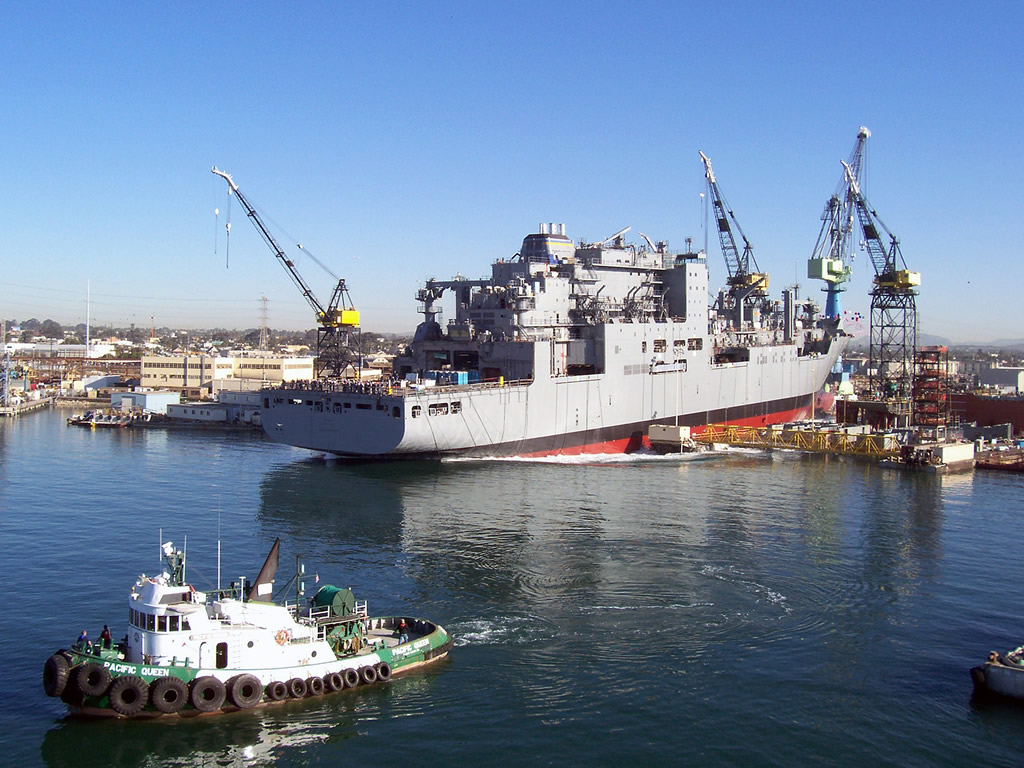
Ken Wright, GD NASSCO
(click to view full)
Dec 15-16/06: USNS Lewis and Clark [T-AKE 1] conducted its first-ever underway replenishment as part of Operation Evaluation Event No. 1 alongside the Nimitz-class aircraft carrier USS Theodore Roosevelt [CVN 71]. The successful UNREP training evolution completed the first of 14 phases of training for Lewis and Clark, assessing the ship’s ability to conduct a ship-ship UNREP and MH-60S helicopter-based vertical replenishment (VERTREP) simultaneously. See Navy release.
Dec 7/06: Detyens Shipyards Inc. in North Charleston, SC received a $6.45 million firm-fixed-price contract for a 90-calendar-day Post Shipyard Availability of Military Sealift Command’s dry cargo ammunition ship USNS Lewis & Clark [T-AKE 1]. The contract includes options which, if exercised, would bring the total contract value to $8.4 million. Work will be performed in North Charleston, SC, and is expected to be completed within 90 calendar days from the commencement of the contract in February 2007. This contract was competitively procured with 2 offers received by US Navy Military Sealift Fleet Support Command, a field activity of US Military Sealift Command (N40442-07-C-3000).
Dec 6/06: T-AKE 3 launched. The USNS Alan Shepard [T-AKE 3] is christened during a launching at General Dynamics National Steel and Shipbuilding Company (NASSCO) in San Diego, CA.
Meanwhile, DID reader Lee R. Wahler wonders “whether the ship’s proper name is [USNS] Alan B. Shepard, Jr or the shortened version [USNS Alan Shepard] which the media types use?” For those unfamiliar with the distinction, the proper name is what ends up on the Certificate of Ownership.
FY 2001 – 2006
T-AKE 1 to 9 ordered; T-AKE 1 to 5 named; T-AKE 1 delivery; T-AKE 2 launch.

(click to expand)
June 24/06: T-AKE 2 launched. The USNS Sacagawea [T-AKE 2] is christened and launched during a twilight ceremony at General Dynamics NASSCO shipyard in San Diego, CA. The ship is named for a Native American from the Lemhi Shoshone tribe; she served as guide and interpreter for the Lewis and Clark expedition.
July 28/06: T-AKE 4 and 5 named. The US Department of the Navy announces the naming of USNS Richard E. Byrd [T-AKE 4] for the famed Antarctic explorer. As an interesting sidenote, Byrd also led the first expedition to fly over the North Pole. USNS Robert E. Peary [T-AKE 5] is named for the famed Arctic explorer, who is credited as the first person to reach the geographic North Pole. US Navy.
June 20/06: T-AKE 1 delivered. The USNS Lewis and Clark, the first T-AKE ship, is delivered to the U.S. Navy’s Military Sealift Command.
Jan 30/06: T-AKE 9 ordered. A $317.1 million fixed-price-incentive modification for design and construction of the 9th T-AKE Dry Cargo/Ammunition Ship (of 12). Work will be performed in San Diego, CA, and is expected to be complete by May 2009 (N00024-02-C-2300). GD NASSCO release.
Jan 11/05: T-AKE 7 & 8 ordered. A $586.3 million fixed-price-incentive option provides full funding of the detailed design and construction of the 7th and 8th T-AKE Dry Cargo/Ammunition Ships ($293.1 million per ship). Work will be performed in San Diego, CA, and is expected to be completed by May 1, 2008 for the 7th ship and July 31, 2008 for the 8th ship (N00024-02-C-2300).
Jan 27/04: T-AKE 5 & 6 ordered. A $578.2 million fixed-price-incentive modification provides full funding of the detailed design and construction of the 5th and 6th T-AKE Dry Cargo/Ammunition Ships ($289.1 million per ship). Work will be performed in San Diego, CA, and is expected to be complete by July 2007 (N00024-02-C-2300).
July 18/03: T-AKE 4 ordered. A $287.6 million fixed-price-incentive modification exercises an option for design and construction of the 4th T-AKE Dry Cargo/Ammunition Ship. This contract will provide for the full funding of the detail design and construction of the fourth ship of the T-AKE Class. Work will be performed in San Diego, CA, and is expected to be complete by December 2006 (N00024-02-C-2300).
July 16/02: T-AKE 3 ordered. A $289.9 million fixed-price-incentive modification exercises an option for design and construction of the 3rd T-AKE Dry Cargo and Ammunition Ship. Work will be performed in San Diego and is to be complete by May 2006. NASSCO would later note that construction on the third T-AKE, to be named the USNS Alan Shepard in honor of the first American in space, began in September 2005.
Oct 18/01: T-AKE 1 & 2 ordered. A $406.9 million fixed-price-incentive (firm targets) contract for the detailed design and construction of the lead ship of the auxiliary cargo and ammunition ship class. T-AKE 1 would later be christened the USNS Lewis and Clark on May 21/05. The contract also provides for spare and repair parts, special studies and analyses, engineering and industrial services and technical data.
This original contract (N00024-02-C-2300) has 10 remaining options for follow-on ships, which would bring the total cumulative contract value to $3.75 billion.
Concurrent with this contract award, the US Navy exercises the 1st $301.6 million option for the detailed design and construction of the first follow-on ship: T-AKE 2 would be named USNS Sacagewea.
Work will be performed in San Diego, CA (75.7%); Iron Mountain, MI (9.3%); Waynesboro, VA (3.9%); Philadelphia, PA (3.5%); Beloit, WI. (3%); Belle Chasse, LA (1.8%); Kingsford, MI (1.8%); Scarborough, ME (0.5%); and Willis, TX (0.5%), and is expected to be complete by September 2005. This contract was competitively procured and advertised via the Commerce Business Daily and posted to the Naval Sea Systems Command web site. There were three offers received by the Naval Sea Systems Command in Washington, DC.
Additional Readings & Sources
* US Military Sealift Command Ship Inventory – USNS LEWIS AND CLARK (T-AKE 1) Dry Cargo/Ammunition Ship
* General Dynamics NASSCO – T-AKE Program. See also the Lewis and Clark (T-AKE) Class Dry Cargo/Ammunition Ship T-AKE Fact Sheet. Includes a helpful quick list of the ship’s capabilities.
* US Navy Fact File – Advanced Auxiliary Dry Cargo Ships – T-AKE
* GlobalSecurity.org – Combat Logistics Force. Includes a helpful quick reference table with capacities for the various US ships that operate in this role.
* GlobalSecurity.org – T-AKE-1 Lewis and Clark. Shuttle ships/ swing ships.
* GlobalSecurity.org – T-AFS 1 Mars. Dry goods and refrigerated shuttle ships.
* GlobalSecurity.org – T-AE-26 Kilauea. Ammunition shuttle ships.
* GlobalSecurity.org – T-AO-187 Henry Kaiser. Oiler ship, can work with T-AKE to replace an AOE ship in a pinch.
* GlobalSecurity.org – AOE-1 Sacramento. Station ships.
* GlobalSecurity.org – T-AOE-6 Supply. Station ships.
* See all DefenseLINK contract announcements related to N00024-02-C-2300.
* Professional Mariner (Dec-Jan 2008) – Diesel-electric propulsion pushes ahead. Explains the benefits and characteristics of the diesel-electric propulsion system used on T-AKE ships. “All electric” ships are a larger naval trend.
* US Department of Defense (May 19/05) – Navy to Christen New Dry Cargo/Ammunition Ship USNS Lewis and Clark. Ship’s class names are derived from the first ship in their class, so this is now the T-AKE-1 Lewis and Clark Class.
* US Department of Defense (May 1/02) – DOD Presents Environmental Awards