

(click to view full)
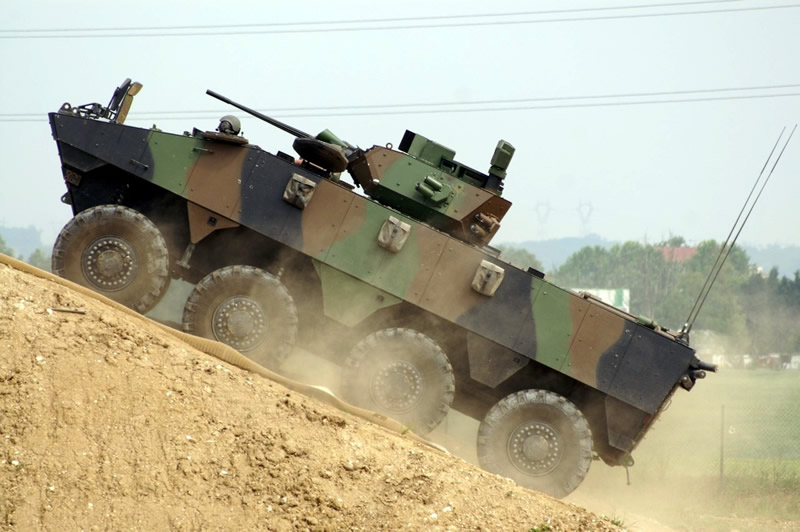
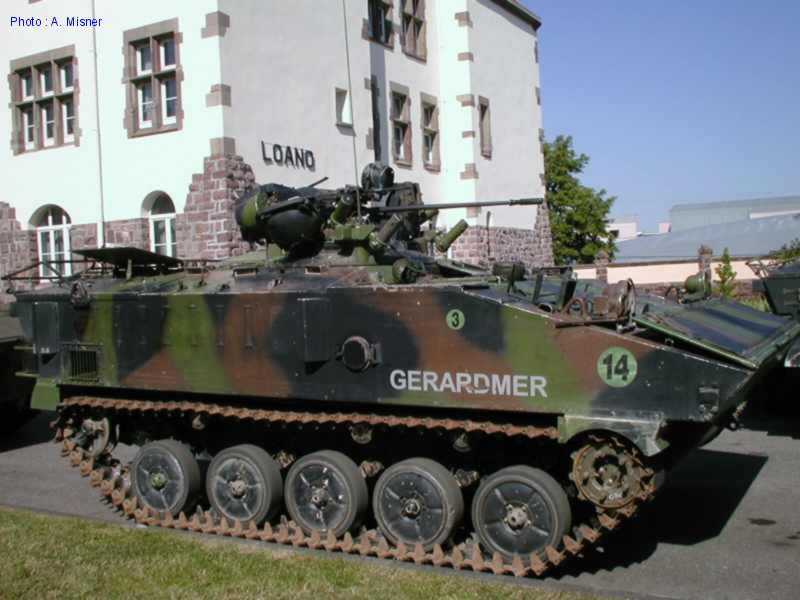
Many European countries are abandoning tracked APCs entirely, for good or ill, and France is joining that trend by replacing its existing tracked AMX-10Ps with the 8×8 wheeled Vehicule Blinde de Combat d’Infanterie (Armored Infantry Combat Vehicle). This article looks at the VBCI platform, discusses the program and export opportunities, and follows associated contracts & key events.
France’s orders give it a strong base, and an additional order has just come in from that quarter. Still, the VBCI is arriving late to the competitive game. Whether it ends up being fashionably late, or just too late, still depends in large measure on one of France’s age-old allies – and age-old rivals.
The VBCI Vehicle Family
(click to view full)
Wheeled armored personnel carriers may have hit the spotlight in the late 1990s, but they’ve been around for much longer. South Africa and its neighbors have used wheeled APCs for many years, due to their suitability on the region’s hard-packed grassland terrain. France’s Foreign Legion and Army has had their VAB wheeled APC since the late 1970s, and successfully exported it to 14 other countries. The US Marines gave Swiss firm MOWAG’s wheeled armored personnel carriers a big boost at about the same time, by selecting its Piranha for their amphibious Light Armored Vehicle (LAV) family. Interest really took off in the 1990s, however, as US General Shinseki and many European countries made a strong push to displace tracked APCs with wheeled alternatives in many land armies. The limitations of wheeled APCs have been made glaringly apparent on the front lines in Afghanistan, but their usefulness in scenarios where heavy mileage is required and protecting roads is part of the mission set has also been demonstrated on the front lines.
The 8×8 VBCI off-road armored vehicle is designed to replace the tracked AMX10P, and early models weigh 25-28t in operational configuration (18t+ empty). By 2014, a 32t base variant had been certified, incorporating lessons from its use in Libya, Mali, and the Central African Republic. In either variant, its weight precludes airlift by C-160 Transall or C-130 Hercules aircraft, but would allow transport in the new Airbus A400M, the Boeing C-17, or leased IL-76s/ An-124s.
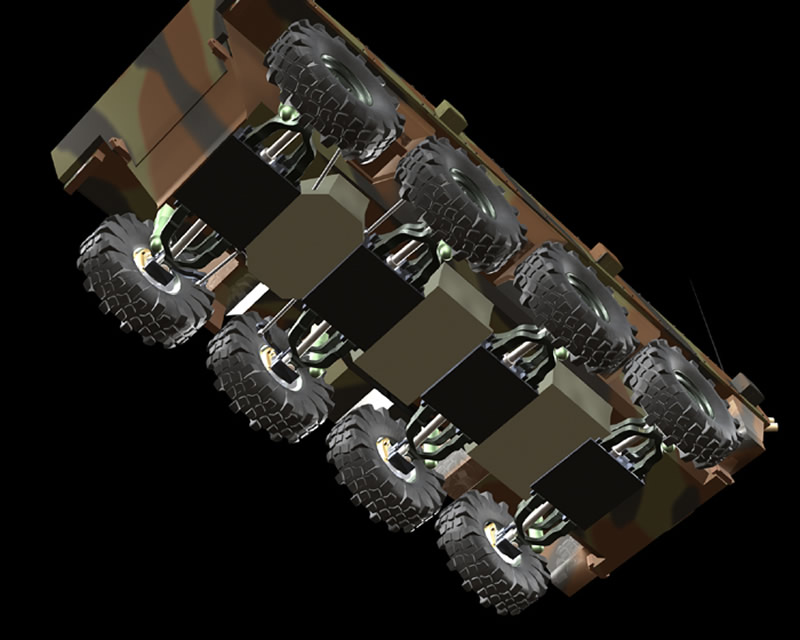
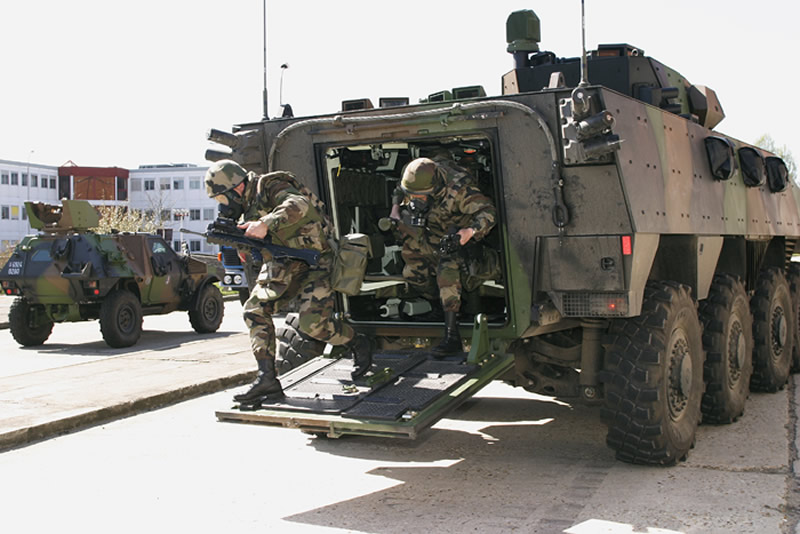
Structurally, the VBCI uses a high strength aluminum alloy body with add-on modular THD steel and titanium armor, and is designed for additional carrying capacity. The usual centralized variable tire inflation and adjustable suspension are present, with the central axles protected by armored housings. Ground clearance is 50-70cm/ 20-25 inches, and the system is powered by a 550 hp diesel engine. Nexter also says that it has anticipated projects for vehicles requiring a higher body (i.e. ambulance), and has designed the chassis accordingly.
(click to view full)
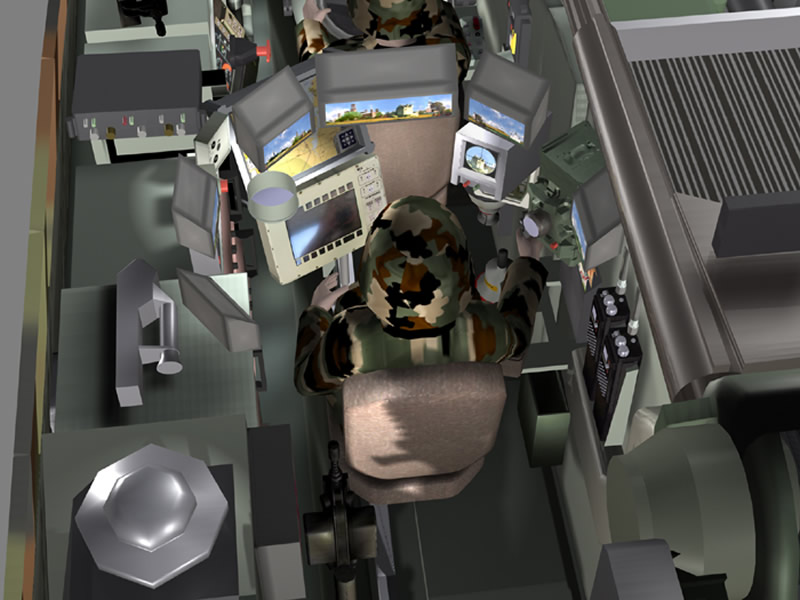
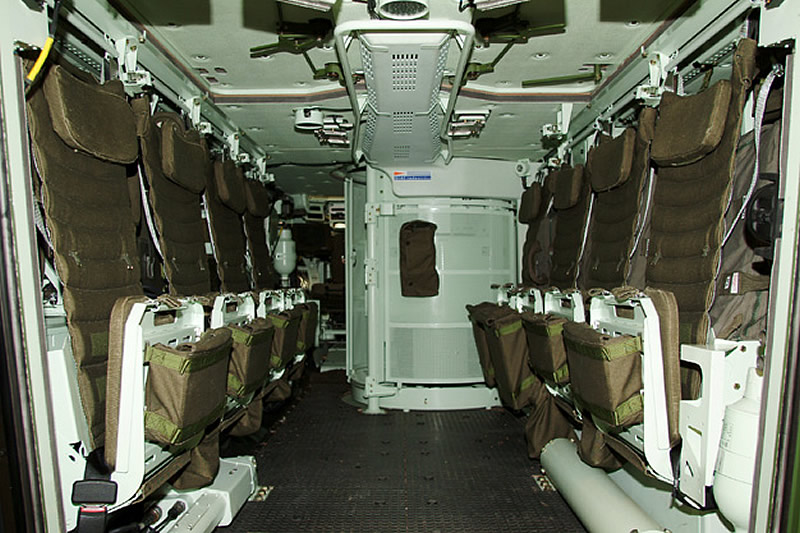
The VCI/ICV infantry carrier version will embark 8 soldiers, plus a 3-man crew of a vehicle commander, gunner and driver. Range is about 470 miles/ 750 km maximum, with maximum speeds of up to 60+ mph/ 100 kph and a circle turning radius of 17m. Fording capability is only 1.2m (about 4 feet) depth, rising to 1.5m with preparation. Its armor claims to withstand “medium caliber fire” (this usually means .50 cal/ 12.7 mm), shell shrapnel and improvised explosive devices (IED), together with an unexplained claim for a high level of mine protection. Additional protection includes the standard fire suppression equipment, NBC (nuclear, biological, chemical) overpressure protection, a GALIX self-protection system to launch smoke and other projectiles, and a LIRE 30 anti-missile infra-red decoy system. A “hard kill” system to protect against incoming rockets and missiles is also expected in the near future.
Standard armament will be a DRAGAR single operated turret equipped with laser and thermal imaging equipment and firing a twin-fed 25mm autocannon with 150 rounds and a 7.62mm machine gun. France and Britain are busy developing a 40 CTAS system that uses cased telescoping ammunition, creating a 40mm turret that has 50mm firepower, but fits in a 25mm weapon’s space. The CT40 turret will field on other French vehicles, and a future VBCI upgrade is very plausible.
The VPC/CPV command post variant will have only a 12.7mm FN remote-controlled cupola.
Upgrades and mission kits are already available, and more are expected over the longer term. For instance, Nexter offers a CASEVAC kit that allows a VCI to be converted into an armored ambulance within 4 hours.
The 32t VBCI Export model was unveiled at Eurosatory 2014. It allows removal of the vehicle’s engine in the field by specialist vehicles, improves the suspension and transmission to increase maximum weight from 29t to 32t, upgrades cooling and engine performance, and and adds 4th-axle steering. The net effect is to maintain power and maneuverability, while allowing for more added protection and systems over time. Minor VBCI-Ex changes include a repositioned fuel tank, and small hull reconfigurations to increase the vehicle’s internal volume.
VBCI: Program, Team, and Competitors
(click to view full)
The vehicle was qualified by the French Army before end of 2007, and is already in full series production. A late 2008 modification cut back on the planned buy from 2009-2014, reducing the overall buy from 700 (550 VCI / 150 VPC) to 630 vehicles (520 VCI / 110 VPC). The overall program total was reported as EUR 2.86 billion (about $4.085 billion at Sept. 2009 conversion).
The VBCI is produced by a joint venture between Giat Industries and Renault Trucks Defense called GME. Renault equips the driver’s station, engine, gearbox, suspension and axles and on-board electrical networks. Giat is responsible for the armored hull, interior furnishing, assembly and integration of the turret and vehicle, observation, command and control, weapons and self-protection systems. Other participants in the program include:
* Renault-Volvo engine with a ZF gearbox
* EADS (electrical turret aiming systems, SIT battle management system in French vehicles)
* FN Herstal (remote weapon system for the command post version)
* Galileo Avionica (commander’s sight)
* Michelin (pneumatics)
* SAGEM (panoramic observation sight)
* Thales (gunner’s sight)
The Global Competition

Piranha-V, VBCI & Boxer
(click to view full)
The VBCI has come late to the field with respect to wheeled armored personnel carriers, and faces long-entrenched competitors including General Dynamics’ MOWAG (Piranha family) and Steyr (Pandur II) subsidiaries, and the popular AMV Armored Modular Vehicle from Patria Oyj, a joint venture of the Finnish government (75%) and EADS (25%). These 3 systems have spent the last several years fighting and winning competitions across Europe for future APCs, which will limit the VBCI’s opportunities. BAE’s RG-41 and the joint Dutch-German ARTEC consortium’s Boxer MRAV add more European competitors, Brazil is developing its 6×6 VBTP Guarani with Italy’s Iveco, and Turkey’s PARS collaboration with BAE has already won exports.
One could argue that the popular BAE Hagglunds CV90 family and KMW/Rheinmetall’s Puma tracked IFV also represent current competition. The VBCI is positioned as the main battle tank’s companion in France’s army, and pursues the same positioning in competitions like Britain’s FRES. It has already found itself facing the CV90 in Canada’s competition, and will likely do so again in future.
While the VBCI will have opportunities in the 3rd world, especially among France’s African clients, the British FRES-Utility competition was its biggest opportunity by far. Wins in France and Britain would have offered Nexter an excellent production base, vaulting it immediately into the top ranks of global wheeled APCs. Unfortunately for Nexter, they lost the competition in 2008 – but GD’s Piranha V couldn’t hold on to its win.
France hasn’t given up, and they’ve made a number of improvements to create a VBCI export version. As of June 2014, however, the VBCI remains confined to its home market.
VBCI production will end soon, and new vehicle designs are expected to fulfill France’s large Scorpion future land force program. Scorpion’s VBMR will replace the ubiquitous VAB 4x4s that sit below VBCI within the French force structure, while the EBRC replaces France’s AMX-10RC wheeled light tanks/ fire support vehicles.
Contracts & Key Events
2012 – 2014
10-year support contract; RPG protection; Most VBCIs delivered; Canada’s vaporwares out; Britain rekindles interest in modified export version.
Oct 2/14: VBCI-32 qualified. The DGA certifies the new 32t base weight VBCI. It was originally developed for export out of lessons learned in Libya, Mali, etc., but may also become a template for French upgrades. Qualification of the new vehicle follows testing in sandy Biscarosse, muddy Coetquidan and Fontevraud, rocky Canjuers, and snowy Valloire.
There doesn’t seem to be a formal designation yet, but the new design allows removal of the vehicle’s engine in the field by specialist vehicles, improves the suspension and transmission, upgrades cooling and engine performance, and adds 4th-axle steering. The net effect is to maintain power and maneuverability, while allowing for more added protection and systems over time. Minor changes include a repositioned fuel tank, and small hull reconfigurations to increase the vehicle’s internal volume. They’re hoping that Britain in particular (q.v. June 25/14) takes notice. Sources: French DGA, “La DGA qualifie la version 32 tonnes du VBCI”.
June 25/14: UK. The British Army will conduct renewed 8-month trials of a heavily-modified VBCI, as a follow-on to the The Lancaster House agreement (q.v. Nov 2/10) regarding the 2 countries’ defense industries. Activities will begin before the end of 2014 at France’s Canjeurs military base, before moving to Mourmelon. VBCI’s export version has some important changes:
“Speaking to IHS Jane’s at Eurosatory 2014 in Paris, Philip Dunne, UK Minister for Defence Equipment, Support, and Technology, said the VBCI had fallen down on three elements in the original competition: accessibility to the vehicle’s powerpack, the vehicle’s armour protection levels, and its growth potential…. “VBCI has undergone a significant upgrade”, he added…. [Nexter’s] new export variant of the VBCI…. included the ability to remove the vehicle’s powerpack in the field (a British but not a French requirement), and an improved suspension and transmission to increase the VBCI’s maximum weight from 29 tonnes to 32 tonnes – meeting the British need for growth potential and improved protection…. Other improvements include fourth-axle steering, a repositioned fuel tank, upgraded cooling and engine performance, and small hull reconfigurations to increase the vehicle’s internal volume.”
The bad news? Under the revised “Army 2020” plan, FRES UV has dropped from initial estimates of around 2,000 vehicles to just 1 Heavy Protected Mobility (HPM) battalion in each of 3 mechanized brigades. There’s no firm date for that buy, either, as relatively new 6-wheeled Mastiff v-hulled vehicles already occupy the HPM role. Sources: IHS Jane’s Defence Weekly, “British Army to trial VBCI”.
April 4/14: The Nexter Group announces a 10-year Support in Service contract with France’s SIMMT (The French ministry of Defence maintenance in operational condition department) for the VBCI armored infantry combat vehicles. The amount wasn’t announced.
The contract will come into force on Aug 1/14, replacing an initial Series Logistics contract that has successfully supported the maintenance of the training fleet in Champagne, as well as operations PAMIR in Afghanistan, DAMAN in Lebanon, and SERVAL in Mali. Sources: Nexter, “Nexter Group awarded VBCI Support in Service contract (MSS)”.
Dec 20/13: Canada. The Canadian government wasn’t able to manage their Close Combat Vehicle IFV buy in a timely manner, so it was never fielded in Afhanbistan where it was needed. With predictable results, as CCV is canceled the about the 3rd time. France’s Nexter minces no words, while bringing Canada’s consistent vaporware problem into focus:
“Nexter has invested a great amount of time, energy and resources in the CCV program over the past four years. Millions of dollars have been spent because we believed the competition would be fair, open and provide a rigorous assessment of the candidate vehicles with a view to acquiring the best possible medium weight infantry fighting vehicle for Canada…. The LAV UP simply does not provide the same level of protection or mobility. This situation also begs the question as to why the Army proceeded with a second CCV Request for Proposals (RFP) six months after it awarded GDLS the LAV UP contract in 2011. It knew the capabilities of both vehicles at that time yet decided to proceed with another RFP and engaged industry in another costly competition…. it would be our expectation that the Government would compensate industry bidders for the cost of their bids. No company can afford to make such considerable investments only to have the process produce no result.”
It hard to call it an export loss when no-one wins. But it is a lost opportunity. Sources: Canada DND, “News Release – Government of Canada Will not Proceed with the Close Combat Vehicle Procurement” and “Statement – Chief of the Defence Staff and Army Commander issue a joint statement on the decision not to proceed with the procurement process for the Close Combat Vehicle” | Nexter, “Nexter Comments on Government’s Decision to Cancel the CCV” | The Record, “Cost-cutting military kills $2-billion armoured vehicle order”.
Canada cancels CCV competition
July 9/13: Q-Net. The US Army writes about the VBCI’s Q-Net rocket-protection system, and the involved process of equipping French vehicles with American technology. There are processes in place, and the technology transfer reportedly goes both ways, but…
“The French Army had purchased an early version of a rocket-propelled grenade, or RPG, defense system, Q-Nets, from QinetiQ North America, known as QNA, a U.S. company. Fighting in Mali spurred the need for increased capabilities to protect French soldiers…. the French Ministry of Defense wanted to review the test data from the U.S. Army Test and Evaluation Command before making a procurement decision [on the follow-on Q-Net II]. However, QNA could not release the data to France because the exchange must be made under an international agreement from one government entity to another government… Willis and his colleagues at the U.S. European Command’s Office of Defense Cooperation in Paris stepped in to expedite the data transfer under an established agreement.”
July 4/13: #500. The 500th VBCI armored vehicle is delivered to France’s DGA. All 110 command vehicles have been delivered as of May 2013, leaving another 130 VCI infantry carriers to go. Still no export orders, though, and time is running out. DGA [in French].
VBCI #500 delivered
2010 – 2012
French buys hit 630; Deployment in combat; FELIN integration; RPG protection; 400th VBCI delivered; UK-French agreement opens the door again; Canadian competition.
(click to view full)
June 12/12: #400. France receives its 400th VBCI armored vehicle, out of the planned order of 630. The last VBCIs are scheduled for delivery in 2015. DGA [in French].
VBCI #400 delivered
June 11/12: FELIN. At Eurosatory 2012, France’s DGA unveils the 1st VBCI vehicle wired to work with the FELIN 21st century soldier system. FELIN integrates wearable computers, optics etc. into a complete soldier kit. “Felinise” vehicles will be able to pass data from their battlefield management and communications systems to equipped soldiers, and will also serve as a hub for keeping all of the required batteries recharged. DGA [in French].
FELINise VBCI unveiled
August 2011: Canada. The VBCI is reportedly one of the 3 finalist contenders for Canada’s CCV infantry fighting vehicle, alongside BAE’s tracked CV90, and GDLS-C’s wheeled Piranha V. The contenders reportedly provide test vehicles for blast and other trials at the US Army’s Aberdeen Test Center.
The end of tests in October 2011 were supposed to be followed by a decision, initial delivery of 8 CCVs within 24 months, and delivery of the remaining 100 CCVs within 48 months. Instead, the competition was canceled, again, in April 2012. CASR | Ottawa Citizen.
Nov 2/10: UK-France. The “UK-France Summit 2010 Declaration on Defence and Security Co-operation” includes the intent to create “a Combined Joint Expeditionary Force suitable for a wide range of scenarios, up to and including high intensity operations.”
The VBCI may have lost the original FRES-UV competition (q.v. May 8/08), but GD’s Piranha V couldn’t hold on to its win (q.v. Dev 11/08). A combined JEF would benefit from armored vehicle commonality, if Nexter can fix the factors that cause it to lose in 2008.
UK-France defense MoU
July 7/10: Budget plans. A parliamentary defense committee hearing gets initial details from defense minister Hervé Morin on future programs. Morin said that the French A400M orders would go ahead as planned, as would its Barracuda nuclear-powered fast attack submarine, Felin advanced infantry set, FREMM multimission frigate, Rafale fighter and VBCI armored vehicle.
Plans to field 14 new A330 MRTTs to replace France’s C-135FR aerial tankers would be delayed, and so would a EUR 700 million life extension and air defense upgrade for France’s Mirage 2000D strike aircraft, a major upgrade to the national airspace command-and-control system, and elements of the Scorpion land systems modernization program. Defense News.
June 14/10: Sub-contractors. Safran Group subsidiary Sagem announces an order from Nexter Systems for 285 MOP panoramic observation systems, and 285 EPS-LT stabilized turret components, to equip its VBCI 8×8 APCs. Including previous acquisitions, this latest contract brings the total number of VBCIs using Sagem’s MOP and EPS-LT to a total of 521.
The MOP is a stabilized 2-axis panoramic observation system using a non-cooler thermal imager, intended for the vehicle commander. It comprises a pointing platform with a non-cooled thermal imager. With functions slaved to the episcope and the chassis centerline, the MOP also provides driving assistance.
The EPS-LT pointing system is a key component of Nexter’s DRAGAR turret. It’s fitted with gyrometric sensors and stabilized, allowing accurate fire on the move from the turret’s 25mm cannon and coaxial 7.62mm machine gun.
May 11/10: Deployment. The French Army announces that its VBCIs are embarking on the chartered ship MS Eider, and will arrive in Afghanistan this summer. They’ll deploy with the 21st Marine Infantry Regiment and the 126th Infantry Regiment, in Afghanistan’s Kapisa and Surobi regions.
Kapisa is the top point of an equilateral triangle, whose base is the road from Kabul to Jalalabad. That road stretches east to Peshawar in Pakistan, and Surobi is on that road at roughly at the midpoint between Kabul and Jalalabad.
Deployment
Sept 5/09: +332. France’s DGA announces an order for another 332 VBCI vehicles, bringing the total to the full planned buy of 630.
As of this date, over 100 VBCI vehicles have already been delivered, and the first combat unit (35th infantry regiment) to receive the VBCI used it in the 2009 Bastille Day parade. The last vehicle is scheduled for delivery to the French Army in 2015. DGA | Nexter.
France: 332 more finishes planned buy
2007 – 2009
France orders more but cuts total. UK loss.
(click to view full)
Dec 11/08: UK. The UK Ministry of Defense announces a sweeping set of changes to a number of procurement programs. FRES is the most seriously affected, as GD MOWAG’s refusal to transfer its newest Piranha-V vehicle’s full intellectual property to the UK MoD ownership scuttles the deal. The firm’s preferred bidder status for FRES-Utility is revoked, but the UK decides to shift to the tracked FRES Scout Vehicle as their first priority.
When and if they return to FRES-UV, the VBCI may get another shot. UK MoD.
Dec 5/08: France. France has decided that part of its industrial stimulus package will be military, and part of that effort is a 116 vehicle order that will bring France’s VBCI fleet to 298 machines.
Over the longer term, France’s 2009-14 military budget law cut total numbers of VBCI units to 630, giving an estimated value of EUR 2.6 – 2.7 billion ($3.8 – 3.9 billion), down from the original plan of just under EUR 3 billion for 700. In total, France is moving EUR 2.3 billion of spending from the military budget law forward in time, as part of a wider EUR 26 billion economic stimulus package. France’s DGA | Defense News.
France: 116 more, but program total cut
Aug 29/08: Support. The French DGA procurement agency awards a 5-year, EUR 320 million performance-based contract to support its VBCI vehicles. The contract covers the period from mid-2009 to 2015, during which period Nexter commits to an availability rate of 95% in foreign theaters, the complete maintenance of VBCIs operated by French Army training bases, and spares delivered directly to French Army maintenance workshops in France. In return, payments from the DGA will vary as vehicle usage rises or declines.
The recent French White Paper on defense and national security gives a planned figure of around 650 VBCIs, to be fielded by the end of 2015. DGA release [Francais].
5-year support contract
May 8/08: Loss. Nexter’s VBCI loses to General Dynamics MOWAG’s Piranha-V in the finals of Britain’s FRES-Utility competition. DID’s FRES FOCUS article | UK MoD release | General Dynamics UK release.
British loss
Oct 19/07: France. France’s DGA procurement agency issues a purchase order for 117 VBCI vehicles, with configuration splits and costs undisclosed. These 117 vehicles will thus be produced within a period of one year, starting early in 2008.
Nexter, with a keen eye on the British FRES contract opportunity, adds that: “the assembly line has the potential to provide a further substantial increase in production rate to meet any export contract requirements.” DGA release [PDF] | Nexter release.
France: 117 more
June 8/07: British finalist. Britain’s MoD announces the FRES finalists. Surprisingly, the SEP vehicles don’t make that list, nor do other test platforms. All of the finalists are wheeled: General Dynamics MOWAG’s Piranha V, Nexter (formerly Giat’s) VBCI – and the KMW-ARTEC Boxer, which program Britain abandoned several years ago in order to pursue FRES.
The vehicles will go on to the “trials of truth,” and the MoD says the outcome of the trials will be announced by the end of November 2007. At that point, “one or more utility vehicle designs will go forward for detailed assessment.” UK MoD release | Nexter release | Nexter DESi brochure | KMW release.
Nov 2000: Initial 65. the French DGA orders 54 VBCIs in the infantry combat version, and another 11 in the command post version. The first 20 vehicles will be delivered to the French Army in July 2008, and personnel training was conducted during the 2nd quarter of 2007.
France: 65
Additional Readings
Background: VBCI
* Nexter (formerly GIAT) – VBCI
* French DGA – Le VBCI, tout un programme .
* Army Technology – VBCI Wheeled Infantry Fighting Vehicle, France.
* Defense Update – VBCI Armored Personnel Carrier (GIAT Industries). GIAT renamed itself Nexter.
Background: VBCI Ancillaries
* CTA International – The 40 CTAS. Very innovative – 50mm punch in a 25mm form factor. May eventually replace the 25mm cannons on France’s VBCIs.
* Nexter – 40mm Cased Telescoped Armament System (CTAS): Cannon (CT C).
* France’s DGA – Le canon de 40 mm à munitions télescopées CTCA (Cased Telescoped Canon and Ammunition).
* DID – MMP: France’s New Portable Anti-Armor Missile. May equip a future VBCI configuration via launchers mounted on the new CT40 turret.
Background: Related Vehicles
* Army Technology – AMX 10RC Wheeled Armoured Reconnaisance Vehicle, France. Will be replaced by Scorpion’s EBRC winner.
* Army Technology – VAB (Véhicule de l’Avant Blindé) Wheeled Armoured Fighting Vehicle, France. Will be replaced by Scorpion’s VBMR winner.
Competitors
Wheeled Competitors
* DID FOCUS Article – The UK’s FRES Transformational Armored Vehicles. VBCI was and is a competitor for the FRES-UT portion against GD’s Piranha-V and ARTEC’s Boxer MRAV, but Britain switched gears and decided to focus on the FRES-SV tracked scout vehicle first (GD UK’s ASCOD-II beat BAE’s CV90).
* Army Technology – Patria AMV (Armoured Modular Vehicle) 8×8 Wheeled Vehicle, Finland.
* ARTEC Boxer official site. Boxer uses a fully modular concept, where specialized mission modules can be slid into and out of a base chassis.
* Army Technology – Boxer MRAV Wheeled Multi-Role Armoured Vehicle, Europe.
* Army Technology – Pandur II 6×6 and 8×8 Light Armoured Vehicles, Austria.
* DID – PARSing Statements: Malaysia’s New Wheeled APCs. Turkish design, in collaboration with BAE.
* Army Guide – Piranha IV 8×8. See also MOWAG’s 2001 release unveiling the vehicle at DSEi 2001.
* Army Technology – Piranha III / LAV III Wheeled Armoured Vehicles, Switzerland .
* Army Technology – RG41 8×8 Wheeled Armoured Combat Vehicle, South Africa. From BAE. South Africa picked Patria’s AMV as its new IFV, before the RG-41 was introduced.
* DID – VBTP Guarani: A New APC for Brazil.
Tracked Competitors
* Army Technology – CV90 Tracked Armoured Combat Vehicles, Sweden.
* Army Technology – Puma Tracked Infantry Fighting Vehicle, Germany.
* Army Technology – BMP-3 Tracked Infantry Combat Vehicle, Russia.