


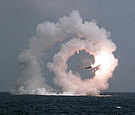
(click to view full)
Nuclear tipped missiles were first deployed on board US submarines at the height of the Cold War in the 1960s, to deter a Soviet first strike. The deterrence theorists argued that, unlike their land-based cousins, submarine-based nuclear weapons couldn’t be taken out by a surprise first strike, because the submarines were nearly impossible to locate and target. Which meant that Soviet leaders could not hope to destroy all of America’s nuclear weapons before they could be launched against Soviet territory. SLBM/FBM (Submarine Launched Ballistic Missile/ Fleet Ballistic Missile) offered shorter ranges and less accuracy than their land-based ICBM (Inter-Continental Ballistic Missile) counterparts, but the advent of Trident C4 missiles began extending those ranges, and offering other improvements. The C4s were succeeded by larger Trident II D5 missiles, which added precision accuracy and more payload.
The year that the Trident II D5 ballistic missile was first deployed, 1990, saw the beginning of the end of the missile’s primary mission. Even as the Soviet Union began to implode, the D5’s performance improvements were making the Trident submarine force the new backbone of the USA’s nuclear deterrent – and of Britain’s as well. To ensure that this capability was maintained at peak readiness and safety, the US Navy undertook a program in 2002 to replace aging components of the Trident II D5 missile called the D5 Life Extension (LE) Program. This article covers D5 LE, as well as support and production contracts associated with the American and British Trident missile fleets.
D5 Life Extension Program
By the time the latest D5 version was deployed, the existence of the Soviet Union itself was in doubt. The previous year, the Soviet’s Eastern European client states began to fall, symbolized by the destruction of the Berlin Wall. Then the Soviet Union itself began to crumble, with various Soviet republics rebelling against the central government in 1990. In 1991, a failed coup attempt against Soviet reformer Mikhail Gorbachev brought Boris Yeltsin to power, who promptly dissolved the Soviet Union.
The end of the Soviet Union and the easing of the Soviet first strike threat did not end the need for a nuclear deterrent. States like Russia and China still have them, North Korea is the first nuclear-armed rogue state but will not be the last, and non-state actors remain a potential threat, given instability in key countries like Pakistan. The US nuclear deterrent got smaller, but it did not go away – and as it became smaller, the importance of the Trident fleet rose. Especially given Britain’s use of the same missiles as its sole nuclear deterrent.
The Trident C-4 has been in service since 1979, but the D-5 Trident II is more recent. Its 1st firing on March 21/89, from the USS Tennessee, almost ended the program. Fortunately, fixes were made in an environment of “tell the truth, only the truth, tell it quickly…” A set of 7 successful test-launches from 1989-1990 saved the program, bringing its funds back from escrow. As of January 2013, it has had a remarkable 143 consecutive flight test successes since that initial launch.

First deployed in 1990 and scheduled for operational deployment until 2042, 12 of the USA’s 14 SSBNs have been outfitted with Trident II D-5 missiles, and the other 2 were scheduled to be back-fitted as opportunity permits.
The Trident II D5 LE Program is intended to extend the service life of the weapon system until 2042, to match the hull life of the Ohio-class submarine. Under the program, 108 additional missiles [PDF] are being purchased, in order to meet long-term inventory requirements.
The LE program involves updating the missile’s electronics, guidance and reentry systems. In particular, the Mk6 LE guidance system is a replacement for the aging Mk6 guidance system, which used 1980s technology that isn’t in production any more. The Next Generation Guidance (NGG) program aims to develop the Mk6 LE as a modern replacement that can achieve the same or better performance as the guidance systems that are breaking down. This requires development of precision instruments, sensors, and radiation hardened architectures, in order to adapt the underlying commercial technologies for use in a must-not-malfunction nuclear weapons system.
The prime contractor [PDF] for the Trident II D5 program is Lockheed Martin, who has managed all of the US submarine-launched ballistic missile/ fleet ballistic missile (SLBM/FBM) programs since the first generation Polaris. Charles Stark Draper Labs is the inventor of the guidance system.
Contracts and Key Events
These entries cover overall support and surveys of the American and British Trident fleets, Trident LE efforts, associated testing, and production of new materials and missiles. It does not cover work on the launcher systems rather than the missiles themselves, unless it’s a multiple-items contract that also includes missile work. Unless otherwise noted, the US Navy’s Strategic Systems Programs in Arlington, VA issued the contracts. As one might expect with such secretive work, many of the contracts are sole-source or non-competed.
Note that despite the recent article improvements, materials before FY 2007 may not be fully up to date.
FY 2014 – 2023
[youtube:v=AzQaUmBP8qY]
click for video
May 29/23: Systems Support Lockheed Martin Space won a $27.1 million modification to provide services and support for Trident II (D5) missile production and deployed systems support. The Trident II (D5) is a submarine-launched ballistic missile (SLBM) system developed for the United States Navy’s Ohio-class submarines. Strategic Systems Programs, Washington, D.C., is the contracting activity. Work will take place in Utah and is expected to be finished by September 30, 2027.
April 10/23: Interferometric Fiber Optic Gyros The Charles Stark Draper Laboratory won a $73.2 million modification which exercises options to provide design analysis, testing, procurement, and manufacturing of interferometric fiber optic gyros, accelerometers, and associated Trident II Strategic Weapon System guidance subsystem material. Work will be performed in Cambridge, Massachusetts; Pittsfield, Massachusetts; and Clearwater, Florida, with an expected completion date of July 30, 2027. The Trident II Strategic Weapons System is an improved SLBM with greater accuracy, payload, and range than the earlier Trident C-4. It is a key element of the US strategic nuclear triad and strengthens US strategic deterrence.
February 20/23: Subsystem The Charles Stark won a $95.1 million modification, which exercises fiscal 2023 options to provide technical and engineering services necessary to maintain and sustain the Trident II Strategic Weapon System MK 6 Guidance subsystem. The effort also includes a requirement for strategic guidance, navigation, and control subject matter expertise and resources to plan and implement an advanced development program that explores and evaluates current and maturing concepts and technologies that will enable follow-on, full-scale development of the second life extension of the Navy’s Trident II Strategic Weapons Systems. Work will be performed in Cambridge, Massachusetts (81%); and El Segundo, California (19%), and is expected to be completed September 30, 2024.
January 9/23: Construction Sauer Construction won a $37.6 million task order to provide construction of two additions to the Trident Training Facility, a Strategic Systems Program missile control center team trainer, and Naval Sea Systems Command weapons handling system team trainer at Naval Submarine Base Kings Bay, Georgia. The contract also contains two unexercised options which, if exercised, would increase the cumulative contract value to $37,809,809. Work will take place in Georgia. Expected completion will be by March 2025.
December 12/22: Fleet Support Lockheed won a $328.5 million deal for the US and United Kingdom to provide Strategic Weapon System Trident Fleet support, Trident II Shipboard Integration Increment 8, and navigation subsystem development efforts. The contract award also benefits a foreign military sale to the United Kingdom. Work will take place in New York, California, Florida, Massachusetts and Virginia.
November 30/22: Missile Production Lockheed Martin Space won a $49.9 million modification for Trident II (D5) missile production and deployed systems support. The contract award also benefits a foreign military sale to the United Kingdom. Work will take place in Arkansas, California, Massachusetts, Florida, New Jersey, Pennsylvania, Colorado, Maryland and various other locations. Work is expected to be completed on September 30, 2027. Fiscal 2023 weapons procurement (Navy) funds in the amount of $49,942,303 will be obligated. No funds will expire at the end of the current fiscal year.
October 24/22: Life Extension BAE Systems won an $11.2 million contract to provide systems engineering and integration in support of US Trident II (D5) Strategic Weapons System Program D5 Life Extension 2 Strategic Systems Programs Alteration. Tasks to be performed include technical planning, requirements management and integration of Strategic Systems Programs subsystems including interface with the Columbia common missile compartment; configuration management, system security engineering, safety engineering support and infrastructure operations model-based engineering and information systems program acquisition. Work will take place in Maryland, Washington DC, Pennsylvania, New Mexico, Maryland and Florida. Work will be finished by October 20, 2024.
October 17/22.Kings Bay Trident Trainer Facility kit General Dynamics won an $18.1 million deal to provide US Trident II Strategic Weapon System Kings Bay Trident Trainer Facility kit and engineering support services. The Trident II Strategic Weapons System is an improved SLBM with greater accuracy, payload, and range than the earlier Trident C-4. It is a key element of the US strategic nuclear triad and strengthens US strategic deterrence.Work will take place in Connecticut, Georgia and Florida.Estimated completion date is December 31, 2025
August 22/22: Missile Production Lockheed Martin Space won a $11 million deal for long-lead time material and the labor, planning, and scheduling necessary to support the fiscal 2023 Trident II (D5) missile production schedule. The contract award also benefits a Foreign Military Sale to the United Kingdom. Fiscal 2022 weapons procurement (Navy) in the amount of $9,7 million will be obligated on this award. Work will take place in Florida. Estimated completion date will be September 30, 2027.
August 3/22: Systems Support Lockheed Martin Space won a $25.7 million contract modification for Trident II (D5) missile production and deployed systems support. Work will be performed in Utah, Colorado, California, Florida and various places below one percent (0.2%). Work is expected to be completed July 1, 2025. The Trident II Strategic Weapon System (SWS) is deployed aboard Ohio-class (Trident) submarines and consists of: the Trident II (D5) Submarine Launched Ballistic Missile (SLBM); Reentry System; and supporting Shipboard Systems.
April 21/22: Missile Production Lockheed Martin Space won a $396.7 million contract modification for Trident II (D5) missile production and deployed systems support. The Trident II D5 is the latest generation of the US Navy’s submarine-launched fleet ballistic missiles, following the highly successful Polaris, Poseidon, and Trident I C4 programs. First deployed in 1990, the Trident II D5 missile is currently aboard OHIO-class and British VANGUARD-class submarines.Work will take place in Utah, Colorado, Florida, California, Arkansas, Tennessee, Massachusetts, Georgia, Illinois, Main, Maryland, New York and various other locations. Estimated completion date is September 30, 2026.
April 4/22: Missile Production and Deployed Systems Support Lockheed Martin Space won a $18.6 million contract modification for Trident II (D5) missile production and deployed systems support. Trident II D-5 is the sixth generation member of the US Navy’s Fleet Ballistic Missile (FBM) program which started in 1956. Systems have included the Polaris (A1), Polaris (A2), Polaris (A3), Poseidon (C3), and Trident I (C4). The first deployment of Trident II was in 1990 on the USS Tennessee (SSBN 734). Work will take place in Florida, Utah, Maryland, Colorado, California, Arkansas and Florida. Estimated completion date is September 30, 2026.
February 21/22: SSBN And SSGN General Dynamics won a $19.3 million contract modification for fiscal 2022-2025 US and United Kingdom Trident II (D-5) SSBN Fire Control System and SSGN Attack Weapon Control System support. The Trident II D5 fleet ballistic missile (FBM) is a three-stage, solid-propellant, inertial-guided ballistic missile developed by Lockheed Martin. The missile can carry multiple independently targeted reentry bodies for a maximum range of over 7,360km. Work will take place in Massachusetts and Rhode Island. Estimated completion date is April 30, 2025.
February 1/22: Production Lockheed Martin won a $9.3 million contract modification for Trident II (D5) missile production and deployed systems support for the US Navy. The Trident II Strategic Weapon System (SWS) is deployed aboard Ohio Class (Trident) submarines and consists of: the Trident II (D5) Submarine Launched Ballistic Missile (SLBM); Reentry System; and supporting Shipboard Systems. Work will take place in Colorado, California, Georgia, Washington and Florida. Estimated completion date is September 30, 2026.
December 27/21: Columbia And Dreadnought Lockheed Martin won a $29.8 million contract modification for the US and the UK to provide Strategic Weapon System Trident Fleet Support, Trident II SSP Shipboard Integration (SSI) Increment 8, SSI Increment 16, Columbia-class and UK Dreadnought-class navigation subsystem development efforts. The Trident II D5 fleet ballistic missile (FBM) is a three-stage, solid-propellant, inertial-guided ballistic missile developed by Lockheed Martin. Work will take place in New York, California, Florida and Massachusetts. Estimated completion date is November 30, 2023.
September 30/21: Inertial Navigation Boeing won a $17.3 million contract modification for the US and United Kingdom to provide Strategic Weapon System Trident II (D5) Inertial Navigation equipment technical engineering support services. The Trident II D5 fleet ballistic missile (FBM) is a three-stage, solid-propellant, inertial-guided ballistic missile. In September 2021 the US Navy test-fired two unarmed Trident II missiles off the coast of Cape Canaveral, dubbing the launches a successful test of the operational readiness of the weapons system. Work will take place in California, Ohio, Washington, New York, Virginia, Georgia, Florida and Scotland. Estimated completion date is September 30, 2022.
August 12/21: Long-Lead Material Lockheed Martin won a $11 million unpriced letter contract for long-lead material and the labor, planning, and scheduling necessary to support the fiscal 2022 Trident II (D5) missile production schedule. This unpriced letter contract will be definitized on or about October 1, 2021, as a fixed-price-incentive contract. The Trident II D5 fleet ballistic missile is a three-stage, solid-propellant, inertial-guided ballistic missile developed by Lockheed Martin. Work will take place in Florida. Estimated completion date is September 30, 2026.
June 21/21: Increment 8 Lockheed Martin won a $191.2 million contract modification for the US and United Kingdom to provide strategic weapon system Trident SSI Increment 8 production of inertial navigation systems and associated inertial spares for the Ohio and Columbia ballistic missile submarine shallow water submersible platforms for the fleet ballistic missile program. The Trident II D5 is the latest generation of the USN’s submarine-launched fleet ballistic missiles. First deployed in 1990, the Trident II D5 missile is currently onboard the US Ohio Class and UK RN Vanguard Class submarines. Work will take place in Ohio, California, New York and Virginia. Estimated completion date is February 28, 2028.
March 16/21: Systems Support Lockheed Martin Space won a $558.8 million contract modification for Trident II (D5) missile production and deployed systems support. The UGM-133A Trident II, or Trident D5 is a submarine-launched ballistic missile (SLBM), built by Lockheed Martin Space in Sunnyvale, California, and deployed with the American and British navies. Work is expected to be completed September 30, 2026. Fiscal 2021 weapons procurement (Navy) funds in the amount of $477,091,291; United Kingdom funds in the amount of $73,747,000; and fiscal 2020 weapons procurement (Navy) in the amount of $8,003,070 are being obligated on this award, none of which will expire at the end of the current fiscal year.
March 3/21: CMC Lockheed Martin Space won a $128.7 million contract to support the integration of the Trident II (D5) Missile and Reentry Subsystems into the Common Missile Compartment (CMC) for the US/United Kingdom Columbia/Dreadnought Submarine construction programs. The Trident II D-5 is a three-stage, solid propellant, inertially guided FBM with a range of more than 4,000 nautical miles (4,600 statute miles or 7,360 km). Work will take place in Florida, Colorado, California, Utah and Tennessee. Estimated completion date is February 28, 2027.
December 21/20: SSI Lockheed Martin won a $9.3 million contract modification for the US and United Kingdom to provide strategic weapon system Trident fleet support, Trident II SSP Shipboard Integration (SSI) Increment 8, SSI Increment 16, Columbia class and UK Dreadnought class navigation subsystem development efforts. Trident II D-5 is the sixth generation member of the US Navy’s Fleet Ballistic Missile (FBM) program which started in 1956. Systems have included the Polaris (A1), Polaris (A2), Polaris (A3), Poseidon (C3), and Trident I (C4). The first deployment of Trident II was in 1990 on the USS Tenessee (SSBN 734). While Trident I was designed to the same dimensions as the Poseidon missile it replaced, Trident II is a little larger. Work will take place in New York, California, Florida and Massachusetts. Estimated completion date is November 30, 2023.
December 15/20: Navigation Subsystem Development Efforts Lockheed Martin won a $43.6 million contract modification for the US as well as the United Kingdom to provide Strategic Weapon System Trident Fleet support, Trident II SSP Shipboard Integration (SSI) Increment 8, SSI Increment 16, Columbia class and UK Dreadnought class Navigation Subsystem development efforts. According to Lockheed Martin, the Trident II D5 is the latest generation of the US Navy’s submarine-launched fleet ballistic missiles, following the highly successful Polaris, Poseidon, and Trident I C4 programs. First deployed in 1990, the Trident II D5 missile is currently aboard OHIO-class and British VANGUARD-class submarines. Each Trident II missile has a range of 4,000 to 7,000 miles. The Navy started the D5 Life Extension Program in 2002 to replace obsolete components using as many commercial off-the-shelf (COTS) parts as possible to keep costs down and to enhance the missile’s capability. Work will take place in New York, California, Florida and Massachusetts. Expected completion date is November 30, 2023.
December 7/20: Pilot Assessment Lockheed Martin Space won a $29.1 million contract modification to procure a pilot assessment of the contractor’s property management system and exercise options under previously awarded contract N00030-20-C-0100 for Trident II (D5) missile production and deployed systems support. The modification includes a $5 million not-to-exceed value for the pilot assessment, which is being awarded as an undefinitized contract action. The Trident II D5 fleet ballistic missile (FBM) is a three-stage, solid-propellant, inertial-guided ballistic missile developed by Lockheed Martin. The Trident II D5 submarine launched ballistic missile (SLBM) is a successor to Polaris A1, Polaris A2, Polaris A3, Poseidon C3 and Trident I C4 missiles. Work will take place in Colorado, Utah, Florida, Illinois, New York and California. Work will take place in September 20, 2025.
October 5/20: Navigation Boeing won a $59.1 million contract to provide the US and United Kingdom Trident II (D5) maintenance, rebuilding and technical services in support of the Navigation subsystem. The Trident II D5 fleet ballistic missile (FBM) is a three-stage, solid-propellant, inertial-guided ballistic missile developed by Lockheed Martin. The missile can carry multiple independently targeted reentry bodies for a maximum range of over 7,360km. The Trident II D5 submarine launched ballistic missile (SLBM) is a successor to Polaris A1, Polaris A2, Polaris A3, Poseidon C3 and Trident I C4 missiles. Work will take place in Washington, Ohio, New York, Virginia, Georgia, Florida and Scotland. Estimated completion dates September 30, 2022. United Kingdom funds in the amount of $893,383 are being obligated on this award.
May 6/20: Strategic Systems Program General Dynamics Electric Boat won a $60.6 million contract to provide US Trident II Strategic Weapon System (SWS) ship alterations and United Kingdom SWS ship alterations for Strategic Systems Program shipboard integration installations. The Trident missile is a submarine-launched ballistic missile (SLBM) equipped with multiple independently targetable reentry vehicles (MIRV). Originally developed by Lockheed Missiles and Space Corporation, the missile is armed with thermonuclear warheads and is launched from nuclear-powered ballistic missile submarines (SSBNs). Trident missiles are carried by fourteen United States Navy Ohio-class submarines, with American warheads, as well as four Royal Navy Vanguard-class submarines, with British warheads. The missile is named after the mythological trident of Neptune. Work will take place Washington, Connecticut, Georgia, Florida, Virginia, Scotland and England. Estimated completion will be by April 2024.
March 31/20: Fleet Support Lockheed Martin won a $137 million contract for the US and UK and provides Strategic Weapon System Trident Fleet Support, Trident II Strategic Systems Programs, Shipboard Integration (SSI) Increment 8, SSI Increment 16, Columbia Class and UK Dreadnought Navigation Subsystem development efforts. Trident ist a submarine-launched ballistic missile. It is equipped with multiple independently targetable reentry vehicles. Work will take place in New York, California, Florida and Massachusetts. Expected completion will be by November 2022.
March 23/20: Production and Systems Support Lockheed Martin Space won a $601.3 million modification for the submarine-launched ballistic missile (model) Trident II D5 production and deployed systems support. The Trident D5 or UGM-133A Trident II is a submarine-launched ballistic missile (SLBM), built by Lockheed Martin Space Systems in Sunnyvale, California, and deployed with the American and British navies. It was first deployed in March 1990. A total of 14 US Navy submarines are armed with Trident II ballistic missiles, each carrying 24 missiles. The Trident missile has a range from 6,400 to 11,250 km. The dimensions of the Trident II missile are 1,360 cm long with a diameter of 210 cm, and the weight is 59,000 kg. The Trident II missile is deployed aboard Ohio-class submarines, each capable of carrying 24 missiles. Under the provisions of the Polaris Sales Agreement, it is also carried aboard the United Kingdom’s Vanguard-class submarines. Work will take place in Utah, California, Colorado, Florida and Virginia. Estimated completion will be in September 2024.
February 25/20: Optional Line Item The Charles Stark Draper Laboratory won a $200.7 million contract modification to exercise the optional line item for fiscal 2020 production of TRIDENT II D5 Strategic Weapon System MK6 Guidance Equivalent Units. UGM-133A Trident II, or Trident D5, is a submarine-launched ballistic missile (SLBM), built by Lockheed Martin Space Systems in Sunnyvale, California, and deployed with the American and British navies. The missile has a maximum operational range of over 7,500 miles and a CEP of 90 meters. The missile’s MK 6 Astro-inertial guidance navigation system is also able to receive GPS updates. The missiles deployed on US submarines can be equipped with a Mark 5 MIRV warhead that can carry up to 8 W88 (475 kt) warheads, or a Mark 4 MIRV that can also carry 14 W76 (100 kt) warheads. Work will take place in Massachusetts, Florida, Texas and estimated completion date is in December 2023.
February 18/20: Missile Production Lockheed Martin Space won a $13.9 million contract modification for Trident II (D5) missile production and deployed systems support. The Trident II D5 is one of the most advanced long-range submarine-launched nuclear missiles in the world. It is the primary US sea-based nuclear ballistic missile, and is deployed aboard US Navy Ohio Class ballistic missile submarines. The US Navy operates 14 of these ballistic missile submarines, each of which can carry as many as 24 Trident II missiles. Although the Trident II is designed to carry as many as 12 multiple independently targetable reentry vehicle (MIRV) warheads, current treaties reduce this number to four or five. Work will take place in Florida, California, and other various locations. Work is expected to be finished by September 30, 2024.
February 4/20: Life Extension Strategic Systems Programs in Washington DC awarded Lockheed Martin Space a $473.8 million contract for Trident II (D5) Life Extension 2 Strategic Systems Programs Alteration Advanced Development Program efforts. The Trident II D5s aboard Ohio Class vessels represent the sea-based part of the US nuclear triad, while those on the UK Vanguard Class vessels are the nation’s main method for delivering nuclear weapons. The missile weighs 130,000 pounds and is a three-stage solid-propellant rocket with a maximum range of 4,600 nautical miles. The missile is launched by the pressure of expanding gas within the launch tube. When the missile broaches the waterline, it enters the boost phase, expending its first, second, and third-stage rocket motors. Following third-stage motor separation, the missile deploys the reentry bodies. Work will take place in Florida, Maryland, Colorado, and California. Estimated completion date is September 30, 2020.
December 18/19: Fire Control System General Dynamics won a $299.9 million contract for fiscal 2020 through 2023 US and United Kingdom Trident II (D-5) Fleet Ballistic Missile Submarines Fire Control System, Guided Missile Submarines Attack Weapon Control System, and Support Equipment Rework Facility support. The Trident II D-5 is a three-stage, solid propellant, inertially guided Fleet Ballistic Missile. The missile’s range is increased by the aerospike, a telescoping outward extension that reduces frontal drag by about 50 percent. Trident II is fired by the pressure of expanding gas in the launch tube. When the missile attains sufficient distance from the submarine, the first stage motor ignites, the aerospike extends and the boost stage begins. Work will take place in Massachusetts, Georgia, Washington, Virginia, and Florida. Estimated completion date is December 30, 2024.
November 22/19: Strategic Weapon System Programs BAE Systems won a $15.8 million modification to provide services for the US and United Kingdom Trident II D5 strategic weapon system programs, US SSGN attack weapon systems, nuclear weapon surety and future concepts. The Trident II D5 is the latest generation of the US Navy’s submarine-launched fleet ballistic missiles. The Trident II Strategic Weapon System is deployed aboard Ohio Class submarines and consists of: the Trident II (D5) Submarine Launched Ballistic Missile; Reentry System; and supporting Shipboard Systems. It is a three-stage, solid-fuel, inertially-guided missile with a range of 4,000 nautical miles capable of carrying multiple W76-Mk4/Mk4A or W88-Mk5 reentry bodies. The missile is launched by the pressure of expanding gas within the launch tube. When the missile broaches the waterline, it enters the boost phase, expending its first, second, and third-stage rocket motors. Following third-stage motor separation, the missile deploys the reentry bodies. Expected completion date is September 30, 2020.
November 6/19: Systems Support Lockheed Martin Space won a $40.3 million modification for TRIDENT II (D5) missile production and deployed systems support. The Trident II (D5) is the latest generation of the US Navy’s submarine-launched fleet ballistic missiles, following the highly successful Polaris, Poseidon, and Trident I C4 programs. Each generation has been continuously deployed at sea as a survivable retaliatory force and has been routinely operationally tested and evaluated to maintain confidence and credibility in the deterrent. Lockheed Martin Space Systems Company is the Navy’s Trident missile prime contractor. Lockheed Martin employees, principally in California, Georgia, Florida, Washington, Utah, Virginia and Scotland, support the design, development, production, test, and operation and sustainment of the Trident Strategic Weapon System. The company also supplies technical and logistical support at sites where the missiles are deployed. Estimated completion date for work under the contract modification will be September 30, 2024.
October 2/19: Support Lockheed Martin Space and the Charles Stark Draper Laboratory were both tapped in support of the Trident II (D5). Lockheed won a $494.9 million modification for missile production and deployed systems support. CSDL won an $83.4 million deal to provide specialized technical knowledge for the guidance, navigation and control applications that will support Navy programs for the US Trident II (D5) Strategic Weapon System. Lockheed will perform work within the US and various other locations and estimated completion will be September 30, 2024. CSDL will work in Cambridge, Massachusetts with an expected completion of September 30, 2021. The Trident II is a submarine-launched ballistic missile equipped with multiple independently targetable reentry vehicles.
September 27/19: US And UK The Strategic Systems Program awarded BAE Systems a $50.4 million contract modification to provide services for the US as well as the United Kingdom Trident II D5 strategic weapon system programs, US SSGN (guided missile submarine) attack weapon systems, nuclear weapon surety, and future concepts. The Trident II D5 SLBM is a three-stage, solid-fuel, inertially-guided missile with a range of 4,000 nautical miles capable of carrying multiple W76-Mk4/Mk4A or W88-Mk5 reentry bodies. The missile is launched by the pressure of expanding gas within the launch tube. When the missile broaches the waterline, it enters the boost phase, expending its first, second, and third-stage rocket motors. Following third-stage motor separation, the missile deploys the reentry bodies. The Trident II (D5) strategic weapon system, originally designed with a life span to 2024, recently underwent a life extension that will keep it operational through the late 2040s. The life-extended missiles will serve for the remaining service life of US Ohio Class and United Kingdom Vanguard Class SSBNs, and as the initial loadout for the US Columbia Class and UK Dreadnought Class SSBNs. Estimated completion date is September 30, 2020.
September 3/19: Supporting Services Peraton Inc. was awarded a $11.4 million contract modification for the continuation of support services including critical system assessment and vulnerability services and reentry systems development support services for the Trident II (D5). The Trident II D5 fleet ballistic missile is a three-stage, solid-propellant, inertial-guided ballistic missile developed by Lockheed Martin. The missile can carry multiple independently targeted reentry bodies for a maximum range of over 7,360 kilometers. The year that the Trident II D5 ballistic missile was first deployed, 1990, saw the beginning of the end of the missile’s primary mission. However, even as the Soviet Union began to implode, the D5’s performance improvements were making the Trident submarine force the new backbone of the USA’s nuclear deterrent – and of Britain’s as well. The Trident D5 Life Extension Program is intended to extend the service life of the weapon system until 2042. Work will take place in Washington DC, Florida and New Mexico. Estimated completion date is September 30, 2020.
August 21/19: Strategic Weapon System Efforts for Navigation Subsystem Lockheed Martin won a $13.4 million contract modification to provide US Trident II Strategic Weapon System efforts for the navigation subsystem. The Trident II D5 is a three-stage, solid-propellant, inertial-guided ballistic missile that can carry multiple independently targeted re-entry bodies for a maximum range of over 7,360km. Lockheed Martin Space Systems Company, the Navy’s Trident missile prime contractor, developed and produced the missile and support equipment. The company also supplies technical and logistical support at sites where the missiles are deployed. The Trident II D5 LE Program is intended to extend the service life of the weapon system until 2042, to match the hull life of the Ohio Class submarine. Earlier this month Lockheed won an $11.5 million modification for Strategic Weapon System efforts for the navigation subsystem. Work will again take place in Mitchel Field, New York. Estimated completion date is December 31, 2022.
April 3/19: Engineering and Technical Support The Strategic Systems Programs awarded Lockheed Martin Space an $18 million contract modification to provide support for the Trident II Fleet Ballistic Missile System of the UK. The modification includes engineering and technical support services, and deliverable materials. The deal is to support technical planning, direction, coordination, and control to ensure that UK Fleet Ballistic Missile Program requirements are identified and integrated to support planned milestone schedules and emergent requirements. The Trident II or Trident D5 is a submarine-launched ballistic missile carried by the US Ohio and four UK Vanguard Class Submarines. It is a three-stage rocket with each stage containing a solid-fuel rocket motor. The contract modification also provides for re-entry Systems UK resident technical support, operational support hardware, and consumable spares. According to the DoD, UK Funds in the amount of $17,976,489 will be obligated on this award. Lockheed will perform work within the US and the UK. The expected level-of-effort completion date is March 31, 2020, and the deliverable items completion date is June 30, 2021.
March 4/19: Columbia and Dreadnought Class Strategic Systems Programs contracted Lockheed Martin with a $28.6 million modification in support of the integration of the TRIDENT II (D5) Missile and Reentry Subsystems into the Common Missile Compartment for the Columbia Class and United Kingdom Dreadnought programs. The modification exercises options for engineering efforts. The TRIDENT II D5 fleet ballistic missile is a three-stage, solid-propellant, inertial-guided missile that can carry multiple independently targeted reentry bodies for a maximum range of over 7,360 kilometers. The Trident II D5 guidance system directs the missile on a rectified trajectory counterbalancing for submarine’s awkward position, in-flight effects and internal guidance calibratable parameters, upon launch of the missile. The guidance system works as the reference for maintaining missile stability and activating the reentry body separation for a ballistic trajectory. The Columbia Class submarine is an upcoming class of submarines aimed to replace Ohio Class ballistic missile submarines, whose remaining boats will be decommissioned, one per year, beginning in 2027. The Columbia-class will take over the role of submarine presence in the United States’ strategic nuclear force. The first submarine is scheduled to begin construction in 2021 and enter service in 2031. A total of 12 submarines are planned. Each submarine will have 16 missile tubes, each carrying one Trident II D5LE missile. The UK Dreadnought Class is the replacement for the TRIDENT II D5 Royal Navy’s missile carrying Vanguard Class submarines. Work under the modification will take place in California, Florida, Connecticut, Pennsylvania and is expected to be finished by March 31, 2021.
February 19/19: MK6 Guidance Equivalent Units Strategic Systems Programs contracted Charles Stark Draper Laboratory with $191 million for the production of TRIDENT II D5 Strategic Weapon System MK6 Guidance Equivalent Units. Draper Laboratory is a development organization that designs, develops, and deploys technological solutions for security, space exploration, healthcare, and energy sectors. The company specializes in the areas of positioning, navigation, and timing solutions, autonomous systems, precision instrumentation systems, microelectronic components and systems, fault-tolerant systems, secure and assured systems, human systems technology, image and data analytics techniques, biomedical solutions, and materials engineering and microfabrication. The TRIDENT is a submarine-launched ballistic missile equipped with multiple independently targetable reentry vehicles. In 2002, the United States Navy announced plans to extend the life of the submarines and the D5 missiles to the year 2040. This so called D5 Life Extension Program wants to replace obsolete components at minimal cost by using commercial off the shelf hardware. The new system had to fit into the space within the missile used by the previous system, constraining design in terms of volume and electrical and mechanical interfaces. The upgraded guidance system will maintain compatibility with other subsystems provided by a number of other companies, while staying on schedule and within budget. Work under the contract is scheduled to be finished by the end of July, 2022 and will take place in Massachusetts, Florida, and Texas.
November 20/18: Funding Lockheed Martin is receiving additional funding for work on the Trident II (D5) missile system. The two cost-plus-fixed-fee modifications are worth a combined $90.4 million and cover missile production and deployed system support. The Trident II D5 is the latest generation of the US Navy’s submarine-launched fleet ballistic missiles, and are found aboard Ohio-class and British Vanguard-class submarines. The D5 is a three-stage, solid-fuel submarine-launched intercontinental-range ballistic missile. The US Navy initially planned to keep Trident submarines in service for 30 years, but has had to extend their service life to 42 years until 2027. The Navy expects to spend $4.8 billion on Trident II modifications between FY2018 and 2021. Work will be performed at multiple location including, but not limited to, Sunnyvale, California; Denver, Colorado and Cape Canaveral, Florida. Performance of the contract is expected to be completed by September 30, 2023.
October 31/18: Trident II AWS The US Navy is modifying a contract signed with BAE Systems. An additional $9.5 million are being awarded for engineering and integration services on the Trident II, SSGN attack weapon system and strategic weapon surety. The Trident II (D5) strategic weapons system is installed on US Navy Ohio-class submarines and UK Royal Navy Vanguard-class submarines. Each Vanguard class submarine has 16 missile tubes and ejects missiles by using high-pressure gas. The Ohio-class submarines can carry up to 24 submarine-launched ballistic missiles (SLBMs) with multiple independently-targeted warheads. BAE is not just working on the current Ohio-class submarines, but is also working on the integration of the Trident II D5 SLBM into the future Columbia-class submarines, by leading weapon system interface coordination and configuration management. Work will be performed at multiple locations such as, Rockville, Maryland; Barrow, United Kingdom and New Paris, Ohio. The Navy has obligated more than $1 million from FY 2019 Navy research and development test and evaluation funds, in addition to more than $8.4 million in UK funds.
October 3/18: Boeing rebuilds navigation subsystems Boeing is being contracted to maintain and rebuild stockpiles of US and UK submarine launched ballistic missiles. The awarded cost-plus-fixed-fee contract is valued at at $26.6 million and provides for all necessary work needed to support the navigation subsystem of the Trident II (D5) missile. Trident II D-5 is the sixth generation member of the US Navy’s Fleet Ballistic Missile (FBM) program. The missile is a three-stage, solid propellant, inertially guided FBM with a range of more than 4,000 nautical miles. The navigation subsystem of the Trident II D5 has been redesigned to achieve accuracy and maintain an extended fix interval. Inertial navigation is achieved with with an electrostatically-supported gyro navigator and with a navigation sonar system that measures velocity. Another addition is a GPS unit and a digital interface with the FBBM weapon system. Work will be performed at Boeing facilities in Huntington Beach, California and Heath, Ohio; with an expected completion date of September 30, 2020.
August 7/18: Keeping up the production The US Navy is further investing in its submarine launched nuclear ballistic missile capability. Lockheed Martin will provide a variety of services to support the fiscal 2019 Trident II missile production at a cost of $22.28 million. The Trident II D5 was first deployed in 1990. The US and UK respectively are investing in the Trident II D5 LE Program, which is intended to extend the service life of the weapon system until 2042, to match the hull life of the Ohio-class submarine. Under the program a further 108 missiles are being purchased, in order to meet long-term inventory requirements. The LE program involves updating the missile’s electronics, guidance and reentry systems. Lockheed Martin has managed has managed all of the US submarine-launched ballistic missile/ fleet ballistic missile (SLBM/FBM) programs since the first-generation Polaris. Work will be performed at the company’s location in Sunnyvale, California, and is expected to be completed by date September 2023.
May 18/18: Trident will continue to deter Lockheed Martin Space Systems will continue its support activities for the Trident II program. The awarded cost-plus-incentive-fee, cost-plus-fixed-fee contract modification worth $40.1 million provides for Trident II (D5) missile production and deployed system support. Nuclear tipped missiles were first deployed on board US submarines at the height of the Cold War in the 1960s, to deter a Soviet first strike. Over the years the missile system evolved. The old C4s were succeeded by larger Trident II D5in 1990. Since then the missiles have been the backbone of US and UK submarine forces. The current Trident II D5 Life-Extension program intends to extend the service life of the weapon system until 2042, to match the hull life of the Ohio-class submarine. Under the program, 108 additional missiles are being purchased, in order to meet long-term inventory requirements. Work will be performed at multiple locations including Sunnyvale, California and Rockford Illinois. Work is expected to be completed by September 2022.
March 29/18: Common Missile Compartment Replacement Lockheed Martin Space Systems Co. of Sunnyvale, California is being awarded a contract valued at over $10 million. This modification refers to a 2016 contract between the US Navy and Lockheed Martin for a Common Missile Compartment Replacement for Ohio Class submarines, a missile service unit, a X-Link Pod Refresh and Strategic Weapons Systems Ashore efforts. The common missile compartment, being designed for the Ohio and Vanguard submarine replacement vessels, will house submarine-launched ballistic missiles in quad-packs aboard future U.S. and United Kingdom missile boats. The common missile compartment carries the UGM-133 Trident II nuclear missile, one of the most advanced submarine-launched atomic missiles in the world. The Strategic Weapons Ashore facility at Cape Canaveral Air Force Station provides long-term shore-based testing capabilities to proof modernized submarine missile systems. This installation will play an important role in the upcoming US Navy program to replace the Ohio-class nuclear ballistic missile submarine. Work will be performed in Cape Canaveral, Florida, with a completion date of December 31, 2020.
March 21/18: Missiles & Support The US Navy has exercised an option to a previously awarded contract to Lockheed Martin’s Space Systems division for additional Trident II (D5) missile production and deployed system support. Awarded by the Navy’s Strategic Systems Programs, the contract is valued in excess of $522 million. Work will be carried out at multiple locations across the US, including Magna, Utah, Sunnyvale, California, and Cape Canaveral, Florida. Contract completion is scheduled for September 30, 2022.
March 2/18: Guidance System Charles Stark Draper Laboratory has been awarded a $132.9 million contract modification for the Trident (D5) MK 6 guidance system. The agreement, awarded by US Navy, will see the production with failure verification, test, repair and recertification of inertial measurement units, electronic assemblies, and electronic modules. Work will take place in Minneapolis, Minnesota, Clearwater, Florida, Cambridge, Massachusetts, and Pittsfield, Massachusetts, with a scheduled completion time for January 30, 2021.
January 30/18: Contract Modification-Systems Integration General Dynamics Mission Systems received last Thursday an $8.3 million US Navy contract modification for services in support of US Navy and British Royal Navy fire control and weapon control systems on ballistic and guided missile submarines. The agreement also includes missile fire control for the Columbia-class and UK Vanguard-class Common Missile Compartment Program development—the integration of the UGM-133 Trident II nuclear missile with the common missile compartment program—through first unit UK production, and the delivery of a strategic weapon interface simulator. Work will take place mainly at Pittsfield Massachusetts, as well as other locations across the US and in the UK, with a scheduled completion date set for September 2023. Anticipating further work on submarines for the Navy, General Dynamics plans to invest some $2 billion into its shipyards over the coming years, with $1.7 billion going into its Electric Boat yard in Connecticut—where 12 Columbia subs will be produced. Employment at the firm is also at its highest in 25 years, with 16,200 currently employed at its Electric Boat operation.
September 03/17: The US DoD has awarded a $418.6 million US Navy contract modification to Lockheed Martin for renewed procurement of Trident II (D5) missile production, D5 life extension production, and D5 deployed systems support. Work will take place at several locations throughout the US with an estimated completion date of Sept. 30, 2022. Production will also support missile production for the British Royal Navy, of which $66.6 million in funding will be obligated for the effort.
September 25/17: General Dynamics Electric Boat has landed a $5.1 billion US Navy contract to commence development work on the Columbia-class nuclear ballistic missile submarine. Announced last Thursday, the award includes component and technology development, missile tube module and reactor compartment bulkhead prototyping and manufacturing efforts, and United Kingdom Strategic Weapon Support System kit manufacturing—which is covered under a foreign military sale—for the Columbia class ballistic missile submarines. Work will be conducted at several US locations and is scheduled for completion by December 2031. 12 Columbia-class submarines are planned by the Navy, and will replace the current fleet of Ohio-class ballistic missile submarines. The first vessel, the Columbia, is expected to be completed by 2031 at a cost of $10.4 billion counting research and engineering costs. The expected cost of follow-on vessels has been floated at over $5 billion a piece. The vessels will support the US Navy and British Royal Navy’s Trident II D5 submarine launched ballistic missile (SLBM) system.
August 22/17: Lockheed Martin Space Systems has won a $21.9 million US Navy contract modification for support of the Trident II D5 submarine launched ballistic missile. Work will be split between Sunnyvale, Calif., Cape Canaveral, Fla. and other locations across the US with a completion date expected by Sept. 30 2017. The Trident II D5 is the submarine-launched ballistic missile deployed by both the US and British Royal Navy, and is the sole nuclear weapon system deployed by the UK.
August 16/17: The US DoD has awarded General Dynamics Advanced Information Systems a $9.7 million contract modification for the continued work on submarine fire control systems of US and British Royal Navy vessels. Under the terms of the deal, General Dynamics work remit will include maintenance for the Attack Weapon Control System on SSGN guided missile submarines and missile fire-control development for the future US Columbia-class and British Dreadnought-class ballistic missile submarines. Both vessels will replace the US Ohio-class and British Vanguard-class submarines currently in operation by both navies, and will share a Common Missile Compartment for the Trident II and other weapons such as cruise missiles. The Columbias and Dreadnoughts are projected to start entering service in the late 2020s and phase out the older models.
June 26/17: Electric Boat has been awarded a $203 million contract modification to conduct work for the joint US Navy-UK Common Missile Compartment program. The work order calls for the design, testing, and delivery of missile tubes for the Trident II D5 submarine launched ballistic missile used by the US and British navies and will be installed on both navies’ replacement ballistic missile submarine classes, the Colombia and Dreadnought. Work will take place at Groton, Conn., Newport News, Va., and several other sites with completion scheduled for October 2017.
May 4/17: The US Navy has awarded Lockheed Martin a $64.6 million contract—with the potential to increase to $94.1 million—for engineering on the Common Compartment Strategic Weapons System. The contract includes testing of a special test vehicle, maintenance and the integration of the Trident D5 II SLBM to the system. Britain will contribute $1.9 million to the program in order to continue their collaboration on the Trident missile, despite the issue causing some controversy there over the missile’s cost and questions as to whether Britain should keep it’s undersea nuclear deterrent. However, with future upgrades, the Trident II is likely to remain both Washington and London’s main SLBM onboard both the US Ohio-class and the British Vanguard-class ballistic missile submarines until 2040.
February 17/17: Lockheed Martin has been contracted by the DoD for Trident II ballistic fleet missile production and deployed system support. The $540 million contract modification supports production efforts for the US.Navy and the British Royal Navy, who deploy the missile on their Ohio-class and Vanguard-class submarines respectively. Lockheed Martin received roughly $453 million in weapon procurement funds from the Navy, plus an additional $50.7 million from the Royal Navy. The company also received $36 million in fiscal 2017 operation and maintenance funds, which are set to expire at the end of the current fiscal year.
January 31/17: A US Navy contract has tasked Charles Stark Draper Laboratory with Trident D5 MK 6 guidance system production. Valued at $53 million, work carried out under the deal will include the performance of several services for the submarine-launched ballistic missile including failure verification, testing, repairs, recertification of inertial measurement units electronic assemblies, and electronic modules. The Trident II D5 program will replace the current Polaris and Poseidon systems currently used by the US and UK armed forces.
January 25/17: US media has confirmed that a British Trident submarine-launched ballistic missile (SLBM) fired from HMS Vengeance off the coast of Florida last year did veer off course. Citing a US defense official, CNN also reported that the inert missile triggered its automatic self-destruct sequence once the test was in jeopardy. Since the story broke on Sunday, the UK government has come under increased pressure to release details on the test, which occurred weeks before last June’s Parliament vote on the program’s $49.5 billion renewal. PM Teresa May initially refused to comment on whether she knew about the test before the vote, before confirming that she had been briefed on a range of nuclear issues, including Trident, on taking office from David Cameron in June, 2016.
January 23/17: UK PM Teresa May has come under fire following news that ministers covered up a failed test of the Trident nuclear deterrent weeks before a crucial Commons vote on the future of the £40 billion program. Previous tests have been publicized by the Government. Details of the test, which happened last July, still remain undisclosed to the public, and opposition MPs are calling for an inquiry into the incident.
July 19/16: Lockheed Martin has won a $21 million US Navy contract to provide Trident II D5 missiles to the service. The latest submarine-launched fleet of ballistic missiles, Trident II follows the Polaris, Poseidon and Trident I C4 programs. Trident was first deployed in 1990 and is currently deployed on board US Ohio-class and British Vanguard-class submarines.
Sept 19/14: Production. Lockheed Martin Space Systems in Sunnyvale, CA receives a $146.3 million fixed-price-incentive, cost-plus-incentive-fee, and cost-plus-fixed-fee contract modification for new Trident II (D5) missile production, D5 Life Extension development and production, and D5 Deployed Systems Support. $128.1 million is committed immediately, including $48.5 million from Britain. Options could raise the contract to $828.4 million if exercised.
Work will be performed in Sunnyvale, CA (35.12%); Magna, UT (16.55%); Kings Bay, GA (8.26%); Cape Canaveral, FL (7.57%); Culpeper, VA (4.51%); Silverdale, WA (4.43%); Bloomington, Minnesota (4.32%); Kingsport, TN (2.51%); El Segundo, CA (1.59%); Lancaster, PA (1.57%); Oakridge, TN (1.44%); and other various locations less than 1% each (12.13%). Work is expected to be complete by Nov 30/19. US Strategic Systems Programs in Washington Navy Yard, DC manages the contract (N00030-14-C-0100, PZ0001).
D5 & LE missile production
Sept 19/14: Infrastructure. Lockheed Martin Space Systems in Sunnyvale, CA receives a $34.2 million cost-plus-incentive-fee, cost-plus-fixed-fee contract modification for all facilities, equipment, and processes required for successful activation and support of a Trident II (D5) missile storage facility at Camp Navajo, AZ, plus design and delivery of specialized support equipment for D5 missile movement and storage. All funds are committed immediately, using FY 2013 US Navy weapons budgets.
Work will be performed at the following locations: Cape Canaveral, FL (38.29%); Oakridge, TN (30.13%); Magna, Utah (10.48%); Sunnyvale, CA (10.02%); Merritt Island, FL (4.45%); Rensselaer, Indiana (1.85%); Arlington, WA (1.26%); Bangor, WA (1.01%); St. Mary’s, GA (0.60%); Tullahoma, TN (0.51%); St. Augustine, FL (0.42%); Jacksonville, FL (0.37%); Poway, CA (0.31%); and other various locations (less than 0.10% each, 0.3% total); work is expected to be completed by Sept 30/19. US Strategic Systems Programs in Washington Navy Yard, DC manages the contract (N00030-13-C-0100, PO 0012).
July 1/14: FY15 Long-lead. Lockheed Martin Space Systems in Sunnyvale, CA received a $20 million unpriced-letter contract for long-lead materials, labor, planning and scheduling necessary to support FY 2015 Trident II D5 missile production.
Work will be performed at Sunnyvale, CA, with an expected completion date of Sept 30/19. All funds are committed immediately, using FY 2014 US Navy weapons budgets. This contract was a sole source acquisition pursuant to 10 USC. 2304(c)(1) by US Strategic Systems Programs in Washington Navy Yard, DC (N00030-14-C-0100).
April 25/14: Navigation. The Charles Stark Draper Laboratory Inc. in Cambridge, MA receives a maximum $283.1 million firm-fixed-price, fixed-price-incentive, and cost-plus-incentive-fee contract for the ongoing Trident (D5) MK 6 Guidance System Repair Program. This includes failure verification, test, repair and recertification of inertial measurement units, electronic assemblies, and electronic modules.
All funds are committed immediately, using FY 2014 US Navy funds and funds from Britain ($40 million). Work will be performed in Pittsfield, MA (42%); Minneapolis, Minn. (29%); Clearwater, FL (22%); Cambridge, MA (6%); and Terrytown, NY (1%), with an expected completion date of April 30/17. This contract is a sole source acquisition pursuant to 10 U.S.C. 2304(c)(1). Strategic Systems Program, Washington, D.C. manages the contract (N00030-14-C-0001).
April 1/14: UK Support. Lockheed Martin Space Systems in Sunnyvale, CA receives a $21.3 million cost-plus-fixed-fee, level of effort, completion type contract to provide the United Kingdom (UK) with Trident II engineering and technical support services and deliverable materials.
All funds are committed immediately. Work will be performed in Sunnyvale, CA (76.4%); Cape Canaveral, FL (12.5%); Coulport, Scotland. (4.4%); Aldermaston, England (3.3%); St. Mary’s, GA (2%); Silverdale, WA (less than 1%), Campbell, CA (less than 1%), Denver, CO (less than 1%), other US cities (less than 1%); and Italy (various cities less than 1%), with an expected level-of-effort completion date of March 31/15 and deliverable items completion date of June 30/16. This contract was a sole-source acquisition pursuant to 10 USC. 2304(c)(4). The US Department of the Navy’s Strategic Systems Programs Office manages the contract (N00030-14-C-0028).
Dec 19/13: Support. BAE Systems receives a 3-year, $171 million contract to continue providing engineering and integration support to the US Navy’s Trident II D-5 submarine-launched ballistic Missiles. The company has supported the US Navy’s program for more than 50 years, through the Polaris, Poseidon, and Trident lifecycles. They’re also involved to some degree in the US/UK Common Missile Compartment program.
BAE Systems’ support for the Fleet Ballistic Missile program is performed in Kings Bay, GA; Bangor, WA; Mechanicsburg, PA; Norfolk, VA; and the Washington, DC area. Sources: BAE, “Maintaining the U.S. Navy’s Fleet Ballistic Missile Program under a $171 Million Contract”.
Dec 12/13: Support. Northrop Grumman Systems Corp. in Sunnyvale, CA receives an $112.9 million firm-fixed-price, cost-plus-incentive-fee, cost-plus-fixed-fee contract. They’ll perform Trident II Underwater Launcher System and Advanced Launcher Development Program Support, technical engineering services to support the CMC Development and Prototyping effort, and other specialized technical support. The maximum dollar value, including the base period and one option year, is $220.3 million.
ULS/ AL: Includes ongoing support for the TRIDENT II D-5 and the SSGN underwater launcher subsystem, Engineering Refueling Overhaul shipyard support, spares procurement, US and UK launcher trainer support, Vertical Support Group E-mount and shim procurement, Nuclear Weapons Safety and Security Review, Missile hoist overhaul, underwater launch technology support, US and UK SSP Alterations and non-compliance report projects, gas generator refurbishment, and case hardware production.
CMC: Assess and analyze technologies and concepts to support the selection of a preferred system concept, which includes the identification of critical cost and risk impacts as a result of immature launcher technologies and/or immature requirements.
Specialized: Technical support of TRIDENT II D-5 Missile tube closure production, technical engineering services, and tactical hardware production efforts for the New Strategic Arms Reduction Treaty.
All funds are committed immediately, using a combination of US Navy FY 2014 procurement, R&D, and O&M budgets, and British funds ($11.5 million). Work will be performed at Sunnyvale, CA (78%); Kings Bay, GA (7%); Bangor, WA (6%); St. Charles, MO (5%); Gardena, CA (2%); Camarillo, CA (1%); and Los Angeles, CA (1%); with an expected completion date of Sept 30/18. This contract was a sole source acquisition in accordance with 10 U.SC 2304(c)(1), managed by the US Strategic Systems Programs in Washington, DC (N00030-14-C-0011).
Dec 11/13: Interstate Electronics Corp., Anaheim, CA receives a $47,401,675 cost-plus-incentive fee, cost-plus-fixed-fee, level of effort, completion type contract for specialized technical support for Trident II flight test operations and data acquisition, systems engineering, post-mission processing and analysis, instrumentation refreshes, and strategic weapons system training program support. The maximum dollar value, including the base period and 2 option years, is $177.3 million.
Funds from a number of different budget lines are committed, ranging from FY 2012 – 2014. Work will be performed in Anaheim, CA (55.5%); Cape Canaveral, FL (25%); Newark, CA (3.2%); Bremerton, WA (3%); Kings Bay, GA (3%); Norfolk, VA (3%); Washington, DC (3%); Silverdale, WA (2%); Austin, (1.3%); San Jose, CA (less than 1%); Huntsville, AL (less than 1%); Sunnyvale, CA (less than 1%); and El Segundo, CA (less than 1%); with an expected completion date of Sept 30/16. This contract was a sole-source acquisition pursuant to 10 U.SC 2304(c) (5). The Department of the Navy, Strategic Systems Programs Office, Washington, DC manages the contract (N00030-14-C-0006).
Dec 6/13: Navigation. Lockheed Martin, Mission Systems & Training in Mitchel Field, NY receives a $58.8 million cost-plus-incentive fee, cost-plus-fixed fee contract for United States and United Kingdom D-5 navigation subsystem engineering support services. This contract provides for US and UK fleet support, US and UK trainer systems support, OH-class SSBN engineered refueling overhauls, US and UK SSI4 trainer system, SSBN-R strategic weapon training system and training system development, UK successor support, software modernization and Linked Autonomous Programmed Navigational Operational Trainer modernization. The maximum dollar value, including the base period and 1 option-year, is $114.2 million.
Funds are committed from a number of FY 2014 budget lines, and from the UK ($6.9 million). Work will be performed in Mitchel Field, NY (97%), Clearwater/Oldsmar, FL (2%) and Manassas, VA (1%), with an expecteDCmpletion date of April 2017. This contract was a sole-source acquisition in accordance with 10 U.SC 2304(c)(1), managed by the US Navy’s Strategic Systems Programs in Washington, DC (N00030-14-C-0002).
March 29/13: UK Support. Lockheed Martin Space Systems Co. in Sunnyvale, CA receives an $18.7 million cost-plus-fixed-fee contract to provide engineering/technical support for the UK’s Trident II Missile Systems. This includes: UK FBM Program efforts; deliverable materials; and on-site technical support in Britain.
Work will be performed in Sunnyvale CA (72.9%); Cape Canaveral, FL (12.3%); Coulport, Scotland and Aldermaston, England (10.3%); St. Mary’s, GA (2.7%); other US sites (0.8%); Silverdale, WA (0.7%), and Poway, CA (0.3%), and is expected to be complete by by March 2015. All funds are committed immediately, and the UK’s FMS agent will be the US Navy’s Strategic Systems Programs in Washington, DC (N00030-13-C-0034).
Nov 5/13: Production. Lockheed Martin Space Systems Co. in Sunnyvale, CA receives an initial $8.4 million fixed-price-incentive, cost-plus-incentive-fee, and cost-plus-fixed-fee modification to a previously awarded un-priced letter contract. Options could push it as high as $803.2 million for new Trident II D5 missile production, D5 life extension development and production, and D5 deployed systems support. The funding breakdown, subject to availability, is:
* $673.4 million FY 2014 Navy procurement
* $60.8 million FY 2014 Navy O&M, all of which expires on Sept 30/14
* $23.1 million FY 2014 RDT&E
* $6.5 million FY 2014 Navy other procurement
* $35.7 million British government
Work will be performed in Sunnyvale, CA (34.31%); Brigham City, UT (21.55%); St. Mary’s, GA (9.49%); Cape Canaveral, FL (5.59%); Silverdale, WA (5.25%); Pittsfield, MA (3.23%); Kingsport, TN (2.81%); Gainesville, VA (2.09%); El Segundo, CA (1.84%); Clearwater, FL (1.74%); Lancaster, PA (1.67%); Inglewood, CA (1.57%); Camarillo, CA (0.75%); Santa Fe Springs, CA (0.62%); Oakridge, TN (0.57%); Arlington, WA (0.5%); St. Charles, MO (0.36%); Joplin, MO (0.36%); Defew, NY (0.34%); Hollister, CA (0.33%); Diamond Springs, CA (0.33%); Santa Ana, CA (0.28%); Miamisburg, OH (0.27%); Bethel, CT (0.24%); Orlando, FL (0.24%); Colorado Springs, CO (0.22%); Torrance, CA (0.20%); Wenatchee, WA (0.19%); Santa Clara, CA (0.14%); Englewood, CO (0.14%); San Diego, CA (0.12%); San Jose, CA (0.12%); Santa Cruz, CA (0.12%); Simi Valley, CA (0.11%); Simsbury, CT (0.10%); and other various locations of less than 0.10% each (2.21%), and work is expected to be complete in December 2014. If options are exercised, all work will continue to November 2018. The US Strategic Systems Programs in Washington, DC manages the contract (N00030-13-C-0100, PZ0001).
D5 & LE missile production
FY 2013
Missile contract; Reentry body contract; Guidance systems contract.
[youtube:v=fl37UZvFsz0]
click for video
Sept 13/13: FY 2014 long-lead. Lockheed Martin Space Systems Co., Sunnyvale, Calif., is being awarded a $15.2 million un-priced letter contract for FY 2014 long lead Trident D5 materials and associated labor, planning, and scheduling. All funds are committed immediately. Work will be performed in Sunnyvale, CA, and the contract is expected to be complete by Sept 30/18. This contract is a sole source acquisition in accordance with FAR 6.302-1 and 10 U.S.C.2304c1 (N00030-13-C-0100).
March 7/13: Navigation. Charles Stark Draper Laboratories, Inc. in Cambridge, MA receives a sole-source $257.8 million to provide Trident II (D5) Guidance System Strategic Program Alteration (SPALT) materials including: labor and consumable material to meet requirements for the guidance system on-going SPALT of MK6 MOD 1; test and procure data package assemblies; and circuit card assembly materials with electronic components.
All contract funds are committed immediately, with $15 million expiring on Sept 30/13, at the end of FY 2013. Work will be performed in Pittsfield MA (84%); Cambridge, MA (7%); Clearwater, FL (5%); Terrytown, NY (2%); El Segundo, CA (1%) and other (1%); and is expected to be complete by Dec 31/16 (N00030-13-C-0007).
March 7/13: Program Support. Aero Thermo Technology, Inc. in Huntsville, AL receives a $6.8 million cost-plus-fixed-fee contract to provide guidance systems, technical, analytical and program services to support the TRIDENT II SLBM. This contract contains options, which could bring the contract total to $20.7 million.
The US Navy and Air Force will conduct closely coordinated strategic ballistic missile technology development and application programs based on recommendations of the U.S. Strategic Command, Defense Planning Guidance, and Nuclear Posture Reviews. Work will be performed in Huntsville, AL, and is expected to be completed Dec 3/13, or Dec 31/15 if all options are exercised. $1.4 million is committed immediately, and $3.9 million will expire on Sept 30/13, at the end of the current fiscal year. (N00030-13-C-0013).
Dec 21/12: Production. Lockheed Martin Space Systems Co. (LMSSC), Sunnyvale, CA receives a $592.2 million fixed-price-incentive, cost-plus-incentive-fee, cost-plus-fixed-fee contract modification to perform additional work such as Trident II D5 Deployed Systems Support, D5 Life Extension Development and D5 Life Extension Production. $550 million is committed immediately, leaving $42.2 million to be spent as needed, plus another $1.082 billion in options to cover D5 Missile Production and additional support for deployed missiles. That creates a maximum contract total of $1.675 billion, if all options are exercised.
Work will be performed in Chandler, AZ (0.151%); Sunnyvale, CA (39.075%); El Segundo, CA (0.672%); Torrance, CA (0.322%); Camarillo, CA (0.245%); Santa Fe Springs, CA (0.240); San Jose, CA (0.174%); Modesto, CA (0.077%); Huntington Beach, CA (0.071%); Simi Valley, CA (0.041%); San Diego, CA (0.035%); Poway, CA (0.018%); Santa Ana, CA (0.014%); Santa Maria, CA (0.013%); North Hollywood, CA (0.013%); Santa Clara, CA (0.011%); Milpitas, CA (0.011%); Campbell, CA (0.009%); Upland, CA (0.004%); Pawcatuck, CT (0.117%); Simsbury, CT (0.049%); Cape Canaveral, FL (14.915%); Clearwater, FL (0.987%); Merritt Island, FL (0.044%); Titusville, FL (0.013%); Cocoa, FL (0.008%); St Mary’s, GA (12.246%); Atlanta, GA (0.049%); Rockford, IL (0.095%); Pittsfield, MA (2.466%); Elkton, MD (0.407%); Jackson, MI (0.148%); Joplin, MO (0.150%); St. Charles, MO (0.120%); Las Vegas, NV (0.334%); East Aurora, NY (0.079%); Miamisburg, OH (0.188%); Lancaster, PA (0.802%); Harrisburg, PA (0.082%); Bristol, PA (0.020%); Valencia, PA (0.015%); West Warwick, RI (0.002%); Kingsport, TN (1.247%); Oakridge, TN (0.247%); Round Rock, TX (0.022%); Brigham City, UT (11.356%); Salt Lake City, UT (0.093%); Gainesville, VA (3.544%); Fairfax, VA (1.381%); Silverdale, WA (7.242%); Poulsbo, WA (0.169%); Wenatchee, WA (0.103%); and Arlington, WA (0.064%), and is expected to be complete by Dec 30/17 – or April 30/18 if all options are exercised.
Technically, $291.1 million will expire at the end of the current fiscal year on Sept 30/13, but more than that is already committed for payment. The contract was not competitively procured in accordance with FAR 6.302-1 and 10 U.S.C. 2304c1 (N00030-12-C-0101, PZ0001).
D5 LE & Missile Production
Dec 17/12: Support. Excelis Inc., Colorado Springs, Colo., is being awarded a $15.7 million cost-plus-fixed-fee contract to provide professional, technical, programmatic, and operational engineering services to September 2016. $4,371,011 will be obligated at the time of award, and this contract contains options which could extend performance to March 31/16, and raise its value to $44.4 million. Their work will support of Navy Reentry Systems programs, including:
* Reentry Body (RB) systems assessment, vulnerability, and nuclear safety and surety support
* RB Life extension studies and analysis
* Support for the development of refurbished reentry systems
* Support for Strategic Systems Program’s declassification review program
* support for Nuclear Weapons System Safety
* Support to weapons facilities manager
Work will be performed in Colorado Springs, CO (95%); College Park, MD (2%); and various locations throughout the continental USA (3%). This contract was not competitively procured in accordance with 10 U.S.C. 2304c1 by the Strategic Systems Program, in Washington, DC (N00030-13-C-0016).
FY 2012
Missile orders; SHIPALT kits; Mk6 LE work; Support contracts; Common Missile Compartment integration
[youtube:v=p5fOaBnlT2E]
click for video
Sept 28/12: Support. Northrop Grumman Systems Corp. in Sunnyvale, CA receives a $76.8 million firm-fixed-price, fixed-price-incentive, cost-plus-incentive-fee, cost-plus-fixed-fee contract to support the Trident II fleet, which could rise as high as $111 million with options. This will include:
1) Ongoing SSBN/SSGN fleet support including engineering refueling overhaul shipyard support, spares (SSP), SSP alterations and non-compliance report projects for the USA & UK, launcher trainer support for the USA & UK, vertical support group e-mount and shims, nuclear weapons safety and security review, missile hoist overhaul, underwater launch technology support, gas generator refurbishment, and case hardware.
2) Specialized technical support includes missile tube closure production, technical engineering services, and tactical hardware production efforts for the New Strategic Arms Reduction Treaty
3) New designs. Technical engineering services and analysis to support the USA & UK’s Advanced Launcher Development Program and Common Missile Compartment concept development and prototyping. This work will support the military’s efforts to pick a preferred system concept, including both critical costs, and clear awareness of risks from immature launcher technologies and/or immature requirements. The technology development phase for the next-generation launcher will be based on those conclusions.
The contract was not competitively procured. Work will be performed in Sunnyvale, CA (79%); Kings Bay, GA (10%); Silverdale, WA (10%); and Camarillo, CA (1%), and will run to Sept 30/15. Contract funds will not expire at the end of the current fiscal year. This contract was not competitively procure in accordance with l0 U.S.C. 2304c1, and 10 U.S.C. 2304c4. The Strategic Systems Programs, Washington, D.C., is the contracting activity (N00030-13-C-0010).
Sept 27/12: CMC integration. Lockheed Martin Space Systems Co. in Sunnyvale, CA receives a sole-source $51.6 million cost-plus-fixed-fee contract for engineering efforts to support next-generation SSBN programs. The firm was deemed to be the only company that could integrate the TRIDENT II Missile and Reentry Strategic Weapon System subsystems into the CMC, and design an updated missile service unit that will be compatible with both current and new submarine fleets. With options, this contract could rise to $52.2 million.
Work will be performed in Cape Canaveral, FL (50%); Sunnyvale, CA (34%); Syracuse, NY (10%); Magna, UT (2%); Washington, DC (1%); yet to be determined locations (2%); and other locations of less than 1% (1% TL); and will run until Dec 31/17. Strategic Systems Programs, Washington, D.C., is the contracting activity (N00030-12-C-0058).
Sept 27/12: D5 LE. Charles Stark Draper Laboratories, Inc. in Cambridge, MA receives a $113.1 million cost-plus-incentive-fee, cost-plus-fixed-fee contract for a wide variety of engineering and R&D services, which could grow to $304.6 million if all options are exercised. Work can include:
1) Trident II support. That includes specialized tactical engineering services, logistics services, fleet support services, test equipment, and guidance SSP alteration services to test, guidance subsystems maintenance and fixes; test equipment, and related support equipment.
2) Trident D5 MK6 MOD 1. Test and evaluate engineering development units and preproduction units systems to verify performance, and document items for flight tests, qualification, and production support.
3) R&D related to TRIDENT II D-5 guidance and reentry systems, including specialized technical knowledge and support for hypersonic guidance (ballistic missiles fly at well over Mach 5), navigation and control applications utilizing an integrated avionics computer and Global Positioning System.
Work will be performed in Cambridge, MA (69%); Pittsfield, MA (19%); El Segundo, CA (10%), and Clearwater, FL (2%), and the contract run through FY 2015 to Sept 30/15. The contract was not competitively procured. Strategic Systems Programs, Washington, D.C., is the contracting activity (N00030-13-C-0005).
July 3/12: Long-lead. Lockheed Martin Space Systems Co. in Sunnyvale, CA received a $12.2 million unfinalized contract to provide the long lead time material for FY 2013 Trident II D5 missile production, as well as the required labor, planning, and scheduling.
Work will be performed in Sunnyvale, CA., and is expected to be complete by Sept 30/17. This contract was not competitively procured pursuant to FAR 6.302.1 and l0 U.S.C. 2304c1 (N00030-12-C-0101).
June 5/12: Navigation. Boeing in Huntington Beach, CA received a $10.2 million cost-plus-fixed-fee contract to provide TRIDENT II (D5) navigation test equipment upgrades. They’ll upgrade test equipment for theodolites; offer drift test station binnacle overhaul kits and necessary contingency replenishment items and program plans; perform electrostatically supported gyro container power supply strategic systems programs alteration (SPALT); and work on resolver replacement, network board SPALT, and TR-C5 A/C 1/6 software SPALT. Options could bring the contract’s total value to $15.6 million.
Work will be performed in Huntington Beach, CA (96.4%), and Heath, OH (3.6%), and is expected to be complete by June 30/15. This contract was not competitively procured by US Strategic Systems Programs in Washington, DC (N00030-12-C-0026).
May 31/12: Testing. Lockheed Martin reminds us that the US Navy’s 4 successful Trident D5 test flights from April 14-16/12, from the submerged USS Maryland in the Atlantic Ocean, bring the total number of successful Trident flight tests to 142 since design completion in 1989.
Thankfully, there have been no operational flights to provide data.
April 25/12: D5 LE. Charles Stark Draper Laboratories, Inc. in Cambridge, MA receives a $236.7 million firm-fixed-priced, fixed-price-incentive, cost-plus-fixed-fee, cost-plus-incentive-fee contract to produce modified Trident II (D5) Missile guidance systems.
Work will be performed in Pittsfield MA (42.2%); Cambridge, MA (26.7%); Clearwater, FL (22.3%); El Segundo, CA (7.2%); and Tarrytown, NY (1.6%). Work will run to Sept 30/16, the end of FY 2016. This contract was not competitively procured (N00030-12-C-0005).
April 2/12: UK support. Lockheed Martin Space Systems Co. in Sunnyvale, CA receives an $18.4 million cost-plus-fixed-fee contract to provide engineering and technical support for the UK’s Trident D5 Missile Systems.
Work will be performed in Sunnyvale, CA (70.8%); St. Mary’s, GA (13.3%); Coulport, Scotland & Aldermaston, England (9.3%); Cape Canaveral, FL (2.8%); Cocoa, FL (2%); Silverdale, WA (0.5%); and other various location in the United States (1.3%), and will run to March 31/13. The contract was not competitively procured (N00030-12-C-0024).
Dec 15/11: Multi-year contracts. Lockheed Martin Space Systems in Sunnyvale, CA receives almost $1.2 billion in cost-plus-incentive-fee, cost-plus-fixed-fee, fixed-price-incentive contract modifications, associated with the support and production of Trident II D5 missiles. $321.4 million will expire at the end of the current fiscal year, on Sept 30/12, but work will run to April 30/17.
The $427.4 million deployed systems support (DSS) contract involves various forms of engineering and operational support, including trainers and training, spares and repairs, flight test analysis and range support, safety assurance including Nuclear Weapon Security; and development, production and installation of special projects.
The unfinalized but not-to-exceed $772.2 million award for TRIDENT II D5 production includes missile bodies, re-entry bodies, D5 instrumentation systems and support equipment, components and requalification activities as part of D5 life extension requirements, and alternate release assembly production.
Work will be performed in Sunnyvale, CA (65.92%); Cape Canaveral, FL (10.33%); St. Mary’s, GA (7.18%); Bangor, Silverdale, WA (7.15%); Brigham City, UT (2.20%); Torrance, CA (1.01%); Pittsfield, MA (0.76%); Poulsbo, WA (0.75%); Clearwater, FL (0.26%); San Jose, CA (0.24%); Elkton, MD (0.10%); Chandler, AZ (0.08%); East Aurora, NY (0.07%); Gainesville, VA (0.07%); Lancaster, PA (0.06%); Rockford, IL (0.02%); and various other locations (3.79%). These contracts were not competitively procured (N00030-12-C-0100, PO 0001).
Multi-year production & support contracts
Dec 9/11: Support. BAE Systems in Rockville, MD receives a $58.3 million cost-plus-fixed-fee, cost-plus-incentive-fee contract to provide Systems Engineering Integration support for the TRIDENT II D5 Strategic Weapon System (SWS) Program, the SSGN Attack Weapon System (AWS) Program, and the Common Missile Compartment (CMC) Program. Options could bring the contract’s total value to $123.3 million.
Work will be performed in Rockville, MD (70%); Washington, DC (20%); St. Mary’s, GA (5%); Bangor, WA (4%); and Barrow-in-Furness, Cumbria, United Kingdom (1%), and is expected to be completed Sept 30/12, or Sept 30/13 if the options are exercised. $38.3 million will expire at the end of the current fiscal year, on Sept 30/12. This contract was not competitively procured (N00012-C-0009).
Dec 2/11: D5 LE. Charles Stark Draper Laboratories, Inc. in Cambridge, MA receives a $120.8 million firm-fixed-price, fixed-price-incentive, cost-plus-incentive-fee contract modification. They’ll provide Trident II D5 Guidance System micro circuit wafers, and Strategic Systems Programs alterations materials.
Work will be performed in Pittsfield, MA (83.5%); Cambridge, MA (7%); by Honeywell, Inc. in Clearwater, Fla. (5%); Terrytown, NY (2.4%); El Segundo, CA (1.1%); and other places yet to be determined (less than 1%), and is expected to be complete on Dec 31/15. This contract was not competitively procured, and contract funds will not expire at the end of the current fiscal year (N00030-11-C-0014, PE0003).
Dec 2/11: Support. Northrop Grumman Electronic Systems – Marine Systems in Sunnyvale, CA, received an $83.2 million firm-fixed-price, cost-plus-incentive-fee, cost-plus-fixed-fee contract to provide FY 2012 support for the TRIDENT II D-5 launchers, submarines, and next-generation development efforts. This contract contains options, which could bring its total value to $123.1 million.
Northrop Grumman will provide services to help with existing SSBN/SSGN Underwater Launcher Systems; Engineering Refueling Overhaul shipyard support; spares procurement; United States and United Kingdom launcher trainer support; Vertical Support Group E-mount and shim procurement; TRIDENT II D-5 missile tube closure production; Launcher Initiation System (LIS) Critical Design Review and Nuclear Weapons Safety and Security Review; TRIDENT II D-5 missile hoist overhauls; underwater launch technology support; U.S. and U.K. Strategic Systems Programs alterations and non-compliance report projects; gas generator refurbishment and case hardware production; LIS Trainer Shipboard Systems Integration Increment 11 conversion; and ancillary hardware and spares.
Technical engineering services and container production restart efforts for the New Strategic Arms Reduction Treaty will also be included, as will technical engineering services to support the Advanced Launcher Development Program and Common Missile Compartment concept development and prototyping efforts for the U.S. and U.K.
Work will be performed in Sunnyvale, CA (80%); Bangor, WA (10%); and Kings Bay, GA (10%); and will end with the fiscal year on Sept 30/12, whereupon $45.3 million of these funds will expire; or it will end on Sept 30/14 if all options are exercised. The contract was not competitively procured (N00030-12-C-0015).
Dec 2/11: Support. Interstate Electronics Corp. in Anaheim, CA receives a $43 million cost-plus-incentive fee, cost-plus-fixed-fee contract to provide FY 2012 and 2013 United States and United Kingdom Lead System Integrator support. An option would add a year, and bring the contract value to $85.8 million.
Work will be performed in Anaheim, CA (77.2%), and Cape Canaveral, FL (22.8%), and will end on Sept 30/12, whereupon $37 million in contract funding expires; or on Sept 30/13 if the option is picked up. This contract was not competitively procured (N00030-12-C-0003).
Nov 25/11: Fire control. General Dynamics Advanced Information Systems, Inc. in Pittsfield, MA receives a $96 million cost-plus-incentive-fee, cost-plus-fixed-fee, fixed-price incentive contract to provide FY 2012 and FY 2013 engineering support to United States and United Kingdom Trident II SSBN Fire Control Subsystems, Ohio Class SSGN Attack Weapons Control Subsystem, and the Common Missile Compartment for the USA and UK’s next-generation nuclear missile submarines. This contract contains options which could bring its total value to $225 million over almost 4.5 years.
Work will be performed in Pittsfield, MA, and could run to April 14/16 with all options exercised. $35.1 million will expire at the end of the current fiscal year, on Sept 30/12. This contract was not competitively procured by the US Strategic Systems Programs in Washington, DC (N00030-12-C-0006).
Oct 26/11: Components. Lockheed Martin Space Systems Co. in Sunnyvale, CA receives a not-to-exceed $64.5 million cost-plus-incentive-fee completion contract modification. It exercises Trident II LE contract line item number 0030 for: 12 flight control electronic assemblies; 2 active inert missile (AIM) flight control electronic assemblies; 12 command sequencer assemblies; 12 interlocks package assemblies; 2 AIM interlocks package assemblies; and 12 missile inverters.
Work will be performed in Sunnyvale, CA (53.5%); Bloomington, MN (15.2%); El Segundo, CA (12.4%); Albuquerque, NM (11.5%); Clearwater, FL (3.7%); Camarillo, CA (2.5%); and Middletown, PA (1.2%). Work is expected to be complete by Sept 30/14 (N00030-11-C-0100).
Oct 17/11: Support. Lockheed Martin MS2 in Mitchel Field, NY receives a $40 million cost-plus-incentive-fee, cost-plus-fixed-fee contract to provide FY 2012-13 U.S. and U.K. TRIDENT II (D5) Navigation Subsystem Engineering Support Services. This contract contains options which could bring it to $94.6 million, if they’re all exercised.
Specific work includes U.S. and U.K. Fleet Support, U.S. and U.K. Trainer Systems Support, next-generation Ohio Replacement Program Support, Engineering Refueling Overhaul Support, and Navigation Subsystem studies.
Work will be performed in Mitchel Field, NY, (99.8%) and Manassas, VA (0.2%), and is expected to be complete by March 31/14. $30.7 million will expire at the end of the current fiscal year, on Sept 30/12. The contract was not competitively procured by the Strategic Systems Programs in Washington, DC (N00030-12-C-0002).
FY 2011
Missile orders; SHIPALT kits; Mk6 LE work; Support contracts; 3D Design software.
Sept 21/11: D5 LE. Cadence Design Systems, Inc. in San Jose, CA receives a $7.4 million firm-fixed price, 5-year software license and support for their commercial electronic design automation software tools. Cadence’s electronics design tools will be used as part of the D5 MK6 Life Extension Guidance System program.
This contract was sole-sourced, and the Pentagon describes the suite as “compatible with collected historical data and utilized for present efforts.” Work will be performed in San Jose, CA, and is expected to be completed by September 2016. The US Naval Surface Warfare Center, Crane Division in Crane, IN (N00164-11-G-GM23).
March 28/11: Support. Boeing in Huntington Beach, CA received a $31.1 million cost-plus-fixed-fee, cost-plus incentive contract to maintain, repair, and rebuild TRIDENT II D5 navigation equipment. This contract contains options which could bring its total value to $64.1 million.
Work will be performed in Huntington Beach, CA (89%), and Heath, OH (11%), and is expected to be complete Sept 30/14. $16.1 million will expire at the end of the current fiscal year, on Sept 30/11. This contract was not competitively procured (N00030-11-C-0002).
March 1/11: Testing. USS Nevada (SSBN 733) successfully launches an unarmed Trident II D5 missile off the coast of southern California, completing a 3.5 year long submarine refueling and overhaul certification process. The launch certifies the readiness of both the SSBN crew and the operational performance of the submarine’s strategic weapons system, before it becomes available for operations again. Nevada was commissioned in 1986 as the eighth Ohio-class fleet ballistic missile submarine.
US Navy Strategic Systems Programs (SSP) oversees the demonstration and shakedown operation (DASO) certification process, and more than 150 SSP employees and special guests were invited aboard US Military Sealift Command’s test range ship USNS Waters (T-AGS 45). This test marked the 135th consecutive successful test flight of the D5 missile since 1989. USN SW Region Navy Compass | Lockheed Martin.
Feb 15/11: UK Support. Lockheed Martin Space Systems Co. in Sunnyvale, CA received a $7.6 million cost-plus-fixed-fee contract modification to the United Kingdom technical services contract in support of the TRIDENT Strategic Weapons System, providing for “Collaborative Replacement Material Experiment Two.” We have no idea what that means, and don’t expect to be enlightened.
Work will be performed primarily in Sunnyvale, CA, and is expected to be complete by March 31/14 (N00030-10-C-0026, P00003)
Feb 14/11: Budgets. The Pentagon releases their FY 2012 budget request, and Pentagon documents indicate that the Trident D5 LE program may increase its budget in 2012. The FY 2012 request is for $1.398 billion ($88.9 million RDT&E and $1.309 billion procurement), a 17.8% jump compared to a FY 2011 request of $1.188 billion, which rose slightly from a FY 2010 request of $1.115 billion. The funds will go to:
“Funds the D5 Missile Life Extension Program replacing missile motors and other critical components, and production support (including flight test instrumentation and additional re-entry system hardware).”
Feb 10/11: D5 LE. Charles Stark Draper Laboratories, Inc. in Cambridge, MA receives a $57.7 million firm-fixed-price, fixed-price-incentive contract for Trident II (D5) Guidance System micro circuit wafers and “strategic systems programs alteration repair equivalent units”.
Work will be performed in Clearwater, FL (44.9%); Pittsfield, MA (29.9%); El Segundo, CA (13.6%); and Cambridge, MA (11.6%); and is expected to be complete by June 30/13. This contact was not competitively procured (N00030-11-C-0014).
Dec 27/10: D5 LE. Charles Stark Draper Laboratories, Inc. in Cambridge, MA, is being awarded a $494.3 million cost-plus-incentive-fee, cost-plus-fixed-fee contract for Trident II D5 work: guidance system tactical engineering support, guidance applications program, and life extension development.
Work will be performed in Cambridge, MA (82%); Pittsfield, MA (11%); Clearwater, FL (2%); and El Segundo, CA (5%). Work is expected to be complete by Sept 20/16, and $84 million will expire at the end of the current fiscal year. This contract was not competitively procured by US Strategic Systems Programs in Arlington, VA (N00030-11-C-0005).
Dec 10/10: Lockheed Space Systems Company in Sunnyvale, CA receives a $920.8 million fixed-price-incentive, cost-plus-incentive-fee, cost-plus-fixed-fee contract to provide Trident II (D5) missile production and deployed system support.
Work will be performed in Sunnyvale, CA; Bangor, WA; Kings Bays, GA; and Cocoa Beach, FL, and is expected to be complete by April 30/16. The contract funds will be drawn from multiple fiscal years – $44 million in FY 2009 weapon funds, and $304.7 million in FY 2011 O&NM funding, all of which will expire at the end of the current fiscal year on Sept 30/11. This contract was not competitively procured (N00030-11-C-0100).
Missile production
Dec 9/10: Support. L3/ Interstate Electronics Corp. in Anaheim, CA receives a $28.2 million cost-plus-incentive-fee, cost-plus-fixed-fee contract modification for specialized technical engineering services to operate, maintain and repair the TRIDENT II D5 test instrumentation subsystems, plus spares and related support equipment in support of the U.S. TRIDENT II D5 weapon systems.
Work will be performed in Anaheim, CA (80%); Cape Canaveral, FL (13%); Arlington, VA (5%); Austin, TX (1%); Los Angeles, CA (0.5%); and Sunnyvale, CA (0.5%), and is expected to be complete by Sept. 30/11. This contract was not competitively procured (N00030-10-C-0009, P00012).
FY 2010
Missile orders; SHIPALT kits; Mk6 LE work; Support contracts.
Aug 3/10: Support. Lockheed Martin Mission Systems & Sensors in Mitchel Field, NY won a $11.8 million cost-plus-incentive-fee, cost-plus-fixed-fee contract to provide: Trident II D5 strategic systems programs shipboard systems integration; Strategic weapon system navigation subsystem; Systems design and development; and Electrostatically supported gyro navigator refresh. This contract contains options which could bring the total contract value to $230.1 million.
Work will be performed in Mitchel Field, NY (35.4%); Huntington Beach, CA (27.9%); Oldsmar, FL (14.8%); Phoenix, AZ (14.2%); Cambridge, MA (7.2%); and Eagan, MN (0.5%). The contract is expected to end on July 30/15. This contract was competitively procured, with 2 offers received (N00030-10-C-0018).
July 7/10: Long-lead. Lockheed Martin Space Systems Co. in Sunnyvale, CA received an $11.3 million fixed-price incentive, cost-reimbursable, incentive contract to provide long-lead materials for the FY 2011 follow-on production of the Trident II D5 missile system.
Work will be performed in Sunnyvale, CA, and is expected to be complete Sept 30/15. This contract was not competitively procured (N00030-10-C-0101).
April 9/10: Testing. Teradyne in North Reading, MA received a $10.6 million, 5-year firm-fixed-price commercial basic ordering agreement for procurement of Teradyne Spectrum 9100 testers, which are used for the development of test program sets (TPSs) for Trident fire control, missile, and guidance electronic modules that are being redesigned as part of the D5 Life Extension program.
The TPSs will also be used for production testing of modules and for service life evaluation. The proposed acquisition is for additional testers, spare equipment, instrument calibration, training, and maintenance contracts that are required to maintain the necessary tester availability.
Work will be performed in North Reading, MA and is expected to be completed by April 2015. The Naval Surface Warfare Center, Crane Division, in Crane, IN manages the contract (N00024-09-C-6317).
March 29/10: UK Support. Lockheed Martin Space Systems Co. in Sunnyvale, CA receives a $17.7 million cost plus fixed fee contract to provide technical services that support Britain’s TRIDENT Strategic Weapons System.
Work will be performed in Sunnyvale, CA (70.69%); Cape Canaveral, FL (12.54%); St. Marys, GA (2.58%); Bremerton, WA (0.81%); and other locations inside and outside the United States (13.38%). Work is expected to be complete by March 31/11. This contract was not competitively procured (N00030-10-C-0026).
March 22/10: D5 LE. Lockheed Space Systems Co. in Sunnyvale, CA received a $24.1 million modification under a previously awarded contract (N00030-07-C-0100) for the procurement and testing of Trident II D5 missile commonality parts needed for the life extension program. The total contract value after this award is $1.2 billion (see March 28/07 entry).
Lockheed Martin will perform the work in Bloomington, MN (93.24%); Sunnyvale, CA (4.15%); Fairview, NC (2.46%); Marionville, MO (0.10%); and Clearwater, FL (0.05%), and expects to complete the work by May 31/12. Contract funds in the amount of $11 million expire at the end of the current fiscal year.
Feb 2/10: D5 LE. Charles Stark Draper Laboratory in Cambridge, MA received a $131.1 million cost-plus-incentive-fee contract for the Trident II D5 MK6 life extension guidance system. This contract is to procure long lead materials and circuit card assemblies to support the delivery of 20 MK6LE guidance systems.
Draper Lab will perform the work in Bloomington, MN (59%); Clearwater, FL (22%); Cambridge, MA (15%); and Pittsfield, MA (4%), and expects to complete it by June 30/15. This contract is a sole source acquisition by the US Navy’s Strategic Systems Programs in Arlington, VA (N00030-10-C-0015).
Dec 28/09: Testing. Lockheed Martin announces that the US Navy conducted a test flight of a Trident II D5 missile from the USS Alaska (SSBN 732) in the Atlantic Ocean. The test, conducted Dec 19/09, marks the 130th successful test flight of the Trident II D5 missile since 1989.
The Navy launched the missile as part of a Demonstration and Shakedown Operation (DASO) to certify USS Alaska for deployment, following a shipyard overhaul period. For the test, a missile was converted into a test configuration using a test missile kit produced by Lockheed Martin that contained range safety devices and flight telemetry instrumentation.
Dec 14/09: Chips. General Dynamics Advanced Information Systems received a contract from Charles Stark Draper Laboratory to produce integrated circuits for the Trident II D5 submarine-launched ballistic missile program. This is a 3-year contract with a total potential value of $110 million including the pre-priced options.
The contract is part of the Trident II D5 LE program. General Dynamics is also providing circuit card assemblies for the Trident II D5 missile and guidance systems. The principle subcontractor to General Dynamics for the wafer foundry services is Honeywell International and work will be performed at its Plymouth, MN facility.
Dec 8/09: Lockheed Martin Space Systems in Sunnyvale, CA received a not-to-exceed $851 million cost-plus-incentive-fee/ cost-plus-fixed-fee contract to provide support for production of Trident II D-5 ballistic missiles as well as maintenance of deployed D-5 and C-4 missiles.
Under the contract, Lockheed Martin is providing D5 missile hardware production support and reentry system hardware, as well as operations and maintenance to support the readiness and reliability of missile systems deployed aboard the US Navy’s Trident II Ohio-class SSBNs. The contract also continues the D5 LE effort, which updates electronic components to support the extended service life of the Ohio-class SSBNs
Mature D5 production efforts will transition to a fixed-price-incentive contract in fiscal year 2011. Lockheed Martin expects to complete the work by Dec 30/13. Contract funds in the amount of $284,965 will expire at the end the current fiscal year. The contract was not competitively procured (N00030-10-C-0100).
Missile Production
Dec 4/09: Support. Charles Stark Draper Laboratory in Cambridge, MA received a $133.3 million modification (#P00003) under a previously awarded cost-plus-incentive-fee, cost-plus-fixed-fee contract (N00030-09-C-0008) for the Trident II D5 guidance system tactical engineering support and guidance applications program. Specific tasks include:
* provide tactical engineering support;
* provide Mk6 LE field support services;
* develop a strategic guidance application program;
* develop a GPS receiver design approach;
* provide support for the Extended Navy Test Bed (ENTB) and ENTB derivative reentry body experiments (ENTB [PDF] is a special Trident reentry body used to test performance of the missile’s reentry vehicle guidance using GPS); and
* assess maintaining the accuracy of the existing reentry systems.
The contract modification increases the total contract value to $290.7 million. Work will be performed in Cambridge, MA (73%); Pittsfield, MA (21%); El Segundo, CA (4%); Clearwater, FL (1%); and Andover, MA (1%). Work is expected to be complete by Sept 30/11.
Dec 4/09: D5 LE. Charles Stark Draper Laboratory in Cambridge, MA received a $109.7 million modification under a previously awarded cost-plus-incentive-fee, cost-plus-fixed-fee contract for guidance system repair and delivery of Trident II D5 Mk6 LE pre-production units, to support 3 planned proofing test missile flights.
The modification increases the total contract value to $547.6 million. Work will be performed in Cambridge, MA (82%) and Pittsfield, MA (18%) and is expected to be complete by Sept 30/12 (N00030-08-C-0010, PO 0009).
Nov 24/09: Support. Lockheed Martin Maritime Systems & Sensors in Mitchel Field, NY received a $62.9 million cost-plus incentive fee/ cost-plus-fixed-fee contract to provide navigation subsystem engineering support services to the US and UK fleet of Trident II D5 ballistic missiles. The contract contains options, which if exercised, would bring its cumulative value to $141.4 million.
Under the contract, Lockheed Martin will provide fleet support, strategic weapon system shipboard integration support and trainer, trainer systems support, sea-based strategic deterrent support, engineering refueling overhaul support, and navigation subsystem studies.
Lockheed Martin will perform the work in Mitchel Field, NY (95.4%); Oldsmar, FL (3.6%); Baltimore, MD (0.4%); Moorestown, NJ (0.4%); Eagan, MN (0.1%); and Manassas, VA (0.1%). The company expects to complete the work by Dec 31/11, or Sept 30/13 if all options are exercised. Contract funds in the amount of $30.1 million will expire at the end of the current fiscal year (N00030-10-C-0002).
Nov 16/09: Support. L3 Interstate Electronics Corp. in Anaheim, CA received a $39.2 million cost-plus-incentive-fee, cost-plus-fixed-fee contract to provide data acquisition, processing, and analysis for Trident missile flight test missions of the United States and United Kingdom. This contract contains options, which if exercised, would bring the contract value to $49.4 million.
L3 Interstate Electronics will perform the Trident flight test data work in Anaheim, CA (50%); Austin, TX (20%); Ascension Island (10%); Cape Canaveral, FL (10%); and St. Croix, US Virgin Islands (10%), and expects to complete it by Sept 30/10, or September 2012 if all options are exercised (N00030-10-C-0009).
Oct 23/09: Lockheed Martin Space Systems Co in Sunnyvale, CA receives an $853.3 cost-plus-incentive-fee/ cost-plus-fixed-fee (CPIF/CPFF) unfinalized contract to support Trident II D5 missile production, and deployed systems (C4 and D5). The contract type will be CPIF/CPFF for this contract only, and mature production efforts will transition to fixed-price-incentive in FY 2011.
The place of performance is to be determined, pending finalization of the award. Work is expected to be complete in Dec 30/13. Only $284,965 will expire at the end the current fiscal year, on Sept 30/09. The contract was not competitively procured (N00030-10-C-0100).
Missile production
FY 2009
Incremental changes: Missile orders; SHIPALT kits; Mk6 LE work; Support contracts.
Sept 30/09: Support. Boeing in Anaheim, CA received a $28.8 million contract modification, exercising an option to provide the following efforts for the TRIDENT II (D5) navigation subsystem:
* Engineering support services, and problem investigations for U.S. and U.K.-owned electrostatically supported gyro navigator (ESGN) navigation inertial equipment;
* Modification, refurbishment, and repair of US and UK ESGN instruments and components;
* TRIDENT II (D5) shipyard overhaul field engineering;
* US Fleet documentation, surveillance program, and training;
* US/UK stable platform housing refurbishment.
These options increase the total contract value to $62.6 million. Work will be performed in Anaheim, CA (84%) and Heath, OH (16%), and is expected to be complete by Dec 31/12. $1.3 million will expire at the end of the current fiscal year, which is more or less immediately (N00030-09-C-0002).
Aug 31/09: Support. General Dynamics Electric Boat Corp. in Groton, CT received a $30.9 million contract modification to add new procurement CLIN(contract line item numbers). The new tasks will include:
* Produce and install the NAVSEA ship alteration kits, for the SSP shipboard integration Increment 1, MK98 MOD 6/7 fire control system
* Conduct investigations and resolution of problems associated with TRIDENT I and TRIDENT II submarine launched ballistic missile programs
* Provide strategic weapon systems technical engineering support.
This is follow-on work from the base contract, vid. June 20/08 entry. Work will be performed in Groton, CT (68%); Silverdale, WA (14%); Kings Bay, GA (14%); and North Kingstown, RI (4%), and is expected to be complete Aug 4/10. $1.25 million will expire at the end of the current fiscal year, on Sept 30/09 (N00030-08-C-0031).
April 9/09: Support. Boeing in Anaheim, CA received a $33.9 million cost plus incentive fee, cost plus fixed fee contract to provide the following efforts for the TRIDENT II (D5) Navigation Subsystem:
* Engineering support services, and problem investigations for U.S. and U.K.-owned electrostatically supported gyro navigator (ESGN) navigation inertial equipment
* Modification, refurbishment, and repair of US and UK ESGN instruments and components
* TRIDENT II (D5) shipyard overhaul field engineering
* US Fleet documentation, surveillance program, and training
* US/UK stable platform housing refurbishment.
Work will be performed in Anaheim, CA (90%) and Heath, OH (10%), and is expected to be complete in June 2012. $25.4 million will expire at the end of the current fiscal year, on Sept 30/09. The contract was not competitively procured (N00030-09-C-0002).
March 31/09: D5 LE. Lockheed Martin Space Systems Co in Sunnyvale, CA receives a $63.6 million modification under a cost plus incentive fee contract for the Trident II D5 Life Extension (LE) SPALT(SPecial Products ALTerations) Production.
Work will be performed in CA (46.20%); MA (18.57%); MN (15.01%); NM (6.25%); GA (6.11%); FL (5.29%); PA (0.77%); SC (0.53%) and other locations (1.40%), and is expected to be complete by Sept 30/14. This contract was not competitively procured (N00030-07-C-0100, P00027).
March 30/09: UK Support. Lockheed Martin Space Systems Co. in Sunnyvale, CA receives a $21.3 million cost plus fixed fee contract to provide for technical services in support of Britain’s TRIDENT Strategic Weapons System.
Work will be performed in Sunnyvale, CA (75%); Cocoa Beach, FL (10%); Hudson, NH (2%); St. Mary’s GA (1%); Groton, CT (1%); Bremerton, WA (.5%); other US locations (.5%); and other UK and Italian locations (10%), and is expected to be complete by March 31/10. This contract was not competitively procured (N00030-09-C-0018).
Jan 30/09: D5 LE. The Charles Stark Draper Laboratory, Inc. in Cambridge, MA received a $146.2 million cost plus incentive fee contract for a Trident II D5 MK6 LE Guidance System.
Work will be performed in Clearwater, FL (35%); Plymouth, MN (27%); Bloomington, MN (16%), Cambridge, MA (12%); and Pittsfield, MA (10%), and is expected to be complete by December 2011. This contract was not competitively procured (N00030-09-C-0011).
Dec 5/08: Support. Charles Stark Draper Laboratories in Cambridge, MA received a $157.3 million cost plus incentive fee, cost plus fixed fee contract for services supporting the TRIDENT II (D-5) weapons system. Services will include:
* Specialized tactical engineering services, logistics services, fleet support services, and guidance repair services to test, repair and maintain guidance subsystems, test equipment, and related support equipment;
* Research in the application of technologies to support TRIDENT II (D-5) Guidance and Reentry Systems;
* Failure verification, test, repair and re-certification of Inertial Measurement Units P/N 5807000, Electronic Assemblies P/N 6285900, electronic modules and MK 6 Guidance System related components;
* Design, analysis and test of service life related upgrades of Inertial Measurement Units P/N 5807000, Electronic Assemblies P/N 6285900, electronic modules and MK 6 Guidance System related components.
Work will be performed in Cambridge, MA (72%); Pittsfield, MA (21%); Clearwater, FL (3%); El Segundo, CA (3%); and Andover, MA (1%), and is expected to be complete Sept 30/09. $91.2 million will expire at the end of the current fiscal year, on Sept 30/09. This contract was not competitively procured (N00030-09-C-0008).
Dec 1/09: Lockheed Martin Space Systems Co. in Sunnyvale, CA receives a $720.1 million modification to a cost-plus-incentive-fee, cost-plus-fixed-fee contract to provide TRIDENT II (D5) and TRIDENT I (C4) missile subsystems. Specific tasks may include:
* Missile body, re-entry body, D5 instrumentation systems and support equipment production (D5 only);
* D5 Production Continuity Hardware (D5 only);
* Components and requalification activities in support of D5 life extension requirements;
* Critical components in support of D5 life extension requirements;
* Field Processing;
* Engineering and operational support services;
* Training material development and maintenance;
* Trainer design and operational support;
* Spares and integrated logistics support;
* Flight Test Analysis and Range Support;
* Safety Assurance including Nuclear Weapon Security (NWS);
* Missile and support equipment repair;
* Flight Test Planning and Flight Test Data Acquisition and Processing (D5 only);
* Development, production and installation of SPALTs/PADs/Sers [Special Projects Alterations, POMF (POLARIS Missile Facility) Alteration Documents, and Support Equipment Requirements];
* Develop and produce an Alteration Release Assembly;
* Develop an Enhanced Telemetry System;
* Technical services in support of the C4/D5 Ballast System and Test Instrumentation Mast program;
* Technical services in support of all requirements associated with TRIDENT I (C4) related to asset dispositions and disposal.
In addition to TRIDENT II (D5), and TRIDENT I (C4) missile subsystem requirements, there is also a requirement to:
* Provide storage and maintenance for the Tomahawk Land Attack Missile, Nuclear (TLAM-N) at the Strategic Weapons Facilities;
* Perform processing and provide technical services in support of the SSGN Attack Weapon System (AWS) at SWFLANT;
* Provide TRIDENT SWS(Strategic Weapons Systems) Missile Training;
* Develop technology applicable to global strike objectives that integrates with existing TRIDENT missile and/or the platform, and the missile processing and TRIDENT operations infrastructure;
* Provide Options for Flight Test Data Acquisition and Analysis for the Air Force and the Missile Defense Agency.
Work will be performed in California (42%); Georgia (11%); Utah (16%); Florida (9%); Washington (8%); Virginia (3%); Tennessee (2%); New Jersey (1%); Massachusetts (1%); Illinois (1%); Maryland (1%); other (5%), and is expected to be complete in September 2012. $285.5 million will expire at the end of the current fiscal year, on Sept 30/09 (N00030-08-C-0100, PZ0001). See also March 26/08 entry.
Missile & components production, D5 LE, Services
Nov 19/08: Fire control. General Dynamics Advanced Information Systems in Pittsfield, MA received a $52.3 million contract modification for FY09-FY11 US and UK TRIDENT II (D5) fire control system (FCS) work, and US SSGN attack weapon control system (AWCS) support. These efforts include:
* US/UK weapon control systems (WCS) and weapon control training system (WCTS) operational support
* US/UK WCS operational support
* US/UK WCS and navigation system repair and return (R&R)
* FCS software 344 (Mk 6 life extension) development
* US/UK Mk 98 Mod 8/9 FCS development
* Engineered refueling overhaul service
* Mk 98 Mod 4, 5, 6 and 7 FCS updates
* AWCS training unique
* Strategic weapon system training unique.
Work will be performed in Pittsfield, MA, and is expected to be complete on April 1/11. $25.8 million will expire at the end of current fiscal year, on Sept 30/09 (N00030-08-C-0041, P00013)
Nov 12/08: D5 LE. The Charles Stark Draper Laboratory receives a $117.4 million contract modification for Trident II (D5) guidance system repair, guidance system parts, and MK6 LE work. This modification increases the total contract value to $298.3 million.
Work will be performed in the following locations: Cambridge, MA (43%), Pittsfield, MA (38%), El Segundo, CA (12%), Clearwater, FL (5%), and Andover, MA (2%) and is expected to be completed by 30 Sept. 2011. This contract was not competitively procured (N00030-08-C-0010, P00006).
FY 2007 – 2008
Missile orders; SHIPALT kits; Mk6 LE work; Support contracts.
Sept 17/08: Support. Lockheed Martin Maritime Systems & Sensors in Mitchel Field, NY receives a $35 million modification to a previously awarded cost plus incentive fee, cost plus fixed fee contract (N00030-08-C-0002), exercising options to provide U.S., and U.K. Trident II (D5) Navigation Subsystem Engineering Support services, and Engineering Refueling Overhaul Support. The options increase the contract value to $112.1 million.
Work will be performed in Mitchel Field, NY, and work is expected to be complete in September 2011.
July 18/08: Support. Aero Thermo Technology Inc. in Huntsville, AL receives a $5.9 million cost-plus-fixed-fee contract to provide technical, analytical, and program research and development services to support the TRIDENT I and TRIDENT II Submarine Launched Ballistic Missile (SLBM) program, and the Intercontinental Ballistic Missile guidance system requirement. This contract contains options, which if exercised, will bring the total contract value to $32.5 million.
Work will be performed in Huntsville, AL (59%); Nashville, TN (20%); Honolulu, Hawaii (18%); and Colorado Springs, CO (3%), and is expected to be complete in December 2008 (December 2012 with options). This contract was not competitively procured (N00030-08-C-0030).
June 20/08: Support. General Dynamics Electric Boat Corp. in Groton, CT received a $13.7 million contract modification to:
* Produce and install the Naval Sea Systems Command Ship Alteration (SHIPALT) kits for the Strategic Systems Programs Shipboard Integration (SSI) Increment 1, MK98 MOD 6/7 Fire Control System;
* Conduct investigations and resolution of problems associated with TRIDENT I and TRIDENT II Submarine Launched Ballistic Missile programs, Ohio Class Submersible Ship Guided Nuclear requirements, Attack Weapon System (AWS) Trainer requirements and Advanced Weapons Systems Development requirements;
* Provide Strategic Weapons Systems (SWS) technical engineering support.
Work will be performed in Groton, CT (68%); Silverdale, WA (14%); Kings Bay, GA (14%); North Kingstown, RI (4%), and is expected to be complete in May 2012. $1.4 million will expire at the end of the current fiscal year, on Sept 30/08. This contract was a sole source award (N00030-08-C-0031).
March 26/08: initial FY 2008. Lockheed Martin Space Systems Co. in Sunnyvale, CA received a $19.3 million unpriced letter contract to provide Long Lead Material (LLM) required for FY 2009 follow-on production of the TRIDENT II (D5) Missile System. This unpriced letter contract will be definitized on/about Oct 1/08 as a cost reimbursable, multiple incentive contract with incentives on cost and performance.
Work will be performed in locations yet to be determined, and is expected to be complete in September 2012. The contract was not competitively procured (N00030-08-C-0100).
March 21/08: UK Support. Lockheed Martin Space Systems Co. in Sunnyvale, CA receives a $15.5 million cost plus fixed fee contract to provide for technical services in support of Britain’s TRIDENT Strategic Weapons System.
Work will be performed in Sunnyvale, CA (74.47%); Cape Canaveral, FL (17.37%); St. Mary’s, GA (1.35%); Silverdale, WA (0.73%); Jenkintown, PA (0.34%); Indianapolis, IN (0.05%); Broomfield, CO (0.03%) ; Herndon, VA (.02%); other U.S. locations to be determined (0.32%); and locations to be determined in the United Kingdom and Italy (5.32%), and is expected to be completed March 2009. The contract was not competitively procured (N00030-08-C-0019).
March 4/08: Support. Lockheed Martin Maritime Systems and Sensors in Mitchel Field, NY received a $21.3 million modification under a previously awarded cost-plus-incentive fee, cost-plus-fixed-fee contract to exercise options to provide U.S. TRIDENT II (D5) navigation subsystem engineering support services requirements. Specific efforts include U.S. Strategic Weapon System shipboard integration support and U.S. trainer shipboard integration support. The options increase the contract value to $80.1 million.
Work will be performed in Mitchel Field, NY, and is expected to be complete in April 2010 (N00030-08-C-0002).
Nov 21/07: Support. Northrop Grumman Space Mission Systems Corp. in Van Nuys, CA received an $8.3 million cost-plus-incentive-fee, cost-plus-fixed-fee contract to provide for U.S. and U.K. TRIDENT Flight test data collection, planning, support, and refresh of the radars used to collect the data.
Work will be performed in Los Angeles, CA (37%); Arlington, VA (7%); Van Nuys, CA (2%); Huntington Beach, CA (4%); Pleasant Hill, CA (2%), and Huntsville, AL (1%), and is expected to be complete in September 2008. $4.4 million will expire at the end of the current fiscal year. This contract was a sole source acquisition (N00030-08-C-0005).
Nov 19/07: Support. General Dynamics Advanced Information Systems in Pittsfield, MA is being awarded a $91.3 million Strategic Systems Programs contract for FY 2008 through FY 2009 work. The contract is a cost plus incentive fee contract (incentives on cost, performance, and schedule) awarded based on a sole source acquisition. The funding profile is as follows:
* $2,978,000 FY2007 UK (3.3%)
* $9,973,000 FY2008 UK (10.9%)
* $35,613,891 FY2007 OPN (39%)
* $2,327,403 FY2008 SCN (2.5%)
* $27,865,698 FY2008 O&M, USN (30.5%)
* $9,096,830 FY2008 OPN (10.0%)
* $3,467,739 FY2008 WPN (3.8%).
* $27,865,698 of FY2008 O&M, USN funding which would expire at the end of the current fiscal year on Sept 30/08.
Specific work will include: U.S. and U.K. operational support, repair, installation, and checkout; Mod 6/7 development and production; Mod 8/9 development; Engineered Refueling Overhaul Support; Training Unique Development; AWCS; Auxiliary Systems Tech Refresh; AWCS Mod 0 updates; Conventional TRIDENT Modification development; and Mk 6 Life Extension development; from Oct 1/07 through April 2/11. Work will be performed in Pittsfield, MA (N00030-08-C-0041).
Oct 16/07: Support. Lockheed Martin Maritime Systems and Sensors in Mitchel Field, NY received a $58.7 million cost-plus-incentive-fee, cost-plus-fixed-fee contract to provide FY 2008 U.S. and U.K. TRIDENT II (D5) Navigation Subsystem Engineering Support Services requirements. Specific efforts include U.S. and U.K. Fleet support, Strategic Weapon System Shipboard Integration support, modifications to Trident II (D5) backfit navigation computer software and hardware, U.S. and U.K. trainer systems support, engineering refueling overhaul support.
Work will be performed in Mitchel Field, NY, and is expected to be complete in April 2011. $30.7 million will expire at the end of the current fiscal year, on Sept 30/08. This contract was awarded based on a sole source acquisition (N00030-08-C-0002).
Sept 28/07: Support. L3/Interstate Electronics Corp. in Anaheim, CA received a $59.6 million cost- plus-incentive-fee, cost-plus-fixed-fee contract for specialized technical engineering services to operate, maintain, and repair the TRIDENT II D5 Test Instrumentation subsystems, spares, and related support equipment in support of America’s TRIDENT II (D5) missiles. It includes operation and maintenance of the Launch Area Support Ship (LASS) Flight Test Support System, the M250 Test Missile Radio Frequency set, and M240R Data Recording System (DRS). The contractor will also monitor and provide recommendations/updates to the formal training materials, documentation, and hardware/software utilized in the Strategic Weapons System (SWS) training program.
Work will be performed in Anaheim, CA, and is expected to be complete in May 2009. This contract was awarded based on a sole source acquisition (N00030-08-C-0006).
Sept 10/07: Support. Boeing in Anaheim, CA received a $21.4 million contract modification, exercising options for TRIDENT II (D5) Navigation Subsystem work. Specific efforts include:
* Engineering support services and problem investigations for U.S. and U.K. owned Electrostatically Supported Gyro Navigator (ESGN) navigation inertial equipment;
* Modification, refurbishment, and repair of U.S. and U.K. ESGN instruments and components
* TRIDENT II (D5) shipyard overhaul field engineering
* U.S. Fleet Documentation, Surveillance Program, and training.
Work will be performed in Anaheim, CA, and is expected to be complete in September 2010. This contract was awarded based on a sole source acquisition (N00030-07-C-0002).
March 12/07: UK Support. Lockheed Martin Space Systems Co. in Sunnyvale, CA receives a $14.2 million cost plus fixed fee contract to provide for technical services in support of Britain’s TRIDENT Strategic Weapons System.
Work will be performed in Sunnyvale, CA (69.94%); Cape Canaveral, FL (18.64%); Helensburgh, Scotland, UK (8.6%); St. Mary’s, GA (1.05%); Silverdale, WA (0.67%); Herndon, VA (0.22%); Indianopolis, IN (0.21%) and other yet to be determined sites (0.67%), and is expected to be complete in March 2008. This contract was procured on a sole source basis (N00030-07-C-0028).
March 28/07: Long-lead. Lockheed Martin Space Systems Co. in Sunnyvale, CA won a $20.5 million unpriced letter contract to procure Trident II D5 long lead time materials. Work will be performed at various locations and is yet to be determined for this undefinitized effort, and is expected to be completed by September 2011. This contract is a sole source procurement (N00030-07-C-0100).
Jan 9/07: FY 2007. Lockheed Martin Space Systems Co’s Space and Strategic Missiles division in Sunnyvale, CA receives a $654.9 million cost-plus-incentive-fee/ cost-plus-fixed-fee contract modification for Trident II D5 and Trident I C4 nuclear sea-launched ballistic missiles (N00030-06-C-0100, PZ0001).
The Trident C-4 has been in service since 1979, but the D-5 Trident II is more recent. First deployed in 1990 and scheduled for operational deployment until 2042, 12 of the USA’s 14 SSBNs have been outfitted with Trident II D-5 missiles, and the other 2 will be backfitted as opportunity permits.
Work will be performed in Sunnyvale, Irvine, Torrance and Santa Ana, CA (33.42%); St. Mary’s, GA (15.76%); Brigham City, UT (15.76%); Cape Canaveral, FL (11.89%); Silverdale and Nepoulsbo, WA (10.5%); Gainsville, VA (2.34%); Kingsport, TN (1.65%); and miscellaneous sites throughout the U.S. (9.3%). Contract funds in the amount of $247.6 million will expire at the end of the current fiscal year, and work is expected to be complete by September 2010.
Missile production
Nov 27/06: D5 LE. The Charles Stark Draper Laboratory in Cambridge, MA received a $195.75 million contract for tactical engineering support re: the Mk 6 guidance system used on American and British Trident II D-5 nuclear missiles. Contract funds in the amount of $76.6 million will expire at the end of current fiscal year, and this contract contains options which would bring its cumulative value to $201.9 million if exercised.
Work will include repair and recertification of Mk 6 guidance systems, including pendulous integrating gyroscopic accelerometers, inertial measurement units, electronic assemblies, inertial measurement units electronics, repair parts, test equipment maintenance, and related hardware; deliver a product and process improvement study to investigate approaches to reduce life-cycle cost and improve performance of the Fleet Ballistic Missile Guidance System program; and employ its personnel and facilities in the conduct of various important technical studies including the Guidance Application Program and the Radiation Hardened Application Program. It will be performed in Cambridge, MA (64%); Pittsfield, MA (23%); Andover, MA (5%); El Segundo, CA (3%); Clearwater, FL (3%); and Woodland Hills, CA (2%), and is expected to be complete September 2007 (N00030-07-C-0001).
FY 2005 – 2006
Missile order; Rocket motors; R&D and work on improved guidance; support contracts.
June 1/06: UK support. Lockheed Martin Space Systems Company in Sunnyvale, CA received a $12.2 million cost-plus-fixed-fee contract for technical services that support Britain’s TRIDENT strategic weapons systems. Work will be performed in Sunnyvale, CA, and is expected to be complete in March 2007. This contract was not competitively procured (N00030-06-C-0038).
April 6/06: Rocket motors. Alliant Techsystems received a $76 million contract from Lockheed Martin to produce solid propulsion systems for all three stages of the US Navy’s Trident II D5 missile. Under the terms of the contract, ATK will continue to supply Trident solid propulsion systems to Lockheed Martin Space Systems Company in Sunnyvale, CA through 2010.
April 5/06: Support. Charles Stark Draper Laboratory in Cambridge, MA received a $26.9 million cost-plus-incentive-fee contract to provide repair and recertification of MK-6 guidance systems, including pendulous integrating gyroscopic accelerometers, inertial measurement units, electronic assemblies, inertial measurement units electronics, repair parts, test equipment maintenance, and related hardware. Work will be performed in Cambridge, MA and is expected to be complete September 2006 (N000-30-06-C-0002).
Dec 22/05: FY 2006. Lockheed Martin Space Systems in Sunnyvale, CA received an $869 million cost-plus-incentive-fee, cost-plus-fixed-fee, cost-plus-award-fee contract from the US Navy to provide funding for fiscal 2006 Trident II D5 Missile Production and Deployed System Support.
Work on this FY 2006 Trident II D5 production & sustainment contract will be performed in Sunnyvale, CA (39%); Magna, UT (12%); Kings Bay, GA (11%); Cocoa Beach, FL (12%); Bangor, WA (8%); Gainesville, VA (3%); Kings Port, TN (1%), Rockville, MD (1%), Lancaster, PA (2%); and other locations (11%), and is expected to be complete by September 2009 (N00030-05-C-0100, Mod. No. PZ0001).
Missile production
Dec 12/05: D5 LE. The Charles Stark Draper Laboratory (CSDL) in Cambridge, MA received a $101.1 million modification to previously awarded cost-plus-incentive-fee contract (N00030-05-C-0007) to develop all the system software and algorithms, system sensors, gyroscopes, and accelerometers for the MK6 LE system. CSDL will also build all the system test beds and integrate all the subsystems produced by the subcontractors (General Dynamics, Raytheon, Honeywell, Dynamics Research Corp.) into the final MK6 LE proof of concept model.
Nov 16/05: Support. BAE Systems Applied Technologies in Rockville, MD is being awarded a $62.5 million cost plus fixed fee and cost-plus incentive-fee-of-effort contract. This contract provides for System Integration Support for the Trident II D5 Fleet Ballistic Missile (FBM) Program in implementing interface control programs and performing special technical investigations such as the following:
* Modify and update system test procedures;
* Perform configuration management and alteration control via documentation, drawings and technical manuals;
* Provide logistics, engineering and material control support; and
* Provide maintenance support data system installation and support for the strategic weapon system, including materials.
The contract also contains option effort to plan for and participate in strategic weapon system testing during submarine overhaul, refit and backfit; and to provide
* Tomahawk Land Attack Missile-Nuclear (TLAM-N) support
* Advanced Systems’ Studies
* Strategic Weapon System Underwater Launch Technology Sustainment
* Trident II D5 Life Extension Systems Engineering, and
* Trident Submarine Operation and Employment Studies.
Work will be performed in Rockville, MD (78.58%), Kings Bay, GA (11.78%); Mechanicsburg, PA (2.83%); San Diego, CA (5.96%), and Bangor, WA (0.85%); and and is expected to be complete by September 2006. Contract funds in the amount of $44.6 million will expire at the end of the current fiscal year (N00030-06-C-0006).
Nov 16/05: Fire Control. General Dynamics Advanced Information Systems (GDAIS) in Pittsfield, MA received an $8.3 million cost-plus-incentive-fee contract to provide Trident II weapon control systems operational support and weapon control system repair and return. Work will be performed in Pittsfield, MA, and is expected to be complete by September 2006. Contract funds in the amount of $4 million will expire at the end of the current fiscal year (N00030-05-C-0051).
Nov 15/05: Support. The Charles Stark Draper Laboratory (CSDL) in Cambridge, MA received $130.6 million cost-plus-incentive-fee, cost-plus-fixed-fee contract, elements of which will also be subcontracted out to various other firms. The contract encompasses the following efforts:
* Providing tactical engineering support (TES) for the US and UK Mk6 Guidance System
* Providing tactical engineering support (TES) for the Trident II D5’s Guidance System Test Equipment
* Providing tactical engineering support for investigation, evaluation, and development of Strategic Programs Alteration (SPALT) plans and/or special studies for the Mk6 Guidance System.
CSDL will subcontract to the following companies:
* Dynamics Research Corp. (DRC) in Andover MA to maintain and operate the centralized engineering database for the Mk6 guidance system, and perform various product improvement tasks related to the Mk6 guidance system test equipment;
* General Dynamics Advanced Information Systems (GDAIS) in Pittsfield MA, to provide field-engineering support at Strategic Weapons Facility Atlantic and Strategic Weapons Facility Pacific;
* Raytheon Company Electronics Systems Division in El Segundo, CA to provide test equipment maintenance and support, fleet support, stellar camera development, and electronic factory support;
* Honeywell International, Inc. in Clearwater, FL, to provide storage assessment testing on Trident guidance systems inertial instruments; and
* Litton Systems in Woodland Hills, CA, to provide for the development of the alternate pendulous integrating accelerometer.
CSDL’s work will be performed in Cambridge, MA, and work on this contract is expected to be complete in September 2006. Contract funds in the amount of $73.7 million will expire at the end of the current fiscal year (N000-30-06-C-0003).
Nov 14/05: Navigation. The Boeing Co. in Anaheim, CA received a $14.2 million cost-plus-incentive-fee letter contract to provide for Trident II Subsystem Fiber Optic Gyro Navigator Design Investigations and Test System Design. Work will be performed in Anaheim, CA and is expected to be complete by October 2007. The contract was not competitively procured (N00030-05-C-0063).
Sept 29/05: Fire Control. General Dynamics Advanced Information Systems in Pittsfield, MA received a $28.3 million cost-plus-incentive-fee contract to provide Trident II Mk98 MOD 6/7 Strategic Weapons Systems Development and Production. The Mk98 mod 6/7 is an updated fire control system for the SSBN 726 Ohio Class nuclear ballistic missile submarines and their Trident II nuclear missiles. Work will be performed in Pittsfield, MA and is expected to be complete by December 2009 (N00030-05-C-0051).
Additional Readings
Readers with corrections, comments, or information to contribute are encouraged to contact DID’s Founding Editor, Joe Katzman. We understand the industry – you will only be publicly recognized if you tell us that it’s OK to do so.
* DID (Dec 9/09) – Up to $851M to Lockheed Martin for Trident Ballistic Missile Support.
* DID (Dec 6/09) – $243M to Draper Laboratory for Trident II D5 Guidance System Support.
* DID (Nov 24/09) – Up to $141.4M to Lockheed Martin for Trident Navigation System Support.
* DID (Nov 16/09) – Up to $49.4M to L3 for Trident Missile Test Data Acquisition and Analysis.
* DID (Jan 11/09) – US Spending $654.9M to Maintain Trident SLBMs.
* DID (Nov 27/06) – $197.5M to Refurbish Mk6 SLBM Guidance Systems.
* DID (April 6/06) – Trident D-5 SLBM Maintenance: Rocket Motors, Guidance.
* DID (Dec 22/05) – $869M for USA’s FY06 Trident D-5 Nuclear SLBM Production and Support.
* DID (Dec 15/05) – $101.1M to Develop the MK6 LE – So, What’s That?
* DID (Nov 18/05) – $215.6M for Trident II Missile-Related Contracts.
* DID (Sep 29/05) – $28.3M for Trident II SLBM Fire Control System.