


(click to view full)
The Precision Engagement modification is the largest single upgrade effort ever undertaken for the USA’s unique A-10 “Warthog” close air support aircraft fleet. While existing A/OA-10 aircraft continue to outperform technology-packed rivals on the battlefield, this set of upgrades is expected to make them more flexible, and help keep the aircraft current until the fleet’s planned phase-out in 2028. When complete, A-10C PE will give USAF A-10s precision strike capability sooner than planned, combining multiple upgrades into 1 time and money-saving program, rather than executing them as standalone projects. Indeed, the USAF accelerated the PE program by 9 months as a result of its experiences in Operation Iraqi Freedom.
This is DID’s FOCUS Article for the PE program, and for other modifications to the A-10 fleet. It covers the A-10’s battlefield performance and advantages, the elements of the PE program, other planned modifications, related refurbishment efforts to keep the fleet in the air, and the contracts that have been issued each step of the way.
A/OA-10 Thunderbolt II: Experiences on the Ground

(click to view full)
“The Major’s Email: British Harrier Support in Afghanistan, Revisited” examined the statements of a British officer who had criticized British close air support, and openly stated a preference for USAF A-10s over any aircraft the British could deploy in theater.
As we explained at the time, this comes as no surprise. The O/A-10 “Warthog” has the advantage of armored protection, along with a purpose-built design that allows slower speed forward flight and longer loiter time over the battlefield. Not to mention its infamous GAU-8 Avenger 30mm gatling gun that can take apart a tank – or just about anything else in its field of fire. This is what allowed it to do a substantially better job in Desert Storm than fast-moving fighters like the quickly-abandoned “A-16” F-16 experiment, and it’s currently keeping them very busy in Afghanistan.
It kept them busy in Iraq, too. A July 2003 report in Air Force News quoted Lt. Col. Dave Kennedy:
“Kennedy said during a Pentagon interview that in the first week of the war, close-air support requests went to the Combined Air Operations Center “open-ended” — meaning no specific aircraft type was requested. After the first week, he said, 80 to 90 percent of the requests for close-air support were A-10-specific.”
As one can see, the British Major is hardly alone in his preferences. Why is this?
As this National Defense magazine article notes, fast jets simply aren’t an ideal choice for close air support, and the British aren’t alone in having this issue. US Army Sgt. First Class Frank Antenori discuss his recent experiences in Iraq:
“The aircraft that we have are awesome, but they are too awesome, they are too fast, too high speed. The older technology, the A-10, is far better than the new technology, Antenori said. “The A-10s never missed, and with the F/A-18s we had to do two or three bomb runs to get them on the target,” he said, recalling his recent experiences in combat.”
Dispatches from Afghanistan add an additional edge, and reinforce the point:
The A-10 combines some of the best of today’s high-technology Air Force with a solid, low-tech foundation. The addition of a targeting and laser-designation pod was a huge boost to the plane’s capabilities, but still no substitute for the pilot’s eyeballs.
“Most other aircraft rely heavily on (electronic) sensors to find and target the enemy,” said Capt. Rick Mitchell, deployed here from the Air Force Reserve Command’s 442nd Fighter Wing at Whiteman Air Force Base, Mo. “In the A-10, it’s not unusual for a pilot to use binoculars.”

flew it home
(click to view full)
Which is not to say that technology is useless. A/OA-10s have made effective and frequent use of LITENING AT surveillance and targeting pods, for instance. Integrating them directly into the aircraft’s systems is a fine idea that lowers pilot workload, and adds scanning range and improved night/bad weather capabilities. While a second crewman would be ideal, and was part of a 1980s “A-10 Night/Adverse Weather” model that was never produced, the sensor pods are clear improvements. Likewise, adding the ability to drop additional precision weapons like JDAM or its WCMD cluster bomb counterpart can only be a plus. On the flip side, A-10s have also been involved in several notable friendly fire incidents, which makes datalink improvements a critical fix.
The difference is that conventional fast jet fighters are forced to depend on these enhancements for effectiveness, because of their aerodynamic design a vulnerability to damage. With the new Precision Engagement additions, the A-10C adds many of the newer fighters’ tricks and weapons, but its cheaper, purpose-built design and stronger protection give its pilots additional options. Those additional options contribute directly to effectiveness in combat, and can still be used if hostile fire or simple technical failure render those technological enhancements useless.
The net result is an A/OA-10A Thunderbolt II/ “Warthog” platform that is a worthy successor to its P-47 Thunderbolt/”Jug” namesake, whose top 10 aces all survived World War II.
The “Hog” is the best western close air support aircraft by a very wide margin, and the A-10C upgrades make it the best close-support aircraft in the world. It’s likely to remain so well into the future, despite competition from the upgraded Sukhoi SU-25/28 “Frogfoot”/”Scorpion”, or boasts from the F-35 Joint Strike Fighter program that their aircraft will be able to replace it.
The A/OA-10 Precision Engagement Modification Program

(click to view alternate)
To date, A-10 fleet upgrades have been somewhat patchwork and piecemeal. The A-10C PE program changes all that. The entire A-10 fleet will be modified over 4-5 years, and an April 2/07 GAO report estimates the A-10 Precision Engagement program’s total overall cost at around $420 million.
Lockheed Martin Systems Integration – Owego is the A-10C Precision Engagement program’s prime contractor and systems integrator under the direction of the A-10 program office (508th Attack Sustainment Squadron), leading a team that includes Northrop Grumman of St. Augustine, FL; BAE Systems of Johnson City, NY; and Southwest Research Institute (SWRI) of San Antonio, TX. The Air Force awarded the Precision Engagement development contract to Lockheed Martin in 2001, and as the prime contractor Lockheed is expected to deliver a total of 356 kits over 5 years, at an estimated cost of $168 million. Lockheed Martin received the production contract in February 2005, with the first production kits delivered to Hill AFB in March 2006.
While the program was originally supposed to consist of several spirals, these plans were modified in light of USAF requests and needs. The program now consists of 2 increments, with JTRS fielding left as an open item to be addressed once the JTRS AMF equipment is available.
A-10 PE, Increment 3.2

(click to view full)
The Maryland ANG(Air National Guard) 175th Wing at Warfield ANG Base in Baltimore, MD was be the first unit to convert to the modified aircraft and integrate them into normal operations, beginning in September 2007. They received Increment 3.2, which will include the PE kit described below plus datalink capability (14 months early), basic JDAM and WCMD compatibility (9 months early), the Spiral 1 PE kit described below, and targeting pod compatibility.
Each Spiral 1 Precision Engagement kit consists of a new cockpit instrument panel. A new computer called the Central Interface Control Unit (CICU) adds new cockpit controls and displays, including a pair of 5×5 inch multi-function color displays that include moving digital map functions. The new integrated Digital Stores Management System (DSMS), meanwhile, keeps track of weapons and launches them; it will be linked into applications as diverse as video from the targeting pod, weapons status reports, and the data link. These upgrades require a major change to the aircraft’s wiring, and consume a lot more power. Not to worry, though; a second DC generator will double the A-10’s generator capacity.
For the pilot, a new stick grip and right throttle provide true hands-on-throttle and-stick (HOTAS) fingertip control of aircraft systems and targeting pod functionality. Using the HOTAS, the pilot can designate the targeting pod to monitor an area of interest, confirm target identification, and provide laser guidance to weapons from his A-10 or from another platform – all without taking his hands from the controls. Upgrading 6 of the A-10C’s 11 pylons to ‘smart’ weapons capability via MIL-STD-1760 is the final piece of the basic infrastructure upgrades.

(click to view full)
Key add-ons build upon these initial steps, and targeting pod integration is touted as the final piece of spiral 1. PE Program modifications will allow the A-10 to carry either the Northrop-Grumman/ Rafael LITENING AT or the Lockheed Martin Sniper XR targeting pod on an underwing pylon as fully integrated devices, with connections to all of the aircraft’s other systems. The pods, which include long-range TV and infrared cameras with zoom capabilities and a laser target designator, will enable the pilot to identify targets from medium altitudes on the order of 20,000 to 30,000 feet day or night, then illuminate them for homing, laser-guided or GPS guided bombs. During the initial deployments in Iraq, their heat-sensing capability has even proved useful for finding buried land mines, which tend to retain a differential heat signature because they’re made of different materials than the earth around them.
The targeting pods will help reduce mistaken attacks on friendly forces and noncombatants by giving the pilot a closer look at potential targets, and experience with other jets indicates that their stabilized, “point and stare” capabilities are likely to prove especially important in urban operations. Eventually, they will allow A-10 aircraft to engage targets from a higher altitude using advanced sensors and targeting pods and precision guided weapons, including the JDAM and their companion WCMD kits for cluster bombs.
Integration with ROVER devices carried by ground troops also becomes possible, allowing front line forces to communicate using annotated map displays and specific positional data.

(click to view full)
Another very significant Increment 3.2 upgrade involves Raytheon’s SADL data link. SADL was added after the A-10 Precision Engagement program requirements were finalized, which is usually a predictor of trouble. Instead, it went from requirements to delivery in just 17 months, thanks to a general sense of urgency and extraordinary contractor efforts. Those efforts included hardware purchases by Lockheed Martin before they had a government contract to do so, putting their funds at risk but ultimately shortening project completion by 6 months. Back in February 207, Major Drew English, the USAF program manager for A-10C Precision Engagement, told Military Aerospace Technology that:
“I would say the biggest [change] we have coming impact wise is the data link. It will shape our tactics and it bring us into a new era, probably as much as night vision goggles did when we got those in the mid-’90s”
SADL automatically sends and receive data from the Army Enhanced Position Locating and Reporting System (ePLRS) that is part of FBCB2, a.k.a. “Blue Force Tracker.” This means that friendly troops on the ground receive the plane’s position and altitude, while the 5 closest “friendlies” will show up on the aircraft’s heads-up display and/or multi-function cockpit displays at the beginning of an attack. SADL also offers Link 16 integration with other fighters and air defense systems, allowing the A-10C to automatically known receive position data for enemy aircraft, air defenses, and other targets – including targets beyond its range of sight. Link 16 and SADL share information via gateways, which are land-based or airborne portals that permit the transfer of information between different formats.
A-10C pilot Capt. Rich Hunt of the Maryland Air National Guard’s 175th Wing said from Al-Asad AFB, Iraq:
“Previously, for me to keep track of all the other airplanes that are around me or to help us perform the mission, I would literally have to write those down with a grease pencil inside my canopy or write them down on a white piece of paper on my knee board in order to keep track of all that… Now I have a color display that has all of the other airplanes that are up supporting the same mission across all of Iraq right now. And they are all digitally displayed through that data link on my map. So now, especially at night when awareness is a little bit lower, I can look at that beautiful map display and know exactly what other airplanes are around me.”
He also praised the ROVER downlink capability, allowing the aircraft to transmit the live video feed to a joint terminal attack controller on the ground, and the new JDAM capabilities:
“In Iraq that is especially important because it’s a very difficult situation when we provide close-air support in such a densely urban environment. By the controller being able to look through my targeting pod real time, we can compare exactly what we are looking at and make sure we have an absolutely 100 percent positive identification of the target… Sometimes we find ourselves where we have to destroy a terrorist stronghold location. But in the house across the street are friendly Iraqi civilians. We know we have to destroy the stronghold, but we don’t want to cause any collateral damage whatsoever. So the JDAM has been outstanding for us. Between the situational awareness data link, the targeting pod with the ROVER down link to the controller on the ground and the JDAM, the A-10C on this deployment has been an amazing success for us.”
“A command and control platform — such as the 12th Air Force Air Operations Center here — can send digital communication via SADL to the A-10C for a variety of purposes. Tasking messages, targeting information, threat warnings, and friendly locations can all be sent and received by the A-10C. Additionally, the A-10C is the only platform with the ability to task other fighter platforms to attack targets.”
Given past A-10-related friendly fire incidents, the appeal of a system like SADL is obvious.
Together, these Increment 3.1 and 3.2 additions create an A-10C aircraft that looks the same on the outside, but offers a very different set of capabilities and can be used in very different ways.
The Air Force has been conducting flight-testing of the A-10C at Eglin Air Force Base, FL, and at Nellis Air Force Base, NV, since early 2005. Operational Testing Certification (OT Cert) begins in July 2007, with Air Force operational test and evaluation center Operational User Evaluation (AFOTEC OUE) in August 2007 that includes a final look at JDAM integration and the SADL datalink. If everything continues to go well, operational fielding begins in early September 2007 and The AFOTEC report will follow in October 2007.
A-10 PE, Increment 3.3

(click to view full)
A second fielded Precision Engagement release will provide for CNS/ATM, full smart weapon integration, more software upgrades, additional improvements as a result of feedback from earlier flight tests, and some maintainer functional improvements.
Releases to test were scheduled for August 2007 and December 2007, with fielding expected around May 2008.
Overall PE kit production ran to 2008. Squadrons released their jets for modification at Hill AFB, UT for upgrades, and they returned about 90 days later as A-10Cs. Installation work was scheduled to run until 2009.
A-10 Fleet: Other Planned Improvements
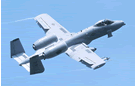
The A-10C PE program is only part of the effort required to keep the Reagan-era fleet of A-10s battle-worthy out to 2028. A separate $2.02 billion dollar wing replacement program is underway, a multiple-award $1.72 billion contract covered overall fleet maintenance and some upgrades from 2009-2019, and more technology inserts and structural modifications were planned. The GAO’s April 2007 report placed the potential total cost of upgrades, refurbishment, and service life extension plans for the A/OA-10 force at up to $4.4 billion.
The Pentagon began pushing to retire the entire fleet early in the FY 2015 budget. If that effort fails, possible upgrades could include electronics and engines, as well as structural work.
The USAF planned to replace the “thin skin” wings on 242 aircraft with new wings, and that effort is now underway. The cost was originally estimated at $1.3 billion, but the June 2007 contract was for $2 billion. This effort will help to extend A-10 service lives to 16,000 flying hours.
At some point, the A-10s would need to install Joint Tactical Radio System-based (JTRS) radios. As of April 2007, JTRS AMF was only in the bid phase, and as of 2014 it was not a required USAF standard.
To improve the A-10’s overall power and maintainability, the USAF hoped to eventually upgrade the existing General Electric TF34-GE-100 turbofan engines. Components of the existing engine will be replaced; in particular, a more efficient fan section with wider blades would be installed by General Electric along with digital engine controls. Flight testing of the revamped engine was slated to begin in FY 2008, and production in 2009-2010. Instead, this effort was downgraded in priority and deferred.
An April 2/07 GAO report places the potential total cost of upgrades, refurbishment, and service life extension plans for the A/OA-10 force at up to $4.4 billion.
Contracts & Key Events
Unless otherwise specified, all contracts are awarded to Lockheed Martin in Owego, NY as leader of the A-10 Prime Team; and they are issued by the Headquarters Ogden Air Logistics Center at Hill Air Force Base, UT.
FY 2016 – 2023
[youtube:v=RBNvcsJkvLo]
August 30/23: Nacelle Doors Kihomac won a $12.5 million deal for A?10 aircraft nacelle doors. This was a competitive acquisition with three responses received. This is a five?year contract with no option periods. The performance completion date is August 31, 2028. Using military service is Air Force.
May 23/22: Rudders Kihomac won an $18 million deal for A-10 universal rudders. This contract provides for the acquisition of a maximum of 330 rudders. The A-10 is Air Force’s primary low-altitude close air support aircraft. Work will take place in Layton, Utah. Expected completion date is May 18, 2027.
January 12/22: F-35 Training The US Air Force is passing targeting information from A-10 Thunderbolts to the F-35B jets in order for the latter to destroy them. Last week, the Idaho Air National Guard welcomed US Marines from Marine Fighter Attack Squadron (VMFA) 225, who fly the F-35B Lightning II, to Gowen Field. The squadron brought four of the fifth-generation fighters to train with A-10 Thunderbolt IIs from the 124th Fighter Wing’s 190th Fighter Squadron.
July 26/21: Transfer Postponed A US Air Force plan to transfer all A-10 Thunderbolt planes and HH-60 Pave Hawk helicopters to Arizona was postponed, pending Congressional budget approval. The Air Force is waiting for action on the Fiscal Year 2022 National Defense Authorization Act, which includes retirement of 42 A-10s, the branch said in a press release.
November 25/20: Legacy VIII Northrop Grumman won a $185.7 million deal for the A-10 Structural Integrity Program Legacy VIII. The deal provides for sustaining engineering services of A-10 aircraft. Services under the indefinite-delivery/indefinite-quantity contract are intended to support the military branch’s A-10 Aircraft Structural Integrity Program Legacy VII effort. Built by Fairchild Republic Company prior to its acquisition by Northrop, the A-10 aircraft is designed to help USAF perform airborne forward air control and close air support operations. Work will take place in Clearfield, Utah and estimated completion date is November 22, 2030.
May 14/20: Middle East The Idaho Air National Guard’s 190th Fighter Squadron deployed to the Middle East on May 11. The personnel left on that day and the A-10s departed one day later. More than 400 members of the 124th Fighter Wing, based at Gowen Field, will continue to deploy throughout the spring and summer in support of Operations FREEDOM’S SENTINEL, INHERENT RESOLVE and NEW NORMAL. The deployment is the wing’s second largest deployment and includes multiple aircraft, pilots, security forces, maintenance and medical personnel, and various other support staff.
February 14/20: Reduction? The US Air Force is looking to reduce its Fairchild-Republic A-10 Thunderbolt II close air support fleet by proposing to cut its non-active force fleet by 46 aircraft, or by 33%, in fiscal year 2021. The USAF, according to its FY 2021 budget request released on February 10, would keep its active force A-10 fleet at 143 aircraft but the service would slash its Air National Guard fleet from 85 aircraft to 46 and also reduce its Air Force Reserve fleet from 55 aircraft to 48. Major General John Pletcher, deputy assistant secretary for financial management and comptroller, told reporters that these aircraft would be the oldest and least-ready aircraft, and that these cuts, combined with planned modernizations, would allow the USAF to have A-10s in seven squadrons flying into the 2030s.
December 11/19: South Korea The Korean Airlines won a $213 million contract for A-10 Pacific Air Force depot support. This contract provides depot support for A-10 aircraft that are stationed in South Korea. A-10s deployed to Korea are based at Osan, south of Seoul. KAL-ASD will perform support work at its MRO facility in Busan. The company also supports other USAF aircraft. The US Air Force introduced the A-10 in 1976 as a close air support aircraft. It is heavily armed, with one 30mm GAU-8/A seven-barrel Gatling gun and up to 7,200kg (16,000lb) of mixed ordnance, according to Boeing. Estimated completion date is December 31, 2029.
October 25/19: 3D Audio Terma North America won a $60 million deal for A-10 3D audio. This contract provides for up to 328 3D audio systems for the A-10. The A-10 Thunderbolt II is a single-seat, twin turbofan engine, straight wing jet aircraft. Its nickname is „Warthog“. After years of trying to retire the Warthog, the US Air Force is now investing money to keep more of the attack jets flying for another decade. Work under the audio contract will be performed by a subcontractor in the US and Denmark as indicated in the contract award and is expected to be completed by February 28, 2024.
August 23/19: Wing Replacements Boeing won a $999 million ceiling contract for A-10 wing replacements. The deal is for up to 112 new A-10 wing assemblies and up to 15 wing kits. Boeing is teaming up with Korean Aerospace Industries for the effort. The news comes after the recent completion of Boeing’s first re-winging contract, awarded to the aerospace company in 2007. Only 109 A-10s still need to be re-winged. The planes, which entered service in 1976 and have deployed to the Middle East, Europe and the Pacific, have played an outsized role in the air campaign that began in 2014 against the Islamic State of Iraq and Syria, or ISIS, helping provide close-air support for Iraqi and US partner forces on the ground. Also dubbed the “Warthog” for its aggressive look and often painted with teeth on the nose cone, the A-10 Thunderbolt II is the US Air Force’s primary low-altitude close air support aircraft. Boeing will perform work under the nearly $1 billion contract at multiple subcontractor locations in the US and South Korea. Estimated completion date is August 23, 2030.
August 16/19: New Wings The US Air Force announced that the last pair of new wings for 173 A-10 Thunderbolt planes was successfully installed last week. “From a warfighter point of view, bringing this program to a successful conclusion was a significant accomplishment for the entire enterprise team,” said Stephen Zaiser, director of the 571st Aircraft Maintenance Squadron. The Air Logistics Complex’s 571st Aircraft Maintenance Squadron swapped wings on 162 A-10s as part of the A-10 Enhanced Wing Assembly replacement program. The remaining 11 were installed at Osan Air Base in the Republic of Korea. The $2 billion project is to remove and replace the wings on the planes.
August 6/19: Technical Order Sustainment HEBCO Inc. won an $80 million deal for A-10 technical order sustainment. The contract is for 10 years of non-personal technical services of technical order sustainment activities by providing technically accurate and up-to-date digital data. The A-10 Thunderbolt II is a single-seat, twin turbofan engine, straight wing jet aircraft developed by Fairchild-Republic for the United States Air Force. The A-10, sometimes also called „Warthog“ served in the Gulf War during Operation Desert Storm, the American led intervention against Iraq’s invasion of Kuwait, where the A-10 distinguished itself. With a variety of upgrades and wing replacements, the A-10’s service life can be extended to 2040. HEBCO will perform work in Oklahoma City, Oklahoma and Clearfield, Utah. Estimated completion date is August 1, 2030.
February 13/18: Draft documents-Upgrades/Re-winging Draft acquisition documents seen by Flight Global reveal that the US Air Force is planning to go ahead with upgrading its A-10 fleet and revive the tank-killer’s production line after March 2019. Even though a contract with Boeing to re-wing the fleet lapsed last month, putting the A-10’s future in doubt, the documents show service intentions to buy 116 new wing sets, and continue with upgrading the fleet with a new contractor. The Air Force plans to buy the first four wing sets for the A-10s under a low-rate initial production contract, then buy up to 112 more over a seven-year period, the documents state.
January 25/18: Back to Afghanistan After a six-year absence, the A-10 Warthog is making a return to Afghanistan. 12 of the ground-attack aircraft are expected to operate from Kandahar air base as the US military continues to intensify its air activities against militants fighting the Washington-backed government in Kabul, and the Warthogs will work providing close air support in a campaign targeting Taliban revenue sources including drug-producing facilities and in counter-terrorism operations. News of the deployment comes following a Taliban attack on the Intercontinental Hotel in Kabul at the weekend, resulting in the deaths of at least 22 people.
February 27/17: The USAF is expected to green light a study into a potential low-cost, light-attack fighter fleet to augment the A-10 Warthog and other close-air support (CAS) platforms in Iraq and Syria. The service will abandon plans for a more long-term replacement of the Warthog, which is expected to keep flying well into the 2020s. $100 million has already been earmarked for the study, scheduled to start in the Spring, and will look at the capabilities of the existing commercial designs such as Textron’s Scorpion light-attack fighter before calling out to industry.
January 23/17: The USAF is looking into testing a new low-cost light attack aircraft as soon as this spring. While Pentagon plans to acquire a new light attack platform are not new, the funding and scope of an earlier effort, the OA-X program, has never materialized into contracts being signed. However, if the experiment is approved and funded fully, the new platform will compliment the A-10 in close air support and reconnaissance missions.
August 9/16: Recommendations for the replacement of the A-10 Warthog are to be expected as soon as September. While recent reporting on the OA-X close-air support (CAS) aircraft has leaked some information on the program, it looks likely that USAF will want to acquire two CAS platforms. This would involve a a low flight-hour cost light attack aircraft augmenting the A-10 in the short term, with the service procuring an existing or potential new CAS design. Also on the table are rewinging the A-10 or buying just one replacement platform.
July 28/16: Reports that the USAF was proposing a dual procurement to replace the A-10 Warthog have been dismissed by Air Force Secretary Deborah Lee James, saying that the funds were not available for two programs, and stating that she had heard of the dual proposal via the news and had not been briefed by anyone within the service, or options or strategy in relation to the new close air support (CAS) A-X program. The stories that the USAF had met with industry officials were initially reported last week.
July 25/16: Two new close air support aircraft to complement and eventually replace the A-10 are being sought by the USAF. Beechcraft’s AT-6 and Embraer’s A-29 Super Tucano are being looked at for an off the shelf procurement while an initial order of 20 light attack OA-X aircraft could deliver as early as next year. For the OA-X, the service is looking for a medium-altitude aircraft with some level of precision strike capability, such as the BAE Systems Advanced Precision Kill Weapon System laser-guided rocket.
March 14/16: The USAF is to look at a variety of options to replace the A-10 Warthog for its Close Air Support (CAS) requirements. A study will investigate whether a new clean-sheet design is required, or if existing aircraft such as the AT-6 or A-29 would be best for continued low-intensity “permissive conflict” like counter-terrorism and regional stability operations. An alternative option could involve a derivative of the T-X Advance Trainer, however with the T-X program not due until 2024, it would miss the A-10’s retirement in 2022.
February 4/16: The life of the A-10 attack jet will be extended until 2022 after it was announced in Secretary for Defense Ash Carter’s 2017 defense budget preview on Tuesday. Lawmakers including former A-10 pilot Rep. Martha McSally and Sen. John McCain who supported the plane’s continuation were pleased with the announcement. The close-air support aircraft will continue to see service in the operations against the Islamic State in the Middle East where it has been supporting ground troops. The deferral of the A-10’s retirement comes as continued delays seem likely for the F-35, which is due to replace the A-10 once it comes into active service. The A-10’s ability to swoop in to heights of 50 feet above ground and engage enemies has been held up as an advantage against the F-35 by supporters.
February 1/16: Rep. March McSally has written to the White House in defense of the A-10 ahead of Obama’s budget rollout this week. The former USAF pilot has been one of the biggest political supporters of keeping the close air support aircraft in service until full plans for its legacy replacement are in motion. McSally’s efforts to keep the plane have so far resulted in the USAF reportedly shelving the A-10’s retirement plan indefinitely, due to increased demand for the attack plane in military operations in the Middle East. The letter also urged the president and defense secretary to fund depot support, maintenance, and upgrades to extend the life of the A-10 fleet, such as finishing the wing replacement effort.
November 12/15: The Air Force is considering pushing back the retirement schedule for the A-10, following a spike in demand from US forces operating in the Middle East. The venerable Close Air Support platform has been on the service’s chopping block for years, with recent efforts to retire the aircraft early blocked by lawmakers in September. The Air Force also recently released a RFI to identify sources for a new A-10 re-winging program, with the Thunderbolt Lifecycle Program Support effort intended to extend a portion of the Air Force’s A-10 fleet out to 2028.
October 23/15: The US Air Force deployed a dozen A-10 Thunderbolt II ground attack aircraft to the south of Turkey last week in anticipation of the aircraft seeing more combat against ISIS in Syria, according to reports Thursday. The first Warthogs were first deployed to the Middle East in November 2014, with the Air Force remaining adamant that the fleet should be retired. The aircraft have been deployed to Incirlik Air Force Base, having relocated from their home base at Moody AFB, Georgia.
FY 2015
Election results make retirement tougher.
September 21/15: The Air Force released a Request for Information on Friday to identify potential industry sources for the re-winging of an unspecified number of A/OA-10A close air support aircraft. Over half of the A-10 Warthog fleet is already undergoing a re-winging program, with Boeing acting as prime contractor for 173 of the aircraft, with options for an additional 69. The RFI comes despite repeated calls by the Air Force’s top brass to retire the fleet early in order to free up money and resources. These calls have been blocked, with this latest RFI part of the A-10’s Thunderbolt Lifecycle Program Support (TLPS) program, intended to keep the aircraft flying until at least 2028.
September 4/15: The Air Force Secretary Deborah Lee James told Congress that their rejection of her branch’s decision to retire the A-10 – a cut projected to save about a couple billion dollars per year – could cause major problems and delays for programs such as the F-35, the new long-range bomber and the KC-46 refueler – programs that together constitute unprecedented expenditures for any nation in history.
September 1/15: The on-again, off-again Air Force comparison test between the F-35 and the A-10 for close air support is back on again, according to the Washington Times. The F-35 doesn’t carry – and isn’t anticipated to carry – the sorts of weapons that have proven useful in the typical CAS mission. It has but a few seconds of canon ammunition and its weapons bay was once compared to a purse after the F-35C variant further infringed on internal storage. A test between the platforms would likely hinge on the scenario imagined by the Air Force brass, so a cynic might expect a profusion of bogeys best handled by stealth fighters.
August 26/15: In what is perhaps the biggest reality perception difference between the Air Force and the rest of the military and civilian government, the Air Force has been working hard to shut down the A-10 program, maintaining that the close air support stalwart isn’t earning its keep. The several billion dollars saved would go to more F-35 work, as that platform has been tipped to be the replacement, although some senior Air Force officers have suggested that perhaps a completely new craft would be in order. So it was newsworthy that a senior officer for testing had suggested a shoot-out between the A-10 and F-35. That test is now taking fire from the Air Force Chief of Staff Gen. Mark Welsh, who called such a test “silly.” Still, Welsh said that the F-35 was never intended as an A-10 replacement, so that leaves observers scratching heads as to which parts of the Air Force desire what outcome, especially as few believe an A-X replacement would be cheaper.
July 27/15: The Air Force has quashed Boeing’s hopes of selling refurbished A-10s to international customers, following the floating of the idea in May. With the House protecting the A-10 from comprehensive retirement for another year, the Air Force is planning to mothball outgoing A-10s, thereby saving a reported $4.2 billion in sustainment over a five year period.
June 26/15: The Government Accountability Office slammed the Air Force’s body of evidence and cost projections used to make the case for retiring the A-10. A report published on Thursday claims that the Air Force did not fully quantify the economic argument for favoring more advanced multi-role aircraft over the time-tested A-10. Manufacturer Boeing recently floated the idea of selling refurbished US A-10s to international customers.
May 22/15: Boeing wants to sell refurbished A-10s to international customers. The US is the only operator of the Warthog, with the House recently voting to fund the fleet for another year, despite the Air Force chiefs’ efforts to cut down numbers. Boeing is currently engaged in an extensive re-winging program for the aircraft, following a $2 billion 2007 contract.
May 1/15: On Thursdaythe House Armed Services Committee voted to keep the A-10 operational for another year, with the 2016 defense policy bill including an amendment to prohibit the Air Force from retiring the plane. The amendment – proposed by Rep. McSally – passed while a “middle ground” amendment proposed by Rep. Moulton failed. That amendment would have allowed the Air Force to retain a hundred of the aircraft while retiring up to 164.
April 28/15: The House is seeking to block the A-10 from being retired, with Rep. Martha McSally reportedly planning to introduce an amendment to prevent the Air Force from pushing the aircraft aside. This amendment will be attached to Thornberry’s version of the defense budget, with the A-10 fleet fully-funded. An A-10 recently had to conduct an emergency landing while deployed to Iraq, with the aircraft’s engine reportedly suffering “catastrophic damage.”
Nov 11/14: Politics. The USAF has a new angle in the A-10 fight, proposing to retire 72 A-10s in order to switch their maintenance workers over to the F-35. It’s being sold as part of having the F-35A reach Initial Operational Capability, but A-10 proponents like Sen. McCain and Kelly Ayotte say the USAF has other choices. The USAF says that their previous plan B has been blown apart by renewed needs in Iraq and Syria. Sources: Defense News, “USAF Discussing A-10 Compromise With Congress”.
Nov 4/14: Elections. American mid-term elections leave the Republican Party with a bigger House Majority, and recapture the Senate from the Democrats. That result leaves John McCain [R-AZ] as the new chair of the Senate Armed Services Committee. There are 80 A-10s at Davis-Monthan AFB, AZ in Tucson, and McCain is very much a proponent of engagement in places like Iraq, Syria, and other places where the A-10’s unique capabilities make a big difference. He’s going to be a staunch opponent of any retirement plans.
The election also features A-10 pilot Lt. Col. Martha McSally [AZ-2], who was the first woman to command an American fighter squadron, and has been described as one of the Republicans’ top House recruits. McSally is narrowly ahead in a traditionally-Democratic district, but the vote count and recount process is going to take a little while. If she is elected, it will have obvious implications for A-10 lobbying in Congress. Sources: AP, “Sen. John McCain vows to save A-10 from retirement” | McSally for Congress, “McSally Campaign Statement on Challenge to Uncertified Ballots” | Politico, “The House GOP’s top recruit”.
FY 2014
Attempted retirement of the fleet.

(click to view full)
Sept 19/14: Ki Ho Military Acquisition Consulting, Inc. in Layton, UT wins a $31.4 million firm-fixed-price, engineering support, indefinite-delivery/ indefinite-quantity contract to identify new and developing technologies that can “support the accomplishment of A-10 missions, and either eliminate or minimize operational and/or sustainability gaps.” $5.3 million is committed immediately, using FY 2014 USAF O&M funds.
Is this operational consulting, or payment to make more arguments for retiring the A-10? Poor results so far against in Iraq and Syria aren’t making fantastic arguments for other systems.
Work will be performed at Hill AFB, UT, and is expected to be complete by Sept 15/19. This award is the result of a competitive acquisition, with 3 offers received by the USAF Life Cycle Management Center at Hill AFB, UT (FA8202-14-D-0002).
Sept 9/14: Support. Korean Air Lines’ Aerospace Division in Seoul, South Korea receives an estimated $46 million firm-fixed-price maintenance and repair contract for depot level support to A-10 aircraft stationed in the Asia/Pacific region. Funds will be committed as needed.
Work will be performed at KAL’s facility in Seoul, South Korea, with an expected completion date of Sept. 30/20. This contract was a competitive acquisition, with 2 offers received by USAF Life Cycle Management Center at Hill AFB, UT (FA8202-14-D-0001).
Week of June 20/14: Politics. Things continue to move at a brisk pace in the House, with floor action starting for HR 4870 then leading to a vote within days. The White House issued its usual set of “strong” disagreements [PDF], with C-130 AMP, E-3s, and AH-64 transfers among the points of contention. At least the executive appreciated that someone in Congress sided with them to retire A-10s. But it was not meant to be, as an amendment against divesting A-10s easily passed with a 300-114 roll call. This was expected given the fact A-10 retirement was at odds with the already approved authorization bill.
The Administration will now have to find Senatorial opponents to the A-10, among other cuts the House doesn’t want, that are convinced enough to push the issue all the way through reconciliation. The odds are not in their favor.
On June 20 the bill was wrapped up with a 340-73 roll call, showing even broader bipartisan support than the authorization bill: amendments [PDF] | Bill report [PDF].
June 10/14: Politics. The House Appropriations Committee votes 13-23 against Rep. Jack Kingston’s [R-GA-1] amendment to transfer $339 million from the Pentagon’s operations and maintenance account to sustain the A-10 fleet. Former USAF pilot Chris Stewart [R-UT-2] was one of the speakers in favor from both parties, and he outlined the inherent issues with the close-air support mission, but it was to no avail.
What really matters is what the House ends up approving by final vote, but these kinds of losses can hurt politically. Sources: DoD Buzz, “House Panel Votes to Scrap the A-10 Warthog”.
May 23/14: Political. The Senate Armed Services Committee has completed the mark-up of the annual defense bill, which passed by a 25-1 vote. The section relevant to the A-10 is explained this way:
“Prohibits the Air Force from retiring or preparing to retire any A-10 or Airborne Warning and Control Aircraft (AWACS), or making any significant changes in manning levels in FY15.”
That isn’t as comprehensive or as long-term as Sen. Ayotte’s S.1764 bill (q.v. Nov 21-Dec 5/14), but it fulfills the same purpose in the immediate term. If the measure remains in the Senate’s FY 2015 NDAA bill, it will have to be reconciled with similar but different provisions in the House bill (q.v. May 8/14). Bottom line? Unless these measures are stripped from the final bill in either the House or the Senate, the A-10C fleet isn’t going anywhere just yet. Sources: US Senate Armed Services Committee, “Senate Committee on Armed Services Completes Markup of the National Defense Authorization Act for Fiscal Year 2015”.
May 8/14: Political. A 41-20 voice vote in the House Armed Services Committee changes the language of Rep. McKeon’s A-10 compromise, and institutes terms that are similar to HR.3657. Ron Barber [D-AZ-2] and Vicky Hartzler [R-MO-4] and Austin Scott [R-GA-8] from HR.3657 are the amendment’s sponsors, and they’ve added interesting requirements. One example would have the Comptroller General’s Office assess the cost per-plane for close air support missions, as part of the set of activities necessary before retiring the A-10s. The F-35’s high operating costs, and heavy depreciation due to its high initial cost, would cripple it in any comparison with the A-10. The F-35’s figures per mission would probably be at least 100% higher, and could easily be worse than that.
May 5/14: Political. House Armed Services Committee chair Buck McKeon [R-MO] proposes a compromise measure that would require “Type 1000 storage” for the retired A-10C fleet. Planes kept in that condition can be recalled to duty and fly again within 30-120 days, because after the initial removal and proper storage of key items like engines and weapons, no parts can be pulled without the express permission of the program office at Wright-Patterson AFB. That’s significantly better than Type 2000/4000 storage, but a step below Type 3000 “temporary storage” planes that receive engine runs, tow-outs to lubricate their bearings, and fluids servicing every 30 days.
Defense News estimates the cost for the 283-plane fleet at $25.7 million over 5 years ($12.17M initial storage + $283k/year + $12.17M refurb every 4 years). Sources: Air Force Magazine, “Living Boneyard” | Defense News Intercepts, “The Price of Storing the A-10 in “Type-1000″ Storage” | House Armed Services Committee, “McKeon Releases Full Committee Mark”.
Feb 24/14: Scrap the A-10Cs. The announcement isn’t a surprise (q.v. Sept 15/13), but Chuck Hagel’s FY 2015 pre-budget briefing explains the official justification for removing the A-10 fleet:
“For the Air Force, an emphasis on capability over capacity meant that we protected its key modernization programs, including the new bomber, the Joint Strike Fighter, and the new refueling tanker. We also recommended investing $1 billion in a promising next-generation jet engine technology, which we expect to produce sizeable cost-savings through reduced fuel consumption and lower maintenance needs. This new funding will also help ensure a robust industrial base – itself a national strategic asset.
To fund these investments, the Air Force will reduce the number of tactical air squadrons including the entire A-10 fleet. Retiring the A-10 fleet saves $3.5 billion over five years and accelerates the Air Force’s long-standing modernization plan [to replace it with the F-35]…. the A-10… cannot survive or operate effectively where there are more advanced aircraft or air defenses. And as we saw in Iraq and Afghanistan, the advent of precision munitions means that many more types of aircraft can now provide effective close air support, from B-1 bombers to remotely piloted aircraft. And these aircraft can execute more than one mission.
Moreover, the A-10’s age is also making it much more difficult and costly to maintain. Significant savings are only possible through eliminating the entire fleet, because of the fixed cost of maintaining the support apparatus associated with the aircraft. Keeping a smaller number of A-10s would only delay the inevitable while forcing worse trade-offs elsewhere.”
The A-10’s original concept did, in fact, aim to survive and operate in the face of advanced fighters and air defense, which makes Hagel’s statement questionable. Expect to see others question Hagel’s use of the term “effective” as well. The A-10 remains peerless in the close support role, and the use of fighter guns for close-in attacks on the front lines remains reality. That isn’t possible for drones, and it’s problematic for the vulnerable F-35A, which carries only 14% as much ammunition (only 180 rounds) in a lesser caliber. It would be possible to defend the decision by saying that the USAF is downgrading Close Air Support in order to build up other capabilities, but that isn’t how the Pentagon is selling this. Sources: US DoD, “Remarks By Secretary Of Defense Chuck Hagel FY 2015 Budget Preview Pentagon Press Briefing Room Monday, February 24, 2014”.
FY 2015 Budget: Retire the fleet
Nov 21-Dec 5/13: Politics. House and Senate members introduce bills in each chamber that would restrict the USAF’s ability to retire its A-10Cs. The Senate’s S.1764 is introduced by Kelly Ayotte [R-NH], While the House’s HR.3657 is introduced by Vicky Hartzler [R-MO-4]. Both have cosponsors from each party, but they’ll need more cosponsors to improve the chances of getting to a vote and being passed into law.
The core condition in both bills is that the USAF must have a fleet of F-35As with Block 4A software, including integration with the GBU-53 Small Diamater Bomb II or equivalent capability, all certified by an audit by the Comptroller General that also says that there are enough F-35s to replace the A-10s. In practice, that would defer A-10C retirement to 2025 at least, and might even push all the way to the A-10’s planned 2028 retirement.
FY 2013
APKWS laser-guided rockets added; A-10s out of Europe.

(click to view full)
Sept 26/13: TLPS. Northrop Grumman Technical Services in Herndon, VA receives an estimated maximum $11.3 million task order under a combined firm-fixed-price and cost-plus-fixed-fee engineering support contract. They’ll provide evaluations, analysis, repair designs, and/or testing to support the requirements for the A-10 aircraft structural integrity program and maintenance of operational safety, suitability, and effectiveness. All funds are committed immediately.
This award is a result of a competitive acquisition under the Thunderbolt Life Cycle Program Support contract, but only 1 bid was received.
Work will be performed at Hill AFB, UT, although various portions of the work will take place at subcontractor facilities, and work is expected to be completed by Sept 18/16. The USAF Life Cycle Management Center/WWAK at Hill AFB, UT manages the contract (FA8202-09-D-0003, 0012).
Sept 25/13: Political. Sen. Kelly Ayotte [R-NH], whose husband Joe was an A-10 pilot, puts a hold on the nomination of Deborah Lee James to be Secretary of the Air Force, until she gets clear and acceptable answers regarding the USAF’s proposal to kill the platform. Sources: Defense News, “Ayotte Blocks Air Force Secretary Nominee Over Possible A-10 Cuts”.
Sept 20/13: Political. House Armed Services Committee member Rep. Ron Barber [R-AZ-02] initiates a letter signed by 8 colleagues, calling the A-10:
“…a critical capability…. In Operation Desert Storm, the A-10 was responsible for the destruction of 4,000 military vehicles and artillery pieces. In Operation Enduring Freedom and Operation Iraqi Freedom, the A-10 has performed nearly one third of the combat sorties…. The Department of Defense must maintain its ability to wage ground combat and support those at the tip of the spear.”
The letter is co-signed by Reps. Rob Bishop [R-UT-01, HASC on leave to Rules]; Paul Gosar [R-AZ-04]; Vicky Hartzler [R-MO-04 HASC]; Jack Kingston [R-GA-01, Ways & Means]; Candice S. Miller [R-MI-10]; C.A. Dutch Ruppersberger [D-MD-02, Intel.]; Austin Scott [R-GA-08, HASC]; and Mike Simpson [R-ID-02, Budget/ Approp.]. Sources: Rep. Ron Barber Release | Full letter [PDF].
Sept 17/13: Political. Gen. Mike Hostage reiterates to reporters at the Air Force Association’s Air and Space Conference that the A-10 may be on the chopping block, and repeats the point about savings only becoming substantial when you remove entire fleets. He adds:
“You can’t get your money out of installations because they won’t support [base realignment and closure]. You can’t get money out of people fast enough. It takes about a year to get savings out of people.”
[youtube:v=HmZjSiyiOFM]
click for video
Sept 15/13: End of the A-10? USAF Chief of Staff Gen. Mark Welsh, Air Force chief of staff, is quoted as saying that “You can cut aircraft from a fleet, but you save a lot more money if you cut all the infrastructure that supports the fleet.”
That’s a step beyond initial reports about the Strategic Choices and Management Review, and current reports have the USAF considering the removal of all 343 A-10Cs, all 59 KC-10 tankers, and more of the 249 or so F-15C/Ds. The CRH successor to the HH-60 Pave Hawk helicopters is also up for review.
The KC-10 option seems to make zero sense as a “single-role” retirement, as it’s far more capable and multi-role than the smaller KC-135s, giving it especial value in the huge Pacific theater. It’s also the USAF’s key insurance against a grounding of its 1950s-era KC-135 aerial tanker fleet – which may explain the decision. If the USAF is trying to protect its KC-46 program, removing any operational insurance for the aged KC-135s makes the KC-46 program that much harder to mess with, or even to delay.
The F-15Cs, on the other hand, have had serious aging out problems, including maneuvering restrictions, and even a months-long grounding after one of the planes broke in 2 in mid-air. The F-22 Raptor fleet’s small size means that retiring the F-15Cs would be a big hit to US air superiority assets, but the multi-role F-15E Strike Eagles can perform the air superiority role almost as well. It’s just a continuing data point in the long-term downsizing of American TacAir. Sources: Defense News, “USAF Weighs Scrapping KC-10, A-10 Fleets” and “USAF General: A-10 Fleet Likely Done if Sequestration Continues”.
Sept 4/13: Wings. Boeing announces a $212 million follow-on order for 56 A-10C replacement wings, bringing total orders so far under the $2 billion program (q.v. June 29/07 entry) to 173 of a maximum 242.
Work will be performed at Boeing’s plant in Macon, GA. Sources: Boeing, Sept 4/13 release.
Aug 12-13/13: Cut the USAF? Prof. Robert Farley makes a condensed argument for abolishing the USAF as a separate service, in advance of his book “Grounded! The Case for Abolishing the United States Air Force.” Farley argues that the USA needs air power, but not a service that’s divorced from the ground and naval forces they support. A misguided focus on strategic effect, which he argues hasn’t panned out in wartime experience, will interfere and has interfered with effective contributions to a land/ sea/ air team.
Michael Auslin of the neoconservative AEI think tank responds, arguing that the USAF’s space role and global fast-reaction capabilities make it a unique asset that can reach areas far inland where the Navy cannot go, and go overseas in a way the Army is unable to. An independent Air Force, he says, will wring every advantage out of the air and space domains, just as the Navy does at sea.
Here’s the thing. What if the USAF is seen as a non-team player, one who consistently short-changes the needs of other services? It then becomes very hard to argue that the USAF is in fact wringing every advantage out of the aerial domain for the USA. At a time of significant budget cuts, cutting an entire service offers much bigger administrative savings than removing aircraft fleets, and removing fleets the other services see as their top priorities could create a level of friction that will place that kind of radical option on the table. Sources: War Is Boring, “America Does Not Need the Air Force” | Breaking Defense, “Why America Needs The Air Force: Rebuttal To Prof. Farley”.
Aug 6/13: Combat. An engagement in Afghanistan illustrates the A-10’s strengths, and underscores why high-altitude bombing simply isn’t going to replace what it does on the front lines:
“Even with all our (top-of-the-line) tools today, we still rely on visual references,” said the lead pilot, who is on his first deployment from Moody Air Force Base, Ga. “Once we received general location of the enemy’s position, I rolled in as lead aircraft and fired two rockets to mark the area with smoke. Then my wingman rolled in to shoot the enemy with his 30 millimeter rounds.”…. “We train for this, but shooting danger-close is uncomfortable, because now the friendlies are at risk,” the second A-10 pilot said. “We came in for a low-angle strafe, 75 feet above the enemy’s position and used the 30-mm gun — 50 meters parallel to ground forces — ensuring our fire was accurate so we didn’t hurt the friendlies.
The engagement lasted two hours that day, and in that time, the A-10s completed 15 gun passes, fired nearly all their 2,300, 30-mm rounds, and dropped three 500-pound bombs on the enemy force.”
As a reference point, the F-35s the USAF wants to use as replacements can’t fly as slowly for visual references, are highly vulnerable to battle damage, and carry just 180 25mm cannon rounds. Sources: USAF, “Bagram pilots save 60 Soldiers during convoy ambush”.
Front-line reality
Aug 5/13: Political. Defense News reports that the 4-month Strategic Choices Management Review will report that the USAF could eliminate most of its older C-130E/H transports, and 5 of 55 tactical A-10, F-15, or F-16 squadrons (up to 120 jets, based on 24-plane squadrons).
The USAF’s problem is that Congress wants to cut money, but won’t countenance closing bases. They’re also not receptive to aircraft retirements, which has left the USAF with several squadrons’ worth of unflyable planes that can’t be retired. FY 2013 budget proposals to retire 22 C-130Hs and shut down two A-10 squadrons were blocked by Congress. Sources: Air Force Times, “AF considers scrapping A-10s, KC-10s, F-15Cs, CSAR helos”
June 18/13: Basing. As part of budget cuts (q.v. Feb 1/12 entry), a ceremony at Spangdahlem Air Base, Germany inactivates the 81st Fighter Squadron and its A-10Cs. The ceremony marks the end of A-10 operations in Europe.
The A-10 was originally designed for combat in Europe, and was seen as a crucial fast-reaction asset that could stop heavy armored thrusts through NATO’s defenses. Now, the 52nd Fighter Wing is left with only F-16 fighters on its roster. Considering the situation in Europe, and likely threats, wouldn’t it have made more sense to remove and retire F-16s? That would have left the A-10s as an inexpensive but uniquely reassuring deterrent for NATO’s eastern flank, with fast deployability to the CENTCOM AOR if needed. Pentagon DVIDS.
Europe, Adieu
April 2/13: APKWS guided rockets. Eglin AFB announces successful tests of the APKWS laser-guided 70mm rocket from an A-10C, marking the 2nd test from a fixed-wing aircraft (a Beechcraft AT-6B was the 1st). For the final A-10C test sortie, 2 APKWS rockets were fired at a surface target at altitudes of 10,000 and 15,000 feet. The first rocket hit within inches, and the 15,000 foot shot hit within 2 meters despite a 70-knot headwind.
The USAF used a US Navy rocket launcher, because the guidance section adds 18″ to the Hydra rocket. If the USAF continues to move forward with APKWS on the A-10C and F-16, they’ll buy the Navy’s modified launchers to replace their 7-rocket LAU-131s. The US Navy is preparing to qualify APKWS on the MQ-8C VTUAV, USMC AV-8B Harrier II V/STOL jets, and F/A-18 family fighters. Pentagon DVIDS.
FY 2012
A-10C fleet cut; 1st re-winged A-10C rolls out; A-10C flies on biofuel; Thales acquires Scorpion HMD.

(click to view full)
Nov 5/12: Thales buys Scorpion HMD. Thales announced that it has signed a definitive agreement to acquire Gentex Corp.’s Visionix subsidiary for Helmet Mounted Displays (HMD) and motion tracking. Products include “Intersense” motion tracking, and the Scorpion HMD that equips American A-10Cs. Thales has a strong position in helicopter HMDs with its TopOwl, but it hasn’t had quite as much luck with fighter HMDs. Visionix has good technologies, which can help Thales improve that position against the Elbit/Rockwell joint venture VSI, and secondary competitors BAE systems and Saab Group.
Visionix will operate as a subsidiary of radio supplier Thales Communications, Inc., a Thales USA company that operates independently under a proxy agreement with the U.S. Department of Defense. Its management team will remain, and they’ll continue to operates from Aurora, IL and Billerica, MA. Thales Group.
July 12/12: Sub-contractors. Boeing calls South Korea’s KAI “a key supplier on the A-10 Wing Replacement Program,” while discussing the Korean company’s role in delivering AH-64D Block III attack helicopter fuselages. Boeing is a huge customer for KAI, who supplies parts for commercial jets and F-15s, as well as helicopter fuselages, A-10 wings, etc.
July 10/12: Lockheed Martin Corp. in Owego, NY receives a $7.3 million firm-fixed-price contract for repair service for the A-10 central interface control unit (CICU), and related Circuit Card Assemblies. This computer is also knows as a Signal Data Processor, and the idea is to provide a support bridge, while the USAF gets ready to perform maintenance in-house.
Work will be performed in Owego, NY, and will be complete by Sept 9/12. The USAF GLSC at Hill AFB, UT manages the contract (FA8251-12-D-0005). See also FBO.gov announcement.
June 29/12: Liquored up. An A-10C from Eglin AFB, FL flies using a cellulosic alcohol derivative, called “Alcohol-to-Jet.” That trick works better for the jets than it does for the pilots, apparently. The fuel comes from Colorado’s Gevo, Inc., and can be had for the bargain price of just $56 per gallon.
The $700,000 flight was just a test, obviously. The A-10 is a good test platform for this sort of thing, because its fuel system was segregated in order to help the plane survive hits. The system allows the 2 engines to run off of different fuel supplies, allowing simple performance comparisons. If a test fuel creates failures, the plane can still make it back on one engine. Daily Mail | Terra.com.
Alcohol flight
May 16/12: Flight International:
“The US Air Force has concluded that the short take-off vertical landing (STOVL) Lockheed Martin F-35B- model aircraft cannot generate enough sorties to meet its needs; therefore the service will not consider replacing the Fairchild Republic A-10 Warthog close air support jet with that variant.”
The short take-off F-35B’s ability to base near the battle does multiply the number of flight sorties from each plane, and improves total time over the battlefield. On the other hand, that’s multiplied relative to the F-35A. The A-10 has excellent endurance, whereas the F-35B has to sacrifice fuel capacity in exchange for its short-takeoff and vertical landing capabilities. Beyond that, F-35s of any vintage lack the armoring or gun for in-close support, remove most of their stealth protection if they carry the same array of weapons as an A-10, suffer from the usual problem identifying targets at fast jet speeds, and don’t offer significantly better battlefield sensors than the LITENING-SE or Sniper-SE pods on current A-10s. No matter what the sortie rates may be, replacement of the A-10 with any F-35 is a poor idea.
Feb 15/12: Boeing and the USAF officially roll out of the 1st re-winged A-10C Thunderbolt II in a ceremony at Hill AFB, UT. Boeing is under contract with the Air Force to deliver 233 wing sets through 2018, and delivered the 1st set in March 2011. In the intervening year, the new wings had to be installed, verified, and conduct initial test flights. Boeing.
1st re-winged A-10C
Feb 1/12: US Secretary of the Air Force Michael Donley and Air Force Chief of Staff Gen. Norton Schwartz released a short white paper [PDF] outlining its priorities and choices within forthcoming budget constraints. The A-10 fleet bears the largest cuts by far, even though it has been the most consistently requested plane by troops on the ground in recent wars, and offers high value in both counterinsurgency and full-war scenarios:
“More than 280 aircraft have been identified… for elimination… over the next five years. This includes 123 fighters (102 A-10s [emphasis DID’s] and 21 older F-16s), 133 mobility aircraft (27 C-5As, 65 C-130s, 20 KC-135s, and 21 C-27s), and 30 select ISR systems (18 RQ-4 Block 30s, 11 RC-26s, and one E-8 damaged beyond repair)”
That’s 102 of 345 total A-10s flown, leaving 243 in service. It remains to be seen whether Boeing’s re-winging contract will be cut, but if not, 233/243 A-10Cs left will be re-winged planes. Unconfirmed reports point to the elimination of 2 regular USAF units, plus 3 Guard units: the 107th Fighter Squadron at Selfridge Air National Guard Base (ANGB), MI; the 163rd Fighter Squadron at Fort Wayne ANGB, IN; and the 184th Fighter Squadron at Ebbing ANGB, AK. See Military.com | Salt Lake Tribune | Neoconservative AEI think-tank’s Weekly Standard.
A-10 fleet cuts
FY 2011
A-10Cs to South Korea; TLPS support contracts.

(click to view full)
Sept 6/11: TLPS. Boeing announces a 1-year, $2.9 million contract to develop and validate a modification of the A-10’s Digital Video Audio Data Recorder (DVADR), which was becoming difficult to support. That’s not uncommon with electronics, which become obsolete much faster than their fighter jets do.
This contract is the 6th Boeing task order under the A-10 Thunderbolt Life-Cycle Program Support (TLPS) program.
Dec 7/10: TLPS. Northrop Grumman announces a set of 3 small task orders under the A-10 Thunderbolt Life-cycle Program Support (TLPS) indefinite delivery/ indefinite quantity contract, worth almost $2 million. Under the terms of the 2-year Aircraft Structural Integrity Program Modernization II task order, Northrop Grumman and its teammate Southwest Research Institute in San Antonio, TX will develop and document non-destructive inspection (NDI) procedures and source data, and report discrepancies found between current technical data program requirements.
The Critical Safety Item (CSI) Technical Deficiency Improvement task order has 1 base year with 3 option years. Along with Wyle Laboratories in El Segundo, CA, and Rowan Catalyst Inc. in Libertyville, IL, the team will identify the engineering and technical correct CSI technical and acquisition data deficiencies.
Northrop Grumman is also teamed with Wyle Laboratories and Rowan Catalyst Inc., for the Critical Systems Component Analysis task, which has 1 base year with 2 option years. The team will perform component analysis of critical systems and provide solutions for increasing system reliability, safety, and aircraft availability; and reducing maintenance requirements and man-hours.
Nov 16/10: To Korea. Brahmand relays reports that the USAF 25th Fighter Squadron has deployed A-10Cs on the Korean peninsula at Osan AB, near Seoul. Subsequent USAF reports indicate that the last A-10A left the base on Dec 4/10, marking the 25th fighter squadron’s transition to an all A-10C force.
FY 2010
A-10C getting a Scorpion HMD, but not Hellfire missiles.

(click to view full)
Sept 27/10: OFP Suite 7, no Hellfire. A $48 million contract modification which will allow for the “completion of the full A-10 Suite 7 Operational Flight Program.”
Asked about this, Lockheed Martin confirmed that this is part of the A-10C program, adding that the government had reached its ceiling on this contract for mission software, also called Operational Flight Programs (OFPs) or Suites. Like the current modification, the original Oct 19/07 sole source contract ceiling for Suites 6, 7 and 8 was not an award, just a maximum. The government awards funds suite by suite, and based on additional things they wanted to add to the A-10C fleet, they requested this ceiling extension to $123 million total. The USAF has since separated Suite 7 into Suite 7A and Suite 7B, and Lockheed Martin recently received a contract for the remainder of OFP Suite 7A work.
The 2007 award also mentioned Hellfire II missiles, which are not normally fired from jets. Lockheed Martin says that the high cost of developing and purchasing a special missile launch rail for the A-10 caused the USAF to change its mind. The AGM-65 Maverick missile can perform the same role at a higher cost per missile, and Hellfire’s forthcoming JAGM missile successor is expected to work with fast jets (FA8635-07-D-6000, PO0012).
July 19/10: Scorpion HMD. Raytheon announces a $12.6 million USAF contract for Phase 1 integration and qualification of the Helmet Mounted Integrated Targeting (HMIT) system for USAF and Air National Guard A-10C and F-16C Block 30/32 aircraft. Raytheon Technical Services Company LLC (RTSC), the prime contractor, is teamed with Gentex Corp. in Simpson, PA to produce the system, based on Gentex’s Visionix Scorpion(TM) Helmet Mounted Cueing System.
HMIT will be a night-vision compatible helmet-mounted display that shows crucial information in high-resolution color imagery directly in the pilot’s field of vision. The color imagery is a step forward, and information displayed will include weapons-cueing, targeting and situational data from on-board and remote sensors. Like other HMDs, the system will track helmet movement to display accurate imagery, regardless of the direction the pilot’s head is turned. The program includes 5 one-year production options, with a potential total value up to $50 million.
April 13/10: Sub-contractors. CPI Aerostructures, Inc. of Edgwood, NY announces an additional $10 million in orders from Boeing in support of the A-10 fleet’s $2 billion re-winging effort. The original contract with Boeing was for $70 million (see July 1/08 entry).
Boeing has added additional structural assemblies and subsystem installations to the CPI Aero contract. These additions include pylon covers, center trailing edge wedge fittings, lower outer trailing edge panels, wingtip covers, wingtip light installations and aileron light installations.
Nov 20/09: OFP. Lockheed Martin announces a $17.8 million contract from the US Air Force to upgrade software that integrates communications and situational awareness capabilities on the A-10C close air support aircraft. The software upgrade is the 3rd in an annual series planned for the A-10 and is scheduled for release in May 2011. The earlier two upgrades were also performed by Lockheed Martin; the first was fielded on schedule in May 2009 and the second is on target for release in May 2010.
The software upgrade will provide improved pilot vehicle interface (PVI) and weapons delivery. Also included with the upgrade are software baselines for the helmet-mounted cueing system that provides situational awareness through improved visual cues for the pilot and for the lightweight airborne recovery system that integrates search and rescue capability. The upgrades will be integrated in Lockheed Martin’s A-10 Systems Integration Lab in Owego, NY. Lockheed Martin A-10 industry team includes Southwest Research Institute in San Antonio, TX and Northrop Grumman in St. Augustine, FL.
Nov 11/09: TLPS. Northrop Grumman announces an 18-month, $3.3 million A-10 TLPS contract to develop and test an anti-jam embedded GPS and an inertial navigation unit (EGI) for the A-10C. Northrop Grumman Technical Services will perform an integrated architecture and life cycle costs analysis and install a temporary modification. The company will then develop a system safety program, and provide program and engineering management support in order to conduct an operational assessment of the EGI capability during flight test. Northrop Grumman’s team includes subcontractors BAE Systems Control Inc., Johnson City, N.Y., and Borsight Aerospace, Farmington, Utah.
FY 2009
$1.72 billion TLPS multi-award maintenance contract; A-10C adds Laser JDAM; Wing cracking in 130 planes.

(click to view full)
February 27/17: The USAF is expected to green light a study into a potential low-cost, light-attack fighter fleet to augment the A-10 Warthog and other close-air support (CAS) platforms in Iraq and Syria. The service will abandon plans for a more long-term replacement of the Warthog, which is expected to keep flying well into the 2020s. $100 million has already been earmarked for the study, scheduled to start in the Spring, and will look at the capabilities of the existing commercial designs such as Textron’s Scorpion light-attack fighter before calling out to industry.
Sept 24/09: Boeing announces that it received 2 separate contracts from the US Air Force to support modernization of its 365 A-10A+ and A-10C Thunderbolt II aircraft. The contracts, which have a total value of $4.2 million, consists of several tasks ranging in duration from 3 to 18 months as part of the A-10 Thunderbolt Life-Cycle Program Support (TLPS) contract. For details on the TLPS contract, see the June 11/09 entry.
Under the 1st contract, Boeing and the Southwest Research Institute (SwRI) will provide engineering services for the A-10 Aircraft Structural Integrity Program (ASIP), which involves updating and aligning modern structural analysis tools, processes and standards for the A-10 fleet. Under the 2nd contract, Boeing, Raytheon Technical Services, and BAE Systems Platform Solutions will conduct a trade study analysis and operational assessment/proof of concept for the A-10 Upgraded Data Transfer Unit (UDTU). The goal of this contract is to update the aircraft’s avionics architecture to improve memory and data capability.
Other A-10 contracts Boeing has received include a contract to provide on-site engineering support and 3-D models of the A-10 wing, and a contract for fuselage lofting – the transfer of a scaled-down plan to full size. The $2 billion A-10 Wing Replacement Program, which Boeing received in June 2007 (see June 29/07 entry), plans to manufacture up to 242 enhanced wing assemblies. The 3-D models allow the Air Force to resolve wing-crack issues that temporarily grounded the A-10 fleet in 2008 (see Oct 3/08 entry).
June 11/09: TLPS. The A-10 Thunderbolt Life-Cycle Program Support (TLPS) “provides a multiple-award indefinite delivery/ indefinite quantity contract vehicle to sustain and modernize all A-10 weapon system configuration.” It’s a follow-on to the A-10 Prime Contract, which was competitively awarded to Lockheed Martin in 1997. A-10 TLPS could run for up to 10 years, with an initial 4-year award that can be followed by up to 3 more 2-year option periods. All funds have been obligated, and the A-10 TLPS is managed by the 538 ACSG/PK at Hill Air Force Base, UT.
The Aug 29/08 entry explains the key rule change from the USA’s 2008 Defense Authorization Act, which requires DoD task & delivery order contracts exceeding $100 million to be awarded to multiple contractors. The USAF will select up to 3 contractors to compete for individual A-10 TLPS orders over the life of the contract, which will include avionics, mechanical, structural, and propulsion system upgrade work and a program integration support. The 3 winners of the $1.72 billion total contract are:
* Lockheed Martin Systems Integration in Owego, NY (FA8202-09-D-0002). Current incumbents. Partnered with Southwest Research Institute in San Antonio TX; and Northrop Grumman in St. Augustine, FL.
* Boeing subsidiary McDonnell Douglas Corp. in Saint Louis, MO (FA8202-09-D-0001). Also on contract for the $2.015 billion A-10 re-winging program (q.v. June 29/07 entry).
* Northrop Grumman Technical Services, Inc. in Herndon, VA (FA8202-09-D-0003). NGC will manage the program from Clearfield, UT. Work will also be performed at Warner Robins, GA; Bethpage, NY; El Segundo, CA; and Rolling Meadows, IL.
See also: Lockheed Martin | Boeing | Northrop Grumman.
TLPS support contract
June 11/09: TLPS. Boeing’s A-10 TLPS release adds information concerning the separate $2.015 billion A-10 Wing Replacement Program:
“The work remains on schedule as Boeing develops the 3-D models that provide the engineering foundation for production of the new wings. The models also allowed Boeing to help the Air Force quickly resolve wing-crack issues that temporarily grounded the A-10 fleet last year.”
June 11/09: A-10PE Update. Lockheed Martin’s A-10 TLPS release adds some details concerning the separate A-10C Precision Engagement program:
“Lockheed Martin will remain under contract to complete efforts that are underway including work to provide Precision Engagement modification kits through 2011… To date, the Air Force has converted more than 200 of the 356 aircraft fleet. The A-10C was declared combat ready in August, 2007… In 2007, Lockheed Martin Systems Integration – Owego and the Air Force were co-recipients of a Top 5 DoD Program Award from the National Defense Industrial Association and the Department of Defense for A-10 systems engineering and program management excellence.”
Feb 4/09: TLPS. Boeing announces that it has submitted a proposal to the to the USAF for the $1.6 billion A-10 Thunderbolt Life-Cycle Program Support (TLPS) contract. This is a separate endeavor from the A-10C PE program, but it will have connections to ongoing modernization work.
Boeing is looking to leverage its work creating 3-D models of the plane under the $2 billion A-10 Wing Replacement Program. The A-10 was designed in the 1970s, and 3-D modeling was not used at the time. Lockheed Martin currently handles a large share of A-10 work, and competition is also expected from BAE Systems and L-3 Communications. Boeing release.
Jan 12/09: Cracking up. DoD Buzz quotes 12th Air Force commander Lt. Gen. Norman Seip, who says the USAF has inspected 200 of 244 aircraft with thin wings. Of those, 40% remain grounded, 41% have been inspected and returned to flight and the remainder are considered “flyable and awaiting inspection.” June 2009 remains the target date for a fix. Among the “thick winged” A-10s, 30% are still grounded, 23% will keep flying and the rest should be ready by June 2009.
The USAF’s challenge has been to keep all of the pilots current in their required flight hours for pilot certification, while providing enough aircraft to meet front-line combat needs.
Nov 14/08: LJDAM. The USAF announces that an upgraded USAF A-10C has dropped the GBU-54 LJDAM in a successful test. The next step is operational testing to develop tactics and techniques for employing the 500 pound dual laser/GPS guidance bombs from A-10s, who can use them to hit moving targets or drop bombs through clouds.
If those tests continue to go well, Eglin AFB’s test team may have their feedback as early as January. The goal is to have the LJDAM/A-10C combination deployed on the front lines by early 2009.
Nov 12/08: Cracking up. USAF release: Approximately 5 members of a depot maintenance team from Ogden Air Logistics Center at Hill Air Force Base, UT arrive at Moody AFB. They will provide hands-on training to perform major crack repairs on A-10 aircraft to Moody maintainers and another 40 active duty, Reserve and Guard maintainers from bases including Davis-Monthan AFB, AZ, Nellis AFB, NV, Whiteman AFB, MO, and Willow Grove Air Reserve Station, PA. Master Sgt. Steve Grimes, Air Combat Command Headquarters A-10 maintenance liaison:
“It would cost too much to fly all the aircraft to Hill. It would also take longer to repair all since three could only be sent at a time. This method is more cost-effective and it would be a faster way to repair the A-10s.”
Oct 3/08: Cracking up. The USAF announces “a time compliance technical order requiring immediate inspection and repair of wing cracks” for approximately 130 A-10 aircraft that were originally built with thin-skin wings.
“Such action has become necessary due to an increase in fatigue-related wing cracks currently occurring in aircraft assigned to Air Combat Command, Pacific Air Forces, the Air National Guard, Air Force Reserve Command and Air Force Materiel Command… The inspections, however, will not impact on-going or future operational combat missions.”
The USAF explicitly notes this as one of the issues associated with its aging aircraft fleet. The US military currently has about 400 active A-10s. See USAF release | Reuters.
Wing cracking grounds 130 A-10s
FY 2008
USAF prepared to compete future support; A-10C #100 delivered; Creating a 3-D model of the A-10.

2006-11-29
(click to view full)
Aug 29/08: New Rules. Aviation Week reports that the A-10C program is likely to be an early test case for a dramatic rule change inserted in the USA’s 2008 Defense Authorization Act, which requires DoD task & delivery order contracts exceeding $100 million to be awarded to multiple contractors.
The kits that upgrade the A-10A to an A-10C are still sole-sourced to Lockheed Martin, but that’s about to change. A final RFP is expected soon, and the current plan is for 3 associate prime contractors to win a “multiple award” contract that lets them compete for individual task orders. The Air Force will reportedly oversee all modifications above and beyond the A-10 Precision Engagement aircraft under the Thunderbolt Lifecycle Program Support (TLPS) contract, with a $1.6 billion ceiling over 5 years and an additional 5-year option.
Boeing, who has extensive fighter experience and makes new A-10 wings under the $2 billion re-winging program, is likely to add itself to the mix. L-3 Communications also has strong experience with aircraft refurbishment and upgrades, and BAE Systems is heavily involved in the A-10A+ program.
July 1/08: Sub-contractors. CPI Aerostructures, Inc. of Edgwood, NY announces a long-term, $70 million requirements from Boeing in support of the A-10 fleet’s $2 billion re-winging effort.
The first ordering period is to run until Sept 30/11, with an additional option period that runs from Oct 1/11 through Sept 30/16. CPI expects to receive the initial order under this contract within the next 30 days.
June 19/08: Model me. Integrating new weapons and systems onto new aircraft involved aerodynamic and mechanical considerations, in addition to electronic compatibility. Modern engineering practices offer comprehensive 3-D design drawings that account for every part, and can be used to create models that reduce the trial-and-error associated with new work. An aircraft designed in the 1970s wouldn’t have those 3-D CAD/CAM models to work from, however, which is where Eglin AFB’s 46th Test Wing’s SEEK EAGLE office enters the picture.
Visibility Size and Shape Targeting Accuracy Room Scale (V-STARS) uses a photogrammetry system of triangulation to collect thousands of data points involving every external surface of an aircraft. These data points are then used to create a model that’s accurate to within 0.03 inches of the aircraft measured. The B-52H bomber has already been through this process, and now the SEEK EAGLE office is measuring an A-10C on loan from the Maryland National Guard. The 1000,000 data points that result will build an A-10C model that can be used when integrating future weapons. USAF.
Jan 22/08: Wings. Boeing announces a $14.9 million U.S. Air Force contract for systems engineering and modeling services under the A-10 Wing Replacement program (see April 2/07 and June 29/07). William Moorefield, Boeing A-10 Wing Replacement program manager, said that the contract will provide the engineering foundation for the program; the goal is “a true paperless engineering package.”
Boeing will perform the majority of the work in St. Louis, MO, with the remaining work done in Salt Lake City, UT. The contract runs through September 2010.
Jan 18/08: #100. The USAF announces that the 100th A-10C has taken off and flown from Hill AFB, UT to Moody AFB, GA. Aircraft 80-0172 was based at Pope AFB, NC before the modification, but transfers to Moody AFB as part of the base realignment and closure (BRAC 2005) recommendations.
On average, the 571st Aircraft Maintenance Squadron technicians at Hill AFB are upgrading each A-10 aircraft to the new A-10C configuration in less than 90 days. The A-10C Precision Engagement program started in the 309th Aircraft Maintenance Group in July 2006.
100th A-10C delivered
Oct 19/07: OFP. Lockheed Martin Systems Integration of Owego, NY receives a $75 million contract modification to fund the A-10C’s Operational Flight Program (OFP) Hardware Improvement Program for the plane’s mission computers, and Development and Integration of mission software Suites 6, 7, and 8, including Hellfire II Missile Development and Integration. This is just an umbrella contract and ceiling, no funds have been obligated by the 642th AESS/PK at Wright-Patterson AFB, OH (FA8635-07-D-6000).
The USAF eventually decided to abandon Hellfire II missiles on the A-10C.
FY 2007
$2.015 billion contract for new wings; 25 more kits; Work on SADL datalink; A-10C arrives and reaches IOC.

(click to view full)
Aug 22/07: Basing. The USAF announces that an associate group of about 215 reservists will support the active duty 23rd Wing at Moody Air Force Base, GA, while a smaller associate detachment of 14 reservists will augment the A-10 Formal Training Unit at Davis-Monthan AFB, AZ. The arrangement means the reservists and active-duty personnel have opportunities to train and deploy as a unit; development of fighter associate units began in March 1997 with the launching of the Fighter Reserve Associate Test program. The success of that program led to the signing of an agreement in April 2003 by the commanders of ACC (Air Combat Command) and AFRC (Air Force Reserve Command) to establish fighter associate units at ACC F-16 Fighting Falcon and F-15 Eagle locations.
“Reservists in the Moody group will fly and maintain the A-10s with the regular component under the classic associate unit structure. The first A-10C Thunderbolt II arrived at Moody Aug. 7. About 50 of the upgraded aircraft will move to the Georgia base as a part of force realignment.”
Aug 21/07: IOC. The precision engagement modified A-10C Thunderbolt II receives its Initial Operational Capability certification at a Langley AFB, VA ceremony. The USAF report says that around 75 A-10s have already been upgraded as of IOC receipt.
Aug 7/07: A-10C #1. The first A-10C arrives at Moody AFB, GA.
1st arrival & IOC
July 18/07: AFSOC A-10s? Jane’s Defense Weekly mentions that USAF Chief of Staff General Michael Moseley has told Jane’s he is considering the creation of a new counterinsurgency (COIN) squadron of A-10A Thunderbolt II aircraft for the Air Force Special Operations Command (AFSOC). Gen Moseley said he is mulling the possibility of putting a squadron of A-10A close-support aircraft inside AFSOC to serve US Special Operations Command, which has the lead engagement role in the US-declared global war on terrorism.
The A-10C would certainly be useful in this role as it comes into service; a 2-seater all-weather version like the canceled A/OA-10B would have been even more useful in situations like this.
July 10/07: Sub-contractors. Rockwell Collins Government Systems, Inc. in Cedar Rapids, IA received a $24.85 million modification to a previously awarded firm-fixed-priced contract, exercising an option for AN/ARC-210(V) Electronic Protection Radio Systems. The AN/ARC-210 Multimode Integrated Communications System provides 2 way multimode voice and data communications over the 30-512 MHz frequency range in either normal, secure or jam-resistant modes via LOS or satellite communications (SATCOM) links.
The ARC-210 family of equipment is made up of several variants of the receiver-transmitter, each providing a specific combination of functionality. This modification consists of 329 each RT-1851 ARC-210 Receiver-Transmitter Radios; 323 each C-12561 Radio Control Sets, and 294 each MT-4935 Mounting Bases for the USAF’s A-10 aircraft. Work will be performed in Cedar Rapids, IA, and is expected to be complete in July 2008. The Naval Air Systems Command, at Patuxent River, MD issued the contract (N00019-05-C-0050).
June 29/07: New wings. Boeing subsidiary McDonnell Douglas Corp. in St Louis, MO received an indefinite-delivery/ indefinite-quantity, firm-fixed-price with economic price adjustment contract for $2.015 billion for Engineering Services plus 242 enhanced A-10 Wing sets. The new wings will extend the planes’ life to 16,000 flight hours, and the program calls for the replacement wing sets to be delivered in parts and kits for easy installation. See also our April 2/07 item, which mentions the USAF’s original estimate of $1.3 billion for this program.
Solicitations began November 2006, negotiations were completed May 2007, and $74.2 million has been committed as of the award announcement. Work on the contract could run from 2007-2018, with a base ordering period from June 2007 – September 2011, plus an option period that runs from Oct 2011 – September 2016. The Headquarters Ogden Air Logistics Center at Hill Air Force Base, UT issued the contract (FA8202-07-D-0004). Boeing release
Re-winging contract
April 11/07: +25 kits. A $17.6 million firm-fixed-price contract modification to produce and deliver A/OA-10 Aircraft Precision Engagement production kits and associated items. This will include: 25 Precision Engagement Modification Kits, 30 Portable Automated Test Sets, 5 Throttle Quadrant Tester Upgrades, 25 Third SP103 Single Board Computers, 30 Stick Grip Attachment, and 357 Throttle Grip Covers. At this time, $8.8 million have been obligated, and work will be complete January 2009 (FA8202-05-C-0004/P00022).
April 11/07: SADL. Lockheed Martin Corp. in Owego, NY received a $70 million indefinite delivery/ indefinite quantity, firm-fixed-price and cost-plus-fixed-fee and time-and-materials contract. This action covers continuing development, integration, and production of Raytheon’s Situation Awareness Data Link (SADL), and Improved Date Modem (IDM) efforts in support of on-going A-10C Precision Engagement (PE) fleet modernization and upgrade efforts. At this time, $4.1 million have been obligated, and work will be complete December 2009. The Headquarters Aeronautical Systems Center at Wright-Patterson Air Force Base, OH (FA8635-07-D-6015).
April 9/07: SADL. The A-10 Prime Team announces successful delivery of the full-function Situational Awareness Data Link (SADL) capability to the U.S. Air Force for developmental flight testing. The U.S. Air Force is expected to conduct developmental flight test of the SADL capability through May 2007 at Eglin Air Force Base, FL. SADL is expected to be fielded to operational A-10 units by September 2007. Lockheed Martin release.
April 2/07: GAO Report – Costs. The US Government Accountability Office releases #GAO-07-415 – ‘Tactical Aircraft: DOD Needs a Joint and Integrated Investment Strategy’. A key excerpt:
“The Air Force will retain the A-10 “Warthog” fleet in its inventory much longer than planned because of its relevant combat capabilities– demonstrated first during Desert Storm and now in the ongoing Global War on Terror. However, because of post-Cold War plans to retire the fleet in the early 1990s, the Air Force had spent little money on major upgrades and depot maintenance for at least 10 years. As a result, the Air Force faces a large backlog of structural repairs and modifications – much of it unfunded – and will likely identify more unplanned work as older aircraft are inspected and opened up for maintenance. Major efforts to upgrade avionics, modernize cockpit controls, and replace wings are funded and underway. Program officials identified a current unfunded requirement of $2.7 billion, including $2.1 billion for engine upgrades, which some Air Force officials say is not needed. A comprehensive service life extension program (if required) could cost billions more.”
…A major re-winging effort is planned for 2007 through 2016 that will replace the “thin skin” wings on 242 aircraft at an estimated cost of $1.3 billion. This effort will help to extend the A-10’s service life to 16,000 hours… Total cost to complete the [Precision Engagement] modification is estimated to be $420 million.”
GAO on costs
March 27/07: EMD. Lockheed Martin announces a $40.4 million contract modification to complete the A-10C Precision Engagement program’s engineering and manufacturing development (EMD) phase. Work will continue through May 2008 to conclude development of the Precision Engagement software suite and to support flight testing conducted by U.S. Air Force. Lockheed Martin release.
Oct 17/06: Update. The USAF reports that as of October 2006, 21 A-10C aircraft have been modified at Ogden Air Logistics Center at Hill AFB, Utah; the entire fleet of 356 active aircraft are to receive the upgrades, including active duty, Reserve and Air National Guard Warthogs.
FY 2005 – 2006
179 upgrade kit orders (or is it 239?); DSMS delivered.

(click to view full)
Sept 27/06: +107 Kits. A $49 million firm-fixed-price, cost-plus-incentive fee and time and material contract. Lockheed Martin’s release cites 107 PE kits, representing the 2nd production lot following the initial award for 72 kits in March 2005:
“The contractor shall provide total systems performance responsibility for A-10 aircraft integration by managing all system problems to a final solution. Interfaces are maintained between the performance work systems primary areas of modifications, system test/evaluation, project management, system engineering, and facilities.”
DID’s own records show 2005 orders for 132 kits, but we’ll go with the manufacturer’s numbers. At this time, $1.3 million have been obligated, and work will be complete September 2010. The 309th Aircraft Maintenance Group at Hill AFB, UT began installing the first award production kits in March 2006 (FA8202-06-D-0001)
March 21/06: DSMS. Lockheed Martin announces that the A-10 Prime Team has delivered the Digital Stores Management System (DSMS) to the U.S. Air Force’s A-10C flight-test program as scheduled. The new system is integrated with the Sniper ATP and LITENING surveillance and targeting pods, and automates many of the weapons control functions that A-10 pilots today perform manually.
Integration of the targeting pods and DSMS took place in Lockheed Martin’s A-10 Systems Integration Lab (SIL) in Owego, NY, where A-10 pilots validated and refined the mechanization of the upgrade before official release of the software to ground and flight test. “The pilot reviews saved significant ground and flight test time,” said Roger Il Grande, A-10 program director at Lockheed Martin Systems Integration – Owego. Built by Lockheed Martin in 2003, the SIL duplicates the aircraft’s wiring and cabling infrastructure, and is outfitted with actual weapon hardware, missile seekers, suspension racks and rocket launchers to emulate an A-10 aircraft on the flight line.
July 25/05: Kits. A $9.1 million firm-fixed-price contract modification to provide for 72 A-10 aircraft precision engagement spiral 1 modification kits with 3 option years and associated test equipment. Looks like an adjustment to a previous order.
At this time, the total amount of funds has been obligated. Work will be complete at a rate of 6 per month beginning 13 months after receipt of order. Solicitation began July 2004 (FA8202-05-C-0004, PZ001).
June 28/05: Sub-contractors. Enertec America in Alpharetta, GA received a $15.3 million firm-fixed-price modification to provide for A-10 digital video and data recorders. Total funds have been obligated, negotiations were completed June 2005, and work will be complete by November 2006 (FA8202-04-C-0023, P00005).
Feb 22/05: +60 Kits? A $28.5 million, firm fixed price, time and materials contract modification for 60 A-10 Thunderbolt II fighter precision engagement Spiral 1 modification kits, along with associated parts and test equipment.
Solicitations began July 2004, negotiations were complete in July 2005, and work will begin 13 months after the exercising option and will refit 6 aircraft per month after that (FA8202-05-C-0004/P00002).
Feb 17/05: +72 Kits. A $37.8 million contract to provide the U.S. Air Force with 72 Precision Engagement Spiral 1 production kits to modify A/OA-10 “Warthog” close air support aircraft, plus associated test equipment. At this time, $28.3 million of the funds have been obligated. Solicitation began July 2004 (FA8202-05-C-0004). Lockheed Martin release.
The production kits, a result of work by Lockheed Martin, BAE Systems and Southwest Research Institute, are one component of the Precision Engagement program.
FY 2004 and earlier
Main upgrade contract; Sniper pods for A-10Cs.

Feb 12/04: Sniper. Lockheed Martin announces a contract to integrate the Sniper XR targeting pod on the A-10 aircraft in support of the A-10 Precision Engagement (PE) Program. The contract award follows a successful demonstration of the Sniper system during the A/OA-10 Precision Engagement upgrade program’s critical design review.
Some existing A-10s do fly with targeting pods, but they’re earlier models of Northrop Grumman’s LITENING pod. The USAF picked Sniper as its future targeting pod in 2001 (though they’d shift to a dual-pod approach again in 2010), and the current contract will ensure that Sniper pods work seamlessly with the A-10’s upgraded stores management systems, pilot displays, weapon targeting, etc.
As part of the integration effort, Lockheed Martin Missiles and Fire Control will develop the Pilot Vehicle Interface (PVI), pod Operational Flight Program (OFP) software, and pod interface adapter hardware for the A-10. Upon completion of this effort, the Sniper XR pod will self-detect and automatically load the appropriate Operational Flight Program when installed on either the A-10, F-16 or F-15E airframes.
Feb 15/01: Lockheed Martin announces the contract win, stating that:
“The A/OA-10 Prime contract modification has an estimated value of $226 million, $74 million for the Engineering, Manufacturing and Development (EMD) phase through 2004 with follow-on production at $152 million.
This innovative government and industry teamwork approach cost-effectively combines multiple A-10 upgrade requirements into one program that fits within current available funding and saves the U.S. Air Force approximately $150 million over the cost of executing the requirements as standalone projects. The Precision Engagement modification also provides the A-10 fleet with enhanced close-air support and precision strike capability earlier than originally planned.
During the EMD phase, the company’s Aerospace Systems business unit will design, manufacture and test the Precision Engagement system. This effort involves the installation of a digital stores management system for cockpit interface with its weapon systems; new cockpit displays; a Situational Awareness Data Link (SADL) to provide accurate information about friendly forces and potential threats; a Direct-Current (DC) generator upgrade; and the integration of guided weapons such as the Joint Direct Attack Munition (JDAM) and Wind Corrected Munitions Dispenser (WCMD) along with future targeting pod integration. Follow-on efforts will then outfit the entire A-10 fleet.”
A-10C upgrade contract
Additional Research
Background: A-10 Platform & Enhancements
* USAF Fact Sheets – A-10 Thunderbolt II
* Air Force Technology – A-10 Thunderbolt (Warthog) Ground Attack Aircraft, USA
* Lockheed Martin – A-10 Thunderbolt II. Describes the Precision Engagement and support programs.
* Northrop Grumman – A-10 Thunderbolt II. The firm bought the A-10 assets of Fairchild in 1987. They are presently partnered with Lockheed Martin Systems Integration as a member of the A-10 Prime Team.
* MILAVIA – Fairchild-Republic A-10/OA-10 Thunderbolt II. Includes upgrade program descriptions into Spiral 2. Not 100% current due to program changes, see article above.
* Federation of American Scientists Military Analysis Network – A-10/OA-10 Thunderbolt II.
* DID Spotlight – Kicked Up Hogs: The A-10A+ Program. Not as extensive as the A-10C PE program. Intended as an interim measure; these aircraft will be the last upgraded to A-10C status.
* Air Force Technology – Su-25 Frogfoot (Sukhoi Su 28) Close-Support Aircraft, Russia. The SU-25 bears a strong resemblance to the A-9 aircraft that lost the US competition. As is frequently the case, some observers thought the A-9 was a better aircraft. A carrier-based variant of the SU-25 has been fielded, and some planes have received a set of upgrades to SU-29 status.
News & Views
* POGO (Dec 13/13) – The A-10 Warthog: A Core Defense Issue Washington Can No Longer Ignore. “More than 100 people (Hill staff, journalists, combat pilots and ground commanders, DOD officials and think-tankers) recently attended two events [covering CAS and the A-10]…. The described materials follow…”
* USAF (Aug 6/13) – Bagram pilots save 60 Soldiers during convoy ambush. What an A-10 pilot’s job really involves.
* USAF, via WayBack – (May 12/10) – Behind the Scenes: The Making of an A-10C Pilot “First Refueling” [PDF]
* USAF (Nov 7/07) – Upgraded A-10s prove worth in Iraq [dead link]. See Public Domain Files for a picture.
* Defense of the Realm, via WayBack (Sept 23/07) – Jackpot! Covers a series of letters to The Sunday Telegraph, including one from from Group Captain Hastings (Ret.), who commanded the Sultan of Oman’s tactical air force in Dhofar Province. He writes that the war “had similarities with the current Afghan operations…” Their weapon of choice? A slow-flying BAE Strikemaster counter-insurgency aircraft, derived from an RAF trainer. The same fast jet/slower plane effectiveness dynamic applied back then.
* Flight International, via WayBack (Aug 29/07) – US Air Force may extend Fairchild A-10 life beyond 2028. “There are bigger numbers throwing around that are much [later] than that,” Air Combat Command chief of requirements Lt Col Ralph Hansen told Flight International on 21 August.”
* USAF (June 27/07) – A-10s get digital makeover with data link. Includes an especial focus on the SADL datalink and how it works.
* David Axe (April-May 2007) – A-10 Upgrade Flickr Photo Set
* Defense Technology International, via WayBack (May 21/07) – Hog Heaven. Bryan William Jones paid a visit to Hog heaven at the Ogden Air Logistics Center at Hill Air Force Base, Utah, where the old jets get ripped apart and rebuilt.
* Defense Technology International, via WayBack (April 30/07) – Warthogs’ Secret Haunt. “The Air Force’s A-10 Warthog squadrons attend a secret training exercise in rural Florida to prepare for combat in Iraq and Afghanistan. The exercise involves jets, pilots and maintainers deploying to an “austere” airfield and practicing round-the-clock bombing and strafing in difficult conditions. Predeployment training in this vein is nothing new: many units do it annually; but rarely is it shrouded in such secrecy. Warthogs have been very busy over Iraq and Afghanistan and are only getting busier…”
* Military Aerospace Technology, via WayBack (Feb 21/07) – A-10 Makeover On The Horizon
* USAF (Oct 17/06) – A-10 upgrade effort transforms Warthog capabilities
* DID (July 21/05) – $9M more for A-10 Modernization Program, Spiral 1
* DID (Feb 27/05) – $28.5M to Lockheed for 60 More A/OA-10C Spiral 1 Upgrades
* Defense Tech, via WayBack (Feb 2/05) – Next-Gen Warthog Takes Off
* C4ISR Magazine (Sept. 14/04) – A-10 Warthogs slated for major upgrade
* Salon, via WayBack (April 5/04) – The Hidden Cost of War. Describes several friendly fire incidents involving A-10s. Reading it helps to explain the appeal of the SADL data link.
* USAF 332nd Air Expeditionary Wing Public Affairs, via WayBack (April 13/03) – Pilot brings battle-damaged A-10 home safely. Recounts the story of Capt. Kim “Killer Chick” Campbell in the photo above. The mission took place on April 7/03.