


(click to view full)
The Soviet tank threat may be history for now, but missiles that can attack moving trucks, armored vehicles, and bunkers remain in demand. This is especially true in urban situations, where the ability to fire a rocket or missile safely from inside an enclosed space is a very important plus.
In 2000, the UK Ministry of Defence carried out a series of trials to evaluate missiles for their “NLAW” program. In the summer of 2002, the Saab/Thales MBT-LAW team beat the Predator/Kestrel system from Lockheed Martin, MBDA and Insys. The Swedish FMV and British Defence Procurement Agency (DPA) followed by ordering final development of the RB 57 NLAW (Next generation Light Antitank Weapon) for the United Kingdom and Sweden. Assembly will take place at Thales Air Defence in Belfast, but Saab Bofors Dynamics of Sweden and Thales Air Defence in the UK have a marketing agreement that lets customers buy the system from either firm.
The RB57 NLAW/ MBT-LAW

(click to view full)
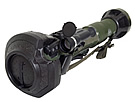
The RB57 NLAW, also known as the MBT-LAW, is a one-man disposable anti-tank system that weighs 12+ kg (over 25 pounds), with a range of 20-600m (just over 1/3 mile). It was designed to kill tanks, and also to overcome the traditional difficulties faced by soldiers, such as complicated firing routines with estimation of range, wind direction and target speed. Because it’s a short range weapon, it uses a simple “PLOS” (Predicted Line of Sight) approach where the soldier tracks the target for a few seconds before firing. The missile’s guidance electronics record the soldier’s aiming movement, then calculate and predict a flight path to the target. Once launched, no further guidance is required; the missile’s inertial guidance tells it where it will need to be.
Against tanks and other armored targets, the weapon’s OTA (Overfly Top Attack) mode is used. Flying about 1m above the line of sight, the missile’s electronics sense the dense metal beneath and detonate above the target’s most vulnerable part – the roof. When facing lighter vehicles or fortified outposts, the DA (Direct Attack) mode can be used instead. for direct attack, the missile flies directly at the target. The sensors designed to detect the target below are disconnected, and the warhead fires shortly after impact.
The weapon is fully compatible with night vision goggles for use at night, and can also be fired from “confined positions” like the inside of a building, without barbecuing the firer and squad. The launcher is disposable after firing, though the Trijicon Compact ACOG 2.5×20 sight may be removed and retained.

(click to view full)
Training is very important for man-portable rockets and missiles, especially as units prepare for international deployments where combat is a real possibility. It’s even important during international deployments, because these missions often last longer than expected, and skills need to be kept up. It can also be very expensive, however, if live missiles are used.
These factors have led to a strong expansion of simulation as a key component of modern man-portable anti-armor missiles. There are 2 kinds of training that typically comes with the most modern anti-tank missiles, and they are not entirely exclusive. One option is embedded training, where training software et. al. are included in the sighting and firing system’s electronics. The American Javelin and Israeli Spike missiles have this feature, for instance. Fully disposable systems like the RB57 find that approach a tad expensive, however, opting for integrated indoor virtual simulators that are designed to work with the weapon.
Saab is the design authority, while Thales UK’s Belfast site is the final assembly location. The overall team includes over 20 firms, but Saab says that more than 80% of weapon value is produced by British industry, as promised by when the British contract was awarded. Firms involved in production of the RB57/MBT-LAW include:
* Saab Systems – Design, components, integrator for Swedish RB57 simulator training.
* Thales Air Defence – Final assembly in Belfast, Northern Ireland. Also makes the laser based Short-Range and Field Trainer, and Thales Missile Electronics makes electronics assemblies and the proximity fuse
* BAE Systems (UK) – inertial measurement unit, BAE RO to supply rocket motors in some accounts. Others place this responsibility with Roxio (France).
* EPS Logistics Technology
* Express Engineering
* FR-HiTEMP (UK) – control fins and actuators
* Goodrich (UK) – SiIMU01® inertial measurement units
* ICI-Nobel Enterprises
* Leafield Engineering
* MetalWeb
* National Plastics Aerospace (UK) – plastic and composite moldings
* NP Aerospace (UK)
* Portsmouth Aviation (UK)
* Raytheon Systems Limited (UK) – electronics assemblies
* Skeldings (UK) – special purpose springs
* Trijicon (USA) – ACOG 2.5 x 20 sight.
* FATS Ltd. (US/UK) – UK’s indoor trainer (IDT) for their Dismounted Close Combat Trainer (DCCT)
* KMW (Germany) – Simulation environment for Swedish training. Collaborates with Saab.
Low rate initial production of the RB57 started in 2006. Full-rate production deliveries to Britain and Sweden began in 2008, and deliveries to Finland began in 2009.
Contracts and Key Developments

(click to view full)
Sept 14/11: #10,000. Saab announces delivery of the 10,000th NLAW weapon from Thales manufacturing site in Belfast. The weapon has been deployed to British regiments, and training is ongoing. Overall, Saab says that NLAW has been made operational within budget.
10,000th delivery
May 23/11: Goodrich Sensors and Integrated Systems in Plymouth, UK announces a follow-on order from Saab Bofors Dynamics AB for additional NLAW inertial measurement units (IMUs). The contract covers additional NLAW units intended for export; deliveries are expected to be complete in 2012.
The IMUs are Goodrich model SiIMU01(R), a rugged MEMS-based IMU that provides missile navigation and guidance. Goodrich’s Plymouth team was first selected in 2001 to design and develop the NLAW’s IMU. Deliveries commenced in 2005, and the most current order brings total NLAW SilMU01 requirements to 20,000 units, including past, current and expected future delivery orders.
June 14/10: Saab announces that Luxembourg has become the 4th nation to choose NLAW, after Britain, Sweden, & Finland. Choice does not always equate to a contract, and no further details are announced.
Luxembourg picks NLAW
Jan 12/09: Market projections. Forecast International’s assessment of the global market for unguided, man-portable rockets sees the MBT-LAW/ RB57 leading European offerings through 2018, accounting for 4.18% of global production and 16.15% of market dollars in this segment.
Nov 5/08: Marketing. Saab Group announces that about 50 guests from 13 different countries took part in this tri-national test-firing of the NLAW. Shooters from the existing customer countries (Finland, Sweden, UK) fired 3 missiles; 2 at moving targets and 1 at a concealed Main Battle Tank from confined space. All shots resulted in direct hits. Thus far, a total of 62 NLAW live firings have been made, of which 61 have been successful.
March 11/08: Parliamentary report. Britain’s Parliamentary Defense Committee releases its “Tenth Report of Session 2007-08, Defence Equipment 2008, HC 295.” among its entries is a note that the RB57 NLAW program has slipped by 15 months, and will now arrive 27 months late. Even as British troops use expensive Javelin missiles at a high rate, as a form of front-line artillery, in roles and situations the NLAW was designed for.
Feb 26/08: Saab and Krauss Maffei Wegmann (KMW) announce an SEK 100 million (about $16 million) order from the Swedish Defence Materiel Administration (FMV) for 10 simulators to act as RB57 virtual training systems, plus support. Saab Training Systems is the prime contractor, and will be responsible for integrating KMW’s virtual simulator with the NLAW.
These RB57 gunnery training systems will be used partly to train approximately 800 soldiers before deployment with the EU battlegroup, and partly for training during deployments. Saab release.
Sweden: 10 simulators
Dec 20/07: Finland has followed the development since 2004 and NLAW has been thoroughly evaluated and tested by the Finnish defence forces. Now Saab announces that they’re the first export customer for NLAW, with a EUR 38 million order. Deliveries to Finland will begin in 2009. Saab release.
Finland buys
Dec 22/05: Following joint development between the United Kingdom and Sweden, the Swedish FMV defense procurement agency places a SEK 500 million (about $75 million) purchase order with Saab Bofors Dynamics for production of the RB 57 NLAW(Next generation Light Antitank Weapon). Saab release.
Swedish order
June 30/05: Sub-contractors SAAB Bofors Dynamics chooses the Trijicon Compact ACOG as the integrated magnified sight for use on the NLAW’s combat and the training weapons systems. Trijicon’s sight had to meet seemingly opposing demands for minimum weight and volume, while providing the extreme strength needed when mounted on the NLAW. Trijicon met those tests, including the requirement to have a functional life of over 20 years without service or change of energy source. In addition, the sight will be zeroed during assembly of the NLAW and will not need to be adjusted again.
This initial order includes a large number of training units which are part of the training and simulator developed by SAAB Training Systems in Huskvarna, Sweden, as a sub-supplier to SAAB Bofors Dynamics for the UK. The Compact ACOG will be part of those systems, too. Release.
Summer 2002: the Swedish FMV and British Defence Procurement Agency (DPA) sign a SEK 4 billion (about $430 million at the time) contract with Saab and Thales for development of the RB 57 NLAW(Next generation Light Antitank Weapon) for the United Kingdom and Sweden, plus series production and delivery for the British Armed Forces.
Development & UK production
May 21/02: British pick. The Minister for Defence Procurement, Lord Bach, announces that Team MBT LAW UK has been chosen as the preferred supplier for the “400M Next Generation Light Anti-Armour Weapon Programme (UK NLAW)”. BAE Systems’ release adds that the consortium “meets the MoD’s requirement for 100% UK industrial participation in the NLAW programme, creating or sustaining more than 500 high-quality long-term jobs throughout the UK. BAE Systems is a 35% shareholder in Saab.”
A same-day BBC report adds that Thales Air Defence, based in east Belfast, has a GBP 70m share of the GBP 400 million deal, whose work is split between 15 firms, with more than 500 jobs being created throughout the United Kingdom. The report also predicts possible export totals of up to 100,000 units. BAE release | BBC: “Missiles order creates 80 jobs.”
Aug 31/01: Market projections. Jane’s Defence Weekly reports that Britain is expected to buy 20,000 – 24,000 MBT-LAW systems, adding that the Saab/Thales consortium claims a potential world market of 80,000 – 100,000 units, valued at more than GBP 1 billion.
Additional Info. and Sources
* Saab – RB 57. See also Saab Bofors Dynamics’ MBT-LAW YouTube commercial and YouTube 2001 test sequence.
* UK MoD – Factsheet: Next Generation Light Anti-Armour Weapon (NLAW). Places the total program cost at GBP 300 million, vs. the larger figure in the May 21/02 BBC report.
* Army Technology – MBT LAW Light Anti-Tank Weapon