

(click to view full)
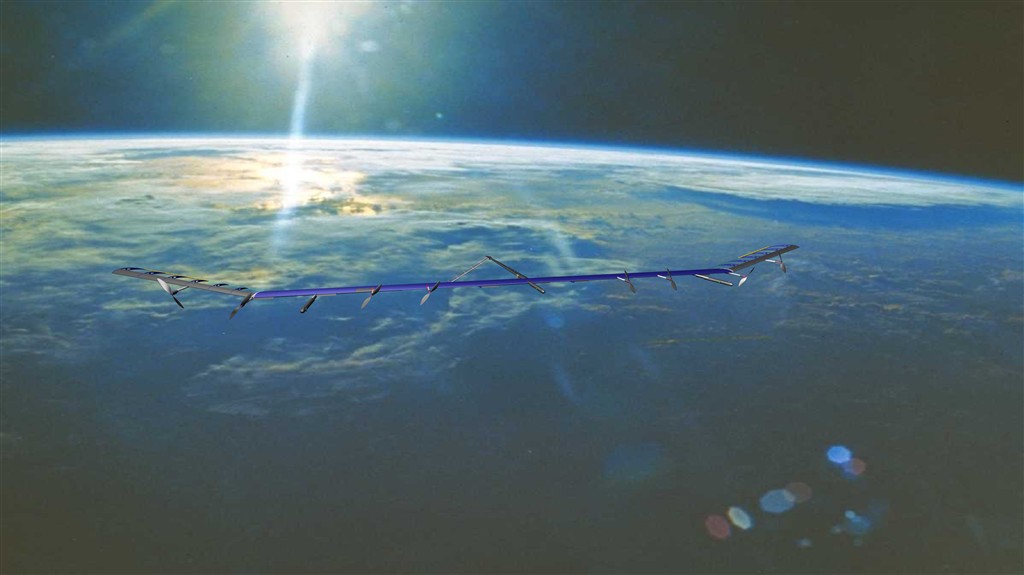
Phase 2 contract for Boeing/ QinetiQ’s SolarEagle. (Sept 15/10)
In April 2008, 3 teams received Phase 1 contracts to begin developing develop a radical new aircraft, under a US Defense Advanced Research Projects Agency (DARPA) program known as “Vulture.” DARPA’s goals for Vulture are not trivial: 5 years on station with a 450kg/ 1,000lb payload, 5kW of onboard power, and sufficient loiter speed to stay on station for 99% of the time against winds encountered at 60,000-90,000 feet.
So, what is the significance of a platform like that, who is competing, and what is happening now? Well, Phase 1 is done, and Phase 2 has been awarded.
* The Potential, and the Process
* The Designers & The Designs
* Contracts and Related Events [updated]
* Additional Readings
The Potential, and the Process
(click to view full)
If Vulture reaches its goals, it would become a very potent lower-cost alternative to the USA’s recently-canceled $20+ billion TSAT satellite program. The system could act as a substitute for communications relay or reconnaissance satellites, as long as the payload fit within the weight limit. Vulture would be more vulnerable to anti-aircraft missiles than a satellite, and could be targeted by fighter jets as well, given the right launch profile. On the other hand, that same relative closeness to the would improve sensor resolution and communications capability.
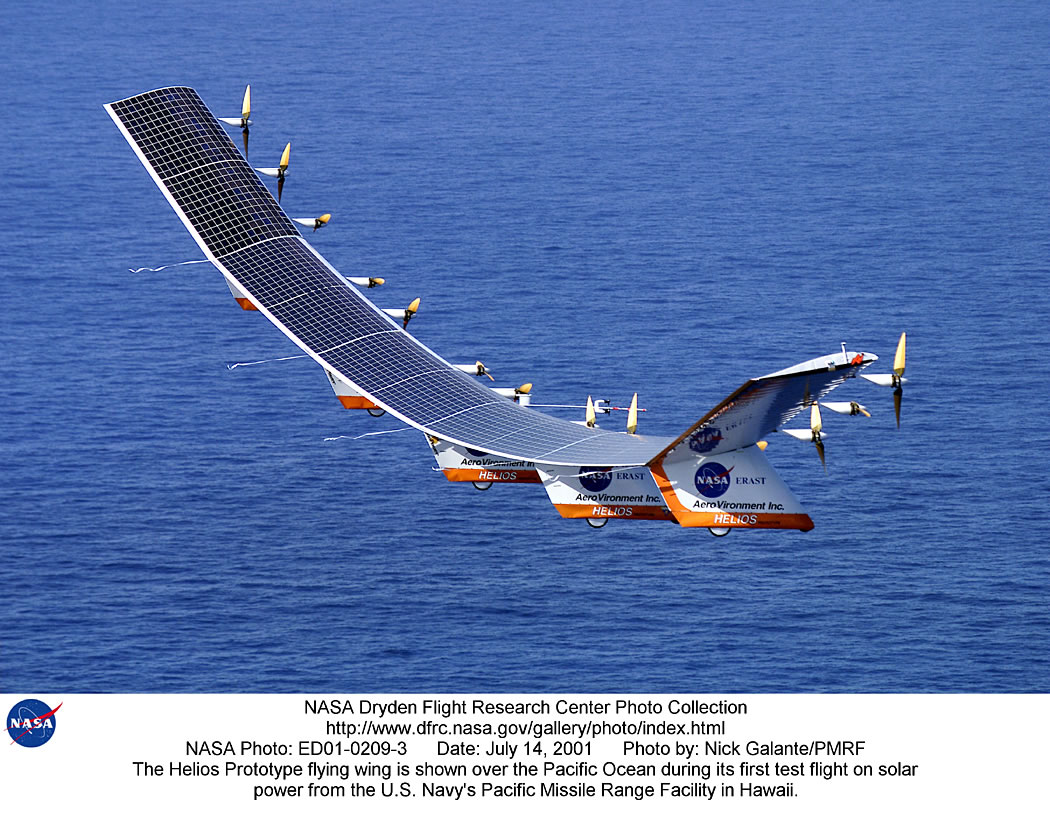
The engineering challenges ahead are formidable, as one would expect for a DARPA project. The power system in particular must be extremely reliable, and the aircraft’s materials will require advances of their own. The winning designs will be exposed to far more warming and cooling than satellites, and more ultraviolet radiation which will affect the aircraft’s materials. The design is also likely to require very large wings, both to help keep it aloft and to accommodate the number of solar cells required. Conditions at altitude can challenge the durability of those wings, especially with hydrogen storage tanks attached. Aerovironment’s Helios (1998-2003) demonstrated this the hard way in its 2003 crash.
DARPA projects aren’t like normal military system development projects, and have different goals. It is true that several breakthroughs will be required for complete success, but even 1-2 breakthroughs in areas like materials durability at 60,000-90,000 feet will deliver advantages that can be carried over to other programs – such as the High Altitude Airship.
During Vulture’s Phase 1 conceptual system definition (12 months, 2008-2009), the firms will define their aircraft, run formal reliability and mission success analysis, and blueprint full-scale and subscale demonstrators. Phase 1 concludes with a System Requirements Review, which has taken place. It was successful enough to initiate Phase 2.
The Phase 2 risk reduction development and testing phase (2009 – mid-2012) go-ahead would build and testing a subscale demonstrators capable of flying for 3 months, and would end with an uninterrupted 3-month system flight demonstration. Exit criteria will include:
* Execute a technology maturation roadmap that systemically reduces performance and reliability risks;
* Provide risk reduction through laboratory/field demonstrations of key major subsystems ability to achieve reliability/mission success objectives;
* Establish a Preliminary Design for the Objective System;
* Develop a detailed Full-Scale Demonstrator design that can be recovered and re-launched;
* Document and demonstrate flight airworthiness, and conduct a minimum of 30 days continuous flight demonstration, to include structural/ aeroelastic data and validation of software development design codes;
* Deliver/update proposed military utility analysis, CONOPS (CONcept of OPerationS), and a provide 5 year mission life cycle cost of the Objective System based on Phase II analysis and validations;
* Deliver/update the detailed development approach and Technology Maturation Plan necessary to achieve an operational system at the culmination of Phase II.
Phase 3 fabrication would involve a full-scale aircraft demonstrator capable of staying up for 12 months, a flight test for 12 uninterrupted months, and a program that reaches a Technology Readiness Level standard of TRL 6 overall. This would let Vulture enter System Design & Development as a program of record, if the military wished to field a design.
For the Vulture project, DARPA is supported by a government team including the US Air Force Research Laboratory and the National Aeronautics and Space Administration.
(click to view full)
DARPA contract winner Aurora Flight Science is involved in building Northrop Grumman’s high-altitude Global Hawk UAV, has worked on a “Mars Flyer”/ARES vehicle for NASA, and is also collaborating with Boeing and with General Dynamics on the hydrogen fuel cell powered, high altitude Orion HALL.
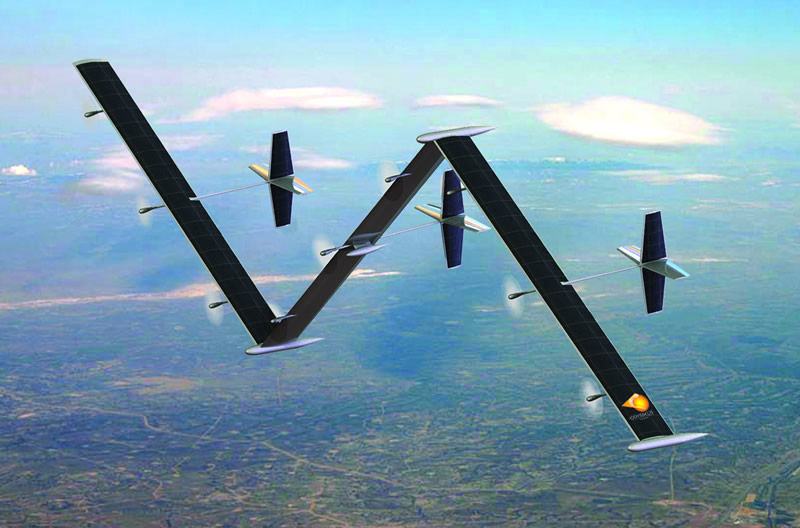
Aurora’s design is called “Odysseus,” using solar energy to power the aircraft during daylight, and stored solar energy to power the aircraft at night. Aurora’s Odysseus uses a “modular shuttling” approach, using 3 UAVs with 160 foot wingspans that can dock and separate in the air. This simplifies take-off and flight to altitude, while providing options if any of the 3 vehicles need to be recalled for maintenance or replaced. Solar power with fuel cells will keep Odysseus in the air, and the 3-vehicle design can go from a Z-shaped configuration to capture more of the day’s sunlight, to a straight wing configuration for low drag at night. See this 9 MB Flash movie for more.
Aurora’s teammates on the program include BAE Systems (payloads, sensors, and concept of operations and employment); C.S. Draper Laboratories (extremely high reliability electronics and control systems), and Sierra Nevada Corporation (specialist in autonomous refueling systems).
DARPA contract winner Boeing also has a varied team drawn from inside and outside the company. Boeing Integrated Defense Systems (IDS) Advanced Systems, IDS Space and Intelligence Systems, Boeing Spectrolab and Boeing Phantom Works are all involved. Their major partner is the British firm QinetiQ, whose solar-powered, carbon-fiber Zephyr high-altitude, long-endurance unmanned aerial system is currently flying under a joint British-American program. Other partners include Versa Power Systems and C.S. Draper Laboratories.
Zephyr is a an ultra-lightweight carbon-fibre aircraft with a wingspan of up to 18 meters/ 59 feet, but weighing just 30 kg/ 66 pounds. By day it flies on solar power generated by amorphous silicon arrays on the wings that are no thicker than sheets of paper. By night it is powered by rechargeable lithium-sulphur batteries that are recharged during the day using solar power. Many of its design approaches and technologies will be leveraged for Vulture, but the winning single-aircraft SolarEagle design is very different from Zephyr.
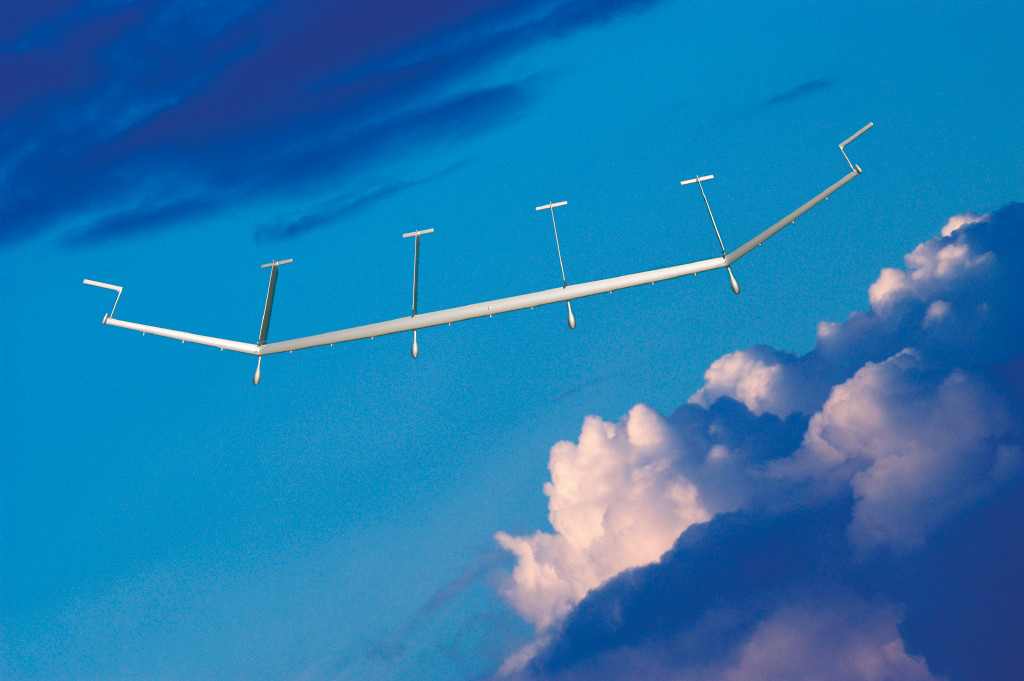
The third competitor was Lockheed Martin. Their solar-powered design is reportedly a single UAV over 300 feet long, with tails that rotate to collect the most sunlight and systems that capture photovoltaic energy from the Earth’s albedo. The power feeds electric ring motors, which can drive propellers directly at a distance without using heavy gearboxes. There are reports that their system will be launched from a lighter-than-air craft. Lockheed’s Vulture program manage Derek Bye is quoted as saying that says their Skunk Works is drawing on the satellite experience of Lockheed Space Systems business, which has to deal with even more extreme environmental and reliability challenges.
Other award competitors were not mentioned, but Aerovironment builds the hydrogen powered Global Observer with its 1 week flight times, and has considerable experience with very advanced high-altitude solar UAVs like the Pathfinder Plus and the record-setting Helios.
(click to view full)
Sept 15/10: Team Boeing receives an $89.3 million Vulture II “other transaction” contract for its “SolarEagle.” SolarEagle will make its first demonstration flight in 2014, and during testing, the SolarEagle demonstrator will remain in the upper atmosphere for 30 days, harvesting solar energy during the day to provide power through the night. The aircraft will have highly efficient electric motors and propellers and a high-aspect-ratio, 400-foot wing.
As noted above, QinetiQ and Versa Power are key team members. Work will be performed in Arlington, VA (5.28%); St. Louis, MO (2 locations, 39.26% and 46.68%); and Seattle, WA (8.78%). Work is expected to be complete by Feb 13/14 (HR0011-10-9-0010). DARPA [PDF] | Boeing.
July 23/10: Zephyr successfully lands after 14 days (336 hours and 21 minutes, launched July 9/10) flying over Yuma Proving Grounds, AZ and is now awaiting official confirmation of its world record status. If FAI confirms the feat as expected, Zephyr will have broken both the UAV and manned time aloft records.
The current title holder is Rutan’s manned Voyager at 216 hours, 3 minutes and 44 seconds (9 days), set in December 1986. Zephyr’s own 2008 record is 82 hours, 37 minutes, but the current official world record of 30 hours 24 minutes was set by Northrop Grumman’s RQ-4A Global Hawk on March 22/01. Longer Global Hawk flights have been held since, but record certification requires the presence and oversight of the Federation Aeronautique Internationale (FAI). At QinetiQ’s invitation and with customer permission, an FAI Official has been monitoring progress at the Yuma Proving Ground.
QinetiQ’s chief designer, Chris Kelleher said:
“The brand-new ‘production ready’ Zephyr airframe incorporates totally new approaches to aerodynamics, structures, propulsion, avionics, flight controls, power system management, thermal control, ground control station design and payload, as well as overall operating processes… We’ve also had to design for temperatures of around plus 40ºC on the ground to below minus 75ºC at altitude, ever changing weather systems including storms and high winds – and Zephyr took them all in its stride. It is a truly fantastic achievement.”
QinetiQ re: landing | mid-flight.

(click to view full)
Sept 19/09: DARPA offers a heads-up at FedBizOpps, regarding the next phase of the Vulture program. DARPA-SN-09-41: Vulture II Special Notice:
“DARPA intends to release a BAA entitled “Vulture II” for Phase II of the Vulture program in October 2009… The Vulture II program is budgeted at $155M total. This budget must support all performer costs including test range and government test facility costs. Performer tasks are envisioned to include risk reduction of key components, subsystems and systems; material identification and characterization; detail design, manufacturing and flight test of a full scale platform to demonstrate structural integrity, thorough understanding of aeroelastic and flight controls attributes and other critical function and capability of all elements of the Vulture II program…”
DARPA expects solar/ electric motor propulsion solutions, but will consider other approaches except radioactive energy sources or lighter-than-air configurations. Aviation Week reports that Vulture had been expected to progress before now, but Aurora threatened to protest when it was not selected, and DARPA decided to re-open Phase 2 to competition. See also DARPA specifications document [PDF] | Aviation Week.
May 14/09: QinetiQ, Inc. in Arlington, VA wins a $44.9 contract for 7 Zephyr UAVs and 1 ground station (N68335-09-C-0194) – but this is not a DARPA contract. Read “NAVAIR Orders 7 Zephyr Ultra-Long Endurance UAVs” for more.
July 28-31/08: Zephyr breaks a world record with an 82 hour, 37 minute flight from Yuma Proving Grounds, AZ. Despite lift-sapping temperatures of up to 45 C/ 113 , Zephyr was flown on autopilot and via satellite communications to a maximum altitude of more than 60,000 feet. The trial included a military utility assessment of a US Government communications payload.
The US DoD funded the demonstration flight under the Joint Capability Technology Demonstration (JCTD) program with the UK’s Ministry of Defence. JCTD projects are specially tailored to meet the needs of US combatant commands, and Zephyr is supported by USCENTCOM along with the Office of Secretary of Defense (OSD) for Advanced Systems and Concepts (AS&C) and the US Army Space and Missile Defense Command (SMDC). Qinetiq release.
April 21/08: Lockheed Martin is the 3rd firm to receive funding under the Vulture program. DARPA release [PDF]
April 21/08: Boeing announces a $3.8 million contract for Phase 1 of DARPA’s Vulture program. See above for details.
April 14/08: Aurora Flight Sciences announces an unspecified contract under DARPA’s Vulture program. See above for details. On April 23/08, AFS releases more information, revealing its Odysseus to be a 3-part vehicle rather than the single aircraft referenced in its earlier release.
Sept 10/07: QinetiQ’s Zephyr High Altitude Long Endurance (HALE) Unmanned Aerial Vehicle (UAV) breaks the official world record time for the longest duration unmanned flight, soaring for 54 hours to a maximum altitude of 58,355 feet over White Sands Missile Range in New Mexico. The current official FAI world record for unmanned flight was set by Northrop Grumman’s RQ-4A Global Hawk on March 22/01 at 30 hours 24 minutes – and since no FAI officials were present at White Sands, that record may stand.
New technologies tested on this Zephyr flight included solar arrays supplied by United Solar Ovonic, a full flight-set of Sion Power batteries, and a novel solar-charger and bespoke autopilot developed by QinetiQ. QinetiQ release.
* DARPA TTO – Vulture. See also the May 16/07 FedBizOpps solicitation #SN07-38 and Sept 19/09 FedBizOpps Special Notice.
* QinetiQ – High altitude long endurance UAV – Zephyr
* Aurora Flight Sciences – Odysseus media gallery released
* Aviation Week Ares (April 30/08) – And Then There Were Three – Lockheed Unveils its Vulture UAV
* GizMag (April 23/08) – DARPA advances plans for five year non-stop flying machine
* Flight International (March 3/08) – DARPA pushes limits of unmanned aircraft capability to extremes
* US Dept. of Energy (Sept 8/04) – NASA Releases Report on Crash of Helios Solar Plane