Aging Array of American Aircraft Attracting Attention

B-52H: to 2030?
(click to view full)
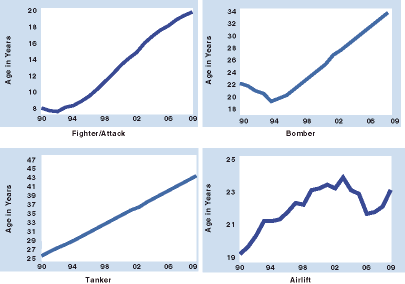
The current US Air Force fleet, whose planes are more than 26 years old on average, is the oldest in USAF history. It won’t keep that title for very long. Many transport aircraft and aerial refueling tankers are more than 40 years old – and under current plans, some may be as many as 70-80 years old before they retire. Since the price for next-generation planes has risen faster than inflation, average aircraft age will climb even if the US military gets every plane it asks for in its future plans. Nor is the USA the only country facing this problem.
As this dynamic plays out and average age continues to rise, addressing the issues related to aging aircraft becomes more and more important in order to maintain acceptable force numbers, readiness levels, and aircraft maintainability; avoid squeezing out recapitalization budgets; handle personnel turnover that becomes more and more damaging; and keep maintenance costs in line, despite new technical problems that will present unforeseen difficulties. Like F-15 fighters that are under flight restrictions due to structural fatigue concerns – or grounded entirely.
The biggest contracts aren’t always the ones deserving of the most attention. Enter the USA’s Joint Council on Aging Aircraft (JCAA), and initiatives like the Navy’s ASLS. Enter, too, DID’s Spotlight article. It seeks to place the situation and its effects in perspective, via background, contracts, and a research trove of articles that tap the expertise and observations of outside parties and senior sources within the US military.
Contracts & Key Events
Unless otherwise specified, the Naval Air Warfare Center Aircraft Division in Patuxent River, MD manages these contracts.
FY 2010 – 2015
Older than my pilot…
(click to view full)
September 15/15:Boeing is
expected to market a set of F-15 modifications capable of equipping the jet with sixteen air-to-air missiles at the Air Force Association conference in Maryland next week. The plans are yet to be outlined fully by the company, which would double the carrying capacity of the F-15 from the current eight missiles and allow the aging design to remain operational potent, given the potential pairing of the
AIM-120D medium-range missile with the aircraft’s
Active Electronically Scanned Array radar system.
Jan 16/13: BAE Aerospace Solutions in Fort Walton Beach, FL announces a $25 million USAF contract for its web-based AVCOM (Advanced Component Obsolescence Management) system that tracks and forecasts obsolete parts. It’s a 1 year contract, with a 1-year option.
AVCOM’s database holds 100 million parts for aircraft, weapon systems, and a range of electronics and equipment The system is touted as being able to forecast when a part will become obsolete or too expensive, and then find suitable replacements from across the marketplace.
Work will be managed at the Fort Walton Beach, FL facility, with additional work at Hill AFB, UT; Tinker AFB, OK; and Robins AFB, GA.
Sept 27/12: BAE Systems Technology Solutions and Services in Rockville, MD receives a $95 million indefinite-delivery/ indefinite-quantity contract to exercise an option for engineering, analytical and manufacturing services in support of the Aging Aircraft Program. Funds will be obligated on individual task orders as they are issued.
Work will be performed in Rockville, MD (20%) and various locations throughout the United States (80%), and is expected to be complete in September 2013. US Naval Air Systems Command in Patuxent River, MD issued the contract (N00421-06-D-0038).
Sept 26/12: F-15 Eagle Extensions? Boeing’s F-15 mission systems director Brad Jones says that the USAF has been pushing to delay fleet retirements, and has asked Boeing for help with estimates of what might be possible. The fighters’ original design service life was 8,000 flight-hours, and the most-used F-15s have flown more than 10,000 hours.
Jones says that Boeing is working on full-scale fatigue test certifications, based on structural fatigue improvements, that could to push F-15C/D models to 18,000 equivalent flight hours (EFHs) and F-15E models to 32,000 EHFs. This is an ambitious target, to say the least. Many USAF F-15s are currently under peacetime maneuver limitations, and see the Nov 3/07 entry re: the F-15 that broke in two during its flight, grounding the F-15A-D fleet. A number of assumptions need to become clearer before the usefulness of these efforts can be fully assessed by outside observers, and a model isn’t that same thing as real world performance. With so few F-22As in service, and budget crunches coming, the USAF may feel that it has little choice. Defense Tech.
Sept 26/11: BAE Systems Technology Solutions and Services in Rockville, MD receives a $92 million indefinite-delivery/ indefinite-quantity contract modification from the US Navy, exercising an option for engineering, analytical, and manufacturing services to support “various aging aircraft.”
Work will be performed in various locations throughout the United States (80%) and Rockville, MD (20%), and is expected to be complete in September 2012. No funds will be obligated at time of award, they will be committed as needed. US Naval Air Systems Command in Patuxent River, MD manages this contract (N00421-06-D-0038).
May 26/10: Rust never sleeps. DoD Buzz reports a quote from the US House Armed Services Committee, in its FY 2011 budget proposal:
“The Committee notes that it has yet to receive the congressionally directed report from the Director of Corrosion Policy and Oversight assessing the corrosion control lessons learned from the F-22 Raptor fleet – which was grounded in February 2010 for corrosion on ejection seat rods due to poorly designed drainage in the cockpit – as they apply to the F-35 Joint Strike Fighter program.”
As DoD Buzz notes:
“Regardless of how lowly rust might seem at first glance, it is a huge problem for the military, costing about $20 billion each year. According to the House Armed Services Committee, roughly $7 billion of that rust is preventable. So, the committee… wants to substantially increase the budget of a little known Pentagon entity, the Office of Corrosion Policy and Oversight… to… $10.8 million, up from a tiny request of $3.6 million.”
FY 2004 – 2009
Me too…
(click to view full)
Sept 18/09: BAE Systems Technology Solutions and Services in Rockville, MD received a $76 million modification to a previously awarded indefinite-delivery/ indefinite-quantity contract from the US Navy, exercising an option for engineering, analytical and manufacturing services to support various aging aircraft.
Work will be performed in Rockville, MD (20%) and in various locations throughout the United States (80%), and is expected to be complete in September 2010. The Naval Air Systems Command in Patuxent River, MD manages this contract (N00421-06-D-0038).
June 8/09: L-3 Communications’ Command & Control Systems and Software division announces a follow-on contract from the U.S. Navy to support its Aircraft Structural Life Surveillance (ASLS) program. This 5-year contract consists of a base year plus 4 option years, with a total contract value of $47.8 million. L-3 will provide engineering and information services under this contract to manage the structural lives of the Navy’s fixed and rotary wing aircraft.
The ASLS program is responsible for administering the US Navy’s Structural Appraisal of Fatigue Effects (SAFE) program, whose mission is to collect, process, and report fleet-wide individual aircraft/ component structural usage and fatigue life information for U.S. Navy aircraft. SAFE findings are used to support aircraft retirement, acquisition, modification, and maintenance decisions. L-3 C2S2 President John Medea adds that
“The monitoring of aircraft service life limits is increasingly significant as requirements for long-term operational usage often exceed planned service life… This program supports the Navy’s objective to further implement an aggressive service life management plan…”
Oct 31/08: BAE Systems Technology Solutions and Services in Rockville, MD received a $55 million modification to a previously awarded indefinite-delivery/ indefinite-quantity contract (N00421-06-D-0038). It exercises an option for engineering, analytical and manufacturing to support aging aircraft.
Work will be performed in various locations throughout the United States (80%) and Rockville, MD (20%), and is expected to be complete in September 2009. The Naval Air Systems Command in Patuxent River, MD issued the contract.
Aug 4/08: Wyle Laboratories, Inc. in Huntsville, AL receives a $9.5 million modification to a previously awarded cost-plus-fixed-fee, cost-plus-award-fee, firm-fixed-price contract (N00421-04-C-0121). It exercises an option for engineering and technical services in support of the Aging Aircraft Team and Joint Council on Aging Aircraft. Work will be performed in Lexington Park, MD, and is expected to be complete in August 2009. Contract funds in the amount of $154,000 will expire at the end of the current fiscal year.
Nov 3/07: Following the crash of a Missouri Air National Guard F-15C aircraft Nov 2/07, the US Air Force suspends non-mission critical F-15 flight operations. The accident findings indicate a structural failure that caused the plane to break in two during flight, as the front fuselage separated from the tail section. Japan follows suit, grounding its F-15Js and leaving Vietnam-era F-4 Phantom IIs as its primary air defense aircraft. Israel follows by grounding its F-15A-D/I fleet, too, as the effects widen.
In the end, the entire American F-15 A-D fleet was down for 2 months, about 1/3 of the American fleet remains grounded indefinitely, and serious rethinking is underway concerning a fighter fleet that was expected to last into 2025. DID: “Aging Aircraft: USAF F-15 Fleet Grounded.”
Aug 6/07: Wyle Laboratories, Inc. in Huntsville, AL received a $9.2 million modification to a previously awarded firm-fixed-price, cost-plus-fixed-fee, cost-plus-award-fee contract (N00421-04-C-0121) to exercise an option for engineering and technical services in support of the Aging Aircraft Team and Joint Council on Aging Aircraft. Work will be performed in Lexington Park, MD and is expected to be complete in August 2008. Contract funds in the amount of $120,000 will expire at the end of the current fiscal year. The Naval Air Warfare Center Aircraft Division, Patuxent River, Md., is the contracting activity.
July 14/05: Wyle Laboratories Inc. in Huntsville, AL received an $8.5 million modification to a previously awarded firm-fixed-price, cost-plus-fixed-fee, cost-plus-award-fee contract (N00421-04-C-0121) to exercise an option for engineering and technical services in support of the Aging Aircraft Team and Joint Council on Aging Aircraft (JCAA). Work on this contract will be performed in Lexington Park, MD and is expected to be completed in August 2006. Contract funds in the amount of $800,000 will expire at the end of the current fiscal year.
Aug 3/04: Advanced Information Engineering Services (AI-ES) in Buffalo, NY received an $8.3 million ceiling-priced, firm-fixed-price, cost-plus-fixed-fee, cost-plus-award-fee contract to provide engineering and technical services in support of the Aging Aircraft Team and Joint Council on Aging Aircraft. Work will be performed in Lexington Park, MD and is expected to be complete in August 2005. Contract funds in the amount of $800,000 will expire at the end of the current fiscal year. This contract was competitively procured by a request for proposals and 4 offers were received by the Naval Air Systems Command in Patuxent River, MD (N00421-04-C-0121).
Appendix: The JCAA
USA: Avg. Aircraft Age
(click to view full)
The JCAA was a collaborative effort established in the 2000s by the Navy, Marine Corps, Air Force, Army, Coast Guard, Defense Logistics Agency, Federal Aviation Administration (FAA), NASA and academia. The mission of the JCAA was to identify, investigate and implement programs that would field products to improve the availability and affordability of all the services’ and agencies’ aging systems, and get fixes to the forces faster.
To that end, they worked on identifying process improvements, advocate and enable promising technology, help the transition of technology and other program opportunities, promote knowledge management, and coordinate funding for promising solutions.
But this effort aged even more quickly than the aircraft it was meant to help maintain, and when funding from the services dried up, the organization was dissolved.
Aging Aircraft: Some Additional Readings
* DID Spotlight – You Can Track Your F-35s, At ALIS’ Maintenance Hub. Does the F-35 program offer a way out of the dilemma for future aircraft?
* DID Spotlight (begins Nov 2007) – Aging Aircraft: USAF F-15 Fleet Grounded. The result of a crash that revealed a structural flaw. Israel and Japan also grounded their F-15 A-D fleets, and the USAF’s grounding was lifted pending inspections, then re-imposed. A good illustration of the hazards inherent in dependence on aging aircraft fleets. Also includes details re: the USAF’s F-15 flight restrictions, which applied even before the crash.
* DID – Aging Aircraft: Cracks in USA’s F/A-18 fleet.
* DID – US P-3 Recovery Plan Tries to Keep the Fleet in the Air
* DID Spotlight – Coroner Delivers Scathing Indictment of UK Nimrod Fleet, Procedures. On Sept 3/06, a British Nimrod patrol jet exploded in mid-air over Afghanistan, following an aerial refueling. Subsequent reports cast the potential problems with aging aircraft in a stark and serious light.
* DoD Buzz (Aug 20/14) – F-16 Grounding Highlights Need for Upgrades.
* USAF (Aug 19/14) – 82 F-16Ds removed from flight status due to longeron cracks.
* Associated Press (Nov 4/12) – Inside the geriatric unit: US Air Force struggles to keep aging aircraft flying
* The Australian (Sept 28/12) – Alert over ageing Hornets as structural fatigue hits fleet. Annual maintenance cost for Australia’s fleet of 71 F/A-18A/Bs was A$118 million in 2001, A$ 170 million in 2012, and is expected to be A$ 214 million by 2018. Meanwhile, 62/71 fighters had “structure fatigue above that expected for the airframe hours”.
* Wall St. Journal (Sept 15/11) – ‘Geriatric’ U.S. Arsenal Needs Expensive Face-Lift. May be subscriber content. See also For the Common Defense | Commentary magazine.
* Aviation Week (Sept 15/09) – USAF Worries About Refueler Repair Costs “…maintenance crews sometimes work 7 hr. for every hour of KC-135 flight… When you get out to about 2018 and 2020, what started out as about $2 billion a year to maintain the KC-135 fleet goes all the way up to $6 billion… In total, aging-related costs are expected to add at least $17.8 billion to the price of maintaining the KC-135 for 40 years.”
* Us GAO (June 1/09, #GAO-09-732R) – Defense Management: Observations on DOD’s Fiscal Year 2010 Budget Request for Corrosion Prevention and Control
* USAF (Oct 3/08) – Inspections ordered for A-10 Thunderbolt IIs. The USAF is requiring them for over 130 A-10s, due to an increasing number of wing cracks found in combat aircraft. Fortunately for the USAF, a re-winging program was already underway for the fleet. January 2009 update.
* Reuters (Oct 15/08) – US Air Force eyes fighter cuts to boost modernization. While cutting maintenance. The fallout can be found in fighter pilot re-enlistments… F-16 pilots often go into the reserves, but the USAF is cutting the reserve fleet and transitioning people to fly Predator family UAVs. F-16 pilots appear to be taking the hint. See StrategyPage: “Pilots Love the F-15E, and Leave the F-22” for rates, and “Reservists Get Screwed By Robots.”
* Gannett’s Navy Times (Aug 24/08) – Navy: Aging P-3s safe despite mishaps. “But despite a steady uptick in mishaps, and the December grounding of 39 P-3s because of fears that wing sections could break off in flight, Navy and civilian officials insist the Orion is still safe to fly.” See accompanying DID article re: the P-3 recovery plan.
* Flight International (Aug 4/08) – US Navy discloses three-year, 36-aircraft buy for P-8A. “The US Navy clarified today that it will order 36 Boeing P-8A Poseidons during the first three years of production, perhaps further opening the door to accelerating the in-service date by one year… An airframe fatigue crisis facing the Lockheed P-3 Orion fleet has recently forced NAVAIR to publicly consider accepting Boeing’s offer to accelerate deliveries.”
* USAF (July 30/08) – B-52H reaches retirement. But others are expected to soldier on past 2020. “The B-52H with tail number LA1023 was built in 1961… It is the first of 18 B-52Hs selected by Air Combat Command to retire. Every two weeks a B-52H will be retired, alternating between here and the 2nd BW in an effort to maximize funding for the aging assets. “It is easier and cheaper to modify and maintain 76 planes, than to keep all 94 up and running,” said Master Sgt. Curtis Jensen, 5th Aircraft Maintenance Squadron production superintendent.”
* Government Executive Magazine (March 21/08) – Wear and tear adds up on military aircraft. “In my 10 years with the F-15, the cost per flying hour has doubled,” Harris said. In fact, the cost per flight hour has climbed for every one of the 14 major aircraft types in continuous service since the 1980s (a trend aggravated by rising oil prices). All 14 have lower readiness rates than they did in 1991.”
* USAF (Nov 6/07) – Aging C-130s: the geriatric fleet. “One, affectionately known as “grandpa,” was built in 1961 and another was awarded an honorary Purple Heart for sustaining multiple mortar hits and ground fire during the Vietnam War… “Due to the age of the aircraft we have a lot of electrical problems and cabin pressure problems… Old wires rub together and short out causing system malfunctions and component failures.”… “There are some jobs which take a long time to work”… “Due to different modifications the aircraft has had over the years the wiring diagrams get confusing.” …changing the same parts multiple times takes a toll on equipment mounting points. “Parts stop fitting like they should…”
* Deutsche Welle (Nov 6/07) – Report: Half of Germany’s Military Planes are in Shambles. “…corrosion and wear and tear have turned over half of Germany’s [C-160] Transall planes into decrepit machinery. The sources apparently said that it was becoming more difficult to locate spare parts for the planes, some of which are more than 40 years old… Germany had originally planned to replace the remaining Transall planes with Airbus’ new A400M model by 2014, but that schedule may have to be revised due to recently announced delays in delivery.”
* Government Executive (Oct 31/07) – Air Force Gen. T. Michael Moseley Transcript: Part One | Part Two. Mosley is the USAF Chief of Staff. The interview covers the USAF generally, but aging aircraft figure in discussions at several points.
* Defense News (Oct 29/07) – Airplanes on Life Support. Moseley, Wynne Plead: Let USAF Pull the Plug. They’re talking about aircraft that can’t fly but must be kept per Congressional directives, which includes a number of C-130E Hercules and KC-135E Stratotankers. “One C-130E Hercules from the 86th Airlift Wing at Ramstein Air Base, Germany, is so old and in such bad shape it cannot safely fly. Yet U.S. Air Force maintainers must tow it around the tarmac every so often to make sure its tires don’t go flat, and crank up the engines every month to make sure they still run… More than 20 percent of the service’s C-130Es are grounded or have significant flight restrictions…”
* USAF Association, Air Force Magazine (Sept 21/07) – Warning: USAF is “Going Out of Business” Quote: “Air Force Secretary Michael Wynne], speaking at a Washington think tank Sept. 19, said that the service’s stay-within-its-topline bootstrap approach isn’t arresting the aging aircraft problem, and the inventory age is still rising, from 23.9 years today to 26.5 years by 2012. The Air Force’s older fighters aren’t up to defeating a modern air defense system or modern foreign fighters, Wynne said…”
* Omaha World-Herald (May 15/07) – Air Force says wars strain resources. Gen. Ronald Keys, chief of the Air Combat Command, added more detail: “They do a great job keeping these planes flying, but the challenge with this kind of operational tempo is we don’t yet know what kind of toll all the fine dust (in Iraq) will take on all the connectors and parts in our airplanes… When we fly these long missions in hot climates, you can get a kind of chronic heat effect on the pieces and parts of the aircraft.”
* DID (April 4/07) – Keeping the C-130s Flying: Center Wing Box Replacements
* DID (Nov 21/06) – Aging Aircraft Redux: Seapower on US Navy & USMC Fleets
* Australian Parliamentary Joint Standing Committee On Foreign Affairs, Defence And Trade Defence Subcommittee: Australian Defence Force Regional Air Superiority panel Q&A (July 5/06) – Ipswich session, near RAAF Amberly…. RAAF Amberley is the F-111s’ base. A very interesting look at the elements required to maintain aging aircraft whose original suppliers are no longer making those parts – an issue that’s highly relevant around the world as global military aircraft fleets age.
* US Air Force Association Policy Forum, Air & Space Conference and Technology Exposition 2005. (Sept 13/05) – National Security Policy Forum on Tactical Air Features Dr. Michael E. O’Hanlon of The Brookings Institution and Dr. Rebecca Grant, President of IRIS Independent Research.
* via D-N-I: Inside The Pentagon (Sept 1/05) – As Tenure Ends, Jumper Is Most Troubled By Aging Aircraft Fleet. “At 23 years of age, our aircraft are older than we have ever seen in our United States Air Force, Jumper said… And we’re dealing with issues that we have never had to deal with before in corrosion, in skin replacement, in frayed electrical wiring, in unanticipated component failures… “Even with planned aircraft procurement, this average age is expected to increase to 29 years by the year 2013,” Roche said in a speech at the same 2003 conference. “That’s assuming our programs stay on track.”
* DID (Aug 24/05) – Follow-Up: Rear Adm. Michael L. Holmes on The USA’s P-3C Force
* GovExec.com (Aug 1/05) – From the Ground Up. Deals with some of the challenges new USAF Chief of Staff Gen. T. Michael “Buzz” Moseley faces as he takes over from Gen. Jumper. See also the article’s Aging Aircraft table.
* Air Force Magazine, Washington Watch (May 2005) – Jumper Pushes Recapitalization. A very wide-ranging article, which comes at the end of Gen. Jumper’s term and so forms something of a wrap-up.
* USAF Materiel Command (Nov 10/05) – Every plane part counts: Oklahoma City Air Logistics Center ensures efficiency and safety of KC-135 Stratotanker boom. Note esp. this line: “[Work leader Carter] Haynes, who began working on booms as an enlisted member in 1970 and has been at Tinker since 1997, said he “really feels at home with the [KC-135] boom,” and is proud that he can continue to offer his expertise in supporting warfighters across the globe.” Exactly the kind of person who is both critical to maintaining aging equipment, and easy to lose for reasons of age and outside opportunities.
* StrategyPage (April 17/05): C-17s Being Worked to Death. General Jumper used almost this exact phrase in an April 2002 Air Force Magazine article.
* Airborne Combat Engineer Blog (Apr 16/05) – Pope AFB down to 6 fully capable C-130s
* StrategyPage (Feb 20/05) – Transport & Tanker Sortie Rates Spiraling. Afghanistan in particular has spiked them.
* StrategyPage (Dec 17/05) – KC-135s Go Multi-Role. Personnel transport and even communications relay are increasingly being folded in to their missions, in addition to their primary role as air tankers.
* StrategyPage (Oct 5/04) – Re-engining the E-8 JSTARS. the Joint STARS is a 707-based aircraft that uses powerful radars to keep track of movements on the ground.
* Strategy Page (Sept 26/04) – USAF Removes 29 KC-135s from Service Due to Metal Fatigue. KC-135s are also 707-based aircraft.
* Reuters (Feb 13/04) – McCain prods US Air Force to explain doctored data. Data was re: corrosion levels on KC-135s, which appear to have been overstated.
* USAF, AFFTC Public Affairs (Jan 22/03) – B-52 launches Avionics Midlife Improvement program. Describes the $260 million AMI program, and also explains some of the looming maintenance and supply problems facing the US B-52 fleet as a result of its age.
* US Congressional Budget Office (January 2003) – The Long Term Implications of Current Defense Plans [PDF format]
* Air Force Magazine (January 2003) – When Aircraft Get Old. Excellent article that underscores the full breadth of challenges facing the USAF. Most serous: flaws relating to aging aircraft can pop up without warning, as they did with an F-15C Eagle in a fatal 2007 crash. When they do, whole fleets of that type can be grounded until the problem is identified and fixed.
* Air Force Magazine (January 2003) – The Force Seeks a New Baseline. Discussions with General Jumper.
* Air Force Magazine (April 2002): The Strength of the Force. Direct commentary from a number of top-ranking USAF Generals on a variety of subjects, from aging aircraft to various components of the USAF force structre to new programs like the F-22 and F-35.
* Naval Aviation News (July/Aug 2002) – The war on aging aircraft: one battle down, many to go
* US Air Force Confirmation Hearing, Washington, DC (Aug 1/01) – General John P. Jumper Written Opening Statement for [USAF] Chief of Staff
* U.S. Government Accountability Office, Report # GAO-01-163 (Feb 9/01) – Tactical Aircraft Modernization Plans Will Not Reduce Average Age Of Aircraft [Abstract | PDF format| Google cache]. Based on assumptions from this late 1990s plan. Note that some of the procurements from that 1990s plan have since been cut, which will intensify the problem.
* US DoD Advanced Materials and Processes Technology Information Analysis Center newsletter (Winter 2001) – Aging Aircraft Special Issue [PDF file, 2.5 MB]. A wealth of useful technical background that goes a bit beyond standard coverage of the issues.
* Frank C. Spinney, Defense and the National Interest (Nov 8/00) – The Defense Death Spiral (PPT Presentation, in HTML format)
* Airpower Magazine (April-June 1998) – Col Alexander P. Shine: Theater Airlift 2010