Advertisement

Apache Block III Program: The Once and Future Attack Helicopter

Related Stories: Americas - USA, Asia - India, Avionics, Boeing, Contracts - Awards, Electronics - General, FOCUS Articles, Helicopters & Rotary, IT - Software & Integration, Lockheed Martin, New Systems Tech, Northrop-Grumman, Radars, Rumours, Signals Radio & Wireless, Support Functions - Other
Advertisement
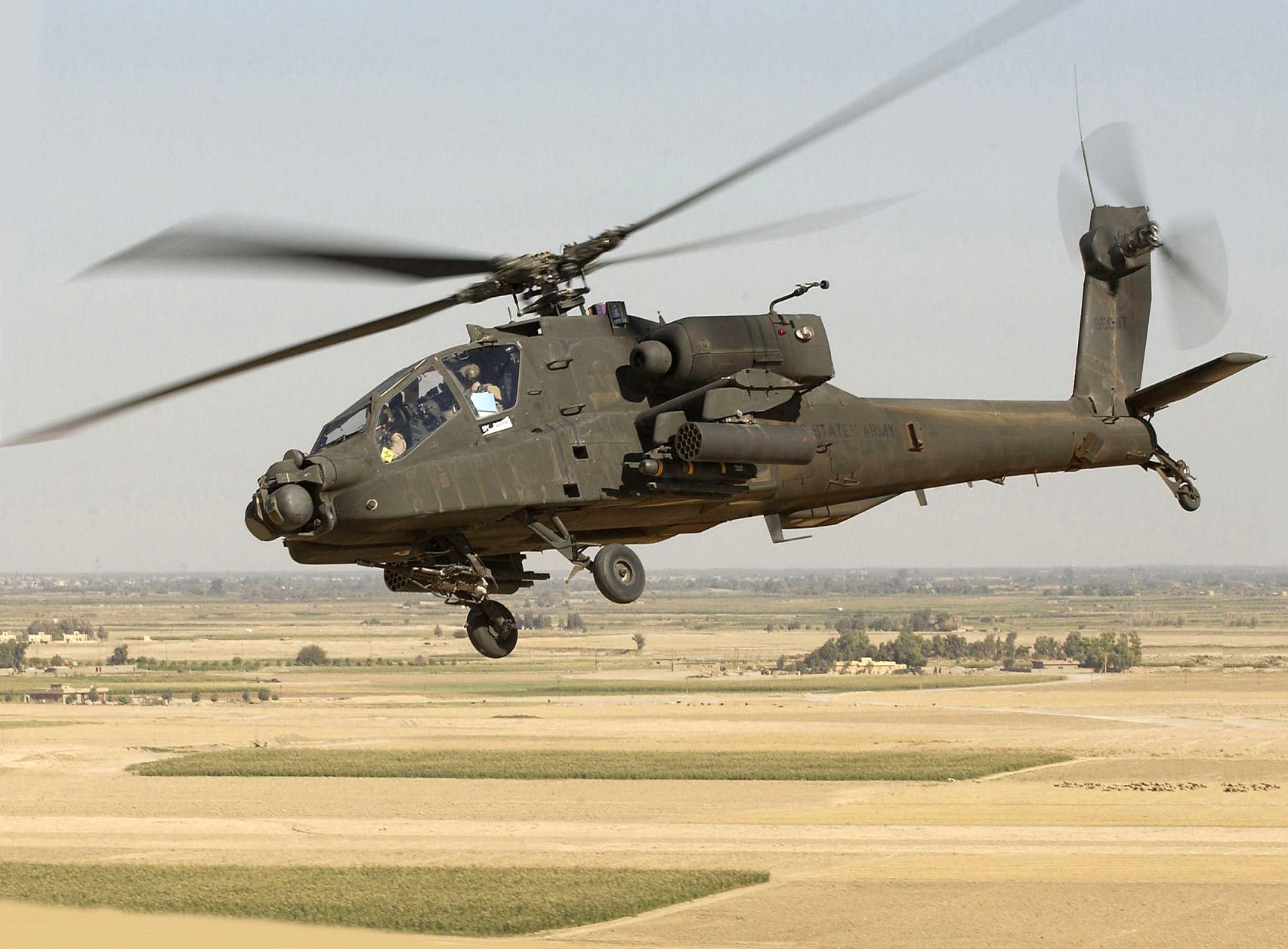
AH-64D helos Afghanistan
AH-64 in Afghanistan
(click to view full)
DII

$181M for Taiwan, US radars & UAV controllers; Conversion training. (Dec 30/11)

With the collapse of the RAH-66 Comanche program, and rededication of its funding into the Armed Reconnaissance Helicopter (ARH) and Light Utility Helicopter (LUH), and other programs, the AH-64 Apache will remain the USA’s primary attack helicopter for several more decades.

Overall, AH-64D Longbow Block III improvements incorporate 25 technology insertions as part of the Army’s future force plan. On July 14/06, Boeing and U.S. Army officials signed a $619.3 million contract for Block III upgrades to the current and future Apache fleet, via a virtual signing ceremony held in Washington, DC; Huntsville, AL; and Mesa, AZ. Previously signed and executed contracts for risk reduction engineering work were collectively valued at another $66.1 million, and there had also been some advance ordering and development of components like radar units.

So… how many helicopters will be modified under the AH-64 Block III program, what do these modifications include, how is the program structured, and what has been happening since that award?

The AH-64 Apache Program: Sunset, Sunrise

AH-64D Sunset
No sunset yet.

Delivery of the first production Block III Apache is scheduled for October 2011, following the completion of current Apache production work that has been ongoing in Mesa, AZ since the program’s inception in the early 1980s.

Of the 937 AH-64As built, 821 were built for US Army, and over 500 of those were remanufactured from those AH-64As to AH-64D status over a 10-year period, under 2 multi-year contracts that ran for 5 years each. These helicopters received equipment upgrades, and were also rebuilt to “zero flight hours” condition.

  • 284 helicopters were fielded as AH-64D Block Is. The first multi-year remanufacture contract was for 232 helicopters, and covered Lots I-V. The Lot VI helicopters from the 2nd multi-year contract were also built to the AH-64D Block I standard, which included the “Longbow” radar mast, compatible dual-mode Hellfire II missile capability, updated self-protection suites, and better cockpit displays.
  • Another 217 helicopters in Lots VII-X built AH-64As to the AH-64D Block II standard, which adds improved electronics and software to include the “Longbow” radar mast, compatible dual-mode Hellfire II missile capability, color cockpit displays including moving digital maps, and even more up to date self-protection suites. All were built during the 2nd multi-year contract period, which covered 269 Block I and Block II helicopters in total.
  • The lateness of the JTRS radio program, and other issues, have delayed the future Block III model, and so January 2007 saw a contract to convert another 96 American AH-64As to the AH-64D “Extended Block II” standard, followed by additional contracts for Extended Block II+, where the plus simply indicates that “we’re still producing this model, past our expected schedule”. Boeing has received orders for 278 of these so far: 117 for the Army, 95 for the National Guard, and 66 War Replacement helicopters. In 2013, this production line is expected to switch to Block IIIs.

The US Army aims to upgrade all of the current Block I and II Apaches, their 68 wartime loss replacements, and the additional AH-64 Extended Block II/+ helicopters, to Block III status by 2020.

This will be accomplished through a second re-manufacture program for 639 machines. There will also be new-build production of 57 helicopters, to reach the current US Army program goal of 690.

Observant readers will note that adding up all of the above cohorts makes 779 AH-64Ds produced (284 + 217 + 278). Note that the 66 war replacement helicopters are effectively counted twice, so that’s 713 left. 713 – 690 = 23 unconverted AH-64Ds for whatever reason, be it unreplaced losses or budgets. The Block III program will also manufacture 56 new-build helicopters that won’t be converted. Barring further losses, that leaves up to 79 Block IIs in the US Army fleet after the program ends.

International AH-64D Block III sales are expected to be a combination of re-manufacture and new-build orders, depending on whether the countries in question already field AH-64s, and how large they want their fleet to be.

The AH-64D Block III

(click for video)

The Apache Block III incorporates 26 new technologies designed to enhance the aircraft’s capabilities.

One set of advances are tied to helicopter’s flight performance. They include enhanced -701D engines with improved digital electronic control (DEC); upgraded drive systems including a a split-torque face gear transmission, which increases power throughput by more than 20% (to 3,400 shp) without taking up more room; and a new composite rotor blade. The new composite rotor blades, which successfully completed flight testing in May 2004, work with the improved engines to increase the Apache’s cruise speed, climb rate and payload. Pilots in pre-training have noticed the additional power very quickly.

Overall, the front-line payoff is a higher hover ceiling altitude, at greater gross weight, on a 95 degrees Fahrenheit day. That’s very useful in places like Afghanistan, Iraq, etc. The new avionics will also help, by allowing the new Block III helicopters to fly in clouds and inclement weather that would have grounded earlier models.

AH-64D Longbow Over Road
AH-64D Longbow
(click to view full)

Block III upgrades are also designed to extend the Apache’s sensor range in all domains, and may be paired with new extended range weapons like the Joint Common Missile.

The mast-mounted radome that defines the current Apache AH-64D Longbow houses the AN/APG-78 Longbow fire control radar. Its millimeter-wave sensing improves performance under poor visibility conditions, and is less sensitive to ground clutter. The short wavelength also allows a very narrow beam-width, which is more resistant to countermeasures as it’s trying to guide the helicopter’s missiles to their targets. Block III will extend that radar’s range, or give commanders the option of trading it for an Unmanned Aerial Systems Tactical Common Data Link Assembly (UTA), mounted in the same place on the mast. The UTA will provide advanced “Level IV” control of UAVs’ flight, payloads, and even laser designators from inside the helicopter, while streaming their sensor feeds back to the Apache’s displays.

Behind those sensors, AH-64D Block IIIs will add open systems architecture electronics to create more standardization and “switchability,” extended range sensing, wideband network communications for high-bandwidth networking, and high capacity data fusion computers to merge off- and on-board sensor imagery into a single shared picture of the battlefield. A new and improved helmet and head-tracking system will be offered, to make good use of that. The Joint Tactical Radio System (JTRS) is scheduled to be part of this effort, but continued delays and program restructurings may lead to installation of upgraded versions of the AN/ARC-231 Skyfire system in some aircraft until JTRS isn’t ready.

Contracts and Key Events

AH-64D Block III
Block-III testing
(click to view full)

Unless otherwise noted, the Army Aviation and Missile Command at Redstone Arsenal, AL manages these contracts.

Note that Longbow LLC is a joint venture between Lockheed Martin and Northrop Grumman.

January 2012: India. India Strategic quotes Raytheon’s Business Development Manager for missile systems Brad Barnard, who says that Raytheon’s FIM-92F Block 1 Stinger ATAS helicopter-mounter anti-aircraft missiles could also be made available for other Indian helicopters, beyond the requested AH-64D Block III buy (vid. Oct 25/11, Dec 27/10).

Missile candidates would include India’s HAL Dhruv helicopters, and HAL’s LCH scout and light attack helicopter.

Dec 30/11: Taiwan & US order. Longbow Limited Liability Corp. in Orlando, FL receives an announced $64.3 million firm-fixed-price contract modification, but Longbow LLC pegs its actual value at $181 million, with options to extend performance past 2015, to 2017.

It’s said to include 15 Longbow Block III mast-mounted Fire Control Radar assemblies for Taiwan’s AH-64Ds, marking the Block III version’s 1st export order.

For the US Army, the order includes 14 Block III Radar Electronics Units, which are smaller then their predecessors, and offer lower weight, maintenance and power requirements. The Army is also buying 14 Unmanned Aerial System Tactical Common Data Link Assembly (UTA) systems and spares, which provide a 2-way, high-bandwidth data link that lets the helicopter crew control nearby UAV flight paths, sensors and lasers at long ranges, while receiving high-quality imagery from the UAVs on the helicopters’ own displays.

Work will be performed in Orlando, FL, with an estimated completion date of Sept 30/15. One bid was solicited, with 1 bid received by US Army Contracting Command in Redstone Arsenal, AL manages the contract, including its work as Taiwan’s FMS agent (W58RGZ-10-C-0005). Lockheed Martin | Northrop Grumman.

Dec 30/11: The US Army discusses AH-64D Block III improvements, as the 1st Attack Reconnaissance Battalion, 1st Aviation Regiment, Combat Aviation Brigade, 1st Infantry Division prepares to be the 1st unit in the Army to field a force with only AH-64D Block III machines.

The differences are extensive enough that existing 1-1 pilots are getting a 3-week course at Boeing’s Mesa, AZ facility, including 28 hours of academics, 24 hours in the new simulator, and 8.5 hours flying in the Block III helicopter. Maintenance test pilots get an additional 22 hours of academics and 3 additional hours in the aircraft.

Dec 7/11: Taiwan. Boeing in Mesa, AZ received a $141.3 million firm-fixed-price contract for “services in support of 30 Apache AH-64D attack helicopters for Taiwan.” This appears to confirm the report in the June 10/11 entry.

Work will be performed in Mesa, AZ, with an estimated completion date of Dec 30/17. One bid was solicited, with one bid received by the U.S. Army Contracting Command in Redstone Arsenal, AL, who is acting as Taiwan’s agent (W58RGZ-09-C-0147).

Dec 7/11: Boeing in Mesa, AZ receives a $7.5 million firm-fixed-price contract for “logistics support services for the AH-64D Apache low rate initial production.” DID is checking, but believes that only Block III is back at the LRIP phase.

Work will be performed in Mesa, AZ, with an estimated completion date of Feb 28/14. One bid was solicited, with one bid received (W58RGZ-09-C-0161).

Nov 9/11: UAV Mast-a. An AH-64D Apache Block III helicopter fitted with the Unmanned Aerial Systems Tactical Common Data Link Assembly (UTA) atop its mast has controlled the payload and flight of an MQ-1C Grey Eagle UAV while both are in flight. This marks the 1st time an unmanned vehicle has been controlled from the cockpit of an Apache helicopter.

Lockheed Martin says that the test program proved the UTA’s design, adding that: “All goals of this phase of UTA testing were completed with 100 percent success.”

Nov 2/11: 1st handover. Boeing hands the 1st of 51 Low-Rate Initial Production AH-64D Apache Block IIIs over to the U.S. Army at a ceremony in Mesa, AZ. Boeing.

Oct 25/11: India. Reports surface that Russia’s Mi-28N Night Hunter has lost the competition for India’s proposed buy of 22 attack helicopters (vid. Dec 27/10 entry). Unnamed sources say that it fell short in 20 technical areas, and that the AH-64D displayed better maneuverability, multi-role capability, and capacity to accept upgrades.

That will be bad news for MBDA & Diehl, as well; their new PARS 3/TRIGAT LR anti-tank missile was reportedly going to be the Mi-28N’s counterpart to Lockheed Martin’s AGM-114 Hellfire missile family on the Apache. The question now is whether the Indian military’s recommendation will be accepted and approved, then turned into a contract. That often takes a long time in India. Economic Times of India | Russia’s Pravda | RIA Novosti | Aviation Week | Monsters & Critics | The Hindu re: PARS 3.

Aug 30/11: A $16 million firm-fixed-price contract modification to buy support for AH-64D Apache Block III Low Rate Initial Production, Lot 1A and 1B. Work will be performed in Mesa, AZ, with an estimated completion date of Feb 28/14. One bid was solicited, with 1 bid received (W58RGZ-09-C-0161).

July 25/11:Boeing in Mesa, AZ receives a $189.2 million firm-fixed-price contract modification of an existing contract to provide “16 AH-64D Apache aircraft and related support.” Discussions with Boeing explain the award in detail as unfinalized contracts for Block III Low Rate Initial Production (LRIP) Lot 2A production and spares/ ground support/ logistics support; increased Advanced Procurement Funding for LRIP Lot 2B production and spares/ ground support/ logistics support/ training devices, and LRIP Lot 2C production and spares.

Work will be performed in Mesa, AZ, with an estimated completion date of Feb 28/14. One bid was solicited, with one bid received (W58RGZ-09-C-0161).

June 10/11: Taiwan deal? Reports surface that Taiwan has signed a contract for 30 AH-64D Apache Longbow Block III attack helicopters under its Sky Eagle program, making it the type’s 1st export customer. US Army AH-64 project manager Col. Shane Openshaw is quoted as the source for the news, and says that Taiwan’s first new-build helicopter will enter the production line in October 2011 as the very 1st new-build Block III, with deliveries expected in 2012-2013. The signing is consistent with April 2011 reports, but no branch of the US government, or Boeing, has made any public announcement yet; and there have been no media reports in Taiwan. On the other hand, subsequent entries strongly suggest a contract.

Per earlier contracts & requests, Taiwanese AH-64s will include Hellfire Longbow fire-and-forget light strike missiles and Stinger anti-aircraft missiles among its weapon options. In exercises, helicopters have proven to be very challenging opponents for fixed-wing aircraft, and the growing aerial imbalance over the China Strait makes some form of aerial engagement capability a necessity for any Taiwanese attack helicopter. The Dec 3/08 DSCA entry set a maximum estimated price of $2.532 billion for 30 helicopters, all associated equipment and initial support, and requested stocks of Stinger and Hellfire Longbow missiles.

Boeing’ VP attack helicopter programs, David Koopersmith, told Shephard’s Rotorhub that the first 3 remanufactured Block IIIs were on the line, and they still expect to deliver the 1st production remanufactured Block III helicopter to the US Army in October 2011. Koopersmith reportedly expects the US Army to eventually request 786 AH-64D Block IIIs, 96 above the current program plan of 690. Once the remaining AH-64D Block II line converts over, he believes that Boeing could deliver 7-8 Block III helicopters per month on the 2 lines at Mesa, AZ. Flight International | Rotorhub | Asian Skies blog.

April 15/11: SAR split. The Pentagon’s Selected Acquisitions Report ending Dec 30/10 includes a small change, for reporting purposes:

“The AB3 (Apache Block III) program was divided into two separate programs (AB3A Remanufacture and AB3B New Build).”

Looking at the accompanying tables [PDF], that brings the program from its 2010 baseline of $9.371 billion for 658 helicopters (602 rebuild, 56 new), to $FY10 12.582 billion for 690 helicopters (639 rebuild, 57 new). The AB3 Remanufacture program cost has increased 43.9%, a jump of 28.3% per helicopter to about FY10$ 11.74 – 16.36 million each for PAUC (Program Acquisition Unit Cost, includes amortized R&D). On the other hand, the AB3 New-Build line has actually seen costs drop 8.3%, from $FY10 41.2 – 37.84 million PAUC, despite adding 1 helicopter.

April 12/11: Taiwan. Defense News reports that representatives from the U.S. government and Boeing will arrive in Taipei in May 2011, to wrap up the AH-64 Block III Foreign Military Sale deal. Author Wendell Minnick.

March 16/11: Longbow, LLC in Orlando, FL received a $10 million firm-fixed-price contract for radar electronics units and unmanned aerial system tactical common data link assembly units, in support of the Apache Block III helicopter fire control radar. This equipment set helps the helicopter work with unmanned drones. The Block III’s desired “Level IV” control means the Apache pilots see what the UAV sees, and can control a UAV to do anything except launch itself, or land itself. Boeing has has equipped the Block IIIs with basic systems for UAV control in anticipation of the day when the battlefield procedures and software, are deemed ready.

Work will be performed in Orlando, Fla., with an estimated completion date of Sept. 30, 2015. One bid was solicited with one bid received. The U.S. Army Contracting Command, Redstone Arsenal, Ala., is the contracting activity (W58RGZ-10-C-0005).

Dec 27/10: India request. India’s attack helicopter competition. The US DSCA announces [PDF] India’s formal request to approve Boeing’s AH-64D Block III attack helicopter for sale, as part of that country’s multinational attack helicopter competition, to supplement and eventually replace India’s existing fleet of 32 Mi-24/35 helicopters. If the Boeing-U.S. Army proposal wins, the Government of India will request a possible sale of 22 AH-64D Block III attack helicopters under Direct Commercial Sale terms, plus up to:

  • 50 T700-GE-701D engines.
  • 23 “Arrowhead” Modernized TADS/PVNS sensor & targeting turrets
  • 12 AN/APG-78 Fire Control Radars. Used in the AH-64’s “top hat” above the rotors.
  • 12 AN/APR-48A Radar Frequency Interferometers. Actually a defensive system; detects and classifies enemy radar emissions. Of course, that information can be used to attack those air defense systems.
  • 812 AGM-114L-3 Hellfire Longbow missiles. These use APG-78’s millimeter-wave radar guidance.
  • 542 AGM-114R-3 Hellfire II missiles. The new “Romeo” missiles use semi-active laser guidance, and carry a triple-threat warhead that can deal armor-destroying, blast, and fragmentation effects.
  • 245 FIM-92 Stinger Block I-92H missiles. A variant of the shoulder-fired anti-aircraft missile for use on helicopters.
  • Rockets (presumably 70mm), training and dummy missiles, 30mm ammunition for the Mk44 chain gun.
  • Transponders, simulators, GPS/inertial navigation systems, communication equipment, spare and repair parts; tools and test equipment, support equipment, repair and return support, personnel training and training equipment; publications and technical documentation, and other forms of U.S. Government and contractor support.

The estimated cost of these items, excluding the helicopters, is up to $1.4 billion. The prime contractors will be GE in Cincinnati Ohio (engines); Lockheed Martin Corporation in Orlando, FL and Mission Systems and Sensors in Owego, NY (APR-48, Arrowhead, Hellfire missiles); Longbow Limited Liability Corporation joint venture in Orlando, FL (Radar); and Raytheon Company in Tucson, AZ (Stinger missiles). Implementation of this proposed sale would require the assignment of 1 U.S. Government and 7 contractor representatives to India for one week to conduct a detailed discussion of the various aspects of the hybrid program with Government of India representatives.

India’s competition has also attracted interest from AgustaWestland (A-129i/T-129 Mongoose), EADS Eurocopter (EC665 Tiger) and Russia (Mi-28 NE Havoc). A previous attempt to buy the 22 attack helicopters also featured interest from Bell Helicopter (AH-1Z Viper), before both Bell and Boeing quit that competition. The 2 American companies had quit because India was insisting on Direct Commercial Sale type procedures, but their offerings required at least some Foreign Military Sale procedures under US law. India ended up canceling the initial competition in 2009, when only Eurocopter was left bidding at the end, but they issued another RFP in early 2010. As is true for other Indian buys of this scale, industrial offsets worth at least 30% of the contract’s value will be required, which may affect Bell’s willingness to participate.

Nov 8/10: UAE request. The US Defense Security Cooperation Agency announces [PDF] a formal request for 60 AH-64D Block III Apache Longbow attack helicopters. Of the 60, 30 will be re-manufactured AH-64D Block IIs, while the other 30 will be new-build helicopters. The total contract set could run as high as $5 billion, and could include:

  • 30 re-manufactured & upgraded AH-64D Block II lot 10s. These have already been upgraded once, from AH-64A status to AH-64D Block II.
  • 30 new-build AH-64D Block III Apache helicopters
  • 120 T700-GE-701D engines. At 2 per helicopter, this is an exact buy.
  • 76 “Arrowhead” Modernized Target Acquisition and Designation Sight/Modernized Pilot Night Vision Sensors
  • 30mm automatic weapons
  • 70 AN/APG-78 Fire Control Radars with Radar Electronics Units,
  • 70 AN/ALQ-144Av3 Infrared Jammers,
  • 70 AN/APR-39Av4 Radar Signal Detecting Sets,
  • 70 AN/ALQ-136v5 Radar Jammers
  • 70 AAR-57v3/5 Common Missile Warning Systems
  • Plus improved counter measure dispensers, communication and support equipment, improved helmet display sight systems (IHADSS), trainer upgrades, spare and repair parts, publications and technical documentation, personnel training and training equipment, and other forms of U.S. Government and contractor support.

The prime contractors will be The Boeing Company in Mesa, AZ and Lockheed Martin Corporation in Orlando, FL. Implementation of this proposed sale may require the assignment of additional U.S. Government or contractor representatives to the UAE, but that isn’t defined yet. U.S. Government and contractor representatives will also participate in program management and technical reviews for one-week intervals, twice semi-annually. Finally, this note from the DSCA was interesting. The UAE does have troops in Afghanistan, where AH-64s are always in demand:

“The UAE is currently deployed in support of U.S. regional operations, and plans to provide future deployment support.”

Oct 25/10: LRIP-1 order. Boeing announces a $247 million contract to begin Low Rate Initial Production (LRIP) for the U.S. Army’s AH-64D Apache Block III helicopter. the Oct 22/10 LRIP Lot 1 contract covers production of 8 AH-64D Block IIIs. The helicopters will be assembled, flight tested and delivered from the Boeing Global Strike facility in Mesa, AZ, and first delivery is scheduled for October 2011. Boeing | Seattle Post-Intelligencer.

Oct 20/10: Saudi request. Saudi Arabia submits official weapons export requests for up to 70 AH-64D Block III helicopters: 10 for the Royal Guard, 24 for the Army, and 36 for the National Guard. Some of these helicopters would have the Longbow mast mounted sights, and mounted weapons will include laser-guided rockets as well as AGM-114R Hellfire II missiles.

Oct 7/10: ADM clearance. A Pentagon Acquisition Decision Memorandum authorizes the AH-64D Block III program to enter the LRIP phase to produce 51 aircraft, and the current Army acquisition objective is for 690 helicopters across LRIP and Full Rate Production. Source.

Jan 13/10: Boeing announces that Science Engineering Services Inc. (SES) is joining its Block II industry team. SES will receive U.S. Army Apache helicopters at the SES West Aviation and Integration Facility near Redstone Arsenal in Huntsville, AL. They will be disassembled, inspected and repaired as necessary, then components and airframes will be shipped to Boeing in Mesa, AZ, for integration into the AH-64D Apache Block III.

The program will create approximately 70 new positions for aviation and avionics mechanics, structural installers, and aviation quality inspectors within SES.

Nov 23/09: Boeing completes the first flight of its AH-64D Apache Block III program structures test aircraft in Mesa, AZ. The tests demonstrate flight characteristics and handling maneuvers, and test technologies including the composite main rotor blade, composite horizontal stabilator, and -701D engines with enhanced digital electronic control. The aircraft also features a split-torque face gear transmission that increases power throughput by more than 20%, without taking up more room.

The Army and Boeing continue to work toward an anticipated US Department of Defense Milestone C decision in April 2010, which would begin production. Boeing release.

November 2009: LUT done. Boeing’s AH-64D Apache Block III program avionics test aircraft completes the Army’s Limited User Test according to schedule. Source.

June 2008: Boeing completes the first flight of its AH-64D Apache Block III program avionics test aircraft ahead of schedule, at the Yuma Proving Ground, AZ. Source.

Dec 3/08: Presagis, a Canadian firm which specializes in providing commercial-off-the shelf (COTS) modeling, simulation and embedded display graphics software, announced that Boeing has selected their Lyra image generator to support the development of the next-generation Apache helicopter simulator. Boeing will use Lyra in its new Block III Apache Engineering Development Simulator (EDS), the virtual simulation of the Apache weapon system. Ottawa Citizen – Defence Watch.

Oct 2/08: Taiwan request. Taiwan’s official request [PDF] is placed for 30 AH-64D Apache Longbow Block III attack helicopters and associated equipment. The estimated purchase price is $2.532 billion. Taiwan currently fields AH-1W Cobras in this role, and the AH-64D beat Bell’s AH-1Z Viper on the grounds that it was battle proven, while the AH-1Z remains developmental.

The helicopters will be ordered with 30 Modernized Target Acquisition Designation Sight/Pilot Night Vision Sensor (MTADS/PNVS “Arrowhead”), 17 AN/APG-78 Fire Control Radars and AN/APR-48 Radar Frequency Interferometer (FCR/RFI), 69 T700-GE-701D Turbine Engines. Composite horizontal stabilators, crew and maintenance trainers, depot maintenance, all necessary support equipment, tools and test equipment, integration and checkout, spares and repair parts, training and training equipment, and other forms of support.

The request also includes applicable weapons: 173 FIM-92F Stinger Block I Air-to-Air Missiles, 35 Stinger air-air missile Captive Flight Trainers with live guidance systems but no rocket motors, 1,000 AGM-114L Longbow Hellfire anti-tank missiles that can use the APG-78 and their own radar’s millimeter-wave guidance for “fire and forget” capability, and 66 M299 Hellfire missile launchers.

Taiwan has requested industrial offsets, which will be defined in direct negotiations with the contractor(s). Implementation of this proposed sale will require the assignment of 2 U.S. Government personnel for a period of 6 years to provide intensive coordination, monitoring, and technical assistance. In addition, 6 contractor representatives will be in country serving as Contractor Field Service Representatives for a period of 5 years, with the possibility of a 5-year extension. The principal contractors will be:

  • The Boeing Company in Mesa, AZ and St Louis, MO (AH-64)
  • General Electric in Lynn, MA (Engines)
  • Lockheed Martin Missiles and Fire Control in Orlando, FL (Longbow Hellfires, M299, Arrowheads)
  • Lockheed Martin Systems Integration in Owego, NY
  • Northrop Grumman Corporation in Baltimore, MD (Longbow Hellfires)
  • Raytheon Company in Tucson, AZ (Stinger missiles)
  • Inter-Coastal Electronics in Mesa, AZ
  • BAE Systems in Rockville, MD

Sept 14/08: South Korea. South Korea’s Yonhap News reports that the USA has offered to sell 36 used Apache attack helicopters to South Korea at less than 60% of the out-of-factory price, with upgrades to Block III status plus include a new frame and engines, resetting their life span to 10,000 flight hours.

The deal, if signed, is expected to be worth around $811 million. Its size is causing hesitation in Korea, which needs to replace its aging fleet of 500MD Defender helicopters and has backed off of its previous plans for an indigenous attack helicopter program. Politics is an uncertain game, and dates are rarely dependable. A government decision was expected by the end of 2008, but remained unmade as 2010 began. Seoul Times article | DID coverage: “US Army Apaches for Auction?

July 11/08: 1st flight. The Boeing Company and assembled guests celebrate the first flight of the AH-64D Apache Block III helicopter in Mesa, AZ. The aircraft was flown by two Apache-rated aviators: U.S. Army Vice Chief of Staff Gen. Richard Cody, and Army experimental test pilot (Chief Warrant Officer 5) Rucie Moore.

Actually the demonstration flight on this day was the second flight. As one might expect given the passenger involved, a U.S. Army soldier and a Boeing teammate initially flew this Block III prototype aircraft over the Arizona desert on June 27/08 in preparation for this day’s ceremony. Boeing’s release states that it plans to begin Low Rate Initial Production in April 2010, and to deliver the first production AH-64D Apache Block III in June 2011.

A follow-on Lockheed Martin release notes the debut of its Arrowhead surveillance and targeting sensors, and Longbow Unmanned Aerial Systems Tactical Common Data Link Assembly (UTA) on the new helicopters. The Longbow UTA can control up to 4 UAVs.

April 30/08: Award. A team comprised of The Boeing Company [NYSE: BA], the U.S. Army’s Aviation Applied Technology Directorate, AMRDEC Aviation Systems Integration Facility, Harris Corp. and Rockwell Collins receive the American Helicopter Society’s (AHS) 2008 Howard Hughes Award during the AHS International Annual Forum in Montreal, Canada. The AH-64D Block III’s progress figures prominently in that award.

One hopes that the award’s annual winners will have better luck with aircraft development than Howard Hughes. Boeing release.

Jan 17/08: Longbow LLC in Orlando FL received a $15.4 million cost-plus-incentive-fee contract for Apache Block III radar electronics unit and an unmanned aerial vehicle tactical common data link assembly. The latter item would allow the helicopter’s pilots to share data with UAVs, and could allow full control depending on the technologies used.

Work will be performed in Baltimore, MD and Orlando, FL and is expected to be complete by June 30/09. One bid was solicited on Jan 20/06, and 1 bid was received (W58RGZ-05-C-0239).

July 14/06: US order. Boeing and U.S. Army officials sign a $619.3 million contract for Block III upgrades to the current and future Apache fleet via a virtual signing ceremony in Washington, DC; Huntsville, AL; and Mesa, AZ. Boeing release

Jan 25/06: Longbow LLC in Orlando, FL received a $76 million increment as part of a $100 million cost-plus-incentive-fee contract for Apache Block III Radar Electronics Units.

Work will be performed in Baltimore, MD (50%), and Orlando, FL (50%), and is expected to be complete by Dec 30/08. This was a sole source contract initiated on Jan 11/06 (W58RGZ-05-C-0239).

July 13/05: Longbow LLC in Orlando, FL receives a $15 million increment as part of a $17.6 million cost-plus-fixed-fee contract for the Apache Fire Control Radar Electronics Unit.

Work will be performed in Baltimore, MD (50%), and Orlando, FL (50%), and is expected to be complete by Dec 15/05. This was a sole source contract initiated on July 22/04 (W58RGZ-05-C-0239).

Additional Readings

  • Inside Defense: Inside the Army (Oct 30/06) – Army Speeds Fielding Of Apache Block III Technologies To Current Fleet. “The Army is working to speed the development of six key technologies slated to be fielded under the Apache Longbow Block III modernization program in an effort to provide the enhanced capabilities to today’s warfighters, according to Col. Derek Paquette, Apache project manager.”
Stay Up-to-Date on Defense Programs Developments with Free Newsletter

DID's daily email newsletter keeps you abreast of contract developments, stats, pictures, data and lots more. The industry is also affected by many of the trends shaping DoD spending, again covered daily on DID. Get both the granular coverage and the bigger picture of the forces buffeting the programs both technically and politically.
 
(privacy policy)