

(click to view full)
Back in March 2006, BAE Systems received a contract for “design and production of the 32 MJ Laboratory Launcher for the U.S. Navy.” Some hint of what they are talking about can be gleaned from the name. BAE isn’t the only firm that’s working on this program, which the US Navy sees as its gateway to a game-changing technology. The project is an electro-magnetic rail gun, which accelerates a projectile to incredibly high speeds without using explosives.
The attraction of such systems is no mystery – they promise to fire their ammunition 10 or more times farther than conventional naval gun shells, while sharply reducing both the required size of each shell, and the amount of dangerous explosive material carried on board ship. Progress is being made, but there are still major technical challenges to overcome before a working rail gun becomes a serious naval option. This DID FOCUS article looks at the key technical challenges, the programs, and the history of key contracts and events.
Rail Guns: Concept & Technology Developments

gun & ammo mock-up
(click to view full)
As a BAE release put it:
“An electro-magnetic railgun uses electrical energy to accelerate projectiles to extreme velocities. Railguns do not require powders or explosives to fire the round and therefore free magazine space for other mission areas. In addition, electro-magnetic guns provide a highly consistent and uniform explosive charge that gives much greater accuracy.”
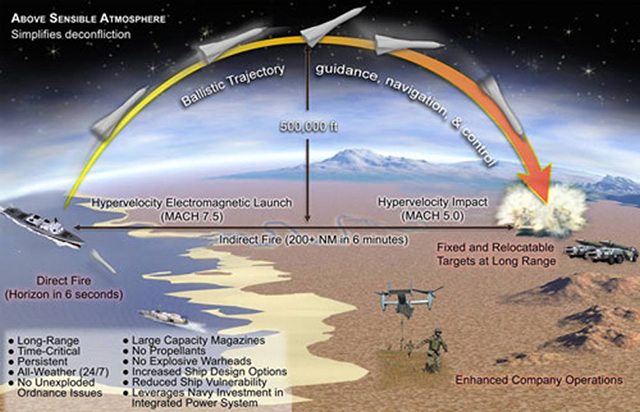
The technology involves sending an electric current along parallel rails up and through an iron rod that connects the poles of a magnet, firing its projectile. To put even 32 megajoules (MJ) in perspective, a 2,000 pound object like a Volkswagen “beetle” car, moving at 100 mph, equals about 1 megajoule of energy. The Navy would use much smaller projectiles, of course, which means they’d be accelerated to extremely fast speeds.
Notional naval specifications involved 15-20 kg projectiles, with muzzle energy of 64 MJ, a muzzle velocity of 2,500 m/s (almost Mach 8.5 at sea level), a maximum range in excess of 500 km/ 300 miles, and an impact velocity of 1,600 m/s (around Mach 5.4) when it hit. Even a 33 MJ firing would leave the barrel at hypersonic speed, and reach ranges of about 170 km/ 92 nautical miles. This compares to just 12 nautical miles with conventional 127mm naval guns, though rocket-boosted projectiles like Oto Melara’s Vulcano can reach about 100 km/ 54 nautical miles, at the price of using a larger shell.
After considering the challenges, and the advantages of being able to hold far larger stores of ammunition that doesn’t require hazardous explosives, the US Navy decided that a 32-40 MJ railgun would probably suffice as their goal. The initial target for initial trials of a tactical weapon is about 20 MJ, with an initial range of 50-100 nautical miles, and growth prospects up to 220 nm.
Projectiles with some GPS guidance and maneuvering capacity would turn railguns into precision strike weapons with the power of 155mm shells on land, and could even allow them to be used in air defense roles at sea.

(click to view full)
Even that goal is difficult. Technically, the biggest challenges are two-fold: The barrel, and the capacitors.
Super-high speed for the fired object = super-high friction in the barrel. The armature also has a tendency to create transitioning, which is a fancy way of saying it creates very hot gas when you move it through the barrel at those speeds. The gun has to be able to take that heat and pressure without deforming, blowing up, or changing in ways that will make the next shot inaccurate.
The other big challenge is capacitors. There were reports that BAE’s delivered gun would see testing delayed, because the Navy would be late in buying 100 capacitors that are big enough to power 32 MJ of muzzle energy. That’s not uncommon for this kind of cutting-edge system, and the rail guns’ cost, the size of the order, and the limited industrial base for key components will all create challenges for the program. The US Office of Naval Research (ONR) now has a separate pulsed power research program, which could solve this problem while offering benefits for laser weapons, and even some ship radars. Estimates place ship power generation requirements at 20-30 MW for even a 32 MJ railgun, in order to fire at its maximum projected rate of 6-10 times per minute.
(click to view entire)
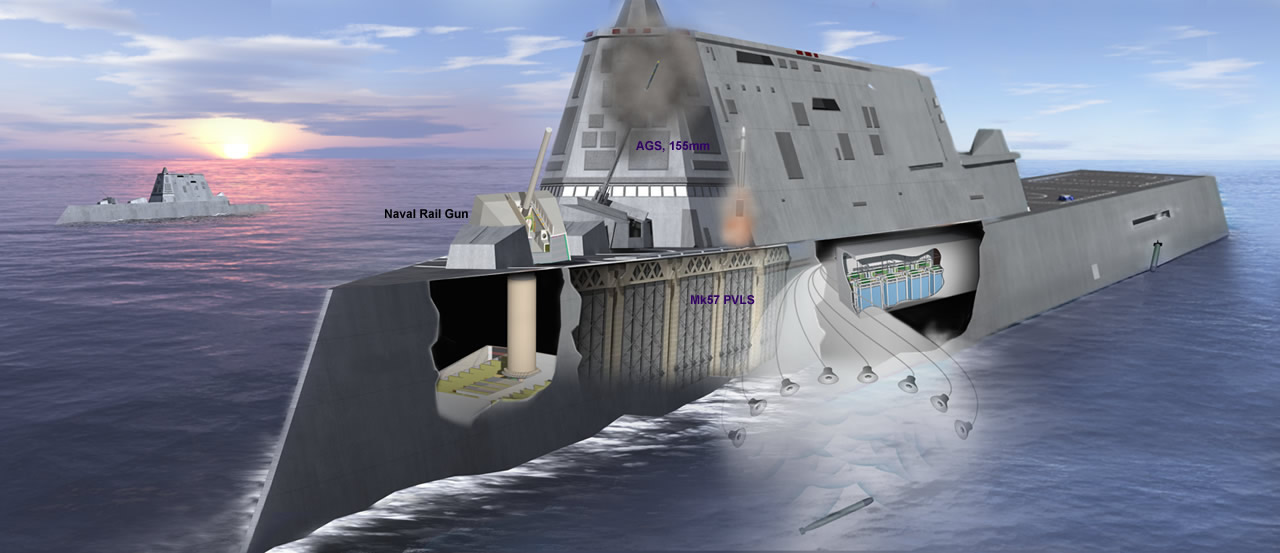
These issues also create practical limitations on what sorts of ships can mount a rail gun. In truth, any platform with sufficient space and power could be configured to mount EMRG weapons. Right now, the power requirements, and the space requirements for electric capacitors that would be big enough to be useful, are they key limiting issues.
The USA’s DDG-51 Arleigh Burke Class destroyers, for example, are hobbled by limited generating capacity. Their 7.5 – 9.0 MW output is already stressed trying to power all of the ship’s existing radars and systems, and even the Flight III ships will only have 12 MW capacity, far below other modern ships which use all-electric systems. Hybrid drive power systems may help them, but the 3 DDG-1000 Zumwalt Class destroyers are going to be all-electric ships, using fully integrated power systems that deliver 78.5 MW to drive propulsion and onboard electronics. That improved generating capacity is why the Zumwalts are most frequently envisaged as the host ships for future EM weapons, like the 64 MJ land-attack weapons that require 40 – 50 MW of generating capacity.
Rail Guns: The US EMRG Program
* July 2012: Hyper Velocity Projectile solicitation for companion effort.
* Jan. 2012: 1st 32MJ gun prototype to ONR.
* Nov-Dec. 2011: Pulsed power contracts
* Oct. 2011: 1,000 US railgun shots
* Dec. 2010: 33MJ test shot at Dahlgren
* Feb-Apr. 2009: 2nd phase ONR contracts
* Mar. 2008: DARPA fires cantilevered railgun “mortar”
* Jan. 2008: ONR 10MJ test shot at Dahlgren
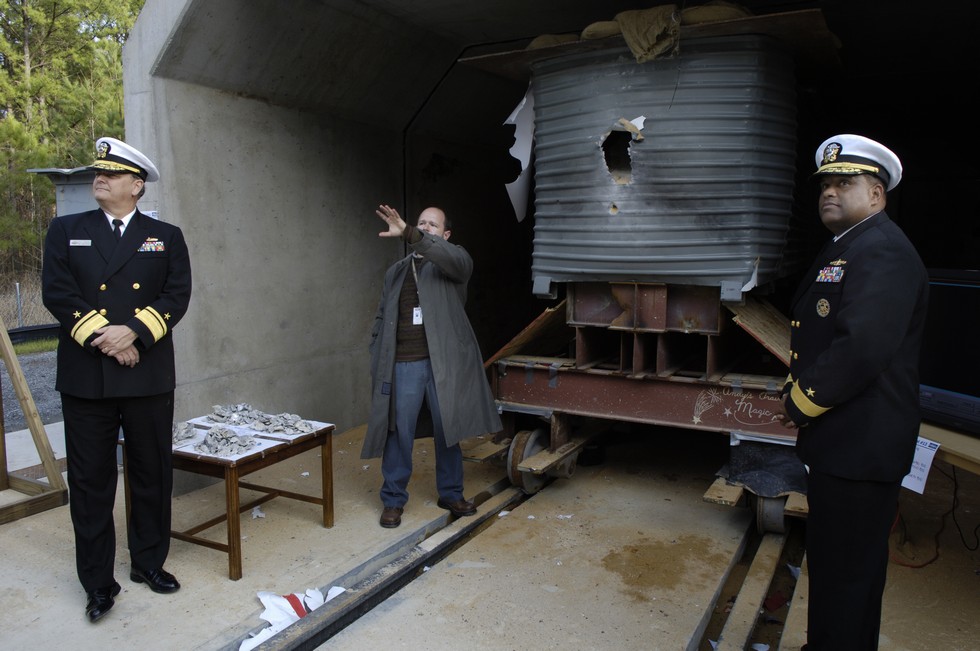
* Jan. 2007: ONR Electromagnetic Launch Facility dedicated at NSWC Dahlgren
* Mar. 2006: Initial ONR 32MJ gun design awards.
(click to view entire)
The US Navy’s rail gun efforts have been undertaken with more than 1 company, and more than 1 country. Even the program office involves a broad array of organizations. As of February 2007, the US Navy had invested a total of $36 million in this effort, and total expenditures by the end of Phase 1 in 2011 are expected to be around $276 million.
The 32 MJ rail gun passed its planned 2009 review, and the technology was deemed mature enough to continue. EMRG INP Phase I is now expected to end in 2012, with delivery of INP prototypes, which began on Jan 30/12.
If funding is approved for further phases, EMRG INP Phase II would end in FY 2015-16, and will focus on managing heat buildup and rate of fire issues, as it develops the weapon and projectile toward a final design that can fire up to 6-10 rounds per minute, to a distance of 50-100 nautical miles, with growth potential to 220 nautical miles. Test sites that might work for that effort are being scoped out, with White Sands Missile Range, NM, and Army Yuma Proving Ground, AZ as top candidates.
The hope is that the rail gun can switch from a science and technology effort to full research and development under Naval Sea Systems Command in FY 2015, with “sea demos” of a tactical system with 20 MJ of muzzle energy by FY 2019. The Navy would say only that “various platforms are being considered” for those demos. Figures like $25,000 have been bandied about as the per-round cost, but the myriad requirements imposed by the US Navy may make that problematic. If all goes well, fielding would still take several years for contracts, ship refits, testing, training, etc., which means that a deployed railgun would not be expected before 2020.
2025 may be a more likely target if there are program slips, and even that date will require some breakthroughs over the next decade.
EMRG: Industrial Players

The ONR’s EMRG program is part of the Department of the Navy’s Science and Technology investments, and partnerships include people from Boeing, BAE, Charles Stark Draper, General Atomics, the US Department of Energy’s Lawrence Livermore National Laboratory, the US Naval Academy, the US Naval Postgraduate School, US Naval Sea Systems Command (NAVSEA) PMS-500, Naval Surface Warfare Center’s Carderock and Dahlgren Divisions, and the US Army. Britain is also involved, at a technical evaluator and support level.
The University of Texas at Austin’s Institute for Advanced Technology (IAT) Electromagnetic Systems Division has performed basic research for NRL, at less than 2 MJ muzzle energy. IAT showed off a demonstrator back in 2004. Jane’s reports that the IAT has also devised a common low-cost projectile concept for both naval surface-fire support and army non line-of-sight (NLOS) engagements using an EM rail gun launcher. The projectile has a flight mass of 15 kg and contains either multiple kinetic-energy flechettes (darts), or a smaller number of sub-penetrators made of tungsten. That effort was part of a 2003 US Navy contract worth up to $10 million over 5 years.
At larger scale, Both UAV maker and EMALS electro-magnetic catapult designer General Atomics, and trans-Atlantic defense giant BAE, have been contracted to design and deliver full-scale 32MJ Innovative Naval Prototype (INP) railguns, which are intended to be closer to tactical designs than to a laboratory style launcher. This sort of dual approach is common in research programs, where supporting different design approaches greatly improves the amount learned, and overall odds of success. INP prototypes began arriving for government evaluation in 2012.
Contracts for design & development in earnest began in 2006, and BAE Systems is executing its contracts in conjunction with teammates IAP Research, Inc. in Dayton, OH; and Science Applications International Corporation (SAIC) in Vienna, VA.
A 2014 contract has hired Raytheon IDS to work on power modules.
EMRG: Parallel Research
(click to view full)
As part of the EMRG development program, the ONR and Naval Research Laboratory (NRL) co-funded scientists at NRL to build and operate a 6-meter long, 50 mm diameter railgun. Researchers fired the first shot in March 2007.
This and other laboratory railguns, including the one that fired a 33 MJ shot at Dahlgren in December 2010, are a parallel research effort. Contractors may be called in – for instance, BAE built the 33 MJ railgun according to a government Integrated Product Team design – but the results of all test firings are shared program-wide with BAE, General Atomics, and others.
The initial goal of EMRG research efforts was an “instrumented environment” for service officials to better understand and control the inside of the railgun’s barrel, which remains one of the program’s top technical challenges. Additional studies have also been chartered to cover ship integration, the effect of electromagnetic energy on personnel and systems, the potential logistics benefits of having rail gun systems aboard ships, and different types of potential projectiles. Then, as noted above, they must deal with the industrial challenge of acquiring adequate capacitors.
After improving the 6m railgun’s sliding armature and rails, the lab has fired an average of 300 shots per year since 2008. The 1,000th shot tested new ideas of how the armature interacts with the rails, and during the course of firing all 1,000 shots, NRL scientists have experimented with a variety of materials and geometries, trying to correlate that with modeling and simulation work. The gun is dismantled after each firing, to examine all the components, and the rails are sliced up and examined under a microscope to reveal surface damage. That feedback mechanism is the key to progress, creating an accumulated body of knowledge and refined models.
EMRG: Key Contracts & Events
FY 2016 – 2017
August 04/17: A new 10 mega joule medium-range multi-mission railgun developed by General Atomics Electromagnetic Systems is ready for testing, according to the company. Designed to provide multi-mission, multi-domain capability with greater flexibility and a smaller footprint for ship, land and mobile platforms, the firm stated that field testing of the system will be conducted at Dugway Proving Ground in Utah, however, they did not disclose when the system will be tested. The railgun integrates a High Energy Pulsed Power Container, 10 MJ launcher, hypersonic hybrid missile, and fire control technologies. The HEPPC uses next-generation railgun capacitors and a new approach to packaging and distribution of the energy in a smaller footprint than existing pulsed power solutions.
FY 2015 – 2016
[youtube:v=szhz9YMl4uE]
June 2/16: Russia has announced that it is developing its own rail gun technology as the first pictures of US efforts made their way to press. The “battlefield meteorite” is capable of firing a projectile at an initial speed of 4,500 miles per hour, piercing seven steel plates, and leaving a 5-inch hole — able to “blow holes in enemy ships, destroy tanks and level terrorist camps.” For Russia, the new weapon will not replace traditional weapons “even in the mid-term perspective,” as much time needs to pass from the first tests to the mass production, especially considering the high price of the production, according to Russian senator Franz Klintsevich.
Nov 17/14: CSBA Paper. The non-partisan CSBA releases “Commanding the Seas: A Plan to Reinvigorate U.S. Navy Surface Warfare.” Their recommendations are wide ranging, including a major shift in US Navy weapons configurations toward higher capacity medium-range air defenses. That would include deployment of 32 MJ railguns for anti-aircraft roles within the 30 nmi zone, alongside greater use of RIM-162 ESSM missiles, and a combination of laser defenses and RAM missiles in the 5-15 nmi zone. This would take place in order to free up vertical launch (VLS) cells for long-range offensive surface attack (LRASM), anti-submarine (new VL-ASROC options: CVLWT on SM-2?), and air-denial (SM-6) weapons.
Reader may be puzzled that a gun with a range of up to 100 nmi would have such a short intercept range. The issue is the limited maneuverability of the guided railgun round, which in turn forces closer shots that reduce incoming missiles’ maneuvering time. Anti-ship ballistic missiles are easier despite the near-vertical shot required, and are likely to be reliably attacked at 20-30 nmi. Supersonic cruise missiles may be more difficult at that range, where they could have 15-20 seconds to execute maneuvering programs, but they become steadily more vulnerable to EMRG fire as engagement range shrinks.
The biggest challenge to these recommendations is the low power generation capacity on board the USA’s CG-47 cruisers and DDG-51 destroyers, which is to say almost all of the US Navy’s high-end ships. Even a 32 MJ railgun requires at least 15-30 MW of onboard power generation, which is well above even proposed DDG-51 Flight III ships (12 MW) from 2017 onward. Other countries have moved their ship designs toward all-electric configurations, which is why smaller Spanish and Australian Aegis frigates sit at 40+ MW, but retrofits of existing 1980s-era American designs would be very expensive.
For the US Navy, this conundrum forces EMRG fits on ships like the LCS/ SSC frigates, or even the JHSV transport. That can be good, if it spreads American naval defenses among more platforms, but it also yanks LCS and JHSV ships away from their planned missions, which must then be offloaded onto other ships. For 64 MJ railguns, which require 40 – 50 MW capacity, the DDG-1000 Zumwalt Class battlecruisers are the USA’s only realistic option at present. Sources: CSBA, “Commanding the Seas: A Plan to Reinvigorate U.S. Navy Surface Warfare” (incl. full PDF) | USNI, “CSBA Recommends New Course for U.S. Navy Surface Forces”.
FY 2013 – 2014
[youtube:v=NWZPp3aEjuM]
July 8/14: The US Navy publicly unveils both BAE and General Atomics’ railgun designs, displayed but not mounted aboard the deck of the USNS Millinocket JHSV ship at Naval Base San Diego. Rear Adm. Matthew Klunder gives a current figure of about $25,000 per round, but the price for the final guided round remains to be seen. Sources: San Diego 6 TV, YouTube segment and “Navy unveils prototype railguns”.
June 27/14: Power. Raytheon Integrated Defense Systems in Tewksbury, MA receives a $33.2 million modification to previously awarded cost-plus-fixed-fee contract for research and development activities associated with integrated power systems power load modules to be used for electromagnetic railgun pulse power containers, and for the fabrication and testing of prototypes.
$8.5 million in FY 2014 USN RDT&E budgets is committed immediately. Work will be performed in Tewksbury, MA, and is expected to be complete by December 2016. US NAVSEA in Washington, DC manages the contract (N00024-12-C-4223).
April 7/14: Experiment: Railgun. The US Navy plans to use JHSV 3 Millinocket as a test platform for one of its newest weapons in 2016: a 32MJ rail gun that can fire projectiles about 100 miles at Mach 7 speeds. JHSV was picked as the trial platform because it has the space to carry the large system on its deck and in its cargo bay. The gun itself isn’t unusually large, but once you throw in the capacitors for power storage, any additional power needs, extensive maintenance tools and parts, and ammunition, it adds up fast. Rolling and bolting that onto a JHSV is much easier than cutting a warship open, and the trial underscores JHSV’s usefulness as a concept testbed.
On the weapon’s side of the equation, ONR Chief Rear Admiral Matthew Klunder touts the railgun’s economic benefit, as well as its military edge in extending the bombardment range of naval guns and the number of rounds on board. It’s true that $25,000 for a defensive railgun shot against incoming missiles is orders of magnitude better than a RIM-116 RAM ($900,000) or RIM-162 Evolved SeaSparrow Missile ($1.5 million), assuming the unproven assumption of equal effectiveness. One must also compute operating and maintenance costs over the railgun’s lifetime, however, which are going to be far higher than they would be for an All-Up-Round missile in its canister. The JHSV tests will offer some early data on the system’s robustness under trial conditions at sea, and that cost data point could end up being as valuable as any weapon performance data.
Klunder says that actual integration on a warship wouldn’t take place until 2018. That would only happen if the JHSV test ends up being nearly perfect, so take that date with a spray of salt. Sources: Reuters, “U.S. Navy to test futuristic, super-fast gun at sea in 2016”.
Jan 16/14: Testing. USN Chief of Naval Research Rear Adm. Matthew Klunder says the Phase 2 (q.v. July 1/13) rail gun tests are going well. From DefenseTech, “Navy Rail Gun Showing Promise”:
“Klunder expressed enthusiasm that the rail gun successfully went 8-for-8 in a recent test firing at White Sands Missile Range, N.M. “It went exactly where we told it to go with good telemetry,” he explained.”
Jan 10/14: DDG 51 Flight IV. The current US Navy program manager for DDG 51 acquisition, Capt. Mark Vandroff, says that the service has begun to look at the requirements for a “Flight IV” destroyer, which wouldn’t begin service until the 2030s. Rail guns and lasers are part of the early conversation, and it isn’t just because they’re cool:
“Some of the thinking involves senior leaders talking about getting on the other side of the cost curve. Right now if someone shoots a missile at us, we shoot a missile back at them. The missile we shoot at them cost about as much, if not more, than the missile that got shot at us. They are burning money and we are burning money to defend ourselves…. The down side is this kind of technology does not exist today and even if it does, you have to look at what kind of maritime platform could you put it on and what that would look like. When that technology starts to get close to mature, then you will see the Navy start to figure out what it has to do in order to field that technology.”
Step 1: find a way to get a lot more power generation into the DDG 51 hull, or switch hulls. Converting DDG 51 ships to hybrid-electric drive would be a minimum requirement, and even that may not be enough. If the Navy needs alternatives, HII is touting their LPD-17 Flight II amphibious assault hull as a future air and missile defense cruiser platform. Looking downscale, Littoral Combat Ships may not have much else, but they do have plenty of onboard power, plus free space for capacitors etc. Sources: Military.com, “Future Destroyers Likely to Fire Lasers, Rail Guns” | USNI, “In Pursuit of the U.S. Navy’s Next Surface Combatant”.
Nov 7/13: HVP Phase 1A. BAE Systems announces a $33.6 million Office of Naval Research (ONR) contract to fund Phase 1A of the Hyper Velocity Projectile (HVP) project. Recall (q.v. July 19/12) that its goal is a 62 cm long guided subcaliber saboted round, compatible with both standard Mk-45 155mm naval gun systems and future 20 – 32MJ railgun systems.
BAE Systems is working with the United Technologies conglomerate and Custom Analytical Engineering Systems (CAES), with its initial phase to be completed by June 2014. Work will be carried out by BAE Systems in Minneapolis, MN; UTC Aerospace Systems in Vergennes, VT; and CAES in Flintstone, MD.
HPV projectile award
July 1/13: INP Phase 2. BAE Systems announces that the Office of Naval Research awarded them a $34.5 million contract for the development of a EM railgun under the Navy’s Innovative Naval Prototype (INP) program.
This marks the transition to the program’s Phase 2. Work is starting now, with initial prototypes to be delivered in 2014.
INP Railgun Phase 2
June 7/13: Railgun Ashore? The House Armed Services Committee report [PDF] about the NDAA 2014 states that:
“[…] the committee is aware that the Department [of Defense] has established a new effort within the Strategic Capabilities Office in the Office of the Secretary of Defense to leverage the Navy’s program to explore the development a land-based railgun. As noted in the committee report (H. Rept. 112–479) for the National Defense Authorization Act of Fiscal Year 2013, the committee is interested in the potential utility in accelerating some electromagnetic railgun efforts for land-based area defense.
The committee finds these developments encouraging, and urges the Director, Missile Defense Agency [MDA] to examine these activities in order to determine their potential application, if they can provide additional capability, to broader ballistic missile defense missions.”
This didn’t just spring out the committee members’ minds, as the Navy’s 2014 budget request asks for [PDF] $130 million, followed by another $120 million in FY15, to conduct a Land Based Rail Gun (LBRG) experiment in 2015 with a 20 Mega Joule (MJ) railgun at Wallops Island test range, VA. Using railguns on land lifts the power bottleneck faced by ships, which are already straining under increasing demand for electricity from onboard radars and other systems.
Oct 9/12: GA into testing. ONR announces that they’ve begun evaluating General Atomics’ Advanced Containment Launcher prototype in Dahlgren, VA. EM Railgun program manager Roger Ellis would say only that:
“It’s exciting to see how two different teams are both delivering very relevant but unique launcher solutions… We’re evaluating and learning from both prototype designs, and we’ll be folding what we learn from the evaluations into the next phase of the program.”
See: ONR | General Atomics.
FY 2012
[youtube:http://www.youtube.com/watch?v=1xxD5js5pIE]
(click to view video)
July 19/12: Long-range shells. The ONR issues an R&D solicitation for guided projectiles, under Long Range Broad Agency Announcement for Navy and Marine Corps Science and Technology, ONRBAA12-001. From “Hyper Velocity Projectile (HVP) Research,” Solicitation #12-SN-0017:
“The Hyper Velocity Projectile (HVP) program is intended to design, develop, fabricate, test and demonstrate a guided hypervelocity projectile compatible with Mk-45 155mm gun systems and future 20 – 32MJ railgun systems. Due to Mk 45 interface requirements, the HVP shall be a 62 cm long subcaliber saboted round. Desired total airframe mass is in the 10-15 kg range. Designs and technologies must survive and perform through harsh environments; 20,000 – 30,000 G’s [sic] launch acceleration and (for railgun) thermal conditions intrinsic with sea level, 2 km/s guided flight. Desired ranges include current capability of the 5″ Mk 45 Mod 4 gun and ranges in excess of 30 nmi. Additional range would be expected out of higher muzzle energy railguns.
The ONR HVP program will address technologies in the areas of high G launch survivability (miniaturized high-G tolerant guidance electronics and control actuation systems, militarized GPS receivers, and compact fuzing – safe & arm), high density electronics packaging and miniaturization , advanced energetics, and aero-thermal management (lightweight-high strength composite materials, heat resistive-thermal managing materials)… A multistage program leading to full-up live fire demonstrations of the technology is anticipated… ending at the end of FY17 to deliver and demonstrate HVP test articles in a realistic environment (TRL 6).”
HVP isn’t the first such project. The ERGM project spent $600 million from 1996-2008, simply trying to create an ultra-long range, GPS-guided projectile for the 127mm/ 62 caliber guns on new US Navy ships. Even so, there’s good reason to think that the basic goal of ultra-long range guided shells for standard naval guns is achievable. Italy’s Oto Melara has Vulcano ultra long range, GPS-guided shells in development for 127/64 and 76/62 naval guns, and BAE and Lockheed Martin are building similar 155mm shells for the new DDG 1000 destroyers.
As often happens in the USA, HVP seems to be trying to do too much. Yes, the pure research areas mentioned could potentially apply to Naval Surface Fire Support, Cruise Missile Defense, and Anti-Surface Warfare. On the other hand, conflating the unique requirements of railguns with the more pedestrian firing environment of standard 5″ naval guns seems like a recipe for over-engineered and overly-costly test solutions, or for technical failure. Adding new requirements like re-targeting in flight, and multiple mission types with their own unique challenges, stacks the deck even further against creating a transferable, mission-ready success. An R&D project might be better off beginning more modestly, and demonstrating solid results in one much-needed area like naval fire support, before branching out. FBO.gov | WIRED Danger Room.
HVP projectile RFP
Feb 7/12: The US Office of Naval Research offers an update:
“Navy planners are targeting a 50- to 100-nautical mile initial capability with expansion up to 220 nautical miles… The prototype demonstrator incorporates advanced composites and improved barrel life performance resulting from development efforts on the laboratory systems located at the Naval Research Laboratory (NRL) and NSWC-Dahlgren… The industry demonstrator will begin test firing this month… In the meantime, the Navy is pushing ahead with the next phase of the EM Railgun program to develop automatic projectile loading systems and thermal management systems to facilitate increased firing rates of… six to 10 rounds per minute. BAE Systems and General Atomics also are commencing concept development work on the next-generation prototype EM Railgun capable of the desired firing rate.”
Jan 30/12: Prototype delivery. BAE’s team delivers its prototype 32MJ railgun to the ONR. Source.
Pulsed power. US NAVSEA in Washington, DC issues a pair of contracts for R&D into “integrated power systems power load modules design and pulsed power loads for future surface combatants.” It’s part of USN ONR’s Capacitors for Pulsed Power Applications Program (q.v. Additional Readings).
Here’s the thing: rail guns need a huge burst of power for their shot, but ships produce steady loads. To make that combination work, a power system needs to be able to build up, store, and then release power in large bursts. Lasers have this issue to a lesser extent, and so do some radar modes. That’s why solving this issue could solve several problems, if the “pulse forming networks” can offer flexible energy levels and durations for their power bursts.
Dec 9/11: BAE Systems Land and Armaments in Minneapolis, MN wins an $11.7 million cost-plus-fixed-fee R&D contract. Work will be performed in Minneapolis, MN (57%), San Diego, CA (33%), and Dayton, OH (10%), and is expected to be complete by December 2016. $200,000 will expire at the end of the current fiscal year, on Sept 30/12. This contract was competitively procured via a Broad Agency Announcement, with 7 proposals received by US Naval Sea Systems Command in Washington, DC (N00024-12-C-4221).
Nov 2/11: General Atomics in San Diego, CA wins a $12.3 million cost-plus-fixed-fee R&D contract for “integrated power systems power load modules design and pulsed power loads for future surface combatants.” The initial effort will include further refinement of General Atomics’ unique approach to the concept, in order to meet a set of notional performance expectations developed in conjunction with the Navy.
Work will be performed in San Diego, CA, and is expected to be complete by October 2016. $200,000 will be provided at time of contract award, and will expire at the end of the current fiscal year, on Sept 30/12. This contract was competitively procured via a broad agency announcement, with 7 proposals received by (N00024-12-C-4222).
Capacitor & Power system development
Oct 31/11: Rear Admiral Nevin Carr, Chief of Naval Research, discusses directed energy and hypersonics, at the 2011 Surface Navy Association (SNA) West Coast Symposium in San Diego, CA. He notes that railguns can now shoot hundreds of times, instead of 5-10 times, and are evolving towards more reasonable energy requirements. The current plan is to be able to conduct an at-sea firing by 2019, with a 20 MJ gun, from a destroyer.
Carr adds that the original 64 MJ requirement has been changed. While the 220 miles of range would be nice, ONR has decided that the 33 MJ version with 110 mile range is good enough. They see the first operational railguns capping out at 33-40 MJ. USN biography | YouTube.
Oct 31/11: 1,000 shots. NRL scientists hit a materials research milestone, with 1,000 railgun firings from laboratory-scale systems. Roger Ellis, ONR’s Electromagnetic Railgun (EMRG) program officer adds this interesting observation:
“When you couple what we’re seeing in testing with what we’re seeing in modeling and simulation, it results in some interesting barrel shapes that you wouldn’t intuitively think about. Railgun barrels don’t necessarily have to be round as in most conventional gun designs.”
FY 2009 – 2011
[youtube:http://www.youtube.com/watch?v=DWHMIz-wTa4]
(click to view video)
Dec 10/10: 33MJ shot. The ONR fires a world-record 33-megajoule shot of their Electromagnetic Railgun, at Naval Surface Warfare Center Dahlgren Division.
While this is short of the 64 MJ goal, a 33 MJ shot would still propel a projectile to Mach 5, and a range of about 110 miles. It’s also about 3 times the energy of the last record firing, in January 2008. US ONR | Fox News.
April 15/09: General Atomics in San Diego, CA received $22.1 million for a cost plus fixed fee task order under a previously awarded contract (N00014-06-D-0056, #0005) for technology development and design of an EM Rail Gun. The firm is also the main contractor for the Navy’s EMALS electro-magnetic catapult for aircraft carriers, which uses similar principles to handle a different task.
Work will be performed in San Diego, CA, and is expected to be complete in February 2012. The contract was competitively procured under Broad Agency Announcement (BAA) 05-003 by the Office of Naval Research in Arlington, VA.
Feb 9/09: BAE Systems Land and Armament LP in Minneapolis, MN received a $21.3 million delivery order under a previously awarded contract (N00014-06-D-0046) to research and develop an Advanced Containment Launcher for an Electromagnetic Rail Gun. BAE’s follow-on release describes the 30-month contract as:
“…detailed design and delivery of an Innovative Naval Prototype (INP) Railgun… including a composite launcher (barrel) that will be demonstrated in 2011.”
BAE Systems is partnered with IAP Research, and SAIC. Work will be performed in Minneapolis, MN and is expected to be complete in September 2011. This contract was competitively procured under Office of Naval Research Broad Agency Announcement 05-003.
Railgun INP prototypes
Feb 3/09: UTexas. The Institute of Advanced Technology at University of Texas, Austin received a $9.1 million cost plus fixed-fee contract to perform railgun assessment. Founded in 1990, IAT Electromagnetic Systems is an autonomous research unit tasked with aiding the U.S. Army and Navy with rail gun technology. IAT showed off a technology demonstrator at the 24th Army Science Conference (ASC 2004).
Work will include laboratory testing and scalability between small and medium scale launchers, pulsed power assessment, and conceptual prototyping and assessment of electromagnetic railgun contractor development items including advanced containment launcher and pulsed power systems. This contract contains options, which is exercised, would bring the contract value to $12.1 million.
Work will be performed in Austin, TX and is expected to be complete Jan 31/12. Contract funds in the amount of $10,000 will expire at the end of the current fiscal year. This contract was competitively procured under the Office of Naval Research Broad Agency Announcement Number 08-001 (N00014-09-C-0187).
FY 2007 – 2008
(click to view full)
March 18/08: EM Mortars? DARPA’s full-scale, fully cantilevered electromagnetic railgun successfully launches a projectile with similar size and weight a 120mm mortar, at speeds of 430 meters-per-second. That’s faster than the 101-318 meter/second speed of regular mortar firings, which translates into greater energy and range.
The 120mm mortar is an inherently simple system, whose virtues include the reliability that simplicity delivers. That’s why the US Marines are relying on a 120mm mortar as their EFSS system. The extra energy in DARPA’s system, and accompanying range, may offer the revolutionary potential for artillery gun range in a mortar-size weapon. The flip side is that a rail gun’s greater complexity and inherent fragility introduces issues of cost, reliability, and dependence on the system’s energy source.
DARPA says that its 2.4m, 950 kg railgun is currently the largest caliber supersonic railgun in the world. It is certainly the first-ever successful full scale cantilevered railgun to shoot a mortar-size projectile. The cantilevered design is used to change aiming on a shot-to-shot basis, just as a regular mortar does. Built-in muzzle shunts quickly extinguish muzzle arc, and reduce muzzle flash. DARPA release [PDF]
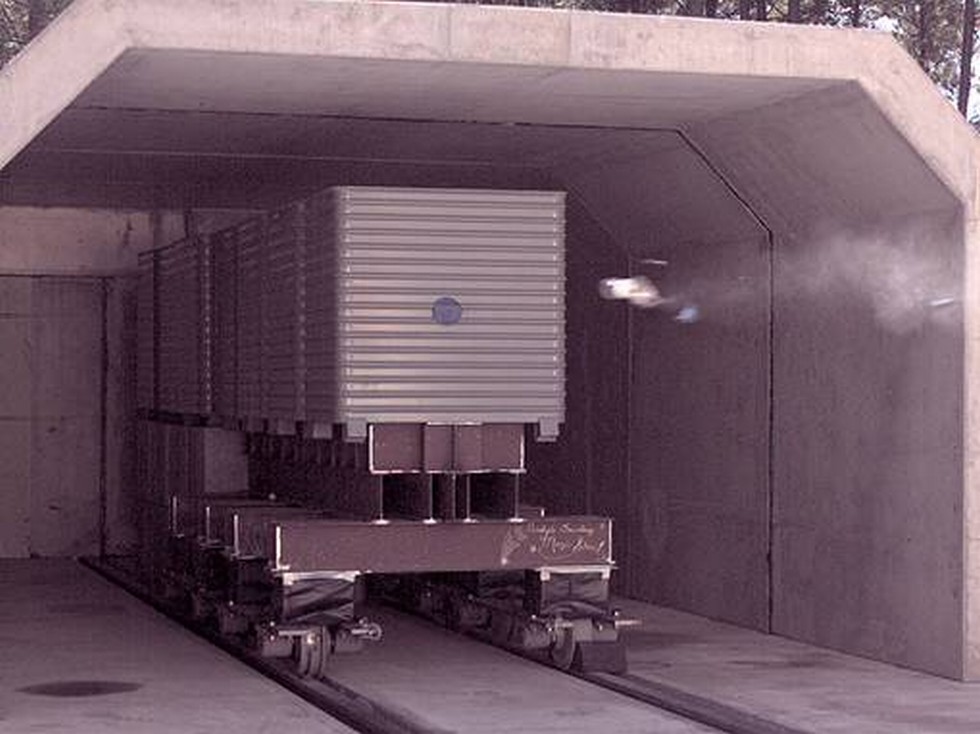
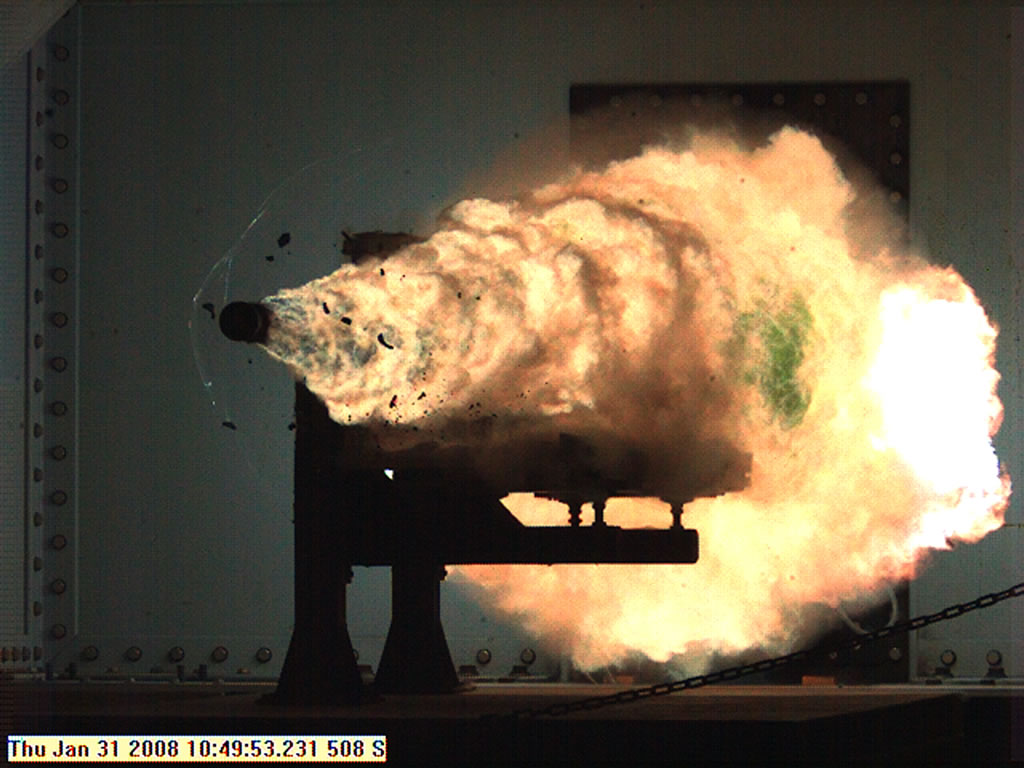
Jan 31/08: 10MJ firing. Another step forward. ONR successfully conducted a record-setting firing of an electromagnetic rail gun at the Naval Surface Warfare Center in Dahlgren, VA, firing at 10.64MJ (megajoules) with a muzzle velocity of 2,520 meters per second. Let’s see: 3,600 seconds per hour, 0.62 miles per kilometer… yes, that’s over 5,600 miles per hour. The speed of sound is about 760 mph at sea level, so it’s about Mach 7.4.
Note the ‘transitioning’ plasma visible in the high speed camera photo, which offers some illustration of what the material design crew is up against. Navy release.
Fire! Record 10+ MJ shot
July 30/07: Envisioneering, Inc. in Alexandria, VA received a sole source $9.2 million cost-plus-fixed-fee, indefinite-delivery/indefinite-quantity contract for systems analysis, system/component design and development, system test and evaluation, data collection and analysis in support of the US Navy’s Directed Energy and Electric Weapons Program Office (PMS-405).
Work will be performed in King George, VA (92%); Kauai, Hawaii (6%); and Kirkland, WA (2%), and is expected to be complete by July 2012. The contract was not competitively procured, as “Envisioneering is the only known source with the knowledge and technical capability to provide the services and support required to meet milestones and deadlines.” The solicitation was, however, posted on the world wide web via Navy Electronic Commerce Online by the Naval Surface Warfare Center in Crane, IN (N00164-07-D-8900).
Jan 19/07: NAVSEA release:
“A new Electromagnetic Launch Facility (EMLF) was dedicated at NAVSEA Surface Warfare Center (NSWC) Dahlgren during a ceremony hosted by the ONR Jan. 16, in which a high speed projectile pierced the ceremonial ribbon… The mission of the Electromagnetic Rail Gun (EMRG) program is to develop the science and technology necessary to design, test, produce, and install a revolutionary 64 Mega Joule (MJ) EMRG aboard U.S. Navy ships in the 2020 – 2025 timeframe. The current phase of the program extends through 2011.”
FY 2005 – 2006
(click to view full)
July 6/06: BAE reported the next phase as well: a $9.3 million contract from the ONR to develop technologies and preliminary design for an Electro-Magnetic (EM) railgun prototype.
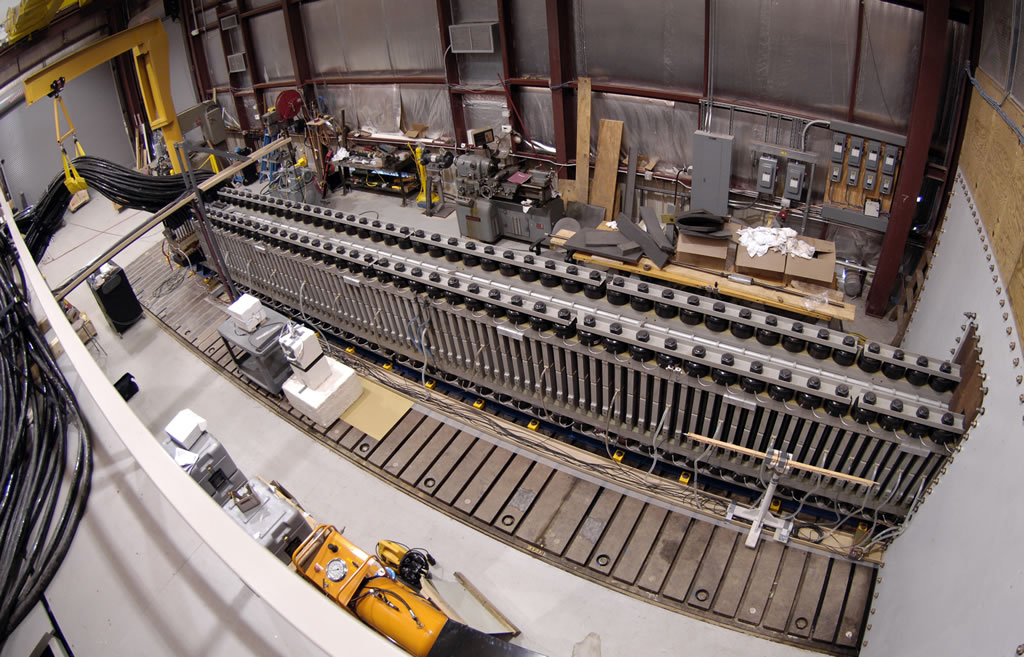
March 3/06: BAE Armament Systems Division in Minneapolis, MN receives a contract for the “design and production of the 32 MJ Laboratory Launcher for the U.S. Navy.” It is a $5.5 million cost-plus-fixed-fee contract for the design and production of the 32 MJ Laboratory Launcher for the U.S. Navy. Work will be performed in Minneapolis, MN (66%) and Dayton, OH (37%), and is expected to be complete by August 2007. The contract was competitively procured and advertised via Federal Business Opportunities site, with three offers received. The Naval Surface Weapons Center, Dahlgren Division in Dahlgren, VA issued the contract (N00178-06-C-1008).
It seems likely that General Atomics also received a contract to this end (vid. April 15/09 entry), but it may not have initially reached the $5 million threshold to qualify for public announcement.
Initial Railgun design contracts
April 18/05: The University of Texas at Austin’s Institute for Advanced Technology (IAT) Electromagnetic Systems Division showed off its electromagnetic rail gun (RailGun) technology demonstrator at the 24th Army Science Conference (ASC 2004).
Founded in 1990, IAT Electromagnetic Systems is an autonomous research unit tasked with helping the U.S. Army and Navy develop rail gun technology. For full details, see the Defense Review article “IAT Electromagnetic Systems Division Developing Rail Gun Tech for U.S. Military.”
Additional Readings
Readers with corrections, comments, or information to contribute are encouraged to contact DID’s Founding Editor, Joe Katzman. We understand the industry – you will only be publicly recognized if you tell us that it’s OK to do so.
DID thanks Roger Ellis, ONR EM Railgun program officer, for his assistance with this article.
Program & Technologies
* US Office of Naval Research – EM Railgun Fact Sheet [PDF]. 2007 capture.
* Naval Research Advisory Committee – (February 2004) – Electromagnmetic (EM) Gun Technology Assessment [PDF format]. See also their terms of reference [PDF] .
* ONR – Capacitors for Pulsed Power Applications Program.
* FBO.gov (July 19/12, #12-SN-0017) – Special Program Announcement for 2012 Office of Naval Research Research Opportunity: “Hyper Velocity Projectile (HVP) Research [sic].
* General Atomics – Railgun programs, with sub-links for their Blitrzer railgun and EM Pulse Power Systems. An earlier version said: “GA is currently supporting the development of advanced pulsed power, launcher, and projectile technology as part of the ONR Railgun Innovative Naval Prototype Program. In addition, GA is pursuing opportunities within the Navy to transition similar technology for Naval Ship Defense and for the development of ‘Cold Electromagnetic Missile Launch’ technology.”
News & Views
* CSBA (Nov 17/14) Commanding the Seas: A Plan to Reinvigorate U.S. Navy Surface Warfare (incl. full PDF). Sees railguns playing an important medium-range anti-aircraft role, and notes the precise power capacity issues involved.
* National Defense (November 2007) – Electric Guns on Navy ships: Not Yet on The Horizon. “In laboratories, scientists have demonstrated the art of the possible: muzzle energy of 9 megajoules, currents of three million amps and velocities close to the Navy’s specifications, says Zowarka. But boosting the muzzle energy from 9 to 64 megajoules, the amps from 3 million to 6 million and the bore size from four inches in diameter to six or seven inches remain a challenge… Major research efforts are focused on materials to extend the bore life of the gun to allow multiple firings of the high-speed projectiles… Anything traveling at thousands of miles an hour will tear raw metal… On top of the research challenges, there are engineering difficulties. “You have to get the current there, and then you have to manage these tremendous forces between the rails…”
* Popular Mechanics (Nov 14/07) – World’s Most Powerful Rail Gun Delivered to Navy. “While the 32-MJ LRG should start firing soon, it could take another 13 years for a 64-megajoule system to be built and deployed on a ship… Effective rail guns will require a major breakthrough in materials between now and 2020, to keep the guns themselves from being shredded by each high-velocity barrage.”
* Inside the Navy (Feb 2/07) – Navy ‘Rail Gun’ Moves Forward.
* Jane’s Naval Intelligence (June 17/03) Naval warfare at the speed of light.