

(click to view full)
According to GlobalSecurity.org, India’s ATV (advanced technology vessel) program to build a nuclear-powered submarine began in 1974, and became a serious effort in 1985. The Federation of American Scientists’ December 1996 document “The Indian Strategic Nuclear Submarine Project: An Open Literature Analysis” remains one of the best single open sources on India’s program. Unfortunately, it was compiled over a decade ago and has become rather dated. That project has continued, and this DID Spotlight article continues to collect open source information on the ATV program.
More and more sources were claiming that a rented Russian Akula class boat would be operational as a training vessel by 2009. The concept was correct, but the date was not. A deadly accident during K-152 Nerpa’s sea trials delayed that project, and further complications pushed its hand-over date to 2012. As efforts to move the Nerpa into service continue, India has finally launched its indigenous nuclear sub Arihant, to begin sea trials and testing.
The ATV Program: Background
Strategic Pressure: Keeping Up with the Shangs

(click to view full)
India has long sea lanes, and industrial progress is forcing greater interest in Africa, with its natural resources and sizable Indian diaspora. China maintains a similar interest, and so the sea lanes from South Africa to the Straits of Malacca have become a focus for quiet rivalry. A nuclear-powered submarine’s ability to remain underwater almost indefinitely has substantial benefits over long sea lanes. It also creates a significant deterrent, if the boat is equipped with cruise missiles for land attack roles.
Even if one omits the new Type 094 Jin class ballistic missile submarines, problem-plagued Type 091 Han class nuclear-powered attack submarines (SSN), and the old, updated-Romeo Type 035 Ming class SSKs, China’s attack sub force was projected at about 30 subs by 2010, including 4 Type 093 Shang class SSN nuclear powered attack subs and 8 Kilo (Project 636) & Advanced Kilo class (Project 877) diesel-electric SSKs. In contrast, India’s fleet sits at just 14 combined Kilo (Sindhughosh Class), and Type 209 (Shishumar Class) SSKs.
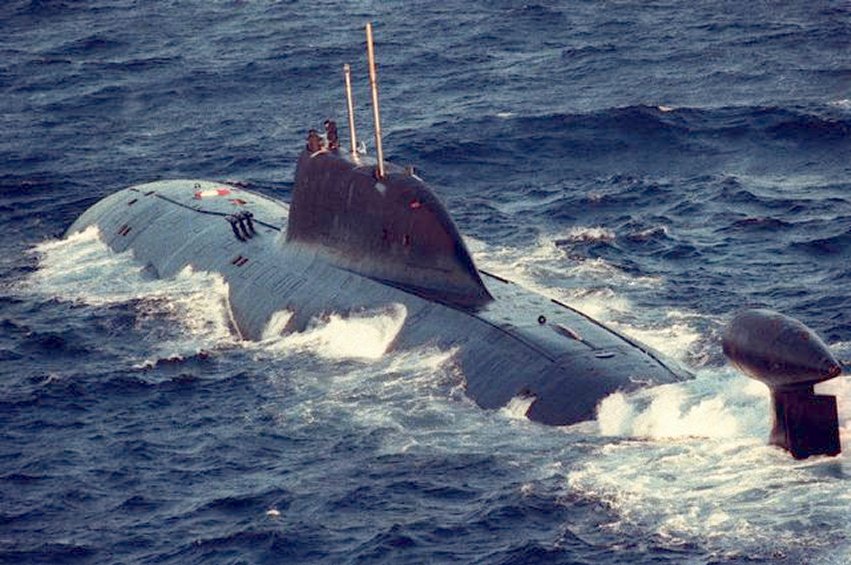
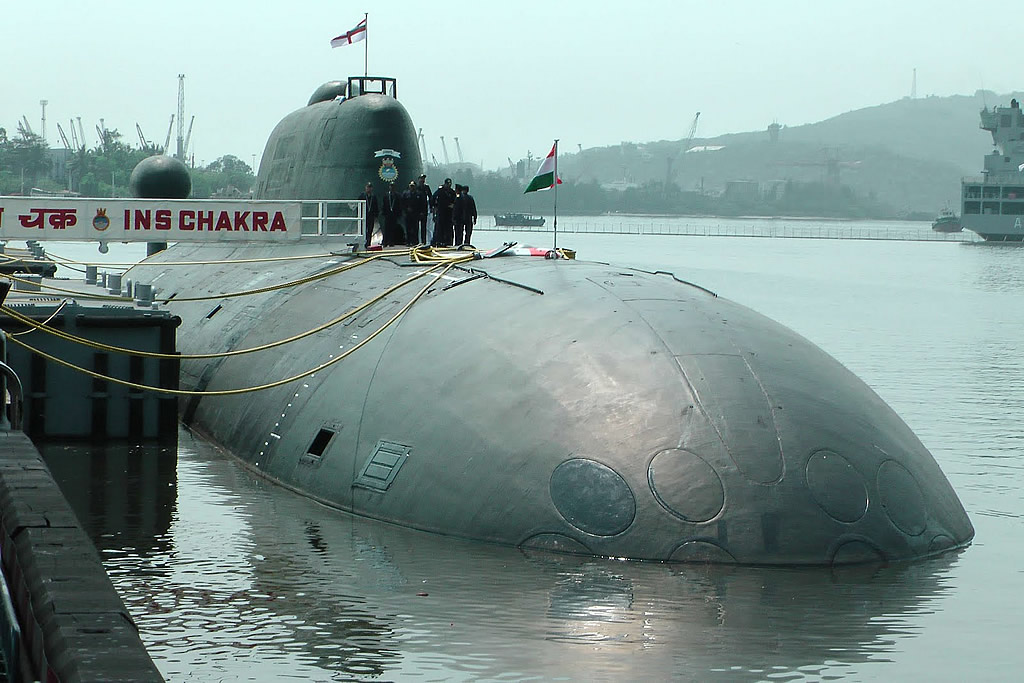
The Indian Navy was originally scheduled to receive a Russian SSN Akula Class nuclear submarine in late 2008, to serve as a training vessel with secondary operational capabilities. Unfortunately, an onboard fire caused numerous fatalities during a check-out cruise, and delayed “INS Chakra’s” delivery until early 2012.
By 2020, aging equipment and a slow procurement bureaucracy means that the best case scenario will leave just 5 Kilos and 4 U209s as the survivors of India’s current operational fleet. The 6 new SSK Scorpene submarines on order would have begun to restore the overall fleet’s mid-decade drop, if deliveries really do begin in 2015. Caution is warranted, however; the project is already quite late, and further delays are possible. The nuclear-powered INS Chakra is still scheduled to be operational in 2020, but it’s technically a training vessel.
Even if one counts INS Chakra, assumes that all Scorpene submarines are operational by 2020, and assumes that India can keep its U209 Shishumars in the water that long, its operational attack submarine fleet would sit at just 16 submarines by 2020, with a rapid drop to 12 or fewer imminent. China’s SSK/SSN fleet will be well past 30 submarines by then, and Pakistan’s 3 Agosta-90B+ AIP submarines are comparable to the Scorpenes.
On the SSBN front, China has submarines that can launch nuclear missiles, and continues to build more modern designs. India can’t do that just yet, but the ATV project is bringing it close. Its 1st ATV project boat, INS Arihant, has successfully launched a short/medium range K-15 ballistic missile.
ATV: Searching for Answers
(click to view full)
Building a nuclear-powered submarine approaches the complexity of a manned space program. India’s native capabilities in submarine design and construction do factor in, but developing a miniaturized reactor suitable for naval use in submarines, and a boat design that can safely and reliably include that reactor, are unique technical challenges. Once those steps are feasible, the submarine’s design must still balance capability, safety, and quiet operation, while incorporating new technologies.
Despite the growing disparity with China, therefore, the ATV project’s going has been slow in India. Reports indicate that it took until the late 1980s before funding began to flow into the ATV project in a more serious manner.
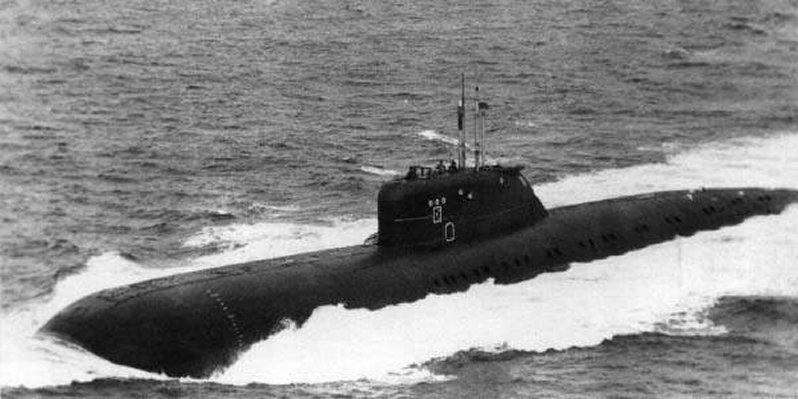
In January 1988, Russia reportedly leased India a single-reactor Charlie-I Class SSGN for a decade of evaluation and training. Unfortunately, it was a bridge to nowhere. India’s ATV program wasn’t moving fast enough to be ready on the other end.

(click to expand)
The first big sign of a breakthrough was the Indian light water[1] development reactor that went critical at Kalpakkam in southern India in October 2004. By 2005, renewed reports began to surface about a follow-on nuclear training submarine lease, and by August 2006, Jane’s Navy International reported Indian claims that they had successfully developed a “fully operational” naval 100MW atomic reactor for the ATV SSN program.
On the question of the submarine’s design, reports varied, but many seemed to converge around the concept of an ATV influenced by Russia’s Project 670M/ Charlie-II class nuclear-powered cruise missile submarine, measuring 110m in length and with a displacement of about 6,000 tonnes.
Given a nuclear submarine’s inherent capabilities, however, the big question has always revolved around weaponry. Was the ATV envisioned as a long range patrol submarine with conventional land attack capabilities, like most SSNs, or did India intend to build an SSBN, armed with nuclear-tipped ballistic missiles as its primary mission?
In a December 2007 press conference, India’s Naval chief Admiral Sureesh Mehta hinted at the ATV’s ultimate SSBN purpose when he said that:
“…in our credible minimum nuclear deterrent plans, the induction of nuclear weapons under sea constitutes the third triad.”
It was only a hint, however, given the ability to launch nuclear weapons from torpedo tubes. Israel’s German-built Dolphin Class is reportedly prepared to do just that, using the country’s locally-developed Popeye Turbo cruise missiles. Yet the Dolphins are conventionally-powered diesel-electric submarines, and Israel’s limited resources mean that they are heavily used for conventional attack submarine and special forces missions.
In 2009, much of the speculation was resolved, as India unveiled its ATV design: the Arihant Class.
The Arihant Class: Destroyer of Enemies
(click to view larger)
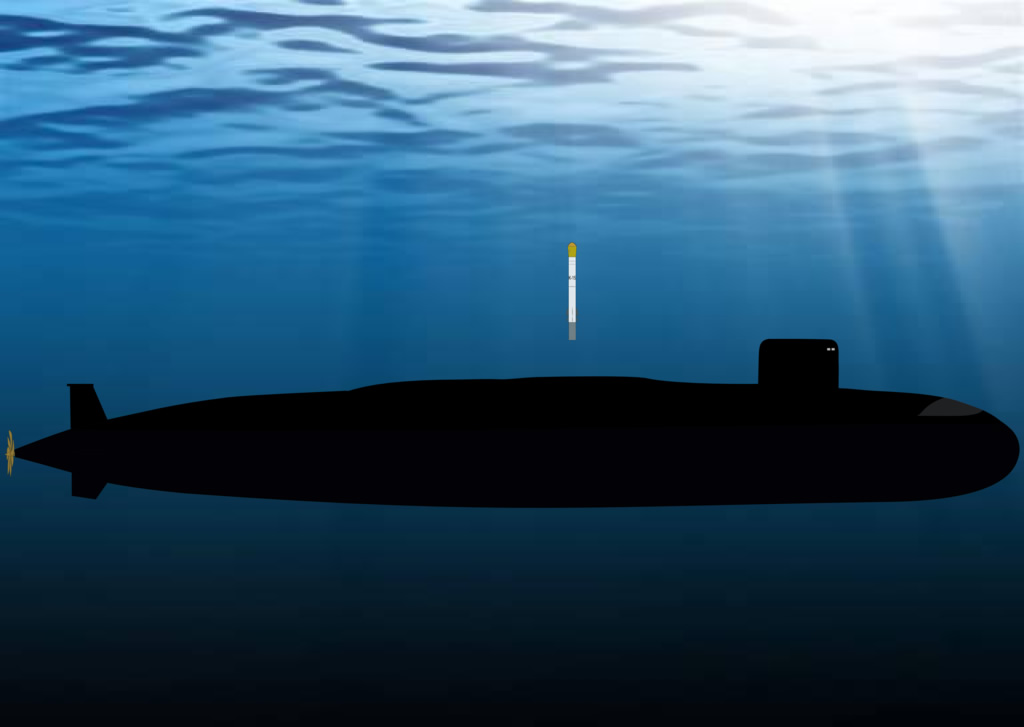
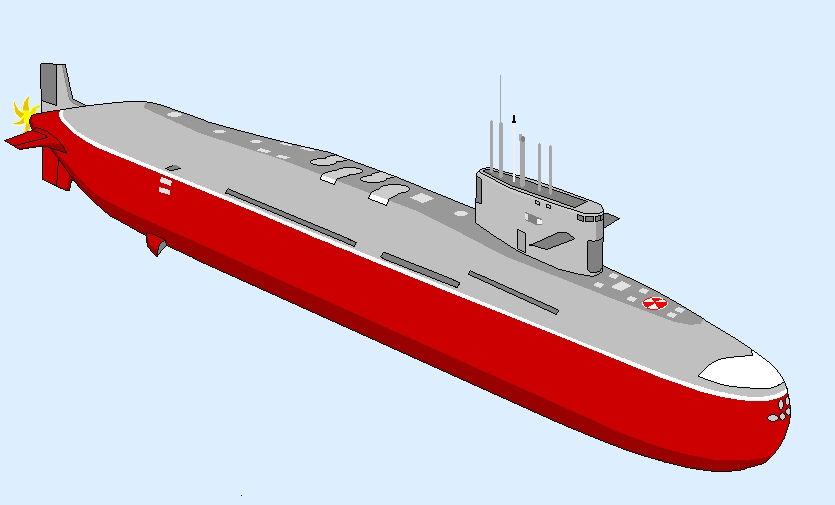
Arihant was built at “The Shipbuilding Centre” in Vishakhapatnam by Indian conglomerate Larsen and Toubro. The boat’s 2009 unveiling made it clear that it has been built to launch ballistic missiles, carrying nuclear warheads. India’s current program involves 4 boats of class: INS Arihant and S-2 Aridhaman have been named, while S-3 and S-4 have yet to be named.
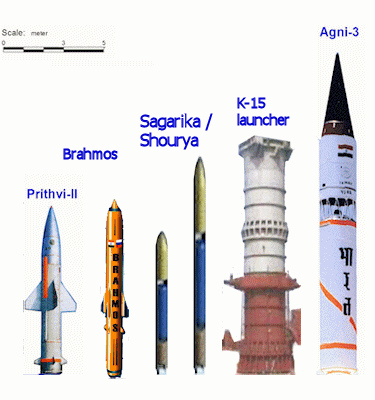
The Arihant Class’ most potent armament will be in 4 silos on its hump. Initial armament will be up to 12 of India’s new 750 km BO5/ K-15 Sagarika medium range ballistic missiles, which can reportedly carry a nuclear weapon. A program is underway to develop the K-4, a 3,500 km range SLBM (Submarine Launched Ballistic Missile) follow-on, derived from India’s land-based Agni III IRBM (Intermediate Range Ballistic Missile).
(click to view larger)
Even so, the submarine’s design is something of a hybrid. Arihant Class submarines would be able to carry just 4 K-4s, in comparison to the 12-16 long-range missiles carried by other SSBN designs. The boats will also include a 6-pack of 533mm torpedo tubes in the bow, giving them the ability to launch cruise missiles, mines, and torpedoes.
For internal power, the Arihant Class will be powered by an indigenous nuclear reactor developed by the Department of Atomic Energy’s Bhabha Atomic Research Centre (BARC), working in cooperation with India’s DRDO defense researchers – and reportedly, with a Russian team as well. The highly enriched uranium reportedly comes from the Rare Materials Project at Ratnahalli, near Mysore, India.
As a form of quick comparison, some dived tonnages for nuclear fast attack (SSN), cruise missile (SSGN), and ballistic missile submarines (SSGN) include:
* 33,000+: SSBN Typhoon class, Russia
* 17,010t: SSBN/SSN Ohio class, USA
* 15,930t: SSBN Vanguard class, Britain
* 14,120t: SSBN Triomphant class, France
* 12,770t: SSN Improved Akula/ Type 971-I/ Schuka-B class, Russia
* 10,885t: SSBN Type 094 Jin class, China (est.)
* 7,925t: SSN-774 Virginia class, USA
* 7,800t: SSN Astute class, Britain
* 7,011t: SSN-688 Los Angeles class, USA
* 6,500t: SSN Type 093 Shang class, China (median: est. 6,000-7,000)
* 6,000t: SSBN Arihant class, India (surface or dived – unclear)
* 5,800t: SSBN Type 092 Xia class, China (median: est. 4,400-7,200)
* 5,400t: SSGN Charlie-II Class, Russia (not currently operational)
* 5,200t: SSN Trafalgar class, UK
* 5,000t: SSGN Charlie-I class, Russia (not currently operational)
* 5,000t: SSN Type 091 Han class, China (median: est. 4,500-5,500)
* 3,950t: SSK Advanced Kilo class, Russia (non-nuclear, in Indian service)
* 2,730t: SSN Rubis Amethyste class, France
Events and Reports
2019
Initial SLBM ready for integration; Chakra reactor fully activated at last; India to lease a 2nd nuke?
[youtube:v=s7vTfM3rswE]
2018
August 21/18: India achieves nuclear triad Indian media reports that the country successfully tested its first indigenous nuclear capable Submarine Launched Ballistic Missile (SLBM). The missile, built under the codename B-05, was launched from the INS Arihant. During the test three missiles were fired from the Arihant at a depth of 20m and about 10km off the Vizag coast. Developed by Defence Research and Development Organisation (DRDO), the 10-meter long B-05 has a strike range of about 750 km and weighs ten tonne. The two-stage missile uses solid propellant and can carry a payload of about 1000 kg. The INS Arihant is capable of carrying 12 B-05 or Sagarika missiles as well as torpedoes and cruise missiles. Indian defense scientists have also been testing longer-range K-series submarine-launched strategic missiles for the past few years. The long range (3,500 kilometers) K-4 missiles have so far been tested three times successfully from underwater pontoons, but the last test from a pontoon in December 2017 failed as the missile did not activate properly during the test. India has also started working on the K-5, which has a range of 5,000 kilometers, as well as the K-6, with its range of up to 6,000 km, for nuclear-powered submarines. This successful test heaves India into a quite exclusive club of nuclear countries. India is now the 6th country that has a nuclear triad, meaning that it can fire nuclear tipped missiles, from land, sea and air.
2013 – 2015
October 13/15: The INS Arihant – India’s first indigenous nuclear submarine – has completed sea trials ahead of planned testing of the Nirbhay cruise missile later this month. The Indian Navy plans to subsequently test a B-05 Submarine Launched Ballistic Missile (SLBM), as the country pursues a nuclear triad capability. The intention of testing this missile was first announced in July.
June 18/14: Not ready. INS Arihant isn’t ready for sea trials yet, and harbor acceptance trials could take a few more months. The 83-MW pressurized light-water reactor went critical in August 2013.
When sea trials begin, they’ll involve 6-8 months of system testing, and a K-15 missile live firing. Sources: Indian Express, “Contrary to Claims, Arihant not Prepared for Sea Trials”.
January 2014. An India Strategic interview with DRDO chief Dr. Avinash Chander sets INS Arihant’s date for initial shakedown voyages around March 2014. The nuclear reactor went critical in August 2013, and is slowly being brought up to 100% capacity in phases. The boat has cleared all Harbour Acceptance Trials, and once the submarine is ready to perform, the missiles (“all the weapons are ready”) are ready for firing trials with dummy warheads.
Dr. Chander also cites the special steel used in Arihant as a DRDO product, which once had to be imported from Russia. Sources: India Strategic, “India’s n-Submarine Arihant Ready for Sea by March”.
Aug 28/13: Lease another? India has been considering a second nuclear submarine lease for a little while now, but the sinking of INS Sindhurakshak has added urgency to the idea. Firstpost even reports that “zealots in South Block have already christened the potential acquisition as INS Chakra III.”
The thing is, the Russians have figured out that no-one else will lease India a nuclear submarine, so the Russians plan to charge a lot more this time.
Not a great advertisement for buying Russian in the upcoming Project 75i, but then, customer relations is not a Russian strong point. The key bellwether? On Sept 1/13, Indian Defence Secretary RK Mathur will lead a tri-service delegation to Moscow for the next High Level Monitoring Group on Defence session. Progress, or lack thereof, will be telling. Sources: BSR Russia, “India all set to lease a second nuclear submarine from Russia” | Firstpost.India, “After INS Sindhurakshak tragedy, India seeks second nuclear sub from Russia”.
Aug 14/13: Sunk. An explosion and fire sink the Kilo Class INS Sindhurakshak while the boat is docked in Mumbai, killing 18 people on board. Firemen manage to contain the blaze to the submarine, so it doesn’t end up sinking the submarine docked next to it as well.
The explosion happens the day before India’s independence day, and the comprehensiveness of the damage leaves observers inside and outside India considering the possibility that it was a terrorist plot. Sources: India’s Business Standard, “INS Sindhurakshak crippled; experts blame battery fire and ammunition explosion” | The Hindu, “Submarine blasts due to ‘possible ignition of armament'” | Hindustan Times, “Russia distances itself from India sub disaster”.
Explosion
Aug 9/13: SSBN. The Arihant’s nuclear reactor goes critical, which is to say that it’s fully activated and providing power. Yes, that’s a long delay (q.v. July 26/09 launch). Sea trials were supposed to be done in 2012, but now they’ll start in late 2013. The submarine will make shallow dives, complete the deep diving trials, and prepare for weapon trials of the torpedoes and test missiles. Those tests will include a BO5 launch, which has previously taken place only from submerged test sites. Reports also list key industrial participants, including:
* Submarine Building Centre (SBC) at Vishakapatnam – assembly
* Bhabha Atomic Research Centre
* Bharat Electronics Ltd (BEL) – USHUS sonar, radars and the Combat Management System.
* Defence Material Department at Hyderabad – Heat exchanger turbine propulsion system.
* Indira Gandhi Centre for Atomic Research (IGCAR) in Kalpakkam – Training and testing.
* Larsen & Tourbo – Hull sections.
* MIDHANI – special steel requirements.
* Jindal pipes
* KSB pumps
* Tata Power Ltd – Control pedestal, works with BAE.
* Walchandnagar Industries – Gear box and shafting.
* “a rubber vulcanising firm in Mysore” – Anechoic tiles.
See: India MoD | NDTV | NDTV analysis.
Reactor fully activated,
Industrial participants
Jan 27/13: K-15 SLBM to BO5. India fires its 14th and last developmental test of the K-15 missile, which has officially been designated “BO5”. Video-gamers would have been more impressed with “BO55”, but it did its job and hit its target, about 6 minutes after being launched from a 50m depth within the Bay of Bengal.
This is the first test that has been opened to reporters. DRDL director AK Chakrabarty told NDTV that the weapon is now ready for integration with Indian submarines, which at the moment means INS Arihant. NDTV | Launch video.
2011 – 2012
K-152 Nerpa becomes INS Chakra; New head of submarine programs; Chakra has readiness problems.
(click to expand)
Dec 24/12: Bad Chakra Karma. The Press Trust of India reports that India is having problems with its SSN, INS Chakra. Like so many other Russian products, support and readiness is the issue:
“The 8,000-tonne submarine has been facing problems with its critical components and Russia has been asked to provide the parts for the vessel which need to be replaced, Navy sources told PTI here. However, they did not divulge the components which would have to be replaced but indicated they are critical for the operations of the submarine.”
To be fair, readiness for India’s overall submarine fleet of Russian Kilos and German U209s was recently placed at just 40% (vid. Jan 14/12 entry).
March 12/12: K-15 SLBM fired. India finally tests its K-15 ballistic missile, which will equip the Arihant. It was reportedly tested from an underwater launching platform, positioned 20 feet underwater and 10 km off the Visakhapatnam coast. The missile then traveled 700 km to its target, though reports don’t comment on its accuracy.
DRDO won’t comment on any aspect, as one expects, but they’ve reportedly scheduled the 2nd test of this new nuclear-capable missile for March 14/12. IBN Live.
1st K-15 missile firing
March 6/12: Paramarine software. Britain’s QinetiQ announces that Larsen & Toubro Limited (L&T) have selected QinetiQ GRC’s Paramarine design software for submarine concept design, in a sale made through QinetiQ GRC’s Indian distributor, Conceptia Pvt Ltd. Larsen & Toubro built Arihant and is one of the largest technology, engineering, construction and manufacturing companies in India’s private sector. Commander (Retd) DK Phule, Senior DGM of Marine Design Centre, L&T:
“We selected Paramarine for submarine concept design and analysis because its integrated structure enables faster iterations of the concept design. The software is not just an input/output algorithm, but has inbuilt knowledge of the basic submarine design research and allows a flexibility for innovative designs. We feel that it may prove to be an excellent tool for validation of concept design of submersibles at bid stage itself. Paramarine delivers a fully integrated submarine modelling, stability, manoeuvring, powering, endurance and early stage design solution. In addition QinetiQ GRC provided us with a comprehensive onsite training programme in concept design and best practical use of the software…”
Paramarine is used by BAE Shipbuilding, DCNS, Northrop Grumman, and MIT, among its customers. The software is too late to play a role in Arihant’s design, but could play a role in designing subsequent boats.
Jan 23/12: SSN. Russia officially hands the K-152 Nerpa over to India, as its name changes to INS Chakra. The ceremony is held in the Zvezda plant, in Russia’s Far Eastern Primorye Territory. Its Indian crew will soon sail it to Visakhapatnam, where the SSN will serve as a training platform and hunter-killer submarine, armed with torpedoes and 3M54 Klub-S missiles.
An at-sea nuclear deterrent will have to wait until 2013 at the earliest, assuming that INS Arihant becomes fully operational by early-2013. That SSBN submarine is slated to begin extensive sea trials in February or March 2013. The Asian Age | Interfax | RIA Novosti | Times of India || Times of India re: Arihant’s schedule.
INS Chakra (ex-Nerpa) handed over
Jan 14/12: SSBN. The Hindu reports that construction of India’s 2nd Arihant Class submarine, Aridamana, leaves it slated for launch in late 2012 or early 2013. Fabrication of the 3rd ATV submarine has begun. Meanwhile, unnamed sources in the Indian Navy continue to express concern about the country’s silent service:
“The decline in the operational availability of submarines [as low as 40 per cent] has seriously compromised the force’s vital sea denial capability. The absence of Air Independent Propulsion… is another debilitating factor.”
Jan 2/12: SSBN.The Times of India places the total ATV program at 4 boats, and transliterates S-2’s bestowed name as “Aridhaman”.
Their report also sets India’s SSN plans at 6 boats over the long term. That will have to take place over the long term, because India hasn’t designed and built its own SSN yet, and the requirements are very different than they are for an SSBN.
Dec 6/12: SSBN. India’s Financial Express quotes Indian naval chief Nirmal Verma:
“I had said that we will do so (commissioning of INS Arihant) in 2012 and by and large we are on track. A firm date can be given only when we have the sea trials which will happen from some months from now… Arihant will require a nuclear regulatory authority certification. BARC (Bhabha Atomic Research Centre) would have a prominent role in this. The submarine will be deployed once this ends…”
July 29/11: Personnel. Rear Admiral MT Moraes takes over as the Assistant Chief of Naval Staff (Submarines) at Delhi, to look after the planning and acquisition of submarines.
Rear Admiral Srikant is also slated to take over as Flag Officer Submarines (FOSM) based at Visakhapatnam. This is the Indian Navy’s class authority on submarines, responsible for defining standards, policies and procedures for their operation and maintenance. Rear Admiral G Ashok Kumar will take over as Flag Officer Sea Training (FOST) at Kochi. India MoD.
July 9/11: SSBN #2. Indian media report that the keel has been laid for India’s 2nd nuclear sub, and the initial work is on full swing. Asian Age | domain-b.
Jan 16 – March 6/11: K-15 missile. India’s DRDO shifts a K-15/B-05 submarine-launched ballistic missile test back. It was supposed to be test-fired from an underwater platform off the Vishakhapatnam coast, but it was pushed back to Jan 30/11, then sometime in February. It finally took place on March 6/11.
That 7th test was successful, giving the K-15 test launches a 5 for 7 record. Times of India | Aviation Week | Indian Express.
January 2011: The publication India Strategic says that India’s nuclear submarine program is farther along than some think, and offers a notional date for Russia’s Nerpa submarine to enter its leased service:
“According to well placed sources, while work on Arihant, the first nuclear submarine that was launched in 2010, was going on as scheduled, construction of the hull and sub components of the remaining two submarines was also underway. Considerable experience has been built from the development of Arihant, and the successive two submarines would be considerably more potent with more power and punch. The Indian Navy also hopes to get the nuclear powered K-152 Nerpa from Russia around March 2011… Indian crews are already training on board the vessel, an Akula-II class 12,000 tonne submarine… There was no official confirmation on what is happening on building the nuclear submarine capability…”
2009 – 2010
K-152 Nerpa’s delays; INS Arihant launched
(click to expand)
Nov 28/10: SSN delay. Another delay, as the Indian Navy refuses to accept the Nerpa until Indian crews reach satisfactory performance. The Chandigarh Tribune:
“The Indian naval teams do not have enough under-sea operating experience on board the nuclear-powered Nerpa, hence the Russians have been told to provide more hours of training, sources confirmed to The Tribune. The training of the Navy teams has been going on for the past one year but the top brass is “not satisfied” with the operational ability that has been acquired so far. This training will take some five months to complete, which means a new delivery deadline of March 2011 has been fixed. This is the third such shift in the deadline for the delivery of the vessel…”
Sept 4/09: SSN. Russia’s RIA Novosti reports that a crew of Indian submariners will take part in sea trials of a Russian nuclear submarine in mid-September 2009, as part of a course of training together with Russian specialists and servicemen. They will subsequently operate on their own under the supervision of Russian instructors.
July 26/09: Arihant Launched. India launches the 6,000t INS Arihant (“Destroyer of Enemies”), its first domestically-produced nuclear submarine. The launch occurs on Kargil Victory Day, with Prime Minister Manmohan Singh in attendance as his wife, Gursharan Kaur, does the honors of launching the submarine. So much for the July 8/09 reports of a quiet, low-key launch on another day.
While Arihant’s sea trials are expected to last for 2 years, most reports quoting expert observers in India and beyond see that as an extremely optimistic forecast, and predict a 3-5 year delay before India has an operationally credible nuclear submarine. The Indian Express adds that:
“Significantly, all three dignitaries who spoke at the function – the PM, Defence Minister and Navy Chief Admiral Sureesh Mehta – made special mention of the Russian “cooperation” received in the project. While it is an open secret that Russia helped in the design of the submarine and miniaturisation of the reactor, this is the first time that its help has been openly acknowledged. The entire Russian design team and the Russian Ambassador to India, V I Trubnikov, were present at the function.”
Another 2 Arihant class boats are currently under construction. Based on quotes from Indian Admirals, the navy will want 5-6 nuclear submarines of this class, in order to ensure that at least one is always at sea with its nuclear missiles. Naval Open Source Intelligence (incl. video) | India’s Business Standard |. Economic Times of India | The Hindu | Sify | Times of India | Times of India re: induction time || Pakistan’s Dawn | Associated Press | Asia Times | China Daily, incl. comparison graphic | South Korea’s Chosun Ibo | Reuters | Singapore’s Straits Times | Australia’s Sydney Morning Herald.
Arihant SSBN (ATV #1) launched
July 24/09: SSN. An unnamed Amur Shipyard official tells RIA Novosti that final sea trials of the Nerpa are continuing on schedule. The goal remains an end of 2009 delivery.
July 10/09: SSN. RIA Novosti reports that sea trials for the Akula II class sub Nerpa have resumed in the Sea of Japan off Russia’s Pacific Coast.
July 8/09: ATV. Indian Express says that the launch of India’s locally-built nuclear submarine has been postponed due to political considerations:
“The submarine was scheduled to be launched on July 26 but the date has now been changed because it also happens to be Kargil Victory Day and the government has no intention of sending any message to the neighbourhood. As of now, the plan is to quietly launch the submarine without fanfare or overt publicity. Even Defence Minister A K Antony is not expected to be present for the launch.”
It will reportedly sail out of Visakhapatnam harbor and into the Bay of Bengal for sea trials.
May 11/09: SSN fixed. Interfac quotes Amur Shipyard director Nikolai Povzyk as saying that:
“The repairs [of the Nerpa] are complete and the vessel is technically ready for the resumption of sea trials… We are completing the enrolment of trial team, which will have to finish trials and deliver the [Schuka-B/ Akula II Class] submarine to the Indian side by the end of this year.”
Meanwhile, domain-b reports that Russian Prime Minister Vladimir Putin has announced plans to provide funds to the Amur Shipyard, in order to complete the Indian order. If so, it might remove the possibility of yet another rancorous, drawn-out contract renegotiation between India and Russia.
Feb 12/09: ATV. The Times of India quotes India’s defence minister A. K. Antony:
“Things are in the final stage now in the ATV (advanced technology vessel) project. There were bottlenecks earlier… they are over now.”
The submarines’ biggest technical problem has revolved around the design of small enough pressurized water nuclear reactors, and their containment.
“[Times of India] sources said such technical problems are a thing of the past now, with a little help from countries like Russia and France.”
Feb 10/09: SSN. A high-level, 4-member Indian delegation led by naval Inspector General Nuclear Safety Vice Admiral K.N. Sushil, heads to Russia on a 2-day fact finding mission to physically inspect the K-152 Nerpa. They will then present a report on the induction of the submarine, and the impact of the recent accident.
India Today | Indopia | RIA Novosti.
Jan 23/09: The Hindu quotes Indian Navy chief Admiral Sureesh Mehta, regarding the Kommersant reports:
“There is no delay as far as we are concerned… The only delay is that it has to go for tests after the incident.”
Jan 21/09: SSN delays. Kommersant reports that Russia has ‘indefinitely’ postponed the Nerpa’s delivery, due to problems encountered in the wake of the November 2008 accident on board. The problems are twofold: lack of a trial crew, and lack of cash. Gennady Bagin, Director of the Amur shipyard’s ‘Vostok’ unit, says that:
“Some members of the trial team, which was on the submarine during last year’s accident have died, some are medically unfit, while some others have refused to go to the sea due to psychological reasons.”
Sailors have always been superstitious, and a ship believed to be ‘cursed’ could indeed have such problems. Bagin says that the new team will not be ready before March 2009 and would have to undergo up to 1 year of refresher courses before it could be authorized to resume pre-delivery trails. Komersant’s reference to a shortage of funds is also ominous, as it probably presages another “renegotiation” of a Russian defense contract with India. Past renegotiations of signed deals have tended to double the original price, or more. Press Trust of India.
2007 – 2008
K-152 Nerpa’s renegotiations, then fire.
Dec 15/08: More SSN leases? Russia’s Itar-Tass news agency quotes Mikhail Dmitriyev, the head of Russia’s Federal Military and Technical Cooperation Service (FSVTS). Dmitriyev’s quote breaks little new ground, but does serve to illustrate a growing level of official acknowledgement:
“There is a real possibility of leasing out to India several of our submarines powered by nuclear reactors for a term of 10 years… This possibility can materialise in the coming years… The talk is not about selling submarines into India’s property, but about their rent by India’s navy.”
Dmitriyev added that the leased submarines would be of the same Akula Class as the Nerpa. Reuters.
Nov 10/08: SSN. India’s Zee News reports on the Nerpa accident, and seems to confirm that K-152 was due to be handed over:
“Indian Navy officials are already there in Russia monitoring the submarine project — both during its construction phase and now during the sea trial phase. So we are keeping a close watch on the developments,” Navy officials here said on Monday.”
Nov 9/08: SSN re-negotiation? The Times of India’s Economic Times reports that K-152 Nerpa was to be transferred to India in July-August 2009, as the leased nuclear training submarine mentioned in reports. A number of other news agencies have made the same claim, but that transfer looks like it will be delayed. It may also be more expensive.
The Economic Times report adds that Russia is demanding more for Nerpa, beyond the initial $650 million agreed to for the lease. Russia had halted construction on the submarine in 1991, following that country’s budget crash. Those kinds of steps lead to loss of talent and expertise, which tends to drive up the cost of resuming a project or a production line. It also raises the risks of mistakes, and the recent disaster involving K-152 will drive Russia’s costs up yet again. The only question is what percentage of those costs they will seek to extract from India. Since India wants to field nuclear submarines, and a training platform like K-152 is a necessary per-requisite, Russia has an extremely strong negotiating position – unless some other country steps in with a similar lease offer.
Nov 7/08: SSN. At least 20 people (17 contractors and shipyard workers, 3 naval officers) are killed and another 21 injured during sea trials of an Akula-II/Nerpa Class nuclear fast attack submarine. The submarine had 208 people on board at the time, including 81 military personnel. It has submerged for the first time on Oct 27/08.
No radiation leak is involved; the incident reportedly occurred in the nose section, away from the reactor. At present, all that is known is that the submarine’s freon gas fire extinguishing systems were triggered. It is unknown whether there was a fire at the time, but reports from Russia claim that autopsies show death from suffocation. Submarine crews are issued portable breathing devices for such eventualities, but for whatever reason, they appear not to have been used. AFP quotes former naval captain Gennady Illaryonov, who blames over-reliance on automated procedures and adds:
“I cannot exclude that among those civilians who found themselves on board, not everyone had the (necessary safety) equipment and that those who did may not have known how to use it,”
Reuters quotes former Russian Navy captain Alexander Nitkin along similar lines. K-152 Nerpa returned to the port of Bolshoi Kamen, near Vladivostok, under its own power. RIA Novosti initial report | RIA Novosti: “What happened on the Nerpa?” | Moscow News: “Lessons from the Nerpa sub accident” | AFP | BBC re: “accident waiting to happen” | India’s Chennai Online | CNN | Press Trust of India (PTI) | Reuters | UK’s Times Online | Washington Post | China’s Xinhua.
Nerpa SSN accident
Aug 9/08: Indian Navy chief Admiral Sureesh Mehta appears to confirm 2009 as the in-service date for the Akula Class nuclear fast attack submarine INS Chakra, under a 10-year lease with Russia:
“After various delays, the nuclear-powered vessel (Akula) for crew training will come some time next year… Though it is an operational submarine… Akula will be used to train our crew before they come up at the platform that will be developed by DRDO (Defence Research and Development Organisation) in two years’ time.”
That ATV project is also delayed, and India will need additional operational experience with nuclear submarines before it is ready to test and fix its own design. The Calcutta Telegraph adds that 3 Indian naval crews for the nuclear submarine have already been trained at the specially set up training centre in Sosnovy Bor near St. Petersburg.
Mehta also reiterated his belief in a submarine-launched nuclear deterrent:
“With nuclear proliferation posing a greater threat along with Weapons of Mass Destruction, our unilateral policy of no-first-use necessitates that India possesses a credible and survivable nuclear deterrent including submarine-launched.”
While existing treaties prevent the sale of long-range nuclear-capable cruise missiles to India, there is nothing preventing the country from developing its own. See: Press Trust of India | IANS | Calcutta Telegraph | AP Pakistan | domain-B.
SSN lease confirmed
June 23/08: SSN. Pakistan’s Online News claims that India will induct a 12,000-tonne Akula-II class nuclear-powered attack submarine into its Naval fleet by December 2009, as a 10 year lease. The article was less clear than it could have been, but the core claims are that nearly 300 Indian naval personnel, or 3 sets of crews, have already been trained to take control of INS Chakra at a specially constructed facility in Sosnovy Bor near St Petersburg, Russia. The article also claims that the sub will be the focus for all future ATV training, while adding that it will be armed with Agni-III ballistic missiles, as well as cruise missiles with a range up to 5,000km.
Analysis of those ballistic missile claims raises questions about their foundations.
The rumored Agni-IIISL is believed to be 2m wide and 12.5m tall, which would place it between the Trident C4 and Trident D5 missile in size. It would be suitable for deployment from an SSBN nuclear missile submarine with big enough launching tubes, but not SSGN cruise missile submarines like the Russian Charlie-II class, which rely on large torpedo tubes for launch and have a secondary naval attack role. Russia’s Akula Class also lacks the ability to launch ballistic missiles.
See also the Dec 6/07 comments below from India’s naval chief Admiral Sureesh Mehta, which seem to separate the training submarine lease from the ATV itself. On the other hand, the reported in-service date of December 2009 does fit with past statements from Indian authorities – as long as the project itself manages to meet its deadlines with a working boat.
Dec 6/07: ATV. India’s Naval chief Admiral Sureesh Mehta vows that the ATV nuclear submarine, currently under construction at Vishakhapatnam by the DRDO, will be commissioned and ready for trials “within 2 years” (2009). The reactor, he said, is now in the process of being mounted on the submarine’s hull.
In the meantime, he said, India was negotiating to lease a Russian SSN Akula Class/ Project 971 nuclear submarine, and hoped the country would get the platform in the middle of 2008 for training Indian naval personnel. India Today claims that the Navy plans to induct the 12,000-tonne Akula class SSN to quickly train personnel to man the ATV. India Today | Daylife news roundup on the topic | New Kerala report.
Senior members on India’s military have issued many statements of this kind on various topics, only some of which emerge from India’s procurement and development bureaucracy and come true. Time will tell, but if the naval reactor is operational and proves to be safe, India will have conquered the biggest part of the SSN challenge.
The Akula lease may prove more problematic. Given Mehta’s reported rejection of Russia’s request for additional funds to finish work on the INS Vikramaditya (ex-Gorshkov) carrier conversion, it would certainly be easy for Russia to use an Akula lease as a very strong bargaining chip, and hold up approval pending satisfaction on other fronts. After all, barring a major and unexpected commitment from the USA, India isn’t likely to find a lease of that type from any other source.
Nov 8/07: SSN. Jane’s Defence Weekly reports that:
“Indian Prime Minister Manmohan Singh is expected to finalise an agreement to lease two Russian Akula II-class nuclear-powered submarines (SSNs) during a visit to Moscow beginning on 11 November. Official sources said one of the 12,000-ton Akula (Bars)-class Type 971 SSNs, currently nearing completion at the Komsomolsk-on-Amur shipyard, would be leased for 10 years for around USD700 million.”
Sept 9/07: ATV. Other sources convey a Press Trust of India report re: the former chairman of India’s Atomic Energy Commission, who reportedly made the surprise announcement on this day that India is building an atomic submarine. Canadian Press | China’s People’s Daily.
1998 – 2006
Submarine reactor design ready; Leases: from INS Chakra I to INS Chakra II.
Aug 18/06: ATV – reactor. The Hindu reports that the reactor for India’s nuclear-powered submarine project at Kalpakkam is working smoothly at its full capacity of 100 MWe. It adds that Defence Minister Pranab Mukherjee inspected the project on July 18 while taking part in the 20th anniversary celebrations of the commissioning of the Fast Breeder Test Reactor there.
July 5/06: SSN. Russia’s deputy chief of federal agency for military-technical cooperation Vladimir Paleshchuk denies media reports about the lease of a NATO classification Akula-2 nuclear powered submarine to India. “Russia is not negotiating lease of project 971 Nerpa atomic submarine with India… We are discussing lease of (submarines), but not of atomic powered submarine,” Paleshchuk was quoted as saying by Itar-Tass. Zee News report.
July 1/06: SSN. The Hindu reports that Russia’s Nerpa fast attack nuclear submarine is launched at the Amur shipyard. Nerpa is a Project 971 third-generation submarine (NATO code name Akula-II). RIA Novosti reports that she will join Russia’s Pacific Fleet in 2007 after undergoing sea trials – Indian and Russian officials have denied reports that she would be leased to India.
February 2006: SSN. The Russian online daily Kommersant reports an announcement by Russian Federal Service for Military and Technical Cooperation head Mikhail Dmitriev, that Russian arms export for the year 2005 touched $6.126-billion. This amount is $826 million more than the amount announced by Russian President Vladmir Putin on Dec 28/05. Kommersant, quoting military sources, attributes the increase to the delivery to China the eighth Project 636 submarine ($225 million) and sale to India of the Akula Project 971 nuclear submarine ($600 million) constructed by Amur Shipbuilder in the Khabarovsk Region. Source.
January 2006: SSN. The Monterey Institute for International Studies’ Center for Nonproliferation Studies reports that:
“Commander-in-Chief of the Russian Navy Admiral Vladimir Kuroyedov has announced that Russia plans to lease two nuclear submarines to India. The statement was made during his visit to the Amurskiy Shipyard [see map] in the Russian Far East in late January 2002. The shipyard is constructing the first submarine India would lease — the Nerpa, a Shchuka B-class [NATO name ‘Akula II’] nuclear-powered attack submarine (SSN). [See Shchuka B-Class SSN Stats.] The second submarine, the Kuguar, is being constructed in the Far North at the Sevmash facility in Severodvinsk. India will provide Russia with financing to complete construction of the two SSNs, while Russia will train four Indian submarine crews and provide India with the submarines for five years, beginning in 2004.”
Sept 17/98: ATV. The Bellona Foundation’s brief concerning the Russian Northern Fleet conveys a report from the Russian Defence Ministry’s official newspaper Krasnaya Zvezda that Russia is assisting India in completing the submarine’s hull and installation of the nuclear reactor. It adds:
“During the past years, ATV has not been receiving sufficient funding, as most of the recourses were spent on development of nuclear bombs. This year, the Indian Defence Ministry has managed to increase funding by 15% for 1998/1999, amounting to more than $10 billion. The future funding has been guaranteed as well… According to Russky Telegraph, the hulls of the submarines laid down in India are almost blueprints of the newest Russian attack submarine, the Severodvinsk-class, which is currently under construction in Severodvinsk, Arkhangel’sk County. Indian submarines reportedly will be outfitted with one PWR reactor with a power output of 190 MW. The same machinery is placed on the Severodvinsk-class submarine.”
1988-1991: SSGN lease. A Soviet Project 670A/ “Charlie Class” SSGN is leased to India, manned by a Russian crew training Indian seamen to operate it. “INS Chakra” under then Capt RN Ganesh operated with the Indian Navy from January 1988 to January 1991. Upon expiration of the ship leasing term in 1991, the submarine was returned to Russia and decommissioned from the Russian Navy.
SSGN lease
End Notes
fn1. In nuclear parlance, a light water reactor uses normal water for cooling. As opposed to a heavy-water reactor, which uses water made with the hydrogen isotope Deuterium (D2O). [return]
Additional Readings
ATV Program
* Bharat Rakshak – INS Arihant
* GlobalSecurity – Arihant – Advanced Technology Vessel (ATV)
* Naval Technology – SSBN Arihant Class Submarine, India
* Global Security – Project 670 Skat / Charlie I; Project 670M Skat-M / Charlie II. Several sources referred to India’s Arihant/ ATV as being derived from the Charlie-II design. Judge for yourself.
Related Submarines
* Naval Technology – SSN Akula Class (Bars Type 971) Attack Submarine, Russia. The rented INS Chakra II is one.
* India & Russia Report – INS Chakra II. Ex-Russian Navy’s Nerpa.
* Global Security – SSGN Chakra. What the Charlie Class submarine India leased from 1988-1991 was called.
* GlobalSecurity.org – Project 885 Yasen / Graney / Granay Severodvinsk class. Note that unless India’s new naval reactor scales beyond the reported 100 MW, it becomes rather unlikely that its SSN will be a copy of a class that sports a 190 MW reactor.
* DID FOCUS Article – India’s Project 75 SSKs: Too Late to Save the Submarine Force? The conventionally-powered side of India’s force, whose decline is beginning to affect the nuclear programs.
The Russian Factor
* NTI – Russia: Nuclear Exports to India Developments
* Center for Nonproliferation Studies at the Monterey Institute of International Studies, via WayBack (last updated February 2010) – Russia: Nuclear Exports to India: Training and Know-How
* India Defence Update (November 2007) – DRDO’s ATV Classified Submarine Project
* Federation of American Scientists’ (December 1996) – The Indian Strategic Nuclear Submarine Project: An Open Literature Analysis
News & Views
* YouTube (Jan 27/13) – India Tests K-15 Sub-surface Launched Missile. Final developmental test of the BO5, which used to be the K-15.
* Calcutta Telegraph (Aug 3/09) – Unveiled: Arihant’s elder brother. They mean the “Plutonium Recyling Project (PRP)” testbed reactor at Kalpakkam. The entire propulsion plant with primary, secondary, electrical and propulsion systems must fit within a 42m x 8m space. It uses a light water/enriched uranium pressurized design, instead of the heavy water/standard uranium approach.
* domain-b (July 30/08) – India’s missile programme: A summary
* WMD Insights (December 2007 – January 2008 issue) – Questions Persist on Reported Russian Lease of Nuclear Sub to India. A more up-to-date open source review of the nuclear submarine leasing issue, penned by a CNS staffer.
* Center for Policy Research, New Delhi (2003-04) CPR Occasional Paper 2003-04: Dealing with Reality: India’s Thermonuclear Force as Strategic Safety-Net and Security Stabilizer in the Indian Ocean Region [PDF]. Page 12 refers to an Indian ATV design modeled on Russia’s Charlie-II Class SSBN [link restricted now].
* The Rediff, via WayBack (Oct 10/03) – India’s nuclear infrastructure nearly ready
Background Data: China
* GlobalSecurity.org – China/ Ships
* Sino Defense – Type 093 Shang Class Nuclear-Powered Attack Submarine
* Sino Defense – Type 091 Han Class Nuclear-Powered Attack Submarine
* Global Security – Type 091 Han Class
Tag: indiassn