

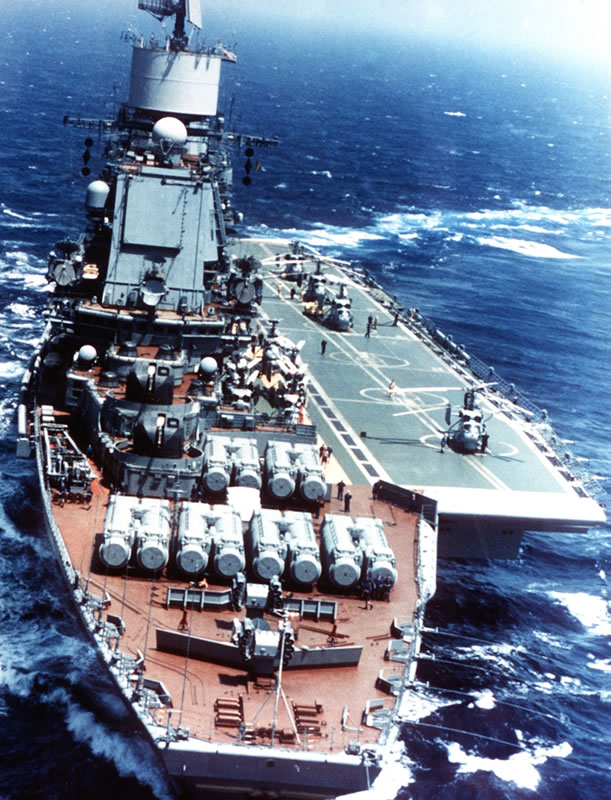
(click to view full)
This free-to-view DID Spotlight article offers an in-depth look at India’s troubled attempt to convert and field a full-size aircraft carrier, before time and wear force it to retire its existing naval aviation and ships.
India faced 2 major challenges. One was slipping timelines, which risked leaving them with no aircraft carriers at all. The other challenge involved Vikramaditya’s 3-fold cost increase, as Russia demanded a re-negotiated contract once India was deeper into the commitment trap. The carrier purchase has now become the subject of high level diplomacy, involving a shipyard that can’t even execute on commercial contracts. A revised deal was finally signed in March 2010, even as deliveries of India’s new MiG-29K naval fighters got underway – but now Russia still has to make good. This article tracks the changes India is making to its new aircraft carrier, key characteristics, and a full history of contracts and events affecting this carrier and its planned aircraft contingent.
INS Vikramaditya: India’s New Carrier

(click to view full)
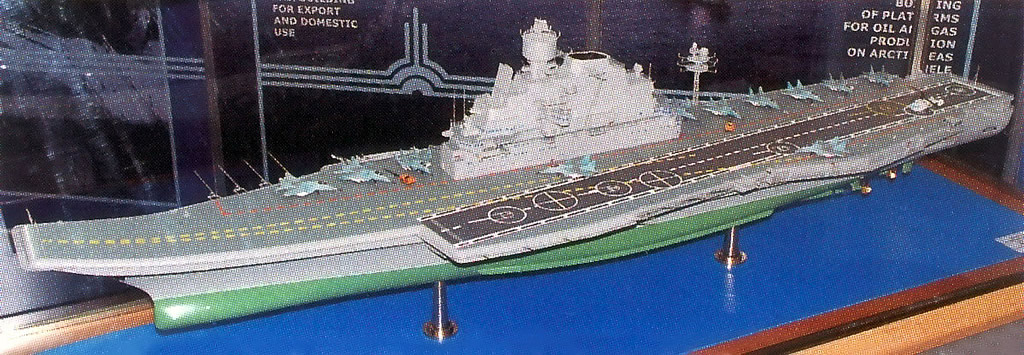
Russian naval doctrine saw the 45,000t Admiral Gorshkov as a missile cruiser with a complement of aircraft. India wanted a full-fledged aircraft carrier. Getting there required extensive modifications.
The cruiser-carrier’s guns, anti-shipping and air defense missile launchers on the front deck were removed. In their place, India installed a full runway and ski jump, widened the deck in numerous places, and installed a bigger and stronger rear aircraft elevator.
Core ship systems were also slated for modernization. New boilers were installed to run on diesel fuel, for instance, and communications were improved. One nasty surprise that might have been expected was the need to replace most of the ship’s old wiring. Adding more reliable, higher capacity wiring will help make Gorshkov a fully modern ship, but it has been very labor intensive and expensive.
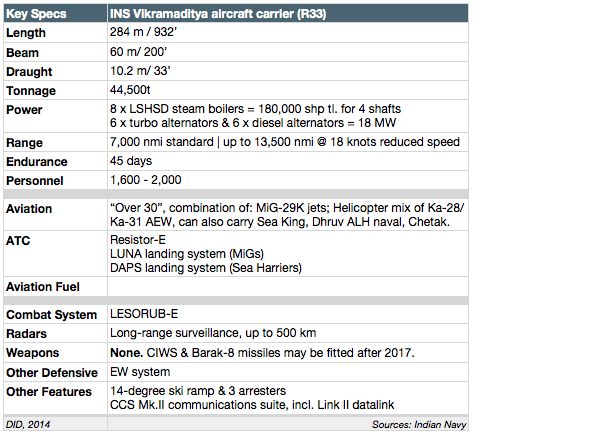
INS Vikramaditya’s weakness will be defensive. An official Indian CAG report says that INS Vikramadirya will have no aerial defenses until 2017. When it does, those weapons will need to integrate with the Russian LESORUB-E combat system, which means that weapon installation won’t take place until the carrier’s initial refit. The Navy would like to field the Barak-8/ MR-SAM missile for medium-long range defense, but integration could be challenging. They also want a close-in weapon system or 2, and intend to hold a competition rather than adopting the gun/missile Kashtan CIWS system carried by Russia’s own Admiral Kuznetsov carrier, or buying Russia’s lower-end 30mm AK-630.
Anti-submarine defenses are equally concerning. The Indian Navy only has 10 Ka-28s, and only 4 of those are operational. That deficit, plus a Sea King fleet that is small, old, and needs improvements, makes anti-submarine defense a big concern. India may end up outfitting its own Dhruv light helicopter with 1st-generation locally-designed ASW gear, and basing some on the carrier. That’s a fine stopgap solution, but a questionable medium-term option for defending their fleet flagship. A global tender for larger and more advanced ASW helicopters has been delayed since 2008.
Failure to add a modern towed sonar to its surface combatant ships juts makes things worse. Anti-submarine defenses will have to be improved within the fleet as a whole, if India intends to field a viable carrier force.
Gorshkov-Vikramaditya: Aerial Complement

(click to view full)
Many of Gorshkov’s key modifications are aircraft-related, including the new arrester gear and ski jump. That’s just the down-payment on the final cost of an operational carrier, because the aircraft are bought separately.
The original cruiser-carrier’s complement was 12 Yak-38 Forger V/STOL(Vertical/Short Take Off and Landing) fighters, 12 Ka-28 helicopters, and 2 Ka-31 airborne early warning helicopters. The removal of the Gorshkov’s forward missiles, addition of the ski ramp, and other modifications will improve the ship’s air complement, but the nature of its original design means that INS Vikramaditya will still fall short of comparably-sized western counterparts. Carriage ranges given for the refitted Vikramaditya seem to converge around 16-24 fighters, and 10 compact Ka-28/31 or Dhruv helicopters.
In contrast, the 43,000t FNS Charles de Gaulle nuclear-powered aircraft carrier is about the same size, with a 40-plane complement that leans heavily to fighter jets. The FS Charles de Gaulle will also have an advantage in surveillance coverage, thanks to catapults that let her operate E-2C Hawkeye 2000 airborne early warning planes. INS Vikramaditya won’t have that option, because it doesn’t have a launch catapult.
The carrier’s AEW complement, if any, is almost certain to use India’s Ka-31 helicopters instead. That means a smaller radar, on a slower platform, offering much less coverage.

(click to view larger)
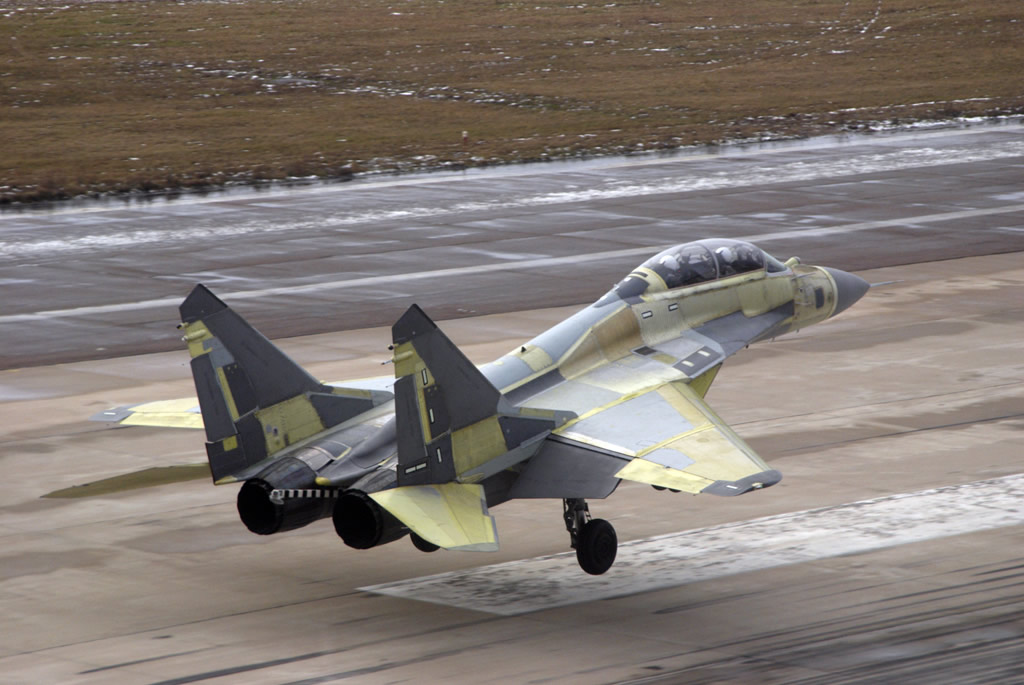
Vikramaditya’s fighters will also be Russian. Its air wing will draw on a fleet of 45 Indian MiG-29Ks, thanks to about $1.95 billion in contracts. The initial $740 million contract for 16 MiG-29K (12 MiG-29K, 4 two-seat MiG-29KUB) aircraft plus training and maintenance was confirmed on Dec 22/04. The contract’s option for another 29 planes, rumored to be worth another $1.2 billion, was signed in March 2010. The MiGs would be operated in STOBAR (Short Take-Off via the ski ramp, But Assisted Recovery via arresting wires) mode.
MiG’s design was reportedly selected over the larger and more-capable SU-33 naval fighter for several reasons. One is that India already operates a large fleet of MiG-29s, and has been improving its ability to maintain them in country. Another reason is that India also wants to operate naval fighters from its locally-built 37,500t – 40,000t “Project-71 Air Defence Ship” (Vikrant Class) STOBAR carriers. The SU-33s wouldn’t be an ideal choice for a carrier that size, Britain hadn’t yet put its Harrier feet up for sale, and India’s own Tejas Naval fighter project remained a high-risk option. That left the MiG-29K as India’s only rational choice, and Russia followed with an order to equip their own carrier.
Waiting for Gorshkov – A History

On Jan 20/04 India and Russia signed a $947 million deal to refurbish and convert the Soviet/Russian Admiral Gorshkov into a full carrier, to be re-named INS Vikramaditya. The announced delivery date for INS Vikramaditya was August 2008 – an ambitious schedule, but one that would allow the carrier to enter service in 2009, around the time as their 29,000t light carrier INS Viraat (formerly HMS Hermes, last of the Centaur class) was scheduled to retire. The new carrier would berth at the new Indian Navy facility in Karwar, on India’s west coast.
That was the plan. Unfortunately, the Vikramaditya story is sadly typical of both Indian defense procurement, and of Russia’s defense industry.
Denial, Delay & Disagreement
(click to view full)
Initial reports of delays sparked controversy and denials in India, but subsequent events more than justified them. Slow negotiations and steadily-lengthening delivery times quickly pushed delivery of the Gorshkov back to 2010, and then to 2012 or later, even as Russia’s asking price more than doubled. India’s sunk construction costs, Russian possession of the Gorshkov, the difficulty in finding a substitute carrier to replace the Gorshkov sooner than 2013, and the Chinese push with the Varyag, have all combined to give the Russians substantial leverage in their negotiations.
They exploited that leverage to the fullest. Cost estimates and reports concerning the Gorshkov’s final total now hover in the $2.9 billion range, following the revised project agreement of March 2010.
As is customary with Indian defense procurement, transparency arrived only after all other alternatives had been exhausted.
When reports first surfaced that this delivery date would not be met, India’s Ministry of Defence initially tried to deflect the issue with denials and obfuscation. In May 2007, Chief of Naval Staff Admiral Sureesh Mehta said the ships will be delivered:
“…by late 2008 or early 2009… Our officials, who are stationed at the spot, have said that the work is going on as per schedule and we can have a month long delay once the work is completed as that part of Russia is frozen for a long time.”
Later comments on this issue included this May 1/07 quote:
“The work is only three to four months behind schedule and we can expect the aircraft carrier to be delivered by late 2008 or early 2009”
Neither assessment turned out to be true, and subsequent updates proved the critics to be correct. After the delivery delays could no longer be denied, the initial approach was to minimize their length. February 2008 news reports, however, began to give figures of up to 3-4 years before refurbishment and testing could allow the ship to enter service. Subsequent reports by Indian and Russian sources stressed 2012, or even later.
Those estimates, at least, turned out to be true. The carrier didn’t see operational service of any kind until May 2014, and it will take even longer before it’s fully ready to fight.
India’s Carrier Collapses
(click to view full)
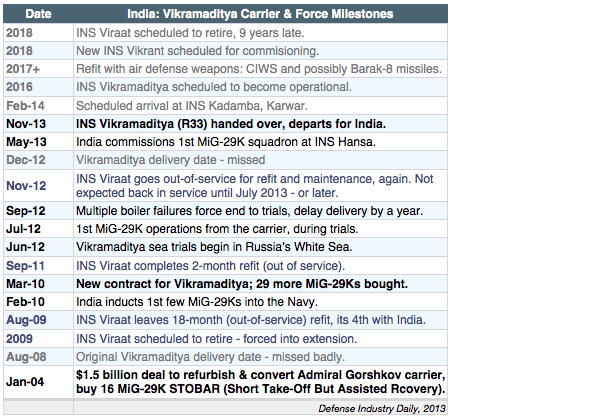
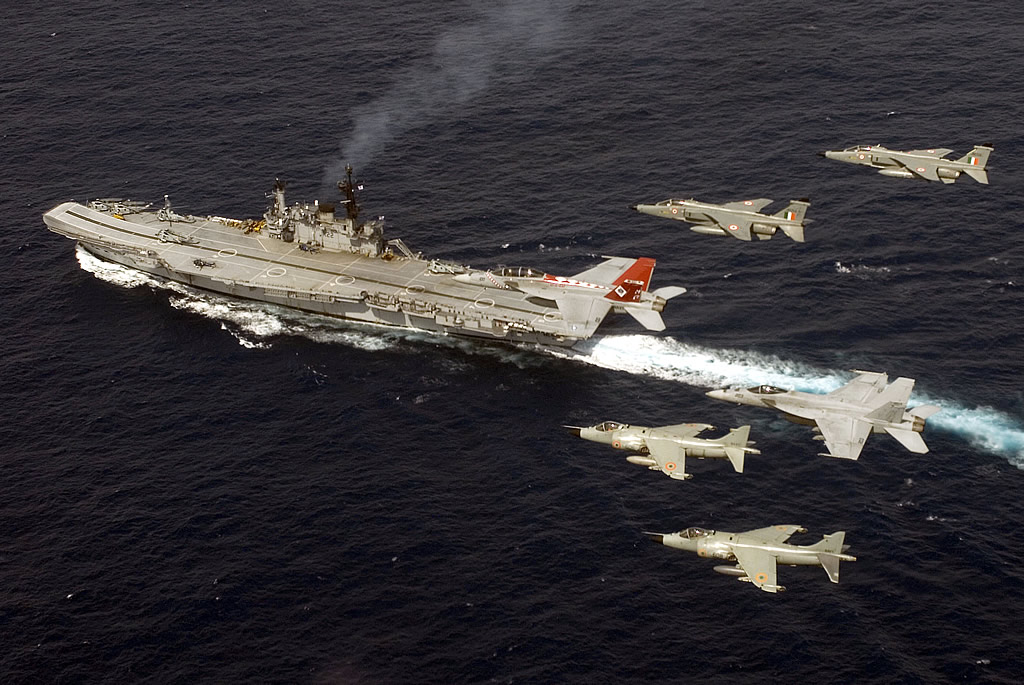
The delays have left India’s Navy with a serious scheduling problem, and created periods with no significant carrier force.
INS Viraat’s retirement was scheduled for 2009, but Vikramaditya’s delays forced India into another refit, leaving the country without a carrier for 18 months until August 2009. Even with the refit, Viraat is nearing the limits of her mechanical life, and shortages of flyable Sea Harrier fighters are creating issues of their own. Subsequent refits and overhauls will try to keep the carrier, whose keel was laid in 1944, running until 2018. When she did return after an unexpectedly long refit, she had just 11 flyable Sea Harrier fighters available.
India’s other option was the locally-built Vikrant Class “Air Defence Ship” escort carrier project, which received formal government approval in January 2003. It was supposed to field a 37,500t – 40,000t carrier by 2013-2014; instead, Vikrant’s operational acceptance into the fleet slipped to 2018, then 2019.
To the east, China bought the engineless hulk of the 58,000t ex-Russian carrier Varyag in 1998, towed her to China, and worked hard to refurbish her. The ship began trials in 2012. By September 2012, reports surfaced that the ship had been re-named “Liaoning,” in honor of the province where it was retrofitted. She began sailing before the end of the 2012, and the ship has launched and recovered J-15 (SU-33 derivative) naval fighters. In May 2013, China declared an official naval aviation capability. Reports have China aiming for 4 carriers in the medium term.
Contracts & Key Events
2014 – 2020
Arrival in India; Competition for air defense systems; Maintenance agreement with Russia.
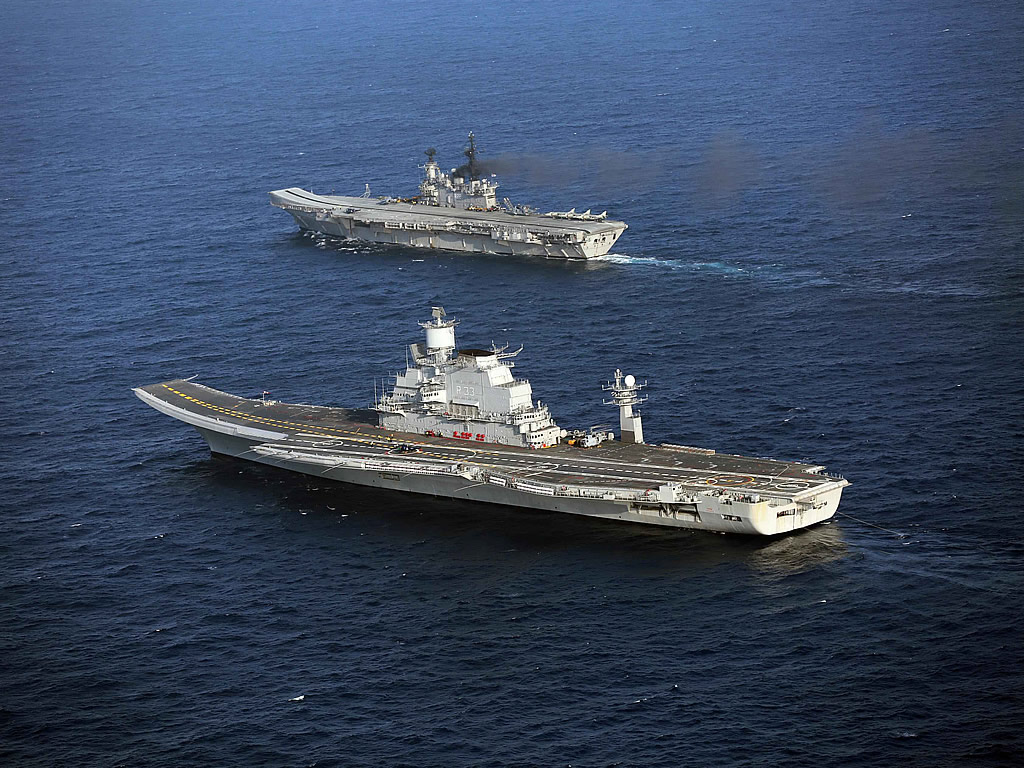
2020
January 13/20: Sucsessful Landing Of LCA The indigenously designed and developed Light Combat Aircraft (N) Mk1 has made a successful arrested landing on the India’s biggest warship INS Vikramaditya on January 11. “With this feat, the indigenously developed niche technologies specific to deck based fighter operations have been proven,” Indian Navy Spokesperson Vivek Madhwal told IANS. This will now pave the way to develop and manufacture the twin engine deck based fighter for the Indian Navy, he said. The Navy has created an aircraft carrier setting on the ground at its air base in Goa to operate these deck-based fighters, which use ski jump to take off and are recovered by arrestor wires on a carrier or STOBAR (short takeoff but arrested recovery) in Navy parlance.
2019
May 6/19: New Carrier? India plans to build an aircraft carrier along the lines of the British HMS Queen Elizabeth as part of the „Make in India“ negotiations. The Indian Navy wants to buy detailed plans for the 65,000-ton British warship to build a so-called “copycat supercarrier“, named INS Vishal. The Sunday Mirror reports that „an Indian delegation has already visited Rosyth dockyard in Scotland where HMS Queen Elizabeth was assembled and where a second supercarrier, HMS Prince of Wales, is now being built“. The report notes that such a new Naval carrier would serve alongside India’s 45,000-ton carrier INS Vikramaditya. The design for UK aircraft carriers is owned by the British and French aerospace giants BAE and Thales. The reported India-UK Naval deal would follow the sale of Britain’s Falklands War carrier HMS Hermes to India in 1987.
2018
December 4/18: Vikrant 2020 The Indian Navy (IN) says that the INS Vikrant, the country’s first indigenous aircraft carrier will begin sea trials in 2020. The carrier has entered its final phase of construction at Kochi shipyard. The INS Vikrant, is a 37,000-tonne Project 71 carrier with a short take-off but arrested recovery (STOBAR) configuration that has been under construction since 2009. Navy Chief Admiral Sunil Lanba is currently pressing for building a second indigenous aircraft carrier. “The case for a second IAC has received necessary impetus though it is still a decade away. Construction would be spread over 7-10 years. We will see the start of construction in three years,” Admiral Lanba told media representatives on the sidelines of a Navy conference on Monday.
October 24/18: Sea trials India’s sole operational aircraft carrier will start sea trials by the start of next week. The INS Vikramaditya recently completed its second refitment at Cochin Shipyard, a process which cost close to $96 million. Captain Puruvir Das, the carrier’s commanding officer, told the New Indian Express “soon, we will start the sea trials, which will take place off the Kochi and Goa coasts. We are hopeful of returning to the Western Naval Command without delay.” During the refitment major work was carried out, including an extensive hull survey and repainting, as well as some large scale repair of the ship’s shaft system. “The refitment will enhance the operations of Vikramaditya. It will be ready for sea operations once the trials are completed,” added Captain Das. The Kiev-class former Russian Navy aircraft carrier has been in service since 2013 and upgrade of its infrastructure were started in September 2016.
July 12/18: India’s plan to build and commission its second indigenous aircraft carrier has been postponed again. Steadily declining budgets, technological hurdles and prolonged delays by the Ministry of Defense in approving the program make it very unlikely that the Vishal will enter service by 2030-2032. The proposed 65,000–70,000 ton conventionally powered ‘flat top’ carrier would be capable of embarking 50–60 fixed- and rotary-wing platforms and cruise at 30 knots, but it would also cost between $12 – 13 billion. India’s Navy has currently one carrier in operation the refurbished Soviet-era Kiev-class Vikramaditya. By 2018–19, Vikramaditya was to have been supplemented by INS Vikrant, the 37,000-tonne Project 71 carrier with a short take-off but arrested recovery (STOBAR) configuration that has been under construction since 2009 at Cochin Shipyard Limited, southern India. At this point the Vikrant is scheduled to enter service by October 2020. The Indian Navy plans to field three carrier battle groups under its Maritime Capability Perspective Plan.
2015
December 10/15: The INS Vikramaditya is set to get its first overhaul, the Indian Navy has announced. The Kiev-class former Russian Navy aircraft carrier has been in service since 2013 and upgrade of its infrastructure is set to be under way by September 2016. Works will be undertaken by Cochin Shipyards (CSL), who recently released India’s first indigenously built aircraft carrier, the INS Vikrant, to the Navy. CSL will no doubt be utilizing the experiences learned during the Vikrant’s construction during the refit.
December 8/15: India’s first indigenous aircraft carrier will be delivered to the Indian Navy by December 2018. The INS Vikrant was undocked in June by Cochin Shipyard (CSL) who are anxious to start construction of a second vessel, although no formal agreements have been made. Some minor delays have been experienced due to lack of availability of warship grade steel, and delays in Russian approval over designs and equipment supply. When commissioned, the INS Vikrant will become the third aircraft carrier in service in the Indian Navy, which has been increasing its fleet size to boost India’s presence in the Indian Ocean.
July 16/15: India’s INS Vikramaditya is scheduled to leave Karwar next week after a recent refit. As per previous reports, the carrier has been updated with new air defense systems, including the Barak-1 missile system and the Russian AK-630 close-in weapon system (CIWS). The Indian Navy carried out feasibility studies for the integration of the two systems in June 2014, with the original plan being to fit the vessel with the Barak-8 missile system, jointly developed with Israel; however, development delays led to the carrier being fitted with the older Barak-1 system.
Dec 4/14: Vikrant Schedule. Vice Admiral Anil Chopra, Commander-in-Chief of the Western Naval Command since last June and the 2nd most senior officer in India’s navy, tells reporters that INS Vikrant is now to be commissioned in 2019, months later than the previous already-postponed deadline. Plans to build a second carrier in the class will be “initiated soon.” Source: Free Press Journal.
Aug 25/14: Infrastructure. Defense World claims that India is preparing to field a 2nd MiG-29K squadron in the east, as part of a major upgrade that will grow INS Dega in Vishakapatnam from 1100 to 1500 acres. An initial outlay of INR 4.5 billion (about $75 million) was reportedly approved this month to build MiG-29 fighter and Hawk trainer support and infrastructure there, in preparation for MiG-29K arrival some time in 2015. The Navy is also looking at reactivating Bobilli, a disused, World War II airfield about 45 nautical miles away, as a secondary divert base. The Business Standard:
“The volume of naval aviation that the airbase is slated to handle will bring it almost at par with the largest naval airbase INS Hansa [on the western coast, in Goa]. The workload will include accommodating the full squadron of MiG29K/KUBs as well as the [Navy’s] Advanced Jet Trainer (AJT) Hawks, nine of which are already operational and eight more will arrive by June 2016, along with their required infrastructure and support set up. INS Dega will also field a large chunk of aircraft which form a part of future acquisitions like Multi Role Helicopter (MRH), 56 Naval Utility Helicopters, Naval Multi Role Helicopters (NMRH) as well as Unmanned Aerial Vehicles (UAVs).”
Some reports characterize this move as preparation for the new Vikrant Class carriers under construction. INS Dega will eventually be used that way, but the carriers aren’t going to arrive before 2019. Until then, INS Vikramaditya will have squadrons available on 2 coasts. A parallel ‘Project Varsha’ program would add a major new naval base near Rambilli, 50 km south-west of Visakhapatnam, which will be able to house aircraft carriers and nuclear submarines. Indian history strongly suggests that Project Varsha won’t be ready in time to welcome INS Vikrant. Sources: India Today, “EXCLUSIVE: Navy initiates ‘Look East’ for lethal MiG29K” | Economic Times, “Navy to deploy MiG 29Ks in Vishakhapatnam; move aimed to strengthen eastern coast” | Business Standard, “New naval base coming up near Visakhapatnam”.
June 16/14: Dhruv ASW? India is reportedly looking to outfit their locally-designed HAL Dhruv helicopter with some anti-submarine equipment from the state’s DRDO research agency:
“The Hindustan Aeronautics Limited-built ALH Dhruv is undergoing trials for carrying out role of detecting hostile submarines using systems developed by the DRDO, Defence officials said…. The system was put under trial at Vishakhapatnam and would be tried further before any final decision is taken on deploying the twin-engine chopper on board the carrier, they said.”
The Dhruv is in the same size and weight class as AgustaWestland’s Lynx, but the final result of this program is likely to fall rather short of capabilities possessed by the AW159 Wildcat, or of larger machines like the NH90 NFH or MH-60R Seahawk. On the one hand, adapting an existing HAL platform circumvents India’s broken foreign procurement system, creating a second-rate but deployable near-term solution for their astonishing weakness in this area (q.v. March 31/14). It also creates a platform that can be improved over time, which is good for India and its industry.
On the other hand, providing sub-standard protection to the flagship of one’s naval force is a terrible idea if it’s the only proposed solution. The question is whether the long-discussed foreign tender (q.v. Feb 25/14) for helicopters like the NH90 will also go forward, in order to equip platforms like India’s high-end destroyers (q.v. Oct 15/13) and add a higher tier of shipborne ASW protection for key assets. Sources: IBD Live, “Dhruv chopper likely to be deployed on-board INS Vikramaditya”.
June 4/14: “Slammer”. Welcome to the world of assisted carrier landings. A 2-seat MiG-29KUB pilot just found out the hard way, after flying in from INS Hansa’s shore base. He was going to miss R33’s first 2 arrester wires, but as he throttled up for a bolter takeoff, his jet caught the 3rd wire with the arrester hook. The MiG’s nose reportedly pointed skyward before slamming back to the deck.
Everyone is fine, but the nose wheel is going to need repair or replacement, and the pilot may wind up with a new nickname. We recommend “Slammer,” in the long and proud tradition of handles that sounds cool but refer to something embarrassing.
There will be more incidents like this, as Indian aviators become more familiar with this new landing mode. Sea Harriers will absolutely kill you for a misstep during vertical landings, so it isn’t like this is some new frontier of required professionalism. It’s just that a full-speed trap is a very different animal, with its own skills and dangers. Sources: Calcutta Telegraph, “Safety scare on Gorshkov”.
May 16/14: ASW weakness. Ajai Shulka says the reason that operational safety was the reason that Vikramaditya was joined by an armada of Indian warships for the last leg of its journey to Karwar. The problem is the lack of an effective towed sonar on Indian surface combatants, due to obstruction by the defense bureaucracy. Coming as it does on top of the MoD derelict performance with respect to anti-submarine helicopters, it creates a huge naval weakness that would doom India’s carriers in a shooting war. Read “Anti-Submarine Weakness: India Has a Problem” for full coverage.
ASW weakness
May 7/14: Navy chief Admiral Robin Dhowan says that:
“The navy has inducted aircraft carrier INS Vikramaditya which is now operationally deployed with MiG 29K aircraft embarked and being flown by Indian naval pilots…”
Looks like India has made real progress since the 1st all-Indian flight (q.v. Feb 7/14), and reports also indicate that the carrier has taken part in a recent war game with India’s Western Navy. INS Vikramaditya will remain India’s core carrier option for some time, as Vikrant isn’t expected to be ready until the end of 2018. Sources: India’s Business Standard, “INS Vikramaditya is operationally deployed with MiG- 29K aircraft: Navy Chief”.
Accepted into fleet
March 31/14: ASW weakness. Not only will India’s carrier sail without onboard air defenses, it and its escorts can’t field an effective set of anti-submarine helicopters.
“The Navy is today being asked to make do with four Ka28 helicopters that have the technology of mid-80s for training pilots, doing ASW roles against modern submarines for the five Rajput Class destroyers as well as the aircraft carrier Vikramaditya,” said a source.”
The other 6 Ka-28s have been mothballed for spares, while a mid-life upgrade that would restore the 10 to flying condition and give them modern sensors has been trying to get underway since 2008. Bids were finally opened in 2012, and a combination of Russia’s Kamov and Italy’s Finmeccanica won the INR 20 billion project. Contracts are set, and both the Cabinet Committee of Security and India’s CBI investigators cleared the deal. Defence Minister Antony’s office has been sitting on that for over a month, however, while playing extreme hardball with AgustaWestland over the VVIP helicopter deal.
Meanwhile, the Sea King fleet has problems of its own, and a proposal to buy up to 16 modern naval helicopters from foreign sources remains stalled (q.v. Feb 25/14, Oct 15/13, Aug 17/12). Sources: Daily Mail India, “Navy left ‘defenceless’ after being forced to ‘make do’ with outdated Soviet hardware”.
ASW weakness
March 13/14: Support. India has decided to stick with Sevmash shipyard in Russia’s northern Arkhangelsk region for long-term post-warranty servicing of INS Vikramaditya. The relevant protocol was signed in Goa on Wednesday, March 12, at the 23rd Indo-Russian Inter Governmental Commission on Military Technical Cooperation’s (IRIGC-MTC) naval subgroup meeting. The full 20-year contract is expected in May 2014.
Sevmash engineers and specialists are already providing warranty maintenance services for the 1st year of operation, and there was no question that India would have to extend the relationship. Even an aggressive indigenization program would take a few years to gear up and provide adequate service. Still, 20 years is a puzzle. Given India’s past problems with Sevmash specifically, and with Russian maintenance and support generally, their flagship aircraft carrier appears to be an odd exception to the government’s recent indigenization push. Sources: India & Russia Report, “Sevmash chosen for INS Vikramaditya post-warranty servicing”.
[youtube:v=ELgua-Slx2o]
March 12/14: Weapons. India reportedly rejected Russian offers to mount their Kashtan gun/missile close-in air defense system on INS Vikramaditya, which were reportedly made during a recent meeting of the India-Russia Inter-Governmental Commission on Military Technical Cooperation. It’s not a final rejection, but their experience with Russian maintenance is reportedly pushing them to hold an open competition. That could be a fine opportunity for a range of systems. KBP’s Kashtan would be eligible to bid, but so would bolt-on, independently-operated options like Raytheon’s SeaRAM missiles or Phalanx 20mm gun, or systems like MBDA’s Mistral-based Simbad/Tetral.
INS Vikramaditya is eventually supposed to use the medium range LR-SAM/ Barak-8 as its main air defense weapon. A close-in defensive option will be needed until India tests and fields it, and it will remain a good idea even after LR-SAM has been installed. Sources: Defense Radar, “Indian Navy To Open Search for Carrier Air Defense System.”
Feb 25/14: Helicopters. India’s Ministry of Defence clears a whole series of defense projects: upgrades for 37 airbases, modernization of 5 ordnance depots, 4,000 hand-held thermal imagers for soldiers, 5,000 thermal imaging sights for tanks and infantry combat vehicles, 44,000 light-machine guns, 702 light armoured multi-purpose vehicles, and 250 RAFAEL Spice IIR/GPS guided smart bombs. The deal’s not done?
A program to buy M777 howitzers, 56 transport aircraft to replace the ageing Avro fleet, produce 4 amphibious LPDs – and 16 naval multi-role helicopters to restore an effective anti-submarine capability. With elections looming, it will take some time before any of them are restarted. Sources: Times of India, “Decision on four key defence deals put off”.
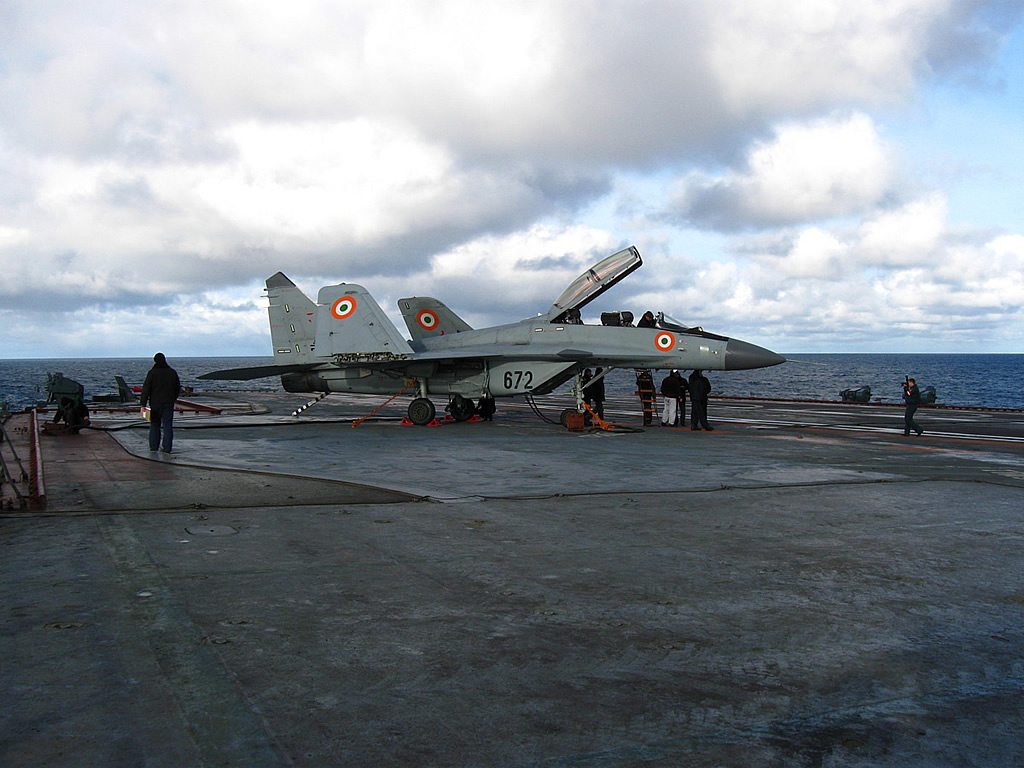
Feb 7/14: Indian landing. A MIG-29KUB fighter lands on Vikramaditya. That has happened before, but it’s the 1st time with an Indian naval officer at the controls. Indian naval aviation has relied on Sea Harrier vertical-landing jets for decades, which makes this arrested landing a milestone for the Navy as a whole, as well as for the ship.
While the 303 Sqn. Black Panthers were commissioned in 2013, the ship will take another 3-4 months before they’re fully ready. It might even take longer, but reports of troubles on the ship’s journeys are probably exaggerated. The complaints amount to postponing refueling with INS Deepak in rough seas off of Portugal, and a reported boiler breakdown. The first complaint is trivial, but the boiler issue could be a problem, given past issues with that machinery. Even India’s Navy won’t know how big an issue this is, until debriefings are done and the report is in.
As the local beachgoers already know (q.v. Jan 14/14), a team of Russian specialists have arrived on board, and will stay in India for a year as technical backup. Itar-Tass, “First Indian-piloted MiG safely lands on Vikramaditya aircraft carrier” | RIA Novosti, “First Indian MiG-29 Fighter Jet Lands on Vikramaditya” | Hindustan Times, “Choppy first ride home for INS Vikramaditya”.
Black Panthers MiG-29KUB lands
Jan 21/14: The UK’s Daily Mail reports that Karwar’s new shore-based test facility (SBTF) replica of Vikramaditya’s flight deck on the ground has now become fully operational, adding that Indian pilots will begin flying operations from the ship very soon. Landings will take place at the SBTF, before working up to full ship-based operations. Sources: “Navy gets ready to start Vikramaditya flying ops”
Jan 14/14: Culture shock. Some Russian support personnel who are in town to help keep INS Vikramaditya ship-shape end up having a close encounter with the local police, after they leave the ship to have a few drinks and spend time on the beach. Public nakedness and carriage of alcohol doesn’t go over very well in Karwar, apparently, though a local resident suggests that Goa might be more into that sort of thing. Good to know. Indian Express, “Vikramaditya Brings Russian Culture to Karwar, Irks Locals”.
Jan 5/14: Arrival. INS Vikramaditya arrives in the Indian Navy’s Area of Operation in the Arabian Sea, marking the 1st time in over 20 years that India has 2 carriers at sea. The ship quickly gains an escort flotilla that includes the existing carrier INS Viraat, 2 Delhi Class destroyers, 3 Trishul Class frigates, a Godavari Class frigate, and “a couple of offshore [patrol] vessels.”
The carrier pulls into Karwar by Jan 8/14. Sources: Economic Times photo page, “INS Vikramaditya arrives: Navy operates two aircraft carriers after 20 years” NDTV, “INS Vikramaditya, India’s biggest warship, finally arrives” | Defense Update, “India’s Largest Carrier INS Vikramaditya Arrives at Karwar Home Port”.
2013
1st MiG-29K squadron commissioned; INS vikramaditya handed over and begins her long sail home.
(click to view full)
Nov 27/13: Sailing home. INS Vikramaditya sets sail for India under the command of Captain Suraj Berry, without any operational aircraft on board. After bunkering and completing customs papers, India’s new carrier will head for the Russian port of Murmansk 215 km away, to join the frigate INS Trikhand and fleet tanker INS Deepak. The flotilla is expected to reach India by the end of January 2014, where it will homeport at the new Karwar base. Even then, the Indian Navy admitted that the ship would take at least 2 years to be ready for full-scale operational deployment – without weapons.
India is still finalizing the proposed weapon fit-out. The Navy would like to field the Barak-8/ MR-SAM missile for medium-long range defense, along with a close-in weapon system or 2. Russia’s Kashtan, which equips Russia’s own Admiral Kuznetsov, would be a high-end gun/missile CIWS option. The AK-630/ A-213-Vympel-A would offer a lower-end, gun-only option. Those weapons will need to integrate with the Russian combat system, and the priority placed on fighter pilot qualification means that weapon installation won’t take place until the carrier’s initial refit. Which is to say, around 2017 at the earliest.
A team of Sevmash specialists remain on board the ship to help with the voyage, and the shipyard hopes to sign a 20-40 year support contract with India after the initial 1-year guarantee period is done. Sources: The Hindu, “INS Vikramaditya sets sail for India” | RIA Novosti, “Refitted Aircraft Carrier Sails Out From Russia to India”.
Nov 16/13: Handover. INS Vikramaditya is handed over to the Indian Navy at Sevmash shipyard, in Russia. That was supposed to happen in 2008. Sources: Indian Navy, “Navy’s largest ship ‘INS Vikramaditya’ Commissioned” | RIA Novosti, “Russia Passes Refitted Aircraft Carrier to India After 5-Year Delay”.
Ship transferred and sets sail for Karwar
Nov 7/13: MiG-29K. India will soon move its 2nd MiG-29K squadron to Naval Air Station INS Dega, on the eastern seaboard in Vishakhapatnam. The Indian Navy’s Hawk Mk.132 advanced jet trainers are already based there, and so is the Maritime Naval Academy. India’s semi-indigenous Vikrant Class carrier will homeport in Vishakhapatnam once it’s complete, but that isn’t expected until at least 2017. Source: Times of India, “MiG 29K squadron base at Vizag soon, says Navy chief Joshi”.
Oct 15/13: Helicopters. India’s anti-submarine issues continue to surface, which is a serious weakness for a fleet air arm and for a carrier. How serious is it?
“The Navy has given an insight into how it is placed during its ongoing exercise with the Royal Navy off the Goa coast. The Royal Navy’s HMS Westminster – a type-23 frigate known for its advanced anti-submarine capability – is taking part in the exercise Konkan. The frigate is equipped with Merlin helicopters – the maritime version of triple-engine AgustaWestland EH-101 that is used extensively by the Royal Navy… The Indian Navy has pitched a Delhi class destroyer, which is a formidable platform, but it carries only one helicopter although it is capable of operating two. The only helicopter on the destroyer is Chetak, which has a limited role in search, rescue and communication. It cannot carry out advanced anti-submarine or anti-surface operation.”
That isn’t what you want defending your carrier. Sources: Daily Mail India, “Chopper shortage rattles Indian Navy during joint exercise with British fleet”.
Oct 14/13: Delays. After the September 2012 blowout (q.v. Sept 17/12), the program expected a handover delay until October 2013. Russian media report that Vikramaditya’s handover to India will take place on Nov 15/13, and the ship will sail out of Russian waters by Nov 30/13.
Russian Deputy Prime Minister Dmitry Rogozin says that: “The problems revealed during sea trials last year have been fixed.” Assuming that he’s correct, and that no new problems surface, the ship is now expected to arrive in Mumbai sometime in February 2014.
Aug 1/13: INS Viraat. Livefist reports that India has decided to keep the 1950s-era INS Viraat in service until 2018. Viraat isn’t really equipped for MiG-29Ks, and there’s some question whether its Sea Harrier contingent will last that long.
May 11/13: MiG-29K. India formally commissions the MiG-29K into the Indian Navy, beginning with the 303 Black Panthers Squadron at INS Hansa, near Goa. The squadron has 16 fighters and full on site training infrastructure now, as opposed to the 4 planes on hand when the MiG-29K was inducted for trials in February 2010.
The announcement comes 1 day after the Chinese formally announced the beginning of their own carrier aviation capability, on May 10. The Chinese fly larger and longer-range J-15 fighters, which are based on Sukhoi’s SU-33 design. The Diplomat | Business Standard | Economic Times | Hindustan Times | Times of India.
MiG-29K inducted
2012
Sea trials – and boiler blowout; Delivery delayed another year; 1st MiG-29K operations from the carrier deck; Russia adds itself to the MiG-29K customer list.
(click to view larger)
Dec 24/12: The 2012 Russian-Indian summit in New Delhi features a number of military and civilian deals, but problems with the Vikramaditya also force their way onto the agenda. The statement itself doesn’t mean much; the meaning is contained in the fact that this statement was included at all. Over $4 billion in defense purchases weren’t specifically mentioned in paragraph 21 of their joint statement, which did find time to say that:
“Both sides discussed measures required to ensure expeditious delivery of the aircraft carrier «Vikramaditya» to India. The Russian side assured that requisite measures would be taken in this regard.”
Nov 3/12: INS Viraat. India’s lone aircraft carrier arrives for a refit at the Cochin Shipyard (CSL). The work is expected to last at least 3 months, and by March 2013, the projection for its return to service is July 2013 (9 months) – or later. India won’t have an operational carrier while the refit takes place, and at the end, they’re left with the carrier and just 11 Sea Harrier fighters. The Hindu | Economic Times | NDTV | Rediff | CDR Salamander.
Oct 10/12: Penalties? Russian Defence Minister Anatoly Serdyukov confirms a 1-year delivery delay, as he arrives in New Delhi for high level talks.
Under the contract, India can impose a penalty of up to 5%, and Ministry of Defence officials have been quoted using a figure of Rs 600 crore (currently about $113.8 million). Russia’s argument is that India didn’t impose a penalty on DCNS for the 3-year delay in delivering Scorpene submarines, but India has acknowledged that its own industry was largely at fault in that case. Unless Russia successfully pushes India into citing required ship design changes as a similar “fault,” the 2 situations are distinct. India Today | Zee News.
Sept 17/12: Blowout. The Vikramadiya has to take 7 of its 8 boilers offline when it tries to go to maximum speed of 30 knots in trials. This is an important ability for a carrier, which needs to generate airflow under its aircraft wings during launch. What the heck happened? Well, India didn’t want to use asbestos as heat protection for the boilers. It’s a definite safety hazard to crews. Instead, the boilers’ designer had to use firebrick ceramics. Which, as we see, didn’t work so well. Especially on a ship that Russia put up for sale in 1994, after a boiler room explosion.
They’ll have to cut the ship open to replace the boilers, which can’t happen until spring. Specialists from the Baltisky Shipyard and boiler design bureau are already at Sevmash shipyard, and the worst case would be damage to the pipes carrying steam from the boilers. The pipes are made from a special steel which is no longer made in Russia, and would need to be bought from the Ukraine. Meanwhile, reports are conflicting. Some say that Vikramaditya can still operate at reduced power, which could allow MiG-29K and systems testing when the weather cooperates, until the ship has to go in for repairs.
The operation is expected to cost Sevmash at least $30 million, and it will be interesting to see if they try to pass the cost on to India, on the grounds that Indian specifications caused the problem. That’s true, but asbestos isn’t a reasonable option, and another re-negotiation attempt isn’t likely to improve relations. The new date for a handover is October 2013, a 10-11 month delay. Business Standard | The Hindu | Livemint | Russia’s RIA Novosti.
Boiler blowout
Aug 17/12: Helicopters. India’s Mk.42B Sea King utility/ASW helicopters have readiness issues, which is a problem because India has a shortage of working anti-submarine helicopters. Upgrades have been delayed, and India is considering packages from AgustaWestland and an Israeli consortium. Upgrades to the 20 or so helicopters would include new avionics, electronic warfare suites, new communication kits, and an all-new weapons suite with anti-ship and anti-submarine ordnance. Sources: SP’s Naval Forces, “Indian Navy Sea Kings upgrade process soon”.
July 28/12: MiG-29K. The first carrier landings and takeoff take place on Vikramaditya, in a MiG-29KUB piloted by RAC MiG test pilots Mikhail Belyaev and Nikolai Diorditsa. RAC MiG.
1st Landing & Takeoff
July 16/12: ADS Watch. Vikramaditya and its air complement had better work well, and mesh swiftly, because there is no backup option. India’s Economic times reports that the 40,000 tonne Vikrant Class (aka. Indigenous Aircraft Carrier or Air Defense Ship project), being built at Cochin Shipyard has “slipped another three years.” The keel was laid in 2009, and it was prematurely floated out of drydock in December 2011, due to delays involving gearboxes and other systems. An anonymous MoD source is quoted as saying that:
“The fact is IAC will not be ready anytime before 2017. In a recent high-level meeting, the Cochin Shipyard was sharply pulled up for this huge delay… IAC is just about 14,000 tonnes at present [instead of the 25,000 tonnes it was supposed to be at launch].”
The original 2002-2003 period contract is already over its Rs 3,261 crore budget, and the follow-on contract to take it from “launch to completion” hasn’t been signed yet. The question isn’t whether the Navy will have 2 carrier strike groups by 2015, as planned; now it’s whether they’ll have that by 2020. Innovative thinking might be able to turn the existing INS Viraat into a useful helicopter and UAV carrier by 2015, if India moved swiftly – but that has never been the MoD’s forte. India’s Economic Times.
July 23/12: MiG-29K. A 2-seat MiG-29KUB naval fighter flown by Russian test pilots jet makes the 1st touch-and-go landings on Vikramaditya, during sea trials in the frigid Barents Sea. A touch-and-go isn’t really a landing, since the jet doesn’t stop. It comes in on approach, touches down on the flight deck, then revs the engines to full power and flies off the front. RIA Novosti.
June 8/12: Sea trials. Vikramaditya leaves the Sevmash shipyard, and heads out for naval trials in the White Sea. Defense News.
Sea trials
May 24/12: The Sevmash shipyard says they’ll have to postpone the Vikramaditya’s naval trials in the White Sea and Barents Sea. The date is now early June – or later, if the weather continues to be bad. That far north, poor conditions means more than just rain and waves. Times of India.
May 14/12: Project update. Minister of Defence Shri A.K. Antony’s written reply to Shri Purnmasi Ram in Lok Sabha, adds nothing new about India’s upgraded Sea Harriers, but says that India has now inducted 15 MiG-29Ks, and plans to induct INS Vikramaditya in December 2012.
Feb 29/12: MiG-29K. India won’t be the type’s only customer, now that Russia has ordered 24 planes for its own naval aviation squadrons.
2011
MiG-29K deliveries continue; Eurofighter MMRCA contender offers naval STOBAR option; Sea trials delayed.

(click to view full)
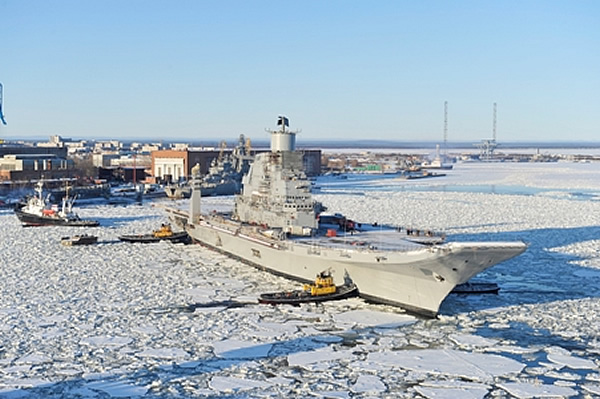
Oct 16/11: Indian media report that Vikramaditya’s sea trials will be delayed 5-6 months, to February or March 2012, because open sea trials aren’t possible from Severodvinsk in northern Russia during the winters. Instead, the ship will do everything they can in the harbor, then hold sea trials when the ice is out.
PTI was told by “senior Defence Ministry sources” said the change in trial plans will not affect the delivery schedule of the aircraft carrier – but then, they have been wrong and even misleading before. The more puzzling question is why it took until October 2011 to realize that conducting sea trials in northern Russia, in November, is unworkable. PTI | Voice of Russia.
Aug 3/11: MiG-29K. RAC MiG CEO Sergei Korotkov places the number of MiG-29Ks delivered to date at 11, with the initial order’s other 5 slated to arrive by the end of 2011. Work of the 2nd MiG-29K order of 29 planes is just beginning. AFP | domain-b | Hindustan Times | Voice of Russia.
Aug 2/11: The Indian MoD offers an official update of progress on the Vikramaditya – and its smaller cousins:
“Consequent to signing of Supplementary Agreements in March, 2010, the Russian side has increased the manpower and material resources considerably for the Project. A majority of the equipment/systems have been installed on board the ship. The delivery of ship is scheduled in December, 2012.
Regarding the ‘Air Defence Ship’ [DID: 35,000t carrier] being constructed at Cochin Shipyard Limited (CSL), 75% of hull work has been completed and is expected to be launched in December 2011, after which further works will be undertaken prior to commissioning… indigenous Aircraft Carrier-sized ships can [now] be built at CSL. Additionally, Indian-manufactures warship quality steel is now available, which will reduce dependence on foreign countries.”
June 23/11: MiG-29K. A prototype MiG-29KUB trainer crashes in Russia. The plane was a test aircraft belonging to RAC MiG, and the company advised the Indian Navy to temporarily suspend MiG-29K operations until the crash’s causes were known.
India asked for a detailed report, and according to the MoD, the crash wasn’t because of a structural failure in the air, engine failure, or avionics/ systems failure. By June 28/11, RAC MiG advised that MiG-29K flights could resume if India wished. India MoD.
MiG-29K crash
May 30/11: MiG-29K. RAC MiG announces that they delivered a new batch of 5 MiG-29K/KUB carrier-based fighters to the Indian Navy in May, along with a flight training simulator and other technical equipment. That’s on top of the first 4 aircraft, \r* which officially entered service with the “Black Panthers” naval squadron in February 2010, and makes 9 of 12 delivered on the initial carrier/aircraft contract.
The March 2010 contract for 29 more MiG-29K Fulcrum-Ds won’t begin delivery until 2012. Economic Times of India.
April 4/11: The Admiral Gorshkov is expected is to reach Murmansk in November 2011, as it heads to Murmansk ship-repair yard # 35 from Sevmash. The carrier is expected to undergo further upgrades and performance testing. Barents Nova.
Feb 21/11: Naval Eurofighter? Aero India 2011 sees Eurofighter and BAE unveil an interesting wrinkle: an initial design for a navalized Eurofighter than can operate from aircraft carriers, based on an internally-funded set of studies and simulations. In a direct nod to potential Indian sales, they tout the plane as being able to take off from “ski jump” carriers without catapults – a design that describes all of India’s current and planned carriers, but not the French carriers that launch the Rafale fighter.
Eurofighter GmbH describes the goal as 95% commonality with land-based aircraft, and required changes as “limited… include a new, stronger landing gear, a modified arrestor hook and localised strengthening on some fuselage sections near the landing gear, as well as updates the EJ200 engines,” which could include thrust-vectoring in flight.
The Eurofighter and Rafale are later picked as India’s 2 finalists for its M-MRCA fighter competition. Eurofighter GmbH | India Defence.
2010
Carrier agreement raises refit costs to $2.33 billion; India inducts MiG-29K, orders 29 more; Russian affair by program chief.

(click to view full)
Aug 9/10: Scandal. Indian Commodore Sukhjinder Singh, who was a key person in the Gorshkov refit program from 2005-2009, has reportedly handed in his resignation after reports of his illicit affair with a Russian woman (vid. April 12/10 entry). The inquiry by Indian naval HQ established the relationship with the woman, but ruled out court martial as they couldn’t establish the woman’s status as an agent, or anything untoward beyond a romantic relationship.
The findings of the Board of Inquiry will have to be acted upon by chief of naval staff Admiral Nirmal Verma, who must also decide whether and how to accept the Commodore’s resignation. On the bright side, at least he didn’t hire Jodie Fisher. See: DNA India.
Aug 3/10: MiG-29K. A CAG (Indian comptroller and auditor general) report says that Indian naval aviation has suffered in recent years, and the current state of the Sea Harrier fleet makes it clear that on-time induction of MiG-29Ks into the fleet will be critical. Read “India’s Sea Harrier Shortage” for more.
April 12/10: Scandal. The inquiry against Commodore Sukhjinder Singh has established his ‘amorous relationship’ with a Russian woman, and India’s naval brass are considering punishments. Meanwhile, he has been relieved of his current posting in the defence ministry’s directorate-general of quality assurance.
Singh oversaw the Gorshkov refit project in Russia from 2005-2007, and was the project’s principal director in India from 2007-2009. That gave him no role in price negotiations, but there is more than casual concern that he may have been “honey trapped” by an FSB agent to give details of India’s negotiating position. Explicit photographs with this Russian woman surfaced recently in the media, and formed part of the “clinching evidence” in the just-concluded naval Board of Inquiry (BoI). Defence minister A K Antony said that:
“Nothing beyond [a romantic relationship] has been proved so far. I do not want to jump the gun. I have asked Navy to finish (the inquiry report) as quickly as possible. I do not want to draw any conclusions prematurely. Once the Navy completes everything, we will take a decision.”
See: Current Affairs (incl. Times Now video) | DNA India | India Server | India TV | Kalyugikalki | The Times of India | Hindustan Times.
Honey trap?
March 11-13/10: India’s Cabinet Committee on Security approves a new $2.33 billion price for the Gorshkov refit, a rise of over 140%.
Russian President Vladimir Putin is currently visiting India, and is expected to sign a number of defense contracts, including the revised Gorshkov pact, and a $1.2 billion contract for another 29 MiG-29Ks. The Gorshkov agreement is signed on March 13/10, and the carrier’s delivery date is now 2013. Indian Express | Russia’s RIA Novosti | Sify | Zee News || Putin visit: Calcutta Telegraph | DNA | Economic Times of India | Sify || Post-Signing: Indian government PIB release | DNA India | Times of India.
Revised agreement, 29 more MiG-29Ks
Feb 19/10: MiG-29K. India inducts its first 4 MiG-29Ks into service at INS Hansa in Goa, as an Intensive Flying and Trials Unit. The government also apologizes to Goa’s citizen’s for the unannounced sonic booms they’ve experienced over the past few days.
During the ceremony, Defence Minister Antony confirms India’s intent to buy another 29 fighters, raising the Navy’s MiG-29K fleet to 45. ANI | Economic Times of India | Indian Express | Sify | Times of India | NDTV video – note that aerial footage is of India’s Kiran trainers instead.
MiG-29K inducted
Feb 15/10: Russian deputy service director Alexander Fomin is quoted as saying that Russia and India will sign a supplementary agreement to finish upgrading the Admiral Gorshkov “in February-March this year.” Time will tell. RIA Novosti.
Jan 17/10: Reports surface that India will “soon” finalize a $1.2 billion deal with Russia to buy 29 more MiG-29K jets, which would bring India’s order total for the carrier capable STOBAR (Short Take-Off But Assisted Recovery) fighters to 45. Russia’s RIA Novosti | domain-b | India’s Economic Times | Press Trust of India | Times of India | UPI | Associated Press of Pakistan.
Jan 16/10: Admiral Nirmal Verma tells the media that there is still no final deal:
“I cannot speak anything about the final pricing till the government’s approval is announced. But, yes, for any of these major induction programs, we have a price negotiation committee, which has done its job and a mutually agreed price has been arrived at.”
See: Press Trust of India | Times of India | Barents Observer | China’s Xinhua.
2009
Scathing CAG program report; India adds a bridging payment, but still no deal; MiG-29 training & infrastructure; British CVF carrier as a Plan B?; INS Viraat is unavailable, and India’s ADS carriers won’t arrive until 2015.
(click to view full)
Dec 5/09: Reports surface once again that India and Russia have reached an agreement on the Vikramaditya’s price. This time, they may even be true. Indian Foreign Secretary Nirupama Rao said that during summit-level talks between Indian Prime Minister Manmohan Singh and Russian President Dmitry Medvedev:
“Both the leaders discussed the [Vikramaditya] issue and noted excellent progress on negotiations on price and technical issues which have been brought to a successful conclusion.”
The actual price in question is not discussed, and that political rapprochement may not be shared by the Navy. Defence Minister AK Antony has publicly distanced the Government from Naval Chief Admiral Sureesh Mehta’s recent public hard line regarding the Gorshkov’s price, and suggestions that India reassess its defense ties with Russia owing to quality issues. Adm. Arum Prakash also issued a warning, saying that: “The long-term price that we pay for 25 years of mischief, of twisting our arm will be much more than what we pay now.”
See: domain-b | Economic Times | Hindustan Times | IANS re: Rao quote | IANS re: Adm. Verma || Naval Spat: IBN Live | IBN Live quotes Adm. Mehta & Prakash.
Dec 4/09: MiG-29K. Ending a year-long wait, the first batch of MiG-29K naval fighter jets, purchased from Russia for the Admiral Gorshkov aircraft carrier, arrive in Goa in a “knocked down condition” packed in containers on board an AN-124 cargo aircraft. Press Trust of India.
Nov 30/09: Defence Minister Shri AK Antony, in a written reply to the Lok Sabha (India’s Parliament):
“The Russian side had submitted a revised Master Schedule indicating delay and increase in prices for repair and re-equipping of aircraft carrier ex-Admiral Gorshkov. The Government has agreed to conduct negotiations for finalizing a revised Repair and Re-equipping contract. Negotiations are in progress with the Russian side. Details of final prices would be known only after completion of these negotiations.
An exhaustive list of equipment to be fitted on the ship was included in the original contract. The Aircraft Carrier is scheduled to be inducted in December, 2012.”
Nov 16/09: Plan B from the UK? Amidst rumors of major British defense budget cuts, The Guardian reports that India has expressed formal interest in the 65,000t CVF/Queen Elizabeth class carrier program. The UK MoD is desperately looking for long-term budget savings, but canceling either of its full-size carriers at this point would be rival the cost of finishing them:
“According to senior defence sources, Whitehall officials are examining the feasibility of selling one of the carriers. It is understood they are planning to put forward the option as part of the government’s strategic defence review, which will start early next year… “Selling a carrier is one very serious option,” a defence source said this weekend, although the government is a long way from committing to any sale. It could take between six and 12 months to reach a decision, he added.”
Each Queen Elizabeth carrier costs about $3.5 billion, and the negotiating difference around the Admiral Gorshkov is currently around $2.2+ billion. The question is whether India would be able to buy one of the CVF carriers for less than the UK paid, in order to offer the Treasury monies that it could not otherwise obtain from the CVF program. If a refund could be forthcoming from the Russians, and a deal done with the British, investing the Vikramaditya’s $3 billion could net India a completely new ship rather than an old and refurbished one, with double the Gorshkov’s aerial complement. Key questions include whether those deals could be secured, and whether India is prepared to wait until 2016 for the British carrier, as opposed to 2013 (and sliding…) for Gorshkov.
Then again, $2.2 – $2.5 billion could also secure India an America class light carrier from Northrop Grumman, with a similar tonnage and aerial complement to the Gorshkov, but markedly better electronics and defensive systems. If India begins to look beyond Russia for options, Britain’s CVF program is not its sole alternative.
Nov 1/09: INS Viraat Watch. The Times of India reports that INS Viraat is now on the verge of completing its sea-acceptance trials and work-up phase, after an 18-month-long comprehensive refit and upgrade program in Mumbai and Kochi. This will give India an aircraft carrier again. The 28,000-tonne carrier will complete its 50th year as an operational warship in November 2009, having serves as both HMS Hermes and INS Viraat.
Oct 23/09: A British BBC report explains some of the hurdles on the road to Vikramaditya’s delivery:
“In this hurry [on both sides to sign a deal], fine points including the ones relating to what was expected of Russia were overlooked… India agreed to buy and get a ship refurbished without Gorshkov’s design [presumably means a detail design blueprint]… When the ship was ripped open, it was found that the wiring was ageing and needed to be redone. A Japanese contractor awarded the rewiring contract found the job overwhelming – given the costs involved – and left. Now a new contractor has been found for the purpose. Gorshkov’s steel plates and machinery, too, needed to be pulled apart and new ones fitted… With Gorshkov’s induction delayed, the government decided to refit its only aircraft carrier, INS Viraat, but it will not be operational till 2015. That leaves the Indian navy with no aircraft carrier for some time.”
Oct 15/09: Despite prior reports that an agreement on the Vikramaditya’s final cost would be reached during Defence Minister A.K. Antony’s 2-day visit to Moscow, India and Russia have failed to reach agreement. Negotiations will continue. India MoD | Indo-Asian News Service.
Sept 24/09: MiG-29K. Russia’s Vedemosti newspaper reports that the Russian Navy may decide to replace its 19 larger and longer-range SU-33 fighters on its Admiral Kuznetsov carrier with 24 MiG-29Ks, when the SU-33’s must be retired in 2015. Caution is advised, since the article is based on a source who sees a contract as possible in 2 years; that’s not exactly a rock-solid basis for concluding that India will avoid the potential trap of being the MiG-29K’s only operator. Vedemosti [in Russian] | Barents Observer.
Sept 3/09: Indian media report that a deal to finish the Vikramaditya refit is expected by mid-October 2009. Some caution is advised, as past reports and predictions in this area have later been proven false by events. India’s Business Standard | The Hindu | Hindustan Times.
Aug 16/09: Bridging payment. Indian media report that the government has cleared a $122 million bridging payment for continued modification work on the Gorshkov, while negotiations continue. The payment was sanctioned in early August, following demands by Rosoboronexport. domain-b | Economic Times of India.
Bridging payment
July 31/09: India’s Business Standard conducts an interview with Russia’s outgoing ambassador to India, Vyacheslav Trubnikov. Excerpts:
“[VT] Not changing [the Gorshkov order], but the Indian Navy was eager to get the best, the most modern equipment [to insert into the hull].
[IBS] So the Navy’s appetite kept increasing, they wanted more and more..
[VT] Yes.[BS] Reports are that it will cost around $2.2 billion?
[VT] It would be irresponsible of me to comment. Price negotiations are now entering the final stage. What is important for India is also the time of delivery. But the point is that if India wants additional equipment, the carrier will cost even more. So if both sides stop and decide, okay no request from India and no increase in price from our side, then we can finalise price and delivery.”
July 29/09: The CAG report begins to generate political opposition to the Gorshkov deal, as well as media op/ed calls for a re-think. In the course of one such op-ed, The Hindustan Times offers a report on the negotiating spread:
“The Russians now want $2.9 billion (Rs 14,500 crore) for the warship, while the defence ministry is bargaining for $2.2 billion (Rs 11,000 crore). [Defence Minister Antony said that] “The Russians have demanded a substantially huge amount. We are still negotiating the deal. No final decision has been taken.”
July 25/09: CAG Criticism. India’s Comptroller and Auditor General (CAG) issues a scathing report, saying that:
“The objective of inducting an aircraft carrier in time to fill the gap in the Indian Navy has not been achieved. The cost of acquisition has more than doubled [from $875 million] to $1.82 billion (Rs. 7,207 crore) in four years. At best, the Indian Navy would be acquiring, belatedly, a second-hand ship with a limited life span, by paying significantly more than what it would have paid for a new ship…”
The largest cost escalation is in sea trials, which have risen from $27 million to $500 million, and the CAG report sharply criticizes the Navy for poor project supervision practices. The report adds that planning failures will leave the warship with no air defense upon delivery, and only a Close-In Weapon System (CIWS) when one is retrofitted in 2017. Risks are also cited with respect to the aircraft arresting gear, which has not been finalized due to development problems. India CAG – they do not archive reports | DNA India | The Hindu | Indian Express | Rediff | Times of India | Agence France Presse.
CAG criticism
May 25/09: Indian media report that the government has decided to speed up renegotiation with Russia, after a recent Moscow trip undertaken by defence secretary Vijay Singh failed to break the long-standing deadlock. The government has reportedly scheduled 3 visits to Russia by Indian officials, in hopes of sealing the deal by the end of July 2009. During those visits, they will also discuss the larger subject of Indian-Russian defense relations.
Another senior official of the Controller of Warship Production and Acquisition will reportedly visit Russia in the middle of June 2009, to work out the warship’s hoped-for 2011 trials in Barents Sea. Assuming that a deal can in fact be reached this time. Times of India.
April 6/09: MiG-29K. India inaugurates the first phase of the MiG-29K maintenance and training facility at the INS Hansa naval base in Goa. Vice-Admiral J. J. Bedi, Commander-in-Chief of India’s Western Naval command, is quoted as saying that:
“This is the first time in my service career of 40 years that I witness construction and availability of major infrastructure project prior to the induction of hardware in the Indian Navy.”
He expects the first batch of 4 aircraft to be “with us by middle of this year.” The Hindu.
March 16/09: MiG-29K. Still no agreement on the Gorshkov refit. Meanwhile, The Times of India reports a Russian decision to ground its MiG-29 fleet, following accidents caused by the disintegration of the planes’ tail fins. It quoted an unidentified “senior officer,” who said that:
“We continue to fly our MiG-29s… Our checks are stringent since we operate our MiG-29s also from coastal airbases (Jamnagar) and Russian metallurgy is susceptible to salinity.”
That’s a somewhat worrying assertion, in light of the MiG-29K naval buy. India is scheduled to finish its MiG-29A upgrades to MiG-29SMT status in 2014, thanks to a contract signed in March 2008. That effort will not be delayed by the news from Russia, but the news will reportedly delay delivery of the new MiG-29Ks to the Indian Navy.
Feb 28/09: ADS Watch. The keel for India’s first “Project-71” 37.5t-40t indigenous carrier project is laid at the Cochin Shipyard in Kerala. The new carrier will be named INS Vikrant, after the 20,000t World War 2 era carrier HMS Herculaeus that was sold to the Indian Navy, and served as the Vikrant (from Sanskrit vikranta, “courageous/ victorious”) from 1961-1997. Ptoject-71 currently has a budget of INR 32.6 billion (currently about $650 million), but few observers believe that the final cost will remain on budget.
Delivery is scheduled for 2014-2015, and these carriers are expected to carry their own complement of MiG-29K fighters. Plans exist for a naval variant of India’s LCA Tejas lightweight fighters, but India’s history of extremely late and failed weapons projects suggests caution. Even a successful project is unlikely to induct a naval Tejas before 2016-2018, leaving both of India’s future carrier classes strongly dependent on Russian goodwill. The Hindu | Indian Express | Sindh Today.
Feb 23/09: Indian media report that Russia has demanded another $700 million, on top of their demand for an additional $1.2 billion which had been approved by India’s cabinet, on top of the original $947 million contract. The shipyard is also demanding $190 million immediately, in order to continue work. Delivery is still scheduled for 2012, but this assumes the schedule promises are kept, and that there are no work stoppages or other production delays owning to contract negotiations.
Assuming that this is in fact Russia’s final demand, it would bring the asking price for the Gorshkov to $2.85 billion. That figure could buy a similar 45.7t new-build America Class LHA-R medium carrier with funds left over, and might even buy one of Britain’s new 65t CVF Class carriers. Hindustan Times | Indian Express | Forecast International report/op-ed | Indian Express op-ed.
Feb 22/09: MiG-29K. The Hindu quotes UAC VP and RAC MiG Director-General Mikhail Aslanovich Pogosyan, who says that Indian naval pilots have been training in Russia since October 2008. The theory portion of the course is done, and:
“Indian pilots are already training to fly the MiG-29Ks from a shore-based facility. They have been doing even 15 sorties in a day during the winter. We expect the first four MiG-29Ks to arrive in India later this year, with the other 12 being delivered by 2010.”
So far, 4 certified MiG-29Ks have been transferred to the Indian project team in Russia, after Russian test pilots have conducted carrier landing check-outs. After the course is complete, India’s Navy hopes to continue their own pilots’ training by using a Shore-based Test Facility (SBTF), built with Russian help at INS Hansa in Goa.
Feb 12/09: RIA Novosti reports that Russia has delivered the first 4 MiG-29 naval fighters to India. Oddly, they use the designation “MiG-29 Fulcrum D,” which is the NATO reporting code and not Russian or RAC MiG nomenclature.
2008
Russia wants more money to complete the contract; Reality – delivery in 2012, maybe; Sevmash shipyard not exactly ship-shape; USA’s retiring CV-63 to India?

(click to view larger)
Dec 3/08: Indian Express reports that India’s Cabinet Committee on Security (CCS) on Tuesday “gave in to Moscow’s demands,” and will renegotiate the Vikramaditya upgrade on terms acceptable to Moscow.
Nov 22/08: Australia’s the Age newspaper reports that Russian President Dmitry Medvedev has cut his December 2008 India visit to a single day, a signal usually associated with a strained geo-strategic relationship. The visit will now take place on Dec 5/08.
Nov 13/08: As negotiations regarding the Gorshkov continue to drag on, pressure for timely resolution is building on the Russian side, as well. Sevmash (Severodvinsk Machine Building Enterprise) shipyard Deputy General-Director Sergey Novoselov tells RIA Novosti new agency that:
“We are essentially constructing a new aircraft carrier at the open assembly berth of Sevmash. In the last two years, work has only proceeded thanks to internal loans…”
That cannot continue indefinitely – but Sevmash is not backlogged with projects, which means it needs to hang on to the Admiral Gorshkov refit. So, what if India proves unwilling to pay? Novoselov pointed out that even at $2 billion, a refitted Gorshkov costs only 50-67% of the $3-4 billion involved in building a medium sized carrier. Novoselov would not be pinned down to any firm figure, of course, but some Russian defense planners are either taking him seriously, or willing to help him put added pressure on India. RIA Novosti, via Forecast International:
“If India won’t pay the money [over the agreed $617 million], we will keep the aircraft carrier ourselves. It will be very useful to us, because the situation in the world is complicated. Vessels like that are needed to patrol the waters of the Atlantic and the Mediterranean,” noted a Russian defense industry official.”
If Russia did make that move, India would need compensation for costs incurred to date – reportedly about $400 million.
Nov 11/08: Russia now says that the delivery of Admiral Gorshkov aircraft carrier to the Indian Navy will be delayed till 2012. The shipyard also claims that New Delhi has not made any payments since last year, although extra work to the tune of $1.7 billion has been done by the shipyard. ITAR-TASS reportedly quoted a shipyard representative as saying that:
“At this juncture, the completion of work in 2010 would be realistic. Two more years would be required to complete the vessel’s sailing trials, including testing its aircraft in the severe conditions of Barents Sea.”
DID isn’t quite sure why arctic operations would matter to India. India Defence.
Nov 2/08: India’s finance ministry has for the second time rejected a proposal from the MoD to approve an additional $1.2 billion in funds, in order to complete the INS Vikramaditya retrofit project. The article reports that India has already paid Russia about 67% of the original program cost, but has made no further payments since January 2007. The India Defence report adds, cryptically:
“The finance ministry’s latest decision also stemmed from a request to allocate $60 million to perform sea trials of the refurbished vessel during 2011.”
Oct 18/08: The Hindu newspaper quotes Sevmash Shipyard’s deputy director for foreign defence contracts Sergei Novosyolov, who says that Gorshkov will be taken out of dry dock by the end of the month.
“The ship’s hull has been fully done and painted and scaffolding will be dismantled by the end of October…”
Sept 21/08: Still no firm deal on the Gorshkov refit, but India’s Defence Acquisition Committee (DAC) has given approval in principle to add another 29 MiG-29Ks to the original 16-plane, $1.5 billion deal.
No price negotiations have taken place, but the contract is expected to be worth close to $2 billion when it is signed. The Navy is reported to have set its sights on a 3-squadron goal for its MiG-29K/KUB force. Indian Express report.
Sept 19/08: Indian Express reports that after Indian officials expressed concern over the slow progress in overhauling Gorshkov at the Sevmash shipyard in North Sea, Russian asked South Block to immediately pay the cash-strapped shipyard $200 million, “without prejudice to the on-going price negotiations,” in order to speed up work.
The report adds that Russian Defence Minister A Serdyukov’s visit to Delhi later in September 2008 is expected to result in a revised price for the Gorshkov refit, which must then receive political approval in India.
June 3/08: Press Trust of India reports that Russia’s Sevmash shipyard has promised readiness by 2012 – maybe. RIA Novosti quotes Sevmash officials as saying that:
“The successful solution of all the financial issues will enable the shipbuilders to sail the aircraft carrier out into the Barents Sea for trials. In the winter of 2012, the ship is expected to be finally refitted and trials will continue in the summer of that year… At the end of 2012, the aircraft carrier is expected to be fully prepared for its transfer to the Indian navy in accordance with the schedule approved by the Russian Navy.”
Negotiations and maneuvering around the contract’s final details continue, and Sevmash’s history of delivery, detailed below, must also be considered when evaluating such statements.
June 2/08: MiG-29K. Defense News reports that India’s MiG-29Ks will be based on land, because the country has no operational carriers. With INS Viraat unavailable due to upgrades and Vikramaditya badly behind schedule, the MiG-29Ks will go to the Naval Aviation Centre at INS Hansa in Goa instead. Hansa is the base used to train naval pilots. Deliveries of all 16 MiG-29Ks are expected to be complete by 2009.
May 30/08: USS Kitty Hawk? Reuters reports that American Secretary of Defense Robert Gates was asked about rumors that the USS Kitty Hawk might be sold to India at the at the Shangri-La Dialogue forum of regional analysts, defense and security officials. “I am aware of no such plans,” Gates replied.
May 9/08: ADS Watch. News Post India’s “Indian Navy To Order Another Aircraft Carrier” claims that the Indian Navy will supplement the Vikramaditya with 2 of its 37,500t indigenous “Air Defence Ship” carriers, instead of just one. The article also includes additional information about the Vikramaditya’s schedule and the potential risks.
April 9/08: Despite an agreement that was supposed to be finalized in March, Indian Defence Secretary Vijay Singh describes the parties as still “locked in intense negotiations over the price details,” adding that “technical assessment of the work needed on the carrier is still on…” The expected responses re: the deal being on track, and having a final price proposal to bring to the Cabinet “soon,” were also voiced. Zee News.
March 18/08: MiG-29KUB flies. During Chief of Naval Staff Sureesh Mehta’s visit to Russia, the first serially produced MiG-29KUB (tail number 113) performs its maiden flight at the RAC MiG test airfield in Lukhovitsy near Moscow. The MiG-29KUB is the 2-seat variant of the carrier-capable MiG-29K. RAC MiG release.
March 10/08: The Indian government’s DDI News reports that “India has reconciled to a price hike for procurement of Russian carrier Admiral Gorshkov and the government has constituted an experts committee to work out the increase.”
Naval Chief Sureesh Mehta, who had opposed additional payments under the contract, said that: “There will be some price hike. We need to pay extra amount and whatever amount is due as per contracts we will pay.” This does not sound like an encouraging report from ongoing negotiations.
March 3/08: India caves. India opts to pay Russia more, in hopes of getting the Gorshkov ready in time. Figures given vary between $500 million and $1.2 billion; exactly how much more India will agree to pay will reportedly be decided later in March 2008, after 2 more rounds of negotiations. India’s Defence Secretary Vijay Singh is quoted as saying that:
“It should be completed by mid-2010. After that, it will undergo 18 months of extensive sea trials by the Russian navy to ensure all systems are working properly.”
Retired Admiral Arun Prakash was head of the Indian Navy in 2004 when the original deal was “laboriously and painstakingly negotiated for 11 months, and the contract sealed and signed.” He told BusinessWeek that he is disappointed by Russia “reneging on the deal” and says Russia “gifted” the Gorshkov to India in exchange for a $1.5 billion contract to buy planes and helicopters and “revive their terminally ill shipbuilding and aircraft manufacturing industries.”
India will also reportedly send 500 shipyard workers, technicians and managers to Russia, to take direct charge of the work, cover Russia’s labor shortage, and keep an eye on quality control so that it’s caught immediately. Whether this will suffice, in the wake of Sevmash shipyard disasters like the Odfjell contract (q.v. Feb 21/08), remains to be seen.
What also remains to be seen at this point is whether India’s MiG-29K contract becomes the next bottleneck. India remains the only customer for this substantially different aircraft, and MiG will need to make production line changes that the existing contract may not adequately finance. Indian MoD, March 12/08 | Calcutta Telegraph | NDTV | Pravda | StrategyPage | Times of India
Meanwhile, BusinessWeek has its own speculation re: “Why India Talked Up A US Carrier Deal.” As an interesting second perspective on the larger Russia-India relationship, see also the Navhind Times March 4/08 article “India’s Defence: Looking Beyond Russia“.
March 3/08: Sea Harriers. India’s Defence Minister Shri A K Antony confesses that India’s Sea Harrier fleet has an availability problem, due to the rotation of aircraft through the current upgrade program.
“India’s Sea Harrier Shortage” looks at numbers and planned upgrades for India’s legacy naval aircraft, as the Navy prepares for future operations with MiG-29Ks. Given the amount of trouble the Harriers are in, it seems unlikely that they will be able to provide a Plan B if the MiGs have problems.
Feb 27/08: India’s Minister of Defence Shri A K Antony, asked about this issue, says:
“The overall progress of repair and re-equipping of the ship, ex-Admiral Gorshkov, in Russia is behind schedule. Execution of contract for construction of three ships of Project 1135.6 (follow-on-ships of Talwar Class) is on schedule. Russia has indicated an increase in price for repair and re-equipping of ex-Admiral Gorshkov. There is no proposal under the active consideration of the Government to contact some other country in this regard. The need for contacting other country does not arise as the existing contract with Russia is still valid.”
A fine politician’s reply. If another country contacted India instead, his denial would still be “true” in the strict sense of the term…
Feb 23/08: Progress on Gorshkov? According to the India Times’ Economic Times, Indian Defence Secretary Vijay Singh’s 5-day delegation visit to Sevmash Shipyard, and talks with Russian Energy and Industries Minister Viktor Khristenko, may have made progress. Russian senior officials reportedly assured Singh that the Russian government was making strenuous efforts to improve the situation.

(click to view full)
Feb 19-23/08: Crazy Sam’s Carrier Clearance Sale? As reports begin to suggest that Russia and India are too far apart to agree on the Gorshkov refit, speculation grows that the USA intends to solve India’s problem with a stunning offer during Defense Secretary Gates’ imminent visit to India. instead of retiring and decommissioning its last conventionally-powered carrier, the 81,800 ton/ 74,200t USS Kitty Hawk [CV-63, commissioned 1961], would be handed over to India when its current tour in Japan ends in 2008. The procedure would resemble the January 2007 “hot transfer” of the amphibious landing ship USS Trenton [LPD-14], which become INS Jalashva. The cost? This time, it would be free. As in, $0.
Naturally, there is a quid pro quo that accompanies these rumors. In return for an aircraft carrier that would be larger than its counterparts in every navy other than the US Navy, India would select at least 60 F/A-18 E/F Super Hornets in its MMRCA fighter competition, to serve as the carrier’s air wing. Unlike the Gorshkov, the Kitty Hawk is a purpose-built carrier whose full air complement is a whopping “75+” aircraft and helicopters. India has also expressed interest in the USA’s E-2 Hawkeye carrier AWACS aircraft, which would be a natural fit for its new ship.
As a number of sources point out, this is a multi-pronged move that would achieve several objectives at once. First, the offer removes all Russian negotiating leverage over India by removing the issues of sunk costs, foreign possession of the Vikramaditya, and any danger of being left without a carrier. The Indian Navy would be greatly strengthened, and its ability to police the Indian Ocean from the Straits of Malacca to South Africa would take a huge leap forward. Any additional work to upgrade or refurbish the carrier could be undertaken in India, providing jobs and expertise while maintaining full national control over the refit. The USA gains financial benefits of its own, as the Navy avoids the expensive task of steaming the Kitty Hawk home and decommissioning it. Americans would almost certainly receive maintenance contracts for the steam catapults, and possibly for some new electronics, but those economic benefits pale in comparison to the multi-billion dollar follow-on wins for Boeing (Super Hornet), Northrop Grumman (E-2 Hawkeye), and possibly even Lockheed Martin (F-16 E/F, F-35B). All of which works to cement a growing strategic alliance between the two countries, and creates deep defense industrial ties as well.
Then there’s the effect on Russia, whose relations with the USA currently border on outright hostility. With the MiG-29Ks no longer necessary for India, that contract would almost certainly be canceled. At which point, the commonality value of choosing the MiG-35 as a lower-cost secondary MMRCA buy drops sharply, opening the door for other MMRCA split-buy options that could include the Saab/BAE JAS-39 Gripen, or a complementary American offer of F-16E/Fs and/or F-35Bs. The combined effect of these blows would be a severe setback for Russia’s arms industry, though rising oil & gas revenues in Russia and other export opportunities may lead to less shrinkage and civilian re-purposing than publications like the Weekly Standard believe. The question now is: will this happen? Barents Observer | Weekly Standard | Information Dissemination: Feb 20th/ 23rd.
Feb 21/08: Sevmash screwups. “Galrahn” of the respected blog Information Dissemination passes a key tip along to DID. First, recall that the Sevmash shipyard in Severodvinsk, Archangel Oblast is responsible for the Gorshkov refit. Until recently, they also had a $544 million contract to build up to 12 tankers for the Norwegian shipping form Odfjell. When it was signed in 2004, it was promoted as “a historic deal in Norwegian-Russian industrial relations.”
Now it has been canceled, and Odfjell CEO Terje Storeng has used terms like “no will to try to understand that this is a commercial project,” “deliberately sabotaged and delayed the project” et. al. to Dagens Næringsliv. He adds:
“Following serious delays in the construction process, combined with demands for further price increases from the Yard, continuous cooperation problems as well as protracted negotiations, Odfjell decided today to serve formal notice of cancellation to Sevmash. The instalments already paid are covered by standard refund guarantees from international banks. Odfjell will further claim full compensation for its costs and losses caused, on account of wilful misconduct and massive contract breaches by the Yard. Unless the matter is solved amicably between the parties, the issue will be solved by arbitration in Sweden, as provided for in the contract.”
Note the Russian official’s comments in the Feb 7/08 entry. Closure may once again become a very real possibility for Sevmash. Worse, Odfjell’s experience has to give India serious pause re: the reliability of Russia’s new refit cost estimates, and the likelihood of further extortion to ‘adjust’ the deal down the road. Barents Observer | Dagens Naeringsliv report [Norwegian] | Odjfell.NO release
Sevmash has wider problems
Feb 7/08: Russia – Let’s Change a Deal! Zeenews quotes an unnamed “Russian official” with interesting and somewhat unsettling arguments, in advance of a high-level delegation’s arrival led by Indian Defence Secretary Vijay Singh:
“Moscow feels that the agreement for supply of the 45,000 tonne warship was signed at a time when the Russian ship-building company was in bad shape and India “used” the situation to sign the contract at lower price. The ship-building company was facing closure and was ready to sign any kind of contract when the contract was signed.”
Defense Industry Daily needs to look up the exact definitions to be certain, but we believe this process is known as “shrewd negotiation,” followed by “a deal.” Indian Naval Chief Admiral Sureesh Mehta appears to be using the same lexicon, and has publicly said that there should be no revision to the Goshkov contract. Still, India cannot receive the carrier she wants if the shipyard goes bankrupt, and Russia is holding the carrier. This gives the Russians considerable leverage in negotiations, unless India can find an alternate provider. There may be a way out, however:
“But Russia is willing to “compensate” for the cost of Gorshkov if it gets more military orders, which Moscow insists is not linked to 126 fighter planes that India is planning to buy but other defence purchases.”
2007
India’s navy and politicians in denial – but the carrier is late.
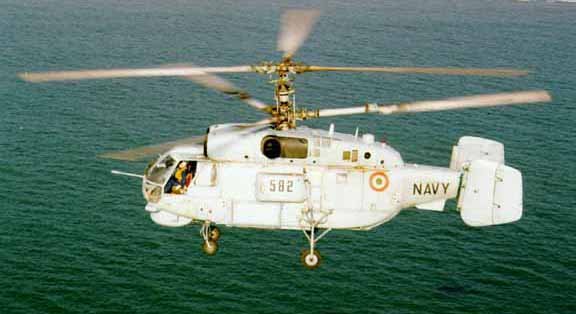
(click to view larger)
Nov 19/07: India’s MoD confirms delays in the Gorshkov’s delivery and slow progress, without really answering any questions. It acknowledges that the Russian side has submitted a revised Master Schedule, attributing the delays to “Growth of Work.” In response, an apex level Indian committee under the Defence Secretary, and a Steering Committee under a Vice Admiral, have been set up. A team has also been stationed at the shipyard.
No word on the timelines or costs suggested; indeed, these are likely to remain under negotiation. Indian MoD release.
Nov 6/07: A top-level Indian Navy delegation is heading for Moscow to discuss the delay and price escalation in the Admiral Gorshkov aircraft carrier deal. A detailed financial and technical plan outlining the specific justifications and amounts will be presented to the Indian side, who is there to listen rather than to negotiate.
The report pegs the original price quoted for refurbishing the carrier was just under $980 million, adding that the Russians are insisting on cost increases of at least $350 million. Indian officials reportedly fear that the final escalation may end up being much more once they are deep enough into the commitment trap of having paid for work. The report also adds that the Navy “had reconciled itself to the fact that the delivery of the ship would be delayed from the original deadline of August 2008 by a few years,” a surprising development given the limited service life of India’s remaining carrier. If the government is indeed prioritizing cost containment over delivery dates, reconciliation of the INS Viraat’s service life with Gorshkov’s entry may prove difficult. IDRW.
Oct 18/07: India’s MoD finally admits the obvious, as part of an announcement concerning an Indo-Russia fighter development deal. India MoD release:
“The Defence Minister described the Agreement on FGFA as a ‘major landmark’ and said that the Indo-Russian relationship is on a trajectory to reach new heights… Mr. Antony expressed satisfaction at the outcome of discussions on other important projects e.g., supply and licensed production of T-90 tanks, SU-30 MKI aircraft and other strategic issues. He admitted that there has been a delay in the delivery of the repaired and refurbished aircraft carrier Admiral Gorshkov [emphasis ours] along with supply of deck-based fighter aircraft MiG-29-K and said it was decided that some more studies by technical groups would be done to go through the details. He appreciated the efforts made by the Russian side to resolve issues relating to life cycle support of equipment of Russian origin.”
June 16/07: India Defence: High Level Indian Delegation In Russia To Re-Negotiate Defense Deals Pricing:
“With differences over prices delaying the delivery of upgraded Sukhoi multi-role fighters and Gorshkov aircraft carrier, India today rushed a high-level defence team to Russia with fresh proposals to break the logjam… The visit of the team assumes significance with Defence Minister AK Antony admitting that New Delhi was facing “problems” in acquisition of the carrier Gorshkov as well as in negotiating a new deal to buy 40 more upgraded Sukhoi-30 fighters for the Indian Air Force.”
May 17/07: India Defence: “No Delays in INS Vikramaditya Acquisition from Russia: Defence Minister.” With that said…
“However, sources from the Indian Navy had earlier confirmed reports being circulated in the Indian and Russian media regarding a possible two year delay in the acquisition of the Aircraft Carrier.”
Additional Readings
Equipment Profiles
* Indian Navy – About INS Vikramaditya – The newest & largest ship of Indian Navy
* Bharat Rakshak – INS Vikramaditya
* Naval Technology – Kuznetsov Class (Type 1143.5) Heavy Aircraft Carrying Cruiser, Russia
* RAC MiG – MiG-29K/ MiG-29KUB
* Bharat Rakshak – MiG-29K/KUB Fulcrum-D
* YouTube – Vikr. Russian report covers MiG-29K carrier landing trials in the Barents Sea.
* Air Force Technology – Ka-31 Radar Picket Naval Helicopter, Russia
* Bharat Rakshak – Kamov KA-31 Helix-B
* Air Force Technology – Ka-27/28 and Ka-29 Helix Naval Helicopters, Russia
* Bharat Rakshak – Kamov KA-28 Helix-A
Other Equipment
* Bharat Rakshak – INS Viraat (formerly HMS Hermes, last of the British Centaur Class). India’s current carrier.
* Bharat-Rakshak – Indian Aircraft Carrier (Project-71). The forthcoming Vikrant Class.
* US Navy, CV 63 Kitty Hawk official site – Kitty Hawk Statistics. Since decommissioned.
* Global Security – CV 63 Kitty Hawk
* DID FOCUS – India’s MMRCA Fighter Competition. This DII Q.V. entry is a public access article.
News & Views
* DID – Russia’s Military Spending Jumping – But Can Its Industry? Provides interesting figures for the industry, and a deeper look at some of the drivers behind the failed Gorshkov refit as well.
* Livefist (Feb 20/10) – Differences Between MiG-29 Of IAF & Navy. The IAF’s MiG-29Bs are being upgraded to MiG-29SMT/UPG status, which will even out many of the MiG-29K’s advantages.
* Asia Times, via WayBack (Dec 9/09) – India displays multi-vector diplomacy. Offers one take on the larger strategic background behind India’s ties with Russia. M K Bhadrakumar was a career diplomat in the Indian Foreign Service whose assignments included the Soviet Union, South Korea, Sri Lanka, Germany, Afghanistan, Pakistan, Uzbekistan, Kuwait and Turkey.
* BBC, via WayBack (Oct 23/09) – Crucial Indian defence deals delayed. These include the Navy’s submarine and aircraft carrier projects, advanced trainers for the air force, and coastal surveillance plans. “For its part, the government has been slow in responding to criticism – even from its auditing organisation. When it comes to defence issues in India, speed does not seem to be of paramount importance.”
* NewsMax, via WayBack (Dec 4/08) – Russian Military Misfires With Defects, Sales Lags. Points to RAC MiG as a firm with an especially problematic future, unless it can secure a big win very soon.
* DID (March 5/08) – India’s Sea Harrier Shortage. It isn’t just the Viraat that has to be maintained until a successor is ready…
* The Weekly Standard, via WayBack (Feb 22/08) – The Carrier Cold War. “The US tries to shut Russia out of India’s defense market.”
* Information Dissemination (Feb 20/08) – The Gorshkov Guessing Game and Feb 23/08 – Kitty Hawk To India Discussion Hits the US Media.
* Barents Observer, via WayBack (Feb 19/08) – India might not get its Russian aircraft carrier.
* Asia Times, via WayBack (Aug 21/07) – India’s blue water dreams may have to wait. The Gorshkov isn’t the only carrier project in trouble. This article mentions the Gorshkov’s difficulties, and also details both the current state of the INS Viraat and difficulties with India’s smaller 37,500t indigenous carrier, which is reportedly slipping its schedule badly and will only be ready by 2015 at the earliest, instead of 2012.
* India Defense, via WayBack (April 26/06) – INS Vikramaditya: Aircraft Carrier Acquisition from Russia Delayed, Cost Overruns Expected. Heatedly denied at the time by India’s military; subsequently confirmed as quite true.
* DID (June 30/05) – U.S. & India Sign 10-Year Defense Pact.