


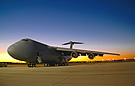
(click to view full)
When it was introduced, back in 1970, the C-5 Galaxy was the largest plane in the world. It also has the highest operating cost of any US Air Force weapon system, owing to extremely high maintenance demands as well as poor fuel economy. Worse, availability rates routinely hover near 50%. To add insult to injury, the Russians not only built a bigger plane (the AN-124), they sold it off at the end of the Cold War to semi-private operators, turning it into a commercial success whose customer list now includes… NATO.
Meanwhile, the USA still needs long-range, heavy load airlift. The AN-124’s commercial success may get its production line restarted, but the C-5 has no such hope. Boeing’s smaller C-17s cost more than $200 million per plane. That’s about the cost of a 747-8 freighter, for much higher availability rates than the C-5, and a longer lifespan.
(click to view full)
What’s the right balance between new C-17s and existing C-5s? The US Air Force believes that the right balance involves keeping some of the larger C-5s, and thought they could save money by upgrading and renewing their avionics (AMP) and engines (RERP). Their hope was that this would eliminate the problems that keep so many C-5s in the hangar, cut down on future maintenance costs, and grow airlift capacity, without adding new planes. Unfortunately, the program experienced major cost growth. In response, the C-5M program wound up being both cut in size, and cut in 2. The C-5A and C-5B/C fleets are now slated for different treatment, which will deliver fewer of the hoped-for benefits, in exchange for lower costs and lower risk.
The C-5’s AMP-RERP
The Problem: Less Than Reliable

KC-135 = 707 airliner!
(click to view full)
“The Galaxy also has major problems, as was glaringly apparent during one particular C-5’s trip from Dover to Europe. As it readied for takeoff, an engine warning light appeared in the cockpit. The flight crew taxied the airplane back to the apron, the passengers got off, and maintenance crews investigated. After the problem was fixed and the passengers had reboarded, the aircraft headed out again, but another warning light came one – this time during the takeoff run.
Five more times, the C-5 attempted to leave, and each time there was a glitch.
Airborne at last, the heavily laden giant lumbered up to cruising altitude, but, some 100 miles out over the Atlantic, yet another warning light came on – this time, a landing gear door seemed ajar. The airplane returned to Dover for yet another repair. The C-5 finally reached its destination in Europe – but more than 18 hours late.”
Stories like this also help to explain why the C-5 has the highest operating cost of any Air Force weapon system. The programs designed to address these cost & reliability problems are called AMP (Avionic Modernization Program) and RERP (Reliability Enhancement & Re-Engining Program). To keep them straight in your head, think of AMP as amping up the Galaxy’s electronics for the modern era, and RERP as putting a bit more roar in its engines.
C-5s are currently assigned to:
* Dover Air Force Base, Delaware (USAF, C-5B)
* Travis AFB, California (USAF)
* Lackland AFB, Texas (USAF)
* Wright-Patterson AFB, Ohio (USAF)
* Martinsburg Air National Guard Base, West Virginia
* Memphis ANGB, Tennessee
* Stewart ANGB, New York; and
* Westover Air Reserve Base, Massachusetts
Changing the C-5: AMP

(click to view full)
AMP is the first step. Its main purpose is to equip the aircraft to fly in civil airspace by the most direct routes, at the most advantageous altitudes, with the most efficient fuel usage and cargo loads. The new avionics systems will allow the aircraft to comply with reduced vertical separation mandates, and also provides an architecture flexible enough to meet future communications, navigation, surveillance (CNS) and air traffic management (ATM) requirements. AMP is also trying to reduce the number of devices and wires in the planes, to reduce costs and improve reliability. All told, 12,000 wires are removed, and 4,000 are installed, during a C-5 AMP.
The program has displayed a philosophy of making its additions using as much commercial equipment as possible, rather than insisting on all-militarized systems. Riding on the development work spurred by changing commercial requirements, rather than funding development on its own, is a change for USAF procurement, but they get a very modern system that way. In addition to the substitution of digital “glass cockpit” computer screen displays, key Global Air Traffic Management avionics include:
* Future Air Navigation System (FANS) data link
* Aeronautical operational communications (AOC) data link
* VHF com, 8.33-KHz spacing
* Multimode receiver (MMR) with protected ILS, VOR, microwave landing system (MLS) and marker beacon
* Dual, embedded inertial navigation system (INS)/GPS
* Identification, friend or foe (IFF)/Mode S transponder
* Traffic alert collision avoidance system II (TCAS II), Version 7, (added earlier)
* Enhanced ground proximity warning system (EGPWS)
* Backup air traffic control (ATC) data link printer, and
* Versatile Integrated Avionics (VIA) software system, with six primary “partitions” or applications, such as: flight management, com/nav/surveillance/identification (CNSI), com management, display services and all-weather flight control.
Even after all these efforts, however, the AMP’s digital avionics offer only minor reliability improvements to the aircraft as a whole. What they will do, is allow the aircraft to operate with fewer restrictions in civil airspace.
They also lay the required foundation for the major improvements expected in the follow-on Reliability Enhancement and Re-engining Program (RERP). Many of the RERP phase’s improvements, which will make a much bigger difference to the C-5’s reliability rates, require the rewiring and improvements made during the AMP phase, in order to work properly. As USAF Mobility Division Chief for Global Reach Programs Colonel Brunderman notes:
“AMP puts a digital backbone into the aircraft. It replaces a lot of legacy analog dial systems that are no longer supportable and are getting unreliable and puts them into a digital format. AMP also allows the aircraft to interface with the digital controls on the new engines that come in the RERP phase.”
Changing the C-5: RERP
(click to view full)
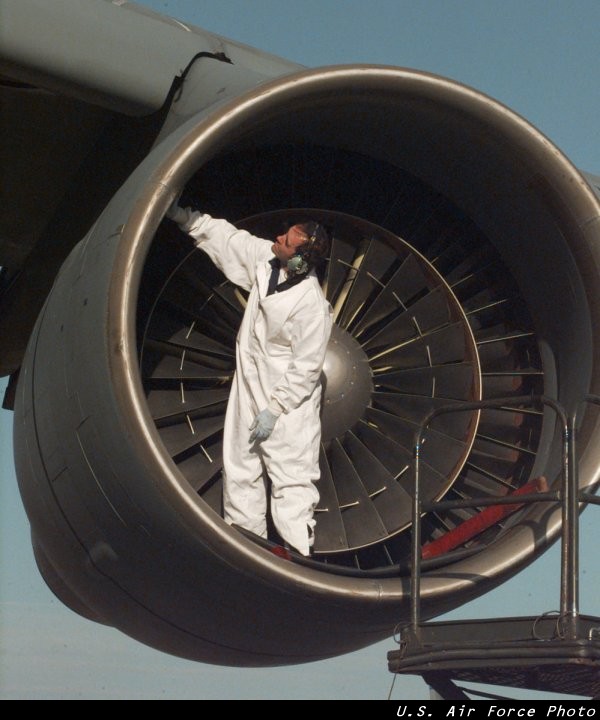
RERP’s core improvement is the addition of modern F138-GE-100 jet engines, derived from General Electric’s CF6-80C2s that power many Boeing 747s (including the President’s Air Force One), 767s, Airbus 300 and 310s, and other commercial aircraft. The full 2-part upgrade aims to lift the C-5’s mission capability rate from the present level of 55-60% to better than 75%. Lead contractor Lockheed Martin also claims the combined AMP and RERP upgrades will reduce the Air Force’s total ownership cost fleet-wide by 34% over the C-5M’s remaining life span.
These new CF6 engines deliver more than 50,000 pounds of thrust each, allowing the C-5Ms to carry more than 270,000 pounds, and to take off and land in distances as short as 5,000 feet. In comparative terms, they deliver 22% more takeoff thrust, achieve 30% shorter takeoff distances, enable 58% faster time-to-climb to cruising altitude (an important metric in dangerous environments, where getting above 15,000 feet makes you a lot safer), and have a 99.98% departure reliability rate in commercial service, providing a 10-fold improvement in reliability and maintainability over the C-5 fleet’s existing TF39 engines.
In 2002, Lockheed Martin awarded GE a $126 million contract to provide CF6-80C2 engines for the C-5M SDD phase. Following a successful SDD phase, the production phase could have called for upwards of 500 F-138 engines, plus service support, at a potential value of $2.6 billion to GE over the life of the multi-year program. In practice, the narrowing of the RERP program to just 42 aircraft means orders for about 170-190 F138 engines.
The C-5s’ RERP phase will also install full-authority digital engine controls (FADECs) that improve their performance and fuel efficiency, updated fault monitoring and recording systems, and much else. Work will cover hydraulic, fuel, fire suppression and pressurization subsystems as well as auxiliary power units, air conditioning systems, landing gear and the airframe.

(click to view full)
After completing the entire modernization program, the C-5s will be renamed the C-5M Galaxy aircraft. The 2 new configurations (C-5 AMP, C-5M) will also create follow-on contracts to modify training devices, etc. to the new standards.
The first test C-5M flew on June 19/06, and the first production C-5M flew in September 2010. The production rate goal for C-5Ms is an 8-month turnaround on the modernization, which translates into 11 converted aircraft per year at peak production.
The Air Force planned to “RERP” 2 C-5Bs and 1 C-5A to verify the hoped-for performance and reliability boost. A production decision on the re-engining program was expected in FY 2007, but did not take place until February 2008. In the end, the C-5A fleet was excluded from the RERP phase altogether. Some were even excluded from the AMP phase, which means the overall C-5 fleet will shrink.
The C-5 AMP/RERP Program
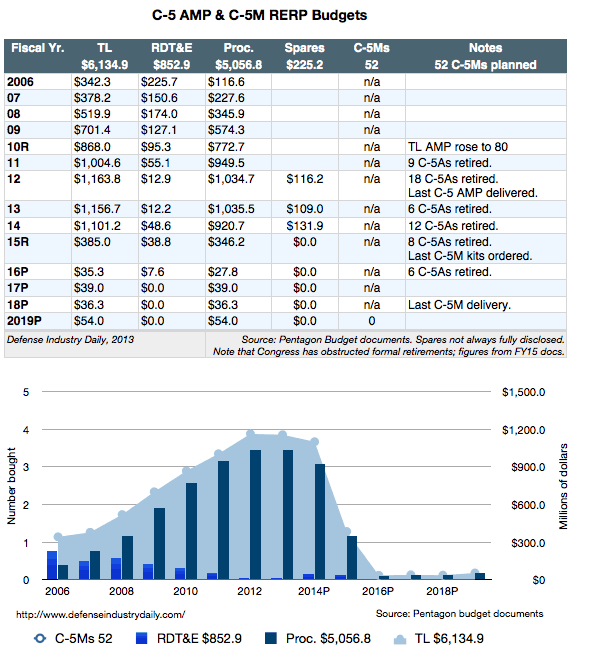
Note that figures after 2015 involve fleet sustainment and modernization, which won’t really stop until the planes are retired from service.
C-5 Upgrade Programs: Budgets
Decisions, Decisions: The C-5 Gamble
(click to view full)
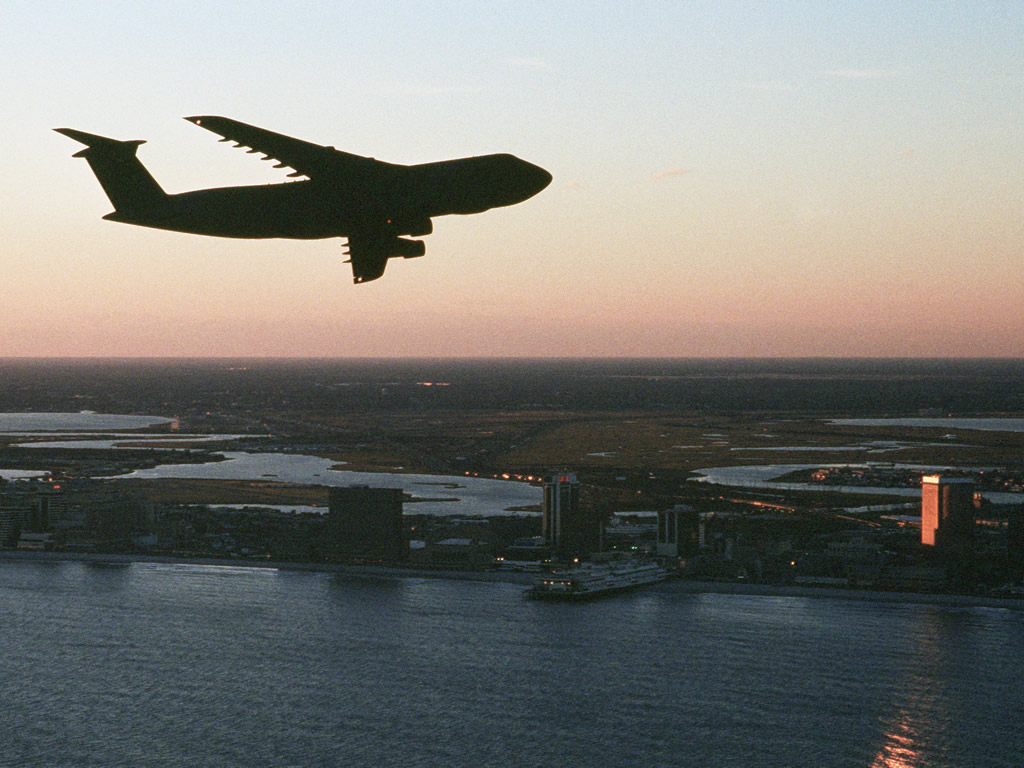
The initial C-5 program delivered 80 aircraft. A 2nd construction program in 1981-1986 delivered 50 more; 4 have been lost in crashes, for a total fleet of 126. Each C-5 aircraft can carry 265,000 pounds of cargo for 4,000 miles (roughly double that of the newer C-17A), or 125,000 pounds for 8,000 miles. Its hinged nose can even be raised to make loading or unloading easier, and the Galaxy’s ability to lift even the heaviest main battle tanks into theater made it a critical part of the trans-oceanic air bridge that would reinforce Europe or Korea in the event of an enemy attack. During the 2003 run-up to Operation Iraqi Freedom I, C-5s proved their worth again as they removed logistics bottlenecks in Europe.
If results and cost projections had been more positive, up to 112 total C-5A, C-5B and C-5C aircraft would have gone through the 2-phase AMP/RERP upgrade, which is currently scheduled to begin in 2008 and continue through to 2014. The C-5Ms would then be expected to serve until 2040. The key is that word “if”. As the US Air Force Association explains:
“The C-5 Reliability Enhancement and Re-engining Program, or RERP, has been the catch-22 of mobility for several years. If the upgrade works, USAF won’t need more new C-17s. If it waits and then the RERP doesn’t work, the C-17 line will be closed, leaving no strategic lift option.”
The twin questions facing the program remain cost, and effectiveness. USAF acquisition executive Sue Payton told a Senate committee in late 2007 that per-aircraft costs for C-5 AMP/RERP had ballooned to $146.7 million. In contrast, Lockheed Martin business ventures vice president Larry McQuien stood by the company’s $83 million price commitment, and said that even if additional Air Force costs like training, spare parts, support equipment, and unanticipated repairs were thrown in, the per-aircraft price would not exceed $118 million.
Officially, the Air Force won that argument. Per USAF estimates, Secretary of the Air Force Michael Wynne declared the C-5 program to be in breach of Nunn-McCurdy notification provisions. That law requires the US military to notify Congress if a program is more than 15% over its baseline budget, and rejustify it if the increase is over 25%.
The USAF estimate was significantly more than a 25% increase, and some senior officials began to have second thoughts.
If RERP’s stated objective is to boost the overall reliability of about 100 C-5s by 10 percentage points, goes the thinking, that equates to adding 10 aircraft to the fleet. If the cost to complete the program is $16-17 billion, that’s over $1.6 billion per extra plane. Of course, one reply may add, the 10% readiness increase happens now – but what if the real difference is that without AMP/RERP, readiness rates continue to get worse, or sudden structural issues surface? What if half-way through their remaining airframe life, worsening issues with engines, wires, maintenance etc. mean that only 20% of the unmodified C-5s can fly? That would create a much higher future readiness gain for the modernization program, but those cost-benefit scenarios become more complex to calculate, involving probability estimates, the value of having certainty, plus capacity tradeoffs and load pattern analysis. How many replacement aircraft would be required to replace lost C-5s, and what would that cost?
[youtube:v=ISFtVs7Gbpw]
In the end, the USAF and Department of Defense separated the C-5s into 62 C-5 AMP-only aircraft, and 49 C-5M AMP/RERP aircraft. Further cuts appear to have reduced the C-5A+ AMP buy to just 79 planes total, leaving 27 C-5 AMPs and 52 C-5Ms.
The estimated cost of the new program drops to just $7.5 billion, but C-5A+ aircraft would be expected to show only minor readiness improvements, and maintenance of their engines will be a growing issue as the fleet ages. Lean Six Sigma initiatives and performance-based maintenance contracts will be used to try to address the readiness gap. Whether they will be successful remains an open question.
If not, studies were undertaken to see if the C-5 has a future as a civilian cargo aircraft, after all. With that low readiness rate, however, it’s unlikely.
Contracts & Key Events
the years…
(click to view full)
Unless otherwise noted, all contracts are issued to Lockheed Martin in Marietta, GA by the USAF’s Headquarters Aeronautical Systems Center at Wright-Patterson Air Force Base, OH. Note that the collection of entries becomes less complete before 2006.
FY 2014-2022
IOC achieved.

(click to view full)
October 5/22: Overhaul Services Thomas Instrument won a $13.6 million deal for depot-level overhaul services of the C-5 dual-powered winch, National Stock Number 1680-01-593-5680/Part Number 200413780-20. Work will be performed at Brookshire, Texas, and is expected to be completed by September 29, 2027.
July 7/22: Paint Job MH Systems won a $24.7 million deal for the purchase of aircraft painters manpower support. This contract provides for the augmentation of 402d Aircraft Maintenance Group organic forces for depot paint and de-paint operations for current and incoming workload for C-5, C-17, C-130, F-15, Global Hawk and JSTARS weapon systems. Work will take place in Georgia. Expected completion date is July 17, 2027.
June 2/22: Control Display Lockheed Martin won a $34.7 million contract modification for the C-5 Super Galaxy Replacement Multi-Functional Control Display Program. The modification provides for engineering and technical services to produce a hardware and software prototype architecture for transition into the engineering and manufacturing development phase. Work will take place Texas. Expected completion date will be by May 31, 2025.
October 23/18: Upgrades Honeywell International is being tapped to support the Air Force’s fleet of C-5M Super Galaxy transport aircraft. Under this $7.8 million firm-fixed-priced order the company will be responsible to upgrade 85 Versatile Integrated Avionics/Avionics Integrated Units (VIA/AIU) to the 905 configuration. The upgrades are part of the Galaxy’s Global Air Traffic Management (GATM) avionics program. The VIA software system has six primary “partitions” or applications that include flight management, com/nav/surveillance/identification (CNSI), communication management, display services and all-weather flight control. The C-5M VIA/AIU repair and upgrade effort is a key component to the overall Core Mission Computer/Weather Radar aircraft modification/installation kit that replaces the current mission computer, and replaces the weather radar with a commercial off-the-shelf color weather radar. Work will be perfumed at Honeywell’s location in Albuquerque, New Mexico, and is expected to be completed by June 14, 2020.
August 7/18: Ready to Lift The Air Force is now in possession of a completely refurbished fleet of C-5M Super Galaxy transport planes. The US Air Force Air Mobility Command began a program to modernize the C-5s in 1998 after a study concluded the decades-old aircraft had 80% of their service life remaining. AMP is the first step. Its main purpose is to equip the aircraft to fly in civil airspace by the most direct routes, at the most advantageous altitudes, with the most efficient fuel usage and cargo loads. AMP is also trying to reduce the number of devices and wires in the planes, to reduce costs and improve reliability. RERP’s core improvement is the addition of modern F138-GE-100 jet engines, derived from General Electric’s CF6-80C2s that power many commercial airliners. The C-5 is capable of carrying two 78-ton M1A1 main battle tanks or helicopters and other large equipment intercontinental distances. Over the years Lockheed Martin upgraded a total of 52 C-5s with new engines, avionics and diagnostic systems, which will keep the airlifters flying until the 2040s.
October 25/17: Lockheed Martin has been awarded a $14.7 million US Air Force (USAF) contract to enhance the automatic dependent surveillance-broadcast out system, among other parts of the communications system on the C-5. Work to be undertaken include C-5 communications, navigation, surveillance/air traffic management engineering and manufacturing development program and incorporates the automatic dependent surveillance-broadcast out technology. Work will be completed at Marietta, Ga., and is expected to be completed by September 25, 2019. Lockheed’s C-4 Galaxy has been in service since 1970 and is one of the world’s largest transport aircraft.
July 16/14: #21 delivered. C-5M Super Galaxy #87-0044 leaves Marietta, GA as the 3rd C-5M destined for Travis AFB, CA. Sources: Lockheed Martin Code One Magazine, “Travis No. 3”.
June 30/14: #20 delivered. A C-5M Super Galaxy leaves Marietta, GA for Travis AFB, CA. Aircraft 85-0010 was delivered 28 days ahead of the contracted schedule. Sources: Lockheed Martin, “Another C-5M Goes West”.
June 18/14: RERP-6: Convert 11. A $222.9 million fixed-price C-5M RERP contract modification pays to modify a total of 11 C-5 aircraft, using the appropriate kits. This brings the Lot 6 total to $882.3 million for materials and installation (q.v. Oct 31/12, Oct 21/11)
All funds are committed immediately, using FY 2013 and FY 2014 USAF aircraft budgets. Work will be performed at Marietta, GA and is expected to be complete by Jan 10/17. USAF Life Cycle Management Center/WLSK at Wright-Patterson AFB, OH manages the contract (FA8625-07-C-6471, PO 0200).
May 8/14: RERP-7 kits. Lockheed Martin in Marietta, GA receives a $508.9 million fixed-price modification for C-5 RERP Lot 7 kits.
All funds are completed immediately, using USAF FY 2014 aircraft procurement funds. Work will be performed at Marietta, GA, and is expected to be complete by May 2018. The USAF Life Cycle Management Center/WLSK at Wright-Patterson AFB, OH manages the contract (FA8625-07-C-6471 P00201).
May 8/14: #19. C-5M Super Galaxy #87-0042 leaves Marietta, GA as the 1st C-5M destined for Travis AFB, CA. The C-5Ms will be flown by active duty crews from the 60th Air Mobility Wing, as well as crews from Air Force Reserve Command’s 349th AMW Associate unit at Travis AFB. Sources: Lockheed Martin Code One Magazine, “First Super Galaxy For Travis”.
April 26/14: Basing. The USAF announces that half of the 439th Airlift Wing’s C-5 fleet at Westover ARB, MA will be cut, with 8 of their C-5Bs transferred fto JB San Antonio-Lackland, TX beginning in 2015. Westover will receive 8 upgraded C-5M Super Galaxys, but they’ll still lose 59 full-time enlisted personnel and 275 drilling Reservists. Sources: Lockheed Martin Code One Magazine, “Westover Basing Decision”.
April 2/14: #18. USAF Lt. Gen. Brooks L. Bash, the vice commander of Air Mobility Command, personally flies C-5M #87-0040 from the Lockheed Martin facility in Marietta, GA, to Dover AFB, DE. It’s the last C-5M delivered to the base, which has been the type’s sole destination so far. Sources: Lockheed Martin Code One Magazine, “Last Super Galaxy To Dover”.
March 25/14: #17. C-5M Super Galaxy #87-0020 leaves Marietta, GA for Stewart ANGB, NY for internal paint and insulation blanket restoration. After getting the touch-up, the aircraft will be flown to Dover AFB, DE. Sources: Lockheed Martin Code One Magazine, “Super Galaxy Number 17”.
March 25/14: Avionics. Lockheed Martin Aeronautics Co. in Marietta, GA receives a sole-source $84.3 million cost-plus-incentive-fee contract. It funds the EMD development program for the C-5 fleet’s Core Mission Computer/Color Weather Radar program. These upgrades are envisaged as retrofits to the entire AMP/ RERP fleet.
$11.2 million in FY 2013 USAF aircraft budgets are committed immediately. Work will be performed at Marietta, GA, and is expected to be complete by March 31/17. The USAF Life Cycle Management Center/WLSK at Wright-Patterson AFB, OH manages the contract (FA8625-14-C-6596).
March 4-11/14: Budgets. The US military slowly files its budget documents, detailing planned spending from FY 2014 – 2019. The C-5 program gets the main C-5M budget zeroed out from FY 2016 – 2019. It’s not quite as big a change as it seemed, because some of the upgrades are being broken out as their own programs, but it’s still a total reduction of about $194.5 million from FY 2016 – 2019. See the charts above.
The C-5’s mission computer has to be replaced. It has reached capacity, and can’t even handle basic additions like the flight management system (FMS); weather radar; and basic requirements for using civil airspace past 2020: ADS-B Out, and identification, friend or foe (IFF) mode 5. The new mission computer will handle these and other upgrades.
A new color weather radar replaces the current AN/APS-133s, which have such serious problems with obsolete parts that they threaten to become unserviceable.
They also want to fix the bathrooms, but that isn’t just convenience. Not only is the current system unreliable, it leaks liquid sodium hypochlorite, causing severe corrosion and burnt wires in the landing gear control panels. Not a great outcome, so they’re going to replace them a commercial product using FY15 funding.
Feb 21/14: IOC. USAF AMC declares Initial Operational Capability for the C-5M. Lockheed Martin has delivered 16 planes, and the aircraft has passed its Qualification Test, Operational Test and Evaluation, stand-up of required spares and maintenance facilities at Dover AFB and other locations, and stand-up of enough trained aircrew and maintenance personnel.
The program is far enough along that the Pentagon’s DOT&E no longer features them in testing reports.
C-5M IOC
Dec 23/13: #16 delivered. Tail number 87-0036 is ferried to Dover Air Force Base, DE. It’s the 16th C-5M delivered, and the 6th delivered in 2013. Is it us, or did that recent set of rapid-fire deliveries seem a bit compressed? Sources: Lockheed Martin, “Sweet Sixteen”.
Dec 12/13: #15 delivered. The latest C-5M is off to Dover Air Force Base, DE. Lockheed Martin is still touting that the plane “exceeds a mission capable rate of 80 percent,” which is a big improvement if it’s true. Sources: Lockheed Martin, “Home for the Holidays”.
Dec 5/13: #14 delivered. Lockheed Martin flies its latest delivery to Stewart Air National Guard Base, NY for internal paint restoration, before C-5M #86-0017 heads to its permanent home at Dover AFB, DE. Sources: Lockheed Martin, “Another Super Galaxy Delivered” | Lockheed Martin Code One Magazine, “Super Galaxy Delivered”.
Nov 21/13: #13 delivered. Lockheed Martin delivers tail number 85-0004 to the 436th Airlift Wing at Dover Air Force Base, DE. Sources: Lockheed Martin, “Baker’s Dozen!”.
FY 2013
[youtube:http://www.youtube.com/watch?v=MZlIc1Kp5vw]
C-5M Pilot
click to play video
Sept 19/13: #12 delivered. Lockheed Martin delivers C-5M #85-0003 to the USAF at its Marietta, GA plant. Maj. Gen. Wayne Schatz Jr., Director of Strategic Plans, Requirements, and Programs at Air Mobility Command headquarters, flies the aircraft to Stewart ANGB, New York, where it will undergo internal paint restoration before returning to its permanent home at Dover AFB, DE. This aircraft has recorded more than 19,000 flight hours.
Lockheed Martin says that they’re on track to deliver 52 C-5Ms by 2017. Sources: Lockheed Martin, “Make it a Dozen!” | Lockheed Martin Code One Magazine, “Super Galaxy No. 12”.
Sept 5/13: Training. A $21.3 million contract modification for a C-5M RERP aircraft maintenance system trainer and a flight control system trainer at Travis AFB, CA, plus associated spares. All funds are committed immediately, using FY 2012 procurement funds. The buy seems minor, but the 2012 report from the Pentagon’s testing department (q.v. Jan 17/13) cited a lack of dedicated training systems as a problem for the fleet.
Work will be performed in Marietta, GA, with an expected completion date of Aug 31/16. Fiscal 2012 aircraft procurement funds in the amount of $21,318,495 are being obligated at time of award. The Air Force Life Cycle Management Center at Wright Patterson AFB, OH manages the contract (FA8625-07-C-6471, PO 0224).
June 21/13: #11 delivered. The eleventh C-5M Super Galaxy leave Lockheed Martin’s Marietta, GA facility for Dover AFB, DE. Sources: Lockheed Martin, June 21/13 release.
June 18/13: Software. A $27.9 million indefinite-delivery /indefinite-quantity contract with cost-plus-fixed-fee, firm-fixed-price, and cost-reimbursement-no-fee portions. Lockheed Martin will support C-5 software and the software integration laboratory, offer engineering support, and provide an emergency operational flight plan.
$21 million in FY 2013-2016 Operations and Maintenance DPEM Software funds in the amount are committed for Task Orders 0001 and 0002. Work will be performed at Marietta, GA, and is expected to be complete by by June 20/16. This award is a result of an electronic solicitation with 1 bidder, from the USAF Life Cycle Management Center/C-5 Galaxy Center at Robins AFB, GA (FA8525-13-D-0004).
April 28/13: Waste. Congressionally-mandated waste continues. USAF training hours are cut and squadrons stop flying, in order to maintain aircraft that cannot fly and pay people in Congressional districts to do meaningless work. The USAF isn’t the only service with this problem, but it’s a sharp one for the C-5 fleet. From the New Hampshire Foster’s Daily Democrat:
“Parked around the airstrip at Joint Base San Antonio-Lackland are more than a dozen massive C-5A Galaxy transport planes. There is no money to fly them, repair them or put pilots in the cockpits, but Congress rejected the Air Force’s bid to retire them…. crews will tow the planes around the Texas tarmac a bit to make sure the tires don’t rot, then send them back into exile until they can finally get permission to commit the aging aircraft to the boneyard…. Fifteen of the C-5A Galaxy aircraft are at Lackland, where crews are getting in some flights now preparing for the retirement, while 11 are at Martinsburg, W.Va., and are flown [sic] by the Air National Guard there.”
April 25/13: Lockheed Martin Aeronautics Co., Marietta, Ga., was awarded a modification on contract for C-5M Reliability Enhancement and Re-engining Program (RERP). The value of this contract modification is $45.7 million, increasing the total contract value from $3.647 billion to $3.693 billion. The contract modification is for C-5M RERP Lots 3, 4, and 5 Rapid Repair and Response legacy repair efforts.
Work will be performed in Marietta, GA, and is expected to be complete by Oct 29/14. $14.8 million in FY 2011 through 2013 Aircraft Procurement funds are committed immediately by the USAF Life Cycle Management Center/WLSK at Wright-Patterson AFB, OH (FA8625-07-C-6471, PO 0182).
April 10/13: FY 2014 Budget. The President releases a proposed budget at last, the latest in modern memory. The Senate and House were already working on budgets in his absence, but the Pentagon’s submission is actually important to proceedings going forward. See ongoing DID coverage.
FY 2014 is the last major year of funding at $1.217 billion. That will drop to $334.7 million in FY 2015, when C-5M budgets will almost end completely. The last aircraft scheduled for delivery in Q1 FY 2017.
Jan 31/13: Support. A $16 million firm-fixed-price, cost-plus-fixed-fee and cost reimbursement contract for replenishment spares and repairs in support of the C-5’s AMP and RERP programs.
Work will be performed in Marietta, GA, and expected to be complete by Jan 31/14. The AFLCMC/WLKB at Robins AFB, GA manages this sole source acquisition, using FY 2013 dollars (FA8525-13-D-0001).
Jan 17/13: DOT&E report. The Pentagon releases the FY 2012 Annual Report from its Office of the Director, Operational Test & Evaluation (DOT&E). The C-5M is included, and it still isn’t “operationally suitable”. In fact, the office had recommended last year that C-5M wasn’t ready to proceed to IOT&E testing. It went anyway, and:
“The aircraft’s ability to conduct the strategic airlift mission is hindered by deficiencies in the Automatic Flight Control System, by problems with the Embedded Diagnostics System (EDS) and built-in test (BIT) functionality, by inadequate support equipment, and by a lack of dedicated training systems. Deficiencies in several aspects of C-5M support functions, identified before the 2010 OT&E began, had a significant effect on suitability, specifically the maintainability of the aircraft.”
As one might imagine, the USAF has an “extensive” correction action plan. Diagnostic false alarm rates remain “very high,” which risks sabotaging the entire mission availability rationale for the entire C-5M program. There’s also a problem with training, since C-5M specific aircrew and maintainer training devices are just becoming available, forcing the USAF to use 1 simulator, plus on-aircraft training when possible. That doesn’t help readiness, either, and the USAF plans to buy more training devices in FY 2013.
OFP 3.5 basic flight & operating software helped with some of the airspeed control issues, but the plane still isn’t reliable in critical situations like final approach, or “gusty or turbulent” conditions. The Air Force plans to begin operational testing of OFP 3.5.2 in August 2013. At least the thrust reversers got their heating blankets to prevent ice-up, then got strengthened gears to make sure they stayed retracted. It works, but they need to be inspected more often.
Nov 30/12: RERP. A $9 million contract modification for the C-5 RERP. Work will be performed in Marietta, GA until July 31/15 (FA8625-07-C-6471, PO 0184).
Nov 29/12: C-5A-M Support. A $56.7 million cost-plus-fixed-fee, cost-reimbursement- no-fee, firm-fixed-price, time and materials contract for the C-5 sustaining engineering and technical support services. It covers all C-5s in service, including the C-5Ms, which are becoming a significant enough presence to matter. Work will be performed in Marietta, GA until Nov 30/12 (FA8525-13-D-0003).
Nov 21/12: A $38.5 million contract modification for procurement of 2 optional C-5 RERP plus-up spare engines, and the engine kits effort. Work will be performed in Marietta, GA, and is expected to be complete by Dec 15/14 (FA8625-07-C-6471, PO 0161).
Note the purchase order number, this is similar to but distinct from the Nov 19/12 order.
Nov 19/12: RERP. A $38.3 million contract modification to buy 2 spare C-5 RERP RFI engines and RFI engine kits.
Work will be performed in Marietta, GA, and is expected to be complete by May 30/14. The AFLCMC/WLSK at Wright-Patterson Air Force Base, OH manages the contract (FA8625-07-C-6471, PO 0160).
Oct 31/12: RERP Lot 6. A $489.4 million contract modification for C-5 RERP Lot 6 kits. It’s added to the $160 million advance procurement (vid. Oct 21/11) for these 11 aircraft kits, and the installation and spares contracts are still pending beyond the current $659.4 million.
Work will be performed in Marietta, GA, and the contract will run until July 17/15 (FA8625-07-C-6471, PO 0140).
Oct 19/12: RERP Lot 5. Lockheed Martin Aeronautics in Marietta, GA receives a $221.8 million contract modification for the C-5 RERP Lot 5 Installation effort, involving 11 aircraft. That boosts the total cost of publicly-reported RERP-5 contracts to $1,000.5 million, or about $91 million per plane, including spares.
Work will be performed in Marietta, GA, and is expected to be complete by Oct 29/15 (FA8625-07-C-6471, PO 0166).
FY 2012
79th & last C-5 AMP delivered; All-C-5M fleet?; Cracks sapping fleet capacity; C-5M testing issues.

(click to view full)
July 20/12: #5 delivered. Lockheed Martin delivers the 5th production C-5M, and 8th overall, to Robins AFB, GA.
June 29/12: Un-cracked. Cracks at the C-5 cargo floor’s bulkhead end fittings had restricted its cargo carrying capabilities to a maximum of 80%, lowering its advantage over platforms like the C-17. In response, the US Air Force Research Laboratory (AFRL) developed a more stress and corrosion-resistant aluminum alloy, and a new die forging process, under the Durable C-5 Structural Improvements Program. Some C-5s are already being refitted at the Warner Robins Air Logistics Center, GA. US AFRL:
“The reshaped end fittings provide an optimised design that is less prone to cracks, and also offers multiple benefits for the revamped C-5 aircraft, which includes a 25% overall cost savings, an 80% reduction in fabrication time, and a 60% increase in service life of the fittings… methods employed earlier… insufficient, as the replacement fittings provided to the aircraft often cracked during the machining process, and also had a shorter lifespan than the original parts.”
April 30/12: Last C-5 AMP. Lockheed Martin announces that it has delivered the 79th and final C-5 AMP plane to the USAF. The planned program total had been cut from 111 to 80, but a C-5 crash dropped the number by one.
Last C-5 AMP delivered.
April 15/12: Link for savings. The USAF discusses its Mobility Mission Linking, or MML, program, which aims to make up for the inconvenient positioning of current C-5 wings in Texas and the USA’s east coast. When most missions are in Southwest Asia, it can mean up to 11 flight hours per mission with no cargo on-board. By linking multiple stops and eliminating the transit from Texas, MML expects to save 3.5 million gallons of fuel and $12 million between FY 2012- 2016. USAF.
April 12/12: All C-5Ms? A USAF story makes an interesting statement:
“The C-5 has long been known as the “Air Force’s largest airlifter.” In the future, Air Mobility Command officials say the goal is to have all C-5s become C-5Ms that would further strengthen the airframe’s worldwide airlift capabilities.”
There are 2 ways to do that. One way is to modernize the remaining 27 C-5 AMP aircraft at a later date, bringing the C-5M fleet to 59. the other way is to retire the lower-readiness, lower-capability, more expensive to operate C-5 AMPs early, leaving the USAF with just 52 C-5Ms as the entire fleet. In a coming era of budget cuts, which seems more likely?
April 7/12: Gannett’s Air Force times reports that Dover AFB will be the 1st base to convert to an all-C-5M fleet, after its last C-5B leaves for conversion in June 2012.
Feb 1/12: RERP #11 begins. Lockheed Martin inducts the 11th C-5 RERP aircraft to the Super Galaxy production line. Aircraft 86-0017 has accumulated more than 18,000 flight hours and more than 4,300 full-stop landings.
Jan 17/12: DOT&E test report. The Pentagon releases the FY 2011 Annual Report from its Office of the Director, Operational Test & Evaluation (DOT&E). The C-5M RERP is listed as 1 of just 3 USAF programs that met their reliability targets, though a subsequent March 2012 DoD DT&E and SE Annual Report lists C-5M reliability at just 66%, instead of the 75% target that must be met in FY 2016. In the interim, the C-5M is proceeding fairly well, but still has some issues to work on.
The 2010 operational test identified problems with engine thrust reversers (restricted use in flight makes emergency descents and some tactical patterns very difficult), autopilot (too aggressive in cruise operations & turbulence, doesn’t always maintain commanded airspeed), and the Environmental Control System (autopilot problems killing bleed air supply and dropping cabin temperature under 50F/ 10C). Operational testing of the fixes was scheduled to begin in January 2012, in conjunction with operational testing of the plane’s new Block 3.5 software set.
While the C-5M was deemed operationally effective, it wasn’t given an “operationally suitable” rating. That will require testing to eliminate a very high false alarm rate and poor fault diagnosis in the plane’s built-in-test equipment, and the delivery of C-5M aircrew and maintainer training devices. The C-5M is also susceptible to unspecified “information assurance” (data security) problems, but the risk was deemed to be low.
Nov 18/11: RERP Lot 5. Lockheed Martin Corp. in Marietta, GA receives a $13.4 million firm-fixed-fee contract modification for C-5 RERP FRP-5 items required to meet the field needs of its 11 C-5M aircraft. That’s on top of the $602.4 million in Oct 21/11 FRP-5 orders. One firm was solicited and one firm submitted a proposal to the ASC/WLSK at Wright-Patterson AFB, OH (FA8625-07-C-6471).
Oct 21/11: RERP Lots 4-6. Lockheed Martin Aeronautical Systems in Marietta, GA receives 4 C-5 RERP program contract modifications, worth around $890 million total. All are firm-fixed-price, with economic price adjustments if the cost of key metals etc. rises. They are:
For C-5 RERP Full Rate Production, Lot 4 (FRP-4, FY 2011), $126.7 million to finish C-5M conversion and install the 28 enhanced engines on FRP-4’s 7 aircraft (FA8625-07-C-6471, PO 0102). They’re Production Lot 4 RERP kits, but they’re installed in the same fiscal year that produces FRP-5.
For C-5 RERP FRP-5 (FY 2012), $518.9 million to build the FRP-5 RERP kits for 11 C-5s (FA8625-07-C-6471, PO 0107), and $83.5 million to buy initial spares for those planes (FA8625-07-C-6471, PO 0104).
For C-5 RERP FRP-6 (FY 2013), $160 million for advance procurement of items whose production lead time is more than 12 months, so they’ll be ready when the FRP-6 build contract for another 11 C-5 RERP kits is issued next year (FA8625-07-C-6471, PO 0103).
FY 2011
Civilian C-5s?
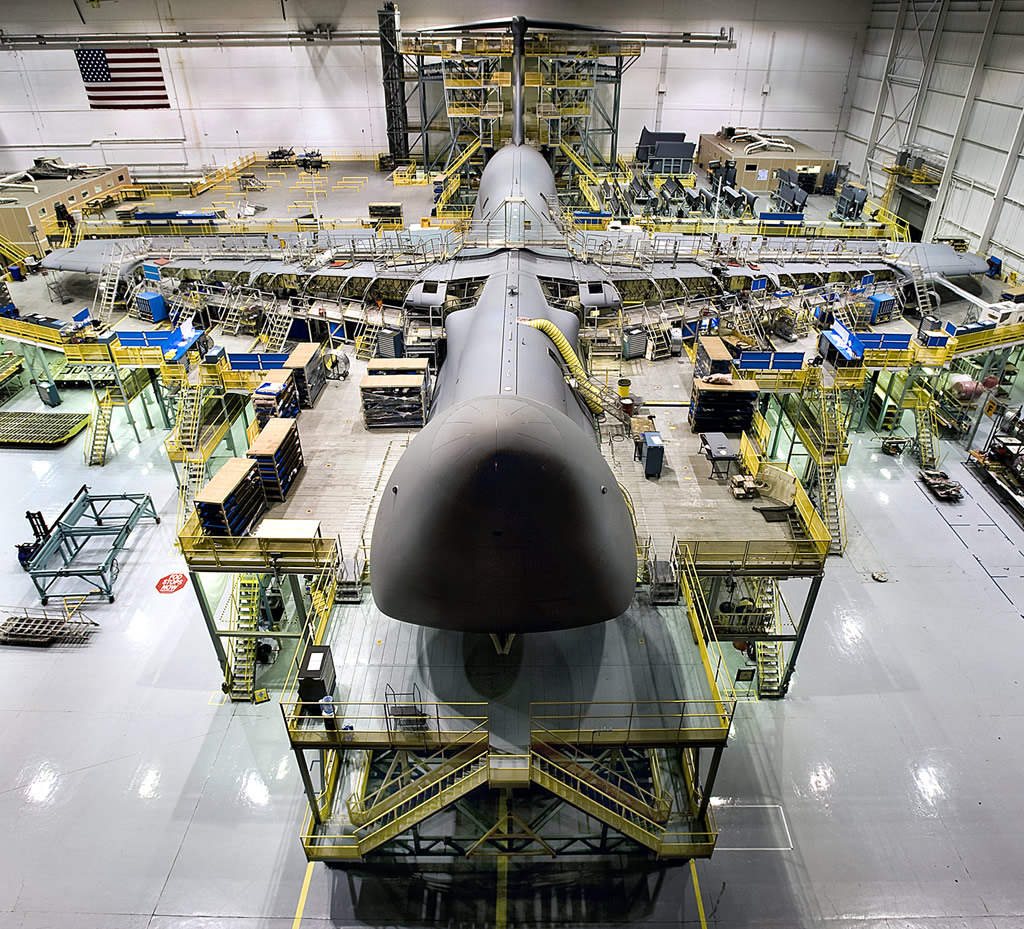
(click to view full)
Sept 29/11: RERP #9P in. Lockheed Martin inducts the 9th C-5 for full C-5M conversion. Tail 0045 was the last C-5B produced for the USAF. It has accumulated nearly 18,000 flight hours, and more than 4,200 full-stop landings.
Sept 25-26/11: Non-stop. A C-5M Super Galaxy from the 436th Airlift Wing at Dover AFB, DE, flies direct to Bagram Airfield, Afghanistan, passing over the Atlantic and Europe en route. Traditionally, C-5s stop in Germany to refuel the plane and rest the crew, then finish the rest of the flight the next day. For this flight, a KC-135R aerial tanker based in Britain refueled the plane.
There’s a balance between proving out new routes, for use if needed, and using routes that don’t place a routine strain on resources. While the C-5M is capable of these missions, it remains to be seen whether they will become the norm. Another pathfinding example took place on June 5-6/11, as a C-5M crew flew an arctic route to Afghanistan over Canada, Russian, and Kazakhstan, with a KC-135R refueling over northern Canada. USAF AMC.
Aug 17/11: Training. Lockheed Martin announces a $5.8 million base contract from FlightSafety Services Corp. The scope of work includes managing hardware, software and courseware, maintaining simulator certifications to Air Force specifications, and overseeing the operations of the C-5 Aircrew Training System (ATS) program.
C-5 ATS helps train C-5 pilots, flight engineers, loadmasters and maintenance engine run personnel, and the contract will apply to all C-5 variants. Lockheed Martin will manage the Lackland AFB, TX C-5 Training Systems Support Center and formal training unit, and provide support for the other 6 training locations: Dover AFB, DE; Travis AFB, CA; Martinsburg ANG Base, WVA; Memphis ANG Base, TN; Stewart ANG Base, NY; and Westover Air Reserve Base, MA. The contract includes 4 more 1-year options, which could bring this contract up to 5 years and $30 million.
Aug 4/11: RERP #8P in. C-5B tail number 85-0003 becomes the 8th aircraft inducted into modernization production. That number is expected to rise to 10 by the end of 2011. Lockheed Martin.
July 18/11: RERP #3P flies. The 3rd production C-5M Super Galaxy takes its first flight at the Lockheed Martin facility in Marietta. Aircraft 0005 is assigned to Dover AFB, DE, and will be flown by both active duty and reserve airlift wings. Lockheed Martin.
April 27/11: Sub-contractors. Small business qualifier Thomas Instrument in Brookshire, TX receives a maximum $9 million firm-fixed-price, indefinite-delivery/ indefinite-quantity contract for C-5 aircraft gearbox assemblies.
The contract runs to March 2015 and is managed by the US Defense Logistics Agency Aviation at Robins Air Force Base, GA (SPRWA1-11-D-0009).
April 12/11: RERP #2P delivered. Lockheed Martin completes delivery of the 2nd production C-5M at Dobbins Air Reserve Base, Marietta, GA. The plane will undergo internal paint restoration at Stewart Air National Guard Base, NY, before traveling to its home base at Dover. Lockheed Martin.
Feb 15/11: An $8.9 million contract modification for the C-5 RERP Lot 4 readiness spares package, part 2, for Dover and Travis Air Force Bases. At this time, all funds have been committed (FA8625-07-C-6471; P00076). This contract and modification number was also announced on March 7/11, where it did not say that all funds had been committed.
Feb 14/11: FY 2012 Budget. The Pentagon releases its FY 2012 budget request, and the USAF details its major programs [PDF]. FY 2011 was the last year for C-5 AMP funding, at $627.7 million requested. In FY 2012, the C-5M RERP program would receive $851.9 million to convert 7 aircraft (up from 5 in FY 2011; note that conversions are done using the previous year’s production) and buy 11 equipment sets for installation in FY 2013, as well as $9.4 million to get USAF maintenance depots ready for C-5Ms, and $500,000 for an AMP/RERP compliant Aircrew Training System (ATS) and a Maintenance Training Device (MTD). Other USAF budget documents [PDF] add that:
“In FY 2012, the F-35, RQ-4 Global Hawk, and Light Cargo Aircraft have large initial spare requirements in preparation for fielding. Other initial spares programs with large requirements include MQ-9 Reaper, C-5 Airlift Squadrons, Light Cargo Aircraft, CV-22, and EC-130H COMPASS CALL aircraft. In FY2012 some programs, including Global Hawk, MQ-9, and C-5 began budgeting for initial spares in Budget Activity 06 instead of Budget Activities 01 through 05.”
The C-5 RERP is the largest of them all, with $116.175 million in spares. That’s not entirely surprising, given the number of new engines involved. The Pentagon doesn’t include the C-5 in its handout of costs by weapon system, but the C-5 AMP/RERP seems to add up to around $978 million in FY 2012.
Jan 28/11: A $20.6 million contract modification to provide interim contract support for the C-5 RERP Program. At this time, the entire amount has been committed (FA8625-09-D-6485 0008).
Jan 19/11: RERP #5P in. Lockheed Martin announces that the 5th C-5 aircraft has been inducted into the RERP process, to be transformed into a C-5M by the end of 2011.
Nov 30/10: An $8 million contract for C-5 fleet sustaining engineering efforts required to resolve technical, supportability, or efficiency issues. Money will be committed as needed by the WR-ALC/GRSKA at Robins Air Force Base, GA (FA8525-11-D-0003).
Nov 18/10: Training. A $23 million contract modification for Phase 3 of the C-5M RERP’s AMS (aircraft maintenance systems) trainer and flight trainer program. At this time, $14.3 million has been obligated (F33657-02-C-2000; P00227).
Nov 15/10: RERP #1P delivered. The 1st production C-5M leaves Stewart Air National Guard base in Newburgh, NY and arrives at its duty station of Dover AFB, DE. The C-5M planes flying to date have all been pre-production planes from the system development stage. defpro | Mid-Hudson News | NY State.
Nov 8/10: A maximum $29.2 million contract for C-5M AMP program sustainment support. Delivery orders will be issued as needs arise by the Warner-Robins Air Logistics Center at Robins Air Force Base, GA (FA8525-11-D-0001).
Oct 22/10: RERP Lot 4 k+s. A pair of C-5M RERP awards from the USAF, for current production, worth $387.9 million. See also Jan 11/10 entry.
A $326.9 million contract modification for C-5M RERP full-rate production Lot 4 materials and fabrication of material required to modify the 7 seven Lot 4 aircraft. At this time, all funds have been committed (FA8625-07-C-6471; P00041).
A $61 million contract modification for spare parts to cover the 7 C-5M aircraft from FRP Lot 4 production. At this time, all funds have been committed (FA8625-07-C-6471; P00058).
Oct 19/10: RERP Lot 3i/5a. A pair of C-5M RERP awards from the USAF, worth $278.6 million.
The first is a a $115.7 million contract modification for C-5M RERP low rate initial production Lot 3 installations. At this time, the entire amount has been committed (FA8625-07-C-6471).
The second is a $162.9 million contract which covers C-5M RERP full-rate production Lot 5 advance procurement of critical materials and equipment, such as aircraft engines. At this time, the entire amount has been committed (FA8625-07-C-6471).
Oct 4/10: Civil C-5s? Aviation Week reports that both Lockheed Martin and elements in the USAF are re-thinking the decision to terminate RERP for the C-5A fleet, if money allows – and even looking at placing some C-5s in the civilian market:
“Lockheed Martin says it needs long-lead funding in Fiscal 2014 to avoid a gap in the modification line after the last C-5B is upgraded, and to keep prices agreed upon with major suppliers… [including] General Electric for the new CF6-80C engines. “As the aircraft proves itself, we are talking to the Air Force about the benefits of a single fleet,” says Lorraine Martin, Lockheed Martin vice president for C-5 programs… The Air Force also operates 59 C-5As, but plans to retire 22 in 2011-12 because of excess strategic airlift capacity. Congress directed the Air Force to study the potential for placing the retired aircraft with the Civil Reserve Air Fleet (CRAF) or international coalition partners. A report will be submitted soon… A Defense Acquisition Board decision on full-rate production [of C-5M RERP planes] is set for Oct. 7.”
Barring some sort of government financing agreement that would tip the scales, C-5As and their $82+ million RERP upgrade costs would have to compete against new-build civilian BC-17s at about $225 million, in order to become a preferred option for would-be civilian carriers who wanted to compete with Antonov’s partners in the outsize cargo market.
Sept 20/10: Infrastructure. Soltek Pacific Construction Co. in San Diego, CA wins a $6.4 million firm-fixed-price task order under a multiple award construction contract (N62473-08-D-8615, #0014) to build a C-5 Squadron Aircraft Operations and Maintenance Facility at Travis Air Force Base, CA. The task order also contains one planned modification which if issued, would increase the cumulative task order value to $7.5 million.
Travis AFB is home to the 60th Aircraft Maintenance Squadron, which services and supports AMC C-5s. Work will be performed in Fairfield, CA, and is expected to be complete by October 2011. The Naval Facilities Engineering Command, Southwest in San Diego, CA received 4 proposals for this task order.
FY 2010
C-5 AMP cut from 112 – 92; C-5M RERP operational; RERP gets low-rate production approval
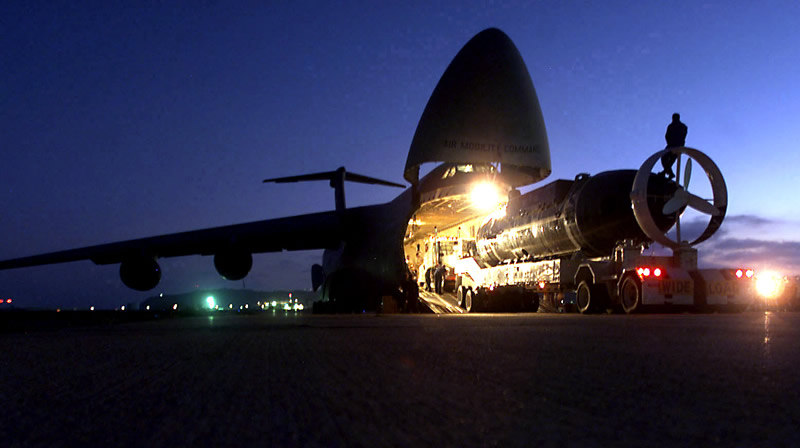
(click to view full)
Sept 19/10: RERP #1P flies. The first production C-5M takes off from Lockheed Martin’s Marietta, GA facility. It is slated for formal delivery on Sept 30/10, and will arrive at its new home Dover AFB, DE in November 2010.
Note that this is not the 1st C-5M, as there were 3 initial planes built in the system development phase, and they are already operational.
July 29/10: Training. CAE USA, Inc. in Tampa, FL receives $10.6 million contract to purchase 7 C-5 AMP training devices and 5 C-5M RERP program training devices for the C-5 aircrew training system. The simulators will be used by USAF Air Material Command, US Air National Guard, and USAF Reserve Command. CAE will begin by upgrading a C-5 WST(Weapon System Trainer) currently located at Stewart Air National Guard Base (ANGB) to the new C-5 AMP configuration. The other C-5 WST, located at Dover AFB, DE and already upgraded by CAE to the AMP configuration several years ago, will now be upgraded to the RERP configuration using new engine performance simulation software and a new aerodynamics model.
A month later, a CAE release says that the contract includes options to upgrade additional C-5 and C-5 cockpit procedures trainers, which could bring total value to more than $50 million. At this time, $10.6 million has been committed by the GHMKA at Hill Air Force Base, UT (F8223-10-R-3000/2).
June 8/10: RERP #3P in. Lockheed Martin inducts its 3rd C-5 Galaxy strategic airlifter into the RERP production line at Marietta, GA. The company has already delivered 3 initial C-5M aircraft, which Lockheed Martin says passed testing with “the highest rating possible.” The 1st production C-5M is scheduled for delivery to Dover AFB, DE later in 2010, and this 3rd production C-5M is expected to be ready in about a year (mid-2011).
Current Air Force plans call for Lockheed Martin to deliver 52 total C-5Ms (modification of 49 C-5Bs, 1 C-5Cs, and 1 C-5A) by 2016. Lockheed Martin.
June 7/10: A $5.7 million contract for C-5M RERP low rate initial production, and related expenses. At this time, the entire amount has been committed by the 716th AESG at Wright-Patterson Air Force Base, OH (FA8625-07-C-6471).
April 2/10: Training. FlightSafety Services Corporation of Centennial, CO received a $34.8 million contract for C-5 aircrew training system operation, maintenance, and support. At this time the entire amount has been obligated by the 508th ACSS/PK at Hill Air Force Base, UT (FA8223-10-C-0007).
April 1/10: SAR – C-5 AMP cut. The Pentagon releases its April 2010 Selected Acquisitions Report, covering major program changes up to December 2009. The first-stage C-5 AMP program is mentioned, confirming a cut from 112 aircraft to 92 aircraft:
“Program costs decreased $200.2 million (-14.3%) from $1,405.3 million to $1,205.1 million, due primarily to a quantity decrease of 20 aircraft from 112 to 92 aircraft (-$112.9 million), and decreases in other support costs and initial spares associated with the quantity decrease (-$73.3 million). There was also a decrease for prior year actuals for kit buys and installations (-$12.6 million).”
SAR change
The force mix would then become 20 unmodified C-5As, 42 C-5A+ AMP aircraft, and 59 C-5M AMP/RERP aircraft. Future disposition of the unmodified C-5As is not clear, but they could easily slip into the neverland of sitting in hangars at all times, eating maintenance dollars the whole time but not flying, while Congress refuses to allow the USAF to retire them. They would not be alone in this status.
March 30/10: GAO ASP. The US GAO audit office delivers its 8th annual “Defense Acquisitions: Assessments of Selected Weapon Programs report. It covers only the full C-5M RERP program, which it describes as mature, stable, and in production, albeit at 66% higher per-unit costs than the original baseline. The remaining program is not completely free of risk, however:
“While the Air Force is expected to spend $3.4 billion less under the restructured program, ultimately, less than one-half of the aircraft will be modernized at a much higher unit cost. Further changes to the program are possible based on whether the program exercises future contract options and the mobility capability study. Program officials have indicated that if options for lots [4] through [7] of the C-5 RERP production contract are not exercised by the dates required in the contract, the remaining lot four through seven negotiated not to exceed prices become invalid for all future options. Consequently, officials indicated that future work may need to be renegotiated and if so, it would lead to a substantial increase in the negotiated prices. In addition, DOD is currently studying its future mobility capabilities requirements with the results expected in December 2009. The study may or may not affect the number of C-5s that require the RERP modification.”
March 16/10: Infrastructure. Lockheed Martin Corp. in Marietta, GA receives a $6.2 million contract. Lockheed Representatives clarify that it will fund the data, support equipment, and spares needed to stand up 5 different Air Logistics Center C-5 AMP maintenance depots, for components manufactured and repaired by GE aviation.
At this time, the entire amount has been obligated. 716 AESG/PK, Wright-Patterson Air Force Base, Ohio, is the contracting activity (F33657-98-C-0006, P00231).
Feb 19/10: An $86.2 million contract which will provide for the C-5M RERP. At this time, $23.2 million has been committed by the 716th AESG/SYK at Wright-Patterson Air Force Base, OH (FA8625-09-D-6485).
Feb 9/10: C-5M operational. USAF Air Mobility Command announces that the C-5M Super Galaxy has completed 4 months and 1,300 hours of operational test and evaluation, releasing the aircraft for use in worldwide operations.
OT&E began on Oct 1/09, and required the cooperation of USAF Air Mobility command, Air Materiel Command, and the Air Reserve Command. Aircrews from the 436th and 512th Airlift Wings flew a mission that included cold weather operation testing at Eielson AFB, Alaska. They also flew nonstop flights from Dover AFB, DE, USA to Incirlik Air Base, Turkey, without refueling, bypassing traditional C-5B fuel stops at Rota Naval Air Station, Spain. USAF AMC announcement | Lockheed Martin release.
The USAF estimates that these direct flights saved more than 365 hours vs. the same mission with a C-5B (N.B. 289 of those are on the ground), and approximately 186,000 gallons of fuel.
Jan 11/10: RERP LRIP-1. Lockheed Martin announces $343.3 million in ongoing funding through a recently issued Acquisition Decision Memorandum (ADM), authorizing Low Rate Initial Production (LRIP) associated with the C-5 RERP program. That funding supports LRIP RERP production support for 15 aircraft, including installation on 3 aircraft, material and fabrication for 5 aircraft, and long-lead funding for 7 aircraft.
Production of the C-5M Super Galaxy began on Aug 18/09, and that first aircraft is slated for delivery to the USAF in September 2010. Three test C-5Ms have already been delivered to the USAF, and current USAF plans call for 52 fully-modernized C-5Ms by 2016.
Jan 5/10: Training. A $6.3 million contract to fund C-5 RERP engine maintenance training devices, integration efforts, and a contract change proposal. At this time, $3.9 million has been committed (33657-02-C-2000, P00207).
Nov 6/09: A $143.2 million contract that will provide C-5 AMP sustainment support. The 330 SW at Robins Air Force Base in Georgia manages the contract (FA8525-06-D-0001, P00013).
FY 2009
1st RERP begins; C-5A+ #50 delivered; GAO cites C-5 AMP shortfalls, risks.

(click to view full)
Aug 18/09: RERP Production begins. Lockheed Martin has produced 3 C-5M test aircraft, but today the 1st C-5 Galaxy (USAF serial number 83-1285) flies into Marietta, GA from Dover AB, DE, for induction into the C-5M RERP production line. This aircraft was also the first C-5B to come off the original production line in 1985. RERP modernization is expected to take 13 months, eventually declining to 8 months for subsequent aircraft as production ramps up.
The 3 C-5Ms produced for the test program are already being put to work. Lockheed Martin cites a recent mission from Dover AFB, DE that flew non-stop and unrefueled from Dover to Incirlik, Turkey, while carrying 90,000 pounds of cargo on 36 standard military cargo pallets. The crew was able to complete the round trip in 2 days versus the normal 3, and saved 30,000 pounds of fuel by eliminating an en-route stop. Lockheed Martin release.
May 28/09: +6 AMP. A $7.3 million modification will install AMP kits and the consolidated load panel in 6 aircraft, under firm-fixed-price terms. Time-and-material charges will apply to rapid response and repair for potential aircraft issues that are discovered during kit installation. At this time, the entire amount has been committed (F33657-98-C-0006, P00223).
April 29/09: C-5A+ #50. Lockheed Martin announces the 50th C-5 AMP delivery, to Air Force Reserve Command’s 433rd Airlift Wing at Lackland AFB, TX, completing AMP modifications to the C-5B fleet.
The AMP installations are taking place at Dover AFB, DE and at Travis AFB, CA, and the fleet-wide AMP modifications are scheduled to be complete in the second quarter of 2014. Modification of the C-5A fleet continues at Travis AFB and at Dover AFB, DE. Current plans call for the entire 111-aircraft C-5 fleet to receive the AMP modifications. A majority of those aircraft will be C-5As, but they are not receiving the additional C-5M RERP modification, which is dependent on the AMP work being done first.
April 22/09: Loading practice. The US Air Force discusses cooperative efforts with the Marine Corps to figure out exactly how to load the newest UH-1Y Hueys and AH-1Z Viper attack helicopters into the C-5:
“…the Marines have been working with Air Force representatives for three months to find the best method of transporting their helicopters to the fight. According to John Buchanan, 60th APS cargo operations manager, they tried to use a C-17 Globemaster III first but found they had to strip too many parts off the helicopter. So the next logical step was to test the C-5 capability.”
The UH-1Y/AH-1Z’s 4-bladed rotor doesn’t fully fold, which makes even the C-5 has been a challenge. At one point in the loading process, clearance for the UH-1Y helicopter is down to 3 inches.
March 31/09: A $13.3 million modification to the indefinite-delivery/ indefinite-quantity RERP contract, to cover an undisclosed contract change. The entire amount has been committed (F33657-02-C-2000, #P00175).
March 30/09: GAO ASP. The US government’s GAO audit office issues GAO-09-326SP: “Defense Acquisitions: Assessments of Selected Weapon Programs.” The C-5 AMP and RERP sections describe the technologies as mature, but note that:
“The AMP was fielded with waivers to 14 specification requirements [that affect operational requirements]. The C-5 RERP will address 4… Other deficiencies and waivers may be addressed in a new modernization program slated for fiscal year 2010. The AMP is addressing some diminishing manufacturing source problems with the navigation system and backup integrated processor.
According to the Director of Operational Test and Evaluation, the AMP is partially mission capable, however, not operationally suitable. About 250 deficiencies, including software issues related to autopilot disconnects, were found during testing… A total of 37 deficiencies will be corrected in C-5 RERP and an additional 6 deficiencies will be fixed if the RERP Operational Flight Plan 3.4 software build is fielded. In addition, 73 more deficiency reports have been corrected or are being corrected as part of a sustainment contract software build that will be released in March 2009…
[RERP] Operational testing is expected to begin in August 2009. However, the Air Force does not plan to provide a low-rate initial production aircraft for operational testing… because one will not be available until September 2010… [There is a risk of] design changes, revised production processes, and rework…”
March 2/09: LAST SDD C-5M. Lockheed Martin delivers the 3rd fully modernized C-5M aircraft to the U.S. Air Force.
Feb 27/09: An $8.4 million contract modification for “the C-5 Reliability Enhancement and Re-engineering Program estimate at completion growth and cost overrun.” At this time $6.4 million has been obligated (F33657-02-C-2000, P00172).
Feb 9/09: SDD C-5M #2. Lockheed Martin delivers the 2nd of 3 fully modernized developmental test C-5M AMP-RERP aircraft to the U.S. Air Force. Following a brief ceremony at the company’s Marietta, GA facility, the C-5M flew to Dover AFB, DE.
To date, the company’s release says that it has also completed 40 out of 111 C-5A AMP aircraft.
Feb 6/09: RERP Lot 3. A $299.8 million fixed-price economic price adjustment contract, exercising options for Lot 3 of the C-5M RERP program. At this time $25.3 million has been committed. (FA8625-07-C-6471, #P00011). See also: Lockheed Martin release.
Feb 6/09: A maximum $86.2 million indefinite-delivery /indefinite-quantity contract for interim contractor support activities around the C-5 RERP program. This contract supports the Super Galaxy during familiarization and Operational Test and Evaluation (OT&E). At this time $25.3 million has been committed (FA8625-09-C-6485).
Dec 9/08: 1st SDD C-5M. Lockheed Martin delivers the first fully modernized C-5M to the U.S. Air Force at Warner Robins Air Logistics Center, Robins AFB, GA.
The aircraft is the first of 3 developmental test C-5Ms to be delivered, with the other 2 to be delivered to Dover AFB, Delaware, in February 2009. All three aircraft successfully completed developmental testing in August 2008. Current Air Force plans call for Lockheed Martin to deliver 52 modernized C-5Ms. Lockheed Martin.
1st C-5M
Nov 3/08: A firm fixed price contract modification for $6.1 million, exercising a USAF option for installation of 5 C-5 Avionics Modernization Program (AMP) Kits in its Aircraft. At this time all funds have been obligated (F33657-98-C-0006, Modification P00215).
FY 2008
RERP program cut from 112 to 49.

(click to view full)
Sept 24/08: Infrastructure. Kinsley Construction Company Inc in York, PA won a $26.8 million firm-fixed-price contract for a follow-on project, involving the 167th Airlift Wing’s Base conversion from C-130 to C-5 Aircraft. Work will be performed in Martinsburg, WVA, with an estimated completion date of April 2010. Proposals solicited were two-phase design build source selections, and 3 proposals were received by the National Guard Bureau in Buckhannon, WVA (W912L8-08-C-0016).
Sept 17/08: 1st C-5A into AMP. Lockheed Martin announces the induction of the first U.S. Air Force C-5A into the AMP program, adding that:
“There are 111 C-5s to be modified through AMP with 42 production airplanes completed to date. The AMP installations are taking place at Dover AFB and Travis AFB and are scheduled to be completed in second quarter 2014. The C-5 AMP fleet has flown more than 9,400 sorties and 40,000 operational flight hours.”
Some C-5Bs have already begun AMP work. The C-5A fleet was re-winged in the 1980s, extending its structural service life. Mission reliability rates, on the other hand, have remained low. AMP is expected to make only a partial dent in the C-5A’s readiness rates, but the new technologies will make a large difference to C-5A+ fleet’s ability to fly in civil airspace when they are operational.
Aug 18/08: C-5M testing done. Lockheed Martin announces that its team has successfully completed developmental testing of all 3 C-5M RERP test aircraft. Preparations now get underway to deliver the 3 test aircraft to the US Air Force in support of Operational Test and Evaluation scheduled to begin in the 3rd quarter of 2009.
< strong>Aug 18/08: SAR. The US military releases its latest round of Selected Acquisition Reports. The C-5 RERP is included, because its costs have reportedly decreased again. The C-5As will now be abandoned completely, and only the C-5B/C aircraft will be upgraded all the way to C-5Ms:
“The SAR was submitted to rebaseline from a Development to a Production estimate following approval of Low Rate Initial Production (Milestone C) and to reflect the Nunn-McCurdy certified restructured program. Since the last report, costs decreased -$3,436.8 million (-30.9 percent) from $11,130.9 to $7,694.1 million due primarily to a reduction in quantity of 59 aircraft from 108 to 49 (-$3.271.0 million) and associated schedule and estimating allocations (-$163.9 million)*. In addition, there were reductions in support associated with the quantity decrease (-$401.0 million).”
The move would also have a significant effect on C-17 production, as it will change the number of new airlifters required by the US military.
SAR change
July 7/08: Lockheed Martin Aeronautical Systems in Marietta, GA received a maximum $17.4 million, unfinalized contract modification. It covers work under CCP 553 for Readiness Spares Package for the C-5M Reliability Enhancements and Re-engining Program (RERP). At this time $8.7 million has been committed (FA8625-07-C-6471, P00005).
June 19/08: Infrastructure. Kern Steel Fabrication, Inc of Bakersfield, CA received a firm fixed price contract for $13.6 million for the design and production of an Isochronal (ISO) Maintenance Stand for the C-5 aircraft. The award amount in item #3 above involves the design and one first production unit (albeit not exercised yet, Option I involves quantities of 1 to 3 maintenance stands). At this time $13.6 million has been obligated (FA8533-08-C-0004).
April 18/08: RERP Lot 1-2. A firm-fixed-price contract for $127.2 million. This contract modification is an Undefinitized Contract Action (UCA) for Lot 1 material/fabrication and initial spares, and Lot 2 advance procurement items, for the C-5M Reliability Enhancement and Re-engining Program (RERP). At this time the full amount has been obligated (FA8625-07-C-6471, P00003).
April 7/08: SAR – fewer RERP planes. The C-5 RERP program’s changes lead to a detailed cost change breakdown in the Pentagon’s Selected Acquisition Reports release:
“Program costs decreased $6,375.3 million (-36.4 percent) from $17,506.2 million to $11,130.9 million, due primarily to net reductions in the Air Force cost estimate for equipment (-$3,332.0 million), installation (-$1,602.2 million), engineering change order estimates (-$505.5 million), and Government Furnished Equipment (-$210.2 million). Additionally, program costs decreased due to the application of revised escalation indices (-$41.0 million), a decrease in advance procurement costs (-$192.1 million), and decreases in initial spares (-$414.2 million) and other support and training costs (-$417.6 million).”
Feb 15/08: Only 49 C-5Ms. In a confusingly-written release, the USAF states that:
“Air Force officials announced today that officials in the office of the under secretary of Defense for acquisition, technology and logistics have certified the C-5 Reliability Enhancement and Re-engining Program for 49 additional aircraft.”
Here’s what that actually means. The 62 C-5As that are still flying will all go through the AMP program, and will receive new avionics by 2014. These C-5A+ Galaxys will be flown by the US Air National Guard and Air Force Reserve. Only the 47 flying C-5B transports and 2 C-5Cs used by NASA will receive the full AMP/RERP upgrade, and become C-5Ms by 2014. According to Defense News, US Undersecretary of Defense for acquisition, technology and logistics John Young believes that program costs will drop to $7.7 billion, down from the September 2007 estimate of $17.5 billion. See also: Sen. Carper release [D-DE].
SAR change
February 2008: The US Air Force Association’s Washington Watch feature notes developments on the C-5/ C-17 fronts:
“Congress ordered an “objectivity/sufficiency” review of the RERP by the Institute for Defense Analyses, due March 1. A RAND review is also being done at the Air Force’s request…”
“Gen. Norton A. Schwartz, head of US Transportation Command, said he “cannot support” terminating C-17 production at this time, given the problems facing the C-5 upgrade program. He declared his belief that the minimum fleet now is 205 C-17s… at a briefing on Capitol Hill.”
At present, total American C-17 orders sit at just over 190 aircraft.
Nov 19/07: SAR – RERP critical cost breach.The Pentagon releases their latest Selected Acquisition Report, and offers their official view re: program costs.
“C-5 RERP (Reliability Enhancement and Reengining Program) – The SAR was submitted to report a unit cost increase of more than 25% to the current baseline estimate and more than 50% to the original baseline, which resulted in a “critical” Nunn-McCurdy breach. Program costs increased $6,168.3 million (+54.4%) from $11,337.9 million to $17,506.2 million, due primarily to a revised program estimate based on an analysis of prime contractor production proposal data, System Development and Demonstration (SDD) actuals, and commercial pricing data.”
A critical cost estimate breach forces re-justification of the entire program under the USA’s Nunn-McCurdy legislation, which covers weapons acquisition.
SAR change
Oct 17/07: Flight International reports that the USAF has asked Airbus for information about the A380F freighter version of its super-jumbo jet, and speculates that it may be connected with the C-5AMP/RERP’s rising costs. DID looks at the A380F, whose 150t (33,000 pound) capacity surpasses even the C-5. There may be a connection, but it may or may not be the connection Flight International thinks.
Are you pondering what we’re pondering? See: “USAF Talking to Airbus About A380 Air Force 1, C-5 Replacement?” for the full story and analysis.
FY 2007
RERP blows cost breach; Infrastructure build-out.
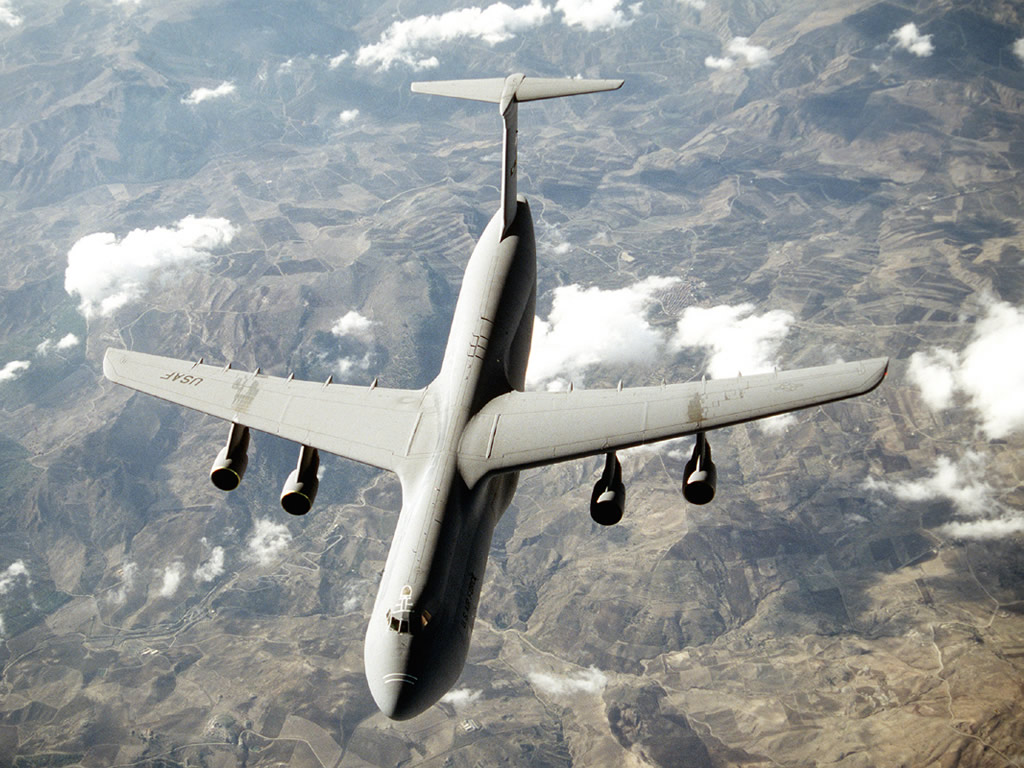
(click to view full)
Sept 27/07: US Air Force Secretary Michael Wynne declares Lockheed Martin’s C-5 Reliability Enhancement and Re-engining (RERP) program in violation of Nunn-McCurdy cost inflation triggers, which require the Pentagon to notify Congress when cost growth on a major acquisition program reaches 15%. If increases reach 25%, the Defense Department must re-justify the program. Lockheed and its supporters are contesting the Air Force’s cost estimates, arguing that the RERP’s costs will grow at rates below the Nunn-McCurdy threshold notification requirement. The notification comes amidst Congressional fights over spending to modernize Lockheed C-5s versus new Boeing C-17s. See the “Additional Readings” section below, and also Aviation Week:
“According to Congressional Research Service defense analyst Christopher Bolkcom, in “then-year” dollars, the Air Force believes the total RERP program will cost $16.1 billion, versus Lockheed’s projection of $11.7 billion and the most recent Selected Acquisition Report’s estimate of $11.3 billion. Another Capitol Hill source has said Air Force forecasts reach $17.8 billion.”
Sept 27/07: RERP Re-baselined. A contract modification for $133.3 million for C-5 Reliability Enhancement and Re-engineering Program (RERP) System Development Re-baseline Engineering Change Proposal. This contract is a modification to an existing contract. At this time, $16.3 million has been obligated (F33657-02-C-2000, P00139).
April 30/07: RERP Lot 1a. A $23 million fixed-price-incentive-firm contract for advance procurement of long lead/ advance buy items for Lot 1 of the Low Rate Initial Production for the C-5M Reliability Enhancements and Re-engining program (RERP). At this time, total funds have been obligated. Solicitations and negotiations were complete April 2007 (FA8625-07-C-6471).
March 26/07: Infrastructure. A DID reader writes:
“I enjoy your articles covering various military spending. I have been checking your aircraft transport listings and haven’t seen much about the C5A. My reason for asking here in Martinsburg, WVA the Air Guard (167th) is spending between 300 million and 400 million to completely rebuild the base that was used for C130H to C5A. The work they’re doing on the other side of the field is absolutely amazing, huge new hangars, new runways and taxiways, construction crews working day and night. I find the amount of money being spent to be simply unbelievable with all of the spare capacity at BRAC’ed air bases. I guess Sen Byrd is spending house ways and means money instead of DoD to get it through, but I was wondering what are you folks hearing? You really got to see it to believe it, and you hear next to nothing in the media. Can your organization tell me anything about the Air Forces plan for the C5A and whats up at the 167th — Big money being spent.”
April 9/07: SAR – more C-5 AMPs. The Pentagon releases its Selected Acquisition Reports for the December 2006 reporting period, and the C-5 AMP program is listed due to cost increases: C-5 AMP (Avionics Modernization Program) costs increased $551.2 million (+64.1%), from $859.3 million to $1,410.5 million. The primary reason is a quantity increase from 59 to 110 kits (+51 kits, +$291.4 million), and associated increases in initial spares, peculiar support equipment, and other weapon system costs (+229.1 million).
SAR change
March 22/07: AMP Lot 5k. A $23.4 million firm-fixed-price contract modification for C-5 AMP production Lot V kits and spares. At this time, total funds have been obligated and work will be complete May 2009 (F33657-98-C-0006/P00167).
Dec 22/06: a $16.7 million cost-plus-award fee contract modification. This is a modification to the C-5 Reliability Enhancement and Re-engining Program (RERP). This undefinitized contract action will correct 4 of the 14 Avionics Modernization Program (AMP) waivers, incorporate functionally from the AMP Block Cycle Change (BCC) Cycle Change 2006 software build, and address specific high priority issues. At this time, $8 million have been obligated, and work will be complete June 2007 (F33657-02-C-2000/P00119).
March 7/07: C-5 justification. In testimony before the House Armed Services Committee Air & Land Forces Subcommittee, Congressional Research Service defense specialist Christopher Bolkcom says [PDF]:
“Current estimates of the per-aircraft cost of AMP and RERP are expected to be approximately one-third that of a new C-17, and the C-5 will carry twice the C-17’s payload. The C-5 also has superior load/off load capabilities. The upgraded aircraft (called the C-5M), is also expected to have greatly improved mission capable rates. It may be noteworthy that during Operations Enduring Freedom and Iraqi Freedom, DoD leased Russian An-124 aircraft to carry outsize and oversize cargo because not enough C-5 aircraft were available. The An-124 Condor is a strategic lift aircraft larger than, but comparable to the C-5. As Figure 1 below illustrates, the Air Force has spent $170 million since FY2002 for An- 124 missions. It also appears that the number of An-124 missions is accelerating. FY07 figures already are on par with FY05 figures, and the fiscal year is not yet half over. While the C-5 may not be as modern as the C-17, or able to operate from as many runways, the fact that DOD has to outsource missions to Russian aircraft indicates that the C-5 still offers important capabilities that other U.S. aircraft may not be able to satisfy.”
DID will simply note the assumption that AN-124s were leased due to a shortage of C-5s, rather than a shortage of C-5s and C-17s. The testimony also includes program and operating cost data for both the C-5 and C-17 aircraft.
Dec 8/06: Process improvement. USAF Air Mobility Command officials announced Dover Air Force Base, DE as one of 3 central sites selected for future C-5 Galaxy isochronal inspections of the entire aircraft. Two additional C-5 ISO inspection sites, one at an Air National Guard base and another at an Air Force Reserve base, will be announced at a later date. During these ISO inspections, aircraft maintainers look for and repair problems in every system.
The US Air Force is reducing C-5 ISO inspection sites from 8 to 3 in order to centrally schedule the inspection from a fleet-wide perspective. Meanwhile, process improvements will aim to reduce “flow days” required to complete a C-5 ISO to a consistent number across the fleet, and reduce waiting time. If the system works, it would add an estimated average of 2.5 availability-days to every C-5 in the fleet, which equates to about 300 more sorties per year, or 10,000 pallets. USAF release.
Nov 30/06: Training. Flight Safety Services Corp. in Centennial, CO received an $18.1 million firm-fixed-price contract modification for C-5 Aircrew Training Systems Contract-Fund option 8. It covers students throughout and fixed operations, maintenance and support from Oct 1/06 through Sept 30/07. This work will be complete by September 2007. The Headquarters Ogden Air Logistics Center at Hill Air Force Base, UT issued the contract (F42630-99-C-0170/P00163).
Nov 17/06: C-5M #2 flies. The 2nd of 3 C-5M AMP/RERP aircraft that will comprise the new test set takes flight for the first time from Dobbins Air Reserve Base, GA. The first test aircraft first flew June 19/06 and has logged more than 51 flight hours to this point. C-5s that have completed only the AMP program, however, have logged more than 4,000 flight hours, many of which were flown in support of Operation Iraqi Freedom.
The first C-5M completed dynamic taxi testing at the Air Force Flight Test Center at Edwards Air Force Base, CA in August 2006. This latest aircraft will be used mostly for utilities and subsystem tests, airfield performance, and diagnostics testing. Both of these aircraft were originally C-5B models. A 3rd test aircraft to be brought up to C-5M standards, a C-5A, is currently in the final stages of modernization and is scheduled to fly later in 2006.
Nov 3/06: Air Force Operational Test and Evaluation Center commander Maj. Gen. Robin E. Scott signs the C-5 AMP Qualification Operational Test & Evaluation (QOT&E) report, which provided a progress update on the C-5M program for the low rate initial production decision. The test team recognized that the C-5 AMP “enhances existing strategic airlift,” but still has limitations. Source.
FY 2006
1st C-5M (RERP) done, flies.
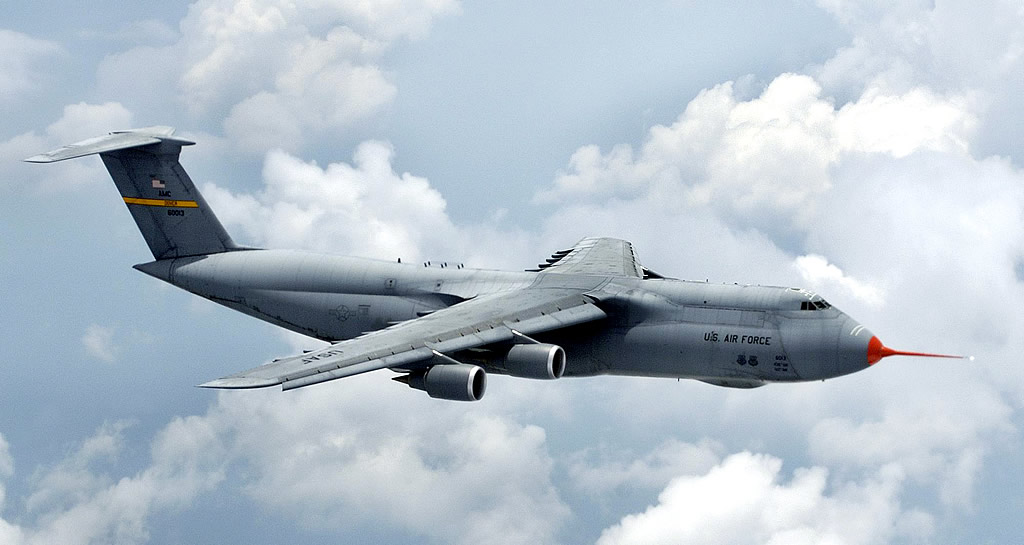
(click to view full)
Aug 8/06: A $6.3 million cost-plus-award fee contract modification. This action provides for an expansion of supply support and development for C-5 RERP. At this time $411,000 has been obligated. This work will be completed by August 2008(F33657-02-C-2000/P00092).
July 26/06: C-5M OpEval. The C-5 RERP re-engining program’s Operational Assessment begins. Source.
July 11/06: The C-5 AMP AFOTEC QOT&E test team completes the last test event. Source.
June 28/06: Air Force Operational Test and Evaluation Center (AFOTEC) commander Maj. Gen. Robin E. Scott signs the C-5 RERP operational assessment test plan. Source.
June 19/06: 1st C-5M flight. The first flight of the C-5M, the new designation given to the C-5 aircraft upgraded under RERP, occurs. Source.
C-5M 1st flights.
May 26/06: Sub-contractors. Eagle Tool and Machine Co., Inc. in Springfield, OH received a $7.5 million fixed price with economic price adjustment contract for 104 (each) landing gear cylinder and piston assemblies applicable to the C-5 aircraft. At this time, total funds have been obligated. Solicitations began March 2006 and negotiations were complete May 2006 (FA8203-06-C-0165).
May 16/06: 1st re-engining. The first C-5 RERP modification to re-engine the planes is complete. Source.
April 21/06: AMP’s Eval resumed. Air Force Operational Test and Evaluation Center (AFOTEC) leadership resumes the C-5 AMP’s Qualification Operational Test & Evaluation (QOT&E). Source”.
March 28/06: Flight Safety Services Corp. in Centennial, CO received a $7 million firm-fixed-price contract modification for C-5 Aircrew Training Systems Contract-Fund Option, CLIN installation, integration and testing of the AMP Production Kits. At this time, total funds have been obligated. The scheduled completion date is March 2008. The Headquarters Ogden Air Logistics Center at Hill Air Force Base, UT issued the contract (F42630-99-C-0170/P00144).
March 21/06: Infrastructure. Burns & McDonnell in Kansas City, MO received a $20.8 million firm-fixed-price contract for construction of a C-5 corrosion control hangar. Work will be performed in Martinsburg, WVA and is expected to be complete by Oct. 31, 2007. Bids were solicited via the World Wide Web on Oct. 24, 2005, and 9 bids were received by the U.S. Property and Fiscal Office for West Virginia, Buckhannon, WVA (W912L8-06-C-0002).
Feb 2/06: Training. Flight Safety Services Corp. in Centennial, CO received a $5 million firm fixed price contract modification for C-5 Aircrew Training Systems Contract-Fund Option, CLINs for Dover Modernization Program (AMP) Kits. At this time, total funds have been obligated, and work will be complete by November 2006. The Headquarters Ogden Air Logistics Center at Hill Air Force Base, UT issued the contract (F42630-99-C-0170/P00142)
Jan 19/06: AMP Lot 4. A $33.3 million firm fixed price contract modification for C-5 AMP Production Lot IV Kits, Support, Spares and Maintenance Training Device Spares. This work will be complete in June 2008, and total funds have been obligated. Negotiations were complete in December 2005 (F33657-98-C-0006/P00161).
Nov 10/05: A $98 million firm-fixed-price, time-and-material and cost reimbursable contract. It will provide supply support, engineering and technical support, and software maintenance services to C-5 Galaxys modified under the Avionics Modernization Program (AMP), plus replenishment spares and non-warranty repair.
Solicitations began July 2005, and 1 proposal was received. Negotiations were complete November 2005, and work will be complete by November 2010. The Headquarters Warner Robins Air Logistics Center in Robins Air Force Base, GA issued the contract (FA8525-06-D-0001).
Oct 12/05: AMP Eval Paused. Air Force Operational Test and Evaluation Center (AFOTEC) leadership pauses the C-5 AMP’s QUOT&E evaluation. Source.
FY 2005
1st C-5 AMP delivered; C-5 AMP OpEval; C-5 RERP begins.
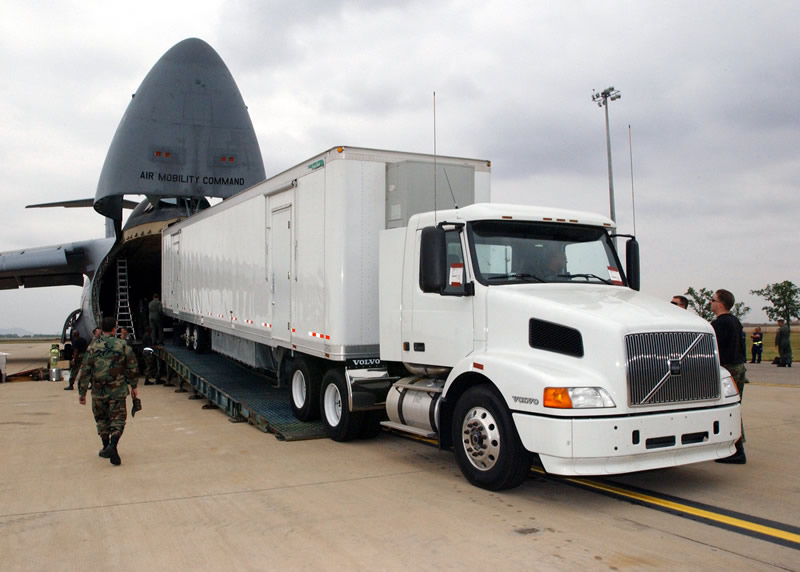
(click to view full)
Sept 13/05: Lockheed Martin reaches a critical milestone as technicians install the first engine pylon on a Reliability Enhancement and Re-engining Program (RERP) test aircraft. Installation of the new pylons, designed and built by Goodrich Aerospace, prepares the aircraft for the new General Electric CF6-80C2 engines which will be installed later in 2005.
The new General Electric CF6-80C2 engines are very widely used on passenger jets, and currently power the President’s Boeing 747, Air Force One. The engine delivers more than 50,000 pounds of thrust per engine, allowing the C-5Ms to carry more than 270,000 pounds and take off and land in distances as short as 5,000 feet. The new C-5 engines deliver 22% more thrust, achieve 30% shorter takeoff distances, enable 58% faster climb, and have a 99.98% departure reliability rate in commercial service, providing a ten-fold improvement in reliability and maintainability over the current TF39 engines. Lockheed Martin release.
Sept 7/05: AMP eval begins. AFOTEC testers began the C-5 AMP’s Qualification Operational Test & Evaluation (QOT&E). Source.
Jan 24/05: AMP Lot 3. A $59.3 million firm-fixed-price contract modification to provide for C-5 AMP Production Lot III Kits, Installation Option, Spares and Support. Total funds have been obligated. This work will be complete by December 2007. Negotiations were completed December 2004 (F33657-98-C-0006, P00126).
October 2004: 1st C-5 AMP delivered. The first upgraded C-5 AMP aircraft with modern avionics, wiring, etc. is delivered to the Air Force. Source.
1st C-5A+
October 2004: C-5 RERP begins. The first C-5 RERP modification to re-engine the planes begins. Source.
May 5/04: Air Force Operational Test and Evaluation Center commander Maj. Gen. Felix Dupre signs the C-5 AMP qualification operational test and evaluation plan. Source.
Dec 29/03: A $42.8 million firm-fixed-price contract modification, exercising an option for 18 C-5 AMP kits. Total funds have been obligated, and work will be complete by March 2005. Solicitation began August 2002, and negotiations were completed March 2003 (F33657-98-C-0006, P00110).
FY 2003 and Earlier
Avionics bought; AMP work begins.
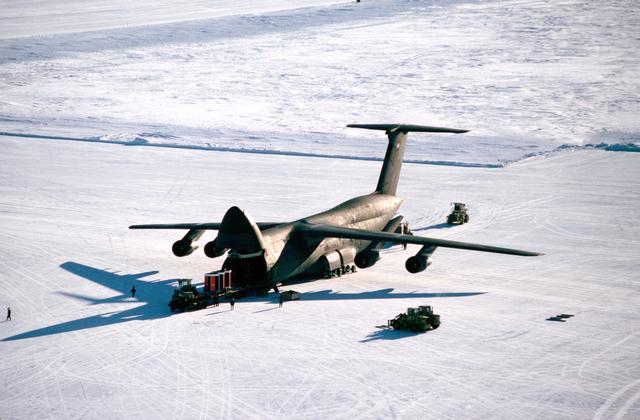
(click to view full)
June 6/03: A $16.7 million contract modification for a C-5 AMP engineering change proposal – the addition of the Integrated Standby Instrument System. At this time, $6.3 million of the funds has been obligated, and work will be complete by August 2004 (F33657-98-C-0006, P00093).
April 3/03: A $20.3 million firm-fixed-price/cost-plus-award-fee contract modification to provide for support of the C-5 AMP. At this time, all funds have been obligated. Solicitation began in August 2002; negotiations were completed in March 2003, and work will be complete by July 2004 (F33657-98-C-0006, P00080).
June 12/02: AMP begins. The first aircraft to be modified under C-5 AMP is brought into Lockheed Martin’s Marietta, GA facility. Source.
AMP Begins
March 25/02: A $5.3 million cost-plus-award fee contract modification to provide for 1 Lot global air traffic management and airworthiness certification support, in support of the C-5 Avionics Modernization Program. At this time, $2.1 million of the funds has been obligated. This work will be complete December 2003 (F33657-98-C-0006, P00048).
Feb 11/02: A $10 million cost-plus-award-fee and firm-fixed price with economic price adjustment contract modification to provide for FY 2002 engineering manufacturing development effort for the C-5 Avionics Modernization program. At this time, the total amount of funds has been obligated. This work will be completed February 2002 (F33657-98-C-0006, P00053).
Dec 21/99: a $28.8 million modification to a cost-plus-award-fee contract, F33657-98-C-0006-P00011, to provide for FY2000 engineering and manufacturing development in support of the Avionics Modernization Program for the C-5 aircraft. Expected contract completion date is September 2001.
Jan 22/99: a $120.5 million cost-plus-award-fee contract to provide for engineering and manufacturing development through FY 2002 for Avionics Modernization Program kits to be applicable to 126 C-5 aircraft. These kits will include Global Air Traffic Management and All Weather Flight Control systems. There were 17 firms solicited and 2 proposals received. Solicitation issue date was May 15/98. Negotiations were completed Nov 16/98, and the expected contract completion date is October 2005 (F33657-98-C-0006).
Base AMP contract.
Additional Readings
Background: C-5M
* Lockheed Martin – C-5 Modernization Program
* GlobalSecurity.org – C-5 Galaxy
* The Aviation Zone, ‘Home of the Heavies’ – C-5 Galaxy. We especially love the C-5 flyby sound file [.WAV].
* GE Aircraft Engines – Model CF680C2: High Reliability, Long Life, Low Fuel Burn
Background: C-5M Program
* Air Force Operational Test and Evaluation Center (Aug 1/07) – Another Galaxy, Another Test: Operational Test and Evaluation of the C-5M. AFOTEC’s historian offers a detailed chronicle of the entire C-5 Galaxy program, from the cost overruns and wing problems that plagued its early years to the present C-5 AMP/RERP program.
* USAF, Wright-Patterson AFB – C-5 Avionics Modernization Program. Solicitation.
* The University of Texas at Austin: Studies in Ethics, Safety, and Liability for Engineers – The C-5 Galaxy: A Question of Need?
* US Joint Aircraft Survivability Program Office – Innovation in the C-5 LFT&E Program. Unfortunately, the old link no longer works and the fragments reproduced on this page are all that’s left. If any readers can give us pointers to the full document, or send us a copy, it was interesting.
* Lockheed Martin Code One Magazine (March 7/12) – Tweak My Ride.
* Lexington Institute (Oct 4/10) – Upgrades To Giant C-5 Galaxy Airlifter Greatly Increase Performance & Reliability. Quantifies some of the C-5M’s advantages over the C-17 in terms of cargo and range.
* USAF (Sept 16/10) – New facility supports C-5 Galaxy software testing. “The building itself cost $658,000, but another $15 million investment was needed for the set up of the lab, including the cockpit wiring and engineering the lab capability, writing the simulation software and validating everything works as intended.”
News & Views
* Aviation Week’s Defense Technology International (Jun 13/07) – A400M could Dominate Strategic Lift. With no C-5 production, and no C-17 production, it would be the only Western choice remaining, competing with Russia’s AN-124s. Also covers the C-17 program, and C-5 AMP/RERP upgrades. There is some question as to whether the upgrades can produce the required readiness rates.
* USAF (Nov 23/07) – AMC commander discusses modernization, recapitalization issues. Among other topics discussed, Gen. Lichte favors re-engining only the C-5Bs, and acquiring more C-17s. Congressional priorities eventually gave him exactly that, in a very roundabout way.
* Defense News (Oct 29/07) – Airplanes on Life Support. Moseley, Wynne Plead: Let USAF Pull the Plug. They’re talking about aircraft that can’t fly but must be kept per Congressional directives, which includes a number of C-130E Hercules and KC-135E Stratotankers. It also talks about the C-5 programs, and thoughts of discarding the C-5As.
* Gannett’s Air Force Times (Oct 29/07) – MRAPs going to Iraq on Russian cargo planes. “The Air Force has been forced to use Russian commercial cargo jets to rush Mine Resistant Ambush Protected vehicles from the U.S. to Iraq because it does not have enough C-5 and C-17 planes to do the job, the service’s top civilian official said recently…” Ever consider sealift?
* Vacaville Reporter (Oct 29/07) – C-5, C-17 topic of planned study.
* DID (Oct 21/07) – USAF Talking to Airbus About A380 Air Force 1, C-5 Replacement? But how serious are they on either score?
* Gannett’s Air force Times (Oct 19/07) – Bill wants a study on airlift capabilities.
* Macon Telegraph (Oct 7/07) – C-5 future hangs on Air Force, Lockheed price differences. “The Galaxy fleet – sixty 1960s-vintage C-5As, forty-nine 1980s-era C-5Bs and two C-5Cs for use by NASA – has been plagued by nagging deficiencies. The C-5Bs were mission ready 66.6 percent of the time last year. The C-5As were much worse at 49.1 percent. The C-5’s counterpart, the much newer C-17 strategic airlifter, registered reliability of almost 85 percent.”
* Flight International (Oct 1/07) – USAF rounds on Congressional C-5 protection
* Defense News (Oct 1/07) – C-5 Upgrade Effort Imperiled by Cost Confusion.
* Stars & Stripes (Oct 1/07) – ‘Winglets’ could save Air Force millions on fuel. The C-5 fleet might be a candidate.
* Flight International (March 20/07) – Latest C-5 flies into budget storm.
* Government Executive (March 8/07) – Lawmakers divided over cargo plane options.
* House Armed Services Committee Air & Land Forces Subcommittee Hearing (March 7/07) – Statement Of Christopher Bolkcom, Specialist In National Defense, Congressional Research Service, On Air Force And Army Airlift And Aerial Re-Fueling Fixed-Wing Aircraft Programs [PDF].
* Air Force Link (Sept 25/06) – Dover AFB receives new maintenance trainer. A training simulator for maintenance? Yes, and it’s working well for the C-5M AMP program.
* Air Force Link (Feb 8/06) – C-5 Galaxy aircraft engine test successful.
* DID (Nov 14/05) – Delayed Pentagon Mobility Study Finally Offers a Preview.
* GE (Sept 16/04) – GE Engine Certified for U.S. Air Force C-5 Galaxy Program.
* Aviation Today (Feb 1/04) – GATM-izing Galaxy: New C-5 Avionics.
* USAF Agile Acquisition magazine (February 2004) – Teamwork, Innovation Eliminate Travis’ C-5 ‘Cannibalization’ Jet.
* Air Force Magazine (January 2004) – Saving the Galaxy.
* Aviation Today (Aug 1/2000) – C-5 Modernization, Step By Step.
* AFA Air Force Magazine (December 1998) – Nickel Grass: The airlift that saved Israel.
