

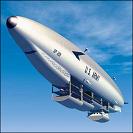
By John MacNeill
The Walrus heavy-transport blimp (“heavy” as in “1-2 million pounds”) was among a range of projects on the drawing board in the mid ’00s. It offered the potential for a faster and more versatile sealift substitute. The Defense Advanced Research Projects Agency (DARPA) funded phase 1 contracts, but things seemed to end in 2006. Yet the imperatives driving the need for Walrus, or even for a much smaller version of it, remain. Is the Walrus dead? And could it, or a Hybrid Ultra Large Aircraft (HULA) like it, rise again?
Recent presentations and initiatives in several US armed services, and some commercial ventures, indicate that it might.
WALRUS/HULA: Concept & Key Technologies

A key goal of DARPA’s Walrus program was to provide confidence that earlier airship-era limitations will be overcome. These limitations will apply to any Hybrid Ultra-Large Aircraft (HULA).
Early foci of the program included investigation of advanced breakthrough technologies that will support the development of innovative lift and buoyancy concepts that do not rely on off-board ballast. Many airships depend on ballast to control their buoyancy, but this becomes problematic if one intends to carry military-class loads to dangerous areas. A craft with buoyancy-assisted lift and no ballast is much more suitable, but those technologies, and associated lightweight solutions that would give the craft the required structural integrity to carry those loads, need to be developed.

The Walrus program aimed to develop and evaluate a very large airlift vehicle concept designed to control lift in all stages of air or ground operations including the ability to off-load payload without taking on-board ballast other than surrounding air. This is obviously rather important when offloading up to 2 million pounds of personnel and military equipment in remote areas. In distinct contrast to earlier generation airships, the Walrus HULA (Hybrid Ultra Large Aircraft) would be a heavier-than-air vehicle that would generate lift through a combination of aerodynamics, thrust vectoring, and gas buoyancy generation and management.
In DARPA’s conception, the Walrus operational vehicle (OV) was intended to carry a payload of 500-1,000 tons (that’s 1-2 million pounds) up to 12,000 nautical miles, in less than 7 days and at a competitive cost. Given these enormous capacities, they would mostly be used to deploy full-scale fighting units quickly, getting them to their site with a minimum of equipment reassembly work required. The ideal was that transported forces should be fully ready to fight within 6 hours.
Initial conceptions called for the Walrus to operate without significant infrastructure and from unimproved landing sites, including rough ground having five-foot-high obstacles like boulders, shrubs, etc. Additionally, Walrus should be capable of performing theater lift and supporting sea-basing or even persistence missions like communications and surveillance.
DARPA said that advances in envelope and hull materials, buoyancy and lift control, drag reduction and propulsion have combined to make this concept feasible. Technologies to be investigated in the initial study phase include vacuum/air buoyancy compensator tanks, which provide buoyancy control without ballast, and electrostatic atmospheric ion propulsion.
click to play video
In the end, it didn’t matter. Congress killed the WALRUS program by refusing to fund it. No explanation was provided to DARPA, even though the initial investment was minimal, and the scaled-down demo vehicle alone would have solved some important military problems.
Walrus remains dead. On the other hand, since its demise, a commercial partnership involving Boeing and Canada’s SkyHook International Inc. has arisen to create the JHL-40 HLV, a craft whose characteristics closely parallel the intended Walrus demonstrator. Other commercial ventures are underway by firms like Lockheed Martin and HAV, and a couple of small DARPA and NASA contracts under much more modest programs are developing key components and technologies required for any HULA military transport. In 2013, Aeros rolled out a 75m airship demonstrator that was partly developed with these public funds.
Walrus & HULAs: Contracts and Key Events
FY 2012 – 2013
Aeros airship is unveiled, preps for free flight; GAO report on airships; Pentagon has a coordinator for LTA; NTSB vindication for Aeros.
click for video
Sept 5/13: FAA R&D Cert. Aeros announces that the US Federal Aviation Administration (FAA) has given their Dragon Dream craft an R&D Airworthiness Certificate. It can only be operated in designated controlled airspace for the purpose of research and development, but at least it can now fly.
Within days, Aeros Corp. begins flight-testing the Dragon Dream half-scale airship in tethered mode. Sources: Aeros, Sept 5/13 release | Defense Update, “Aeroscraft – Mega Airship Back in the air in Tustin, California”.
Aug 28/13: Aeros – flight crew. Aeros announces a high-powered flight crew for its Dragon Dream airship. In addition to veteran airship pilot Corky Belanger as Test Pilot in Command, former USAF Air Mobility Command chief Gen. Raymond Johns is aboard as Test Pilot. Inventor and CEO Igor Pasternak will be the Flight Test Engineer.
This thing had better not crash. Sources: Aeros, Aug 28/13 release.
Aug 21/13: Pelican done. Aeros announces that all Project Pelican testing and demonstrations have been completed successfully within budget, and 1 month ahead of schedule. Work has included taxi tests of the air bearing landing system (ABLS), Control-Of-Static-Heaviness (COSH) internal ballasting system, and low speed control (LSC) system, plus cockpit improvements. Aeros CEO Igor Pasternak does thank the Pentagon:
“Aeros will be forever grateful to the DOD, DARPA and NASA for their support and vision during the Aeroscraft’s development, and I would also like to thank all the members of the Government-Aeros team for their professionalism and insights throughout the Pelican program…. The successful demonstration of the Aeroscraft ‘Dragon Dream’ vehicle was only possible because of tremendous cooperation, vision and passion shared with these great partners.”
Project Pelican complete
June 3/13: Commercial. Aeros boasts that its initial fleet will include 24 airships in ML866 (66 ton payload) and ML868 (250 ton) configurations, with airlines and individual customers invited to rent them. They’re considerably ahead of themselves from an engineering point of view, but locking up verifiable intent from customers is critical to gaining the financing they’ll need. Aeros’ release includes this quote from CEO Igor Pasternak:
“The initial fleet of 24 vehicles will be allocated based on our clients’ needs, which include Project Cargo, resupplying offshore oil rigs, moving wind components across the vast landscapes and over borders of Southern Africa, and bringing renewable energy power sources and equipment to rural villages in India…. Recognizing about half the fleet will be located in South America, the Arctic and sub-Saharan Africa, our vehicles have been tested and developed with the goal of global operations in all climates.”
Commercial traction and success with this technology will equal military traction, so Aeros’ success in reaching these targets, and operational performance, will be watched closely.
March 4/13: Aeros unveiled. Aeros unveils the 75 meter, 36,000 pound “Dragon Dream” airship prototype, built with funding from DARPA, OSD, and NASA. The VOA report says $35 million, but a GAO report cites Project Pelican costs alone as being $42.4 million between FY 2008-2011, and Aeros has also received funding under BAAV and COSH.
Dragon Dream uses Aeros’ system of helium compression to vary its buoyancy, along with vectored propellers and body shape in order to produce lift. A a rigid structure made of carbon fiber and aluminum is covered by silver Mylar polyester. Tests have been conducted indoors, and an outdoor test is expected in 2013.
The final working model would be twice as big, and carry up to 60 tons in cargo. Even if tests go well, however, a production version remains 2-3 years away. Voice of America article | video.
Jan 1/13: Aeros. The firm has completed construction on its 75 meter, 36,000 pound airship prototype. They’re hoping to begin flight tests in a few months. Los Angeles Times.
Oct 23/12: GAO Report. The US GAO issues a report on American government aerostat and airship (LTA) programs, and finds none of significance beyond the military. They also find that funding is going to drop sharply after 2012, and that the military has no concrete long-term plans for LTA programs, nor has it included them in key roadmaps like the U.S. Army Unmanned Aircraft Systems Roadmap 2010-2035 and DOD’s Unmanned Systems Integrated Roadmap FY2011-2036.
About $5.9 billion of the Pentagon $7 billion in aerostat and airship investments from 2007-2012 has involved tethered aerostats, as opposed to airships. The only really large airship project is the developmental ISIS, with a radar integrated into its skin ($471.4). are all terminated (Blue Devil 2) or developmental: for ISIS. Smaller developmental options like the Army’s LEMV and OSD/NASA’s Project Pelican ($42.4 million, by Aeros) are also underway, while completed programs include the Navy’s AAFL MZ-3A airship test platform, the Army’s HALE-D demonsrator for the High Altitude Airship, and the terminated/failed HiSentinel (Army) and Star Light (Navy) projects. Every one of these projects involves surveillance as the primary focus, rather than cargo.
The GAO faults the military for lack of integration and coordination during this period. This is a common situation with new or re-introduced technologies, as different groups/services need to be able to experiment and gain understanding on their own, without the damage done by partners with less enthusiasm or competing visions. GAO always falls victim to Balzac’s fallacy of the unseen, and never considers that in its reports. The GAO also faults the Pentagon for using the rapid acquisition process to acquire airships that had high technical risks. They’re on more solid ground here, as the risks did manifest, and have hurt or canceled LTA programs.
DID’s conclusion? In a Pentagon dominated by protection of parochial programs amidst shrinking budgets, rather than a strategic view, Hybrid airship technology will probably require private sector investment and purchases to drive its takeoff as a viable industry. US GAO.
June 2012: Personnel. The Deputy Secretary of Defense designates the Assistant Secretary of Defense for Research and Engineering as the “senior official with principal responsibility for DOD”s airship programs,” per the requirements of the National Defense Authorization Act for Fiscal Year 2012. Source.
Sept 1/12: Hybrid Airship Industry. The Los Angeles Times covers the growth of an airship industry in the region:
“So much is going on with airships in California now,” [Aeros founder] Pasternak said. “It wasn’t this way 10 years ago.” Pasternak’s Montebello firm makes airships used for surveillance, advertising and transport. Lockheed Martin Corp. designs and builds airships for commercial use at its secretive Skunk Works facility in Palmdale. Northrop Grumman Corp. does design work for airships around the Southland but is building them in Florida.”
Northrop Grumman’s main focus is the Army’s LEMV, though they’re considering cargo applications. Lockheed Martin is building a 90m SkyTug for Canada’s Aviation Capital Enterprises, with 20 tons of cargo capacity. They hope to start the FAA certification process by the end of 2012. Envisioned follow-ons include a 70 ton capacity SkyFrieghter, and Walrus class 250m SkyLiner variants with 500 ton capacity.
Dec 14/11: In 2001, operators lost an Aeros 40B airship during a storm. The US National Transportation Safety Board (NTSB) had issued a report claiming the accident was caused by crew, pilot, and design error, but Aeros appealed – and kept at it for over 6 years. Now Aeros announces:
“Today, the NTSB has corrected its finding and acknowledged that design error was not a cause in the accident and that the Aeros 40B “Sky Dragon” airship meets all Federal design requirements.”
FY 2006 – 2011
DARPA Walrus rises, then falls; Follow-on COSH & BAAV move the technologies forward; Army looks to a smaller LEMV surveillance hybrid airship.
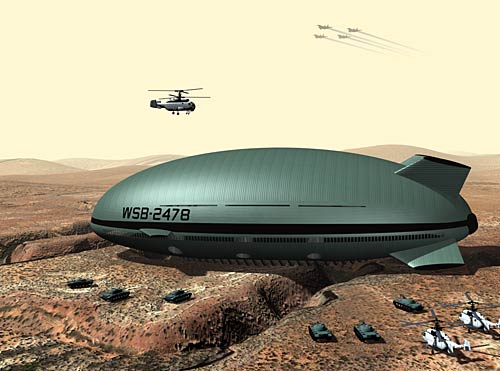
(click to view full)
June 14/10: LEMV a go. The LEMVs (long-endurance multi-intelligence vehicles) hybrid airship demonstrator program goes ahead, with a $517 million award that will use a Hybrid Air Vehicles, Inc. platform as its base. As noted below, this is not a heavy cargo craft, but it may fund and prove out companies and technologies associated with a future HULA platform. Northrop Grumman is already considering the craft’s cargo capabilities. Read “Rise of the Blimps: The US Army’s LEMV” for full coverage of the LEMV program.
Dec 30/09: LEMV. Flight International reports on the US Army’s interest in a hybrid airship it calls LEMV (long-endurance multi-intelligence vehicle). Though much smaller than a HULA, LEMV would be a hybrid buoyancy/lift craft that would likely end up proving out associated technologies. The US Army aims to test the airship’s performance during the first 18 months, and deploy the airship into Afghanistan as a super long-endurance surveillance platform.
Space and Missile Defense Command will reportedly issue an RFP on Jan 29/10 (actual date: Feb 11/10), and an acquisition notice posted on Dec 29/09 asks for an “optionally manned” craft that can fly for up to 3 weeks, carry multiple intelligence payloads weighing up to 2,500 pounds/ 1,134 kg, provide 16kW onboard power, and reach speeds up to 80 knots/ 148km/h.
Sept 10/09: BAAV. Aeros announces the successful completion of the Buoyancy Demonstration Test under DARPA’s BAAV program.
The focus of the BAAV program was to demonstrate a semi-monocoque structure of rigid design (Aerostructure) for a buoyancy assisted lift air vehicle. Aeros conducted scaled demonstrations to indicate that in a full scale vehicle, a rigid aerostructure can be both light and strong enough to accommodate high-speed dynamic air loads without failure. The Buoyancy Demonstration test validated this structural approach as the air platform basis for a new class of buoyancy assisted vehicles.
Sept 2/09: NAVAIR. US Navy NAVAIR’s Director of Advanced Program Development, Airship Concepts, Steve Huett, gives a presentation titled “Hybrid Aircraft: Envisioned Military Relevance.”
The presentation discusses an airship that would be very similar to DARPA’s WALRUS, and goes into additional detail. Hybrid Air Vehicles’ proposed “SkyCat 200” design is used as an example several times.
June 26/09: HAV airship. Flight International reports that a 50 foot/ 15.2 meter prototype for a 95 meter airship has now been flown 22 times. Its Bedfordshire, UK-based developer Hybrid Air Vehicles has been working on vectoring and bow thruster systems, and working on vertical take-off and landing. The firm is developing the SkyCat line of hybrid airships, with envisioned capacities of 20 – 1,000 metric tons. The firm acknowledges submitting bids for US military contracts, and is interested in US Army’s Long Endurance Multi-INT Vehicle (LEMV) program as a stepping stone. It is reportedly considering its “Condor 404” design for that effort.
HAV would eventually become part of Northrop Grumman’s LEMV bid.
Sept 12/08: BAAV. Aeros announces that DARPA has awarded them a contract for a Buoyancy Assisted Lift Air Vehicle (BAAV) Rigid Aerostructure Technology demonstration. This appears to begin laying a technology foundation for any future Walrus-like aircraft:
“The focus of the BAAV program is a demonstration of the lightweight rigid aerostructure technology. This will involve analysis leading to a demonstration air test of the aerostructure under flight load conditions. Proving that the rigid aerostructure can be both light and strong enough to accommodate air loads without failure will validate this structural approach as the air platform basis for a new class of buoyancy assisted vehicles that are more robust and have potentially greater military utility… [it] is an essential design element of the Aeroscraft; an air vehicle that is designed to control lift in all stages of air or ground operations including the ability to off-load payload without taking on-board ballast… The key features of the Aeroscraft include the noted rigid structure, vertical takeoff and landing capability, ability to operate at low speed and hover, and operate from unprepared surfaces.”
July 17/08: COSH. Aeros announces a successful demonstration of their ballastless COSH (Control of Static Heaviness) system, using one of their Aeros 40D airships. This system works by compressing, storing, then decompressing helium to adjust the vehicle’s buoyancy. Since static heaviness is the ratio of buoyancy to gravity, it can be increased to land and reduced to take off.
The COSH system is the main technology element of the Aeroscraft, and the flight demonstration was accomplished under a DARPA contract (vid. Oct 10/07 entry).
March 11/08: FAA Certification. Aeros announces that the American Federal Aviation Administration has accepted the type certification application for their Aeroscraft (model Aeros ML866), which shares technologies from their Walrus submission. The Aeroscraft is based on proprietary Dynamic Buoyancy Management and Structural Technologies that generate lift through a combination of aerodynamics, thrust vectoring, and gas buoyancy generation and management.
The Aeroscraft would be type certified as a new type of aircraft, which is a big step forward for aerospace as a whole. It is not the same thing as a Production Certificate, however, which would allow the company to issue Standard Airworthiness Certificates for its craft.
Oct 10/07: COSH. Aeros announces DARPA funding for the Control of Static Heaviness (COSH) ‘non-ballast’ flight demonstration program. Under the program, Aeros will carry out the conceptual design, technology development, hardware development and bench demonstration, finalizing with the flight demonstration of the system on the FAA type certified Aeros 40D airship.

(click to expand)
March 28/06: Walrus dead. Noah Shachtman of DefenseTech reports:
“But it wasn’t meant to be. Darpa took away the fiscal year 2006 funding for the Walrus. And the agency’s 2007 budget request calls for “termination of the Walrus effort.” Now, the Army’s Surface Deployment and Distribution Command had its own plans for a heavy-hauling airship, too. I’m checking to see if they’re still interested. Keep your fingers crossed.”
A DARPA source tells DID that Congress canceled the Walrus effort by zeroing the program in the FY06 Appropriations. It’s interesting to counterpoise that decision with this recent article from Inside Defense “New Airlifter Could Become C-130 Surrogate“:
“Air Force Chief of Staff Gen. T. Michael Moseley told Inside the Air Force earlier this month that he is interested in exploring whether the JCA [DID: smaller C-27J or C-295 aircraft] could one day be used as a C-130 “surrogate.” The four-star spoke to ITAF on Capitol Hill March 9 [DID: 2006].
If I had something like [a nimble JCA platform] in the Afghan campaign and the Iraqi campaign, I would have felt a whole lot better because you can get in and out of smaller places, you can get out of runways that measure just 2,500 feet,” Moseley said last fall at an event in Washington (ITAF, Oct. 14, 2005, p1).
A Jan. 27 Congressional Research Service report, citing Air University analysis, highlights some of the Hercules’ shortcomings. “It does not appear that the C-130 is best suited to deliver supplies and reinforcements to U.S. ground forces operating in remote areas. The C-130 requires approximately 5,000 feet of runway to operate,” states the report, crafted by CRS analyst Christopher Bolkcom.”
Walrus killed
Aug 26/05: DARPA announces [PDF] the 2 contractors who received Walrus Phase I awards.
The first is Lockheed Martin Corp. Advanced Development Programs in Palmdale, CA ($3 million). More commonly known by its colloquial name “Skunk Works,” it has designed and produced legendary aircraft like the U-2 and SR-71.
The second is Aeros Aeronautical Systems Corp. in Tarzana, CA, near Los Angeles ($3.3 million). It was founded by Russian emigre Igor Pasternak.
Another contractor, Millenium Airship, says that:
“Millennium Airship Inc. was notified by DARPA on June 13, 2005 that we were not one of the two selected contractors. However, both our ITAMMS and Vacustat technologies are unique and important to the viability of this program. We have been contacted by both winners, Lockheed Martin and Aeros Aeronautical Systems, about possibly integrating our two technologies into their systems. Currently, we have been invited to Lockheed Martin for a meeting on October 24 to further examine the combined opportunities.”
Walrus Phase 1
Appendix A: DARPA’s Walrus Program
 SkyFrieghter
(click to view full)
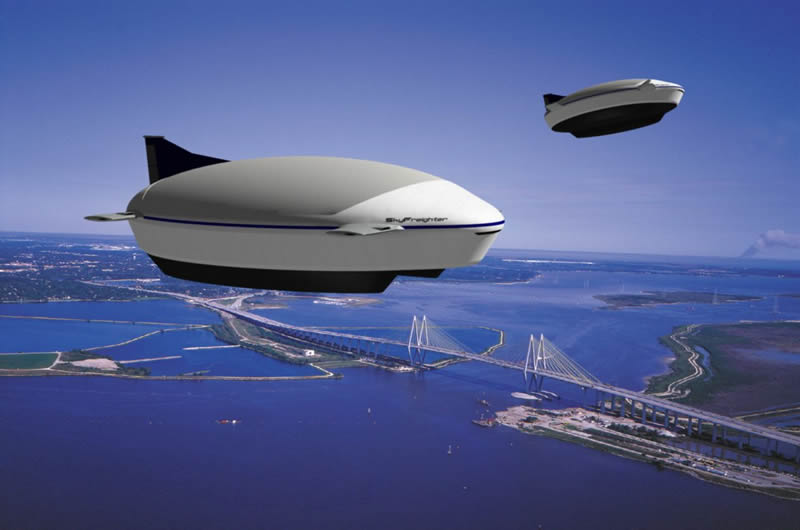
(click to view full)
The Walrus program aimed to develop an operational vehicle concept design and required breakthrough technologies in the airship field. The first step involves risk reduction demonstrations of these new technologies.
During the program’s first phase, a 12-month analytical effort, the 2 contractor teams would conduct trade studies to determine which OV design concept most satisfies the operational tasks and optimizes design capability. Phase I aimed to explore various vehicle configurations (rigid, non-rigid and semi-rigid). It would conclude with a concept design review of the 500-1,000 ton OV, and the supporting technology development plan for risk reduction demonstrations including the 30-ton capacity ATD vehicle.
DARPA intended to select 1 contractor team to enter the second phase, which would have been a demonstration effort spanning 3 years. During Phase II, the program would refine the Walrus’ design needs, identify its potential military use through modeling and studies, develop breakthrough technologies, and conduct risk reduction demonstrations of components and subsystems.
DARPA added that demonstrations will include flight tests of a Walrus Advanced Technology Demonstration (ATD) scaled aircraft. This is a fancy way of saying that they plan to flight-test a “significant-scale” lifting airship in 2008 with a payload capability of around 30 tons, about 50% more than a Lockheed Martin C-130 Hercules. These risk reduction demonstrations, including the ATD vehicle, were intended to establish a low-risk technology path for proving the Walrus concept and achieving the operating goals.
It wasn’t entirely clear whether this scaled-down Walrus would fall under the $10 million advanced technology demonstration (ATD), or under a larger contract. The LA Times reported that DARPA would award a $100 million contract for a prototype airship in 2006, and noted that if Walrus worked out, the total contract could be worth up to $11 billion over 30 years.
In the end, it didn’t matter. Congress killed the WALRUS program by refusing to fund it. No explanation was provided to DARPA, even though the initial investment was minimal, and the scaled-down demo vehicle alone would have solved some important military problems.
Additional Readings
Thanks to John MacNeill for permission to use the Walrus conceptual illustration that leads this article.
Background: Current Airships
* Aeros Corp. – Aeroscraft. It’s interesting to compare it to the 2008 representations of the 60-ton payload ML866.
* Lockheed Martin – P-791. Lockheed Martin’s hybrid airship. It also uses hovercraft-type landing pads, reversible to suction pads for stabilization on the ground.
* Lockheed Martin – YouTube video explains the P-791.
* Hybrid Air Vehicles – Aircraft. LEMV program supplier. The Airlanders would be amphibians, thanks to their hovercraft skirt. That’s a trait they share with Aeroscraft.
* Millenium Airship, Inc. Skyfreighter. They also formed Skyfreighter Canada. Not even at the demonstrator stage, it seems, but see their ITAMMS technology for thrust/lift.
* Dedicated LTA builder World SkyCat also failed to receive a DARPA contract. Their site is highly worthwhile, however, especially for all the variants of HULA craft they propose (and justify) for specialized uses, and their incorporation of operating cost figures. The economics of SkyGas and SkyPipeline were especially interesting, as commercial demand would push per-unit HULA costs down and ensure open production lines (and hence additional military procurement options) much more consistently than reliance on pure military orders.
* DID – Boeing’s Skyhook Shot: Redefining the Aerial Heavy-Lift Market? Their Skyhook 40 partnership aims to create a commercial airship whose performance would be very close to the intended Walrus demonstrator.
Official Reports
* GAO (Oct 23/12, #GAO-13-81) – Future Aerostat and Airship Investment Decisions Drive Oversight and Coordination Needs.
* DARPA, via WayBack – Next Generation Aerostructures [PDF]
* FBO.gov (Jan 26/05, PS 05-01) – WALRUS – Global Reach Air Vehicle [PDF]
* Gizmag, via WayBack – The Walrus: the US Army contemplates building an aircraft the size of a football field
News and Views
* Dow Jones (March 13/13) – Builder to Ask Army for Canceled Blimp. Hybrid Air Vehicles wants to buy the LEMV prototype back from the US Army, before it’s scrapped. The airship would constitute a valuable proof-of-concept and testing platform, and a cut-rate buy-back would make sense for all concerned. Which is why we don’t expect the US Army to do it.
* Defense Tech (Jan 30/13) – Back to the Future with Cargo Airship. “DoD and NASA have invested $35 million in prototype testing so far, and Aeros is looking for more funding to start the next phase.”
* Defense Technology International (May 2011) – The Giggle Test [dead link]. Notes Aeros’ work under the RRTO’s Project Pelican.
* Vostok Media (Nov 27/09) – Project of Advanced Airship Submitted to Russian President. LocomoSky Co. submits an airship that could lift 600 tons to the presidium of the State Council on innovative development of transportation in Ulyanovsk.
* Defense Transportation Journal, via WayBack (June 2008) – Air Born: Leading the way – Overcoming Barriers to Force Movement [PDF]. By Gen. William Tuttle, Jr., USA (Ret.).
* US Air Force Journal of Logistics, via WayBack (Volume XXIX, Number 3/4, Fall/Winter 2005) – Back to the Future: Airships and the Coming Revolution in Strategic Airlift [PDF]
* DID (March 17/06) – Energy Conservation Moving Up Pentagon’s Agenda. The Army Corps of Engineers forecasts that fuel availability and cost may become an important constraint on future operations. That has implications for transport and aviation.
* DID (Feb 17/06) – Aeros Dreaming Big With Walrus Project. LA Times: “An obscure Tarzana firm run by Russian emigres is locked in competition with Lockheed Martin Corp., the world’s largest defense contractor, to win a Pentagon contract to build 900-foot- long, blimp-like aircraft to move cargo and troops into combat zones.”
* DID (Oct 21/05) – US CBO Gives OK to HULA Airships for Airlift. the Congressional Budget Office, a nonpartisan analytical arm of the US Congress, “likes the heavy-lift airship concept because it could do more than the airlift aircraft and surge sealift capabilities currently used when U.S. forces deploy.”
* DID (July 6/05) – USAF Looking at “Near-Space” Blimps. Interest takes the next step via a positive formal report to the USAF.
* DID (Apr 26/05) – USN, DARPA See Blimps & HULAs Rising
* Book: The Deltoid Pumpkin Seed by John McPhee, via WayBack. Fascinating book. This isn’t the first time someone has floated a similar idea. In the 1930s, a group of visionaries also attempted to develop a hybrid blimp/aircraft with these kinds of capabilities. Its early and secret experimental development took 12 years time, and $1.5 million dollars that came came from private individuals. Much of it was raised by the minister of the Fourth Presbyterian Church of Trenton, New Jersey, who initiated the project.