

(click to view full)
Pentagon contracts occasionally refer to the Global Broadcast Services (GBS), a system linked to the Wideband SATCOM program. A variant was first fielded in Bosnia during 1996, and special nodes were also set up in the aftermath of Hurricane Katrina. It sounds almost like a form of global satellite TV – which is close, but not quite right. GBS is not intended to replace existing MILSATCOM (MILitary SATellite COMmunications) systems in any way. Instead, GBS uses a form of “push and store” to distribute high-bandwidth information for local relay, thereby saving critical two-way military satellite communications systems from having to handle every field request.
The other thing that makes GBS so attractive is the ability to provide high-volume data directly into 18-inch antennas, allowing streaming to and storage in devices that can move with units in the field. The GBS “pushes” a high volume of packaged data to these widely dispersed, low-cost receive terminals, whose function resembles the set-top smart cable TV storage box or TiVO used at home.
The GBS System: More Details

GBS disseminates Internet Protocol (IP)-based real-time video and large data files over-the-air up to 45 Mbps. It remains the primary method used to disseminate Full Motion Video (FMV) from USAF UAVs like the Predator and Reaper to warfighters on the front lines.
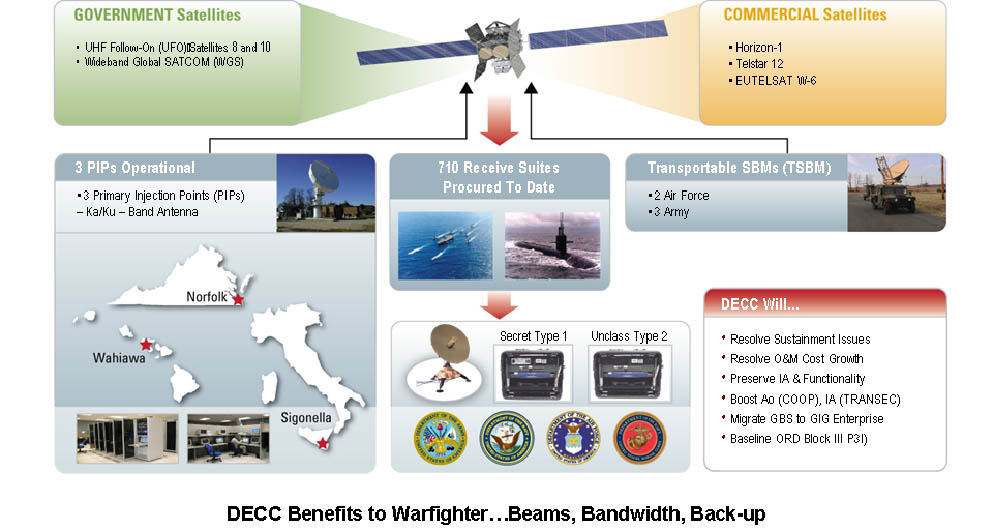
GBS Satellite Broadcast Manager (SBM) Sites in Norfolk, VA; Sigonella, IT; and Wahiawa, HI are the primary broadcast sites through which information products are transmitted to satellites from Primary and Theater Injection Points (PIP/TIP) and DoD Teleport Gateways.
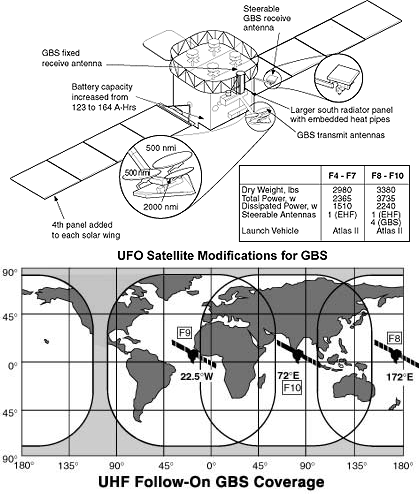
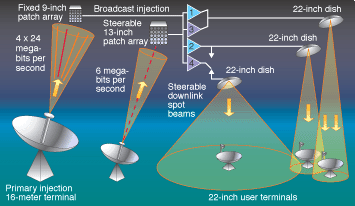
GBS uses communication payloads on a number of satellites: 4 Commercial Satellites (Ku-Band), augmented UFO satellites 8 – 10 (Ka-Band), and all WGS satellites (Ka- and X-Band, will be 10). For each WGS satellite, 2 of the beams each cover an area 500 nautical miles in diameter, and the 3rd covers an area of 2,000 nautical miles in diameter.
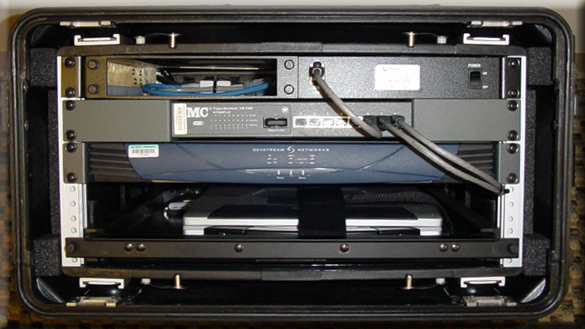
The satellite signals are received by multiple simultaneous AN/TSR-9 Transportable Ground Receive Suites (TGRS) to save valuable bandwidth. Over 1,000 GBS TGRS suites are deployed world-wide. Each Enhanced 88XR Receive Suite (E88XR RS) consists of 2 transportable Receive Broadcast Manager (RBM) cases and 1 Next Generation Receive Terminal (NGRT), including unique GBS software. NGRTs are the antenna portion of a GBS Transportable Ground Receive Suite and are paired with the RBMs to allow the user to receive, decrypt (via KG-250 module), and access the GBS broadcast.
Ground terminals with antenna diameters of 0.6 to 1 meter receive data at rates up to 24 megabits per second per transponder from either of the two 500-nautical-mile diameter spot beams. Rates up to 1.5 megabits per second can be achieved through the 2,000-nautical-mile diameter WGS spot beam.

To accomplish all this, information is developed and distributed using a “Smart Push” and/or “User Pull” philosophy to avoid saturating deployed forces with information overload. This capability allows existing and planned satellite-communications systems to support the two-way communications needs of force elements while providing a means for GBS users to request information. Information products such as imagery, weather, mapping, logistics, national intelligence and theater intelligence are assembled and broadcast to the user. The information may be in the form of video (classified or unclassified) or data (classified or unclassified).
The program has also been shifted from an ATM (Asynchronous Transfer Mode) underpinning to an Internet Protocol (IP) based underpinning, and added the commercial “digital video broadcasting-return channel service” 2-way satellite TV standard.
GBS: The Program
(click to view full)
The original estimate for GBS in base-year (FY 97) dollars was $451.4 million, based on an expected production run of the above infrastructure and 346 receiver systems. The actual total is now FY97$ 950.8 million, for the infrastructure and 1,926 receiver systems. Given that numbers growth, the per-unit increase is only 17.3%.
Initial Operational Capability (IOC) for GBS Phase 2 Block II was declared in October 2008. In early FY 2014, GBS is shifting its SBM primary broadcast sites to a Defense Enterprise Computing Center (DECC), with data available via DoD Teleports and across the Global Information Grid (GIG).
Primary Contractors
* Lockheed Martin: DECC broadcast center.
* Raytheon: SBM broadcast; Receive suite, legacy sustainment/O&M.
* General Dynamics: Receive suite.
* Windmill International: Receive suite.
Contracts & Key Events
FY 2009 – 2014
(click to view full)
Oct 28/13: Support. Raytheon, Intelligence and Information Systems’ Defense and Civil Missions Solutions in Sterling VA receives a $12 million firm-fixed-price annual installment to sustain uninterrupted GBS to garrisoned and deployed war fighters. $1.6 million in FY 2014 funds are committed immediately.
Work under the new contract will be performed at Sterling, VA, and the contract will run until March 31/16. USAF Space and Missile Systems Center at Los Angeles Air Force Base, CA manages the contract (F8823-14-C-0001).
April 1/13: Support. Raytheon Intelligence and Information Systems in Sterling, VA receives an $11.8 million firm-fixed-price contract for GBS sustainment service, using FY 2013 appropriations.
Work will be performed in Sterling, VA, and is expected to be complete by Oct 31/13. The AFSPC SMC/PKL at Peterson AFB, CO manages the contract (F8823-13-C-0004).
March 28/13: GAO Report. The US GAO tables its “Assessments of Selected Weapon Programs“. Which is actually a review for 2012, plus time to compile and publish. GBS is only included as an MDAP summary line.
The current total estimated cost for GBS is now $1.215 billion, a 104.9% jump from the original $593 million projection. The program’s costs have risen by 2.5% over the last year, and 20.6% over the last 5 years. Cost overrun, or just architecture upgrades because it was more popular than expected?
Aug 22/11: Receivers. General Dynamics C4 Systems in Taunton, MA receives a maximum $900 million indefinite-delivery/ indefinite-quantity contract for about 1,500 new GBS receive suites, and about 1,100 retrofit kits for fielded systems. The ESC/HNSK at Hanscom AFB, MA issued the contract (FA8307-11-D-0005).
GBS Transportable Ground Receiver Suites include next-generation receive terminal antenna, receive broadcast management, and cryptographic equipment, all packed into mobile transit cases. See also GDC4S release.
March 23/10: Receivers. Raytheon Defense and Civil Missions Solutions in Falls Church, VA near Washington, receives a $15.4 million firm-fixed-price contract to produce Global Broadcast Receive Suites for the Global Broadcast Service (GBS) program.
Work will be performed in Falls Church, VA (82.5%), and Reston, VA (12.5%) and is expected to be complete by March 2012. This contract was not competitively procured by Space and Naval Warfare Systems Command in San Diego, CA (N00039-10-C-0059).
Feb 3/10: GBS + UAVs? FBO pre-solicitation/ contract announcement N65236-09-R-0189:
“The Government intends to award a sole source contract to Marshall Communications Corporation (MCC), 20098 Ashbrook Place, Suite 260, Ashburn, VA 20147 in accordance with FAR Part 6.302-1, for Digital Video Broadcast-Return Channel via Satellite (DVB-RCS) Enhanced Production Subscriber Suite (EPSS) bundles, Production Subscriber Suite (PSS) bundles, User Subscriber Suite (USS), and associated spare parts required for maintaining system integrity and operational connectivity.
This technology provides a continuous, high-speed, and asymmetrical two-way Internet Protocol (IP) traffic flow of high volume information (data and video) in support of unmanned aerial vehicle (UAV) utilization and operations. The procured suites will be integrated hardware and software platforms that must be compatible with existing, fielded assets. The equipment must be specific make and model to be compatible with the Intelligence, Surveillance, and Reconnaissance (ISR) architecture, unique hardware, and existing proprietary software features of existing equipment systems. This equipment will integrate with the current Global Broadcast Service (GBS) Atlantic coverage and be capable of supporting existing ground-based, shipboard, and sub-surface GBS suites, as well as provide reach back to DOD gateways for access to DISN services, imagery & data file dissemination, and full motion video dissemination. MCC is the manufacturer of the bundled systems suites.
The Government anticipates award of a firm-fixed-price, indefinite delivery, indefinite quantity contract for a base year and two (2) one-year option periods in accordance with FAR Part 15 procedures. The NAICS Code is 334220 and the applicable size standard is 750 employees.”
Nov 22/09: More video. USAF Military Satellite Communications Systems Wing Operations Support and Logistics office implements Phase 1 of a system modification to increase Global Broadcast Service full-motion video feeds to the U.S. Central Command (Middle East & Central Asia) area of responsibility.
MCSW/OSL worked closely with CENTCOM as they designed, tested and implemented the first phase in less than 3 months. Fielding went according to schedule, and is currently meeting CENTCOM’s near-term operational requirements. A long-term modification to meet worldwide requirements is on track to meet a February 2010 fielding date. USAF.
FY 2004 – 2008
(click to view larger)
May 5/08: Receivers. Raytheon Intelligence and Information Systems in Reston, VA received a $11.7 million firm-fixed price contract for the 205 Global Broadcast Service transportable ground receive suites and associated spares. Work will be performed primarily in Virginia, and is expected to be complete by June 19/09. One bid was solicited on April 16/08 by the CECOM Acquisition Center, Fort Monmouth, NJ (W15P7T-08-C-K406). See also Raytheon release.
April 8/08: Industrial. Raytheon Company announces exclusive teaming agreements with radio firm Harris Corporation and computer giant HP as, part of an industry-leading team to pursue the $30 million U.S. Air Force Global Broadcast Service Satellite Broadcast Manager transition contract.
Raytheon has executed the GBS program for the past 10 years, and they are boosting their team to compete for the next evolution of the GBS contract as the USAF’s Electronic Systems Command, Hanscom Air Force Base, MA transitions GBS broadcast functionality to a centralized Defense Enterprise Computing Center.
July 13/07: Software. Raytheon’s C3I group in Reston, VA received a $9.9 million cost-plus-award-fee contract modification to implement the Spiral 4B software development effort. Spiral 4B will add Defense-In-Depth IA updates, RBM Unclassified Enclave Presence Display, and support tforIP Encapsulator IA testing activities.
Solicitations began September 2006, negotiations were complete in June 2007, and work will be complete June 2008. The Headquarters Electronic Systems Center at Hanscom Air Force Base, MA issued the contract (F04701-97-C-0044/P00252).
May 31/07: Receivers. Raytheon’s C3I group in Reston, VA received a $7.5 million cost-plus-award-fee/firm-fixed-price contract modification to provide for the Global Broadcast Service (GBS) program. The modification directs Raytheon to build 62 Army Receive Suites and 20 Marine IP Receive Suites which will provide theater commanders the ability to broadcast theater-specific command and control information in a timely manner. At this time, total funds have been obligated. Negotiations were complete May 2007, and work will be complete June 2008. The Headquarters Electronic Systems Center at Hanscom Air Force Base, MA issued the contract (F04701-97-C-0044/P00251).
April 9/07: The Pentagon releases its April 2007 Selected Acquisition Report, and GBS is one of the systems covered due to cost growth:
“Program costs increased $111.3 million (+15.0%) from $744.0 million to $855.3 million, due primarily to a new GBS Simplified Robust Architecture (SRA) that will address broadcast shortfalls. The SRA upgrade is scheduled for implementation in fiscal year 2008-2010. Beginning in fiscal year 2008, the SRA upgrade will develop custom software, procure commercial hardware/software, integrate into the Defense Enterprise Computing Centers (DECCs), integrate joint internet protocol modem (JIPM) hubs into two ultra-high frequency follow-on (UFO) uplink sites, establish JIPM upgrade kits for receive suites, transition to DoD teleports as required for wideband gapfiller satellite (WGS) broadcasts, and perform developmental/ operational tests leading to follow-on operational test and evaluation events.”
Cost growth
March 19/07: Receivers. Raytheon Co. in Reston, VA received a $14.5 million cost-plus-award fee, firm-fixed-price contract modification for the Global Broadcast Services program. This modification directs Raytheon to build 59 Army receive suites and 69 Air Force IP receive suites which will provide theater commanders the ability to broadcast theater-specific command and control information in a timely manner. At this time, total funds have been obligated. Solicitations began March 2006, negotiations were complete February 2007, and work will be complete September 2007. The Headquarters Electronic Systems Center at Hanscom Air Force Base, MA issued the contract (F04701-97-C-0044/ P00237).
June 20/06: 2-way! The Defense Department’s GBS now provides 2-way service thanks to engineering work by the Defense Information Systems Agency. David Mihelcic, head of engineering for the Global Information Grid at DISA, said his engineering team incorporated the commercial “digital video broadcasting-return channel service” 2-way satellite TV standard. Thus far, 20 suites of equipment in Iraq and Afghanistan have been upgraded to provide the 2-way service. Government Computer News.
Oct 31/05: Support. Raytheon Intelligence and Information Systems in Reston, VA received a $50 million cost plus fixed fee, firm fixed price contract to provide full sustainment support for fielded portions of the Global Broadcast Services (GBS). This contract will transition support for the GBS from a development program to full operation and sustainment, providing seamless GBS support for joint warfighting forces.
Work on this GBS transition and sustainment contract will be complete by October 2010, and includes high-caliber sustaining engineering/technical services, operation and maintenance of GBS satellite broadcast managers and primary injection points, supply chain management support (i.e. repair services and spares support) and software support/maintenance. Solicitations began in August 2005 with one proposal received, and negotiations were complete in October 2005. The Headquarters Ogden Air Logistics Center at Hill Air Force Base, UT issued the contract (FA8207-06-D-0001).
Aug 12/05: Receivers. Raytheon Systems Co. in Reston, VA received a $5.1 million cost-plus award-fee contract modification for the Global Broadcast Service (GBS) program. The contract action directs Raytheon to build 44 Enhanced 88XR Receive Suites (RS). The 44 RS are destined for multiple users. The US Marine Corp procured the majority of this modification, with 33 E88XR RS bound for their operational units and 1 additional NGRT.
Total funds have been obligated. Solicitation began May 2005, negotiations were completed August 2005, and work will be complete by May 2006. The Headquarters Electronic Systems Center at Hanscom Air Force Base, MA issued the contract (F04701-97-C-0044, P00221).
April 28/05: Receivers. Raytheon Systems Co. in Reston, VA received a $6.1 million cost-plus award-fee contract modification to build 8 Shipboard Receive Suites (RSs) and 6 Subsurface RSs for installation of Naval Fleet assets. The modification also directs the production of 42 Next Generation Receive Terminals (NGRT) for the Army. Total funds have been obligated. Negotiations were completed April 2005, and work will be complete by March 2006. The Headquarters Electronic Systems Center at Hanscom Air Force Base, MA issued the contract (F04701-97-C-0044, P00215).
Feb 2/05: Broadcast Management terminals. Raytheon Systems Co. in Reston, VA received a $5.6 million cost-plus award-fee contract modification for the Global Broadcast (GBS) program. The modification directs Raytheon to design and build 2 Army Internet Protocol (IP) Theater Satellite Broadcast Manager (TSBM) terminals, which will provide theater Commanders the ability to broadcast theater-specific command and control information in a timely manner. The IP TSBM will replace existing Asynchronous Transfer Mode TSBMs as the entire GBS Program transitions to an IP architecture.
At this time, $2.4 million of the funds has been obligated. Negotiations were completed December 2004, and work will be complete by December 2005. The Headquarters Electronic Systems Center at Hanscom Air Force Base, MA issued the contract (F04701-97-C-0044, P00205).
Dec 27/04: Receivers. Raytheon Co. in Reston, VA received an $8.9 million firm fixed price contract modification. Contract Change Proposal 13, Navy FY04 production is to provide production and delivery of Shipboard Receive Suites and Sub-Surface Receive Suite to replace the fleet’s Asynchronous Transfer Mode Global Broadcast Capability with new Internet Protocol based capability and additional Navy FY04 Production quantities.
Total funds have been obligated. Negotiations were completed December 2004, and work will be complete by July 2005. The Headquarters Electronic Systems Center at Hanscom Air Force Base, MA issued the contract (F04701-97-C-0044, P00204).
Sept 10/04: Broadcast Management terminals. Raytheon Intelligence and Information Systems in Reston, VA received a $6.5 million contract modification to design and build two Army Internet Protocol (IP) Theater Satellite Broadcast Manager (TSBM) terminals, which will provide theater commanders the ability to broadcast theater-specific command and control information in timely manner. The IP TSBM will replace existing Asynchronous Transfer Mode TSBMs as the entire GBS program transitions to an IP architecture.
At this time, $3.25 million of the funds has been obligated. This work will be complete by December 2005. The Electronic Systems Center at Hanscom Air Force Base, MA issued the contract (F04701-97-C-0044 P00194).
Sept 8/04: Receivers. Raytheon Intelligence and Information Systems in Reston, VA received a $10.7 million firm fixed price contract modification ($25.1 million with all options exercised) on the Global Broadcast Service Program. The modification directs Raytheon to design, assemble, test, and deliver 12 Internet Protocol (IP) based receive broadcast managers as test articles. In addition, Raytheon will assemble, test, and deliver 284 RBS receive broadcast managers in three different configurations, 81 RS receive suites, and 137 NGRT next generation receive terminals.
The location of performance is Atlantic Microwave Corp. in Bolton MA (30%) and CTSI Corp. in Chantilly, Va. (50%). At this time, $10.7 million of the funds has been obligated, and work will be complete by December 2005. The Electronic Systems Center at Hanscom, Air Force Base, MA issued the contract (F04701-97-C-0044, P00191).
Additional Readings & Sources
* USAF Los Angeles AFB – Factsheets: Global Broadcast Service (GBS) Joint Program
* GlobalSecurity.org – Global Broadcast Service
* Raytheon – Global Broadcast Service
* Raytheon – Global Broadcast Service (GBS)- Next Generation Receive Terminal (NGRT) Antenna
* Windmill – Tactical SATCOM. They make receiver terminal parts.
* Boeing, via WayBack – UHF Follow-On Global Broadcast Service. Detailed the changes to UFO satellites 8-10, in order to support GBS.
* DID – The Wideband Global SATCOM Program. Has become GBS’ main carrier, exceeding the UFO constellation.
News & Views
* FedBizOpps (Feb 3/08) – 99 — GLOBAL BROADCAST SERVICE FY10-15 TRANSPORTABLE GROUND RECEIVE SUITE PRODUCT. Solicitation Number: R1968. Repeatedly modified through March 10/10.
* Raytheon (Sept 9/05) – Raytheon Sends Employees to Field Global Broadcast Service Capabilities to the Hurricane Ravaged Area [dead link].
* Army Communicator (Fall 2004) – Global Broadcast Service [dead link]
* IEEE eXplore (Oct 21-24/96) – Information management for the Global Broadcast System: operational considerations and recommendations. From IEEE’s MILCOM ’96 conference proceedings.