


The USA’s MIM-104 Phased Array Tracking Radar Intercept On Target (PATRIOT) anti-air missile system offers an advanced backbone for medium-range air defense, and short-range ballistic missile defense, to America and its allies. This article covers domestic and foreign purchase requests and contracts for Patriot systems. It also compiles information about the engineering service contracts that upgrade these systems, ensure that they continue to work, and integrate them with wider command and defense systems.
The Patriot missile franchise’s future appears assured. At present, 12 nations have chosen it as a key component of their air and missile defense systems: the USA, Germany, Greece, Japan, Israel, Kuwait, The Netherlands, Saudi Arabia, South Korea, Spain, Taiwan and the UAE. Poland, Qatar, and Turkey have all indicated varying levels of interest, and some existing customers are looking to upgrade their systems.
The Patriot Missile Family
PATRIOT Ground Systems
[youtube:v=iWJAN9J837k]
click for video
A Patriot firing battery includes several components: an antenna mast group, radar, electric power station, launchers, ECC command center, and maintenance center. They are carried on a mix of heavy and medium trucks.
The OE-349 antenna mast group is usually carried on a M927 5-Ton truck.
The radar set is either an AN/MPQ-53 radar for PAC-2 systems, or an AN/MPQ-65 for PAC-3 systems, and is carried by a 10-ton M983 HEMTT truck pulling a M860 semitrailer. That equipment needs a lot of power, hence the truck mounted electric power plant, with 2 150kW generators on a modified HEMTT.
An AN/MSQ-104 engagement control station acts as the command center, pulled by a 5-ton FMTV or similar truck, and a semi-trailer maintenance center rounds out the battery. A battalion is usually made up of 4-6 batteries, with a command center and maintenance center of its own. It can include up to 600 soldiers including command, maintenance, and other roles.
With the other ground elements deployed, the battery’s 8 x M901 launching stations can be effective, deploying over a wide area on fully self-contained M983 HEMTT trucks pulling M860 semitrailers. In a PAC-2 battery, each launching station has 4 missiles, for a total of 32. In a PAC-3 battery, each launching station has 16 missiles, for a total of 128.
Raytheon is the prime contractor for the Patriot system as a whole. The most current standard for the Patriot’s ground systems is known as “Configuration 3”, and is compatible with both PAC-2 and PAC-3 launchers.
Raytheon recently completed a major upgrade to the ECS’ interface and computing, is currently testing Gallium Nitride radar semiconductor components that would improve performance at all power levels, and has proposed a rotating radar with 360-degree field-of-view, instead of the current 120 degree regard and 90 degree fire control cone.
PATRIOT Missile Variants
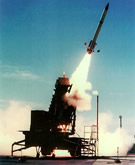
(click to view full)
PAC-2 GEM. In 2002, Raytheon completed a separate upgrade of their PAC-2 missiles, which became known as Patriot Guidance Enhanced Missile Plus (GEM+). GEM missiles, including next-step upgrades like GEM-C/T, are essentially PAC-2 systems that still use the larger PAC-2 fragmentation missiles, but have a range of improvements to their guidance systems, fuzes, etc. GEM-T is optimized against tactical ballistic missiles, while GEM-C is optimized against cruise missiles. They’re fielded by the USA and by foreign militaries, such as Israel and South Korea. In 2003, the U.S. military launched approximately 20 PAC-2 missiles during Operation Iraqi Freedom, the majority of which were GEM interceptors.
PAC-3.The current US standard for new-build Patriot Missiles is the Patriot Advanced Capability 3. While Lockheed Martin’s missile is as long as previous Raytheon versions, it’s thinner and weighs only 30% as much (688 vs. 2,000 pounds). PAC-3 uses a “hit-to-kill” approach, instead of the PAC-2’s large fragmentation warhead, which allows it to packs more missiles per launcher (16 instead of 4). Its enhanced capabilities also allow it to be used for point defense against ballistic missiles, and its Config-3 ground systems also feature a range of improvements to the battery’s radar, communications, electronics, and software.
Lockheed Martin produces the PAC-3 missile, including the hit-to-kill interceptor, the missile canister 4-packs, a fire solution computer, and an Enhanced Launcher Electronics System (ELES). It has been exported to Germany, Japan, Kuwait, Netherlands, Taiwan, and the UAE. The latest PAC-3 variant is the PAC-3 CRI (Cost Reduction Initiative).
Beyond the USA, America is working with Japan on missile defense. Japan’s system will use the long-range naval SM-3 missiles as the outer layer, and Patriot PAC-3s as the point defense component. Japan has been licensed to produce its own Patriot PAC-3s.
A subsequent variant called the PAC-3 MSE was originally part of a canceled system called MEADS, but has been incorporated into the USA’s future plans. It’s covered as part of the USA’s ongoing PATRIOT programs.
The USA’s Patriot Programs
Pure Fleet, etc.

(click to view full)
Budgets for PATRIOT systems as a whole are difficult to quantify, as recent years have seen them fully conflated with the separate MEADS program. Beyond MEADS, however, the U.S. Army has 2 important Patriot programs underway: “Pure Fleet” and “Grow the Army.”
Pure Fleet involves upgrading all its ground systems to Configuration-3. It will not necessarily replace all missiles in these batteries, which are often a mixed PAC-3/PAC-2 fleet, and are expected to remain so. What it will do, is make all batteries capable of firing the latest missiles, and ensure that the system’s technologies are kept up to date. This involves upgrades of multiple ground systems, and will be coupled with PAC-2 GEM-T missile upgrades under “continuous technology refreshment” programs.
Grow the Army was set to add 2 PAC-3 battalions to the Patriot force structure.
Lockheed Martin’s PAC-3 Patriot-based air-launched hit-to-kill (ALHTK) concept was a much more radical concept. It would be launched from fighter jets, and used to target ballistic missiles during their vulnerable but hard-to-reach launch phase. Initial studies were conducted, but neither this variant, nor Raytheon’s internally-mountable NCADE, managed to gain much traction.
Beyond Patriot, the USA has also been involved in the tri-national American/ German/ Italian MEADS project. Pentagon documents started to lump the Patriot and its successor MEADS together after 2006, making it difficult to track each system. The 2 air defense systems use very different technologies, but the Pentagon’s treatment of MEADS in its documents may have been prescient. MEADS became an R&D-only effort in 2011, and looks set to feed in some of its technologies as future PATRIOT upgrades. Patriot system production appears to be secure for the near future.
Even so, American production has tailed off, and the production line has been weighted in favor of foreign orders:

After 2013’s orders are delivered, foreign orders will be the only thing sustaining PAC-3 missile production. The reason for that is a new missile. The multinational MEADS R&D program looks set to end, but it produced a PAC-3 Missile Segment Enhancement (MSE) design that will become part of existing PATRIOT batteries.
Over the Horizon: PAC-3 MSE

(click to view full)
One element that will survive from MEADS is the improved PAC-3 MSE missile, which is becoming its own program. PAC-3 MSE is designed to be a longer range missile that is more agile, and able to counter both tactical ballistic missiles and more conventional threats. Improvements begin with a higher performance, dual-pulse, 11″ diameter Solid Rocket Motor (SRM) design, a thermally hardened front end for longer fly out, enlarged fixed fins, more responsive control surfaces, upgraded guidance software, an improved Hit-To-Kill system, and upgraded batteries. They’re also pushing toward Insensitive Munitions (IM) compliance in order to lower safety risks, and a more compliant SRM propellant is being developed. The missile’s “single canister” design concept is similar to the Navy’s approach with its “all-up-rounds” for delivery, transport storage, and firing.

The MSE takes the PAC-3 Cost Reduction Initiative (CRI) missile design as its base, and the Army hopes this will lower its overall cost per missile. By 2015, the Army expects the more capable PAC-3 MSE to cost less per missile (around $7.5 million) than the current PAC-3 (about $7.6 million), with costs continuing to drop toward an average of about $5.5 million over the life of the program. The USA plans to order 1,680 of them in the coming years.
Patriot Engineering Services Contracts

(click to view full)
PATRIOT Engineering support is a sole source contract initiated on Aug 26/03 by the Army Aviation and Missile Command in Redstone Arsenal, AL (W31P4Q-04-C-0020). A follow-on contract was issued in FY 2009 (W31P4Q-09-C-0057).
Raytheon releases note that “engineering support” includes system and software engineering, hardware engineering, system testing, quality assurance, configuration management, logistic support and program management. The contract also funds specific tasks, including the implementation of the architecture for the first phase of the Combined Aggregate Program (CAP), CAP phase 2 studies, system of system architecture studies, Patriot Advanced Capability 3 (PAC-3) missile integration and missile segment enhancement, and conducting annual service practice missile firings. The CAP program aligns the Patriot system to incorporate and field Medium Extended Air Defense System (MEADS) Major End Items (MEIs) as they become available.

The overall program is an international cooperative effort, in which foreign partners both fund and benefit from common support. The FY 2004 – 2009 umbrella contract called for engineering services tasks to be performed specifically for Germany, Greece, Israel, Japan, Kuwait, the Netherlands, the Kingdom of Saudi Arabia, Spain, and Taiwan. Beginning in 2009, South Korea and the UAE added themselves to that list.
What follows are all of the publicly-announced disbursements since the FY 2004 base award:

Work on PATRIOT Engineering Services is generally performed at Raytheon IDS HQ in Tewksbury, MA; its Integrated Air Defense Center in next-door Andover, MA; its Missile Defense Center in Woburn, MA; its Integrated Force Protection and Security Center in Huntsville, AL; its Mission Capability Verification Center at White Sands Missile Range, NM; and additional Raytheon facilities that include Burlington, MA and El Paso, TX. The vast majority of work is done in Tewksbury and Andover, MA. These facilities also process Patriot Advanced Configuration-2 (PAC-2) and Guidance Enhanced Missile-T (GEM-T) missiles for stockpile reliability testing, recertification and repair in support of the Patriot Field Surveillance program.
Other PATRIOT-Related Contracts & Events
Unless otherwise specified, contracts are awarded by the U.S. Army Aviation and Missile Command at Redstone Arsenal, AL.
FY 2017-2025

(click to view full)
January 4/23: NATO members in Europe have inked a contract for up to 1,000 Patriot missiles to bolster air defenses in the face of the threat from Russia, the alliance said Wednesday. The announcement of the contract, estimated to be worth $5.5 billion, comes as Moscow has unleashed repeated barrages of deadly missile and drone strikes against Ukraine in recent days. NATO’s procurement agency said the deal agreed upon by an initial group of countries including Germany, the Netherlands, Romania, and Spain would see Patriot missile production stepped up in Europe.
October 10/22: Production Capacity Lockheed Martin has opened its 85,000-square-foot All-Up Round III facility in Arkansas to boost the production capacity of the PAC-3 missile. The second expansion of Lockheed’s Camden Operations is part of a $142 million investment announced in June 2019. With the new facility, Lockheed is expecting to raise its production of PAC-3 missiles by 500 per year.
August 4/22: Saudi Arabia The US State Department has approved the sale of 300 Patriot missiles to Saudi Arabia in a deal worth $3.05 billion. In a statement released by the Pentagon, the US said Riyadh requested Patriot MIM-104E Guidance Enhanced Missile-Tactical Ballistic missiles (GEM-T). The sale will include other tools and test equipment.
July 25/22: Netherlands The US Department of State cleared a possible foreign military sale of 96 Raytheon-made Patriot surface-to-air missiles to the Netherlands in a deal estimated to be worth $1.2 billion. The Netherlands requested to buy the Patriot MIM-104E Guidance Enhanced Missile-Tactical, or GEM-T, missiles, which the State Department said support its goal of improving its defenses and increase its interoperability with the US and fellow NATO forces.
June 17/22: Palau Charlie Battery, 1-1 ADA (Air Defense Artillery), 38th Air Defense Artillery Brigade based in Japan successfully destroyed a cruise missile target using two PAC-3 air defense missile interceptors on June 15 in Palau. This is the first time the Patriot missile has been fired from Palau and the second time the US conduct such live-firing of the Patriot missile west of the International Date Line. According to the 94th Army Air and Missile Defense Command, targeting data was provided from an F-35.
June 7/22: Test-Fire The United States intends to test-fire the Patriot air defense missile system in Palau on June 15, the island’s ambassador to Washington D.C. has disclosed. The 1st Battalion, 1st Air Defense Artillery Regiment, from Okinawa will be deployed to Palau for this event. The firing is part of Exercise Valiant Shield which will involve Palau and Micronesia for the first time this year. The Patriot unit is to be deployed at Airai, according to Island Times.
June 1/22: South Korea South Korea’s Defense Project Promotion Committee has approved a $605 million project to buy PAC-3 missile interceptors and upgrade its existing PAC-2 launchers so that it can launch the PAC-3 missiles. Seoul will also spend $783 million to develop a mine-sweeping helicopter.
May 30/22: Post-Production Lockheed Martin won a $10.5 million deal for logistics support labor for and a $10.5 million deal for product assurance basic labor for the PATRIOT Advanced Capability-3 Missile Support Center post-production effort. Work locations and funding will be determined with each order. Estimated completion date is May 25, 2023.
May 26/22: Poland Polish Defense Minister Mariusz B?aszczak has announced his country is launching the second phase of its mid-range air defense program by requesting the US government to sell it six Patriot batteries with related gear. These would be in addition to the $4.7 billion order for the first two Patriot Configuration 3+ batteries that are scheduled for delivery this year.
April 7/22: Taiwan The US State Department has approved the potential sale to Taiwan of equipment, training and other items to support the Patriot Air Defense System in a deal valued at up to $95 million, the Pentagon said. Chinese-claimed Taiwan has complained of increased military pressure by Beijing to try and force the democratically ruled island to accept its sovereignty. The package would include training, planning, fielding, deployment, operation, maintenance and sustainment of the Patriot Air Defense System and associated equipment, the Pentagon said, in a notification to Congress.
March 10/22: Poland The US sent two PATRIOT surface-to-air missile batteries to Poland in preparation to enforce a no-fly zone over that country and parts of its border with Ukraine. “At the direction of the Secretary of Defense and at the invitation of our Polish allies, General Wolters, Commander of US European Command, has directed US Army Europe and Africa to reposition two Patriot Batteries to Poland,” United States European Command (EUCOM) spokesman Capt. Adam Miller said in a statement.
February 16/22: Saudi Arabia And Qatar Lockheed Martin won a $16 million deal for Patriot Advanced Capability-3 flight test support in Saudi Arabia and Qatar. Bids were solicited via the internet with one received. Work will be performed in Saudi Arabia and Qatar, with an estimated completion date of February 13, 2025. Fiscal 2022 Foreign Military Sales (Saudi Arabia and Qatar) funds in the amount of $16,099,270 were obligated at the time of the award.
December 9/21: Saudi Arabia Saudi Arabia is reportedly running low on its stock pile of Patriot missile interceptors and has reached out to the United States and allies in Europe and Gulf for resupplies. Houthi rebels based in Yemen have been launching ballistic missiles and drones into Saudi Arabia. The Kingdom has been using the interceptors to defeat those attacks over the past several months.
December 1/21: Technical Assistance The US Army announced a contract valued $94 million to Lockheed Martin for technical assistance support for the Patriot Advanced Capability-3 missile segment. Patriot is a long-range, all-altitude, all-weather air defense system to counter tactical ballistic missiles, cruise missiles and advanced aircraft. Work will be performed in Sweden, Kuwait, Poland, South Korea, Romania, United Arab Emirates, Taiwan, Qatar, Saudi Arabia, Bahrain, and Orlando, Florida, with an estimated completion date of November 30, 2024.
November 22/21: Sweden Sweden officially inducted the PAC-3 air defense missile system into service on November 18. The PAC-3 is designated as air defense system 103 in Swedish service. The ceremony took place at the Air Defense Regiment in Halmstad.
November 17/21: IBCS The PAC-3 Missile Segment Enhancement (MSE) units worked with the US Army’s Integrated Air and Missile Defense Battle Command System (IBCS) for the first time to intercept ballistic missiles during flight tests conducted earlier this month, Lockheed Martin announced. During the flight test series, two PAC-3 MSE missiles successfully engaged from IBCS and intercepted tactical ballistic missile (TBM) threats over White Sands Missile Range, New Mexico.
October 20/21: Flight Test Support Lockheed Martin won a $79.9 million contract modification to definitize the task order for the fire control components development and flight test support for Integrated Air and Missile Defense Battle Command System, PATRIOT advanced capability and PAC-3 missile segment enhancement integration with lower tier air and missile defense sensor. Work will take place in Texas. Estimated completion date is December 31, 2023.
October 11/21: Poland The Polish Ministry of Defense (MoD) has commenced preparing infrastructure to receive PATRIOT missile battery from the US, which is expected to arrive at the end of 2022. In March 2018, Poland signed a $4.75 billion agreement with the US for two Patriot Configuration 3+ batteries. The purchase includes Northrop Grumman’s IBCS Battle Command System and four fire units equipped with four AN/MPQ-65 radars, 16 launchers, four Engagement Control Stations, six Engagement Operation Centers, 12 IFCN Relays and 208 PAC-3 MSE missiles.
September 16/21: From Greece To Saudi Arabia The Greek defense ministry held a send off ceremony for the soldiers who are heading to Saudi Arabia to operate a Patriot air defense missile system. The ceremony was held at Tanagra air base.
September 14/21: Saudi Arabia During the last few weeks, the US has removed its most advanced air defense system, the Terminal High Altitude Air Defense (THAAD) system, as well as Patriot missile batteries from Saudi Arabia. Spokesmen for the Pentagon and the Saudi Defense Ministry confirmed the removal of the air defense systems. According to AP, images taken on Friday by satellite imagery company Planet Labs showed that the area of the air base where the systems were previously located is now empty, and there is no activity of any kind.
July 16/21: Down Under The US Army’s 38th Air Defense Artillery Brigade will fire a Patriot missile in Australia during exercise Talisman Sabre on July 16. The firing drill at Shoalwater Bay will be the first time a Patriot missile has been fired in Australia.
July 6/21: Orient Shield The US Army has deployed a PAC-3 air defense missile battery from Okinawa to Amami for the first time as part of Orient Shield 21-2. The unit carried out joint training with the 8th Anti-Aircraft Artillery Battalion from the Japan Ground Self-Defense Force.
July 2/21: Switzerland The Swiss Federal Council announced that it is set to propose that Parliament approve the procurement of 36 F-35A fighter aircraft from US manufacturer Lockheed Martin and five Patriot fire units from US manufacturer Raytheon together worth 8 billion CHF ($ 8.64 billon). The Federal Council based its decision on a comprehensive technical evaluation of four new fighter aircraft candidates (Eurofighter by Airbus, Germany; F/A-18 Super Hornet by Boeing, USA; F-35A by Lockheed Martin, USA; Rafale by Dassault, France) and two candidates for a longer-range GBAD system (SAMP/T by Eurosam, France; Patriot by Raytheon, USA), a council statement said.
June 25/21: Reduction In The Middle East According to reports, the Biden administration is sharply reducing the number of US antimissile systems in the Middle East in a major realignment of its military footprint there as it focuses the armed services on challenges from China and Russia, administration officials said. The Pentagon is pulling about eight Patriot antimissile batteries from countries including Iraq, Kuwait, Jordan and Saudi Arabia, according to officials. Another antimissile system known as a Terminal High Altitude Area Defense, or Thaad system, is being withdrawn from Saudi Arabia, and jet fighter squadrons assigned to the region are being reduced, those officials said.
June 8/21: Spare Hardware Lockheed Martin won a $172.4 million contract modification for procurement of spare hardware in association with Phased Array Tracking Radar to Intercept on Target (PATRIOT) Advanced Capability (PAC-3) FY21 missiles and command and launch system. The PAC-3 serves as an endoatmospheric point defense system with a capability to intercept short-range tactical ballistic missiles, cruise missiles, and military aircraft. Unlike earlier Patriot missile defense systems, the PAC-3 interceptor relies on hit-to-kill technology whereby the interceptor uses kinetic energy to destroy its target on impact. Work will take place in Alabama, Arkansas, Florida, Texas and Massachusetts. Estimated completion date is December 31, 2024.
May 12/21: Sweden Sweden has taken delivery of the Patriot Advanced Capability-3 (PAC-3) Missile Segment Enhancement (MSE) interceptors in April, Lockheed Martin said. Sweden selected the PAC-3 MSE in August 2018. Building on the combat-proven PAC-3 Cost Reduction Initiative (CRI), the PAC-3 MSE expands the lethal battlespace with a two-pulse solid rocket motor, providing increased performance in altitude and range, according to Lockheed.
April 14/21: Saudi Arabia Greece’s Foreign Minister Nikos Dendias and National Defense Minister Nikos Panagiotopoulos will travel to Riyadh on April 20 to sign an agreement for the deployment of a Greek PAC-3 air defense missile system to the kingdom.
June 1/18: Sweden boosts defense Lockheed Martin is being awarded a cost-plus-fixed-fee delivery order. Valued at $46.6 million the delivery order provides for non-recurring engineering, the development of design documentation, and the creation of modification instructions. These efforts will support service life extension and enable the developmental test F-35 aircraft to maintain currency with delivered technology. The F-35 Joint Strike fighter can be considered as the largest single global defense program in history. Testing and re-testing is an incremental part of this project. Due to the jets high procurement cost, Lockheed Martin is trying to develop systems that extend the F-35s life while keeping the associated costs to a minimum. This delivery order combines purchases for the Navy $12.37 million; Marine Corps $12,37 million; and non-US DoD participants $7,89 million. Work will be performed in Fort Worth, Texas and is expected to be completed in June 2019.
May 29/18: Romania gets radar units Romania is set to receive new ballistic missile defense units as part of US foreign military sales. A $395 million contract modification enables Raytheon IDS to produce a phased array tracking on radar to intercept option fire unit in support of the PATRIOT system. Phased array radar systems are used to scan, identify and track both enemy planes and incoming ballistic missiles. A PATRIOT firing battery includes several components: an antenna mast group, radar, electric power station, launchers, ECC command center, and maintenance center. They are carried on a mix of heavy and medium trucks. The radar set is either an AN/MPQ-53 radar for PAC-2 systems, or an AN/MPQ-65 for PAC-3 systems and is carried by a 10-ton M983 HEMTT truck pulling a M860 semitrailer. Work will be performed at various locations. Including Andover, Massachusetts and McKinney, Texas. The contract has an estimated completion date of April 30th, 2020.
May 25/18: FMS underway The United States government is continuing to supply some of its key international allies with further Patriot support. Lockheed Martin is being awarded a contract valued at $282 million as part of the US Foreign Military Sales program. The contract sees for the delivery of Patriot PAC-3 support services. The Phased Array Tracking Radar Intercept On Target missile system is a mainstay in many military inventories. At present, 12 nations have chosen it as a key component of their air and missile defense system. Lockheed Martin produces the PAC-3 missile, including the hit-to-kill interceptor, the missile canister 4-packs, a fire solution computer, and an Enhanced Launcher Electronics System. The modification includes a number of not predefined orders to be delivered to the Netherlands, Germany, Japan, Saudi Arabia, Kuwait, Qatar, Taiwan, the United Arab Emirates and the Republic of South Korea. Work locations and funding will be determined with each order. All work is expected to be completed by May 2019.
April 24/18: Lithuania wants Patriots, SHORAD Lithuania wants the regular deployment of both long-range and short-range advanced anti-air and missile assets in its country to allow for more regular training with NATO, Defence Minister Raimundas Karoblis has said. “Yes, of course (we are asking the Americans)”, he told Reuters on Thursday. “We are talking not only about the Patriots but also other capabilities, such as short-range Avengers, and other systems to create a regional architecture of air defence, because we are not able to do that ourselves.” While Karoblis did not expect NATO to increase defences in the Baltics immediately, he does expect the alliance to show greater commitment at a NATO leaders summit in July to deterring any threat in the Baltics. “We would like to have the permanent deployment of ground missile systems and other capabilities, but we understand that a quite significant part of these capabilities were lost by NATO after the Cold War and it’s difficult to rebuild them fast”, he said. “We need to ensure that (air defences) could be deployed (in the Baltics) at any time necessary.” Formerly part of the Soviet Union, Lithuania—along with neighboring Estonia and Latvia—have since 1991 realigned themselves by joining NATO and the European Union. Anxious since Russia’s annexation of the Crimea from Ukraine in 2014, the nations have continued to ask for Western help despite growing defence budgets due to their small economies. Poland was equally alarmed by Moscow’s Crieman seizure, spending more than $5 billion on buying Patriot missiles from Raytheon after a deal in March.
March 27/18: Poland’s FMS—Offsets agreed! The Polish government has officially signed an offset agreement with the US industry that will pave the way for the purchase of the Patriot integrated air and missile defense (IAMD) system under the Wisla program. The Wisla program is part of the Tarcza Polskior (Shield of Poland), aiming at to give the country an advanced air defense system to match. Missile proliferation in the Middle East, American fecklessness, and a rearming Russia have all led Poland to the conclusion that they can no longer depend on old Soviet-era air defense equipment. They need their own advanced national air defense system, which can benefit from allied contributions without being dependent on them. The purchase of the Patriot system was initialised in March 2017 when Poland signed a deal worth up to $7.6 billion with Raytheon. Warsaw sees the deal as central to a thorough modernisation of its armed forces by 2023. The MIM-104 PATRIOT anti-air missile system offers an advanced backbone for medium-range air defense, and short-range ballistic missile defense, to America and its allies. A Patriot firing battery includes several components: an antenna mast group, radar, electric power station, launchers, ECC command center, and maintenance center. They are carried on a mix of heavy and medium trucks.
March 19/18: FMS contract Qatar will receive Patriot air defense system support from Raytheon, after the award of a foreign military sales contract by the US Army. The award was announced by a Pentagon statement on Thursday, March 15, with the work order tasking the firm with proving staffing and training for Qatar depot operations for the Qatar Emiri Air Force Patriot Missile System. Work will take place in Doha, Qatar at a cost of $150.4 million.
March 8/18: Intercept test Lockheed Martin have announced the successful intercept of two ballistic missile targets of PAC-3 Cost Reduction Initiative (CRI) interceptors during a recent US Army test at White Sands Missile Range, New Mexico. The test marks the tenth and eleventh successful PAC-3 CRI FSP intercepts in six years. “PAC-3 continues to be successful against today’s evolving threats, and it remains the only combat proven Hit-to-Kill interceptor in the world,” said Jay Pitman, vice president of PAC-3 programs at Lockheed Martin Missiles and Fire Control. “Today’s global security environment demands reliable solutions. We expect PAC-3 interceptors to continue serving as an essential element in integrated, layered defense systems.”
February 26/18: Sweden-DSCA Clearance Sweden joins Romania and Poland as the latest government to purchase the Patriot Configuration-3+ air defense system, after the potential sale was cleared by the US State Department last week. Valued at an estimated $3.2 billion, the package includes four Patriot Configuration-3+ Modernized Fire Units consisting of: four AN/MPQ-65 radar sets, four AN/MSQ-132 engagement control stations, nine antenna mast groups, 12 M903 launching stations, 100 Patriot MIM-104E Guidance Enhanced Missile-TBM (GEM-T) missiles, 200 Patriot Advanced Capabilty-3 (PAC-3) Missile Segment Enhancement (MSE) missiles, and four Electrical Power Plants (EPP) III. Also included are communications equipment and technical publications, along with training equipment. Lockheed Martin and Raytheon have been listed as prime contractors, and 24 US Government and 32 contractor representatives will be sent to Sweden for an extended period for equipment de-processing/fielding, system checkout, training, and technical and logistics support.
February 21/18: South Korea-PAC-3 MSE Orders South Korea’s Defense Acquisition Program Administration (DAPA) has approved $53 million for the purchase of an undisclosed number of PAC-3 Missile Segment Enhancement (MSE) interceptors, Defense News reports. “This procurement plan is aimed at acquiring more PAC-3 precision-guided missiles to respond to North Korea’s ballistic missile threat in a more effective way,” DAPA spokesman Kang Seok-hwan said. “The contract is expected to be made in the second half of the year for the delivery after 2020.” The PAC-3 MSE uses a two-pulse solid rocket motor that increases altitude and range to defend against evolving threats. It can intercept missiles at an altitude of 40 kilometers, two times higher than the normal PAC-3 interceptor, so a combination of both missiles could be used as part of a layered missile defense operation.
February 8/18: PAC-3 Orders-Field Surveillance Program The US Army and foreign Patriot system operators will receive additional PAC-3 MSE missiles and associated equipment and support under a $523.8 million contract modification awarded Tuesday, February 6, by the Pentagon to Lockheed Martin. Foreign recipients include Saudi Arabia, Qatar, and Romania. Work will take place at several Lockheed facilities across the US, with an estimated completion date of January 31, 2021. On the same day, Raytheon’s Andover, Massachusetts, facility was awarded a $17.5 million in support of the Patriot Field Surveillance program. The order—which covers domestic orders as well as foreign military sales to Israel, Qatar, Kuwait, Japan, South Korea, Taiwan, United Arab Emirates, Luxembourg, and Saudi Arabia—will include missile assessments, testing, recertification, and repair activities. The contract is estimated to run until January 31, 2020.
February 2/18: Poland gets a write-down Mariusz Blaszczak, Poland’s new Defense Minister, took to Twitter on Wednesday to announce that Warsaw had secured a reduced price tag on its Patriot air-defense system procurement. Assuring his followers that the reduced price “does not limit the assumed combat capabilities of the system,” Blaszczak added that the government was on “track to sign a contract by the end of the first quarter of 2018.” While he didn’t have enough characters to confirm how much of a reduction Poland was given, an earlier notification to US Congress by the State Department’s Defense Security Cooperation Agency (DSCA) said the first phase of the acquisition could cost the country $10.5 billion for four systems—roughly 37 billion zloty—which came as a shock for Polish ministers who had earmarked only 7 billion zloty on its entire program. Known as the Wisla program, Poland looks to acquire a unique configuration of the Patriot system as part of an integrated air and missile defense (AMD) network. This will include the still-in-development command and control system—known as the Integrated Battle Command System (IBCS)—16 missile launchers, four sector radars (that will be replaced with a new radar further down the line), and 208 PAC-3 Missile Segment Enhancement (MSE) missiles. The government is also seeking a generous offsets package tosee components produced by its own industrial base, and discussions with Lockheed, Raytheon and Northrop Grumman are expected to continue in the coming months ahead of finalizing the agreement, which could see the price of the system decrease further.
February 1/18: Saudi Arabia Combat Intercepts Footage taken on January 17 by a CNN news crew at a Saudi military base, shows that the remnants of a Burkan-2H ballistic missile launched by Houthi rebels from Yemen on December 19, 2017, was not intercepted by Saudi’s Patriot interceptors. While the news crew “reiterated the Saudi claim, saying the missile was shot down about 15 miles (24 km) from Riyadh…the remnants it filmed showed no sign that it had been hit by the fragmentation from a Patriot PAC-2 missile or been struck by one of the new PAC-3 ‘hit-to-kill’ missiles Saudi Arabia is buying. It also appeared the re-entry vehicle (RV) containing its warhead separated from its main body as designed,” according to analysis by Jane’s. Another missile launched on November 4 was also met with claims that Patriot interceptors had downed the intruding missile, however, fragments later displayed showed it had detonated after hitting the ground as they would have been difficult to recover after an aerial detonation.
February 1/18: Contracts-Software The Pentagon announced Tuesday, the awarding to Raytheon of a $2.3 billion contract in support of the Patriot air-defense system. Under the terms of the deal, Raytheon will provide ongoing support of software, refresh for obsolescence, and will also include support of systems outside of the continental US, as well as for partner nation’s Patriot systems. Work will take place at various locations depending on each order, with a scheduled completion date set for January 31, 2023.
January 24/18: Saudi Arabia-Support FMS A US State Department statement through its Defense Security Cooperation Agency (DSCA), has approved the continuation of missile system support services for Saudi Arabia’s Patriot air defense system. Valued at an estimated $500 million, the package contains continued participation, technical assistance, and support in the Patriot Legacy Field Surveillance Program (FSP); the Patriot Advanced Capability 3 (PAC-3) FSP; and the Patriot Engineering Services Program (ESP). Also included are Patriot and HAWK Missile System spare parts and repair and return management services and component repairs, and other related elements of logistics and program support. Once approved by Congress, principal contractors that will work on the deal are Lockheed Martin of Bethesda, Maryland for the FSP and Raytheon of Andover, Massachusetts for the ESP.
December 12/17: Contracts-Risk Reduction-Radar Northrop Grumman will perform risk reduction for radar technology and associated mission capabilities intended to replace the Army’s 50-year-old Patriot radars, under a contract awarded by the US Army’s Lower Tier Program Office (LTPO). The Lower Tier Air & Missile Defense Sensor (LTAMDS) will be the Army’s first net centric radar to be added to the Army’s Integrated Air and Missile Defense enterprise controlled by the Integrated Air and Missile Defense Battle Command System (IBCS), which Northrop Grumman also develops. IBCS is the advanced command and control system that integrates air and missile defense sensors and weapons, including Patriot, to generate a real-time comprehensive threat picture and enable any-sensor, best-shooter operations. Northrop did not disclose the value of the contract.
December 8/17: FMS Poland has expressed its surprise at the price-tag attached to its purchase of the Patriot air defense system. Cleared by the US Defense Security Cooperation Agency (DSCA) last month at an estimated cost of $10.5 billion for four systems—half the number of system Warsaw planned to buy—but this seems to be already in excess of what Poland had budgeted for the entire procurement. “The high cost came as a surprise for us,” Bartosz Kownacki, secretary of state in Poland’s Ministry of National Defense, said during an interview while he visited Washington this week. “The price is indeed unacceptable for us even in the view of the significant financial assets that we allocated for the technical modernization of the Polish Armed Forces,” he said through a translator. “We cannot simply afford to spend that much money on the procurement of two batteries and [Patriot Advanced Capability]-3 missiles for such an amount of money.” Looks like negotiations on this deal ain’t done and dusted just yet.
December 6/17: FMS-Services & Support The US Army has granted Raytheon a $150.2 million foreign military contract to provide Qatar with services and support of the Patriot Air Defense System. Work on the contract will be performed in Doha, Qatar, and is expected to be completed by November 2020. More than $150.2 million of fiscal 2018 foreign military sale funds was obligated to Raytheon at the time of award. Under the terms of the deal, Raytheon will provide technical expertise and assistance in the training, planning, fielding, deployment, operation, maintenance management, configuration management, logistics support, installation and sustainment of the Qatar Patriot Air Defense Systems and associated equipment.
December 6/17: Combat Intercept-Report A report by the New York Times has quoted experts claiming the Patriot air defense system operated by the Royal Saudi Air Force failed to intercept a missile fired by Yemeni Houthi militants on Saudi Arabia’s King Khalid international airport in Riyadh on November 4. Five interceptors were fired at the Houthi missile—believed to be a Burqan-2, a Scud family missile popular in the Middle East—however, US officials now say that there was no evidence to prove that any of them hit the incoming missile. Instead, they said, the incoming missile body and warhead may have come apart because of its sheer speed and force. In the immediate aftermath of the attack, even US President Trump hailed the Patriot system’s effectiveness—“That’s how good we are. Nobody makes what we make, and now we’re selling it all over the world”—but governments have overstated the effectiveness of missile defenses in the past, including against Scuds. During the first Gulf War, the United States claimed a near-perfect record in shooting down Iraqi variants of the Scud. Subsequent analyses found that nearly all the interceptions had failed.
December 1/17: Milestone-Testing-RFP Lockheed Martin heralded the successful neutralisation by five Patriot Advanced Capability-3 interceptors of four tactical ballistic missile targets during a recent test at White Sands Missile Range, New Mexico. Four PAC-3 Cost Reduction Initiative (CRI) interceptors and one PAC-3 Missile Segment Enhancement (MSE) were used during the test, with the successful PAC-3 MSE intercept part of a requirement that “supports” a full-rate production decision for the variant. The MSE variant uses a larger, dual-pulse solid-rocket motor and larger control fins that double the missile’s reach and improve performance against evolving ballistic and cruise missiles. It was fired for the first time by the US Army during a successful intercept test last summer.
December 1/17: Foreign Military Sale Romania has officially signed a letter of offer and acceptance for the purchase of Raytheon’s Patriot air defense system from the US Army. The accord paves the way for Romania’s Patriot force to rapidly reach Initial Operational Capability by allowing for negotiations between the US government and Raytheon. As part of the sale, Bucharest will the receive Patriot Configuration 3+, the most advanced configuration available, as well as an undisclosed quantity of GEM-T and PAC-3 MSE interceptor missiles.
November 20/17: Foreign Military Sale The US State Department has notified Congress that it is allowing the possible sale of the Patriot air defense system to Poland. Released through the Defense Security Cooperation Agency (DSCA), the statement calls for the first phase purchase of a two-phase program for an Integrated Air and Missile Defense (IAMD) Battle Command System (IBCS)-enabled Patriot Configuration-3+ with Modernized Sensors and Components. Valued at an estimated $10.4 billion, the package consists of 4 AN/MPQ-65 radar sets, 4 engagement control stations, 4 Radar Interface Units (RIU) modification kits, 16 M903 Launching stations adapted, 18 Launcher Integrated Network Kits (LINKs) (includes 2 spares), 208 Patriot Advanced Capabilty-3 (PAC-3) Missile Segment Enhancement (MSE) missiles, 11 PAC-3 MSE test missiles, IBCS software, 2 future operations – IBCS Engagement Operations Centers (EOCs), 6 current operations-IBCS EOCs, 6 engagement operations-IBCS EOCs, 15 Integrated Fire Control Network (IFCN relays, 4 Electrical Power Plants (EPP) III, and 5 Multifunctional Information Distribution Systems/Low Volume Terminals (MIDS/LVTs). Raytheon, Lockheed Martin, and Northrop Grumman have all been listed as prime contractors on the deal, and as many as 42 US Government and 55 contractor representatives will travel to Poland for an extended period for equipment de-processing/fielding, system checkout, training, and technical and logistics support. While Warsaw has also requested offsets as part of the purchase, a decision will be announced upon negotiations between contractors and the Polish government. Current NATO allies that already operate the system on the continent include the Netherlands, Germany, Spain, and Greece, while Romania is also obtaining the system.
November 9/17: Foreign Sales Sweden’s Defense Materiel Administration (FMV) will commence discussions with Raytheon and the US government after the government in Stockholm okayed the procurement of the Patriot air defense missile system. The system once again won out against the Eurosam consortium’s SAMP/T, and the contract is expected to be worth $1.2 billion. Deliveries will begin in 2020 and the system is expected to be operational by 2025.
October 20/17: It’s been reported that a number of contracts have been awarded by the Department of Defense Ordnance Technology Consortium (DOTC) to four companies to come up with concept designs for the Army’s long-running Patriot air-and-missile defense radar replacement. Based on their previous involvement with the Patriot program, both Raytheon and Lockheed Martin received contracts to develop new concepts for the radar, while Northrop Grumman also confirmed its involvement in the concept phase of the program. Another firm, Brea, California-based Technovative Applications, has also been reported to have landed another Army contract, which are expected to run for 15 months. After spending years debating what will replace the Patriot’s Raytheon-manufactured radar, the Army announced earlier this year a competition for a brand new 360-degree, lower-tier AMD sensor that can detect different evolving threats coming from any direction, be they ones that ones that fly slower, faster or manoeuvre differently.
September 26/17: Lockheed Martin announced the successful intercept of a tactical ballistic missile with a Patriot Advanced Capability-3 Missile Segment Enhancement (MSE) surface-to-air-missile controlled from a remote launcher, the first time such a test has been completed. The test was conducted by the US Army at Reagan Test Site at the Kwajalein Atoll in the Marshall Islands. Lockheed Martin said the “test demonstrated the expanded defended footprint available by deploying the launcher remotely from the Patriot radar. It also confirmed PAC-3 MSE’s unique ability to detect, track and intercept an incoming threat.”
July 19/17: Lockheed Martin will deliver Patriot Advanced Capability-3 anti-ballistic missile systems to several international customers after receiving a $130.3 million contract from the US Army. The order calls for the delivery of 35 missile segment enhancements, 100 launcher modifications kits, parts, software, and missile round trainers. Recipients of the systems include Qatar, Saudi Arabia, the Untied Arab Emirates, the Republic of Korea, and Taiwan. Work will primarily take place at the company’s Grand Prairie, Texas facility, as well as other sites across the US, and is expected to be completed by June 30, 2020.
 that its Patriot air defense systems have downed more than 100 ballistic missiles in worldwide combat operations since January 1, 2015. Of those 100 or so intercepts, more than 90 involved the low cost Raytheon-made Guidance Enhanced Missile (GEM) family of interceptors. First introduced as an improvement to earlier PAC-2 missiles, early GEMs added a new, faster proximity fused warhead, alongside upgraded seekers to improve performance, and has been subsequently improved into four variants over the last two two decades. The missile operates by flying at extremely high speeds to close in on the threat and then detonating a blast-fragmentation warhead at precisely the right moment. that Bucharest was interested in acquiring the Patriot system, saying that it is just one of a several possible solutions that is being looked at by officials. Responding to criticisms that the system may be too old, Les argued that the purchase of Patriot was more about air defense rather than for solely countering anti-ballistic missile threats. “The system is not for antiballistic defence, it’s about an air defence system against all possible aircraft. Just as the defence against cruise missiles is another thing. When we will have a solution in this direction, we will come up and announce it publicly, because after all, this is our intention, to be extremely transparent,” he added.
April 23/17: Romania looks set to be the latest site of NATO’s European missile defense shield after General Nicolae-Ionel Ciuca, chief of the General Staff, announced Bucharest’s intentions to purchase the Patriot system. Already in talks with manufacturer Raytheon, the missiles would be part of an integrated air defense system comprising six newly acquired F-16 fighter jets as Romania brings their forces up to NATO standards and retires outdated communist-era MiGs. News of the potential deal shortly follows Poland’s decision to purchase the Patriot system, much to Russia’s chagrin. Russian President Vladimir Putin described the purchases as a “great danger” saying Moscow will be forced to respond by enhancing their own missile strike capability.
April 2/17: Poland plans to proceed with the procurement of eight Patriot missile defense systems as contracts with manufacturer are expected to be signed by the end of the year. Valued at $7.6 billion, the purchase will go toward fulfilling the Wisla program — Warsaw’s plan for a multi-tiered defense shield — and is considered central to a thorough modernization of their armed forces by 2023. While approval still needs to be given by the US Congress, Raytheon’s head of Europe Bill Schmieder remains optimistic, saying that “It’s premature to say that it is all done, but we have very high hopes that the process will proceed normally.”
December 30/16: An unknown customer has contracted Raytheon to provide a $600 million modernization of its Patriot Integrated Air and Missile Defense System. The upgrade will advance the country’s Patriot system to the most advanced configuration available, the Configuration 3+ with Post Deployment Build 8 software and hardware. Configuration 3+ enables the Patriot to use the PAC-3 missile Segment Enhancement interceptor, which provides greater range and mobility in destroying tactical ballistic missiles.
December 27/16: Contracts have been awarded to Lockheed Martin for $1.4 billion worth of Patriot advanced capability production. The foreign military sales deal will see the delivery of 205 missile segment enhancements for the governments of South Korea, Qatar, Saudi Arabia, Taiwan, the United Arab Emirates and the United States. The agreement also includes associated ground support equipment for the missiles.
December 13/16: Officials at Raytheon have expressed confidence that the US government will grant export licenses for eight Patriot missile defense systems to Poland within the next few months. Speaking to Polish media, John Baird, vice president of Raytheon Poland programs said “concrete decisions are expected within the next few months.” Warsaw is also in talks to procure the Patriot’s rival, the Medium Extended Air Defense Systems (MEADS), with Lockheed Martin.
November 30/16: An undisclosed member of the Patriot Integrated Air and Missile Defense System program has contracted Raytheon to provide additional Patriot missile capabilities. The $225 million deal comes just 45 days after Poland requested the same product from the US government, and when Raytheon received another contract from the Netherlands to upgrade their own systems. Answers on a postcard please.
FY 2016
October 18/16: Radar signal management technology made by a Taiwanese company will be used in Lockheed Martin’s latest MIM-104F (PAC-3) air defense missile system upgrade. Developed by the state-owned National Chungshan Institute of Science and Technology, the technology is also found in the indigenous Sky Bow III air defense system. So far, it has made $25.3 million in international orders.
October 10/16: Raytheon has been contracted to update the Netherlands’ Patriot missile system. Work to be undertaken as part of the upgrade includes the installation of the Modern Man Station user interface — the latest operator-machine interface upgrade to Patriot command and control shelters. The upgrade will make it easier to operate Patriot and provide enhanced situational awareness.
October 7/16: Plans by Taiwan to shoot down one of its indigenous Sky Bow II interceptors with the American Patriot air defense system have been postponed due to a China Coast Guard vessel being found lurking nearby. The Sky Bow II was supposed to be fired from Jihui Fish Port with a Patriot fired from Jioupeng Military Base attempting to shoot it down on October 5. Initially scheduled for May, the test had been first postponed due to typhoons.
September 8/16: Poland has officially selected the Patriot air defense missile system, making it the 6th NATO Patriot country and the 14th Patriot partner nation. Manufacturer Raytheon made the announcement saying that the company “will continue supporting the US and Polish governments through the Foreign Military Sales process,” and that it “will also partner with Poland’s government and industry to finalize offset and industrial participation plans.” So far, Raytheon has already signed eight contracts and more than 30 letters of intent with Polish industry.
August 31/16: The Government Accountability Office (GAO), Congress’ watchdog, has stated that it wants more oversight into the Army’s Patriot upgrade. With $1.8 billion in funding allocated for the next five years, the GAO stated that the service’s plan, which is expected to remain in operation until at least 2050, lacks oversight mechanisms as the Army carries out its strategy in the coming years. Congress has consistently taken issue with what it sees as the Army’s inability to estimate the cost of the system in future years, and has regularly withheld funds to upgrade portions of the system, demanding the Army provide more clarity to its plans before shelling out all of the requested cash to fund it.
August 19/16: Both Lockheed Martin and Raytheon have submitted offers for upgraded integrated air-and-missile defense radar concepts as the US Army decides on its eventual Patriot system replacement. The service was initially planning to integrate the Medium Extended Air Defense System (MEADS), but this was ultimately shelved. As a result, the request for fresh radar concepts may prove a progressive first step in deciding whether to upgrade Patriot or go for something new.
July 28/16: Polish Defense Minister Antoni Macierewicz expects to have their Patriot missile-defense system finalized by the end of the year. The $5.5 billion deal could also be joined by more missile-systems as Warsaw accelerates efforts to enhance their missile-defense capability. $15 billion has been earmarked for the modernization with plans to spend some $10 billion on mid-range air- and missile-defense systems, and over $5 billion on short-range air-defense systems.
July 19/16: Last week Raytheon announced the success of Saudi-operated Patriot batteries in intercepting missiles coming from Yemen, however the system failed to take down a Syrian UAV that ended up in Israeli air space. The intrusion took place over airspace on the Golan Heights, which has been in Israeli possession since its annexation in 1967. While the IDF have often responded to stray rocket fire from the neighboring Syrian Civil War with tank and mortar shells, this marks the first time that Patriot missiles have been brought into play.
July 14/16: Patriot anti-missile systems operated by Saudi Arabia have had a 100% success rate according to manufacturer Raytheon. The system has seen service as part of the Saudi-led intervention in Yemen intercepting missile attacks from Houthi rebels. Iran is believed to be arming the rebels with small arms and munitions including scud missiles.
July 7/16: Following its agreement with Raytheon over offsets, Poland’s state-run defense group PGZ has signed a letter of intent with Raytheon to install a Patriot missile defense system. According to a PGZ statement, “the signed letter of intent positions the Polish industry as an important component of the Global Patriot program, including the transfer of key technologies. It also opens the doors to the Polish industry to enable its participation in the modernization programs of 220 Patriot systems operated by 13 countries.” The agreement comes days before the commencement of Warsaw’s hosting of this year’s NATO summit between July 8-9.
July 6/16: Poland finally looks set to make a $5 billion deal to acquire the Patriot missile defense system after a breakthrough in discussions with manufacturer Raytheon. Defense Minister Antoni Macierewicz made the announcement as the US defense giant capitulated to allow for at least 50% of the money to be spent on works done by Polish plants. Just a few short months ago the deal, started by the previous government, had been seriously questioned by Macierewicz in a bid to secure more offsets to boost Polish manufacturing employment.
January 18/16: Belgium’s government is looking to buy the Patriot air defense system as part of its new strategic defense plan. The plan, if approved by the parliamentary defense select committee, could potentially see over $600 million used to purchase a battery of the system. Defence minister Steven Vandeput said the system would be used not only as part of Belgium’s defense from ballistic missile threats, but could be utilized by other NATO allies in places where such a system is most needed such as on the Turkish-Syrian border. The announcement comes alongside the news that Poland may also install the system in their country in a procurement that could reach $5 billion.
December 29/15: Kuwait is to receive technical assistance for the PATRIOT system after Raytheon was awarded a $9.27 million foreign military sales contract by the US Department of Defense. The contract shortly followed a previous $74.5 million award to provide pre-PATRIOT training classes to Kuwaiti military personnel ahead of the delivery of batteries of the missile defense system in July 2016, and will run until December 2016.
December 16/15: Lockheed Martin has been awarded a $1.09 billion contract to provide Patriot PAC-3 missiles for use by the US Army, Saudi Arabia, South Korea and Qatar. Delivery of the missiles is expected to be completed by June 30, 2019. The contract follows a similar one awarded in July worth $1.5 billion. The award follows a growing increase in demand for missiles and defense systems from both the US and countless other foreign buyers. The Pentagon’s Defense Security Cooperation Agency has come under scrutiny as of late for not being able to process foreign arms sales quickly enough to keep up with demand.
November 30/15: Poland’s new government is considering backing out of a previous $5 billion deal to install the Patriot missile defense system. A further order of 50 Caracal EC725 helicopters worth $3 billion is also in doubt. The agreements were made last April amid rising tensions among NATO member states in eastern Europe after the Russian annexation of Crimea. The ruling Law & Justice party have brought the nature of the deal into doubt expressing concerns over extra costs and increased delivery time and may look at a renewed tendering process in 2016.
November 18/15: UAE Patriot missiles have been credited with shooting down two ballistic missiles launched by Houthi militants in Yemen. The UAE have had the Patriot battery deployed in the Marib provence of Yeman since September as part of a Saudi led coalition against the Shia insurgency there. The sale of the Patriot missile systems to various Gulf nations by the US has been part of a concentrated effort to counter Jihadist activity in various countries in the region. Earlier this month, the Defence Security Cooperation Agency (DSCA) cleared the sale of $380 million worth of munitions to the UAE who it sees as an “important force for political stability and economic progress in the Middle East”.
November 9/15: The Netherlands is planning to modernize its Patriot air defense missile systems, rather than procure new MEADS systems. Beyond Germany’s selection of the Medium Extended Air Defense System – a Lockheed Martin/MBDA Deutschland project – in May, MEADS has not seen the success some hoped for. The Dutch are reportedly planning to upgrade their Patriots between 2017 and 2021, extending their service lives out to 2040, with the Dutch withdrawing Patriot batteries from Turkey in August 2014 to facilitate this modernization work.
FY 2015
Purchases: Kuwait, Taiwan, Qatar, UAE; Requests: Saudi Arabia.
July 30/15: Saudi Arabia has requested Patriot PAC-3 missiles and auxiliary equipment through a potential $5.4 billion deal, which would modernize the Kingdom’s current stockpile of Patriot missiles. This DSCA request comes on the heels of a $1.5 billion contract announced by Lockheed Martin earlier this month, which will see Foreign Military Sales partners worldwide upgraded with new PAC-3 and PAC-3MSE interceptors, including Saudi Arabia, as well as another DSCA request from October 2014 for PAC-3 missiles, with that request valued at $1.75 billion.
July 27/15: Lockheed Martin will upgrade US Army and international partners’ Patriot systems through the Foreign Military Sales program in a deal worth $1.5 billion. The contract will supply PAC-3 and PAC-3 MSE interceptors for Taiwan, South Korea, Saudi Arabia, Qatar and the UAE. These states all operate the PAC-3, with Saudi Arabia requesting $1.75 billion-worth of PAC-3 enhancements in June 2014, with Qatar ordering the PAC-3 in October as part of a $11 billion equipment deal with the US. South Korea announced in April 2014 that the country’s Patriot systems would be upgraded to the PAC-3 configuration between 2016 and 2020, with a budget of around $1.25 billion.
May 19/15: Raytheon was awarded a $7 million contract modification in support of the UAE’s Patriot systems, with this totaling 138 man-months of work. The GCC member state first procured the systems in 2008, with the country operating the PAC-3 variant.
April 24/15: The undisclosed customer in Raytheon’s $2 billion contract announced earlier this week for Patriot air defense systems is now thought to be Saudi Arabia. The company secured a multi-billion dollar contract with Poland this week, with the Patriot system also a contender for Germany’s air defense modernization requirement.
April 20/15: On Friday, Raytheon announced the award of a $2 billion contract to an undisclosed international customer for the supply of new-production Patriot systems, training and support. The precise variant of the system was not revealed, however the new systems will include the “latest technology for improved threat detection, identification and engagement,” which sounds like the PAC-3 variant.
Nov 5/14: Korea. The US DSCA announces South Korea’s official export request for PAC-3 missiles to upgrade its Korea Air Missile Defense (KAMD) system from its existing PAC-2 GEM-Ts. This will create better interoperability with American forces in theater, while enhancing the country’s ballistic missile defenses (q.v. March 12/14). The estimated cost is up to $1.405 billion, and includes:
* 136 PAC-3 Missiles with containers
* 2 Patriot-As-A-Target (PAAT) Flight Test Targets with 2 PAC-3 Telemetry Kits
* 10 Fire Solution Computers
* 18 Launcher Station Modification Kits
* 8 Guided Missile Transporters
* 8 Missile Round Trainers
* 8 PAC-3 Slings
* 13 Installation Kits for TPX-58 Identification Friend or Foe with KIV-77 crypto
* PAC-3 Ground Support Equipment (GSE)
* 10 Shorting Plugs
* 77 Defense Advanced Global Positioning Receivers (DAGR GPS) and Installation Kits
* Patriot Fiber Optic Modem
* 4 AN/VRC-90E Radios with Installation Kits
* 10 Patriot Automated Logistics System Kits
* Plus the usual spare and repair parts, support equipment, communication equipment, publications and technical documentation, personnel training and training equipment, and US Government and contractor support.
The principal contractors will be Raytheon Corporation in Andover, MA (config-3 ground systems); and Lockheed Martin Missiles and Fire Control in Dallas, TX (PAC-3 missiles). Implementation of this proposed sale won’t require the assignment of any additional US Government or contractor personnel to Korea, beyond temporary in-country visits to meet program technical and management oversight and support requirements. Sources: US DSCA #14-52, “Republic of Korea – Patriot Advanced Capability (PAC-3) Missiles”.
DSCA request: South Korea (136 PAC-3 & Config-3 upgrades)
Oct 14/14: PATRIOT. Lockheed Martin Missiles and Fire Control in Grand Prairie, TX receives a $595.5 million foreign military sales contract modification, covering FY 2014 production for Kuwait, Taiwan, Qatar, and the UAE. They’re selling 152 PAC-3 cost reduction initiative missiles, 15 PAC-3 launcher modification kits, and the associated ground equipment, tooling, and initial spares. $543 million is committed immediately.
The PAC-3 CRI missile was used as the base for the PAC-3 MSE missile, but the MSE also adds a number of new technologies, and changes the missile’s structure. In contrast, PAC-3 CRI missiles offer PAC-3 performance at a slightly lower cost.
Work will be performed in Grand Prairie, Lufkin, and El Paso, TX; Camden, AR; Chelmsford, MA; Ocala, FL; Huntsville, AL; and Anaheim, CA; and will continue until May 31/16. Army Contracting Command in Redstone Arsenal, AL (W31P4Q-14-C-0034, PO 0008).
PAC-3 missiles: Kuwait, Qatar, Taiwan, UAE
Oct 1/14: Saudi Arabia. The US DSCA announces a Saudi Arabian export request for more PATRIOT PAC-3 missiles, with Lockheed Martin in Dallas, TX and Raytheon in Tewksbury, MA as the designated contractors to negotiate with. the contract could be worth up to $1.75 billion, on top of previous request and sales involving a $1.7 billion upgrade of PATRIOT systems to Config-3 status for PAC-3 missile use (q.v. Nov 30/11), high-end maintenance and re-certification contracts (q.v. Dec 23/11, Nov 28/12), and a national C4I system (q.v. Nov 26/12).
This time, they want to buy up to 202 PATRIOT PAC-3 Missiles with containers, and 1 Patriot as a Target (PAC-2 Guidance Enhanced Missile GEM Flight Test Target). They also want up to 36 Launcher Station Modification Kits, 6 Fire Solution Computers, 6 Patriot Automated Logistics Systems Kits, 2 PAC-3 Telemetry Kits, 2 Missile Round Trainers, 2 PAC-3 Slings, 6 Shorting Plugs, spare and repair parts, lot validation and range support, ground support equipment, repair and return, publications and technical documentation, personnel training and training equipment, a Quality Assurance Team, and other US Government and contractor support.
“The proposed sale will help replenish Saudi’s current [PAC-2] Patriot missiles which are becoming obsolete and difficult to sustain due to age and the limited availability of repair parts. The purchase of PAC-3 missiles will support current and future defense missions…. Although [industrial] offsets are requested, they are unknown at this time and will be determined during negotiations between the KSA and contractor.”
Implementation of this proposed program will require 1 additional US contractor to travel to the Kingdom of Saudi Arabia for a period of 3 years for equipment fielding and system checkout. Sources: US DSCA #14-43, “Kingdom of Saudi Arabia (KSA) – Patriot Air Defense System with PAC-3 Enhancement”.
DSCA request: Saudis (202 PAC-3s)
FY 2014
Purchases: USA, Kuwait, Qatar; Requests: Saudi Arabia, South Korea; 2 batteries deployed to Turkey; DOT&E highlight reliability issues with radar, Raytheon crafts significant system upgrades for Polish competition, becomes a finalist; South Korea buys PAC-2 GEM-Ts, will upgrade to PAC-3/Config-3.

(click to view full)
July 16/14: Upgrades. Raytheon announces a $235.5 million full rate production contract for Radar Digital Processor (RDP) kits, to upgrade PATRIOT systems for the USA and 2 partner nations. The changes will also allow support for the new PAC-3 MSE missile. As DID discussed when covering industrial process and component increases (q.v. May 10/14):
“The introduction of the new Radar Digital Processor in the Configuration-3 radar eliminates older components, provides a 12x improvement in mean time between failure, and increases radar processing efficiency. Innovations include radar system chips that have shrunk by 87.5%, and would almost fit into the grooves on a dime’s side. Meanwhile, Radar Digital Processor has dropped from 435 circuit cards to 5 in one of its assemblies, 16 power supplies have been combined into 1, and wiring that used to require 31 cables now takes 10. The space this opened up could house some refrigerator models, and is available for future upgrades.”
Raytheon also expects 40% improvement in Mea Time Between Failure, and notes that reducing the number of battery replaceable units from 759 to 56 should provide some maintenance savings. US Army Aviation and Missile Command in Redstone Arsenal, AL manages the contract. Sources: Raytheon, “US Army awards Raytheon $235.5 million contract for Patriot”.
July 15/14: R&D. Raytheon touts successful prototyping of Active Electronically Scanned Array (AESA) and Gallium Nitride (GaN) technologies into the PATRIOT system’s radar. It’s part of a wider, privately-developed upgrade that will also include 360 degree coverage (q.v. June 12/14), and goes beyond extensive manufacturing and design improvements within the existing technology framework (q.v. May 10/13):
“…these technologies will significantly increase the defended area and decrease the time to detect, discriminate and engage threats. The introduction of GaN-based AESA technologies will also further improve reliability and lower the life cycle costs for the Patriot radar, beyond what has already been achieved with other recent Patriot radar improvements.”
Raytheon has made significant investments in GaN as a better base for semiconductors, and is also working with materials like synthetic diamond’s improved heat dissipation for denser circuits. GaN is more expensive than standard Gallium Arsenide, so for the moment it’s restricted to high-value applications like radars that appreciate its performance boost. Sources: Raytheon, “Raytheon demonstrates successful prototyping of AESA/GaN technologies into Patriot radar”.
July 14/14: Qatar. Defense Secretary Chuck Hagel hosts Qatar’s Minister of State for Defense Affairs Hamad bin Ali al-Attiyah at the Pentagon, where they sign letters of offer and acceptance worth around $11 billion for AH-64E Apache helicopters, Patriot PAC-3 air and missile defense systems (q.v. March 27/14, July 8/14), and FGM-148 Javelin Block 1 anti-tank missiles.
Details remain scarce, but their Nov 7/12 DSCA request covered up to 11 fire units, using Config-3 ground equipment and a combination of PAC-2 GEM-T (246) and PAC-3 (768) interceptor missiles. Lockheed Martin’s Oct 15/14 release only says that the initial contract “…is for missile and command launch system production.” Sources: Pentagon, “U.S., Qatar Sign Letters on $11 Billion in Helicopters, Defense Systems” | Lockheed Martin, “Qatar Becomes 8th International Customer for Lockheed Martin’s PAC-3 Missile”.
Qatar PATRIOT systems
July 14/14: Kuwait. Lockheed Martin Corp. in Grand Prairie, TX receives a $28.5 million modification for PATRIOT PAC-3 Launcher Modification Kit Phase II Redesigns, on behalf of Kuwait. All funds are committed immediately.
Work will be performed at Grand Prairie, TX; Clearwater, FL; Minneapolis, MN; and Aguadilla, PR; and is expected to be complete by Sept 30/17. Army Contracting Command, Redstone Arsenal, Alabama, is the contracting activity (W31P4Q-12-G-0001, PO 0007).
July 8/14: Sub-contractors. Japan’s new relaxation of its self-imposed arms export ban may be about to benefit Qatar, via a sub-component of Qatar’s PAC-2 GEM-T missiles. Mitsubishi Heavy Industries already manufactures the PAC-2 GEM missile and related ground equipment for Japan, under a license agreement with Raytheon. They also assemble PAC-3 missiles under an agreement with Lockheed Martin.
The report said that MHI would produce a “key component of the infrared seeker set into the tip of the missile to identify and track incoming targets,” but Raytheon has confirmed that the PAC-2 GEM-T has no such infrared component. They’ve also confirmed that this is still just a discussion about incorporating components manufactured by MHI, rather than a hard agreement. Sources: Raytheon | Channel NewsAsia, “Japan reportedly set for first arms export under new rules”.
June 30/14: Poland. Poland’s MON announces the Wisla air and missile defense program’s finalists: Raytheon (q.v. June 12/14), and EuroSAM. Poland won’t become part of the MEADS program, nor will it buy Israel’s David’s Sling. The 2-stage technical dialogue led Poland to conclude that they required an operational system that “znajdowac sie na uzbrojeniu panstw NATO.” Once those requirements were set, MEADS and David’s Sling failed to qualify. Sources: Poland MON, “Kolejny etap realizacji programu Wisla zakonczony”.
June 12/14: Poland, Upgrades. Raytheon Company and Bumar Elektronika announce a partnership to design and develop a modernized Patriot Identification Friend or Foe (IFF) antenna that can upgrade previous ground systems. Meanwhile, Raytheon has begun laying out its broader vision for WISLA.
The IFF system will be used as part of an “advanced Patriot 360 degree radar.” Raytheon says that it would be based on the current AN/APG-65 with the new Radar Digital Processor, but it would carry an all-new antenna, and rotate for full hemispheric coverage. The result would also be an attractive upgrade for customers whose emplaced PATRIOTs are currently limited to a 120 degree field of regard. It would also bring Raytheon closer to parity with Lockheed’s MEADS, which substitutes three 360-degree radars (2 X-band MFCR, 1 UHF-band VSR) in place of the PATRIOT system’s single G-band MPQ-53 (PAC-2) or MPQ-65 (PAC-3).
A new open-architecture, NATO-compatible Common Command and Control (CC2) system would be a joint Raytheon-Polish development, incorporating PATRIOT fire control software, but allowing the integration of options like NASAMS and other systems. CC2’s design, development, and testing would be done in partnership with Polish industry, with the final product produced in Poland.
Missile choice would be up to Poland. Raytheon makes PAC-2 GEM missiles, while Lockheed Martin makes PAC-3 and PAC-3 MSE missiles. To flank their rival at the high end, Raytheon is offering a “new advanced Low Cost Interceptor (LCI)” option. This refers to Raytheon’s PAAC-4 offering, which can add RAFAEL’s Stunner missiles from the competing David’s Sling air defense/ ABM system. If previous reports are true (q.v. May 14/14), Raytheon has effectively recruited their Israeli competitor into their team. The final LCI missile solution would be based on Polish requirements, and it’s worth noting that Raytheon is also RAFAEL’s partner for the famous Iron Dome counter-rocket system. Sources: Direct discussions | Raytheon, “Poland’s Bumar Elektronika and Raytheon Partner to Develop New Patriot IFF Antenna”.
May 19/14: Support. Lockheed Martin Missiles and Fire Control in Grand Prairie, TX receives a $212.3 million indefinite-delivery/ indefinite-quantity foreign military sales contract, for the Patriot Advanced Capability-3 (PAC-3) Missile Support Center’s services to PAC-3 customers.
Funding and work location will be determined with each order, from customers including Japan, Taiwan, Germany, Netherlands, Kuwait, and the United Arab Emirates. Estimated completion date is Dec 31/17. This contract is for 3.5 years instead of 1, but it’s a full order of magnitude larger than similar contracts since 2006. The US Army Contracting Command in Redstone Arsenal, AL acts as their agent (W31P4Q-13-D-0030, PO 0006). See also Lockheed Martin, “Lockheed Martin Receives $212 Million Contract for PAC-3 Missile Support”.
April 28/14: South Korea. South Korea’s defense establishment formally confirms their intent to upgrade existing PATRIOT systems to PAC-3/Config-3 status (q.v. March 12/14). The budget is WON 1.3 – 1.4 trillion (about $1.25 billion), and they aim to deploy the system between 2016 – 2020. Sources: The Korea Herald, “Seoul to upgrade missile defense”.
March 31/14: Support. Raytheon IDS in Andover, MA receives an $8.3 million contract modification for the repair and return of PATRIOT Missile parts pertaining to Israel, Kuwait, Taiwan, Japan, Saudi Arabia, South Korea, Holland and the United Arab Emirates.
All funds are committed, using FY 2013 – 2014 budgets. Estimated completion date is June 30/15. Work will be performed in Andover, MA. US Army Contracting Command in Redstone Arsenal, AL manages the contract on behalf of its FMS clients (W31P4Q-13-C-0111, PO 0008).
March 28/14: PAC-3 MSE Lockheed Martin Missiles and Fire Control in Grand Prairie, TX receives a $610.9 million “modification to a foreign military sales contract” for the PATRIOT system advanced capability production to include 92 one pack Missiles, 50 launcher modification kits and associated ground equipment, tooling, and initial spares.
Only the PAC-3 MSE is a “one pack” missile, and an April 29/14 release from Lockheed describes this as “…the first production order of the PAC-3 Missile Segment Enhancement (MSE) following the Army’s successful Milestone C decision earlier this year.” It would appear that the Pentagon’s wording to imply exports was misleading – the contract number, which is associated with Kuwait, may be as well.
The effect of the contract is to commit a total of $873.8 million in FY 2013 – 2014 budgets. The estimated completion date is May 31/16. Work will be performed in Grand Prairie, Lufkin, and El Paso, TX; Camden, AR; Chelmsford, MA; Ocala, FL; Huntsville, AL; and Anaheim, CA. US Army Contracting Command, Redstone Arsenal, AL manages the contract as an agent of their FMS customer (W31P4Q-14-C-0034, PO 0003). See also Lockheed Martin, “Lockheed Martin Receives $611 Million Contract for Production of First PAC-3 MSE Missiles”.
1st PAC-3 MSE order
March 27/14: Qatar. At DIMDEX 2014 in Doha, the Emirate announces $23 billion worth of military contracts, including a PATRIOT missile system contract related to its Nov 7/12 DSCA request. Sources: Al Defaiya, “Qatar Announces Big Defense Deals at DIMDEX 2014” | Arabian Aerospace, “Qatar in $23bn arms order including Apache and NH90 helicopters” | Reuters, “Qatar buys helicopters, missiles in $23 billion arms deals”.
March 12/14: Korea. DAPA spokesman Baek Youn-hyeong announces that South Korea has decided to shift its missile defense into higher gear. They’ll push for a full upgrade of their ex-German PATRIOT PAC-2/ Config-2 batteries to Config-3 ground systems, then buy PAC-3 missiles to switch in for existing PAC-2s. An anonymous official said that their goal is to sign a contract by December 2014, and begin to take deliveries in 2016.
Costs haven’t been negotiated yet, and another export request will be necessary, but the ministry reportedly set aside around KRW 1.5 trillion ($1.34 billion) in an earlier arms procurement plan. It isn’t clear whether DAPA would still seek to add another 112 PAC-2 GEM-T missiles (q.v. Dec 23/13), but PAC-3/ Config-3 naturally positions itself as a replacement rather than a supplement.
The ROK will also be pursuing related offensive and defensive systems, in the wake of recent North Korean rocket launches. DAPA intends to develop its MLRS rockets for ranges beyond 70-80km, in order to match the North’s 300mm systems, and one can expect precision guidance for lethal counterfire capabilities. On the defensive front, DAPA intends to spend KRW 200 billion ($186 million) in the next 5 years to field a tracked short-range gun/missile system based on the Bi-Ho, with twin-30mm guns and the SA-18 derived Chiron/ Shin-Gung missile. That won’t kill rockets, but it will add air defense resources. Alongside the ROKAF’s modern qualitative edge in the air, their SAM system seems to be evolving toward Biho Hybrid LLAD, plus short range Chun Ma/ Crotale NG missiles, plus remaining MIM-23 Hawk batteries which will be replaced by the K-SAM/ Cheongung cooperative effort with Russia. That’s an effective layered system, reducing reliance on PATRIOT batteries for conventional air defense. Sources: IMINT & Analysis, “The South Korean SAM Network ” | Arirang, “South Korea seeking Patriot missile upgrade by end of year” | Chosun Ilbo, “S.Korea to Upgrade Patriot Missile Defense” | Korea Herald, “Korea to buy PAC-3 missiles next year” | Reuters, “South Korea says seeks Patriot missiles upgrade deal by December”.
March 4-11/14: Budgets. The US military slowly files its budget documents, detailing planned spending from FY 2014 – 2019. For the PAC-3 MSE missile, there have been several notable changes.
The first is a sharply increased initial FY14 buy of 86 missiles, instead of 56. After that, the amounts are slightly below previously projections. The 2nd change is that the projected cost per missile drops sharply from $8 million in FY15 to around $5.5 million in FY16, and every year thereafter. $5.5M had been the program’s goal, but FY14 documents didn’t expect to get there until after FY18. The 3rd noticeable change may be related, and involves R&D spending dropping off a cliff beginning in FY15.
Feb 28/14: Kuwait. Raytheon in Andover, MA was awarded a $655.4 million firm-fixed-price, sole-source contract from Kuwait for 2 new-build Patriot fire units and associated initial spares. The new systems include recent upgrades to the PATRIOT’s ground systems, including increased computing power and radar processing efficiency, and a better interface for the operators. These new systems are part of Kuwait’s PAC-3 missile orders, and seem especially linked to their July 25/12 DSCA request, but note that the PAC-3 missiles themselves are a separate Lockheed Martin product (q.v. Dec 31/13).
All funds are committed immediately, and the contract runs until April 30/18. Work will be performed in Andover, MA, Chatsworth, CA, and in Greece. One bid was solicited with 1 received by US Army Contracting Command in Redstone Arsenal, A. They’re acting as Kuwait’s FMS agent (W31P4Q-14-C-0052). Sources: Pentagon DefenseLINK | Raytheon, “Raytheon Awarded $655 Million Contract for Patriot”.
Kuwait: PATRIOT Fire Units
Jan 29/14: R&D. Raytheon in Andover, MA receives a $107.9 million in FY 2014 RDT&E funds for work on the Patriot missile system.
All funds are committed immediately. Work will be performed at Andover, Billerica, Burlington, and Tewksbury, MA; El Segundo CA; El Paso TX; Huntsville AL; Norfolk VA; Pelham NH; and White Sands, NM until July 31/14 (W31P4Q-09-C-0057, PO 0108).
Jan 28/14: DOT&E Testing Report. The Pentagon releases the FY 2013 Annual Report from its Office of the Director, Operational Test & Evaluation (DOT&E), which features the PAC-3 & MSE. It was a good year for PATRIOT testing, with 5 PAC-3 & MSE tests that killed 4 ballistic missiles and 3 cruise missiles. The Army also addressed 14/21 recommendations from last year’s report, but there are still a few areas of concern.
The latest overall system version is Post Deployment Build-7 (PDB-7), which offered improvements against some threats compared to PDB-6.5 (q.v. Jan 17/12), and a step back against others. Those details are classified, but Army engagement procedures are said to be part of the problem. At the same time, DOT&E publicly spotlights reliability issues with the PATRIOT’s radar, which doesn’t collect key reliability data from the field, and training that isn’t adequate for complex engagements.
On the other hand, PATRIOT testing against radar-killing ARM missiles is only models and simulations. Those are the most common air defense killers, so a real test or 2 seems like a good idea. DOT&E also wants the Army to conduct PATRIOT testing during joint and coalition exercises that include large numbers of different aircraft types, sensors, battle management elements, and weapons systems, while conducting cyber-penetration testing of the system. Having PATRIOT act as a live interceptor backup while testing other systems like THAAD could be helpful, especially in cases like the FTI-01’s SM-3 test failure.
Nov 14/13: R&D. Lockheed Martin Missiles and Fire Control in Grand Prairie, TX receives a $16.8 million firm-fixed-price contract for “the design, development, production, and fielding of a mobile capability outside the continental United States for reconstitution of 4-pack PAC-3 launcher assemblies.”
$4.2 million in FY 2014 funds is committed immediately. Estimated completion date is Nov 30/15. Work location is Grand Prairie, TX. One bid was solicited and one received (W31P4Q-14-C-0022).
Dec 31/13: Kuwait. Lockheed Martin Missiles and Fire Control in Grand Prairie, TX receives a $263.4 million firm-fixed-price contract from the Emirate of Kuwait for 14 Patriot missile 4-packs and 7 launcher modification kits. Kuwait operates PATRIOT PAC-2 batteries, and is in the process of converting some of them to the PAC-3/Config-3 standard (q.v. July 25/12, July 2/13), while enhancing others with PAC-2 GEM-T missiles.
$23.8 million is committed immediately. Work will be performed in Grand Prairie, TX; Lufkin, TX; Camden, AR; Chelmsford, MA; Ocala, FL; El Paso, TX; Huntsville, AL; and Anaheim, CA; and will run until June 30/16. One bid was solicited with one received by US Army Contracting Command at Redstone Arsenal, AL, who acts as Kuwait’s agent (W31P4Q-14-C-0034).
Oct 25/13: South Korea. The US DSCA announces South Korea’s official request to buy 112 Patriot Anti-Tactical Missiles (basically PAC-2), which will be upgraded to the GEM-T configuration via a follow-on Direct Commercial Sale. They’ll also buy test equipment, spare and repair parts, personnel training, publications and technical data, and other forms of Government and contractor support. The estimated cost is up to $404 million.
Raytheon IDS in Andover, MA will be the prime contractor, and would also be the contractor for any DCS GEM-T upgrade. No additional US Government or contractor representatives will be deployed long-term, though teams will travel to the country on a temporary basis for logistics support. Sources: US DSCA #13-55 | NTI, “S. Korea Seeks More Patriot Missiles as N. Korea Eyes Rocket Launches”.
DSCA: South Korea PAC-2/GEM-Ts
Oct 17/13: Support. Raytheon IDS in Andover, MA receives a $17.3 million cost-plus-fixed-fee, multi-year foreign military sales contract modification for PATRIOT repair and return services. This FMS contract is in support of Israel, Kuwait, Taiwan, Japan, Saudi Arabia, South Korea, Netherlands and the United Arab Emirates. US Army Contracting Command in Redstone Arsenal, AL will act as their FMS agent (W31P4Q-13-C-0111, PO 0004).
FY 2013
Annual order; Kuwait begins PAC-3 orders; Raytheon discusses major upgrades to ground systems; New PAC-3 MSE aces twin-kill; South Korea pushed to PAC-3 by PAC-2’s BMD performance; Deployment to Turkey; Corruption investigation in Greece; Good PAC-3 performance in varied FIT-01 BMD test.

(click to view full)
Sept 23/13: MMS upgrades. Raytheon in Andover, MA received a $44.9 million firm-fixed-price contract to buy PATRIOT MMS (modern manstation) upgrade kits for the USA and Kuwait.
Work will be performed in Andover, MA as a non-competitive acquisition, with 1 bid received by US Army Contracting Command (Missile) at Redstone Arsenal, AL (W31P4Q-13-C-0017).
Sept 9/13: Support. Raytheon IDS in Andover, MA, was awarded a $9.7 million cost-plus-fixed-fee multi-year contract modification of contract for foreign military sales for repair and return of Patriot missile parts. This contract was a foreign military sale to: Israel, Kuwait, Taiwan, Japan, Saudi Arabia, Korea, Republic of the Netherlands and United Arab Emirates.
Work will be performed in Andover, MA as a non-competitive contract, with the US Army Contracting Command – Missile at Redstone Arsenal, AL acting as the program agent for these countries (W31P4Q-13-C-0111, PO 0003).
Aug 31/13: PAAC-4? Raytheon’s partnership with Israel’s RAFAEL is about to result in a challenge to Lockheed Martin’s PAC-3/MSE missiles. Raytheon is RAFAEL’s US marketing partner for the well-known Iron Dome, and RAFAEL’s development partner for a different, longer-range system called David’s Sling. It will replace Israeli MIM-23 Hawk and PATRIOT PAC-2 batteries, and the US military has expressed cautious interest. The firms’ American proposal would integrate the 2-stage, EO and radar-guided, hit-to-kill Stunner/ Magic Wand missile into PATRIOT Config-3 ground systems.
What’s the attraction of a “Patriot Advanced Affordable Configuration 4”? Cost. The new PAC-3 MSE missile is just starting production, and budget figures show a production cost of about $6.3 million each in 2018. That’s expected to drop, but even a standard PAC-3 missile at full-rate production costs around $3.3 million. Raytheon and RAFAEL are touting Stunner cost figures that amount to less than $500,000 per missile, assuming 60% production in the USA, and the savings would be noticeable even if they doubled that cost. For $20 million, they’re prepared to prove their claims and build a prototype.
There are 2 catches here. The first is operational. David’s Sling won’t be fielded in Israel until 2014, and its initial block won’t have key capabilities like cruise missile/ UAV interception, or the ability to hit maneuvering ballistic targets. The 2nd catch is that the PAC-3 is well tested by the Army, and the MSE variant that begins production in FY 2014 is a derivative successor with full-spectrum capabilities. Unless further cuts really bite the Army hard, they’re going to be reluctant to embrace a less proven missile with fewer capabilities, even if the cost savings are significant. Sources: Defense News, “Raytheon-Rafael Pitch 4th-Gen Patriot System” | RAFAEL: Stunner (David’s Sling).
Aug 30/13: R&D. Lockheed Martin in Grand Praire, TX receives a $44.1 million cost-plus-incentive-fee contract modification to redesign the PAC-3’s tactical telemetry.
Work will be performed in Grand Prairie and Lufkin, TX; Chelmsford, MA; Ocala, FL, and Camden, AR, with funding from FY 2013 other authorization funds. One bid was received (W31P4Q-12-G-0001, PO 006).
Aug 26/13: Support. Lockheed Martin in Grand Prairie, TX receives a maximum $7.3 million cost-plus-fixed-fee contract for PAC-3 and MSE engineering services, support for launchers’ ELES and fire solution computer software, and hardware post deployment.
Work will be performed in Grand Prairie, TX using FY 2012 “other procurement” funding. This contract was a competitive acquisition via the web with one bid received – though realistically, it’s unlikely that any other firm could have won. The U.S. Army Contracting Command, Missile at Redstone Arsenal, AL manages the contract (W31P4Q-12-G-0001).
Aug 23/13: Support. Lockheed Martin in Grand Prairie, TX receives a maximum $20.5 million cost-plus-incentive fee contract to redesign the PAC-3 and MSE’s Simplified Inertial Measurement Units (SIMU) and remove obsolete/ out-of-production parts. Inertial measurement uses very accurate accelerometers to help the missile know where it is in space, relative to its launch point.
Work will be performed in Grand Prairie, TX; Clearwater, FL, Minneapolis, MN, and Aguadilla, Puerto Rico, using FY 2013 Other Procurement funds. This contract was a non-competitive acquisition, with 1 bid solicited and 1 received. The U.S. Army Contracting Command ? Redstone Arsenal (Missile), Redstone Arsenal, Ala., is the contracting activity (W31P4Q-12-G-0001, Order 0004).
Aug 15/13: Testing. Another PAC-3 test against a ballistic missile target. Two missiles ripple-fired at White Sands, NM, and the target is destroyed by the 1st missile. Sources: Lockheed Martin Aug 15/13 release.
July 2/13: FY 2013. Lockheed Martin in Grand Prairie, TX receives a $308.3 million firm-fixed-price contract modification from the USA and Kuwait. The Gulf Emirate becomes the PAC-3 missile’s 6th export customer, alongside Germany, Japan, Netherlands, Taiwan, and the UAE. Discussions with Lockheed Martin confirm that the total for the Jan 3/13 order and this one amount to 244 PAC-3 tactical missiles and 72 PAC-2 to PAC-3 launcher modification kits. The cumulative total face value of this contract is now $1.063 billion.
PAC-3 launchers mount 16 missiles instead of just 4 PAC-2s per launcher, and use some different systems. The modification kits include 4 PAC-3 Missile quad-pack canisters, a fire solution computer, an ELES (Enhanced Launcher Electronics System), and launcher support hardware.
The implication is that Kuwait is ordering 48 modification kits, but the missile buys don’t add. US Army budget FY 2014 justification documents show just 84 PAC-3 missiles, as the USA’s final order for the type. FY 2013 documents show 40 missiles for Taiwan, completing their multi-year order for 386, and FY 2014 documents show 60 missiles for Kuwait, beginning in that fiscal year. Lockheed Martin’s Jan 10/13 release left 44 missiles unaccounted for (168 – 40 = 128), and this release raises that number to 60, even if we presume that Kuwait has moved its entire FY 2014 buy into FY 2013 (244 – 84 – 40 – 60 = 60). DID is seeking to clarify.
$151.1 million is committed immediately, and the US Army Contracting Command at Redstone Arsenal, AL both manages American buys, and acts as Kuwait’s agent for those sales. Work will be performed in Grand Prairie, Lufkin and El Paso, TX; Camden, AR; Chelmsford, MA; Ocala, FL; Huntsville, AL; and Anaheim, CA (W31P4Q-13-C-0068, PO 0002). Deliveries will begin in 2014. See also: Lockheed Martin Aug 12/13 release.
FY 2013 PAC-3, Part 2: USA & Kuwait
Aug 1/13: Testing. Lockheed Martin in Grand Prairie, TX receives a $25.8 million cost-plus-fixed-fee contract modification for the new PAC-3 MSE missile’s follow on test program. $6.1 million is committed immediately, and the cumulative total face value of this contract is now $51 million (W31P4Q-07-G-0001, #001213).
Aug 1/13: Support. Lockheed Martin in Grand Prairie, TX receives a $9.6 million cost-plus-fixed-fee contract modification for unscheduled maintenance at the PAC-3 Missile Support Center. This brings the contract’s total value so far to $29.5 million (W31P4Q-13-D-0030, #0005).
July 25/13: Support. Raytheon in Huntsville, AL receives a modification to their $16.7 million cost-plus-fixed-fee, option-filled, multi-year contract, paying for PATRIOT depot-level diagnostics and repair. The cumulative total face value of this contract is now $31.1 million. Work will be performed in Fort Sill, OK; El Paso, TX; Fort Bragg, NC; and Fort Hood, TX (W91P4Q-12-C-0238, PO 0004).
June 27/13: Training. Raytheon IDS in Andover, MA receives a maximum $19.6 million firm-fixed-price contract for PATRIOT Mobile Flight Simulators. $9.6 million in FY 2013 RDT&E funds are committed immediately.
Work will be performed in White Sands Missile Range, NM, and Andover, MA. One bid was solicited, with one bid received by US Army Contracting Command at Redstone Arsenal, AL (W31P4Q-13-C-0018).
June 18/13: Upgrades. Raytheon IDS in Andover, MA receives a $10.4 million firm-fixed-price contract modification, for PATRIOT Radar Digital Processor Upgrade Kits (q.v. May 10/13 entry), bringing the contract’s cumulative total value to $21.2 million. FY 2013 Procurement funds are being committed (W31P4Q-13-C-0016).
June 16/13: Kuwait, Germany. Raytheon’s VP of Integrated Air and Missile Defense, Sanjay Kapoor, tells Bloomberg that negotiations to sell Kuwait its next set of PATRIOT equipment and missiles (q.v. July 25/12 entry) are almost done.
Germany is discussing an upgrade of its own PATRIOT systems, and wants to incorporate elements of MEADS after spending all that R&D money. Bloomberg.
June 7/13: MSE Splash 2. The improved PAC-3 MSE aces its 1st major test at White Sands Missile Range, NM, killing both a tactical ballistic missile (TBM) target and a cruise missile.
The TBM got 2 ripple-fired missiles, but the 1st hit so #2 self-destructed. Missile #3 took out the BQM-74 jet-powered target drone. Preliminary data indicates that all test objectives were achieved. Lockheed Martin | Raytheon.
June 3/13: Support. Lockheed Martin Corp. in Grand Prairie, TX receives a maximum $12 million cost-plus-fixed-fee contract for PAC-3 field support services.
Fiscal 2013 Procurement funds this award, and work will be performed in Dallas, TX; Kuwait; El Paso, TX; Killeen, TX; Lawton, OK; Fayetteville, NC; Bahrain; Germany; Japan; Korea; Qatar; Turkey; and the United Arab Emirates. One bid was solicited, with 1 bid received (W31P4Q-13-C-0100).
May 10/13: Support. Lockheed Martin Missiles and Fire Control in Grand Prairie, TX receives a $32.1 million cost-plus-incentive-fee contract modification, extending recertification and repair services in support of the PAC-3 Missile Support Center program. The cumulative total face value of this contract is now $91 million. FY 2013 Operation and Maintenance funds are being used to find this award (W31P4Q-12-C-0100, PO 0014).
[youtube:v=EHRvyaN9gjI]
click for video
May 10/13: Raytheon’s Upgrades. Raytheon discusses major design and manufacturing changes to the PATRIOT Config 3 ground systems, and PAC-2 GEM missiles, over the last few years. The firm says that designers have invested more than $400 million over the last 4 years to change manufacturing, improve performance, and make the system more reliable. That’s a big deal, after a DOT&E report (q.v. Jan 17/12 entry) that slammed the system’s “poor radar reliability and system availability”.
First, the components themselves have changed. The introduction of the new Radar Digital Processor in the Configuration-3 radar eliminates older components, provides a 12x improvement in mean time between failure, and increases radar processing efficiency. Innovations include radar system chips that have shrunk by 87.5%, and would almost fit into the grooves on a dime’s side. Meanwhile, Radar Digital Processor has dropped from 435 circuit cards to 5 in one of its assemblies, 16 power supplies have been combined into 1, and wiring that used to require 31 cables now takes 10. The space this opened up could house some refrigerator models, and is available for future upgrades. Similar changes have taken place within the PAC-2 GEM-T missile, even as the Config-3 control room got a big makeover with color touch screens, faster computers, etc.
In tandem with that, the manufacturing processes have changed, as work crews ripped out whole sections of the factory to installed brand-new machinery. New ceramics are used in the missile’s radome. Computer-controlled tools that can compensate for room temperature and other factors cut beams to support the radar’s antenna. “Chip shooter” machines install 30,000 components an hour, making cleaner connections.
The first new GEM-T missile was fired at the White Sands Missile Range in New Mexico in August 2011, followed by a test firing of the first complete, new-production Patriot system in 2012 (q.v. March 29/12 entry). Raytheon: Release | Feature | Infographic [PDF, view at 200+%]
Raytheon’s Config-3 & PAC-2 upgrades
April 12/13: PAC-3 Testing. Lockheed Martin’s PAC-3 Missile successfully detects, tracks and intercepts a tactical ballistic missile (TBM) in a Lower Tier Project Office flight test at White Sands Missile Range, NM. The 1st missile kills it, and so the 2nd one self-destructs.
It’s one of the steps along the path to the PAC-3 MSE’s big test at White Sands, later this year. Lockheed Martin.
April 10/13: FY 2014 Budget. The President releases a proposed budget at last, the latest in modern memory. The Senate and House were already working on budgets in his absence, but the Pentagon’s submission is actually important to proceedings going forward. See ongoing DID coverage. FY 2014 is a big transition for PATRIOT, as PAC-3 missiles are no longer being ordered, and PAC-3 MSE missile production begins in earnest. Relevant figures can be found in the article’s charts.
April 1/13: PAC-2 GEM-T Recert. Raytheon announces that its PAC-2/ GEM-T missiles have received US Army approval for a 2nd recertification, extending the world-wide fleet’s operational life from 30 – 45 years. Recertification and upgrades can be done at a fraction of replacement cost, and since replacements are likely to be Lockheed Martin’s PAC-3s, that’s a very good selling point for Raytheon.
The decision comes on the heels of a recent $46.7 million U.S. Army contract awarded to Raytheon to recertify and upgrade Patriot missiles to the latest GEM-T configuration, as part of the continuous Patriot modernization effort. Raytheon.
Feb 11/13: Sweden. Sweden’s deputy prime minister and Liberal Party leader Jan Bjorklund thinks Sweden’s military capabilities have hit a dangerous level, and believe the country needs to place national defense priorities before international missions as Russia begins to re-arm.
What’s unusual is that he openly suggested buying PATRIOT missiles from the USA during an interview with Svenska Dagbladet, and proposed to base them on the Baltic island of Gotland as forward air defense. MBDA probably feels slighted that their longer-range Aster-30 SAMP/T wasn’t mentioned.
The comments come about a month after Swedish Armed Forces commander-in-chief Sverker Göransson said that the country could only defend itself for about a week under sustained attack. It probably didn’t make things any more comfortable when Danish NATO head Anders Fogh Rasmussen told the same annual security conference that Sweden couldn’t count on NATO coming to their defense, despite Swedish membership in NATO’s Partnership for Peace. The Local.
Jan 7/13: Testing. Lockheed Martin Missiles and Fire Control in Grand Prairie, TX receives a $12.5 million cost-plus-incentive-fee contract to establish a PAC-3 MSE Missile Field Test Program.
Work will be performed in Grand Prairie, TX, with an estimated completion date of March 31/14. The bid was solicited through the Internet, with 1 bid received (W31P4Q-13-C-0094).
Jan 3/13: PAC-3. Lockheed Martin Missiles and Fire Control in Grand Prairie, TX receives a $755.1 million firm-fixed-price contract for PAC-3 missiles and related services, which includes support for Foreign Military Sales to Taiwan.
The contract covers 168 hit-to-kill PAC-3 Missiles, 27 launcher modification kits and associated tooling, and program management and services. This is the US government’s 14th production buy of the PAC-3 Missile. US Army budget documents place Taiwan’s FY 2013 order at 40 missiles, completing their multi-year order for 386.
Work will be performed in Grand Prairie & Lufkin, TX; Camden, AR; Chelmsford, MA; and Ocala, FL; with an estimated completion date of July 31/15. One bid was solicited, with one bid received. US Army Contracting Command in Redstone Arsenal, AL manages the contract (W31P4Q-13-C-0068). See also Lockheed Martin 2013-01-10 release.
FY 2013 PAC-3
Jan 3/13: Taiwan. Raytheon IDS in Andover, MA receives a $72.6 million firm-fixed-price contract modification for PATRIOT Config-3 spares in support of Foreign Military Sales. Raytheon confirms to DID that these are spares for Taiwan.
Work will be performed in Andover, MA, and El Paso, TX, with an estimated completion date of Nov 30/15. One bid was solicited, with 1 bid received (W31P4Q-09-G-0002).
Jan 3/13: Taiwan. Raytheon IDS in Andover, MA receives a $22.7 million firm-fixed-price contract modification for PATRIOT Technical Refresh Spares. Raytheon confirms to DID that these are for Taiwan.
Work will be performed in Andover, MA with an estimated completion date of Dec 31/14. One bid was solicited, with 1 bid received (W31P4Q-09-G-0002).
Jan 3/13: Kuwait. Raytheon IDS in Andover, MA receives a $22.2 million firm-fixed-price contract modification buying PATRIOT Spare Parts. Raytheon confirms to DID that these are are for Kuwait.
Work will be performed in Andover, MA with an estimated completion date of Sept 30/14. One bid was solicited, with one bid received (W31P4Q-09-G-0002).
Dec 20/12: CTR. Raytheon IDS in Andover, MA receives a $46.7 million firm-fixed-price contract. The award will provide for the modernization of the PATRIOT Advanced Capability missiles through the continuous technology refreshment program.
Work will be performed in Andover, MA with an estimated completion date of Dec 17/16. One bid was solicited, with 1 bid received. US Army Contracting Command in Redstone Arsenal, AL manages the contract (W31P4Q-13-C-0088).
Nov 28/12: Saudi Arabia. The US DSCA announces [PDF] Saudi Arabia’s official request to buy technical services and re-certify up to 300 PATRIOT PAC-2 GEMs (MIM-104D Guidance Enhanced Missiles). They also want to perform some modernization of existing equipment, and receive spare and repair parts, support equipment, and other forms of US Government and contractor support. The estimated cost is up to $130 million.
The DSCA says that proposed re-certification program will allow the Royal Saudi Air Defense Forces to extend the shelf life of the PAC-2 missiles for another 12 years. Raytheon Corporation in Andover, MA will be the prime contractor, but the US Army’s Letterkenny Army Depot in Chambersburg, PA will perform the re-certification. Implementation of this proposed sale will require 1 Raytheon representative to travel to the Missile Assembly Disassembly Facility in Jeddah, Saudi Arabia on an extended basis for missile assembly/disassembly support, system checkout, training and technical and logistics support.
DSCA: Saudis request PATRIOT PAC-2 re-cert
Dec 14/12: To Turkey. The USA will send 2 batteries of Patriot missiles and 400 troops to Turkey, as part of a NATO force meant to protect Turkish territory from potential Syrian missile attack. Germany and the Netherlands had already agreed to provide 2 PATRIOT batteries each, along with 400 German and 360 Dutch troops, bringing the total number of Patriot batteries slated for Turkey to 6. Yahoo! News.
Nov 7/12: Qatar. The US DSCA announces that Qatar is looking to buy up to 11 PATRIOT Configuration 3 fire units, at a cost of up to $9.9 billion. The PAC-2 GEM-T and PAC-3 missiles would serve as the country’s lower BMD tier, beneath the requested (q.v. Nov 5/12) THAAD exo-atmospheric interceptors. The request includes up to:
* 11 AN/MSQ-132 Engagement Control Systems
* 11 AN/MPQ-65 Radar Sets
* 11 Electrical Power Plants (EPPII)
* 30 Antenna Mast Groups
* 44 M902 Launching Stations
* 246 PATRIOT MIM-104E Guidance Enhanced Missile-TBM (GEM-T) with canisters
* 2 PATRIOT MIM-104E GEM-T Test Missiles
* 768 PATRIOT Advanced Capability 3 (PAC-3) Missiles with canisters
* 10 PAC-3 Test Missiles with canisters
* 8 Multifunctional Information Distribution Systems/Low Volume Terminals (MIDS/LVTs)
* Plus communications equipment, tools and test equipment, support equipment, publications and technical documentation, personnel training and training equipment, spare and repair parts, facility design, and other Government and contractor support.
The prime contractors will be Raytheon Corporation in Andover, MD (Config-3 ground systems and GEM-T missiles), and Lockheed-Martin in Dallas, TX (PAC-3 missiles). If a sale is concluded, the Qataris will need about 30 U.S. Government and 40 contractor representatives in Qatar for an extended period for equipment de-processing/ fielding, system checkout, training ,and technical and logistics support. Sources: US DSCA #12-58.
DSCA: Qatar request
Oct 29/12: Greece. Up to 8 Greek arms deals signed since the late 1990s are the subjects of investigations into illegal bribes and kickbacks, and Greece’s purchase of US-made Patriot missiles has advanced to the docket of an investigating magistrate. Investigators are probing bank accounts and offshore companies, and some cases involve more than 1 defense minister.
There is a precedent in former PASOK (socialist) Defense Minister Akis Tsochatzopoulos, who sits in Korydallos Prison awaiting charges for money laundering during his 1996 – 2001 term. ekathimerini.
Oct 28/12: South Korea. A joint study by the Korea Institute for Defense Analyses and the US Missile Defense Agency concludes that the PATRIOT PAC-2 system has an interception success rate of below 40% against ballistic missiles. South Korea’s government looked at that, then concluded that they need to buy PAC-3 batteries, in order to push their odds above 70% for covered areas.
The PAC-3 systems appear to be a priority, with deliveries to begin in 2014. To achieve that, a DSCA export request will need to be issued in the very near future. As PAC-3 systems arrive, South Korea reportedly plans to divert their billion-dollar buy of German PAC-2 batteries to defend against aircraft and cruise missiles. ROK’s Yonhap News Agency | Chosun Ilbo.
Oct 25/12: FIT-01 Test. Pacific Chimera (aka. Flight Test Integrated-01) features a combination of land and sea missile defense systems, who go 4/5 against a combination of ballistic missile and cruise missile targets. The USA’s Command and Control, Battle Management, and Communications (C2BMC) system acted as FIT-01’s command and control backbone.
The Medium Range Ballistic Missile E-LRALT (Extended Long Range Air Launch Target) was launched out of a C-17, tracked by a US Army AN/TPY-2 radar on Meck Island, and destroyed by its companion THAAD missile.
A pair of Short Range Ballistic Missile targets were launched from a platform in the ocean. One was destroyed by a US Army PATRIOT PAC-3 system, but the USS Fitzgerald’s [DDG 62] attempt to intercept the 2nd SRBM target with a long-range SM-3 Block 1A missile failed. They’re still trying to figure out why, because there were no obvious malfunctions.
The USS Fitzgerald had better luck with an SM-2 missile against a low flying cruise missile target, and the Army’s PATRIOT PAC-3 battery racked up a cruise missile kill of its own. Final tally: 80%. US MDA | Lockheed Martin | Raytheon.
Oct 5/12: Infrastructure. Raytheon in Andover, MA receives a $7.9 million firm-fixed-price contract to upgrade PATRIOT depot maintenance plant equipment.
Work will be performed in Tewksbury, MA, and White Sands, NM, with an estimated completion date of Sept 30/16. The bid was solicited through the Internet, with 1 bid received (W31P4Q-12-C-0287).
FY 2012
Annual order; Big Taiwan order for PATRIOT/PAC-3 systems; Export request from Kuwait; Successful test using JLENS aerostat for cueing; BMD test for new PAC-3 CRI missile variant; New PAC-3 MSE missile kills “over the shoulder”; Testing milestones for new-build Config-3 ground systems; PATRIOT shipment to Korea gets much more exciting than intended; Pentagon testers highlight poor system reliability.

(click to view full)
July 25/12: Kuwait. The US DSCA announces [PDF] Kuwait’s official request to add to its PATRIOT assets. The request begins by asking for 60 more PAC-3 missiles, a request that has been made before (q.v. Dec 4/07 – 80 PAC-3 missiles). Kuwait has also added a stock of PAC-2 GEM-T missiles (vid. Dec 11/10 and Jan 24/11 entries).
Beyond the missiles themselves, this request requests ground equipment for 2 more fully modern (Config-3) batteries, plus additional equipment to extend existing infrastructure: 4 PATRIOT radars, 4 PATRIOT Engagement Control Stations, 20 PATRIOT Launching Stations, 2 Information Coordination Centrals, 10 Electric Power Plants, communication and power equipment. The Dec 4/07 request has already ordered Config-3 upgrades to 6 radars and associated equipment. Personnel training and training equipment, spare and repair parts, facility design and construction, and other forms of U.S. Government and contractor support round out the possible order. The estimated cost is up to $4.2 billion
The principal contractors will be Raytheon Corporation in Tewksbury, MA and Lockheed Martin Missiles and Fire Control in Dallas, TX. Implementation of this proposed sale will require the assignment of 3 contractor representatives to Kuwait on a temporary basis for program, technical support, and management oversight.
DSCA: Kuwait PAC-3/Config-3 request
Sept 13/12: Testing. A pair of PAC-3 missiles are successfully ripple-fired at a tactical ballistic missile (TBM) target at White Sands Missile Range, NM. The first interceptor destroyed the target and the second PAC-3 Missile self destructed as planned. Lockheed Martin.
July 16/12: CTR. Raytheon IDS in Andover, MA received a $7.5 million firm-fixed-price export contract for new modern adjunct processor upgrade kits. The recipients were not discussed.
Work will be performed in Phoenix, AZ; El Segundo, CA; Anaheim, CA; Fremont, CA; Charlottesville, VA; and Andover, MA; and will run until Nov 30/13. One bid was solicited, with 1 bid received (W31P4Q-10-C-0301).
July 13/12: Getting MSE ready. Lockheed Martin in Grand Prairie, TX receives a $69 million cost-plus-incentive-fee contract to support of PAC-3 MSE Initial Production Facilities. Work will be performed in Grand Prairie and Camden, AR; Lufkin, TX; and Ocala, FL; with an estimated completion date of July 2/14. One bid was solicited, with 1 bid received (W31P4Q-12-C-0001).
The contract is pretty explicit about getting the new PAC-3 MSE missile ready for production, which is set to begin in FY 2014 with orders for 56. The US Army plans to order a total 1m680 PAC-3 MSE missiles over the lifetime of that program, which will be worth $9.114 billion. By 2015, the Army expects the more capable PAC-3 MSE to cost less per missile (around $7.5 million) than the current PAC-3 (about $7.6 million), with costs continuing to drop for the MSE after that. Time will tell if beginning MSE’s design from the PAC-3 Cost Reduction Initiative (CRI) blueprint will deliver on its promise, or not. See also Lockheed Martin release.
May 6/12: Support. Lockheed Martin in Grand Prairie, TX wins a $34.7 million cost-plus-incentive-fee contract, to fund the PAC-3 Missile Support Center. Work will be performed in Grand Prairie, TX until Dec 31/13. The bid was solicited through the Internet, with 1 bid received by the US Army Contracting Command in Redstone Arsenal, AL (W31P4Q-12-C-0100).
April 30/12: JLENS/ PATRIOT test. The promised firing test takes place during an exercise at the Utah Training and Test Range. The JELNS high-altitude aerostat picked up the target on radar, and provided tracking data to the PATRIOT system. Raytheon says that:
“In addition to destroying the target drone, initial indications are that the JLENS-Patriot systems integration met test objectives.”
That will help make the case for JLENS as a very low operating cost option for cruise missile defense, but is it too late? The Pentagon has decided to remove the program’s production phase, leaving just the 2 testing “orbits”. Raytheon | Lockheed Martin.
April 13/12: Support. Lockheed Martin Missiles and Fire Control in Grand Prairie, TX receives a $7.6 million cost-plus-incentive-fee contract, to support the PAC-3 Missile Support Center. Work will be performed in Dallas, TX, with an estimated completion date of March 30/13. The bid was solicited through the Internet, with 1 bid received by the US Army Contracting Command in Redstone Arsenal, AL (W31P4Q-12-C-0100).
April 9/12: Lockheed Martin in Grand Prairie, TX receives a $45.4 million firm-fixed-price contract modification for PAC launcher modification kits. Lockheed makes the PAC-3 missile, which demands a different launcher system than Raytheon’s larger PAC-2.
Work will be performed in Grand Prairie, TX; Camden, AR; Lufkin, TX; and Ocala, FL, with an estimated completion date of July 31/14. One bid was solicited, with 1 bid received by U.S. Army Contracting Command at Redstone Arsenal, AL (W31P4Q-11-C-0001).
April 2/12: UAE. Raytheon IDS in Andover, MA receives a $67.5 million firm-fixed-price contract for UAE Patriot spares. Work will be performed in Andover, MA, with an estimated completion date of Sept 30/13. One bid was solicited, with one bid received by U.S. Army Contracting Command in Redstone Arsenal, AL (W31P4Q-09-G-0002).
March 30/12: GAO Report. The US GAO tables its “Assessments of Selected Weapon Programs” for 2012. It places the current total PAC-3 sub-program cost at $11.581 billion in FY 2012 dollars. That number has risen just 14.1% over the past 5 years, though the change from the initial program estimate is a bit more radical: 122.2%.
March 30/12: SAR. The Pentagon’s Selected Acquisitions Report ending Dec 31/11. The overall program cost for the PAC-3 sub-program stands at $10.205 billion in base-year dollars.
March 29/12: New-production tests. Raytheon announces a series of testing milestones involving new-production PATRIOT Config. 3 systems, as opposed to upgraded systems. One is the successful firing of 2 PAC-3 missiles to engage a tactical ballistic missile (TBM) at White Sands Missile Range, NM. Surprisingly, this is the 1st firing of PAC-3s from a new-build system.
This test comes on the heels of a successful March 21/12 system-level guided flight test of the new-production Patriot system, and the successful test of the first ground-up production PAC-2 GEM-T missile in October 2011. Raytheon.
Feb 15/12: New BMD target. The U.S. Army Space and Missile Defense Command and Army Forces Strategic Command successfully complete a test flight of the new Economical Target-1 at Eglin AFB, FL. ET-1 is a threat representative tactical ballistic missile that could be used to test PATRIOT missiles going forward. It’s a combination of excess body and motor assemblies from the government, and a nose and tail assembly made at Holloman AFB, NM.
The ET-1 was launched using SMDC’s new 25K Transportable Target Launcher, a mission-configurable rail launcher with 25,000 pounds-capacity that complies with applicable treaties, and lets the Army simulate a number of incoming missile flight geometries. It can be carried inside C-17 and C-5 aerial transports for fast shipping, and expands the number of available launch sites for Short Range Ballistic Missile Defense testing. US Army.
Feb 13/12: The USA’s FY 2013 budget documents include $646.6 million to buy 84 PAC-3 missiles and 38 Enhanced Launcher Electronic Systems (ELES). It adds $12.85 million to finish preparations for PAC-3 MSE missile manufacturing; production orders will begin in FY 2014.
Feb 13/12: Support. Raytheon Integrated Defense Systems in Andover, MA receives a $15.7 million cost-plus-fixed-fee contract, to support of the Patriot Missile Support Center.
Work will be performed in Chambersburg, PA; Andover, MA; Burlington, MA; and Germany; and the contract runs until Jan 31/14. One bid was solicited, with one bid received (W31P4Q-11-C-0156).
Jan 17/12: Testing report. The Pentagon releases the FY 2011 Annual Report from its Office of the Director, Operational Test & Evaluation (DOT&E). All PATRIOT missile variants are included, even the MEADS’ PAC-3 MSE, which gets a good review:
“The first MSE intercepted the [ballistic missile] target and the second intercepted debris from the first intercept… performance was consistent with preflight predictions and body-to-body impact was achieved… The system met the mission objectives.”
The report also notes a series of GEM-T tests, which have generally been successful, though firings of 2 missiles generally have just 1 successful intercept by the 1st missile. Proximity fuzes can be like that, if the 1st hit doesn’t leave much of a proximity target to trigger. Unfortunately, this next excerpt is much more disturbing, given PATRIOT’s status as the main modern air defense weapon for the USA and several of its key allies:
“Based on the PDB-6.5 LUT conducted during FY10, DOT&E assesses the current Patriot system as effective against some threats and partially suitable due to poor radar reliability and system availability. There has been substantial variance in Patriot’s reliability and resulting availability as observed during testing. The causes of this variance are unknown.”
The Army has updated the PATRIOT’s Test and Evaluation Master Plan, which DOT&E approved on Sept 1/11.
Jan 17/12: An $11.3 million firm-fixed-price contract “for the procurement of Patriot missiles and spares.” DID is given to understand that this Pentagon description of the items bought is in fact a mistake, but official clarification has yet to arrive.
Work will be performed in Andover, MA, with an estimated completion date of Sept 30/13. One bid was solicited, with one bid received (W31P4Q-12-D-0009).
Jan 5/12: CTR. Raytheon in Andover, MA receives a $51.3 million firm-fixed-price contract, to modernize Patriot PAC-2 missiles to the GEM-T configuration. Raytheon says that this is a follow on to AMCOM’s PATRIOT missile continuous technology refreshment program, initiated in 2000.
Work will be performed in Andover, MA, with an estimated completion date of Feb 28/15. The bid was solicited through the Internet, with 1 bid received (W31P4Q-12-C-0079).
Dec 30/11: US FY 2012 & Taiwan. Lockheed Martin in Grand Prairie, TX receives a $606 million firm-fixed-price and cost-plus-fixed-fee contract for FY 2012 PATRIOT requirements – which includes missiles, launchers, and ground support for Taiwan. Within the PATRIOT system, Lockheed Martin produces the PAC-3 missile, the missile canister 4-packs, a fire solution computer, and the Enhanced Launcher Electronics System (ELES).
Work will be performed in Grand Prairie, TX; Camden, AR; Lufkin, TX; Chelmsford, MA and Ocala, FL, with an estimated completion date of July 30/15. One bid was solicited, with one bid received by US Army Contracting Command, Redstone Arsenal, AL manages the contract for the USA, and as Taiwan’s FMS agent (W31P4Q-12-C-0002).
FY 2012 PAC-3
Dec 30/11: Taiwan. Raytheon Integrated Defense Systems in Andover, MA receives a $34.3 million firm-fixed-price contract, providing initial funding for 3 Taiwanese Patriot fire units and training equipment. DID is investigating possible connections to the Dec 16/11 announcement.
Work will be performed in several locations within Alabama, Arizona, California, Connecticut, Florida, Georgia, Illinois, Indiana, Maryland, Massachusetts, Minnesota, Missouri, New Hampshire, New Jersey, New York, North Carolina, Ohio, Oklahoma, Pennsylvania, Rhode Island, Utah, Washington, Italy, Greece, and Canada, with an estimated completion date of Dec. 31, 2016. One bid was solicited, with one bid received. US Army Contracting Command in Redstone Arsenal, AL manages the contract, incl. services as Taiwan’s agent (W31P4Q-12-C-0069.
Dec 23/11: Saudi request. The US DSCA announces [PDF] Saudi Arabia’s official request to buy continuing services for the PATRIOT Systems Engineering Services Program (ESP). Also included: modification kits, engineering changes, spare and repair parts, support and test equipment, publications and technical documentation, personnel training and training equipment, and other forms of US Government and contractor support. The estimated cost is up to $120 million, but no duration is specified.
Saudi Arabia has had a Shared Engineering Services Program (SESP) with the USA for the past 20 years; this just extends it. The prime contractor will be Raytheon Integrated Defense in Andover, MA, and implementation won’t require the assignment of any additional U.S. Government or contractor representatives to Saudi Arabia, beyond those already there.
DSCA: Saudi support request
Dec 23/11: Support. Raytheon in Andover, MA receives a $13.6 million cost-plus-fixed-fee contract for PATRIOT training services. Work will be performed in Andover, MA, with an estimated completion date of Dec 15/13. One bid was solicited, with 1 bid received. The U.S. Army Contracting Command, Redstone Arsenal, Ala., is the contracting activity (W31P4Q-12-C-0102).
Dec 21/11: Thor & bothered. Finnish Detective Superintendent Timo Virtanen says that they have detained 2 crew members of the M/S Thor Liberty, an Isle of Man-flagged vessel that left Emden, Germany en route to China but had 69 Patriot surface-to-air missiles and 160 tons of explosives on board. Virtanen said that “the missiles did not have the appropriate transit papers.”
Which sounds alarming, but a spokesman for Germany’s Defense Ministry said the missiles were an official shipment to South Korea that was fully declared, and had all necessary clearings from German authorities. The ship is eventually allowed to sail, and the German story proved to be true, but some members of the crew were kept for questioning. BBC | Sacramento Bee | Voice of Russia | Washington Post World.
Dec 16/11: Taiwan order. Raytheon announces a $685.7 million Foreign Military Sales (FMS) contract from Taiwan for additional PATRIOT fire units, featuring current electronics, an improved man-machine interface, and claims of lower life-cycle costs. The firm adds that this award is in addition to the 2009 contract for new systems, and the 2008 contracts to upgrade Taiwan’s existing systems. Work under this contract will be performed at Raytheon’s Integrated Air Defense Center in Andover, MA; El Paso, TX; and Huntsville, AL.
When queried, the firm clarified that this order will be built from the ground up as PATRIOT PAC-3, and that “fire unit” means the complete system, including radars, generators, antenna, ECS command module, and missile launchers. Taiwan is already beginning to build experience with the equipment, as Raytheon recently delivered the first upgraded Configuration-3 radar system, 10 months ahead of the original requested program plan.
Dec 7/11: Taiwan order. Raytheon Integrated Defense Systems in Sudbury, MA receives a $42.9 million cost-plus-fixed-fee and firm-fixed-price contract for the Surveillance Radar Program. Specifically, this system includes a UHF phased array radar integrated with Taiwan-furnished Identification Friend-or-Foe beacons; 2 Missile Warning Centers; and communications and interface architecture and protocols to specific nodes within Taiwan’s military communications infrastructure, consistent with US restrictions
The SRP is a Foreign Military Sales Program managed by the USAF Electronic Systems Center at Hanscom AFB, MA, to provide Taiwan with the elements of a missile and air defense capability. Work will be performed in Sudbury, MA, and is expected to be complete by Nov 9/12 (FA8722-05-C-0001, PO 0062).
Taiwan – adjunct radar & PAC-3 units
Dec 7/11: Support. Raytheon in Andover, MA received a $12.7 million firm-fixed-price, cost-plus-fixed-fee, and cost-reimbursable contract. The award will modify an existing contract for technical services in support of Taiwan’s PATRIOT air defense missile system.
Work will be performed in El Paso, TX, and Taipei, Taiwan, with an estimated completion date of Dec 31/15. by the U.S. Army Contracting Command in Redstone Arsenal, AL, who is acting as Taiwan’s agent (W31P4Q-11-C-0317).
Nov 30/11: Saudi Arabia OK. Raytheon announces U.S. Congressional and State Department approvals for Saudi Arabia’s $1.7 billion Direct Commercial Sales contract to upgrade to PATRIOT Config. 3 (vid. June 21/11 entry).
Nov 21/11: Lockheed Martin in Grand Prairie, TX receives a $25.5 million firm-fixed-price and cost-plus-fixed-fee contract modification to support the “PAC-3 production requirement for 11 launcher mod kits.”
Work will be performed in Grand Prairie, TX; Camden, AR; Lufkin, TX; Chelmsford, MA; and Ocala, FL, with an estimated completion date of Dec 31/13. One bid was solicited, with one bid received (W31P4Q-11-C-0001).
Nov 17/11: MEADS test. The 1st full MEADS firing test successfully engages a simulated “over the shoulder” target (approaching from behind) at White Sands Missile Range, NM. The test used the PAC-3 MSE missile, lightweight launcher and BMC4I battle manager, and the nature of the test required a unique sideways maneuver from the missile.
This matters to the larger Patriot program, because it’s very probable that PAC-3 MSE missiles will be incorporated into existing Patriot systems. That makes the “unique sideways maneuver” an item of interest. Lockheed Martin.
Nov 1/11: BMD test. Lockheed Martin announces a successful intercept against an aerodynamic tactical ballistic missile target at White Sands Missile Range, NM. The test included a ripple fire engagement, using a PAC-3 Cost Reduction Initiative (CRI) Missile as the 1st interceptor and a standard PAC-3 as the 2nd interceptor.
The CRI Missile includes block upgrades to the PAC-3 for performance improvement, as well as reduced costs.
Oct 24/11: Lockheed Martin Corp. in Grand Prairie, TX receives a $33.3 million firm-fixed-priced and cost-plus-fixed-fee contract modification, for 12 PAC-3 launcher modification kits.
Work will be performed in Grand Prairie, TX; Camden, AR; Lufkin, TX; Chelmsford, MA; and Ocala, FL, with an estimated completion date of Nov 30/13. One bid was solicited, with 1 bid received (W31P4Q-11-C-0001).
Oct 11/11: Lockheed Martin Corp. in Grand Prairie, TX receives a $37.8 million firm-fixed-priced and cost-plus-fixed-fee contract modification, for 11 PAC-3 launcher modification kits.
Work will be performed in Grand Prairie, TX; Camden, AR; Lufkin, TX; Chelmsford, MA; and Ocala, FL, with an estimated completion date of July 31/13. One bid was solicited, with 1 bid received (W31P4Q-11-C-0001).
Oct 5/11: CTR. Raytheon IDS in Andover, MA receives a $7.1 million firm-fixed-price and cost-plus-fixed-fee contract for PATRIOT Modern Adjunct Processor Upgrade Kits. Work will be performed in Andover, MA and El Segundo, CA, with an estimated completion date of May 3/13. One bid was solicited, with one bid received (W31P4Q-10-C-0301).
Oct 5/11: Taiwan. Raytheon IDS in Andover, MA receives a $20.4 million firm-fixed-price and cost-plus-fixed-fee contract, to provide PATRIOT technical assistance services to Taiwan. Work will be performed in El Paso, TX; Taipei, Taiwan, and Andover, MA; with an estimated completion date of Dec 31/15. One bid was solicited, with 1 bid received (W31P4Q-11-C-0317).
Oct 5/11: Support. Raytheon IDS in Andover, MA receives a $6.6 million firm-fixed-price contract for “various PATRIOT Secondary Items.” Work will be performed in Andover, MA, with an estimated completion date of July 31/13. One bid was solicited, with one bid received (W31P4Q-11-C-0349).
FY 2011
Annual buy; Big Saudi upgrade to ground systems; Kuwait orders GEM-T missiles; Shining as light on UAE industrial offsets; Korean experience shows importance of spares; PAC-3 motor redesign.

(click to view full)
Sept 19/11: ROKy start. South Korea’s Chosun Ilbo reports that 3 of the key tracking radars that equip its 8 Patriot missile batteries have broken down, rendering their corresponding missile batteries useless for “a few months.” The information comes from Grand National Party lawmaker Kim Jang-soo.
One radar was reportedly failed by a power supply breakdown in March; a 2nd by an IFF system breakdown in March, followed by a frequency generator breakdown in June; and a 3rd by a broken compressor in April. Part of the problem is that the “SAM-X” project is still in early deployment stages, with just under 10% of the required 32,149 Patriot system parts in stock from Germany, and no proper maintenance float program in place yet. South Korea hopes to import replacement parts for the broken down systems by the end of 2011, allowing them to put the Patriot PAC-2 system into operation by early 2012 as planned.
Why spares matter
Sept 19/11: Support. Raytheon in Andover, MA receives an $8.4 cost-plus-fixed-fee contract to fix and replace Patriot missile systems assemblies and sub-assemblies.
Work will be performed in Andover, MA, with an estimated completion date of Oct 14/12. One bid was solicited, with one bid received by the Directorate of Contracting at Letterkenny Army Depot, Chambersburg, PA (W911N2-09-D-0001).
Aug 30/11: Patriot spares umbrella. Raytheon in Andover, MA receives an initial $37.6 million delivery order for 15 additional NSNs (National Stock Numbers, individual items identified by a a 13-digit numeric code), that are being added to the basic firm-fixed-price, indefinite-delivery/ indefinite-quantity contract to support the Patriot Missile System.
Raytheon confirms that this is the new Patriot spares contract. The overall contract will run to May 1/14, and is managed by the Defense Logistics Agency Aviation at Redstone Arsenal, AL (SPRRA2-11-D-0012, PO 0001).
New Raytheon spares umbrella deal
Aug 3/11: Japan support. Raytheon in Andover, MA receives an $8.4 million firm-fixed-price cost-plus-fixed-fee contract from Japan for M818E3A fuzes, and upgrades of their existing Patriot missile M818E2 fuzes to M818E3A configuration. Though Japan does deploy PAC-3 systems among its air defenses, these fuzes are used in the larger PAC-2 missile.
Work will be performed in Lowell, MA, with an estimated completion date of Jan 31/14. One bid was solicited, with one bid received (W31P4Q-11-C-0224).
June 21/11: Saudi order. Raytheon announces a $1.7 billion contract to upgrade Saudi Arabia’s MIM-104 PAC-2 Patriot batteries to Config 3 status. The Direct Commercial Sale (DCS) includes ground-system hardware, a full training package and support equipment upgrades. As noted above, PAC-3 hit-to-kill missiles are made by Lockheed Martin, and improved Raytheon PAC-2 GEM-T missiles can also be part of a Config 3 system. Reports thus far have been silent on the Saudis’ chosen missile path.
Because the Saudis chose a DCS contract, instead of a Foreign Military Sale contract process, they will manage it themselves. Subject to customary U.S. DCS regulatory approvals, work under this contract will be performed by Raytheon at the Integrated Air Defense Center in Andover, MA and in Saudi Arabia.
Saudi Arabia’s air defense network relies on MIM-23 I-Hawk and MIM-104 Patriot PAC-2 batteries, concentrated around key sites within the kingdom. Since their initial 1990, Patriot order, they are believed to have received 21 Patriot batteries, and to field 11 operational batteries at 15 prepared, hardened sites. They are joined by 10 operational I-Hawk batteries; advanced MIM-23K/J Hawk variants have some ballistic missile defense capability, but all Hawk missiles have shorter ranges than Patriot, and the exact variant fielded by Saudi Arabia is not certain. Raytheon | Saudi Arabia’s Arab News | US-Saudi Arabian Business Council | IMINT on the Saudi SAM Network.
Major Saudi upgrade
June 20/11: Lockheed Martin in Grand Prairie, TX receives an $18 million firm-fixed-price contract, with some cost-plus-fixed-fee contract line item numbers. It covers FY 2011 U.S. Patriot capability production: 5 launcher mod kits, ground support equipment, and a parts library.
Work will be performed in Grand Prairie, TX; Lufkin, TX; and Ocala, FL, with an estimated completion date of July 30/14 (W31P4Q-11-C-0001).
June 7/11: Raytheon Integrated Defense Systems in Andover, MA receives a $6.8 million contract, for 10,500 antenna elements used in the Patriot missile system. Work will be performed in Andover, MA, with an estimated completion date of May 25/14. One bid was solicited, with one bid received by the U.S. Army Letterkenny Army Depot in Chambersburg, PA (W911N2-11-C-0021).
June 3/11: UAE support. Lockheed Martin in Grand Prairie, TX receives a $17.6 million firm-fixed-price and cost-plus-fixed-fee contract for the integration support of Post Deployment Build-7 software in the UAE’s PAC-3 Ground System Engagement Control System.
Work will be performed in Grand Prairie, TX, and White Sands Missile Range, NM, with an estimated completion date of May 31/14. One bid was solicited, with one bid received by the U.S. Army Contracting Command at Redstone Arsenal, AL (W31P4Q-07-G-0001).
May 27/11: Sub-contractors. Boeing announces a $274 million firm fixed price sub-contract from Lockheed Martin Missiles and Fire Control, to produce more than 300 seekers for PAC-3 missiles.
This is Boeing’s 9th consecutive PAC-3 seeker production award, and the largest PAC-3 contract received by Boeing to date.
May 4/11: PAC-3 MSE test. Raytheon’s Patriot system successfully test fires Lockheed Martin’s enhanced PAC-3 MSE missile at White Sands Missile Range, NM. This is another step forward for the MEADS development program. It also shows that the missile can be incorporated into existing Patriot systems, as an upgrade that stops short of full MEADS capabilities. Raytheon.
May 2/11: Support. Raytheon announces a $15.7 million contract to provide material and technical services in support of the Patriot Missile Field Surveillance Program. This is a follow-on to the 3-year contract awarded in January 2008, and this one runs through 2013. Raytheon IDS VP for Patriot programs, Sanjay Kapoor:
“This work supports all Patriot customers, U.S. and our 11 international partners, who have selected the combat-proven Patriot… The Field Surveillance Program is a key part of Raytheon’s commitment to ensuring system performance…”
Work will be performed at Raytheon’s Integrated Air Defense Center in Andover, MA; at Raytheon IDS Headquarters in Tewksbury, MA; at Raytheon Technical Services Company in Burlington, MA, and at Letterkenny Army Depot in Chambersburg, PA.
April 26/11: CTR. Raytheon announces a $58.3 million contract to upgrade 131 PAC-2 missiles to the PAC-2 GEM-T configuration.
This is a follow-on contract as part of AMCOM’s Patriot missile continuous technology refreshment program, which was initiated in 2000.
April 21/11: FY 2011 order. Lockheed Martin announces a set of contracts totaling $1.06 billion from the U.S. Army Aviation and Missile Command. It covers the USA’s FY 2011 PAC-3 missile production, as well as follow-on sales to international partners. The contracts include PAC-3 missile production, launcher modification kits, spares and other equipment, as well as program management and engineering services. Production of all equipment will take place at Lockheed Martin manufacturing facilities in Dallas and Lufkin, TX; Chelmsford, MA; Ocala, FL; and the PAC-3 All-Up Round facility in Camden, AR.
Lockheed Martin is the prime contractor on the PAC-3 Missile Segment upgrade, which consists of the PAC-3 Missile, a highly agile hit-to-kill interceptor, the launcher’s 4 PAC-3 Missile canisters (which each hold four PAC-3 Missiles, instead of 1 PAC-2), a fire solution computer and an enhanced launcher electronics system.
FY 2011 PAC-3
March 3/11: Motor redesign. Lockheed Martin Corp. in Grand Prairie, TX receives a $7 million incremental-funding, cost-plus-fixed-fee contract to eliminate obsolete materials in the PAC-3 and PAC-3 MSE solid rocket motor, in support of the United States and Taiwan.
Work will be performed in Grand Prairie, TX, with an estimated completion date of June 30/14. One bid was solicited with one bid received (W31P4Q-07-G-0001).
March 2/11: Support. Lockheed Martin Corp. in Grand Prairie, TX receives a $7 million cost-plus-fixed-fee contract, for Patriot PAC-3 Missile Support Center work that includes technical and consumable material support, planning, management, failure analysis, quality reliability assessment, maintenance of the Certified Round Data Management system, and maintenance support.
Work will be performed in Grand Prairie, TX; Camden, AZ; and Lufkin, AR, with an estimated completion date of Jan 31/12. One bid was solicited with one bid received (W31P4Q-11-C-0180).
Feb 21/11: UAE Industrial. UAE’s The National reports on Raytheon’s industrial offset commitments, which are attached to the UAE’s 2008 Patriot missile buy (vid. Dec 17/08 entry). The firm is waiting for the UAE’s Offset Program Bureau to approve 2 new facilities:
* A joint venture with Abu Dhabi Ship Building to build an intermediate level maintenance facility for missiles used by the UAE Navy, incl. Raytheon’s RIM-116 RAM and RIM-162 ESSM ship defense missiles
* A 3 way joint-partnership with Lockheed Martin and Emirates Advanced Investment’s Global Aerospace Logistics, to build a consolidated maintenance facility for Patriot missiles. Since The UAE ordered both PAC-2 GEM and PAC-3 missiles, both Lockheed and Raytheon need to participate.
The latter facility could quickly become a regional asset, speeding maintenance turnaround for Patriot missiles bought by nearby Arab states.
Feb 1/11: UAE. Lockheed Martin Corp. in Grand Prairie, TX receives an $18.1 million cost-plus-fixed-fee contract for PAC-3 software modernization development on behalf of the United Arab Emirates.
Work will be performed in Grand Prairie, TX, with an estimated completion date of Aug 31/13 (W31P4Q-07-G-0001).
Jan 24/11: Kuwait order. Raytheon announces a $145 million production contract from Kuwait, for Patriot GEM-T missiles. The new missiles will work with Kuwait’s upgraded Configuration-3 radar systems, and that upgrade work is already underway at Raytheon. See also Aug 11/10 entry.
Kuwait – GEM-T missiles
Dec 28/10: Lockheed Martin Corp. in Grand Prairie, TX receives a $209.1 million firm-fixed-fee, cost-plus-fixed-fee contract for 58 tactical Patriot (PAC-3) missiles; 5 launcher mod kits; ground support equipment; and contractor field support.
Work will be completed in Grand Prairie, TX; Camden, AR; Lufkin, TX; Chelmsford, MA; and Ocala, FL, with an estimated completion date of July 30/14. One bid was solicited with one bid received (W31P4Q-11-C-0001).
PAC-3s
Dec 28/10: CTR. Raytheon Co. in Andover, MA received a $58.3 million firm-fixed-price, cost-plus-fixed-fee contract, to upgrade 131 PAC-2 missile forebodies to GEM+ status.
Work will be performed in Andover, MA, with an estimated completion date of March 31/14. One bid was solicited with one bid received (W31P4Q-11-C-0072).
Dec 20/10: Support. Raytheon Co. in Andover, MA receives a $20.1 million firm-fixed-price/cost-plus-fixed-fee contract for support of Foreign Military Sales. Raytheon will provide advice and assistance in all areas of the Patriot air defense system, associated equipment, and logistics support.
Work will be performed in Andover, MA, and will run until Dec 31/15. One bid was solicited with one bid received (W31P4Q-11-C-0112).
Dec 10/10: Japan. Kyodo News reports that Japan’s 5-year National Defense Program Guideline (NDPG) may involve deploying PAC-3 interceptor missiles at air bases nationwide.
Kyodo cited government and defense officials as saying the missiles will be deployed on ships as well as air bases, but that’s almost certainly a mistake. At sea, Japan is an active participant in the Standard Missile 3 program, and has already conducted successful SM-3 test firings from its Kongo class AEGIS destroyers. Reuters.
Oct 22/10: Support. A $7.6 million cost-plus-fixed-fee contract to repair and recapitalize Patriot missile system assemblies and sub-assemblies. Work is to be performed at Andover, MA, with an estimated completion date of Oct 14/12. One bid was solicited and one received by the Letterkenny Army Depot in Chambersburg, PA (W911N2-09-D-0001).
Oct 19/10: Sub-contractors. Raytheon announces an agreement with Aselsan of Ankara, Turkey to co-develop of the antenna mast group for the UAE’s PATRIOT Configuration-3 systems. Raytheon.
FY 2010
Major order from Taiwan; Annual buy; Export requests from Kuwait, Taiwan; Control station improvements unveiled; JLENS aerostat integration; PAC-2 GEM missile #1,000 produced; MEADS cancellation likely to extend PATRIOT.

(click to view full)
Sept 21/10: ECS MAP. Raytheon in Andover, MA receives a $16.3 million firm-fixed-price contract for Patriot MAP upgrade kits, with an estimated completion date of Dec 31/13. In response to questions, Raytheon said that the Modern Adjunct Processor used in the engagement control stations of new-build Patriot systems offers improved memory and speed, and will be required in order to host future revisions to the Patriot tactical software. Hence the importance of a command station upgrade track as well.
Work is to be performed at El Segundo, CA, and Andover, MA. One bid was solicited, with one received (W31P4Q-10-C-0301, Serial #1932).
Sept 20/10: GEM-T #1,000. Raytheon celebrates its 1,000th Patriot Guidance Enhanced Missile-Tactical (GEM-T) upgrade for the U.S. Army, a modernized PAC-2 missile with better capabilities against ballistic and cruise missiles, and refreshed electronics. GEM-T missile upgrades are still ongoing, and are performed at Raytheon’s Integrated Air Defense Center in Andover, MA.
The firm also celebrates its progress as a result of 6 Sigma and Lean manufacturing principles, including cutting manufacturing cycle time in half, resulting in 77 consecutive months of on or ahead-of-schedule deliveries.
PAC-2 GEM-T #1,000
Sept 15/10: JLENS. Lockheed Martin Corp. in Grand Prairie, TX receives a $7.1 million firm-fixed-fee and cost-plus-fixed-fee contract for “PAC-3 Integrated Fire Control.” Lockheed Martin representative confirmed that this contract is “for integration of the PAC-3 Missile Segment with the Joint Land Attack Cruise Missile Defense Elevated Netted Sensor (JLENS), which is scheduled to run a live-fire test involving a PATRIOT missile in 2012.
Work is to be performed at Grand Prairie, TX; White Sands Missile Range, NM; and Chelmsford, MA, with an estimated completion date of Aug 30/12. One bid was solicited with one received (W31P4Q-10-C-0304; Serial #1936). See also FBO solicitation.
Sept 13/10: US & Taiwan. Lockheed Martin Missiles and Fire Control in Dallas & Grand Prairie, TX received a $7.8 million firm-fixed-fee and cost-plus-fixed fee contract for PAC-3 FY 2010 subset efforts to include the following: United States enhanced launcher electronics system kit cables; Taiwan control interface circuit card assembly redesign; Taiwan power and control circuit card assembly redesign; Taiwan missile test set; Taiwan portable four-pack test set; Taiwan seeker digital processor parts; United Arab Emirates (UAE) portable 4-pack test set; UAE guidance processor unit redesign – tooling and test equipment.
The estimated completion date is Oct 31/12, with work to be performed at Dallas, TX (95.74%), Camden, AZ (0.25%), and Ocala, FL (4.01%). One bid was solicited and one bid received (W31P4Q-10-C-0002).
Aug 11/10: Kuwait request. The US Defense Security Cooperation Agency announces [PDF] Kuwait’s formal request to buy 209 MIM-104E PATRIOT GEM-T Missiles, for an estimated cost of up to $900 million.
The GEM-T missiles use the PAC-2 missile body and configuration, but have warhead and guidance upgrades that make them more effective against ballistic missiles. The prime contractor will be Raytheon Corporation in Tewksbury, MA. See also Arabian Aerospace.
DSCA: Kuwait GEM-T missile request
July 20/10: New MMS. At the 2010 Farnborough International Airshow, Raytheon shows visitors its new state-of-the-art Patriot modern man station (MMS) control station, with its touch-screen display, color graphical user interface, and improved ergonomics. Raytheon.
June 1/10: Kuwait & Taiwan. Raytheon Co. in Andover, MA receives a $21.3 million firm-fixed-price contract, covering spares for Taiwan’s PAC-3 configuration upgrade, and for Kuwait’s Patriot radar upgrade.
Work will be performed in Andover, MA, with an estimated completion date of June 30/13. One bid was solicited with one bid received (W31P4Q-09-G-0002).
April 30/10: Taiwan. BAE Systems in Sealy, TX received a $5.6 million firm-fixed-price contract for 8 of its M1086A1P2 and 9 of its M1A096A1P2 Patriot vehicles with Patriot kits installed for the country of Taiwan, as well as 7 M1088A1P2 FMTV tractor-trucks, for a total of 24 vehicles purchased with this modification. Work is to be performed in Sealy, TX, with an estimated completion date of Dec 31/10. One bid was solicited with one bid received by the TACOM Contracting Center in Warren, MI (W56HZV-08-C-0460).
Taiwan appears to have chosen FMTV medium trucks, as opposed to the Oshkosh HEMTT heavy trucks used by the US Army. While Oshkosh will own the next FMTV medium truck contract as well, BAE Systems retains the rights to key variants, and are the only production source for FMTV vehicles at this point.
Taiwan – trucks
April 30/10: Support. Raytheon Co. in Andover, MA received a $13.3 million cost-plus-fixed-fee contract for Patriot on-site depot level diagnostic, fault isolation, clean and repair capability beyond the capabilities of battalion and intermediate support units. This includes depot level clean-up, repair, and maintenance of PATRIOT major items, including services required to return and maintain PATRIOT major items deployed in Southwest Asia, Germany, Korea, and locations inside the contiguous United States to maximize operational readiness.
Work is to be performed in Korea (39.1%); Qatar (5.7%); Germany (14.0%); El Paso, TX (18.6%); Killeen, TX (2.5%); Fayetteville, NC (1.8%); Lawton, OK (1.8%); Andover, MA (7.0%); Japan (4.5%); and Kuwait (4.9%), with an estimated completion date of June 16/11. One bid was solicited with one bid received (W31P4Q-06-C-0352).
April 9/10: Kuwait. Raytheon Co. in Andover, MA received a $16.7 million firm-fixed-price contract for Kuwait Patriot Radar upgrade spares, including fabrication, production, testing, and delivery. Work is to be performed in Andover, MA, with an estimated completion date of Aug 31/12. One bid was solicited with one bid received by the U.S. Army Aviation and Missile Command at Redstone Arsenal, AL (W31P4Q-09-G-0002).
March 9/10: MEADS endangered. The Washington Post reports that the US Army wants to cancel MEADS, the intended follow-on system to Patriot that uses a modified PAC-3 missile:
“After several failed attempts, the Army is trying again to cancel a $19 billion missile defense system that the United States is developing in partnership with Italy and Germany… the Army says MEADS has become too expensive, is taking too long to produce and is difficult to manage because any changes in the program require German and Italian approval. “The system will not meet U.S. requirements or address the current and emerging threat without extensive and costly modifications,” an internal Army staff memo concluded last month in recommending the cancellation of MEADS… Officials said a primary reason for sticking with the project is that it would be too expensive to stop. If the Defense Department were to cancel the system now, it would be required to pay $550 million to $1 billion in penalties… [and could] undercut the Pentagon’s relations with Germany and Italy, which need to replace their own aging missile defense systems… The Army is scheduled to decide this week whether it will continue to oversee the development of MEADS or hand over responsibility to the Pentagon’s Missile Defense Agency.”
Defense News reports that the meeting, involving senior Army officers and the US Missile Defense Agency, produced no resolution concerning the potential transfer of MEADS to the US MDA. Instead, senior officials from both organizations reportedly agreed that follow-up questions needed to be answered, and additional analysis was needed first.
March 17/10: Support. Raytheon Company announces an $11.9 million award to provide material and technical services in support of the Patriot Missile Field Surveillance program. It modifies a 3-year award, under which Raytheon offers routine services to support the manufacture, assembly and testing of Patriot missiles through 2010. See also Apr 13/07 entry. Raytheon release.
Feb 24/10: To Poland. In the wake of a December 2009 agreement between the USA and Poland, the PAP news agency reports that an American Patriot battery will be headed into Poland:
“The Defense Ministry expects the first stage of the stationing of a Patriot air-defense battery and a 100-man service team to get under way in the [northern] town of Morag at the turn of April [2010].”
Jan 29/10: Taiwan request. The US DSCA announces [PDF] Taiwan’s official request to complete its Patriot upgrade plans, adding PAC-3 missiles and additional command equipment.
* 114 PATRIOT Advanced Capability (PAC-3) missiles
* 26 M902 Launching Stations
* 3 AN/MPQ-65 Radar Sets
* 1 AN/MSQ-133 Information and Coordination Center
* 1 Tactical Command Station
* 3 AN/MSQ-132 Engagement Control Stations
* 3 Communication Relay Groups
* 5 Antenna Mast Groups
* 1 Electronic Power Plant III (EPP)
* Plus battery and battalion maintenance equipment, prime movers, generators, electrical power units, trailers, communication equipment
* Also personnel training and equipment, tool and test sets, spare and repair parts, publications and technical documentation, Quality Assurance Team support services, and U.S. Government and contractor support.
The estimated cost is $2.81 billion, and the principal contractors will be Raytheon Corporation in Andover, MA, and Lockheed-Martin in Dallas, TX. “The recipient, which already has PAC-3 missiles in its inventory, will have no difficulty absorbing these missiles… Implementation of this proposed sale will not require the assignment of any additional U.S. Government and contractor representatives.” See also Dec 23/09, Oct 16/09, Jan 26/09, and Oct 3/08 entries.
DSCA: Taiwan PAC-3 request
Jan 26/10: UAE order. Lockheed Martin Missiles and Fire Control in Grand Prairie, TX a $44.9 million firm-fixed-price and cost-plus-fixed-fee contract for 16 PAC-3 launcher modification kits, and 16 PAC-3 motor control units, from the UAE.
Work is to be performed in Dallas, TX (82.8%), Camden, AR (0.2%), Lufkin, TX (10.9%), Ocala, FL (6.1%). One bid was solicited with one bid received by U.S. Army Aviation and Missile Command in Redstone Arsenal, AL (W31P4Q-09-C-0002).
UAE PAC-3
Jan 6/10: PAC-3. Lockheed Martin Missile and Fire Control in Grand Prairie, TX receives a $968.7 million firm-fixed-price contract for the FY 2010 PAC-3 missile buy. It includes 253 tactical missiles, 5 test missiles, 20 launcher modification kits, 15 motor control units, 13 fire solution computers, 13 programmable array logic systems, 13 shorting plugs, 6 telemetry kits, and 1 lot each of the following: United States storage and aging, replenishment spares, obsolescence; United States/United Arab Emirates/Taiwan basic missile tooling upgrades, command and launch control tooling; United Arab Emirates unique cost; Taiwan unique cost; Taiwan spares, ground support equipment; German concurrent spares; and United States contractor field support and data items.
Work is to be performed in Dallas, TX (88.7%); Camden, AR (4.0%); Lufkin, TX (2.4%); Chelmsford, MA (3.5%); and Ocala, FL (1.4%), with an estimated completion date of Oct 31/12. One bid was solicited with one bid received by U.S. Army Aviation and Missile Command in Redstone Arsenal, AL (W31P4Q-10-C-0002).
FY 2010 PAC-3
Dec 29/09: CTR. Raytheon in Andover, MA received a $58.3 million cost-plus-fixed-fee, firm-fixed-price contract to upgrade 124 PAC-2 missile forebodies to the PAC-2 GEM-T/GEM+ standard. Work is to be performed in Andover, MA, with an estimated completion date of March 31/12. One bid was solicited with one bid received by U.S. Army Contracting Command’s Aviation and Missile Command Contracting Center in Redstone Arsenal, AL (W31P4Q-10-C-0132). Raytheon release.
Dec 23/09: Taiwan order. Raytheon announces Foreign Military Sales contract awards totaling $1.1 billion to fund new production of Patriot Air and Missile Defense System for Taiwan. The awards include ground-system hardware through an initial contract valued at $965.6 million, and an initial spares contract valued at $134.4 million.
See the Oct 3/08 DSCA release; this is the contract for the radars, ground stations, and other ancillary equipment besides the missiles themselves. The U.S. Army Aviation and Missile Command in Redstone Arsenal, AL manages this contract for new-production Patriot fire units, which will include new advances in technology, improved man-machine interfaces, and (hopefully) reduced life-cycle costs over earlier generations.
Major Taiwan order
Nov 16/09: Kuwait support. The USA’s Defense Security Cooperation Agency announces [PDF] Kuwait’s official request to purchase 4 years of Patriot sustainment, including repair/return programs, associated spare parts, modification kits, equipment, Liaison Office Support Services, and US government and contractor support worth approximately $410 million.
The principal contractor will be Raytheon Corporation in Tewksbury, MA. There are no known offset agreements proposed in connection with this potential sale.
DSCA: Kuwait support request
Oct 16/09: Raytheon in Andover, MA receives a $77.9 million firm-fixed-price contract for Taiwan’s Patriot hardware upgrade program. Work is to be performed in Andover, MA (8%), and Burlington, MA (15%), with an estimated completion date of June 30/15. One bid was solicited with one bid received (W31P4Q-09-G-0001).
See also the Jan 26/09 and April 23/08 entries, below, and the Feb 22/08 engineering services contact, above.
Taiwan
Oct 6/09: Support. Raytheon announces a $64 million performance-based contract to establish and maintain inventory levels for select Patriot parts. Work under this contract will be performed by Raytheon IDS at the Integrated Air Defense Center in Andover, MA, with support from Raytheon Technical Services Company locations in El Paso, TX and Norfolk, VA.
This sole-source, firm-fixed-price contract from the U.S. Army Aviation and Missile Command (AMCOM) at Redstone Arsenal, AL is a follow-on. Under the previous contract, Raytheon says that it increased parts availability by up to 40%, decreased response time for soldier requests, and reduced the overall inventory of parts required. Raytheon intends to drive further improvements in all 3 categories.
FY 2009
Annual order makes UAE a new customer; Kuwait begins ground system upgrades; Export requests from Taiwan, Turkey, UAE; South Korea starts receiving German PAC-2s.

(click to view full)
Sept 9/09: Turkey request. The US DSCA announces [PDF] Turkey’s official request for up to $7.8 billion worth of Patriot-related equipment. Note that this comes in the midst of its international competitions for medium (T-MALADMIS) and long-range (T-LORAMIDS) air defense systems (see April 29/09 entry); as such, this request is about assuring access to all elements of the offer, rather than indicating Turkey’s choice.
If Patriot does win, the principal contractors would be Raytheon Corporation in Andover, MA, and Lockheed-Martin in Dallas, TX. There are no known offset agreements proposed in connection with this potential sale. The order could include up to:
* 13 Patriot Fire Units
* 72 Patriot Advanced Capability (PAC-3) missiles
* 4 PAC-3 Lot Validation Missiles
* 197 MIM-104E Patriot Guidance Enhanced Missiles-T (PAC-2 GEM-T)
* 4 MIM-104E GEM-T Lot Validation Missiles
* 5 Patriot Digital Missiles
* 5 Anti-Tactical Missiles
* 13 AN/MPQ-65 Radar Sets
* 13 Battery Command Posts
* 13 Engagement Control Stations
* 4 Tactical Command Systems
* 6 Communication Relay Groups
* 8 AN/USQ-140V2c (RT-1785) or AN/USQ-140V11c MIDS/LVT-2 Link-16 terminals for a shared battlespace picture
* 48 M902 Launching Stations
* 52 Antenna Mast Groups
* 13 Electronic Power Plant III (EPP)
* 100 THALES 9310C Very High Frequency (VHF) Voice Radios
* 150 THALES 9310C VHF Data Radios
* Plus containers, battery and battalion maintenance equipment, prime movers, generators, electrical power units, personnel training and training equipment, trailers, communication equipment, tool and test sets, spare and repair parts, publications and technical documentation, and U.S. Government and contractor support services.
The DSCA notes that Turkey has not previously purchased PAC-3 missiles, but believes it will be able to absorb and effectively utilize these missiles. Support would include 26 contractor representatives in Turkey for training for a period of 24 months, major item repair for approximately 12 months, and several U.S. Government representatives who will participate in program management and technical reviews in Turkey for 2-week intervals twice annually.
DSCA: Turkey PAC-3 request
June 29/09: Kuwait order. Raytheon announces a $36.1 million Foreign Military Sales award to provide Kuwait with PAC-3 radar upgrade depot test equipment, training, and related technical services.
This depot test equipment contract complements a June 27/08 order placed with Raytheon to upgrade Kuwait’s Patriot system to Configuration-3. The June 2008 order covers the upgrades, while this order adds the equipment and services needed to maintain the upgraded equipment. Work under this contract will be done at 3 Raytheon centers in Massachusetts – Raytheon IDS headquarters in Tewksbury, the Integrated Air Defense Center in Andover, and the Surveillance and Sensors Center in Sudbury; as well as at the Seapower Capability Center in Portsmouth, RI.
Kuwait – Config-3 support
May 20/09: Support. An $8.8 million firm-fixed-price contract for 3 Patriot missile depot test equipment upgrades, and new depot test equipment, including installation and training.
Raytheon is performing the work at the following MA facilities: Andover (50%), Tewksbury (20%), Sudbury (20%), and Burlington (10%), with an estimated completion date of June 08/15. Only one bid was solicited and received by U.S. Army Aviation and Missile Command, Army Contracting Command in Redstone Arsenal, AL (W31P4Q-09-C-0321).
May 6/09: Pure Fleet. Raytheon announces a $115 million contract to upgrade 4 additional U.S. Army Patriot batteries to Configuration-3 status, via enhancements to its ground components and radar. The contract option supports the USA’s “Grow the Army” initiative, and will equip an additional Patriot battalion with the PAC-3 system.
May 1/09: Support. Raytheon announces an additional $9 million modification, under a 3-year contract previously awarded to Raytheon in January 2008. This brings the total value of the contract to $45 million, with the potential for additional funding through 2010. Work involves technical services like missile testing, data analysis, and spares. Work will be performed by Raytheon’s Integrated Air Defense Center, Andover, MA; at Raytheon Technical Services Company in Burlington, MA; and at various overseas locations.
The contract also provides funding for Raytheon to move Patriot maintenance operations and test equipment from Red River Army Depot in Texarkana, TX to Letterkenny Army Depot in Chambersburg, PA. That move was prompted by the 2005 BRAC(Base Relignment and Closure) process and plans.
April 29/09: UAE & Turkey. Raytheon names Roket Sanayii ve Ticaret A.S (Roketsan) of Ankara, Turkey as the sub-contractor who will integrate and test the control actuation system for the UAE’s Patriot GEM-T missiles. Roketsan will work with subcontractors throughout Turkey and the United States, coordinating and perform the major assembly work at its Ankara facility. The Raytheon release adds that:
“Roketsan is Raytheon’s first major trans-Atlantic supplier strategically located to support the 11 countries in Europe and Asia, including several in the Middle East, that have chosen Patriot as a key component of their air and missile defense programs.”
What it doesn’t add is that Turkey is preparing several competitions for surface to air missiles, which will include a number of Patriot competitors. A March 21/09 RFI from the Turkish SSM will by 3 medium-altitude air defense missile systems (T-MALADMIS) for the Land Forces, with responses due by June 29/09. Meanwhile, announced competitors for the SSM’s long-range air and missile defense systems (T-LORAMIDS) RFI for missile capable of ballistic missile defense include Boeing/IAI (Arrow), Lockheed Martin/ Raytheon (PAC-3), China’s CPMIEC (HQ-9, derivative of S-300), and local companies including Aselsan, FNSS and Roketsan.
April 27/09: Support. Raytheon in Andover, MA received a $14.8 million cost plus fixed-fee and cost reimbursable contract for an on-site depot level diagnostic, fault isolation, clean up, repair, and maintenance of Patriot-related items that are beyond the capability of the battery, battalion, and intermediate support units. It includes services required to return, and maintain, these items on deployment in Southwest Asia (SWA), Germany, Korea, and the USA, to maximum operations readiness.
Work is to be performed in Korea; Qatar; Germany; Japan; Kuwait; El Paso, TX; Killeen, TX; Fayetteville, NC; Lawton, OK; and Andover, MA, with an estimated completion date of June 16/10. One bid was solicited and one bid received by the U.S. Army Aviation & Missile Command in Redstone Arsenal, AL (W32P4Q-06-C-0352).
April 7/09: PATRIOT AAM? Flight International reports that Lockheed is proposing a $137 million program to adapt its Patriot PAC-3 surface-to-air missiles for use on the USAF’s F-15C Eagle air superiority fighters. The missiles would reportedly be used to help the fighters kill ballistic missiles during the boost phase or mid-course phase, instead of hoping for a Patriot’s usual final phase intercept.
March 5/09: Support. Raytheon announces an $11 million option under a 3-year January 2008 contract to support Patriot missile facilities. A total of $35.5 million have now been awarded under this contract, with the potential for additional options through 2010.
Discussions with Raytheon reveal that the contract number is (W31P4Q-08-C-0025), which corresponds to the Feb 1/08 entry below.
March 2/09: Kuwait order. A $71.6 firm-fixed-price Letter Contract Modification contract to buy, install, and test 6 Radar Enhancement Phase 3 and Classification, Discrimination, and Identification Phase 3 modification kits for Kuwait’s Patriot radars.
Work is to be performed at Andover, MA, with an estimated completion date of Oct 30/12. One bid was solicited and one bid received by the Aviation and Missile Command Contracting Center at Army Contracting Command, Redstone Arsenal, AL (W31P4Q-07-C-0151). This is part of Kuwait’s effort to upgrade its own systems to PAC-3 capability; see Dec 4/07 entry.
Kuwait – Radar upgrades
Feb 24/09: Pure Fleet. A $9.2 million firm-fixed-price contract for Patriot Pure Fleet Lot XII Add on Items. “Pure fleet” is the American program to bring all of its batteries up to PAC-3/ Config-3 capability.
Work is to be performed at Andover, MA with an estimated completion date of Feb 28/10. One bid was solicited and one bid received by the U.S. Army Contracting Command’s Aviation & Missile Command Contracting Center in Redstone Arsenal, AL (W31P4Q-07-C-0151).
Feb 9/09: UAE request. Raytheon announces a $246 million Foreign Military Sales contract from the United Arab Emirates (UAE), for Patriot system spares. The firm fixed price contract that is initially funded at $123 million, which represents the first delivery order awarded under a 5-year agreement for Patriot system spares. See Dec 17/08 for the main contract.
Work will be performed by Raytheon’s Integrated Defense Systems at its headquarters in Tewksbury, MA; its Integrated Air Defense Center in Andover, MA; the Surveillance and Sensors Center in Sudbury, MA; and the Seapower Capability Center in Portsmouth, RI. The contract will be managed by the U.S. Army Aviation and Missile Command, Redstone Arsenal, AL.
UAE – PAC-3 Spares
Jan 26/09: Taiwan order. Raytheon announces a $154 million Foreign Military Sales contract to upgrade Taiwan’s Patriot Air and Missile Defense Systems from Configuration-2 to Config-3 standard, enhancing its ability to deal with targets like China’s growing array of ballistic missiles pointed at the island. See also the April 23/08 entry, below, and the Feb 22/08 engineering services contact, above.
Work under this contract will be performed by Raytheon IDS at the Integrated Air Defense Center in Andover, MA; the Warfighter Protection Center in Huntsville, AL; the Mission Capability and Verification Center at White Sands, NM, and by Raytheon Technical Services Company in El Paso, TX.
Taiwan – Config-3 Upgrades

(click to view full)
Dec 24/08: FY 2009 order. Lockheed Martin Missiles and Fire Control in Grand Prairie, TX received a $774.8 million firm-fixed-price (FFP) and cost plus fixed fee (CPFF) contract for the FY 2009 production buy of PAC-3 missiles. These orders include missile production for the U.S. Army as well as the first sale of the PAC-3 Missile Segment to the United Arab Emirates (UAE), who joins the Netherlands, Germany and Japan as PAC-3 version customers. Lockheed Martin expects in excess of $1.8 billion in PAC-3 Missile-related business over the life of the initial UAE program.
The DefenseLINK announcement says that the order is for 188 Missiles, plus associated work like tooling, maintenance of the parts library, storage and aging services, interim contractor depot support, and spares. Lockheed Martin’s release states 172 hit-to-kill PAC-3 Missiles, 42 launcher modification kits, plus other services as mentioned.
FY 2009 PAC-3
Work is to be performed at Lockheed Martin manufacturing facilities in Grand Prairie and Lufkin, TX; Chelmsford, MA; Orlando and Ocala, FL; and the PAC-3 All-Up Round facility in Camden, AR. Deliveries on the contracts will be completed by July 2011. One bid was solicited and one bid received (W31P4Q-09-C-0002). Lockheed Martin release.
Dec 19/08: Support. An $8.3 million cost plus fixed fee contract for U.S. PATRIOT new equipment training within and beyond the continental USA. Work is expected to be complete by Dec 14/11. One bid was solicited from the OEM on July 2/08 (W31P4Q-09-D-0001).
Dec 17/08: Big UAE order. Raytheon receives a not-to-exceed $3.3 billion order for Patriot Config-3 systems, including Patriot GEM-T and Lockheed PAC-3 missiles, whole life support, and training.
Raytheon and teammate Lockheed Martin have worked with the U.S. and UAE governments during the past year to develop this agreement. The initial request was for up to 9 full fire units, with a stated maximum value of $9 billion. See “Gulf States Requesting ABM-Capable Systems,” and the Sept 9/08 order, for more background.
Raytheon established its first office in the UAE in 1983, and began delivery and support of the medium range Hawk Air Defense System to the UAE in 1987. The Hawk has also been upgraded to have limited ABM capabilities, but the addition of Patriot 3 systems represents a major advance in capability for the UAE. Raytheon multimedia release.
UAE – PAC-3
Oct 3/08: Taiwan. Taiwan issues a series of DSCA-cleared official requests to buy $6.363 billion of equipment, thanks to Congress’ extended session. All export requests are listed in DSCA releases as being “…consistent with United States law and policy as expressed in Public Law 96-8. The U.S. is committed to providing military assistance under the terms of the Taiwan Relations Act.” Purchase requests include Patriot PAC-3 systems [PDF]:
* 330 PATRIOT Advanced Capability (PAC-3) missiles
* 24 Launching Stations
* 4 AN/MPQ-65 Radar Sets
* 2 Tactical Command Stations
* 2 Information and Coordination Centrals
* 12 Antenna Mast Groups
* 6 Communication Replay Groups
* 4 Engagement Control Stations
* 282 Single Channel Ground and Airborne Radio System (SINCGARS) (115 AN/VRC-88E, 96 AN/VRC-90E, 13 AN/VRC-91E, and 58 AN/VRC-92E) radios
* 9 Electronic Power Plant III (EPP)
* 50 Multifunctional Information Distribution Systems (MIDS, provides Link 16 data sharing)
* Plus battery and battalion maintenance equipment, vehicles, generators, electrical power units, personnel training and equipment, trailers, communication equipment, tool and test sets, spare and repair parts, publications, supply support Quality Assurance Team support services, U.S. Government and contractor engineering and logistics services, technical documentation, and other related elements of logistics support.
See also their Nov 9/07 request re: upgrading its Patriot PAC-2 batteries to be PAC-3 compatible. The estimated cost of this request is $3.1 billion, and the prime contractors will be Raytheon Corporation in Andover, MA and Lockheed-Martin in Dallas, TX. Taiwan has not previously purchased PAC-3 missiles, but they do use PAC-2s. They will require several U.S. Government representatives for 2-week intervals twice annually, to participate in program management and technical reviews.
DSCA: Taiwan PAC-3 request
Nov 28/08: South Korea. The South Korean Air Force formally receives the first shipment of Patriot missiles from Germany, after a series of performance tests since their delivery in August 2008.
The shipment is reportedly part of a EUR 551 million (about $710 million) second-hand deal signed in September 2007. The Patriot missiles will replace the country’s outdated Nike air defense missiles. They will be deployed by 2012, after 2 years of trial operation. Deutsche Welle.
Nov 21/08: CTR. Raytheon Co. in Andover, MA receives a $77.4 million firm-fixed fee price contract. It exercises an option for the ongoing “technology refreshment” of 166 Patriot PAC-2 missile forebodies to Guidance Enhanced Missile Plus (GEM+) standard.
Work will be performed in Andover, MA, with an estimated completion date of Aug 30/11. One bid was solicited and one bid was received by US Army Contracting Command in Redstone Arsenal, AL (DAAH01-00-D-004).
Oct 10/08: PAC-3 re-cert. Lockheed Martin Missile and Fire Control in Grand Prairie, TX received a $5.4 million firm-fixed-price contract to support re-certification of 72 baseline PAC-3 missiles during each of the fiscal years of 2009 and 2010 (144 tl.), and 1 Lot of consumable material to support re-certification of 24 baseline PAC-3 missile during FY 2009.
A weapon’s certification for use does not last forever. Recertification is important to assure the Army that stored missiles remain fully operational, and will perform to standard if needed. Work will be performed in Huntsville, AL and will end on Sept 30/10 (W31P4Q-06-C-0180).
Oct 2/08: Pure Fleet. Lockheed Martin Corp. of Grand Prairie, TX received a $9 million firm fixed price contract on Sept 26/08, for add-on items to the Patriot Pure Fleet. Since Lockheed makes the PAC-3 missiles, the items are likely to be related. The work will be performed in Grand Prairie, TX and will be complete by Feb 28/10 (DAAH01-03-C-0164).
FY 2008
South Korea buys German missiles, and new ground systems for “SAM-X”; Export requests from Israel, Kuwait, South Korea, Taiwan, UAE; Saudi support contract; Japanese PAC-3 test; Israel evaluates “Sniper” EO addition; Deployment in Poland.

(click to view full)
Sept 30/08: Raytheon Co. in Andover, MA received a $11.3 million firm fixed price contract for 1,201 Patriot thread rings, part number 10272350. Work will be performed in Killeen, TX with an estimated completion date of May 31/11. One bid was solicited and one bid was received (W31P4Q-07-C-0159).
Sept 26/08: Pure Fleet. A $77.5 million firm-fixed-fee price contract for Patriot “Pure Fleet” conversion equipment. Work will be performed in Andover, MA with an estimated completion date of April 30/11. One bid was solicited and one bid was received (W31P4Q-07-C-0151).
Sept 17/08: Japan test. Members of the Japanese Self Defense Force conduct a successful interception of a tactical ballistic missile target (usually a Lance rocket) at White Sands Missile Range, NM, USA. They used the Patriot PAC-3 system, whose missiles are license-produced in Japan for the JASDF.
The PAC-3 system will provide the point defense component of Japan’s missile defense shield, while the jointly-developed SM-3 Standard Block IA naval missile provides wider theater-level coverage. Lockheed Martin release.
Sept 9/08: Israel Config-3. The US Defense Security Cooperation Agency announces [PDF] Israel’s official request to enhance 3 of its existing Patriot fire units to Config-3 status, while using the PAC-2 GEM+ missile. The request includes 3 Patriot System Configuration 3 Modification kits, which will upgrade 3 PATRIOT fire units to Radar Enhancement Phase 3 (REP-3) and Classification, Discrimination and Identification Phase 3 (CDI-3). The sale will also include communication support equipment, tools and test equipment, integration and checkout, spares and repair parts, installation and training, publications and technical documents, and other forms of support.
The estimated cost is $164 million, the contractor is Raytheon Corporation in Andover, MA, and Israel won’t need any US government or contractor representatives to help with the upgrades.
DSCA: Israel Config-3 request
Sept 9/08: UAE. The US Defense Security Cooperation Agency announces [PDF] the United Arab Emirates’s official request for 4 Patriot PAC-3 missiles with containers, 19 MIM-104D Patriot Guided Enhanced Missiles-T (GEM-T) missiles with containers, 5 Anti-Tactical Missiles, and 5 Patriot Digital Missiles. These missiles are for lot validation and testing of the PAC-3 missiles notified for sale in the $9 billion Dec 4/07 request noted below, which would equip 9 full fire units.
The estimated cost of this sale is $121 million, as it also includes AN/GRC-245 Single Channel Ground and Airborne Radio Systems (SINCGARS Export), Power generation equipment, an Electric power plant, Trailers, Communication and support equipment, plus other related elements of support.
The principal contractors are the Raytheon Corporation in Andover, MA; and Lockheed-Martin in Dallas, TX (PAC-3 missiles). The purchaser intends to request industrial offsets, but these will be negotiated with each contractor. An in-country field office will likely be manned by 1-4 U.S. Government personnel who will remain in country for an undetermined length of time, and 65 contractor personnel are expected to be in country for an extended period for training purposes.
UAE – Test equipment
Aug 25/08: Poland. The US State Department announces a missile defense agreement with Poland, which includes the deployment of an American Patriot PAC-3 battery in country:
“We also talk about the desire of the United States and Poland to pursue cooperation involving air and missile defense cooperation. The United States is prepared, and we commit in this document to deployment of a U.S. Army Patriot battery in Poland. We’ll begin those deployments once, of course, we reach the necessary agreements with the Poles, and that could begin next year. And then we set the goal of establishing a garrison for the U.S. Army Patriot battery in Poland by the year of 2012.”
The battery will be redeployed from another location, and many analysts believe it will be removed from Germany. See: US Department of State briefing | Stars and Stripes | RIA Novosti, Russia | UPI.
Aug 6/08: Israel’s PATRIOT + Sniper. David Eshel reports that Israel is evaluating an electro-optical add-on system called “Sniper” that can scan for, find, and magnify targets out to the Patriot missile’s full range.
As Eshel explains, many surface-air missiles cannot take advantage of their range right now, because rules of engagement will not allow them to be fired without positive identification. IFF (Identification, Friend or Foe) technology is supposed to provide that, but it is not 100% reliable. This has led to “blue on blue” kills in the past, which have helped create the current restrictions.
July 15/08: South Korea. The second part of South Korea’s Patriot missile buy has now come through. Germany will be selling 64 Patriot PAC-2 missiles to Korea. Then, a joint venture between Raytheon and German MBDA subsidiary LFK called COMLOG will manage upgrades to PAC-2 GEM-T configuration, to give the missiles some anti-ballistic missile capabilities, and greater effectiveness against UAVs.
COMLOG has now issued a $38.5 million contract to Raytheon for this work, and Raytheon’s same-day release re: Kuwait places the total value of South Korea’s Patriot-related orders at $269 million so far. Raytheon release.
ROK buys missiles from Germany
June 27/08: Raytheon Integrated Defense in Andover, MA receives a $76.5 million firm fixed price / cost-plus-fixed-fee, level of effort contract to upgrade 6 Patriot Radar Sets to PAC-3-Kuwait configuration. Work will be performed at Raytheon’s Integrated Air Defense Center in Andover, MA; its Warfighter Protection Center in Huntsville, AL; and their Mission Capability and Verification Center in White Sands, NM; with an expected completion date of July 31/13. One bid was solicited with 1 bid received (W31P4Q-07-C-0151).
This contract is related to the Dec 4/07 DSCA request; Raytheon’s July 15/08 release refers to it as a $156 million contract, which indicates that the DefenseLINK announcement covered the 50% initial payment, with the rest to follow. It also notes that the Kuwaiti upgrades are very similar to the upgrades the US Army is implementing under its “Pure Fleet” initiative.
A 2009 release later reports the value of this contract as $148 million.
Kuwait – Config-3
May 5/08: Raytheon – Integrated Defense Systems in Andover, MA received a $68.6 million firm-fixed price and cost-plus-fixed fee contract for “PATRIOT tactical assets.” Work will be performed in Andover, MA and is expected to be complete by Apr. 30, 2010. One bid was solicited on Dec 20/06 (W31P4Q-07-C-0151).
April 23/08: Raytheon announces a $79 million Foreign Military Sales award from the U.S. Army to provide Taiwan with Patriot Configuration-3 radar upgrade kits and related engineering and technical services. This is part of a much larger order; see Nov 9/07 entry for more.
Work will be performed by Raytheon Integrated Defense Systems at the Integrated Air Defense Center in Andover, MA; the Warfighter Protection Center in Huntsville, AL; and the Mission Capability and Verification Center in White Sands, NM.
Taiwan – Config-3
March 31/08: ROK. A $118.1 million firm-fixed-price contract for the design, development, fabrication, production, training, integration, testing and delivery of PATRIOT hardware for the Republic of Korea Air Force. The firm will provide command and control, communications, maintenance support, and training equipment for Patriot systems. See Feb 4/08 entry.
Work will be performed in Andover, MA and is expected to be complete by Dec 31/10. One bid was solicited on Feb 26/08 (W31P4Q-08-C-0288). See also Raytheon’s April 22/08 release, which places the total value of the effort at $241 million.
South Korea
Feb 4/08: SAM-X. Raytheon has announced an initial contract (amount undisclosed) for preliminary planning efforts aimed at integrating Patriot Fire Units into South Korea’s national command and control structure. This work is in preparation for a Foreign Military Sale of the Patriot air and missile defense system to South Korea under its $1.2-1.6 billion SAM-X program. Raytheon says that it expects significant follow-on awards to complete the system integration and to provide command and control, communications and maintenance support equipment, as well as the training of Korean operators and maintainers and technical assistance to the deployed systems.
Under SAM-X, up to 48 fire systems of Patriot PAC-3 missiles would replace South Korea’s aged Nike missiles; Raytheon has been the only contender since Russia’s Rosvoorouzhenie (S-300/SA-20) dropped out of the race in 2000. While the S-300 has longer range, that isn’t South Korea’s priority. The capital city of Seoul contains 25% of the country’s population, and is within range of at least 11,000 short-range missiles and artillery tubes on the other side of the Demilitarized Zone. South Korea’s Defense Ministry had originally planned to award the SAM-X contract to Raytheon by the end of 2001, but the negotiation broke up over funding approval, and price and the payments timetable issues. An attempt was made in 2007 to buy second-hand Patriot PAC-2 systems from Germany, and there are reports that this is still the plan – missiles and launchers from Germany, electronics and integration from Raytheon.
South Korea: Work on SAM-X begins
Jan 31/08: Support. An $11.4 million cost-plus-fixed fee contract for services in support of the Patriot Missile Support Center. Work will be performed in Andover, MA, and is expected to be complete by Jan 31/11. One bid was solicited on Dec 20/06, and 1 bid was received (W31P4Q-08-C-0025).
The contract was issued on Jan 31/08, so Raytheon’s March 5/09 release is correct in its timing. Subsequent discussions with Raytheon also place this contract’s value at $24.1 million, rather than $11.4 million.
Dec 19/07: Pure Fleet. Lockheed Martin Missiles and Fire Control in Grand Prairie, TX received a $71.4 million firm-fixed-fee and cost-plus-fixed-fee contract for a PAC-3 Fiscal Year FY 2008 production buy for pure fleet requirements. This involves supplying PAC-3 missiles, 4-box launchers, et. al. for retrofit onto Patriot PAC-2 systems, which are having their other components upgraded to PAC-3 status.
Work will be performed in Grand Prairie, TX and is expected to be complete by May 31/10. Contract funds will not expire at the end of the current fiscal year. There was 1 bid solicited on Nov 24/06, and 1 bid was received (W31P4Q-06-C-0180).
Lockheed Martin’s Jan 8/08 release says that the Dec 18-19/07 contracts include production of 148 hit-to-kill PAC-3 Missiles, 17 launcher modification kits, spares and other equipment, as well as program management and engineering services. Production of all equipment will take place at Lockheed Martin manufacturing facilities in Dallas and Lufkin, TX; Chelmsford, MA; Ocala, FL; and the PAC-3 All-Up Round facility in Camden, AR. Deliveries on the contracts will be completed by July 2010.
Dec 18/07: Lockheed Martin Corp Missiles and Fire Control in Grand Prairie, TX received a $485.1 million firm-fixed price and cost-plus-fixed-fee contract for Patriot Advanced Capability (PAC-3) missiles and associated systems. Note that this would be a FY 2008 order, and is likely to be an order for the full year’s planned procurement of 108 missiles and associated systems.
Work will be performed in Grand Prairie, TX and is expected to be completed by July 31/10. There was 1 bid solicited on Nov 24/06, and 1 bid was received (W31P4Q-06-C-0180).
FY 2008 PAC-3
Dec 14/07: Pure Fleet. Raytheon Integrated Defense Systems in Andover, MA received a $155 million firm-fixed-price contract for Patriot “Pure Fleet” tactical assets. In English, they will upgrade additional tactical Patriot fire units from PAC-2 to PAC-3 standard, in order to meet current and emerging threats. Exact numbers were not mentioned by DefenseLINK, but a Feb 13/08 Raytheon release put the number at 8 Patriot fire units (includes radars, control stations, and launcher sets).
Work will be performed in Andover, MA, and is expected to be complete by Apr. 30, 2010. There was one bid solicited on Dec. 20, 2006, and one bid was received (W31P4Q-07-C-0151).
Dec 11/07: GEM-T. Raytheon Co. in Andover, MA received a $66.9 million firm-fixed-price contract for “Patriot PAC-2 frequency generator upgrades.” A Feb 13/08 Raytheon release described the work as “152 Patriot Guidance Enhanced Missile-Tactical (GEM-T) upgrades, the second of two large orders received in 2007 for GEM-T. The award increases the total number of GEM-T missiles ordered to 952 since program inception for a total contract value of $430 million.”
Work will be performed in Andover, MA and is expected to be complete by July 31/10. There was one bid solicited on June 30/99, and one bid was received by the US Army Aviation and Missile Command at Redstone Arsenal, AL (DAAH01-00-D-0004).
Dec 4/07: UAE. The United Arab Emirates moves to become a Patriot missile customer, officially requesting 9 full fire units with all equipment, plus 288 PAC-3 missiles, 216 PAC-2 GEM-T missiles, and support. The bill? Up to $9 billion.
See “Gulf States Requesting ABM-Capable Systems” for full details.
DSCA: UAE PAC-3/GEM-T request
Dec 4/07: The US DSCA announces Kuwait’s formal request to upgrade its Patriot systems to PAC-3 capability, upgrading 6 radar sets, bringing 60 PAC-2 missiles to GEM-T standard, adding 80 PAC-3 missiles, and more. The entire contract would be worth up to $1.363 billion. See “Gulf States Requesting ABM-Capable Systems” for full details.
DSCA: Kuwait PAC-3 upgrade request
Nov 9/07: The US DSCA announces [PDF] Taiwan’s formal request to upgrade and refurbish their 3 existing PATRIOT fire units’ ground support equipment to the latest Army Configuration 3 under a $939 million contract. Raytheon Corporation in Andover, MA will be the prime contractor, and the effect of the sale will be to add Patriot PAC-3 radar and communications enhancements to Taiwan’s existing Patriot batteries, turning them into a PAC-2 GEM-T type configuration in use by other US allies.
* 2 PATRIOT, MIM-104 (Patriot-As-A-Target)
* Radar Enhancement Phase 3 (REP-3)
* Classification, Discrimination and Identification Phase 3 (CDI-3)
* Remote Launch Communication Enhancement Upgrade (RLCEU)
* An Electric Power Plant.
* 36 AN/VRC-88E SINCGARS EXP Vehicle Short Range Radio Systems
* 32 AN/VRC-90E SINCGARS EXP Vehicle Long Range Radio Systems
* 4 AN/VRC-91E SINCGARS EXP Long Range Radio Systems
* 11 AN/VRC-92E SINCGARS EXP Dual Range Radio Systems
It also includes non-MDE (Military Designated Equipment under US Arms transfer laws) items such as all necessary modification kits, communication support equipment, tools and test equipment, integration and checkout, spares and repair parts, installation and training, publications and technical documents, U.S. Government and contractor technical assistance, other related elements of logistics and program support, and 4 telemetry kits for its live fire training.
DSCA: Taiwan Config-3 request
Oct 9/07: Dutch delivery. Lockheed Martin announces that it has delivered the first PAC-3 Missiles to government and military representatives of The Netherlands, during a ceremony held at its manufacturing facility in Camden, AR.
The Netherlands became the first international customer to buy the PAC-3 Missile in 2005, when it purchased missiles through a Foreign Military Sales contract with the U.S. government.
Oct 8/07: Pure Fleet Raytheon announces a $150 million U.S. Army contract to begin the Patriot “Pure Fleet” modernization program bringing all Army Patriot equipment to state-of-the-art PAC-3 status. “Pure Fleet” is the result of the Army’s decision in February 2006 to upgrade additional tactical Patriot fire units to the Config-3 standard, in order to meet current and emerging threats.
The new contract calls for Raytheon to provide hardware upgrades to 4 Patriot radars, engagement control stations and launchers as well as enhanced logistics capability through support to a common configuration. The initial contract provides for the upgrade of 1 battalion, consisting of 4 fire units, and work will be performed at Raytheon’s Integrated Air Defense Center, Andover, MA.
Oct 3/07: Saudi Arabia. Raytheon announces 2 contracts from The Kingdom of Saudi Arabia totaling more than $100 million. The awarded contracts include a multi-year contract to Raytheon to continue to provide technical, training and logistics support from 2007-2009 inclusive for the Kingdom’s Patriot and Hawk surface-air missile systems. The other is a contract extension to provide local support services for 2007. Raytheon release.
FY 2007
US Buys; Kuwait’s 4-year support contract; 500th PAC-3 missile delivered.

(click to view full)
Aug 16/07: #500. A Lockheed Martin release celebrates their recent delivery of the 500th PAC-3 missile to the US military.
PAC-3 #500 to USA
April 24/07: Support. Raytheon Co. in Andover, MA received an $11.5 million modification to a cost-plus-fixed-fee and cost-reimbursable contract for an on-site depot level diagnostic, fault isolation, clean-up, and repair capability for the PATRIOT weapon system major items.
Work will be performed in Korea (39.1%), El Paso, TX (18.6%), Germany (14%), Killeen, TX (2.5%), Fayetteville, NC (1.8%), Lawton, OK (1.8%), Andover, MA (7%), Japan (4.6%), and Kuwait (4.9%), and is expected to be complete by June 16, 2010. This was a sole source contract initiated on Dec. 15, 2005 by the U.S. Army Aviation and Missile Command at Redstone Arsenal, AL (W31P4Q-06-C-0352).
April 13/07: Support. Raytheon announces contract modifications totaling $13 million from the U.S. Army Aviation and Missile Command to continue to provide technical and material support of the Patriot Missile Field Surveillance program in the United States and at overseas locations. The facilities under contract process Patriot PAC-2 and Guidance Enhanced Missile-T (GEM-T) missiles for stockpile reliability testing, recertification and repair in support of the Patriot Field Surveillance program. The program is an international cooperative effort, in which foreign partners fund and benefit from common support. International partners include Germany, the Netherlands, the Kingdom of Saudi Arabia, Japan, Israel, Kuwait, Taiwan, Greece, and Spain.
The contract modifications, which include options for up to $12 million, call for Raytheon to provide technical personnel and material to support the processing of Patriot missile rounds and the operation of the Patriot missile facilities, missile assembly/disassembly facilities and the Patriot missile transmitter facility. The modifications exercise $13 million in options for 2007 against the basic 2005-2006 contract award, that now totals $43 million. Raytheon release.
April 4/07: Support. Walton Construction Co. LLC in Kansas City, MO received a $13.5 million modification to a cost-plus-fixed-fee contract for FY07 PATRIOT engineering services. See this corporate list of projects for a better idea of their usual expertise.
Work will be performed in Burlington, MA (3.95%), Huntsville, AL (8.09%), Andover, MA (9.82%), Tewksbury, MA (76.44%), El Paso, TX (1.67%), and Norfolk, VA (0.03%), and is expected to be complete by Jan. 9, 2009. This was a sole source contract initiated on Aug. 26, 2003 by the U.S. Army Aviation and Missile Command at Redstone Arsenal, AL (W31P4Q-04-C-0020).
This exact amount, contract number, and workshare is identical to the April 3, 2007 Raytheon award in all respects, so this may be a mistake. DID is treating it as one for the purposes of our FY 2007 calculations.
March 19/07: Lockheed Martin received a $376 million contract for hardware and services associated with the Patriot Advanced Capability 3 (PAC-3) Missile program. The contract includes production of 112 hit-to-kill PAC-3 Missiles per the FY 2007 budget, launcher modification kits, spares and other equipment, as well as program management and engineering services.
Production of all equipment will take place at Lockheed Martin manufacturing facilities in Dallas and Lufkin, TX, and the PAC-3 All-Up Round facility in Camden, AR. See Lockheed Martin release.
FY 2007 PAC-3
March 12/07: Pure Fleet. Raytheon announces a $38.6 million US Army contract for test equipment upgrades and engineering as the first step in the upgrade of three Patriot battalions (12 fire units) from PAC-2 to the PAC-3 configuration. The intent of the so-called “Pure Fleet” effort is to upgrade Patriot fire units for the Army’s worldwide requirements, providing all fielded units with Patriot configuration-3 capability.
The initial work includes software and hardware upgrades to Patriot test stations, and engineering to address obsolescence in the factory and key suppliers (i.e. components that are no longer manufactured). The work will be performed at Raytheon’s Integrated Air Defense Center in Andover, MA. Raytheon release.
March 1/07: Raytheon received an $18 million operation and maintenance support contract from the U.S. Army Aviation and Missile Command to provide Kuwait with Patriot system technical assistance. The firm will provide support to Kuwaiti operational and maintenance personnel at fire unit locations, and also at the depot in Kuwait. This program is a 4-year follow-on Foreign Military Sale award to continue a program that has been in place under various awards since 1996. Raytheon release.
Kuwait is also upgrading its Spada anti-aircraft missile systems to Spada 2000 configuration, a move that will offers these less advanced weapons similar range to Kuwait’s Patriots.
Kuwait – 4-year support
Feb 2/07: Support. Raytheon in Andover, MA received a $10.5 million modification to a cost-plus-fixed-fee contract for Patriot (PAC-2) Missile Support Center. Work will be performed in Andover, MA and is expected to be complete by Jan. 31, 2008. This was a sole source contract initiated on Nov 9/04 (W31P4Q-05-C-0033).
Feb 2/07: Support. Lockheed Martin Missile and Fire Control in Grand Prairie, TX received a $5.8 million cost-plus-fixed-fee contract for Patriot PAC-3 Missile support services, Field Surveillance Program. Work will be performed in Grand Prairie, TX and is expected to be complete by Jan 31/10. This was a sole source contract initiated on July 3/06 (W31P4Q-07-C-0135).
Feb 1/07: CTR. Raytheon Co. in Andover, MA received a delivery order amount of $59.6 million as part of a $257.4 million firm-fixed-price and cost-plus-fixed-fee contract for continuous technology refreshment of Patriot PAC-2 Forebodies to Guidance Enhanced Missile Plus (GEM+) Frequency Generator upgrade. Work will be performed in Andover, MA and is expected to be complete by April 30/09. This was a sole source contract initiated on June 30/99 (DAAH01-00-D-0004).
See our April 3/06 contract coverage. This would be the 12th delivery order for GEM+ upgrades. Raytheon release.
Jan 18/07: Upgrades abroad? As the 3rd Battalion, 43rd Air Defense Regiment deploys to Kuwait to accompany the USS John C. Stennis carrier strike group, the Boston Globe reports that Raytheon has been talking to 9 foreign customers about upgrading their existing Patriot systems. They would be upgrading from various versions of the larger, fragmentation warhead PAC-2, to the “hit to kill” Patriot PAC-3 system with more anti-missile capability.
Countries named by Raytheon executives included Germany, Greece, the Netherlands, Spain, Saudi Arabia, Kuwait, Israel, Japan, and Taiwan. Raytheon also revealed that they are in discussions with several potential new customers, including Turkey and South Korea. See also Raytheon’s pointer, and the full Boston Globe article.
Dec 27/06: Lockheed Martin Corp. in Grand Prairie, TX received a $376.9 million modification to a firm-fixed-price and cost-plus-fixed-fee contract for the Patriot PAC-3 FY 2007 production effort.
Work will be performed in Grand Prairie, TX (53.6%), Lufkin, TX (2.6%), Camden, AR (4.4%), Huntsville, AL (28%), Chelmsford, MA (4.5%), Clearwater, FL (1%), and Atlanta, GA (5.9%), and is expected to be complete by July 31, 2009. This was a sole source contract initiated on March 24, 2006 (W31P4Q-06-C-0180).
FY 2007 PAC-3
Dec 27/06: Kuwait. Raytheon Southeast Asia Systems Co. in Andover, MA received an $18.1 million modification to a firm-fixed-price contract for technical assistance for the Kuwaiti Patriot missile system. Work will be performed in Kuwait, and is expected to be completed by Jan. 2, 2011. This was a sole source contract initiated on June 30, 2006 (W31P4Q-06-C-0232).
FY 2006
US orders; Export requests from Germany Japan, South Korea; Deployment to Japan; GEM+ missile BMD test.
[youtube:http://www.youtube.com/watch?v=n6BGXQCijys]
(click for video)
Sept 29/06: Support. Raytheon Co. in West Andover, MA received a delivery order amount of $223.6 million as part of a $600.3 million firm-fixed-price contract to buy new spares for the Patriot Missile System. Work will be performed in West Andover, MA and is expected to be complete by Sept 30/09. This was a sole source contract initiated on Sept. 3/03 (W31P4Q-05-D-0029).
Sept 29/06: The US DSCA (Defense Security Cooperation Agency) notifies Congress of Japan’s request for 16 PAC-3 sets (each cannister contains 4 missiles, so 64 total missiles) plus support equipment, modification kits, publications, spare and repair parts, U.S. Government and contractor technical assistance and other related elements of logistics support. The estimated cost is $144 million.
Lockheed Martin Missiles and Fire Control in Dallas, TX is the prime contractor, and implementation will involve up to 2 U.S. Government representatives and up to 8 contractor representatives in Japan for two weeks following delivery. See full DSCA release [PDF].
DSCA: Japan PAC-3 request
Sept 28/06: The US DSCA notifies Congress of South Korea’s request for up to $1.5 billion worth of SINCGARS and Patriot missile system support equipment as well as associated equipment and services.
In addition to a request for 58 AN/VRC-90E ITT Long-Range Radio System SINCGARS(Single Channel Ground and Airborne Radio System) vehicular systems, Korea is requesting two (2) 30 KW Electric Power Unit II, Patriot missile system support equipment including spare and repair parts, Information Coordination Centrals, maintenance equipment, transporters, calibration support, tools and test equipment, modification kits, system integration and check out, devices, documentation, personnel training and training equipment, technical support, and other related elements of logistics support.
Korea needs this surface-to-air equipment to continue the upgrade of its air defense capabilities, and implementation of this proposed sale will involve up to 24 U.S. Government and contractor representatives for up to 2 years to participate in training, maintenance, program management and technical reviews in Korea. See full DSCA release [PDF].
DSCA: South Korea request
Sept 6/06: Germany has requested a possible sale of 72 PAC-3 CRI (cost reduction initiative) missiles, and 12 each of Missile Round Trainers, support equipment sets, modification kits, publications, spare and repair parts, and other related elements of logistics support. The estimated cost if all options are exercised is $298 million.
Germany already operates Patriot missiles, and requires no technical or contractor assistance. Lockheed Martin Missiles and Fire Control in Dallas, TX is the contractor for the missiles et. al. See DSCA release [PDF format].
DSCA: DSCA: Germany PAC-3 request
Sept 6/06: Support. A delivery order amount of $135.1 million as part of a $376.7 million firm-fixed-price contract for new spares to support and maintain the Patriot Missile System. Work will be performed in Andover, MA and is expected to be complete by Sept 30/09. This was a sole source contract initiated on Sept 3/03 (W31P4Q-05-D-0029).
August 24/06: Japan. Associated Press reports that the USA has offered Japan up to 80 Patriot PAC-3 missiles to boost its defenses following North Korea’s missile tests last month. Note that the report was very unclear re: the distinction between missiles and Patriot systems. Quoting NHK, AP noted that instead of deploying an unspecified number of locally produced missiles in 2008 or 2009, the missiles would be US-made and delivered to a Japanese military base in March 2007.
Japan’s Defense Agency will reportedly ask for an extra $100 million in the 2007 budget (219 billion yen or $1.87 billion for missile defense, up from 140 billion yen this year) to buy the missiles while local production gears up, in addition to the anticipated $1.88 billion Kyodo reported as the likely request for development and deployment of missile defenses. Kyodo adds that a supplementary budget will also be requested to speed up the deployment of the Patriot PAC-3 missiles.
June 30/06: Support. A $7.7 million cost-plus-fixed-fee and cost-reimbursable contract for on-site depot level diagnostic, fault isolation, clean-up, and repair capability for the Patriot weapon system.
Work will be performed in Korea (19.14%), Germany (8.76%), Tacoma, WA (10.39%), Qatar (9.79%), Killeen, TX (15.14%), Lawton, OK (7.05%), El Paso, TX (17.88%), Fayetteville, NC (8.68%), and Andover, MA (3.17%), and is expected to be complete by June 16/10. Contract This was a sole source contract initiated on Dec 15/05 (W31P4Q-06-C-0352).
June 26/06: To Japan. AP reports that the U.S. military will deploy 3-4 Patriot PAC-3 batteries on the southern island of Okinawa by the end of 2006, and sending 500-600 additional U.S. troops. In related news, testing of the USA’s X-Band ABM radar at its new location in JASDF Shariki at Tsugaru, 360 miles northeast of Tokyo, has been moved ahead by several weeks. In addition, a previously negotiated agreement to expand cooperation on a joint ballistic missile defense shield and joint production of interceptor missiles was formally signed.
The moves come as North Korea prepares to test-fire a Taepodong-2 ballistic missile at a launch site on its northeastern coast. See Military.com for more details.
June 5/06: Testing. Raytheon’s Patriot PAC-2 Guidance Enhanced Missiles (GEM+) destroys 2 surrogate ballistic missile targets, highlighting a successful test flight at White Sands Missile Range, NM. This was the first of four development flight tests to be conducted by the Army’s Patriot Lower Tier Project Office using Raytheon’s newly developed Patriot system post deployment build-6 (PDB-6) software.
Many foreign militaries use the PAC-2 version, so these upgrades offer the potential for an immediate capability boost. See details in corporate release.
April 19/06: Lockheed Martin Corp. in Grand Prairie, TX received a $379.8 million firm-fixed-price and cost-plus-fixed-fee contract for 112 PAC-3 missiles, launcher mod kits, parts library, storage and aging, missile and midsection audits, interim contractor depot support, PALS FSC, shorting plugs, test set cables, concurrent spares, and replenishment spares for the PATIROT PAC-3. The PAC-3 Missile Segment upgrade consists of the PAC-3 Missile, the PAC-3 Missile canister (which holds four PAC-3 missiles), a Fire Solution Computer and an Enhanced Launcher Electronics System.
Work on this contract will be performed in Grand Prairie, TX (53.6%), Lufkin, TX (2.6%), Camden, AR (4.4%), Huntsville, AL (28%), Chelmsford, MA (4.5%), Clearwater, FL (1%), and Atlanta, GA (5.9%), and is expected to be complete by July 31, 2008. This was a sole source contract initiated on March 31, 2005 by the Army Aviation and Missile Command at Redstone Arsenal, AL (W31P4Q-06-C-0180). See also: Lockheed Martin May 4/06 release. /p>
FY 2006 PAC-3
April 3/06: CTR. Raytheon Co. in Andover, MA received a delivery order amount of $46.9 million as part of a firm-fixed-price and cost-plus-fixed-fee contract for the “Continuous Technology Refreshment of Patriot PAC-2 Forebodies to GEM+ Frequency Generator Upgrade.” Raytheon reports that this is the eleventh delivery order awarded for GEM+ upgrades, for a total contract value of $256 million. This was a sole source contract initiated on June 30/99 (DAAH01-00-D-0004).
GEM+ missiles are essentially PAC-2 interceptors that have been refurbished, modernized, and integrated with the PAC-3 system of radars, et. al. Since the program’s inception in 2000, Raytheon has received awards for 770 GEM+ upgrades and has delivered 515 consistently on or ahead of schedule, with the remainder on track for delivery in 2006 and 2007. Work will be performed in Andover, MA, and is expected to be complete by Aug 31/08. See also Raytheon press release.
April 3/06: Support. Lockheed Martin Corp. in Grand Prairie, TX received a $6.1 million increment as part of a $36.4 million cost-plus-fixed-fee contract for Development and Maintenance of a PAC-3 Missile Support Center. Work will be performed in Grand Prairie, TX and is expected to be complete by Jan. 31, 2007. This was a sole source contract initiated on Dec. 13, 2005 by the Army Aviation and Missile Command, Redstone Arsenal, AL (W31P4Q-04-C-0125).
March 21/06: Lockheed Martin Corp. in Grand Prairie, TX received a $250.1 million modification to a firm-fixed-price contract for production of PATRIOT PAC-3 missiles.
Work will be performed in Grand Prairie, TX (87%), Chelmsford, MA (7%), Camden, AR (4%), and Lufkin, TX (2%), and is expected to be complete by Dec. 31, 2010. This was a sole source contract initiated on May 27, 2004 by the U.S. Army Aviation and Missile Command at Redstone Arsenal, AL (W31P4Q-05-C-0051).
FY 2006 PAC-3
Feb 2/06: Support. Raytheon in Andover, MA received a $13.5 million modification to a cost-plus-fixed-fee contract for the Patriot (PAC-2) Missile Support Center. Work will be performed in Andover, MA and is expected to be completed by Jan. 31, 2008. This was a sole source contract initiated on Nov 9/04 (W31P4Q-05-C-0033). This 2-year award follows exactly one year after the original $7.1 million contract was issued for CY (calendar year) 2005.
Dec 1/05: Industrial. Northrop Grumman Space and Mission Systems in Redondo Beach, CA received a $6.9 million cost-plus-fixed-fee R&D contract to develop and demonstrate a wafer-scale assembly (WSA) process for a batch fabricated SMART three-dimensional cell that will enable affordable, scalable, high performance architectures for millimeter-wave arrays.
Solicitation began March 2005, and 7 proposals were received. Negotiations were complete November 2005, and work will be complete by October 2007. The Air Force Research Laboratory at Wright-Patterson Air Force Base, OH manages contract. (FA8650-06-C-7600). The Patriot system uses this technology.
Additional Readings
Background: Missiles
* Designation Systems – Raytheon MIM-104 Patriot.
* Raytheon, via WayBack – Patriot Data Sheet. Excellent resource for identifying the exact improvements made for each new version of the Patriot PAC-2 and ground systems. GEM-Ts are PAC-2s improved for use against ballistic missiles, for instance, while GEM-Cs are improved for use against cruise missiles.
* Designation Systems – Lockheed Martin Patriot PAC-3.
* Lockheed Martin – PAC-3 Missile.
* Lockheed Martin – PAC-3 Missile Segment Enhancement (PAC-3 MSE).
* GlobalSecurity.org – Patriot TMD.
Other PATRIOT Modifications
* DID – Getting More Value from Patriots: Israel’s Sniper EO Add-on. In practice, air defense units often require positive identification before they can fire. This Israeli system helps provide that, and can also lower the firing battery’s emissions signature.
* DID – Patriots for Eagles? Covers the ALHTK concept, which would mount PAC-3 derivative missiles on fighter jets for use as launch-phase missile interceptors.
News & Views
* DID – Alone, If Necessary: The Shield of Poland. Raytheon will offer PATRIOT Config-3 ground systems with PAC-3 MSE missiles, while MBDA & Lockheed will offer the successor MEADS system that developed the PAC-3 MSE.
* DID – Beyond Patriot? The Multinational MEADS Air Defense Program. PATRIOT’s intended successor. The US backed out, but Germany, Italy and Poland may carry it forward anyway.
* US DoD, via WayBack (Sept 17/09) – DoD News Briefing with Secretary Gates and Gen. Cartwright from the Pentagon. Cartwright cites a PAC-3 cost per-missile of $3.3 million, and compares it with other missile defense weapons like THAAD, SM-3, and GBI.