
(click to view full)
The CIM-2000 Scorpene class diesel-electric attack submarine partnership was just the first step for Spain’s Navantia, as it joined with France’s DCNS to enter the global submarine market. Now Navantia is building on that base of expertise, to field its own S-80 Class for the Spanish Armada. Spain’s new submarines will be larger boats than Navantia/DCNS’ Scorpene Class, with Air-Independent Propulsion (AIP) systems as standard gear, and completely new designs for both external shape and internal systems.
This article will cover the S-80 submarines’ capabilities and associated key events and contracts – including sub-contracts to American, British, and Italian firms.
S-80 Submarines: Program & Schedule
(click to view full)
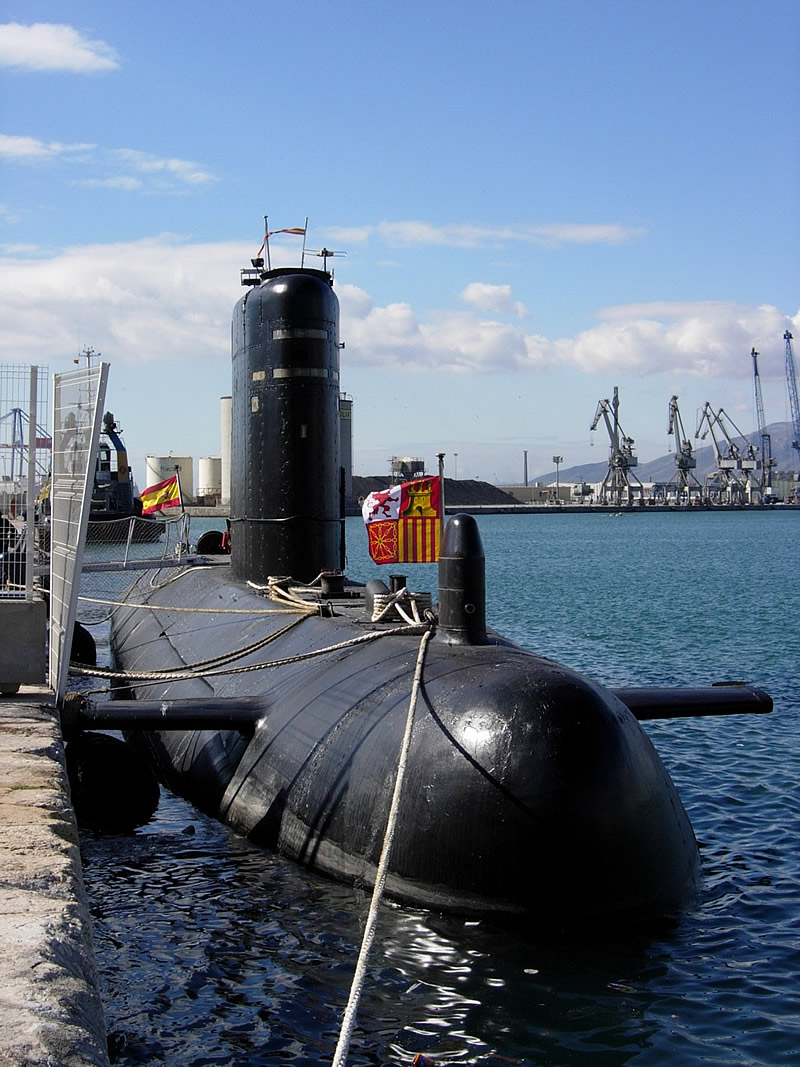
Spain’s existing fleet comprises 3 Galerna (Agosta) Class diesel-electric submarines, delivered from 1983 – 1985. S72 Sirocco was decommissioned in 2012, and the S-80 program’s scheduled 1st delivery in 2015 will make it challenging for Spain to keep its existing fleet in operation long enough.
Spain can’t be accused of poor planning, or lack of foresight. The S-80 program actually had its genesis in 1989, but it wasn’t until 1997 that Spain’s Armada began defining its objectives more clearly. A final project definition contract was signed in 2002, by which time Spanish shipbuilders had already developed the Scorpene Class submarine alongside France’s DCNS, and begun construction for Chile. Scorpene is an advanced SSK design, and can be upgraded to AIM-2000 configuration by adding MESMA Air-Independent Propulsion (AIP) systems alongside their diesel-electric drives.
(click to view full)
Spain decided not to adopt the Scorpene class, however, and in March 2004, a contract was signed with IZAR (now Navantia) to build 4 S-80 submarines. As of August 2011, El Pais pegs the program’s budget at EUR 2.136 billion.
Initial delivery was supposed to take place in 2011, with all 4 submarines operational by 2011-2014. At present, however, the first-of-class S81 isn’t expected until 2015-2017, depending on how long it takes to work out some issues with weight. The 4th boat was scheduled to arrive in 2018-2019, but it’s almost certain to be late. If and when the submarines do arrive, they will be named:
* S81 Isaac Peral. One of the 1st people to build and test a military submarine.
* S82 Narciso Monturiol. He invented the 1st combustion engine-driven submarine, Inctineo, in 1859.
* S83 Cosme Garcia. Invented a submersible, Garcibuzo, in 1859.
* S84 Mateo Garcia de los Reyes. Commanded the Armada’s 1st submarine, the original Narciso Monturiol (A-1), in 1917.
A second batch of S-80 submarines may be ordered after 2014, which would bring Spain’s total to 8, but that country’s deep fiscal woes have left it with a 2011 defense budget of just EUR 7 billion, against about EUR 35 billion as the estimated cost of about 19 key modernization programs over time. Since procurement is just a minority share of the defense budget, the math isn’t promising for a Spanish follow-on buy.
The S-80 Submarines
(click to view full)
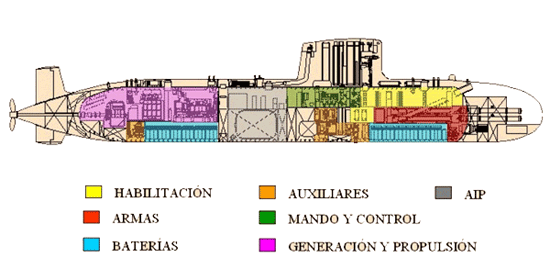
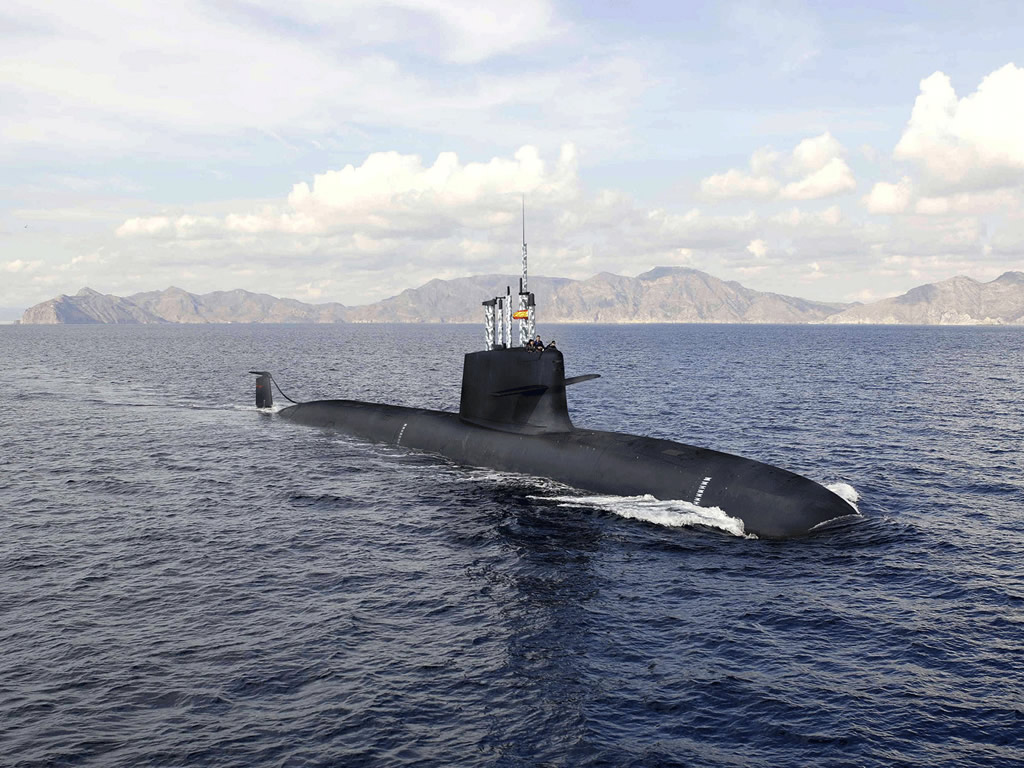
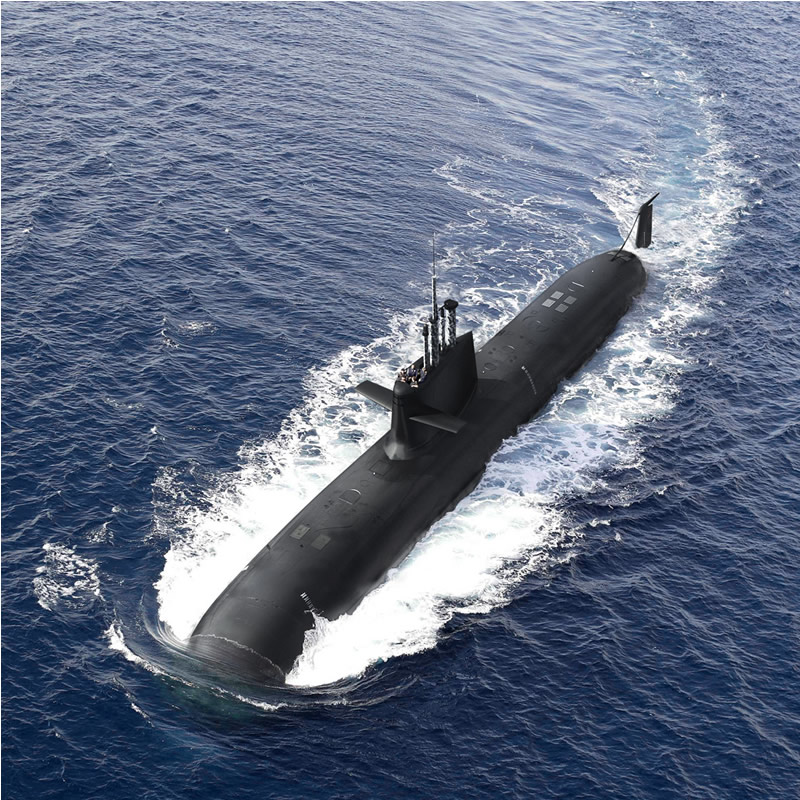
Spain’s S-80 submarines will be an entirely new and larger ship class that builds upon Navantia’s recent submarine experience, rather than a modified version of the more well-known AIM 2000 Scorpene AIP boats. It will share some key technology developments, however, including Air-Independent Propulsion.
AIP changes the parameters for diesel-electric submarines. As an example, a standard CM-2000 Scorpene can operate underwater for 4-6 days, without surfacing or snorkeling to get oxygen to recharge its batteries. Once it does that, of course, it becomes much more vulnerable to detection by planes, surface radars, etc. In contrast, an AIM-2000 Scorpene AIP is able to operate underwater for up to 18 days, depending on variables like speed, etc. Each Scorpene AIP system costs around $50-60 million, and adds a new 8.3 meter (27 foot), 305 tonne hull section to a Scorpene Class submarine.
AIP won’t be optional on the S-80, it will be an integral feature that’s built in from the start.
S-80 Specifications
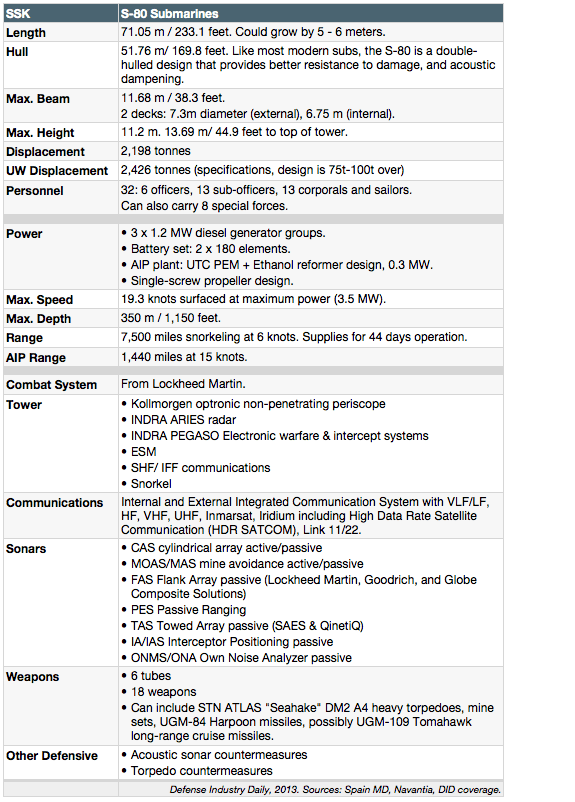
The Spanish Armada lists the S-80’s intended displacement as 2,400t, far larger than the 1,870t AM-2000 Scorpene with AIP. They’re quite similar in length, at 70.5 vs. 70m, but Navantia and the Spanish government list the S-80 as rather wider than the Scorpene: 7.3 meters, vs. 6.2 meters for the AIM-2000. Size improves submarine capacity in a number of ways, and larger boats are often seen as having a greater range of action. That isn’t always true, however, so it’s important to compare published statistics.
Spain is having a big problem with S-80 specifications, on 2 fronts. One is that the Armada keeps adding to, or changing, existing specifications. The 2nd, related problem is that the design is now about 100 tonnes overweight. That has to be fixed, and the fix will add both time and money to the program.
There are persistent reports that Spain’s S-80s will deploy UGM-109 Tomahawk sea-launched land attack cruise missiles, in addition to their usual armament. The Spanish Armada site includes a land attack role for the subs as one of the desired capabilities, and the S-80 Class’ increased size and Lockheed-led combat system should make it possible to add Tactical Tomahawks without a lot of fuss or compromise. First, Spain has to own some. Tomahawk missiles could also be deployed on Spain’s F100 Alvaro de Bazan Class AEGIS frigates, for instance, which already have the Mk.41 vertical launching system and AEGIS combat system to accommodate them. So far, the Spanish government has been very reticent about its plans to buy or use these weapons.
S-80: Industrial Team
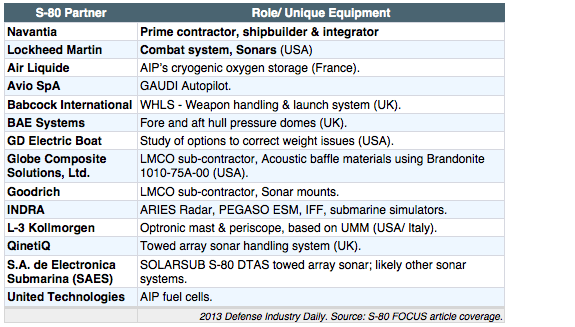
One of the most interesting trends to observe as one watches the Spanish contracts being issued is the consistent choice of equipment: a UTC AIP instead of the French MESMA, a Lockheed combat system instead of the SUBTICS from France’s Thales/Armaris, etc. These choices serve to clearly differentiate the S-80 from DCNS’ AIM/CM-2000 Scorpenes, while also minimizing avenues for retaliation by French companies.
As a side benefit, these choices also position the S-80 as an option for countries that prefer American naval weapons and technologies. If Navantia wants to extend its production line, it will probably need to rely on exports. Since the USA doesn’t make diesel-electric submarines, Navantia can step in with a competitive offering for the export market. Navantia’s 2011 Memorandum of Understanding with Lockheed Martin MS2 is part of that push.
Nor is the USA Spain’s only industrial partner. Several British firms have also become involved, which leverages technologies developed for the Royal Navy’s all-nuclear submarine fleet.
S-80 Submarines: Contracts & Events
2011 – 2013
Subs named; Overweight design creates costs & delays; Navantia calls on US for help; Sub-contractors; Export MoU with Lockheed; Australia offers a possible opportunity – until the government decides not to hold a competition.
(click to view full)
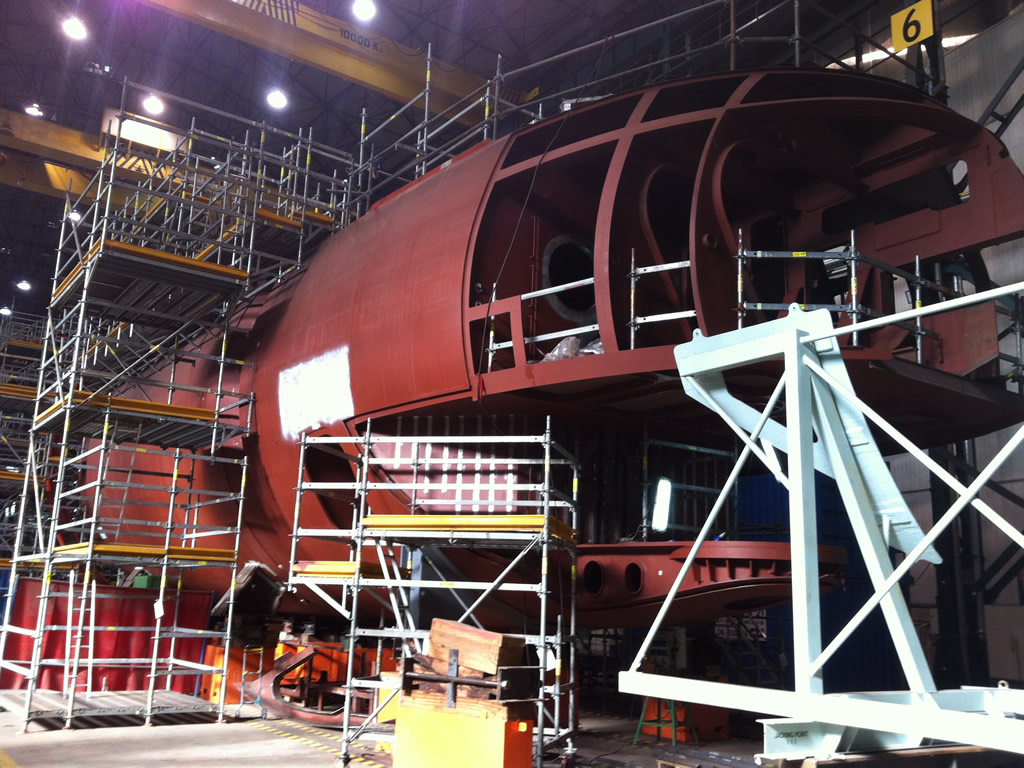
Unless otherwise noted, contracts are from the Spanish Armada (Navy), either directly to Spanish shipbuilder Navantia, or through Navantia as the prime contractor and integrator if issued to other firms.
May 24/14: S-70 LEX. Spain is forced to extend the operational life of its S-70 Agosta Class boat Tramonta, because the S-80 submarine Issac Peral isn’t expected until 2018 now. The cost of S74 Tramonta’s refit has risen from EUR 30 million to EUR 42.9 million after the last budget, in order to extend the boat’s life to compensate for the S-80 program’s 5-year delay.
Spain’s entire budget is under huge pressure, but they didn’t have much choice with this. The Agosta Class submarines S71 Galerna reportedly has just 2 years of safe service life left, and Spain needs to have at least 2 submarines in its fleet to meet NATO commitments in the Mediterranean. The current plan is to keep S73 Mistral in service, and use S74 Tramonta’s enhanced servicing overhaul to ensure that she is the 2nd boat.
On the other hand, El Confidencial also reports that Spain won’t increase the S-80’s EUR 2.136 billion budget to deal with its weight issues and delays. Even though changing specifications from the Navy may be partly to blame. That could end up cutting the S-80 program to 3 boats. Sources: El Confidencial, “El retraso del S-80 obliga a invertir 43 M€ para mantener un submarino con 29 anos”.
April 15/14: US help. Spain is asking for more American help to fix its S-80s:
“[Spanish Secretary of State for Defense Pedro] Arguelles asked the U.S. for “continued cooperation,” with S-80 builder Navantia to “resolve a technological [rough] patch,” in the program…. Last week, Navantia told Jane’s the problem with the submarine should be solved by June [2014], “when it expects to be able to release details about the extent of the redesign, the time needed to sort it out, and the extra costs involved.”
If they’re asking for continued help at this juncture, is the June date in jeopardy? Sources: USNI, “Spain Asks U.S. for More Help to Fix Flawed Sub”.
Jan 20/14: Delays. Spanish paper El Confidencial reports that S81 Issac Peral won’t be operational until 2018. Apparently, the dates bandied about in meetings between Navantia and the government keep on getting later, with about 4 more years of design, testing, and training left to go before the sub can be operational.
As a result, Spain will have to approve additional funds to keep 2 Agosta Class boats in service until 2018 at least. If the S-80’s program budget can’t be increased, Spain may also have to cut 1 submarine from the build plan. Sources: El Confidencial, “El ‘exceso de peso’ del submarino S-80 retrasara la primera unidad hasta 2018”.
July 26/13: Paying the bill. The Spanish government approves an extra EUR 877.33 million (about $1.165 billion) in their 2013 budget, in order to finance payments that have come due on several major weapons programs. At the same time, in order to finance investments in their troubled S-80 submarine program, and purchases of their Pizarro (ASCOD) tracked IFVs, they will be cutting other programs.
The A400M aerial transport contract doesn’t allow Spain to cancel deliveries, but the government has officially decided to take delivery of the last 13 planes in “austere” condition, with few mission options, and then sell them on the second-hand market. They also intend to look for a way to reduce their planned buy of 45 NH90-TTH medium helicopters to just 22, while selling 6 of their 24 Tiger HAD/HAD-E attack helicopters, and reducing the number of serving Leopard 2A6E tanks from 190 to 116. Sources: Defense-Aerospace | Publico [in Spanish].
June 5/13: US help. The Spanish government has given General Dynamics Electric Boat in Groton, CT a $14 million contract over 3 years for assessments of the S-80 submarine program, and the scope of the work that would be required to correct its weight programs.
The Strategic Study Group’s Rafael Bardaji, who was recently director of the Spanish MdD’s Office of Strategic Assessment, said that the default preference is to extend the hull’s length by 5-6 meters (EUR 37.5 – 45 million per boat). AP.
May 19-20/13: Sinking feeling. Spanish media report that the S-80 design has a buoyancy problem, because it’s 75 – 100 tonnes overweight. According to EL Mundo, EUR 530 million had been spent on the design contract before Navantia’s own engineers flagged the issue. Worse, the S-81 Issac Persal was mostly complete when the problem was discovered. Resolution reportedly requires either removing weight, or lengthening the submarine at a cost of about EUR 7.5 million per meter.
Working through the issue is expected to delay deliveries by 12 – 24 months, which would push 1st delivery back to 2016 – 2017, instead of 2011 as originally promised.
At the same time, the reports stumble on an even more important issue for the submarines: a lot of re-work and improvisation, because the Ministry of Defence keeps adding new requirements. That kind of thing is obviously harmful to schedule and budgets, but it can also lead to serious technical issues. Added weight for each new feature, for instance, which compounds over time. Spain’s The Local | El Pais [in Spanish].
Buoyancy problem
May 2/13: Australia out. The Labor government’s 2013 defense white paper rejects the safer and quicker options of buying or modifying an existing class from abroad. Instead, they’ll focus on options #3 & 4: an evolved design of the Collins Class, or a completely new Australian design. It isn’t really a loss for the S-80; rather, Australia decided not to have a competition. Read “Australia’s Next-Generation Submarines” for full coverage.
June 30/12: Spain withdraws its S-70/ Agosta Class submarine Siroco from service during a ceremony at the Military Arsenal in Cartagena, leaving just 3.
The submarine was initially commissioned on Dec 12/83, and was actually Spain’s 2nd Agosta Class submarine. She has spent more than 2,300 days at sea including more than 33,000 hours underwater. That matters, because the cycle of dive compression and surfaced release eventually fatigues submarine hulls past their margin of safety. Sources: Murica Today, “The last crew say farewell to the Siroco in Cartagena”.
S-70 Siroco retired
Dec 12/12: Sub-contractors. Spain SAES announces delivery of the 2nd SOLARSUB S-80 DTAS towed array sonar to the Spanish Navy.
SOLARSUB S-80 DTAS has 3 sub-systems: the Digital Towed Antenna Unit (UAR) with its hydrophones, Signal Conditioner Unit (UAS) for filtering, amplifying and equalizing the UAR’s digital signals, and an Operator Console Unit (UCO) for processing and viewing. The system uses very low frequencies, and includes features like advanced beamforming, triangulation between DTAS and the Cylindrical Array or Flank Array sonars, etc. SAES.
July 31/12: Sub-contractors. Babcock announces that it has delivered its WHLS (weapons handling and loading system) for the 1st Spanish submarine, S-81 Issac Peral. The WHLS and its combat system interfaces were developed under a 2006 contract, in order to handle the complicated task of loading, moving, and readying large weapons like heavy torpedoes, missiles, mines, etc. within the confined space of a submarine.
Babcock’s Weapons Handling Equipment (WHE) sub-system uses a semi-automated and modular approach. Unusual features include includes a tilting centerline lift that accepts weapons directly from outside the submarine, stowages with a semi-automated ‘paired release’ system for mine loading, and proximity sensors to aid in self-diagnosis of electrical and hydraulic systems.
The WHE will now be installed by Navantia in Section 5. Once the submarine sections have been welded together, system installation including electrical and hydraulic connections can be completed for re-testing. The major elements of the torpedo tubes and launch system have already been delivered, and are subject to their own installation.
Jan 31/12: Naming. Spain’s Armada names its 4 contracted S-80 submarines, under Ministerial order 100/01194/2012. The submarines will be: S81 Isaac Peral, S82 Narciso Monturiol, S-83 Cosme Garcia, and S-84 Mateo Garcia de los Reyes.
Isaac Peral was one of the first people in the world to build and test a military submarine. Narciso Monturiol invented the first combustion engine-driven submarine, Inctineo, in 1859. That same year, Cosme Garcia invented the submersible Garcibuzo. Mateo Garcia de los Reyes commanded the Armada’s first submarine, the original Narciso Monturiol (A-1), in 1917. Infodefensa.
Namings
Dec 13/11: Australia, again? Australia’s DoD releases RAND’s requested report of lessons learned from US, UK, and Australian submarine programs, and discusses the class options they’re investigating to replace their troubled Collins Class. They have issues RFIs to France’s DCNS (Scorpene), Germany’s TKMS HDW (Type 214), and Australia’s biggest shipbuilding partner, Spain’s Navantia (S-80). TKMS’ Swedish Kockums subsidiary, who worked with Australia to design the Collins Class, didn’t see its developmental A26 Class make the list.
Navantia is Australia’s biggest shipbuilding partner by far, with billions of dollars in work to build the core of the future RAN: Hobart Class air defense destroyers, and Canberra Class LHD amphibious aviation ships. The Australian government’s release refers to the discussions and agreement with the USA at AUSMIN 2010, regarding Australian-United States cooperation on submarine systems, which “will extend into future submarine acquisition program.” That could add one more advantage to Navantia, whose S-80 uses a number of American technologies. Australia DoD | RAND Report.
Nov 7/11: Delays. Jane’s Defense & Security Intelligence & Analysis reports that funding cuts will delay the S-80 type’s initial fielding by about 2 years, to 2015. At present, the other 3 boats are still expected to follow at 1-year intervals.
Three consecutive years of budget cuts have also affected Spain’s existing submarine program. Jane’s adds that work on a major life extension refit of SPS Galerna [S 71] had to stop for several months as Navantia waited for a payment guarantee.
Oct 26/11: Export MoU. Lockheed Martin MS2 and Navantia meet to deepen export collaboration, which includes “new generation” submarine programs and opportunities:
“Fruto del MoU que ambas empresas tienen en vigor, los dos ejecutivos han profundizado en su colaboracion de cara a los programas de fragatas en marcha para Brasil y otras oportunidades significativas, asi como potenciales programas a nivel internacional para submarinos de nueva generacion.”
Sources: Navantia | Diario de Cadiz [in Spanish] | Infodefensa [in Spanish].
Navantia – Lockheed MoU
2008 – 2010
Navantia splits from Scorpene project over S-80 disputes; Simulator development; Sub-contractors.

(click to view full)
Nov 12/10: Divorce. The tensions created by Spain’s pursuit of the S-80 project have finally led to full divorce between Navantia and DCNS.
“DCNS and Navantia have put an end to their disagreement concerning their submarine collaboration. As a result, the arbitration procedure between them will be terminated. Scorpene submarines will from now on be built and marketed by DCNS. Similarly, S80 submarines will be built and marketed by Navantia.”
The arbitration in question is an 18-month dispute in French courts, as DCNS accused Navantia of plagiarizing technology from Scorpene to develop their larger S-80. The 2 firms had shared intellectual property rights to the design, though Navantia’s workshare at Cartagena was only about 35%. Aviation Week | Brahmand | Jane’s.
DCNS split
May 25/10: Sub-contractors. BAE Systems is shipping the 2nd set of forward and aft dome assemblies to Navantia, after technical challenges forced a do-over. The first set was delivered in August 2009.
The technical problems were associated with Spanish high tensile steel. Its elasticity makes it hard to form, and welding attempts create cracks unless strict temperature control is achieved. BAE has had to scale the learning curve, and the latest domes were reportedly completed to a redrawn budget and schedule, with “no recordable defects and no dimensional deviations.” North-West Evening Mail.
Feb 18/10: Sub-contractors. Babcock International announces that it has delivered all 6 of the internal slide valve lengths for the S-80’s Weapon Handling and Launch System (WHLS), on schedule. The 6 substantial slide valve lengths handle the flooding of the tubes, and their new design is internal to the tube body instead of being on the outside. That change allows the tubes to be mounted closer together, and Babcock also touts lower initial costs and simplified maintenance.
Manufacture and delivery of the slide valves marks the start of the hardware supply phase for the first-of-class boat. In 2006, Babcock was contracted to design, develop, manufacture and supply the S-80’s WHLS, including mechanical, electrical, electronic, hydraulic, pneumatic and software systems, as well as defining the interfaces with the submarine structure, combat system and weapons. When a submarine commander says “launch,” the WHLS moves into action, sealing the tubes, flooding them, and using rotary air-turbine pumps to launch the torpedo, missile, or mine from the tube. Key features of the S-80’s WHLS include a modular system, and a semi-automated weapon handling and stowage system. The contract is scheduled for completion in 2014.
Nov 12/09: Sub-contractors. Lockheed Martin Undersea Systems announces successful in-water testing of the S-80’s cylindrical array sonar system at the U.S. Navy’s Underwater Test Facility at Seneca Lake, NY. The cylindrical array is the bow-mounted sonar, and the configuration of hydrophones must be optimized for each ship class. Lockheed Martin designed and developed the S-80’s new array under a 2005 contract to provide the submarine’s integrated combat system.
In addition to the cylindrical array sonar, the S-80’s integrated combat system will contain flank array, passive ranging, and mine and obstacle detection sonars. The flank and passive ranging sonars were successfully tested in June 2009, and these are designed, manufactured and assembled in Manassas, VA and Syracuse, NY.
July 16/09: Sub-contractors. Globe Composite Solutions, Ltd. announces a Lockheed Martin contract to supply special acoustic baffle materials for the S-80 submarine hull’s passive ranging sonar and flank array sonars. The baffle panels will use Globe’s Brandonite® 1010-75A-00 composite material, which assists with signature reduction and sonar performance. The acoustic sensors are part of Lockheed Martin’s sub-contract with Navantia for the S-80’s Integrated Combat Management System.
Fabrication and assembly of the composite components will occur at Globe’s Rockland, MA facility, with delivery of the first shipset scheduled for the Q4 2009.
Dec 18/08: Sub-contractors. Goodrich Corp. will supply the Spanish Navy with sonar equipment mounts as part of a contract with Lockheed Martin’s maritime systems and sensors division, who was in turn hired by Navantia to develop the S-80 combat-management system. Goodrich will supply a cylindrical array sonar support structure, and 4 shipsets of passive ranging sonar and flank array sonar fairings. Goodrich | Charlotte Business Journal.
Dec 12/08: Training. Indra will cooperate with Navantia in the development of a simulator to train S-80 submarine crews. As recent events involving Russia’s Nerpa SSN illustrate, submarines have very little margin for error. Rapid, correct reaction is all that stands between safety and tragedy if anything goes wrong underwater.
The EUR 9 million contract will install the simulator in a specific building within Cartagena’s Submarine School. The equipment will be an exact and natural-sized replica of the control room’s portside, with equipment and parts that are identical to that of the submarine and can reproduce key behaviors. The simulator is used to reproduce various incidents, breakdowns and emergency situations that are likely to occur during a mission.
Indra has a simulator business, but this is the first time Indra has designed a training system for a submarine. The simulator is expected to begin operations in 2011. Indra is also responsible for EUR 24 million in contracts that cover the S-80 class’ radar, electronic defense, and the friend/foe identification systems. Indra release.
Feb 22/08: India. Infodefensa relays a Negocios newspaper report [in Spanish] that Navantia has submitted its S-80 Class currently under development for Spain, in response to an Indian Navy RFP for a follow-on submarine purchase. The purchase would follow India’s 2005 contract for 6 Scorpene Class submarines, and is expected to allocate almost EUR 3 million (about $4.5 billion) to buy another 6 submarines.
Infodefensa adds that bids for the follow-on contract have also been submitted by France’s DCNS (likely the Scorpene AIM-2000, or possibly the in-development Marlin Class), Russia’s Rubin (Advanced Kilo Class), and Germany’s HDW (likely the Type 214).
Feb 4/08: Sub-contractors. QinetiQ’s Underwater Systems business in Winfrith, Dorset announces a “multi-million Euro” contract for 4 Towed Array Handling Systems (TAHS), to be used with Spain’s new S-80 class of submarines. Towed sonar arrays are a good way for a submarine to extend its acoustic baseline, improving its ability to detect and find ships, submarines et. al. at greater distances and with greater accuracy.
The TAHS contract was reportedly won against “strong international competition.” Its chief virtues are said to include compactness and its electric drive system as opposed to a traditional hydraulic drive. It will be part of the Cartagena-based Sociedad Anonima Electronica Submarina’s (SAES) towed array sonar, and in compliance with Spanish industrial offset requirements, a significant amount of the manufacturing and integration will be undertaken by Spanish companies under sub-contract to QinetiQ. The units will be delivered between 2010 and 2012. QinetiQ release.
1997 – 2007
From initial assessments to the contract for 4 boats; Keel-laying for 1st sub; Sub-contractors; Strains in Navantia’s DCNS partnership.
(click to view full)
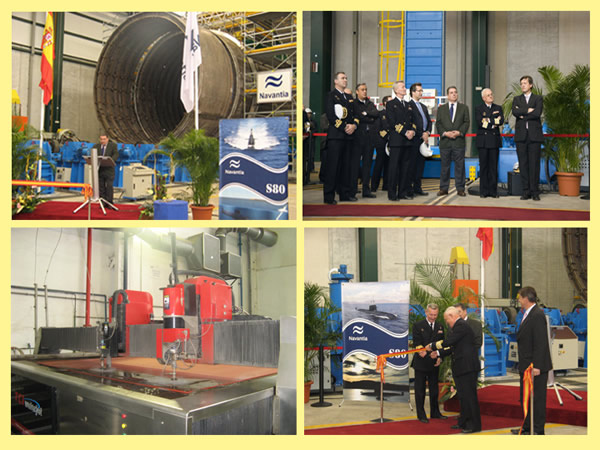
Dec 13/07: Spanish Navy Admiral Sanjurjo Jul, Director of Naval Constructions, and Juan Pedro Gomez Jaen, CEO of Navantia, preside over ceremonies to lay the first submarine’s keel [S-81], and cut the first steel for the second S-80 submarine [S-82].
Keel-laying
May 2/07: Sub-contractors. In its first submarine export order in more than 20 years, BAE Systems Submarine Solutions will fabricate and assemble fore and aft pressure hull domes for Spain’s 4 S-80 submarines in its Barrow-in-Furness shipyard, under the terms of the “multi million-pound agreement.” BAE Systems Submarine Solutions has already begun work on the contract for Navantia, and the first 2 boat sets will be fully welded and completed in Barrow. The last two will be partly assembled and welded in Barrow, with final welding set to take place in Navantia’s facilities in Cartagena, Spain with support from BAE Systems Solutions as required.
A nuclear submarine maker who isn’t about to introduce competing diesel-electric class boats of its own would appear to be a perfect partner for Navantia. Meanwhile, Navantia positions itself to pick up any future diesel-electric orders from Britain, and gains access to BAE’s global marketing network for the S-80.
Nov 1/06: Breaking the Scorpene partnership? Jane’s Navy International reports that “The partnership forged by French naval shipbuilding and systems group DCN and its Spanish counterpart Navantia in the conventional submarine export market looks set to break apart as the two companies look to further their rival international ambitions. Despite securing 10 orders for variants of their jointly-developed Scorpene design over the past nine years, a growing schism has emerged at corporate level as the two partners seek to bring their respective Marlin and S-80A designs to the market.”
Aug 8/06: Sub-contractors. Kollmorgen Electro-Optical and its Italian subsidiary, Calzoni Srl in Bologna, Italy, announce a $78.3 million contract. They will provide non-penetrating optronic periscopes and imaging systems and hoistable masts for the Spanish Armada’s new S-80 submarines.
The hoisting masts are based on the highly successful Universal Modular Mast utilized by the US Navy on their SSN-774 Virginia Class. Kollmorgen was the first firm to develop and deploy non-hull penetrating optronic imaging systems, while Calzoni will provide state of the art hoistable masts which raise and lower submarine sensors including radar, electronic surveillance and communication antennae, periscopes and optronic sensors.
July 27/06: Sub-contractors. Avio SpA will supply its GAUDI (Guidance Automation Unit Distributed Intelligence) autopilot system to the S-80 program, for an undisclosed amount. Avio will collaborate with Navantia’s Faba electronics division, who also has extensive experience in control system design and construction.
July 24/06: Sub-contractors. Indra announces receipt of a EUR 24.2 million contract for the development and introduction of radars, defense electronic systems, and Friend-Foe identification systems (IFF) in S-80 submarines.
* The radars will be based on the Aries systems developed by Indra and which are currently operative in surface ships. These radars are low probability of interception type (LPI) and will also perform exploration tasks. The contract includes adapting the Aries systems to submarine platforms, and installing them in the 4 Scorpene S-80 submarines.
* The Friend-Foe identification systems will incorporate the new NATO identification mode 5 whose main function will be self-identification under any interrogation signal request to create reliable recognition among allies.
* Indra’s modular Pegaso defense electronic systems will enable them to detect, analyze, identify and issue warnings about possible threats through radar signals and communications intercepts.
July 19/06: Sub-contractors. United Technologies Inc. subsidiary UTC Power announces that its UTC Fuel Cells unit will design and develop a 300 kW proton exchange membrane (PEM) fuel cell power module for the Spanish shipbuilder Navantia, S.A., for use in the Spanish Navy’s new S-80 Scorpene submarines as part of their Air-Independent Propulsion (AIP) system. The 300 kW PEM fuel cell will be designed to operate on reformed ethanol and pure oxygen. According to an AP report, the company says it will take about five years to design and produce the system, which could result in about 80 jobs at UTC Power.
July 27/05: Thales SUBTICS out, Lockheed in. Reuters reports that Spain’s Defence Ministry has chosen Lockheed Martin Corp. to supply combat systems for its S-80 in preference to Thales’ SUBTICS. They passed on a report from El Pais, which stated that the Lockheed contract was worth around EUR 200 million, adding laconically that “Ministry spokesmen were unable to confirm that.” They also noted this snippet on the Ministry’s web site, which said that “This decision… guarantees technology transfers from Lockheed Martin to Navantia, which will allow the Spanish shipyards to improve their future commercial prospects in the world submarine market.” Which seems to be an accurate translation of the release we found at the MDE.
Lockheed would eventually announce the win in a Jan 4/06 release, noting the benefits its open architecture approach to the combat systems on the U.S. Navy’s SSN-774 Virginia, SSN-21 Seawolf and SSN-688 Los Angeles Class submarines. For the S-80A submarines, Lockheed Martin said they would “support a Spanish industry design and develop the core combat system as a technology partner using experience gained over the last 40 years…”
March 2004: Contract for IZAR to build 4 S-80 Submarines. Shipbuilding is to start by January 2005, with the 1st submarine to be delivered in October 2011, and all submarines delivered by 2014.
Subsequent events would see the keel laid on S-81 in December 2007, and delivery of the 1st submarine isn’t expected until 2015.
Contract for 4
September 2003: The Spanish Council of Ministers gives the go-ahead for Spanish production of S-80 submarines. The S-80 program had reported values from EUR 1.75 – 2.1 billion
November 2002: A 2nd stage Project Definition contract is signed with IZAR, in order to implement the new requirements from the 1st stage. Source.
Nov 2/99: A 1st stage Project Definition contract is signed between IZAR Shipyards in Cartagena and Spain’s DAM for the definition of a submarine prototype. Source.
April 1998: Pre-feasibility stage resulting in the document “Staff Objectives.” Source.
November 1997: Assessment of operational requirements resulting in the “Preliminary Concept of Staff Objectives.” Source.
Additional Readings & Sources
Many thanks to DID reader Pedro Lucio, who put the S-80’s initial profile together based on his research into English and Spanish language sites. DID has continued to update this information. Corrections are welcome, and should be sent to tips, over here @defenseindustrydaily.com.
* Spanish Armada – El Futuro: Serie S-80. En Espanol, of course.
* Navantia – “S-80” Submarine fact sheet [PDF]
* El Pais (Aug 12/11) – Defensa renegocia una deuda de 26.000 millones que no puede pagar. Spain’s military modernization budget needs to rise sharply, but its economy isn’t doing that. Which could mean trouble for many programs.
* US Dept. of State Report on Spain’s Military & Defense Sector, 2004. We included it because it’s very interesting, and adds helpful overall background re: the larger context for the S-80 program and many of the firms in it.
* Seapower Magazine (June 2003) – International Seapower/ Spain Requests Tomahawks For Destroyers and Submarines. Includes some details re: the S-80 program, though some of their details conflict with other reports. A November 2003 report pegs the S-80’s displacement at 2,345t.