


(click to view full)
Australia’s AIR 9000, Phase 8 project aimed to buy 24 modern naval helicopters to 16 existing S-70B-2 Seahawks, along with the disastrous A$1.1 billion, 11-helicopter SH-2G “Super Seasprite” acquisition attempt. With a total sales and support value of over A$ 3 billion, it was a highly coveted award.
The finalists were familiar, and both had roots in Australia. Sikorsky’s MH-60R is a modernized descendant of the RAN’s existing S-70B anti-submarine helicopters, and Australia’s army operates the S-70A utility helicopter. On the other hand, a multi-billion dollar 2006 order made the European NH90-TTH (“MRH-90”) the Army’s future helicopter, and some MRH-90s will even serve as Navy utility helicopters. NHI/Eurocopter’s NH90-NFH naval variant builds on that base. So why did the MH-60R make Australia its 1st export win?
Australia’s Winner
[youtube:http://www.youtube.com/watch?v=2SHArQEV3iU]
click for video
A combination of problems with its “MRH-90s,” slow NH90 TTH development, MH-60R naval interoperability benefits with Australia’s principal ally, and the MH-60R’s low-risk already-operational status tipped the balance. Australia’s MH-60Rs will be entirely standard US Navy designs; the only differences will be their paint scheme, and the addition of tamper-proofing to 4 avionics boxes that are considered “sensitive.” Australia’s DoD states that the fleet of 24 will:
“…provide at least eight warships with a combat helicopter at the same time, including ANZAC Class frigates [8 bought] and the new Air Warfare Destroyers [3 bought]. The remainder will be based at HMAS Albatross in Nowra, New South Wales, and will be in various stages of the regular maintenance and training cycle.”
There’s a regular cycle of ship maintenance and training, as well as deployments, which means Australia never has all of these ships at sea at one time. The helicopters can rotate among ships as they enter training & service stages, allowing full coverage with some helicopters left over. Unless the 4-ship Improved Adelaide Class is added to this mix, however, the decision as discussed does raise the question of how to equip Australia’s expensively-upgraded FFG-7 frigates with naval helicopters. One option may involve some sort of service-extension program for the existing S-70B-2s, whether through refurbishment, or by rotating a larger pool of S-70Bs among a small set of operational ships.
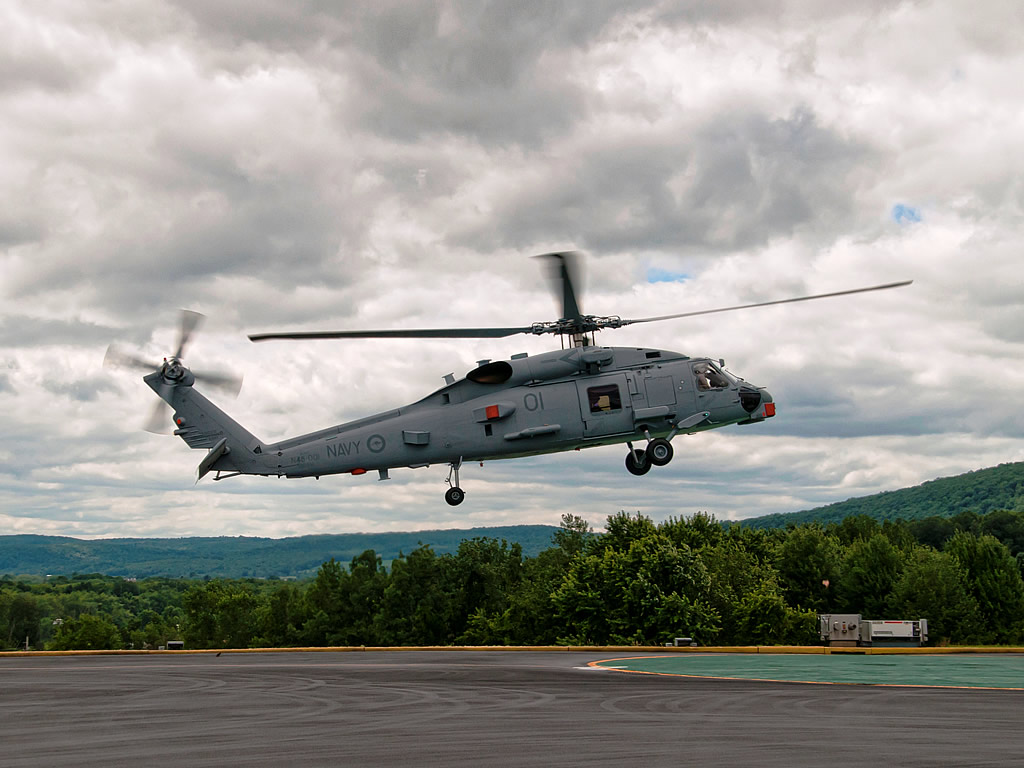
The RAN currently has 4 MH-60Rs flying as RAN 725 Squadron, alongside 3 full US Navy MH-60R squadrons in Jacksonville, FL. Australian crews and maintenance personnel are trained in operations and tactics there, until they return to Australia with their machines at the end of 2014. They’ll become the training squadron at the air station in Nowra, New South Wales, and Initial Operational Capability for the Royal Australian Navy as a whole is scheduled for August 2015.
Deliveries to Australia will continue until 2016. The larger RAN 816 Squadron will fly the MH-60Rs from Australian ships, while using Nowra, NSW as its home base.
Contracts & Key Events
2014 – 2024
[youtube:v=zn64qpK-hwo]
October 24/22: Unique Configuration Lockheed won a $49.6 million modification, which provides non-recurring engineering and add/delete efforts to bring 12 MH-60R aircraft from standard Foreign Military Sales configuration to a unique configuration for the government of Australia. Additionally, this modification procures 12 Australian unique modification one kits and 10 embedded Global Positioning System Inertial Navigation Systems spares. Work will take place in New York, Connecticut and Alabama. Expected completion will be in December 2026.
May 11/22: 12 More Australia has announced plans to acquire 12 more MH-60R naval helicopters and 29 AH-64E attack helicopters. The MH-60R contract will include a 13th aircraft to replace one that was lost in 2021. All will be based at HMAS Albatross. Boeing says it welcomes Australia’s decision as the AH-64E Apache provides Australia with a low-risk, fully-integrated, battle-proven capability.
October 11/21: DoS Clearance Australia has been given clearance by the US State Department to purchase 12 MH-60R naval helicopters. The Defense Security Cooperation Agency says in Transmittal No 21-61 that the Foreign Military Sales package is worth up to $985 million.
July 5/21: FMC Lockheed Martin won a $28.2 million contract modification, which exercises an option to procure mission computers (MC) and flight management computers (FMC) retrofit kits to upgrade the MH-60R/S aircraft. The quantities are as follows: 205 Generation 3i/5i MCs to upgrade from Generation III/V/VI, to include 187 for the Navy, nine for the government of Australia, five for the government of Saudi Arabia and four for the government of Denmark; 200 Generation 3i/5i FMCs to upgrade from Generation III/V FMCs, to include 182 for the Navy, nine for the government of Australia, five for the government of Saudi Arabia and four for the government of Denmark. Additionally, this modification procures 153 wiring kits to include 136 for the Navy, nine for the government of Australia, four for the government of Denmark, and four for the government of Saudi Arabia. Work will take place in New York and Florida. Estimated completion will be in March 2024.
July 2/20: Computers Lockheed Martin won a $12.9 million delivery order, which provides for the production and delivery of 62 Audio Management Computer-Lite computers to be used as spares in the MH-60R Seahawk helicopter in support of the Naval Supply Systems Command, the government Australia and Saudi Arabia and to support the development of the Operation Test Program Set for the Navy. Additionally, this order provides for the production and delivery of 33 flight management computers for installation on the Navy MH-60 Seahawk helicopter and 50 SP-103E circuit cards for retrofit computer upgrades. MH-60R Seahawk is a multi-mission helicopter manufactured by Sikorsky Aircraft. It is considered to be the world’s most advanced maritime helicopter. The helicopter is equipped for a range of missions, including anti-submarine warfare (ASW), anti-surface warfare (ASuW), search-and-rescue (SAR), naval gunfire support (NGFS), surveillance, communications relay, logistics support and personnel transfer, and vertical replenishment. Work will take place in New York and expected completion will be by August 2023.
June 3/20: Retrofits Lockheed Martin won a $37.8 million order, which provides for retrofits from the Generation III, V and VI Mission Computer configuration to the Generation 3i and 5i MC configuration on the MH-60R/S Seahawk helicopter (186 for the Navy, seven for the government of Australia, five for the government of Denmark, and two for the government of Saudi Arabia). MH-60R Seahawk is a multi-mission helicopter manufactured by Sikorsky Aircraft. The rotorcraft replaces the SH-60B and SH-60F helicopters in the US Navy’s fleet and combines the capabilities of these aircraft. The MH-60R is also referred to as ‘Romeo’. The helo is equipped for a range of missions, including anti-submarine warfare, anti-surface warfare, search-and-rescue, naval gunfire support, surveillance, communications relay, logistics support and personnel transfer, and vertical replenishment. Work will take place in New York and Florida. Estimated completion date is in May, 2023.
April 10/20: LHD Trials First-of-class flight trials for Royal Australian Navy’s (RAN’s) MH-60R ‘Romeo‘ maritime multirole helicopters aboard landing helicopter dock (LHD) vessel HMAS Adelaide will begin shortly, the RAN announced on April 7. The trials, which will take place off the Queensland coast, will determine the safe operating limits of the Lockheed Martin-made anti-submarine- and anti-surface warfare-capable helicopters aboard the 27,500 tonne LHD in a range of sea states and wind speeds at both day and night. They will also include aviation facilities assessments, equipment calibration, and evaluation of the interface between a particular helicopter type and class of ship.
February 4/20: Maintenance Lockheed Martin won a $185.9 million contract, which provides program management, various levels of maintenance, training and logistics support to sustain the operational capability of 24 Royal Australian Navy MH-60 Romeo aircraft. The Australian Navy became the second operator of of the MH-60R Romeo helicopter in 2013. Its acquisition program was structured in such a way to allow it to have a say on what new capabilities are added. The Australian MH-60R is equipped with a highly sophisticated combat systems designed to employ Hellfire air-to-surface missiles and the Mark 54 anti-submarine torpedo. The primary missions of the Romeo is anti-submarine warfare and anti-surface warfare. Secondary missions include search and rescue, logistics support, personnel transport and medical evacuation. Lockheed Martin will perform work in Australia as well a New York, Connecticut and Florida. Estimated completion will be in January 2024.
December 7/17: Final Flight The last S-70B-2 Seahawk operated by the Royal Australian Navy has flown its last flight as the service completes its transition to the Sikorsky MH-60R. 24 models of the new anti-submarine and anti-surface warfare helicopter have been delivered since 2014 and are operated by the 725 Sqn from Nowra, New South Wales. The last Seahawk was flown to the Australian War Memorial in Canberra, where it will be preserved. The departing model was used during operations in the Middle East from the 1990-1991 Gulf War onwards.
August 3/16: Australia has taken delivery of their last MH-60R Seahawk helicopter from manufacturer Lockheed Martin. Replacing the older S-70B-2 Seahawks, the MH-60Rs now complete a requirement for a fleet of 24 next-generation, multi-role naval combat aircraft. The cost of the replacement is believed to be in excess of $2.2 billion.
July 30/14: Testing & Deliveries. The Australians fire their 1st Hellfire missile from the new helicopter, and also update their delivery status and plans.
The RAN has 4 MH-60Rs; the first pair were accepted in the United States in December 2013, and the second pair were accepted in February 2014. They’re currently flying as RAN 725 Squadron, alongside 3 full US Navy MH-60R squadrons in Jacksonville, FL. Australian crews and maintenance personnel are trained in operations and tactics there, until they return to Australia with their machines at the end of 2014. They’ll become the training squadron at the air station in Nowra, New South Wales, and deliveries to Australia will continue until 2016. The larger RAN 816 Squadron will fly the MH-60Rs from Australian ships, while using Nowra as its home base. Sources: Australia DoD, “Hellfire missile firing a first for new Navy helicopters”.
May 13/14: Sensors. Australia’s new MH-60Rs of NUSQN 725 “commence dipping operations” with the new AQS-22 ALFS sonar off of Jacksonville, FL, as part of their training. NUSQN 725 will begin a phased return to the Fleet Air Arm’s home base at HMAS Albatross (Nowra Airport, SSW of Sydney) in October 2014, and current plans involve a full return of all members by Christmas. Sources: RAN Navy Daily, “Romeos packing a new punch”.
March 28/14: Sensors. Lockheed Martin Corp. in Owego, NY receives $13.1 million firm-fixed-price delivery order for 19 radar receiver processors, used in support of Australia’s MH-60R buy.
All funds are committed immediately. Work will be performed at Owego NY (56%) and Syracuse NY (44%), and work is expected to be complete by March 2017. This was a non-competitive requirement in accordance with FAR 6.302.1 by US NAVSUP Weapons System Support in Philadelphia PA (SPRPA1-09-G-002Y).
2013
Support contract Phase 2 awarded; MK-54 torpedo request; 1st helicopters delivered.
(click to view full)
Dec 17/13: ANAO Report. Australia’s National Audit Office releases their 2012-13 Major Projects Report. Overall, the MH-60R program is seen as stable in its early stages, and its truly off-the-shelf nature is expected to keep it that way. The helicopters are arriving earlier than predicted, but basing and support facilities may not be ready in time. As ANAO puts it, “there is no float in the construction program.” The RAN is looking at temporary or shared hangar and administrative facilities, and may operate the initial MH-60Rs in the US to mitigate risk and consolidate training – whose infrastructure may fall behind its own February 2015 target date.
Meanwhile, how many ships will actually be ready to host MH-60Rs once the whole fleet has arrived, in 2016? It may be just 3-4 ships. While Australia’s ship certification baseline is the existing S-70B-2 Seahawk helicopters, there are differences. As such, the 3 new Hobart Class air defense destroyers will have to be modified for MH-60R use, and that won’t happen until their 1st docked servicing program after they enter the fleet. As things stand now, HMAS Hobart won’t even be declared operationally capable by the end of 2016, and the 3rd ship won’t be delivered until 2019. The 8-ship ANZAC frigate Class will be looking to make any required changes during their extensive Anti-Ship Missile Defense upgrade; 6 ships will be ready by the end of 2017, excepting HMAS Perth (already done), and HMAS Arunta (already in progress).
The final point ANAO makes is that overseas travel restrictions have become a problem for the project. People need to attend key engineering, project management and airworthiness activities in the USA, but can’t go. The RAN’s proposed solutions involve videoconferencing and teleconferencing, which doesn’t work especially well from Australia to Jacksonville, FL, and also using “contracted staff to represent overseas rather then ADF or Australian Public Service (APS) staff.” None of that seems like a useful solution to the actual problem.
Dec 16/13: ALFS. Raytheon IDS in Portsmouth, RI receives a maximum $42.6 million sole source, firm-fixed-price contract from the Royal Australian Navy for “the manufacture and delivery” of AN/AQS-22 ALFS dipping sonar systems. Australia has ordered 25 systems already (q.v. Dec 22/11), which is more than enough for installation in each helicopter. Spares? Upgrades? Additional reserve units? Finalized payment? Raytheon’s Dec 20/13 release is uninformative. If the 2 orders are combined, they total $123.4 million.
Work will be performed in Rhode Island, with a February 2017 performance completion date. The US Defense Logistics Agency Aviation in Philadelphia, PA manages this contract, unlike the 2011 contract which was managed by US NAVAIR (SPRPA1-09-G-001Y-5027).
Dec 10/13: Australia accepts the first 2 MH-60R helicopters, at a delivery ceremony in Owego, NY. The expected in-service date remains June 2014. Source: Lockheed Martin, Dec 10/13 release.
Delivery
Nov 5/13: Mods. Lockheed Martin in Owego, NY receives a $10.5 million firm-fixed-price delivery order for electronics modifications, on behalf of Australia. They’ll develop and test system configuration 15 series modifications to the MH-60R’s VHF Omni-directional Range/Instrument Landing System, crash data recorder, and ABS-B Out.
All funds are committed immediately. Work will be performed in Owego, NY, and is expected to be complete in February 2016. US Naval Air Systems Command in Patuxent River, MD manages the contract as Australia’s agent(N00019-09-G-0005, #4092).
Nov 4/13: Sub-contractors. Textron’s AAI Test & Training receives a $1.6 million award to provide Advanced Boresight Equipment for Australia’s MH-60Rs. ABE is a gyro-stabilized, electro-optical angular measurement system designed to align systems on any land, sea or air vehicle before a mission begins. The base system is widely used, but adds platform-specific “personality modules” for customization.
The US Naval Air Warfare Center Aircraft Division at Lakehurst, NJ manages the contract, and deliveries are expected to take place throughout 2014. Sources: Textron Systems, “AAI Test & Training to Provide Advanced Boresight Equipment (ABE) Systems for Royal Australian Navy MH-60R Seahawk Helicopters”.
Aug 30/13: Support. The Sikorsky/ Lockheed Martin “Maritime Helicopter Support Co.” partnership in Trevose, PA receives a 6+ year, $170.4 million firm-fixed-price contract modification for the RAN’s MH-60R Through Life Support program (q.v. Feb 2/12), Phase II. They’ll perform depot level Phased Maintenance Interval, and also handle the corresponding back office services of squadron administrative management of aircraft and support equipment, data and aircraft inventory reporting, and supply chain management. All funds are committed immediately.
MHSCo also performs this kind of work for the US Navy. Work on Australia’s behalf will be performed in Yerriyong, New South Wales, Australia (73%); Owego, NY (15%, LMCO); and Stratford, CT (12%, Sikorsky); and is expected to be complete in December 2019. US Naval Air Systems Command in Patuxent River, MD acts as Australia’s agent (N00019-13-C-4000).
July 24/13: The 1st RAN MH-60R arrives at Lockheed Martin Mission Systems and Training in Owego, NY, to have its digital cockpit and integrated mission systems and sensors installed. Sources: US NAVAIR Aug 7/13 release.
July 10/13: Weapons. The Defense Security Cooperation Agency announces Australia’s formal export request for up to 100 MK-54 All-Up-Round Torpedoes, 13 MK-54 Exercise Sections, 13 MK-54 Exercise Fuel Tanks, 5 Recoverable Exercise Torpedoes, support and test equipment for upgrades to MK 695 Mod 1 capability, plus spare and repair parts, and various forms of US government and contractor support. Raytheon Integrated Defense Systems in Keyport, WA is the contractor, and the DSCA says that:
“Australia will use the MK 54 torpedo on its MH-60R helicopters and intends to use the torpedo on a planned purchase of the P-8A Increment 2 Maritime Patrol and Response aircraft.”
Note that this is Australia’s 2nd request (q.v. Oct 5/10), totaling 300 torpedoes now, which they have begun buying (q.v. Oct 18/12). Australia’s uses Eurotorp’s MU90 as its standard lightweight torpedo, but that weapon isn’t integrated with the MH-60R or the P-8A. Australia decided that they’d rather have 2 separate stocks of lightweight torpedoes, instead of paying to integrate the MU90 on those platforms. The cost implications would require a full study; meanwhile, opponents have their lives complicated by knowing that they need to defeat or avoid 2 different weapon types.
DSCA: 100+ Mk-54s for Australia
June 29/13: The RAN’s 1st MH-60R Seahawk is officially delivered by Sikorsky Aircraft and accepted by the US Navy. At this point, however, it’s just the base airframe. Delivery and flight may have happened 6 months ahead of the original schedule approved by the Australian Government in 2011, but the formal delivery of the helicopter to Australia hasn’t changed, It’s still December 2013. Sources: US NAVAIR Aug 7/13 release.
Officially delivered by Sikorsky Aircraft and accepted by the U.S. Navy on June 29, the Seahawk was flown from Sikorsky’s Stratford, Conn., facility by U.S. Navy pilots to the Lockheed facility to have the digital cockpit and integrated mission systems and sensors installed.
“Delivery and first flight of an Australian MH-60R aircraft in late June occurred only two years after contract signature, some six months ahead of the original schedule approved by the Australian Government in 2011,
May 15/13: Training. The first 2 Australian crew complete NATOPS certification for the MH-60R at NAS Mayport, FL, USA, after extensive experience in the RAN’s S-70B helicopters and a 9-week, 17/7 schedule. The team have a few more weeks to absorb the aircraft’s mission and weapon systems, then they’ll move to USN test squadron HX-21 at NAS Patuxent River, MD to work on testing the Australian configured MH-60R. Initial MH-60R deliveries are still expected by December 2013. RAN.
2012
New umbrella contract for global MH-60R buys; Sub-contracts.

(click to view full)
Dec 19/12: ANAO Report. Australia’s National Audit Office releases their 2011-12 Major Projects Report. Project SEA 9000, Phase 8 has A$ 2.91 billion budgeted. The official In-Service Date (ISD), defined as 2 aircraft in US Navy configuration, is June 2014.
Cited risks include an unapproved Helicopter Aircrew Training System (Project AIR 9000 Phase 7). In addition, staffing and work pressures at Australia’s Defence Support Group have hurt the schedule for the facilities required to house the new helicopters. The schedule has slipped by 12 months vs. its Second Pass baseline, and has become a possible issue for the helicopters’ initial operational capability milestone.
At sea, Australia’s new MH-60R Seahawks won’t achieve full capability until all ANZAC Class frigates are modified for interoperability. Unfortunately, ANAO says that can happen only after each updated ship is accepted into naval service, and a suitable maintenance period for the modifications becomes available. The same issues will be present for Australia’s Hobart Class destroyers. It seems likely that Australia’s S-70B Seahawks will be needed well past their successors’ entry into service.
Oct 18/12: Weapons. Raytheon announces a $45.3 million contract to provide MK 54 lightweight torpedo hardware, test equipment, spares and related services for the US Navy, Australia, and India. It’s exercised as an option under the current umbrella contract, but Raytheon doesn’t release numbers or proportions. Australian buys are almost certainly aimed at their forthcoming MH-60R fleet. Sources: Raytheon Oct 18/12 release.
Aug 3/12: Sensor turrets. Raytheon Co. in McKinney, TX receives a $23.9 million firm-fixed-price contract for 24 Multi-Spectral Targeting systems, which includes purchases for the government of Australia under the Foreign Military Sales (FMS) Case AT-P-SCF.
Work will be performed in McKinney, TX, and is expected to be complete by December 2013. This non-commercial contract was procured and solicited on a sole source basis by the US Naval Surface Warfare Center in Crane, IN, acting as Australia’s FMS agent (N00164-12-G-JQ66).
July 11/12: MH-60Rs under MYP-8 contract? Sikorsky signs an $8.5 billion firm-fixed-price umbrella contract with the US government to buy 653 H-60M, MH-60S, and MH-60R helicopters, with options for up to 263 more that could push the contract as high as $11.7 billion (W58RGZ-12-C-0008). Interestingly, Sikorsky adds that:
“To reach the full baseline value of $8.5 billion, the services are ordering aircraft in the base agreement to be sold via the U.S. Government’s Foreign Military Sales program. These aircraft include Foreign Military Sale (FMS) UH-60M aircraft for several allied countries and MH-60R SEAHAWK anti-submarine and anti-surface warfare helicopters for the Royal Australian Navy… BLACK HAWK and SEAHAWK aircraft deliveries under the new contract will begin this month.”
Read “Sikorsky’s $8.5-11.7B “Multi-Year 8? H-60 Helicopter Contract” for full coverage.
June 28/12: IMDS/HUMS. Simmonds Precision Products (United Technologies’ Goodrich Sensors and Integrated Systems) in Vergennes, VT receives a $9.6 million firm-fixed-price contract for 120 various Integrated Mechanical Diagnostic System kits in support of The US Navy and Australia’s MH-60R/S helicopters. As their name implies, these embedded sensors are used to detect mechanical problems in critical areas of the helicopter, allowing maintenance to shift from a regular schedule regardless of need, to a “condition-based” response to problems while they’re still small.
The US Navy gets 11 retrofit kits and one Delta retrofit kit, 18 integrated vehicle health management units and data transfer units, and 18 production kits.
Australia receives 24 Troy kits, 24 integrated vehicle health management units and data transfer units, and 24 production kits for its 24 MH-60Rs.
Work will be performed in Vergennes, VT, and is expected to be complete in March 2014. This contract was not competitively procured pursuant to FAR 6.302-1. US NAVAIR manages the contract (N00019-12-C-2015).
June 11/12: Sikorsky Aircraft Corp. in Stratford, CT receives a $19.1 million firm-fixed-price delivery order for one-time engineering efforts to support delivery of 24 Australian baseline MH-60R helicopters.
Work will be performed in Stratford, CT, and is expected to be complete in September 2017. Contract funds will not expire at the end of the current fiscal year. The Naval Air Systems Command, Patuxent River, Md., is the contracting activity (N00019-08-G-0010).
April 20/12: Avionics. Lockheed Martin Mission Systems and Sensors in Owego, NY receives a $126.5 million modification to Australia’s previous advance acquisition contract, which turns its preliminary order for 24 MH-60R mission systems and common cockpits into a finalized firm-fixed-price contract. This brings all contracts related to these sub-systems up to $315.1 million, or $13.13 million per helicopter. Note that “mission systems” reach well beyond the cockpit, to include things like the maritime radar, integration of the dipping sonar and sonobuoy systems, weapons capabilities, etc.
Work will be performed in Owego, NY (58%); Farmingdale, NY (25%); Woodland Hills, CA (4%); Ciudad Real, Spain (3%); East Syracuse, NY (2%); Victor, NY (2%); Everett, WA (1%); Stratford, CT (1%); St. Charles, MO (1%); Bennington, VT (1%); Lewisville, TX (1%); and various locations throughout the United States (1%), and is expected to be completed in March 2017. US Naval Air Systems Command in Patuxent River, MD acts as Australia’s agent to manage the contract (N00019-11-C-0020).
March 13/12: Sikorsky in Stratford, CT received a $27.6 million firm-fixed-price contract for the “advanced procurement funding services in support of the Royal Australia Navy MH-60R program.” Work will be performed in Stratford, CT, with an estimated completion date of Dec 13/12. One bid was solicited, with one bid received by US Army Contracting Command in Redstone Arsenal, AL (W58RGZ-08-C-0003).
2011
MH-60R picked, contracts begin; Australian industry; Rival MRH-90’s problems.

(click to view full)
Dec 29/11: Avionics. Lockheed Martin Mission Systems and Sensors in Owego, NY receives a $103.5 million firm-fixed-price delivery order for Australia. It covers common cockpit and mission electronics to equip 24 MH-60R helicopters for the Royal Australian Navy, including non-recurring engineering, program support, and associated efforts required for the production and delivery. See also Dec 2/11 entry; the combined value is $188.6 million (abut A$ 185 million).
Work will be performed in Owego, NY (95%), Farmingdale, NY (4%), and various locations throughout the United States (1%). Work is expected to be completed in July 2018. Contract funds will not expire at the end of the current fiscal year. The Naval Air Systems Command, Patuxent River, MD, is the contracting activity (N00019-09-G-0005).
Dec 22/11: ALFS. Raytheon Integrated Defense Systems in Portsmouth, RI receives an $80.8 million firm-fixed-price contract modification to buy 25 AN/AQS-22 Airborne Low Frequency Sonar (ALFS) dipping systems for the Royal Australian Navy’s 24 MH-60R helicopters.
Thales produces the system’s sonar, which is why most work will be performed in Neuilly-sur-Seine, France (68%). Raytheon in Portsmouth, RI (32%) has the rest, and work is expected to be complete in October 2016. US Naval Air Systems Command in Patuxent River, MD manages the sale on behalf of its Australian client (N00019-11-C-0077).
Dec 2/11: Avionics. Lockheed Martin MS2 in Owego, NY receives an $85.1 million firm-fixed-price contract modification for work at both ends of the MH-60R Mission Avionics Systems and common cockpit life-cycle. It includes both long-lead materials to begin building cockpits, and “end-of-life components” so the Australians have enough of certain items to support their 24 Royal Australian Navy MH-60Rs.
Work will be performed in Farmingdale, NY (53%); Owego, NY (32%); Ciudad Real, Spain (5%); Victor, NY (4%); St. Charles, MO (3%); Lewisville, TX (1%); Windsor Locks, CT (1%); and various locations throughout the United States (1%). Work is expected to be complete in March 2012. US Naval Air Systems Command in Patuxent River, MD manages the contract, as the agent of their Foreign Military Sale client (N00019-11-C-0020).
June 16/11: MH-60R wins. Sikorsky’s MH-60R beats the NH90-NFH for Australia’s 24-helicopter, A$3+ billion (over $3.16 billion) AIR 9000, Phase 8 helicopter competition. The Commonwealth of Australia has signed the Letter of Acceptance with the US Navy, who will manage the acquisition on behalf of its Australian client under Foreign Military Sales procedures.
A subsequent GE release value the T700-401C engines and associated Total Logistics Support package at approximately $100 million.
“Team Romeo” includes Sikorsky (MH-60R) and Lockheed Martin (sensor/ weapon/ mission systems integration), plus CAE (training simulators), GE (engines), and Raytheon (sonar and sensors). The team has pledged to bring long-term industrial benefits to Australian industry valued at $1.5 billion over 10 years, which was a necessary move to compete with Eurocopter’s established in-country MRH-90 infrastructure. Australia DoD | US NAVAIR | Sikorsky | Lockheed Martin | GE | Team Romeo web site.
MH-60R wins.

(click to view full)
April 29/11: Competition. Australia completes its “full diagnostic review” of the MRH-90 program, after engine failures, transmission oil cooler fan failures and the poor availability of spares ground the fleet. To date, 13 of 46 MRH-90 helicopters have been accepted by Australia’s DoD and are being used for testing and initial crew training. They aren’t operational yet. So far, the Army helicopters are 12 months behind schedule and the Navy utility helicopters, 18 months.
The review doesn’t consign the program to the infamous “Projects of Concern” list – yet. It does ask for a remediation plan, before a follow-up diagnostic review later in 2011 looks at the project again. With the Australian naval helicopter contract looming, a good follow-on review is important to Eurocopter. Australian DoD.
March 3/11: Sub-contractors. Sikorsky signs a Memorandum of Understanding (MOU) with Trakka Corp. in Melbourne, Australia. Searchlights are Trakka’s specialty, and they are integrated into a highly efficient pan and tilt gymbal, allowing slewing up to 60 degrees per second. Internal filtering allows the searchlight to choose the appropriate light spectrum for the mission, while precision optical elements and a low power light source deliver a more intense and efficient on-target beam than conventional reflector-type searchlights.
This MoU goes beyond just Australia’s naval helicopter competition. Trakka develops and manufactures aviation searchlight products in its AS9100 certified facility in Australia, but it also has operations in Scottsdale, AZ to support its U.S. customers, including U.S. Customs and Border Patrol and the U.S. Coast Guard. The MoU covers H-60 Black Hawk and Seahawk helicopters. Sikorsky.
Feb 25/11: Sub-contractors. Lockheed Martin has issued a Request For Information to Australian firms to supply MH-60R weapons pylons, with selections expected by the end of 2011. The RFI is issued under the auspices of a recently signed Global Supply Chain (GSC) Deed, giving Australian companies new opportunities to compete for subcontracts on a range of Lockheed Martin products and services. Lockheed Martin’s naval helicopter program head, George Barton:
“Growth in orders for the MH-60R has resulted in an urgent need for an expanded supply base, and Australian industry has a depth of capability that would be an ideal supplement to our dedicated supplier base.”
The pylons are just the 1st opportunity, and tie into the billion-dollar naval helicopter competition there, featuring the MH-60R vs. the NH90-NFH. Lockheed Martin.
Feb 2/11: Competition. The US Defense Security Cooperation Agency announces [PDF] Australia’s formal request to buy a 10-year Through-Life-Support (TLS) contract for 24 MH-60R helicopters, including associated equipment & part, at an estimated cost of up to $1.6 billion. With the ADF’s MRH-90 program facing difficulties and receiving increased scrutiny, the support offer caps what amounts to a $3.7 billion maximum (A$ 3.66 billion) offer for 24 MH-60Rs, plus 10 years of support (vid. July 20/10), to set against the NH90 NFH.
The principal contractors will be Sikorsky Aircraft Corporation in Stratford, CT; Lockheed Martin of Owego, NY; GE of Lynn, Massachusetts; and the Raytheon Corporation of Portsmouth, RI. Implementation would require temporary assignment of approximately 20 U.S. Government and contractor representatives to Australia on an intermittent basis over the life of this Foreign Military Sale case.
DSCA request: support
Feb 1/11: Competition. The Australian DoD makes an announcement concerning its MRH-90s:
“Mr Smith and Mr Clare also announced that a high-level comprehensive diagnostic review of the MRH-90 helicopter project would occur this month. As reported in both the Defence Annual Report and the ANAO Major Project Report released last year, the project has suffered delays of 12 months for the Navy’s helicopters and 18 months for the Army’s helicopters. Delays are due to a series of key issues, including engine failure, transmission oil cooler fan failures and the poor availability of spares… 13 MRH-90 helicopters have been accepted by Defence to date and are currently being used for testing and initial crew training. Minister Smith said that the full diagnostic review would be supported by external specialists. It will provide recommendations to Government on the actions necessary to fully implement this important project.”
2009 – 2010
Competition announced and underway; US DSCA request.

(click to view full)
Oct 23/10: Competition. The Australian reports on the Project AIR 9000, Phase 8 helicopter competition. A navy evaluation team reportedly test-flew the MH-60R in early October 2010, and wants to fly the NH90 NFH as well, even though its mission systems software won’t be ready until mid-2011, and the helicopter won’t be operational until late 2011 – well after Australia’s decision deadline.
The paper believes that the Navy will simply declare both helicopters capable of meeting specs, so the buy could simply come down to price in the current budget environment.
Oct 5/10: Weapons. The US DSCA announces [PDF] Australia’s official request to buy up to 200 MK 54 All-Up-Round Torpedoes, 179 MK 54 Flight in Air Material Kits to mount them onto aircraft, 10 MK 54 Exercise Sections, 10 MK 54 Exercise Fuel Tanks, 10 MK 54 Dummy Torpedoes, 6 MK 54 Ground Handling Torpedoes for safe training, plus support and test equipment to upgrade Intermediate Maintenance Activity to full MK 54 capability, spare and repair parts, technical data and publications, personnel training and training equipment, and other forms of U.S. government and contractor support.
It’s an interesting request, because Australia had picked the Eurotorp MU90 as its lightweight torpedo, but an MH-60R pick would require either a MK-54 purchase or expensive integration work. The estimated cost is up to $169 million, and the prime contractor will be Raytheon Company Integrated Defense Systems in Keyport, WA.
DSCA: 200 MK-54s for Australia
July 9/10: Competition. The US DSCA announces [PDF] Australia’s formal request to buy 24 MH-60R Seahawk Multi-Mission Helicopters, along with 60 T-700 GE 401C Engines (48 installed and 12 spares), communication equipment, support equipment, spare and repair parts, tools and test equipment, technical data and publications, personnel training and training equipment, and other support services.
The estimated cost is up to $2.1 billion, but that will not be settled until and unless a contract is negotiated. The prime contractors are Sikorsky Aircraft Corporation in Stratford, CT (helicopter); Lockheed Martin in Owego, NY (mission systems); General Electric in Lynn, MA (engines); and Raytheon Corporation in Portsmouth, RI (sensors). Implementation of this proposed sale would require the assignment of 10 contractor representatives to Australia to support delivery of the MH-60R helicopters.
DSCA requests are not contracts, and in this case, it doesn’t even indicate intent. The MH-60R is competing against the NH90 NFH in Australia, and it isn’t unusual for countries to submit requests during competitions, in order to ensure that the American equipment has full export clearances.
DSCA request: 24 MH-60Rs
April 28/10: Australia issues its formal solicitation for “AIR 9000, Phase 8” to buy naval helicopters: either the NH90 NFH or the MH-60R, with a decision expected in 2011. Ministerial release.
RFP
Jan 6/10: Competition. Australia’s Daily Telegraph reports that Australia’s Labor Party government has rejected a DoD request to approve a $4 billion “rapid acquisition” of 24 MH-60R Seahawk helicopters, plus related equipment including training weapons, etc. The buy would have been an emergency replacement for the long-running, ill-starred, and canceled SH-2G Super Seasprite program.
Instead, successful lobbying by Eurocopter will force a competition between Sikorsky’s MH-60R, in service with the US Navy, and the European NH90 NFH variant, which is expected to be ready for service some time around 2011-2012.
Sole-source buy rejected
Oct 23/09: Recommendation. The Australian reports that the country’s military chiefs have recommended the MH-60R as Australia’s next anti-submarine helicopter, citing it as a cheaper and lower risk solution compared with the NH90 NFH, with better allied interoperability. Australia would be looking to buy 24 helicopters for service by 2014, per its 2009 Defence White Paper.
Australia currently flies 16 older S-70B Seahawks that lack the full range of capabilities required, and delays to the NH90 program do add risks that aren’t present in the already-operational MH-60R. That’s particularly sensitive in light of the A$ 1+ billion SH-2G Super Seasprite fiasco; the Navy is operating none of the planned 11 SH-2G helicopters, and the Labor government who made a big issue of the Seaprite acquisition is aware that delays or overruns in the follow-on program would put them in a very bad situation.
On the other hand, Australia’s Army is standardizing on the NH90-TTH (MRH-90), and Australia has invested large sums of money in building its Eurocopter affiliations through the MRH-90 and Tiger ARH attack helicopter programs. Sikorsky and Lockheed Martin are talking about A$ 1 billion of investment in local industry if the expected A$ 4 billion deal goes through, and assure the Australians that delivery under the ongoing MH-60R program could be made by late 2011. If the US government wishes to trade some of its MH-60R production slots, that date could even move up. Which leaves Australia’s Labor Party government with a decision to make.
Additional Readings
The MH-60R
* DII – MH-60R/S: The USA’s New Naval Workhorse Helicopters. Full coverage of these helicopter programs, in the USA and beyond.
* DII – Fly and Listen: The AN/AQS-22 ALFS Sonar System. This dipping sonar is a critical feature of the new MH-60R. As it happens, it shares key components with the NH90 NFH’s system.
* DII – Sikorsky’s $7.4-11.6B “Multi-Year VII” H-60 Helicopter Contract and Sikorsky’s $8.5-11.7B “Multi-Year 8” H-60 Helicopter Contract. Australia’s base helicopter airframes were actually bought under the volume pricing provided by these American deals.
Other Australian Equipment
* DII – NH90: Europe’s Medium Helicopter Contender. The MH-60R’s opponent. A medium utility “MRH-90” variant will serve as the Australian Army’s main helicopter.
* DII – Aussie Anti-Air Umbrella: The Hobart Class Ships. They’ll carry MH-60Rs.
* DID – Australia and USA Collaborating on New Small-Ship Radars. They’ll be the core of the 8 refitted ANZAC Class frigates, which will also get a helicopter upgrade in the MH-60R.
* DII – Australia’s Canberra Class LHDs. Not slated to host MH-60Rs, but they could certainly do so in a revival of the anti-submarine escort carrier role. The question would be datalinks and other interoperability issues, in order to go beyond mere “lily pad” status.
* DID – Australia’s Hazardous Frigate Upgrade. The project to upgrade its FFG-7 frigates didn’t go well, but it was finished. Left hanging: what helicopters will they carry, now that the Seasprites are gone?
* DID – Australia’s Ill-Starred SH-2G Seasprite Project. Canceled, after an A$ 667 million deal for 11 refitted helicopters turned into over A$ 1.1 billion for 11 helicopters, which were years late and deemed not yet ready for service by the RAN. They were eventually sold to New Zealand, which already operated SH-2Gs.