


(click to view full)
The FFG-7 Oliver Hazard Perry Class frigates make for a fascinating defense procurement case study. To this day, the ships are widely touted as a successful example of cost containment and avoidance of requirements creep – both of which have been major weaknesses in US Navy acquisition. On the other hand, compromises made to meet short-term cost targets resulted in short service lives and decisions to retire, sell, or downgrade the ships instead of upgrading them.
Australia’s 6 ships of this class have served alongside the RAN’s more modern ANZAC Class frigates, which are undergoing upgrades of their own to help them handle the reality of modern anti-ship missiles. With the SEA 4000 Hobart Class air warfare frigates still just a gleam in an admiral’s eye, the government looked for a way to upgrade their FFG-7 “Adelaide Class” to keep them in service until 2020 or so. The SEA 1390 project wasn’t what you’d call a success… but Australia accepted their last frigate in 2010, and the 4 remaining ships will serve until 2020.
Australia’s Adelaide Class & Its Upgrade Program
Ships Rationale
(click to view full)
The FFG-7 Oliver Hazard Perry class was produced as a capable 3,600t – 4,100t anti-submarine platform, with some secondary air defense and anti-ship capabilities via its SM-1 Standard and RGM-84 Harpoon missiles, and which could be bought in large enough numbers to fill the US Navy’s needs. The ships’ hull twisting and cracking problems were solved early on, and they proved they could take a hit and stay afloat when the USS Stark was struck by 2 Iraqi Exocet missiles during the Iran/ Iraq war. By FFG-36, the “FFG-7 Flight III (Long)” variant was the sole US production version, with an extra 8 feet of length that let it accommodate larger and more capable SH-60 Seahawk helicopters instead of the SH-2 Sea Sprites.
The bad news was the flip side of the good news. FFG-7 updates were problematic, thanks to very little reserved space for growth (39 tons in the original design), and the inflexible, proprietary electronics of the time. Indeed, they were so problematic that the US Navy gave up on the idea of upgrades to face new communications realities and advanced missile threats. Instead, they removed the 25 “FFG-7 Short” ships from inventory via bargain basement sales to allies or outright retirement, after an average of only 18 years of service. The remaining 30 ships received minor upgrades but had their no-longer standard SM-1 missiles removed – and with them, any air defense role. They do not operate in dangerous areas without cover from high-end AEGIS destroyers and cruisers.
The Royal Australian Navy (RAN) acquired 4 US Navy designed FFG-7 Flight I frigates: FFG 1 Adelaide (ex-FFG 17), FFG 2 Canberra (ex-FFG 18), FFG 3 Sydney (ex-FFG 35) and FFG 4 Darwin (ex-FFG 44) in the late 1970s and early 1980s. In 1983, the Australian Government decided to build 2 more ships of this class at the Williamstown Naval Dockyard – now owned and operated by BAE. HMAS Melbourne [FFG 5], was delivered in 1992. HMAS Newcastle [FFG 6] was delivered in 1993.
The supportability of the Adelaide Class had been the subject of discussion since 1987. Between 1993 – 1996, a Surface Combatant Force Study conducted within Australia’s Department of Defence analyzed the capabilities of their 14-ship surface combatant force. Unsurprisingly, they concluded that the FFG 7 class required an increase in capability. HMAS Adelaide and HMAS Canberra were eventually retired, but the other 4 ships were upgraded.
These 2 decisions – to build 2 more 4,000t Adelaide Class frigates instead of buying a newer type, and to begin a capability improvement program instead of buying the USN’s second-hand 9,700t Kidd Class destroyers – largely set the stage for what was to follow.

(click to view full)
The Adelaide Class upgrade program has a number of elements, but the 3 most important are (1) a new combat and fire control system with an upgraded long-range air search radar, (2) improved air defense missiles, and (3) an upgraded sonar suite that includes both a new hull-mounted sonar, and integration of towed sonars into a common data picture.
Their goal was to create ships that would remain able to defend the fleet against aerial attacks, including the ability to face the supersonic anti-ship missiles that are beginning to appear in the region. The other regional trend involves a growing number of quiet diesel-electric submarines being purchased by nations near Australia’s sea lanes. Hence the need for ships with better anti-submarine capabilities.
Buying used Kidd Class destroyers instead would have improved both capabilities, while providing much more room for growth. That decision is water under the bow now.
SEA 1390: Ship Upgrades

(click to view full)
First, the ships’ maximum displacement was raised from 4,100t to 4,200t by increasing their longitudinal, deck and bulkhead strength, and raising the V lines. New ship service diesel generators and new solid state 400 Hz static frequency converters provide more reliable power. Beyond that, the upgrades break down into several groups:
Electronics
Under SEA 1390, the Adelaide Class ships received a modified and re-hosted FFG Naval Combat Data System (NCDS) and Australian Distributed Architecture Combat System (ADACS), operating on upgraded computers with new Q70 consoles, and using an upgraded Local Area Network (LAN) with higher data transmission rates.
Link-16 equipment was introduced to complement the older Link-11 standard, and provide the combat system with better allied and helicopter interoperability.
The Gun and Missile Fire Control System was upgraded from Mk92 Mod 2 to Mod 12 variant.
Sensors
The AN/SPS-49v4 air surveillance radar is upgraded to AN/SPS-49Av1MPU, and the AN/SPS-55 surface search and navigation radar is improved.
The Mk92 Fire Control System is upgraded from the original MOD 2 to MOD 12, which includes upgrades to the Separate Target Illumination Radar (STIR).
An Radamec 2500 EOTS system offers long-range passive TV & infrared surveillance that doesn’t warn its targets, plus a laser rangefinder. It’s integrated into the targeting system, but the RAN has placed operational limitations on it due to performance.
Along related lines, a multi-sensor Radar Integrated Automatic Detect and Track System (RIADT) was added to improve target detection, tracking and engagement, particularly against low altitude targets in cluttered ocean or near-shore environments.
For underwater warfare, the AN/SQS-56 and MULLOKA sonar system was removed, in favor of an improved variant of the ANZAC Class’ Thompson (Thales) Spherion Medium Frequency Sonar. Electronics that can integrate the Spherion’s data with the ALBATROS towed sonar, in order to provide the frigate with a single underwater picture, are every bit as important.
Defensive
The old AN/SLQ-32v2 “Slick 32” electronic support system was replaced with newer technology from Israel’s Elbit (EA-2118) and RAFAEL (C-Pearl). An ESM system picks up and classifies enemy radar emissions, and part of its role is to act as a 2nd layer of warning against attacks.
The torpedo detection and classification system was deemed “unlikely to achieve operational viability”. Instead, the ships will rely on a DSTO-developed PANORAMA processor that combines the Spherion bow sonar and Albatross towed array inputs, in order to detect incoming torpedoes passively. HMAS Darwin, Melbourne, and Newcastle also got SLQ-25 Nixie active towed torpedo decoys transferred from ANZAC frigates, but HMAS Sydney will be left without.
This area has proven to be somewhat weak. According to the ANAO, the RAN has placed operational limitations on the Electronic Support (ES) System, Long Range Chaff Rocket (LRCR), PIRATE Infra Red Decoy, and the Electro-Optical Tracking System (EOTS). The Mine and Obstacle Avoidance System has not been endorsed at all, and the RAN won’t decide what to do until 2014.
Weapons

(click to view full)
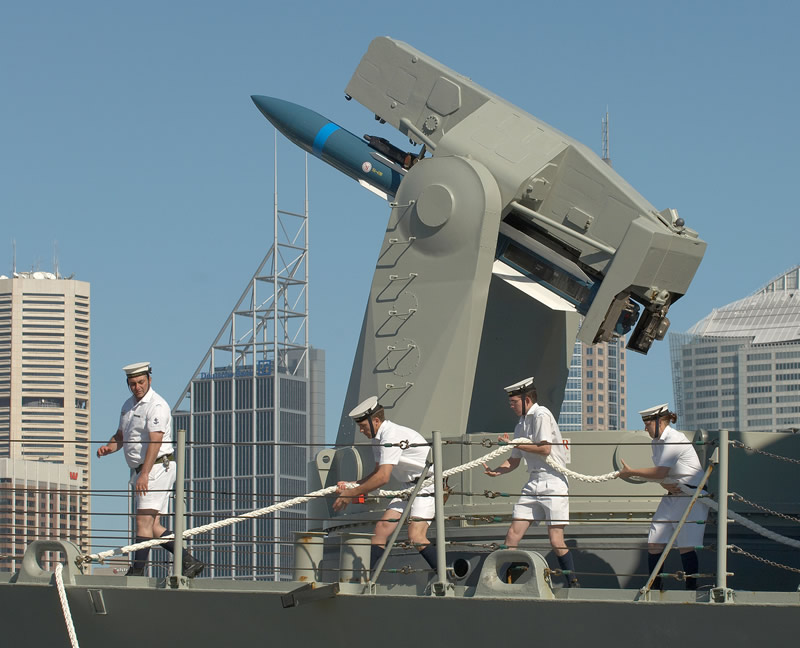
The ships’ existing Mk13 GMLS pop-up launcher retains its 40 round magazine, but it can now be fitted for more advanced SM-2 Standard anti-air missiles and Harpoon strike missiles (usually fitted: 32 x SM and 8 x Harpoon). An 8-cell Mk41 tactical-length vertical launching system will generally carry up to 32 shorter-range RIM-162 Evolved Sea Sparrow air defense missiles, but could carry different weapons including SM-1/ SM-2s.
Self-contained drop-in weapon changes round out the mix.
* SEA 1390 Phase 4A/4B will replace all SM-1 missiles with SM-2 Block IIIAs. They offer far better performance against modern anti-ship missiles, and don’t require constant Home All the Way guidance.
* Harpoon anti-ship missile capability was improved to include RGM-84 Block IIs, with GPS guidance and land/ near-shore attack capability.
* New Eurotorp MU90 lightweight torpedoes sit in the torpedo tubes, instead of the old American Mk.46s. The MU90s were a troubled project of their own, and weren’t officially commissioned into service until October 2013.
* The ship’s 20mm Phalanx CIWS last-ditch defense systems were upgraded to Block 1B for better capabilities against UAVs, helicopters, and small boats.
* RAFAEL’s Mini-Typhoon 12.7mm remote weapons systems were bolted on to supplement the Phalanx’s defenses against fast boats and similar threats.
* Additional launchers for acoustic, long-range chaff and passive infrared (IR) decoys.
All these changes must work together well, in order to make the Improved Adelaide Class’ upgrades effective. That wasn’t easy.
SEA 1390: Project & Industrial Structure
The SEA 1390 project has had several phases, all of which have been completed.
* Phase 1 – Project Definition Studies (1995-1998).
* Phase 2 – FFG Upgrade Implementation (1999-2010).
* Phase 3 – A Study into the replacement of the SM-1 missile.
* Phase 4A – Upgrade of the existing test set to enable testing of the SM-1 replacement missile.
* Phase 4B – Replacement of the SM-1 Missile capability.

(click to view full)
SEA 1390, Phase 1. The RFP was released in 1994, and Transfield Defence Systems of Melbourne (TDS, now BAE), and ADI Limited of Sydney (now Thales Australia) were selected to conduct the 2-year Project Definition Studies. The Australian Government subsequently endorsed a list of capability improvements and supportability measures for the Adelaide Class.
SEA 1390, Phase 2.1. ADI won the tender for on Nov 13/98, and signed an A$ 900 million contract on June 1/99, as part of a A$ 1.266 billion budget overall. The last ship was to be delivered in 2005. The project faced difficulties from the outset, and in November 2003, the upgrade set was cut to 4 ships. HMAS Adelaide and HMAS Canberra would be decommissioned. It actually took until June 2006 to amend the contract, including the settlement of all claims and provisional acceptance disputes. Final acceptance was now scheduled in December 2009.
SEA 1390 Phase 4B. This upgrade received Second Pass approval on July 12/04, and would allow the 4 ships to fire newer SM-2 Block IIIA Surface to Air Missiles, with far better performance against modern anti-ship weapons. Completion was scheduled for early 2009, but Operational Release didn’t take place until July 2013.
Despite RAN acceptance of the last ship in 2011, problems with some of the on-board sub-systems have delayed Final Materiel Release until March 2014. These 4 ships will serve until 2020 or so. Companies involved included:
* ADI Systems (now Thales Australia) – Integration Authority and Combat System Design.
* Gibbs and Cox – Platform System Design Authority. The ship’s upgrades will push its weight to 4,200t – note that American upgrades to 4,100t have pushed a hull designed for 3,600t into stability issues.
* AAI – On Board Training System (OBTS).
* BAE Systems – Changes to the missile launcher system.
* CEA – Data Fusion system.
* Lockheed Martin Naval Electronic and Surveillance Systems (LM NE&SS) – Mk 92 Mod 12 Fire Control System.
* RAFAEL – Electronic Support Measures. Israel’s Elbit Systems would also contribute, and Tenix (now BAE) would become a RAFAEL subcontractor.
* Thales Underwater Systems (formerly Thompson Marconi Sonar) – Underwater Warfare Design Agent.
Other major subcontractors include Raytheon and Lockheed Martin Launching Systems, who would handle the 8-cell Mk41 vertical launching system placed in front of the Mk13 pop-up launcher and magazine in the bow, and the ESSM and SM-2 missiles the ships will carry.
Replacement of the diesel generators and air compressors involved their own equipment contractors.
Contracts & Key Events, 2008 – Present
2012 – 2020

(click to view full)
February 18/20: Partnering Agreement Saab has signed an agreement with Australia to provide combat management systems for Navy’s surface ships. According to the agreement, Saab will deliver its Next Generation’ Combat Management System (CMS) to Australia’s new Arafura Class offshore patrol vessels (OPVs) and the Supply class auxiliary oiler replenishment (AOR) ships. Saab will also modernize the 9LV CMS currently in use in the Anzac Class frigates and will provide the software for the future tactical interface for the Hobart class air warfare destroyer (AWDs) when their current CMS is modernized.
October 30/19: Decomissioned The Royal Australian Navy’s (RAN’s) last operational Adelaide Class guided-missile frigate, HMAS Melbourne, was decommissioned in a ceremony held on October 26 at its home port of Fleet Base East, Garden Island in Sydney. During its 27 years in service the 4,260-tonne frigate was deployed on operations to the Middle East eight times and earned battle honors for service in East Timor, the Persian Gulf, and Middle East. The 138-meter warship was the only missile frigate left in the fleet of six, after HMAS Newcastle was decommissioned in June. Her departure will make way for a more modern fleet of warships.
June 19/19: Completed and Rejoined The Royal Australian Navy’s Anzac Class frigate HMAS Arunta (II) has reportedly rejoined the fleet after having undergone a 20-month-long Anzac Mid-Life Capability Assurance Program upgrade at the Australian Marine Complex in Henderson, Western Australia. The Arunta is the first of eight ships of the class to have completed the extensive upgrade. She returned in early June to its home port of Fleet Base West where she rejoined the fleet. The 118 meter-long ship, which was commissioned in December 1998, will soon start to conduct work-ups and testing the new equipment on board.
Dec 17/13: ANAO Report. Australia’s National Audit Office releases their 2012-13 Major Projects Report. The frigate upgrades themselves aren’t reported any more, but Project SEA 1390 Phase 4A and 4B are. It involves replacing the frigates’ SM-1 missiles with more advanced SM-2s Block IIIAs possessing Mid-Course Guidance capability.
That program is almost done, but not quite. Final Materiel Release (FMR) was supposed to be September 2012, but is now January 2014 due to contracting and shipping issues (q.v. ). That pushes Final Operational Capability to March 2014. “Capability observations by Navy regarding legacy Fire Control performance issues have been addressed insofar as these can be corrected in software to ensure the products are suitable [emphasis DID’s].”
The project has spent A$ 327 million of A$ 400.2 million, and will come in under budget but about 16 months late. As of June 30/13, A$ 258.3 of those funds have been devoted to the SM-2 missiles themselves, and mostly went to Raytheon via the US government. The other contractors were AAI (training systems), BAE Systems (launcher modifications), and Lockheed Martin (Mk92 CW illuminator modifications). A Foreign Military Sale Letter of Request for 3 years In-Service Support is pending, per the project’s obligations. Then there’s this mention, which is something for global buyers to remember:
“…classified items require licensing by the US Department of State for international transfer. Several issues were encountered where the Australian Freight Forwarder changed its street address in US and this required reissuing of the licence, a process that takes about three months through the US Department of State.”
Dec 17/13: ANAO Report. Australia’s National Audit Office releases their 2012-13 Major Projects Report. SEA 1390 Phase 2.1 seems like it would be over, as the final ship was accepted in 2011, but there’s still work to do on the Torpedo Defense System. Phase 2.1 has spent A$ 1,352.1 million of 1,450.1 million, leaving just A$ 98.0 million to last until Final Materiel Release in December 2014. That’s somewhat at risk because the program was largely de-staffed after final delivery, and the RAN will need to recruit contract help for the project office.
As things stand, the RAN has placed operational limitations on the Electronic Support (ES) System, Long Range Chaff Rocket (LRCR), PIRATE Infra Red Decoy, and the Electro-Optical Tracking System (EOTS). The Mine and Obstacle Avoidance System has not been endorsed at all, and the RAN won’t decide what to do until 2014.
The other technical problem is the torpedo detection and classification system, whose faults made the accompanying Le Scut decoy “unlikely to achieve operational viability”. Instead, they’ll rely on a DSTO-developed PANORAMA processor that combines the Spherion bow sonar and Albatross towed array inputs, in order to detect incoming torpedoes passively. HMAS Darwin, Melbourne, and Newcastle also got SLQ-25 Nixie active towed torpedo decoys transferred from ANZAC frigates, but HMAS Syndney will be left without.
SEA 1390 Phase 4A and 4B are still in progress to deliver SM-2 Block IIIA missiles and their accompanying MK 698 test sets, as a replacement for existing SM-1s. Most missiles have been delivered, and Operational Release took place in July 2013, but there’s still A$ 73.2 million of the A$ 400.2 million budget left. There’s also an unfinished item or 2:
“Procurement of Additional Missile Section Spares was initially delayed due to US FMS contracting issues. Delivery has commenced but is not expected to be completed until Dec 2013 due to shipping delays associated with the annual/semi-annual ammunition ship that transports ordnance from US to Australia. Additionally establishment of the In-Service Support arrangements are outstanding but expected to be in place by late 2013.”
Nov 22/13: The Australian DoD announces a A$ 46 million contract to Thales Australia, replacing an interim contract to support the Improved Adelaide Class’ upgraded ADACS Combat System. The contract also covers on-board systems and associated support facilities, and will be delivered from Thales facilities in Sydney and Perth. Source: Australian DoD, “Defence awards contract to support frigates”.
Oct 15/13: MU90. The MU90 lightweight torpedo finally receives its official entry into RAN service, 13 years after the deal to buy an “off the shelf” torpedo began. Australia’s ANZAC and Adelaide Class frigates are now fully equipped with the MU90, which has reached Full Operational Capability for Australian purposes. Source: Australia Defence Magazine, “MU90 torpedo enters Royal Australian Navy service”.
Dec 12/12: MU90. The JP 2070 project to equip Australian ships with the MU90 lightweight torpedo is finally removed the Australia’s “Projects of Concern” list, after a sojourn of more than 4 years. They have also attained Initial Operational Capability, signifying that Australian ships are finally able to depend on them in combat. Delays in weapons testing, integration challenges, and cost risks forced a formal remediation plan agreement in 2011, and it didn’t achieve Initial Operational Capability until November 2012.
The torpedo’s problems were treated as separate from the SEA 1390 Frigate Upgrade program, but they matter, because they’re the ships’ main anti-submarine weapon. Sources: Australian DoD, “Minister for Defence and Minister for Defence Materiel – Joint Media Release – Update to the Projects of Concern List” | See also ANAO, “Remediation of the Lightweight Torpedo Replacement Project”.
Jan 27/10: Thales Australia announces that HMAS Sydney, Melbourne, Darwin and Newcastle, have all been contractually accepted into service by the navy, and the project had been struck from the Government’s notorious “Projects of Concern” blacklist. The Australian.
In-service & closure
2008 – 2011

(click to view full)
Dec 18/09: SM-2 firing. HMAS Melbourne fires the SM-2 Block IIIA edium range air defense missile, an upgrade from its previous SM-1 armament. Australia’s upgraded Adelaide Class frigates are all slated to add this capability, and the lessons learned may allow Raytheon to offer a more standardized upgrade package for other operators of the SM-1 missile and/or FFG-7 Oliver Hazard Perry Class Australian DoD | Raytheon.
SM-2-IIIA firing
Sept 17/09: Last acceptance. Australia’s Minister for Defence Personnel, Materiel and Science announces contractual acceptance of the last upgraded FFG-7 frigate, HMAS Newcastle. In legal terms, it means the government is certifying that the ship meets all requirements of the contract. In practical terms, it means that any problems discovered after this point are the government’s responsibility, not the contractor’s. Combet thanked a couple of specific individuals for reaching this point:
“Twenty four days before the election of the Rudd Labor Government the Australian National Audit Office released a performance audit of the FFG program. This report concluded that this $1.5 billion upgrade was over four and half years behind schedule… So concerned was the new Government regarding projects like the FFG upgrade, the Sea Sprite and the Airborne Early Warning and Control Aircraft that we established the ‘Projects of Concern’ process.
…The oversight provided by the ‘Projects of Concern’ unit was very important in improving cooperation between the parties. The involvement of the General Manager-Major Programs was especially important in elevating this issue. [Thales Australia CEO] Chris Jenkins realised that the reputation of Thales was at risk and showed strong leadership to improve contractor performance. This project also highlights one of the advantages of having multinational companies active in Australia. Thales was able to reach back into their parent corporation to access specialists who helped resolve some of the issues around the upgrade.”
The 2006 re-baselining had set this milestone for December 2009, so project delivery was about 3 months ahead of project expectations, even if it was years late based on the initial schedule. DoD release | Combet’s speech | Thales Australia release.
Nov 20/08: 2 accepted. Australia’s Minister for Defence announces that the DMO has agreed to Contractual Acceptance of HMAS Sydney and HMAS Darwin from prime contractor Thales Australia. He adds that contractual acceptance of HMAS Melbourne is expected by the end of 2008, and provisional acceptance of HMAS Newcastle is now expected by June 2009. See also Thales release.
This acceptance milestone also includes the new FFG Warfare Systems Support Centre at Garden Island. Integrated combat system performance has been one of the project’s biggest difficulties, with claims that key weapons systems were not fully integrated. The ministerial release adds that upgraded software for the Australian Distributed Architecture Combat System has now been delivered – but it did not say whether this had resolved past issues, in part or in full.
Defence minister Fitzgibbon recognized the Hon. Greg Combet MP, Australia’s Parliamentary Secretary for Defence Procurement, for his role in resolving outstanding issues with the project:
“Greg invested a lot of time and effort in getting the parties to the contract – Defence, Thales Australia and Raphael – to sit down and talk about the issues impeding the project. This has resulted in much greater collaboration between the parties than has previously been experienced during the project’s history [as well as improved progress].”
Nov 19/08: MTWAN. Thales Australia announces that it has completed the Detailed Design Review for both Mission and Support Systems for project SEA 1442 Phase 3: Maritime Communications Modernisation. Its inclusion on the Adelaide Class is enabled by previous upgrade efforts.
SEA 1442 involves the introduction of an Internet Protocol (IP) based Maritime Tactical Wide Area Network (MTWAN) into the Royal Australian Navy, interfacing with the RAN’s existing analogue system. The MTWAN is scheduled to be installed on all 8 ANZAC frigates, its 4 upgraded Adelaide Class guided missile frigates, and the amphibious ships HMAS Manoora, HMAS Kanimbla, and HMAS Success. The first installation at the Fleet Network Centre is scheduled for December 2008.
Jan 19/08: FFG 1 gone. HMAS Adelaide [FFG-01] is decommissioned after 27 years of service. Following her decommissioning, Adelaide will be gifted to the NSW Government, to be sunk off Terrigal on the New South Wales central coast, as an artificial reef and dive attraction. DoD release.
Adelaide retired
Jan 1/08: Unfit for purpose. A whistleblower describes a raft of very serious problems with the frigate upgrade program, as described above. Their sum would make the ships less capable in use than they were before the upgrade.
Reports place the total cost of the upgrade to date at A$ 1.46 billion (about $1.01 billion at June 2004 conversion), or A$ 360 million per ship, with 98% of those funds already paid out to Thales Australia. The project is also reportedly 4 years behind schedule. A blizzard of coverage and recriminations follow – see Additional Readings for more details.
Appendix A: SEA 1390 – Equipment Problems & (Partial) Resolution

(click to view full)
The Frigate UP program’s problems were a continuous and changing set, triggering a program change in 2003. Unfortunately, the renegotiated 2006 contract didn’t solve the problems. In 2007, Australian Navy chief Vice-Admiral Russ Shalders refused to accept HMAS Sydney for operational release, on the grounds that its fighting systems did not function properly.
In January 2008, an unnamed “government whistleblower” claimed that even this understated the problems.
Towed and on-board sonar sensors could not be integrated, he claimed, significantly hampering submarine detection. Long range chaff could not be used, datalinks to the onboard S-70 Seahawk helicopters were not functioning, and though the RIM-162 Evolved Sea Sparrow Missiles had been fired from the ships, the electronic support measures that find enemy radars are not working properly, and the ships’ radars were alleged to be inadequate. The Australian Defence Materiel Organization, for its part, took the official position that the problems were fixable, and said that SEA 1390 can still deliver FFG-7 ships that have been improved enough to face modern threats.
Incoming defence minister Joel Fitzgibbon didn’t appear to believe this, and was especially vociferous in his criticism. In response, allegations flew in Parliament as well as the media. Obviously, ships in this state cannot be sent to even low-medium threat conflict zones, and there are allegations that Adelaide Class sailors were quitting in disproportionate numbers, due to their inability to deploy.

(click to view full)
What to do?
Step 1 in politics: blame. There were even claims that the entire upgrade project was partly driven by a desire to maximize government-owned ADI’s sale price, before it was sold to France’s Thales. Raising this issue also raises questions about the 1990s construction program as a “jobs buying” measure, in lieu of purchasing more capable Kidd Class destroyers second-hand.
The thing is, there seemed to be more than enough blame to go around. Australian Defence Association executive director Neil James went right to that point when asked by the media, saying that while the [Liberal Party] Howard government was responsible for the upgrade contract, it was the [Labor Party] Whitlam government that chose the wrong frigates to begin with:
“There’s no one government that can be blamed for this, the whole problem has both parties’ fingerprints on it.”
Ultimately, therefore, the issue wasn’t blame. It was ships.

(click to view full)
The pressure to accept the ships must be understood in light of the scenario if the effort had failed. The Adelaide Class would have remained undeployable in threat zones, and A$ 1.5+ billion would still be gone. Australia’s effective surface combatant fleet would have shrunk to just 6 ANZAC frigates, to be supplemented 7 or more years later by 3 Hobart class air warfare frigates. This set would be supported by the new 56m Armidale Class Offshore Patrol Vessels, which are suitable for Coast Guard type duties throughout the South Pacific, but very little else.
The extra coverage slots would have had to be filled somehow. One option would have been lesser capability ships like an extended OPV, or a corvette like Navantia’s BAM. Unfortunately, almost A$ 1.5 billion had already been spent, and buying anything else would require additional funds. It’s a classic sunk cost question. Can an equivalent alternative be fielded for less than it would now take to complete SEA 1390?
This was more than a cost question, as ships that could not be made fit for purpose could be replaced by anything as an improvement.
As it happens, the Improved Adelaide Class had its upgrades completed within 2 years of the whistleblower’s revelations, leaving some question concerning just how many of the issues described were fixed, and how many were simply accepted. In exchange for more than A$ 1.6 billion, The Royal Australian Navy ended up with 4 ships that plus up its anti-submarine warfare numbers until 2020, and can perform the full range of naval duties to varying levels in low to medium threat environments.
What transpired was better than a hole, or a significantly reduced capability. Even so, the decision to extend and then to upgrade Australia’s FFG-7s remains a very expensive program. One that came, twice, disguised as a bargain.
Additional Readings & Sources
Background: Ships & Upgrade
* Royal Australian Navy – Adelaide Class Guided Missile Frigate
* GlobalSecurity – FFG-7 OLIVER HAZARD PERRY-class
* Australia DoD, Defence Materiel Organization – SEA 1390 – FFG Upgrade Project (FFG UP). A bit behind the times, even though it’s a 2013 snapshot.
* Thales – FFG Upgrade [PDF]. Details the changes.
* Tenix – SEA 1390 Ph 2 FFG Upgrade. They stepped back in as a subcontractor to Israel’s RAFAEL, who is integrating the electronic support systems that detect enemy radars. 2008 snapshot, since Tenix became BAE that year.
* GlobalSecurity – DDG-993 Kidd Class. They are now referred to as the DDG 1801 Chi Teh Class.
News & Views
* ANAO (2012/13 Report) – Remediation of the Lightweight Torpedo Replacement Project. The very problematic MU90, whose procurement began in 2000.
* ANAO (May 20/10) – Lightweight Torpedo Replacement Project [PDF].
* The Australian (Jan 7/08) – Navy cost sinking budget
* The Australian (Jan 3/08) – Parties exchange blame over frigates
* The Age (Jan 2/08) – Adelaide frigates a nightmare: govt
* The Courier-Mail (Jan 1/08) – Navy Ships Unfit For War
* Lockheed Martin (Sept 25/07) – Lockheed Martin Awarded $20.6 Million For Fire Control System Upgrade To Support Enhanced Missile Australian Navy Frigate. To give them SM-2 missile capability.
* Australian DoD (Annual Report 2004/05) – Approved Major Capital Equipment Projects: SEA 1390 Ph 2 FFG Upgrade Implementation. It isn’t going well.
* Sea Power magazine (September 2004) – Australia to Upgrade Adelaide-Class Ships, Eyes UAV Fleet
* Asia Pulse (October 2002) – Taiwan’s Kidd-Class Warships Deal To Cost US$785 Mln [dead link]. For 4 of the fully multi-role, 9,700t ships, or about 20-25% of their original cost. The Kidds would also have required upgrades, but had more native capability and the space to accommodate upgrades more easily.
* Australian Navy, Navy News (June 14/99) – $900m FFG Upgrade
* Australian government (#65, Dec 1/98) – Australian Centre for Maritime Studies, Australian Maritime Digest. See “RAN Frigate Upgrade.”