

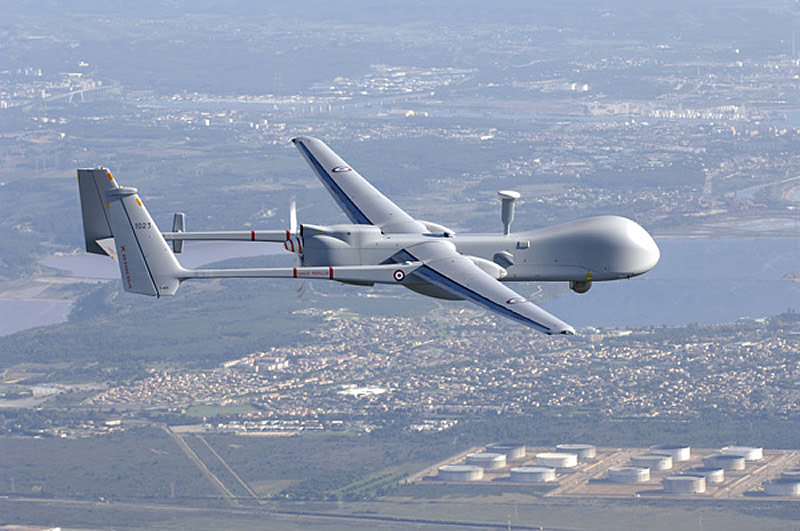
(click to view full)
France is wondering what to do about its next high-end UAV buy. They bought mini-UAVs off the shelf, but turned to a build-in-partnership approach for their current set of Predator-class Medium Altitude, Long Endurance (MALE) machines. That sacrificed some fielding speed and cost more, in order to build the industrial capabilities of key French firms. Unfortunately, their Harfang/ SIDM IUAV Program to field an IAI Heron derivative hit some snags. Harfangs have been very useful in several conflicts now, but the fleet isn’t keeping up with France’s growing land and naval needs. Which leads to the question: what’s next?
The answers to that question remain unclear, several years after French efforts began. What is becoming clear is that France needs UAVs of this type. By mid-2013 a request for MQ-9s came. Will it be more than a stopgap?
Programs and Choices

by M. Bertram
(click to view full)
There are really 3 programs going on in France. There’s a short-term program to field an immediate solution, which bought MQ-9 Reapers after much to-ing and fro-ing. There is a long-term program to develop a “European” UAV, however that term is defined. Then there’s a joint program with Britain, which seems likely to build a UCAV design that draws on the experience of the British Taranis and multinational nEUROn programs.
The Interim Buy. Unmanned Aerial Vehicles have become a must-have item for modern armies, and the pressures of modern campaigns are forcing rapid acquisitions. Mini-UAVs are being bought off the shelf, and leased tactical options like Boeing’s ScanEagles and Aeronautics DS’ Aerostars have carved out their own niche. These days, rent-a-UAS services even include high-end MALE (Medium Altitude Long Endurance) options like IAI’s Heron UAVs.
Instead of renting, however, France decided to buy a fleet of advanced medium UAVs, type unspecified, under a program labeled “DTIA”. Deliveries were eventually pushed back from 2013-2015 to 2020 or later, which brought France back to an interim solution. France initially chose to repeat their Harfang approach, and buy modified IAI Heron TP/ Heron-2 UAVs. After a great deal of controversy over the cost of their choice’s industrial benefits, and France’s growing need for immediate help, a new French government switched to an interim buy of MQ-9 Reaper UAVs from the USA.
With France’s interim option set, the question is what they will do as their long-term option.
FE-MALE/ MALE2020. The EU is nudging this idea along via research programs etc., and potential base platforms like Piaggio’s Hammerhead and BAE’s Mantis have already flown. France’s problem is that developing a qualified high-end UAV from the ground up is very expensive. France and its likely partners are struggling to afford the social programs their aging populations have been promised, while negotiating the fallout from the Eurozone’s overall economic policies.
One cheaper possibility for a future European MALE UAV would involve modifying MQ-9 Reapers to include all-European systems, removing the need for American permission to conduct weapons integration or other add-ons. France, Britain, Italy, and soon the Netherlands will all operate this platform soon. Unfortunately, American politics and diplomacy have injured that option, by creating a lot of uncertainty around American obstructionism. Germany’s decision not to buy any advanced UAVs before 2018 or so has also weakened this case.
France & Britain. On Nov 2/10, the Lancaster House Treaty promised that the 2 countries would “work together on the next generation of Medium Altitude Long Endurance Unmanned Air Surveillance Systems”. BAE and Dassault got a small study contract, but that was all, and their Mantis/Telemos UAV collaboration ended up being displaced by a collaboration agreement between Dassault, EADS, and Alenia.
A GBP 120/ EUR 150 million “future combat air system” follow-on in January 2014 appears to have shifted toward a full UCAV that’s more similar to stealthy, jet-powered options like Britain’s Taranis or the French-led nEUROn. All of the yo-yoing in France’s UAV plans to date, and a questionable ability to finance a full UCAV within France & Britain’s future defense budgets, makes one wonder if the R&D contracts will translate into an operational UAV.
France’s Next MALE UAV: Contenders

(click to view full)
Initial reports said that France’s next UAVs would be used only for surveillance and targeting. Britain’s experience with its MQ-9 Reapers, and the realities of modern battlefields, suggested from the outset that however France’s DTIA project began, French UAVs would wind up carrying weapons. Experiences in Libya and Mali are driving that truth home, despite American obstruction preventing France from arming its own MQ-9 interim UAVs. France’s future UAVs will either be armed, or will operate in conjunction with armed aircraft that offer low operating costs compared to France’s high-end fighters.
With that in mind, France has a number of options.
MQ-9 Reaper (General Atomics, interim buy). A battle-proven choice, with higher carrying capacity and costs. The Reaper initially lost to IAI’s Heron TP, but persistent rumors came true in May 2013, when France’s defense minister pledged to buy 2 Reapers for delivery before the end of the year. Its biggest advantage is immediate availability, and there is speculation that the UAVs may even come from the USAF’s active fleet. This is still an interim capability, however, not a long-term program.
The biggest question involves France’s ability to make use of the Reaper’s comparatively huge 3,000 pound/ 1,360 kg carrying capacity. The USAF’s progress with very advanced wide-area sensors like Gorgon Stare and ARGUS-IS adds to the Reaper’s attractiveness, if America will export them, and Reapers are qualified to use JDAM and SDB GPS-guided bombs, Paveway laser-guided weapons, and Hellfire anti-armor missiles. On the other hand, the Americans’ reluctance to allow even key NATO allies like Italy to arm their drones is a stumbling block. Early reports suggest that French MQ-9s will be unarmed, and France’s reputation for pervasive industrial espionage, even during combat operations, may get in the way of advanced sensor exports.
General Atomics has floated the idea of a European Reaper, with an open architecture and all-European sensors etc. The UK, France, and Italy have already ordered standard MQ-9s, the Dutch have made a commitment to the platform, and there are rumors that Poland will follow, creating a strong European customer base for modifications and upgrades. American interference would still be a sticking point, and the other unresolved issue involves long-range control. If France wants to operate the Reapers via the preferred satellite link method, they’d need to either spend the time and money to build their own control facility, make arrangements to share Britain’s newly-built RAFB Waddington facility, or co-locate with the USAF at Creech AFB, NV. A European MALE project would make a new joint control facility easier to swallow financially, and provide workshare and economic benefits to distribute within the partnership.
[youtube:v=lznciYMmo54]
click for video
P.1HH Hammerhead (Piaggio/ Selex ES). Italy has declared their intention to buy 10 of these converted executive turboprops, and Piaggio has good odds of picking up sales in the UAE. The Hammerhead offers a unique 395 KTS cruising speed at up to 45,000 feet, with 16 hours endurance at lower speeds and a payload whose 500 kg limit is treaty-related rather than technical. Testing and flights have begun, and core development is largely covered by existing private investments. Additional development would be required to integration national communications capabilities, modify the ground stations, and arm the UAV, but Hammerhead’s development costs would rival the Reaper’s for cost-effectiveness.
The bad news is that Piaggio isn’t closely associated with the major industrial players like EADS or Dassault, who can call in political favors. EADS has already stated that the UAV partnership with Dassault and Alenia would use one of its platforms as the base, and even the prospect of failure might not be enough motivation to change that. Hammerhead’s comparatively low endurance for a MALE UAV could also become an issue, and so could operating costs. Hammerhead’s operating costs might beat Telemos or Talarion, but probably wouldn’t compare as well with the slower, single-engine, and slim-bodied MQ-9 design. The P.1HH may be one of Europe’s most achievable MALE 2020 options, but at this point, it has to be rated as a long shot. Read “MALE Performance Enhancement: Piaggio’s P.1HH Hammerhead UAV” for full coverage.

(click to view full)
Harfang (IAI/ EDAS). systems are one option, at about $25 million each for UAVs and ground stations. The benefit of additional Harfangs is that adaptation and integration have already been handled, costs are known, and deliveries could begin very quickly. On the flip side, EADS would have to show that existing issues with the type have been resolved, and adding weapons would require its own integration effort and costs.
Heron TP (IAI/ Dassault/ Thales). Also known as the Heron 2 or Eitan, this is a larger and more advanced version of the Heron UAV that formed the basis for EADS’ Harfang. The Eitan project began in 2004, initial flights began in October 2007, and the new Israeli squadron was formally unveiled in February 2010 – but was reportedly operational before that. A French version would involve a number of modifications, plus testing time, and it was thought that by 2015-2016, Thales-Dassault’s derivative SDM could be available for under EUR 1 billion investment.
The drone’s history in France helps to explain why France is having a UAV crisis in 2013. Thales & Dassault were one of the 2 teams that put in French UAV bids in 2010, but the competition hit a cul-de-sac as France stepped back from the proposed buy, and began looking at alternatives. France’s need for an interim UAV replacement revived the competition, and in July 2011, and IAI’s proposed knowledge transfer and workshare with Dassault and Thales made the Heron TP France’s choice as their interim UAV, to enter service around 2014. Eventually, rising costs, stalled decision-making and very belated acknowledgement that France couldn’t wait for more drones pushed the Heron TP aside.
It could still become the basis of a European “Super MALE” UAV project, but it will have to compete anew. With Dassault (and hence Thales) linked to EADS and Alenia now, its odds are iffy.
Patroller (Sagem). On the developmental front, Sagem already supplies France’s Sperwer tactical UAVs, and is working on a Buzard/ Patroller UAV based on Stemme AG’s S15 powered glider. Sagem is advancing Patroller’s flight schedule, and hoped to be able to offer delivery by 2012-13 at a price of EUR 20-30 million per system. Patroller participated in a French government operational trial, but wasn’t a top option for the interim buy. It’s even less likely to become the basis for a Europe-wide project, but it could win some border control and maritime security customers on its own, given its characteristics.

(click to view full)
Telemos/ Mantis (BAE). BAE and Dassault were using Mantis as the basis for their Telemos MALE UAV partnership. Their design offers a number of benefits. Twin engines are attractive to navies because they’re safer for long over-water flights, and the type’s carrying capacity is expected to be comparable to an MQ-9 Reaper. Like the Reaper, Mantis’ design is very suitable for carrying weapons, or large and heavy sensors.
On the flip side, a new UAV design means higher project risk, and estimated full development costs were in the EUR 1 – 1.5 billion range. The 2 firms were tapped for a future MALE UAV study, which will help define their design and industrial partnerships, but won’t get Telemos anywhere near production. Dassault’s shift to an EADS/ Alenia partnership, without BAE, would appear to doom Telemos as a future European UAV. Nor is Britain likely to invest in it alone.

(click to view full)
EADS’ Talarion. The Talarion Advanced UAV project was rolled out in 2009 as the European MALE (Medium Altitude, Long Endurance) UAV collaboration between France, Spain, and Germany, and was one of the 2 bids submitted to the French in 2010. After that impressive entrance, however, it faded. The reasons boil down to time, cost, and risk.
Unlike the other options here, Talarion is an entirely new design. That increases risk, and ensures that all integration must be done de novo. It’s also the only jet-powered UAV in this set, and seems positioned as a heavy, high-end option somewhere between the MQ-9 Reaper and the USAF’s high altitude, very long endurance RQ-4 Global Hawk. EADS reportedly offered a pre-financed EUR 1.4 billion development deal for Talarion, in return for a purchase commitment beginning around 2017. French parliamentary estimates have placed Talarion’s total program costs at around EUR 2.9 billion, including around 12-15 systems of 3 UAVs each.
France didn’t bite. Turkey said yes in principle, but needed others to step forward. Meanwhile, Spain’s ongoing financial crisis, and Germany’s sharp defense budget cuts, stripped Talarion of its original European support. EADS was investing its own funds to continue development, but they officially suspended that work in February 2012. EADS has another opening, thanks to November 2013 EDA declarations of intent to cooperate on MALE UAV projects, and an announcement that EADS Talarion would be the basis a MALE UAV partnership with France’s Dassault and Italy’s Alenia. The question is still cost, however; EADS’ November 2013 proposal estimated EUR 1 billion for development alone.

(click to view full)
WK450 Watchkeeper UAV (Elbit/ Thales). This collaboration between Thales UK and Elbit is another system that would be available quickly, but not immediately. Britain is paying for development and ensuring its tactical relevance, but the system is behind schedule, and the UK MoD is still renting the popular Hermes 450 base platform for now. Co-developer Thales is a French firm, but the UAV would still require some adaptation to France’s systems and needs. A February 2012 announcement confirmed that France intends to field Watchkeeper as a future UAV, but that hasn’t turned into a purchase commitment beyond 1 system for evaluation.
Watchkeeper is smaller than other contenders, with lower than average payload and endurance. If it does enter French service, it will probably be in the same role it plays for Britain: as a lower tier companion to the Reaper or its replacements. Watchkeeper isn’t being developed as an armed UAV, either, although Israel has reportedly added weapons to its Hermes 450 base platform.
If France wants a more capable solution, Elbit does offer a larger Hermes 900, which has been sold to Israel and to Latin American countries. If France asked, the Hermes 900 could be shared under the same Thales joint venture that runs Watchkeeper.
Contracts & Key Events
UCAV MoU with Britain

(click to view full)
2019
May 24/19: New School In order of coping with expanding air vehicle inventory, the French Air Force is introducing a new UAV pilot training. The French Air Force is planning to have 24 MQ-9 Reaper MALE UAVs operational by 2030, generating a requirement for 80 to 100 crews. To cope with this expansion the service will establish a new course into its flying schools. Students will fly the Cirrus light aircraft and the Grob 120 basic trainer before moving on UAV Operational Conversion Squadron and the 1/33 Belfort to acquire the particular tactical know-how required to operate the Reapers. The MQ-9 Reapers are remotely piloted vehicles and the first hunter-killer UAVs designed for long-endurance, high-altitude surveillance. Up until now the 1/33 Belfort UAV Squadron flew five GA-ASI MQ-9 Reapers. The first two Reapers to enter French service are designated Block 1 and use US equipment.
March 26/19: MQ-9 The US Air Force awarded General Atomics a not-to-exceed $8.9 million contract action for the France MQ-9 Block 1 Weapons integration effort. The Foreign Military sale comes under an undefinitized contract action for the production and integration of the kits for the remotely piloted aircraft. The Reaper has a range of 1,150 miles up to 50,000 feet in altitude with a takeoff weight of 10,500 pounds. In 2013, the French ordered two MQ-9 Reaper medium-altitude long endurance drones to replace its Harfang drones. Last November, the US Air Force awarded General Atomics Aeronautical Systems a $263.4 million contract for production of the Reaper. Work under the contract action will take place n Poway, California and is expected to be complete by September 30, 2020.
2014
May 19/14: MALE 2020. Airbus Defence and Space, Dassault Aviation and Alenia Aermacchi deliver a MALE2020 Unmanned Aerial System (q.v. Nov 20/13) proposal to the Ministries of Defence in France, Germany and Italy. The offer proposes a Definition Phase, backed by an industrial agreement on workshare and a cooperative agreement to start the MALE2020 program. Once the Definition Phase is done, European governments would have to make decisions, but the release says that a quick go-ahead could mean “an affordable and certifiable solution ready by 2020.”
Of course, we have been here before… (q.v. May 28/09). Sources: Dassault Aviation, “Airbus, Dassault Aviation and Alenia Aermacchi propose joint approach to Europe’s next generation drone” | Finmeccanica, “A joint approach to the development of Europe’s next generation drone”.
Jan 31/14: UCAV MoU. Britain and France build on the 2010 Lancaster House treaty with various commitments, including “a statement of intent for a future combat air system, which would launch a 2-year, [GBP] 120 million joint feasibility phase that will see British and French industries working together.” The consensus is that this R&D will involve a stealthy, jet-powered Unmanned Combat Air Vehicle like the British Taranis and European nEUROn programs.
The twin catches are funding and commitment beyond the initial 2-year period. Despite efforts of this nature, and continued development of an Anglo-French Combined Joint Expeditionary Force, French sources are expressing quiet reservations. These include the difficulty of securing program cooperation with British political counterparts who are already in campaign mode for 2015, and concerns about British austerity measures and their potential effects on joint programs and endeavors. If the parties conclude that a stealth UCAV isn’t a reasonable fiscal option, many of the component technologies would still be useful within a lesser UAV. Sources: UK MoD, “UK and France agree closer defence co-operation” | Dassault, “Dassault Aviation salutes a major step forward for the Future Combat Air System” | Defense Update, “UK, France to Invest £120 million in a Joint UCAV Study” | IHS Jane’s, “France and the UK sign defence co-operation agreements” | The Independent, “Britain to set up controversial drone development partnership with France” | Le Monde, “La defense au coeur du sommet franco-britannique”.
2013
France needs UAVs now, commits to 2 Reapers and deploys them at year end; Italy frustrated by American obstruction, wants European armed drone project – France agrees; EU EDA takes steps toward a European MALE (FEMALE) UAV program.

(click to view full)
Jan 1/14: MQ-9. Defense World reports that French MQ-9s arrived “in the Sahel Region” on this day, for operations over Mali. Sources: Defense World, “France Receive First MQ-9 Reaper Drone “.
Dec 19/13: MQ-9. The DGA procurement agency receives its 1st Reaper UAV, which is being readied for deployment to Mali along with a 2nd UAV, associated ground systems, etc. The DGA praises the USA’s help in getting personnel trained, helping with communications planning, etc. A record of six months from order to delivery is impressive, and demands nothing less. Sources: DGA.
MQ-9s delivered & deployed
Nov 20/13: FEMALE. Defense Ministers committed to the launch of 4 programs during the EU European Defence Agency’s Steering Board session, 1 of which centered around a 4-part program for UAVs. “Ministers tasked EDA to prepare the launch of a Category B project” to develop a Future European MALE (FEMALE!?!) platform, to be introduced from 2020 – 2025. Other documents, noting the obvious potential for ridicule if Future European MALE = FEMALE, refer to it as “MALE 2020” – a timeline that would be imperative for industrial and competitive reasons. EDA hasn’t launched the project yet. Once it does, can Europe’s traditionally fractious program negotiations and fragmented execution hit a 2020 target date?
In parallel, a coalition of countries also plan to create an operator community of UAV users, so they can share experiences and improve the foundation for future cooperation. Germany, France, Spain, Greece, Italy, the Netherlands and Poland have all joined.
Other areas of cooperation will include streamlining UAV certification in European airspace, now that its costs and uncertainties have already killed Germany’s major Eurohawk UAV program. In a related move, Austria, Belgium, Britain, the Czech Republic, Germany, France and Spain signed a joint investment program around technologies required for UAV use in civil airspace. Sources: EDA, “Defence Ministers Commit to Capability Programmes” | Les Echos, “Drones : des pays europeens s’engagent a collaborer”.
Nov 4/13: Talarion. The EADS-Dassault-Alenia partnership has followed its June 16/13 announcement with a broad overview of their proposed solution. As expected, EADS would resurrect a variant of its shelved Talarion project as the base platform. Dassault would be the overall system integrator, and Finmeccanica would supply key sensors and related equipment. The remaining development cost is estimated at EUR 1 billion, with orders costing more on top of that.
The launch of an actual project will require a number of steps, from harmonization of UAV requirements in a way that fits Talarion, to the reasonable promise of a solution that countries can afford to buy, to the willing commitment of enough development funds by budget-strapped countries. Sources: Les Echos, “Drone : Dassault, EADS et Finmeccanica levent le voile sur leur projet”.
Sept 30/13: Reaper. General Atomics Aeronautical Systems, Inc., Poway, CA receives a not-to-exceed $49.8 million unfinalized cost-plus-fixed-fee contract action for France’s MQ-9 Reaper urgent request program of 2 UAVs. That seems about right.
Work will be performed in Poway, CA, and is expected to be complete by July 15/15. USAF Life Cycle Management Center/WIIK’s Medium Altitude Unmanned Aircraft Systems group, at Wright-Patterson Air Force Base, OH, acts as France’s FMS agent (FA8620-10-G-3038, DO 0112).
Just days earlier the first of 3 crews from the French air force had taken its initial training flight at Holloman AFB, NM. They want to be ready when 2 UAVs and 1 GCV are delivered at the end of the year. Sources: Pentagon | French Air Force, “Premier vol d’un equipage francais aux commandes d’un drone Reaper”.
MQ-9 Reaper contract
June 27/13: France wants more? The US DSCA notifies Congress [PDF] of a possible Foreign Military Sale to France for 16 unarmed MQ-9s and the necessary equipment and support, for a potential $1.5B total. Such a commitment would further damage the prospects for a future European UAV, but this is a possible sale at this stage, not a contract yet. This will surely get Dassault and EADS howling.
Le Figaro (a newspaper incidentally owned by Dassault) explains [in French] that the size of the request is just a reflection of the FMS process, but that the maximum quantity France would buy is 12 UAVs – in line with the latest whitepaper – for a maximum of 670 million euros (about $875M). But this gives France the option to meet more than its urgent operational requirement. If not directly off-the-shelf as some amount of “francisation” would be expected, at least from a supplier with an already well-established program.
The package would include 48 Honeywell engines (2 spare engines for each installed one), 8 ground control stations, 40 ground data terminals, 24 satellite earth terminal substations, 40 ARC-210 radio systems, and 48 IFF systems. Again, these quantities are very unlikely to happen.
DSCA request: 15 MQ-9s
June 18-24/13: Hammerhead. Italy indicates that they intend to buy 10 Piaggio P.1HH “Hammerhead” MALE UAVs. The twin-engine unmanned derivative of the civil P180 Avanti II will have a max speed of 395 knots, loiter speed of 135 knots, and endurance of 16 hours, with a ceiling as high as 45,000 ft. Payload will be limited to 500 kg in order to stay under Missile Technology Control Regime limits, but that should be enough to allow a couple of weapon stations, along with a Selex Seaspray 7300E radar in the ventral bay. Italy is looking for an initial operational capability in 2016-17, and says they will proceed with or without additional partners – but partners would be nice. Read “MALE Performance Enhancement: Piaggio’s P.1HH Hammerhead UAV” for full coverage. Aviation Week | AIN re: Hammerhead | Aviation Week follow-on.
June 16/13: EuroMALE. EADS, Alenia, and Dassault call for a European program along the lines Italy has suggested.
The most significant aspect of their announcement is Dassault’s inclusion and BAE’s exclusion, which appears to flip them out of their Telemos UAV focus with BAE. Note, also, Rheinmetall of Germany’s exclusion despite their UAV agreement with EADS (q.v. Sept 12/12):
“EADS Cassidian, Dassault Aviation and Finmeccanica Alenia Aermacchi, having a common view on the current situation in Europe regarding MALE drones, call for the launch of a European MALE program… through pooling of research and development funding. With a new development, critical requirements around the certification of drones, allowing their safe passage and operation in European air space, would inherently be built into the program from the onset.”
May 31/13: MQ-9. French Defense Minister Jean-Yves Le Drian writes an article for Les Echos, stating his commitment to buy 2 MQ-9 Reaper UAVs from the USA, for delivery before the end of 2013. After so much procrastination, with only 2 Harfang drones operational, and with pressing commitments in Mali and elsewhere, he says that France must take the immediately available choice. Defense Aerospace suggests that the French Air Force finally got their way, after stalling other options.
The Americans’ reluctance to allow even key NATO allies like Italy to arm their drones suggests that French MQ-9s will also be unarmed, and Le Drian confirmed this when he said these UAVs would be weaponless. France’s reputation for pervasive industrial espionage, even during combat operations, could also get in the way of advanced sensor exports, leaving their Reapers with 3,000 pounds of ordnance capacity that doesn’t get fully used. The other unresolved issue involves long-range control. If France wants to operate the Reapers via the preferred satellite link method, they’ll need to either spend the time and money to build their own control facility, make arrangements to share Britain’s newly-built RAFB Waddington facility, or co-locate with the USAF at Creech AFB, NV.
Ultimately, Le Drian argues for a European partnership that will share expertise and develop a Medium Altitude Long Endurance (MALE) UAV like the Reaper. The Italians must be happy to hear that, and Le Drian seems to be referring to their discussions when he says “Cette ambition est d’ores et deja en chantier” (loose trans. “we’re already working on it”). At the same time, Dassault wasn’t happy, noting that there would already be a European MALE UAV if the requirement had been set and a project declared.
The question in Europe is always whether talk will lead to action, so we’ll wait until we see a contract. The advanced nEUROn stealth UCAV is a contract, for instance, and Le Draan’s “all means necessary” commitment that “lui consacrerons a cette fin les moyens necessaires” has immediate and positive significance for its long-term prospects. Les Echos [in French] | Tele
| Usine Nouvelle [in French] | Defense-Aerospace.
France will buy 2 MQ-9 Reapers
May 9/13: Italy. Aviation Week interviews Italy’s national armaments director Gen. Claudio Debertolis, who reveals that Italy asked to arm its MQ-1 Predator and MQ-9 Reaper UAVs 2 years ago. The USA has refused to cooperate, halting Italian efforts even though Italy is responsible for wide swathes of territory in Afghanistan, and was the point country for NATO’s campaign against Libya in 2011.
Arming the Aeronautica Militare’s UAVs is a high priority, and Debertolis confirms that Italy is in talks with potential European partners to move forward with a covert “Super MALE” weaponized UAV program. The main question revolves around funding. America may have delayed Italy for so long that it doesn’t have the budget to do anything, even convert its existing UAVs. Aviation Week.
Feb 17/13: Armed UAVs. French experiences in Mali and Libya are pushing them toward armed UAVs. The realities of on-call firepower needs, and the high cost of fighter air cover, are staring them in the face. Unfortunately, there’s no quick fix. There aren’t any armed European UAVs, and EADS/IAI’s formal proposal to extend France’s Heron-derived Harfang rent-a-drone service involves sensor upgrades, but no weapons.
Israeli Herons do carry weapons, and in principle, it would be possible to modify the Harfang UAVs to add RAFAEL’s Spike-LR missiles, or MBDA’s Viper Strike glide bombs. In exchange, the Armee de l’Air would have to become more involved in operations and maintenance, and may even have to take the UAVs in-house.
The MQ-9 Reaper is a more capable option because of its weapon choices and higher payload, and appears to be France’s preference. The bad news is the 2+ year time frame for buying Reapers through the USA’s weapon export bureaucracy, modifying them with European sensors, and then fielding them. A formal letter of request is reportedly being prepared, so it can be ready immediately if and when the French defense minister decides.
Another option would involve manned light planes such as the EMB-314 Super Tucano, which is related to the Armee de l’Air’s EMB-312 Tucano trainers. They would offer less loiter time, and place a pilot at risk. In exchange, they would work alongside UAVs like the Harfangs to provide better situational awareness, more speed, mounted guns, lower loss rates, and faster delivery and fielding. Purchase costs would be similar, and operating costs of $1,000 or less per flight hour could be very competitive if UAV infrastructure and loss costs are factored in. With Brazil pondering its next fighter buy, a conditional Super Tucano purchase might even offer France a negotiating edge. Defense Aerospace | Defense News.
2012
Reaper rising; Winner to fly in NATO’s AGS?; EADS’ JV campaign adds Germany; Franco-German MALE UAV agreement; Tarrying over Telemos; Talarion looks to be toast.

(click to view full)
Dec 19/12: DGA chief Laurent Collet-Billon confirms to reporters that France is discussing the option of buying MQ-9s through the US Foreign Military Sales (FMS) program, then modifying them to carry European sensors and weapons. Collet-Billon believes that this proposition could interest existing operators in Britain and Italy, as well as potential future operators in Germany and Poland.
IAI’s Heron TP also remains in the running. Aviation Week.
Oct 19/12: La Tribune reports that France’s DGA is having informal discussions with General Atomics about their Predator family UAVs. France’s dilemma is that if they want to field UAVs quickly, the MQ-9 may be their best bet. Drawbacks include limited or no access to source codes, and strong American leverage over the drones’ use. They hope to be able to “Europeanize” the drone’s sensors and control software, and the report says that they’re looking to make a decision about their interim MALE UAV by the end of 2012.
DGA chief Laurent Collet-Billon also confirms that France spent EUR 30 million on the Talarion project, but says that the resulting UAV was too large. France didn’t even pursue sensor development for Talarion. La Tribune [in French].
Sept 12/12: France & Germany. France and Germany sign an agreement to cooperate in the MALE UAV field, to create a “European” solution. Actually, they agreed to a common set of key operational needs, with a MALE UAV as a goal, and possible operational cooperation between their Heron-derived fleets in the meantime.
The French announcement didn’t directly address the fate of Franco-British efforts, except to say that anything they do with Germany will be “coherent avec” the Treaty of Lancaster House. That could certainly become easier, if BAE and EADS decide to merge. In the end, however, they didn’t merge. French DGA [in French] | Aviation Week | Defense News.
French – German agreement
July 25/12: No joy. Following a meeting in London, defense ministers from the UK and France confirm that France will buy 1 WK450B Watchkeeper unmanned system for operational assessments and trials in 2012 and 2013. They also agreed on a joint EUR 13 million (about $15.7 million) UCAV research study by BAE (Taranis) and Dassault (nEUROn lead).
What did not happen, is any kind of collaboration announcement on an Anglo-French medium-altitude, long-endurance (MALE) UAV, like the Dassault/BAE Telemos. Defense News | Thales Group.
July 10/12: No-show. France and Britain cancel a joint press conference at Farnborough 2012, which was scheduled to discuss progress on joint UAV projects. British defense procurement minister Peter Luff, said the announcement of a medium-altitude, long-endurance (MALE) UAV risk-reduction contract and an unmanned air combat vehicle demonstration deal is being delayed as the new French government “is pausing for breath to look at what it can afford.”
Defense News adds that France recently signed a more limited security cooperation deal with Germany, and MALE UAV development is a possible area. Looks like the EADS vs. BAE/Dassault jostling is back on. Defense News.
July 9/12: Mantis Plan B. BAE Systems announces its intention to fly the Mantis UAS Concept Demonstrator again, but this time in UK airspace. BAE touts it as a way to “support the development of future MALE (Medium Altitude Long Endurance) and UCAS (Unmanned Combat Air Systems) operational capabilities… [and] address the associated challenges of airspace integration and safe operation of an airborne system in accordance with UK rules and regulations.”
That might be enough to pick up additional research funding, if Anglo-French cooperation on the derivative Telemos project fails. Their stated goal is as flight in 2013.
June 10-17/12: French elections. France holds legislative elections. The Socialist Party wins again, and its coalition has 331 seats to 229 for its center-right opposition coalition. The Socialist party gains 94 seats, to reach 280 of the total 541 in the National Assembly. As the Feb 17/12 entry notes, this may have consequences for France’s UAV programs.
May 6/12: French elections. France’s Presidential election is a win for the Socialist candidate Hollande, who beats Sarkozy 51.6% to 48.3%.
Elections
Feb 20/12: Talarion tails off. Flight International reports confirmation from EADS Cassidian that it has halted work on Talarion, at least for now:
“Cassidian said several times during the last few months that we will only continue to invest in the Talarion programme if we would get a firm commitment from our potential customers,” the company says, referring to France, Germany and Spain. “Unfortunately, we did not get this commitment so far. Therefore we decided to ramp down the programme.”
Note that “ramp down” is not “cancel,” and the 2012 French elections remain to influence Talarion’s future. Meanwhile, EADS is resuming flights of its jet-powered Barracuda UAV, with a focus on civil airspace integration, testing certain technical advances, and UAV autonomy.
Feb 17/12: A study? Britain & France follow up on their Nov 2/10 cooperation statement with an underwhelming announcement: they’ll commission a study about a next-generation UAV, and France will evaluate Britain’s smaller Watchkeeper MK450B:
“Medium Altitude Longue Endurance (MALE) Drone: The Joint Program Office was launched in 2011. We will shortly place with BAES and Dassault a jointly funded contract to study the technical risks associated with the MALE UAV. We look forward to taking further decisions jointly in the light of the outcomes of this risk reduction phase… Watchkeeper drone: France confirms its interest for the Watchkeeper system recognising the opportunities this would create for cooperation on technical, support, operational and development of doctrine and concepts. An evaluation of the system by France will begin in 2012, in the framework of its national procurement process, and conclude in 2013.”
The BAE/Dassault study is expected to be worth EUR 50 million, which isn’t enough to develop a joint UAV. The main production contract is expected by 2013, with a 2020 fielding goal. Defense-Aerospace correctly points out that this structure leaves BAE and Dassault very exposed to an election loss by Sarkozy, whose socialist opponents are expected to have EADS’ outgoing CEO Gallois as a candidate and potential cabinet minister. The DGA is very unenthusiastic about another EADS drone, however, alluding to problems with EADS’ Harfang:
“Collet-Billon was dismissive of a future role for EADS in French UAV programs. When asked if the company and DGA were still talking on the subject, he noted that EADS had provided French forces with the Harfang UAV, “and we are in constant dialogue at least on this subject.”
While it is very easy for new politicians to terminate a study and pick a different platform, like EADS’ Talarion, France cannot develop Talarion alone. If Gallois ascends to Cabinet and insists, the big question is whether Britain would go along with that, or if enough European partners would sign on.
Meanwhile, the Elbit/Thales WK450B Watchkeeper is smaller and less capable than France’s Harfang Heron derivatives, and much smaller than the Heron TP or Telemos, but it is still a MALE class UAV. Depending on what France chooses to do, Watchkeeper could either complement the Harfang & Heron TP fleet after 2013, or become a Heron substitute. UK Prime Minister | Defense Aerospace | Defense-Aerospace re: political risks.
Feb 5/12: Telemos. The UK’s This is Money offers an unconfirmed, unsourced report that:
“Britain and France are expected to sign a [GBP 1 billion] deal to develop a high-tech unmanned aircraft based on the topsecret Mantis project developed by BAE Systems in Lancashire.”
Time will tell.
Jan 20/12: EADS German JV. Fresh from its UAV pact with Alenia (vid. Dec 14/11), EADS signs an agreement with Rheinmetall for a joint venture in the UAV field. It’s effectively a merger involving the German firm’s UAV operations, in exchange for 49% ownership by Rheinmetall. The German firm makes the KZO tactical UAV, which has been fielded in Afghanistan alongside Germany’s longer-range, Rheinmetall-operated, leased Heron-1 UAVs.
EADS & Rheinmetall JV
Jan 16/12: Heron TPs for AGS? Defense News reports that France is offering the modified Heron TP drones as its contribution to NATO’s Alliance Ground System battlefield surveillance program – which wants cash as promised, in order to buy the program’s 5 larger and more capable RQ-4B Global Hawk Block 40 jet-powered UAVs. NATO statements later confirmed that France could join by contributing flight hours from compatible UAVs, and receive AGS intelligence in return.
Their report adds that the bill for France’s Heron-TPs, with additions like satellite communications and de-icing gear, will be even higher than expected, at about EUR 620 million total. The difference from the EUR 320 million budget is said to be an extra EUR 150 million each for Dassault and Thales. French Defense Minister Gerard Longuet reportedly told French journalists that the Heron TP deal would be finalized and signed by the end of 2012, adding that:
“We could have found a cheaper, more efficient, quicker solution, but at the [unacceptable] price of long-term dependence… No proposition was made by Reaper, which did not want to share, nor to adapt to French standards…”
Sharing MQ-9 technology with French competitors might be an issue with both General Atomics and the US government. On the other hand, the magazine’s industry sources say that the proposition remains untested. General Atomics is said to have sent no offer because there was no letter of request for one.
2011
Heron TP picked amid controversy; EADS’ Italian JV; Telemos & Talarion lobbying.

Dec 14/11: EADS’ Italian MoU. EADS Deutschland GmbH/ Cassidian and Alenia Aeronautica S.p.A. sign a Memorandum of Understanding to investigate cooperation in the field of Medium Altitude Long Endurance (MALE) UAVs and Unmanned Combat Aerial Vehicles (UCAV). Talarion is mentioned explicitly in the joint release.
The move is underscored, not-so-quietly, by Senate Intelligence Committee Chair Dianne Feinstein [D-CA], who opposes giving armed UAVs to even key allies. The USA has already done exactly that with Britain’s MQ-9 Reapers. Italy is also a Reaper customer, but does not arm them. It doesn’t really matter if Feinstein succeeds here. The mere fact that she is trying, and that the Obama administration is vacillating on the issue, will cause other countries to step up their own efforts. Alenia | EADS | Wall Street Journal [subscription].
EADS & Alenia MoU
Nov 28/11: Faucheur pour la France? The French Senate adopts its Foreign Affairs and Defense Committee’s recommendation to re-route EUR 109 million in funding from France’s UAV budget line item, dropping it from EUR 318 million to EUR 209 million, and adding a proviso that French industrial policy would (unusually) play no role in UAV selection. Because of the way the French system is structured, the vote is mostly symbolic, unless it can ignite a larger controversy, and either get traction in the Assemblée Nationale, or lever the executive branch or the French DGA into backpedaling on the deal.
The key to understanding the move’s symbolism is to understand the package bids for the Harfang replacement project. Dassault and IAI reportedly bid EUR 320 million for 7 modified Heron TP UAVs, 2 ground stations and 10 years’ maintenance. French sensors, satellite communications gear, and other modifications would be added by Dassault and Thales, bringing total costs to around EUR 370 million. In contrast, General Atomics and EADS proposed – yes, EUR 209 million for 7 MQ-9 Reapers, 2 ground stations, and 10 years maintenance. EADS’ proposed modifications were more expensive, at EUR 88 million, bringing the total to EUR 297 million. That’s still less than Dassault’s bid, but France opted for the Heron TP on the basis of its transfers and workshare for French industries.
Under the Commission des Affaires Etrangères et de la Défense’s proposal, the missing EUR 109 million wouldn’t be cut. EUR 80 million would become R&D funds for France’s long-term drone replacement: Dassault (Telemos/Mantis) and EADS’ (Talarion) are directly mentioned, but this wouldn’t preclude other investments by that program. The other EUR 29 million would pay for Harfang UAV upgrades. That way, the Sénat can argue that it’s actually increasing the net industrial benefits to French industry. Serge Dassault is predictably unhappy with the Senat’s move:
“We proposed the Israeli drone to meet an obvious gap in drones today… while we wait for a French drone. If we buy an American one, well then everything is screwed up and we’ll spend more money, drive up unemployment and reduce exports – if that’s what you want, I don’t understand.”
His math was not clarified, but it’s worth noting that Dassault Group’s head is also a Senator, for President Sarkozy’s UMP party. Article 32, Amt II-104 [in French] | French Sénat release [in French] | Defense News | Reuters.
July 21/11: Heron TP picked. The French Defense Ministry has entered into talks with Dassault Aviation to adapt IAI’s Heron TP for use by the French military, starting in 2014. The idea is to plug the gap in availability before a “new generation” of drones becomes available in 2020. The Jerusalem Post reports that the deal is expected to be worth around $500 million, though it isn’t clear whether that amount refers just to Israeli firms, or also includes contracts to participating French firms like Dassault and Thales.
Options like Sagem’s Patroller and the Elbit/Thales Watchkeeper appear to have missed the shortlist. Reports cite General Atomics’ MQ-9 Reaper drones as the military’s preferred choice, while the other finalist was reportedly another 4 updated Harfang drones from EADS. In the end, however, the high-value workshare for Dassault and Thales SA clinched the Heron TP as the Ministère de la Defense’s interim choice. MdlD [in French] | Dow Jones | Jerusulaem Post.
Heron TP picked as interim UAV
July 12/11: Telemos. Dassault Aviation exhibits a full-size Telemos mock-up at the 2011 Paris Air Show, confirming its strong Mantis derivation. Dassault Aviation.
June 18/11: Talarion. EADS Cassidian CEO Stefan Zoller confirms that they will offer their jet-powered Talarion UAV for Britain and France’s new-generation MALE UAV competition. He says the drone is very close to the design review stage, and could fly as early as 2014.
He also confirms that Turkey has signed a Memorandum of Understanding for Talarion, and continues EADS push to engineer a political outcome in which 1 favored European UAV is picked in advance. Defense News | Defense News Show Scout.
June 8/11: Telemos. At the 2011 Paris Air Show, Dassault and BAE unveil their proposed offering, named “Telemos”. It looks like the Mantis UCAV, with a name change. In Greek mythology, Telemos was the prophetic son of Eurymos, known for having the foresight to warn Polyphemus about an attack by Odysseus. That may not be a great name choice – despite this warning, the cyclops Polyphemus had his lone eye put out by Odysseus/”Noman”, who escaped to continue his Odyssey.
The current plan reportedly calls for BAE Systems to be responsible for aircraft and engine selection, as the Mantis UAV’s originator. They are reportedly considering the possibility of turbofans instead of turboprops for the final design, and talking to both Safran SA and Rolls-Royce. Dassault will reportedly focus on systems integration and testing. With respect to EADS’ repeated calls for a single European medium-high end UAV project, the 2 firms kept to the Greek theme and offered EADS a Spartan answer: the door is open for EADS to become a junior partner in Telemos. BAE Systems | Dassault Aviation | Aviation Week | Defense Aerospace: “BAE Systems-Dassault Aviation Telemos Revives France’s UAV Wars.”
BAE / Dassault’s “Telemos”
March 28/11: Talarion. During a financial presentation, EADS Cassidian CEO Stefan Zoller cuts Talarion’s requested initial development funding by 90%, from a complete EUR 3 billion commitment to to EUR 300 million: 100 million each in initial funding from France, Germany and Spain. That would finance a flying prototype by early 2014, putting Talarion on a level field with other flying designs, and also created an initial commitment trap by tying defense careers and local industries to the project. Meanwhile:
“We still go full speed ahead with the development, pre-financed with our own money… We can’t wait any longer, and we can’t self-finance forever.”
So far, the firm has invested EUR 500-600 million in various UAV projects, but Zoeller would not answer questions about Talarion’s share of that. One bright spot is that Turkey has reportedly earmarked funds to participate in Talarion. The question is whether there will be a project to participate in, and if so, whether Turkey will be a 4th partner, or a replacement for one or more existing partners. Bloomberg | Flight International | EADS Financial Statements & Presentations, 2011.
March 14/11: BAE/Dassault MoU. BAE Systems and Dassault Aviation announce a Memorandum of Understanding (MoU) to collaborate exclusively on the Anglo-French Medium Altitude Long Endurance Unmanned Aircraft System (MALE UAS) competition, per the Nov 2/10 Declaration on Defence and Security Co-operation.
BAE Systems and Dassault Aviation have already completed a joint MALE UAS feasibility study for the United Kingdom and French Governments, but their releases do not say anything about which platform they’d bid. BAE’s Mantis is seen as a likely option, and Reuters specifically identifies it as the base platform. BAE Systems | Dassault Aviation [in French] | Reuters.
BAE & Dassault
March 3/11: MQ-9. In the wake of Boeing’s $25 billion KC-X aerial tanker win, following the Pentagon’s cancellation of EADS’ KC-45 contract and subsequent recompete, Flight International reports that there may be follow-on effects:
“Newspaper Les Echos published a small article four days after the contract award noting that the USAF’s decision on tankers will make it “very difficult” for Paris to purchase the General Atomics MQ-9 Reaper unmanned air vehicle, which is competing against the EADS Talarion and a Dassault/Thales/Indra consortium offering the Israel Aerospace Industries Heron TP.”
Jan 17/11: Scavenger vs. bi-MALE? Reports indicate some confusion concerning the bi-national Anglo-French future MALE UAV program (bi-MALE?). A Daily Telegraph report appears to confuse that project with the British Scavenger ISTAR deep reconnaissance UAV program, believed to be worth about GBP 600 million ($952 million). Scavenger bidders are believed to include BAE and Dassault (Mantis UAV), Cobham plc and General Atomics (jet-powered Predator-C), and Northrop Grumman (RQ-4 Global Hawk). EADS is reportedly holding Talarion partnership discussions with Thales and MBDA, and considering a bid of its own.
The contracts may remain independent, as the bilateral MALE UAV program has yet to be defined. On the other hand, bidders are all aware that the outcome of Scavenger could affect the Anglo-French project, by locking in a British buy that pulls the subsequent competition toward a common platform, if that’s possible. A win by the Mantis team, for instance, would place it in a very strong position. Meanwhile, the choice of MBDA as a potential Talarion partner is especially interesting. Arming the Talarion has not been a focus to date, but the joint Franco-British project reportedly wants the UAVs to have some offensive capabilities. Meanwhile, EADS is lobbying hard to make Talarion Europe’s sole bet on the future MALE UAV front – thus far, without success. Daily Telegraph | Shephard Group.
2010
Lots of jockeying for position.
Nov 2/10: Franco-British agreement. The “UK-France Summit 2010 Declaration on Defence and Security Co-operation” includes a proviso regarding MALE UAVs:
“16. Unmanned Air Systems have become essential to our armed forces. We have agreed to work together on the next generation of Medium Altitude Long Endurance Unmanned Air Surveillance Systems. Co-operation will enable the potential sharing of development, support and training costs, and ensure that our forces can work together. We will launch a jointly funded, competitive assessment phase in 2011, with a view to new equipment delivery between 2015 and 2020.”
As far as existing contenders go, this may weaken EADS’ Talarion even further, and probably gives BAE’s Mantis platform a boost, as BAE is reportedly in talks with Dassault. If they can keep that delivery timeframe, France’s Harfang fleet could leave service in 2015 instead of 2014. This might remove the need for a stopgap buy, but such decisions depend on available budgets, the priority that frontline commanders place on other large UAVs, and what France believes it can learn from any UAV technologies it buys.
Franco-British defense cooperation
Oct 5/10: DGA projections. French Defense Minister Hervé Morin speaks to the National Assembly’s defense committee (translated):
“It seems to me preferable to retain an intermediate system with effectively an off-the-shelf purchase, all the while looking in the medium term for a lasting European solution, allowing France and the United Kingdom to position themselves at a higher level…”
Morin reportedly added the DGA’s assessment of various UAV options for France. EADS’ Talarion option is seen as the slowest project and highest risk, at 8-10 years, with very high costs. BAE’s Mantis also gets good sovereignty marks, with delivery in about 7 years for an undetermined price and high risk. Dassault/Thales Heron TP-based UAV gets medium marks in all areas, with delivery in 4-5 years. They rated an off-the-shelf Heron TP option at 4 years delivery, with no sovereignty benefits, while rating the MQ-9 Reaper as available in 3 years, and closer to a fit within the EUR 139 million in available MALE(Medium Altitude Long Endurance) UAV funds from 2010-2014, under the current budget law.
Oddly, Thales’ Watchkeeper Mk450 is not mentioned in the reports, nor is Sagem’s Patroller. Their common denominator seems to be a lack of weapons. The delivery times for both the MQ-9 and Heron TP both seem rather high, but taken together, it seems likely that France will look to field MQ-9 Reaper UAVs as their immediate option (or possibly MQ-1/ MQ-1C Predators if the USA won’t sell MQ-9s), while leaning toward the Mantis UAV as their future surveillance and counterinsurgency platform. AN CNDFA transcript [in French] | Defense News | UPI.
Sept 15/10: Barracuda/ Talarion. EADS has run another set of test-flights of its Barracuda jet-powered UAV at Goose Bay AFB, Canada, in order to test technologies for its proposed Talarion UAV. Foci included Sense & Avoid capabilities, Auto Taxi Systems, a Structure Integrated Antenna, and Automatic Target Detection Systems. The firm has been adamant that Talarion remains its focus, saying they do not wish to develop the Barracuda and its stealth features into a UCAV(Unmanned Combat Air Vehicle). Flight International.
Sept 14/10: Sagem/Elbit MoU. Safran Group subsidiary Sagem Defense Securite signs a Memorandum of Agreement with Israel’s Elbit Systems Ltd., to form a 50/50 Joint Venture company by early 2011. The joint venture company would offer current UAVs, as well as “derivative products” and newly developed products, to France and “designated international markets” as a French corporation, located in Eragny and Montlucon.
Joint ventures seem to be emerging as a preferred strategy for Elbit’s bids in advanced markets, with partnerships in Britain (Thales UK), the USA (General Dynamics), and now France. There are several obvious possibilities for cooperation here, as well as several pitfalls, if the Sagem joint venture is actually established. The most obvious pitfall is the potential to undercut Elbit’s existing UTacS JV with Thales UK, to produce and export the Watchkeeper derivative of its Hermes 450.
Potential cooperation seems promising in several areas. French special forces already use Elbit’s Skylark mini-UAV. Elbit’s Hermes 90 UAVs can be offered as a battalion level option. Sagem’s Patroller UAV could benefit from Elbit’s technologies and development experience, and Elbit’s own Hermes 900 or Hermes 1500 could also form the basis of a bid to replace the Harfang. DID asked Elbit Systems about the potential for conflicts, whether any UAV types had been excluded from the JV, and whether the Patroller was included. Elbit’s response was that the JV company has not been formed yet, and so these details remain unsettled.

(click to view full)
Aug 12/10: Patroller. Safran Group subsidiary Sagem Defense Securite will conduct a series of operational trials of its Patroller UAV for the civil security division of the French Ministry of the Interior, from Aug 16-31/10. Their Patroller system will offer complete image surveillance services in the southern Provence-Alps-Cote d’Azur region, and will be fitted with Sagem’s Euroflir gyrostabilized optronics pod. The Patroller ground station will be located at the Canjuers military camp, and connected via radio and satellite links to the French Civil Security Division’s command centers. Units in the field will also be equipped with a Sagem RVT portable remote video terminal.
The test is not a prelude to anything, militarily, but it may accomplish 3 objectives. One is continued funding and encouragement for development. The second is greater familiarity and comfort within the French government for Sagem’s slightly unusual approach. The third benefit could involve positive media coverage, if the Patroller features in wildfire efforts or successful search-and-rescues. Sagem DS | Defense News | Shephard Group | UPI.
June 25/10: No decision yet. A ministerial investment committee meeting [in May 2010] determined that EADS’s [Talarion] and Thales-Dassault Aviation’s [SDM Heron-TP variant] development options for meeting the MALE requirement are too uncertain, and the likely cost would be well beyond the [EUR] 139 million ($171 million) currently budgeted… “How can we develop a MALE UAV while funding the A400M [and other priority programs]?” [French defense minister] Morin asks. Aviation Week:
“French industry officials say they expect the DGA to release a request for information for development of a joint tactical UAV system toward year-end, with a request for proposals to follow in early 2011 and a selection in late 2011 or early 2012. Originally known as SDT and now called DTIA, the system will be designed to meet both army and navy needs, although definition of navy specifications is well behind the curve. The notional requirement is 60 air vehicles for the French army, to be delivered starting in 2015-16, and 15 for the navy, with first deliveries in 2019. According to a new doctrine released in May, the requirement will include target-designation and damage-evaluation capabilities, a multisensor payload and a real-time data link. Autonomy will be 6-8 hr., radius 80-100 km. (50-62 mi.) and fielding time 30 min.”
June 16/10: Talarion. Dow Jones reports that the German government will decide whether it can finance Talarion as it draws up the 2011 budget, which will implement EUR 11.2 billion in austerity measures, including a EUR 1 billion cut in defense spending. Meanwhile, at Eurosatory 2010, EADS DS CEO Stefan Zoller reverses course, and tells the Associated Press that EADS will continue to invest its own funds to develop the Talarion UAV:
“The Talarion is the solution to stay in military airborne systems… You give that up you would lose the industry thereafter. Once you lose airborne military systems, what will be the consequences for sensors, avionics, for ground stations, for data links and so on? That’s why I say we are at a crossroads… The shortage of budgets is a reality, it’s something we have to accept… Therefore I have to envisage for still a while EADS has to pre-finance further.” He said he hopes for a political commitment from the three governments – and possibly Turkey which has expressed an interest – but declined to set a deadline.”
A June 14/10 Aviation Week article made similar points, via an interview with EADS Military Air Systems head Bernhard Gerwert. EADS’ offer involved corporate “pre-financing” of development costs, in return for confirmed orders by 2017:
“While German government officials have indicated support for an initiative to build home-grown UAV capacity… France and Spain have been less enthusiastic… bidders there argue that the governments should focus on system and payload development, not the air vehicle… Workshare also has been a point of discussion; Thales, for example, is unhappy with its role and the level of radar work. But Gerwert argues that… work allocation is now equally split… EADS had hoped to secure a program commitment by now to ramp up staffing to more than 400 engineers, from around 150… development efforts will continue for now without financial backing, but at the lower staffing level – which effectively means the in-service date will start slipping… [EADS] would still want to be paid… not just attempt to recoup the development bill during the production run… too financially risky.”
March 30/10: Next-gen UAV study. The UK’s Labour Party Minister of Defence Quentin Davies says that the U.K., France and Italy have commissioned a set of firms including Dassault Aviation SA to study a multinational project for an armed UAV with surveillance capabilities. The goal is “an improvement on [MQ-9] Reaper, the next generation,” and the report is due in June 2010.
BAE’s Mantis UAV project is one possible basis for an effort of this type, and the UK MoD has confirmed that “Mantis will be one contender in the assessment phase [but] no firm commitments have been made.” Other possibilities might include widening the current French/ German/ Spanish Talarion UAV project, or merging the UK’s stealthy Taranis UCAV project into the similar nEUROn consortium, which already includes France and Italy. A great deal depends on the specifications laid out for the new UAV. BusinessWeek.
Jan 18/10: Talarion. EADS warns that it may freeze the Talarion program, unless it can receive orders. Der Spiegel:
“In an interview with the Financial Times Deutschland newspaper published on Monday, EADS defense chief Stefan Zoller said the Talarion project would have to be frozen by this summer if Germany, France and Spain do not place concrete orders for the drone. Developing the drone will cost the three countries an estimated total of [EUR] 1.5 billion, plus a further [EUR] 1.4 billion to procure 45 models. So far the countries have invested [EUR] 60 million into the project.”
The comments come amidst a funding crisis and negotiations surrounding EADS’ A400M large tactical transport aircraft.
2008 – 2009
Talarion study & mock-up; Interest in the MQ-9 Reaper.

(click to view full)
Oct 10/09: MQ-9. Reports surface in the French media that France is considering an urgent purchase of 2 MQ-9 Reaper systems (4 MQ-9s, 2 ground stations) for use in Afghanistan at a cost of up to $100 million, because 2 of its 3 deployed EADS SIDM/ Harfang UAVs are grounded for repairs, and have had issues with human error and contractor support.
France has advanced UAV programs in development, in collaboration with other European countries, at the medium, heavy, and UCAV levels. A recent test of the jet-powered Barracuda UAV demonstrator in Canada, and ongoing progress on the multinational Talarion and nEUROn UCAV underscores the seriousness of those efforts, but they are not realistic near-term fielding options. Assuming that France does not wish to lease a UAV service as the Australians, British, Canadians, and Dutch have done, the MQ-9 offers commonality with the American, British, and Italian contingents in theater, as well as a UAV with strong weapons options that set it apart from the rest. Reuters || In French: Le Point magazine EXCLUSIF | France-Soir | TF 1.
Sept 9/10: Talarion. EADS DS CEO Stefan Zoller urges Britain to consider joining the Talarion program, in an interview at Britain’s DSEi 2009 trade show. Flight International reports:
“EADS hopes to secure a production commitment by year-end from the three partners on its Talarion unmanned air vehicle project… Zoller says EADS “will target something” by the end of the year to have a commitment from France, Germany and Spain… Zoller says the European capability has already attracted interest from Turkey… he said: “I can hardly see a standalone UK approach: it’s a huge investment. If we were to discuss with the UK, the requirements and the missions would be very much the same.” ADS has already spent more than [EUR] 500 million ($728 million) of its own money on the pursuit of the Talarion system, which it says is capable of performing 20 different mission types.”
July 27/09: Ooooh, Barracuda! EADS Defence & Security announces a successful series of 4 flight tests for its jet-powered Barracuda UAV at Goose Bay AFB, Newfoundland, Canada. During the test campaign, the demonstrator flew completely autonomously along pre-programmed flight profiles. The new system is a further development of the first Barracuda technology test bed, which performed its maiden flight in April 2006. Since that time the software, systems and solutions have been continuously developed under the Agile UAV program.
Barracuda is not currently envisioned as a serving UAV, but is seen as risk reduction for advanced projects like Talarion and nEUROn. EADS.
June 15/09: Talarion. EADS DS offers a full-scale mockup of the tri-national Advanced UAV project at the Paris Air Show. The UAV is now named “Talarion.” The name comes from the winged sandals of Hermes in the Greek mythology. EADS adds that:
“Talarion, with its 27,90 m wing span, is a joint endeavour of DS in France, Germany and Spain… Given a governmental go-ahead for development in 2009, the maiden flight of “Talarion” would be in 2013, and with first series deliveries in 2015. The industry proposal to the three partner nations contains six Talarion systems for France and Germany each, and three for Spain, respectively. One system consists of three Talarion units plus ground segment. In addition to the three partner nations, there is also a growing interest on the advanced UAV programme Talarion in the international markets.”
See: EADS | Flight International.
May 28/09: Euro study done. The concluding review meeting of representatives from France, Germany and Spain marks the end of the “tri-national Advanced UAV” (Talarion’s) risk reduction study, after almost 2 years of work. Thales electronics led the radar partners team, and with EADS Defence Electronics, and Indra in Spain. EADS DS Military Air Systems SVP Nicolas Chamussy:
“The twin-jet propulsion system of the Advanced UAV will not only supply ample on-board energy for the satellite communications, sensors and data links, but also safeguard secure flight conditions in the densely populated skies over Europe… I firmly believe that we fully understood our customers’ requirements, including their tight timeframe…”
May 28/08: Heron TP bid. Dassault Aviation, Thales and Indra submit a joint MALE UAV offer in Franco-Spanish cooperation to the French and Spanish Ministries of Defence. Their bid is based on IAI’s Heron-TP. Dassault.
Additional Readings
* DID – France’s Harfang/SIDM IUAV Program.
* EADS Cassidian – Harfang.
* DID – MQ-9 Reaper: The First Operational UCAV?
Further UAVs are listed in alphabetical order by name.
* Piaggio Aero – P1HH Hammerhead. Italian armed MALE project.
* Air Force Technology – Heron / Machatz 1 Unmanned Aerial Vehicle (UAV), Israel.
* Air Force Technology – Mantis Unmanned Aerial Vehicle (UAV), United Kingdom.
* Flight International, via WayBack (May 11/10) – Sagem advances Patroller UAV flight tests.
* Air Force Technology – Talarion MALE UAV, France.
* EADS Cassidian – Future European MALE. Note that this acronym = FEMALE, someone has a sense of irony. Was known as Talarion.
* BAE – Telemos. Its Dassault partnership, using the Mantis as the base.
* DID – The UK’s Watchkeeper ISTAR UAV.
* Think Defence (June 19/13) – Telemos, Talarion, Hammerhead and the Mystery of the European MALE