


The US military needs a bigger data firehose. In an era of streaming data from proliferating UAVs and other persistent surveillance platforms, and the need for control of those systems anywhere in the world, bandwidth is almost as important as fuel. Commercial satellite communications (SATCOM) can fill some of the gaps, but it’s expensive, and may not be available when needed. The Wideband Gapfiller SATCOM (now Wideband Global SATCOM) program began as a way to ease these problems in the near term, but went on to become one of the twin pillars of US military communications, alongside the hardened AEHF constellation. Both satellite types expanded their roles after the super-high bandwidth T-SAT program was canceled. Instead, the USA is adding WGS and AEHF satellites in space, even as it makes both programs multi-national efforts here on earth.
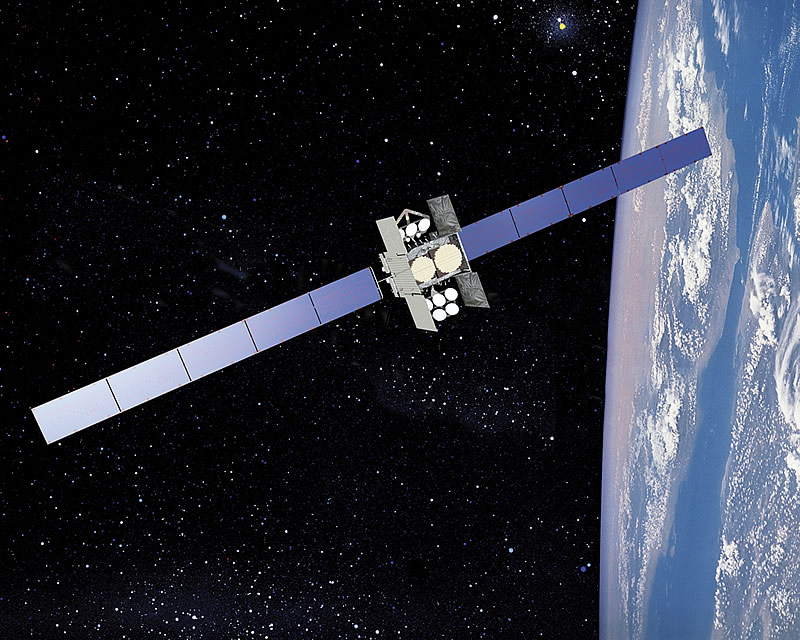
WGS is a set of 13-kilowatt spacecraft based on Boeing’s model 702 commercial satellite. These satellites will handle a significant portion of the USA’s warfighting bandwidth requirements, supporting tactical C4ISR(command, control, communications, and computers; intelligence, surveillance, and reconnaissance); battle management; and combat support needs. Upon its 2007 launch into geosynchronous orbit, WGS Flight 1 became the U.S. Department of Defense’s highest capacity communication satellite. WGS F4, launched in January 2012, offers further improvements, as do satellites from WGS F8. The constellation is set to grow to 10, including international participation.
This is DID’s FOCUS Article covering the WGS program’s specifications, budgets, travails, international partnerships, and contracts, with links to additional research materials.
WGS: Capabilities & Role
[youtube:http://www.youtube.com/watch?v=vcMIMRV23Qg]
(click for video)
The WGS constellation has limitations, as its wideband communications are “unprotected” against jamming and nuclear effects. This makes them less secure than programs like AEHF or the canceled T-SAT. On the other hand, WGS excels in 3 areas: bandwidth, coverage, and flexibility.
The WGS payload can filter and route 4.875 GHz of instantaneous bandwidth. Depending on the exact ground equipment and network settings, each satellite can support data transmission rates ranging from 2.1 to 3.6 Gbps – more than 10 times the communications capacity of the predecessor DSCS III satellite’s 0.25 Gbps. Indeed, just 1 WGS satellite provides more throughput than the entire Defense Service Communications Satellite (DSCS) constellation did before WGS F1 was launched.
Reconfigurable antennas and a digital channelizer allow WGS to tailor its coverage areas, and to connect X-band and Ka-band users anywhere within the satellite’s field of view. The WGS design includes 19 independent coverage areas that can be positioned throughout the field of view of each satellite. To accomplish this, it uses 8 steerable and shapeable X-band beams formed by separate transmit and receive phased arrays; 10 Ka-band beams served by independently steerable, diplexed antennas, including 3 with selectable RF polarization; and transmit/receive X-band Earth coverage beams. Within those limits, WGS’ digital channelizer divides the uplink bandwidth into nearly 1,900 independently routable 2.6 MHz subchannels, providing connectivity from any uplink coverage area to any downlink coverage area (including X and Ka band crossbanding). The channelizer supports multicast and broadcast services, and provides uplink spectrum monitoring to support network control.
A new channelizer in WGS F8-F10 looks set to increase that throughput, by removing the bottleneck in the satellite’s architecture and letting the birds take full advantage of their antennas. Instantaneously filtered and routed bandwidth rises to 190% vs. the 100% baseline for previous Block II satellites (about 9.25 GHz). Data capacity rises to 130% (up to 4.68 Gbps transmission rates) depending on loading, but exact system throughput is dependent on how the satellite is used. The number of independently routable 2.6MHz subchannels, including crossbanding, is expected to increase from 1,900 to approximately 3,200.
Boeing adds that:
“Despite all of its military features, WGS is substantially more cost-effective than leased commercial SATCOM bandwidth.”
It’s also more flexible. Unlike commercial services, WGS satellites can be repositioned in orbit to adapt to changing mission requirements.
WGS-4 and the Block II set will be similar to the 3 Block I satellites, but will include a switchable radio frequency bypass capability designed to support airborne intelligence, surveillance and reconnaissance platforms requiring additional bandwidth. The RF bypass will support data rates of up to 311 megabits per second, which is about 3x the rate of Block I birds, allowing platforms like the US Navy’s RQ-4N BAMS UAVs to rely on the WGS constellation for satellite control.
The U.S. MILSATCOM Joint Program Office (MJPO), Space and Missile Systems Center (SMC), is responsible for development, acquisition and sustainment of the WGS Program, which is a joint-service program funded by the US Air Force and Army. A total of 8 satellites are currently planned, augmenting X-band communications now provided by the Defense Satellite Communications System (DSCS) and one-way Ka-band service provided by the Global Broadcast Service (GBS). Additionally, WGS will provide a new 2-way Ka-band service.
Operation of WGS is a shared responsibility. Spacecraft platform control is accomplished by the 3rd Space Operations Squadron (3 SOPS) at Schriever AFB in Colorado Springs, CO, using WGS mission unique software and databases provided by Boeing, and hosted on the Command and Control Segment Consolidated (CCS-C) system fielded by Integral Systems, Inc. The satellite is designed for compatibility with current S-band capabilities, as well as the planned Unified S-band (USB) formats and frequencies. The Army controls the communications payloads and warfighter transmissions from 4 Wideband SATCOM Operations Centers (WSOCs) around the world, using ground equipment hardware and software developed by Boeing, ITT Industries, and Raytheon. Each Gapfiller Satellite Configuration and Control Element (GSCCE) has the capability to control up to 3 satellites at a time, via “in-band” (X-band or Ka-band) telemetry and command links.
The WGS Program & Schedule
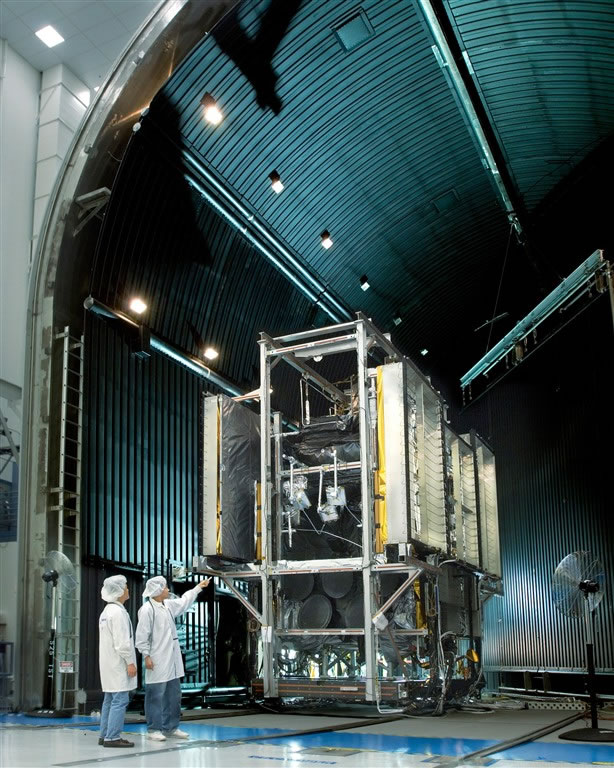
(click to view full)
The T-SAT Transformational Satellite Network that was originally intended to replace WGS, has been canceled. To address that gap, the US Department of Defense is buying AEHF-4 and 5 for secure communications, and will field a total of 10 WGS satellites, instead of just 3. The program has also become international. Australia bought WGS F6, and an international consortium led by Canada funded WGS F9, leaving 8 satellites to be funded by the USAF. Full members now include the USA, Australia, Canada, Denmark, the Netherlands, and New Zealand, all of whom have seats on a WGS partnership steering committee.
The program even received the Air Force’s John J. Welch Award for acquisition management in 2001 for its use of commercial approaches. On the whole, the end results mark WGS as an unquestioned success.
That doesn’t mean the program has been problem free. Far from it.
For starters, total program cost rose well beyond $1.8 billion, and the initial launch was pushed back almost 3 years.
Wideband Global SATCOM F1 was originally scheduled to be launched in 2004, to be followed by 2 more satellites launched on Delta IV and Atlas V Evolved Expendable Launch Vehicle (EELV) rockets. That schedule was pushed back to F1 launch in 2007, with F2 also intended to go aloft in 2007, and F3 scheduled for 2008.
WGS F1 actually launched in October 2007, and was placed into service over the Pacific Ocean region, but wasn’t declared operational until April 2008.
WGS F2 launched in April 2009. It’s in service over the Middle East.
WGS F3 had its schedule moved back several times; it was eventually launched in December 2009, and was declared operational in March 2010. Its operations cover Europe and Africa.
The WGS program’s design, integration and manufacturing issues stemmed from a number of causes. One was less-than-anticipated commercial demand for the base 702 satellite, which reduced the program’s expected ability to leverage commercial expertise and orders. A second problem arose after a launch date in December 2005 was scratched, in favor of a higher priority satellite. The delay was actually very fortunate, as subsequent checks found a widespread problem with fasteners in WGS F1. That manufacturing issue caused heavy slippage in the satellite’s launch date, and created an expensive production gap between satellites F3 and F4 until the USAF was satisfied that future satellites wouldn’t need all that rework.
The Block II contract called for the launch of F4 by the first quarter of 2011, and subsequent launches of F5 and F6 in 2012 and 2013 (moving the launch schedules back by about a year).
In reality, WGS F4 didn’t launch until January 2012. It was declared operational in August 2012, and covers the Indian Ocean Region.
WGS F5 lifted off in May 2013, and will cover the Americas once it’s operational.
WGS F6 lifted off in August 2013.
Satellite F7 is scheduled to launch in FY 2016, and F8 is scheduled for FY 2017.
Budgets & Participants
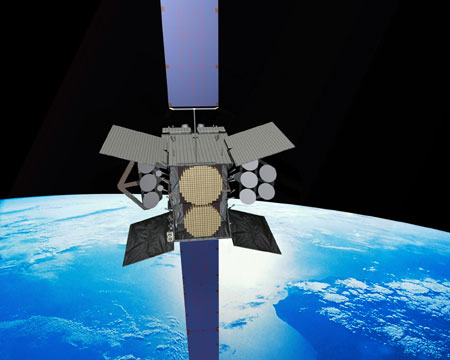
(click to view full)
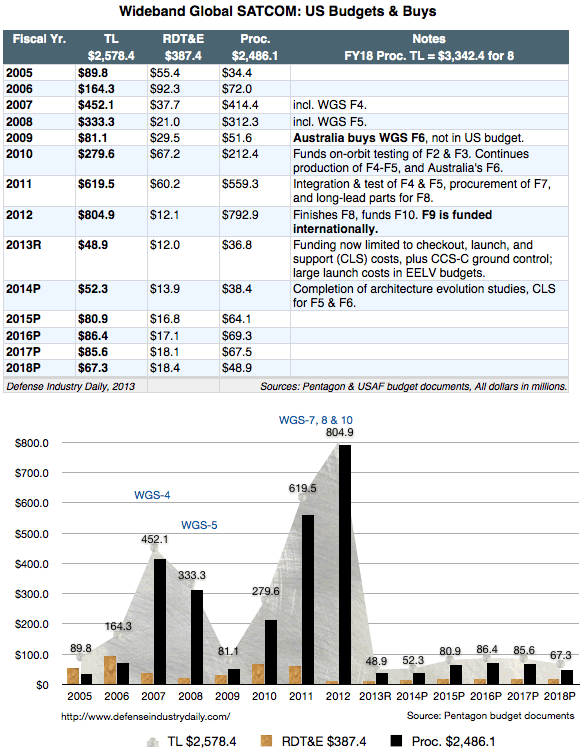
As one might guess, the program’s budget has grown in tandem with the constellation. WGS was originally envisaged as a US-only program, with an upper limit of $1.3 billion for 6 satellites. As of the FY 2014 budget, the American WGS program will involve about $3.35 billion in American procurement costs alone, for a constellation of 10 satellites: 8 paid for by the USA, and the other 2 paid for by international customers. Contributing countries can use any satellite in the constellation, within pre-arranged terms for bandwidth, access, etc.
That growth took place over time, but most of it came early. By December 2009, program costs in $FY01 had grown to $2.971 billion for 7 American satellites, owing in part to the costs and manufacturing delays mentioned above. New expenses included associated ground-based payload command and control systems, mission unique software and databases, satellite simulators, logistics support and operator training. When the 2012 budget added a 10th satellite to the constellation, the USA was committed to 8 birds.
According to US DoD documents, recent budget allocations to the program have included:
WGS Industrial Team

As the prime contractor and overall systems integrator, Boeing supplies the satellites, and also performs final satellite processing and preparations for launch, as well as initial orbital operations and on-orbit testing. Listed members of Boeing’s WGS team have included:
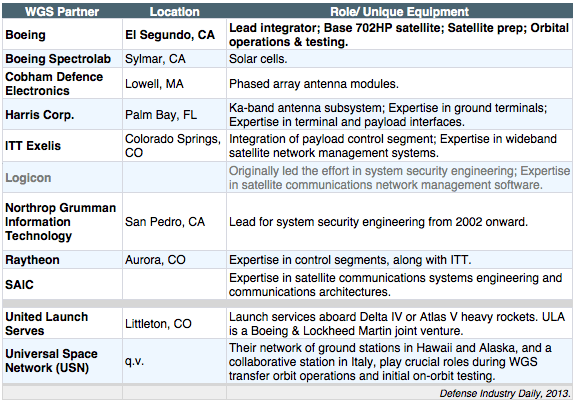
The internationalization of WGS is likely to add suppliers from those countries as well, in accordance with local industrial offset agreements.
WGS Program: Contracts & Key Events
FY 2018-2019
F5 and 6.
[youtube:v=PGroyYWuRzM]
click for video
April 23/19: 11th WGS Communication Space Vehicle Boeing won a $605 million modification for the production of the Air Force’s 11th Wideband Global Satellite (WGS) Communication Space Vehicle. The DoD uses the WGS system to communicate with warfighters across the globe. Ten Ka-band and 8 X-band beam can be positioned anywhere in the field of view of each satellite. WGS combines unique commercial spacecraft capabilities that Boeing has developed, including phased array antennas and digital signal processing technology, into a powerful, flexible architecture. United Launch Alliance ULA is scheduled to launch the 11th satellite aboard a Delta IV rocket in November 2023. Since 2001, Boeing has been the prime contractor of the WGS, which was first launched in 2008. GS 4, which was launched off in 2012, was the first Block II series. WGS-10 was meant to be the last of the constellation. But in March 2018, Congress added $600 million for the procurement of WGS-11 and WGS-12. Boeing will perform work under the modification in El Segundo, California and expects completion by November 20, 2023.
April 15/19: Poseidon’s SATCOM The Navy tapped Boeing with $93.6 million to supply eight Wideband Satellite Communication (SATCOM) kits for the P-8A Poseidon aircraft. The deal includes the manufacture as well as test, installation, integration and qualification of the kits. The Wideband Global SATCOM system or WGS is a high-capacity, high-speed SATCOM link that will augment and eventually replace Defense Satellite Communications System (DSCS) and Global Broadcast Service (GBS) satellites as soon as all six satellites are up and ready for use. The new technology provides increased capabilities for C4ISR, battle management, and combat support information purposes by improving satellite bandwidth and communication. The Navy uses The Boeing P-8 Poseidon aircraft, which will be receiving the upgrades, for anti-submarine warfare, anti-surface warfare, and blockade purposes. The aircraft includes electronic support measures to detect, locate, analyze, and intercept sources of electromagnetic energy, such as combat vehicles, ships, or aircraft, to protect from potential threats. Adding WGS will improve the P-8A’s ability to detect electromagnetic sources because it can recognize foreign frequencies that other satellite communications systems cannot detect. Boeing will perform work in Washington, Maryland, and Missouri and is expecting completion in April 2024.
November 28/18: Anti-jam Boeing is being contracted to support the DoD’s Protected Tactical Enterprise Service program. Awarded by the Space and Missile Systems Center, the $383 million contract provides for development of a ground system that protects tactical satellite communications from enemy jamming. The Protected Tactical Enterprise Service (PTES) will be a hub-and-spoke system that reaches out to tactical warfighters and uses the WGS constellation. It will tap the Protected Tactical Waveform (PTW), which the government developed to provide secure communications in a frequency-agnostic format. The US military relies on a complex set of Military Satellite Communication (MILSATCOM) and tactical networks. These networks transport command and control (C2), sensor, and intelligence, surveillance, and reconnaissance (ISR) information to enable timely and decisive operations. As electronic threats against satellite communication are rapidly advancing the US military needs more robust networks that allow its warfighters to securely and effectively communicate in the most congested electronic environments. Work will be performed at Boeing’s facility in El Segundo, California, and is expected to be completed by December 31, 2025.
November 23/18: Resilience Boeing is being contracted to increase resilience of the Wideband Global Satellite (WGS) communication system. The $14 million contract modification includes mitigation and anti-jam efforts and additional strings. The Wideband Global SATCOM satellite system is the successor to the Defense Satellite Communications System-III, and is the backbone of US military global satellite communications. The WGS constellation provides flexible, high-capacity high-data-rate and long-haul communications for the nation’s warfighters. Boeing’s experts will provide an X-Band anti-jam upgrade for the satellite constellation that increases resilience to unintentional and hostile electronic threats. Work will be performed at Boeing’s facilities in El Segundo, California and Colorado Springs, Colorado, and is expected to be completed by February 28, 2021.
FY 2013
Aug 7/13: F6 Launch. Australia’s WGS-6 successfully lifts off aboard a Delta IV medium+ (5,4) configuration rocket, which means a 5m diameter payload fairing, and 4 strap-on boosters. All 3 WGS Block II satellites have been launched using this configuration, and WGS payloads make up all 4 of the configuration’s launches to date. Unlike past launches, this one was funded entirely by Australia.
About an hour later, controllers confirmed that WGS-6 was functioning as expected. As usual, it’s going to be a few months before the satellite is in its final orbit, handed over, tested by both Boeing and the USAF, and declared operational. Current estimates are for full operational status in early 2014.
USAF SMC MILSATCOM director Dave Madden is quoted as saying that the satellite’s final coverage area isn’t finalized yet, but any area it picks will overlap one or more of the other satellites. It doesn’t really matter, since Australia has bought into service from the whole constellation, and Australia’s areas of interest are already covered by existing birds. Australia DoD | ULA | ATK | Boeing | Spaceflight Now.
WGS-6 launch
May 24/13: F5 launch. WGS-5 lifts off aboard a Delta IV heavy rocket. Subsequent reports reveal that this satellite will cover the Americas, completing the constellation’s initial global service.
This launch involved more work than usual, following the successful but low-performing GPS IIF-3 launch in October 2012. The United Launch Alliance, Pratt & Whitney Rocketdyne (PWR), and USAF had been working on their investigations, and they made a number of changes before ULA and the USAF would issue flight clearances. Engine testing replicated fuel leaks in the upper-stage RL10 engine, similar to those observed in the GPS IIF-3 launch. That led to a regime of extensive engine and launch-vehicle inspections. Launch vehicle hardware modifications include in-flight helium purges to critical areas. Operational changes include changes to how the engine is thermally conditioned in-flight post-boost, to prepare for the first engine start. They all seemed to work for this launch, but it will take a few launches to really be sure.
The satellite is fully launched, but it isn’t in its operational orbit yet. That process will take over a month of controlled burns, monitoring, and testing. ULA pre-launch | ULA post-launch | ATK | Boeing.
WGS-5 launch
April 10/13: FY 2014 Budget. The President releases a proposed budget at last, the latest in modern memory. The Senate and House were already working on budgets in his absence, but the Pentagon’s submission is actually important to proceedings going forward. See ongoing DID coverage.
For FY 2014, PE 0303600F (Wideband Global SATCOM (Space)) seems to disappear, but even a comparison of the corresponding 3020F line shows a sizeable drop of around $82.1 million in WGS procurement funding from FY 2013-2017. Launch costs fall under the EELV budget line, and the associated pre-launch delivery, post-launch checkout, and satellite sustainment costs don’t seem like a very flexible outlay. We asked USAF SMC for clarification, and they offered a reasonable explanation – but wow, $80 million over 4 years, in savings, from ONE program:
“The cost savings are a result of reduced level of Government Program Management and Administration effort required to manage and execute the Firm-Fixed Price contract for the acquisition of WGS satellites 7-10.”
FY 2012
Program goes multi-national; WGS-4 launched; WGS-8-10 contracts; WGS-10 lead items.
(click to view full)
July 27/12: WGS F10. Boeing Satellite Systems Inc. in El Segundo, CA received a $317.7 million contract modification to a previously awarded firm-fixed-price contract for WGS Satellite Vehicle 10 (SV10) production, processing, launch, and on-orbit activation.
This modification adds an additional satellite to the $1.1 billion WGS 7-9 contract (vid. Sept 1/11), but only 3 of those satellites were American, so from the Pentagon’s point of view, its terms didn’t change. Work will be performed in El Segundo, CA by March 31/18. As usual, the contract is managed by US Space & Missile Command at Los Angeles AFB, in El Segundo, CA (FA8808-10-C-0001, PZ0026). See also USAF | Boeing.
WGS-10
July 6/12: USAF Space Command announces a $111 million contract modification to Boeing Space and Intelligence Systems, to develop a better bandwidth channelizer for WGS F8 and F9. USAF officials say that it will improve overall bandwidth on each satellite by 90%, and add that its development was funded by savings from the WGS 7-9 block-buy contract.
A satellite bandwidth increase is an odd effect from a channelizer, which normally apportions satellite bandwidth among different channels. Some interesting channelizer development has been done in recent years by firms like RF Engines Ltd. and others, and the USAF saw an opportunity to remove the bandwidth bottleneck in WGS’ architecture. Which wasn’t the antenna, but the channelizer.
WGS 8-10, with the new channelizer, are still officially Block II satellites. Bandwidth rises to 190% of previous Block II satellites, data capacity rises to 130% (vs. the 100% baseline of previous Block IIs) depending on loading, but exact system throughput is dependent on how the satellite is used. The number of independently routable 2.6MHz sub-channels, including crossbanding, is expected to increase from 1,900 to approximately 3,200.
June 15/12: Lockheed Martin Integrated Systems, Inc. in Bethesda, MD receives a $10.7 million firm-fixed-price/ cost-plus-fixed-fee contract to operate, maintain, and sustain the Camp Parks Communication Annex site equipment. Camp Parks is 1 of 5 Automated Remote Tracking Stations (ARTS), with the mission control center located at nearby Onizuka Air Force Station in Sunnyvale, CA. The Camp Parks ARTS is used to test and analyze signals form communications and navigation satellites. It supports WGS satellite performance in orbit testing, payload characterization testing, and other satellite on-orbit ancillary tests as needed.
Work will be performed in Bethesda, MD. Work is to be completed by Nov 30/12. The SMC/PKJW at Los Angeles AFB, CA manages the contract (GSA-00-Q-09BGD0039/ FA8808-12-F-0001).
May 10/12: F10 lead in. Boeing Satellite Systems, Inc. in El Segundo, CA receives a $21 million firm-fixed-price contract to purchase parts for SV10, under the “Wideband Global SATCOM 7 & Beyond” contract. The life size Buzz Lightyear action figure is presumably thrown in for free, though it may be interesting to see who gets it; WGS-10 was paid for by a consortium of countries (vid. Jan 17/12).
Work will be performed Palm Bay, FL and El Segundo, CA,and is to be complete by June 2012. USAF SMC HQ / PKJW in El Segundo, CA manages the contract (FA8808-10-C-0001, PO 0031).
April 12/12: Boeing announces that the USAF has accepted control of WGS F4, after several weeks of rigorous on-orbit tests from Boeing’s Mission Control Center in El Segundo, CA, and from “government facilities in central California.” Air Force operations personnel at Schriever AFB, CO are conducting additional tests, and preparing to move WGS-4 into its operational position so it can go into service this summer.
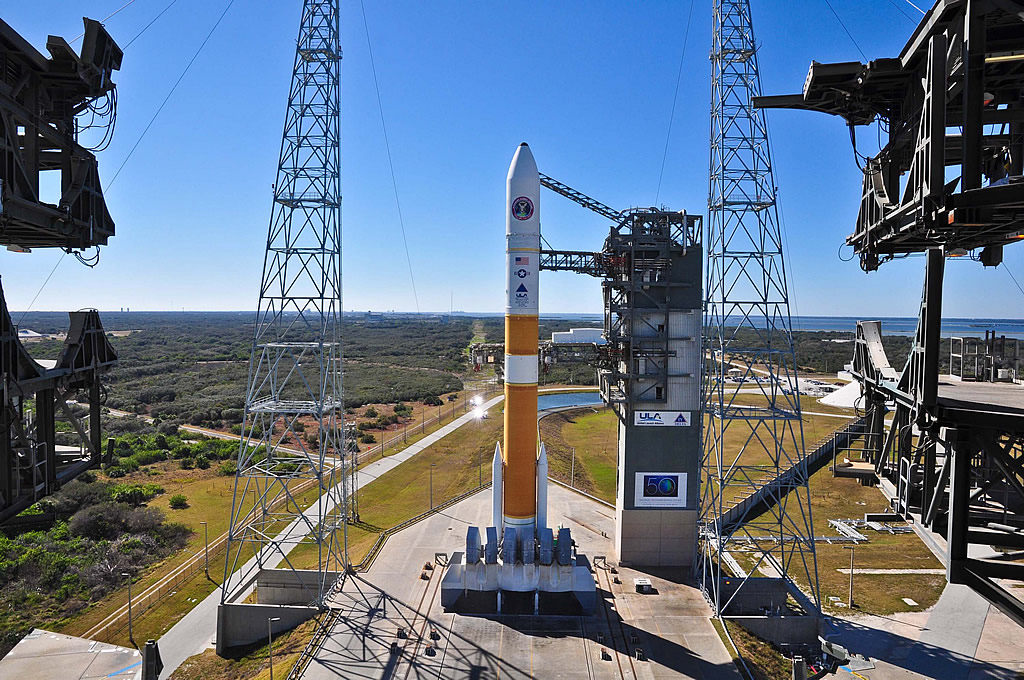
Jan 19/12: F4 launch. The 1st Block II satellite, WGS-4, successfully blasts off from Cape Canaveral aboard a Delta IV Medium-plus. It then sends signals from space, indicating readiness for on-orbit testing. So far, WGS 1 & 2 have launched on Atlas V EELV rockets, while 3 & 4 launched on Delta IVs.
WGS-4 used a ULA single common booster core powered by a Pratt & Whitney Rocketdyne RS-68 main engine, along with 4 ATK GEM 60 solid rocket motors. The 5m diameter upper stage was powered by a PWR RL10B-2 engine, with the satellite encapsulated in a 5m diameter composite payload fairing. ULA | Boeing | Boeing post-launch | ATK | America Space.
WGS-4 launch
Jan 17/12: WGS International. At the Canadian Embassy press conference in Washington, USAF deputy undersecretary for international affairs Heidi Grant announces that Canada won’t be alone. All together, Canada, Denmark, Luxembourg, the Netherlands and New Zealand have agreed to contribute $620 million toward development and launch of a 9th WGS satellite, in return for access to the system.
As noted below, Canada is investing the lion’s share, at $333 million. New Zealand is investing NZ$ 83.2 million [$66.5 million] over 20 years, which compares favorably to the current model of $NZ 4.3m per year, growing at about 10% per year, for 1/20th of the bandwidth. Australia’s experience has shown (vid. Aug 30/11 entry) that participation in WGS also entails changes to ground and receiving infrastructure. The Canadian Forces are defining requirements and preparing a separate tender for that, and the other countries involved will be doing likewise.
American officials said that they are open to negotiating the entry of new members, but said there were no specific expansion plans at the moment. USAF | New Zealand government | NextGov | Reuters | TMCNet.
WGS-9 international
Jan 17/12: Canada joins. Canada announces that it’s joining the WGS program, which will be known to DND as the Mercury Global project. DND currently pays about C$ 25 million per year to commercial providers, and was expecting those costs to rise over the next 20 years. As battlefield bandwidth demands continue to grow, it remains to be seen whether WGS will be able to serve as a full substitute for commercial providers.
“By signing the WGS Memorandum of Understanding, Canada joins allies such as Australia, Denmark, Luxembourg, the Netherlands, New Zealand, and the United States. In exchange for a contribution of [C$] 337.3 million [DID: about $333 million], the CF will obtain approximately 20 years of access to reserved frequencies for military communications systems in theatres of operation across the globe. This cost is approximately [C$] 140 million less than what was approved by the Order in Council in October 2011… The signing of the MOU will provide funding for the construction of a ninth satellite.”
Canada’s IRB industrial offsets policy applies to this buy, but it’s a bit more complicated than usual. Boeing, Canada’s largest aerospace firm, must place activities in Canada equal to the standard 100% of Boeing’s C$ 240 million share. Since the WGS agreement was a direct government-to-government MoU, the Boeing agreement is a separate document. That document also commits Boeing to provide 20% of that C$ 240 million in “direct and/or global value chain business activities” involving Canada’s space sector, and a possibly-overlapping 10% with Canadian small and medium-sized businesses. Canada DND.
Canada joins
Jan 12/12: F9 contract. Boeing Satellite Systems, Inc. in El Segundo, CA receives a $376.5 million firm-fixed-price contract modification of the Wideband Global SATCOM (WGS) Block II follow-on contract, “exercising the option to produce, process, launch, and activate on-orbit WGS F9.” Per the pattern for WGS F8 (vid. Dec 16/11), it’s part of the $1.1 billion maximum contract announced on Sept 1/11, rather than being extra monies on top of that figure. Later events reveal that most of the satellite’s cost is paid for by Canada.
Boeing’s own release describes it as a production option to make WGS F8, and authorization to produce F9 through a cooperative agreement with Canada, Denmark, the Netherlands, Luxembourg and New Zealand. They value the WGS-9 authorization and the WGS-8 production option at a combined $673 million, as part of the $1.09 billion umbrella contract announced in September 2011.
Work will be performed in Fort Worth, TX, and is expected to be complete by May 2013. The USAF SMC/PKJW in El Segundo, CA manages the contract (FA8808-10-C-001, PO 0020).
WGS-9 option
Dec 30/11: Boeing Satellite Systems in El Segundo, CA, is being awarded a $9.5 million cost-plus-fixed-fee contract modification. It pays for a study around upgrading the Wideband Global SATCOM Block II’s digital channelizer, as part of ongoing modernizations. This is normal for very expensive platforms that take a long time to build. Just because 2 satellites are “Block II” doesn’t always mean they’re the same, just as 2 Nimitz Class aircraft carriers can be very different under the skin.
Work will be performed in El Segundo, CA, and is expected to be complete on Jan 1/12 – which implies that the study is already done. The USAF SMC/PKJW in El Segundo, CA manages the contract (FA8808-10-C-0001, PO 0021).
Dec 16/11: F8 contract. Boeing Satellite Systems in El Segundo, CA receives a $296.1 million firm-fixed-price contract modification for WGS F8, as part of the Block II satellite follow-on. “The contract exercises the option to produce, process, launch, and activate on-orbit Satellite Vehicle Eight as previously negotiated.” Work will be performed in El Segundo, CA, and is expected to be complete by July 31/16. This was a sole-source acquisition by SMC/PKJW in El Segundo, CA (FA8808-10-C-001, PO 0018). See also USAF.
When queried, Boeing spokespeople explained that:
“Today’s authorization is one of those options on the [Sept 1/11] contract [clarified: and is part of that announced $1.1 billion rather than an addition to it]… The Block II satellites feature a switchable radio frequency bypass that enables the transmission of airborne intelligence, surveillance and reconnaissance imagery at data rates approximately three times greater than the rates available on Block I satellites.”
WGS-8 option
Dec 15/11: Engineers complete the Delta IV rocket encapsulation procedure for WGS F4, at the Astrotech Space Operations facility in Titusville, FL. The event marks completion of Air Force Satellite Control Network compatibility testing, payload and bus functional testing and propellant load. The launch is scheduled for Jan 19/12, which is about a year after the original plan. USAF.
Dec 7/11: ITT Systems Corp. in Colorado Springs, CO won a $121.3 million multi-year, cost-plus-fixed-fee contract “for the services in support of the [WGS] missions identified in the Operational Management System.”
Work will be performed in Colorado Springs, CO; Fort Meade, MD; Fort Detrick, MD; Wahiawa, Hawaii; Landstuhl, Germany; Okinawa, Japan; Fort Gordon, GA; MacDill Air Force Base, FL; and Canberra, Australia, and will run until Jan 31/19. The bid was solicited through the Internet, with 3 bids received by the US Army Space and Missile Defense Command at Peterson AFB, CO (W91260-12-C-0001).
Nov 28/11: F5 launch contract. United Launch Services, LLC in Littleton, CO receives a $150 million unfinalized firm-fixed-price contract, for launch services in support of WGS F5, using their roster of EELV rockets. WGS uses the medium-heavy lift Delta IV or Atlas V. The USAF Space and Missile Systems Center in El Segundo, CA manages the contract (FA8811-11-C-0001).
Nov 17/11: Boeing begins shipping WGS-4 to Cape Canaveral, FL, in preparation for a January 2012 launch. The first Block II WGS satellite flew to Florida aboard a C-5 transport plane.
Oct 28/11: Canada, eh? Canada could also be set to join WGS, and may spend as much as $477 million to participate. The Conservative majority government has given Cabinet approval up to that sum, which means it’s a done deal if it stays within those costs. DND spokesman Daniel Bouin:
“After Afghanistan and Libya, our efforts in those two countries have proven that the exchange of information between headquarters and deployed elements is critical to modern military operations and their success. So, in order to meet that intent while ensuring good value for taxpayer money, we’re seeking out an agreement with international allies that will provide Canadian forces with access to an international constellation of satellites.”
U.S. deputy assistant secretary of defense for space policy, Gregory Schulte, reportedly said on Oct 4/11 that the USAF was in the final phases of developing similar WGS arrangements with several other allies. Canada is also looking to field a 2-satellite “Polar Communications and Weather Mission” constellation of their own, to cover the High Arctic where WGS doesn’t reach. Canada’s Postmedia | Satellite Today.
Oct 11/11: More countries in? Reports surface that The Netherlands is one of several US allies getting ready to join the WGS program, in order to provide more bandwidth for their military forces. By 2018, the WGS program could have 9 satellites in orbit to provide global coverage, serving the USA, Australia, Canada, Denmark, Luxembourg and New Zealand. Aviation Week | Defense Systems.
FY 2011
WGS 7-9 umbrella contract; Australian ancillaries.
(click to view full)
Sept 1/11: F7-F9 umbrella. Boeing Satellite Systems, Inc. of El Segundo, CA receives a maximum $1.1 billion firm-fixed-price contract modification to allow production of WGS Satellite Vehicle F7 (See also Aug 19/10 entry), as well as advance procurement for Satellite Vehicle F8, per the program changes announced in the April 1/10 Selected Acquisitions Report. Finally, this contract includes options to produce, process, and launch and activate F8 and F9 on-orbit.
The SMC/PKJW in El Segundo, CA issued the contract (FA8808-10-C-0001, PO 0006). See also USAF | Boeing.
Contract, incl. WGS-7 option
Aug 30/11: Australian ancillaries. The Australian Government agrees to first pass approval for Joint Project 2008 Phase 5B, which will buy transportable land terminals to equip the Army, upgrades of the satellite communications fit on Royal Australian Navy platforms, and the establishment of a satellite communications network management system.
The total cost of Joint Project 2008 Phase 5B is cost capped between A$ 300-500 million (currently $320-535 million) in the Public Defence Capability Plan. Initial funding of A$ 12 million has been approved for project development and risk mitigation studies, which must happen between 1st and 2nd pass approval. Studies will include the potential upgrade of the Geraldton ground station, and construction of a new ground station facility in Eastern Australia. Australian DoD.
Australian ancillaries
April 20/11: The USAF says that WGS is proving very helpful in coordinating post-tsunami Japan relief efforts. Ka-band is reserved for emergency use in Japan, and such satellite signals are not allowed. Instead, they’re using WGS X-band transmissions, and using the satellite’s crosslinking capability to transmit to Ka-band receivers outside the region.
Dec 8/10: Boeing Satellite Systems Inc. in El Segundo, CA receives a $6 million contract modification to purchase a spare battery for WGS Block II satellites 5 & 6, or as a test battery for the Block II follow on contract, depending on things like satellites meeting launch schedules, discovering anomalies that would require a battery swap-out, etc. At this time, the entire amount has been committed by the SMC/PKJ at Los Angeles AFB, CA (FA8808-06-C-0001; P00094).
Dec 8/10: Boeing Satellite Systems Inc. in El Segundo, CA received a $26.4 million contract modification, exercising the option for WGS-6 launch services. This option modification is fully funded by the Australian government, and the entire amount has been committed. The SMC/MC in El Segundo, CA manages the contract (FA8808-06-C-0001; P00109).
FY 2010
WGS-3 launched; WGS Block I (F1-F3) all on station; WGS-7 lead-in; SAR officially grows program to 8.
Aug 19/10: F7 lead-in. Boeing Satellite Systems in El Segundo, CA receives a $182.2 million contract “which will provide the necessary items to begin production of Wideband Global SATCOM Satellite 7.” At this time, $164.4 million has been committed by the MCSW/PK at Los Angeles Air Force Base, CA (FA8808-10-C-0001). See also Reuters.
Aug 2/10: WGS Block I on-station. WGS-3 enters formal service with the U.S. Air Force. The first 2 WGS satellites are operating over the Pacific Ocean and Middle East, respectively, while WGS-3 is located over the Atlantic Ocean. This completes the WGS Block I network. Boeing | SatNews Daily | StrategyPage.
June 25/10: Boeing Satellite Systems, Inc. in El Segundo, CA receives a $6.8 million contract modification, which pays for additional on-ground testing thermal vacuum tests of the first WGS Block II satellite, SV4. At this time, the entire amount has been committed by HQ SMC/MCSW/PK in El Segundo, CA (FA8808-06-C-0001/ P00090).
June 25/10: The USAF announces that U.S. Strategic Command has accepted operational command and control of WGS-3.
WGS-3 is operated by the 3rd Space Operations Squadron at the 50th Space Wing in Schriever Air Force Base, CO. It’s under the operational command of the Joint Forces Component Commander for Space at Vandenberg Air Force Base, CA, where the JFCC SPACE Joint Space Operations Center continuously monitors WGS-3’s orbital safety and operational status.
May 25/10: Northrop Grumman announces the last flight test of the 1st airborne Ka-based satellite terminal for use with the WGS system. The flight test used the communications terminal system installed on a modified business jet aircraft to connect with a WGS via the Ka-band link. The test is the 2nd of 3 phases required to certify the airborne communications system for WGS operations. Northrop Grumman is performing the certification under the Multi-Role Tactical Common Data Link (MR-TCDL) Developmental and Operational Test program contract.
April 1/10: The Pentagon releases its April 2010 Selected Acquisitions Report, covering major program changes up to December 2009. WGS qualifies as a full breach under Nunn-McCurdy Legislation, as the program rises to 8 satellites and deals with its issues:
“WGS (Wideband Global Satellite Communications) – The APUC (Average Procurement Unit Cost) increased 27.2% to the current APB and 39.5% to the original APB. The original WGS acquisition strategy, approved in June 2000, called for a commercial-like Firm Fixed Price (FFP) competitively awarded contract with options for six satellites. The original program was baselined for 3 satellites assuming commercial pricing. At the time of the original WGS 1-6 contract award, a strong commercial market for wideband communication satellites was expected. Production options for WGS 1-3 were exercised, and the first satellite launched on October 10, 2007. Due to limited resources and other priorities, the contract options for satellites 4-6 were not exercised before they expired.
Subsequent decisions resulted in the department deciding to award another contract for WGS 4-6 Advanced Procurement and Production. A production break of approximately three years was introduced between WGS 3 and WGS 4. Further, following the acquisition of WGS 1-3, the commercial communication satellite market took a significant downturn, and the WGS X-band phased array transmit and receive system and digital channelizer capability were no longer available commercially. More recently, the department directed the procurement of additional satellite vehicles to support and maintain an eight satellite constellation. These satellites will follow a second break in production estimated at two years which will require re-establishing the supplier and contractor base and addressing issues with parts obsolescence.”
Officially, the accompanying PDF table lists WGS as having only 7 satellites, even though the test (and US FY 2011 budget documents) says 8. Total cost is now pegged at $2.971 billion in $FY01, or $3.441 billion in “then year” dollars (expected dollars actually paid, including inflation).
WGS expands
March 1/10: The USAF accepts control of the 3rd WGS satellite, after the satellite passed several weeks of on-orbit tests. WGS-3 completes the initial WGS constellation, and will be followed by 3 more WGS satellites under Block II of its USAF contract. Boeing release
Jan 29/10: Boeing Satellite Systems in El Segundo, CA received a $21 million change order to the Wideband Global Satellite Communications (WGS) program to integrate, test, and store the 1.5 ship-sets of xenon-ion propulsion system (XIPS) hardware procured. The XIPS is used to maneuver the satellite into its orbit and to change the satellite’s location if necessary. At this time, $14 million has been obligated. MCSW/PKW in El Segundo, CA manages the contract (FA8808-06-C-0001, P00070).
December 2009: Boeing integrates the WGS-4 payload module with a high-power Boeing 702 platform at the company’s Satellite Development Center in El Segundo, CA. WGS-4 is the first of 3 satellites to be built under the Block II contract, adding features like a radio frequency bypass designed to support airborne intelligence, surveillance and reconnaissance platforms requiring additional bandwidth. Over the next few months, the WGS team will conduct final integration activities followed by rigorous environmental testing, including vibration and thermal-vacuum tests.
WGS-1 and WGS-2, launched in October 2007 and April 2009, are already in service. WGS-3 was launched in December 2009. Boeing release.
Dec 5/09: F3 launch. After a Dec 2/09 launch was canceled for inclement weather and a Dec 3/09 launch was scrubbed due to a ground system fault, a United Launch Alliance Delta IV rocket lifted off from its Cape Canaveral Space Launch Complex-37 launch pad at 8:47 p.m. EST, with WGS-3 on board. It was the 36th successful ULA mission in 36 months. Boeing later reported that the satellite had checked out, and sent the first signals from space. Following a series of orbital maneuvers and on-orbit tests over the West Coast of the United States, WGS-3 will be placed into geosynchronous Earth orbit over the Atlantic Ocean.
The satellite joins WGS-1, which entered service over the Pacific Ocean in April 2008, and WGS-2, which began operations over the Middle East in August 2009. Both had been launched by the ULA’s Atlas V rockets. NASA Spaceflight mission overview | ULA Mission Overview [PDF] | Boeing.
WGS-3 launch
FY 2009
Australia buy WGS-6; WGS-2 launched; WGS-3 stored.

(click to view full)
Sept 14/09: Boeing Satellite Systems, Inc. in El Segundo, CA received a $6.5 million contract to store the 3rd Wideband Global Satellite. Obviously, satellite storage carries very stringent environmental and security requirements, above and beyond normal warehousing. At this time the entire amount has been obligated by the SMC/MCSW/PK at HQ Space and Missile Command in El Segundo, CA (F04601-00-C-0011, P00190).
WGS F3 was originally intended for launch in 2008. Current plans call for a mid-November 2009 launch, on board a Delta IV EELV rocket, from Cape Canaveral, FL.
June 15/09: Following an on-orbit checkout, Boeing successfully transfers control of WGS-2 to the U.S. Air Force, which will monitor and control the new satellite from Schriever Air Force Base, CO. Boeing release.
May 28/09: A $6.3 million contract modification for Boeing Satellite Systems, Inc. of El Segundo, CA, exercising the 3rd 3-month storage option for WGS-3. At this time, the entire amount has been committed by HQ Space and Missile Command in El Segundo, CA (F04701-00-C-0011, P00182).
Spaceflight Now indicates that the Delta 4 launch of WGS-3 has no fixed date, but is expected in late summer or early fall 2009.
April 7/09: Boeing Satellite Systems in El Segundo, CA receives an estimated $8.1 million modification to a fixed price incentive contract to provide sustaining engineering for Post-Initial Operational Capability (IOC) of WGS-2. At this time, the entire amount has been committed by the Space and Missile Systems Center at Los Angeles Air Force Base, CA (FA8808-06C-0001, P00044).
April 3/09: F2 launch. A United Launch Alliance Atlas V rocket carries WGS-2 into orbit from Cape Canaveral Air Force Base. A ground station in Dongara, Australia, receives the satellite’s first signals 44 minutes later, at 9:15 p.m. Eastern time, and Boeing controllers in El Segundo, CA confirmed that the satellite is functioning normally. Boeing.
WGS-2 launch
March 17/09: WGS-2’s launch is scrubbed, when an anomalous leak rate was detected in the Centaur upper stage oxidizer valve. A follow-on review of the time needed to inspect the Atlas V rocket, fix the identified problem and prepare for a rescheduled attempt revealed it could not take place prior to the Delta II launch date on March 24/09, so the schedule will be moved back beyond that. That date was later set for March 31st, but the satellite ended up launching on April 3rd.
Feb 25/09: Boeing Satellite Systems of El Segundo, CA receives a not-to-exceed $8 million change order modification. This contract will purchase Thermal Cycling Testing on the solar panel arrays of the WGS-2 and WGS-3 Block I satellites. At this time, $6 million has been committed. The Military Satellite Communications Systems Wing HQ in El Segundo, CA manages this contract (F04701-00-C-0011, 00172).
Dec 17/08: Australia buys F6. Contract for US/Aussie WGS-6. The USAF modifies a fixed-price incentive contract to Boeing Satellite Systems, Incorporated in El Segundo, CA, adding $233.9 million by exercising the option for WGS satellite #6. At this time, the entire amount has been committed. SMC/MCSW, Los Angeles Air Force Base, CA manages the contract (FA8808-06-C-0001, P00036).
With this authorization, Boeing is now fully funded for the production of all 3 WGS Block II satellites, and is on track to deliver the first in this new series in 2011.
See also Boeing’s release, the Dec 21/07 long lead time materials order below, and the Nov 14/07 agreement regarding this joint US/Australian satellite.
Australia buys WGS-6
FY 2008
WGS-1 operational; Australia joins; WGS-5 bought; WGS-6 lead-in.

(click to view full)
April 16/08: Operational. The first Wideband Global SATCOM Satellite is declared operational. US Army release | Boeing release.
April 11/08: Fast acceptance. Air Force Gen. C. Robert Kehler, commander, Air Force Space Command; and Army Lt. Gen. Kevin T. Campbell, commander of the Army Space and Missile Defense Command/Army Forces Strategic Command at Redstone Arsenal, AL, sign a memorandum at Peterson Air Force Base, CO. It recommends that USSTRATCOM accept of command and control of the first Wideband Global SATCOM satellite ahead of schedule. Source.
Dec 21/07: F5 contract. Boeing Satellite Systems, Inc. of El Segundo, CA received a firm-fixed-price contract for $229.7 million, exercising an option to build WGS satellite #5. This includes the contract requirement to increase the target price due to changes in the foreign currency exchange rate. At this time $510.5 million has been obligated. HQ, Military Satellite Communications Systems Wing at Los Angeles Air Force Base, CA issued the contract (FA8808-06C-0001, P00018).
WGS-5 option
Dec 21/07: F6 lead-in. Boeing Satellite Systems, Inc. of El Segundo, CA receives a firm-fixed-price contract for $51.7 million, exercising an option to begin advance materials procurement for WGS-6 and begin construction. HQ Military Satellite Communications Systems Wing at Los Angeles Air Force Base, CA issued the contract (FA8808-06-C-0001, P00019).
The Commonwealth of Australia is funding the procurement as part of a cooperative agreement between the U.S. and Australian governments. See also Boeing release
Nov 14/07: Australia joins. A memorandum of understanding signed by the US and Australian governments formally adds Australian Defence Force access to WGS services worldwide in exchange for funding the constellation’s 6th satellite.
The 6th WGS satellite, a Block II version, will carry the radio frequency (RF) bypass capability designed to support airborne intelligence, surveillance and reconnaissance platforms requiring additional bandwidth. The RF bypass supports data rates of up to 311 Megabits per second, more than 200 times faster than most cable or DSL connections. WGS-6 is expected to launch in the fourth quarter of 2012.Source.
Australia on board
Oct 10/07: F1 launch. WGS-1 is successfully launched at 8:22 p.m. Eastern (ZULU -0500) by a United Launch Alliance Atlas V vehicle from Cape Canaveral Air Force Base, FL. Following a nominal 45-minute flight, the launch vehicle’s upper stage deployed the spacecraft, and a ground station in Dongara, Australia received the satellite’s first signals 47 minutes later at 9:09 p.m. Eastern. Boeing controllers in El Segundo, CA confirmed that the satellite is healthy, and the firm has acquired signals from the first Wideband Global SATCOM (WGS) satellite. Boeing release.
WGS-1 launch
Oct 3/07: Australia. Australia’s Minister for Defence announces that the Australian Government will enter into an A$ 927 million partnership (about $820 million) with the United States to become part of the new Wideband Global Satellite Communications (WGS) constellation. Dr. Brendan Nelson says that “I expect to finalise the arrangement through the signing of a government-to-government Memorandum of Understanding shortly after the 30 day US Congressional Notification Period.”
Under this arrangement, Australia will fund one satellite plus associated ground infrastructure, extending the constellation to 6 satellites. In return, they will receive global coverage from WGS, which will become the backbone of their military satellite communications capability. Minister Nelson’s release states that WGS “will comfortably handle the increase in ADF communications requirements… out to at least 2024.”
Achieving full operational WGS capability by 2013 will coincide with the predicted capability drawdown of the SingTel/Optus C1 satellite. The SingTel/Optus C1 satellite will remain an important element of Australia’s satellite capability until it fails, and will be maintained in parallel with WGS. DoD Ministerial release.
FY 2007
WGS 4-6 umbrella contract; WGS 4 bought.
June 26/07: Integral Systems, Inc. in Lanham, MD received a $5.8 million cost-plus-award-fee contract modification. It modifies the Command and Control System-Consolidated (CCS-C) effort to support the Wideband Gapfiller Satellite (WGS) Program Operations Readiness, add training, and incorporate changes to the system/Subsystem Specification (SSS) to clarify development requirements for the Advanced Extremely High Frequency (AEHF) satellite program.
The CCS-C program provides an upgraded capability to command and control the Air Force’s communication satellites, including the Defense Satellite Communication System, Milstar, Advanced Extremely High Frequency, and Wideband Gapfiller Satellites. At this time, $2 million has been obligated, and work will be complete in June 2010. The Headquarters Military Satellite Communications Systems Wing in Los Angeles Air Force Base, CA issued the contract (F04701-01-C-0012/P00118).
June 5/07: Boeing announces that they have successfully completed end-to-end testing of the Boeing/ITT WGS payload command and control system, paving the way for the launch of the first WGS satellite in the summer of 2007. Three years late, and over budget by more than 33%, but apparently ready at last. The tests also demonstrated a unique design feature of the WGS system, allowing both U.S. Air Force and Army operators to control the payload via separate S-band and in-band (X or Ka-band) radio frequency links for greater operational flexibility and redundancy.
During the tests, the newly-installed WGS ground station equipment at the Camp Roberts Wideband Satellite Communications Operations Center in Paso Robles, CA communicated with a WGS satellite located at Boeing’s El Segundo, CA satellite factory, successfully routing operational commands through the Satellite Operations Center at Schriever Air Force Base, CO and a U.S. Air Force satellite control network connection at Kirtland Air Force Base, NM. Boeing release.
April 24/07: Boeing Satellite Systems Inc. in El Segundo, CA received a $27 million fixed-price-incentive contract modification. This action provides for two priced for Military Satellite Communications Systems Wing WGS Vehicle F4: 1) Launch Services and 2) Astrotech Launch Site Processing Facilities. At this time, no funds have been obligated. Work will be complete in September 2011. The Headquarters Military Satellite Communications Systems Wing, Los Angeles Air Force Base, CA issued the contract (FA8808-06-C-0001/P00009).
Nov 2/06: F4 contract. Boeing Satellite Systems Inc. in El Segundo, CA received a $299.9 million fixed-price-incentive contract modification, exercising an option for the production of Wideband Global SATCOM (WGS) Space Vehicle F4. At this time, total funds have been obligated. Work will be complete March 2011. The Headquarters Military Satellite Communications Systems Wing at Los Angeles Air Force Base, CA issued the contract (FA8808-06-C-0001/P00004). See also Boeing’s press release.
WGS-4 option
Oct 18/06: F4-F6 umbrella. Boeing and the U.S. Air Force MILSATCOM Systems Wing have signed a $1.067 billion contract for up to three more Wideband Global SATCOM satellites (WGS), if all options are exercised. The Block II satellites will be similar to the three Block I satellites already in production, but Boeing will add a radio frequency bypass capability designed to support airborne intelligence, surveillance and reconnaissance platforms requiring ultra-high bandwidth and data rates demanded by unmanned aerial vehicles.
The new Block II contract also gives the USAF the flexibility to independently exercise options for long-lead material, production and launch services for WGS F4 through F6. In February 2006, the Air Force authorized Boeing to begin non-recurring engineering and advanced procurement of parts for the fourth WGS satellite. At the time of this release Boeing anticipates Air Force authorization to proceed with full production of WGS F4 and to begin long-lead work for F5 by the end of 2006. See Boeing press release.
Contract
FY 2006
WGS-4 lead-in; Program delays.
Sept 26/06: Boeing announces the completion of Spacecraft Thermal Vacuum (SCTV) testing for the first of its Wideband Global SATCOM (WGS) satellites. The tests, conducted over two months at the Boeing Satellite Development Center in El Segundo, CA, evaluated the WGS operating systems’ ability to withstand the extreme vacuum and hot and cold temperatures of space. See Boeing release.
July 27/06: The Boeing-led team announces that its WGS program has successfully completed 2 more key space-to-ground compatibility tests with partners Universal Space Network (USN) and ITT Industries. The joint tests were conducted at the Boeing Satellite Development Center in El Segundo, CA, in order to test interoperability between the satellite and two key ground control systems.
Boeing and USN demonstrated the compatibility between the satellite’s telemetry, command and ranging systems and USN’s ground network which controls the satellites. USN’s network of ground stations in Hawaii, Alaska and a collaborative station in Italy will play crucial roles during WGS transfer orbit operations and initial on-orbit testing.
Boeing also verified telemetry and command interface compatibility between the satellite and the Gapfiller Satellite Configuration and Control Element (GSCCE). The GSCCE payload control system, designed by Boeing and ITT Industries, will be fielded at Wideband Satellite Communications Operations Centers around the world. The tests confirmed the system’s ability to properly configure the digital channelizer and the X-band phased array antennas, which are key elements of the WGS communications payload. See Boeing release.
June 1/06: The 1st of 3 Wideband Gapfiller Satellites (WGS) successfully completes key dynamic environmental tests to confirm the spacecraft’s structural design and mechanical integrity. See Boeing release.
Feb 17/06: F4 lead-in. Boeing Satellite Systems Inc. in El Segundo, CA received a $148.2 million firm-fixed incentive with firm-target contract to begin work on the fourth WGS satellite. As part of the non-recurring engineering effort, Boeing Satellite Systems will be addressing spacecraft hardware obsolescence issues through the implementation of alternative components or designs, or selection of new suppliers. They’ll also be handling advance procurement of long-lead-time parts for the manufacture of WGS #4. Solicitations began December 2005, negotiations were complete in February 2006, and work will be complete by July 2007. The Headquarters Space and Missile Systems Center at Los Angeles Air Force Base, CA issued the contract (FA8808-06-C-0001).
Nov 18/05: Boeing Satellite Systems in Los Angeles, CA received a $7.6 million firm-fixed-price contract modification to add Pedigree Reviews of Wideband Gapfiller Satellites (WGS) F1, F2 and F3. The Pedigree Review rigorously audits all critical components and subsystems, and is designed to help ensure that the satellite will work in the “one chance to get it right” environment that characterizes space-based equipment. The Headquarters Space and Missile Systems Center, Los Angeles Air Force Base, CA issued the contract (F04701-00-C-0011/P00112).
FY 2001 – 2005
Boeing wins competition; WGS 1-3 bought.
June 9/05: Boeing Satellite Systems in Los Angeles, CA received a $6.5 million firm-fixed-price contract modification authorizing Satellite 3 launch services to provide launch support and early operations, including orbit-raising on-orbit checkout for Wideband Gapfiller Satellite Flight 3. Boeing Satellite Systems will accomplish this work at their El Segundo, CA facility, Cape Canaveral Air Force Base, FL, and at other locations as required. This contract action will not lengthen the period of performance beyond the current overall period of performance on contract, and work will be complete by January 2007. The Headquarters Space and Missile Systems Center at Los Angeles Air Force Base, CA issued the contract (F04701-00-C-0011, P00105).
Dec 20/02: F3 contract. The Boeing-led team is awarded a contract option to build a third WGS satellite. With the current option for the WGS F3 satellite, Boeing lists the total value of the WGS program contract at approximately $660 million. See Boeing release.
March 6/02: F1-F2 contract. Boeing’s team receives $336.4 million to build the first two satellites in the Wideband Gapfiller Satellite (WGS) system. The contract also includes long-lead material for a third satellite. See Boeing release.
Contracts
Aug 20/01: PDR. The Boeing-led team announces successful completion of a recent series of preliminary design reviews (PDRs), an important early project milestone. Twelve days of PDRs focused on the space and ground segments of the program as well as the overall system. The meetings involved a broad range of customer participation, including Air Force, Army, Navy and Department of Defense agency personnel, as well as their system engineering and technical assistance support contractors. Also included were WGS program teammates and senior technical experts from Boeing. See Boeing release.
Jan 03/01: Boeing wins. A satellite communications industry team led by Boeing wins the contract to develop the Wideband Gapfiller Satellite (WGS) system. A joint-service program funded by the Air Force and Army, WGS is a firm, fixed-price award with an initial value of $160.3 million and a potential total value of $1.3 billion that includes options for as many as six Boeing 702 satellites and their associated spacecraft and payload control equipment. Operational and logistics support and training are also included in the program, and the procuring agency is the Air Force Materiel Command’s Space and Missile Systems Center. See Boeing release.
Additional Readings
* Boeing – Transformational Wideband Communication Capabilities for the Warfighter (WGS product home page)
* Spaceflight Now – WGS fact sheet
* Boeing – Boeing 702 fleet
* Boeing – Satellite Launch Schedule
* Boeing Feature (Aug 16/10) – Lifeline for the troops. About the WGS program
* Boeing IDS All Systems Go (Vol 1, #3) – Leveraging Technology. Article covers WGS.
* USAF (March 17/08) – New satellite provides more power, better warfighter support
* USAF (Oct 15/07) – Air Force, Boeing team up for early-orbit operations
* USAF (Oct 9/07) – Airmen Train for Wideband Global SATCOM
* DID (Sept 28/06) – GAO 2006 Report on Key US Weapons Programs. Includes coverage of WGS on pages 119-120.
* US Department of Defense (Nov 15/05) – DoD Releases Selected Acquisition Reports. WGS is listed as a program with slipping schedule/costs, and some issues are noted.
* DID (Aug 4/05) – GAO Report: Satellite Programs Show Overruns Across the Board. Including WGS.