


(click to view larger)
As part of its spate of military modernization announcements issued just before Canada Day (July 1) 2006, the Canadian government issued an RFP that began the process of defining and building 3 “Joint Support Ships.” The aim was to deliver 3 multi-role vessels with substantially more capability than the current Protecteur Class oiler and resupply ships. In addition to being able to provide at-sea support (re-fueling and re-supply) to deployed naval task groups, the new JSS ships were envisioned as ships that would also be capable of sealift operations, as well as amphibious support to forces deployed ashore.
This was expected to be a C$ 2.9 billion (USD $2.58 billion) project. This article describes the process, the industry teams participating, and some of the issues swirling around Canada’s very ambitious specifications. Specifications that ultimately sank the whole project, twice, in a manner that was predictable from the outset. Leaving Canada’s navy with a serious problem, as its existing ships were forced into retirement. Will another go-round in 2012-13 help any? And what will Canada do in the meantime?
Take 2: Lessons, Process, and Contenders

(click to view larger)
The 24,700t Canadian oiler and supply ships HMCS Protecteur (T-AOR-509, commissioned 1969), and HMCS Preserver (T-AOR-510, commissioned 1970) have contributed to humanitarian aid missions in Florida and the Bahamas, peace-making off Somalia and East Timor, and have been poised for the evacuation of non-combatants from Haiti, to name but a few of their recent endeavors. In the end, both HMCS Protecteur (fire) and HMCS Preserver (corrosion) were forced into “early” retirement in September 2014, after 45 and 44 years of respective service time.
Canada picked the 20,240t Berlin Class as its follow-on supply ships in June 2013, but hasn’t managed to issue a build contract. Current projections involve an expected cost of C$ 2.6 billion, for ships that Canada is unlikely to receive before 2020 at the earliest.
This outcome wasn’t necessary, but it was predictable. Meanwhile, interim leases of much larger 49,600t American ships are being considered as a bridge-buy option.
JSS Procurement Plan #1

(click to view full)
The ship’s requirements were unveiled in June 2006. they included the ability to carry liquid and bulk supplies, amphibious support roles, a hangar for multiple helicopters, and a strengthened hull for operations in ice. August 2008 saw the predictable demise of that JSS program (vid. Appendices A & B), but Canada’s Protecteur Class still faced all of the same issues with maintenance, and still had a limited lifespan left.
Canada’s DND was still thinking things over in January 2010 when the Dutch made a move of their own, ordering their own “Joint Logistic Support Ship” with specifications that closely matched Canada’s stated JSS needs and requirements.
Canada made no move. Its government remained stuck considering what it wanted to do, and JSS discussions became intertwined with a proposed national shipbuilding strategy that added more complexity and delay. Some countries like Australia have shifted toward a single preferred shipbuilder approach, in order to keep their defense shipbuilding industrial base alive despite limited orders. Regional politics make that a perilous option for any Canadian government, so in June 2010 Canada opted for a dual preferred shipbuilders approach. Their National Shipbuilding Procurement Strategy (NSPS) would build their future combat ships in one shipyard, and their future support and non-combatant ships at a second location.
With that step out of the way, July 2010 saw the JSS program’s re-start announcement, this time at C$ 2.6 billion instead of $2.9 billion. With the Canadian dollar close to par with the US dollar, currency shifts made up some of that difference. The other difference involved cutting the planned order to just 2 ships instead of 3, after previous program experience showed that it wasn’t possible to buy 3 ships that do all of the things that Canada wanted, for the money it was prepared to spend.
JSS Procurement Plan #2

(click to view larger)
October 2010 saw the final piece of the puzzle fall into place. A dysfunctional political and procurement system has led Canada’s government to use ACAN buys for big defense purchases, almost all of which have been organized as rigged sole-source decisions instead of competitions. The JSS program looked to pick one of 2 existing designs that were already in service with NATO allies.
The Dutch multi-role JSS, which isn’t in service yet, wasn’t one of the 2 choices.
Contender #1 was ThyssenKrupp Marine’s 20,240t Berlin Class, with 3 examples serving in the Germany Navy. These ships are mostly conventional oiler and replenishment ships, with storage for 9,330t of fuel oil, aviation fuel and fresh water, and 550t of mixed cargo. They can carry light armament and up to 2 medium helicopters, with an on-board hospital that can handle up to 43 patients.
Contender #2 was Navantia S.A.’s Cantabria Class, an enlarged 19,500t version of the Patino Class replenishment ship. Cargo specifications for the smaller Patino are 8,480t fuel capacity (6,820t diesel and 1,660t aviation), and 500t of mixed cargo. The Cantabria carries a crew medical center with 10 beds, including a operating facilities equipped for telemedicine by videoconference, an X-ray room, dental surgery, sterilization laboratory, medical surgery and gas containment center.
While each of these ships has some minor capabilities beyond the basic fleet replenishment mission, the most striking thing about these choices is their signal that Canada had effectively abandoned its attempt to make the JSS a multi-role amphibious operations ship.
JSS Procurement Plan #3

(click to view full)
Discussions were held with each firm concerning Canada-specific modifications to their designs, and the terms under which they’d be willing to hand over their designs to a designated Canadian shipbuilder. Those discussions reportedly didn’t go well, and other reports surfaced that BMT Fleet Technology of Kanata, ON near Ottawa might offer an design if those negotiations failed.
The report turned out to be true, and in March 2012, Canada gave design contracts to BMT and to TKMS. BMT would offer a custom JSS design for Canada, while TKMS would offer a modified version of the Berlin Class. Canada would pick a design between the 2 once the teams were done, arrange license production in Canada at Vancouver Shipyards per the NSPS selections, then contract with the shipyard.
Adding a new design that is not in service would vastly increase the program’s risks. On the other hand, their parent company has an Aegir family of ships that were designed from the outset to be built in “local country” shipyards, and will form the basis for the UK’s new MARS fleet tankers.
Canada’s conclusion? The entire competitive structure had been a waste of time. Implementation costs would be 15% less with an off-the-shelf design, so that was the only contender offering enough contingency funding for an executable project. TKMS’ modified Berlin Class was picked in June 2013, but construction isn’t expected to begin until at least “late 2016,” and delivery isn’t expected until 2020 at the earliest.
Supply Ship Cost Comparison: Canada vs. Britain

(click to view full)
Canada isn’t the only country looking to reinvest in supply ships. As noted above, the Dutch are fielding a 28,000t multi-role supply and amphibious JSS support ship that’s similar to Canada’s original requirements, at a coat of around $500 million. Changing specifications in Canada have made that a poor comparison.
When it comes to simpler oiler/ supply vessels, Britain is a much better comparison. In 2002, Britain began a Military Afloat Reach and Sustainability (MARS) program to replace 11 supply ships in the Royal Fleet Auxiliary. Their program also went through a great deal of internal turbulence, including a program split in 2007. In early 2012, however, the Royal Navy placed its first MARS contract for 4 double-hulled oiler ships, which would also have the ability to transport and transfer other supplies.
While the 20,240t Berlin Class would certainly qualify for this role, Britain ended up choosing the option Canada didn’t: BMT’s Aegir design, albeit in a larger 37,000t ship. This makes for a very interesting comparison, and Britain added one more major difference: their ships would be built abroad, because even the UK’s shipbuilding facilities weren’t deemed ready, or good value for money. Instead, they chose one of the world’s leading shipbuilders, with a commercial and military history of on-time, on-budget delivery: Daewoo Shipbuilding and Marine Engineering in South Korea. The 1st ship, RFA Tidespring, is expected to enter service in 2016.
The cost differential is stunning.
Canada’s JSS program is budgeting C$ 2.6 billion for 2 ships of 20,240t each. Which means that each ship costs $1.3 billion. We’ll assume that rough parity with the US dollar continues throughout the project. We’ll also assume that the JSS project doesn’t end up with major cost overruns, even though this is a significant risk given Seaspan Vancouver’s lack of experience.
Britain’s 4 x 37,000t Tide Class MARS replenishment ships cost GBP 602 million total, or about $950 million equivalent. Which means that each ship costs $237.5 million. Their builder has a long record of solid performance, so this amount is fairly reliable.
The difference per ship = 5.47x, in order to build ships with just 2/3 the individual tonnage, and much greater risk of cost overruns or late arrival.
JSS: Contracts and Key Events
2019
Fire on board Protecteur; Both existing ships forced to retire; Lease of retiring US MSC Supply Class T-AOEs?
[youtube:v=KcD-NUnqUvs]
April 9/19: Sea Giraffe for Protecteur Lockheed Martin contracted Saab to deliver Sea Giraffe AMB 3-D surveillance radars to the Royal Canadian Navy’s two new Protecteur Class Joint Support Ships. According to a press release by Saab, the Sea Giraffe AMB will form part of the command management system for the new ships. The Sea Giraffe Agile Multi Beam (AMB) is a C-band maritime 3D mid-range multifunction radar. The radar provides airspace reconnaissance and simultaneous target tracking, weapon system targeting and high-resolution navigation. The Sea Giraffe AMB has been optimized for use on the Swedish Visby Class corvettes and the Independence Class US Coast Guard. The AMB contains a number of independent elevation-angle antenna beams. Saab will perform work in Gothenburg, Sweden and Halifax, Canada with deliveries scheduled between 2020 and 2022.
2014
Sept 23/14: Rent a T-AOE? CBC reports that Canada is considering a lease of the 49,600t Supply Class fast combat support ship USNS Bridge [T-AOE-10], which was recently inactivated by the US Navy because it costs $75 million per year to keep it in operation.
Older oilers cost about $40 million, and the new T-AKE dry supply ships cost aout $50 million, but they limit the speed of any naval group using them to under 20 knots. Carrier Strike Group transits are often 20-24 knots, and 25-26 knots is not uncommon; the Supply Class are the ships that can keep up. USNS Rainier [T-AOE-7] is scheduled to be held in reserve for another year, but current plans would also remove her from the fleet, over strenuous objections from fleet commanders.
A Canadian lease could help solve the US Navy’s problem by transferring the operating costs, while helping Canada at the same time. For the USA, the question is whether to give up control over the ships’ future usage, such as it is. If they believe the Canadians will send their T-AOEs and frigates to accompany US Navy strike groups often enough, it could still be a net plus. For the Canadians, the size difference is a big deal, because it affects required infrastructure. The USD $75 million per year operating cost could also be an issue to a military that may not have enough funds for operations under planned budgets. The good news is that crewing won’t be a big problem, since the 1960s-era Protecteur Class required almost twice as many crew as the late-1990s era Supply Class do. Sources: CASR, “The JSS Project: Delays, delivery dates, urgency, and alternatives” | CBC, “Canada’s navy looks to fill fleet gap with purchase from U.S.” | Defense News, “Canada To Seek NATO, US Support For Naval Air Defense, Resupply” | Defense News “Big Supply Ships May Get Reprieve – For Now” (July 2014).
Sept 19/14: Retired. Both HMCS Preserver and HMCS Protecteur are forced into retirement. HMCS Protecteur has never recovered from its engine fire (q.v. Feb 27/14) and collision with the destroyer HMCS Algonquin (q.v. Aug 31/13), which will also be scrapped. HMCS Preserver was found to have serious corrosion problems, and the destroyer HMCS Iroquois was scheduled for retirement in 2015 anyway, after 43 years of service.
Sources: CTV News, “Navy sending four Cold War era ships into retirement” | Nanaimo Daily News, “Navy to drop four ships, including Protecteur and Algonquin”.
Both T-AORs retire
Feb 28/14: Fire. As if its recent crash wasn’t bad enough (q.v. Aug 31/13), HMCS Protecteur suffers an engine room fire en route to Pearl Harbor, Hawaii. She is taken under tow by the American destroyer USS Chosin, but the tow line breaks in rough seas. HMCS Protecteur is eventually towed into Pearl Harbor on March 6/14 by the fleet ocean tug USNS Sioux [T-ATF 171].
About 20 crew suffered minor injuries, but the damage to the ship is more serious. the engine room and propulsion control machinery is badly damaged, and there’s fire and smoke damage to adjoining compartments. Some doubt the ship will ever sail again, and she has to be towed back to Canada after the damage assessment is complete. Sources: CBC, “Line towing fire-damaged HMCS Protecteur to Hawaii breaks” | CBC, “HMCS Protecteur towed into Pearl Harbor” | US Navy, “HMCS Protecteur, Crew Arrive Safely to Pearl Harbor” | CBC, “HMCS Protecteur too badly damaged to sail home on her own”.
Protecteur fire
2013
Berlin Class picked for JSS, but no contract; Inflation mismatch risks shortfalls; 2012 saw both existing oilers out of service; Collision with destroyer damages Protecteur.

(click to view larger)
Oct 11/13: More delays. There isn’t even a contract for the JSS ships yet, and the government is already admitting to reporters that Canada’s existing supply ships will need to be retired before the new Berlin Class variants can enter service over the 2019-2020 time frame. This is a new admission, and it’s so even though the polar icebreaker project will be deferred in JSS’ favor.
Senior officials are already talking about a service gap of “at least 18 months,” without even a contract in place to offer an notional end date. Shipbuilding isn’t even expected to start before “late 2016,” despite the use of a licensed design as the base Meanwhile, making JSS the yard’s first major military shipbuilding project sharply raises the odds of industrial mistakes and rework, cost overruns, and schedule failures.
Any delays will have costs and implications beyond even the JSS project, because Seaspan Vancouver doesn’t have the capacity to run both projects in parallel. Meanwhile, CGCS Louis St. Laurent will need at least $55 million in refits in order to keep operating until 2021 – 2022. Further JSS delays would force Canada to either spend more, or to field a navy with no supply ships and no icebreaker. Sources: Canadian government, “National Shipbuilding Procurement Strategy Secretariat announces Vancouver Shipyards to build the Joint Support Ships in 2016” | CBC, “Arctic icebreaker delayed as Tories prioritize supply ships” | Postmedia, “Shipbuilding schedule conflict to cost taxpayers extra $55 million”.
Aug 31/13: Crash. HMCS Protecteur collides with the Tribal Class destroyer HMCS Algonquin during a west coast training exercise. The towing exercise certainly went “dramatically wrong”, but that’s almost a tangential point. Until the damage is fixed, Canada’s Pacific Fleet has no replenishment ship – a situation that can be repeated at any time with JSS, given that there are only 2 ships planned.
The same amount of money could build 4 or more similar ships abroad, as countries like Britain have done. The difference illustrates the non-monetary cost of Canada’s chosen approach. The Globe and Mail, “Canadian Pacific navy fleet severely hampered without damaged ships.”
Collision
June 2-10/13: Calling Berlin. Canada chooses ThyssenKrupp Marine Systems’ “proven, off-the-shelf” design, based on the German Navy’s double-hulled Berlin Class Einsatzgruppenversorger (EGV – Task Force Support Ship), over a variant of BMT Fleet Technology’s Aegir that was picked as the base for Britain’s forthcoming Tide Class support tankers.
It wasn’t a features contest. Ultimately, TKMS won because Canada believed that implementation costs would be 15% less with an off-the-shelf design, so that was the only contender offering enough contingency funding for an executable project. First Marine International was used to validate construction cost estimates.
The TKMS design can carry 2 CH-148 (S-92) medium helicopters, and has less fuel capacity than the Protecteur Class, but useable fuel is closer. It seems that the Protecteurs can’t transfer their full payload without creating stability challenges, and their single-hull design’s days are numbered by maritime rules. ThyssenKrupp Marine Systems designs show a pair of MK-15 Phalanx systems mounted for defense, 1 forward and 1 aft.
TKMS will prepare the detailed design package for Vancouver Shipyards Co. Ltd to review in preparation for actual production, and part of that process will involve definition contract negotiations between Vancouver Shipyards Co. Ltd. and the Canadian government. Once these steps are complete, Canada will acquire the license for the ship design, allowing in-country production and support. Canada DND | Canada DND added background | Navy Recognition | TKMS concept: ship 3-view.
TKMS Berlin Class picked
Feb 22/13: The Canadian government offers a C$ 15.7 million trickle of contracts to Seaspan’s Vancouver Shipyard, in British Columbia. The money will be used to assess the Joint Support Ship design options, review the future CCGS John G. Diefenbaker polar icebreaker’s design, refine the design and specifications for the offshore fisheries science vessel, and produce plans for construction, material, subcontractors and labor. STX Marine is acting as the shipyard’s design partner. Public Works Canada | Seaspan Shipyards [PDF] | MarineLog.
Seaspan study contracts
Feb 13/13: JSS & inflation. Opposition parties draw attention to the 2.7% inflation rate being used to cost the “C$ 2.6 billion” Joint Support Ship project, and to an internal DND audit that cites 3.5% – 5.0% as the norm for the shipbuilding industry. American defense planners have been known to use even higher figures. Public Works Minister Rona Ambrose defends the estimate as coming from their usual process, but doesn’t explain the deviation from industry norms.
Over the course of a long project, the difference can add up to tens or even hundreds of millions of dollars. Which means either higher defense spending, cuts to the project, or cancellation of other projects. Higher defense spending is unlikely any time soon, and it’s hard to cut a 2-ship project. The situation could become even worse if other NSPS projects pick up the same flawed estimate, but the inflation rate issue is likely to surface again later in 2013, when the Parliamentary Budget Office tables their report on the JSS program. Canada.com
Feb 13/13: Out of action. Canada.com reports:
“National Defence reported late last year that biggest challenge facing the navy in 2012 was when its two support ships, the HMCS Protecteur and Preserver, went into maintenance at the same time…. because of their absence in late 2011 and early 2012, the navy was forced to turn to allies for help replenishing other Canadian vessels at sea until the re-supply ships came back online.”
Both oilers down
2010 – 2012
Canada launches 2nd JSS attempt, which sinks. Try plan #3?

(click to view full)
Dec 6/12: PBO denied. Parliamentary Budget Officer Kevin Page is denied when he asks to see the winning NSPS shipyard bids, as part of a study examining the financial implications of the Joint Support Ship, and a similar effort focused on Canada’s project to build Arctic patrol vessels. From Canada.com:
“Public Works has provided PBO with some information related to the national shipbuilding strategy, including a number of agreements and reports related to Seaspan’s Vancouver Shipyards for the resupply ship study…. In a letter to Page dated Dec. 3, d’Auray indicated the winning bids were not relevant to the PBO study because they “do not stipulate awarding contracts, and the bidders were not asked to submit cost estimates for any of the vessels.”
Oct 19/12: Infrastructure. Part of the NSPS involved meeting a “target state” level of efficiency, as set by First Marine International standards. The ability to reach this state, and to finance the required upgrades, was an important part of the bidding process. Along those lines, Vancouver Shipyards holds a ground breaking ceremony as part of their C$ 200 million infrastructure investment: 4 new fabrication buildings, a shipbuilding gantry crane, and a load out pier.
While the government touts the investment as having “no cost to Canada,” Costs will be passed through one way or another. Especially when the shipyards in question are now sole-source bidders. The more likely result is that they’ll soak the provincial government for most of the funds, as their east coast counterparts at Irving did. Government of Canada
March 8-12/12: JSS Plan #3. Canada has moved forward with a new JSS approach, awarding relatively small design contracts for a custom JSS design from BMT, and a modified off-the-shelf Berlin Class design. Canada intends to pick a winner, and then license the design for construction in Canada.
BMT Fleet, who designed Britain’s new 37,000t MARS fleet tankers and supply ships, is awarded a 12-month, C$ 9.8 million design project to further develop their Contract Design as a JSS option. They have already done a JSS Preliminary Design under earlier contracts, and have been supporting the JSS project since December 2002 through a series of individual taskings issued under an Engineering, Logistics, and Management Support (ELMS) Services Contract. These have included a broad range of engineering and design studies.
At the same time, ThyssenKrupp Marine Systems has won an undisclosed contract to modify their Berlin Class Task Group Supply Vessel (EGV) to meet Canadian requirements. The modified design will be developed by ThyssenKrupp Marine Systems Canada (TKMSC) and TKMS subsidiary Blohm + Voss Naval. If the modified Berlin Class EGV design is chosen, it would be followed by a functional design contract, and those designs would be licensed for construction by a Canadian shipyard. This design contract includes initial provisions for a licensing agreement to that effect. Blohm + Voss | BMT Fleet.
New JSS approach, initial design contracts
Nov 4/11: HMCS Preserver crash. As it prepares to return to service following a C$ 44.7 million refit, HMCS Preserver hits the floating drydock at Irving’s shipyard in Halifax, NS. The drydock now has a hole, and the ship’s hull is reportedly dented above the water line.
The incident underscores the vulnerability of Canada’s fleet to problems with existing supply ships, and the importance of the future JSS. Until HMCS Preserver is returned to service, HMCS Protecteur will remain Canada’s only supply ship. Which it did – until it had to go in for repairs in 2012, leaving Canada with nothing. CBC | Global TV News | Ottawa Citizen’s Defence Watch.
HMCS Preserver crash
Oct 19/11: Trouble. The National Post reports that the JSS program has hit a major block:
“Defence sources said it is in trouble because two companies competing to design the new ships – ThyssenKrupp Marine Systems of Germany and Navantia S.A. of Spain – are backing away from the bidding process. It is understood that the government is not prepared to pay their asking price and is likely to turn to a domestic Canadian design being prepared by engineering support contractor BMT Fleet Technology of Kanata, Ont. None of the competing companies responded to requests for comment Tuesday… One Defence insider said the JSS problems reflect a lack of experienced procurement staff. “This is so depressingly Canadian – you go out to bidders, you indicate an interest in designs, you load on extras and then say ‘no, thank you.’ It could set us back another five years,” he said. The new supply ships were due to be in service by 2017 but sources say that deadline is unlikely to be met now.”
Bidders not playing
Oct 19/11: NSPS. Tim Colton’s Maritime Memos was right, it took just over a year from Canada’s government to announce the obvious. In their partial defense, there was a May 2011 election in between, and at least they didn’t pick an obviously disastrous political choice for the 20-30 year, C$ 33 billion program.
On the west coast, Seaspan subsidiary Vancouver Shipyards Co. Ltd. in North Vancouver, BC wins the C$ 8 billion non-combat portion. They will build the 2-3 Berlin or Cantabria derivative JSS support ships, 4 off-shore science vessels for the Coast Guard, and a new polar icebreaker, for a total of 7-8 ships, worth about C$ 8 billion. Despite the JSS’ long-running competition, and the fleet’s need, the 3 off-shore fisheries and 1 oceanographic science vessels will be the first ships built. Other team members include and Alion Canada (design), CSC (logistics), Imtech Marine (ship systems), STX Canada Marine (design), and Thales Canada (ship systems).
There are 2 caveats worth noting. One is that the projects will involve 100% value industrial offsets, which matters because many ship systems and components, especially combat-related equipment, will come from outside Canada. The other is that the government can take over the shipbuilder if it signs up for NSPS, and then defaults on contractual obligations (vid. Part 3, Section 5.2). Read “Canada’s National Shipbuilding Strategy” for full coverage.
NSPS shipyards designated
Oct 8/10: NSPS. Public Works Canada announces the results of their initial shipbuilding strategy Solicitation of Interest and Qualification. One yard will be selected to build combat vessels, while a 2nd yard will build non-combat vessels. Five Canadian shipyards have been short-listed. Read “Canada’s National Shipbuilding Strategy” for full coverage.
Oct 8/10: RFI. Canada’s MERX government procurement board posts solicitation W8472-115312/A. It says the government has approved a new approach, restricted to “adapting the designs of recently built naval fleet replenishment ships that are operating with other NATO Navies.”
It then narrows the contenders down to ThyssenKrupp Marine Systems’ Berlin Class, and Navantia S.A.’s Cantabria Class. The process will begin by ordering risk reduction studies to cover adapting these designs to meet Canadian requirements, provide historical costs of building, and deliver a proposal that includes a data package and technology transfer agreement so a Canadian shipyard can build and support the ships. If one of these designs is selected for the JSS, Canada will amend the contract with that designer to implement its proposal.
RFI for v2.0
July 14/10: JSS, Take 2. Canada’s Department of National Defence (DND) issues background materials concerning a second attempt at the JSS project. Specifications are very, very thin. The second go-round is listed as a C$ 2.6 billion project, though currency strength would offset some of the $300 million reduction. So would the revised plan of buying 2 ships, with an option for a 3rd.
Canada’s proposed shipbuilding strategy fits into the plan, but a construction bid can’t be expected before 2012 at the earliest. The mission description is close to meaningless, and will remain so until tradeoffs are specified among these capabilities, and exact requirements become clearer:
“The primary role of the JSS will include supply of fuel, ammunition, spare parts, food, and water. The JSS will also provide a home base for the maintenance and operation of helicopters, a limited sealift capability, and logistics support to forces deployed ashore… the [current] definition phase, will involve the assessment of both new and existing designs. Existing ship designs are those already built, operating, and meet key specific Canadian requirements. A new ship design is being developed by government and industry officials working side-by-side… The design is expected to be available in approximately two years, at which time a Canadian shipyard, selected as part of the National Shipbuilding Procurement Strategy, will be engaged to complete the design of and build the Joint Support Ships.”
See: Backgrounder | Release.
2nd JSS procurement attempt begins
June 3/10: NSPS. Canada announces a new shipbuilding strategy:
“Two shipyards will be selected to build the large vessels (1000 tonnes displacement or more)… process, led by Public Works and Government Services Canada (PWGSC)… will result in the signing of formal agreements establishing a long-term relationship between each yard and the Government of Canada. The negotiation and signing of umbrella agreements with the successful shipyards is expected to occur in the 2011-2012 timeframe.
One shipyard will be selected to build combat vessels. This will enable the procurement of the Canadian Surface Combatant [CSC frigate/destroyer replacement] and Arctic/Offshore Patrol Ships (AOPS)… Another competitively selected shipyard will build non-combat vessels, such as the Joint Support Ships (JSS)… Shipyards among those not selected for the building of large vessels may be engaged in the building and support (maintenance, refit, and repair) of the approximately 100 smaller vessels included within the strategy. Maintenance, refit, and repair of the Navy’s fleet represent some [C$] 500 million annually.”
Now it has to start picking winners, and approving programs. Major ministry participants include Defense, Public Works, and Fisheries & Oceans. Plus Industry Canada. Not a recipe for speed. DND release | Public Works | Coast Guard.
National shipbuilding strategy announced
Jan 18/10: Dutch JSS. The Dutch go ahead with their own multi-role “Joint Logistics Support Ship” program, with a budget of EUR 385.5 billion for 1 ship. Could this represent a JSS contender if the project resurfaces?
2006 – 2009
JSS program launched, contracts signed, then program canceled.

(click to view larger)
April 13/09: Rust-out. Canadian Broadcasting Corporation News obtains copies of the Canadian Forces’ 2009-2010 Maritime Staff Capability Plan, in which navy Commodore Kelly Williams warns that maintaining the Navy’s existing 40 year-old supply ships will be problematic:
“Maintaining the obsolescent tankers is costly and will put further pressure on the already constrained [repair budget] and further delays in the mid-life refit for Halifax class [frigates] which will lead to rust-out…”
“Rust-out” is caused by repeatedly sanding warships, which leads to hulls becoming thinner and more fragile. CBC News quotes Liberal Party (official opposition) Senator Colin Kenny, who chairs the Senate’s standing defence committee, is highly critical of the program, which was begun under one of his own party’s governments:
“The navy only asked for three [ships] when it knew it needed four,” he told CBC News. “But the costs have come in that there’s only enough money for two. And if Mr. MacKay thinks things are on track, he really doesn’t know what’s happening.”
April 2/08: The Ottawa Citizen publishes an op-ed, “Celebrating a robust navy with an uncertain future.”
Aug 22/08: JSS – The End. Canada’s Ministry of Public Works and Government Services announces the termination of the JSS program:
“After receiving and evaluating the mandatory requirements for the Joint Support Ship Project from the bidders, the Crown has determined that the proposals were not compliant with the basic terms of the Request for Proposals (RFP). Among other compliance failures, both bids were significantly over the established budget provisions… The Department of National Defence and the Department of Fisheries and Oceans are currently considering the next steps. The government is committed to procure, repair and refit vessels in Canada according to the government’s Buy Canada policy.”
The Hill Times was blunt, as it offered more background details:
“According to industry insiders, both design teams were unable to come up with a ship design under-budget. Although details are tight, officials say one team submitted a blueprint for two vessels [instead of 3], while the other sent in a plan for three, which was way over budget. In other words, industry has sent a strong signal to Ottawa – either increase the funding or scale down the project.”
The government’s decision left the Canadian navy’s future ability to operate independently at risk. HMCS Preserver and HMCS Protecteur were expected to reach the end of their service life between 2010- 2012, but the failure of the JSS concept means that it will be very difficult to build replacement ships before that date. Meanwhile, HMCS Preserver is headed into dock to have its boiler system repaired, just 2 years after the last repair. Those systems are an ongoing risk, as the Canadian Press explains:
“An undated briefing note, leaked to The Canadian Press over the weekend, show the navy was bracing for the blow… “If the Protecteur and Preserver are going to be needed longer than expected, we will also determine what needs to be done to keep our supply ships safe, operational and available until they can be replaced… Many of their systems are nearly obsolete, such as the boilers they use to generate steam for main propulsion. As you might expect, it’s becoming increasingly difficult and costly to maintain these ships. Spare parts are no longer readily available, and the skills needed to operate and maintain systems that were already mature in the 1960s are becoming increasingly rare.”… Beyond basic mechanics, marine engineering designs and environmental laws have become more complex over the last 40 years. The navy’s two supply ships are single hull designs…”
See also: The Hill Times | Globe & Mail | Canwest News Service | Canadian Press | CBC.
JSS terminated
Aug 3/08: The National Post reports that discussions have begun with Dutch shipbuilders, in the wake of serious problems with the JSS bid. The Netherlands builds the highly-regarded Rotterdam Class LSDs – but political friction is building around the prospect of contracting for shipbuilding outside Canada. Even though…
“This year, the federal government determined that proposals from two Canadian consortiums earmarked to build the new fleet were “noncompliant.” Defence officials were told the Joint Support Ship budget was not enough to build the three vessels envisioned and attempts to obtain more funding from the government have been unsuccessful.”
See Apendix A, which discusses why this outcome could have been, and was, predicted long in advance. Meanwhile, Conservative Party Defence Minister Peter MacKay’s press secretary Jay Paxton is attempting to douse the flames of controversy regarding the Netherlands visit:
“Although the director-general of major project delivery land and sea was in Europe on other business, he had a chance to meet with government representatives from the Netherlands who are undertaking a similar project and they compared best practices in the context of an update on their project.”
May 19/08: The Ottawa Citizen reports problems with the JSS program:
“The $2.1 billion set aside for buying three Joint Support Ships is not enough, defence officials confirm. They point out that part of the problem is the new vessels would conduct missions far beyond the scope of re-supplying warships at sea, the role now done by the decades-old Protecteur-class ships… There is no similar type of ship in the world, as most navies use two types of vessels to perform the distinct roles.
Defence officials have heard from industry that the money set aside by the government might be enough for two ships, not three.”
Nov 24/06: Phase 2 contracts. The Phase 2 Project Definition contracts have been awarded. Teams led by ThyssenKrupp Marine Systems Canada Inc. and SNC-Lavalin ProFac Inc. were selected, receiving identical contract of C$ 12.5 million (US$ 11 million). Irving Shipbuilding and BAE were eliminated. Each team will now have 14 months to develop a preliminary system specification, and a proposal for project implementation. A winner will be selected in 2008, and delivery of the first ship is planned for 2012. See MarineLog report.
Phase 2 definition contracts
June 26/06: JSS announced. Liberal Party Minister of National Defence Gordon O’Connor, Minister of Public Works and Government Services Michael Fortier and Chief of the Defence Staff General Rick Hillier announce the C$ 2.9 billion Joint Support Ship project for Canada’s Navy. This project includes a base cost of C$ 2.1 billion, plus an estimated C$ 800 million in contracted in-service support over 20 years. DND Backgrounder | DND Release.
Joint Support Ship program announced
Appendix A: The JSS v1.0 Procurement Process

(click to view larger)
Here’s how the three-step process announced by Paul Martin’s Liberal Party government in 2006 was expected to work:
Four industry teams were pre-qualified to compete for the contract. A request for proposals, to be issued shortly, will trigger the process to select two industry teams for the project definition phase.
The second phase, Project Definition, would see 2 qualified consortia selected from among the qualifying proposals. These two consortia will each be awarded a C$ 12.5 million contract to produce and deliver an implementation proposal consisting of a preliminary ship design, a project implementation plan, and an in-service support plan. These proposals will be evaluated on the basis of compliance and the proposal demonstrating the best value, taking into consideration technical merit and total ownership cost, will be selected as the winner.
The final phase, Project Implementation, will see the winning bidder awarded two separate but inter-related contracts. The first will be for the completed design for and construction of the Joint Support Ships. The second will be for the in-service support for the life of the vessels. Delivery of the first ship is targeted for 2012.
The expected overall project cost for the JSS includes a base cost of C$ 2.1 billion (USD $1.87 billion), plus an estimated C$ 800 million (USD $712 million) in contracted in-service support over 20 years. Industry teams were led by:
* Irving Shipbuilding
* BAE Systems (Project) Limited (BAE Systems Naval Ships)
* ThyssenKrupp Marine Systems AG
* SNC-Lavalin Profac Inc.
A list of the required capabilities could be found in the Canadian government’s detailed 2006 release. Supply functions, medical care, repair facilities, self-defense, roll-on roll-off, lift-on lift-off helicopter operation, ice capabilities, deck space for vehicles… the list goes on. All in a 200m/ 28,000t ship:
* The provision at sea of fuel, food, spare parts, and ammunition. Goal is to enable a Naval Task Group to remain at sea for up to 6 times longer than would be possible without these ships;
* Afloat support to Canadian forces deployed on shore;
* The ability to navigate in first-year arctic ice up to 0.7 m thick;
* 20 knots sustained speed;
* A covered multi-purpose deck space for vehicles and containers with space for additional containers on the upper decks. Total of 1,000 – 1,500 lane meters desired on upper and lower decks;
* Ability to carry 7,000t – 10,000t of ship fuel,650 – 1,300t of JP-5 naval aviation fuel, and 1,100 square meters of ammunition.
* The operation of 3-4 maritime helicopters per ship, with rapid reconfiguration possible should the ship wish, for example, to use its hangars for evacuated disaster survivors;
* Roll-on Roll-off (RO-RO) of cargo;
* Lift-on Lift-off (LO-LO) of cargo.
Other capabilities would include:
* The ability to function as a Joint Task Force HQ
* Work and living space for additional personnel, over and above the standard crew of up to 165 people;
* Modern medical and dental care facilities, including an operating room for urgently needed operations;
* Repair facilities and technical expertise to keep aircraft and other equipment functioning; and
* The ship will be configured with both active and passive self-defence systems
The new Conservative Party government kept the JSS program, and followed the competition procedure to narrow the contest down to just 2 bidders: ThyssenKrupp Marine Systems AG, and SNC-Lavalin Profac Inc.
In the end, however, the specifications, design, and budget simply could not be made to agree. The JSS project is currently in limbo. A solution is required, and soon, but successfully executing one demanded a rethink of the project’s main premises.
Surprisingly, the project got exactly that. The next iteration featured an overarching national shipbuilding strategy, and a specification set that scrapped the multi-role requirement in favor of a slightly-modified variant of a serving NATO support vessel.
Appendix B: DID Op-ed/Analysis (June 30, 2006)
(click for alternate view)
Candidly, the record for small to mid-size powers attempting to develop new military technologies is not all that good. Engineering is a challenging art at the best of times, and military projects are more demanding than most because of the myriad of parts to integrate and the advanced (and hence often new and unproven) nature of the technologies. Add local unfamiliarity into the mix, and the result is inevitably schedule slips and cost overruns – often significant slips, and major cost overruns.
Given the limited procurement resources of small to medium powers, such projects can easily threaten to swallow entire service procurement budgets. Cancellation means millions or even billions of dollars has been flushed down the toilet. On the other hand, continuing the program may break one’s military as other areas are starved to pay for it – all with no guarantee of success.
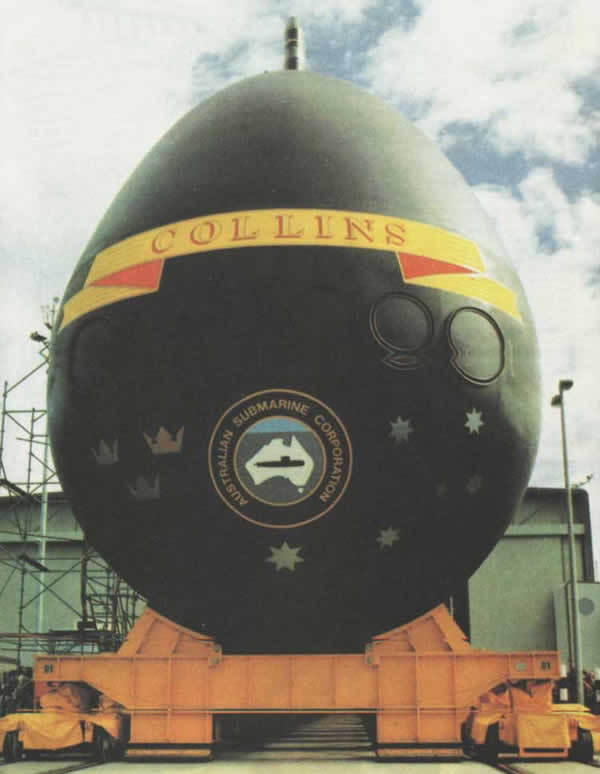
Australia’s Collins Class subs, for instance, are excellent vehicles. Yet cost overruns have measured in the hundreds of millions, remediation is not yet finished, and the schedule for full deployment has slipped by years. All for vessels of a well-understood ship type, based in part on a pre-existing class (Sweden’s Gotland Class), and built in cooperation with an experienced, world-leading firm in submarine technology.
Overall, the Collins Class is an example of a successful local to medium power project to develop an advanced military platform despite previous inexperience.
Canada’s Joint Support Ships, in contrast, conform to no known ship type in their breadth of required functions, and are based on no pre-existing class. The firms competing for the design are not world leaders in similar ship classes like amphibious assault ships or LPDs. Nor does the depth of Canadian design and build experience in related efforts give cause for optimism; quite the reverse. Indeed, the JSS’ breadth of functions alone suggests a difficult project for any entity or country to undertake, and little hope of much beyond mediocrity in all functions due to the required trade-offs.
The Canadian Forces may succeed in the end, and if DID would be happy to apologize. Indeed, we would be pleased to run an article here explaining why they believe they can succeed, and what steps they have taken to address their approach’s inherent risks and performance trade-offs.
For the project’s critics appear to have the high ground when they suggest that JSS is set up to become a budget-eating failure, and recommend that Canada replace the unwieldy JSS idea with a conventional oiler or two plus a few HSV rapid deployment vessels like the ones the USA is gravitating toward. Or recommend the LPD-17 San Antonio Class amphibious support ship as an alternative. Or even recommend a larger number of smaller Dutch/Spanish Rotterdam Class LPDs, plus the USA’s versatile new T-AKE supply ships.
Those kinds of risk reduction strategies would leverage successful R&D efforts, and spend more money on cutting steel and floating boats. As opposed to pursuing paper visions that risk sucking up vast resources and producing inferior products – or no products as all.
Additional Readings
Canada’s NSPS and the JSS
* DID – Canada’s National Shipbuilding Strategy.
* Canada DND, via WayBack – Joint Support Ship (JSS).
* Canada DND, via WayBack – Internal Audit of Joint Support Ship (JSS) Project.
* Canada DND, via WayBack (July 14/10) – Canada Begins Joint Support Ships Procurement for the Canadian Forces.
* Canada DND (July 14/10) – Government of Canada to Acquire New Joint Support Ships.
* Canada DND, via WayBack (June 26/06) – Backgrounder: ‘Canada First’ Defence Procurement – Joint Support Ship.
* Canada DND, via WayBack (June 3/10) – The Department of National Defence and the Government of Canada’s National Shipbuilding Procurement Strategy.
* Seaspan for NSPS – Promo by the company, which eventually won the non-combat portion.
* Naval Technology – Berlin Class Fleet Auxiliary Vessels, Germany.
Related Ships
* Royal Canadian Navy – Supply ships; see also Tech Data. Protecteur Class, now retired; 2014 snapshot.
* Wikipedia – Protecteur class auxiliary vessel.
* BMT Defence – Aegir: A family of naval task force support ship designs. The alternative to the Berlin Class for JSS.
* DID Dutch Order Multi-Purpose Support Ship. A 28,000t JSS, similar to Canada’s original multi-role conception, and ordered in 2010. The Netherlands was going to sell it on completion, but decided that it was too valuable; HNLMS Karel Doornan is expected to be commissioned in 2015, at a cost of around $500 million.
* DID – Britain’s Tide Class: Supplies are From MARS. Britain ordered a larger 37,000t Aegir Class variant, built in South Korea, which will cost about 1/5 as much per ship as Canada’s smaller vessels.
* Navantia S.A. – AOR Cantabria. Was in the mix at one point, alongside the Berlin Class.
* Naval Technology – Patino Class Auxiliary Oiler and Replenishment Ship, Spain.
* Naval Technology – LPD Rotterdam Class Landing Platform Dock, Netherlands. A less ambitious, less expensive, and much more successful effort to create an amphibious forces ship.
* New Zealand Navy – HMNZS Canterbury – L421. New Zealand has its own, smaller multi-role ship design, which combines transport and some minor patrol tasks. The vessel was built by Merwede Shipyard in the Netherlands, under subcontract to Tenix. Unfortunately, it has stability issues.
News & Views
* CASR, via WayBack – BG Comparison – Joint Support Ship (JSS) Project – AOR or LPD. Includes an excellent comparison of the proposed JSS specifications with several existing ship classes – including the Dutch Rotterdam Class LSD.
* CASR (July 2014) – Bailing out NSPS: A National Shipbuilding Procurement Strategy Fix. Part of which is simply contracting JSS abroad.
* CASR (December 2011) – Backgrounder: Joint Support Ship ( JSS ) Project – Now an AOR. Includes a table with the Berlin Class, Cantabria Class, JSS 2006 specs, and Aegir 26R.
* Frontline Defence (April 2010) – Canada’s JSS: Trendsetter …Follower …or Trap?
* Canadian Forces College (May 27/09) – Partnership, Balance and Flexibility: A Model for A Sustainable Naval Shipbuilding Sector in Canada. By Lieutenant-Commander John Charlebois.
* National Post (June 20/08) – J.L. Granatstein: Canada needs a navy that can do the job.
* Canadian Conference of Defence Associations (Nov 19/08) – Military/Naval Procurement in Canada: A Flawed Process [PDF] by Commander (Ret’d) Ken Bowering.
* Ottawa Citizen: David Pugliese Defence Watch Blog, via WayBack (Sept 2/08) – Navy Talking Points for Joint Support Ship.