

(click to view full)
When moving whole units, shipping is always the cheaper, higher-capacity option. Slow speed and port access are the big issues, but what if ship transit times could be cut sharply, and full-service ports weren’t necessary? After Australia led the way by using what amounted to fast car ferries for military operations, the US Army and Navy decided to give it a go. Both services leased Incat TSV/HSV wave-piercing catamaran ship designs, while the Marines’ charged ahead with very successful use of Austal’s Westpac Express high-speed catamaran. These Australian-designed ships all give commanders the ability to roll on a company with full gear and equipment (or roll on a full infantry battalion if used only as a troop transport), haul it intra-theater distances at 38 knots, then move their shallow draft safely into austere ports to roll them off.
Their successful use, and continued success on operations, attracted favorable comment and notice from all services. So favorable that the experiments have led to a $3+ billion program called the Joint High Speed Vessel. These designs may even have uses beyond simple ferrying and transport.
The JHSV Ships
(click to view full)
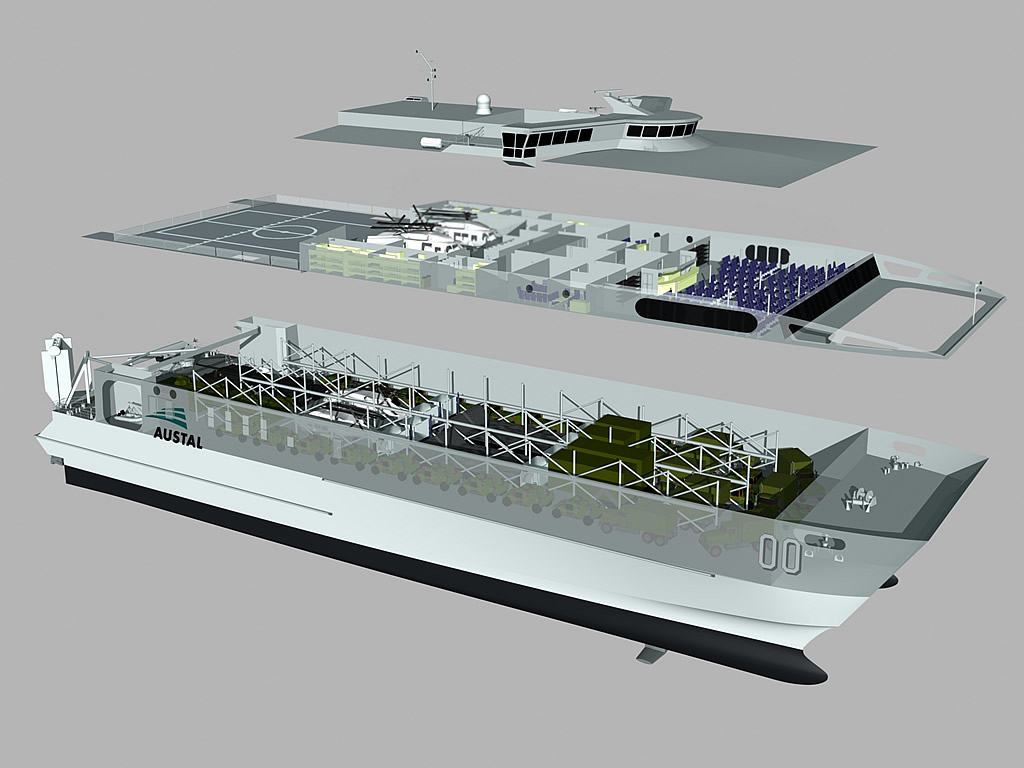
The design specifications established for the JHSV described an ocean-going vessel 450 feet in length or less, capable of carrying 600 short tons of cargo up to 1,200 nautical miles at a speed of 35 knots. It must also have seats for at least 312 passengers, and must be able to provide long-term berthing and galley facilities for at least 104 of those passengers in addition to the vessel’s 41 crew.
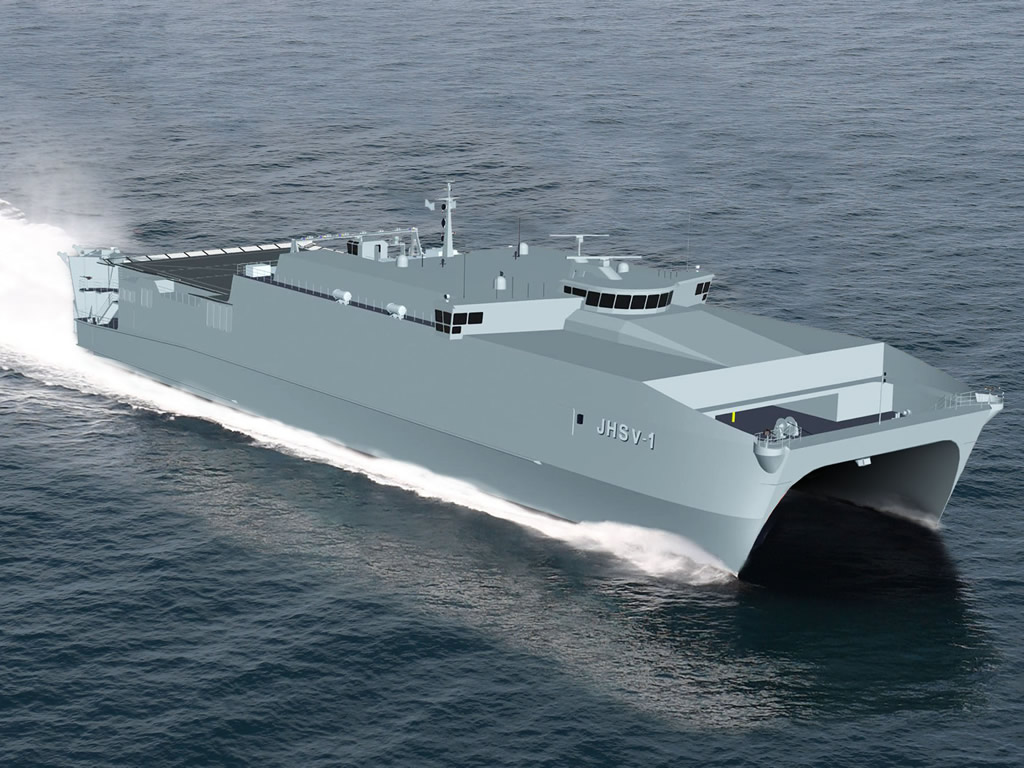
A single firm was ultimately selected to produce all planned JHSV ships, and Austal beat their rival Incat for the contract. Austal’s design ventured slightly beyond the program’s specifications. Length is just 103.0m/ 337.9 ft, with a Beam of 28.5m/ 93.5 ft, and a miniscule Draught of just 3.83m/ 12.57 ft.
The ship’s 4 Wartsalia WLD-1400-SR waterjets are powered by the same MTU 8000 class diesel engines used on Austal’s Independence Class Littoral Combat Ship, and the Hawaii Superferries. Specifically, JHSVs use 4 MTU 20V8000 M71Ls, rated at a maximum of 9.1 MW each. These engines and waterjets can push the ships to the required 35 knots at full cargo load, or 43 knots unloaded.
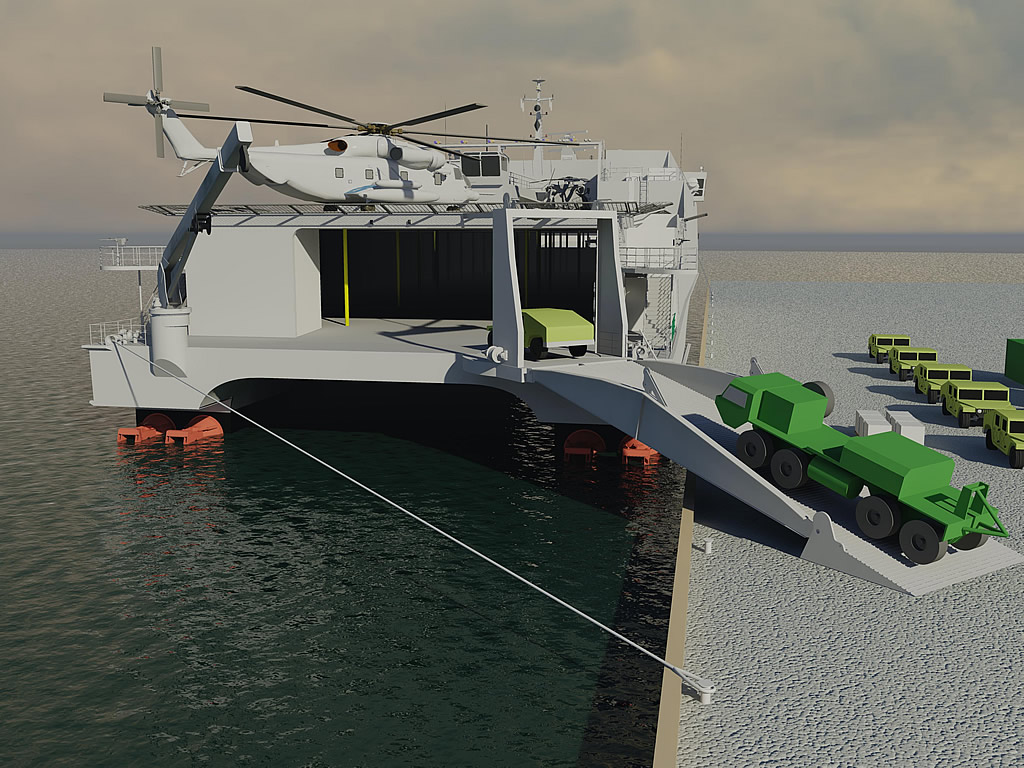
Austal’s design offers embarked troop berthing for 150 (104 permanent, 46 temporary) that can support 14 days of operations. Alternatively, airline-style seating for 354 troops, in addition to the crew of 41, allows the ship to support 96 hours of operations. Cargo capacity is up to 700 short tons/ 635 metric tons, in a usable cargo area 1863 m2/ 20,053 ft2, with a clear height of 4.75m and a turning diameter of 26.21m. The cargo area also has 6 ISO TEU (20′ ISO container) interface panels, for containers that need power. The Austere Loading Ramp Arrangement can support vehicles up to 70 ton M1A2 Abrams tanks, per requirements, and a telescoping boom crane can lift 18.2 metric tons at 10m, dropping to 12.3 metric tons at 15m.
The ship is required to be able to transport 600 short tons of troops, supplies, and equipment 1,200 nautical miles at an average speed of 35 knots, through wave height of up to 4 feet. It won’t quite manage that, in part because its 12.5 short tons overweight. Required range will also suffer a bit at 23 knots cruise speed (4,018 nmi vs. 4,700 nmi).
The JHSV’s flight deck can support all current Navy helicopters up to and including the Marines’ current med/heavy CH-53E Super Stallion, and Vertical Replenishment has been tested using a tilt-rotor MV-22 Osprey. Flight operations will be handled by Kongsberg Maritime’s night-capable Helicopter Operations Surveillance System (HOSS).
(click to view full)
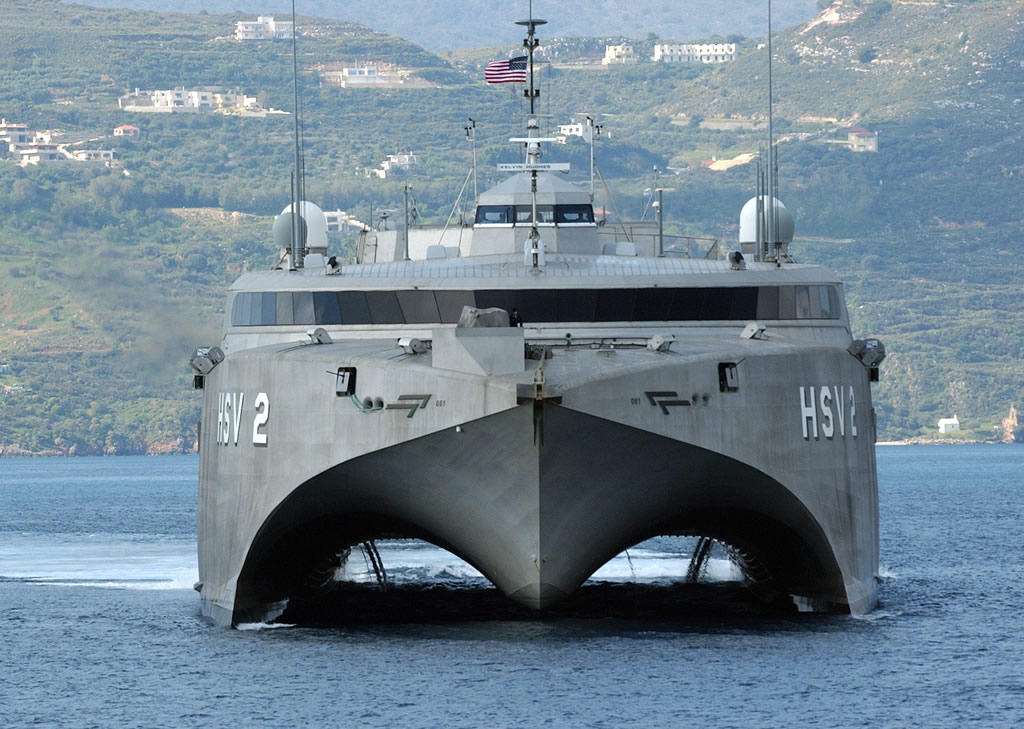
“[JHSV] will be capable of transporting Army and Marine Corps company-sized units with their vehicles, or reconfigure to become a troop transport for an infantry battalion. Its 35-45 nautical miles per hour speed allows for rapid deployment and maneuver of conventional or special operations forces.
The JHSV will not be a combatant vessel. Its construction will be similar to high-speed commercial ferries used around the world, and the design will include a flight deck and an off-load ramp which can be lowered on a pier or quay wall – allowing vehicles to quickly drive off the ship.
[youtube:v=MVGQpXUAIhg]
JHSV testingJHSV’s shallow draft will allow it access to small austere ports common in developing countries. This makes the JHSV an extremely flexible asset ideal for three types of missions: support of relief operations in small or damaged ports; as a flexible logistics support vessel for the Joint Commander; or as the key enabler for rapid transport of a Marine Light Armored Reconnaissance Company or an Army Stryker unit.”
It has taken time, but the US military is beginning to expand its thinking beyond these obvious applications, and begin thinking about ways to employ the JHSV’s vast internal space and mobility in front-line missions. The most dramatic example may involve mounting a 32MJ railgun on USNS Millinocket [JHSV 3] in 2016.
The JHSV Program
(click to view full)
The Joint High Speed Vessel’s Initial Capability Document received approval from the Department of Defense Joint Requirements Oversight Council on Nov 1/05, with all 4 military services concurring. The initial goal was 5 Army vessels, and 3 Navy vessels, for a program worth about $1.6 billion, but the Navy’s interest has continued to grow. The contract signed in November 2008 called for up to 10 ships, split evenly between the Army and Navy. An initial Memorandum of Agreement (MOA) allowed the U.S. Navy to use its surface ship acquisition expertise to buy these vessels on the Army’s behalf, with Army participation – until program changes moved all of these ships to the Navy’s procurement budget and operation.
All of the JHSVs were then transferred to Maritime Sealift Command under a May 2011 agreement. The first 4 / 10 projected vessels will be crewed by civil service mariners. JHSV 5-10 are slated to be crewed by contracted civilian mariners working for a private company. Military mission personnel will embark with either set, as required by mission sponsors. The goal was for JHSV to achieve Initial Operational Capability in 2012, and JHSV 1 just made it.
All ordered JHSV ships have been named now, and ships with the USNS listing have been delivered to US Military Sealift Command:
* JHSV 1 USNS Spearhead (has deployed)
* JHSV 2 USNS Choctaw County (accepted)
* JHSV 3 USNS Millinocket
* JHSV 4 USNS Fall River
* JHSV 5 Trenton Resolute
* JHSV 6 Brunswick
* JHSV 7 Carson City Courageous
* JHSV 8 Yuma
* JHSV 9 Bismarck (North Dakota, not Otto von) Sacrifice
* JHSV 10 Burlington
* HSV USNS Guam (ex-Huakai)
* HSV USNS Puerto Rico (ex-Alakai)
The Pentagon’s April 2011 Selected Acquisition Report placed the program at 18 ships, and its total cost at about $FY08 3.5 billion. That changed as FY 2013 budget plans cut all ships beyond the 10 in the current contract, and the US Navy is negotiating over cancellation of its JHSV 10 contract due to sequestration cuts. Annual budgets to date have included:
FY 2008: $231.9 million, 1 ship funded.
Navy: $18.4M RDT&E
Army: $5M RDT&E, $208.6M production, 1 ship
FY 2009: $364.2 million, 2 ships funded.
Navy: $11.6M RDT&E, $181.3M production, 1 ship
Army: $3.0M RDT&E, $168.3M production, 1 ship
FY 2010: $391.1 million, 2 ships funded
Navy: $8.2M RDT&E, $202.5M production, 1 ship
Army: $3.0M RDT&E, $177.4M production, 1 ship
FY 2011: $390.1 million, 2 ships funded.
Navy: $3.5M RDT&E, $203.9M production, 1 ship
Army: $3.0M RDT&E, $179.7M production, 1 ship
FY 2012: $376.4 million, 2 ships funded.
Navy: $4.1M RDT&E, $372.3M production, 2 ships
FY 2013 request: $376.4 million, 1 ship funded.
Navy: $1.9M RDT&E, $189.2M production, 10th & final ship
Note that advance materials purchases for future years are included in each year’s procurement budgets. After FY 2013, JHSV budgets are very small, reflecting only minor post-shakedown work.
Supplements: From Leased to Bought

(click to view full)
At present, 1 leased vessel remains in military service, following the end of Incat’s HSV-2 Swift lease. Austal’s HSV 4676 Westpac Express catamaran continues to serve in Military Sealift Command in the Pacific around Guam and Japan, working closely with the Marine Corps as a troop and cargo transport.
HSV-2 Swift’s influence lives on in the JHSV concept of operations. The ship had supported relief operations in Indonesia post-tsunami, and in the Gulf Coast region following hurricane Katrina. In both cases, Swift’s high speed and shallow draft combined to make it an ideal platform for the delivery of relief supplies and support of other platforms operating in the area. During operations following Katrina, Swift was able to use ports that were inaccessible to other ships of the logistics force. It has also been a platform for UAV and aerostat experiments.
It’s likely that both charters will soon be replaced, thanks to a recently-purchased alternative with many similarities to the JHSV.
After its ferry service was forced into bankruptcy by environmental lawfare, the Hawaii Superferries Huakai and Alakai were pressed into service by their main creditor: the US Department of Transportation’s Maritime Administration (MARAD). They were called into service in the wake of the 2010 Haiti earthquake, and these Austal-built ships were very successful in that role. Both ferries were ultimately bought by the US Navy in 2011, for just $35 million. Once their $35 million conversions are done, they’re likely to replace Westpac Express and Swift as USNS Guam (ex-Huakai) and USNS Puerto Rico (ex-Alakai, slightly smaller). The superferries will offer more troop-carrying berths than their similar JHSV counterparts, in exchange for less military flexibility.
USNS Guam is expected to relieve Westpac Express in the Pacific some time in FY 2015.
Contracts & Key Events
FY 2014-2020
JHSV 1 passes trials & deploys; JHSV 3 passes acceptance trials; JHSV 4 launched.
(click to view full)
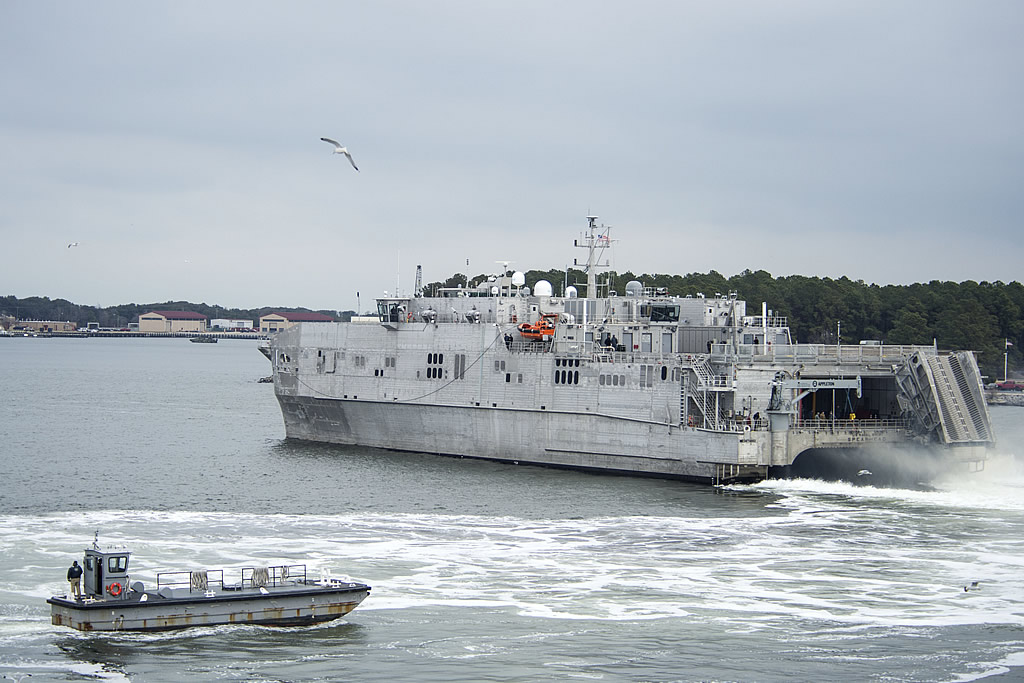
March 5/19: Structural Bow Section The Navy awarded Austal USA a $13.6 million contract modification for the 11th and 12th Expeditionary Fast Transport (EPF) ships. The modification provides for the incorporation of a structural bow section engineering change proposal. The Spearhead-Class EPF is a Navy-led shipbuilding program. The class was previously designated as Joint High Speed Vessel (JHSV). The EPF ships provide high-speed, shallow-draft transportation capability to support the intra-theater maneuver of personnel, supplies, and equipment for the Navy, Marine Corps and Army. The EPF program received Milestone A approval in May 2006. On 16 September 2016, Austal won a contract to design and construct EPF-11 and EPF-12. In 2015, the USNS Spearhead, the lead ship of the class, experienced bow-damage from rough seas requiring more than a half-million dollars to repair. It was determined that a design change recommended by Austal to the Navy late in the design phase in order to save weight has resulted in a weakened bow structure. The current modification is an undefinitized contract action for implementation of change to the bow structure on EPF 11 and EPF 12 on the DD&C Contract Line Item for each respective ship. Work will take place in Alabama, Mississippi, and Massachusetts and is scheduled to be finished by July this year.
December 5/18: EPF-14 Austal is being contracted to build another Spearhead-class vessel for the US Navy. The cost-plus-fixed-fee undefinitized contract action is priced at $40.4 million and procures long-lead-time material and production engineering services for Expeditionary Fast Transport (EPF) 14. EPF ships are the go-to platform for fast, intra-theater transportation of troops, military vehicles and equipment. These vessels bridge the gap between low-speed sealift and high-speed airlift. Their capability to access austere, minor and degraded ports make them very suitable for operations in underdeveloped countries. Work will be performed at multiple locations, including – but not limited to – Novi, Michigan; Chesapeake, Virginia and Iron Mountain, Michigan. The US Navy’s 14th EPF is expected to be completed by July 2022.
October 24/18: EPF-1 ROH Colonna’s Shipyard is being contracted to work on the Navy’s first Spearhead-class ship during the ship’s upcoming regular overhaul and dry docking phase. The firm-fixed-price contract is valued at $7.9 million and provides for a 67-calendar day shipyard availability. The contractor will be responsible to conduct structural inspection of the hull, perform a variety of repairs, support the main propulsion engine’s overhaul, replace heater exchangers and perform gear maintenance. The USNS Spearhead is an Expeditionary Fast Transport ship that was launched in 2011, it is designed for the fast, intra-theater transportation of troops, military vehicles and equipment with aviation support. Work will be performed at Colonna’s shipyard in Norfolk, Virginia. The Regular Overhaul availability is expected to be completed by January, 2019.
October 22/18: EPF-13 Austal is being tapped to start building the Navy’s next Expeditionary Fast Transport (EPF) ship. The undefinitized contract action is valued at $57.8 million and allows for the procurement of long-lead-time material and production engineering services. The Spearhead-class vessels are designed for the fast, intra-theater transportation of troops, military vehicles and equipment with aviation support. Bridging the gap between low-speed sealift and high-speed airlift, EPFs transport personnel, equipment and supplies over operational distances with access to littoral offload points including austere, minor and degraded ports often found in developing countries. The vessels are able to transport 600 short tons of military equipment to a range of 1.200 nautical miles at speeds of up to 35 knots. Work will be performed at multiple locations, including – but not limited to – Novi, Michigan; Mobile, Alabama and Rhinelander, Wisconsin. The US Navy’s 13th EPF is expected to be completed by November 2021.
February 28/18: Christening Ceremony The US Navy has christened its latest Spearhead-class expeditionary fast transport, the USNS Burlington, during a ceremony in Mobile, Alabama, on Saturday. It is the tenth of 12 Expeditionary Fast Transports being built for the Navy at a cost of $1.9 billion. Overseeing the event were the ship’s primary sponsors US Senator Patrick Leahy and his wife Marcelle Pomerleau. Marcelle Leahy said naming the ship after the Vermont city of Burlington was “fitting because Vermonters have long heeded the nation’s call to service.” Built by Austal USA, the vessel is designed to transport troops and equipment at high-speeds and in shallow waters for rapid deployment. The Navy says it can “carry 600 short tons of military cargo for 1,200 nautical miles, at an average speed of 35 knots.” This equates to the Burlington being able to carry 1,200,000 pounds for 1,380 miles at an average speed of 40 mph. It also has a flight deck for helicopter operations and an off-loading ramp for disembarkment missions.
Sept 26/14: Naming. “Secretary of the Navy Ray Mabus announced the next joint high speed vessel (JHSV) will be named USNS Trenton during a ceremony in Trenton, New Jersey, Sept. 25.” Um, OK. Trenton, which is still under construction, was publicly named by the Secretary of the Navy on April 12/13 (q.v.) Sources: US Navy, “SECNAV Names the Next Joint High Speed Vessel”.
Sept 16/14: #4 delivered. Austal delivers USNS Fall River to US Military Sealift Command. Construction update:
“Preparations are underway for the launch of Trenton (JHSV 5) later this month with construction on Brunswick (JHSV 6) progressing well. Metal cutting began for Carson City (JHSV 7) in early September.”
Sources: Austal, “Austal Delivers Fourth Joint High Speed Vessel”.
USNS Fall River
June 13/14: Aerostat zapped. From US Naval Forces Southern Command:
“During routine testing off the coast of Key West, the Aerostat tethered off the Joint High Speed Vessel USNS Spearhead (JHSV-1) was struck by lightning at 12:21 in the morning, June 12…. The lightning strike caused the Aerostat to deflate and land in the water. Response efforts were delayed as the thunderstorm moved into the area. The Aerostat was subsequently sunk so to pose no hazard to other vessels or navigation.”
Aerostats are tethered blimps, used to dramatically expand a JHSV’s field of view (q.v. April 27/13). This can be very useful for survey and interdict deployments like Operation Martillo (q.v. March 31/14). Sources: US Navy, “USNAVSO/US 4th Fleet Statement regarding AEROSTAT”.
May 20/14: JHSV 3. USNS Millinocket will become the 1st JHSV deployed to the far east, where it will operate alongside the leased ship Westpac Express [HSV-4676] and the former Hawaii Superferry USNS Guam [HST-1].
MSC’s JHSV project officer Mike Souza says that USNS Millinocket is preparing for a move to San Diego, CA. She’ll serve as a display platform for the two EM Railgun prototypes during the May 26/14 International Symposium on Electromagnetic Launch Technology in La Jolla, CA. Some final post-delivery tests and trials will follow, including some interface testing with a Mobile Landing Platform ship. Once the post shakedown availability trials and fixes are done, Millinocket head to an unspecified new homeport in the Far East. Sources: Seapower, “Millinocket Will Be the First JHSV in Westpac”.
April 7/14: Experiment: Railgun. The US Navy plans to use JHSV 3 Millinocket as a test platform for one of its newest weapons in 2016: a 32MJ rail gun that can fire projectiles about 100 miles at Mach 7 speeds. JHSV was picked as the trial platform because it has the space to carry the large system on its deck and in its cargo bay. The gun itself isn’t unusually large, but once you throw in the capacitors for power storage, any additional power needs, extensive maintenance tools and parts, and ammunition, it adds up fast. Rolling and bolting that onto a JHSV is much easier than using any warship, and the trial underscores JHSV’s usefulness as a concept testbed.
On the weapon’s side of the equation, ONR Chief Rear Admiral Matthew Klunder touts the railgun’s economic benefit, as well as its military edge in extending the bombardment range of naval guns and the number of rounds on board. It’s true that $25,000 for a defensive railgun shot against incoming missiles is orders of magnitude better than a RIM-116 RAM ($900,000) or RIM-162 Evolved SeaSparrow Missile ($1.5 million), assuming the unproven assumption of equal effectiveness. One must also compute operating and maintenance costs over the railgun’s lifetime, however, which are going to be far higher than they would be for an All-Up-Round missile in its canister. The JHSV tests will offer some early data re: the gun’s robustness under trial conditions at sea, and that cost data point could end up being as valuable as any performance data. Sources: Reuters, “U.S. Navy to test futuristic, super-fast gun at sea in 2016”.
March 31/14: Operations. USNS Spearhead [JHSV 1] is preparing for a 2nd deployment, this time to the 4th Fleet’s waters around the Caribbean and South America. The US military is taking cautious steps to expand JHSV uses, and is explicitly following in the footsteps of HSV-2 Swift’s 2013 deployment. It’s well short of full innovation toward mothership roles, but still a step forward.
These extensions still have JHSV 1 operating primarily in a ferry capacity, with “adaptive force packages.” They’ll be carrying the USMC’s 4th Law Enforcement Battalion and equipment to the Dominican Republic. After the Marines are ferried back to Florida, a trip to Belize will involve a Navy Seabee explosive ordnance disposal detachment, and a riverine crew. From Belize, a a mobile diving and salvage unit and an explosive ordnance disposal team will be ferried from Guatemala to Colombia, before all of the units that were in Guatemala and Columbia end up ferried to Honduras.
In between, USNS Spearhead will “conduct detection and monitoring activities” in support of the multinational anti-drug Operation Martillo. Spearhead’s exact role isn’t made clear, but Spearhead works well with helicopters, Swift has shown that UAVs can be used from these ships, and it would be possible to have boarding teams embarked. Sources: US Navy, “Plans Finalized for USNS Spearhead’s Deployment to 4th Fleet AOR”.
March 21/14: #3 delivered. Austal delivers USNS Millinocket to US Military Sealift Command. They add that:
“Ships currently under construction are JHSV 4, which was christened in January and is being prepared for sea trials, JHSV 5, which has begun final assembly, and JHSV 6, which commenced construction in January in the module manufacturing facility. Five Independence-variant Littoral Combat Ships are also in construction at Austal’s US shipyard…”
Sources: Austal, “Austal Delivers Third Joint High Speed Vessel” | GD-AIS, “Austal Delivers USNS Millinocket (JHSV 3)”.
USNS Millinocket
March 10/14: JHSV 5. Trenton’s keel is formally laid. Sources: Austal USA, “Austal Commemorates Keel Laying for Trenton (JHSV 5)”.
Jan 28/14: DOT&E Testing Report. The Pentagon releases the FY 2013 Annual Report from its Office of the Director, Operational Test & Evaluation (DOT&E). JHSV will be able to carry 354 passengers for 96 hours, which is better than the required 312, but it’s overweight by 12.5 tons, and will fall short of required ranges at 23 knots (4,018 nmi vs. 4,700) and 35 knots (won’t make 1,200 nmi) transit speed. The extra weight amounts to about 4% fuel load, or 3,565 gallons.
Overall testing results have been positive. Loading tests demonstrated suitability up to M-1A2 tank loading onto a floating causeway. If the ships need replenishment at sea, both USNS Spearhead and USNS Choctaw County have successfully conducted fuel-only underway replenishments. For other supplies, vertical replenishment tests have included an MH-60S helicopter at night, and MV-22 Osprey tilt-rotos by day, and Aircraft Dynamic Interface testing has included MH-53E Minehunting helicopters. DOT&E says that “manning and facilities can accommodate handling of all required helicopters, with the exception of fuel and power.” Finally, DOR&E says that with an embarked security team and weapons, JHSV can engage a moving surface threat. The bad news, aside from ship range?
“The JHSV’s organic container load trailer is not effective for loading 20-foot long metal storage containers. During the IOT&E, the test team took five hours to connect the container load trailer with a storage container and failed to load it…”
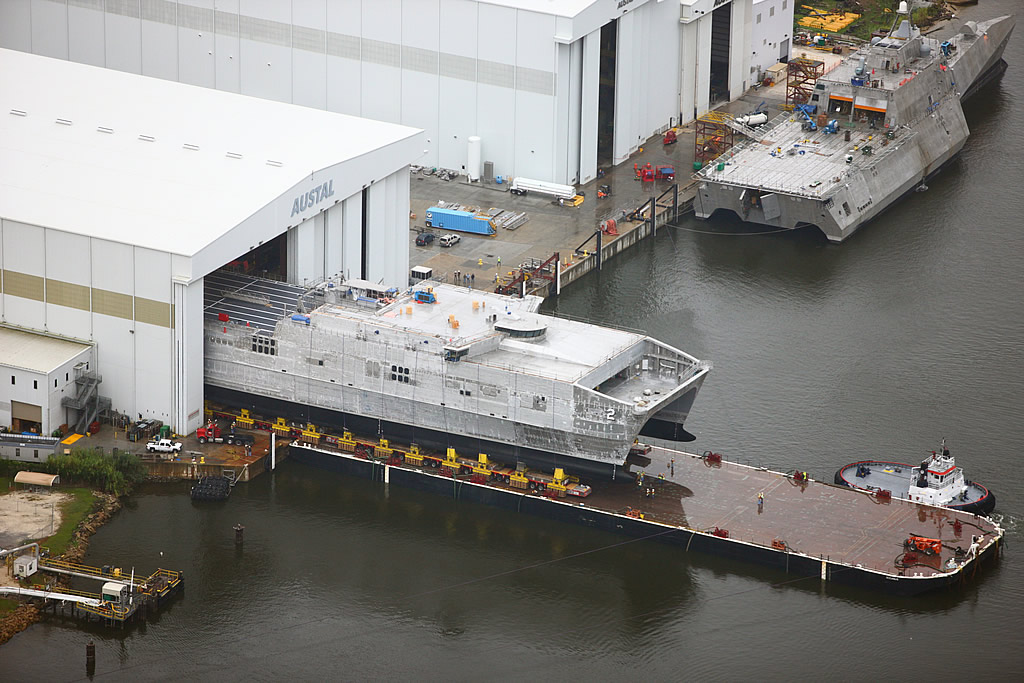
Jan 17/14: JHSV 4. Fall River is launched at Austal’s Mobile, AL shipyard, after a side trip to BAE. Instead of moving down a slipway, launches are now float-off affairs from a BAE floating drydock. Getting to the drydock requires a transfer onto a barge, using Berard Transportation rollers. The ship was christened on Jan 11/14, and will be formally delivered to the USN later in 2014, after final fitting out. Austal adds that:
“Three JHSVs and four LCSs are currently under construction in Austal’s Mobile, Alabama shipyard. Austal will begin production of one more ship in each program before the end of January.”
Sources: Austal, “Austal Launches USNS Fall River (JHSV 4)” and “USNS Fall River (JHSV 4) Christened – One of seven Navy vessels currently under construction at Austal USA”.
Jan 16/14: JHSV 1 deploys. Operational use of the JHSV fleet begins with USNS Spearhead’s deployment from NAB Little Creek. She’ll head to “the US 6th Fleet Area of Responsibility” (Africa) until May 2014, then on to the 4th Fleet AOR (Central & South America) until December 2014. Sources: USN, “USNS Spearhead departs on Maiden Deployment”.
1st deployment
Jan 9/14: JHSV 3. USNS Millinocket successfully completes Navy Acceptance Trials in the Gulf of Mexico. Formal delivery is expected in late January. Sources: MarineLog, “JHSV 3 completes Acceptance Trials”.
Oct 8/13: JHSV 1. USNS Spearhead has successfully completed initial operational testing and evaluation with the US Navy. Sources: Austal, “JHSV 1 successfully completes US Navy operational testing”.
FY 2013
JHSV 10 bought, but Navy wants to cancel it over sequestration; JHSV 1 & 2 delivered; JHSV 3 launched; Keel-laying for JHSV 4; Aerostat experiment.
(click to view full)
July 31 – Aug 6/13: Testing. USS Spearhead completes Initial Operational Test and Evaluation and Total Ship Survivability Trials, thanks to about 280 Marines from 1st Battalion/ 2nd Marine Regiment/ 2nd Light Armored Reconnaissance Battalion, and 2nd Assault Amphibian Battalion. The Marines embarked Spearhead with their weapons, gear and vehicles and traveled from Morehead City, NC, to Mayport Naval Station, FL and back, while participating in various tests. Sources: US MSC Sealift magazine, October 2013.
June 6/13: Naming. The Secretary of the Navy names the last 3 JHSV ships under contract.
The future USNS Yuma (JHSV 8) honors the city in Arizona near the USMC’s big testing range, and will be the 4th ship to bear this name. JHSV 9 USNS Bismarck is named in honor of North Dakota’s capital city. As one might imagine, it’s a first for the US Navy. JHSV 10 USNS Burlington is also a first, named for the largest city in Vermont. US DoD.
June 6/13: JHSV 2. USNS Choctaw County is accepted into service, after completing acceptance trials in May. Delivery just 6 months after the 1st ship in the class is a very fast pace. US Navy | Austal.
USNS Choctaw County
June 5/13: JHSV 3. Millinocket is launched from the Austal USA shipyard in Mobile, AL. It’s not done, just entering the final phase of construction, test, and activation, followed by preparation for sea trials late in 2013. US NAVSEA | Austal.
May 23/13: JHSV 4. The keel is formally laid for Fall River. Austal.
May 3/13: JHSV 2. USNS Choctaw County successfully completes USN Acceptance Trials. Sources: Austal, “Joint High Speed Vessel USNS Choctaw County (JHSV 2) completes Acceptance Trials”.
April 27/13: Aerostat experiment. The Miami Herald reports that the chartered catamaran HSV 2 Swift is currently testing an interesting combination for the US Navy. An aerostat (tethered blimp) mooring system has been attached to the starboard rear at the helicopter deck, and sailors are deploying hand-launched Aerovironment Puma mini-UAVs to investigate targets cued by the aerostat’s radar and optical sensors. When fully deployed to 2,000 feet, Raven Inc’s TIF-25K gives Swift a sea surveillance radius of 50 miles at almost zero operating cost, roughly doubling a warship’s surveillance radius, and increasing Swift’s by 10x.
The JHSV ships and Hawaii Superferries (esp. USNS Puerto Rico) are natural fits for this configuration, given their similarity to HSV 2. If weight and other issues can be worked out, the USA’s Littoral Combat Ships like the trimaran Independence Class could also be an option, and so could amphibious LSD and LPD ships. Still, Swift needs to work out a coherent concept of operations in these trials, including the question of barrier vs. mobile surveillance approaches.
If all goes well with the operational tests, the US Navy will consult with drug enforcement agencies, including the Key West, FL Joint Interagency Task Force South (JIATF) that oversees Operation Martillo in the Caribbean. If the system is deployed, the biggest losers would probably be expensive-to-operate P-3 quad-turboprop sea control planes. US personnel have also begun promoting the concept to other nations, including Colombia, though those countries would almost certainly use their own ships.
April 20/13: JHSV 3 christened. The Millinocket is christened at Austal’s Alabama shipyard, named after 2 Maine towns. No word on negotiations concerning JHSV 10, though Austal’s release does make a point of noting 10 JHSV vessels under contract. US MSC | Austal.
April 12/13: Naming. 3 JHSV ships are among the 7 named by Secretary of the Navy Ray Mabus, who actually stuck to class naming conventions this time instead of veering into political partisanship.
JHSV 5 will become USNS Trenton, after New Jersey’s capital city. JHSV 6 will become USNS Brunswick, after the seaport in Georgia. JHSV 7 will become USNS Carson City, after Nevada’s capital city. Pentagon, “Secretary of the Navy Names Multiple Ships”.
April 5/13: LCS Council. The CNO adds the JHSV program to the portfolio of the Littoral Combat Ship (LCS) Council, which was set up to manage the logistics, support, training, and concept of operations involved in making LCS a useful part of the fleet. Sources: Gannett’s Navy Times, “LCS council adds new member”.
Added to LCS Council
March 15/13: JHSV 2. Choctaw County completes builder’s trials, reaching speeds of more than 41 knots. Delivery is expected this summer. Austal.
March 2/13: JHSV 10. The US Navy’s guidance regarding sequestration budget cuts involves negotiations to cancel JHSV 10’s contract. They have to hold negotiations, because the contract is already live. The question will be cancellation costs.
Dec 20/12: JHSV 10. Austal USA in Mobile, AL receives a $166.9 million contract modification, exercising the construction option for JHSV 10. All contract funds are committed immediately.
Work will be performed in Mobile, AL (48%); Pittsfield, MA (9%); Franklin, MA (3%); Philadelphia, PA (3%); Henderson, Western Australia (3%); Atlanta, GA (2%); Chicago, IL (2%); Gulfport, MS (2%); Slidell, LA (1%); Iron Mountain, MI (1%); Houston, TX (1%); Dallas, TX (1%); Chesapeake, VA (1%); Milwaukee, WI (1%); Brookfield, WI (1%), and various sites inside and outside the United States each below 1% (21% tl.), and is expected to be complete by June 2017. US Naval Sea Systems Command in Washington, DC manages the contract (N00024-08-C-2217).
JHSV 10 bought
Dec 5/12: #1 delivered. US Military Sealift Command accepts delivery of USNS Spearhead [JHSV 1] at Austal Shipyard in Mobile, AL.
Following delivery to the Navy, Spearhead will participate in operational testing before sailing to its layberth in Little Creek, VA. The Navy says that it expects the ship to begin conducting missions in Q1 of FY 2013. Which is to say, by Dec 31/12. US MSC | US Navy | Austal.
USNS Spearhead
Oct 1/12: JHSV 2 launch. Choctaw County is launched in Mobile, AL.
FY 2011 – 2012
JHSV becomes Navy-only; JHSVs 4-9 bought; 2 Superferries bought, re-named; JHSV program to end at 10; JHSV 1 christening, trials; Corrosion controversy.
(click to view full)
Sept 15/12: JHSV 2 christened. USNS Choctaw County is christened during a ceremony at Austal USA in Mobile, AL. US MSC | Pentagon.
May 30/12: Secretary of the Navy Ray Mabus announces that the next JHSV will be named the USNS Millinocket. Pentagon.
May 8/12: The US Navy re-names the Hawaiian Superferries, which will becomes USNS Guam and USNS Puerto Rico.
They do not say, but it’s likely that the larger Huakai, tabbed to replace the Westpac Express and move Marines to and from Okinawa and Guam, is the future USNS Guam. The smaller Alakai was being considered for missions in Latin America and/or Africa, so it’s likely that she’ll become USNS Puerto Rico.US DoD.
April 25/12: The first of 43 modules for JHSV 3 have been successfully transported from the Module Manufacturing Facility (MMF), and erected in the final assembly bay on the waterfront, in preparation for the May 3/12 keel-laying ceremony. The 46 tonne, 20.4m x 8.3m x 9.4m module will be part of one of the catamaran akas. Austal.
April 19/12: JHSV-1 trials. The future USNS Spearhead completes builder’s trials of the ship’s propulsion plant, communication and navigational systems, ride control systems, pollution control systems; and first-of-class maneuverability and stability trials. The ship reached speeds of more than 35 knots, exceeding the program’s requirements.
Next steps include INSURV inspection, and commissioning. US Navy acceptance is scheduled by the end of 2012. USN PEO Ships | Austal.
Feb 24/12:JHSV 8-9. Austal USA in Mobile, AL receives a $321.7 million contract modification, exercising construction options for JHSV 8 and JHSV 9.
Work will be performed in Mobile, AL (48%); Pittsfield, MA (9%); Franklin, MA (3%); Philadelphia, PA (3%); Atlanta, GA (2%); Chicago, IL (2%); Gulfport, MS (2%); Slidell, LA (1%); Iron Mountain, MI (1%); Houston, TX (1%); Dallas, TX (1%); Chesapeake, VA (1%); Milwaukee, WI (1%); Brookfield, WI (1%); various sites throughout the United States (5%); and various sites outside of the United States (19%). Work is expected to be complete by April 2016 (N00024-08-C-2217).
Austal’s release offers a snapshot of current progress. USNS Spearhead is scheduled for builder’s sea trials in early March 2012. JHSV 2 is taking shape in Austal’s final assembly bay. Modules for JHSV 3 are being built, and the ship’s official keel laying is scheduled for April 12/12.
JHSV 8 & 9 bought
Jan 26/12: JHSV cut. The Pentagon issues initial guidance for its FY 2013 budget, and next plans. They include lowering planned JHSV buys by 8 ships, leaving only the 10 in the current contract. Pentagon release | “Defense Budget Priorities and Choices” [PDF] | Alabama Press-Register.
Just 10
Jan 20/12: Superferry supplement bought. Inside the Navy reports that the cost for the 2 Hawaii Superferries, plus required modifications, is actually $70 million. The superferries were seen as a better option to move 880 Marines, because JHSV wasn’t designed for maximum passenger seating. Read “Hawaii Superferry’s Bankruptcy = US Navy Opportunity” for full coverage.
Dec 19/11: Superferries. The Defense Authorization Act of 2012, which will soon become law, looks set to buy both of the Austal-built Hawaii Superferries out of the firm’s bankruptcy, then send them to US MSC, alongside the future JHSV vessels. Read “Hawaii Superferry’s Bankruptcy = US Navy Opportunity” for full coverage.
Superferry supplements bought
Oct 10/11: JHSV 3 begun. Austal announces the official beginning of fabrication for JHSV 3 Fortitude. Austal USA President and COO, Joe Rella:
“The race is on… The world is about to learn just how much value Austal’s investments in modular ship fabrication offers our Navy and Military Sealift Command customers. We challenge ourselves every day to build each ship faster and more efficiently than the one before.”
Oct 7/11: JHSV 6 named. Secretary of the Navy Ray Mabus names JHSV 6 as USNS Choctaw County. He grew up in that Mississippi county, though there are also Choctaw counties in Alabama and Oklahoma. Ray Mabus said that “I chose to name JHSV after Choctaw County to honor those men and women who represent rural America.”
The name eventually migrates to JHSV 2. US MSC.
Sept 10/11: JHSV 1 christened. JHSV-1 Spearhead is launched at Austal USA’s yard in Mobile, AL. The formal christening ceremony is held on Sept 17/11. The ship is reported to be slightly over budget, but not badly so – a welcome departure for a USN first ship of class. US MSC | Austal | Alabama Press-Register | Maritime Executive.
June 30/11: JHSV 6-7. Austal USA in Mobile, AL receives a $312.9 million contract modification, exercising options for JHSVs 6 and 7. Note, as usual, that this is not the full price of a ready to serve ship. On the other hand, JHSVs have much lower amounts of “government furnished equipment” beyond the base seaframe and installed gear, so the figure will be much closer than it would for a warship.
Options remain for another 3 ships under the current FY 2009-2013 contract, though the program of record tops out at 18 ships. Spearhead [JHSV 1] is scheduled for launch in August 2011, and delivery in December 2011, with other ships currently in various stages of assembly.
Work will be performed in Mobile, AL (48%); Pittsfield, MA (9%); Franklin, MA (3%); Philadelphia, PA (3%); Henderson, WA (3%); Atlanta, GA (2%); Chicago, IL (2%); Gulfport, MS (2%); Slidell, LA (1%); Iron Mountain, MI (1%); Houston, TX (1%); Dallas, TX (1%); Chesapeake, VA (1%); Milwaukee, WI (1%); and Brookfield, WI (1%), with other efforts performed at various sites throughout the United States (5%) and outside the United States (16%). Work is expected to be complete by June 2014. US Naval Sea Systems Command in Washington, DC manages the contract (N00024-08-C-2217). See also US NAVSEA | Austal.
JHSV 10 bought
June 20-22/11: Corrosion issues? After USS Independence [LCS-2] corrosion reports hit Austal’s share price, a company release addresses the issue. It notes the complete lack of such problems on all of Austal’s commercial and military ships to date, and suggests that the US Navy may have failed to follow basic procedures. Information Dissemination has a different take, and wonders if Austal’s JHSV, which may not have a cathodic protection system either, could also be at risk due to the military’s added electronics:
“In the case of LCS-2, the problem was apparently accelerated by stray currents in the hull from the electrical distribution system problems the ship has been having since it was turned over to the Navy. LCS-4 doesn’t have [a cathodic protection system] either, but apparently CPS is part of the lessons learned process and was included in the fixed-price contracts for Austal versions of the LCS beginning with LCS-6. LCS-2 will have the CPS installed at the next drydock period, while Austal has said a CPS will be added to LCS-4 before the ship is turned over to the Navy. The question everyone seems to be asking is whether the JHSV could suffer the same issue… I’d be curious to know if Westpac Express has a CPS installed, or some other form of prevention is used at all.”
MarineLog’s report says that yes, cathodic protection is used on Westpac Express. See: Austal | Alabama Press-Register | Information Dissemination | MarineLog | WIRED Danger Room.
June 17/11: Corrosion issues? The US Navy has told Congressional appropriations committees that “aggressive” corrosion was found in the propulsion areas of the Littoral Combat Ship USS Independence, which rely on Wartsila waterjets. The ship has been given temporary repairs, but permanent repairs will require dry-docking and removal of the water-jet propulsion system. The strong Australian dollar has hurt Austal’s commercial exports, so this blow to its defense business has added impetus. Bloomberg | Alabama Press-Register | Sydney Morning Herald.
Corrosion in new ships isn’t unheard of, though it’s never a good sign. Norway’s Fridtjof Nansen Class AEGIS frigates had this problem, for instance. The Independence Class runs some risks that are specific to its all-aluminum construction, however, as key subsystems with different metals create risks of galvanic corrosion.
Corrosion controversy
June 11/11: Industrial accident. A 50-ton block from JHSV Vigilant, containing the ship’s service diesel generators, breaks loose while the module is being lifted and repositioned for further work. One source reported that pad eyes tore loose from the module, causing it to fall about 3 feet and tip over.
The extent of the damage to the module, and the cost of repairs, are still being assessed. The good news is that modular construction ensures less schedule impact. Defense News.
Accident
June 9/11: Inside the Navy reports that a June 14/11 Defense Acquisition Board meeting will determine the Navy’s readiness to procure JHSV ships 6-10. Defense officials may opt to fast-track the decision as a “paper DAB,” granting approval without requiring a meeting.
June 2/11: Sub-contract. Taber Extrusions LLC announces contracts to supply extruded aluminum products for JHSV 3 Fortitude, and LCS 6 Jackson, from its facilities in Russellville, AR and Gulfport, MS. Some structural extrusions for both ships will also be manufactured by Taber and supplied to Austal through a contract with O’Neal Steel Corp.
Taber has an 8,600 ton extrusion press with a rectangular container and billet configuration. The firm says that compared with smaller presses and round containers, their tool gives superior metal flow patterns with much tighter tolerances for flatness, straightness and twist; and better assurance of critical thickness dimensions. The resulting wide multi-void extrusions are friction stir welded into panels, and tight tolerances improve productivity while reducing downstream scrap. When finished, they make up some of the ship’s decking, superstructure and bulkheads.
May 2/11: Army Out. The US Army signs a memorandum of agreement to transfer custody of all 5 of its JHSVs to US Military Sealift Command. Army watercraft personnel who had been training to operate the ships have been reassigned. Instead, JHSVs will be operated by the US Navy’s Military Sealift Command, and crewed by civil service (JHSV 1-4) or civilian contract (JHSV 5-10) sailors. The transfer was approved in principle in December 2010, during Army-Navy talks.
MSC has been slated to operate the Navy JHSVs since August 2008, and in May 2010, MSC announced that the vessels would each have a core crew of 21 mariners (vid. May 13/10 entry). That template will now apply to all ships of class, which will carry a USNS designation instead of the Navy’s USS. US DoD | US MSC | Gannett’s Navy Times.
Navy-only now
Oct 12/10: #4 & 5 bought. Austal USA in Mobile, AL receives a $204.7 million contract modification, exercising options to build JHSV 4 and 5. Work will be performed in Mobile, AL, and is expected to be complete by December 2013. US Naval Sea Systems Command in Washington, DC manages the contract (N00024-08-C-2217).
The $204.7 million is on top of the earlier $99.6 million long-lead materials contract, bringing the total so far to $304.3 million for the 2 ships. See also Austal.
JHSV 4 & 5 bought
FY 2009 – 2010
Program baseline set; Austal wins; JHSVs #1-3 bought; Long-lead items for #4-5; JHSV 1 keel-laying; Austal opens new manufacturing facility; Hawaii Superferries in Haiti; JHSV program to reach 23 ships?
(click to view full)
Sept 28/10: JHSV 2 begins. Austal announces that they’ve begun construction of JHSV 2 Vigilant for Maritime Sealift Command. A subsequent release fixes the start date at Sept 13/10.
July 22/10: JHSV 1 keel-laying. Keel-laying for the first JHSV ship, Spearhead, at Austal’s Mobile, AL facility. Austal | Press-Register advance report.
June 3/10: #4-5 lead-in. Austal USA in Mobile, AL receives a $99.6 million modification to a previously awarded contract (N00024-08-C-2217) for JHSV 4 and 5 long lead time materials, including main propulsion engines, aluminum, waterjets, reduction gears, generators and other components, beginning in fall 2010.
Work will be performed in Detroit, MI (38%); Chesapeake, VA (18%); Henderson, Australia (13%); Gulfport, MS (10%); Ravenswood, WVA (9%); Ft. Lauderdale, FL (4%); Mobile, AL (3%); Auburn, IN (2.6%); Winter Haven, FL (1%); Gardena, CA (1%); and Davenport, IA (0.4%), and is expected to be complete by December 2011. The Naval Sea Systems Command in Washington, DC manages this contract. See also Austal release.
May 26/10: Sub-contract. Kongsberg Maritime has successfully delivered the first JHSV Helicopter Operations Surveillance System (HOSS) to General Dynamics Advanced Information Systems. The sub-contract was awarded in November 2009.
The JHSV HOSS system will provide comprehensive flight deck coverage for helicopter operations, even in very low light conditions, on a MIL-S-901D shock qualified 19″ SXGA liquid crystal display (LCD) monitor in the JHSV control room. The monitor’s Night Vision Device (NVD) optical filter makes it suitable for night operations in ship compartments directly overlooking the flight deck. defpro.
March 25/10: JHSV 4 named. US Navy Secretary Ray Mabus officially names the 2nd US Navy ship under the JHSV program: USNS Fall River [JHSV 4]. US Navy | Gannett’s Navy Times.
March 16/10: Support. Reuters reports on a recent US Navy SBIR research solicitation, aimed at more quickly and cheaply diagnosing cracking in aluminum ship structures. From US Navy SBIR N10A-T041: “Fracture Evaluation and Design Tool for Welded Aluminum Ship Structures Subjected to Impulsive Dynamic Loading” :
“A new analysis tool combined with an experimental validation protocol is needed to accurately characterize the dynamic response and fracture behavior of welded aluminum ship structures subjected to extreme loading events. The goal of this effort is to develop an explicit dynamic failure prediction toolkit for fracture assessment of welded thin-walled aluminum structures. To efficiently characterize a large size ship structure, innovative modeling techniques using fractured shell elements are needed along with a mesh independent crack insertion and propagation capability. In addition to innovative crack simulation in a shell structure, advanced constitutive models have to be implemented in the toolkit to capture the rate dependence and anisotropy in strength, plastic flow and ductility. Developing and demonstrating novel damage simulation and fracture prediction methods has significant potential impact on design and operation of current and future Navy welded aluminum, ship structural systems.”
US Navy Commander Victor Chen reiterated the Navy’s confidence in the JHSV and Littoral Combat Ships; the JHSV is aluminum construction, as is the LCS-2 Independence Class, and the LCS-1 Freedom Class uses an aluminum superstructure on a steel hull. He adds that:
“We already have a level of confidence in how to work with aluminum. The Office of Naval Research is trying to expand the knowledge base and build on what we already know.”
May 13/10: Crewing plans. The US Navy and Military Sealift Command announce the crewing plan for USN JHSVs (even numbers, JHSVs 2-10). Because the ships are new and could conduct a wide variety of missions, MSC determined that the best course of action is to institute a pilot program where JHSV 2 Vigilant and JHSV 4 Fall River will be crewed by 21 civil service mariners each, in order to create a base of experience and knowledge. Delivery as USNS Vigilant is scheduled for FY 2013, but the crews arrive beforehand; while USNS Fall River’s delivery is scheduled for FY 2014. JHSVs 6, 8 and 10 will be crewed with 21 civilian contract mariners each, with specifications developed based on experience with the first 2 ships.
The Army Transportation Corps officers have apparently won their argument to crew the Army’s JHSVs as USAV ships, involving larger crews of soldiers. Within a year, however, that victory would be undone. US MSC.
April 2/10: SAR baseline. The Pentagon adds [PDF] the JHSV program to its Selected Acquisition Reports. The program’s baseline is $3.9355 billion, and subsequent SARs set the number of ships at 18. The program is listed under the US Navy.
Baseline
Feb 11/10: Superferries. The former Hawaii superferries Huakai and Alakai are pressed into service by the USA’s Maritime Administration (MARAD), in the wake of the disaster in Haiti. The ships are managed by Hornblower Marine Services (HMS), and the deployment is seen as an earl concept test of the similar JHSV design’s operations. Haiti’s lack of port infrastructure has not, to date, been a major problem for these ships.
Maritime Executive magazine has the full report, and see also July 30/08 entry.
Feb 3/10: JHSV Boost? Defense News reports that the JHSV program may be about to get a very big boost. Navy Undersecretary Bob Work:
“There was a big debate within the [Navy] department on patrol craft, PCs… People said these are very good for irregular warfare. But when we looked at it we said we wanted to have self-deployable platforms that have a lot of payload space that you can take to the fight whatever you need – SEALs, Marines, riverine squadrons. So we decided to increase the Joint High Speed Vessel program.” Work said the Navy now envisions buying up to 23 of the ships for its own use, in addition to five being built for the Army. “We like their self-deployability aspects,” Work said. “They can be a sea base, they can be an Africa Partnership Station, they’re extremely flexible.”
Jan 28/10: JHSV 2 & 3. Austal USA in Mobile AL receives a $204.2 million modification to a previously awarded contract (N00024-08-C-2217), exercising options for JHSV ships 2 and 3. Work will be performed in Mobile, AL, and is expected to be complete by July 2012. The Naval Sea Systems Command in Washington, DC issued the contract. See also the June 19/09 entry for related advance materials purchases.
The accompanying Austal release, adds that the similar (ex-)Hawaii Superferry ships, “Alakai” and “Huakai,” have been mobilized by the US Maritime Administration, and are currently supporting the ongoing relief operation in Haiti.
JHSV 2 & 3 bought
Dec 18/09: Industrial. Austal announces success in the US Navy’s Production Readiness Review (PRR), which allows their Mobile, AL facility to immediately begin construction of Fortitude [JHSV 1]. US Navy Program Manager George Sutton referred in part to Austal’s recently-competed Module Manufacturing Facility (MMF) when he said that:
“Considerable investments in the Austal shipyard coupled with the implementation of proven commercial technology gives me high levels of confidence in the shipyard’s ability to execute the program.”
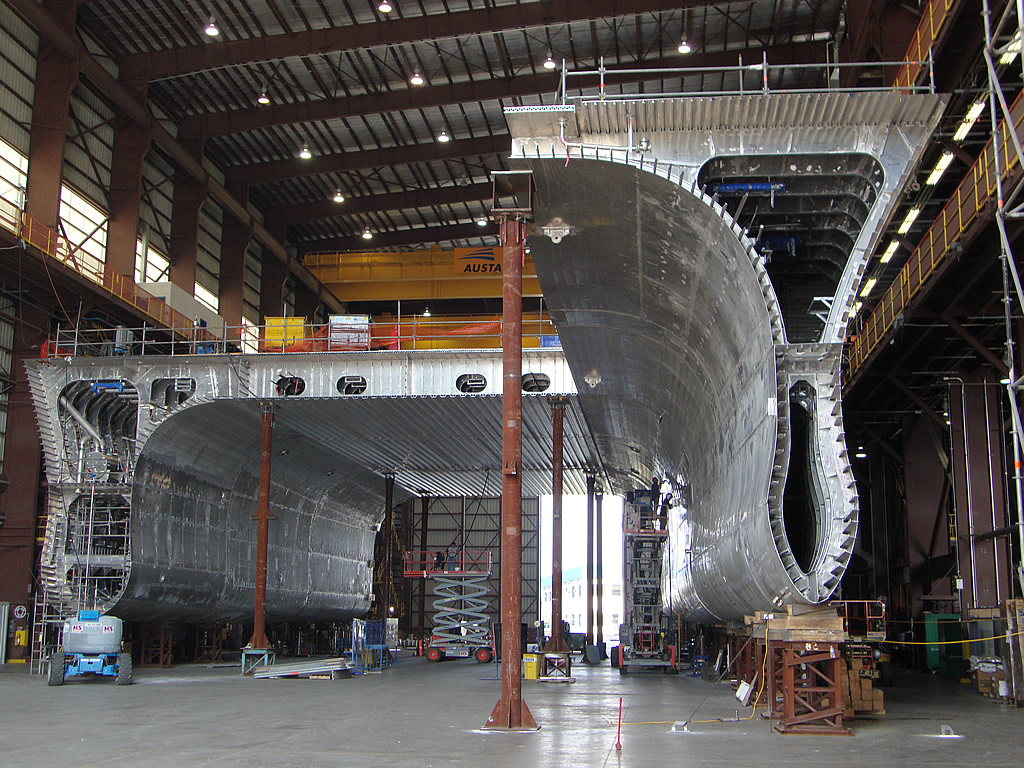
Nov 10/09: Industrial. Austal officially opens its new $88 million state-of-the-art Modular Manufacturing Facility (MMF) in Mobile, AL, equipping its US shipyard with the ability to build up to three 100 metre-plus vessels each year. Phase 1 facility boasts 35,000 m2 of manufacturing space under one roof, including a 7,900 m2 warehouse, as well as paved parking for more than 2,000 vehicles.
The MMF will increase Austal USA’s capacity to assemble and outfit unit modules before consolidating them into the full vessel, automating component manufacture, including pipe runs, from a 3D model. This approach is widely used in advanced European and Asian shipyards, but is less common in the USA. Austal’s MMF is equipped with routers for the precise cutting of aluminum plate, as well as automated pipe and plate benders. Test constructions are currently underway at the new facility, with work on the first 103 meter JHSV scheduled to commence before the end of 2009. The facility will also build LCS-2 Independence class trimarans for the Littoral Combat Ship program. Austal release.
July 17/09: Ship names 1-3. The Pentagon announces names for the first 3 JHSV ships. The Army will field Fortitude [JHSV 1] and Spearhead [JHSV 3], while the Navy’s first JHSV will be named Vigilant [JHSV 2]. The names for JHSV 2 and 3 eventually change.
Spearhead would later become the name for JHSV 1 instead. US Navy Team Ships | MarineLog.
June 19/09: #2-3 lead in. Austal USA in Mobile AL receives a $99.6 million modification to their JHSV contract (N00024-08-C-2217), covering long lead time materials needed for JHSV 2 and JHSV 3. These materials include items like aluminum for the hulls, main propulsion engines, waterjets, reduction gears, generators, and other components that need to be on hand before construction begins in June 2010.
Work will be performed in Detroit, MI (38%); Chesapeake, VA (18%); Henderson, Australia, (13%); Gulfport, MS (10%); Ravenswood, WVA (9%); and Ft. Lauderdale, FL (4%); Mobile, AL (3%); Auburn, IN (2.6%); Winter Haven, FL (1%); Gardena, CA (1%); and Davenport, IA (0.4%), and is expected to be complete by July 2013. US Naval Sea Systems Command manages the contract
Once construction contracts are awarded for the 2 ships later in FY 2009, these materials will be moved with their associated costs into their respective ship construction line items.
April 6/09: US Secretary of Defense Robert M. Gates takes the unusual but approved step of making his FY 2010 defense budget recommendations public. They include another 2 high speed ship charters from 2009-2011, until JHSV ships begin arriving.
Nov 13/08: Austal wins. Austal USA in Mobile AL received a $185.4 million Phase II modification to previously awarded contract (N00024-08-C-2217) for 1 (one) JHSV, and for associated shore-based spares. The firm also has options for up to 9 additional ships by 2013, which could raise the contract’s total value to about $1.6 billion. The Naval Sea Systems Command, in Washington Navy Yard, DC manages this contract, which eliminates fellow Phase I winners Bollinger/Incat and General Dynamics Bath Iron Works. The 103m JHSV design appears to be based on Austal’s Westpac Express catamaran, which is currently under long term charter to the US Marines.
Work on this initial contract will be performed at the firm’s American facility in Mobile, AL and is expected to be complete by November 2010. Austal is teamed with General Dynamics Advanced Information Systems, who will design, integrate, and test the JHSV’s electronic systems, including an Open Architecture Computing Infrastructure, internal and external communications, electronic navigation, aviation, and armament systems.
Austal already produces ships in Mobile, AL, which has about 1,000 employees and will now grow to about 1,500 employees. Ships produced at this location include some similar civilian designs like the Hawaii Superferry, as well as the Independence Class trimaran Littoral Combat Ship produced in partnership with General Dynamics Bath Iron Works. Austal USA is growing the Alabama facility, and phase one of what will ultimately be a $170 million expansion should be complete by summer 2009. The assembly-line style manufacturing building will allow construction of 3 LCS/ JHSV/ Hawaii superferry scale vessels per year, rising to a capacity of 6 ships per year at full build out. Austal | General Dynamics | Marinelog | Alabama Press-Register | Biloxi-Gulfport Sun-Herald | Western Australia Today | Maine’s Brunswick Times-Record re: union lobbying in Congress to scrutinize the deal.
Austal Wins! JHSV 1 bought
FY 2005 – 2008
From initial requirements draft, to 3-team preliminary design contracts, to final RFP submissions.

loading in Australia
(click to view full)
July 30/08: Austal announces its final Phase II JHSV submission to the US Navy, following an extensive detailed design and review process. The firm expects that a single Phase II contract for up to 10 JHSV ships will be awarded in late 2008.
Austal’s release adds the interesting tidbit that the firm was recently awarded a new contract to provide additional features and equipment on Hawaii Superferry’s second commercial 107 meter catamaran, in order to allow its use by the military if required.
Jan 31/08: Preliminary design. The US Department of Defense awards a trio of $3 million Phase I preliminary design contracts for the JHSV. Winners include:
Team Austal: Austal USA, Austal Ships (Australia), and General Dynamics Advanced Information Systems (GDAIS). This is sort of the same Austal/GD core team building the trimaran LCS 2 Independence design for the USA’s Littoral Combat Ship competition – but note competitor #3…
Team Incat: Louisiana-based Bollinger Shipyards, Inc., Incat of Australia, and its design arm Revolution Design, Nichols Brothers Boat Builders and Kvichak Marine in Washington State, and Gladding-Hearn (Duclos Corp) in Massachusetts. Their design will be based on Incat’s 112 meter wave-piercing catamaran, currently in commercial service. Consortium source.
General Dynamics’ Bath Iron Works. No information.
See: US NAVSEA release [PDF] | Incat Australia release | Austal release | UPI re: Bath Iron Works | Springbored’s blog commentary re: Austal-GD dynamics.
Preliminary design contracts
April 23-27/07: Representatives of the US Army, Navy, Marine Corps and the shipbuilding industry meet at at Quantico Marine Corps Base, VA, to discuss the JHSV’s current status of the Joint High Speed Vessel and update prospective contractors on the vessel’s design requirements. US Army release.
November 2005: Initial Draft. The JHSV program office’s Initial Capability Document received approval from the Department of Defense Joint Requirements Oversight Council in early November. All four military services concurred with the decision. The Analysis of Alternatives for this program is scheduled to report out before the end of the 2005 calendar year, and procurement of the lead ship is planned for FY 2008. NAVSEA release
Appendix A: The US Military’s HSV/TSV Experience

(click to view full)
Instead of arising from a drawing board or a notional requirements sheet, the JHSV’s requirements were based on 7 years of experience operating similar leased vessels, from 2001-2008. The core concept is based on an Australian innovation: fast catamaran ferries from Austal and Incat that are in widespread civilian use. Each ship has a carrying capacity equal to about 20 C-17 heavy airlifters, and their waterjets can power these aluminum catamarans through the water at a consistent 35-40 knots in calm seas. Robert Kaplan, in “Hog Pilot and Blue Water Grunts“:
“Who thought up the idea of using car ferries to get Marines to a combat zone and then link up with pre-positioning ships?” I asked a Marine chief warrant officer. “No-one at the Pentagon. Just a bunch of guys brainstorming here,” the chief replied.”
It was more than just brainstorming. Incat’s HMAS Jervis Bay had been used very effectively by Australia during East Timor’s 1999 independence referendum and subsequent operations, and its demonstrated capabilities attracted American interest.
The chartered vessels quickly lived up to their billing. Normal transit for a Marine battalion from Okinawa, Japan to South Korea aboard ferry or amphibious shipping is about 2-3 days, and moving it by air would take 14-17 “lifts” from C-17 aircraft, a process that might require several trips unless that many planes were available. The same deployment could be carried out by Austal’s chartered WestPac Express catamaran in 24-30 hours; which is to say, at about half the time of conventional naval options, and at about 25% of airlift’s costs. One ship can carry a complete battalion of up to 970 Marines, along with 663 tons of vehicles and equipment. If the Marines must deploy from Guam, where many are being moved from Okinawa, the added distance makes JHSV an even more timely and cost efficient option.

(click to view full)
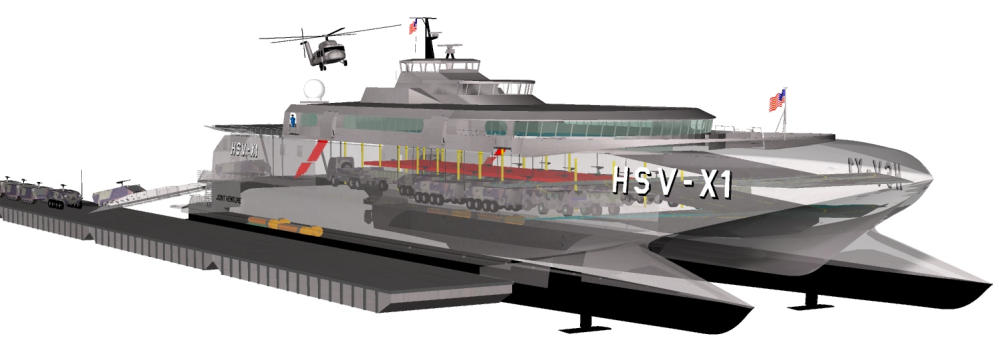
Austal’s ships weren’t the only high speed vessels in operation. The Army operated Incat’s HSVX-1 Joint Venture in conjunction with the Navy, and TSV-1X Spearhead was under sole Army control until its 2005 return to commercial service. Both ships saw extensive Army use in operations Enduring Freedom and Iraqi Freedom, as well as supporting operations in the Pacific, Atlantic, Mediterranean, Horn of Africa, Persian Gulf and Southeast Asia.
In one operation, TSV-1X Spearhead moved the 101st Airborne Division’s military police and their equipment from Djibouti, Africa to Kuwait in the Persian Gulf. The fast catamaran made the 2,000 mile trip in just 2.5 days. Its naval LSV predecessor would have needed 10 days to make the voyage, and would only have carried the equipment, forcing the troops to fly separately.
HSVX-1 Joint Venture was even used by Special Operations Command as a proof-of-concept platform for a special operations force afloat in the western Pacific. Its modifications included a helicopter landing deck and hangar, along with a small military command, control and communications suite. Modifications to its complement also included ScanEagle UAVs, letting US Navy experiment with UAVs, blimps and related vehicles in a persistent surveillance role. The combination of high speed transport, persistent surveillance, and advanced communications may prove to be very complementary.
A 3rd Incat ship, the 112m HSV-2 Swift, was contracted to serve as an interim Mine Warfare Command and Support Ship (MCS), supporting R&D into new mine warfare modular payloads. From 2004 onward, its scope of use became far broader, and Swift’s geographic range expanded to include Africa, Asia, and recovery efforts in the USA after Hurricane Katrina. It remains in American service as of 2013, and continues to trial new approaches like aerostats and UAVs.
If HSVX-1 and HSV-2’s experiences sound a lot like the USA’s forthcoming Littoral Combat Ships, the similarity is no accident. Experience with these high-speed catamarans has played an important role in developing the LCS concept of operations, though the US Navy may not have taken the experiments to their logical conclusion. Given the emergence of naval unmanned vehicles, some observers believe that JHSV’s size and lower cost make it a better choice than the smaller LCS as a “robotic swarm mothership”.
Additional Readings & Sources
Thanks to DID reader and long-serving US MSC vet Lee Wahler for his assistance with this article.
JHSV and its Relatives
* US Navy Fact File – Joint High-Speed Vessel – JHSV
* US Navy PEO Ships PMS-325 – Joint High-Speed Vessel (JHSV). 2007 snapshot.
* US Navy NWDC – Naval Concept Development – High Speed Vessel. 2007 snapshot.
* JHSV Program – Joint High Speed Vessel Program Overview: SNAME SD-5 & IHS. Sept 28/06 presentation.

* DID – Hawaii Superferry’s Bankruptcy = US Navy Opportunity. Became USNS Guam and USNS Puerto Rico, based on vessels similar to the JHSV.
* DID – U.S. Marines Extend Westpac Express TSV Ship Charter.
* US Military Sealift Command – WESTPAC EXPRESS, MV.
* US Military Sealift Command – HSV SWIFT. December 2013 snapshot. No longer leased.
Ancillary Equipment
* DID – Ruin on Rails: The US Navy’s Railgun Project. JHSV 3 will serve as a testbed.
* DID – From Dolphins to Destroyers: The ScanEagle UAV. USNS Swift was a testbed, and JHSVs can be expected to operate this and Insitu’s follow-on RQ-21 Blackjack UAV in future.
News & Views
* Soldiers Magazine, via The Free Library (August 2007) – Launching the JHSV.
* US Army (April 30/07) – Services Chart Course for New Vessel.
* Inside the Navy via Military.com (July 13/06) – Joint High-Speed Vessel Taking Shape.
* Seapower Magazine (May 2006) – In the Shallows: The Joint High-Speed Vessel will bring a new dimension to U.S. forces.
* National Defense Magazine (November 2005) – Navy’s High-Speed Vessel Aids Relief Effort.
* US Armed Forces Press Service (Oct 21/02) – “Joint Venture” Craft Cruises to the Future .