

IEDed in Iraq
(click to view story)
General Dynamics is one of the biggest suppliers of land equipment to the US Army and Marines, alongside firms like BAE and Oshkosh. As IED land mines became an unmistakable trend in modern warfare, however, the company had nothing of its own to respond with. To fix that, they fell back on a focused partnership with BAE and the Canadian government, and created another limited partnership with newcomer Force Protection. Those kinds of partnerships can be preludes to an acquisition, and that was true in this case as well. In late 2011, the firm bought Force Protection, bringing all of its vehicles, technologies, and experience in house.
General Dynamics Land Systems is now a legitimate player in the global marketplace for blast-resistant vehicles. The long-term question involves competitiveness, as both the RG-31 (BAE) and Cougar (Force Protection) faded in the face of newer MRAP competitors. GDLS will reap maintenance and upgrade contracts for the RG-31s and Cougar in the US fleet, and consolidating accountability may strengthen their position if the Army decides to rationalize its MRAPs. That cash flow buys time; beyond, exports beckon. The Cougar family has a strong customer in Britain, where General Dynamics is supplanting BAE as a major land forces supplier, and it is used by several NATO and Middle Eastern countries. The Buffalo heavy mine-disposal vehicle has a unique niche, and offerings like the Ocelot and Jamma light patrol vehicles may yet pick up. Will it be enough?
Experiences on the Front Lines

(click to view full)
During the fighting in Iraq and Afghanistan, the leading source of casualties among allied forces has been the “Improvised Explosive Device” – a fancy name for the centuries-old tactic of using land mines. Despite the clear example of South Africa, whose v-hulled land vehicles had let them prevail over this same threat more than 30 years earlier, the US military was very slow to appreciate the importance of blast-resistant vehicles.
Still, there were some early successes. Eventually, they led to a full-fledged acquisition program that made the USA the globe’s leading operator of blast-resistant vehicles. A few stories from the front lines will help explain why.
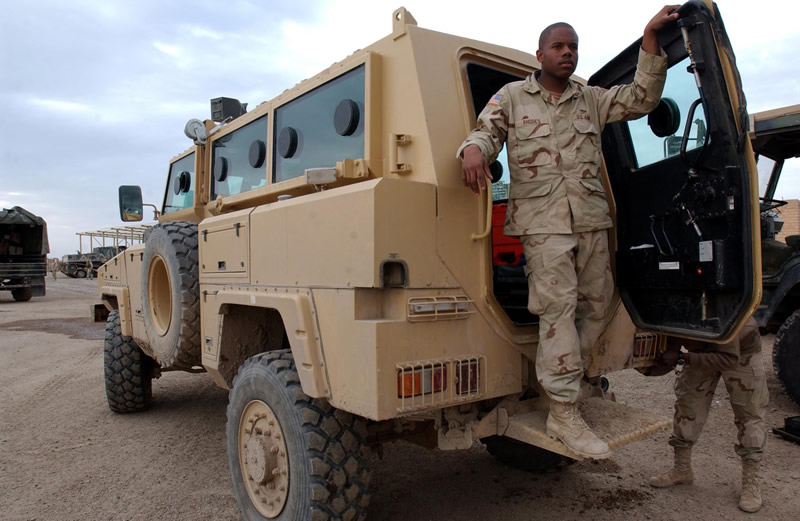
Many RG-31s saw early use by the US Army and US Marine Corps as pathfinder vehicles that took lead convoy roles, or act as specialty vehicles for Explosives Ordnance Disposal teams. The US 101st Airborne used these vehicles the same way the Canadians did, as proven blast-resistant patrol vehicles whose protection level, mobility and multiple firing ports made them small but formidable opponents. As one report notes:
“On 26 September 2006, a suicide bomber attacked a Canadian convoy 2km from Kandahar Airfield. The bomber detonated a explosives-laden minivan while trying to ram an RG-31 Nyala Armoured Patrol Vehicle. The result differed dramatically from earlier attacks on armoured [Mercedes] G-wagons. Instead of charred wreckage, the blast- resistant [BAE Systems OMC] Nyala limped home with little damage. Instead of wounded or dead, no-one was injured inside the APV.”
No vehicle is invincible, however; a July 2007 land mine attack near Kandahar left 7 crewmen dead. A July 4/07 Edmonton Sun article also notes a series of mechanical issues the Canadian Forces have had with the RG-31 and its independently-manufactured remote weapons system:
“Army records show that at the height of fierce fighting in Afghanistan last summer, more than a quarter of the RG-31 fleet were in the shop with maintenance problems.
The vehicles had a series of electrical and software glitches, many relating to the roof-mounted remote-controlled machine-gun [DID: the Kongsberg Protector M151 RWS, also used on US Stryker vehicles].
Nyala maintenance logs, obtained by The Canadian Press under the Access to Information Act, show the vehicles arrived with a series of minor defects.
Records show that between mid-June and mid-July last year, 13 of the 50 Nyalas – some with as few as 550 km on them – were deemed “non-mission capable” by the army.
The ratio has since improved, with only one or two of the current complement of 75 RG-31s down for maintenance at any time.”
Hopefully, US forces will be able to avoid the initial maintenance issues that have given Canadian RG-31s problems in Afghanistan. Hence Engineering Change Proposals to improve the vehicles’ armor and internal systems, while installing upgraqded suspensions to mitigate the off-road issues created by a v-hull’s higher center of gravity.

The Cougar family’s added weight, and designed-in protection, make a difference. On March 1/07, the Cougar’s success in theater had led The Commandant of the US Marine Corps, Gen. James Conway to submit a Memorandum to the US Joint Chiefs of Staff [PDF]. It traces the history of program growth for MRAP vehicles, including a significant acceleration in 2006, from a request for 185 vehicles in May to a projected need that had grown to 4,060 vehicles by November 2006. It listed MRAP vehicles as his #1 unfunded priority, and added that:
“Based on the recognition of significantly reduced lethal and severe injuries in MRAP vs. the HMMWV, on 2 January 2007, commander, MARCENT requested support for a policy change that would provide MRAP level protection for all Marines operating outside the wire in MNF-W[1] . Under this policy, limited use of Armored HMMWV’s [sic] will be authorized in specific tactical situations where the operational characteristics of HMMWV are required. On 6 February 2007, the MROC (Marines Requirements Oversight Council) validated a Marine Corps requirement of 3700 vehicles in support of this policy.”
The Anbar Awakening among Iraqi Sunnis, and their revolt against al-Qaeda, changed the strategic dynamic in Iraq, to the point that this policy change eventually became unnecessary. Hard fighting continuedm, however, and Cougar MRAPs saved lives. As one June 2007 USMC story describes it:
“I’ve had two IEDs go off on me in the last two weeks,” said [Staff Sgt. Timothy Kessler of C Company, 2nd Combat Engineer Battalion, Regimental Combat Team 6], whose unit has been hit at least six times so far since the beginning of his tour. The largest explosion detonated under the right front tire of the vehicle.
“It blew my fenders off, it blew the front bumper about 30 meters away. We never did find the fenders, but all the Marines inside the vehicle were OK.”
“The other blast was again under the right tire. We sustained minor damage and it fragged my window up a little bit,” said Kessler.
Although the MRAP vehicle Kessler was riding in survived the attacks, it is very likely that a humvee would have sustained catastrophic damage.”
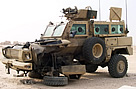
Kessler was far ffrom alone. The Cougar vehicle pictured above was hit by a much larger bomb, estimated later as being well over 50 pounds of explosives, and possibly over 100. The blast ripped the engine from its armored bay, and hurled it over 100 yards. Every member of the crew survived.
The MRAP Trend, and GD’s Offerings

(click to view full)
Even after several years of escalating casualty reports from land mines, which were consistently the #1 killer in-theater, there were still think tanks in Washington who believed that buying blast-resistant vehicles was a mistake. They were too large and too heavy to remain mobile, went the criticisms, and would cut American forces off from contact with the population. Leaving aside the question of which vehicle a think-tank member would prefer to ride in on the front lines, subsequent operational experiences have not validated these criticisms.
Other critics advocated keeping troops off roads entirely, which has more military value to recommend it. Some groups proposed an approach similar to British Lt. Col. Labouchere in Iraq, using armored vehicles and combat engineering to offer a modern take on Roman “move and fortify” methods. David Axe, who has ridden in “almost every MRAP variant”, offered a more visceral take:
“MRAPs are not comfortable. In fact, I hate them — not only for their cramped interiors and many sharp metal edges and the way the seat cushions get flattened or their frames bent after repeated use, but also because MRAPs and other Army vehicles are basically bomb magnets… I’ve been bombed or nearly bombed in MRAPs twice since 2009, and while I’m grateful to have emerged mostly unscathed, I’ve learned that in a warzone I’d rather walk 15 miles up a mountain with a rucksack on my back than ride two miles in an MRAP or any other vehicle… [MRAPs] will keep people alive when they are bombed, but the vehicles also attract attacks. It’s a Catch-22 situation. You need safer vehicles… because you’re riding in vehicles in the first place.”
Unfortunately, staying off-road is only a partial solution if a country’s road network is seen as a critical economic asset that must be kept open and defended. This has been the case in both Iraq and Afghanistan, under American/Western doctrines of counter-insurgency.
Unsurprisingly, the net trend around the world is a clear move toward more blast-resistant vehicle designs for front-line troops, mostly via emergency buys. GDLS hopes that its expanded stable of offerings can help them meet some of that demand.

(click to view full)
The question is how big that demand will eventually get, as vehicle fleets need to be renewed. There are down sides to fielding blast-resistant vehicles. The laws of physics ensure that they’re heavier, which makes them both more expensive to buy, and more expensive to fuel. They do have higher centers of gravity, which makes them more likely to tip over on uneven ground or inclines. That height can even become an issue when trying to transport them inside of some air vehicles and ships.
New programs like the USA’s JLTV (where GDLS is partnered with HMMWV manufacturer AM General as GTV), Iveco’s MLV/LMV, and Australia’s funding of its local Thales Hawkei design, are one approach to bridging this gap. Advanced vehicles with novel design and proetection are commissioned to offer lighter, lower, more transportable designs that will hopefully provide enough blast protection. The flip side is that nothing comes free, and squaring this technical circle usually means a more expensive vehicle. Other companies, including several MRAP vendors, are looking at very low-cost options, with upgrades for existing vehicles like HMMWVs that offer protection improvements, while using shallower v-hulls to avoid creating new problems.
In between, General Dynamics Land Systems now has its own set of offerings for the global market, alongside its limited RG-31 partnerships with BAE Systems.
GDLS’ 3-Way RG-31 Partnership
by Pedro Lucio
(click to view full)
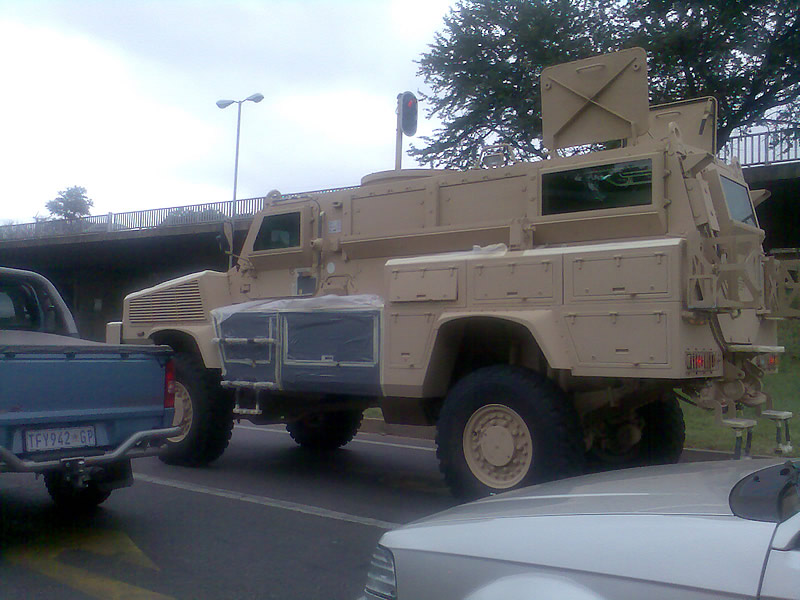
BAE OMC’s RG-31 was the first mine-resistant vehicle fielded by US forces in Iraq and Afghanistan, where it was used by the 101st Airborne (and reportedly by SOCOM) as a patrol vehicle. According to General Dynamics, as of August 2007, U.S. forces had ordered 492 RG-31 vehicles, including 309 of the improved RG-31 Mk5 variant for the U.S. Army and Special Operations Command (SOCOM).
Then the MRAP program began, and American buys of blast-resistant vehicles jumped sharply.
The US MRAP Category I MRUV (Mine-Resistant Utility Vehicle) specified a 6-person vehicle (including both front seats), with blast-resistant design, ballistic glass, gun turret, undercarriage armor and a raised chassis. MRAP Category II JERRV vehicles must seat at least 10, and offer larger mine-protected patrol and specialty vehicle functions for troops and Explosive Ordnance Disposal (EOD) teams.
General Dynamics Land systems reacted to this need in 2 ways. One path involved the existing RG-31 partnership. The other path involved the 50/50 Force Dynamics partnership with Force Protection, which began on Nov 11/06. The early presence and publicized record of that company’s Cougar vehicles had played a significant role in spurring the USA’s MRAP program. Force Protection needed additional production capacity and certainty, while General Dynamics was looking for additional offerings to bolster the anemic MRAP orders for its RG-31.
All American RG-31 orders, both before and during the MRAP program, have been placed through an odd triumvirate: All contracts are signed through the Canadian Commercial Corporation, a Crown Agency of the Canadian Government (who also use RG-31s). Technically, General Dynamics Land Systems Canada is partnered with BAE OMC of South Africa, with service through its GDLS parent in the USA. The arrangements with BAE OMC are America-specific. The firm does not have a wider alliance, but industrial circumstances have also handed General Dynamics an RG-31 partnership in Spain, via GD’s Santa Barbara Sistemas subsidiary.
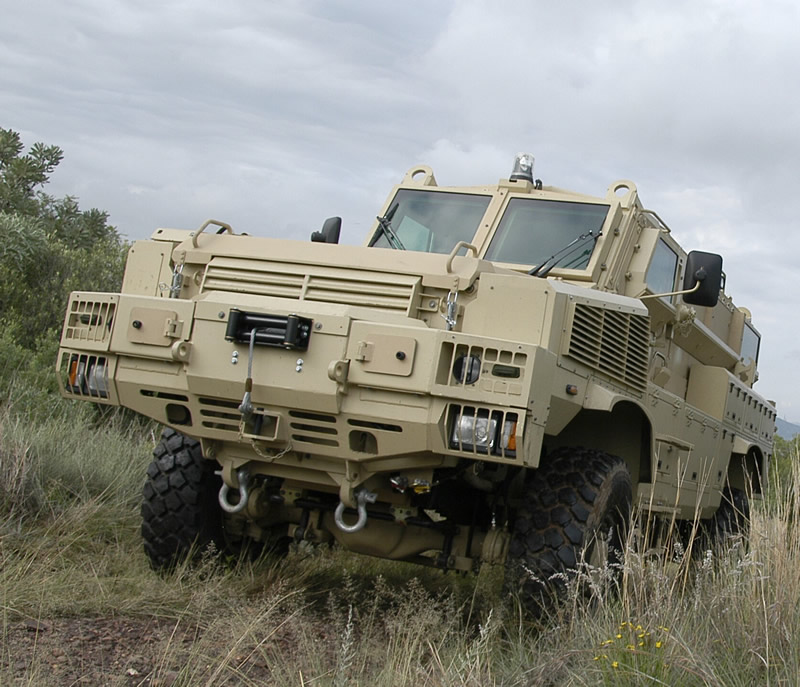
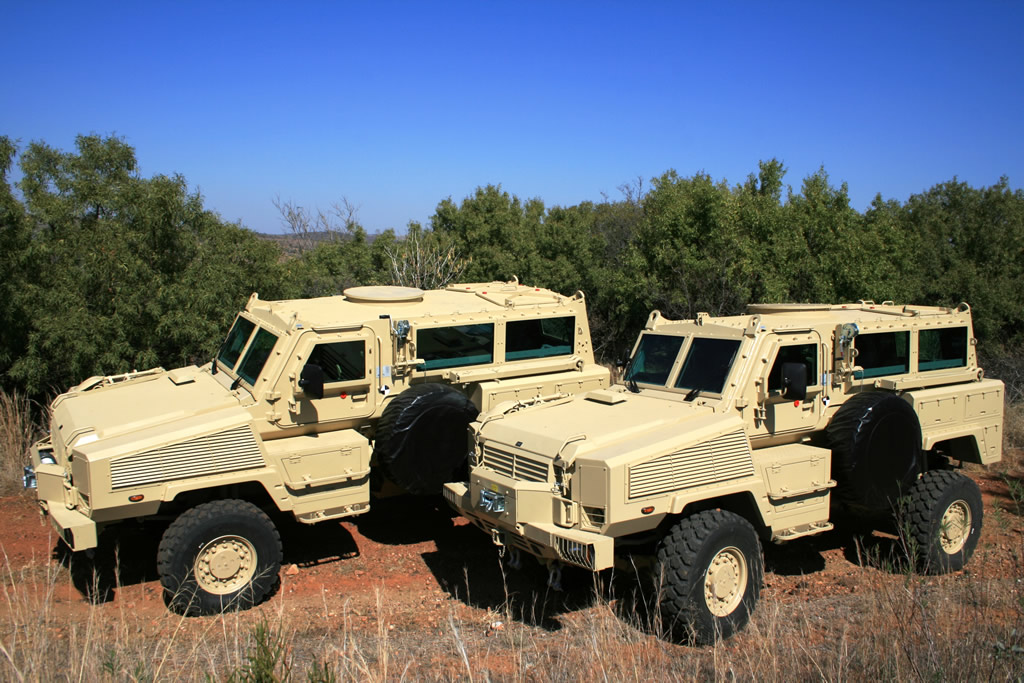
In America, the CCC – GDLS – BAE OMC team entered the RG-31 Mk5 as its CAT I entry, or RG-31A2 as it’s known by the US Army. RG-31s are one of the lighter MRAP vehicles on the roster, with a combat weight of about 18,500 pounds, as opposed to the Cougar 4×4’s weight of 31,000 pounds empty. By comparison, the M1114 up-armored Hummers have an empty “curb weight” of around 9,000 pounds, and a top weight of about 12,000 pounds.
The RG-31 MK3 4×4 Mine Protected APC is built from an all-steel welded armor monocoque hull; dismounting is provided via a large rear door for rapid exits and 2 front doors. The RG-31A2 is the latest version of the “Charger,” as the Americans call it, delivering a significant increase in power and payload.
The team’s MRAP CAT II/ JERRV entry was the RG-31 Mk5E (“Extended”), a stretched and heavier variant of the RG-31 Mk5 that can carry more troops and/or cargo.

(click to view full)
The RG-31s have received a number of changes over the years, in response to battlefield pressures. Many are detailed in specific ECP orders below, but a few are worth special mention. BAE’s lightweight LROD aluminum cage armor provides partial protection from anti-tank rockets. QinetiQ’s Q-Net is an all-fabric mesh developed jointly with DARPA and the Office of Naval Research. It’s lighter still, allowing in-field repairs, and can easily be used to “patch” removed bar armor panels.
In order to improve mobility in rought terrain like Afghanistan, American RG-31s have received an array of changes. The most significant is an improved 4500 Series ISAS independent suspension set from General Dynamics subsidiary AxleTech International in Troy, MI. Axletech’s ISAS technology is already deployed in Textron’s M1117 Guardian ASV armored cars, Thales Australia’s blast-resistant Bushmaster, and Navistar Defense’s top-selling MRAP, the MaxxPro.
Some American RG-31s have received Oshkosh’s TAK-4 independent suspension system instead, which also equips the US Marines’ MTVR and LVSR trucks, the US military’s M-ATV blast-resistant patrol vehicle, and upgraded Cougar and RG-33 MRAPs. GDLS has no visibility into final customers, and could not confirm a service-specific Army vs. USMC split between RG-31s upgraded with AxleTech 4500s, and those upgraded with TAK-4 suspensions.
Force Protection: From Plan B to Plan A

(click to view full)
Almost exactly 5 years after the Force Dynamics partnership was signed to produce Cougar vehicles for the USA, General Dynamics took the next step. In November 2011, GDLS bought Force Protection for about $360 million, picking up the firm’s entire product line, and positioning themselves for export sales as well.
Cougar vehicles are larger than the RG-31. The comparable Cougar 4×4 MRAP CAT 1 weighs 31,000 empty (“curb weight”), with a maximum recommended weight when fully loaded of 38,000 pounds (“gross vehicle weight,” or GVW). It usually carries 4 troops, plus the front 2 seats.
(click to view full)
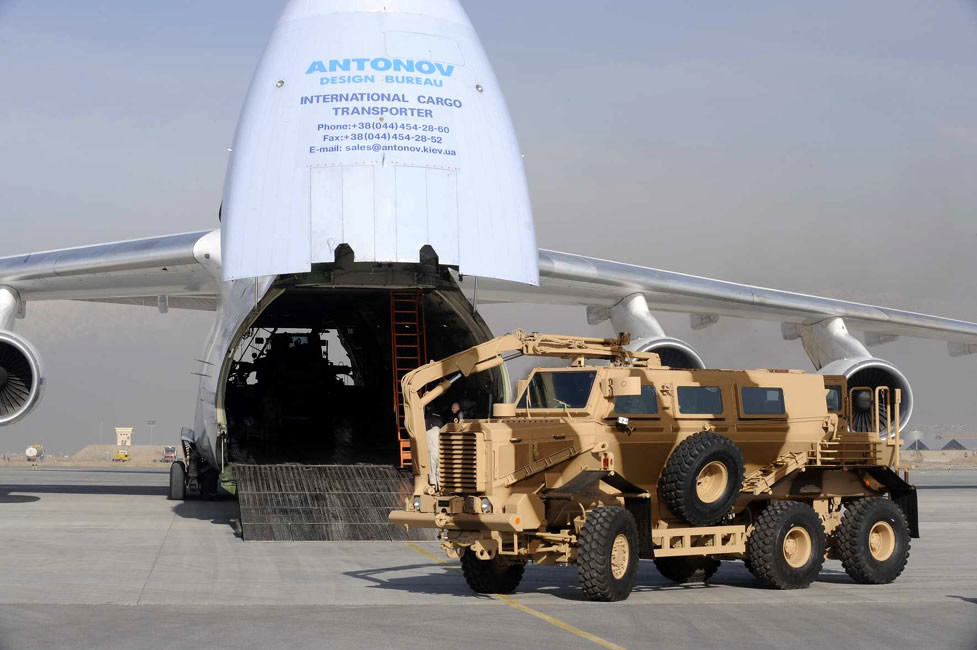
The larger Cougar 6×6 MRAP CAT II has a curb weight of 38,000 pounds, and a GVW of 52,000 pounds. They can carry 8 troops plus the front 2 seats, These vehicles can be customized for multiple tasks including troop transport, mine and explosive ordnance disposal, command and control, reconnaissance, and as a lead convoy vehicle. An ambulance variant has also seen limited production.
Both Cougar types are being equipped with Oshkosh TAK-4 Independent Suspension Systems, in order to make them less “tippy” on inclines, and help them navigate the kind of rougher ground that’s so pervasive in places like Afghanistan. The TAK-4 system is in wide usage, equipping the US Marines’ MTVR medium and LVSR heavy trucks, the US military’s M-ATV blast-resistant patrol vehicle, some RG-31s, and BAE’s RG-33 MRAPs.
An even larger and more awe-inspiring relative, the Buffalo, is deployed in Iraq and Afghanistan as a mine-disposal vehicle. Its signature pavement-destroying digger has given it a nickname: “The Claw.” “Darwin’s Bane” might be equally appropriate. It’s a testament to the product’s design that even bomb disposal crews who lifted up the explosive they unearthed, in order to see them better, have survived the detonations.
Buffalo vehicles serve with the US military, Canada, France, and Italy.
(click to view full)
Force Protection ended up shut out of the emerging JLTV competition to replace some of the US military’s HMMWVs, and their Cheetah vehicle is now just a memory.
Efforts to develop vehicles for foreign customers have been more successful. Distinct Cougar 6×6 variants serve with Iraq and Yemen as the ILAV/Badger, and with the British Army as the more heavily protected Mastiff or Mastiff 2. The British also worked with Force Protection to develop a specialty 6×6 flatbed cargo version called the Wolfhound, then served as the variant’s lead customer. Britain also worked to modify and then order smaller Cougar 4×4 “Ridgeback” variants. Read “Blast Hounds: UK Land Forces Order Force Protection’s Vehicles” for more.
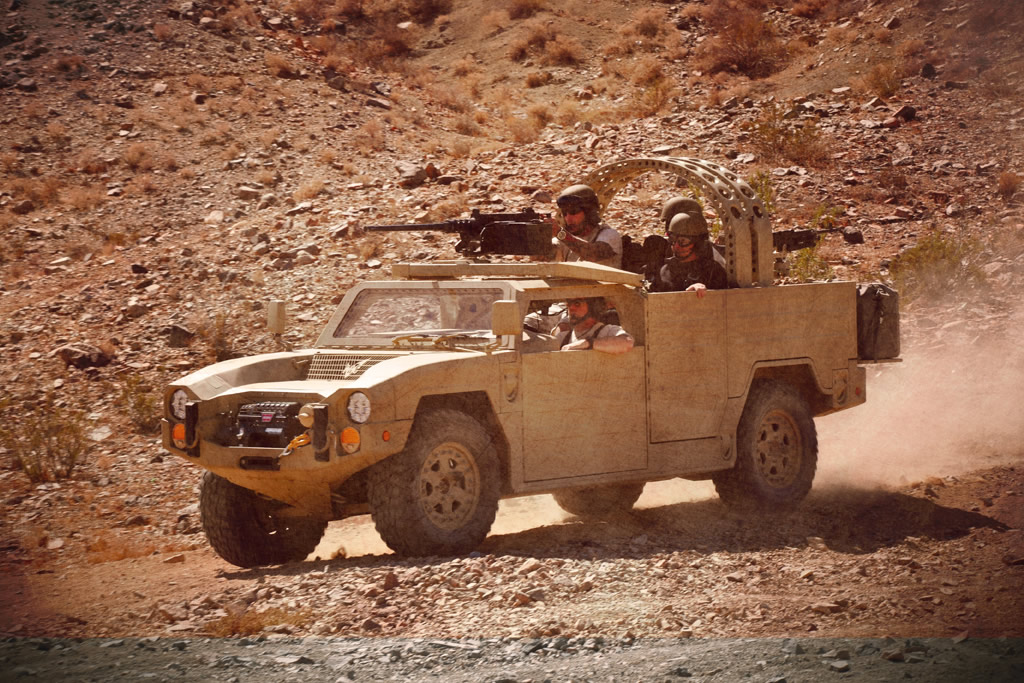
Force Protection’s stable extends beyond Cougar variants. A vehicle called the JAMMA(Joint All-Terrain Modular Mobility Asset) is optimized for Special Forces use, and features a number of basic switchable add-ons alongside its different wheel width options. Protection is limited, but JAMMA’s narrow-track configuration is certified for transport in the V-22 Osprey’s low cargo hold, which may help it get the attention of the USMC.

(click to view full)
Abroad, a British partnership has developed the Ocelot, an entirely new vehicle design in the Cheetah’s weight class. Force Protection claims that its Ocelot exceeds the required British LPPV mine protection level and offers protection similar to the 6×6 Mastiff Cougar variant, while still meeting LPPV targets for mobility, payload, size and gross vehicle weight.
Ocelot is a modular design with a core automotive armored spine or “skateboard,” and a composite special-to-role pod. Center of gravity is low, as all the heavy items are contained within the V-shaped skateboard: the Steyr 3.2 litre straight six diesel powerpack, propshaft, 6-speed ZF gearbox, AxelTech differentials, fuel tank and all the suspension gear, except for a torsion bar which is mounted alongside the hull. The V-shape design results in the running gear not intruding into the crew area, making movement from front to back easier and improving protection levels. Bulkheads between vehicle crew and dismounts, and between crew and electronic equipment such as radios and jammers, give added protection. Current add-on pods include patrol, fire support, or protected logistics vehicle, and the patrol vehicle pod seats 2 crew and 4 dismounts. The pods can be swapped out in the field as the need requires. Access is through large rear doors, 2 top hatches, or an oversize commander’s door. Ocelot can reportedly be airlifted in a C-130 Hercules aircraft, or even a CH-47 Chinook heavy-lift helicopter, but not a V-22.
The British have dubbed the Ocelot “Foxhound,” in keeping with the use of dog names for their blast-resistant vehicles, with 300 planned orders by December 2011. Unfortunately, in December 2011, the Ocelot lost Australia’s much larger Overlander PMV-L competition.
USA MRAPs: The Broader Picture
The overall MRAP competition breaks down as follows:
| Manufacturer | CAT I | CAT II | Notes |
| Navistar | MaxxPro MaxxPro Ambulance (Dash) MaxxPro AF MaxxPro Dash MaxxPro Plus |
MaxxPro MaxxPro Recovery Vehicle |
Top finisher in number of MRAP orders. |
| BAE Systems | RG-33 RG-33 SOCOM Caimin |
RG-33L RG-33 HAGA ambulance Caimin |
Won MMPV with RG-33L derivative. |
| General Dynamics Land Systems | RG-31 Mk.5/ RG-31A2 | RG-31 Mk.5E | Partnered with BAE OMC, Canadian government CCC. Also received orders before MRAP began. |
| GDLS: Force Protection | Cougar 4×4 | Cougar 6×6 | Bought by GDLS, who produced most MRAP Cougars in a 50/50 partnership. Also received orders before MRAP began. Buffalo MRAP CAT-III mine disposal vehicle is sole-source. |
| Oskkosh | Alpha (w. PVI) |
Bushmaster (w. Thales) |
No MRAP orders, but sole winner of related M-ATV program with its own design. |
| PVI | Alpha serve w. US Border Patrol |
Golan (w. RAFAEL) |
Alpha failed MRAP testing; 2008 firm bankruptcy & fire-sale acquisition |
| Textron | M1117 ICV | M1117 ICV | Failed MRAP testing; no MRAP orders, but ASV variant widely ordered by Military Police and fire targeting units. |
Of the envisaged 15,771 vehicles in the MRAP-I program as of March 31/08, all have been ordered – and follow-on orders have grown the total further, even as related programs like the more mobile M-ATV and the Army’s MMPV engineer vehicle have grown the overall fleet of blast-resistant platforms.
Thus far, General Dynamics’ 3-way arrangement for the RG-31 has won US MRAP contracts for 1,660 vehicles, in addition to over 550 pre-MRAP orders for the smaller RG-31 4×4. This placed them a distant 4th in the competition as the last manufacturer to win significant orders, behind Navistar, BAE Systems, and Force Protection. Even with the firm’s 2011 purchase of Force Protection, the combined entity remains in 3rd place behind BAE Systems.
GD’s MRAP Contracts
(click to view full)
Unless otherwise specified, all contracts are issued by the US Marine Corps Systems Command (MCSC) in Quantico, VA. Post-acquisition Force Protection contracts (after Nov 7/11) around the world will now be covered here, alongside a fuller history of US RG-31 orders. To see Force Protection contracts & events before November 2011, read “Force Protection’s MRAPs to Stalk Mines on the Battlefield“.
The first Force Protection MRAP order was for test vehicles; subsequent orders under that contract (M67854-07-D-5031) include:
#002: 60 CAT I Cougar 4x4s and 65 CAT II Cougar 6x6s
#003: 300 CAT I and 700 CAT II
#004: 395 CAT I and 60 CAT II
#005: 25 CAT I and 100 CAT II
#006: 553 CAT I and 247 CAT II
#007: 178 CAT I and 180 CAT II
#012: 1,862 vehicles: Oshkosh TAK-4 suspension kits
These listed orders do not count Buffalo MRAP Class III mine-clearance vehicles, which are sole-sourced, or orders outside the USA.
As noted above, RG-31 contracts are signed with the Canadian Commercial Corporation, a Crown Agency of the Canadian Government in Ottawa, ON. General Dynamics Land Systems – Canada manages the contracts, and works with partner BAE OMC in South Africa to deliver the vehicles. US RG-31 MRAP delivery orders include:
#0001: Test vehicles
#0002: 10 4×4 Category I and 10 6×6 Category II
#0003: 600 Category II
#0004: 773 Category I
#0007: 250 Category I
#0009: 27 unspecified
Only a fraction of these vehicles will continue to serve in the US military. The US Army is consolidating its MRAP fleets around Oshkosh’s M-ATV and Navistar’s MaxxPro. Some other types will continue to serve, but most will either be destroyed in place or sold to allies. Some are being disposed of by giving them to American police forces, often in very small towns where the rate of violence is quite low. This kind of overtly intimidating militarization is stirring political controversy in the USA.

(click to view full)
March 28/14: Upgrades. General Dynamics Land Systems-Force Protection in Ladson, SC receives a $74.7 million firm-fixed-price contract for the development, design, and production of 916 Cougar “egress upgrade kits” =that improve the crew’s ability to get out safely. The kit includes upgrades to 4 existing vehicle systems: front doors; rear doors; rear steps; and exhaust.
All funds are committed immediately from a variety of FY 2012 – 2014 USAF, USN & USMC budget lines. Work will be performed in Ladson, SC, and work is expected to be complete in September 2015. The term of the contract is not to exceed 18 months. One offer was received by US Marine Corps Systems Command in Quantico, VA, who manages the contract in support of PEO Land Systems’ Program Manager for Mine Resistant Ambush Protected Vehicles (M67854-14-C-5501).
Feb 4/14: Upgrades. The US Marine Corps Systems Command in Quantico, VA has competitively awarded General Dynamics Land Systems – Force Protection a contract valued at $26 million for survivability upgrades for Cougar combat vehicles previously delivered under the Mine Resistant, Ambush Protected (MRAP) program.
The company will develop, design and produce 468 Seat Survivability Upgrade (SSU) kits for the MRAP vehicles. The kits will include energy absorbing seats, five-point seatbelts and blast mats to enhance the survivability and operation of the Cougar. Additional improvements include a reconfiguration of the internal crew Automatic Fire Extinguisher System, upgrades to the driver and co-driver compartments, and other improvements to the interior layout and stowage.
General Dynamics will complete delivery of the kits by July 2015. Sources: GD, “General Dynamics Awarded $26 Million for Cougar Survivability Upgrade Program”.
Nov 23/12: 51 Foxhounds. The UK MoD announces a GBP 46 million contract for another 51 Foxhound patrol vehicles, and describes it as “part of an overall investment of £340m that the MOD has made in Foxhound since 2010.”
This brings total orders so far to 376 vehicles. The first Foxhounds were deployed to Afghanistan in June 2012, and are now being used by soldiers operating in mentoring and partnering roles with the Afghan National Security Forces.
Aug 23/12: 25 Foxhounds. The UK MoD announces the purchase of an additional 25 Foxhounds for GBP 30 million (about $47.5M), taking the ordered fleet to a total of 325 vehicles.
Jan 18/12: A $16.3 million firm-fixed-priced contract modification for 111 field service representatives, to install ECP modifications on RG-31s at the MRAP sustainment facility in Kuwait. The costs include mobilization, labor, transportation, equipment, lodging and tools.
Work will be completed in Kuwait, and is expected to be complete by Jan 31/13. FY 2010 Army “other procurement” contract funds will expire at the end of the current fiscal year, on Sept 30/12 (M67854-07-D-5028).
Jan 18/12: GDLS’ newly-acquired Force Protection manufacturing facility in Ladson, SC, will be doing work on another v-hulled vehicle. About $10 million in new work is moving there, to install additional combat-related communication and protection equipment on 292 Stryker DVH (Double-V Hull) 8×8 wheeled APCs, which are getting ready to deploy to Afghanistan.
The new work begins in March 2012, and will occupy about 45 jobs until about February 2013. Force Protection.
Jan 17/12: The US Defense Department’s Director of Operational Test and Evaluation issues his FY 2011 Annual Report, which includes the military’s 53 Cougar Ambulance 6x6s. That review is mixed:
“Based on results from the MRAP ISS LUT(Limited User Testing), the Cougar Ambulance is operationally effective [and survivable]. A unit equipped with the Cougar Ambulance can provide protected transport and urgent medical care for units in Afghanistan. The Cougar Ambulance is not operationally suitable due to its poor reliability, which contributed to its low availability… 367 MMBOMF(Mean Miles Between Operational Mission Failure) versus its operational requirement of 600 MMBOMF.”
Dec 22/11: Foxhound Britain’s MoD announces that they intend to buy another 100 Foxhound (Ocelot) vehicles, as part of a larger GBP 400 million counter-mine package, but that isn’t a contract yet. One it becomes one, Britain’s ordered fleet will rise to 300 vehicles.
Dec 20/11: Acquisition complete. General Dynamics Land Systems completes its acquisition of Force Protection. GD.
Dec 20/11: A $19 million firm-fixed-priced contract modification for the labor and material required to inventory, package and ship 425 RG-31 Block Upgrade 3 (BU3) kits. Each BU3 kit includes 55 individual engineering change proposal kits that will be installed on the RG-31 MRAP vehicle platform. Work will be performed in Johannesburg, South Africa, and is expected to be complete no later than Nov 30/12 (M67854-07-D-5028).
Dec 14/11: GD acquisition Force Protection Industries, Inc. in Ladson, SC receives a $61.6 million firm-fixed-price contract modification for a 12-month renewal of 177 field service representatives (FSR). They’ll continue to install TAK-4 independent suspension systems, conduct battle damage assessment and repair, install block modification kits, and perform other maintenance. The modification also provides for FSR sponsorship, lodging, vehicle, bus, and heavy equipment rentals.
All contract work will be performed at the MRAP sustainment facility in Kuwait, and will run to Dec 31/12. All funds are FY 2012 Operations and Maintenance Marine Corps funds, and will expire at the end of the current fiscal year, on Sept 30/12 (M67854-07-D-5031). See also FP release.
Dec 12/11: GD acquisition Force Protection Industries, Inc. in Ladson, SC receives an $88.9 million firm-fixed-price contract modification for a 12-month renewal of 240 field service representatives. These FSRs will install Kevlar spall liner blanket kits, modernization safety kits, and conduct general maintenance work in Afghanistan.
Contracted work will be performed in the theater of operations throughout Afghanistan, and is expected to be completed December 31, 2012. and will run to Dec 31/12. All funds will expire at the end of the current fiscal year, on Sept 30/12 (M67854-07-D-5031).
Dec 12/11: Losses in Australia The Australian government announces several wins under Project Overlander. Unfortunately, this includes a PMV-L MSA development phase loss for GD/FP Ocelot and the GD MOWAG EAGLE IV, to Thales Australia’s Hawkei. General Dynamics could still come out ahead, if their GTV joint venture wins the US JLTV nod, and Australia then picks the JLTV winner over Hawkei for its 1,200+ vehicle PMV-L program.
A Force Protection release adds that their entry also lost Australia’s REDFIN competition, to provide up to 76 special forces vehicles for the Australian SAS. This would appear to end their opportunities in Australia for the forseeable future. Read “Overlander is On! Australia’s A$3B+ Vehicle Program” for full coverage of Australia’s LAND 121 “Overlander” meta-program.
Dec 6/11: Canadian Commercial Corp. & General Dynamics Land Systems – Canada receive an $18.5 million firm-fixed-priced, indefinite-delivery/ indefinite-quantity contract modification for 275 rocket propelled grenade net kits for RG-31s. The nets are actually QinetiQ’s Q-Net, but they’re being ordered through the vehicle’s prime contractors.
Work will be performed in Waltham, MA, and is expected to be complete by May 2012 (M67854-07-D-5028).
Nov 23/11: Canadian Commercial Corp. & General Dynamics Land Systems – Canada receive a $25.1 million firm-fixed-priced contract modification for 71 field service representatives to work on RG-31s in Afghanistan until Dec 31/12. FY 2011 Other Procurement Appropriation funds will be used, but will not expire at the end of the current fiscal year (M67854-07-D-5028).
Nov 18/11: GD acquisition Force Protection Industries, Inc. in Ladson, SC receives a $6.7 million firm-fixed-priced contract modification for 18 field service representatives in support of its MRAP vehicles in Afghanistan. The contract runs until Nov 30/12, and used FY 2012 Marine Corps Operations and Maintenance funds that will expire at the end of the current fiscal year, on Sept 30/12 (M67854-07-D-5031).
Nov 10/11: CCanadian Commercial Corp. & General Dynamics Land Systems – Canada receive a $6.6 million firm-fixed-priced contract modification for an increase in the unit price of 691 hydraulic upgrade kits, previously purchased for the Block 3 upgrade effort. See also July 22/11 entry; the 691-vehicle upgrade total is now over $470 million, though some contracts also applied beyond.
Work will be performed in Benoni, South Africa, and is expected to be completed by July 31/12 (M67854-07-D-5028).
Nov 7/11: General Dynamics Land Systems, who has partnered with Force Protection to build the Cougar MRAP, takes the next step, as the parent firm agrees to buy Force Protection, Inc. for $5.52 per share of common stock, or approximately $360 million. The move gives General Dynamics a lineup of blast-resistant patrol and de-mining vehicles to call its own, which is something the firm has never had. Force Protection | General Dynamics.
Oct 20/11: A $28.6 million firm-fixed-priced contract modification for 425 MRAP spall liner kits and 295 window retrofit kits. Work will be performed in Waltham, MA (88%), and Selma, AL (12%), and is expected to be complete in July 2012. The FY 2011 “other procurement” appropriation funds used will not expire at the end of the current fiscal year, on Sept 30/12 (M67854-07-D-5028).
(click to view full)
Sept 28/11: An $87.3 million firm-fixed-priced contract modification for 425 each of the following RG-31 Engineering Change Proposal upgrades: Upgraded transfer case kit; Hood/bonnet assembly kit; Exhaust system kit; Central tire inflation system upgrade kit; Skydex blast-absorbing flooring material kit; Electrical harness kit; Route clearance digirack kit; Remote weapon station joystick kit; Front door assist kit; Wheel and tire upgrade kit; and Independent suspension axel system kit.
Work will be performed in Benoni, South Africa (70%); Trenton, NJ (20%); Chandler, AZ (6%); and Halifax, Canada (4%), and is expected to be complete by July 31/12. $17 million in FY 2009 other procurement appropriation funds will expire at the end of the current fiscal year, on Sept 30/11 (M67854-07-D-5028).
Sept 22/11: A $47.3 million firm-fixed-priced contract modification for 425 each of the following RG-31 Engineering Change Proposal upgrades: Power pack (engine) upgrade kit; Heater guard assembly kit; and Bracket door actuator kit.
Work will be performed in Benoni, South Africa, and is expected to be completed no later than June 2012 (M67854-07-D-5028).
Sept 16/11: A $45.2 million firm-fixed-priced contract modification for RG-31 engineering change proposal upgrades: independent suspension axle systems; transfer case component kits; hydraulics upgrade kits; auxiliary power harness kits; battery harness kits; modular ammunition restraint system brackets; crew cooling kits; automated fire extinguisher system kits; and storage bin hardware.
Work will be performed in Benoni, South Africa (91%); Halifax, NS, Canada (5%); Goleta, CA (3%); and Irving, TX (1%), and is expected to be completed no later than June 2012. All of these FY 2009 Other Procurement Appropriation contract funds used in this buy will expire at the end of the current fiscal year, on Sept 30/11 (M67854-07-D-5028).
July 22/11: A $41.5 million firm-fixed-priced contract modification for 111 field service representatives to install engineering change proposals on 691 RG-31 Mine Resistant Ambush Protected (MRAP) vehicles at the MRAP sustainment facility in Kuwait. The costs include mobilization, FSR labor, transportation, lodging, and tools required. Work will be performed in Kuwait, and is expected to be complete no later than Oct 31/12. FY 2010 Other Procurement Army funds will be used, but will not expire at the end of the current fiscal year (M67854-07-D-5028).
See also related May 20/11, March 22/11, Feb 1/11, Jan 25/11, Dec 9/10, and Nov 29/10 entries. Taken together, these conversions to improve protection, install improved suspension systems, and make a number of other modifications in 691 vehicles come in at $464 million so far. It might be better, however, to say “over $450 million,” since a couple of the smaller contracts were dual-purpose.
July 15/11: Shortly after outgoing US Secretary of Defense Robert M. Gates cites increased covert shipments of EFP land mines from Iran into Iraq, Ashton Carter specifically notes efforts to add “armor plates on the side of the Caiman,” “with EFP’s specifically in mind… This is a very important effort so those vehicles are strengthened.” The Pentagon MRAP program office set an accelerated delivery schedule for 1,140 upgrade kits in the next few months.
It is likely that RG-31s are also slated for improvements to cope with the same threat. Bloomberg.
June 1/11: A $10.8 million firm-fixed-priced modification for 71 field service representatives, to conduct vehicle maintenance in Afghanistan until Dec 31/11. Contract funds will expire at the end of the current fiscal year, on Sept 30/11 (M67854-07-D-5028).
May 20/11: A $42.2 million firm-fixed-priced contract modification covers labor and materials for packaging and kitting of 51 separate RG-31 engineering change proposal (ECP) vehicle upgrade kits into 1 individual kit. A total of 691 kits will be delivered to Kuwait, and installed on RG-31 MRAP vehicles. This procurement also includes the packaging and kitting of 7 ECP kits for installation on 350 MRAP vehicles from delivery order #0003.
Work will be performed in Johnannesburg, South Africa, and is expected to be completed no later than May 31/12 (M67854-07-D-5028).
May 4/11: A $21.8 million firm-fixed-priced contract modification for 325 rocket propelled grenade net kits, and the associated one-time engineering work. Discussions with the Marines reveal that the products in question are QinetiQ’s Q-Net, which uses similar principles to equipment like Tarian’s QuickSafe and TNO’s Constrictor. The all-fabric mesh is significantly lighter than bar armor, even products like BAE’s aluminum LROD, and reportedly provides multi-hit protection. Q-Net was jointly developed by QinetiQ North America, DARPA and the Office of Naval Research.
Work will be performed in Waltham, MA (98%, kit produciton), and London, Ontario, Canada (2%, installation). Installation of the kits will happen in Afghanistan, and work is expected to be complete no later than November 2011 (M67854-07-D-5028).
March 22/11: A $25.2 million firm-fixed-priced contract modification for 691 ECP/modernization kits, to include: storage bin installation hardware kits; roof armor kits; upgraded dashboard kits; automatic fire extinguishing system kits; and improved side steps installation kits. 691 does seem to be the magic number for RG-31 upgrade kits these days.
Work will be performed in Benoni, South Africa (45%); New Brunswick, Canada (45%); Fresno, CA (9%); and Ontario, Canada (1%). Work is expected to be completed no later than December 2011 (M67854-07-D-5028).
Feb 1/11: BAE Land Systems South Africa announces a ZAR 900+ million contract (about $130 million) from General Dynamics Land Systems – Canada for RG-31 survivability and mobility upgrades, including a higher performance engine, improved suspension components and transfer cases, etc.
Feb 1/11: An $8.3 million firm-fixed-priced contract modification for 691 block upgrade kits for RG-31 MRAPs, to include the following items: heater guard assembly; remote weapon station joystick; route clearance vehicle fire control unit bracket; government furnished equipment power; delivery order seven route clearance vehicle digirack; photo luminescent egress tape; modular ammunition restraint system bracket; t-case cooler protection; t-case cooler electrical connector; data plates; delivery order seven specific labels and decals; and roxtec cover.
Work will be performed in Benoni, South Africa, and is expected to be complete in December 2011 (M67854-07-D-5028).
Jan 25/11: A $7.9 million firm fixed priced contract modification for 691 RG-31 window armor upgrade kits Work will be performed in Selma, AL (80%) and London, Ontario, Canada (20%), and is expected to be complete in October 2011. This contract modification was a sole source procurement (M67854-07-D-5028).
Dec 9/10: A $317.4 million firm-fixed-priced contract modification for 1,382 kit sets, used to modify CAT II RG-31 Mk.5E vehicles delivered under previous orders. These engineering change proposal (ECPs) sets include 691 kits with: independent suspension axle aystem (ISAS); ISAS nose assembly; armor kits; wheel and tire upgrade; left forward seats; spall liner; central tire inflation system upgrade; power pack upgrade; transfer case assembly; transfer case components; upgrade hydraulics; hood/bonnet assembly; and enhanced exhaust system. The buy also includes 525 ECP kits to install inward facing seats, and 166 ECP kits for footrests.
Work will be performed in Trenton, NJ; Chandler, AZ; Waltham, MA; Ogdensburg, NY; St-Etienne, France; and Benoni, South Africa. Work is expected to be completed no later than November 2011 (M67854-07-D-5028). See also GD release.
Nov 29/10: A $ 21.2 million firm-fixed-priced contract modification for 485 block upgrade kits. Each kit includes a fire resistant self sealing fuel tank and relocation kit; a driver controlled rear door kit; an “increased crew ventilation” kit; and an exterior door handhold kit. The contract also buys 691 block upgrade kits for Skydex flooring, which helps cushion shock, vibration, and blast forces. Work is expected to be completed October 2011 (M67854-07-D-5028).
click to play video
July 28/10: A $33.2 million firm-fixed-price delivery order for 27 RG-31 MRAP vehicles with associated engineering change proposal upgrades, to include an independent suspension system.
The major production and assembly work will be performed in South Africa. Major sub-assemblies will be purchased from companies in Fairfield, OH; Buffalo, NY; and Ogdensburg, NY. Work is expected to be complete no later than April 2011.
June 28/10: A $5.7 million firm-fixed-priced delivery order to install modernization safety kits on the USA’s RG-31 fleet. The safety kits include a fire-resistant self-sealing fuel tank; an upgraded 570 amp alternator; a back-up alarm system; an improved interior lighting system; and a higher-powered crew ventilation kit to reduce the dangers of heatstroke.
Approximately 33% of the work will take place in Buffalo, NY, with the remainder being completed at General Dynamics facilities in Canada and South Africa. All deliveries are expected no later than June 28/11. Fiscal 2008 OPA contract funds are being will be used, and will expire at the end of the current fiscal year on Sept 30/10 (M67854-07-D-5028, #0008).
June 1/10: Qinetiq subsidiary Foster-Miller, Inc. in Waltham, MA receives a $21.8 million firm-fixed-price contract, covering 651 LAST spall liner kits for the RG-31 vehicle platform to support ongoing route clearance vehicle missions in both Iraq and Afghanistan. “An urgent and compelling justification and authority was approved, and this is a DX-rated program.”
Two quick explanations. Spall liners are made of flexible materials, and installed on the inside of a vehicle to stop shrapnel – especially shrapnel produced by the vehicle itself, as explosions turn fragments of its body or mechanisms into lethal projectiles. A DX rating is the Pentagon’s highest priority rating, and means that raw materials or work effort for other contracts will be diverted to this program if necessary.
Work is to be performed in Waltham, MA with an estimated completion date of Sept 30/10. One bid was solicited with one bid received by the Letterkenny Army Depot in Chambersburg, PA (W911N2-10-C-0036).
May 18/10: A $29.7 million firm-fixed-priced modification under a previously awarded contract (M67854-07-D-5028) for 79 field service representatives to perform RG-31 maintenance and repair services throughout the Afghanistan and Iraq areas of operations.
Work is expected to be complete by May 31/11. This contract modification was a sole-source procurement, and contract funds will expire at the end of the current fiscal year, on Sept 30/10.
April 6/10: A $28.6 million modification to delivery order #0007 under contract (M67854-07-D-5028). The procurement is for MRAP vehicle engineering change proposal upgrades and associated non-recurring engineering costs to support the 250 LRIP Lot 17 MRAP RG-31A2 vehicles ordered. Work will be performed in Centennial, CO, and Boston, MA, and is expected to be complete no later than Dec 31/10.
March 3/10: A $41.5 million modification to delivery order #0007, covering various associated RG-31 kits. They include the authorized spares list, the prescribed load list, and battle damage repair kits that will support 250 LRIP Lot 17 MRAP RG-31A2 vehicles ordered (the wording of the DefenseLINK release was mangled, this is correct). See also Feb 16/10 entry.
Work will be performed in Fairfield, OH; Buffalo, NY; and Ogdensburg NY, and is expected to be complete no later than December 2010. This contract delivery order was a sole-source procurement.
March 2/10: General Dynamics subsidiary AxleTech International in Troy, MI announces that will supply 250 new RG-31 MRAP vehicles with its proprietary 4500 Series ISAS independent suspension systems. They will be delivered to BAE Systems’ Land Systems South Africa division in South Africa.
The company’s ISAS technology already deployed in Textron’s M1117 Guardian ASV armored cars and Thales Australia’s blast-resistant Bushmaster, and will be used to upgrade Navistar Defense’s top-selling MRAP, the MaxxPro. AxleTech says that “major components” are common to BAE’s RG-31, RG-33 and Husky blast-resistant vehicles, as well as Oshkosh Defense’s serving HET and the Palletized Load System (PLS) heavy trucks.
Note that many of these vehicles are US Army platforms, as opposed to the TAK-4 suspensions in wide use among US Marines platforms like the MTVR, and modified Cougar MRAPs. GDLS has no visibility into final customers, however, and could not confirm a service-specific split between RG-31s upgraded with AxleTech 4500s, and those upgraded with TAK-4 suspensions. They could confirm that RG-31 operator Canada hasn’t begun discussions to acquire similar off-road capabilities for its own RG-31s in Afghanistan.
Feb 18/10: A $29.2 million modification under a previously awarded firm-fixed-priced, indefinite-delivery/ indefinite-quantity contract (M67854-07-D-5028, #0006) will buy 127 TAK-4 independent suspension system (ISS) upgrade kits and associated support.
Installation will take place at the MRAP sustainment facility in Kuwait. But the suspensions themselves are Oshkosh’s TAK-4s, and will be made in Oshkosh, WI. The TAK-4 already equips the Marines’ MTVR trucks, the M-ATV MRAP, and is available as a retrofit kit for other MRAP models like Force Protection’s Cougar and the RG-31. Work is expected to be complete by May 1/10. This was a sole-source procurement, as the vehicles and ISS manufacturers are pre-determined. See also General Dynamics release.
Feb 16/10: A $227.4 million firm-fixed-priced delivery order for 250 MRAP RG-31A2/ RG-31 Mk5E vehicles and associated engineering change proposal upgrades to include an independent suspension system.
Work is expected to be complete no later than Oct 30/10. As is customary under the 3-way sole source arrangement for RG-31s, major production and assembly work takes place in South Africa, subassemblies will be purchased from companies in Fairfield, OH; Buffalo, NY; and Ogdensburg, NY; and finishing takes place in London, ON, Canada (M67854-07-D-5028, #0007). See also General Dynamics release | BAE Systems release.
Aug 24/09: A $6.4 million firm-fixed-priced modification to delivery order #0004 for battle damage repair parts to support repair of damaged RG-31 MRAP vehicles. Work will be performed in London, Ontario, Canada, and is expected to be complete in May 2010.
April 9/09: A $15.4 million firm fixed priced modification to a previous delivery order (M67854-07-D-5028, #0004) for RG31 Mk5 technical manuals. Work will be performed in London, Ontario, Canada, and is expected to be complete by Dec 9/10.
Feb 5/09: A $26.8 million firm fixed priced modification to a delivery order under a previously awarded contract (M67854-07-D-5028, #0004) for the purchase of Authorized Stockage List and Prescribed Load List parts to support 673 MRAP vehicles.
The staging of these parts allows vehicles that have been damaged to be brought back to full mission capability quickly. GDLS-C uses a multitude of suppliers for these parts, both U.S. based and abroad.
Feb 3/09: A contract worth up to $355 million contract awarded to ManTech by VSE Corporation, acting on behalf of the U.S. Army’s PEO Combat Support and Combat Service Support, and TACOM Product Manager for Assured Mobility Systems.
ManTech will provide maintenance, sustainment and logistics analysis to BAE/GDLS’ RG-31 and BAE’s RG-33 MRAPs. This contract extends current support and expands services to include maintenance and logistics for the RG-33 for TACOM. This contract is requirements driven, and will be heavily dependent on operational tempo in the Southwest Asia region. ManTech.
Dec 4/08: An $8.4 million firm fixed priced modification to a delivery order under previously awarded contract (M67854-07-D-5028, #0003: 600 CAT II MRAPs for $338.7 million) for the purchase of Battle Damage Sustainment Kits and associated Non-Recurring Engineering costs. Work will be performed in London, Ontario, Canada, and is expected to be completed no later than July 29/09.
Nov 19/08: A $49.5 million firm-fixed-priced modification to a delivery order under previously awarded contract (M67854-07-D-5028, #0004: 773 RG-31 Mk5E MRAP Category I) for the purchase of technical service representatives and trainers in Afghanistan and associated areas. Work is expected to be complete no later than Jan 2/10.
Oct 29/08: An $8.1 million firm fixed priced modification to a delivery order under a previously awarded contract (M67854-07-D-5028, #0004) for the engineering changes and upgrades for enhanced maneuverability, and associated non-recurring engineering costs to 100 RG-31 vehicles. Work will be performed in Durban, South Africa, and is expected to be complete by April 24/09.
Oct 24/08: Defense News reports that more mine-resistant vehicles could be in the order pipeline. The U.S. Army and Marine Corps reportedly plan to rapidly develop and buy a fleet of lighter 7-10 ton vehicles that offer better mine resistance than Hummers, but better off-road mobility than MRAPs. Afghanistan is seen as an especial focus for these vehicles.
Oshkosh’s Sandcat and Force Protection’s Cheetah vehicle are mentioned as potential candidates for that bridge buy. Other competitors are likely, and the RG-31 may also be in this category given recent the orders for maneuverability modifications and its previously favored position in the Afghan theater (vid. Sept 4/08 entry).
Defense News places potential military demand at 2,000- 5,000 bridge buy vehicles – assuming that issues with JLTV don’t lead to the bridge becoming the road. General Dynamics may be covered either way, however; its GTV partnership with Hummer manufacturer AM General won one of the 3 JLTV development contracts.
(click to view story)
Sept 4/08: Despite the statements in the Pentagon’s Juy 2008 report re: MRAP demand in Afghanistan, it appears that competitor Navistar has won with an 822 vehicle, $752 million contract for a “MaxxPro Dash” variant optimized for Afghan conditions.
The CCC/BAE/General Dynamics firm-fixed-priced delivery order (M67854-07-D-5028, #005) is for $7.7 million, and covers 5 “test vehicles with engineering change proposal upgrades for enhanced maneuverability and associated non-recurring engineering costs.” This is the exact same language used to describe the MaxxPro Dash, and could indicate interest in future conversions or production, but DID’s spreadsheet shows an MRAP program that has reached its stated overall limit of 15,771 vehicles with the MaxxPro order.
Work will be performed in Durban, South Africa (80%), and London, Ontario, Canada (20%), and is expected to be complete no later than Jan 31/09.
Sept 2/08: General Dynamics closes a EUR 64.6 million ($102 million) contract from the Spanish Government to supply 100 RG-31 Mk5E vehicles for the Ejercito de Tierra.
July 24/08: A $15.8 million firm-fixed price contract for MRAP sustainment spare parts. Work will be performed in Guateng, South Africa; Trenton, N.J.; and Ontario, Canada, and is expected to be complete by July 5/09. One bid was solicited on June 17/08 by U.S. Army TACOM in Warren, MI (W56HZV-08-C-0514).
July 17/08: The consortium receives delivery order #0004 under a previously awarded firm-fixed-priced, indefinite-delivery/indefinite-quantity contract (M67854-07-D-5028). They will produce another 773 RG-31 Mk5E Category I vehicles for the MRAP vehicle program, including Engineering Change Proposal (ECP) upgrades and associated Non-Recurring Engineering (NRE) costs. The order has a total potential value of $552.1 million.
Part of the reason for General Dynamics’ success is rising demand for MRAPs in Afghanistan. There are roughly 800 MRAPs in Afghanistan, and Army Maj. Gen. Jeffrey J. Schloesser, commander of Combined Task Force 101 at Bagram Airfield, relayed his request for more to Joint Chiefs of Staff Chairman Navy Adm. Mike Mullen during Mullen’s recent visit to Afghanistan. Commanders in Afghanistan wanted the RG-31 in particular because it’s smaller and lighter than many other MRAP vehicles, without being to small and light to have survivability issues. They also reportedly believe that the RG-31’s design is well suited for Afghanistan’s unimproved roads and rugged terrain. Those requests, and their urgency as violence intensifies in Afghanistan, are driving an accelerated production schedule that has forced a slight change in work arrangements. Work will be performed in South Africa (57%); Lansing, MI (22%) and Anniston, AL (21%). The GDLS press release adds that:
“Work will be performed by General Dynamics employees in Anniston, AL and by Demmer Corporation of Lansing, MI. Additional production will come from BAE OMC of Benoni, South Africa, in order to meet the urgent production schedule. Deliveries will be completed by April 2009.”
This contract is in addition to the 624 RG-31 Mk5 vehicles already supplied under the MRAP program, bringing GDLS’ total to 1,397 – just over 9% of total MRAP orders to date. Another 566 RG-31s have been ordered under other programs by the U.S. Army TACOM Life Cycle Management Command. See also: Pentagon DefenseLINK re: Afghanistan | GDLS release | Engineering Times of South Africa.
June 11/08: The U.S. Army’s Program Executive Office for Combat Support and Combat Service Support (PEO CS&CSS), has awarded a USD $67.3 million modification to a previously awarded contract for RG-31 Mk5 vehicles to General Dynamics Land Systems – Canada, via US Army TACOM Life Cycle Management Command (LCMC).
The contract orders 111 RG-31 Mk5E Mine Protected Vehicles, and deliveries will occur from August – October 2008. Yet this is not an MRAP order.
Since February 2005, the TACOM LCMC has ordered RG-31 vehicles based on Operational Need Statements (ONS) by the U.S. Army for route clearance vehicles. This is the 3rd ONS requirement,folowing ONS 1 (148) and ONS 2 (307) RG-31 Mk5 vehicles. The RG-51Mk5E is the larger variant recently purchased by Spain, and predominates in the American MRAP program as the Category II variant. This order brings the total of RG-31 vehicles bought under ONS requirements to 566; the 610 RG-31s ordered under MRAP are additive.
April 28/08: Looks like some design changes are underway. A $28.6 million firm-fixed-priced delivery order modification is received under previously awarded contract M67854-07-D-5028. RG-31 vehicles will be brought to Durbin, South Africa for a battle damage assessment repair list, removal of gun ports in the ballistic windows, a revised statement of work, and a related contract data requirements list. Further work will be performed in a combat area of operations operating in an austere environment (35%); Lansing, MI (35%); and Texarkana, TX (30%), and is expected to be complete by April 2009.
March 11/08: A $7.2 million for firm-fixed-priced delivery order modification under previously awarded contract (M67854-07-D-5028). The funds will pay for OCONUS (Outside the CONtinental US) Field Service Representatives (FSR) in the Operation Iraqi Freedom and Operation Enduring Freedom (Afghanistan) areas of operation, and is expected to be complete in April 2009.
Feb 21/08: The stretched RG-31 Mk5E wins the second phase of the Spanish MRAP competition, for 100 squad level vehicles at a cost of about EUR 100 million ($150 million). Spain’s General Dynamics Santa Barbara Sistemas will be the vehicle integrator, and armament will include RAFAEL’s Samson remote weapon system that can be fired from inside the vehicle. Deliveries are expected to begin in 2008, and end in 2009.
Jan 24/08: A $6.1 million delivery order under a previously-awarded firm-fixed-priced, indefinite-delivery/ indefinite-quantity contract (M67854-07-D-5028, #0001) for the purchase of Objective Gunner Protection Kit Parts. The equipment will be installed on RG-31 Mk5 MRAP Category I vehicles. Work will be performed in Ontario, Canada, and is expected to be complete by February 2009.
Nov 5/07: A $60.2 million firm-fixed-price delivery order modification under previously awarded contract (M67854-07-D-5028) for the purchase of field service representatives, Mine Resistant Ambush Protected (MRAP) University, new equipment training, logistics and engineering requirements, logistics demonstration at Red River Army Depot, level of repair analysis, and PLL/ASL (prescribed load list/authorized stock level) sustainment parts.
Work will be performed in combat areas of operations in an austere environment, and in Lansing, MI and Texarkana, TX, and is expected to be completed October 2008.
Oct 9/07: BAE Systems and the Red River Army Depot (RRAD) signed a Memorandum of Intent for a partnership to support production of Mine Resistant Ambush Protected (MRAP) vehicles during the Association of the U.S. Army’s (AUSA 2007) Annual Symposium and Exhibition in Washington, DC.
The memorandum states that RRAD and BAE Systems have agreed to enter into a Public Private Partnership for MRAP production and follow-on support, similar to the existing M2/M3 Bradley public-private remanufacture program undertaken with RRAD. BAE notes that they are “contracted to build three of the five MRAP variants,” and imply that the agreement covers all of them – if so, General Dynamics’ orders would also be covered. Further specifics were not included in BAE’s Oct 31/07 release
Aug 7/07: $338.7 million for firm-fixed-priced delivery order #0003 under previously awarded contract (M67854-07-D-5028) to produce 600 RG-31 Category II MRAP vehicles. The 600 RG-31s will be manufactured by Demmer Corporation of Lansing, MI, with additional production coming from BAE OMC of Benoni, South Africa, in order to meet the urgent production schedule. Deliveries will be completed by March, 2008. GDLS release.
July 17/07: BAE Systems announces a lightweight form of “cage armor” for the RG-31. An initial contract will also see LROD installed on installed on U.S. Army RG-31 vehicles; the first 2 kits have been installed, and the US Army will procure 12 additional LROD kits for 2007 delivery to operational units in response to an Army Operational Need Statement. The Army has also expressed interest in procuring additional kits for the entire RG31 fleet.
Feb 14/07: The Marine Corps Systems Command in Quantico, VA issued Limited Rate Initial Production (LRIP) orders for a number of MRAP contender vehicles. These firm-fixed-price delivery orders under previously awarded indefinite-delivery/indefinite-quantity contracts are not destined for the testing range – they are being issued to accelerate the production of “lower risk” (i.e. more complete and tested) vehicle designs for deployment to Iraq and Afghanistan. As part of the order, logistics support will continue up to two years after fielding [emphasis DID’s] for test and any production vehicles. Work will be performed by the manufacturers, and is expected to be complete in June 2007.
Feb 23/07: An $11 million delivery order for 10 Category I and 10 Category II MRAP vehicles (M67854-07-D-5028, order #002). Support will be provided from York, PA.
Additional Readings
* GDLS Canada – RG-31
* DID – Force Protection’s MRAPs to Stalk Mines on the Battlefield. Covers Force Protection events & contracts around the world from May 16/05 – Nov 7/11.
* DID JLTV: Hummer v2.0, or MRAP Lite?. GDLS is aprtnered with HMMWV manufactrer AM General.
* Navistar moved to #1 in the MRAP competition with the MaxxPro, developed with Israeli firm Plasan Sasa.
* BAE’s MRAP orders, covering RG-33 family and Caiman orders, made them #2.
* UK Forces Afghanistan Blog (April 13/11) – British-Australian co-operation helps deliver extra armour to Afghanistan. With the RAF fully engaged, an extra C-17 came in very handy, in order to get the Wolfhound into theater.
* Des Moines Register (March 24/11) – Brawny ‘buffalo’ helps Iowa Guard to hunt buried bombs
* UK MoD (June 17/08) – Cougar begins its transformation into the Ridgback
* Seeking Alpha (March 18/08) – What’s Behind Force Protection’s Significant Share Price Drop? An analyst llooks at how he got his predictions wrong.
* MarketWatch (Dec 19/07) – Force Protection loses ground to rivals. “MRAP orders were historically based on who could produce the number the DoD wanted, but greater concern was later based upon commonality with other existing vehicles in the fleet,” said Patrick McCarthy, an analyst for Friedman, Billings, Ramsey.”
* CSBA (Oct 7/07) – Of IEDs and MRAPs: Force Protection in Complex Irregular Operations
* USA Today (Aug 2/07) – As explosives in Iraq get deadlier, makers of armored vehicles alter plans. Good history of Force Protection, and side-by-side comparison of the Cougar 4×4 with the M114 HMMWV. N.B. While FP has produced the most mine-resistant vehicles for US forces, at the time of publication they were in second place for MRAP program orders; the USA Today chart blurs this distinction.
* USMC (June 18/07) – MNF-W eyes MRAP. MNF-W stands for Multi-National Forces West in Iraq, covering the Sunni Triangle areas around Ramadi and Fallujah, and extending west into Al-Anbar province where Al-Qaeda’s heavy-handed actions resulted in an ongoing tribal revolt against them.
* USMC Commandant James T. Conway (March 1/07) – Memo to the Joint Chiefs of Staff re: MRAP [PDF format]. Includes information re: a requested policy change that would use only MRAP class vehicles “outside the wire” (i.e. off-base) in MNF-W, barring special commander’s waivers.
* DID (Nov 14/06) – (Lt. Col. David) Labouchere of Mesopotamia. An innovative off-road approach was used by this British commander, who flummoxed his enemies by “going Bedouin”.
* 10Q Detective (Aug 26/06) – Force Protection–Explosive Turnaround Story. In 2001, Force Protection looked like it might go out of business. Much has changed. An interesting business/stock analysis of Force Protection, Inc., with details the rest of DID’s coverage does not include. DID adds that we don’t do stock recommendations, that this is one source of information among many whose reliability you must evaluate entirely on your own, and that if you buy stocks that’s 100% your decision and your risk.
* US Marine Corps (April 8/06) – Cougar Roars Through Iraq
* US Marine Corps (Feb 2/06) – Cougar on Prowl for IEDs
* Force Protection Industries – Cougar family. Includes one of the best defense site tag lines we’ve ever seen, anywhere: “Drop your purse, it’s not a Hummer.”
* DoD report and Corporate News Release.
* GlobalSecurity.org – Cougar HEV [Hardened Engineer Vehicle]
* DID (March 23/06) – $191.9M more to AM General for M1151 & M1152 Humvee Jeeps. Explains why the Cougar is important by illustrating the problems with the Hummer, and looking at how key design differences affect battlefield survivability.
* DID (Feb 10/06) – $18.6M for More Buffalo Mine Clearance Vehicles. If you think the Cougars are impressive… meet ‘The Claw’
* DID (June 29/05) – NY Times on Procurement Issues for Armored Vehicles to Iraq. A surprisingly good article from the NY Times, with solid background regarding the Cougar system’s difficult procurement start in the Pentagon bureaucracy and subsequent turnaround die to events in Iraq.
* Military.com (Sept 15/04) – New Cougar HEV to hit Corps soon