
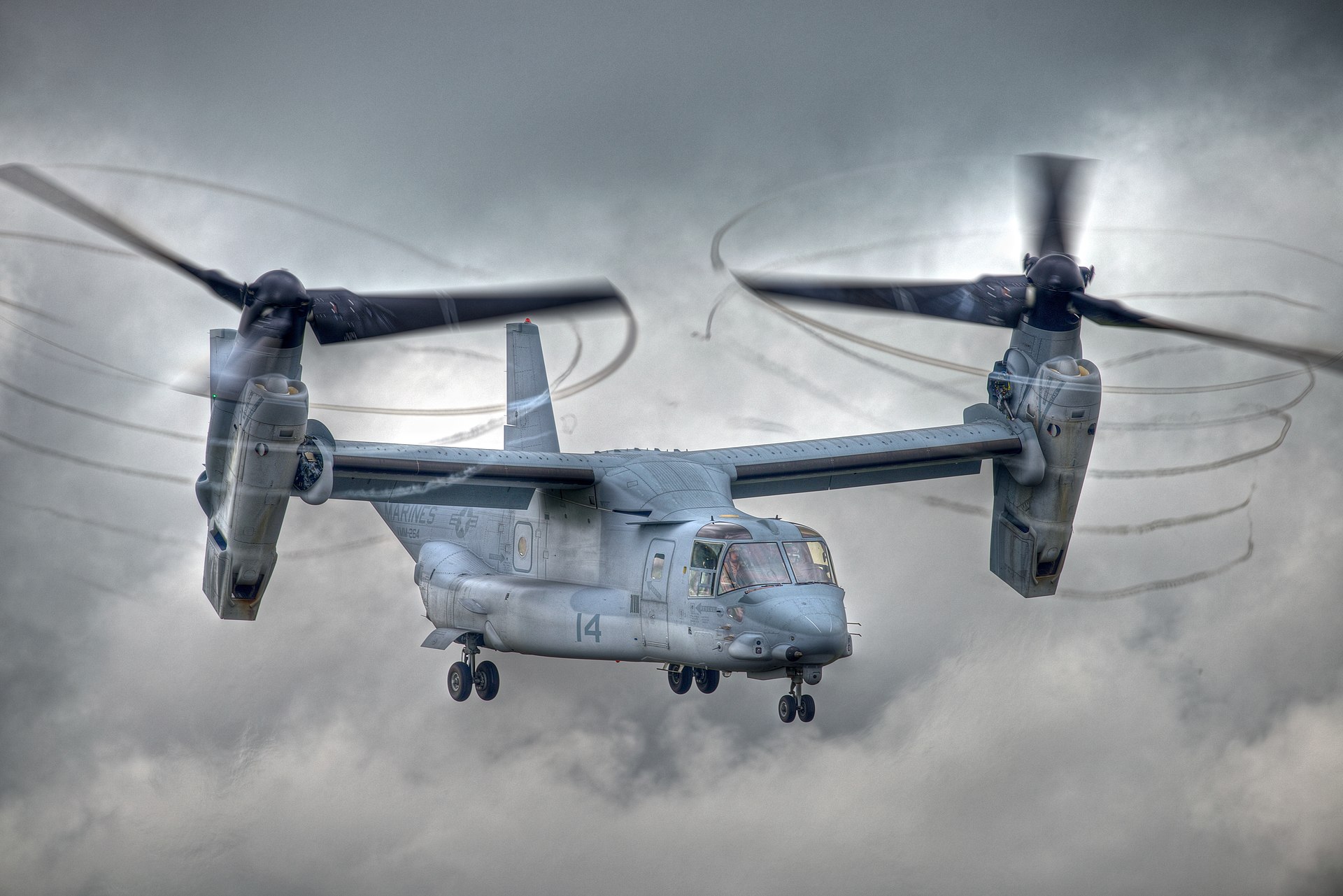

In March 2008, the Bell Boeing Joint Project Office in Amarillo, TX received a $10.4 billion modification that converted the previous N00019-07-C-0001 advance acquisition contract to a fixed-price-incentive-fee, multi-year contract. The new contract rose to $10.92 billion, and was used to buy 143 MV-22 (for USMC) and 31 CV-22 (Air Force Special Operations) Osprey aircraft, plus associated manufacturing tooling to move the aircraft into full production. A follow-on MYP-II contract covered another 99 Ospreys (92 MV-22, 7 CV-22) for $6.524 billion. Totals: $17.444 billion for 235 MV-22s and 38 CV-22s, an average of $63.9 million each.
The V-22 tilt-rotor program has been beset by controversy throughout its 20-year development period. Despite these issues, and the emergence of competitive but more conventional compound helicopter technologies like Piasecki’s X-49 Speedhawk and Sikorsky’s X2, the V-22 program continues to move forward. This DID Spotlight article looks at the V-22’s multi-year purchase contract from 2008-12 and 2013-2017, plus associated contracts for key V-22 systems, program developments, and research sources.
The V-22 Program
[youtube:v=mGebyL7P5HA]
V-22 Initial Operational Capability didn’t begin until 2007, about 24 years after the initial design contract. A long series of design issues and mass-fatality crashes almost got the program canceled, but Congressional industrial lobbying preserved it.
The current objective is 472 Osprey tilt-rotors: 360 MV-22 Marine Corps aircraft, 14 VH-22 Presidential squadron, 50 CV-22 aircraft for USSOCOM (funded by USSOCOM and the Air Force), and 48 HV-22 Navy aircraft.
USMC. The Marine Corps plans to field:
* 18 active squadrons x 12 MV-22B
* 2 reserve squadrons x 12 MV-22B
* 1 fleet replacement squadron x 20 MV-22B
A requirements-based analysis is underway to increase the program of record to 388, which would involve the introduction of VMM-362 and VMM-212 in FY 2018 – 2019.
As of November 2014, the USMC says that they’re 65% through its transition from CH-46E Sea Knight helicopters, with 13 full operational capability squadrons. Remaining switchovers will involve the West Coast, Hawaii, and the reserves, with some basing shifts, and the last CH-46E retiring from HMM-774 in early FY 2015.
Presidential. Beyond the USMC’s combat and training units, a squadron of 12 USMC VH-22s now serves in the Presidential squadron, effectively replacing past CH-46E and CH-53E helicopters. The President never rides in them, though – they’re solely for supplies, aides, etc. By FY 2016, the squadron will be full at 14 planes.
Navy. There was supposed to be an V-22 for the US Navy, but its expected roles in search and rescue etc. were taken up by the MH-60S Seahawk helicopter. Technically, a buy of 48 HV-22s has always been part of the program. In reality, the US Navy has made no moves to adopt the platform. That may change as of FY 2016, if the V-22 can win a likely competition for the next Carrier Onboard Delivery (COD) platform to replace the fixed-wing C-2A Greyhound.
Indeed, on January 13, the Bell-Boeing consortium signed a memorandum of understanding with the Navy to provide the replacement for Carrier Onboard Delivery services. The big challenge will be whether or not the Osprey can handle the behemoth F-35 engine, the F-135.
The Osprey certainly didn’t compete on price or operating costs against remanufactured C-2s that use technologies from the derivative E-2D Hawkeye production line, while Lockheed Martin’s refurbished and modified C-3 Viking offered jet speeds and the unique ability to carry whole F135 jet engines inside. Boeing and Textron relied on the Navy valuing the V-22’s commonality, and ability to land on more of the carrier group’s ships, enough to pay a lot more for less internal capacity.
To date, there have been no exports of the V-22. Israel is mulling over an offer for an expedited buy of 6 MV-22s, and Japan is contemplating 20-40 MV-22s to equip their new Marines, but neither has signed a contract. As of October 2014, formal briefings have also been given to Australia, Brazil, Canada, Colombia, Italy, Qatar, Saudi Arabia, Singapore, and the UAE.
MV-22 vs. CV-22

(click to view full)
The V-22 comes in 2 variants.
MV-22. The US Marines operate the MV-22, whose most current configuration is Block C. A subtype of the MV-22 serves in the Presidential squadrons, as the VH-22.
The current MV-22 Block C’s enhancements (software version C1.01) include forward-mounted AN/ALE-47 defensive systems, move the MV-22’s Ice Detectors, improve dust protection for the engines, and add a redesigned Environmental Control System (ECS) to keep devices and troops from overheating. A “Cabin Situational Awareness Device” displays essential mission information, including access to GPS updates for handheld devices, plus way points, flight plans, location, etc. for troop commanders inside. For the pilots, a Color Weather Radar System provides weather detection, ground mapping to 20 nm, and sea search. Electronic Standby Flight Instruments (ESFI) replace the analog standby instrument cluster, and a Day Heads-up Display (HUD) feeds its data to a helmet-mounted monocle. A Traffic Advisory System (TAS) was intended to warn MV-22 pilots of other aircraft that might hit them, but it doesn’t work properly.
As of October 2014, operational USMC squadrons mostly fly the MV-22B Block B. This mix is expected to shift in the near future: from 8 MV-22B Block B and 4 MV-22B Block C per squadron, to an even 8:8 ratio. The VMMT-204 training squadron is different, and will contain Block A and Block B aircraft until Block As are fully phased out FY 2018.
The USMC currently has a real problem escorting MV-22s, with AH-1Z Viper helicopters not really fast enough, and AV-8B Harrier jets a bit too fast. Future plans include more jamming and warning devices, as well as offensive upgrades. Weapons haven’t been very successful on the V-22 yet, thanks to the huge position arc of the tilting rotors. Fixing that requires significant changes like BAE’s IDWS cut-in belly turret, but many pilots prefer to just use the craft’s speed as a defense. Future USMC concepts of operations may not always give them that luxury, so the USMC plans to add an Advanced Targeting Sensor with full laser targeting. It would be accompanied by some kind of precision strike weapon, type undetermined. Those kinds of weapons wouldn’t suffer from the same arc-of-fire problems, but wide turbulence variations could make release testing fun and exciting.
At present, MV-22B Block D is only in the initial planning stage. Block D will serve as a mid-life upgrade, with a partial but much-needed focus on reliability, maintainability, and operating costs. We won’t see an MV-22C until the mid-2030s.
[youtube:v=Ul3Z0WtJcuI]
CV-22. US Air Force Special Operations Command operates the CV-22, which adds more sophisticated surveillance capabilities, beefed-up defensive systems that include the AN/ALQ-211v2, extra fuel tanks, and useful capabilities like terrain-following flight. Its most current configuration is the CV-22 Block 20.
A 2013 incident in South Sudan led to several operators being injured by small arms fire that punched up through the CV-22’s belly. AFSOCOM is looking at lightweight armoring modifications to try to improve that situation.
V-22 Budgets & Buys


Initial Operational Capability in 2007 was followed by a big Multi-Year Procurement contract in FY 2008, which ended up buying 175 V-22s (143 MV-22s, 32 CV-22s) for about $14.416 billion.
The US fiscal situation is almost certain to lead to serious defense budget cuts, so the V-22’s manufacturers responded by trying to lock the government into a 2nd multi-year contract, creating cancellation penalties that would make the Osprey too expensive to kill, and impossible to seriously reduce. Enough contracts like that will end up gutting other USMC investments when cuts do hit, and could lead to even more serious problems if V-22 fleet operations and maintenance costs don’t start dropping very quickly (vid. Nov. 29/11 entry).
That wasn’t the manufacturers’ concern, however, and it wasn’t the Navy’s, either. The FY 2013 budget included a submission to buy 98 more V-22 aircraft (91 MV-22s, 7 CV-22s) under a 2nd fixed-price multi-year contract, between FY 2013 – FY 2017. The MV-22s will be bought by the Navy for the Marines, while the CV-22s aircraft are a joint buy involving the USAF and SOCOM. To get approval for a multi-year buy, they had to demonstrate at least 10% cost savings over the same buys placed year by year. Their proposal hoped to save $852.4 million, or 11.6% of the total, at the price of less flexibility in the number bought through FY 2017:
| Year | Qty | Net Proc. ($M) |
Savings |
|---|---|---|---|
| FY13 | 21 | 1,693 | 38 |
| FY14 | 21 | 1,741 | 185 |
| FY15 | 19 | 1,541 | 226 |
| FY16 | 19 | 1,468 | 229 |
| FY17 | 18 | 1,430 | 225 |
| Total | 98 | 7,922 | 852 |
| Source: US Navy, FY13 PB [large PDF]. Totals may not add up due to rounding up and FY12 Advance Procurement (incl. $50M for cost reduction initiatives). |
|||
The actual contract and budget plans ended up being a bit different, per the June 12/13 entry and the data and graphs above. Instead of 98 Ospreys (91 MV-22, 7 CV-22) for $6.5 billion, the actual MYP-II contract adds up to 99 tilt-rotors for $6.524 billion.
Contracts & Key Events

(click to view full)
Unless otherwise noted, US Naval Air Systems Command in Patuxent River, MD issues the contracts, and the Bell-Boeing Joint Program tiltrotor team in Amarillo, TX is the contractor.
Note that “low power repairs” are triggered when an AE1107 engine’s Power Assurance Check (PAC) reads below 96%. It’s normal for aircraft engine performance to drop somewhat over time, and the fix involves engine removal for maintenance and tune-up.
FY 2017-2025
August 27/25: Triumph Gear Systems won an $11.6 million contract for the repair of 42 pylon conversion actuators in support of V-22 aircraft. All work will be performed in Park City, Utah, and will be completed by January 2027. One source was solicited for this non-competitive, sole-source requirement in accordance with 10 U.S. Code 2304(c)(1) with one offer received. Naval Supply Systems Command, Weapon Systems Support, Philadelphia, Pennsylvania, is the contracting activity.
June 2/25: Bell Boeing won a $21.9 million deal, which provides for non-recurring efforts for the engineering, component production, supportability, and management necessary to facilitate the incorporation of tailored wiring and structural improvements on the nacelle via forced retrofit at the depot level of maintenance for previously delivered MV-22 Osprey aircraft for the Marine Corps. Work will be performed in Fort Worth, Texas (98.5%); and Ridley Park, Pennsylvania (1.5%), and is expected to be completed in May 2027. Naval Air Systems Command, Patuxent River, Maryland, is the contracting activity.
May 2/25: Aerospace giants Bell and Boeing have announced that the final CV-22 Osprey military transport and cargo aircraft has entered production, with the project’s Program of Record (POR) completion coming in the next few months. The final CV-22 will be completed at Bell’s assembly center in Amarillo, Texas, where it will roll out for future special operations missions that require advanced speed and range capabilities deemed too complex for other military aircraft. Following the completion of the POR, the companies’ Team Osprey is scheduled to continue support for the army by implementing sustainment and upgrades for the variant.
May 1/25: Bell Boeing Joint Project Office in Amarillo, Texas, has received an $18.3 million contract change to support additional repairs and upgrades for the Marine Corps’ MV-22 Osprey aircraft. The work is part of a program to modernize and maintain the aircraft’s readiness. Repairs will be carried out in Ridley Park, Pennsylvania, and are expected to finish by July 2026. The funding includes money from both the Navy’s 2024 and 2025 aircraft procurement and operations budgets. A total of $226,800 from this year’s budget will expire if not used by the end of the fiscal year. The contract was awarded without competition by the Naval Air Systems Command in Patuxent River, Maryland.
April 18/25: Japan’s Defense Ministry announced that its fleet of MV-22 Osprey tiltrotor aircraft temporarily stationed at the Ground Self-Defense Force’s Kisarazu base in Chiba Prefecture will begin relocating to the new Saga base on Jul. 9th, with the transfer expected to be completed by mid-August. Defense Ministry’s North Kanto Defense Bureau Chief Hirohisa Mori informed Kisarazu Mayor Yoshikuni Watanabe of the relocation plan during a visit on April 15.
March 31/25: Raytheon Co., based in Indianapolis, Indiana, has been awarded a $13.5 million modification to an existing contract to provide engineering, management, and technical sustainment for V-22 Avionics Systems software. This work supports the Navy, Marine Corps, Air Force, and Special Operations Command by maintaining and updating software at on-site V-22 laboratories. The project will be carried out in Indianapolis and is expected to be completed by March 2026. The funding for this contract includes contributions from multiple sources. Fiscal 2025 operation and maintenance funds amount to $5,490,941 from the Air Force, $2,793,734 from the Navy, and $2,398,054 from Defense-wide activities. Additionally, there are $854,624 in fiscal 2025 aircraft procurement funds from the Navy, $365,883 in fiscal 2025 research and development funds from the Air Force, and $901,925 in fiscal 2024 aircraft procurement funds from the Air Force. Of the total amount, $12,805,161 will be obligated at the time of award, with $10,682,729 set to expire at the end of the current fiscal year. The Naval Air Systems Command in Patuxent River, Maryland, is overseeing the contract. This agreement was not competitively bid.
March 24725: The US Navy has approved a $590 million contract modification with Bell Boeing to produce and deliver five CMV-22B Osprey aircraft. These tiltrotor planes, designed for delivering personnel, mail, and cargo to aircraft carriers, will replace the older C-2A Greyhound. Work will take place at various locations in the US and is expected to finish by January 2028. An initial $132.1 million from the Navy’s 2024 budget has been allocated for this project.
February 14/25: Bell Boeing Joint Project Office in Amarillo, Texas, has been awarded a $23 million contract modification to continue flight test support for the V-22 Osprey aircraft. This modification extends the existing contract to provide ongoing support for the Navy, Marine Corps, Air Force, and the government of Japan.The work will be distributed across multiple locations, with the majority of work (70%) performed in Patuxent River, Maryland, followed by Philadelphia, Pennsylvania (15%), Fort Worth, Texas (10%), and Hurlburt Field, Florida (5%). The project is expected to be completed in January 2026.
December 11/24: The Pentagon has once again grounded its entire fleet of V-22 Osprey tiltrotor aircraft. This comes after a worrying incident at Cannon Air Force Base in New Mexico on November 20, where a CV-22 Osprey experienced a near-crash shortly after takeoff. Initial investigations suggest that weakened metal components in a critical part may have been a contributing factor. The decision to pause all Osprey flights came as a recommendation from Vice Adm. Carl Chebi, the head of Naval Air Systems Command, which oversees the Osprey program for the military. This incident bears a striking resemblance to a fatal crash off the coast of Japan in November of the previous year. In that crash, eight Air Force Special Operations Command personnel lost their lives when similar weakened metal components caused the Osprey’s transmission to fail catastrophically in mid-flight.
November 14/24: Bell Boeing won an $18.6 million order, which provides research, development, test, evaluation, program management, and engineering support for integrated aircraft survivability equipment in support of CMV-22 Osprey retrofit efforts for Navy. Work will be performed in Ridley Park, Pennsylvania (95%); North Island, California (4%); and Fort Worth, Texas (1%), and is expected to be completed in November 2029. Fiscal 2024 research, development, test and evaluation (Navy) funds in the amount of $1,362,110 will be obligated at the time of award, $1,362,110 of which will expire at the end of the current fiscal year. This order was not competed. Naval Air Systems Command, Patuxent River, Maryland, is the contracting activity.
July 10/24: AAR Supply Chain Inc. won a $46 million contract for V-22 Osprey Black Hawk aircraft repair and replacement parts. This was a sole-source acquisition using justification 10 US Code 3204 (a)(1), as stated in Federal Acquisition Regulation 6.302-1. This is a three-year base contract with three three-year option periods. The performance completion date is June 29, 2027. The contracting activity is the Defense Logistics Agency Aviation, Richmond, Virginia.
June 28/24: Raytheon won a $10 million order, which provides for sustainment of delivered block fleet releases, as well as ongoing development of flight test and fleet releases and analysis in support of implementation of future sustainment block fleet releases for the V-22 avionics systems for the Navy, Marines, and Air Force. Work will be performed in Indianapolis, Indiana, and is expected to be completed in March 2026. Naval Air Systems Command, Patuxent River, Maryland, is the contracting activity.
May 10/24: Bell Boeing won a $14 million modification to provide continued post-production systems engineering and program management support for the V-22 Common Configuration Readiness and Modernization retrofit program for the Marine Corps. Work will be performed in Ridley Park, Pennsylvania; and Fort Worth, Texas and is expected to be completed in September 2024. Naval Air Systems Command, Patuxent River, Patuxent River, Maryland, is the contracting activity.
April 22/24: The Bell Boeing Joint Project Office won a $11 million modification for V-22 spare consumable and depot level repairable parts. This is a firm-fixed-price requirements contract. Locations of performance are Texas and Pennsylvania, with a May 10, 2024, performance completion date. Using customers are Navy, Marine Corps and Air Force. Type of appropriation is fiscal 2023 through 2024 defense working capital funds. The contracting activity is the Defense Logistics Agency Aviation, Philadelphia, Pennsylvania.
April 10/24: The US Navy’s transition to the CMV-22B Osprey for its long-range and medium-lift aerial logistics missions took a significant step forward on April 5, with the arrival of the first tiltrotor aircraft assigned to the East Coast at Naval Station Norfolk, Virginia. Fleet Logistics Multi-Mission Squadron (VRM) 40, nicknamed “Mighty Bison,” received the first Osprey, marking the beginning of their permanent relocation to Norfolk. All VRM-40 personnel have been stationed in Norfolk since February 2024, with the remaining squadron aircraft expected to arrive this summer. The CMV-22B Osprey offers a significant upgrade in capabilities compared to the C-2A Greyhound. This tiltrotor aircraft combines the vertical takeoff and landing (VTOL) capabilities of a helicopter with the long-range cruise efficiency of a fixed-wing airplane. This versatility allows the Osprey to deliver critical supplies, personnel, and high-priority cargo from shore bases directly to ships at sea, supporting Atlantic carrier strike groups starting in 2025.
March 22/24: Bell Boeing Joint Program Office won a $19 million order, which provides recurring and non-recurring engineering to complete software upgrades for the government of Japan in support of V-22 aircraft program. Work will be performed in Ridley Park, Pennsylvania; Fort Worth, Texas; Chantilly, Virginia; Tokyo, Japan; Phoenix, Arizona; and Huntsville, Alabama and is expected to be completed in May 2028. Naval Air Systems Command, Patuxent River, Maryland, is the contracting activity.
February 28/24: Triumph Gear won a $18.5 million deal for the repair of one item that is part of the V-22 pylon conversion actuator system. All work will be performed in Park City, Utah. Work is expected to be completed by April 2025. Naval Supply Systems Command Weapon Systems Support, Philadelphia, Pennsylvania, is the contracting activity.
February 26/24: Bell Boeing won a $11.5 million modification, which adds scope to procure three shipsets of proprotor gearboxes in support of the Nacelle Improvements Step 2 requirement for CV-22 aircraft. Work will be performed in Amarillo, Texas; Fort Worth, Texas; and Ridley Park, Pennsylvania, and is expected to be completed in January 2026. Naval Air Systems Command, Patuxent River, Maryland, is the contracting activity.
January 15/24: Bell Boeing won a $23.3 million modification, which exercises an option to provide continued flight test support for the V-22 Osprey aircraft for the Navy, Marine Corps, Air Force, and the government of Japan. Work will take place in Maryland, Pennsylvania, Texas and Florida. Expected completion date is in January 2025.
January 2/24: Bell Boeing won a $21.3 million order, which provides for the production and delivery of 59 line clearance kits, 18 integrated aircraft survivability equipment (IASE) A-Kits, and installation of 16 IASE A-Kits, allowing increased infrared countermeasure and radar warning capability and aircraft survivability, in support of the MV-22 Osprey aircraft sustainment efforts for the Marine Corps. Work will be performed in Ridley Park, Pennsylvania; Kaneohe Bay, Hawaii; Jacksonville, North Carolina; San Diego, California; Fort Worth, Texas; Yuma, Arizona; and Patuxent River, Maryland, and is expected to be completed in June 2027. Fiscal 2024 aircraft procurement (Navy) funds in the amount of $21,300,446; and fiscal 2023 aircraft procurement (Navy) funds in the amount of $91,389, will be obligated at the time of award, none of which will expire at the end of the current fiscal year. Naval Air Systems Command, Patuxent River, Maryland, is the contracting activity.
October 26/22: SKR Raytheon won an $8.4 million deal, which provides for software product updates and qualification testing for the CV-22 Silent Knight Radar (SKR) Joint Services Vertical Lift Aircraft Experimental (JVX) Avionics System Software (JASS) instrumentation build, the SKR JASS Functional Requirements Document (FRD) 8 port forward, and the SKR JASS FRD 9 port forward in support of the V-22 Joint Program Office. Work will take place in Indiana. Expected completion will be in May 2024.
October 17/22: Japan For the first time, US Marine Corps MV-22Bs are now allowed to fly at 300ft in Japan. The first such flights took place during Resolute Dragon in Hokkaido on October 7. “The Low Altitude Tactics training at Resolute Dragon greatly benefited the squadron and significantly improved operational readiness. By providing a venue for training that is difficult to obtain, the exercise enabled the unit to requalify over 20 aircrew and conduct instructor qualification flights. We are extremely grateful for the months of coordination among USFJ, III MEF, and GOJ that secured clearance to fly at 300 feet and conduct this valuable training. We look forward to continued cooperation with USFJ and the GOJ in order to accomplish bilateral training objectives and improve readiness,” said Lieutenant Colonel Jason Laird, VMM-265 commanding officer.
September 28/22:Planetary Blade Fol Mood Inc. won a $8.6 million deal for the spare of the Planetary Blade Fol used on the V-22 aircraft. The V-22 Osprey is a joint-service, medium-lift, multimission tilt-rotor aircraft developed by Boeing and Bell Helicopters. Boeing is responsible for the fuselage, landing gear, avionics, electrical and hydraulic systems, performance and flying qualities. All work will be performed in Torrance, California, and is expected to be completed by March 2026. Naval Supply Systems Command Weapon Systems Support, Philadelphia, Pennsylvania, is the contracting activity
September 19/22: Flight Control Systems Bell Boeing won a $13.4 million contract by the Navy. The deal provides engineering, management, technical, and acquisition support for the implementation and sustainment of V-22 capability defect packages for V-22 avionics and flight controls systems. Work will take place in Pennsylvania, Texas and Missouri. Estimated completion will be by September 2026.
August 8/22: Repair Triumph Gear System won a $24.3 million contract action for the repair of the pylon conversion actuator used on the V-22 aircraft. The V-22 Osprey is a joint-service, medium-lift, multimission tilt-rotor aircraft developed by Boeing and Bell Helicopters. Boeing is responsible for the fuselage, landing gear, avionics, electrical and hydraulic systems, performance and flying qualities. All work will be performed in Park City, Utah, and is expected to be completed by August 2023. Naval Supply Systems Command Weapon Systems Support, Philadelphia, Pennsylvania, is the contracting activity.
August 2/22: Procurement Triumph Gear System won a $24.3 million contract action for the procurement of one item used on the V-22 aircraft. All work will be performed in Park City, Utah, and is expected to be completed by July 2024. Fiscal 2022 working capital (Navy) funds will be used and will not expire at the end of the current fiscal year. The V-22 Osprey is a joint service multirole combat aircraft utilizing tiltrotor technology to combine the vertical performance of a helicopter with the speed and range of a fixed-wing aircraft. Boeing is responsible for the fuselage, landing gear, avionics, electrical and hydraulic systems, performance and flying qualities. Work will take place in Utah. Expected completion will be by July 2024.
July 25/22: Engine Rolls-Royce won an $8.4 million modification, which adds scope to provide test cell labor and associated materials and test cell commissioning in support authorized military overhaul facilities stand-up for the V-22 AE 1107C engine to include establishment of an indigenous depot-level maintenance and repair capability for the Rolls-Royce AE 1107C engine and integration of an AE 1107C engine test cell into existing facilities in support of the government of Japan. Work will take place in Indiana and Japan. Expected completion will be in February 2025.
May 27/22: Nacelle Improvements Bell Boeing Joint Project Office won a $61.1 million contract modification, which adds scope to provide additional non-recurring engineering to support the production line incorporation of nacelle improvements for the CV-22 aircraft. Additionally, this modification exercises an option to procure 14 nacelle improvements kits in order to accelerate the CV-22 installation schedule, as well as procure an additional six brackets to support the kit installation. Work will take place in Texas and Pennsylvania. Estimated completion is in December 2025.
May 25/22: Half Wing Part Task Trainer Bell Boeing won a $9.5 million firm-fixed-price order against a previously issued basic ordering agreement (N0001922G0002). This order provides for the upgrade and delivery of the V-22 Half Wing Part Task Trainer in support of executing training for the government of Japan. Work will take place in Texas and Japan. Expected completion date is in January 2027.
May 3/22: Marine Corps Bell Boeing won a $302.2 million contract modification by the US Navy. The modification provides for the production and delivery of four MV-22B variation in quantity aircraft for the Marine Corps. Work will take place in Texas, Pennsylvania, New York and Utah. Estimated completion date is in November 2025.
March 18/22: Japan Rolls-Royce won an $8.6 million ordering agreement, which provides for sovereign repair capability development as well as facility standup for the V-22 AE 1107C engine to include establishment of an indigenous depot-level maintenance and repair capability for the Rolls-Royce AE 1107C engine and integration of an AE 1107C engine test cell into existing Kawasaki Heavy Industries facilities in support of the government of Japan. Work will take place in Indiana and Japan. Estimated completion will be in June 2024.
March 14/22: Repair Support Bell Boeing won a $24.3 million contract modification, which increases scope to provide additional MV-22 Common Configuration Readiness and Modernization in-service and over and above repair support. The V-22 Osprey is a joint-service, medium-lift, multimission tilt-rotor aircraft developed by Boeing and Bell Helicopters. Boeing is responsible for the fuselage, landing gear, avionics, electrical and hydraulic systems, performance and flying qualities. Work will take place in Pennsylvania and Texas. Estimated completion will be in June 2023.
February 1/22: Drive Link Boeing won a $21.6 million contract modification, which exercises an option to procure 104 proprotor hub spring and drive link kits for the V-22 Osprey aircraft, to include 60 for the MV-22 aircraft; 10 for the CV-22 aircraft; 29 spare kits for the MV-22 aircraft; and five spare kits for the CV-22 in support of proprotor hub spring and drive link improvement efforts to improve safety, reliability, and maintainability of MV and CV V-22 Osprey aircraft. The V-22 Osprey is a joint-service, medium-lift, multimission tilt-rotor aircraft. Boeing is responsible for the fuselage, landing gear, avionics, electrical and hydraulic systems, performance and flying qualities. Bell Helicopter Textron is responsible for the wing and nacelle, propulsion, rotor, empennage (complete tail system), ramp, overwing fairing and the dynamics. Work will take place in Texas. Estimated completion will be in February 2024.
January 21/22: Egress System Rockwell Collins won a $32.4 million deal for the manufacture of ballistic signal transmission devices and canopy severance assemblies in support of the egress system of the V22 aircraft. The V-22 Osprey is a joint-service, medium-lift, multimission tilt-rotor aircraft. The aircraft operates as a helicopter when taking off and landing vertically. The nacelles rotate 90° forward once airborne, converting the aircraft into a turboprop aircraft. Work will take place in Iowa. Fiscal 2022 procurement of aircraft (Navy) funds; FMS Japan funds; fiscal 2020 procurement of aircraft (Air Force) funds; and fiscal 2021 procurement of aircraft (Air Force) funds will be used to fund requirements.
January 10/22: Components Bell Boeing won a $1.6 billion deal for the repair, replacement, required availability, configuration management, and inventory management for supply support for 228 MV-22B (Marine); CMV-22 (Navy); and CV-22 (Air Force) Osprey aircraft components. The V-22 Osprey is a family of multi-mission, tiltrotor military aircraft with both vertical as well as short takeoff and landing capabilities. It is designed to combine the functionality of a conventional helicopter with the long-range, high-speed cruise performance of a turboprop aircraft. Work will take place e in Texas and Pennsylvania. Estimated completion will be by December 2026.
January 5/22: Common Configuration Readiness and Modernization Bell-Boeing won a $7.9 million contract modification, which provides for additional post-production repairs and related system engineering and program management support for the MV-22B Common Configuration Readiness and Modernization retrofit program. The V-22 Osprey is a joint-service, medium-lift, multimission tilt-rotor aircraft. The Marine Corps variant, MV-22B, provides reliable and safe transportation of personnel, supplies, and equipment. Work will take place in Pennsylvania and Texas. Estimated completion will be in March 2023.
December 15/21: Engineering Support Bell Boeing won a $18 million contract modification, which exercises an option to provide systems integration, technical analysis, and engineering support for the V-22 aircraft. The V-22 Osprey is a joint-service, medium-lift, multimission tilt-rotor aircraft, which operates as a helicopter when taking off and landing vertically. The nacelles rotate 90° forward once airborne, converting the aircraft into a turboprop aircraft. Work will take place in Texas and Pennsylvania. Estimated completion is in December 2022.
December 6/21: CAH Bell Boeing won a $9.3 million contract modification, which exercises an option to procure 68 Conversion Area Harness (CAH) base kits, 53 CAH supplemental kits, two hardware kits and two consumable kits in support of the Marine Corps MV-22 aircraft, the Air Force CV-22 aircraft, the Navy CMV-22 aircraft, and the government of Japan V-22 aircraft. Additionally, this modification provides for electrical wiring interconnect system assessments for the CV-22 fleet aircraft. The V-22 Osprey is a joint-service, medium-lift, multimission tilt-rotor aircraft. The aircraft operates as a helicopter when taking off and landing vertically. The nacelles rotate 90° forward once airborne, converting the aircraft into a turboprop aircraft. Work will take place in South Carolina, Texas and California. Estimated completion date is in January 2026.
December 1/21: Engineering Support Bell Boeing won a $149.1 million contract modification for performance-based logistics and engineering support for the V-22 platform. This is a firm-fixed-price requirements contract. The V-22 Osprey is a joint-service, medium-lift, multimission tilt-rotor aircraft developed by Boeing and Bell Helicopters. Boeing is responsible for the fuselage, landing gear, avionics, electrical and hydraulic systems, performance and flying qualities. Work will take place in Texas and Pennsylvania. Estimated completion date is November 30, 2022.
November 18/21: Nacelle Improvements Bell Boeing won a $72 million contract modification, which exercises options to procure 15 Nacelle improvements kits, rotatable pool components and interim spares. The modification also provides for the installation of eight kits in conjunction with conversion area harness, electrical wiring interconnect system assessments, sustaining engineering, and over and above requirements for the CV-22 fleet aircraft. Work will take place in Texas and Pennsylvania. Estimated completion is in June 2025.
November 8/21: Windscreens Llamas Plastics won a $14.2 million deal for V-22 windscreens. The V-22 Osprey is a joint-service, medium-lift, multimission tilt-rotor aircraft. The aircraft operates as a helicopter when taking off and landing vertically. The nacelles rotate 90° forward once airborne, converting the aircraft into a turboprop aircraft. Work will take place in California. Estimated completion date is October 28, 2026.
September 30/21: Miniaturized Airborne Global Positioning System Receiver 2000 Boeing won a $15.3 million contract, which provides systems engineering, technical, logistics support and retrofit of the Miniaturized Airborne Global Positioning System Receiver 2000 for integration onto the V-22 Osprey aircraft. The V-22 Osprey is a joint-service, medium-lift, multimission tilt-rotor aircraft. Work will take place in Pennsylvania and Texas. Estimated completion will be in November 2024.
September 3/21: Repair Hamilton Sundstrand won a $60 million requirements contract for the repair of the constant frequency generator used on the V-22 aircraft in support of the weapon replaceable assemblies and shop replaceable assemblies programs. The V-22 Osprey is a joint-service, medium-lift, multimission tilt-rotor aircraft. The aircraft operates as a helicopter when taking off and landing vertically. The nacelles rotate 90° forward once airborne, converting the aircraft into a turboprop aircraft. Work under the contract will take place in Illinois. Estimated completion will be by September 2026.
August 13/21: Logistics And Repair Support Textron Systems won an $11.3 million deal for the logistics and repair support of MV-22B, CMV-22 (Navy) and CV-22 (Air Force) Osprey components in support of the Joint Service Electronic Combat Systems Tester system. The V-22 Osprey is a joint-service, medium-lift, multimission tilt-rotor aircraft developed by Boeing and Bell Helicopters. Work will take place in Maryland. Estimated completion will be by August 2026.
July 1/21: Spare Parts Honeywell International won a $10 million delivery order for V-22 spare parts. The deal was a sole-source acquisition using justification 10 US. Code 2304 (c)(1), as stated in Federal Acquisition Regulation 6.302-1. The V-22 Osprey is a joint-service, medium-lift, multimission tilt-rotor aircraft developed by Boeing and Bell Helicopters. Work will take place in Arizona. Estimated completion date is December 31, 2021.
June 23/21: Engineering Raytheon won a $17 million contract modification, which exercises an option to provide software engineering and testing, avionics integration and testing and avionics acquisition support to include classified and unclassified laboratories, configuration and data management and release of avionics software products and related systems in support of V-22 Software Support Activity systems. Work will take place in Indiana. Estimated completion will be in December 2023.
May 31/21: Visual Environment Helmet L3 Communications Integrated Mission Systems won an $18.9 million contract, which provides non-recurring engineering and material to develop and qualify the degraded visual environment helmet mounted display and processor capability for integration into the Marine Corps MV-22B Osprey aircraft. The MV-22 Osprey’s mission for the US Marine Corps is the transportation of troops, equipment, and supplies from ships and land bases for combat assault and assault support. Work will take place in Texas, Illinois, California and Alabama. Expected completion will be in December 2024.
April 19/21: Flight Deck The US Navy announced that it landed an Osprey V-22 aircraft for the first time on a flight deck aboard a hospital ship. The flight testing is result of a seven-month mission to expand the ship’s capabilities for landing aircraft such as the V-22 Osprey and MH-60 Seahawk. Prior to the testing, the deck of Military Sealift Command hospital ship USNS Mercy was upgraded to allow for the flights to take off.
April 15/21: Repair Support Bell Boeing won a $143.2 million delivery order from the US Navy for the logistics and repair support of MV-22B, CMV-22 (Navy) and CV-22 (Air Force) Osprey components. The Navy is planning to use the CMV-22 variant as a replacement of the Grumman C-2 Greyhound for carrier onboard delivery. The service marked a milestone last November, when a CMV-22B conducted the first carrier landings, take-offs and refueling on the USS Carl Vinson. COD deployments should begin sometime later this year. All work will be performed in Fort Worth, Texas. Work is expected to be completed by December 2025.
April 7/21: Cartridge Initiators Universal Propulsion Company won a $10.9 million contract for the manufacture of up to 5,000 cartridge initiators and thrusters used in V-22 and CV-22 aircraft. This contract includes a five-year base period with no options. The V-22 Osprey is a joint-service, medium-lift, multimission tilt-rotor aircraft developed by Boeing and Bell Helicopters. Boeing is responsible for the fuselage, landing gear, avionics, electrical and hydraulic systems, performance and flying qualities. Work will take place in California. Estimated completion will be by March 2026.
April 5/21: Navy Unit The US Navy will establish its second CMV-22B unit and the first squadron for the East Coast, at NAS North Island this fall. The squadron will eventually relocate Naval Station Norfolk in 2023. So far, 18 C-2A pilots have completed their transition to the CMV-22B. The goal is to have 115 C-2A pilots eventually.
March 31/21:AE1107C Rolls-Royce won a $26.5 million modification, which exercises an option that provides for the production and delivery of eight AE1107C engines for the Navy and four for the Air Force in support of the V-22 Osprey. The V-22 Osprey is a joint-service, medium-lift, multimission tilt-rotor aircraft developed by Boeing and Bell Helicopters. Boeing is responsible for the fuselage, landing gear, avionics, electrical and hydraulic systems, performance and flying qualities. Work will take place in Indiana. Estimated completion will be in December 2022.
December 14/18: Analysis The Bell Boeing Joint Project Office is receiving extra funding to support the V-22 family of tilt rotor aircraft. The modification to a previously awarded IDIQ contract (N00019-18-D-0103) is priced at $18 million. It exercises an option for technical analysis, engineering and integration on V-22 aircraft platform. Work under this contract will support the US Navy, Marine Corps and US Air Force; as well as the government of Japan as part of the Foreign Military Sales program. The V-22 has been in service with the Air Force and the Marine Corps for almost a decade; and the Navy plans to adopt its own variant of the aircraft to perform its critical Carrier-Onboard-Delivery mission to deliver forces, supplies and weapons to forward-stationed ships at sea. The Navy plans to buy a total of 44 CMV-22Bs starting in 2018, with first deliveries expected to start in 2020. Japan currently has 19 V-22s on order. Work will be performed in Fort Worth, Texas and Philadelphia, Pennsylvania, and is expected to be completed in December 2022.
November 30/18: US support The Bell-Boeing Joint Project Office is receiving a ceiling increase for additional V-22 Osprey support. The modification is priced at $20.5 million and provides for additional Joint Performance Based Logistics support for the MV-22 flown by the Marine Corps, and the CV-22 flown by US SOCOM and by the Air Force. The Corps’ currently flies the Osprey in its Block C configuration which adds features AN/ALE-47 defensive systems, a “Cabin Situational Awareness Device”, a Color Weather Radar System and large HUD displays. The CV-22 features more sophisticated surveillance capabilities, beefed-up defensive systems that include the AN/ALQ-211v2, extra fuel tanks, and useful capabilities like terrain-following flight. Its most current configuration is the CV-22 Block 20. Work will be performed at multiple locations throughout the United States, including Fort Worth, Texas; Philadelphia, Pennsylvania; Fort Walton Beach, Florida; Oklahoma City, Oklahoma and St. Louis, Missouri. The contract is set to run through January 2019.
November 20/18: Local opposition The Japanese government will delay a planned deployment of V-22 Ospreys amidst local opposition. The MoD initially intended to deploy 17 Ospreys to Saga airport in southwestern Japan in an effort to strengthen defense of remote islands in the southwest amid China’s increasingly aggressive posture. “It’s true that we are seeing a delay in the entire schedule. We’ll try to realize the delivery as soon as possible,” Japanese Defense Minister Takeshi Iwaya told reporters, without elaborating on when the aircraft are now expected to arrive to Japan. Local residents are resisting the scheduled deployment because the tilt-rotor aircraft are considered to be noisy and accident-prone. Japan received the first of its 19 ordered Ospreys in August 2017.
September 25/18: The gears are turning The Navy is contracting Bell for the delivery of essential parts for its fleet of V-22 Osprey tilt rotor aircraft. The company is being awarded with two firm-fixed-price delivery orders each valued at $48.4 million. They cover the procurement of V-22 PRGB right- and left hand aircraft assembly parts. The V-22’s propulsion system’s external link consists of dual counter rotating proprotors attached to gearboxes driven by two turboshaft engines. PRBG, or proprotor gearboxes are an integral part of the Osprey’s gearbox system, which also includes one mid-wing gearbox (MWGB), two tilt-axis gearboxes and the emergency reservoir system (ELS).
September 19/18: SIRFC US Special Operations Command is contracting Harris Corp in support of its CV-22s. The company will provide SOCOM with components and technical services needed to keep the Osprey’s suite of integrated radio frequency countermeasures (SIRFC) operational. SIRFC is an integrated electronic combat system which provides RF threat awareness and active self-protection jamming capabilities for Army aircraft against RF air defense systems actively engaging the aircraft. SIRFC consists of the Advanced Threat Radar Warning Receiver (ATRWR) and the Advanced Threat Radar Jammer. The system contributes to the aircrew’s full-dimensional protection. The awarded modification of $93.5 million increases the contract ceiling to a total of $383.5 million. The contract and its ordering period will end by July 30, 2019.
July 30/18: New displays Elbit Systems of America is receiving a $7.2 million firm-fixed-price delivery order to support the Navy’s fleet of V-22 aircraft. The order provides for the procurement of 120 Slim Multi-Function Displays to be installed on the Common Configuration and Modernization retrofit aircraft. Of the 120 displays, 100 are reserved for the Navy, 4 for the Air Force and 16 will be delivered to Japan. The Slim Multi-Function Display is a digital system of flight information that is designed to reduce pilot workload and provide enhanced safety and includes a HUD on the cockpit canopy. Work will be performed at the company’s location in Fort Worth, Texas, and is expected to be completed in October 2019.
July 27/18: CFG Hamilton Sundstrand Corp. is being contracted for support work on the MV-22 and CV-22 platforms. The three-year long-term requirements contract has a value of $64.8 million and provides for repair work of the constant frequency generator (CFG) installed on the aircraft. The MV-22 is flown by the US Marine Corps. The newest Block C variant includes forward-mounted defensive systems, ice detectors, dust protection and a “Cabin Situational Awareness Device”. The US Air Force Special Operations Command operates the CV-22, which adds more sophisticated surveillance capabilities and beefed-up defensive systems. The CFG together with the auxiliary power unit and variable frequency generator is housed in the V-22’s mid-wing gearbox. The mid-wing gearbox transmits power between the left and right interconnecting drive shafts without changing speed or direction of rotation. This contract intends to enhance the CFG reliability and improve its overall aircraft operational readiness. Work will be performed in Rockford, Illinois, and is expected to be completed by July 2021.
July 25/18: Shaft repair The Navy’s fleet of V-22 need some repair work done. Engine manufacturer Honeywell International is being awarded a $8.4 million firm-fixed-price delivery order for the repair of shaft driven compressors installed on the V-22 Osprey. The V-22’s propulsion system consists of dual counter rotating proprotors attached to gearboxes driven by two turboshaft engines. The engine is capable of developing over seven shaft horsepower per pound of weight – the highest ratio of any engine in its class. The V-22’s two-shaft axial design consists of a 14-stage compressor followed by an effusion-cooled annular combustor, a two-stage gas generator turbine and a two-stage power turbine. Work will be performed in Torrance, California, and is expected to be completed by November 2021.
July 3/18: Multi-billion order Bell Boeing is being awarded a contract conversion in support of the V-22 aircraft. The conversion into a fixed-price-incentive-fee multiyear contract is valued at $4.1 billion and provides for the manufacturer and delivery of 78 V-22s. Under the contract the Navy will receive 39 CMV-22Bs, 34 MV-22Bs are marked for the Marine Corps, the US Air Force will receive 1 CV-22B and the government of Japan will take delivery of 4 MV-22Bs. V-22 Initial Operational Capability didn’t begin until 2007, about 24 years after the initial design contract. A long series of design issues and mass-fatality crashes almost got the program canceled, but Congressional industrial lobbying preserved it. This modification combines purchases for the Navy ($2,8 billion); Marine Corps ($1,03 billion); Air Force ($75,7 million); and the government of Japan ($230,2 million), under the Foreign Military Sales program. Work will be performed at various locations inside and outside the continental US. Locations include Fort Worth, Texas; East Aurora, New York; Rockford, Illinois. It is expected to be completed by November 2024.
June 20/18: Armor order The Navy is ordering protective systems in support of its V-22 aircraft. The $20 million fixed-price indefinite-delivery/indefinite-quantity contract sees for the production of up to 200 Ballistic Protection System panel sets and single floor spares for the V-22 by MACRO Industries. The V-22 has specific Naval Air Systems Command (NAVAIR) driven aircraft vulnerability programmatic requirements and was a lead aircraft subject to Office of the Secretary of Defense (OSD) oversight with the Live Fire Test Law passed in 1987. Many vulnerability reduction techniques have been applied to the V-22 airframe. These technologies range from inherent structural design requirements such as ballistic protection panels to active fire suppression systems to prevent sustained fire in the aircraft. Work will be performed in Huntsville, Alabama, and is expected to be completed in June 2023.
June 4/18: Royal Engines Roll-Royce Corp. is being tapped for the provision of engines in support of the V-22 Osprey platform. The contract, which is valued at $28.25 million provides for the procurement of 15 engines in total. The Marine Corps will receive 7, 6 will be delivered to the Navy and the remaining 2 are reserved for the Air Force. The AE1107C engines weight 971 pounds each and deliver 7,000 shaft horsepower. Rolls Royce has so far produced more than 860 V-22 engines. The V-22 tilt-rotor program has been beset by controversy throughout its 20-year development period. V-22 Initial Operational Capability didn’t begin until 2007, about 24 years after the initial design contract. A long series of design issues and mass-fatality crashes almost got the program canceled, but Congressional industrial lobbying preserved it. Work will be performed in Indianapolis, Indiana, and is expected to be completed in May 2019.
April 26/18: VARS testing The US Naval Air Systems Command has confirmed that the V-22 Aerial Refueling System (VARS) will start testing this fall. According to a US Marine Corps statement published by the Marine Corps Times, VARS-equipped Ospreys will be capable of providing an additional 10,000 pounds of fuel to aircraft forward deployed with Marine Expeditionary Units, extending the range of aircraft such as the F-35B and other V-22s. The Corps expects its new refueling system to be operational by fiscal year 2019 and will be welcomed by the Corps as troops are being shifted across the Pacific—nearly nine thousand Marines are being moved off Okinawa, Japan, where they will be disbursed to other locations like Guam and Hawaii. Furthermore, the USMC is kicking off its largest deployment yet to Darwin Australia, at nearly 1,587 Marines as part of its annual six-month rotation.
April 12/18: Export Sales Push Israel is considering joining the potential procurement of V-22 Osprey tilt-rotor aircraft with a larger heavy-lift package that aims to replace its fleet of aged CH-53 Yasur helicopters. Tel Aviv had initially put a pause on buying six Ospreys last year, three years after the US State Department cleared the potential sale. However, the freeze was short-lived with Israeli officials restarting talks over their purchase late last year. According to NAVAIR officials, any sale of V-22s would be part of a package with heavy-lift helicopters—Israel is considering both the Sikorsky CH-53K King Stallion and the Boeing CH-47F Chinook—adding that European countries such as Italy, Norway, Spain and the UK have also been targeted as potential foreign buyers for the Osprey. The export push comes as the V-22 joint program office looks to fill vacant production capacity ahead of the release of a third multi-year production contract for V-22s this summer. According to Flight Global, the next five-year production plan calls for introducing CMV-22s with the US Navy, and delivering 17 V-22s ordered by Japan, along with additional shipments to the USMC and AFSOC.
March 23/18: Engine orders The US Navy has tapped Rolls Royce to build and deliver 14 AE 1107C engines for use in the V-22 Osprey program. Valued at $31 million, the contract modification will see 12 engines go to Ospreys used by the Navy while the remaining two will go to the Marine Corps. Work will take place at Rolls’ Indianapolis, Indiana plant with a scheduled completion date set for March 2019. In 2012, Rolls landed a $598 million contract for 268 engines destined for the USMC and Air Force. In 2013, it received an $84 million contract for 38 more AE 1107C engines for the two military branches.
January 22/18: Software & Hardware Upgrades The Bell-Boeing Joint Program Office (JPO) has been tapped by the US Navy to provide upgrades onboard V-22 Osprey tilt-rotor aircraft. The order, totalling almost $35 million, calls for the provision of software and hardware upgrades for 28 flight training devices necessary to integrate aircraft software version B 6-01/C 4.01 into 23 Marine Corps MV-22 training devices and software version 20.4.01/10.6.01 into nine Air Force CV-22 training devices. Most of the work will take place in Virginia, Oklahoma and Texas, with the rest spread through locations in Pennsylvania, Missouri, Florida, New Mexico, New Jersey and the United Kingdom. Contract completion is scheduled for April 2022.
January 11/18: Contracts-Item Repair Lord Co. of Pennsylvania were awarded Monday, a five-year long-term US Navy contract for the repair of three items used on the V-22 Osprey aircraft. The firm specialises in adhesives, coatings, specialty chemicals, electronic materials, vibration & motion control, and magneto-rheological (MR) fluids, and their Active Vibration Control (AVC) System is used to minimize vibration and reduce weight in helicopters. Work will take place at the firm’s operation in Erie, Pa., with a scheduled completion date of January 2023. Funds will not expire at the end of the current fiscal year. The Navy also announced last week that the latest Osprey variant, the CMV-22B Osprey, will replace the C-2A Greyhound for carrier onboard delivery duties to the service’s carrier vessels. The aircraft are expected to be operational by 2024, with the full transition expected by 2028.
December 11/17: Lot 23-Long-lead Materials Bell-Boeing will acquire for the the US Navy, additional long-lead material and associated efforts required for the production and delivery of seven V-22 Lot 23 tilt-rotor aircraft. Awarded under a $19.6 million firm-fixed-price contract, work will run until December 2018 at several US locations. US Navy aircraft procurement funds from fiscal year 2018 for the full value of the contract have been obligated at the time of award and do not expire at the end of the current fiscal year.
November 16/17: Support Contract A US Department of Defense (DoD)contract has tapped Bell-Boeing for “field representative and logistic support services” in support of Japanese V-22 Osprey tiltrotor aircraft. Valued at just of $10 million, the cost-plus-fixed-fee contract will be mostly carried out at Camp Kisarazu, Japan, with other work taking place in Pennsylvania and Florida. Scheduled completion is set for December 2019. Japan received the first of its 19 ordered Ospreys in August.
August 07/17: The Bell-Boeing Joint Project Office has received a $57.1 million US Navy contract modification to carry out modifications to the MV-22 Osprey fleet operated by the US Marine Corps (USMC) in support of the V-22 Common Configuration-Readiness and Modernization (CC-RAM) Program. Under the terms of the agreement, the funding will go towards the retrofit of one MV-22 as a test for improving readiness and eventual modification of the MV-22 fleet to the Block C common configuration. Work will be performed in Ridley Park, Pennsylvania (80 percent); and Fort Worth, Texas (20 percent), and is expected to be completed in December 2019. The Block C configuration includes improved environmental controls, chaff/flare countermeasures, navigation upgrades and command-and-control displays.
June 27/17: Deliveries of V-22 Ospreys to Japan will commence in September, according to the Joint Program Manager, Marine Col. Dan Robinson. Tokyo ordered 14 of the aircraft back in 2014 and it plans to base several of the aircraft on the helicopter carrier Izumo, while more will be deployed defend its territorial holdings in the East China Sea. On the export front, Japan is looking to build on the success of its lease of TC-90 aircraft to the Philippines by teaming with the US in order to boost sales of used military helicopters aircraft to South East Asia.
June 1/17: Triumph Group will continue to manufacture parts for the V-22 aircraft if Boeing Bell successfully negotiates its next V-22 Osprey Multi-year 3 contract with the US Navy. In a renewed statement of work, Triumph added that it will also manufacture cargo ramps and doors for the aircraft, in addition to components including the empennage, elevator, ramp extensions, ramp mounted weapons system floor boards, main landing gear doors. Deliveries of the components in support of the Multi-year 3 contract would begin in 2019.
March 26/17: New British Royal Navy Queen Elizabeth-class aircraft carriers will not have V-22 tiltrotor aircraft onboard, according to a written parliamentary reply to Lord West. Lord West, a retired Royal Navy officer and former government minister, had asked if the government was considering the Osprey for use by the state’s special forces. In response, the government stated that the aircraft was not part of plans to deliver the UK Carrier Strike capability. However, the MoD will continue to explore a variety of options to augment the capabilities of the carriers.
February 9/17: The USMC has given March 2019 as the date for declaring initial operational capability for the V-22 Aerial Refuelling System (VARS). Four V-22 Osprey’s will be part of the initial program and will be able to refuel all fixed-wing USMC fighters and the CH-53 helicopter. The V-22 joint program office is looking at the feasibility of adding a chin-mounted gun and crew-served door guns for the Osprey, the latter being of particular interest to the service.
December 20/16: The US Navy has awarded the Bell-Boeing Joint Program Office two contract modifications to perform repair services for the sailing branch’s V-22 Osprey aircraft. Valued at $246 million and $165.7 million, the awards are part of a contract with options that can reach a total value of $545 million if all options are exercised. Work is expected to be completed by December 2019.
November 29/16: The Bell-Boeing Joint Project Office has been awarded a $267.2 million US Navy contract modification for additional logistics support for MV-22 Osprey tiltrotor aircraft. Under the deal, both the USMC MV-22 and the USAF Special Operations Command CV-22 variant will be covered. The contract runs until November 2018.
FY 2016
July 21/16: Bell-Boeing has been awarded a $545 million deal to manufacture and deliver four MV-22 tilt-rotor aircraft. The July 19 Navy contract will see the USMC variant of the aircraft delivered to the government of Japan, adding to a number of V-22s ordered in 2014. Delivery of the systems is expected for May 2020.
June 15/16: The US Navy took an MV-22 from VMX-1 aboard aircraft carrier USS Carl Vinson for flight trials on June 12. Testing comes as the service moves to induct the CMV-22B variant as the replacement for the Northrop Grumman C-2 Greyhound twin turboprop in the aircraft carrier logistics role at sea. The purpose of the MV-22 tests is to allow crews to experience landing on an aircraft carrier as opposed to landing on an amphibious ship, like with the USMC. Additions to the Navy model will see the installation of extra fuel bladders to extend its range from 860nm to approximately 1,150nm, as well as a beyond line-of-sight radio and public address system so that crews can communicate en route to the aircraft carrier’s deck, or between other ships in the battle group.
June 1/16: The Bell-Boeing Joint Project Office has been awarded a $58.8 million US Navy contract in order to develop and integrate the V-22 aerial refueling system (VARS) for the MV-22. Once installed, VARS will operate by using a portable refueling station that will roll up the Osprey’s back ramp and into its back cabin. Crews will use it to aerially refuel F-35s, F/A18 Hornets and other aircraft – including V-22s and CH-53 helicopters – by extending a hose and drogue out the open back ramp. NAVIR will supervise the contract execution, and the whole project is to be completed by June 2019.
May 19/16: The Navy’s V-22 Osprey program has set 2018 for the deployment of the aerial tanker variant of the USMC’s MV-22B. Once the new capability is installed, it will be possible for the air combat element of a Marine Expeditionary Unit to refuel in air its F-35 Lightning II strike fighters and CH-53 heavy-lift helicopters, and eventually even other V-22s may be a possibility. This capability will extend the reach of the amphibious ready groups for strike and assault missions.
May 2/16: A USMC MV-22 Osprey has given a successful ground refueling of a Marine F-35B Joint Strike Fighter. The one-hour test consisted of hooking up fuel transfer lines between the two aircraft with the MV-22 fueling the F-35B with an aerial refueling to follow. Both aircraft will be used to allow the Marine Corps to employ assets in austere environments on short notice without having to rely on long-term planning and fixed facilities.
April 27/16: The DoD has issued a notice to modify the V-22 so that a 18-inch gimbaled multispectral sensor can be lowered from the tilt-rotor’s cargo hold well. The new sensors will increase the ability of the US military to target enemies from afar, giving the aircraft similar situational awareness and precision targeting capabilities to the General Atomics Aeronautical Systems MQ-9 Predator UAV. Up to four competing sensor solutions will be tested at the Marine Aviation Weapons and Tactics Squadron One (MAWTS-1) tactical demonstration next year.
April 3/16: The US Navy has given Bell-Boeing Joint Project Office $151 million to start development work on the CMV-22B, the naval variant of the V-22 Osprey. The new plane will be used a as a carrier onboard delivery plane. Work included in the contract involves adding new radios, a public address system, and extra fuel tanks to the new tilt-rotor variant by the manufacturer, and it is expected that the Navy will be placing orders by the end of next year.
March 1/16: The USAF Special Operations Commander Lt. Gen. Bradley Heithold wants three more V-22 Ospreys before the product line ceases. 51 aircraft are already being funded through fiscal year 2016, however three more have been suggested as extra attrition reserves. According to budget documents, there are no further plans to procure the aircraft in fiscal years post 2016, so any additional orders would need to be added quickly before the end of production. Having four aircraft in attrition reserve as back-ups when an aircraft goes down will ensure that AFSOC forces are flying at its capacity of at least 50 airplanes well into the future, Heithold said.
January 20/16: Testing of a new blade for the V-22 Osprey is to take place after the current rotor blades fitted to the aircraft were deemed too labor intensive to manufacture. The new prop rotor blade has been designed as part of the manufacturer Bell’s Advanced Technology Tiltrotor (ATTR) program, which aims to reduce production costs for the aircraft. The test has been derived from ongoing development work on the next-generation V-280 with flight testing of the new modified components due to last between 2017-2018.
November 13/15: The USMC is hoping that foreign production orders will cover a gap in V-22 Osprey production between 2017 and 2020, with a planned multi-year buy appearing insufficient to keep the Boeing production line healthy until a newer variant is introduced. By bringing in orders from international partners, the per-unit price of future multi-year buys could be reduced by around 10%. Countries such as Japan, South Korea and Israel could be precisely the type of orders the Marines are hoping for. The latter of which could receive the aircraft as part of a US military aid package currently under negotiation.
FY 2015
Export prospects. Firing forward.
September 2/15: The Japanese defense budget will again break the record, but increase only 2.2 percent to ¥5.09 trillion. Programs funded include the V-22 Osprey, with this year’s expenditures covering the purchase of a dozen.
August 17/15: The Marines are exploring possible upgrades to their fleet of V-22 Osprey tilt-rotor aircraft. This plan would involve bringing 131 A and B model Ospreys up to the C spec in order to access the higher availability rates offered by the C variant. The C model boasts a variety of improvements on earlier models, including a redesigned Environmental Control System (ECS) to keep devices and troops from overheating. The Marines are now reportedly in talks with manufacturer Boeing to establish the likely costs of these upgrades.
July 15/15: The Bell-Boeing Joint Project Office was handed a $332.5 million contract modification to manufacture and delivery five MV-22B Block C Osprey tiltrotor aircraft to Japan, following a DSCA request in May. The Japanese government requested seventeen of the aircraft, with this contract subsequently revising the number down. This latest modification has been tacked onto a December 2011 contract which covered the manufacture of MV-22 and CV-22 aircraft for the US Air Force and Marine Corps. Japan announced its intention to procure the tiltrotor aircraft last November, with this marking the first international export for the type.
June 19/15: The United Arab Emirates is reportedly showing interest in procuring V-22 tiltrotor aircraft from Boeing, following the Paris Air Show. The possible sale of the aircraft to Israel is still on hold, with Japan recently requesting seventeen Ospreys in a $3 billion sale. The company has also been chasing the United Kingdom and Singapore as possible future customers. However, the future of the aircraft is uncertain despite optimism from the manufacturers.
November 2014: rocket tests. Bell Helicopter announces on Dec. 8 that forward-firing capability was successfully tested during the previous month at the US Army Proving Ground in Yuma, AZ. V-22s refuel and reload from Forward Arming and Refueling Points (FARPs), and Bell hopes that the installation of forward-firing weapons will reduce reliance on them. This may also reduce the need for V-22s to be escorted by slower attack helicopters, and the absence of a forward-facing gun was among the trade-offs that mired the program’s early years in controversy. Back during the program’s prehistory planners had considered turret-mounting a GAU-19 gatling gun in the aircraft’s undernose [GDAS PDF, 2002].
Nov 3/14: USMC Plan. The USMC’s Aviation Plan to 2030 has a number of sections that are relevant to the V-22. The V-22 Aerial Refueling System (VARS) roll-on capability is being developed to field with the F-35B’s West Pacific deployment in summer 2017, as a near-ship aerial tanker for large-deck amphibious assault ships. Follow-on certifications would aim to refuel other V-22s and helicopters.
The MV-22’s own ability to refuel in the air currently has flight clearance for USMC KC-130s and USAF KC-10s. The next certifications will involve Omega Air Tanker’s private K-707s, and the USAF’s forthcoming 767-based KC-46s. Deployment dates aren’t given for those.
The V-22 fleet is scheduled to get LAIRCM defenses against infrared-guided missiles in 2016, and radar-related defenses are in the Survivability Upgrade Roadmap, but not extra armor (q.v. May 22/14). The Interoperability Upgrade Roadmap makes the MV-22 the lead platform for the the Software Reprogrammable Payload communications package, with integration beginning at the end of FY 15. It’s eventually expected to include full voice/ data/ video compatibility, datalinks like Link-16 and TTNT, and even full airborne communications gateway capabilities. The other future IUR item of especial interest is integrated RFID for cargo and personnel.
Finally, plans exist to beef up MV-22 weapons and “increase all-axis, stand-off, and precision capabilities.” This will include an upgraded Advanced Targeting Sensor with full laser targeting. The huge position arc of the tilting rotors makes guns very difficult to use, absent significant changes like BAE’s IDWS cut-in belly turret. But there’s no issue for small precision gravity weapons like ATK’s Hatchet or MBDA’s Viper-E, small missiles like Raytheon’s Griffin, or well-understood weapons like 7-rocket pods with APKWS laser-guided 70mm rockets, or (less likely) the future JAGM missile.
Weight and complexity are always worth considering before making these kinds of weapon modifications, especially in light of evidence that V-22s already need more belly armor. The V-22’s wide turbulence variations could also make weapon release testing fun and exciting. On the other hand, the USMC currently has a real problem escorting MV-22s, with AH-1Z Viper helicopters not really fast enough, and AV-8B Harrier jets a bit too fast. If the weight trade-off works, a precision weapons option may help solve some operational gaps. Sources: USMC, Marine Aviation Plan 2015 [PDF].
USMC Aviation Plan

Nov 2-5/14: Israel. Israeli defense minister Moshe Ya’alon is recommending the cancellation of several deals with the USA, including the V-22. A potential purchase of more F-35s has survived, but the V-22, more KC-135 aerial tankers, radar-killing missiles, and radar upgrades for Israel’s F-15s have not. Instead, recent fighting in Gaza, and developments in Lebanon and Syria, are pushing him toward more buys of precision weapons and ground forces equipment. The weak protection of Israeli M113s has come in for particular criticism.
The decision isn’t final, and the IDF and Mossad were both lobbying to keep the V-22s, in advance of a planned Nov 5/14 meeting of high-level ministers. That meeting showed weakened F-35 support, which may open a door for the V-22s. The USA’s Letter of Offer and Acceptance, which will expire on Dec 10/14, reportedly allows Israel to buy 6 V-22s and initial infrastructure for about $900 million, instead of the $1.3 billion mentioned in the DSCA announcement. The arrangement with the USMC would also ensure delivery by 2016, and funding arrangements involve commercial bridge loans that would be repaid with future American military grant aid. Those are fine terms, and there is both commercial and strategic value in securing Israel as the V-22’s 1st export customer. Now that Japan is also stepping up, however (q.v. Oct 16/14), this isn’t an offer that’s likely to be repeated. Then again, with new technology like Sikorsky’s S-97 Raider emerging, Israel may be field lower-cost, fully-armed options with similar flight performance by 2019 or so. Sources: Defense News, “Israeli Brass Urge MoD To Stick With V-22 Deal” | Times of Israel, “Ya’alon said to cancel aircraft purchase from US” | Times of Israel, “Ministers may look to shoot down F-35 jet deal”.
Oct 23/14: ECM. Northrop Grumman in Rolling Meadows, IL receives a $7.9 million task order for 1-time engineering in support of the MV-22’s Integrated Aircraft Survivability Equipment Suite upgrade, including integration of the AN/AAQ-24(V)25 software with an electronic warfare controller and the MV-22 mission computer. All funds are committed, using FY 2014 US Navy aircraft budgets.
Work will be performed in Rolling Meadows, IL, and is expected to be complete in April 2016. Fiscal 2014 aircraft procurement (Navy) funds in the amount of $7,926,639 will be obligated at time of award, none of which will expire at the end of the current fiscal year. The Naval Air Systems Command, Patuxent River, Maryland, is the contracting activity (N00019-10-G-0004, #00506).
Oct 16/14: Exports. Marine Corps Commandant General James Amos says that he’s pleased with the V-22 (not he’d say anything else), and specifically mentions the roll-on/roll-off aerial tanker capability as something that’s going well. He adds that a 2nd second foreign country is expected to announce plans to buy the V-22 Osprey within the next 6 months, joining Israel (q.v. Jan 14/14) as an export customer.
That country is almost certainly Japan; they have said as much (q.v. Dec 14/13), and supposedly want 20-40 tilt-rotors overall. The article adds that formal V-22 briefings have been given to Australia, Brazil, Canada, Colombia, (Israel), Italy, Qatar, Saudi Arabia, Singapore, and the UAE. Sources: Reuters, “US sees second foreign buyer for V-22 Osprey in six months”.
FY 2014
Israel confirmed for 6; Japan to buy at least 17; Prep & orders for new ECM systems; Lots of support contracts; Still looking for an engine alternative?

(click to view full)
Sept 25/14: Training. A $24 million firm-fixed-price delivery order against a previously issued Basic Ordering Agreement to upgrade the MV-22 Consolidated V-22 Electronics Maintenance Trainer, V-22 Sponson Part Task Trainer, V-22 Aircraft Maintenance Trainer, and Power Plants Training Article Trainers to the Block C configuration, to keep them in sync with serving tilt-rotors. All funds are committed immediately, using FY 2013 and 2014 Navy aircraft budgets.
Work will be performed in Philadelphia, PA (35%); Fort Worth, TX (34%); St. Louis, MO (14%); Ozark, AL (11%); Jacksonville, NC (5%); and Mesa, AZ (1%), and is expected to be complete in December 2016 (N00019-12-G-0006, DO 0092).
Sept 25/14: Training. A $10 million firm-fixed-price delivery order for upgrades to 13 Marine Corps MV-22 training devices to the MV-22 Block C-2.01 configuration. All funds are committed immediately, using FY 2013 Navy aircraft budgets.
Work will be performed in New River, NC (86%), and Miramar, CA (14%), and is expected to be complete in September 2016. The Naval Air Warfare Center Training Systems Division in Orlando, FL manages the contract (N00019-12-G-0006, DO 0026).
Sept 23/14: Support. A $36.6 million contract modification for the repair of various V-22 parts, including the Prop-Rotor Gearbox and HUB Assembly. Funds will be committed as required, using FY 2014 Navy budgets.
Work will be performed in Hurst, TX, and is expected to be complete no later than Sept 30/15. One company was solicited for this non-competitive requirement in accordance with 10 U.S.C.2304 (c)(1), and 1 offer was received by NAVSUP Weapon Systems Support in Philadelphia, PA (N00383-14-D-039N, PO 0001).
Sept 11/14: Support. A $9.6 million firm-fixed-price, cost-plus-fixed-fee delivery order for one-time engineering involving the MV-22’s variable frequency generator-generator control unit update. All funds are committed immediately, using FY 2013 US Navy budgets.
Work will be performed in Tucson, AZ (56%); Philadelphia, PA (43%); and Amarillo, TX (1%), and is expected to be complete in March 2017 (N00019-12-G-0006, DO 0109).
Sept 9/14: Support. A $9.5 million cost-plus-fixed-fee delivery order buys spare V-22 flight display components, building up a stock of components that are no longer easily available due to production closeouts and material shortages. All funds are committed immediately, using FY 2013 Navy budgets.
Work will be performed in Philadelphia, PA, and is expected to be complete in December 2016 (N00019-12-G-0006, DO 0061).
Sept 17/14: Engines. Rolls Royce seems to be taking the threat of an engine switch (q.v. Sept 1/14) seriously. Their latest release touts modifications that improve performance 17% at the US military’s standard challenge limit of 6,000 foot hover out of ground effect in lift-sapping 95F degree temperatures.
They also tout $90 million in ongoing investments under their MissionCare support costs by the hour deal. Reducing maintenance costs per flight hour by 34% since 2009 is very good for the firm’s bottom line under that scenario. Whether it’s at a level the US military would call good, of course, depends on its absolute price. As a hedge, Rolls Royce can also point to 730 AE-1107C engines delivered, ground tests that have demonstrated potential upgrades to over 8,800 shp, and the MT7 engine derivative’s role in the US Navy’s forthcoming SSC hovercraft. Sources: Rolls Royce, “V-22 flight tests validate ‘hot and high’ capability for Rolls-Royce AE 1107C engines”.
Sept 3/14: Engine support. Rolls-Royce Corp. in Indianapolis, IN receives a $10.1 million firm-fixed-price contract modification for AE1107C MissionCareTM support, including “lower power engine removals and repairs.” All funds are committed immediately, using FY 2014 US Navy O&M budgets.
Work will be performed in Oakland, CA (70%), and Indianapolis, IN (30%), and is expected to be complete in February 2015. US Navy NAVAIR in Patuxent River, MD manages the contract (N00019-10-C-0020).
Sept 1/14: Engine alternative? The Pentagon is still looking into alternatives to the V-22’s Liberty engine, but that has been true for years (q.v. March 8/10). The Wall Street Journal:
“The V-22 Program is continually investigating ways to reduce the life cycle costs of the aircraft,” the U.S. Navy, which manages the program, said in an email. “Knowing that more than 90% of the operational use of the V-22 is in the future, coupled with budget pressures, it is prudent to investigate alternatives to existing systems and the engine is no exception.”
The catch? The engine has to be fully retrofittable into the V-22, with minimal to no impact on the V-22’s physical characteristics, and equal or better performance, without costing more. One imagines that the Pentagon would have a candidate already, if that combination was easy to find. Lesson: if you need non-standard power output levels, for a totally different airframe concept, it’s going to be tough to replace. Sources: WSJ, “Rolls-Royce Under Threat for Osprey Engine Deal” [subscription].
Aug 28/14: MV-22 ECM. A $21.4 million cost-plus-fixed-fee delivery order for non-recurring engineering in support of the “MV-22 Integrated Aircraft Survivability Equipment Universal Urgent Needs Statement Effort.” This order helps fund initial steps toward replacing the missile warning system and radar warning receiver system, and upgrades the capabilities of the countermeasures control system and associated software. All funds are committed immediately, using FY 2014 US Navy procurement budgets.
AFSOC is already rolling with something like that for its CV-22s (q.v. Aug 1/14).
Work will be performed in Ridley Park, PA (86%); Fort Walton Beach, FL (4%); Hurst, TX (2%); Salisbury, MD (2%); and various locations throughout the United States (6%), and is expected to be complete in April 2016 (N00019-12-G-0006, #0096).
Aug 1/14: CV-22 ECM. Exelis, Inc. in Clifton, NJ receives a $190 million indefinite-delivery/ indefinite-quantity contract to provide AN/ALQ-211 Suite of Integrated Radio Frequency Countermeasure components and related services, on behalf of the Technology Applications program office and CV-22 program office. The contract has a 5-year base period and a 3-year incentive award period, with $8.6 million committed immediately for the 1st task order from FY 2014 US SOCOM O&M funds.
The CV-22 uses the ALQ-211v2 variant; US SOCOM also uses this system in its MH-60 (ALQ-211v7) and MH-47 (ALQ-211v6) helicopters, and each platform has a slightly different mix of components and capabilities. The V-22 has slightly weaker jamming, for instance.
Work on the base contract will continue until July 30/19, and individual task orders will be funded with operations and maintenance or procurement appropriations under the appropriate fiscal year. This contract was a not competitively procured by US Special Operations Command in Tampa, FL, in accordance with FAR 6.302-1 (H92241-14-D-0006). See also: Exelis, AN/ALQ-211 brochure [PDF].
July 29/14: Engines. Rolls-Royce Corp. in Indianapolis, IN receives a $29.1 million firm-fixed-price contract modification, buying Mission Care support by the hour for the V-22’s AE1107C engine, including flight hours, and lower power engine removals and repairs. All funds are committed immediately, using FY 2014 Navy, USAF, and SOCOM O&M budgets.
Work will be performed in Oakland, CA (70%) and Indianapolis, IN (30%), and is expected to be complete in February 2015 (N00019-10-C-0020).
July 22/14: Upgrades. A $69.7 million cost-plus-fixed-fee delivery order covers Phase II non-recurring engineering of the V-22’s Improved Inlet Solution (IIS). It includes completion of preliminary and critical design reviews; installation of an IIS retrofit kit for installation on a CV-22 aircraft for demonstration and operation; installation of aircraft instrumentation to support flight test analysis; flight and qualification testing of the IIS design; and removal of the instrumentation from the test aircraft following flight testing. $31.3 million un FY 2014 USAF and US Navy RDT&E funds is committed immediately.
Work will be performed Amarillo, TX (73%), and Philadelphia, PA (27%), and is expected to be complete in December 2018. This delivery order combines purchases for the USAF ($41.8 million / 60%) and the U.S. Navy ($27.9 million / 40%). US NAVAIR in Patuxent River, MD manages the contract (N00019-12-G-0006, 0073).
July 21/14: Japan. Defense Minister Itsunori Onodera confirms that the 17 MV-22s Japan plans to buy over the next 5 years (q.v. Dec 14/13) will be stationed at Saga city’s commercial airport in northwestern Kyushu. This keeps the Ospreys close to Sasebo in Nagasaki Prefecture, which will hold Japan’s planned amphibious force. Saga will also be usable by the US Marines when the MV-22s from MCAS Futenma conduct training, exercises, or operations in mainland Japan. Sources: Asahi Simbun, “SDF to deploy 17 Osprey aircraft at Saga Airport”.
July 8/14: Upgrades. A $14.6 million cost-plus-fixed-fee delivery order for research, engineering and technical analysis “of new capabilities of the V-22 aircraft.” It combines USAF ($8.8 million / 60%) and US Navy ($5.9 million / 40%), and $2.1 million in FY 2014 R&D funding is committed immediately.
Work will be performed at Ridley Park, PA (55%) and Fort Worth, TX (45%), and is expected to be complete in June 2019 (N00019-12-G-0006, DO 0089).
June 12/14: Support. Small business qualifiers Form Fit and Function, LLC in Patterson, NJ wins a $9.8 million firm-fixed price, indefinite-delivery/ indefinite-quantity contract to manufacture “peculiar support equipment” for the V-22: hub and blade stands, blade trailer adapters, restraint tools, and actuators. $1.8 million in FY 2012 and FY 2013 USAF/ US Navy aircraft procurement budgets is committed immediately.
Work will be performed in Patterson, NJ, and is expected to be complete in June 2017. This contract was competitively procured via a HUB Zone set-aside electronic RFP, and 4 offers were received by the US Naval Air Warfare Center Aircraft Division in Lakehurst, NJ (N68335-14-D-0024).
June 4/14: Engines. Rolls-Royce Corp. in Indianapolis, IN receives a $9.5 million firm-fixed-price contract modification to a previously awarded for 13 MV-22 “low power engine repairs” under the Mission Care contract. All funds are committed immediately, using FY 2014 O&M budgets.
Work will be performed in Oakland, CA, and is expected to be complete in February 2015 (N00019-10-C-0020).
May 22/14: Mods. Briefings at the annual SOFIC conference indicate that SOCOM is looking at a limited set of new options for its CV-22s. SOCOM’s V-22/C-130 program director Lt. Col. John DiSebastian says that they can’t afford $50 million to refit 50 CV-22s, but “if you’ve got a $100,000 or a $50,000 widget that can improve the sustainment, capability, or ops of the aircraft, then bring that to us.”
Some CV-22s got shot up during a mission over South Sudan (q.v. Dec 21/13), prompting SOCOM to start adding additional armoring. They’re also looking at a forward-firing gun that would be simpler than the retractable 7.62mm IDWS, and pack more punch. Sources: Gannett’s Air Force Times, “SOCOM soon getting more capable, deadlier Ospreys and C-130s”.
May 6/14: ECM. Northrop Grumman Systems Corp. in Rolling Meadows, IL receives $18 million for cost-plus-fixed-fee delivery order for one-time engineering in support of the MV-22 Integrated Aircraft Survivability Equipment Suite upgrade. This includes integration of AN/AAQ-24(V)25 LAIRCM software with an electronic warfare controller and with the MV-22 mission computer.
$7.8 million in FY 2014 Navy aircraft procurement funds are committed immediately. Work will be performed in Rolling Meadows, IL and is expected to be completed in April 2016. US NAVAIR in Patuxent River, MD manages the contract (N00019-10-G-0004, 0506).
May 5/14: Engines. Rolls-Royce Corp. in Indianapolis, IN receives an $8 million firm-fixed-price contract modification for CV-22 Mission Care engine support, including AE1107C lower power engine removals.
All funds are committed, using FY 2014 O&M budgets, all of which will expire on Sept 30/14. Work will be performed in Oakland, CA (70%) and Indianapolis, IN (30%), and is expected to be complete in February 2015. US NAVAIR in Patuxent River, MD manages the contract (N00019-10-C-0020).
April 8/14: Israel. Israel is opting for a deferred payment plan (DPP) to purchase a range of new military equipment, including its V-22s (q.v. Jan 14/14).
“The Defense News report quotes US and Israeli officials saying Israel would only pay interest and fees until the current military aid package expires in September 2018, while the principal on the loan would be covered by a new aid package promised by President Barack Obama, which would extend the annual foreign military financing (FMF) aid until 2028.”
Sources: yNet News, “New deal to purchase V-22s relies on future US aid”
April 1/14: Support. Hamilton Sundstrand Corp. in Rockford, IL receives a $7.4 million firm-fixed-price delivery order for repairs of the V-22 Osprey’s aircraft constant frequency generator, which is part of the electrical power system.
All funds are committed immediately, using FY 2014 Navy budgets. Work will be performed in Rockville, IL, and is expected to be complete in September 2016. US Naval Supply Systems Command Weapon Systems Support in Philadelphia, PA manages the contract (N00383-12-D-011N, DO 7006).
March 26/14: Engines support. Rolls-Royce in Indianapolis, IN receives a $39.6 million firm-fixed-price contract modification for 26,495 V-22 flight hours and 26 low power MV-22 repairs under the existing Mission Care contract.
All funds are committed immediately, and expire on Sept 30/14. Work will be performed in Oakland, CA (70%) and Indianapolis, IN (30%), and is expected to be complete in February 2015. US Naval Air Systems Command, Patuxent River, MD, is the contracting activity (N00019-10-C-0020).
March 4-11/14: FY15 Budget. The US military slowly files its budget documents, detailing planned spending from FY 2014 – 2019. Bell and Boeing worked hard to get a multi-year deal signed before sequestration, so that their orders would be locked in. That is holding true, see charts in this article.
AFSOC appears to be set to stop 2 CV-22s short of its planned 52, however, ordering just 51 including 1 loss replacement. The USMC will continue buying another 15 or so from FY 2020 onward, but the V-22 needs to win the US Navy Carrier On-board Delivery plane competition to keep things going much longer after that. Sources: USN, PB15 Press Briefing [PDF] | USAF, Fiscal Year 2015 Budget Overview.
March 7/14: A $76.1 million modification to Lot 17-21’s fixed-price-incentive-fee multiyear contract exercises an option for 1 USAF CV-22 tiltrotor aircraft.
All funds are committed immediately, using FY14 USAF & SOCOM budgets. Work will be performed in Fort Worth, TX (24.6%); Ridley Park, PA (19.2%), Amarillo, TX (10.4%), Dallas, TX (4.3%); East Aurora, NY (2.5%); Park City, Utah (1.7%); El Segundo, CA (1.3%); Endicott, NY (1%); Ontario, Canada (0.9%); Tempe, AZ (0.8%); Rome, NY (0.7%); Torrance, CA (0.7%); Luton, United Kingdom (0.6%); Clifton, N.J. (0.6%); Salisbury, MD (0.6%); Los Angeles, CA (0.6%); Cobham, United Kingdom (0.6%); Irvine, CA (0.6%); San Diego, CA (0.5%); Yakima, WA (0.5%); Brea, CA (0.5%); Rockmart, GA (0.5%); McKinney, TX (0.4%); Albuquerque, NM (0.4%); Whitehall, MI (0.4%); Wolverhampton, United Kingdom (0.4%); Tucson, AZ (0.4%); Erie, PA (0.3%); Vergennes, VT (0.3%); Kilgore, TX (0.3%); Shelby, NC (0.3%); Avon, OH (0.2%); Santa Clarita, CA (0.2%); Garden City, NY (0.2%); El Cajon, CA (0.2%); Corinth, TX (0.2%); Sylmar, CA (0.2%); Westbury, NY (0.1%); and various other locations inside and outside the United States (21.8%), and is expected to be complete in December 2016 (N00019-12-C-2001).
1 CV-22
March 4/14: FY15 Budget. The USAF and USN unveil their preliminary budget request briefings. They aren’t precise, but they do offer planned purchase numbers for key programs between FY 2014 – 2019.
Total V-22 buys will be unaffected, even as key programs like the P-8 sea control aircraft and its MQ-4C Triton UAV companion are cut back and delayed. This is to be expected, given the reality of an existing multi-year contract. The only real savings would have involved cutting the 4 MV-22s per year in FY 2018 and 2019. That doesn’t help in 2015, and applies to the Marines rather than the Navy. Source: USN, PB15 Press Briefing [PDF] | USAF, Fiscal Year 2015 Budget Overview.
Feb 28/14: Support. A $351 million cost-plus-incentive, fixed-price incentive-fee contract modification for V-22 Joint Performance Based Logistics support.
Funds will be committed as individual delivery orders are issued. Work will be performed in Fort Worth, TX (40%); Ridley Park, PA (40%); various locations within the continental United States (15%) and locations outside the continental United States (5%), and is expected to be complete in November 2016 (N00019-09-D-0008).
Feb 28/14: Engines. Rolls-Royce in Indianapolis, IN receives an $8 million firm-fixed-price contract modification for 11 low power CV-22 repairs under the Mission Care? engine contract.
All funds are committed, using USAF FY 2014 O&M budgets. Work will be performed in Oakland, CA (70%) and Indianapolis, IN (30%), and is expected to be complete in February 2015 (N00019-10-C-0020).
Feb 25/14: Support. Raytheon Co. in McKinney, TX receives $14.3 million for firm-fixed-price delivery order under a previously awarded Basic Ordering Agreement for various quantities of repair parts to support the H-53 and V-22 aircraft.
All funds are committed immediately. Work will be performed in Jacksonville, FL, and is expected to be complete by Feb 28/16. The contract was not competitively procured in accordance with FAR 6.302-1, and is managed by US NAVSUP Weapon Systems Support in Philadelphia, PA (N00383-11-G-003D, 7008).
Feb 12/14: HV-22 COD? Vice Adm. David Buss, commander Naval Air Forces, says that the service is about a year away from picking their replacement Carrier Onboard Delivery aircraft to replace the C-2 Greyhounds. “We’re still culling through all the data and very much in the [analysis of alternatives] process.” The problem of what to do with the F-35B/C fleet’s F135 engines is especially vexing, as the V-22 can’t carry a whole engine, and it isn;t likely that a C-2D could, either. Yet the F-35’s status as the Navy’s future fighter makes that a critical piece of cargo. Sources: USNI, “WEST: Decision on New Carrier Supply Plane ‘About a Year Away'”.
Jan 30/14: Engines. Rolls-Royce Corp. in Indianapolis, IN receives a $90.2 million contract modification from the USMC, exercising an option for 40 AE1107C engines on the production line (20 MV-22s).
All funds are committed immediately, using USN FY 2013-2014 aircraft budgets. Work will be performed in Indianapolis, IN, and is expected to be complete in November 2015 (N00019-12-C-0007).
Jan 30/14: Support. A $10.3 million cost-plus-incentive-fee contract modification for more MV-22 and CV-22 Joint Performance Based Logistics support.
All funds are committed immediately, using SOCOM, USAf, and Navy budgets. Work will be performed in Amarillo, TX (50%) and Philadelphia, PA (50%), and is expected to be complete in February 2014. The Naval Air Systems Command, Patuxent River, Md., is the contracting activity (N00019-09-D-0008).
Jan 28/14: DOT&E Testing Report. The Pentagon releases the FY 2013 Annual Report from its Office of the Director, Operational Test & Evaluation (DOT&E). The Special Forces CV-22 is their focus this year. As of Aug 13/13, 34 of 50 CV-22 aircraft have been fielded, but it has a serious issue to address.
2008 had revealed serious shortfalls in the Block 5 Suite of Integrated Radio Frequency Countermeasures (SIFRC) defensive system. They included serious reliability issues, inaccurate and late threat awareness, and limited countermeasure effectiveness against some threats. That won’t do, so the USAF modified SIRFC with new, higher-power transmitters, cabling, radio-frequency switches, antennas, and Block 7 operational flight software.
SIFRC Block 7 improves awareness, and offers some reliability improvements, but the other issues remain. Electronic countermeasures are no better than Block 5. The decoy countermeasures dispenser has to be triggered manually, because the automatic mode doesn’t work. The system also persists in “blue screen of death” computer system crashes, which require reboots. You’d rather not be shot at just then. The DOT&E’s overall verdict was that the CV-22 is survivable with the SIFRC Block 7 system, if correct tactics and procedures are used, but they’d still like to see these things fixed.
AFSOC also switched the GAU-21 (FN M3M) .50 caliber machine gun for the lightweight GAU-18 M2 variant on the rear ramp, which improved reliability. Antennas were also switched about, after 2008 tests showed radio communications limits that were unreliable even within 0.5 nmi of ground troops. FY 2013 testing went better, and radio communication with ground troops extended to 25 nmi, and aircraft extended from 5 nmi to 120 nmi.
DOT&E report
Jan 15/14: Support. A $26.7 million cost-plus-fixed-fee, cost reimbursable delivery order for on-site V-22 flight test management, flight test engineering, design engineering, and related efforts to support the US Navy’s Rotary Wing Aircraft Test Squadron.
All funds are committed immediately, using USN FY 2013 procurement and FY 2014 R&D dollars. Work will be performed at Patuxent River Naval Air Station, Patuxent River, MD (53%); Philadelphia, PA (32%); and Fort Worth, TX (15%), and is expected to be complete in December 2014 (N00019-12-G-0006, DO 0067).
Jan 15/14: Engines. Rolls-Royce Corp. in Indianapolis, IN receives a $13.6 million firm-fixed-price contract modification to provide 17,226 MV-22 engine flight hours. The maintenance and work required to keep the fleet in shape for that is their problem.
All funds are committed immediately, using FT 2014 Navy O&M funds. Work will be performed in Oakland, CA (70%) and Indianapolis, IN (30%), and the Pentagon days that it “is expected to be complete in November 2013”. Looks like they’re paying for a past period? (N00019-10-C-0020).
Jan 14/14: Israel. The US DSCA announces Israel’s official request for up to 6 “V-22B Block C Aircraft” for search and rescue and special operations roles. MV-22B Block Cs are the USMC’s most modern variant, though the notice carefully avoids specifying either USMC MV-22s or SOCOM CV-22s. The request could be worth up to $1.3 billion, and includes:
* 16 Rolls Royce AE1107C Engines (12 + 4 spares)
* 6 AN/APR-39 Radar Warning Receiver Systems
* 6 AN/ALE-47 Countermeasure Dispenser Systems
* 6 AN/AAR-47 Missile Warning Systems
* 6 AN/APX-123 Identification Friend or Foe Systems
* 6 AN/ARN-153 Tactical Airborne Navigation Systems
* 6 AN/ARN-147 Very High Frequency (VHF) Omni-directional Range (VOR) Instrument Landing System (ILS) Beacon Navigation Systems
* 6 AN/APN-194 Radar Altimeters
* 6 Multi-Band Radios
* 6 AN/ASN-163 Miniature Airborne Global Positioning System (GPS) Receivers (MAGR)
* 36 AN/AVS-9 Night Vision Goggles
* Plus a Joint Mission Planning System, support and test equipment, software, repair and return, aircraft ferry services and tanker support, spare and repair parts, technical documentation, personnel training and training equipment, and other forms of US Government and contractor support.
Previous assurances (q.v. Oct 31/13) mean that Israel will receive 6 V-22 Block Cs out of the next order lot, pushing out USMC acquisitions. Israel eventually chooses to finance this and other purchases with a Deferred Payment Plan (q.v. April 8/14).
The principal contractors involved with this proposed sale will be the Bell and Boeing joint venture in California, MD, with final aircraft assembly occurring in Amarillo, TX. Implementation of this proposed sale will require up to 30 US Government or contractor representatives in Israel on a temporary basis for program technical support and management oversight. Sources: US DSCA #13-73 | Defense News, “Pentagon Advances V-22 Sale to Israel” | Motely Fool, “Pentagon Swipes V-22 Ospreys From U.S. Marines, Sells Them to Israel Instead” (refers to Oct 31/13 entry info).
DSCA request: Israel (6)
Dec 23/13: Upgrades. An $9 million cost-plus-fixed-fee, firm-fixed-price contract exercises an option for 2 V-22 Block A to Block B 50-69 series upgrade kits.
All funds are committed immediately, using FY 2014 Navy procurement budgets. Work will be performed in Philadelphia, PA (60%) and Fort Worth, TX (40%), and is expected to be complete in November 2015 (N00019-13-C-0021).
Dec 21/13: Operations. Defense News reports:
“US aircraft flown into South Sudan to help with evacuation efforts on Saturday came under fire, wounding four US servicemen…. US and Ugandan officials said three US military aircraft that were trying to land at Bor, a rebel-held city in Jonglei state [South Sudan], were fired on and forced to return to neighboring Uganda with one of the aircraft hit and leaking fuel.”
The sources that said the planes were CV-22s turn out to be right, and SOCOM later decides that some additional armoring might be a good idea. Sources: Defense News, “US Aircraft Attacked, Fighting Escalates In South Sudan”.
Dec 17/13: Infrastructure. The Watts Contrack joint venture in Honolulu, HI receives a $57.1 million firm-fixed-price contract to build an MV-22 hangar, infrastructure and aircraft staging area for one MV-22 squadron at Marine Corps Base Hawaii. Work includes a multi-story type II modified high bay aircraft maintenance hangar that uses a steel frame and metal roof, along with a 2nd story administrative space. Other primary and supporting facilities include an aircraft taxiway with shoulders, a 12-plane staging area, a Substation No. 3 feeder upgrade, and utility infrastructure. This will require earthwork in advance, and paving and site improvements include site storm drainage systems and taxiway shoulders. An unexercised option could raise the cumulative contract value to $59 million.
All funds are committed immediately, using 2010, 2011 & 2013 construction. This contract was competitively procured via Navy Electronic Commerce Online, with 9 proposals received by NAVFAC Pacific in Pearl Harbor, Hawaii (N62742-14-C-1327).
Dec 14/13: Japan. Japan’s new 5-year FY 2014-2019 defense plan includes 17 MV-22s, as well as 3 Global Hawks. All will be bought outside the USA’s multi-year procurement term, pending Japanese cabinet approval and certain American export clearance.
This is somewhat amusing after the protests over American stationing of MV-22s in Japan, but Chinese aggressiveness around some of Japan’s more remote territories is pushed the Japanese to set up a force of Marines. The MV-22s are meant to offer them rapid mobility. Sources: Asahi Shimbun, “A lot of new equipment purchases in latest 5-year defense plan” | FY11-15 MTDP [PDF].
[youtube:v=WfY14NxULc4]
click for video
Dec 6/13: ECP – HMD. Bell-Boeing Joint Project Office, Amarillo, TX, is being awarded a $15.6 million firm-fixed-price delivery order for additional engineering and technical support. They need to forward fit/retrofit Engineering Change Proposal #1007 into the V-22, and the contract also includes 8 helmet mounted display retrofit kits, spares, support equipment, tooling, and training devices. All finding is committed immediately, using FY 2013 US SOCOM budgets.
The V-22 uses Elbit Systems’ ANVIS/HUD helmet mounted displays, and SOCOM’s CV-22s use a new variant with color symbology (q.v. Sept 6/11). Work will be performed at Ridley Park, PA (99.9%), and Fort Worth, TX (0.1%), and is expected to be complete in March 2015 (N00019-12-G-0006, DO 0075).
Oct 31/13: Israel. US Secretary of Defense Chuck Hagel confirms (see April 22/13 entry):
“Tonight, I am pleased to announce that we are working with the Israeli government to provide them with six new V-22s. I have directed the Marine Corps to make sure that this order is expedited. That means Israel will get six V-22s out of the next order to go on the assembly line, and they will be compatible with other IDF capabilities.”
From Hagel’s speech it can be inferred that these are MV-22s in the process of being modified for integration with Israeli systems. Israel had shown increasing interest in the rotorcraft during the last 2 years, so this 1st export is not surprising. Japan will be a tougher sell. Sources: US DoD.
FY 2013
RO-RO tanker test.

(click to view full)
Sept 25/13: Training. Bell-Boeing Joint Project Office, Amarillo, TX, is being awarded $20.5 million for cost-plus-fixed-fee delivery order to upgrade the existing 15 Marine Corps MV-22 and 8 USAF CV-22 training devices; they’ll be upgraded to MV-22 Block C2.02 and CV-22 Block 20.2.01 configuration.
All funds are committed immediately, using FY 2012 & 2013 budgets. Work will be performed at the Amarillo, TX (63.5%), Chantilly, VA (29%), and Broken Arrow, OK (7.5%), and is expected to be complete in September 2016. The Naval Air Warfare Center’s Training Systems Division in Orlando, FL manages the contract (N00019-12-G-0006, #0026).
Sept 25/13: ECM. Bell-Boeing Joint Project Office, Amarillo, TX, is being awarded a $9.5 million cost-plus-fixed-fee modification, for non-recurring engineering and flight test aircraft modifications to incorporate the Joint Allied Threat Awareness System (JTAS) and the APR-39D(V)2 radar warning receiver into the MV-22 Osprey aircraft. JATAS detects lasers and incoming fire, and is a standard for modern Navy rotorcraft. The APR-39 detects radar emissions, and is used on a wide range of US military planes.
$5.2 million in FY 2012 & 2013 RDT&E funds are committed immediately. Work will be performed in Ridley Park, PA (98.7%); St. Louis, MO (1.1%); and El Paso, TX (0.2%), and is expected to be completed in March 2016. US Naval Air Systems Command in Patuxent River, MD manages the contract (N00019-07-G-0008). See also ATK JATAS page | DID re: APR-39.
Sept 5/13: RO-RO Aerial Tanker. The Bell Boeing V-22 Program announces a successful initial test of a roll-on aerial tanker system for the V-22 Osprey. Once it’s loaded in, it extends the refueling hose out a partially-open back ramp to refuel helicopter and aircraft. That kind of system has obvious uses for Special Forces CV-22s, and the US Marines will find a ship-based aerial refueling capability extremely useful. So would the US Navy, which has allowed this capability to shrink with the retirement of its A-6 Intruder and S-3 Viking aircraft fleets. Success could create another argument in favor of the HV-22 as the next naval cargo aircraft (COD, q.v. June 20/13), but it would be used in place of Super Hornets for refueling aircraft near the carrier. Serious refueling capability for fighter jets may require more capacity and range than the V-22 can usefully provide.
The August 2013 demonstration over north Texas used F/A-18C and F/A-18D Hornet fighters, and only tested the V-22 system’s ability to perform on command and maintain stable hose positions. Future tests will involve graduated stages, leading to connections with receiver aircraft and then active refueling. Sources: Boeing and Bell Helicopter’s Sept 5/13 releases.
Aug 22/13: Support. Rolls-Royce in Indianapolis, IN receives a $10.8 million to a previously awarded firm-fixed-price contract modification for 11 low power repairs (see above) to AE1107 turboshaft engines, and 2 months of mission care site support, for the HMX-1 VH-22s in Quantico, VA.
Those are the new Presidential V-22s, which received so many headlines recently for being used to take the President’s dog Bo on vacation. Not to mention 2 bags of basketballs. They aren’t used to carry the President, so if you ever get a ride on one, just remember that they’re carrying you instead of basketballs.
All funds are committed immediately. Work will be performed in Oakland, CA (70%); Indianapolis, IN (20%); and Quantico, VA (10%), and is expected to be complete in February 2014. US Naval Air Systems Command in Patuxent River, MD manages the contract (N00019-10-C-0020). Sources: Boston Globe, “Obamas arrived on Martha’s Vineyard” | Washington Times, “Dog days of summer: Bo Obama flies on Osprey to Martha’s Vineyard vacation”.
Aug 21/13: Japan. Japan is looking to create a small force of Marines to protect its outlying islands, in an expansion of the Western Army’s Infantry Regiment. A preparatory force is being set up, and Japan reportedly plans to equip the final force with MV-22 Ospreys.
The MV-22B has been very controversial in Okinawa (q.v. September 2012 entry), which isn’t happy to have the Marines in general. A role in the defense of Japan’s outlying Islands will help change the V-22’s perception in Japan as a whole, and Japan plans to buy early. It will take a while for the new unit to learn how to fly and use the Ospreys, and they’ll want to be ready by the time the unit is officially activated. A sharp jump in the YEN 8 million ($80,000) budget to research V-22 integration into the JSDF will be the 1st step. Sources: Asahi Shinbun, “Defense Ministry preparing Japanese version of U.S. Marines”.
Aug 16/13: Support. The Bell-Boeing Joint Project Office in Amarillo, TX receives a maximum $43 million delivery order for prop rotor gearboxes, under a firm-fixed-price, sole-source Navy contract.
There was 1 solicitation with 1 response. Work will be performed until December 2017. The US Defense Logistics Agency Aviation in Philadelphia, PA manages the contract (SPRPA1-09-G-004Y, DO 6125)
June 24/13: Engines. Rolls-Royce in Indianapolis, IN receives a $7.1 million firm-fixed-price contract modification for “additional engineering services for up to 9,253 [engine] flight hours for the MV-22 fleet aircraft in support of Operation Enduring Freedom and the east and west coast Marine Expeditionary Units deployments.”
Work will be performed in Oakland, CA (70%), and Indianapolis, IN (30%), and is expected to be complete in November 2013. All funds are committed immediately from a combination of regular and OCO war supplemental budgets, and it will all expire on Sept 30/13 (N00019-10-C-0020).
June 27/13: +1 MV-22. A $60.2 million modification adds 1 MV-22 to the fixed-price-incentive-fee Lot 17 – 21 multiyear contract, using the FY 2013 funds under the Variation in Quantity clause. All funds are committed immediately.
Work will be performed in Fort Worth, TX (24.6%); Ridley Park, PA (19.2%); Amarillo, TX (10.4%); Dallas, TX (4.3%); East Aurora, NY (2.5%); Park City, UT (1.7%); El Segundo, CA (1.3%); Endicott, NY (1%); Ontario, Canada (0.9%); Tempe, AZ (0.8%); Rome, NY (0.7%); Torrance, CA (0.7%); Luton, United Kingdom (0.6%); Clifton, NJ (0.6%); Salisbury, MD (0.6%); Los Angeles, CA (0.6%); Cobham, United Kingdom (0.6%); Irvine, CA (0.6%); San Diego, CA (0.5%); Yakima, WA (0.5%); Brea, CA (0.5%); Rockmart, GA (0.5%); McKinney, TX (0.4%); Albuquerque, NM (0.4%); Whitehall, MI (0.4%); Wolverhampton, United Kingdom (0.4%); Tucson, AZ (0.4%); Erie, PA (0.3%); Vergennes, Vt. (0.3%); Kilgore, TX (0.3%); Shelby, NC (0.3%); Avon, OH (0.2%); Santa Clarita, CA (0.2%); Garden City, NY (0.2%); El Cajon, CA (0.2%); Corinth, TX (0.2%); Sylmar, CA (0.2%); Westbury, NY (0.1%); and various other locations inside and outside the United States (21.8%). The contract runs until November 2016 (N00019-12-C-2001).
1 extra MV-22
June 20/13: HV-22? The US Navy’s Analysis of Alternatives for the Carrier Onboard Delivery (COD) fleet cargo role will lead to an RFP in late 2014, with a contract award planned for FY 2016. The V-22 reportedly did better than the Navy had expected in the initial AoA analysis, and is now expected to be a strong competitor.
Northrop Grumman will be offering a much cheaper option: remanufacture and upgrade the existing 35-plane C-2 fleet, incorporating technologies from the derivative E-2D Hawkeye AWACS plane that’s just beginning to roll off Florida production lines. The new C-2s would have remanufactured fuselages and wings, with the E-2D’s improved engines and propellers, cockpit, and avionics. The goal would be a service life extension from 2028 to 2048, for much less than the $78 million average flyaway cost of a V-22, and lower operating costs.
The original V-22 program had the Navy ordering 48 “HV-22” Ospreys for duties like search and rescue, but heavy downwash, technical problems, and high costs led them to assign HV-22 roles to the MH-60S Seahawk helicopter instead. The COD competition offers the V-22 a second crack at a Navy contract, and they’ll be touting an HV-22’s ability to deliver to each ship in the fleet, instead of offloading onto a carrier for helicopter delivery to individual ships. NDIA National Defense.
June 12/13: MYP-II. A $4.894 billion modification finalizes the previously Lot 17 contract (q.v. Dec 12/12) into a fixed-price-incentive-fee, multi-year contract. It covers the manufacture and delivery of 92 MV-22s for the US Marine Corps, and 7 CV-22s for AFSOCOM. $326.7 million is committed immediately, using FY 2013 Navy, USAF, and SOCOM budgets.
The proposal in the FY 2013 budget involved 98 Ospreys (91 MV-22, 7 CV-22), and priced the overall outlay at $6.5 billion, in order to create an $852.4 million savings over individual annual buys. When the Dec 21/12 contract is added to this announcement, the actual MYP-II contract adds up to $6.524 billion for 99 tilt-rotors.
Work will be performed in Fort Worth, TX, (23%); Ridley Park, PA (18%); Amarillo, TX (10%); Dallas, TX (4%); East Aurora, NY (3%); Park City, UT (2%); El Segundo, CA (1%); Endicott, NY (1%); Tempe, AZ (1%); and other locations (37%), and is expected to be complete in September 2019. (N00019-12-C-2001).
US NAVAIR also announced the deal, while setting the current fleet at 214 V-22s in operation worldwide, with more deliveries to come in fulfillment of past orders. That serving fleet has amassed nearly 200,000 flight hours, with more than half of those logged in the past 3 years.
MYP-II:
92 MV-22s,
7 CV-22s
June 10/13: Reuters reports that the U.S. Navy plans to sign the V-22’s second multi-year procurement deal this week, and buy 99 more V-22s. The deal was supposed to begin in FY 2013, and that contract has already been issued. On the other hand, as we’ve seen with the Super Hornet program, it’s possible for multi-year deals to reach back a year and incorporate existing commitments.
USMC Col. Gregory Masiello says the decision underscores the government’s confidence in the V-22. Alternative and possibly co-existing explanation: it underscores the USMC’s desire to make the program untouchable, helping to shield the overall force from budget cuts by making the depth of cuts needed elsewhere too unpalatable to think about.
June 7/13: Engines. Rolls-Royce Corp. in Indianapolis, IN received a $6.9 million firm-fixed-price contract modification for 10 “low power repairs” of the CV-22’s AE1107 turboshafts.
Work will be performed in Oakland, CA (70%) and Indianapolis, IN (30%), and is expected to be complete in February 2014. All funds are committed immediately, using USAF FY 2013 Operations and Maintenance dollars that will expire on Sept 30/13 (N00019-10-C-0020).
May 16/13: Lot 18. Bell-Boeing Joint Project Office, Amarillo, TX, is being awarded a $40 million contract modification for long-lead components associated with the manufacture and delivery of 19 USMC MV-22Bs in Production Lot 18 (FY 2014). Which is 1 more than the budget stated, but there are also OCO supplemental requests for wartime replacement. All funds are committed immediately.
Work will be performed in Fort Worth, TX (24.6%); Ridley Park, PA (19.2%), Amarillo, TX (10.4%), Dallas, TX (4.3%); East Aurora, NY (2.5%); Park City, Utah (1.7%); El Segundo, CA (1.3%); Endicott, NY (1.0%); Ontario, Canada (0.9%); Tempe, AZ (.8%); Rome, NY (0.7%); Torrance, CA (0.7%); Luton, United Kingdom (0.6%); Clifton, NJ (0.6%); Salisbury, MD (0.6%); Los Angeles, CA (0.6%); Cobham, United Kingdom (0.6%); Irvine, CA (0.6%); San Diego, CA (0.5%); Yakima, WA (0.5%); Brea, CA (0.5%); Rockmart, GA (0.5%); McKinney, TX (0.4%); Albuquerque, NM (0.4%); Whitehall, Mich. (0.4%); Wolverhampton, United Kingdom (0.4%); Tucson, AZ (0.4%); Erie, PA (0.3%); Vergennes, VT (0.3%); Kilgore, TX (0.3%); Shelby, NC (0.3%); Avon, Ohio (0.2%); Santa Clarita, CA (0.2%); Garden City, NY (0.2%); El Cajon, CA (0.2%); Corinth, TX (0.2%); Sylmar, CA (0.2%); Westbury, NY (0.1%); and other locations (21.8%). Work is expected to be complete in September 2016 (N00019-12-C-2001).
April 22/13: Israel. Secretary of Defense Hagel announces that Israel will order V-22s, as part of a package that includes KC-135 aerial tankers, AESA radars for their fighter jets, and radar-killing missiles:
“Minister Yaalon and I agreed that the United States will make available to Israel a set of advanced new military capabilities,… including antiradiation missiles and advanced radars for its fleet of fighter jets, KC-135 refueling aircraft, and most significantly, the V-22 Osprey, which the U.S. has not released to any other nation,” Hagel said…. Introducing the V-22 into the Israeli air force, he added, will give that service long-range, high-speed maritime search-and rescue-capabilities to deal with a range of threats and contingencies.”
“Has not released” is a nice way of saying that Israel was the 1st country to take its request to this level. Based on previous reports (q.v. Aug 2/11, June 8/11), it seems likely that Israel will either order CV-22s, or modify MV-22Bs on its own for special forces roles. Pentagon | Israel Defense | yNet.
April 10/13: FY 2014 Budget. The President releases a proposed budget at last, the latest in modern memory. The Senate and House were already working on budgets in his absence, but the Pentagon’s submission is actually important to proceedings going forward. See ongoing DID coverage.
The FY 2014 request is $1.867 billion to buy 21 aircraft: 18 MV-22Bs and 3 CV-22s. It represents the 2nd year of the V-22’s 2nd multi-year contract.
April 10/13: Ro-Ro Kits. Flight International reports that Boeing is working on a roll-on/roll-off kit for the V-22. The concept could apply to functions like surveillance, via kits designed for ground or even aerial surveillance. Their main focus, however, is reportedly an aerial refueller kit that would extend a hose out the back ramp. Customers like the USMC and SOCOM can use C-130 Hercules turboprops for that, but a V-22 kit would trade less fuel capacity for a refueller that could deploy from ships. There are many situations in which that’s a very useful trade. Flight International.
March 11/13: Support. A $73 million cost-plus-fixed-fee, indefinite-delivery/ indefinite-quantity contract to repair 142 V-22 component types. Funding for this contract will be release through individual task orders.
Work will be performed in Fort Worth, TX (80%) and Ridley Park, PA (20%) until Sept 8/15. This contract was not competitively procured in accordance with 10 USC 2304 (c)(1) by US NAVSUP Weapon Systems Support in Philadelphia, PA (N00383-13-D-017N).
Jan 31/13: Engines. Rolls-Royce Corp. in Indianapolis, IN receives an $83.7 million firm-fixed-price contract modification, exercise an option for 38 AE1107C turboshaft engines (34 USN @ $74.9 million & 4 USAF @ $8.8 million).
This is part of the multi-year engine deal described on March 30/12, and it would equip most of Lot XVII: 17 MV-22s and 2 CV-22s. Work will be performed in Indianapolis, IN and is expected to be complete in December 2014. All contract funds are committed immediately from USN FY 2012 Aircraft Procurement, and USAF FY 2013 Aircraft Procurement budget lines (N00019-12-C-0007).
[youtube:v=W_olbz0ERlI]
click for video
Jan 17/13: DOT&E testing. The Pentagon releases the FY 2012 Annual Report from its Office of the Director, Operational Test & Evaluation (DOT&E). The V-22 is included, and critics are sure to take note of this paragraph:
“No additional flight testing or engineering analysis have been done indicating a change would be appropriate to DOT&E’s September 2005 assessment that the MV-22 cannot perform autorotation to a survivable landing.”
V-22 pilots seem to prefer glides instead, vid. the April 11/10 crash. DOT&E also confirms that the engine nacelles’ integrated wiring systems fail too often, due to internal chafing and wire insulation breakdown. PMA-275 has funded a program to try and fix it by replacing 13 wiring bundles, but this is another issue that’s closely connected to a tilt-rotor’s fundamental design.
Overall, MV-22 Block C upgrades have been helpful to the platform, improving reliability, availability, and maintainability. Some things aren’t quite 100%, though. The weather radar works, but only the right-hand pilot can use it, by sacrificing 1 of the plane’s 2 multi-colored displays. Electronic Standby Flight Instruments have a 1 – 5 second lag in the Vertical Velocity Indicator, which makes it hard to handle aircraft altitude. The Traffic Advisory System (TAS) was a complete fail, triggering warnings when the V-22 entered formation flight.
Dec 28/12: Lot 17. A $1,405.7 million contract modification, covering 21 FRP Lot 17 (FY 2013) tilt-rotors: 17 MV-22s and 4 CV-22s. With long-lead contracts added, the total comes to $1,629.5 million including engines. Even this may not reflect full costs, given other government furnished equipment.
The contract modification also includes long-lead items for another 21 FRP Lot 18 (FY 2014) aircraft: 18 MV-22s and 3 CV-22s. These are the first big buys under the new multi-year contract, and $1,043.6 million is committed immediately.
Work will be performed in Fort Worth, TX (24.6%); Ridley Park, PA (19.2%); Amarillo, TX (10.4%); Dallas, TX (4.3%); East Aurora, NY (2.5%); Park City, UT (1.7%); El Segundo, CA (1.3%); Endicott, NY (1.0%); Ontario, Canada (0.9%); Tempe, AZ (.8%); Rome, NY (0.7%); Torrance, CA (0.7%); Luton, United Kingdom (0.6%); Clifton, NJ (0.6%); Salisbury, MD (0.6%); Los Angeles, CA (0.6%); Cobham, United Kingdom (0.6%); Irvine, CA (0.6%); San Diego, CA (0.5%); Yakima, Wash. (0.5%); Brea, CA (0.5%); Rockmart, GA (0.5%); McKinney, TX (0.4%); Albuquerque, N.M. (0.4%); Whitehall, Mich. (0.4%); Wolverhampton, United Kingdom (0.4%); Tuczon, AZ (0.4%); Erie, PA (0.3%); Vergennes, Vt. (0.3%); Kilgore, TX (0.3%); Shelby, N.C. (0.3%); Avon, OH (0.2%); Santa Clarita, CA (0.2%); Garden City, NY (0.2%); El Cajon, CA (0.2%); Corinth, TX (0.2%); Sylmar, CA (0.2%); Westbury, NY (0.1%); and other locations, each below 0.25% (21.8% total), and is expected to be complete in September 2016. US Naval Air Systems Command, Patuxent River, MD, is the contracting activity (N00019-12-C-2001).
FY 2013 buy & FY 2014 long-lead items
Jan 3/13: Japan. Despite a steady stream of anti-Osprey protests on Okinawa through 2012, Japan is reportedly becoming interested in buying the V-22 for itself. The idea was actually proposed in October 2012 by ousted Prime Minister Noda’s administration, but the new Abe government’s push for more defense capabilities is expected to boost the Osprey’s odds. Sources: Defense Update, “Japan Looking At Procuring Controversial V-22 Osprey”.
Dec 28/12: Avionics. A $33.6 million cost-plus-fixed-fee delivery order for engineering and technical support for V-22 flight control system and on-aircraft avionics software; flight test planning and coordination of changed avionics and flight control configurations; upgrade planning of avionics and flight controls, including performance of qualification testing; and integration testing on software.
Work will be performed in Philadelphia, PA, (90%) and Fort Worth, TX (10%), and is expected to be complete in December 2013. All contract funds are committed immediately, but $10.9 million will expire at the end of the current fiscal year, on Sept 30/13 (N00019-12-G-0006).
Dec 21/12: MV-22 upgrades. A $19.6 million firm-fixed-price contract modification exercises an option for 2 MV-22 Block A to B 50 – 69 series upgrade installs, and 3 MV-22 Block A to B kits.
Work will be performed in Philadelphia, PA (60%); Havelock, NC (20%); and Fort Worth, TX (20%), and is expected to be complete in June 2016. All contract funds are committed immediately (N00019-12-C-0091).
Nov 27/12: Engine support. Rolls-Royce Corp. in Indianapolis, IN receives a $52.3 million firm-fixed-price contract option for AE1107C engine sustainment services, on behalf of the USMC and the USAF. It covers “low power repairs”, turboshaft engine support and fleet site support until November 2013.
Work will be performed in Indianapolis, IN (80%), and Oakland, CA (20%), and is expected to be complete in November 2013. “Contract funds in the amount of $52,267,510 will be obligated on this award of which $50,378,962 will expire at the end of the current fiscal year.” (N00019-10-C-0020).
Nov 5/12: De-icing. A $9.5 million firm-fixed-price contract modification to buy 51 V-22 central de-icing Distributor retrofit kits and 29 engine nacelle ice protection controller unit retrofit kits. Icing up has been a recurring issue for the V-22, due to its structure and the altitudes it flies at. Work will be performed in Fort Worth, TX and is expected to be complete in December 2014 (N00019-07-G-0008).
Oct 4/12: Crash whitewash? Brig. Gen. Don Harvel (ret.), who led the investigation into the April 9/10 CV-22 crash in Afghanistan, discusses the USAF’s efforts to whitewash his investigation, and prevent publication of a report that pointed to engine failure as the cause of the crash. WIRED Danger Room.
Oct 4/12: Support. A $204.9 million cost-plus incentive-fee delivery order for supply chain management of 170 components, over slightly more than 4 additional years, in support of the V-22 aircraft.
Work under the performance based logistics contract will be performed in Fort Worth, TX (80%), and Ridley Park, PA, (20%) and is expected to be complete by Dec 31/16. This contract was not competitively procured by NAVSUP Weapon Systems Support in Philadelphia, PA, in accordance with 10 U.S.C. 2304c1a (N00019-09-D-0008, #0006). See also US Navy.
FY 2012

(click to view full)
Sept 26/12: Paint me. An $8.8 million modification to a previously awarded fixed-price-incentive-fee, firm-target V-22 multi-year production contract, to add the HMX-1 paint scheme to 14 MV-22s: 7 Lot 15 and 7 Lot 16 aircraft.
Work will be performed in Fort Worth, TX (98%), and Philadelphia, PA (2%), and is expected to be complete in November 2014. Contract funds will not expire at the end of the current fiscal year (N00019-07-C-0001).
Sept 25/12: Training. A $74.1 million firm-fixed-price contract for 7 MV-22 Block C Containerized Flight Training Devices (CFTD – simulators) including spares and a support period.
Work will be performed in Amarillo, Texas (39%); Chantilly, VA (30%); Salt Lake City, UH (13%); Clearwater, FL (11%); Orlando, FL (3%); Lutz, Fla. (2%); Huntsville, AL (1%) and Ann Arbor, MI (1%), and is expected to be complete in October 2016. NAWCTSD received one other bid. The Bell-Boeing team delivered a first batch of 6 CFTDs (q.v. Aug 16/10 entry) between 2007 and 2010 (N61340-12-C-0033). See also FBO #N61340-12-C-0033, initiated in December 2011.
Sept 25/12: Sub-contractors. Raytheon in Mckinney, TX receives a maximum $14.7 million firm-fixed-price, sole-source contract for CV-22 support. The firm does a lot of V-22 avionics work, and there was one solicitation with one response.
Work will use FY 2012 Navy Working Capital Funds, and continue to August 2014. The US Defense Logistics Agency Aviation in Philadelphia, PA manages this contract (SPRPA1-09-G-001X-1058).
Sept 21/12: Sub-contractors. US NAVAIR announces a $3 million cost-plus fixed fee award to Mound Laser & Photonics Center, Inc. in Miamisburg, OH for “Operational Readiness Improvement of V-22 Osprey via Wear Mitigation of Key Engine Components.” It’s a backhanded acknowledgement of a problem. FBO.gov.
September 2012: Japan. In press conference after press conference, the Japanese Ministry of Defense is hounded by journalists seeking to see who will get the last word, as local opposition to the Osprey deployment continued unabated (see July 2012 entries below). The mayors of Iwakuni and Ginowan continue to express their disapproval with ongoing, though smaller, protests going on for 3 months now, despite the authorities granting official safety clearance to the aircraft on September 18.
Aug 14/12: MV-22 post-crash. The USMC releases publicly a redacted report [PDF] on the April 2012 crash in Morocco. It concludes that the co-pilot lacked proper understanding of true wind speed during take off then made errors that led to losing and failing to regain control of the aircraft. The report also regrets that the two marines who lost their lives in the accident were not strapped to their seats.
Among recommendations, they want additions to NATOPS manuals to cover the type of tailwind circumstances under which the accident occurred. USMC Deputy Commandant for Aviation Lt. Gen. Schmidle Jr. subsequently said during a press conference that other pilots will be briefed on what happened, and training and simulators will be updated.
July 26/12: Infrastructure. Barnhart-Balfour Beatty, Inc. in San Diego, CA receives a $35.5 million firm-fixed-price task order to demolish an existing aircraft hangar at Marine Corps Air Station Camp Pendleton, CA, and build a new 2-bay MV-22 hangar with adequate space to support maintenance. The contract also funds interior furniture, fixtures, and equipment, and contains options that could raise its value to $35.7 million.
Work will be performed in Oceanside, CA, and is expected to be complete by August 2015. Nine proposals were received for this task order, under a multiple-award contract managed by US Naval Facilities Engineering Command, Southwest in San Diego, CA (N62473-10-D-5407, #0004).
July 25/12: CV-22 SATCOM. A $22.2 million cost-plus-fixed-fee contract modification for engineering design, integration and testing of an improved CV-22 Block 20 communications system for “trans-oceanic air traffic control and tactical communications”.
Work will be performed in Philadelphia, PA (99%), and Amarillo, TX (1%), and is expected to be complete in December 2015. $79,188 will expire at the end of the current fiscal year, on Sept 30/12 (N00019-08-C-0025).
July 23/12: Japan. Twelve MV-22 Osprey tiltrotor aircraft are off-loaded from the civilian cargo ship Green Ridge at Marine Corps Air Station Iwakuni, Japan, which features both an airfield and a port facility. This marks the first deployment of the MV-22 to Japan. With their range and in-flight refueling capability, MV-22s would be able to transfer marines to disputed regions included the Pinnacle Islands, Taiwan and the South China Sea.
MCAS Iwakuni Marines will prepare the 12 aircraft for flight, but they won’t conduct functional check flights until the Government of Japan confirms the safety of flight operations. After their check-out flights, the Ospreys will fly to their new home at MCAS Futenma in Okinawa, Japan, as part of Marine Medium Helicopter Squadron 265 (HMM-265).
A 2nd squadron of 12 aircraft is scheduled to arrive at MCAS Futenma during the summer of 2013. However arrival of the aircraft has proven contentions with protests to its deployment making evening TV news in Japan. USMC | US Embassy in Japan | Want China Times | The Economist.
July 21/12: Japan. At a press conference in Tokyo, Deputy US Defense Secretary Ashton B. Carter answered questions and described the compromise reached with the Japanese government concerning MV-22 deployment in Japan.
“…we are committed to providing your airworthiness experts with all of the data and all of the information about the entire flight history of the V-22, including the two recent incidents, and allowing them to analyze that data and take every step they need to make to reconfirm the airworthiness of that airplane… This is a process, a technical process of assessing airworthiness. I think you have to let the experts do their work…”
The U.S. and Japanese governments have agreed that flight operations will not begin until that reconfirmation has taken place. Let’s just say that it would be unlikely for the answer to be “no” at the end of this process. US DoD.
July 19/12: Japan. Fourteen governors whose prefectures host U.S. bases issued a statement criticizing the delivery of MV-22 Ospreys at MCAS Iwakuni in Yamaguchi Prefecture. They plan to ask the central government to take responsibility for explaining to prefectural authorities the impact on residents of the Osprey training flights that are to be conducted through many parts of the country, and to respect local opinions. There has also been talk of extending the inquiry to include Class-B (partial disability or $500,000+ damage) and Class-C ($50-500 thousand, recovered injury) V-22 accidents, but:
“The U.S. military regards Class-A mishaps as the major accidents,” a Defense Ministry official said. “There would be no end to the procedure if you began taking up Class-B and Class-C incidents.”
See: Asashi Shimbun | Japan Times.
[youtube:v=GJ5uqtZssRY]
click for video
July 19/12: CVN landing. A V-22 Osprey from Marine Tiltrotor Operational Test and Evaluation Squadron (VMX) 22 lands for the first time on USS Harry S. Truman (CVN 75) to contribute to that carrier’s flight deck certification. V-22s had already landed on aircraft carriers CVN 77 and 72 earlier during the year, says NAVAIR.
Concepts of employment for the Navy’s V-22s published as early as 2004 [PDF] included landing on carriers for search & rescue missions and for logistics done so far with C-2As. Whether the Navy will procure its own V-22s as carrier on-board delivery planes (COD) has been discussed for years (see also Aug 11/10 entry).
July 12/12: Infrastructure. Pave-Tech Inc. in Carlsbad, CA receives $8.3 million for firm-fixed-price task order to design and build the MV-22 Aviation Pavement Project at Marine Corps Air Station, Camp Pendleton, CA. All contract funds are obligated immediately, and the firm will install or rehabilitate Pendleton’s aircraft pavement to accommodate MV-22 squadrons.
Work will be performed in Oceanside, CA, and is expected to be complete by January 2014. Four proposals were received for this task order, under a multiple-award contract managed by US Naval Facilities Engineering Command, Southwest in San Diego, CA (N62473-09-D-1605, #0012).
June 22/12: CV-22. A $74.4 million option under the fixed-price-incentive-fee V-22 multi-year production contract, to provide 1 CV-22 combat loss replacement aircraft for the Air Force.
Work will be performed in Philadelphia, PA (56%); Amarillo, TX (43%); and El Paso, TX (1%), and is expected to be complete in November 2014 (N00019-07-C-0001).
CV-22 loss replacement
June 16/12: Japan. USMC MV-22s were supposed to deploy to MCAS Futenma in Okinawa, but recent crashes (vid. April 11/12, June 13/12 entries) led Japan’s government to halt those plans. Chief Cabinet Secretary Osamu Fujimura says that Tokyo has asked the United States to investigate the details of the crash as quickly as possible, adding that the “Japanese government will take no further action [on the Osprey deployment] unless details [of the crash] are shared…”
The Osprey deployment has also turned into a lightning rod among local politicians, who cite safety fears. On the one hand, this is a pretext, as many of these politicians are simply hostile to the base in general. On the other hand, Okinawa is densely populated enough that crashes are a legitimate civilian concern, and a crash that killed civilians there could set off a serious political crisis. Even mainland locals in MCAS Iwakuni, where USMC MV-22s were temporarily deployed in July 2012, are restive. Daily Yomiuri.
June 15/12: Support. A firm-fixed-price, sole-source $6.5 million contract for MV-22 rudder assemblies. Work will be performed in Texas and Pennsylvania, using FY 2012-2015 Navy Working Capital Funds until Sept 30/15. The Defense Logistics Agency Aviation in Philadelphia, PA manages this contract (SPRPA1-09-G-004Y-5948).
June 13/12: Crash. Hurlburt Field announces that 5 aircrew members were injured when their CV-22 crashed north of Navarre, FL on the Eglin Range, during a routine gunnery training mission. The cause of the crash is unknown, as the lead ship didn’t see them go down. The CV-22 came to rest upside down, and there were fires in the area that had to be fought afterward. It may not be salvageable.
At a June 14/12 press conference, Col. Slife says that CV-22 flights will resume while the Safety Board and Accident Board complete their work. He adds that mission requests from SOCOM currently exceed the CV-22 fleet’s capacity to fill them. As of June 15/12, 3 of the 5 crew remain hospitalized, in stable condition.
CV-22 Crash
June 4/12: Engine support. Rolls-Royce Corp. in Indianapolis, IN received a $10.8 million firm-fixed-price contract modification for 18 CV-22 “low power repairs” to their AE1107C turboshaft engines.
Work will be performed in Oakland, CA (70%), and Indianapolis, IN (30%), and is expected to be complete in February 2013. All contract funds will expire at the end of the current fiscal year, on Sept 30/12 (N00019-10-C-0020)
April 11/12: Fatal Crash. A USMC MV-22B crashes in a training area southwest of Agadir, Morocco, during a the African Lion 2012 military exercise. The Marine Corps Times reported that it had just unloaded a group of Marines at a training camp and was returning to the amphibious assault ship USS Iwo Jima when it crashed. That probably prevented a lot of fatalities, as the crash killed 2 Marines and injured the other 2 on board. USMC | Fort Worth Star-Telegram | POGO’s program crashes timeline.
MV-22 crashes
March 30/12: Multi-year Engine Contract. Rolls-Royce Corp., Indianapolis, IN receives a $150.9 million 1st year installment on a 5-year firm-fixed-price contract, to buy 70 AE1107C turboshaft engines for the US Navy ($129.4 million) and US AFSOC ($21.6 million).
An April 23/12 Rolls-Royce release clarifies the total award as a $598 Million contract for up to 268 installed and spare engines, to equip USMC MV-22s (232) and AFSOC CV-22s (33). The contract has 4 more option years left, and will run to October 2017. Work will be performed in Indianapolis, IN. This contract was not competitively procured pursuant to FAR 6.302-1. US Naval Air Systems Command in Patuxent River, MD manages this contract (N00019-12-C-0007).
Multi-year engine buy
March 30/12: GAO Report. The US GAO tables its “Assessments of Selected Weapon Programs” for 2012. The V-22 program is included only in passing, as GAO notes the fleet’s current expected total purchase cost of $57.211 billion. That’s a hefty jump from even the “first full estimate” baseline, but the last 5 years have seen a change of just 5.2%.
On the other hand, most of a platform’s costs lie in Operations & Maintenance budgets, and here the V-22 remains a question mark – vid. Nov 29/11 reports that the fleet’s cost would break $100 billion.
March 30/12: Guns. A $31.3 million cost-plus-fixed-fee modification to a delivery order will design and develop improvements to BAE’s Interim Defensive Weapon System (IDWS) turret, retrofit the IDWS to incorporate these improvements, provide IDWS logistical support, and perform aero model and software updates.
Work will be performed in Johnson City, NY (95%), and Philadelphia, PA (5%), and is expected to be complete in December 2015 (N00019-07-G-0008).
March 30/12: Testing. A $28,846,120 fixed-price-incentive, cost-plus-fixed-fee delivery order to provide a new V-22 instrumented aircraft (NVIA) for testing. The NVIA will support V-22 structural tests, and replace an existing test aircraft which is “increasingly difficult and expensive to support and not representative of current production configuration.” They also expect the new NVIA bird to support the V-22 development roadmap with better flight test data, and better reliability than the existing test aircraft.
Work will be performed in Amarillo, TX (35%); Arlington, TX (35%); Fort Worth, TX (21%); Philadelphia, PA (8%); and Seattle, WA (1%), and is expected to be complete in December 2014 (N00019-12-G-0006).
March 6/12: V-22 flight costs. Loren B. Thompson of the Lexington Institute think tank fires a piece strongly in favor of the MV-22, arguing that detractors are not applying the right metrics to properly assess its value, saying they:
“…complain it costs about $10,000 per flight hour to operate the MV-22 compared with about $3,000 per flight hour for the MH-60, the Marine helicopter most closely resembling what the Air Force uses for combat search-and-rescue. However, this ignores the superior speed, range and carrying capacity of the MV-22. When the metric is changed to cost per mile flown, the MV-22 only looks about 60 percent more expensive, and when the metric is passenger seat miles, the MV-22 looks twice as efficient ($1.53 versus $3.21).”
Of course, passenger seat miles assume full capacity. Airlines know that isn’t always true, and the variety inherent in military missions makes it a poor choice of statistic. Thompson does add one point that’s more reasonable, when he says that:
“It is also worth noting that the MV-22’s computerized reporting system depresses apparent readiness rates compared with the older, manual system used for the legacy CH-46s it will replace.”
Feb 26/12: Media are picking up on previous reports of interest from Canada, Israel, and the United Arab Emirates, and have added India as a potential export prospect. Most of this involves trade show visits, which don’t mean much, though some cases have involved formal requests for technical information (Israel) and even limited demonstrations (Canada).
This comes as the US military operates more than 160 CV/MV-22s, and has flown more than 130,000 hours with the aircraft. Reuters | Flightglobal. See also Aug 2/11 and Dec 1/11 entries.
Feb 17/12: Hostile in HASC. Congresswoman Jackie Speier (D-CA-12, south San Francisco) joins the House Armed Services Committee. Her position statement on defense makes it clear that she’s no fan of the V-22, or of missile defense.
Feb 14/12: MV-22 Block C The first MV-22 Block C is delivered, with enhanced displays in the cockpit and in the cabin. See also Nov 24/09 entry. Boeing.
Feb 13/12: MYP-II? FY13 Budget Request. The Navy proposes a follow-on multiyear procurement (MYP) to buy 98 V-22 aircraft (91 MV-22, 7 CV-22) under a single fixed-price contract, between FY 2013 – FY 2017. The MV-22s will be bought by the Navy for the Marines, while the CV-22s aircraft are a joint buy involving the USAF and SOCOM. Their hope is to save $852.4 million, or 11.6% of the total.
Feb 9/12: T-AKE ship landing. A USMC MV-22 Osprey tilt-rotor aircraft from VMM-266 makes the 1st landing aboard a T-AKE ship, on USNS Robert E. Peary [T-AKE 5]. The Osprey landed aboard Robert E. Peary while conducting an experimental resupply of Marines during exercise Bold Alligator 2012.
If the USMC can turn this test into a standard operating procedure, it would let the Marines lift ammunition directly from a T-AKE shuttle ship to shore, rather than using further transfer to other ships. US Navy photo release.
T-AKE ship landing
Feb 7/12: Support. Textron subsidiary AAI Test & Training announces a $7.7 million Advanced Boresight Equipment (ABE) award from the US Defense Logistics Agency, to provide 16 Model 310A ABE core test systems for AFSOC’s CV-22 Osprey fleet. Both the USAF and US Special Operations Command were already customers. The company has already delivered more than 40 ABE systems to the USAF, supporting more than 10 different aircraft platforms, while US SOCOM has used AAI Test & Training’s ABEs to align its fixed-wing aircraft fleet for more than 5 years.
ABE is a gyro-stabilized, electro-optical angular measurement system designed to align aircraft subsystems. Poor alignment may be bad for your tires, but it’s a lot worse in a flying aircraft. Because the ABE system supports concurrent maintenance, and does not require aircraft to be jacked and leveled during testing, both depot-level and operational-level users can maintain maintenance schedules, while spending less. These features also support increased manufacturing throughput for original equipment manufacturers.
Feb 2/12: Engine support. Rolls-Royce Corp. in Indianapolis, IN receives a $55.4 million firm-fixed-price contract modification, exercising a maintenance services option for the V-22 fleets’ AE1107C turboshaft engines.
Work will be performed in Oakland, CA (70%), and Indianapolis, IN (30%), and is expected to be complete in November 2012. All contract funds will expire at the end of the current fiscal year, on Sept 30/12 (N00019-10-C-0020).
Jan 18/12: Unique ID. A $7.3 million fixed-price-incentive-fee contract modification to the MYP will prepare the V-22 production line to incorporate unique identification marked parts, beginning with Lot 16. The US military has been moving toward automated part identification since it adopted the EAN.CC standard in 2005.
Work will be performed in Philadelphia, PA (73%); Fort Worth, TX (17%); and Amarillo, TX (10%), and is expected to be complete in October 2014 (N00019-07-C-0001).
Jan 17/12: DOT&E testing. The Pentagon releases the FY 2011 Annual Report from its Office of the Director, Operational Test & Evaluation (DOT&E). For the V-22, a follow-on Operational Test and Evaluation (FOT&E) dubbed OT-IIIG that took place between August and November 2011 showed that the latest V4.01 software works as intended, as well as demonstrated Netted Weather and Blue Force Tracker capabilities.
DOTE was more reserved regarding the Interim Defense Weapon System, noting that its 360 firing radius can only work in limited firing arcs during landing approach. Coordinating targeting with the gunner also adds an extra burden on the co-pilot, and mounting this turret reduces the useful cargo and troop payload. On the other hand, the weapon has been effective when used. The competing ramp-mounted .50 caliber machine gun (RMWS) doesn’t have these issues, because it’s limited to facing the rear of the aircraft, though it is in the way on the ramp. Pick your poison.
“[V-22] Reliability, availability, and maintainability data were not available in time for this report.” They do state, however, that reliability and maintainability during OT-IIIG tests had the same issues as the deployed fleet. They mention an average 53% mission capable rate for the period between June 2007 – May 2010, though the V-22 office has been reporting a readiness rate of about 68% over the last year. Both figures are way below the promised target of 82%. DOTE [PDF].
Dec 29/11: Lot 17 lead-in. A $72.9 million advance acquisition contract for Production Lot 17 (FY 2013) long lead time components. Lot 17 includes 21 V-22s: 17 USMC MV-22Bs, and 4 US AFSOC CV-22s.
Work will be performed in Ridley Park, PA (50%), Forth Worth, TX (25%), and Amarillo, TX (25%), and is expected to be complete in December 2012. This contract was not competitively procured pursuant to FAR 6.302-1 (N00019-12-C-2001).
Dec 29/11: Support. A $34.4 million cost-plus-fixed-fee delivery order modification covers 2012 engineering and technical support for C/MV-22 flight control system and on-aircraft avionics. This includes configuration changes to the V-22 avionics and flight control software; flight test planning and coordination of changed avionics and flight control configurations; upgrade planning of avionics and flight controls, including performance of qualification testing; and integration testing on software products.
Work will be performed in Philadelphia, PA (90%); and Fort Worth, TX (10%); and is expected to be completed in December 2012. $6.6 million will expire at the end of the current fiscal year, on Sept 30/12 (N00019-07-G-0008).
Dec 29/11: Defensive. A $33.3 million cost-plus-fixed-fee delivery order for engineering and flight test modifications to the MV-22B’s APR-39DvX Joint and Allied Threat Awareness System and Radar Warning Receiver.
Work will be performed in Philadelphia, PA (96%); Fort Walton Beach, FL (3%); and St. Louis, Mo. (1%), and is expected to be completed in February 2016. $6,526,986 will expire at the end of the current fiscal year, on Sept 30/12 (N00019-07-G-0008).
Dec 29/11: Test Sqn. A $28.9 million firm-fixed-price, cost-plus-fixed-fee delivery order to support the Navy Rotary Wing Aircraft Test Squadron’s MV-22s. Services will include on-site flight test management, flight test engineering, design engineering, and related efforts.
Work will be performed at NAS Patuxent River, MD (42%); Philadelphia, PA (37%); and Fort Worth, TX (21%), and is expected to be complete in December 2012 (N00019-12-G-0006).
Dec 29/11: Defensive. An $11.5 million firm-fixed-price delivery order for 12 combined CV-22 Integrated Radio Frequency Countermeasures System modification and retrofit kits. Work will be performed in Philadelphia, PA (98%), and Fort Worth, TX (2%), and is expected to be complete in May 2014 (N00019-07-G-0008).
Dec 27/11: Avionics. A $30.2 million fixed-price-incentive, cost-plus-fixed-fee order covering engineering and testing efforts to redesign the C/MV-22’s mid-wing avionic units. The mid-wing avionic units include the vibration structural life and engine diagnostics airborne unit, the fuel management unit, and the drive system interface unit.
Work will be performed in Fort Worth, TX (99%), and Philadelphia, PA (1%), and is expected to be complete in June 2014. $30.2 million will expire at the end of the current fiscal year, on Sept 30/12 (N00019-07-G-0008).
Dec 22/11: Support. $12.4 million for the repair of various V-22 components. Work will be performed in Ridley Park, PA, and is expected to be complete by Dec 30/13. The Navy Working Capital Funds being used will not expire before the end of the current fiscal year, on Sept 30/12. One company was solicited for this non-competitive requirement, and one offer was received in response to the solicitation by US NAVSUP Weapon Systems Support in Philadelphia, PA (N00383-10-D-003N, DO 0016).
Dec 12/11: Support. A $37.6 million for delivery order for the repair of various V-22 components, under a cost-plus-fixed-fee contract, using Navy Working Capital Funds. Work will be performed in Roanoke, TX, and is expected to be complete by Dec 30/13. This contract was not competitively procured by US NAVSUP Weapon Systems Support in Philadelphia, PA (N00383-10-D-003N, #0015).

(click to view full)
Dec 7/11: Recognition. The V-22 Propulsion and Power IPT (Integrated Product Team) receives a Naval Air Warfare Center Aircraft Division Commander’s Award for improving engine time-on-wing and reducing costs – 2 areas where the program has been having real problems. If service experience matches results to date, the team projects that the AE1107 MGT increase will provide an 80% increase in average engine time on wing, and avoid about 200 engine removals over the next 5 years.
The AE1107 Measured Gas Temperature (MGT) Increase Team formed in January 2011 to evaluate raising the MGT limit of the AE1107 engine. They went on to develop, qualify, test and field upgraded engines for an initial field service evaluation in about half the expected time from their initial feasibility study. They didn’t cut the schedule from 14 – 6 months, but they did achieve just 7 months thanks to engineering clarity and parallel tasks. V-22 Joint Program (PMA-275) manager Col. Greg Masiello says officials approved the fully qualified MGT limit modification on Aug 2/11, released the interim flight clearance on Aug 5/11, and incorporated the MGT limit increase on 27 operational V-22s by the end of August 2011. US NAVAIR.
Dec 1/11: UAE. Boeing and Bell Helicopter sent the V-22 to Dubai’s 2011 air show, and a Boeing release is a lot more positive than usual. Of course, with a multi-year buy under consideration, and defense cuts on the table, potential exports add extra weight to economic arguments for a deal. Bell Boeing V-22 Program deputy director, Michael Andersen:
“The amount of interest in the V-22 exceeded our highest expectations leading up to the show, with many regional officials requesting briefings and demonstration flights… We are now working on follow-up visits and providing information as requested by several governments.”
Nov 30/11: Support. Rolls-Royce Corp. in Indianapolis, IN received a $15.6 million firm-fixed-price contract modification, exercising an option for AE1107C turboshaft engine maintenance services.
Work will be performed in Oakland, CA (70%), and Indianapolis, IN (30%), and is expected to be complete in November 2012. All contract funds will expire at the end of the current fiscal year, on Sept 30/11 (N00019-10-C-0020).
Nov 30/11: CAMEO. SAIC in San Diego, CA, is being awarded an $11.5 million indefinite-delivery/ indefinite-quantity, cost-plus-fixed-fee contract to provide Comprehensive Automated Maintenance Environment, Optimized (CAMEO) system and software engineering support services in support of “a range of Department of Defense programs, including the V-22 Osprey.” This 3-year contract also includes a 2-year option, which could bring the period to 5 years, and the potential value to $19 million.
CAMEO is a related derivative of SAIC’s Pathfinder software series, and is used as part of V-22 fleet maintenance. Work will include software integration and test, product validation/verification analyses, product integration and release, and training. Work will be performed in San Diego, CA (50%), and at government sites nationwide (50%), and is expected to be complete Nov 29/12 – or Nov 29/14 with all options exercised. This contract was competitively procured via FBO.gov and the SPAWAR e-Commerce Central website, with 1 offer received by US SPAWAR Pacific in San Diego, CA (N66001-12-D-0048).
Nov 30/11: Sub-contractors. Sierracin-Sylmar Corp. in Sylmar, CA receives $10 million for a delivery order to manufacture V-22 Osprey windshields. Work will be performed in Sylmar, CA, and is expected to be complete in December 2013. This contract was not competitively procured by US NAVSUP Weapons System Support in Philadelphia, PA (N00383-11-G-011F, #5002).
Nov 29/11: $121.5 billion O&M?!? An Oct 31/11 Pentagon report is said to place the lifetime cost of operating and supporting a fleet of 458 MV/CV-22s at $121.5 billion, adjusted for inflation, up 61% from a 2008 estimate of $75.4 billion – which was already controversial when the GAO used it in a June 2009 report. Bloomberg News reports that the previously-undisclosed estimate stems from increased maintenance and support costs, over a service life extending into the mid-2040s. Bloomberg | WIRED Danger Room.
Future sustainment crisis?
Nov 29/11: Sub-contractors. Moog, Inc. in East Aurora, NY receives a $12 million firm-fixed-price order to repair the V-22’s swashplate actuator, using Navy Working Capital Funds. The swashplate turns pilot input into rotor blade motion via pitch and tilt changes.
Work will be performed in East Aurora, NY, and is expected to be complete by Dec 30/12. One company was solicited for this non-competitive requirement, and 1 offer was received by US NAVSUP Weapon Systems Support in Philadelphia, PA (N00383-09-G-002D, #7038).
Nov 17/11: Engine support. Rolls-Royce Corp. in Indianapolis, IN receives a $13.7 million firm-fixed-price contract modification, exercising an option for V-22 AE1107C turboshaft engine maintenance services.
Work will be performed in Oakland, CA (70%), and Indianapolis, IN (30%), and is expected to be complete in November 2012, but all contract funds will expire at the end of the current fiscal year, on Sept 30/12 (N00019-10-C-0020).
Nov 14/11: De-icing. A $10.4 million delivery order modification for 40 central de-ice distributors, and 44 nacelle ice protection controller unit retrofit kits. Work will be performed in Fort Worth, TX and is expected to be complete in December 2013 (N00019-07-G-0008).
Nov 9/11: CV-22 upgrades. A $7 million firm-fixed-price delivery order for the CV-22’s Block 20/C upgrade. Work includes co-site communications; multi-mission advanced tactical terminal replacement; standby flight instrument; GPS repeater system; parking brake light; and environmental control system upgrades.
Work will be performed in Ridley Park, PA (86%); Fort Walton Beach, FL (13.6%); and Fort Worth, TX (0.4%); and is expected to be complete in December 2015 (N00019-07-G-0008).
Oct 13/11: V-22 safety data questioned. Over at WIRED’s Danger Room, a long article by reporter David Axe questions the way the USMC has recorded “Class A” accidents for the MV-22. David has earned a reputation as a solid reporter on the defense beat, and the data matters because the USMC is using V-22 safety ratios as part of its case for another multi-year contract, whose termination fees would place the V-22 out of reach for budget cutters. Excerpt from “Osprey Down” :
“A review of press reports, analysts’ studies and military records turns up 10 or more potentially serious mishaps in the last decade of V-22 testing and operations. At least three — and quite possibly more — could be considered Class A flight mishaps, if not for pending investigations, the “intent for flight” loophole and possible under-reporting of repair costs… What follows is the history of the V-22 that the Pentagon and its boosters don’t want you to read — a history of botched design, reckless testing, possible cover-ups and media spin. But mostly, it’s the history of an aircraft capable of some amazing feats, but whose capabilities still come at the cost of burned aircraft and dead men.”
The USMC’s response cites deployment statistics to date, and says:
“…the Marine Corps’ aviation safety records and standards are publicly available at the Naval Safety Center website. The mishap rate… follows Naval Safety Center standards that are applied universally across all type/model/series [of aircraft we fly]… Just because it falls under Flight Related or Ground doesn’t mean it isn’t investigated or counted… the Marine Corps does not include CV-22 mishap rates when talking about the V-22 Osprey because we are the Marine Corps, not the Air Force… since the Osprey was redesigned, the Marine Corps has not had a crash similar to the ones it experienced over a decade ago in which we lost pilots and crew…The MV-22 Osprey has proven to be effective and reliable.”
In a follow-up, Axe did not back down:
“The Marines found reasons not to count a chain of [incidents]… only by omitting officially “non-flight” incidents can the Marines claim a rate of so-called “Class A mishaps” of just 1.28 per 100,000 flight hours, compared to a rate of 2.6 for the overall Marine air fleet… [and] for all non-fatal accidents, the Marines themselves provide the data… it’s not independently derived. And the Marines have a record of manipulating V-22 data.”
See: WIRED Danger Room | USMC response | US Navy safety records | WIRED follow-up | Fort Worth Star-Telegram Sky Talk
Oct 13/11: Sub-contractors. Robertson Fuel Systems, LLC in Tempe, AZ receives a $16.8 million firm-fixed price indefinite-delivery/ indefinite-quantity contract modification, buying 24 mission auxiliary fuel tank systems and related hardware for the V-22. See also March 31/11 and Dec 27/10 entries; this makes $47.6 million in publicly announced orders so far.
Work will be performed in Tempe, AZ, and is expected to be complete in December 2012. All contract funds will expire at the end of the current fiscal year, on Sept 30/12 (N00019-08-D-0009).
Oct 11/11: Personnel. Bell Helicopter announces the appointment of Michael “Willy” D. Andersen as VP and Program Director for the V-22 Osprey, and deputy director of the Bell-Boeing Program Office. He’ll represent Bell Helicopter in the program office, reporting directly to Bell EVP of military programs Mitch Snyder, and V-22 Program Executive Director John Rader.
Andersen is a retired Air Force Colonel with 27 years of service, who directed and managed product portfolios for aircraft, weapons, avionics and cyber, and international sales.
Oct 1/11: Canada. Reports surface that Bell Helicopter and Boeing have demonstrated their V-22 to the Canadian Forces, as a possible solution to that country’s long-running on-again, off-again domestic search and rescue aircraft competition.
The competition is currently off-again, so there’s no live RFP, and no commitment yet by Boeing to bid. The notional advantage over current contenders, which include the C-27J Spartan, C-295M, and Viking’s revamped DH-5 Buffalo, is the V-22’s ability to go beyond identification and supply drops. A v-22 could simply land and pick people up. The flip side is its status as the most expensive option in the mix, but the counter-argument would be its ability to pick up rescuees if it can find a landing spot, removing the need to send additional helicopters or ground forces. AIN Online | Ottawa Citizen Defence Watch.
FY 2011

(click to view full)
Sept 20/11: Infrastructure. The Hensel Phelps/ Granite Hangar joint venture in Irvine, CA receives a $97.2 million firm-fixed-price contract for work at Marine Corps Air Station Miramar, CA. They’ll design and build an MV-22 aircraft parking apron/taxiway expansion; an addition to Aircraft Maintenance Hangar 4; and Aircraft Maintenance Hangar 7. The contract also contains 2 planned modifications, which could raise the total to $103.6 million.
This work is designed to enable the operation of both the MV-22 and the CH-53 heavy-lift helicopter, with a focus on accommodating and maintaining the MV-22 squadrons so they can conduct readiness, training, and special exercise operations. Work will be performed in San Diego, CA, and is expected to be complete by September 2014. This contract was competitively procured via Navy Electronic Commerce Online, with 10 proposals received by the US Naval Facilities Engineering Command, Southwest in San Diego, CA (N62473-11-C-0401).
Sept 19/11: V-22 upgrades. US NAVAIR is working on a number of software changes to improve the V-22’s flight and maintenance performance. A test team from the V-22 Joint Program Office recently spent about 6 weeks in Logan, UT, about 4,400 feet above sea level, in order to test the effects of one software change. This one tilts the rotors about 4 degrees outward in hover mode, reducing air flow over the wings. The result lets the pilot either carry more weight, or carry the same weight to higher altitude.
The software change has already been implemented into some MV-22s, and the plan is to upgrade all V-22s by the end of 2011. US NAVAIR.
Sept 15/11: CV-22 upgrades. An $8.7 million cost-plus-fixed-fee contract modification for one-time efforts associated with the CV-22 Block 20 Increment 3 upgrade program. Efforts will include concept definition, non-recurring engineering, drawings, and installation/integration to design, develop, and test the enhanced helmet mounted display upgrade.
Work will be performed in Philadelphia, PA, and is expected to be complete in December 2015. $21,544 will expire at the end of the current fiscal year, on Sept 30/11 (N00019-08-C-0025).
Sept 6/11: Sub-contractors. Elbit Systems of America in Fort Worth, TX announces a contract to supply Boeing with a Color Helmet Mounted Display (HMD) for AFSOC’s CV-22s. The displays are based on Elbit’s widely-used ANVIS/HUD, with full helmet tracking capability and color display.
Aug 15/11: VIP Kits. USMC squadron HMX-1 in Quantico, VA is soliciting 4 installable “VIP kits” for MV-22s. This means a set of green interior wall and ceiling inserts, black seat covers, black carpeting that includes the squadron logo, and carrying/stowage cases.
Ospreys are tentatively set to begin arriving at HMX-1 in 2013. That squadron supports the USA Presidential Helicopter fleet, carrying cargo and associated people as necessary. Gannett’s Marine Corps Times | US NAVAIR.
Aug 8/11: Training. A $34.2 million delivery order to upgrade SOCOM’s CV-22 training devices to faithfully simulate the Block 20/C Upgrade. That means upgrading the Cabin Operational Flight Trainer (COFT), Cabin Part Task Trainer, and the Wing Part Task Trainer.
Work will be performed in Mesa, AZ (57%); Fort Worth, TX (34%); and Ridley Park, PA (9%), and is expected to be complete in June 2014 (N00019-07-G-0008).
Aug 4/11: MYP-II proposal. Bloomberg reports that the Bell-Boeing partnership has submitted an initial proposal for the 2nd and final multi-year V-22 contract, which would buy another 122 CV-22 and MV-22 tilt-rotors to finish the USMC and AFSOCOM’s planned buys at 410. If export deals are made for the Osprey, they would also be produced under the US multi-year volume buy’s terms and conditions, as is done with helicopters like the H-60 Black Hawk/ Seahawk series.
In order to meet the legal requirements for a multi-year deal, however, the Navy must have reliable data to certify that the proposed 5-year block buy can save at least 10% over 5 separate yearly buys. USMC Deputy Commandant for Aviation Lt. Gen. Terry Robling told Bloomberg that they believe they can meet or even exceed that threshold. The reported goal is to have that certification ready by April-May 2012, so the 2nd block buy contract can be signed by the end of 2012, or early 2013.
The other thing a multi-year buy does, of course, is make termination costs so steep that a program cannot be cancelled. As the USA enters the jaws of existing fiscal crunch, a number of recommendations have already targeted the V-22 program for cancellation, and replacement with less expensive standard helicopters. Bloomberg | POGO.
Aug 2/11: Israel. Flight International reports that Israel’s air force has returned with a very positive evaluation of the USMC’s MV-22B Ospreys, and wants to include a “limited” initial order in the IDF’s multi-year spending plan. If that doesn’t happen, the IAF may have to use its reserve budgets if it wants the Ospreys that badly.
July 20/11: Flight International:
“Saying export discussions have intensified within the past six months, Textron chief executive Scott Donnelly now estimates as many as 12 countries could buy the Bell Boeing V-22 Osprey tiltrotor after 2015.”
July 18/11: Engine support. Rolls-Royce Corp. in Indianapolis, IN receives a $9.5 million firm-fixed-price contract modification for 17 CV-22 low power repairs. Work will be performed in Oakland, CA (70%), and Indianapolis, IN (30%), and is expected to be complete in February 2012. All contract funds will expire at the end of the current fiscal year, on Sept 30/11 (N00019-10-C-0020).
July 13/11: V-22 sustainability. In response to questions from DID, US NAVAIR explains “low power repairs,” and also discusses some benchmarks for the V-22 fleet. V-22 Joint Program Manager Col. Greg Masiello says that actual cost per flight hour (CPFH) is currently lower than the projected CPFH and is continuing to trend lower, with an 18% drop over the past year. MV-22s on the front lines are seeing a direct maintenance man-hour : flight-hour ratio of about 19.6:1, and current readiness rates in Afghanistan are around 69% for May 2011. Readiness rates show some monthly fluctuation but, he says, an overall upward trend. With Sikorsky reporting an 85% mission readiness rate for its H-60 Black Hawk helicopter fleet in Iraq and Afghanistan, that will be necessary, in order to avoid invidious comparisons.
With respect to the efforts described in part in the June 7/11 entry, to improve engine time between maintenance, that conversation is still ongoing, and will be published in future.
June 13/11: Engine support. Rolls-Royce Corp. in Indianapolis, IN receives a $34.2 million firm-fixed-price contract modification, for maintenance services in support of the MV-22 AE1107C turboshaft engine. There do seem to be a lot of these.
Work will be performed in Oakland, CA (70%), and Indianapolis, IN (30%), and is expected to be complete in September 2012. All contract funds will expire at the end of the current fiscal year, on Sept 30/11 (N00019-10-C-0020).
June 8/11: Israel. Defense Update reports that Israel may be re-evaluating the V-22 for use by its Special Forces, and for long-range CSAR (combat search and rescue) duties.
The V-22 had been removed from the IAF’s quadrennial procurement plan in 2009, but Israel’s needs represent something of a unique case. The IAF has intermittent but consistent needs to conduct long-range missions, over entirely hostile territory. CH-53 helicopters can be refueled in mid-air, and offer greater versatility by allowing the carriage of vehicles, but the sheer volume and hostility of enemy territory gives speed a special premium for the Israelis. Until competing platforms like Sikorsky’s quieter but developmental S-97 Raider are fielded, those combined needs make a platform like the CV-22 attractive to the Israelis.
June 7/11: Engines. A Defense News article notes that the USMC is working with contractor Rolls Royce to increase the durability of the V-22 Liberty engines’ “time on wing” by 45%. That’s an ambitious goal, and the article admits that durability is a larger problem in hostile conditions. Which is normal, but that does include many of its current and expected deployment zones.
The program is working on a range of changes, which would also cross over to SOCOM’s CV-22s. Dust filters have been a persistent problem, with a number of redesigns already, and installing them will reduce engine power without further redesign work. That is underway, and test aircraft have already flown with some of the changes. The hope is that it increases “time on wing” by 30%.
The other approach is a software change, touted as increasing both reliability and performance. Lt. Col. Romin Dasmalchi is quoted as saying that an earlier software upgrade improved power output, and increased maximum speed by 20 knots. That lends credence to the possibility, but in terms of reliability enhancements, one would have to know more about the upgrade to judge. For instance, one notional way to achieve the touted 80% drop in off-wing time would be to remove a number of the software-driven diagnostic warnings that force maintenance checks. If that approach was followed, would it be good or bad?
Major engine improvement program
June 6/11: Reliability. An article in The Hill magazine notes that the USMC continues to praise the MV-22B’s performance, but doesn’t give any specifics. It does note that “the Osprey’s closely monitored reliability rate in Afghanistan is around 73 percent, according to program officials.”
That’s above the 68.1% reported in 2008, but still below the program goal of 80%. Nor does it address how many maintenance hours are required per flight hour, or the cost of spares required, to achieve present totals.
April 12/11: Engine support. Rolls-Royce Corp. in Indianapolis, IN received a $9.8 million firm-fixed-price contract modification, exercising an option for 3 low power AE 1107C-Liberty engine repairs and 11,247 engine flight hours.
Work will be performed in Oakland, CA (70%), and Indianapolis, IN (30%), and is expected to be complete in November 2011. All contract funds will expire at the end of the current fiscal year, on Sept 30/11 (N00019-10-C-0020).
April 8/11: Avionics. A $7 million cost-plus-fixed-fee order to install, integrate, and test Block 10.3.01 flight/mission hardware, vehicle management system math model software, computational system software, and instructor/operator station software into 6 AFSOC CV-22 flight training devices.
Work will be performed at Kirtland Air Force Base, NM (66%); Hurlburt Field, FL (17%); and Cannon Air Force Base, NM (17%). Work is expected to be complete in January 2013 (N00019-07-G-0008).
March 31/11: Sub-contractors. Robertson Fuel Systems, LLC in Tempe, AZ receives a $14 million firm-fixed price, indefinite-delivery/ indefinite-quantity contract modification, exercising an option for the procurement of V-22 mission auxiliary fuel tanks, refueling kits, and accessories.
Work will be performed in Tempe, AZ, and is expected to be completed in December 2012 (N00019-08-D-0009).
March 25/11: Training. A $30.3 million cost-plus-incentive-fee contract to procure 2 AFSOC CV-22 flight training simulators, with associated provisioned items and spares.
Work will be performed in Broken Arrow, OK (53%); Fort Worth, TX (35%); Philadelphia, PA (7%); Clifton, NJ (3%); and Orlando, FL (2%). Work is expected to be complete in September 2013. This contract was not competitively procured, pursuant to FAR 6.302-1. The Naval Air Warfare Center Training Systems Division in Orlando, FL manages this contract (N61340-11-C0004).
March 22/11: Combat rescue. A USAF F-15E Strike Eagle fighter catches fire and crashes in northeastern Libya due to mechanical failure; crew ejects and landed safely in rebel-held territory, before being picked up by a USMC MV-22 Osprey tilt-rotor.
A demonstration of the V-22’s unique size, range, and speed advantages, as the USMC touts? Only to a limited extent. The 90 minute round trip recovery time to an objective 130 nautical miles away does owe something to the Osprey’s speed, but the MV-22s were accompanied by a pair of CH-53Es, carrying a quick reaction force. They are larger but slower helicopters that boast equal or better range. Less felicitously, the Ospreys were also accompanied by a pair of AV-8B Harrier II V/STOL fighters, whose 500 pound laser guided bombs ended up seriously injuring a number of Libyans who had come to help the American pilot. One young man lost his leg. USMC | US AFRICOM | Eastern NC Today | UK’s Daily Mail | UK’s Guardian.
Combat rescue in Libya
Feb 25/11: CV-22 upgrades. A $13.1 million cost-plus-fixed-fee order for one-time engineering services to upgrade the CV-22’s electrical system and dual digital map system. Work will be performed in Philadelphia, PA (92%), and Fort Worth, TX (8%), and is expected to be complete in December 2015 (N00019-07-G-0008).
Feb 25/11: Engine support. Rolls-Royce Corp. in Indianapolis, IN receives a $12.6 million firm-fixed-price contract modification, exercising an option for 14 low power AE1107C engine repairs within the MV/CV-22 fleet, and 6,565 engine flight hours.
Work will be performed in Oakland, CA (70%), and Indianapolis, IN (30%), and is expected to be completed in November 2011. All funds will expire at the end of the current fiscal year, on Sept 30/11 (N00019-10-C-0020).
Feb 16/11: De-icing. A $9.8 million delivery order modification for 38 central de-ice distributor and nacelle ice protection controller unit retrofit kits, for the V-22 ice protection system. Icing has been an issue with the V-22, especially in early models, and the presence of a full de-icing kit is part of the type’s operational configuration.
Work will be performed in Fort Worth, TX, and is expected to be complete in December 2012 (N00019-07-G-0008).
Feb 15/11: Budgets. Rep. Luis Gutierez [D-IL-4] submits an amendment to the 112th Congress’ H.R. 1 spending bill for FY 2011, which would address the fact that the 11th Congress did not pass a FY 2011 budget. H.Amdt. 13 would have removed $415 million funding from the V-22 program, about 14.8% of the system’s $2.8 billion FY 2011 request. The U.S. House of Representatives defeats the amendment, 326 – 105, (17-223 Republicans, 88-103-2 Democrats). GovTrack for H.Amdt. 13 | Reuters.
Feb 14/11: Budgets. The Pentagon releases its official FY 2012 budget request. The V-22 request is for a total of $2.97 billion, to buy 30 MV-22s and 6 CV-22s, which includes 1 supplemental CV-22 to replace the one that crashed in Afghanistan. Under the multi-year buy, the USA has been ordering V-22s at this same steady pace of 35-36 per year.
The proposed FY 2012 US Navy budget for Ospreys is $2.393 billion, split $85 million RDT&E and $2.309 billion procurement for the 30 MV-22s. The USAF budget is $438.1 million, split $20.7 million RDT&E and $487.6 million procurement for the 6 CV-22s, incl. $57.5 million budgeted for the supplemental combat replacement. There’s also $127.5 million budgeted to the program for spares, which is a lot.
Feb 7/11: Engine support. Rolls-Royce Corp. in Indianapolis, IN receives an $8 million firm-fixed-price contract modification, exercising an option for AE1107C engine maintenance services, including 14 low power repairs. There do seem to be a lot of these contracts.
Work will be performed in Oakland, CA (70%) and Indianapolis, IN (30%), and is expected to be complete in November 2011. All contract funds will expire at the end of the current fiscal year, on Sept 30/11 (N00019-10-C-0020).
Feb 2/11: CAMEO. A $6.6 million modification to a cost-plus-fixed-fee delivery order to provide engineering and technical services for the Comprehensive Automated Maintenance Environment-Optimized (CAMEO) and technical data systems in support of the MV-22 and CV-22 aircraft, and procure a CAMEO equipment suite and a CAMEO technology upgrade suite in support of V-22 aircraft.
Work will be performed in Philadelphia, PA (90%), and Fort Worth, TX (10%), and is expected to be complete in December 2011 (N00019-07-G-0008). See Sept 24/08 entry for more on CAMEO.
Jan 27/11: Engine support. Rolls Royce Corp. in Indianapolis, IN receives a $22.2 million firm-fixed-price contract modification, exercising an option to buy 17,800 engine flight hours of support services, and 17 low power repairs. Work will be performed in Oakland, CA (70%) and Indianapolis, IN (30%), and is expected to be complete in November 2011. All contract funds will expire at the end of the current fiscal year, on Sept 30/11 (N00019-10-C-0020).
Jan 3/10: Avionics. A $24.3 million cost-plus-fixed-fee delivery order for engineering and technical support of MV-22 and CV-22 flight control systems and on-aircraft avionics software. This work will support configuration changes to the software of V-22 aircraft for avionics and flight controls, flight test planning, coordination of changed avionics and flight control configurations, upgrade planning of avionics and flight controls, and software qualification/ integration testing.
Work will be performed in Philadelphia, PA (90%), and Fort Worth, TX (10%), and is expected to be complete in December 2011. $5.2 million will expire at the end of the current fiscal year, on Sept 30/11 (N00019-07-G-0008).
Dec 28/10: Support. A $12.6 million firm-fixed-price, cost-plus-fixed-fee order to provide 15 sets of organizational and intermediate level support equipment sets that are unique to the MV/CV-22 Osprey, including supportability data.
Work will be performed in Amarillo, TX, and is expected to be complete in January 2014. All contract funds will expire at the end of the current fiscal year. This contract combines purchases for the Navy (MV-22/ $9.2M/ 73%) and Air Force (CV-22/ $3.35M; 27%). The Naval Air Warfare Center Aircraft Division in Lakehurst, NJ manages this contract (N68335-10-G-0010).
Dec 27/10: Engines. Rolls-Royce Corp. in IN received a $49 million firm-fixed-price contract modification for 24 AE1107C engines for the AFSOC’s CV-22 aircraft (10 Production Lot 15 installs, 14 spares). Work will be performed in Oakland, CA (70%), and Indianapolis, IN (30%), and is expected to be complete in April 2012 (N00019-07-C-0060).
24 more engines
Dec 27/10: Sub-contractors. Robertson Aviation, LLC in Tempe, AZ receives a $16.8 million firm-fixed price, indefinite-delivery/indefinite-quantity contract modification, exercising an option for V-22 mission auxiliary fuel tanks, refueling kits, and accessories. Work will be performed in Tempe, AZ, and is expected to be complete in December 2011 (N00019-08-D-0009).
Dec 27/10: Support. Bell Helicopter Textron, Inc. in Hurst, TX receives a maximum $10 million firm-fixed-price, sole-source contract for MV-22 prop rotor gearboxes. The date of performance completion is Oct 31/13. There was originally one proposal solicited with one response to the Defense Logistics Agency Aviation in Philadelphia, PA (SPRPA1-09-G-004Y-5638).
Dec 27/10: Support. A $9.1 million fixed-price, indefinite-delivery/indefinite-quantity contract for 14 “support equipment workarounds” for MV-22 and CV-22 organizational- and intermediate-level maintenance. Work will be performed in Amarillo, TX, and is expected to be complete in December 2014. $599,607 will expire at the end of the current fiscal year, on Sept 30/11. This contract was not competitively procured by the Naval Air Warfare Center Aircraft Division in Lakehurst, NJ (N68335-11-D-0002).
Dec 23/10: Engine support. Rolls-Royce Corp. in Indianapolis, IN receives an $8.8 million firm-fixed-price contract modification, exercising an option for MV-22 engine maintenance services. Work will be performed in Oakland, CA (70%), and Indianapolis, IN (30%), and is expected to be complete in November 2011. All contract funds will expire at the end of the current fiscal year, on Sept 30/11 (N00019-10-C-0020).
Dec 22/10: Engines. Rolls-Royce Corp. in Indianapolis, IN receives a $121.4 million firm-fixed-price contract modification, exercising an option to buy another 58 AE1107C Liberty engines for USMC MV-22s. Work will be performed in Oakland, CA (70%), and Indianapolis, IN (30%), and is expected to be complete in April 2012 (N00019-07-C-0060).
58 more engines
Dec 18/10: Cover-up? The Fort Worth Star-Telegram reports that senior USAF generals overturned the findings of their own investigation team, when it ruled that an Afghan CV-22 crash that killed 4 people was due to engine trouble. Chief investigator Brig. Gen. Donald Harvel gave an interview to the paper – key excerpts from the story follow:
“Crash site evidence showed that the pilot tried an emergency roll-on landing, as if it were a conventional airplane, rather than a vertical, helicopter-type landing… “I think they knew they were going down and they had some kind of power problem,” chief investigator Brig. Gen. Donald Harvel said in an interview… The pilot… “made what is in my opinion a perfect roll-on landing,” but the aircraft’s nose landing gear collapsed and the aircraft flipped tail-over-nose when it ran into a 2-foot-deep drainage ditch… “It is unlikely that this very experienced and competent [pilot] would have chosen to execute a roll-on landing on rough terrain if he had power available to go around and set up for another approach.”
…Harvel said it was clear to him early on that [AFSOC vice commander Lt. Gen. Kurt Cichowski] would not accept the findings of the Accident Investigation Board if it disagreed with the service’s own internal safety report, which was done in the days immediately after the crash… Release of the public investigation report had been delayed for months due to internal Air Force wrangling.”
See also “April-May 2010” entry.
Crash cover-up?
Dec 17/10: Testing. A $31.6 million firm-fixed-price delivery order, exercising an option for on-site flight test management, flight test engineering, design engineering, and related efforts to support the Naval Rotary Wing Aircraft Test Squadron. That squadron conducts MV-22 flight and ground testing.
Work will be performed in Patuxent River, MD (43%); Philadelphia, PA (36%); and Fort Worth, TX (21%), and will run to December 2011 (N00019-07-G-0008).
Nov 29/10: Engine support. Rolls-Royce Corp. in Indianapolis, IN receives a $26.8 million firm-fixed-price contract modification, exercising an option to buy another 12 AE1107C spare engines for the CV-22 fleet. Work will be performed in Indianapolis, IN, and is expected to be complete in December 2011 (N00019-07-C-0060).
The Aug 16/10 entry featured a $23.2 million contract for the same thing.
Nov 22/10: Engine support. Rolls-Royce Corp. in Indianapolis, IN receives a $20.3 million modification to a previously awarded firm-fixed-price contract (N00019-10-C-0020), exercising an option for AE1107C engine maintenance services in support, including low power repairs and program management and site support.
Work will be performed in Oakland, CA (70%) and Indianapolis, IN (30%), and is expected to be complete in November 2013. $20.3 million will expire at the end of the current fiscal year, on Sept 30/11. This contract combines purchases for the USAF (CV-22, $9.4M, 46.3%); US Navy (MV-22, $9.1M; 45%); and Special Operations Command (CV-22, $1.8M; 8.7%).
Nov 19/10: CV-22 upgrades. A $10.1 million firm-fixed-price delivery order against a previously issued basic ordering agreement (N00019-07-G-0008) for one-time efforts required to complete an engineering change proposal (ECP) for the Air Force CV-22. The fuel jettison mission management restriction removal will remove the fuel jettison restriction, allowing the aircrew to rapidly reduce the CV-22’s mission gross weight.
Work will be performed in Ridley Park, PA (70%); Dallas, TX (20%); Fort Worth, TX (7%); Fort Walton Beach, FL (2%); and St. Louis, MO (1%). Work is expected to be complete in August 2013. but all contract funds will expire at the end of the current fiscal year, on Sept 30/11.
FY 2010

(click to view full)
Sept 27/10: Support. A $7.3 million firm-fixed-price delivery order to buy operational test program sets (OTPSs), for the Air Force (CV-22s; $1.5M; 21%) and Marine Corps (MV-22s; $5.8M; 79%), and on-site verification (OSV) for the Marine Corps. See Sept 20/10 entry for an explanation of OSTPs.
Work will be performed in St. Louis, MO, and is expected to be completed in November 2012. The Naval Air Warfare Center Aircraft Division in Lakehurst, NJ manages the contract (N68335-08-G-0002).
Sept 24/10: Training. A $5.6 million firm-fixed-price order against a previously issued basic ordering agreement for simulator software and hardware in support of 7 MV-22 simulators. Work will be performed in New River, NC (85%), and Miramar, CA (15%), and is expected to be complete in February 2012.
Sept 24/10: Support. A maximum $6.4 million firm-fixed-price, sole-source, basic ordering agreement contract for hub assembly items in support of the MV-22. There was originally one proposal solicited with one response, and the contract will run to Dec 31/12. The Defense Logistics Agency Aviation in Philadelphia, PA manages this contract (SPRPA1-09-G-004Y-5260).
Sept 20/10: Support. A $22.4 million cost-plus-fixed-fee delivery order to develop and deliver Production Lot IV Operational Test Program Sets (OTPSs), including production copies of the OTPSs for MV-22 and CV-22, on-site verification (OSV), and a buy of General Electric Interface Unit Weapons Replaceable Assemblies (WRAs) and standby flight instrument/enhanced standby flight instrument WRAs. This order combines USAF CV-22 OTPS ($1 million; 4%; 16 production units and OSV of 2 units) and the Marine Corps MV-22 ($22.3 million; 96%; one-time design engineering, 12 pilot production units, 72 production units, and OSV of 12 units).
Asked about the Operational Test Program Set (OTPS) sets, NAVAIR responded that they’re a tool used to test aircraft avionics systems and subsystems, and to diagnose the source of any problems found. The OTPS involves both connective hardware and software programming, and connects a specific aircraft type to the Consolidated Automated Test Station (CASS Station). The software is referred to as the Operational Test Program Medium (OTPM). It includes the Operational Test Program (OTP), the Operational Test Program Instruction (OTPI) that provides additional instructions, Test Diagrams that show the connections for each test, and troubleshooting software.
Work will be performed in St. Louis, MO (89.6%), and Ridley Park, PA (10.4%). Work is expected to be complete in August 2015. Contract funds in the amount of $13.5 million will expire at the end of the current fiscal year, on Sept 30/10. The Naval Air Warfare Center Aircraft Division in Lakehurst, NJ manages this contract (N68335-08-G-0002).
Sept 17/10: Near-hit. A V-22 Osprey nearly collides with a civilian de Havilland DHC-6 Twin Otter parachute jump aircraft at 12,000ft altitude in controlled airspace. Flight International adds that:
“Along with inherent limitations in on board see-and-avoid tactics, the NTSB (National Transport Safety Board) also faulted an air traffic controller who had been on a non-pertinent phone call during a time period where the aircraft’s pilot was expecting to receive air traffic reports.”
Oops.
Aug 16/10: Training. The Bell Boeing V-22 program delivers the 6th and final MV-22 Osprey Containerized Flight Training Device (CFTD) to the US Marines. Marine Corps Air Station (MCAS) New River, NC received the trainer 6 weeks early, and now has 6 of them, plus 3 full-flight, motion-based simulators and 1 non-motion-based flight training device. MCAS Miramar, CA now has 4 CFTDs. An upgrade delivered to Miramar in August 2010 brought all CFTDs to full concurrency with the Osprey aircraft. The first CFTD was delivered to MCAS New River in 2007.
The CFTD trains aircrew on basic aircraft familiarization and handling qualities. Additional training capabilities include systems/subsystems operation, communication, malfunctions, day and night flying, use of night-vision goggles, formation flying, aerial refueling and landing on ships. The device is intended to train crews for any task that might be performed in the aircraft, while limiting the monetary and environmental costs and safety risks of in-flight training. All CFTDs can be locally networked, and the CFTDs at MCAS New River also are able to network with AV-8 Harriers at MCAS Cherry Point, NC. Shepard Group.
Aug 16/10: Engine support. Rolls-Royce Corp. in Indianapolis, IN receives a $23.2 million firm-fixed-price contract modification to supply another 12 AE1107C spare engines for the CV-22 fleet. Work will be performed in Indianapolis, IN, and is expected to be complete in December 2011 (N00019-07-C-0060).
Aug 16/10: Navy plans. DoD Buzz looks at the shifting plans to replace the USMC’s 30 CH-53D Sea Stallions. The original plan was to replace them with MV-22s. At some point in 2007/08, the Marine Corps formally decided replace their aging CH-53Ds with CH-53Ks. But now USMC Lt. General Trautman is saying that he wants an east coast and a west coast MV-22 squadron to replace the CH-53Ds in Afghanistan, and “When I can do that, that’ll be the start of getting CH-53 Delta out of the way.”
Exactly what “out of the way” means is ambiguous. If it means out of service, DoD Buzz correctly notes that this raises questions about the USMC’s support for the CH-53K, and would seem to be better news for the MV-22. If it means “shifted back to Hawaii while MV-22s serve in Afghanistan,” that would be something else. The exact meaning isn’t 100% clear in the article.
Aug 11/10: Navy plans. Flight International reports that the US Navy has commissioned a 6-month study from Northrop Grumman to look at remanufacturing C-2A Greyhound bodies using tooling and components already developed for the new E-2D Hawkeye, in order to give its 36 carrier-capable cargo planes longer service life.
The C-2As were originally designed to last for 36,000 carrier landings and 15,000 flight hours, and some have already had their center wing boxes replaced. The E-2 Hawkeye is a close derivative, and with Northrop Grumman ramping up E-2D production, refurbishing or building C-2s could become a cheaper option than buying up to 48 V-22s for Navy roles that would be anchored by the same Carrier On-board Delivery function.
July 26/10: Support. A $13.8 million firm-fixed-price modification, exercising an option to a previously-awarded delivery order for 107 swashplate actuators and 137 flaperon actuators for MV-22 and CV-22 aircraft. Work will be performed in New York, NY, and is expected to be complete in January 2012 (N00019-07-G-0008).
July 20/10: Presentation. At Farnborough 2010, USMC V-22 Program Manager Col. Greg Masiello on July 20 briefs media about the current status of the program. It reiterates the basic rationale that has justified the V-22 since inception, and adds that a joint industry-government team will be trying to address the platform’s readiness issues by having more spares on hand, analyzing root causes, and making more modifications to the platform. Presentation [PDF, 9.8 MB]
July 14/10: Support. A $12.1 million firm-fixed-price contract modification will buy various obsolete parts for MV-22 and CV-22 aircraft, including both life-of-type and bridge buys. As Defense Acquisition University explains:
“A lifetime [aka. Life Of Type] buy involves the purchase and storage of a part in a sufficient quantity to meet current and (expected) future demands. Lifetime buys are usually offered by manufacturers prior to part discontinuance and may delay discontinuances if purchases are large… The trick with lifetime buys is to determine the optimum number of parts to purchase.”
Parts that end their manufacturing while their military system continues to serve are common problem among military electronics, and the list of parts reflects that: Display Electronics Unit II; Dual Digital Map System; Air Data Unit; Slim Multi Functional Display; and Thermoelectric Cooler Modular Unit.
Work will be performed in Fort Worth, TX (95%); Vergennes, VT (3%); and Albuquerque, NM (2%). Work is expected to be complete in October 2014. $10.1 million will expire at the end of the current fiscal year (N00019-07-C-0007).
June 28/10: Sub-contractors. Raytheon Technical Services Co. in Indianapolis, IN received a $250.5 million indefinite-delivery/ indefinite-quantity contract to develop and support FY 2009, 2011, 2013, 2015, and 2017 V-22 Block Fleet release avionics systems software, including V-22 aircraft avionics acquisition support. The contract also provides for V-22 situational awareness/Blue Force tracking software and prototype hardware.
Work will be performed in Indianapolis, IN, and is expected to be complete in September 2014. This contract was not competitively procured by the Naval Air Warfare Center Aircraft Division in Patuxent River, MD (N00421-10-D-0012).
June 21/10: Engine support. A $12.4 million firm-fixed-price delivery order against a previously issued basic ordering agreement (N00019-07-G-0008). It will buy 698 upgraded engine air particle separator blowers (558 MV-22; 68 CV-22; and 72 spares). “Air particle separators” help engines avoid being clogged and/or internally sandblasted by flying dust. The V-22 generates a lot of that, and as contracts covered here attest, it has been a recurring problem for the aircraft on the front lines in Iraq and Afghanistan.
Work will be performed in Ft. Worth, TX (63%), and Jackson, MS (37%), and is expected to be complete in March 2014. $6.8 million of this contract will expire at the end of the current fiscal year, on Sept 30/10 (N00019-07-G-0008).
April-May 2010: Crash follow-up. Early reports indicate that the CV-22 crash in Afghanistan was caused in part by brownout” conditions, created when a helicopter’s rotors create so much dust that visibility drops to near-zero, and the engine may ingest sand and dust. In May, however Military.com’s Jamie McIntyre offers a different account:
“An investigation of the crash of an Air Force special operations CV-22 Osprey in Afghanistan last month has concluded the pilot of the tilt-rotor aircraft flew too close to the ground, striking an earthen berm, a source who has been briefed on the finding tells Line Of Departure. The conclusions of the accident investigators – which haven’t been released because they are not yet final – rule out mechanical malfunction and hostile fire… evidence suggests the V-22 was flying at high speed, at very low altitude, in airplane mode, with its massive rotors perpendicular to the ground when it struck the berm. A source says the force of the impact sheared off both engines (nacelles) and both wings before the plane flipped over… The accident report neither validates the V-22’s proponents, nor vindicates its detractors. It may just postpone that debate until the next incident… longtime aviation reporter Richard Whittle, author of the authoritative new book, “The Dream Machine: the Untold History of the Notorious V-22 Osprey”… cautions against blaming the pilot for the crash, before the full investigation is released…”
See: Flight International | Popular Mechanics | Military.com Line of Departure.
April 15/10: Avionics. A $42.1 million fixed-price-incentive-fee delivery order against a previously issued basic ordering agreement (N00019-07-G-0008) to swap out the MV/CV-22’s flight computer hardware for newer and better gear. Official releases refer to an effort to develop, qualify, and test and new “integrated avionics processor into the avionics system architecture,” in order to “resolve obsolescence issues, add new network capabilities, increase data throughput for legacy 1553 network, and re-host mission computer capabilities that will significantly increase avionics system and operations readiness.” Sounds like the old IAP was a problem, which may not be surprising if one contrasts the length of time V-22s have taken to develop, with the expected lifespan of computer processors.
Work will be performed in Ridley Park, PA (70%) and Ft. Worth, TX (30%), and is expected to be complete in October 2014.
April 11/10: An 8th Special Operations Sqn. CV-22 crashes 7 miles west of Qalat City, in Zabul province, Afghanistan. The crash kills 4: a civilian, Army Ranger Cpl. Michael D. Jankiewicz, AFSOC Maj. Randell D. Voas, and AFSOC Senior Master Sgt. James B. Lackey. Other troops in the aircraft were injured, and were evacuated.
As of April 15/10, the USAF has yet to offer a cause for the 5th crash of a CV-22 in the program’s history – but Taliban claims of a shoot-down were strongly denied. USAF release | AF News Service | Aviation Week | Defense Tech | LA Times | Politico | NJ.com | Washington Post | WCF Courier | Agence France Presse.
CV-22 crash
April 1/10: CV-22 upgrades. A $55.2 million modification to a previously awarded cost-plus-fixed-fee contract (N00019-08-C-0025) for non-recurring efforts associated with the CV-22 aircraft Block 20 upgrade program, Increment III. Efforts to be provided include concept definition, non-recurring engineering, drawings, and installation/integration of brake performance enhancements and the helmet mounted display upgrade.
Work will be performed in Philadelphia, PA (91%); Fort Worth, TX (5%); and Fort Walton Beach, FL (4%), and is expected to be completed in December 2015. Contract funds in the amount of $6.5 million will expire at the end of the current fiscal year.
April 1/10: The Pentagon releases its April 2010 Selected Acquisitions Report, covering major program changes up to December 2009. With respect to the V-22, bookkeeping errors account for more than 100% of the program’s cost decrease, while manufacturing, spares and maintenance costs are listed as rising:
“Program costs decreased $1,327.9 million (-2.5%) from $54,226.9 million to $52,899.0 million, due primarily to duplication of obsolescence costs erroneously included in both procurement and operations and support (-$1,281.6 million), associated erroneous inclusion of modifications under procurement (-$367.3 million), the application of revised escalation indices (-$758.6 million), and realignment of Integrated Defensive Electronic Counter Measures funding from Special Operations Command to the Air Force (-$96.2 million). These decreases were partially offset by increases from updated learning curves and material cost adjustments (+$608.4 million), a revised estimate for completion of the development program (+$182.3 million), an updated support equipment estimate (+$380.8 million), the addition of obsolescence ancillary equipment and cost reduction initiative investments (+$218.8 million), and an increase in initial spares (+$193.1 million).”
Cost decrease? Sort of.
March 30/10: GAO Report. The US GAO audit office delivers its 8th annual “Defense Acquisitions: Assessments of Selected Weapon Programs report. With respect to the V-22, the GAO said:
“Although the program office considers V-22 critical technologies to be mature and its design stable, the program continues to correct deficiencies and make improvements to the aircraft. For example, the engine air particle separator (EAPS), which keeps debris out of the engines, and has been tied to a number of engine fires caused by leaking hydraulic fluids contacting hot engine parts. Previous design changes did not fully correct this problem or other EAPS problems… Due to the aircraft’s design, many components of the aircraft are inaccessible until the aircraft is towed from its parking spot. Shipboard operations were adjusted to provide 24 hour aircraft movement capability. Temporary work-arounds were also identified to mitigate competition for hangar deck space, as well as to address deck heating issues on smaller ships caused by the V-22’s exhaust… According to the program office, during the first sea deployment in 2009, the MV-22 achieved a mission capable rate of 66.7 percent [emphasis DID’s]. This still falls short of the minimum acceptable (threshold) rate of 82 percent. The mission capable rate achieved during three Iraq deployments was 62 percent average.”
With respect to self protection:
“According to program officials the program has purchased eight belly mounted all quadrant (360 degrees) interim defensive weapon system mission kits [DID: see RGS article]. Five kits are currently on deployed V-22 aircraft… the speed, altitude, and range advantages of the MV-22 will require the Marine Corps to reevaluate escort and close air support tactics and procedures.”
The GAO adds that the V-22 program is planning for and budgeting for a second multiyear procurement contract, to begin in FY 2013.
March 26/10: CV-22 support. The US government announces, via FedBizOpps solicitation #FA8509-10-R-21916, a sole source contract to Boeing to have 2 experts co-located within 580th Aircraft Sustainment Group (ACSG) at Robins AFB, to provide on-site technical and engineering support for AFSOC’s CV-22s. The contract will run for 1 year, with an additional 4 annual options that could carry it to 5 years.
March 9/10: Support. The US government modifies a pre-solicitation notice; NAVAIR will award Bell-Boeing a delivery order for integration and test of the V-22 Dual-Digital Map, Electrical System Improvements, Troop Commander Panel, and Holdup Power Circuit (N00019-07-G-0008/ 0092).
March 8/10: Engine support. Rolls-Royce announces a 5-year MissionCare contract from the U.S. Naval Air Systems Command (NAVAIR), to support AE 1107C-Liberty engines powering MV-22 & CV-22 Ospreys. Services will include engine management and repair, logistics support, and field service representatives at 6 operating locations in the U.S. The initial 11-month contract is worth $75 million, but 4 option years could push the total value up to $600 million.
In March 2008, however, Aviation Week reported that problems with engine durability and costs had led the USMC to examine alternatives, and Rolls Royce to reconsider its “power by the hour” type pricing framework. A June 2009 GAO report added gravity to V-22 support cost issues.
This contract appears to offer a near-term path forward for all parties. The AE 1107C MissionCare contract is a military variant of Rolls Royce’s “power by the hour” contracts, with payment calculated on a fixed price based on aircraft hours flown. Rolls Royce representatives characterized the contract as a continuation of earlier MissionCare support contracts for the Liberty engine, and said that there had been no major shifts in terms. Rolls Royce release.
5-year Engine Support deal
March 5/10: MV-22s. A $117.4 million modification to the fixed-price incentive fee V-22 multi-year production contract (N00019-07-C-0001) will add 2 more MV-22s, under the “variation in quantity” clause that allows the Navy to order additional aircraft at a set price. This is more than a simple delivery order, therefore, as it raises the total number of aircraft bought under this MYP contract from 141 to 143.
Work will be performed in Ridley Park, PA (50%); Fort Worth, TX (35%); and Amarillo, TX (15%), and is expected to be complete in May 2014. All contract funds will expire at the end of the current fiscal year, on Sept 30/10.
2 more MV-22s
Feb 5/10: Support. A $70 million cost-plus-fixed-fee repair contract for repairs in support of the V-22 aircraft. Work will be performed in Ridley Park, PA (50%), and Fort Worth, TX (50%), and is expected to be complete by June 2012. This contract was not competitively awarded by the Naval Inventory Control Point in Philadelphia, PA (N00383-10-D-003N).
Feb 4/10: Engine support. Rolls-Royce Corp. in Indianapolis, IN receives a $52.5 million modification to a previously awarded firm-fixed-price contract (N00019-10-C-0020). The change provides additional funding for maintenance services in support of the MV-22 and CV-22 AE1107C engines.
Work will be performed in Indianapolis, IN, and is expected to be complete in February 2011. All contract funds will expire at the end of the current fiscal year. This contract combines purchases for the Navy (MV-22, $48.2 million; 92%) and the Air Force (CV-22, $4.25 million; 8%).
Jan 15/10: Support. US Naval Air Systems Command (NAVAIR) announces that it will issue an order under Basic Ordering Agreement N00019-07-G-0008, and modify contracts N00019-07-C-0001, N00019-08-C-0025 and N00019-07-C-0040 with the Bell Boeing Joint Program Offices.
“The order/modifications will cover Engineering Change Proposals for the Retrofit and Forward Fit of the CV-22 Osprey aircraft that incorporates Block 20/C Upgrades consisting of: Co-Site Communications, Parking Brake, GPS Repeater, Environmental Cooling System, Standby Flight Instrument and Multi-Mission Advanced Tactical Terminal. Additionally the order will cover the debit/credit of Technical Manuals.”
Dec 30/09: Support. The Bell-Boeing Joint Project Office in Amarillo, TX received a $13.8 million cost-plus-fixed-fee modification to design and build 12 types of CV-/MV-22 specific support equipment for the intermediate and operational maintenance levels.
Work will be performed in Amarillo, TX, and is expected to be complete in March 2013. Contract funds in the amount of $10.6 million will expire at the end of the current fiscal year, on Sept 30/09 (N68335-06-G-0007).
Dec 29/09: Defensive. The Bell-Boeing Joint Project Office in Amarillo, TX received $11.9 million to provide recurring engineering for the Suite of Integrated Radio Frequency Counter Measure (SIRFC) system on the V-22 aircraft. This firm-fixed-price delivery order against a previously issued basic ordering agreement will include replacement of LRU-2 (Line Replaceable Unit, aka. “black box”) with the upgraded LRU-2B, SIRFC cable changes, and antenna radome redesign. Work will be performed in Philadelphia, PA (98%), and Fort Worth, TX (2%), and is expected to be complete in August 2013 (N00019-07-G-0008).
ITT’s AN/ALQ-211 SIFRC system [PDF] provides detection, analysis and protection against radar-guided threats, including triangulation and GPS geolocation of threats, advance warning that may enable a pilot to route around the threat, and cueing of countermeasures like chaff dispensers via integration with the CV-22’s entire self-protection suite. It’s a modular system with multiple sensors and electronic components installed all around a rotary-winged or fixed winged aircraft. Variants of the ALQ-211 SIFRC equip US AFSOCOM’s CV-22s (ALQ-211v2), as well helicopters like SOCOM MH-47s and MH-60s (ALQ-211v6/v7), some NH90s (ALQ-211v5), and AH-64D attack helicopters (ALQ-211v1). Foreign F-16 jet fighters also deploy the ALQ-211, most recently as the ALQ-211v4 AIDEWS integrated defensive system.
Dec 28/09: Testing. The Bell-Boeing Joint Program Office in Amarillo, TX received a $29.4 million firm-fixed-price, cost-plus-fixed-fee delivery order to support the Naval Rotary Wing Aircraft Test Squadron by providing on-site flight test management, flight test engineering, design engineering and related efforts to support the conduct of flight and ground testing for the MV-22 tilt rotor aircraft.
Work will be performed in Patuxent River, MD (70%); Philadelphia, PA (19%); and Fort Worth, TX (11%), and is expected to be complete in December 2010 (N00019-07-G-0008).
Dec 28/09: Avionics. A $25.9 million cost-plus-fixed-fee modification, exercising an option to a previously awarded delivery order provides engineering and technical services for the Navy and Air Force in support of the V-22 flight control system and on-aircraft avionics software. It includes supporting configuration changes to the software of the V-22 aircraft for avionics and flight controls; flight test planning; coordination of changed avionics and flight control configurations; upgrade planning for avionics and flight controls; and software qualification and integration testing.
Work will be performed in Philadelphia, PA (90%), and Fort Worth, TX (10%). Work is expected to be complete in December 2010. Contract funds in the amount of $6.1 million will expire at the end of the current fiscal year, on Sept 30/09 (N00019-07-G-0008).
Dec 23/09: Avionics. Raytheon Technical Services Co. LLC in Indianapolis, IN receives an $18.7 million delivery order modification. It provides additional funding to extend the firm’s work on V-22 aircraft software until June 30/10.
Work will be performed in Indianapolis, IN and is expected to be complete in June 2010. Contract funds in the amount of $711,200 will expire at the end of the current fiscal year, on Sept 30/09 (N00019-05-G-0008).
Dec 18/09: Engine support. Rolls-Royce Corp. in Indianapolis, IN receives a $160.6 million modification to a previously awarded firm-fixed-price contract, exercising an option to buy 78 AE1107C engines to equip Navy/USMC MV-22s (62 engines, $128.1 million, 80%) and US AFSOCOM CV-22s (16 engines, $32.5 million, 20%).
Work will be performed in Indianapolis, IN, and is expected to be complete in December 2011. Contract funds in the amount of $16 million will expire at the end of the current fiscal year, on Sept 30/09 (N00019-07-C-0060).
Dec 5/09: Support. Bell Helicopter Textron, Inc. in Hurst, TX receives a $5.9 million ceiling-priced order contract for the repair of left hand and right hand blades for the V-22 aircraft. Work will be performed in Ft. Worth, TX, and is expected to be complete by December 2010. This contract was not competitively awarded by the Naval Inventory Control Point (N00383-05-G-048N, #0031).
Nov 30/09: Engine support. Rolls-Royce Corp., in Indianapolis, IN received a $22.6 million firm-fixed-price contract to provide maintenance services for the AE1107C engines installed on Marines’ MV-22s ($12.4 million, 54.7%) and AFSOCOM’s CV-22s ($10.2 million, 45.3%). Work will be performed in Indianapolis, IN. T contract extends to December 2010, but $21.3 million will expire at the end of the current fiscal year, on Sept 30/10. This contract was not competitively procured, pursuant to FAR 6.302-1 (N00019-10-C-0020).
Nov 24/09: Block C. A $105.4 million modification to a previously awarded fixed-price-incentive-fee multi-year contract (N00019-07-C-0001) for work associated with the Block C upgrade of 91 MV-22 and 21 CV-22 aircraft. Work will be performed in Ridley Park, PA (90%); Fort Worth, TX (5%); and Amarillo, TX (5%) and is expected to be complete by October 2014; $5.5 million will expire at the end of the current fiscal year.
Block C configuration adds forward-mounted AN/ALE-47 defensive systems, Enhanced Standby Flight Instrument, a GPS repeater in the cabin area, and a Weather Radar. It also upgrades systems like the VHF/UHF LOS/SATCOM radio interface for the Troop commander, improves the plane’s Environmental Control System (air conditioning/ heating, cited as an issue), and moves the MV-22’s Ice Detectors. In addition, this contract modification upgrades the engine air particle separator and installs a shaft-driven compressor inlet barrier filter.
Block C coming
Nov 19/09: Training. The Marines take delivery of the 2nd MV-22 Osprey flight trainer at Marine Corps Air Station Miramar, CA. The containerized flight training devices (CFTD) are used for over 50% of crew training, and require only a concrete pad and dedicated power hookup. NAVAIR quotes Lt. Col. David Owen of PMA-205, who says that reliability is about 98% (12-15 hours maintenance downtime per year), and costs have gone down from $12 million for the initial units to the current $8.6 million.
The third and fourth trainers are scheduled to be delivered to MCAS Miramar in early to mid-2010. A fifth V-22 flight trainer is scheduled for delivery to MCAS New River, N.C. in the fall of 2010. NAVAIR Dec 16/09 release.
Nov 5/09: Support. A $7.5 million cost-plus fixed-fee order against a previously issued basic ordering agreement (N68335-06-G-0014) to manufacture 28 peculiar support equipment items for V-22 organizational and intermediate level maintenance.
Work will be performed in Amarillo, TX is expected to be completed in April 2012; $5.3 million in contract funds will expire at the end of the current fiscal year. The Naval Air Warfare Center Aircraft Division in Lakehurst, NJ.
Oct 30/09: Training. Boeing announces a contract for the Bell-Boeing team to upgrade the CV-22 Cabin Part Task Trainer (CPTT), including an Aircrew Flight Simulation (AFS) that deploys a fused reality system that fuses video images with virtual reality. The AFS enables the student to view both the interior cabin environment and the simulated outside world in a composite picture sent to the student’s helmet-mounted display, allowing training for things like wing fires, hydraulic leaks and engine smoke. This modification also opens the door to future upgrades that could enable simulated mission operations with separate cockpit flight simulators, where the CPTT could ‘fly’ with the cockpit simulator on a common mission.
The upgrade will be delivered to Air Force Special Operations Command, 58th Training Squadron at Kirtland Air Force Base, Albuquerque, NM.
Oct 28/09: FY 2010 budget. President Obama signs the FY 2010 defense budget into law. That budget provides almost $2.3 billion in funding for 30 V-22s, and Congress did not modify the Pentagon’s request in any way. White House.
FY 2009

Sept 22/09: Guns. A $10.6 million cost-plus fixed-fee delivery order against a previously issued basic ordering agreement to design and develop improvements to the interim defensive weapon system on the V-22 tiltrotor aircraft. This delivery order includes the design, qualification testing, airworthiness substantiation; aircraft fit check and ground testing and procurement of all necessary materials and parts.
Work will be performed in Ridley Park, PA (50%) and Johnson City, NY (50%), and is expected to be complete in March 2012. All contract funds will expire at the end of the current fiscal year (N00019-07-G-0008).
Sept 21/09: Sub-contractors. L3 Vertex Aerospace of Madison, MS received an $8.2 million contract for UH-1N and HH-60G helicopter maintenance services, and functional check flight services for the CV-22 aircraft located at Kirtland Air Force Base, NM. At this time, all funds have been committed by the AETC CONS/LGCK at Randolph AFB, TX (FA3002-10-C-0001).
Sept 15/09: Sub-contractors. The Naval Surface Warfare Center, Crane Division in Crane, IN awards a set of firm-fixed price, indefinite-delivery/ indefinite-quantity multiple award contracts with a maximum value of $14 million, to 6 firms. The firms will compete for delivery orders for various types of MH-60S/R and V-22 gun mount components, along with bore sight kits. Work is expected to be completed by September 2014. This contract was competitively procured via the Navy Electronic Commerce Online and Federal Business Opportunities websites, with 14 proposals being received. Contractors include:
* Guardian Technology Group in Crawfordsville, IN (N00164-09-D-JN14)
* Northside Machine Company in Dugger, IN (N00164-09-D-JN60)
* MCD Machine Inc. in Bloomington, IN (N00164-09-D-JN61)
* C&S Machine in Plainville, IN (N00164-09-D-JN62)
* Precision Laser Services, Inc. in Fort Wayne, IN (N00164-09-D-JN63)
* Colbert Mfg, Co., Inc in Lavergn, TN (N00164-09-D-JN64)
Aug 25/09: CAMEO. A $7.3 million cost plus incentive fee delivery order against a previously issued basic ordering agreement for the continued development of technical data products necessary for the integration of the Comprehensive Automated Maintenance Environment Optimized (CAMEO) System into the V-22 Osprey (q.v. Sept 24/08 entry).
Work will be performed in Ridley Park, PA (50%); and Fort Worth, TX (40%); and New River, NC (10%), and is expected to be complete in May 2010 (N00019-07-G-0008).
July 15/09: Support. A $24.5 million ceiling-priced indefinite-delivery/ indefinite-quantity time and material contract for the development and delivery of safety corrective actions, reliability and maintainability improvements, and quick reaction capability improvements in support of V-22 Osprey missions for the Air Force, Special Operations Command, and the U.S. Marine Corps.
Work will be performed in Philadelphia, PA (50%); Amarillo, TX (25%); and Fort Worth, TX (25%), and is expected to be complete in December 2010 (N00019-09-D-0004).
July 15/09: Sub-contractors. Northrop Grumman Electronic Systems’ Defensive Systems Division in Rolling Meadows, IL receives a $6 million cost-plus-fixed-fee delivery order against a previously issued basic ordering agreement (N00019-08-G-0012) to perform configuration upgrades to the V-22 large aircraft infrared countermeasures, including qualification testing and acceptance test reports.
NGC produces the LAIRCM system, which uses sensors and pulsed lasers to identify and decoy incoming shoulder-fired anti-aircraft missiles. t is typically fitted to large aircraft like the C-17 and C-130. Work will be performed in Rolling Meadows, IL and is expected to be complete in June 2012.
June 29/09: CV-22 support. A maximum $44.9 million firm-fixed-price, sole source contract for depot level reparables in support of the USAF’s CV-22 aircraft. Contract funds will expire at the end of the current fiscal year on Sept 30/09, but the contract runs until Oct 31/12. The contracting activity is the DLR Procurement Operations (DSCR-ZC) at Defense Logistics Agency Philadelphia, in Philadelphia, PA (N00383-03-G-001B-THM4).
June 23/09: GAO Report. The US GAO releases report GAO-09-692T: “V-22 OSPREY AIRCRAFT: Assessments Needed to Address Operational and Cost Concerns to Define Future Investments”.
Among other things, the report questions the fleet’s effectiveness in high-threat combat zones, estimates potential operations and support costs of $75 billion (!) over the fleet’s 30-year lifetime, and states that the fleet needs so many spares that there may not be enough room for them all aboard the ships expected to carry V-22s (!!). The GAO goes so far as to recommend a formal exploration of alternatives to the USMC’s MV-22.
The report is bracketed by Congressional testimony from the GAO, outside experts, and the US Marine Corps, a session that ends with House Oversight and Government Reform Committee Chairman Ed Towns (D-NY) clearly opposed to continuing the MV-22 program. GAO Report | House Oversight Committee statement and full video | Information Dissemination.
Future sustainment crisis?
June 11/09: Support. A $10.9 million cost-plus-fixed-fee delivery order to a previously awarded indefinite-delivery requirements contract to provide joint performance based logistics Phase 1.5 support, which aims to improve component reliability of the US Marine Corps (MV-22: $9.9 million; 91%) and Air Force Special Operations Command’s (CV-22: $1 million; 9%) Osprey tilt rotors.
Work will be performed in Ft. Worth, TX (72%) and Philadelphia, PA (28%) and is expected to be complete in May 2011 (N00019-09-D-0008).
May 20/09: Sub-contractors. Small business qualifier Organizational Strategies, Inc. in Arlington, VA wins a $10 million Small Business Innovation Research (SBIR) Phase III firm-fixed-price contract for an “Advanced Training Technology Delivery System.” Phase III is the final stage of the SBIR process, and is expected to lead to a commercial product at the end.
Organizational Strategies will provide services and materials required to deliver the Training Continuum Integration (TCI) portion of the H-53 and V-22 Integrated Training Systems, including collaborative product acquisition, deployment, and concurrency data. Successful completion hopes to reduce program and operational risk, while improving safety, crew performance and operational efficiency for both the H-53 and V-22 programs.
Work will be performed in New River, NC (60%); Patuxent River, MD (20%); and Atlanta, GA (20%), and is expected to be complete in May 2011. Contract funds will not expire at the end of the current fiscal year. This contract was competitively procured using SBIR Program Solicitation Topic N98-057, with 15 offers received by the Naval Air Warfare Center Aircraft Division in Lakehurst, NJ (N68335-09-C-0120).
May 20/09: CV-22 upgrades. A $7.3 million firm-fixed-price delivery order for one-time engineering services to retrofit 7 CV-22 aircraft per single configuration retrofit ECP V-22-0802. The order will bring the 7 aircraft to a Block B/10 configuration. The firm will also provide the associated retrofit kits for 3 more CV-22 aircraft.
Bell-Boeing plans to perform the work in Ridley Park, PA (60%), and Fort Worth, TX (40%) and expects to complete the work in November 2012 (N00019-07-G-0008).
March 31/09: De-icing. A $61.6 million not-to-exceed order against a previously issued basic ordering agreement will provide Ice Protection System upgrades for 49 Marine Corps MV-22s and 8 Air Force CV-22s under the production and deployment phases of the V-22 Program. See the March 30/09 entry for more on the V-22’s de-icing system.
Work will be performed in FT Worth, TX (99%) and New River, NC (1%), and is expected to be completed in December 2010. Contract funds in the amount of $19 million will expire at the end of the current fiscal year (N00019-07-G-0008).
March 30/09: GAO Report. The US government’s GAO audit office issues GAO-09-326SP: “Defense Acquisitions: Assessments of Selected Weapon Programs.” It compares the V-22 program’s costs from 1986 to the present, in constant FY 2009 dollars. Over its history, the program’s R&D costs have risen 209%, from $4.1 billion to $12.7 billion, and procurement costs rose 24% from $34.4 billion to $42.6 billion, despite a 50% cut in planed purchases from 913 to 458. With respect to current issues:
“…the full-rate production configuration deployed to Iraq, have experienced reliability problems… with parts such as gearboxes and generators… well short of its full- mission capability goal… complex and unreliable de-icing system… less than 400 hour engine service life fell short of the 500-600 hours estimated by program management… Also, pending modifications to the program’s engine support contract with Rolls Royce could result in increased support costs in the future. Planned upgrades to the aircraft could affect the aircraft’s ability to meet its requirements… [adding a 360 degree belly turret will drop troop carrying capacity below 24… an all-weather radar into the V-22. This radar and an effective de-icing system are essential for selfdeploying the V-22 without a radar-capable escort and deploying the V-22 to areas such as Afghanistan, where icing conditions are more likely to be encountered. However, expected weight increases from these and other upgrades, as well as general weight increases for heavier individual body armor and equipment may affect the V-22’s ability to maintain key performance parameters, such as speed, range, and troop carrying capacity. While the program office reports a stable design, changes can be expected in order to to integrate planned upgrades… The program is adding forward firing countermeasures to enhance the aircraft’s survivability; modifying the engine air particle separator to prevent engine fires and enhance system reliability; and improving the environmental control system.”
March 13/09: Avionics. A $30 million order against a previously issued basic ordering agreement to support configuration changes to the V-22’s avionics and flight control software, flight test planning, coordination of changed avionics and flight control configurations, upgrade planning, performance of qualification testing, and integration testing on software products.
Work will be performed in Philadelphia, PA (90%) and Ft. Worth, TX (10%), and is expected to be complete in December 2009. Contract funds in the amount of $5.4 million will expire at the end of the current fiscal year (N00019-07-G-0008).
March 12/09: To Afghanistan. Military.com quotes Marine Corps Commandant Gen. James Conway, who says that “By the end of the year, you’re going to see Ospreys in Afghanistan.”
“One Osprey squadron is still in Iraq, but will be returning in a couple of months. The next Osprey squadron to deploy will be going aboard ships with a Marine Expeditionary Unit, Conway said, to test the aircraft’s ability to handle salt and sea and give crews shipboard operating experience… The squadron that follows in the deployment line up will then go to Afghanistan.”
The MV-22s in Iraq were criticized as glorified taxis, with the aircraft reportedly kept out of dangerous situations. It may be much more difficult to exercise that luxury in Afghanistan.
March 12/09: CV-22 upgrades. An $11.1 million modification to a previously awarded cost-plus-fixed-fee contract (N00019-08-C-0025), for Increment II of the CV-22 aircraft Block 20 upgrade program. Efforts will include concept definition, non-recurring engineering, drawings, prototype manufacturing, installation, and associated logistic support to integrate and test the V-22 Multi-Mission Advanced Tactical Terminal Replacement Receiver, and improved crew interface of broadcast data. Additionally, this procurement provides for the supposedly one-time support to augment the contractor engineering technical support team.
Work will be performed in Philadelphia, PA (81%); Fort Worth, TX (10%); and Fort Walton Beach, FL (9%), and is expected to be completed in September 2012.
March 2/09: Downwash hazard. Gannett’s Marine Corps Times reveals that the Osprey’s downwash is creating new hazards on board America’s amphibious assault ships:
“For example, Kouskouris said flight deck operators [on the USS Bataan] are reluctant to land an Osprey next to smaller helicopters such as the AH-1 Super Cobra or the UH-1 Huey because the tilt rotors’ massive downdraft could blow the smaller aircraft off a deck spot. He has formally asked for this restriction to be included in the Osprey’s future training programs.”
March 2/09: Sub-contractors. GE Aviation Systems, LLC in Grand Rapids, MI received a $12.1 million ceiling-priced indefinite-delivery/ indefinite-quantity contract for aircraft recorders. The order includes 27 Crash Survivable Memory Units (CSMU) for the V-22 Osprey tilt-rotors; 120 Crash Survivable Flight Information Recorder (CSFIR) Voice and Data Recorders (VADRs) for the E-2D Hawkeye AWACS plane; and 2 CSFIR Integrated Data Acquisition and Recorder Systems for T-6A trainer aircraft. In addition, this contract provides for CSFIR supply system spares; engineering and product support; CSFIR and CSMU hardware; software upgrades, repairs, and modifications for CSFIR/Structural Flight Recording Set (SFRS) common ground station software.
Work will be performed in Grand Rapids, MI, and is expected to be complete in March 2010. This contract was not competitively procured by the Naval Air Systems Command in Patuxent River, MD (N00019-09-D-0017).
Feb 27/09: Testing. A $24.5 million cost-plus-fixed-fee delivery order against a previously issued basic ordering agreement (N00019-07-G-0008) to support the Naval Rotary Wing Aircraft Test Squadron’s MV-22 efforts. The contract includes on-site and off-site flight test management, flight test engineering, design engineering, and related efforts to support flight and ground testing.
Work will be performed at Naval Air Station Patuxent River, MD (70%); Philadelphia, PA (19%); and Fort Worth, Texas (11%) and is expected to be complete in December 2009.
Feb 17/09: CV-22 plans. Defense News reports that US Air Force Special Operations Command (AFSOC) is looking to accelerate its purchase of CV-22 Osprey tiltrotor aircraft to an average of 8 planes per year starting in FY 2010.
According to the report, AFSOC deputy director of plans, programs, requirements, and assessments Col. J.D. Clem says that that right now, AFSOC has 7 operational CV-22s at Hurlburt Field, FL and 4 training aircraft at Kirtland AFB, NM. They are reportedly looking to declare Initial Operational Capability before the end of March 2009. If AFSOC’s desired funding in its next 6-year spending plan comes through, it would have a fleet of 50 CV-22s by 2015, but many would not arrive until the end of FY 2011.
Jan 22/09: Support. A $581.4 million cost-plus-incentive fee, indefinite-delivery 5-year requirements contract to provide Joint Performance Based Logistics (JPBL) support for the Marine Corps (MV-22), Air Force, and Special Forces Operations Command (CV-22) aircraft during the production and deployment phase of the V-22 Program.
Work will be performed in Ft. Worth, TX (46.6%); Philadelphia, PA (41.4%); Ft. Walton Beach, FL (6.1%); Oklahoma City, OK (4.3%); and St. Louis, MO (1.6%), and is expected to be complete in November 2013. Contract funds in the amount of $84.8 million will expire at the end of the current fiscal year. This contract was not competitively procured (N00019-09-D-0008).
Dec 29/08: Engines. Rolls-Royce Corp. in Indianapolis, IN is being awarded a $221.7 million modification to a previously awarded firm fixed price contract. The modification exercises options to buy 96 AE1107C engines for MV-22 and CV-22 aircraft, along with 1 year of support services.
Work will be performed in Indianapolis, IN and is expected to be complete in December 2011 (N00019-07-C-0060).
96 engines
Dec 8/08: MV-22 upgrades. A $55.6 million modification to a previously awarded fixed price incentive fee contract (N00019-07-C-0066) to incorporate Engineering Change Proposal #708R2, which will convert Lot 5 MV-22 aircraft from the initial MV-22A configuration to the operational MV-22 Block B configuration. Block B aircraft are more reliable and introduce a ramp gun, hoist, refueling probe, and an improved EAPS (engine air particle separator).
Work will be performed in Cherry Point, NC (65%); Amarillo, TX (20%); Philadelphia, PA (10%); Oklahoma City, OK (3%); and Mesa, AZ (2%) and is expected to be complete in May 2009. Contract funds in the amount of $47.9 million will expire at the end of the current fiscal year.
Dec 3/08: The USA’s 8th Special Operations Squadron returns 4 CV-22s to Hurlburt Field, FL after November’s Exercise Flintlock 2009 in Bamako, Mali. The Trans-Saharan exercise included personnel from 15 countries, and the CV-22 was used as a ferry to transport American, Malian and Senegalese special operations forces and their leadership teams to and from locations over 500 miles away. The aircraft did not require refueling, and the round trips took about 4 flight hours.
The USAF release adds that this is the CV-22’s first operational deployment. Because the exercise was held at a remote location rather than an established base, one of the maintenance challenges was self-deploying with all the parts and equipment they needed to keep the CV-22s operational for the entire exercise. The squadron had a 100% mission-capable rate, but Master Sgt. Craig Kornely adds that:
“We have a laundry list about three pages long of things we’d like to take next time… As we grow into the machine, we realize our needs for equipment and resources.”
CV-22 deploys
Oct 8/08: Support. An $18.1 million modification to a previously awarded cost plus incentive fee contract, exercising an option in support of the MV-22 Total Life Cycle logistics support effort. Services to be provided include planning and management; supportability analysis; training; support equipment; facilities management; computer resources; supportability test and evaluation; packaging, handling, storage and transportation of supplies; post-DD250 engineering and technical support; site/unit activation; on-site representative support; logistics life cycle cost; age exploration; configuration management; technical publications; and Naval Air Training and Operational Procedures Standardization support.
Work will be performed in Ridley Park, PA (45%); Fort Worth, TX (40%); New River, NC (10%); and OCONUS Deployment (5%), and is expected to be complete in January 2009 (N00019-03-C-3017).
FY 2008

(click to view full)
Sept 24/08: Support. A $6.5 million ceiling priced order contract for MV-22 spare parts. Work will be performed at Hurst, TX and is expected to be complete by July 2011. This contract not was competitively procured by the Naval Inventory Control Point.
Sept 24/08: CAMEO. A $6.4 million cost plus incentive fee delivery order against a previously issued basic ordering agreement for the continued development for a Comprehensive Automated Maintenance Environment for Osprey (CAMEO) electronic maintenance support package for the V-22 family.
CAMEO is a related derivative of SAIC’s Pathfinder software series, and is used as part of V-22 fleet maintenance. CAMEO integrates with the V-22 Tiltrotor Vibration, Structural Life, and Engine Diagnostics (VSLED) unit, and the Aircraft Maintenance Event Ground Station (AMEGS). It allows continuous integration of new technical data, and helps to automate diagnosis and maintenance. It is hoped that the system will lead to better in service rates and availability.
Work will be performed in Ridley Park, PA (50%); Fort Worth, TX (45%); and San Diego, CA (5%), and is expected to be complete in June 2009 (N00019-07-G-0008).
Sept 18/08: CV-22 support. A $9.8 million not-to-exceed modification to a previously awarded cost plus incentive fee contract (N00019-03-C-0067), exercising an option for interim contractor support for the CV-22 operational flight at Hurlburt Field, Ft. Walton Beach, FL and potential deployed locations. This modification also provides for operational training support at Kirtland Air Force Base, NM.
Work will be performed at Hurlburt Air Force Base, Fort Walton Beach, FL (60%) and Kirtland Air Force Base, Albuquerque, NM (40%), and is expected to be complete in January 2009.
Sept 17/08: MV-22 upgrades. A $23 million fixed-price-incentive-fee delivery order against a previously issued basic ordering agreement (N00019-07-G-0008) for “non-recurring engineering effort for ECP-762 Pre-Block A to Block B Retrofit in support of the MV-22 Osprey aircraft.” What this means is that the funds will help upgrade some of the first MV-22As produced to the MV-22B configuration required for serving, operational aircraft. Block B incorporates systems that were left out of initial test aircraft, as well as systems added later to fix testing or operational problems.
Work will be performed in Amarillo, TX (60%) and Philadelphia, PA (40%), and is expected to be complete in September 2009. Contract funds in the amount of $15 million will expire at the end of the current fiscal year.
Sept 8/08: CV-22s. A $358.7 million modification to a previously awarded fixed-price-incentive-fee multi-year contract (N00019-07-C-0001) for 5 additional CV-22 Tiltrotor aircraft. Pursuant to the Variation in Quantity clause, this procurement will be added to the current multi-year V-22 production contract, bring the number of CV-22 aircraft on this contract from 26 to 31.
Work will be performed in Ridley Park, PA (50%); Fort Worth, TX (35%); and Amarillo, TX (15%), and is expected to be complete in October 2014.
5 more CV-22s
Aug 1/08: CV-22 upgrades. A $91.8 million modification to a previously awarded cost-plus-fixed-fee contract (N00019-08-C-0025) for Phase II of the CV-22 aircraft Block 20 Upgrade. Additions will include integration and testing of Terrain Following (below 50 knots), Terrain Following Logic Improvements, Communication Co-Site Interference, Advanced Mission Computer (AMC) Thru-put, flight test engineering support, and logistics and supply support.
Work will be performed in Hurlburt Field, FL (70%); Ridley Park, PA (15%); and Amarillo, TX (15%), and is expected to be complete in Sept. 2012.
July 14/08: Sub-contractors. GE-Aviation announces a $190 million, 10-year contract with Bell Boeing to supply integrated systems and equipment for 167 MV-22 and CV-22 aircraft – which is to say, all of the V-22s scheduled under the new multi-year deal. Deliveries will begin in 2009.
The systems provided have an estimated value of approximately $410 million over the entire life of the program, which extends beyond this 10-year contract. They will be designed and developed at a range of GE facilities in Maryland, Michigan, Florida, California, Ohio, Illinois and New York, as well as at Cheltenham and Wolverhampton in the United Kingdom. Items will include:
* Aircraft structures – supplied by GE’s Middle River Aircraft Systems, who was named supplier of the year for Bell on the V-22.
* Rudder servoactuators
* Main landing gear actuation
* Forward cabin control station
* Ramp door control panel
* Optical blade trackers
* Hydraulic fluid monitor
* Standby attitude indicator
* Digital data set
* Fight information recorder
* Coaxial cables
* Environmental control system valves
* Primary & secondary lighting control
* Nacelle Blowers
July 3/08: CV-22 support. A $14.3 million ceiling priced delivery order under a previously awarded contract for repairable spare components of the CV-22 aircraft such as blade assemblies and pendulum assemblies.
Work will be performed in Hurst, TX, and is expected to be complete in December 2011. One company was solicited for this non-competitive requirement, and one offer was received by the Naval Inventory Control Point in Philadelphia, PA (N00383-03-G-001B, #0275).
June 25/08: CV-22 support. a $28.5 million ceiling priced delivery order under a previously awarded contract for spare components of the CV-22 aircraft. Work will be performed in Hurst, TX and is expected to be complete by December 2011. This contract was not awarded competitively by the Naval Inventory Control Point (N00383-03-G-001B, #0274).
June 19/08: Support. An $18.2 million modification to a previously awarded cost-plus-incentive-fee contract, exercising an option for engineering and logistics services under the MV-22 Total Life Cycle Logistics Support program. Work will be performed in Ridley Park, PA (45%); Fort Worth, TX (40%); New River, NC (10%); and Deployment outside the continental USA (5%), and is expected to be complete in October 2008.
Services to be provided include planning and management; supportability analysis; training; support equipment; facilities management; computer resources; supportability test and evaluation; packaging, handling, storage and transportation of supplies; post-DD250 engineering and technical support; site/unit activation; on-site representative support; logistics life cycle cost; age exploration; configuration management; technical publications; and Naval Air Training and Operational Procedures Standardization (NATOPS) support (N00019-03-C-3017).
June 9/08: Avionics. A $17.7 million ceiling-priced cost-plus-fixed-fee contract for hardware and software development and risk reduction efforts associated with a common MV/CV-22 mission and avionics systems upgrade (MSU). The MSU will consist of hardware and software components of the advanced mission computer and displays, tactical aircraft moving map capability, automatic terrain avoidance for very low level and/or night flights, and weapons system control. Work will be performed in Philadelphia, PA (50.8%); Bloomington, MN (36.9%); and St. Louis, MO (12.3%), and is expected to be complete in June 2009. This contract was not competitively procured (N00091-08-C-0024).
May 30/08: Training. A $78.5 million ceiling-priced indefinite-delivery, indefinite-quantity contract for the analysis, design, development, manufacture, test, installation, upgrade and logistics support of the MV-22 Aircraft Maintenance Trainer (AMT) and CV Flight Training Device/Full Flight Simulator (CV FTD/FFS) Products. Work will be performed in Amarillo, Texas (70%); and Philadelphia, PA (30%), and is expected to be complete in May 2012. This contract was not competitively procured by the Naval Air Warfare Center Training Systems Division in Orlando, FL (N61339-08-D-0007).
May 14/08: Engines. Rolls-Royce Corp. in Indianapolis, IN received a $9.9 million modification to a previously awarded firm-fixed-price contract for 6 of its AE1107C MV-22 engines. Work will be performed in Indianapolis, IN, and is expected to be complete in December 2010 (N00019-07-C-0060).
May 1/08: A turret at last. Production begins. BAE Systems Inc. in Johnson City, NY receives a FFP pre-priced contract modification for $8 million for a CV-22 interim defense weapon system productions option in support of U.S. Special Operations Command and NAVAIR. Work will be performed in Johnson City, NY from April 30/08 through Jan 31/09, using FY 2006 SOCOM procurement funds and FY 2008 Navy aircraft procurement funds. This is a within scope modification to a competitive contract where 2 offers were received (H92222-08-C-0006-P00003). See also “BAE’s Turret to Trial in CV-22s.”
April 28/08: CV-22 support. A $19 million ceiling-priced delivery order for CV-22 spare components. Work will be performed in Hurst, TX, and is expected to be complete by May 2011. Contract funds will not expire at the end of the current fiscal year. This contract was not competitively procured by the Naval Inventory Control Point (N00383-03-G-001B, #0270).
April 23/08: Support. A $14.4 million for ceiling priced delivery order under a previously awarded contract (N00383-03-G-001B, #0264) for V-22 spare parts. Work will be performed in Ridley Park, PA and is expected to be complete by July 2011. This contract was not competitively procured by the Naval Inventory Control Point.
April 16/08: Related modifications to USS Wasp. BAE Systems Norfolk Ship Repair in Norfolk, VA received a $33.8 million modification to previously awarded contract (N00024-05-C-4403) to exercise an option for the USS Wasp (LHD-1) FY 2008 drydocking phased maintenance availability. There are 80 plus work items that are repair/replace/preserve/install/clean in nature, plus the following ship alternations: LHD1-6 SCD 3263 – fuel oil compensation stability improvement modifications (requires drydock), LHD1-0248K – install additional A/C plant, LHD1-0270K – install nitrogen generator, LHD1-0274K – accomplish MV-22 service and shop modifications, LHD1-0283K – accomplish MV-22 topside modifications, and S/A 71265K – low light flight deck surveillance system.
Work will be performed in Portsmouth, VA, and is expected to be complete by November 2008. All funds will expire at the end of the current fiscal year. The Mid-Atlantic Regional Maintenance Center in Norfolk, VA issued the contract.
April 10/08: Infrastructure. The Whiting-Turner Contracting Company in Raleigh, NC received a $35.6 million firm-fixed-price contract for design and construction of an aircraft maintenance hangar, phases I and II, at Marine Corps Air Station New River, Camp Lejeune. The work to be performed provides for construction of a multi-story aircraft maintenance hangar to provide hangar bay, shop space, flight line operations, and maintenance functions in support of the V-22 aircraft squadrons. Work also includes mechanical, electrical support systems and telephone system. Built-in equipment includes a freight elevator and five ton bridge crane. Site improvements include parking and landscaping and incidental related work.
Work will be performed in Jacksonville, NC, and is expected to be complete by May 2010. This contract was competitively procured via the Naval Facilities Engineering Command e-solicitation website with 4 proposals received. The Naval Facilities Engineering Command, Mid-Atlantic in Norfolk, VA issued the contract (N40085-08-C-1419).
April 4/08: CV-22 support. $15.5 million for ceiling priced order #0260 against previously awarded contract for repairable and consumable spare components for the CV-22 aircraft. Examples of parts to be purchased are valve module-brake, air data unit, hand wing unit (manual), ramp door actuator, and torque link subassembly.
Work will be performed in Hurst, Texas, and is expected to be completed July 2011. This contract was not awarded competitively by the Naval Inventory Control Point (N00383-03-G-001B).
April 4/08: CV-22 support. $12.2 million for a ceiling priced order against previously awarded contract for repairable and consumable spare components for the CV-22 aircraft. Examples of types of parts to be bought include rod end assembly, slip ring assembly, fairing assembly, blade assembly, and link assembly.
Work will be performed in Hurst, TX and is to be completed July 2011. This contract was not awarded competitively by the Naval Inventory Control Point (N00383-03-G-001B, #0259).
March 28/08: DefenseLINK announces a $10.4 billion modification that converts the previous V-22 advance acquisition contract to a fixed-price-incentive-fee, multi-year contract. The new contract will be used to buy 141 MV-22 (for USMC) and 26 CV-22 (Air Force Special Operations) tiltrotor aircraft, including associated rate tooling in support of production rates.
Work will be performed in Ridley Park, PA (50%); Fort Worth, TX (35%); and Amarillo, TX (15%), and work is expected to be completed in October 2014. Contract funds in the amount of $24.2 million will expire at the end of the current fiscal year (N00019-07-C-0001). See also Bell Helicopter release.
MYP-I contract
March 18/08: New engine? Aviation Week reports that issues that have arisen with V-22 engine maintenance in Iraq may drive the U.S. Marine Corps to look for entirely new engines. Despite a recent redesign to try and solve issues with dust, Marine Corps V-22 program manager Col. Matt Mulhern is quoted as saying that “…as we actually operate the aircraft, the engines aren’t lasting as long as we [or the government] would like.”
This is forcing a move from the proposed “Power By the Hour” framework of payment per available flight-hour, an arrangement that is also used for civil airliner fleets. Rolls Royce reportedly can’t support this model any longer for the V-22, and wishes to change its contract to a standard time and materials maintenance arrangement.
Key problems encountered include erosion in the compressor blades, and lack of power margin to handle expected weight growth. Mulhern has said that “We need to move on, with or without Rolls-Royce,” but General Electric’s GE38-1B is the only alternative engine in the same power class. It will be used in the Marines’ new CH-53K heavy lift helicopter.
Additional Readings
Readers with corrections, comments, or information to contribute are encouraged to contact DID’s Founding Editor, Joe Katzman. We understand the industry – you will only be publicly recognized if you tell us that it’s OK to do so.
Background: V-22 and Key Systems
* NAVAIR – V-22 Program Office
* USAF Fact Sheets – CV-22 Osprey
* Bell Helicopter – The Bell-Boeing V-22
* Boeing – V-22 Osprey
* How Stuff Works – V-22 Osprey
* Rolls Royce – AE 1107C-Liberty engine.
* DID – BAE’s Turret to Deploy in CV-22s, MV-22s. Refers to the MGS/ IDWS.
* BAE Systems, via WayBack – RGS V-22 turret briefing from AUSA 2007. Press release: “a” [PDF] | RGS Data Sheet [PDF] | Slides [PDF] | Briefing video [Windows Media, dead link] | Live fire testing video [Windows Media WVX, dead link].
YouTube – V-22?????IDWS. Drop-down minigun and sensor turret.
Reports
* DID Spotlight – V-22 Osprey: A Flying Shame? Includes links to all of the other reports below, and more.
* US GAO (March 30/10, #GAO-10-388SP) – Defense Acquisitions: Assessments of Selected Weapon Programs. Includes a rundown of the V-22’s ongoing issues, in the V-22 section.
* CSBA Testimony before the U.S. House of Representatives Committee on Oversight and Government Reform (June 23/09) – The Future of the MV-22 Osprey [PDF].
* US GAO (June 23/09, #GAO-09-692T) – V-22 OSPREY AIRCRAFT: Assessments Needed to Address Operational and Cost Concerns to Define Future Investments
* US GAO (March 30/09, #GAO-09-326SP) – Defense Acquisitions: Assessments of Selected Weapon Programs. Includes a rundown of the V-22’s ongoing issues, in the V-22 section.
* US Congressional Research Service (updated March 13/07) – V-22 Osprey Tilt-Rotor Aircraft [Full http://www.fas.org/sgp/crs/weapons/RL31384.pdf]. Very fair. Catalogs all of the program’s travails in detail, and presents the arguments both for and against the V-22 Osprey well.
* Center for Defense Information (2006) – V-22: Wonder Weapon or Widow Maker? [PDF]. Contains the most detailed and specific set of allegations to date concerning the V-22.
* The Pentagon, Office of Operational Test and Evaluation, Office of the Director (September 2005) – V-22 Osprey Program: Report on Operational and Live Fire Test and Evaluation (OT-IIG) [PDF]
News & Views
* YouTube – V-22 Documentary.
* Alpha Foxtrot (May 31/14) – 7 Things The Marines Have To Do To Make The F-35B Worth The Huge Cost. Several of them involve new V-22 roles and variants: KC-22 tankers, EV-22 AEW&C, and CV-22 CSAR.
* WIRED Danger Room, via WayBack (Oct 4/12) – General: ‘My Career Was Done’ When I Criticized Flawed Warplane. That would be Brig. Gen. Don Harvel (ret.), who led the investigation into the April 9/10 CV-22 crash in Afghanistan.
* Boeing (July 9/12) – CV-22: At Home With AFSOC.
* WIRED Danger Room, via WayBack (Oct 13/11) – Osprey Down: Marines Shift Story on Controversial Warplane’s Safety Record. The US Marines made an official response, citing the platform’s publicly-available safety records, and success in Afghanistan. David Axe responds that he isn’t satisfied.
* Seapower (March 2011) – Osprey Readiness.
* Fort Worth Star-Telegram, via WayBack (Dec 18/10) – Findings on Osprey crash in Afghanistan overturned. “But the general who led the [CV-22] crash investigation said Thursday that there was strong evidence to indicate that the $87 million-plus aircraft, which has a history of technical problems, experienced engine trouble in the final seconds leading to the crash…”
* Aviation Week, via WayBack (March 18/08) – Marines May Seek New V-22 Engines. As a result of issues that have arisen with V-22 engine maintenance in Iraq. Seems to confirm observations re: the Jan 23/08 USMC article. Despite a recent redesign, Marine Corps V-22 program manager Col. Matt Mulhern is quoted as saying that “…as we actually operate the aircraft, the engines aren’t lasting as long as we [or the government] would like.” This is forcing a move from the proposed “Power By the Hour” framework of payment per flight-hour, which Rolls Royce can no longer support.
* US Marine Corps, via LMP (Jan 23/08) – MV-22 ‘Osprey’ brings new capabilities to the sandbox. The April 14/07 NY Times reported that the V-22s would be kept out of combat situations. These days, that isn’t very hard to do in Anbar province; they key to evaluating this report is clarifying what the Marines are defining as a “combat sortie.” The sentence at the end of the excerpt also hints that answers to questions re: rates of spare parts use would be informative: “The squadron has completed more than 2,000 ASRs in the first 3 months of the deployment, keeping approximately 8,000 personnel off dangerous roadways and accruing approximately 2,000 flight hours… VMM-263 has flown 5 Aeroscout missions, 1 raid, more than 1400 combat sorties and maintained an average mission capable readiness rate of 68.1%… The range and depth of aviation supply parts is the latent limitation for high availability rates.”
* CBS Evening News, via WayBack (Oct 4/07) – Troubled Osprey Set To Take Flight In Iraq. Claims that one of the 10 Ospreys deploying to Iraq had to abort the mission due to mechanical issues, and had to return to USS Wasp [LHD 1] for repairs before resuming the flight.
* NAVAIR V-22 Program Office, via WayBack (Sept 19/07) – 1st squadron of V-22s quietly deployed to Iraq.
* NY Times, via WayBack (April 14/07) – Combat, With Limits, Looms for Hybrid Aircraft. “They will plan their missions in Iraq to avoid it getting into areas where there are serious threats,” said Thomas Christie, the Pentagon’s director of operations, test and evaluation from 2001 to 2005, who is now retired.” Also contains testimonials (both good and worrisome) from people who have flown in them.
* DID (March 12/07) – Lots Riding on V-22 Osprey. The USMC is designing several ancillary programs around the MV-22, setting key requirements for vehicles, howitzers, and more based on the Osprey’s dimensions and capabilities. Is this why they’re buying a $120,000 jeep?
* DID (July 14/05) – Osprey Tilt-Rotor Declared “Suitable and Effective”.
* U.S. Naval Institute, via WayBack (1999) – How Will We Escort the MV-22? (registration required). If attack helicopters aren’t fast enough, and fighter jets are too fast, and Ospreys aren’t really armed…