
(click to view full)
In December 2006, Australia bought a new tactical UAV to go with the Israeli Skylark mini-UAV. Australian Minister of Defence Senator Hill said the Government had agreed to the A$ 145 million (USD $109 million) UAV project to provide its Army with a high precision day and night surveillance and targeting capability.
The initial winner was IAI’s short-range I-View Mk. 250 UAV, but that didn’t last. Issues with the platform led to contract cancellation, and the use of leased solutions as interim options on the front lines. JP129 didn’t go away, though. Australia was still interested in owning a tactical UAV solution, and events in Afghanistan upped the urgency level. Finally, an August 2010 deal got them their JP129 UAVs.
The JP129 Competitors

(click to view full)
The Israel Trade Commission was good enough to inform DID that the original competitive teams for the JP129 competition consisted of 3 partnerships:
Boeing Australia in Brisbane teamed with Israeli UAV manufacturer Israel Aircraft Industries Malat in Tel Aviv to offer the latter’s I-View system.
Australia was to be the launch customer for the I-View 250 model, which shares some components with IAI’s long-range Heron, medium-range Hunter and short-range Searcher II. Unfortunately, the launch crashed. If Boeing competes again, it would have had other choices, including its subsidiary Insitu’s new Integrator UAV. As it happens, it didn’t win the long-term competition, but did very well selling ScanEagle UAV services to the Australian government until JP 129 got on track again.
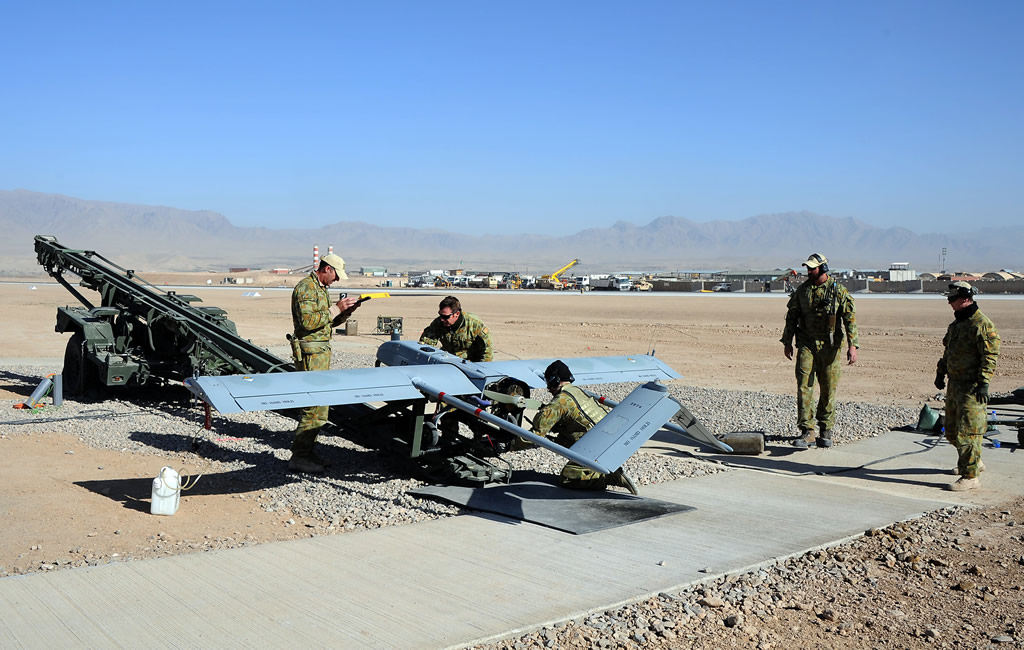
BAE Systems Australia in Adelaide teamed with American firm AAI in Hunt Valley, MD to offer the Shadow 200 UAV, which is in U.S. Army service in Iraq. The Shadow would eventually become the deal that replaced the i-View.
The RQ-7B Shadow expands the original Shadow’s wingspan to 14 feet, endurance to 6 hours, and payload to 45 pounds. It is the US Army’s main tactical UAV, and this status has had the expected “network effect” on available add-ons. Shadows are being used as surveillance aircraft with laser targeting capability, and as aerial communications relays that let troops in mountainous areas like Afghanistan talk to one another, without having line-of-sight. Beyond that, a US Army program seems set to arm them with GPS-guided 81mm mortars. That versatility helped Shadow win the nod as the i-View’s replacement.
(click to view full)
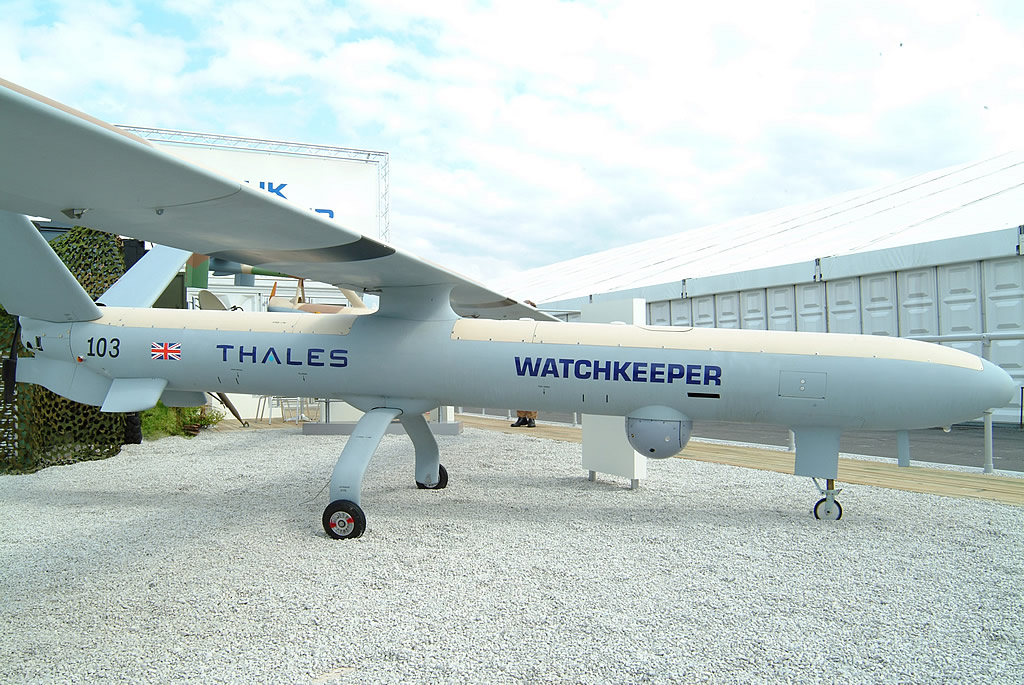
ADI in Sydney (now Thales Australia) teamed with Elbit in Tel Aviv to offer a variant of the Watchkeeper 450 UAV chosen by the United Kingdom. Australia’s DMO eventually got back to DID, and added that Elbit has also offered the smaller Hermes 180 as an option. Elbit makes the Skylark mini-UAV, which was ordered for Australian service, but couldn’t crack this competition.
Australia’s DMO eventually got back to DID on Dec 21/05, and added one more competitor.
France’s SAGEM had offered its CU-161 Sperwer UAV. The Sperwer was then in service with Canada, Denmark, France, Greece, the Netherlands, and Sweden. Even at the time, however, Sperwer was likely to exit service with Denmark soon, and Canada would soon relegate its Sperwers to training duties back home. That didn’t bode well for its chances, and indeed Sperwer lost.
Australia’s UAV Plans
In 2006, Senator Hill discussed Australia’s has further plans for UAVs:
“The Government is investing on more research and development of unmanned vehicle technology for use in future operations and for surveillance purposes. UAVs are an increasingly important part of the modern battlefield, particularly because they increase the troop’s ability to detect, respond and remain informed of activities across a wide area. This information can then be used to warn our troops and help them avoid potentially dangerous situations.”
All of that is true, but a statement is not the same thing as fielding working UAV systems.
The first tactical UAVs were originally expected to be in operational service in 2008, but that date slipped to late 2009 by the time a contract was actually signed. Sen. Hill noted that tactically, the I-Views were intended to complement short-range Tier 1 Skylark UAVs deployed to Iraq, and the High Altitude Long Endurance Maritime UAV that was to be purchased under Project Air 7000[1].
The new 132 Battery of the 20th Surveillance and Target Acquisition Regiment was set to operate the tactical UAVs at Gallipoli Barracks, Enoggera, in Queensland. Boeing Australia would provide the through-life-support, generating around 125 new jobs in the Brisbane area. In line with Australia’s Skilling Australia defense procurement strategy, a number of Australian small-to-medium enterprises and research institutions will assist.
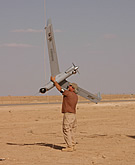
(click to view full)
Those plans went awry in 2008, when problems with the Boeing/IAI i-View 250 forced cancellation of the program. Budget issues also caused Australia to drop out of the BAMS program to field the RQ-4N Global Hawk UAV derivative, while maintaining the possibility that they might buy in later.
In the absence of these UAV options, Australia turned to a popular option these days: rentals.
Boeing lost the main JP129 contract, but the incredible 20-hour endurance of their popular ScanEagle UAV gave them a lease contract to operate ScanEagles in theater for Australia as a Tier 2 solution, just as they do for Canada and for the US Marines. Those contracts began in 2007, even before the i-View buy was formally canceled. The JP129 project office explicitly says that these UAVs are complementary to the Phase 2/ Tier 3 Tactical UAV buy.
In order to provide longer-range surveillance from higher altitudes, Australia’s next step in 2009 was to lease IAI Heron-1 UAVs through MDL, the same firm doing that job in-theater for Canada.
JP129 had not gone away during this time, and a recommendation and business case was set to follow in late 2010. As the Dutch left Uruzgan Province in summer 2010, however, Australian troops were left in the breach, alongside a coalition of forces from the USA, Singapore, Slovakia, France, and New Zealand.
With roadside bomb attacks rising, and the need for quick delivery of UAVs rising in tandem, a deal for 2 RQ-7B Shadow 200 systems from the US military was announced in August 2010. The A$ 175 million deal reportedly bought 18 used UAVs, which had served with the US Army. Normally, each complete Shadow 200 “system” comes with 5 UAVs, plus the usual complement of 2 ground control stations, 1 portable ground control station, and launch and recovery equipment. A complete system can be transported in 2 trips of Australia’s C-130J aircraft, or 1 C-17A mission.
Contracts & Key Events
2010 – 2013

(click to view full)
Oct 29/13: Support. AAI Corp. in Hunt Valley, MD receives a cost-plus-incentive-fee, option-included contract with a maximum value of $126.3 million, to provide RQ-7 Shadow logistics and operational support services to the US Army, USMC, and Australia. Work will performed in Afghanistan.
On the American side, $14.4 million in FY 2014 procurement & operations and maintenance funds are committed immediately. The bid was solicited through the Internet, with 1 bid received. US Army Contracting Command in Redstone Arsenal, AL will act as the contracting agent (W58RGZ-14-C-0001).
Dec 17/12: Training. Australia’s government announces an A$ 7.2 million five-year contract to provide Australian-based training for RQ-7B operators and maintainers. The training will be delivered through AAI Corporation’s Australian-based subsidiary Aerosonde Pty Ltd., and will begin in Queensland in April 2013. Troops will train using Australia’s second Shadow 200 system, which was delivered 12 months ahead of schedule in April 2012.
Australia DoD.
March 30/12: Deliveries. Australia’s government announces accelerated delivery of their 2nd ordered RQ-7B Shadow 200 system in the 1st half of 2012, almost a year ahead of the planned “first half of 2013” delivery specified in the contract. The accelerated delivery will let Australian troops train with UAV in Australia, before deploying to Afghanistan.
Australia’s 1st Shadow 200 system is still operating in Afghanistan, and has completed more than 220 hours of successful testing and training on top of its operational role. It will be certified as fully operational in the near future. Ministerial release | Press conference & transcript.
March 13/12: Support. Textron subsidiary AAI Corp. in Hunt Valley, MD received a $180.9 million cost-plus-incentive-fee contract to support RQ-7B Shadow unmanned aircraft systems serving with the US military and Australia. Work will be performed in Hunt Valley, MD, Afghanistan, and Australia with an estimated completion date of Oct 3/12. One bid was solicited, with 1 bid received. The U.S. Army Contracting Command at Redstone Arsenal, AL manages the contract (W58RGZ-12-C-0011).
August 2011: 1st Shadow system is delivered to Australia, and then deployed to Afghanistan. The UAVs fly from Australia’s base at Tarin Kowt. Source.
Shadow deployed
July 16/11: Defence Materiel Minister Jason Clare confirms that Australia will deploy its 1st RQ-7B Shadow UAV system of up to 6 UAVs by the end of 2011, to replace Boeing’s leased ScanEagles. The Australian government is acquiring 2 Shadow 200 systems via a Foreign Military Sales Agreement,” with initial delivery happening up to 18 months ahead of the FMA schedule. Early delivery of a 2nd system has been made possible by the US Army giving up one of its production-line slots. The Australian.
Aug 2/10: A reported A$ 175 million (about $158 million) deal for 18 RQ-7B Shadow 200 UAVs, sourced from the US military, will give Australia a tactical UAV fleet that it owns. Adelaide Now | The Australian | News Australia.
Shadow 200 contract
May 6/10: Return of the Shadow? The US DSCA formally announces [PDF] Australia’s request to buy 2 RQ-7B Shadow 200 Unmanned Aircraft Systems (UAS), plus communication equipment to include 4 Ground Control Stations, support equipment, spare and repair parts, tools and test equipment, technical data and publications, personnel training and training equipment, and U.S. government and contractor support. The estimated cost is up to US$ 218 million. Asked about this request, Australia’s DoD said that:
“The information being sought from the US will assist in the development of the JP129 Phase 2 business case that Defence plans to present for Government consideration in the second half of 2010. The Australian Government has not made a decision to acquire the Shadow 200 TUAV system or any other TUAV system. Should Government agree to the deployment of the selected JP129 Phase 2 capability on operations in MEAO, it is likely the capability would replace the current leased ScanEagle capability.”
If the RQ-7B wins, the prime contractor will be Textron’s subsidiary AAI Corporation in Hunt Valley, MD. Implementation of this proposed sale would require the assignment of 4 contractor representatives to Australia to support delivery in-country.
DSCA: 2 RQ-7B Shadow 200 systems
2005 – 2009
(click to view full)
Sept 4/08: It’s officially over. The contract’s cancellation is announced by Defence Minister Joel Fitzgibbon:
“Since contract award, Boeing Australia and its subcontractors have experienced a range of technical issues making it increasingly difficult to deliver the full scope of the contract within a timeframe acceptable to Defence. With a Defence imperative to field a TUAV capability as soon as possible, and the potential for a number of lower risk alternative systems, the DMO and Boeing Australia have agreed to terminate the contract on mutually acceptable terms… This decisive action will enable Defence to focus on the earliest acquisition of an alternative TUAV to meet the JP129 requirement.
…The Australian Army will continue to use the Scan Eagle UAV that is currently in service in the Middle East. As part of the agreement to terminate, Boeing will refund to Defence the $6 million they have been paid to date under the contract.”
See also: Flight International report.
I-View terminated
Sept 3/08: The Australian reports that new Labor Party defense minister Joel Fitzgibbon may be about to terminate the JP129 contract:
“The Israeli-built I-View 250 UAV system is dogged with technical problems and more than two years behind schedule. The relationship between the partners in the project, US aircraft builder Boeing and Israeli Aerospace Industries, has deteriorated in recent months.
A defense source close to the project, who asked not to be named, said: “The capability has not been axed but the contract has. Boeing have had two years to get this sorted and they’ve been dragging the chain.”
Taxpayers can expect a refund from Boeing of about $6 million.”
Boeing could re-enter a re-competed JP129 program with its own ScanEagle UAV, which has been leased by Australia for front-line use as an interim measure. The Hermes 450 has also strengthened its position in the interim, however, deploying with British forces in Afghanistan and Iraq, and seeing front-line use with Georgia during Russia’s invasion. Given Thales Australia’s local strength, Australia might well become the first export customer for the Thales/Elbit Watchkeeper Mk450 UAV.
Dec 14/06: Contract. The JP129 contract for I-View 250s is formally signed with Boeing Australia, with IAI as the subcontractor. Australian DoD | Boeing release | IAI release.
I-View 250 wins
Nov 11/05: DID relays a report from the Israeli newspaper Ha’aretz, which said that Australia had purchased 18 Heron UAV systems.
It was at about the right time for the JP129 program’s announcement, but a couple of our readers emailed us to wonder. DID attempted to check this out, and eventually an official announcement re: the JP129 program debunked the Ha’aretz report.
Footnotes
fn1. Project Air 7000 is Australia’s program to upgrade and complement its AP-3C Orion maritime patrol aircraft so they can remain effective until a successor is introduced. The USA’s RQ-4 Global Hawk is widely expected to be Australia’s preferred choice; still, Australia’s innovative Coastwatch program could end up choosing the Predator-derived Mariner UAV, creating an interesting competition with the USA’s BAMS program.
Appendix A: Initial Winner – The I-View UAV

(click to view full)
The winning bid for Project 129 belonged to Boeing Australia & Israel Aircraft Industries’ I-View 250 Unmanned Aerial Vehicle (UAV), which was chosen to provide airborne surveillance, reconnaissance, and target acquisition to support ADF land operations and work closely with Australia’s Tiger Armed Reconnaissance Helicopters to support operations on the battlefield.
In discussing the I-View 250’s win, Sen. Hill mentioned value for money of course. He also said:
“The I-View has a fully automatic take-off and landing system that dramatically increases operational reliability. Its catapult launcher and unique parafoil landing concept enables it to be deployed and recovered from an uneven area smaller than a football field [DID: soccer to our American readers.] This capability, which includes real time video, will enable 24-hour surveillance for the protection of Australian forces as well as the identification of enemy targets…
I-View also offers multiple EO/IR payload options with the option to fit a Synthetic Aperture (ground-looking) Radar; TCDL and EPLRS communications systems to ensure joint and coalition interoperability, and a highly advanced ground control station fitted to standard Army vehicles. Follow-on reports indicate that this combination of sensor flexibility, integration with Australia’s C4ISR systems via Boeing, and risk reduction at landing where many UAVs are lost, were instrumental in winning it the contract.
According to this article in The Australian, the I-View has a range of up to 80 km (about 50 miles), is able to stay airborne for up to 6 hours, and can carry loads of up to 30 kg (66 pounds).
Additional Readings
* Australian DMO – JP129 – Airborne Surveillance for Land Operations. Really, only covers phase 2, the Tactical UAV.
* IAI – I-View Mk. 250
* Defense Update – I-View