

Northrop Grumman’s E-2C Hawkeye is a carrier-capable “mini-AWACS” aircraft, designed to give long-range warning of incoming aerial threats. Secondary roles include strike command and control, land and maritime surveillance, search and rescue, communications relay, and even civil air traffic control during emergencies. E-2C Hawkeyes began replacing previous Hawkeye versions in 1973. They fly from USN and French carriers, from land bases in the militaries of Egypt, Japan, Mexico, and Taiwan; and in a drug interdiction role for the US Naval Reserve. Over 200 Hawkeyes have been produced.
The $17.5 billion E-2D Advanced Hawkeye program aims to build 75 new aircraft with significant radar, engine, and electronics upgrades in order to deal with a world of stealthier cruise missiles, saturation attacks, and a growing need for ground surveillance as well as aerial scans. It looks a lot like the last generation E-2C Hawkeye 2000 upgrade on the outside – but inside, and even outside to some extent, it’s a whole new aircraft.
From E-2A Hawkeyes to the E-2D
[youtube:v=DveoRhilv1A]
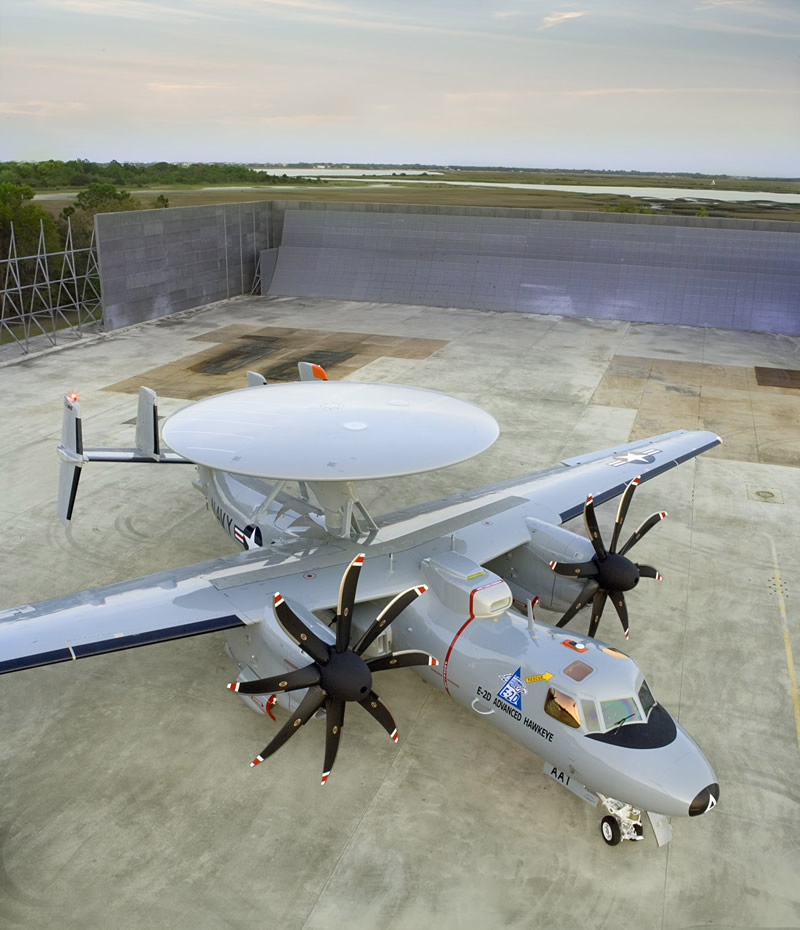
The Hawkeye is based on the same airframe as the USA’s C-2 Greyhound cargo aircraft, with the obvious addition of the 24 foot diameter, frisbee-shaped, rotating radome on its back. It carries a crew of 5 – pilot, copilot, and 3 mission system operators.
The first E-2A was delivered in 1964, the first E-2B upgrade in 1969, and as noted above, the first true “second generation” E-2C Hawkeye was delivered in 1973. In 1992, an E-2C Block II update program added the AN/APS-145 and L-304 radar systems; improved Rolls Royce T56-A-427 engines; JTIDS, Link-4A, -11, and 16 datalinks; GPS capability; and various avionics, and electronics upgrades. It finished in 2001. By 2003, Hawkeyes were proving their worth over Iraq in a new capacity: close air support. Smithsonian Air & Space magazine’s July 2008 issue discusses:
“The Hawkeye, of course, wasn’t designed for close air support, but time and again during the fighting in the Gulf, ground troops advanced so rapidly that they passed beyond radio contact with the units that were supposed to coordinate close air support for them. Early on in Iraq, E-2s were pressed into a stopgap role as airborne communications relays between ground forces and the U.S. Army’s Air Support Operations Center. But because the battleground was so fluid and so many airplanes had to be re-routed so quickly, Hawkeyes were given more latitude to pair warfighters with targets. “If the Hawkeye hadn’t been there, I think the [Air Support Operations Center] would have failed,” says Lieutenant Commander Brent Trickel, an E-2 naval flight officer who served as the Navy’s only officer in the Air Support Operations Center during the first few weeks of the war.”

(click to enlarge)
Technology moves quickly, however, and technology that was cutting edge in 1992 isn’t so cutting edge any more. A subsequent upgrade called the Hawkeye 2000 (HE2K) added the 8-bladed NP2000 propeller, replaced the old computer platform that was inhibiting further modernization with commercial-standard computer component upgrades; and added associated electronics, power, and maintainability modifications, including integrated satellite communications. All of these upgrades pale, however, in comparison to the effectiveness boost offered by adding Co-operative Engagement Capability (CEC). With CEC, the Hawkeye can see everything the ships in its task group can see – and vice-versa, turning the aircraft into a force multiplier to all ships in the group and even enabling ballistic missile defense roles.
Hawkeye 2000 aircraft were first deployed in 2003 aboard USS Nimitz, and additional customers have included Egypt, France, Japan & Taiwan (The UAE submitted a formal request in 2002, but later decided to put its money elsewhere).

(click to view full)
The next-generation, E-2D Advanced Hawkeye is planned as a major platform upgrade, rather than the incremental improvements of Hawkeye 2000. Cruise missiles are becoming stealthier, smaller targets are becoming important, and surveillance in coastal areas and overland is as important to the Navy as aerial surveillance.
The most important improvement to the E-2D AHE is the new APY-9 radar, which can detect and track smaller (or stealthier) targets, in larger numbers, and at greater ranges. It has been described as a 2-generation improvement over previous Hawkeye aircraft. Figures discussed to date involve up to 2,000 targets over 6 million cubic miles, on land and sea. The electronically scanned array offers improved in-service time and maintenance, allows simultaneous air/ground scans with extremely fast focusing on multiple targets, and features lower ‘sidelobe’ leakage, as well as other improvements. Improved clutter & interference cancellation offer significant improvement in tracking small land and sea targets, as well as better performance against electronic jamming. Additional features allow the radar to flip from 3660 degree scan, to 45 degree focused scan, to full power on one target mode against intermittent or stealthy contacts.
The E-2D’s internal equipment also gets a makeover. ESM (Electronic Support Measures) and IFF (Identification, Friend or Foe) systems offer improved classification of radar contacts at longer ranges. The communications suite is modernized to include dual-band SATCOM (SATellite COMmunications), as well as improved datalinks. Engines are improved. In-flight refueling capability for longer missions on-station is part of the basic aircraft, not an option. Etc.
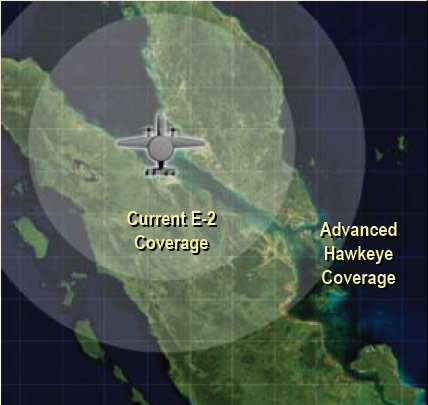
(click to view full)
Like any electronic system, however, the E-2D needs an improved interface in order to take advantage of its full capabilities. New mission computers and tactical workstations use commercial off-the-shelf components, providing more power to integrate incoming information into a coherent picture, and easier future upgrades. More to the point, the onscreen interface features dramatic improvements, including larger displays and advances in the front seats that allow the pilot or copilot to participate as 4th mission system operator once the aircraft is on station. The cockpit itself has also received attention, and has been fully modernized with an “all glass” (i.e. screens, not dials) system and a number of enhancements.
The end result is an aircraft that looks a lot like the E-2C Hawkeye 2000, but can scan larger areas for smaller targets; offers a new dimension in coverage by combining strong aerial, maritime, coastal, and land surveillance; can function as an integral part of missile defense efforts against both cruise and ballistic missiles; and allows operators to make better use of its capabilities.
Advances have also taken place on the manufacturing floor. When Northrop Grumman was awarded the system development and demonstration contract for the Advanced Hawkeye in 2003, the company chose to change its manufacturing approach. Engineers created a virtual design environment that integrated the engineering team in Bethpage, NY with the manufacturing team in St. Augustine, FL. They then began to re-engineer the structure, beginning with single detail parts.
In previous Hawkeye platforms, individual sheet-metal components were the basis for all structural assemblies. For the E-2D, a number of substructures were re-designed as machined components. This removes many detail parts, improves the production process, and leaves fewer potential points of failure in the finished aircraft.
E-2D Advanced Hawkeye: Program
(click to view full)
The US Navy remains the E-2D’s only confirmed customer at this point, but export interest has already been expressed by the UAE and by India. As of April 2011, all 5 test & pilot production E-2Ds had been delivered, and aircraft #10 had begun construction.
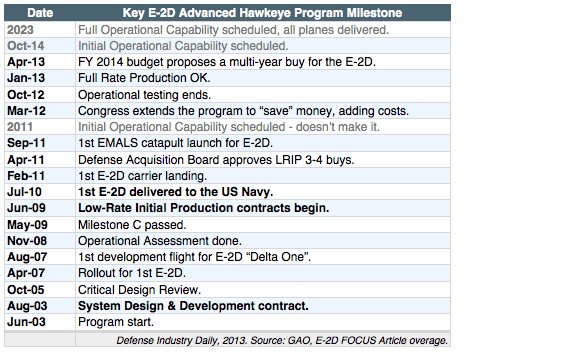
Initial operational capability was scheduled for 2011, and the type’s first carrier launch and landing did take place in February 2011, but testing and evaluation lags forced IOC back to October 2014.
As of 2013, an R&D program is underway to add in-flight refueling capability, but that development program will run to 2019.
Full Operational Capability is now scheduled for 2023, when a total of 75 aircraft (2 test, 3 pilot production, 70 operational) will have been delivered as the cornerstone of future US naval surveillance.
American Budgets

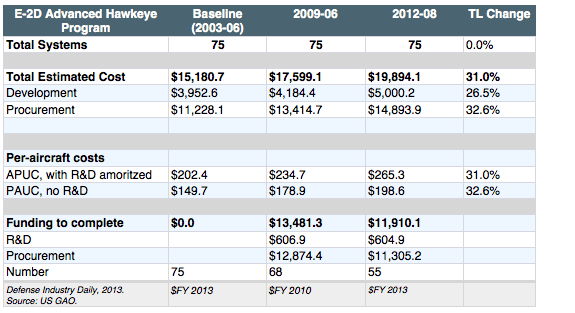
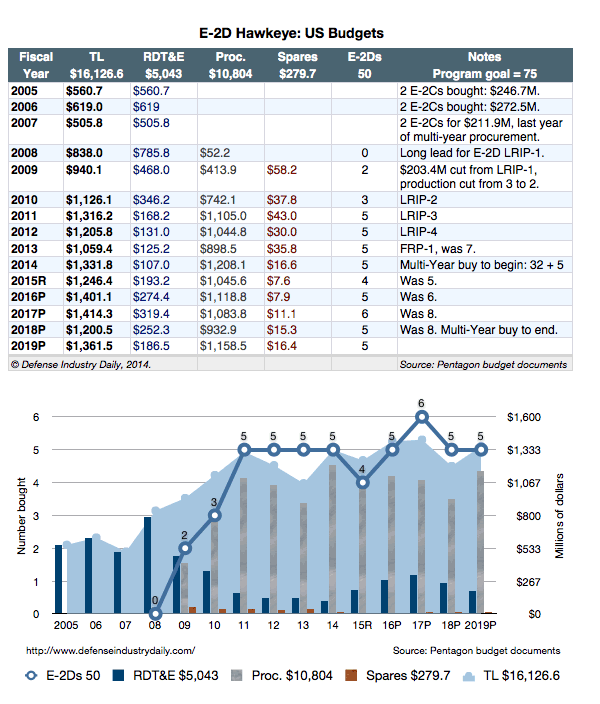
At present, total E-2D program cost has risen 40.6% over the original baseline figure of $14.752 billion FY 2012 dollars. The Pentagon’s April 2012 SAR (Selected Acquisition Report) placed the E-2D’s entire program cost, including R&D, production of all aircraft, internal equipment, and equipment required for initial fielding, at $20.737 billion. That works out to $276.5 million per aircraft, up from $196.7 million. Part of the reason for these high figures is that the number bought is only 75, so R&D adds a lot of money per-plane. Part of it is because AWACS aircraft of any type are expensive assets, thanks to all of the advanced radars, electronics etc. crammed into them.

Finally, part of it is because of deliberate buying decisions by Congress & the Pentagon, which eliminated a money-saving multi-year buy, and slowed production to stretch budgets, even though the program was performing well. Stretching programs out always costs more money, because every year you extend a production program is another year of fixed costs.
Annual budgets to date include:
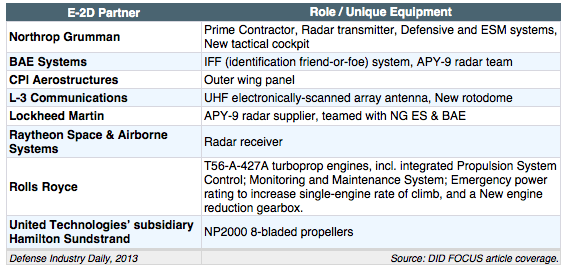
Industrial Partners
E-2D Advanced Hawkeye: Contracts & Key Events
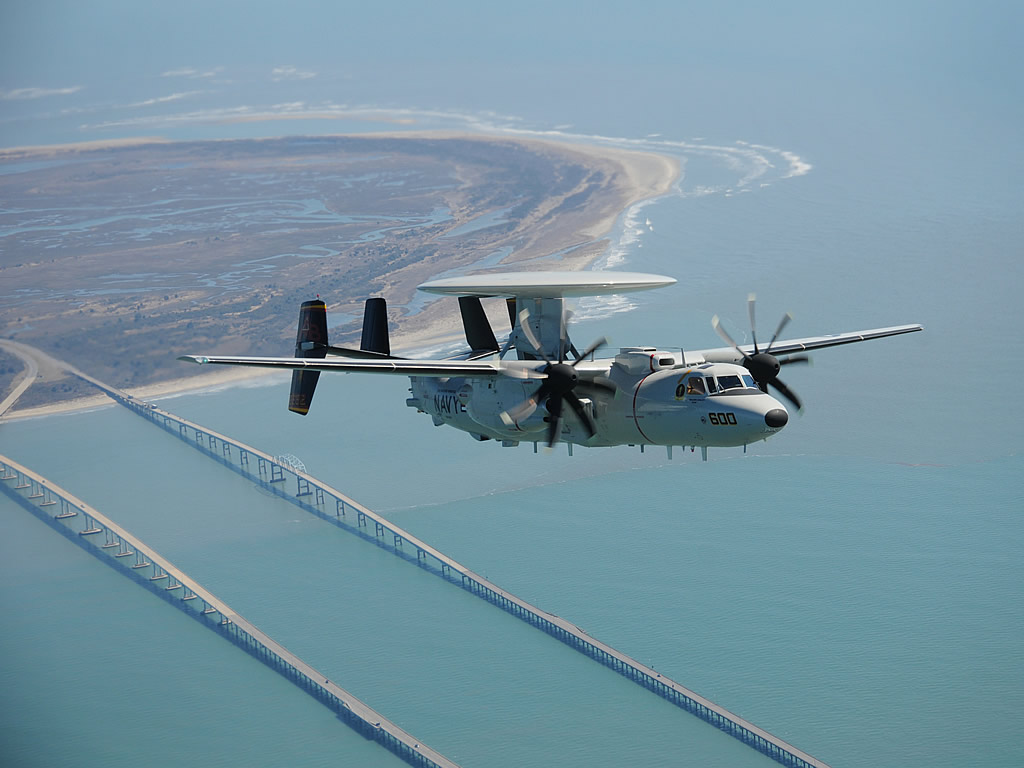
(click to view full)
Unless otherwise specified, US Naval Air Systems Command at Patuxent River, MD manages these contracts, and Northrop Grumman Integrated Systems Corp. in Bethpage, NY, is the contractor.
FY 2016-2023
November 6/23: SSA Northrop Grumman won a $31.8 million modification, which adds scope to extend software support activity (SSA) services to align with the extension of the E-2D Advanced Hawkeye full rate production, Lot 11, for the Navy. SSA consists of all aspects of software management in support of all software elements of the weapon system, subsystem, and support element levels of the aircraft software that are on the production line and/or released versions. Work will be performed in Melbourne, Florida; Liverpool, New York; Greenlawn, New York; and various locations within the continental US, and is expected to be completed in March 2024.
October 3/23: Japan Northrop Grumman Systems won a $150 million deal, which provides for the production and delivery of long lead parts for five E-2D Advanced Hawkeye Aircraft in support of the government of Japan. Work will be performed in Syracuse, New York; Rolling Meadows, Illinois; Woodland Hills, California; Menlo Park, California; Greenlawn, New York; Aire-sur-l’Adour, France; Owego, New York; Edgewood, New York; Melbourne, Florida; Marlboro, Massachusetts; and various locations within the continental US, and is expected to be completed in February 2029.
September 21/23: ONR Lockheed Martin won a $46.4 million deal for the digital expanded ultra-high frequency multiple input multiple output optimized radar. This contract provides for the development of advanced radar technology solutions applicable to both next generation platforms and current generation platforms (such as the E-2D). To support a rapid pace of development, the contractor will leverage, build-upon, and/or integrate available technologies from other programs including the Office of Naval Research (ONR). This effort centers on maturing high value radar technologies to a state enabling transfer to one or more programs of record for integration onto naval airborne platforms. Work will be performed in Liverpool, New York, and is expected to be completed in September 2027. The total cumulative value, including a 48-month base period and three 28-month option periods that, when exercised, will run concurrently with the base period, is $46,415,206. Fiscal 2023 research, development, test and evaluation (Navy) funds in the amount of $8,439,900 are obligated at time of award and will not expire at the end of the current fiscal year.
September 14/23: Retrofit Installation Northrup Grumman won a $458.2 million deal, which provides for retrofit installation of the cockpit technical refresh and theater combat identification, to replace the current integrated navigation and controls and display systems and tactical mission computer and display systems on E-2D Advanced Hawkeye aircraft. Work will be performed in Melbourne, Florida; Cedar Rapids, Iowa; Bloomington, Maryland; St. Augustine, Florida; Rolling Meadows, Illinois; Ft. Lauderdale, Florida; Greenlawn, New York; Falls Church, Virginia (1.6%); Woodland Hill, California; Laval, Quebec, Canada; and various locations within the continental US, and is expected to be completed in September 2028.
August 2/23: France Northrop Grumman won a $387.8 million modification, which adds scope to provide non-recurring engineering efforts in support of the production of three unique configuration E-2D Advanced Hawkeye for the Government of France. Work will be performed in Melbourne, Florida; Marlborough, Massachusetts; Baltimore, Maryland; Liverpool, New York; Orlando, Florida; West Chester, Ohio; Woodland Hills, California; Cisterna di Latina, Italy; and various locations within the continental US, and is expected to be completed in December 2027.
July 10/23: France Northrop Grumman won a $76 million order, which procures spares to support flight test and an initial two year sustainment after the delivery for three unique configuration E-2D Advanced Hawkeye aircraft for the government of France. Work will be performed in Liverpool, New York; Melbourne, Florida; Indianapolis, Indiana; St. Augustine, Florida; Menlo Park, California; Bethpage, New York; Edgewood, New York; Woodland Hills, California; Baltimore, Maryland; Provo, Utah; Valencia, California; Falls Church, Virginia; West Chester, Ohio; Clemmons, North Carolina; various locations within the continental US (CONUS); and various locations outside the CONUS, and is expected to be completed in August 2027.
June 28/23: Amplifier Modules Northrop Grumman won a $15.6 million deal for the repair and overhaul of 270 power amplifier modules in support of the E-2D aircraft used in the Naval Supply Systems Command (NAVSUP) Weapon Systems Support (WSS) Integrated Weapon Support Team’s program. The delivery order does not include an option period. Work will be performed in Woodland Hills, California (95%); and Liverpool, New York (5%). Expected completion date is in July 2026.
May 5/23: Support Northrop Grumman won a $60 million modification, which adds scope to procure long lead parts and associated support for two E-2D Advanced Hawkeye plus up aircraft for the Navy. Work will be performed in Syracuse, New York (25.06%); Rolling Meadows, Illinois (9.52%); Woodland Hill, California (5.87%); Menlo park, California (5.08%); Greenlawn, New York (3.33%); Aire-sur-l’Adour, France (2.02%); Owego, New York (1.79%); Edgewood, New York (1.41%); Melbourne, Florida (1.35%); and various locations within the continental US (44.57%), and is expected to be completed in April 2028.
May 1/23: APY9 Raytheon won a $10 million deal for the repair of the towed auxiliary radar antenna system, position tracking system and APY9 radar receiver system in support of the E2D Advanced Hawkeye aircraft. The delivery order does not include an option period. All work will be performed in El Segundo, California, and work is expected to be completed by May 2026.
April 27/23: Technical Support Northrop Grumman won a $25 million modification, which exercises an option to provide sustainment and technical support in support of E-2C/D aircraft common and unique requirements for the Governments of France, Japan, Taiwan, and Egypt. Work will be performed in Florida, Japan, Ohio, Florida and various locations within the continental US, and is expected to be completed in April 2026. Foreign Military Sales customer funds in the amount of $14,384,000 will be obligated at the time of award, none of which will expire at the end of the current fiscal year.
March 23/23: Lot 11 Northrop Grumman won a $50 million contract modification, which exercises options to provide non-recurring engineering, product support, and production cut in support, in support of Lot 11 E-2D Hawkeye production aircraft. Work will be performed in Melbourne, Florida (24.8%); St. Augustine, Florida (20.1%); Liverpool, New York; El Segundo, California; Indianapolis, Indiana; Menlo Park, California; Rolling Meadows, Illinois; Aire-sur-l’Adour, France; Edgewood, New York; Marlboro, Massachusetts; Woodland Hills, California; Greenlawn, New York; and various locations within the continental US, and is expected to be completed in February 2027.
March 6/23: Delta System Software Northrop Grumman won a $25.4 million modification, which exercises an option for the fabrication and installation support to retrofit the Delta System Software Configuration 4.0 capabilities, to include Tactical Targeting Network Technology and the Beyond Line of Sight in the E-2D Advanced Hawkeye aircraft. Work will be performed in Dallas, Texas (57%); Melbourne, Florida (11%); Boulder, Colorado (9%); Norfolk, Virginia (8%); Salisbury, Maryland (5%); Ronkonkoma, New York (3%); and various locations within the continental US (7%), and is expected to be completed in September 2025.
January 10/23: Overhaul Northrop Grumman won a $15.5 million delivery order for overhaul of power amplifier modules in support of the E-2D aircraft. All work will be completed by September 2025 with no option periods. Work will be performed in Woodland Hills, California; and Liverpool, New York. Annual working capital funds (Navy) in the full amount will be obligated at the time of award and funds will not expire at the end of the current fiscal year.
December 28/22: Damage Taiwan has decided against carrying out expensive repairs to a E-2K Hawkeye airborne early aircraft that was damaged during a belly landing incident on November 25. According to local news reports, the cost of repairs will cost $65.16 million. The cause of the incident, in which the landing gear failed to deploy, was due to pilot error. This is the second such incident for a Taiwan Hawkeye. A similar accident occurred in 1997 when #2503 was damaged in the same way. However, the aircraft was repaired using a fuselage that was being produced for the US Navy.
December 14/22: Advanced Capability Build 20 Lockheed Martin won a $14 million deal for AEGIS Combat System Engineering Agent efforts, which include the design, development, integration, test and delivery of Advanced Capability Build 20. Work will be performed in Moorestown, New Jersey, and is expected to be completed by May 2023.
December 12/22: Japan Northrop Grumman won a $32.5 million order, which procures spare Wet Outer Wing Panels for the government of Japan’s configuration of the E-2D Advanced Hawkeye aircraft. An additional two E-2D Advanced Hawkeye airborne early warning (AEW) aircraft for the Japan Air Self-Defense Force (JASDF) arrived by ship on 18 October, bringing to six the number of these aircraft completed for Japan to date. Work will take place in New York, Florida, North Carolina, California, Oklahoma, Utah and various other locations within the continental US. Expected completion will be in July 2027.
December 1/22: ISR&T The US Air Force has awarded engineering firm KBR a $69.2 million contract to support the Naval Surface Warfare Center Crane and Naval Air Systems Command all-weather airborne early-warning fleet. Work for the program will focus on the E-2D Advanced Hawkeye, E-2C Hawkeye and C-2A Greyhound aircraft. Under the agreement, KBR will develop and integrate new intelligence, surveillance, reconnaissance, and targeting (ISR&T) capabilities for the fleet.
November 7/22: Refueling Retrofit Kits Northrop Grumman won a $29 million modification, which exercises an option that provides five aerial refueling retrofit kits including installation onboard E-2D Advanced Hawkeye aircraft for the Navy. The E-2D Advanced Hawkeye is the newest variant of the E-2 aircraft platform. It features a state-of-the-art radar with a two-generation leap in capability and upgraded aircraft systems that will improve supportability and increase readiness. Work will take place in Florida. Expected completion will be in August 2025.
November 4/22: Delta System Software Configuration 4.0 Northrop Grumman Systems won a $25 million contract modification, which adds scope for fabrication and installation support to retrofit the Delta System Software Configuration 4.0 capabilities, to include tactical targeting network technology and the beyond line of sight in the E-2D Advanced Hawkeye aircraft. Work will be performed in Dallas, Texas; Melbourne, Florida; Boulder, Colorado; Norfolk, Virginia (8%); Salisbury, Maryland; Ronkonkoma, New York (3%); and various locations within the continental US, and is expected to be completed in September 2025.
October 24/22: Fatigue Test Article Northrop Grumman won a $31.6 million deal, which provides for the inspection and teardown of the E-2D Advanced Hawkeye fatigue test article to identify fatigue critical locations and demonstrate that the E-2D aircraft structure satisfy the program’s service life requirement. Work will take place in Florida, New York and California. Expected completion will be in June 2027.
September 27/22:Integrated Training System Devices Rockwell Collins won a $15.6 million modification, which adds additional in-scope work to provide a virtual reality trade study, aircraft common equipment replacement/virtualization, aircraft flight management computer functional equivalent unit card development, and Beyond Line Of Sight (BLOS) chat software enhancements in support of the E-2D Hawkeye Integrated Training System devices, as well as provides associated technical data, computer software, and computer software documentation for BLOS chat software enhancement efforts. Additionally this modification exercises an option to procure coupled mode capability in support of E-2D Aircrew Procedures Trainer Device 2F211 S/N 4 and E-2D Distributed Readiness Trainer. Work will take place in Virginia and Florida. Estimated completion will be in February 2024.
July 18/22: HPA North Star Scientific Corp. won a $14.4 million order, which provides for the production and delivery of 41 high power amplifier (HPA) units: six HPA units for System Configuration Set-11 E-2C aircraft; nine HPA units for E-2D crypto modernization and frequency remapping aircraft retrofits; 11 spare HPA units; and 15 HPA units for the government of Australia. Additionally, this order provides for the production and delivery of 19 HPA units and vibration isolating tray assemblies with integral air plenums: 14 that are Multi-functional Information Distribution System – Joint Tactical Radio System (MIDS-JTRS) compatible, and five that are MIDS-JTRS Link-16 compatible. As well, as provides engineering and engineering data support for HPA units kitting, installation, and testing. Work will take place in Hawaii and California. Expected completion will be in July 2024.
May 25/22: AN/APY-9 Lockheed Martin won a $13.3 million deal, which provides for engineering, development and production of Operational Test Program Sets (OTPS) to support AN/APY-9 Radar Avionics Line Replaceable Modules (LRMs). These OTPSs will provide support for the E-2D Advanced Hawkeye program and will be used at the depot level to provide test and repair capabilities for the LRMs. Work will take place in New York. Expected completion date will be in September 2025.
May 18/22: Repair Rolls-Royce won a $20.9 million modification, which exercises an option to provide depot repair of T56-A-427 engines utilized on E-2 Hawkeye aircraft, to include repair of the power section, torque meter, gearbox and accessories in accordance with Navy depot manuals and approved repair practices. Work will take place in Texas, Canada and Indiana. Expected completion will be in December 2023.
May 5/22: Performance Analysis Toyon Research won a $9.1 million ordering agreement, which provides for analysis tools and performance analysis to support the E-2D aircraft and provide support equipment for E-2D performance analysis. Additionally, this order provides two E-2D Delta System Software Configuration (DSSC)-4 mission computer upgrade kits to support analysis of E-2D DSSC-4 in an operational environment, as well as develop system requirements to update the E-2D All-source Track and ID Fuser data fusion engine to accept data from tactical information web services. This order continues efforts in support of Small Business Innovation Research (SBIR) Topic N111-016 titled, “Optimizing Track-to-Track Data Fusion for Variable Cases”, which seeks to develop a method that would analyze different approaches of combining tracks from multiple disparate data sources and identify the approach that results in the best overall track accuracy within the processing and time constraints available. Work will take place in California, Florida, Texas and New Hampshire. Estimated completion will be by July 2024.
April 25/22: Technical Support Northrop Grumman won a $24.7 million contract modification, which exercises options to provide in service and technical support in support of E-2C/D aircraft common and unique requirements for Foreign Military Sales (FMS) customers. Work will take place in Florida, Japan, Ohio and various locations within the continental US. Expected completion will be in April 2023.
March 15/22: Link 16 Northrop Grumman won a $17 million modification, which adds scope to provide for the production, delivery, and installation of Link 16 Crypto-Modernization/Hybrid Beyond Line of Sight capabilities on 15 E-2D Advanced Hawkeye aircraft. The E-2D Advanced Hawkeye (AHE) is the newest variant of the E-2 aircraft platform. It features a state-of-the-art radar with a two-generation leap in capability and upgraded aircraft systems that will improve supportability and increase readiness. Work will take place in Florida, Virginia, Illinois, California and New York. Estimated completion date is May 2023.
March 4/22: Maintenance Support Northrop Grumman Systems won a $22.6 million order, which provides for maintenance support to the E-2D aircraft throughout its entire life-cycle using operationally supportable and interoperable solutions. The E-2D Advanced Hawkeye (AHE) is the newest variant of the E-2 aircraft platform. It features a state-of-the-art radar with a two-generation leap in capability and upgraded aircraft systems that will improve supportability and increase readiness. Work will take place in Florida and New York. Estimated completion will be in February 2025.
February 16/22: DSSC Rockwell Collins Simulation and Training Solutions won a $31.4 million contract modification, which extends services and adds hours to implement Delta Software System Configuration (DSSC) #4 tactical baseline updates and concurrency enhancements, to include technical data, on the E-2D Hawkeye Integrated Training System, flight, tactics, maintenance, and E-2D Distributed Readiness Trainer (D-DRT) devices. Additionally, this modification exercises options to provide integration of the DSSC #4 on weapons system trainers and flight devices, DSSC #4 Operating Systems upgrades on flight and D-DRT devices, and technical data, as well as provide DSSC #4 training, to include maintenance, user, and cyber security/software support. Work will take place in California, Virginia and Japan. Estimated completion will be in September 2024.
December 24/21: France Northrop Grumman won a $353.6 million contract modification, which provides for the production and delivery of three E-2D Advanced Hawkeye aircraft for the government of France. The E-2D is the US Navy’s premier airborne command and control aircraft for all targets and all environments. The French Navy has been operating the E-2C Hawkeye since 1998 and is the only country other than the United States to operate its E-2 Hawkeyes from an aircraft carrier. France’s plan to acquire three E-2Ds to replace the Navy’s old E-2C Hawkeyes was first revealed more than a year ago. The U.S. approved this sale for $2 billion in July 2020. The French Navy will be second only to Japan, to own these jets. Work will take place in New York, Florida, Indiana, California, Illinois and Connecticut. Estimates completion will be in April 2027.
November 25/21: Engines Rolls-Royce won a $23.3 million deal, which provides for the depot repair of T56-A-427A engines installed on E-2D Advanced Hawkeye aircraft for the Navy. The Allison T56 is a single shaft, modular design military turboprop with a 14-stage axial flow compressor driven by a four-stage turbine. The E-2D is a twin-engine turboprop aircraft. Work will take place in Texas, Canada and Indiana. Estimated completion date is in November 2022.
November 19/21: Radar Processor The US Navy awarded Lockheed Martin a $15.9 million contract modification, which exercises an option to procure seven retrofit advanced radar processor systems for the E-2D aircraft. The E-2D Hawkeye features a state-of-the-art radar with a two-generation leap in capability and upgraded aircraft systems that will improve supportability and increase readiness. Work will take place in New York and Massachusetts. Estimated completion will be in February 2026.
October 7/21: Flight Computers Northrop Grumman won a $8.4 million delivery order for support of the E2-D Advanced Hawkeye aircraft program avionics flight management computers. The E-2D Advanced Hawkeye (AHE) is the newest variant of the E-2 aircraft platform. In December 2020, Northrop Grumman was awarded a $13.1 million order to provide new computers and displays for the E2-D Hawkeye. The new contract is a 42-month contract with no option periods. Work will take place in California. Estimated completion date is February 5, 2025.
September 14/21: IFF The US Navy has awarded BAE Systems a $26 million contract for Identification Friend-or-Foe (IFF) spares for the E-2D Advanced Hawkeye aircraft. Under the contract, BAE Systems will provide Beamforming Networks (BFNs), an integral part of antenna control for the AN/APX-122A IFF Interrogator system, onboard the carrier-capable tactical aircraft.
September 2/21: Integrated Training Systems Rockwell Collins Simulation and Training Solution won a $17.6 million modification, which procures initial spare parts and aircraft common equipment to support the E-2D Hawkeye Integrated Training Systems flight, tactics, and maintenance devices.The E-2D Advanced Hawkeye features a state-of-the-art radar with a two-generation leap in capability. Work will take place in Virginia, Japan and California. Work is expected to be finished by March 2024.
August 16/21: Computers Northrop Grumman won a $8.4 million delivery order for support of the E2-D Advanced Hawkeye aircraft program avionics flight management computers. The E-2D provides broad area coverage resulting in broader range capabilities. With the E-2D’s enhanced ability to work in the littoral and over land, the platform provides a critical capability to protect our nation’s interests. Work will take place in California. Estimated completion date is February 5, 2025.
August 6/21: Egypt/Taiwan Capt. Pete Arrobio, head of PMA-231, disclosed during the Navy League’s annual Sea-Air-Space conference that Egypt and Taiwan are the next potential export customers for the E-2D early warning aircraft. Japan and France are existing customers with Japan taking delivery of three airframes already. France will take delivery of its aircraft in 2027.
July 29/21: France Northrop Grumman won a $19.7 million contract modification, which adds scope to provide non-recurring engineering risk reduction efforts to support the delivery schedule of the E-2D Advanced Hawkeye aircraft FAA1-FAA3 for the government of France. The E-2D Advanced Hawkeye (AHE) is the newest variant of the E-2 aircraft platform. It features a state-of-the-art radar with a two-generation leap in capability and upgraded aircraft systems that will improve supportability and increase readiness. Work will take place in Florida, New York and Ohio. Estimated completion will be by January 2022.
July 6/21: Delta Northrop Grumman won a $12.9 million contract modification, which exercises an option to provide continued support for integrated test team operations in executing advanced development experimentation flights and development testing in support of future delta system software builds for the Navy E-2D Advanced Hawkeye aircraft. The E-2D Advanced Hawkeye (AHE) is the newest variant of the E-2 aircraft platform. It features a state-of-the-art radar with a two-generation leap in capability and upgraded aircraft systems that will improve supportability and increase readiness. Work will take place in Patuxent River, Maryland. Estimated completion will be in July 2022.
June 7/21: Full-Scale Fatigue Repair Time Northrop Grumman won a $12 million contract modification, which increases the ceiling to extend services and adds hours increasing the full-scale fatigue repair time to achieve the required simulated flight hours in support of E-2D Advanced Hawkeye aircraft development. The Advanced Hawkeye features a state-of-the-art radar with a two-generation leap in capability and upgraded aircraft systems that will improve supportability and increase readiness. Work will take place in California, Florida and New York. Estimated completion is in June 2023.
May 18/21: France And Japan Northrop Grumman won a $17.7 million order, which provides technical and sustainment support for E-2C/D aircraft common and unique requirements for the Governments of France and Japan. The E-2C Hawkeye aircraft supplied by Northrop Grumman is an all-weather airborne early warning aircraft to the naval task force. The next-generation E-2D Advanced Hawkeye has a new radar system, theatre missile defence capabilities, multi-sensor integration and a Northrop Grumman Navigation Systems tactical glass cockpit. Work will take place in Florida, Japan, and Ohio. Expected completion will be in April 2022.
April 28/21: Repair Rolls-Royce won a $21.8 million contract modification, which exercises an option to provide depot repair of T56-A-427 engines utilized on E-2 Hawkeye aircraft, to include repair of the power section, torque meter, gearbox and accessories in accordance with Navy depot manuals and approved repair practices. The Hawkeye is an s an American all-weather, carrier-capable tactical airborne early warning (AEW) aircraft. Work will take place in Texas, Canada and Indiana. Expected completion date is January 2022.
April 19/21: France Northrop Grumman won a $99 million contract modification, which adds scope to procure long lead items and associated services in support of the production and delivery of three E-2D Advanced Hawkeye aircraft for the government of France. The French Navy has been operating the E-2C Hawkeye since 1998 and is the only country other than the United States to operate its E-2 Hawkeyes from an aircraft carrier. This capability enables interoperability exercises that support Hawkeyes from each other’s carrier flight decks. With the US Navy’s fleet transition to E-2D squadrons, the French Navy intends to maintain interoperability and partnership by taking steps to procure three E-2D aircraft. Work will take place in New York, California, North Carolina and Florida. Estimated completion will be in April 2027.
April 2/21: Support Northrop Grumman Systems won a $195 million contract modification to a previously awarded fixed-price incentive (firm-target) contract (N0001918C1037). This modification exercises options to provide support services to include non-recurring engineering, software support activity and product support in support of E-2D Advanced Hawkeye (AHE) Lot 9 full rate production (FRP) aircraft. In addition, this modification adds scope to procure one E-2D AHE CV-22B variation in quantity aircraft Lot 10 FRP aircraft. The E-2D Advanced Hawkeye (AHE) is the newest variant of the E-2 aircraft platform. It features a state-of-the-art radar with a two-generation leap in capability and upgraded aircraft systems that will improve supportability and increase readiness. Work will take place in Florida, New York, California, Indiana, Illinois, France, and Massachusetts. Estimated completion date is in February 2026.
January 11/21: HPA North Star Scientific Corp. won a $9.6 million order, which provides for the production and delivery of 42 high power amplifier (HPA) units (13 HPA units for E-2D crypto modernization and frequency remapping aircraft retrofits; 10 HPA units for E-2D Tactical Targeting Network Technology (TTNT) production aircraft, 10 HPA units for spares; five HPA units for system configuration set-11 E-2C aircraft,; and four HPA units for E-2D TTNT aircraft retrofits) under Small Business Innovation Research (SBIR) topic N06-125 titled, “L-Band Solid-State High Power Amplifier for Airborne Platforms.” Additionally, this order provides engineering and engineering data support for HPA units kitting, installation and testing. The E-2D is the latest version of the E-2 Hawkeye all-weather, carrier-capable, tactical airborne early warning (AEW) aircraft. Work will take place in Hawaii and California. Estimated completion will be in August 2022.
December 24/20: Flight Mission Computers Northrop Grumman won a $13.1 million order, which procures 39 avionic flight mission computers, 10 control display units and one environmental stress screening station in support of E-2D aircraft. The E-2D Advanced Hawkeye (AHE) is the newest variant of the E-2 aircraft platform. It features a state-of-the-art radar with a two-generation leap in capability and upgraded aircraft systems that will improve supportability and increase readiness. The E-2D continues the Navy’s integrated war fighting legacy by providing broad area coverage resulting in broader range capabilities. With the E-2D’s enhanced ability to work in the littoral and over land, the platform provides a critical capability to protect our nation’s interests. Work will take place in California and Florida. Estimated completion is in November 2024.
November 17/20: Trainer Device Rockwell Collins Simulation won a $19.6 million modification, which is for the production and delivery of one 2F211 S/N 5 aircrew procedures trainer device, associated technical data and proposal preparation in support of the E-2D Hawkeye Integrated Training System program. The E-2D Advanced Hawkeye is the latest version of the Hawkeye early warning aircraft and features a new radar system. It brings new capabilities including the new and powerful AN/APY-9 radar, which is a two-generational leap in technology. The APY-9 radar is an Ultra High Frequency (UHF) surveillance system that provides both mechanical and electronic scanning capabilities designed to “see” smaller targets as well as more of them at a greater range, particularly in coastal regions and over land.
August 5/20: Reviews And Planning Northrop Grumman won a $34.7 million ordering agreement, which provides non-recurring engineering for requirements development and systems engineering technical reviews and certification planning; initial requirements change requests; procurement strategy source selection package; performance based navigation certification plan; initial system safety; cyber; program protection and exportability analysis; integrated master schedule; and other associated technical deliverables in support of the E-2D Advanced Hawkeye cockpit redesign. Operating from an altitude more than 25,000ft high, the Hawkeye alerts the naval task force to approaching air threats, while also providing threat identification and positional data to fighter aircraft such as F-14 Tomcats. The next-generation E-2D Advanced Hawkeye has a new radar system, theatre missile defense capabilities, multi-sensor integration and a Northrop Grumman Navigation Systems tactical glass cockpit. Work will take place in Melbourne, Florida and Patuxent River, Maryland. Expected completion will be in January, 2022.
July 9/20: Electronic Phase Shifters BAE Systems won a $26.3 million delivery order for E-2D aircraft electronic phase shifters. This was a sole-source acquisition using justification 10 US Code 2304 (c)(1), as stated in Federal Acquisition Regulations 6.302-1. The next-generation, E-2D Advanced Hawkeye has a new radar, theatre missile defense capabilities, multisensor integration and a Northrop Grumman Navigation Systems tactical glass cockpit. Lockheed Martin Maritime Systems & Sensors has developed the AN/APY-9 solid-state, electronically steered UHF radar under the E-2C radar modernization program. Work will take place in New York. Estimated completion date is November 30, 2027.
July 8/20: France The DoS approved a possible sale of three E-2D Advanced Hawkeye aircraft to France, in a deal that would bring the US and French carrier air wings even closer together. The Government of France had requested to buy three E-2D Advanced Hawkeye Aircraft, ten T-56-427A engines, three AN/APY-9 radar assemblies, four AN/ALQ-217 electronic support measure systems, three AN/AYK-27 Integrated Navigation Channels and Display Systems, five Link-16 (MIDS-JTRS) Communications Systems, ten Embedded GPS/INS (EGI) Devices, four AN/APX-122(A) and AN/APX-123(A) Identification, Friend or Foe systems and one Joint Mission Planning System. Also included are Common Systems Integration Laboratories with/Test Equipment, one in Melbourne, FL, and the other in France; air and ground crew equipment; support equipment; spare and repair parts; publications and technical documentation; transportation; training and training equipment; US Government and cntractor logistics, engineering, and technical support services; and other related elements of logistics and program support. The total estimated program cost is $2 billion. France currently flies the E-2C Hawkeye. The upgraded E-2D Advanced Hawkeye, according to the US Navy “features a state-of-the-art radar with a two-generation leap in capability and upgraded aircraft systems that will improve supportability and increase readiness.
July 2/20: Maintenance Support Northrop Grumman won a $54.4 million delivery order, which procures maintenance support equipment and recurring peculiar support equipment, along with associated non-recurring engineering and integrated logistics support for the E-2D Advanced Hawkeye aircraft. The next-generation, E-2D Advanced Hawkeye has a new radar, theatre missile defense capabilities, multisensor integration and a Northrop Grumman Navigation Systems tactical glass cockpit. Work will take place in Florida. Estimated completion date will be by December 2022.
June 25/20: Processor Systems Lockheed Martin won a $22.4 million contract modification, which exercises options to procure 12 retrofit advanced radar processor systems for the E-2D Advanced Hawkeye aircraft. The E-2D Advanced Hawkeye has a new radar system, theater missile defense capabilities, multi-sensor integration and a Northrop Grumman Navigation Systems tactical glass cockpit. Work will take place in Liverpool, New York and Andover, Massachusetts. Estimated completion date is in November 2023.
June 3/20: Production And Engineering Northrop Grumman won a $27.6 million contract modification, which provides recurring production and non-recurring engineering in support of the incorporation of beyond line of sight, tactical targeting network technology, navigation warfare and electronic support measures cable modifications into full rate production Lots 7-11 of the E-2D Advanced Hawkeye aircraft. The E-2 Hawkeye is an american all-weather, carrier-capable tactical airborne early warning aircraft. The next-generation E-2D Advanced Hawkeye has a new radar system, theatre missile defense capabilities, multi-sensor integration and a Northrop Grumman Navigation Systems tactical glass cockpit. Work will take place in Florida, Illinois, Massachusetts, Colorado, California, New York, Maryland, Arizona and various locations within the continental US. Expected completion will be by September 2026.
April 17/20: Japan Northrop Grumman delivers two more E-2D Advanced Hawkeye (AHE) aircraft to the Japan Air Self Defense Force (JASDF). Following assembly and some test flights at Iwakuni, the two aircraft, which belong to an initial batch of four, are set to be transferred to Misawa Air Base in Aomori Prefecture in northern Japan where the JASDF’s 601st Squadron, which operates both E-2C and E-2D aircraft, is based. The US Department of Defense announced in September 2019 that the US Naval Air Systems Command had awarded Northrop Grumman a $1.36 billion contract modification for the production and delivery of nine additional aircraft to Japan, bringing to the number of E-2Ds under contract for the JASDF to 13.
March 24/20: Parachute Survival Ensemble BAE Systems won an $8.6 million contract modification, which provides for the procurement of 20 E-2 parachute survival ensemble units and 130 FLU-10 inflators for the Navy, in addition to 60 E-2 parachute survival ensemble units and 70 FLU-10 inflators for the government of Japan. The E-2 Hawkeye is the Navy’s all-weather, carrier-based tactical battle management airborne early warning, command and control aircraft. The E-2 is a twin engine, five crewmember, high-wing turboprop aircraft with a 24-foot diameter radar rotodome attached to the upper fuselage. Work will take place in Phoenix, Arizona and Orchard Park, New York. Estimated completion will be in November 2023.
February 17/20: Retrofit Advanced Radar Processor Systems Lockheed Martin won a $15.3 million delivery order that procures four retrofit advanced radar processor systems to include required non-recurring engineering and 16 high-density servers for the E-2D Advanced Hawkeye aircraft. The E-2D Advanced Hawkeye is the latest variant of the E-2 Airborne early warning aircraft, replacing the E-2C Hawkeye. The next-generation E-2D Advanced Hawkeye has a new radar system, theater missile defense capabilities, multi-sensor integration and a Northrop Grumman Navigation Systems tactical glass cockpit. Lockheed Martin Maritime Systems & Sensors developed the AN/APY-9 solid-state, electronically steered UHF radar under the E-2C radar modernization program. Work will take place in Liverpool, New York and Andover, Maine and is expected to be finished in May 2023.
February 5/20: Updates Rockwell Collins Simulation and Training Solutions won a $20.3 million modification, which procures updates to the Delta Software System Configuration #3 software baseline to include the visual system and cyber security on tactics and flight trainer devices. Additionally, this modification provides technology refresh and aircraft concurrency updates on tactics devices, aircraft concurrency and aerial refueling updates on the flight devices, tactics and flight device training and associated technical data in support of the E-2D Hawkeye Integrated Training System. The Hawkeye is a Northrop Grumman-manufactured surveillance aircraft designed to provide information operations for battle management, theater air and missile defense, and multiple sensor fusion capabilities. The training systems, which Rockwell Collins has been delivering to the Navy and allied militaries that use the surveillance platform for several years, include simulators, interactive computer media, as well as other shore-based training. Work will take place in Point Mugu, California and expected completion will be in June 2022.
November 8/19: Refueling Retrofit Kits The Naval Air Systems Command awarded Northrop Grumman a $32.5 million contract modification, which exercises the option for five aerial refueling retrofit kits, installations and technical data in support of the E-2D Advanced Hawkeye aircraft. The aircraft is the the latest version of the Hawkeye and features an entirely new avionics suite including the new AN/APY-9 radar, radio suite, mission computer, integrated satellite communications, flight management system, improved T56-A-427A engines and a glass cockpit. The first E-2D Advanced Hawkeye airborne early warning aircraft with aerial refueling capability has joined the US Navy’s fleet at Naval Station Norfolk in September. In April this year, the US Navy awarded a contract modification worth $3.2 billion to Northrop Grumman to deliver 24 E-2D Advanced Hawkeye airborne surveillance aircraft. Work will take place in Florida, New York, California, Maryland as well as England and other locations. Estimated completion will be in March 2021.
October 1/19: Non-Recurring And Recurring Engineering Northrop Grumman won a $1.4 billion contract modification for non-recurring and recurring engineering for the production and delivery of nine Japan configuration E-2D Advanced Hawkeye aircraft under the FMS Act. The announcement comes after Japan received the first of an initial batch of four E-2Ds at the end of March, with the other three E-2Ds expected to be delivered between the end of 2019 and the end of 2020. The E-2Ds are expected to supplement Japan’s 13 E-2Cs ahead of the latter being eventually retired. Japan has operated the E-2C since 1983 and is the largest E-2 operator outside the US. FMS funds in the full amount will be obligated at time of award, none of which will expire at the end of the current fiscal year.
September 18/19: Phase II Northrop Grumman won a $16.2 million contract modification that provides non-recurring engineering to incorporate Phase II of the Multifunctional Information Distribution System/Joint Tactical Radio System on the E-2D Advanced Hawkeye aircraft. The modification is in support of the government of Japan. The Japanese Ministry of Defense selected the E-2D in 2014 to enhance the JASDF’s AEW&C capabilities and to supplement the service’s aging fleet of 13 E-2C Hawkeye AEW aircraft, as well as the four Boeing E-767 Airborne Warning and Control System aircraft currently deployed by the JASDF.The Advanced Hawkeye is a twin-turboprop, carrier-capable tactical airborne early warning aircraft. In June 2019, Japan took delivery of its first E-2D Advanced Hawkeye aircraft. Northrop will perform work in Florida, Virginia, and other locations within the US as well as Japan. Estimated completion will be in December 2021.
September 17/19: VAW-120 VAW-120 now has an aerial refueling capable E-2D when the first such aircraft arrived at NAS Norfolk on September 9. Besides VAW-120, two operational fleet squadrons will be transitioned to aerial refueling capable E-2Ds by 2020. The aerial refueling capable E-2D joined the “Greyhawks” of Carrier Airborne Early Warning Squadron (VAW) 120. VAW-120 is a Fleet Replacement Squadron. “This is an important day for naval aviation as we continue to increase our capabilities and maintain our competitive edge in the skies,” said Commander, Naval Air Force Atlantic, Rear Adm. Roy Kelley. “This capability will extend the endurance of Hawkeyes, increasing the Navy’s battlespace awareness and integrated fire control – both from the air and the sea.”
September 2/19: Engineering And Management Support The US Navy awarded Northrop Grumman a $68.9 million contract modification for non-recurring engineering and obsolescence management to support delivery of 24 E-2D Advanced Hawkeye full-rate production Lot 7 – 11 aircraft. Hawkeye is an airborne, all-weather, tactical, early-warning aircraft used by the US Navy. E-2D is the fourth version of the E-2 Hawkeye. The technology and gadgets fitted in this aircraft increase its visibility on targets far away. Notably, the E-2D Advanced Hawkeye has a structurally distinctive design — a rotating rotodome and four vertical stabilizer tail configurations — that provide 360-degree surveillance at all times. In April, the Navy awarded Northrop Grumman a $3.2 billion five-year contract modification to buy 24 E-2D Advanced Hawkeye airborne surveillance aircraft. Work will take place in Florida, New York, Virginia, California, Indiana, Ohio, Italy and France as well as various other locations within the continental US. Estimated completion date is in January 2023.
August 16/19: Training System Rockwell Collins Simulation and Training Solutions won a $31.1 million contract modification or one E-2D Hawkeye Integrated Training System III Weapons Systems Trainer and one Aircrew Procedures Trainer, including technical data. The Hawkeye is an advanced all-weather, carrier-capable tactical Early Warning Aircraft. The Advanced Hawkeye is assigned aboard aircraft carriers and provides airborne early warning and command and control to carrier air wing. The E-2D can act as a sensor to guide the fleet’s weapons onto targets that other aircraft and ships can not locate. Also it warns of incoming anti-ship missile attacks. Rockwell will perform work in Norfolk, Virginia and estimated completion is in April 2024.
July 29/19: Advanced Hawkeye Program Lockheed Martin announced that it has received a contract from Northrop Grumman to produce 24 additional APY-9 radars for the US Navy’s E-2D aircraft program. It’s also known as the Advanced Hawkeye program. The deal is valued at $600 million. The APY-9 radar program is close to completion of a current five-year production contract in 2020, and this new award calls for another five years of production with deliveries spanning from 2021 to 2025. The latest radar order will include Lockheed Martin’s new Advanced Radar Processor. The deal follows a contract award in April for 24 more E-2D aircraft for the Navy. The ultra high frequency surveillance radar is designed to “see smaller targets” at greater range Lockheed says, especially in both coastal regions and over land. The newly ordered radar systems also will include the new Advanced Radar Processor.
July 15/19: Power Supply and Amplifier Modules Northrop Grumman won two delivery orders for the E-2 Hawkeye aircraft. The first deal is for high voltage power supplies and is valued at $17 million. The second contract worth $11 million will provide power amplifier modules. Northrop Grumman’s Hawkeye is an all-weather, carrier-capable tactical airborne early warning aircraft. The Hawkeye is based on the same airframe as the USA’s C-2 Greyhound cargo aircraft, with the addition of the 24 foot diameter, frisbee-shaped, rotating radome on its back. It carries a crew of 5 – pilot, copilot, and 3 mission system operators. In April, Northrop won a potential $3.2 billion contract modification to produce 24 units of the E-2D Advanced Hawkeye variant. The Navy intends to finance both purchases with its working capital funds for fiscal 2019 through fiscal 2022.
June 3/19: Japan According to Northrop Grumman, the company completed its first delivery of an E-2D Advanced Hawkeye to the Japanese Air Self-Defense Force on March 29. The Japan Ministry of Defense chose the Northrop Grumman E-2D as its next airborne early warning requirement in November 2014. The Advanced Hawkeyes will help the Japan Air Self-Defense Force in surveilling and securing the country’s airspace but also its territorial waters. They can detect aircraft and ships. The APY-9 Radar fitted in the E-2D has an effective range of over 500 km or 270 nautical miles. Japan previously operated the Northrop Grumman E-2C Hawkeye since 1983 and is the largest E-2 operator outside the US.
May 1/19: Product Support Northrop Grumman will provide product support and software support activity efforts for the E-2D Advanced Hawkeye. The Navy awarded the company a $38.8 million contract modification. Earlier this month Northrop won a $3.2 billion deal to buy 24 E-2D Advanced Hawkeye surveillance aircraft. The twin-turboprop airborne early warning aircraft had its first flight in August 2007. The Advanced Hawkeye features the new AN/APY-9 radar, radio suite, mission computer, integrated satellite communications, flight management system, improved T56-A-427A engines, and a glass cockpit. Northrop will perform work under the modification within the US and is expecting completion in April 2020.
April 12/19: Navy orders 24 Northrop Grumman won a $3.2 billion order from the US Navy for 24 more E-2D Advanced Hawkeye aircraft. The E-2D is the latest variant of the E-2, the Hawkeye carrier-based AEW&C aircraft. It is an all-weather airborne early warning aircraft that provides real-time tactical intelligence in maritime combat zones. The Advanced Hawkeye is assigned aboard aircraft carriers and provides airborne early warning and command and control to carrier air wing. The E-2D can act as a sensor to guide the fleet’s weapons onto targets that other aircraft and ships can not locate. Also it warns of incoming anti-ship missile attacks. The aircraft was approved for full-rate production in 2013. In 2014 the US Navy ordered 25 E-2D aircraft. Work under the modification will take place within the US and France and is scheduled to be completed in August 2026.
April 8/19: Aerial Refueling Kits Northrop Grumman won $9.7 million from the Navy to deliver five aerial refueling kits for the E-2D Advanced Hawkeye. The Advanced Hawkeye is the Navy’s carrier-based airborne early warning, battle management, command, and control aircraft. The turboprop aircraft is able to take off using an aircraft carrier catapult and carries on its back a large, disk-like radar that has the ability to track threats at long ranges. According to Northrop Grumman, the E-2D gives the warfighter expanded battlespace awareness, especially in the area of information operations delivering battle management, theater air and missile defense, and multiple sensor fusion capabilities in an airborne system. In 2017, the Hawkeye successfully performed its first aerial refueling when it received its first in-flight fuel transfer from a tanker aircraft. Work under the contract modification will take place within the US and England and the company expects work to be finished in March next year.
March 7/19: Repair Coverage The Navy contracted Northrop Grumman $23.3 million in support of the E-2D Advanced Hawkeye System. The deal provides for repair coverage of eight items that are part of the Hawkeye. The Hawkeye is an airborne, all-weather, tactical, early-warning aircraft. The E-2D is the fourth version of the E-2 Hawkeye. The technology and gadgets fitted in this aircraft increase its visibility on targets far away. The E-2D Advanced Hawkeye features an entirely new avionics suite including the new AN/APY-9 radar, radio suite, mission computer, integrated satellite communications, flight management system, improved T56-A-427A engines, a glass cockpit and later changes should enable aerial refueling by 2020. The award is a three-year contract with no option period. Work will take place in California and New York and is scheduled to conclude by December 2020.
February 6/19: Joint Tactical Radio System for Japan The US Navy awarded Northrop Grumman a $11.7 million contract modification in support of the Japanese government. The modification is for non-recurring engineering to incorporate the Multifunctional Information Distribution System/Joint Tactical Radio System into the E-2D Advanced Hawkeye aircraft. The Multifunctional Information Distribution System/Joint Tactical Radio System is a four-channel radio. It runs the Link 16 waveform and up to three additional communication protocols, including the Airborne Networking Waveform. The system enhances operational effectiveness without consuming more space, weight or power. The E-2D Advanced Hawkeye is the latest version of the E-2 featuring the new AN/APY-9 radar, radio suite, mission computer, integrated satellite communications, flight management system, and improved T56-A-427A engines. In October 2018 Japan has greenlighted the purchase of nine E-2D Advanced Hawkeye aircraft from the US. Work under the modification will take place within the USA and is expected to be completed in June 2020.
February 4/19: Aerial Refueling and Tanker testing The Navy contracted Northrop Grumman $11.3 million for aerial refueling envelope expansion and objective tanker qualification testing in support of the E-2D Advanced Hawkeye aircraft. The E-2D Advanced Hawkeye is the latest version of the American all-weather, carrier-capable tactical airborne early warning E-2 Hawkeye aircraft. It features a new avionics suite including the new AN/APY-9 radar, radio suite, mission computer, integrated satellite communications, flight management system, improved T56-A-427A engines, a glass cockpit and planned changes are to enable aerial refueling. Work under the deal will be performed in Maryland and Florida and is scheduled to be completed by January 2021.
January 29/19: Engine Repair The Navy awarded a $26.3 million contract to Rolls Royce for repair of T56-A-427 engines, used on the E-2 Hawkeye aircraft. The E-2 Hawkeye is an American all-weather, carrier-capable tactical airborne early warning aircraft by Northrop Grumman. Its primary mission is battlespace mission command and control, as well as early warning detection. The aircraft was designed specifically for electronic warfare and early detection, which was a big change from previous aircraft. The Allison T-56 is a single-shaft, modular design turboprop with a 14-stage axial flow compressor driven by a four-stage turbine. The T56-A-427 fitted to the E-2 Hawkeye has a 5250 shp rating and a 12:1 compression. In addition, the T56 produces approximately 750 lbs of thrust from its exhaust. Work for the contract till take place in Canada, Texas, Indiana and California and is scheduled to be finished by January 2020.
December 12/18: USN orders more Northrop Grumman is being contracted to start work on two new E-2D Advanced Hawkeye aircraft. Priced at $49.8 million the firm-fixed-price modification provides for long-lead parts procurement and associated support needed to start full rate production of the two Lot 7 surveillance planes. The E-2D Advanced Hawkeye is an all-weather, tactical airborne early warning aircraft that is capable of deploying from an aircraft carrier. The E-2D comes with enhanced operational capabilities including the replacement of the old radar system with Lockheed Martin AN/APY9 radar, upgraded communications suite, mission computer, displays and the incorporation of an all-glass cockpit. Work will be performed at multiple locations throughout the continental US including – but not limited to – Syracuse, New York; El Segundo, California; Marlborough, Massachusetts and Indianapolis, Indiana. Work on this contract is expected to be completed by December 2023.
December 4/18: Northrop Grumman is receiving more money to increase the operational range of four US Navy E-2D Advanced Hawkeye aircraft. The awarded contract modification is valued at $21 million and allows for the installation of aerial refueling retrofit kits on four E-2Ds. The retrofit kits comprise a probe and associated piping, electrical and lighting upgrades, and long endurance seats that will enhance field of view in the cockpit and reduce fatigue over longer missions. The aerial refuelling capability effectively doubles the time the Hawkeye can stay in the air conducting its mission. The upgraded version of the Advanced Hawkeye flew for the first time in December 2016. Work will be performed at Northrop’s factory in St. Augustine, Florida and is expected to be completed in June 2020.
November 20/18: 2nd batch for Japan Northrop Grumman is being tapped to start work on the second batch of E-2D aircraft for Japan. The FMS contract is priced at $33 million and provides for long-lead acquisitions related to the production of the fifth aircraft (JAA5) for the Japan Air Self-Defense Force (JASDF). The carrier-capable “mini-AWACS” aircraft is designed to give long-range warning of incoming aerial threats. The E-2D comes with enhanced operational capabilities including the replacement of the old radar system with Lockheed Martin AN/APY9 radar, upgraded communications suite, mission computer, displays and the incorporation of an all-glass cockpit. The aircraft will improve Japan’s ability to effectively provide homeland defence utilizing an AEW&C capability. Work will be performed at multiple locations throughout the United States, France and Canada including, but not limited to, Syracuse, New York; Marlborough, Massachusetts; Aire-sur-l’Adour, France and Falls Church, Virginia. The initial batch is due to be delivered to the JASDF between the end of 2019 and the end of 2020, while the fifth aircraft will follow before the end of 2022.
September 12/18: More for Japan The State Department is determined to approve a possible FMS to Japan. The Japanese government is requesting the purchase of up to nine additional E-2D Advanced Hawkeye aircraft. The potential deal has a value of up to $3.1 billion. The purchase would also include information and communication terminals, APY-9 radars and a variety of other systems. The carrier-capable “mini-AWACS” aircraft, is designed to give long-range warning of incoming aerial threats. If the sale is approved Japan’s fleet of E-2Ds would increase to 23. Principal contractor will be Northrop Grumman.
September 7/18: Japanese request The Japanese government is ordering one E-2D Advanced Hawkeye aircraft from Northrop Grumman. The aircraft’s cost of $165.3 million is being obligated through US Foreign Military Sales funds. The carrier-capable “mini-AWACS” aircraft, designed to give long-range warning of incoming aerial threats. The Advanced Hawkeye is equipped with an APY-9 radar, which can detect and track small and stealthy targets, in large numbers, and at great range. The aircraft’s ESM and IFF systems offer improved classification of radar contacts at longer ranges. The Japanese Air Self Defense Force currently flies 13 E-2Ds. Work will bet performed at multiple facilities located in the US, France, Canada, Italy and the UK. The Hawkeye is scheduled to ready for delivery by March 2020.
August 9/18: PSE item order The Naval Air Warfare Center Aircraft Division is procuring support equipment for its fleet of E-2D Advanced Hawkeye aircraft. Northrop Grumman will supply the Navy with 45 end items of Peculiar Support Equipment (PSE) at a cost of $29.9 million. The firm-fixed-price order includes the delivery of updated software sets, system specification documents and obsolescence management. E-2D support activities are conducted through the PEO(T) and PEO(U&W) programs led by the Supporting Program Executive Office. Both programs provide flight line and intermediate maintenance level test equipment & automated test equipment for the E-2D. The E-2D gives the warfighter expanded battlespace awareness, especially in the area of information operations delivering battle management, theater air and missile defense, and multiple sensor fusion capabilities in an airborne system. Work will be performed in Melbourne, Florida, and is expected to be completed in August 2021.
June 27/18: ESM upgrade Lockheed Martin is being tapped by the Navy in support of its E-2D aircraft. The cost-plus-incentive-fee, cost-plus-fixed-fee contract is valued at $64 million and provides for the design, development, and integration of the Advanced Digital Receiver/Processor (ADRP) and Active Front End (AFE) upgrades to the existing E-2D AN/ALQ-217 Electronic Support Measures (ESM) system. The ESM system is part of a large makeover program for the Hawkeye. It offers improved classification of radar contacts at longer ranges. The communications suite is modernized to include dual-band SATCOM, as well as improved datalinks. The AN/ALQ-217 ESM system functions as the highly sophisticated ears of advanced-tactical aircraft. As a passive sensor system, the AN/ALQ-217 protects the warfighter by identifying and locating sources of radio-frequency emission and providing a full range of ESM operation. The system autonomously scans the environment allowing for a high probability of detection and accurate identification. Work will be performed Owego, New York and Clearwater, Florida and is expected to be completed in June 2022.
April 24/18: Japan’s E-2C upgrades A Pentagon award last Thursday, April 19, to Northrop Grumman has tasked the firm with supplying identifying friend or foe technology compatible with the E-2C Hawkeye for the government of Japan. Valued at $51.8 million, the US Navy contract is against a previously issued basic ordering agreement and calls for supplies and services required for the delivery, installation, and testing of one Japan E-2C compatible AN/APX-122A Mode 5/S interrogator and transponder unit and will include non-recurring engineering for the developmental laboratory work, integration laboratory testing, software modifications, technical data, training, and post installation ground and flight testing support, kits, and associated hardware for aircraft integration. Work will take place at several locations across the US and in Japan with a scheduled completion time set for December 2020.
April 16/18: Refuelers on the way Northrop Grumman will this year begin the production of the first E-2D Advanced Hawkeye early warning aircraft to have in-flight refueling (IFR) straight from the factory. Officials said that production of the line’s 46th model—a total of 75 have been ordered by the Navy—will begin later this year and delivered to the customer in 2020. A modified Advanced Hawkeye with a refueling probe has so far took on fuel from KC-130, KC-135, F/A-18E/F Super Hornet and the KC-10. According to Defense News, the Navy has had a longstanding requirement to make the E-2D capable of being refueled by USAF and Navy tankers, but a lack of funding at the time the aircraft began production meant the Navy couldn’t afford it. The new production cost is expected to be an additional $2 million on top of the ones currently rolling off the production line, however, retrofitting the 45 models made to date is estimated to cost about $6 million per airframe.
March 26/18: Japan support Northrop Grumman Systems Corp, Melbourne, Florida was contracted to provide program and engineering support for the E-2D Advanced Hawkeye weapon system trainer for the government of Japan. The contract has a value of $13,8 million and includes development, integration and verification processes. Japan ordered its first E-2D Hawkeye aircraft in 2015. The E-2D weapon system trainer will enable training for Japanese Ministry of Defense weapons system operators in the operation and employment of the Japan E-2D Hawkeye aircraft. The E-2D comes with enhanced operational capabilities including the replacement of the old radar system with Lockheed Martin AN/APY9 radar, upgraded communications suite, mission computer, displays and the incorporation of an all-glass cockpit. The aircraft will improve Japan’s ability to effectively provide homeland defence utilizing an AEW&C capability.
February 27/18: Contracts-Lots 6 & 7 Northrop Grumman received Thursday February 22, 2018, two contracts for the US Navy’s E-2D Advanced Hawkeye program. The first, valued in excess of $99.7 million, covers long-lead parts and support associated with the full rate production Lot 7 aircraft, while the second is a $50.6 million agreement for non-recurring engineering, product support, engineering investigations, engine and software support activity efforts for the full rate production Lot 6. Work on the tactical airborne early warning aircraft will take place at several locations across the United States, with Lot 6 work expected to be complete in March 2019 and Lot 7 work expected to be completed by December 2022.
January 8/18: ARP Orders Northrop Grumman has been awarded a $11.7 million US Navy order from the US Department of Defense (DoD) to provide Advanced Radar Processor (ARP) hardware sets in support of the service’s E-2D Hawkeye airborne early warning aircraft. Work on the contract will take place in Liverpool, New York (85 percent); Melbourne, Florida (13 percent); and Patuxent River, Maryland (2 percent), and is expected to be completed in November 2019. The delivered sets will be used by the Navy during the operational testing phase and counter electronic attack development test phase of the ARP, scheduled to take place between 2019 and 2020.
November 21/17: Foreign Sales-Milestone-First Flight Northrop Grumman has carried out the first flight of the first E-2D Advanced Hawkeye (AHE) early warning and surveillance aircraft it is building for Japan. Tokyo ordered an initial Hawkeye in 2014, followed by an additional example in August 2016, and will be added to a 13-strong E-2C fleet the Japanese Air Self Defense Forces have been operating since 1983. Both E-2Ds will be delivered next year and in the words of the company “further strengthens its ability to meet Japan’s evolving security and intelligence needs.”
November 02/17: Northrop Grumman announced the successful first refueling of its E-2D Hawkeye early warning aircraft. The milestone was reached during a four hour flight on July 14 of this year, where the crew performed 10 dry plugs and two wet plugs with the help of a US Navy KC-130 tanker. Awarded in 2013, the aerial refueling contract was granted to give the US Navy the capability and flexibility to conduct missions over four hours. The aerial refueling system modification contains several sub-system upgrades to accommodate the refueling capability including adding the fuel probe plumbing, formation lighting, long-endurance seats, as well as flight control software and hardware changes.
December 20/16: An E-2D Advanced Hawkeye equipped with aerial refueling has made its debut flight. Work carried out by Northrop Grumman included the installation of a probe along with associative piping and electrical cabling, as well as long endurance seats that will enhance the field of view in the cockpit and reduce fatigue over longer missions. A 2013 engineering, manufacturing, and development (EMD) contract has tasked the company with modifying three aircraft for testing followed by retrofits and production cut-in starting from 2018.
February 25/16: Northrop Grumman has announced that their E-2D Hawkeye aircraft is to carry out its first aerial refueling by the end of 2016. The air-to-air refueling modification is currently being integrated at the company’s newly-renovated St. Augustine, Florida facility. The new capability will be integrated into new-build aircraft, and retrofitted on delivered E-2Ds to increase the time the type can operate on station. The US Navy has so far acquired 22 of the aircraft, and it is believed that the first 31 delivered will then be retrofitted with the capability. All new-builds after that are expected to have the system prior to their roll out.
December 11/15: Northrop Grumman has been awarded a $65 million contract to complete upgrade work on radar systems of 11 E-2D advanced Hawkeye aircraft. Work is to take place at several locations across the US, and is expected to be completed by October 2018. $30 million of the contract is said to expire by the end of the current fiscal year.
November 16/15: The first of Japan’s ordered E-2D Advanced Hawkeye aircraft are underway as the US government issued contracts to Northop Grumman for $151 million to build one of the aircraft. Japan hopes to buy four in total which they hope will boost their maritime capabilities in the region.
FY 2015
Japan picks E-2D; Initial Operational Capability
July 2/15: The E-2D Hawkeye has passed a Critical Design Review for its air refueling capability, following a successful Preliminary Design Review in September last year and a $226.7 million engineering, manufacturing and development contract in 2013.
June 2/15: Japan has requested four E-2D Advanced Hawkeye early warning and control aircraft from the US, following a decision in November to procure the aircraft along with V-22 Ospreys and Global Hawk UAVs. The Japanese already operate the E-2C version of the Hawkeye, with this potential sale worth an estimated $1.7 billion.
March 16/15 The E-2D Advanced Hawkeye prop planes are off on their first carrier deployment, five of them having been assigned to the Theodore Roosevelt (CVN 71). In addition to having twice the observation resolution, the glass cockpit allows the co-pilot swap between flying duties and helping handle the information inflow.
Dec 1/14: Training. Rockwell Collins won a $26M contract that can reach a maximum value of $40M to upgrade the E-2D Advanced Hawkeye Integrated Training System (HITS). This includes modifications to the tactics trainer, a modification to the maintenance trainer, spares, and an operational flight trainer provided by subcontractor ASI. Rockwell Collins was already the incumbent for the Hawkeye Integrated Training System for Aircrew (HITS-A) since a 2008 award, as well as the Hawkeye Integrated Training System for Maintenance (HITS-M). Previously the company was already involved in the E-2C’s training and simulation.

Nov 21/14: Japan. Japan picks the E-2D as its lower-tier AEW&C aircraft, which will slot in below its upgraded E-767 AWACS. The Advanced Hawkeye beat a joint Itochu/Boeing bid involving the E-737, which is in service with Australia and South Korea. There had been rumors about the E-737 being part of an offset deal with Australia for Japanese submarine technology.
For Japan, the bottom line was cost. Both aircraft met Japan’s requirements, but the E-737’s extra speed and range came with extra costs, and the E-2D offers a smoother transition for all JASDF personnel who already work with the E-2C. As a bonus, the Hawkeye offers some basing advantages related to runway length, but that wasn’t mentioned in the official release. Sources: Japan MoD, “Airborne Early Warning & Control Model Selection” [rough translation from the Japanese].
Japan picks E-2D
Oct 10/14: The E-2D Advanced Hawkeye achieves Initial Operational Capability, signifying that a 5-plane Carrier Airborne Early Warning Squadron (VAW-125 “Tigertails”), is manned, trained, equipped and ready to start deployment preparation.
They’re currently assigned to USS Theodore Roosevelt [CVN 71], with deployment scheduled for 2015. Sources: US NAVAIR, “U.S. Navy’s E-2D Advanced Hawkeye aircraft achieves Initial Operational Capability” | US Navy, “CARAEWRON One Two Five” | C4ISR & Networks, “Navy’s Advanced Hawkeye will deploy next year”.
IOC
FY 2014
$3+ billion multi-year buy; DOT&E continues to report technical issues, esp. CEC; E-2D directs JSOW glide bomb; Program production cut over medium term, despite multi-year deal.
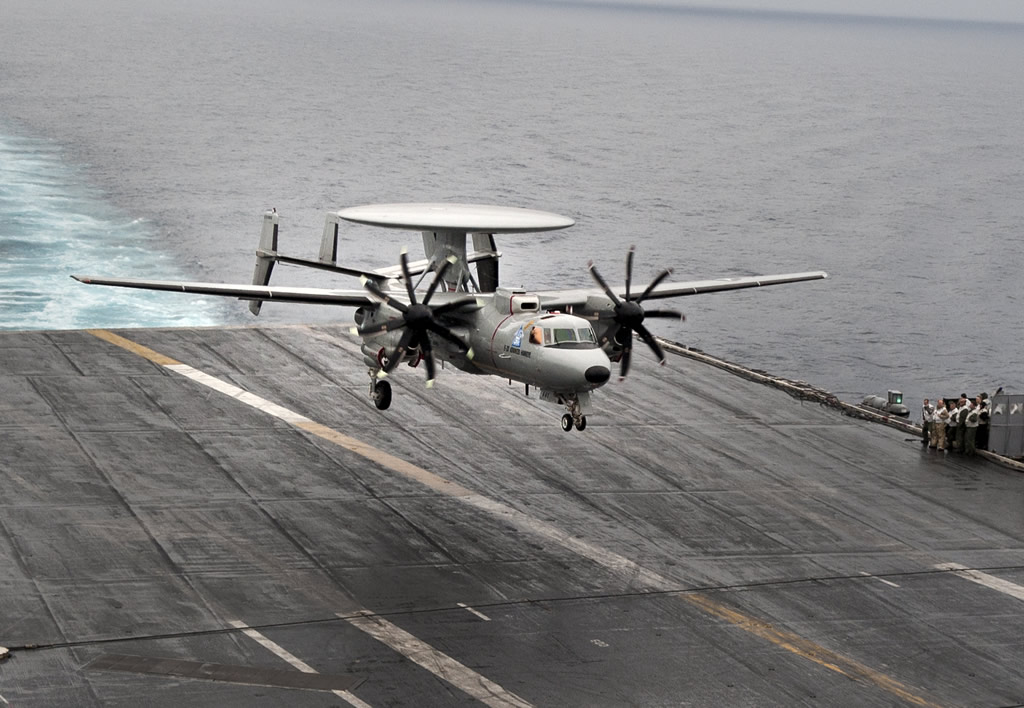
(click to view full)
Sept 11/14: Support. A $7.2 million fixed-price-incentive-firm target contract modification for E-2D FRP Lot 2 software sustainment. All funds are committed immediately, using FY 2014 US Navy budgets.
Work will be performed in Melbourne, FL (82%); Liverpool, NY (14%); and Greenlawn, FL (4%), and is expected to be complete in March 2015 (N00019-13-C-9999).
Aug 28/14: Support. A $32.5 million to a previously awarded fixed-price-incentive, firm target contract modification for non-recurring engineering in support of the Full Rate Production Lot 2 E-2D Advanced Hawkeye Program. All funds are committed immediately, using FY 2014 US Navy budgets.
Work will be performed in Syracuse, NY (53.47%); Melbourne, FL (20.16%); St. Augustine, FL (9.83%); Indianapolis, Indiana (5.70%); Woodlawn Hills, CA (3.63%); Aire Sur L’Adour, France (2.48%); Menlo Park, CA (1.36%); El Segundo, CA (1.11%); Johnson City, NY (0.97%); Greenlawn, NY (0.80%); Falls Church, VA (0.31%); Marlboro, MA (0.14%); and various locations throughout the United States (0.04%), and is expected to be complete in July 2017 (N00019-13-C-999).
Aug 1/14: Japan. In December 2013, Japan introduced a new defense strategy that aims to improve air and maritime surveillance, as part of a drive to counter increasingly-aggressive Chinese moves. In response, Northrop Grumman is promoting the E-2D as a natural upgrade, since Japan already flies the E-2C. APY-9 radar manufacturer Lockheed Martin is also pushing the E-2D:
“Brad Hicks, vice president of radar programs at Lockheed’s Mission Systems and Sensors business, told the conference that the radar on the E-2D, built by his company, can detect advanced threats. He noted that 800 foreign aircraft violated Japan’s airspace last year…. The E-2D is designed to operate in concert with Lockheed’s Aegis Ballistic Missile Defense System, Hicks said.”
Japan uses the AEGIS BMD system on its Kongo and Atago Class destroyers. Meanwhile, Northrop Grumman are also touting their Global Hawk family of UAVs, which includes the RQ-4B Global Hawk and a maritime MQ-4C Triton. Sources: Stars and Stripes, “Defense contractors hawk their surveillance planes in Japan”.
July 7/14: Testing. Northrop Grumman Integrated Systems in Bethpage, NY receives a $52.4 million cost-plus-fixed-fee contract for material and services to perform an Equivalent Flight Hours fatigue test, which will substantiate the E-2D’s expected service life.
$7.8 million is committed immediately, using FY 2014 US Navy R&D funds. Work will be performed in El Segundo, CA (68%); Melbourne, FL (30%); and Bethpage, NY (2%), and is expected to be completed in July 2019. This contract was not competitively procured, pursuant to FAR 6.302-1 (N00019-14-C-0036).
June 30/14: MYP 2014-18. A $3.643 billion modification, finalizing the E-2D’s multi-year fixed-price-incentive-firm target contract for 25 planes from FY 2014 – 2018, bringing the total number of E-2Ds under contract so far to 50, but note that the original proposal to savings that qualified for a multi-year deal involved 32 planes + 7 options (q.v. April 10/13, March 4-11/14). Other contracts that fall within this ambit include:
* $113.7 million: FRP-2 long-lead (July 2/13)
$871.8 million in FY 2014 USN aircraft budgets are committed immediately. Work will be performed in St. Augustine, FL (24.90%); Syracuse, NY (20.58%); Melbourne, FL (7.60%); El Segundo, CA (4.56%); Indianapolis, IN (4.06%); Menlo Park, CA (3.90%); Rolling Meadows, IL (2.30%) and various locations throughout the United States (32.10%); and is expected to be complete in August 2021 (N00019-13-C-9999).
The E-2D Hawkeye is slated to deploy with the first operational squadron, Carrier Airborne Early Warning Squadron (VAW) 125, in Fall 2014. See also NAVAIR, “U.S. Navy awards E-2D aircraft contract, saves $369 million” | NGC, “Northrop Grumman Receives $3.6 Billion Multiyear Contract for 25 E-2D Advanced Hawkeye Aircraft”.
Multi-Year Buy: 25
June 26/14: Support. An $8.3 million contract to repair 51 line items used in the E-2D Advanced Hawkeye system. All funds are committed immediately, using FY 2014 US Navy aircraft budgets.
Work will be performed at Melbourne, FL (40.26%); Liverpool, NY (18.39%); Baltimore, MD (13.74%); Davenport, IA (6.54%); Falls Church, VA (5.56%); and 12 other various locations in the United States (15.51%). Work will complete by June 25/15. This is a non-competitive requirement in accordance with 10 U.S.C 2304(c)(1), issued by US NAVSUP Weapons System Support in Philadelphia, PA (N00383-12-G-034G, DO 7252).
May 29/14: CEC. Raytheon Integrated Defense Systems, Largo, Florida, is being awarded an $11 million contract modification. It exercises an option for 5 AN/USG-3B Cooperative Engagement Capability (CEC) Airborne Systems, which will be installed in E-2Ds to give them 2-way sharing of targeting quality information with other ships and aircraft. The systems need to be installed in new aircraft now, even though performance has been a problem and all parties are working on a fix (q.v. Jan 28/14).
All funds are committed immediately. Work will be performed in St. Petersburg, FL (90%) and Largo, FL (10%), and is expected to be complete by November 2015 (N00024-12-C-5231).
April 17/14: SAR. The Pentagon releases its Dec 31/13 Selected Acquisitions Report. For the E-2D. Costs are increasing, but about 2/3 of that that is Congress & the Pentagon’s fault:
“Program costs increased $1,210.7 million (+5.9%) from $20,455.8 million to $21,666.5 million, due primarily to the net stretch-out of the procurement buy profile delaying 10 aircraft beyond the Future Years Defense Program and extending the end of production two years from FY 2021 to FY 2023 (+$759.1 million). Also, there were other increases for the addition of fighter-to-fighter backlink, data fusion, integrated fire control, net enabled weapons J11 message, navigation warfare anti-global positional system jam electronic protection, and stores performance assessment requested quality (+$341.3 million).”
We haven’t added this to the article’s program dashboard, because Pentagon figures and GAO figures aren’t an apples-to-apples comparison. It’s worthy of note, however, that when past SARs (q.v. March 30/12) are included, Congress and the Pentagon’s decisions have cost this program $2.486 billion.
Delays cost money
March 4-11/14: FY15 Budget. The USN unveils their preliminary budget request briefings, followed by more detailed figures over time. R&D continues, with a FY 2015 focus on adding in-flight refueling, and continuing mission system software development, countermeasures against jamming etc., MIDS-JTRS integration, full-scale fatigue tests, testing and evaluation expenses. RDT&E funding will also be ramping up, rather than down, in subsequent years.
The E-2D continues to be a target for cuts. Despite a multi-year deal for 32 planes and 5 options from FY 2014 – 2018, the current budget aims to cut 7 planes from that base by ordering just 4 in FY15 (-1), 5 in FY16 (-1), 6 in FY17 (-2), 5 in FY18 (-3), and then 5 in FY19. Total cuts from FY 2015 – 2018 are $1.01 billion. Yet the Navy says that:
“The E-2D combined with the SM-6 missile, Cooperative Engagement Capability and the AEGIS combat system is a key component of Naval Integrated Fire Control – Counter Air (NIFC-CA), enabling use of the missile at its maximum kinetic range. The E-2D will ensure the “eyes” of the nation’s sea-based strike capability remain focused on emerging threat systems.”
It’s hard to reconcile the words with the consistent actions. The missing FY15 aircraft can be seen in the Unfunded Priority List That Shall Not Be Named So, and near-term reductions might make sense on technical grounds (q.v. Jan 17/13, Jan 28/14). Cuts 3 and 4 years out tell a different story. Sources: USN, PB15 Press Briefing [PDF] | Detailed budget documents.
March 4/14: Testing. Lockheed Martin Corp. in Liverpool, NY receives a $16.2 million firm-fixed-price contract for specialized test equipment and associated technical data packages and adapters required to perform testing of E-2D AN/APY-9 radar system LRMs (line replacement module “black boxes”).
All funds are committed immediately, using USN FY12 aircraft budgets. Work will be performed in Liverpool, NY, and is expected to be complete in February 2017. This contract was not competitively procured pursuant to FAR 6.302-1, and is managed by the US Naval Air Warfare Center Aircraft Division in Lakehurst, NJ (N68335-14-C-0145).
Jan 28/14: DOT&E Testing Report. The Pentagon releases the FY 2013 Annual Report from its Office of the Director, Operational Test & Evaluation (DOT&E). The entry focuses on the USG-3B Cooperative Engagement Capability module used in E-2D naval AWACS aircraft. Bottom line: it’s worse than the USG-3 carried by its E-2C predecessors. UGS-3B is operationally suitable (maintaiable), but not operationally effective.
Key problems include misalignments that make it hard to depend on consistent object tracking between platforms (which is CEC’s core purpose). In a similar vein, the system has an issue with dual tracks for single objects that’s well above normal. There are also integration problems with the mission computer, and EM interference problems that affect the radar altimeter. The problems were persistent enough that the Navy has decoupled CEC testing from the E-2D’s own IOT&E evaluation as a new platform.
Oct 27/13: Testing. At the US Navy’s Trident Warrior 2013 demonstration, Super Hornet fighters simulated the launch of an AGM-154C-1 JSOW precision glide bomb, while the E-2D directed the imaginary weapon toward the positively identified target, and received status updates from the “weapon.” In effect, they made the E-2D itself an offensive weapon.
This mirrors a 2009 simulation involving a JSOW C-1 with a Navy P-3 Orion and USAF E-8C JSTARS battlefield surveillance aircraft. Sources: Raytheon, Oct 27/13 release.
FY 2013
Multi-Year deal for 32 + 5 options; FRP-1 orders; Development order for in-flight refueling capability; Testing has some gaps, but good enough for full production; Exports update.
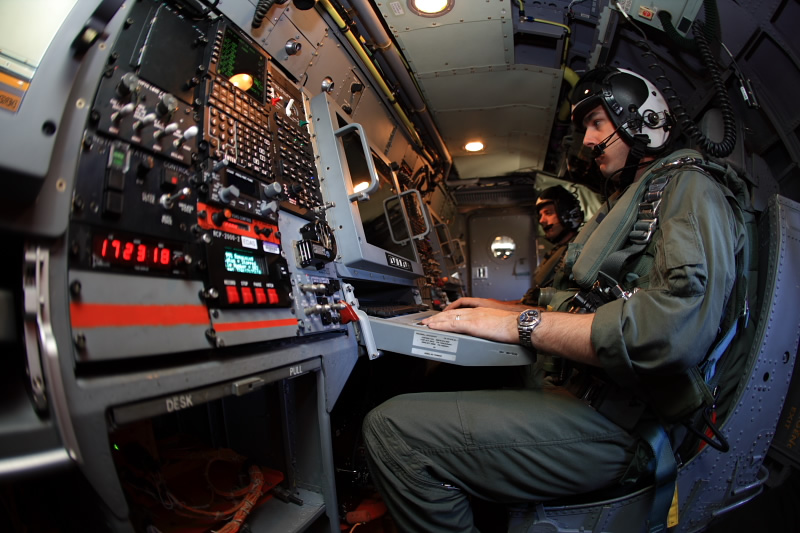
(click to view full)
Sept 27/13: Refueling. A $226.7 million cost-plus-incentive-fee contract to design, develop, install, test, and document an In-flight Refueling capable E-2D Advanced Hawkeye. $8.6 million is committed immediately.
The aerodynamics of in-flight refueling for a plane like the E-2D will be a challenge for NGC engineers, but extending the aircraft’s range would be a very big payoff. USN test squadron VX-20 has been conducting limited scope test flights over the past couple of years, in order to identify potential risks. Aerial refueling would be a nice foundation for a Block II/ Increment 2 variant, and NGC has also been working on improving the Standard Automatic Flight Control System (SAFCS) to assist the pilots when refueling. New seats whose adjustments can address pilot field-of-view and crew fatigue are a minor development with a strong payoff, and NGC’s proposed formation lights certainly have their uses as well.
Work will be performed in Bethpage, NY (64%); St. Augustine, FL (21%); Irvine, CA (3.7%); Endicott, NY (2.7%); Ronkonkoma, NY (1.6%); Bohemia, NY (1%); and various locations throughout the United States (6%), and is expected to be complete in January 2019. This contract was not competitively procured pursuant to FAR 6.302-1 (N00019-13-C-0135). See also Northrop Gruman, “Northrop Grumman Awarded $226.7 Million for E-2D Advanced Hawkeye In-Flight Refueling”.
R&D to add in-flight refueling
Sept 17/13: An $11.7 million for firm-fixed-price delivery order orders the design, development, first article, and production units for 10 pieces of support equipment unique to the E-2D (PSE); and the procurement of 29 pieces of existing PSE items. All funds are committed immediately from FY 2011 procurement budgets.
Work will be performed in Bethpage, NY, and is expected to be complete in March 2016. The US Naval Air Warfare Center Aircraft Division in Lakehurst, NJ manages the contract (N68335-10-G-0021, #0009).
Aug 28/13: FRP-1. A $31.4 million firm-fixed-price contract modification buys engineering support for E-2D Full Rate Production Lot 1. All funds are committed immediately.
Work will be performed in Syracuse, NY (29.88%); St. Augustine, FL (24.38%); Bethpage, NY (12.64%); Greenlawn, NY (10.21%); Woodland Hills, CA (8.2%); El Segundo, CA (6.99%); Menlo Park, CA (4.5%); and various locations within the United States (3.2%); and is expected to be complete in September 2016 (N00019-12-C-0063).
July 24/13: FRP-1. A $617.1 million modification finalizes the 5-plane Full Rate Production Lot 1 advance acquisition contract into a firm-fixed-price contract. All funds are committed immediately.
Total announced contracts under FRP-1 have reached $855.8 million (q.v. Feb 1/12, April 24/13, June 4/13, June 27/13, Aug 28/13), or $171.6 million per plane.
The E-2D was cleared for FRP on Feb 8/13. Work will be performed in St. Augustine, FL (24.90%); Syracuse, NY (20.59%); Bethpage, NY (7.60%); El Segundo, CA (4.56%); Indianapolis, IN (4.6%); Menlo Park, CA (3.90%); Rolling Meadows, IL (2.3%), and approximately 200 various locations within the United States (TL 32.1%) that are individually under 5% (N00019-12-C-0063).
FRP-1: 5 E-2Ds
July 2/13: FRP-2. $113.7 million in advance contracts for FRP Lot 2 long lead materials and related support, which will cover 5 aircraft. The Pentagon announced it as a $9.3 million option, which may be true initially, and $9.3 million is committed immediately. Northrop Grumman gave the maximum figure. This award also changes the FRP-2 advance acquisition contract to a fixed-price contract.
Work will be performed in Syracuse, NY (36.9%); Bethpage, NY (15.6%); El Segundo, CA (7.8%); Chicago, IL (7.4%); Menlo Park, CA (7.1%); Indianapolis, IN (6.8%); Cleveland, Ohio (3.3%); Aire-Sur-L’Adour, France (2.6%); Owego, NY (2.4%); Torrance, CA (2.1%); Edgewood, NY (1.7%); Falls Church, VA (1.4%); and various locations throughout the United States (4.9%); and is expected to be complete in March 2014 (N00019-13-C-9999).
NGC says that total E-2D procurement, including low-rate initial production and full-rate production aircraft, now stands at 30. The USN received its 10th E-2D in June, with another 10 in various stages of manufacture and testing. 2015 remains the expected date for Initial Operational Capability with the U.S. Navy. NGC.
June 27/13: Support. A $32.3 million delivery order to provide spares in support of FRP Lot 1’s 5 ordered E-2Ds. All funds are committed immediately.
Work will be performed in Syracuse, NY (37.8%); Indianapolis, IN (23.1%); Bethpage, NY (13.7%); Woodland Hills, CA (6.7%); Greenlawn, NY (3.4%); Marlborough, Mass. (1.9%); Tustin, CA (1.8%); Rockford, IL (1.4%); Falls Church, VA (1.3%); Garden City, NY (1.1%); and other locations within the United States (7.8%), and is expected to be completed in December 2016 (N00019-10-G-0004).
June 4/13: Saved for later. On FBO.gov, NAVAIR announces their intent to give Northrop Grumman a Cost Plus Incentive Fee contract under a “Post Initial Operational Capability” solicitation. The E-2D’s planned IOC date is October 2014, and the contract involves adding an Installation Data Package for adding Secure Internet Protocol Router (SIPR) Chat, Tactical Targeting Network Technology (TTNT) and Cooperative Engagement Capability (CEC) Accelerated Mid-Term Interoperability Improvement Program (AMIIP). That will allow retrofits of existing aircraft, and installation in production models.
Northrop Grumman will manage the set as a single entity, but each separate capability may be delivered separately and incorporated into the most appropriate E-2D DSSC software build.
June 4/13: Support. A $17.1 million contract modification for additional product, fleet, and engineering investigations support for the 5 planes in Full Rate Production Lot 1.
Work will be performed in Bethpage, NY (81.94%); Norfolk, VA (8.98%); Syracuse, NY (3.71%); Indianapolis, IN (3.32%); and St. Augustine, FL (2.05%), and work is expected to be complete in June 2014. All funds are committed immediately, using FY 2013 budgets (N00019-12-C-0063).
June 4/13: Support. A not-to-exceed $7.5 million delivery order for the repair of 43 line items on the E-2D Advanced Hawkeye System. All funds are committed immediately, using FY 2013 budgets. This is a sole-source contract in accordance with 10 U.S.C. 2304(c)(1), and is managed by NAVSUP Weapon Systems Support in Philadelphia, PA (N00383-12-G-034G, 07192).
May 31/13: R&D. A $12.8 million delivery order modification, to conduct in-flight refueling risk reduction trade studies for the E-2D (N00019-10-G-0004).
Seems a little late for those – wasn’t that supposed to be a standard feature? We’re asking NAVAIR.
Work will be performed in Bethpage, NY (67%); Endicott, NY (12.6%); Irvine, Calif. (10%); Bohemia, NY (3.8%); Ronkonkoma, NY (3.6%); Windsor Locks, CT (2%); St. Augustine, FL (.8%); and Stanford, CT (.2%), and is expected to be completed in September 2013. Fiscal 2013 Research, Development, Test & Evaluation, Navy contract funds in the amount of $12,808,636 will be obligated at time of award, none of which will expire at the end of the current fiscal year. The Naval Air Systems Command, Patuxent River, Md., is the contracting activity.
April 24/13: Software. Northrop Grumman Systems Corp. in Bethpage, NY receives a $23 million firm-fixed-price delivery order for software sustainment of Full Rate Production Lot 1 aircraft. This delivery order provides all aspects of software management support, including the update and maintenance through the life cycle support. Test reports say the E-2D has some significant software issues (vid. Jan 17/13 entry), so there’s no shortage of things to do.
Work will be performed in Bethpage, NY (86.5%); Syracuse, NY (9.7%); Marlborough, MA (1.3%); Greenlawn, NY (1.3%), and Woodland Hills, CA (1.2%), and is expected to be complete in October 2014. FY 2011 and 2012 Aircraft Procurement funds are being used, and the entire amount is committed immediately. $14.5 million will expire at the end of the current fiscal year, on Sept 30/13 (N00019-10-G-0004).
April 10/13: FY 2014 Budget. The President releases a proposed budget at last, the latest in modern memory. The Senate and House were already working on budgets in his absence, but the Pentagon’s submission is actually important to proceedings going forward.
The FY 2014 request proposes a multi-year agreement (MYP) for 32 E-2Ds, plus options on another 5 from FY 2014-2018, leaving 18 planes left to buy. If the Navy exercises its MYP options in FY 2015-2016, it could bring full-rate production to a steady rate of 8 planes per year. The Navy is estimating MYP savings of $522.8 million over 5 separate annual contracts. About 30% of that is attributable to electronic components whose minimum buy quantities can’t be met under single year procurements, which makes their cost artificially high unless bought in a multi-year deal.
Note that Navy budget documents show the E-2D as a 114-plane program, a figure that must count a number of E-2C 2000 buys. A careful look at actual E-2D orders and schedules confirms that it remains a 75 plane program.
March 28/13: GAO Report. The US GAO tables its “Assessments of Selected Weapon Programs“. Which is actually a review for 2012, plus time to compile and publish. The assessment notes that the Navy has stretched production out in order to “save” annual funds, but will pay $1.3 billion more in total – nearly double the March 30/12 SAR’s figure. That might be reduced a bit if the program gets a 32-38 plane multi-year buy approved for FY 2014 – 2018.
On the good news front, the E-2D remains a low-drama program, and the long-standing issue of radar reliability (vid. Jan 17/13 entry) has improved and reached the test plan requirement.
Feb 8/13: FRP. US NAVAIR says that the E-2D has been cleared for Full Rate Production by the Pentagon.
NAVAIR added that their own VX-1 Air Test and Evaluation Squadron had declared the E-2D Advanced Hawkeye “suitable and effective” in their Initial Operational Test and Evaluation (IOT&E) report.
FRP approved
Feb 7/13: Exports. A report in Shephard’s UV Online says that India, Malaysia, and the UAE have all been approved for E-2D exports by the US government. Which is not the same thing as saying that all 3 are negotiating contracts.
Northrop Grumman has responded to India’s RFI for a fixed-wing carrier-based AEW platform, to complement its Ka-31 heliborne AEW. The request is a bit odd, because Indian carriers won’t have catapults, but it is just an RFI. Northrop Grumman continues to promote the E-2D in India.
The UAE has issued a full RFP, after establishing an initial AEW&C capability with an interim order of Saab’s S340-AEW Erieye turboprops. The E-2D is expected to compete against an order of more Saab systems, and against Boeing’s E-737 AEW&C.
Jan 17/13: DOT&E testing. The Pentagon releases the FY 2012 Annual Report from its Office of the Director, Operational Test & Evaluation (DOT&E). The E-2D is included, and it has generally performed well in over 600 hours of carrier and land-based Initial Operator Testing & Evaluation (IOT&E) from February – September 2012. The aircraft demonstrated improvements over the E-2C, but a few key gaps remain.
Cooperative Engagement Capability (CEC) is the biggest gap. It’s supposed to create a single picture, based on inputs from other ships, planes, etc. Instead, it was creating multiple tracks for the same object, and had to be decoupled from other testing. New software loads have been added, and renewed CEC testing began in October 2012, but CEC and full Theater Air & Missile Defense (TAMD) capability won’t be fully tested now until 2015.
The radar and software combination also has a serious problem with tracks. The automated system sometimes swaps labels when tracks get too close, which can be a fatal error. This problem had shown up in previous developmental testing, but IOT&E went ahead anyway. The problem became so serious that operators must now manually label tracks. Obviously, in any stressful environment with many tracks, that’s going to fall apart. Overland reliability in all situations, and radar reliability (vid. March 30/12 entry), were also cited by DOT&E, albeit without specifics.
The final gap is maintenance and training. A maintenance training system for the E-2D won’t be delivered until July 2013, and the E-2D integrated simulator wasn’t available for IOT&E, either.
Dec 28/12: Unplanned Obsolescence. Northrop Grumman Corp., Integrated Systems, Bethpage, NY, is being awarded a $34.3 million firm-fixed-price delivery order for “obsolescent component redesign” of the E-2D’s mission computer and displays, integrated navigation and control display system, and network file system systems. Once again, we see the phenomenon of key computing components that become outdated and/or unavailable before a major US weapon system can even reach Initial Operational Capability.
Work will be performed in Bethpage, NY (49%); Woodland Hills, CA (20%); Marlborough, MA (21%); Redwood City, CA (8%), and at various locations within the United States (2%), and is expected to be complete in December 2014. All contract funds are committed immediately, and $8.5 million will expire at the end of the current fiscal year, on Sept 30/13. The Naval Air Systems Command, Patuxent River, MD, is the contracting activity (N00019-10-G-0004).
FY 2012
LRIP-4 contract; FRP-1 lead-in; program evaluations.
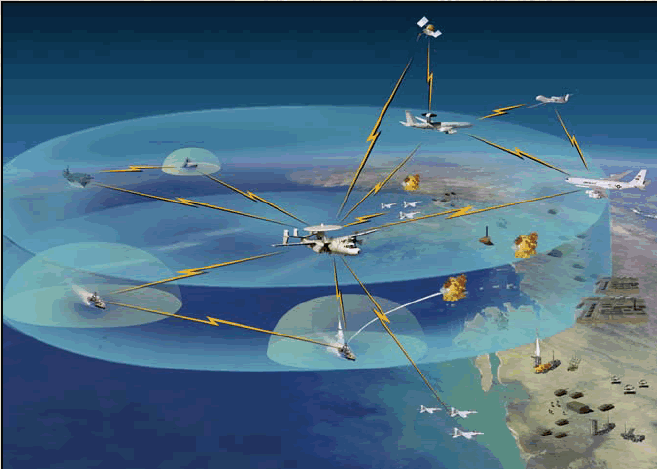
(click to view full)
Sept 27/12: Support. A $15 million cost-plus-fixed-fee modification to a fixed-price-incentive-fee contract for additional E-2D system engineering and software maintenance for Production Lot 1 and 2 aircraft.
Work will be performed in Bethpage, NY, and is expected to be complete in May 2015. All contract funds will expire at the end of the current fiscal year, on Sept 30/12 (N00019-08-C-0027).
Sept 27/12: Spares. An $8.4 million firm-fixed-price delivery order modification, to provide spares for 10 E-2D Low Rate Initial Production Lots 3 and 4 aircraft.
Work will be performed in Syracuse, NY (51.3%); Bethpage, NY (13%); Owego, NY (7.1%); Greenlawn, NY (6.3%); Woodland Hills, CA (6.1%); West Chester, OH (4.2%); North Hollywood, CA (3.0%); Marlborough, MA (2.3%); Horsham, PA (1.6%); New Port Richey, FL (1.6%), and various other locations in the United States (3.5%); and is expected to be complete in October 2015 (N00019-10-G-0004).
April 27/12: Spares. A $31.4 million firm-fixed-price delivery order against a previously issued basic order agreement for spare components of the E-2D Advanced Hawkeye low rate initial production, Lots 3 and 4 – which is to say, 10 planes.
Work will be performed in Syracuse, NY (54%); El Segundo, CA (9.6%); Bethpage, NY (5.1%); Greenlawn, NY (4.4%); Owego, NY (3.8%); West Chester, Ohio (3.4%); Woodland Hills, CA (3.2%); Irvine, CA (3.5%); Marlborough, MA (2.1%); Bayshore, NY (1.8%); Cleveland, Ohio (1.3%); Davenport, Iowa (1.3%); North Hollywood, CA (1.1%); Horsham, Pa. (0.9%); Rome, Italy (0 .7%); New Port Richey, FL (0.5%); and various other locations in the United States (3.3%). Work is expected to be completed in August 2016 (N00019-10-G-0004).
April 27/12: Electronics. A $15.3 million firm-fixed-price order to buy, store and deliver 146 E-2D avionic units under test.
Work will be performed in Syracuse, NY (53%); Greenlawn, NY (11%); Bethpage, NY (8%); Woodland Hills, CA (7%); Marlborough, MA (5%); West Chester, Ohio (4%); Falls Church, Va. (3%); Ronkonkoma, NY (3%); Rome, Italy (3%); New Port Richey, FL (2%); and Indianapolis, Ind. (1%). Work is expected to be completed in April 2016 (N00019-10-G-0004).
March 30/12: Good GAO review. The US GAO tables its “Assessments of Selected Weapon Programs” for 2012. The E-2D program is #13 on the list of highest cost programs to complete, at $11.3 billion. That hasn’t been because of poor program performance, though – a “should cost” analysis helped them negotiate a 4.5% reduction in its 3rd production contract. The GAO sees the E-2D’s technologies as mature, and its design and manufacturing processes as stable. Overall development costs are up 18% from the 2003 baseline to $4.53 billion, and costs are up because of buying decisions, but the remaining technical issues are pretty minor:
“[E-2D testing is done, but] Some development test points related to the Cooperative Engagement Capability (CEC) remain to be completed… because of late deliveries from the CEC program… The E-2D program reported the current radar reliability rate is 71 hours. The radar must achieve a rate of 81 hours prior to the decision to enter full-rate production, which is scheduled for December 2012. DOD test organizations expressed some concern about whether the radar will be able to meet some reliability and performance measures… [but] initial results from a test exercise conducted in November partially addressed the performance concerns, according to an official at a DOD test organization.”
March 30/12: SAR – Congress costs. The Pentagon’s Selected Acquisitions Report ending Dec 31/11 includes the E-2D. The short version: costs are going up because of Congress. They still plan to buy the same 75 planes, just less frugally or intelligently:
“Program costs increased $2,279.3 million (+12.4%) from $18,457.9 million to $20,737.2 million, due primarily to an affordability-driven stretch-out of the procurement buy profile (i.e., movement of 12 aircraft over multiple years) and the addition of two production lots from FY 2012 to FY 2021 (+$780.6 million). The addition of two production lots also increased other support (+$294.7 million). There were further increases due to the removal of projected savings from cancellation of the FY 2014-2018 multi-year procurement (+$651.6 million), the application of revised escalation indices (+$224.6 million), a revised estimate for In-Flight Refueling (+$208.9 million), and increases due to capability enhancements for Secure Internet Protocol Router (SIPR) Chat, E-2D Hawkeye Integrated Fire Control Training, Long Range Tracking, and Counter Electronic Attack (+$161.2 million).”
It’s common for defense programs that are performing well to end up paying for programs that are performing poorly, by being subject to stretch-outs and/or cuts. Unfortunately, the E-2D is a good example.
SAR – how Congress adds costs
March 30/12: Support. A $22.9 million firm-fixed-price order will buy: avionics source data consisting of detailed functional description document packages; development of systems synthesis modeling reports for 34 units under test; and 392 pieces of organizational “O” level support equipment for the E-2D Advanced Hawkeye aircraft.
Work will be performed in Bethpage, NY, and is expected to be complete in June 2015. The US Naval Air Warfare Center Aircraft Division in Lakehurst, NJ manages this contract (N68335-10-G-0021).
Feb 1/12: FRP-1 lead-in. A maximum $157.9 million advance acquisition contract for long lead material etc., in order to support 5 E-2Ds in FY 2013’s Full Rate Production Lot 1. FRP-1 was planned at 7 aircraft, but the eventual plan is reduced to the 5 planes covered here.
Work will be performed in Syracuse, NY (32.6%); Bethpage, NY (15.5%); Dallas, TX (12.4%); Menlo Park, CA (9.8%); Woodland Hills, CA (6%); and various other locations within the United States (23.7%) into March 2013. This contract was not competitively procured pursuant to FAR 6.302-1 (N00019-12-C-0063).
Jan 24/12: LRIP-4 contract. A $781.5 million contract modification for 5 FY 2012/ LRIP(low rate initial production) Lot 4 E-2D Advanced Hawkeyes.
Work will be performed in Syracuse, NY (25.36%); Bethpage, NY (25.10%); St. Augustine, FL (19.3%); El Segundo, CA (5.34%); Indianapolis, IN (4.84%); Menlo Park, CA (4.64%); Rolling Meadows, IL (2.50%); and various locations within the United States (12.92%). Work is expected to be complete by May 2015 (N00019-10-C-0044).
LRIP-4: 5 E-2Ds
Jan 20/12: Spares. A $31.9 million cost-plus-fixed-fee delivery order for integrated E-2D LRIP program spares support. Work will be performed in Bethpage, NY, and is expected to be complete in May 2013 (N00019-10-G-0004).
Jan 17/12: 2011 DOT&E – Radar & CEC. The Pentagon releases the FY2011 Annual Report for the Office of the Director, Operational Test & Evaluation. The E-2D Hawkeye is included, and concerns revolve around 3 core areas: Overland radar performance; Cooperative Engagement Capability; and Reliability. For radar performance, DOT&E suggests a post-evaluation processor upgrade to boost overland performance. It adds:
“As of December 2011, 93% of CEC test points are complete. Carrier suitability testing and the initial cadre of pilots completed carrier qualification in January, August, and September 2011, to support upcoming IOT&E… Discovery of hardware and software integration discrepancies significantly delayed E-2D/CEC integration and testing in FY11… now appears CEC developmental testing will complete in 1QFY12 and is the pacing event for… IOT&E… for the E-2D… [and] for new CEC aircraft hardware (AN/USG-3B) under development by the Navy…
“The [APY-9] radar system reliability, specifically radar mean time between failures, does not currently meet established requirements of 81 hours. While low radar mean time between failures has been a concern for the last two years, it has steadily improved and was 64.3 hours as of July 2011. [Other data are based on small sample sizes, but are under reliability goals].”
FY 2011
DAB approval; LRIP 2/3; carrier and EMALS launch.
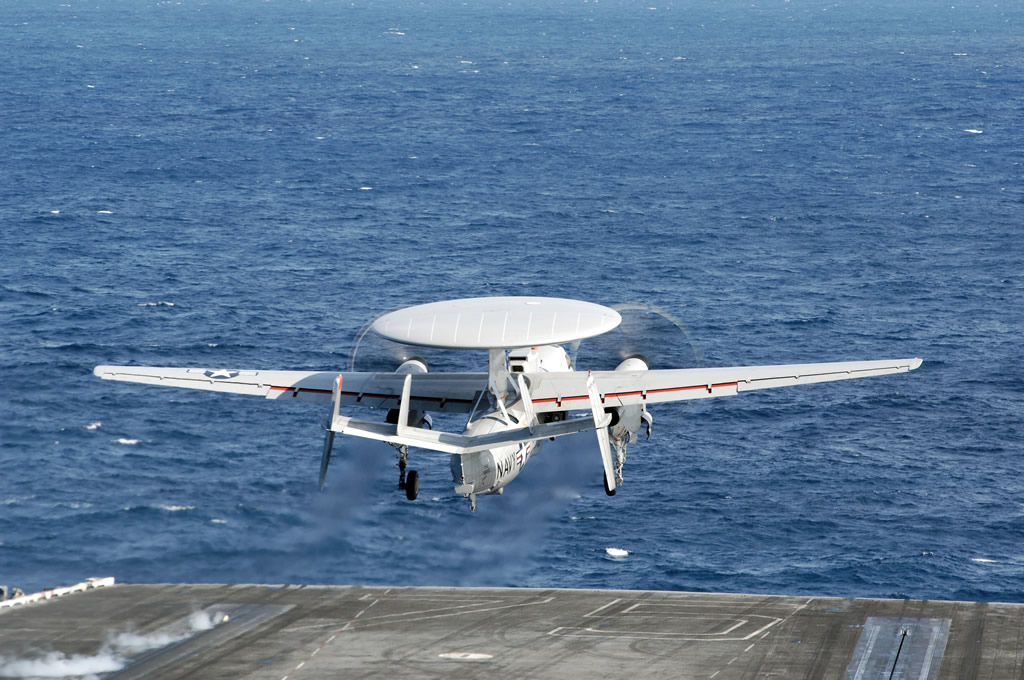
(click to view full)
Sept 27/11: EMALS launch. The EMALS test site at Lakehurst, NJ launches an E-2D Advanced Hawkeye. The EMALS electro-magnetic catapult, which will outfit the new USS Gerald R. Ford and replace the old steam catapults on refitted Nimitz Class ships, has already launched an F/A-18E Super Hornet, a T-45 Goshawk jet trainer, and the Hawkeye’s C-2A Greyhound cargo cousin.
About 63 – 65 launches are planned for each aircraft type, and the 2nd phase of aircraft compatibility testing is scheduled to begin in 2012. Engineers will continue reliability testing through 2013, then perform installation, checkout, and shipboard testing, with the goal of shipboard certification in 2015.US Navy.
EMALS catapult launch
August 16/11: SDD. A $47.6 million cost-plus-award-fee contract modification for maintenance and repair of components and/or systems that are unique to the E-2D, as part of the SDD program.
Work will be performed in Bethpage, NY (63%); Greenlawn, NY (35%); and Rolling Meadows, IL (2%), and is expected to be complete in December 2012 (N00019-03-C-0057).
July 22/11: LRIP-3 Order. A $760.8 million firm-fixed-price contract modification to manufacture and deliver 5 LRIP Lot 3/ FY 2011 E-2D Advanced Hawkeye aircraft, including associated support connected to the delivery. This contract also provides for long lead time materials and related support for 5 LRIP Lot 4/ FY 2012 planes.
Work will be performed in Syracuse, NY (25.36%); Bethpage, NY (25.10%); St. Augustine, FL (19.3%); El Segundo, CA (5.34%); Indianapolis, IN (4.84%); Menlo Park, CA (4.64%); Rolling Meadows, IL (2.50%); and other locations within the United States (12.92%). Work is expected to be completed by May 2015 (N00019-10-C-0044). See also April 13/11 entry.
LRIP-3: 5 E-2Ds
July 22/11: A $34 million contract modification finalizes a fixed-price-incentive-fee contract for 1 additional LRIP Lot 2/ FY 2010 E-2D Advanced Hawkeye aircraft, bringing it to $170 million, plus long-lead buys, plus Government-Furnished Equipment that’s bought separately.
Work will be performed in Syracuse, NY (25.36%); Bethpage, NY (25.10%); St. Augustine, FL (19.3%); El Segundo, CA (5.34%); Indianapolis, IN (4.84%); Menlo Park, CA (4.64%); Rolling Meadows, IL (2.50%); and various locations throughout the United States (12.92%), and is expected to be complete in July 2013 (N00019-08-C-0027). See also July 22/10 entry.
LRIP-2: now 3 E-2Ds
April 15/11: Spares. A $6.6 million contract modification to provide spare consumables and repairables for the E-2D Advanced Hawkeye LRIP Lot 2 as well as the Hawkeye Integrated Training System trainers.
Work is expected to be complete in August 2013 and will be performed in El Segundo, CA (52%); Woodland Hills, CA (27%); Marlborough, MA (16%); Syracuse, NY (4%); and Rolling Meadows, IL (1%) under contract N00019-10-G-0004.
April 14/11: DAB approval. The E-2D Advanced Hawkeye has a successful Defense Acquisition Board review. That leads to authorized funding for an additional 10 E-2Ds, via an Acquisition Decision Memorandum signed by undersecretary of defense for Acquisition, Technology and Logistics Dr. Ashton Carter. Subsequent conversations with NAVAIR add some clarity to this announcement:
“The Navy’s E-2D Advanced Hawkeye program received approval for procurement of Low Rate Initial Production (LRIP) Lot 3 (4 aircraft) and Lot 4 (6 aircraft), as well as Advance Acquisition Contract (AAC) for the procurement of long-lead items to support Full Rate Production (FRP) Lot 1 (7 aircraft) [after it] met all criteria needed to continue LRIP.”
LRIP Lot 4 is 6 planes because there are 5 E-2Ds + 1 combat loss replacement requested in FY 2012. To date, Northrop Grumman has delivered 5 E-2D aircraft to the Navy, and production on the 10th aircraft recently began at Northrop Grumman’s East Coast Manufacturing and Flight Test Center in St. Augustine, FL. The aircraft is on track to enter Initial Operational Test and Evaluation later in 2011. Northrop Grumman.
DAB approval
April 13/11: LRIP-4 lead-in. A $94.6 million contract modification to finalizes a previously awarded advance acquisition contract (N00019-10-C-0044) to a fixed-price agreement. As a first step, this modification buys long-lead items for 4 LRIP (Low Rate Initial Production) Lot 4 E-2D Advanced Hawkeyes. NAVAIR tells DID that:
“The average unit recurring flyaway (URF) cost for 70 aircraft in then-year dollars is $166.1 million based on President’s Budget 2012.”
Work will be performed in Syracuse, NY (46.8%); Bethpage, NY (13.5%); El Segundo, CA (2.6%); Potez, France (2.4%); Edgewood, NY (1.9%); Menlo Park, CA (1.6%); Woodland Hills, CA (1.4%); Owego, NY (1.2%); St. Augustine, FL (1.2%); Marlborough, MA (1.1%); Brooklyn Heights, OH (1%); Greenlawn, NY (.6%); and various locations within the United States (24.7%). Work is expected to be complete by December 2011. This contract was not competitively procured (N00019-10-C-0044).
April 5/11: Spares. A $21.3 million firm-fixed-price delivery order for both consumable and repairable E-2D spares, covering the LRIP Lot 2 buy of 3 planes, and Hawkeye Integrated Training System trainers.
Work is expected to be complete in July 2015, and will be performed in El Segundo, CA (30 %); Syracuse, NY (23 %); Woodland Hills, CA (7.6 %); Menlo Park, CA (6.4 %); Marlborough, MA (6.1 %); Bethpage, NY (3.6 %); Indianapolis, IN (3.1 %); Rolling Meadows, IL (1.6 %); St. Augustine, FL (0.75 %); and various locations throughout the United States (17.85%) under contract N00019-10-G-0004.
Feb 8/11: India. India Defence reports that:
“While briefing media personnel in Bangalore on the eve of Aero India 2011, (Retired) Commodore Gyanendra Sharma, Managing Director of Northrop Grumman India announced that the Ministry of Defence has sent a Request for Information (RFI) for E-2D Naval Airborne Early Warning aircraft to Northrop Grumman. As per details given by Mr. Sharma, Indian Navy has shown interest in procuring at least four such aircrafts… Northrop Grumman is positive that a Request for Proposal (RFP) for the same would be issued by year end.”
Feb 1/11: Carrier landing. An E-2D flown by VX-20 squadron makes the type’s 1st carrier takeoff and landing, aboard the USS Harry S. Truman [CVN 75]. Carrier suitability testing is now underway, with 99% of radar testing complete. US Navy | Northrop Grumman.
1st carrier takeoff & landing
Jan 28/11: India. Northrop Grumman announces that an E-2D Advanced Hawkeye crew work-station will be among its Aero India 2011 exhibits, adding that “India is among the very first countries for which the Advanced Hawkeye capability has been released.” Unfortunately, its carriers don’t carry the catapults required to operate it, so any E-2Ds would be based from shore.
Dec 27/10: Industrial. A $7.4 million firm-fixed-price modification to a previously awarded fixed-price-incentive-fee contract. It covers one time efforts associated with turning E-2D engineering drawing changes into E-2D production changes. Work will be performed in Bethpage, NY (71.5%), and St. Augustine, FL (28.5%), and is expected to be complete in December 2012. $1,000,000 will expire at the end of the current fiscal year, on Sept 30/11 (N00019-08-C-0027).
Dec 7/10: Support. A $19.6 million firm-fixed-price delivery order under the basic order agreement to provide integrated logistics support for low rate initial production E-2D aircraft. A performance based support contract is expected down the road, and this contract is expected to handle the transition period. Work will be performed in Bethpage, NY, and is expected to be complete in October 2011 (N00019-10-G-0004).
FY 2010
1st delivery; SATCOM; IFF.
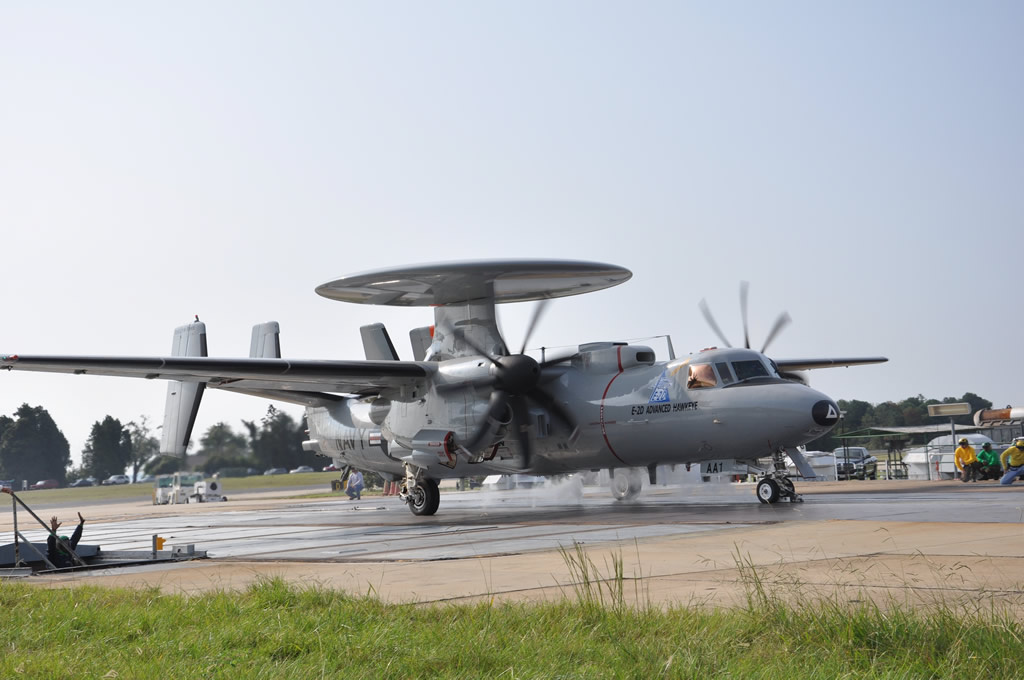
(click to view full)
Sept 29/10: IFF. A $59.2 million modification to a previously awarded cost-plus-award-fee contract for IFF Mode 5 and Mode S upgrades. Efforts will include design, implementation, test and evaluation, verification, documentation, acceptance, and certification. Mode 5 IFF offers improved encryption, range, and civil compatibility. It also adds “lethal interrogation” as a must-respond last chance, and the ability to see individual aircraft even when they’re close together. The further addition of the civilian Mode S assigns a discrete ‘squawk’ which is unique to that aircraft. Together, they improve combat identification, and enable unrestricted flight in civilian airspace.
Work will be performed in Bethpage, NY (63%); Greenlawn, NY (35%); and Rolling Meadows, IL (2%). Work is expected to be complete in December 2013 (N00019-03-C-0057).
Sept 29/10: Industrial. A $25 million firm-fixed-price fixed-price-incentive-fee contract modification covers one-time efforts associated with E-2D engineering drawing modifications, and incorporation of open corrective actions required to produce production-ready documentation. Work will be performed in Bethpage, NY (67%), and St. Augustine, FL (33%), and is expected to be complete in September 2012 (N00019-08-C-0027).
Sept 15/10: SATCOM. A $9 million modification to a previously awarded cost-plus-award-fee contract (N00019-03-C-0057) to develop a dual satellite communication capability in the E-2D.
Work will be performed in Bethpage, NY (75%); Menlo Park, CA (17%); Westminster, CO (4%); Ronkonkoma, NY (2%); and Whippany, NJ (2%); and is expected to be complete in July 2011.
July 30/10: Fleet entry. The first Northrop Grumman E-2D Advanced Hawkeye aircraft to enter the U.S. Navy fleet is “welcomed home” in a ceremony held at Norfolk Naval Air Station, VA. The 2 pilot production aircraft bought in July 2007 remain on track for delivery in 2010, and Northrop Grumman claims that “manufacturing of four Low-Rate Initial Production aircraft also is progressing well.” Northrop Grumman.
Aug 11/10: C-2 spinoff? Flight International reports that the US Navy has commissioned a 6-month study from Northrop Grumman to look at remanufacturing C-2A Greyhound bodies using tooling and components already developed for the new E-2D Hawkeye, in order to give its 36 carrier-capable cargo planes longer service life.
The C-2As were originally designed to last for 36,000 carrier landings and 15,000 flight hours, and some have already had their center wing boxes replaced. The E-2 Hawkeye is a close derivative, and with Northrop Grumman ramping up E-2D production, refurbishing or building C-2s could become a cheaper option than buying up to 48 V-22 Osprey tilt-rotors for Navy roles that would be anchored by the same Carrier On-board Delivery function.
July 29/10: The 1st E-2D Advanced Hawkeye AWACS is delivered to the fleet at Chambers Field, Naval Station Norfolk, VA. The E-2D will go to the “Greyhawks” of Airborne Early Warning Fleet Replacement Squadron VAW-120, the “Greyhawks,” first. They will fly and operate the new plane, help set its parameters and procedures, and train pilots and Navy flight officers to fly and operate E-2Ds.
Another 2 pilot production E-2Ds are on schedule for delivery in 2010, and 4 Low Rate Initial Production planes are in various stages of manufacture. US Navy | Northrop Grumman | Virginia Pilot.
1st delivery
July 22/10: LRIP-2 partial. A $136 million unfinalized not-to-exceed contract modification for 1 E-2D Advanced Hawkeye from LRIP Lot 2 (FY 2010). This fixed-price-incentive-fee contract is only partial, as LRIP-2 is expected to include 3 planes.
Work will be performed in Syracuse, NY (32.6%); Bethpage, NY (15.5%); Dallas, TX (12.4%); Menlo Park, CA (9.8%); Indianapolis, IN (6.3%); Woodland Hills, CA (6%); Aire-sur-l’Adour, France (2.7%); Brentwood, NY (2.6%); Owego, NY (2.6%); Greenlawn, NY (2.2%); Irvine, CA (1.7%); Marlboro, MA (1.6%); Clemmons, NC (1.6%); Windsor Locks, CT (1.2%); and various locations throughout the U.S. (1.2%). Work is expected to be complete in December 2012 (N00019-08-C-0027).
LRIP-2: 2-3 E-2Ds
March 15/10: LRIP-3 lead-in. A $94.6 million not-to-exceed advance acquisition contract for long lead materials and support associated with the manufacture and delivery of 4 LRIP Lot 3 E-2D Advanced Hawkeye aircraft in FY 2010.
Work will be performed in Syracuse, NY (32.6%); various locations within the United States (23.7%); Bethpage, NY (15.5%); Dallas, TX (12.4%); Menlo Park, CA (9.8%); and Woodland Hills, CA (6%), and is expected to be complete in May 2011. This contract was not competitively procured, as the manufacturer is already set (N00019-10-C-0044).
March 4/10: Radar. Lockheed Martin announces a $171.8 million low-rate initial production contract from Northrop Grumman Aerospace Systems in Bethpage, NY, for 4 AN/APY-9 Airborne Early Warning (AEW) radar systems and spare parts.
The company adds that 2 engineering-development models and 4 pre-production radar systems are currently in flight and qualification testing. Mission system and radar-related testing are currently ahead of schedule, with more than 230 radar flights over the last several months, by the Navy/ Industry integrated test team.
Dec 14/09: Sub-contractors. A $9.3 million modification to a previously awarded firm-fixed-price contract (N00019-08-C-0027) for “non-recurring engineering in support of new supplier qualification and startup in support of E-2D Advanced Hawkeye aircraft low-rate initial production Lot 1 and 2 aircraft.”
According to Northrop Grumman, CPI Aerostructures in Edgewood, NY is the E-2D Outer Wing Panel supplier. They replaced Vought/Schweizer, who provided the E-2C Outer Wing Panel.
Work will be performed in Bethpage, NY (40.63%); Edgewood, NY (22.35%); St. Augustine, FL (20.86%); Aire-sur-l’Adour, France (14.17%); and various locations within the continental United States (1.99%), and is expected to be complete in January 2011.
Dec 14/09: Support. Wyle Laboratories, Inc. in Huntsville, AL receives a $30.6 million modification to a previously awarded indefinite-delivery/ indefinite-quantity multiple award contract (N00421-03-D-0015) for continued E-2C/ E-2D/ C-2 planning, program and financial services in support of the US Navy and the governments of Egypt, France, Taiwan, Singapore, Japan and Canada under the Foreign Military Sales program.
Canada does not operate any C-2 or E-2 family aircraft at this point, which makes their inclusion interesting; the other foreign military inclusions all operate versions of the E-2C. Work will be performed in Patuxent River, MD, and is expected to be completed in December 2010.
Nov 30/09: CEC. A $6.8 million modification to a previously awarded contract (N00024-08-C-5203) build and test AN/USG-3B Airborne Cooperative Engagement Capability (CEC) Systems for use on the Navy’s new E-2D Hawkeye AWACS aircraft. The AN/USG-3B will create a shared fleet defense capability for the E-2D that will reportedly include assistance with ballistic missile tracking. China’s introduction of anti-ship ballistic missiles will make that a valuable capability twice over.
Work will be performed in Largo, FL (80%); St. Petersburg, FL (19%), and Dallas, TX (1%), and is expected to be complete by June 2011.
Nov 9/09: SDD. A $15.6 million modification to a previously awarded cost-plus-incentive-fee contract (N00019-03-C-0057) to provide Phase I aircraft data management for the E-2D Advanced Hawkeye aircraft, as part of the SDD phase.
Work will be performed in Bethpage, NY (71.3%); Grand Rapids, MI (9.3%); Woodland Hills, CA (6%); St. Augustine, FL (5.4%); Cedar Rapids, IA (3%); Norfolk, VA (2.2%); and various other locations within the United States (2.8%), and is expected to be complete in July 2012.
Oct 16/09: Testing. Northrop Grumman announces that its Delta One test aircraft successfully completed its first land-based catapult launch tests. Both E-2D System Development and Demonstration (SDD) aircraft, Delta One and Delta Two, are currently undergoing shore-based carrier suitability testing at Naval Air Station Patuxent River, MD with the U.S. Navy’s Air Test and Evaluation Squadron 20 (VX-20).
Oct 8/09: India. The US government’s Voice of America news service reports (Text | Video) that India has ordered the E-2D:
“The latest India-U.S. defense deal is the sale of this Airborne Early Warning Air Craft, Hawkeye E-2D, developed by American arms manufacturer, Northrop Grumman. Woolf Gross, the corporate director at the company, says the reconnaissance plane has yet to be introduced in the U.S. Navy. Its sale to India, he says, is a symbol of how close India/U.S. military relations are. “So they [the Indians] could have advanced Hawkeyes in India about the same time that the U.S. Navy becomes fully operational with the same aircraft,” he explained.”
Direct discussions with Northrop Grumman representatives clarified this situation. The E-2D was recently approved for export to India, which clears the way for the USN to conduct E-2D technical briefings with India under American arms export laws. To date, however, there is no sale and no contract.
FY 2009
Operational Assessment; Milestone C; LRIP-1 contract. Interest from India.

(click to view full)
Sept 24/09: Spares. A $23 million firm-fixed-price order against a previously issued basic ordering agreement (N00421-05-G-0001) for spares in support of 2 E-2D Lot 1 aircraft. Spares include 2 Quick Engine Change Kits; 2 T-56-A-427A engines; 1 Rotodome; and consumables.
Work will be performed in Indianapolis, IN (30.9%); Bethpage, NY (27.8%); Menlo Park, CA (23.9%); Springville, UT (7.5%); St. Augustine, FL (1.8%); and at various locations within the United States (8.1%), is expected to be complete in May 2013.
Sept 23/09: Spares. A $32.3 million firm-fixed-price order against a previously issued basic ordering agreement (N00421-05-G-0001) for various spares in support of two E-2D Low Rate Initial Production (LRIP) Lot 1 aircraft.
Work will be performed in Syracuse, NY, (41%); Bethpage, NY (15.6%); Menlo Park, CA (5.7%); Greenlawn, NY, (4.8%); Woodland Hills, CA (4.6%); Irvine, CA (3.3%); Cleveland, OH (3.2%); West Chester, OH (3.2%); Indianapolis, IN (2.9%); Freeport, NY (2%), and at various locations within the United States (13.7%), and is expected to be complete in February 2013.
Sept 13/09: India. Indian media report that the US government has cleared the E-2D for possible export to India, following the signing of End User Monitoring Agreement (EUMA) protocols in July 2009.
India is the second country after the UAE to be cleared by the US State and Defense Departments for E-2D sales, but a specific Foreign Military Sales contract would require clearances for other systems as well. The report states that initial operations would be shore-based, because even the converted 40,000t Admiral Gorshkov will lack the required catapults. India would be able to receive E-2Ds within 3 years of signing a contract. Hindustan Times.
July 31/09: SDD. Northrop Grumman Technical Services Sector in Herndon, VA received a $7 million modification to a previously awarded cost-plus-fixed-fee, firm-fixed-price contract (N00421-08-C-0065), exercising an option for approximately 89,886 hours of engineering and logistics services in support of E-2C, C-2A test and E-2D System Design and Development (SDD) aircraft located at the Air Test and Evaluation Squadron TWO ZERO (VX-20) in Patuxent River, MD.
Services will include modification and preparation of the aircraft for test operations, correction of safety of flight discrepancies, quality control inspections, engineering investigations, and logistics and parts support. Work will be performed in Patuxent River, MD, and is expected to be complete in July 2010.
July 7/09: Industrial. Northrop Grumman begin manufacturing its 6th E-2D Hawkeye, and the 1st Low-Rate Initial Production (LRIP) aircraft for operational use, with the start of keel assembly at the company’s East Coast Manufacturing and Flight Test Center in St. Augustine, FL. This work is being performed under the June 15/09 contract. NGC release.
July 1/09: Engines. A $6.4 million modification to a previously awarded cost-plus-incentive-fee contract (N00019-03-C-0057) to buy NP2000-3 Propellar Systems and associated spares for 3 E-2D pilot production aircraft – in other words, 6 of the Hamilton-Sundstrand propellers, plus associated spares. Northrop Grumman receives the contract because they’re the prime integrator.
Work will be performed in Windsor Locks, CT (80%, Hamilton-Sundstrand) and Bethpage, NY (20%, Northrop Grumman), and is expected to be complete in October 2010.
June 15/09: Milestone C, LRIP-1 contract. The E-2D successfully passes its Milestone C review, and a $360.5 million modification finalizes the previously awarded $20 million April 7/09 contract for 2 Low Rate Initial Production (LRIP) E-2D aircraft (N00019-08-C-0027). In addition, this contract provides long lead materials and related support for the 2 FY 2010 LRIP Lot 2 aircraft. A subsequent Northrop Grumman release adds additional items, and places the contract’s total value at $432 million.
Work will be performed in Bethpage, NY (31.27%); Syracuse, NY (23.57%), various locations within the United States (19.06%); St. Augustine, FL (16.36%); Menlo Park, CA (3.81%); Indianapolis, IN (3.76%); and Rolling Meadows, IL (2.17%), and is expected to be completed in October 2011.
Milestone C and LRIP-1: 2 E-2Ds
June 10/09: To Pax. Northrop Grumman announces that an E-2D test aircraft has flown north to Naval Air Station Patuxent River, MD, to begin carrier suitability testing. The bulk of the testing involves catapult and arrested landing structural tests, also called ‘Shake, Rattle, and Roll Tests’, as well as aerodynamic testing for minimum acceptable approach airspeed, and establishing crosswind limits, etc. Logistics, manpower and interoperability compatibility with the carriers are also tested.
June 3/09: The E-2D Advanced Hawkeye Integrated Test Team (ITT) – composed of military, civil service and industry personnel from Naval Air Warfare Center Aircraft Division, prime contractor Northrop Grumman, and other program contractors – has received the Weapons Systems Award from the 75 year old Order of Daedalians. Their award, and its Colonel Franklin C. Wolfe Memorial Trophy, are presented annually for the most outstanding weapons system development in the aerospace environment. Other recent awards for the team include recognition as a model ITT by Vice Adm. David Architzel, Principal Deputy Assistant Secretary of the Navy (Research, Development and Acquisition); the U.S. Navy’s VX-20 Test Team of the Quarter for Q2 2008; he 2008 James S. McDonnell Test Team of the Year from the Society of Experimental Flight Test Engineers; and the 2007 Naval Air Warfare Center Aircraft Division Test Team of the Year.
The NGC corporate release identifies the Navy’s current Advanced Hawkeye program manager, Capt. Shane Gahagan; Northrop Grumman’s Jim Culmo, as VP of Airborne Early Warning and Battle Management Command Control Programs for its Aerospace Systems sector; and Marty McCord, as Northrop Grumman’s Contractor Flight Test Director.
May 13/09: Testing. Northrop Grumman announces that the E-2D program recently reached its 1,000th hour of flight testing at Northrop Grumman’s East Coast Manufacturing and Flight Test Center. The release adds that the aircraft “continues to successfully meet, or exceed, all major program and performance milestones… E-2D pilot production continues ahead of schedule on the first three aircraft, and radar long-range detection performance is exceeding expectations.” The E-2D will fly to NAS Patuxent River later in 2009, for the carrier suitability testing phase.
April 30/09: Support. A $12.7 million modification to a previously awarded cost plus incentive fee contract. They will provide integrated logistics services for E-2D Pilot Production aircraft, as part of the SDD phase. Work will be performed in Bethpage, NY (91%) and at various locations throughout the United States (8%), and is expected to be complete in September 2011 (N00019-03-C-0057).
April 7/09: LRIP-1 lead-in. A not-to-exceed $20 million modification to a previously awarded advance acquisition contract (N00019-08-C-0027), buying long lead-time materials and support for the 2 E-2Ds that will be built under LRIP Lot 1.
Work will be performed in Syracuse, NY (32.6%), various locations within the United States (23.7%); Bethpage, NY (15.5%); Dallas, TX (12.4%); Menlo Park, CA (9.8%); and Woodland Hills, CA (6%), and is expected to be complete in August 2011.
March 31/09: GAO report re: delays. The US GAO audit office delivers its 7th annual “Defense Acquisitions: Assessments of Selected Weapon Programs report. The E-2D is included among the 47 programs reviewed. Total program cost growth is under 10%, with just 5.8% cost growth during the R&D phase. Overall, the reports rates all 4 of the E-2D AHE’s critical technologies as mature, and the E-2D AHE design as stable. That’s an uncommon combination among similar stage programs, and the cost and schedule figures mark the E-2D as a successful acquisition program. They added that:
“In early flight testing, the program experienced problems with the high power circulators, hydraulic lines, antenna power amplifier modules, and inclement weather, which has resulted in a 4 to 6 month delay in the program’s flight testing schedule… The program is taking a series of steps to address flight testing delays [but] completing flight testing according to its original schedule may not be feasible. According to program officials, the program will experience additional delays due to budget cuts… likely that the budget cuts will impede the program’s ability to meet its planned initial operational capability date due to the reduced number of aircraft available to perform pilot and maintenance training operations to prepare for initial deployment. Program officials estimate this reduction in two aircraft will cause a 12 to 24 month delay in initial operating capability and a 20% increase in the aircraft’s unit cost.”
March 2/09: Electronics. GE Aviation Systems, LLC in Grand Rapids, MI received a $12.1 million ceiling-priced indefinite-delivery/ indefinite-quantity contract for aircraft recorders. The order includes 27 Crash Survivable Memory Units (CSMU) for the V-22 Osprey tilt-rotors; 120 Crash Survivable Flight Information Recorder (CSFIR) Voice and Data Recorders (VADRs) for the E-2D Hawkeye AWACS plane; and 2 CSFIR Integrated Data Acquisition and Recorder Systems for T-6A trainer aircraft. In addition, this contract provides for CSFIR supply system spares; engineering and product support; CSFIR and CSMU hardware; software upgrades, repairs, and modifications for CSFIR/Structural Flight Recording Set (SFRS) common ground station software.
Work will be performed in Grand Rapids, MI, and is expected to be complete in March 2010. This contract was not competitively procured by the Naval Air Systems Command in Patuxent River, MD (N00019-09-D-0017).
Feb 6/09: With a new administration in place and the “economic stimulus” package pending in Congress, Northrop Grumman and local leaders step up lobbying for restoration of the FY 2009 budget’s $203.4 million cut to production procurement for the E-2D (see October 2008 entry, and related materials). Tom Vice, sector vice president for Northrop Grumman Aerospace Systems sector, says that the firm has the manufacturing capacity to accommodate up to 10 E-2Ds per year.
Program Manager Jim Culmo, Northrop Grumman’s vice president of Airborne Early Warning and Battle Management Command and Control Programs, believes that there’s a key industrial base issue. The last E-2C will be delivered in 2009, leaving the E-2D program as the sole support. As a result:
“We have major concerns about the jobs impact and here’s why. Northrop Grumman and its 280 suppliers will make their final E-2C Hawkeye deliveries this year, as well as transfer our two SD&D aircraft to Patuxent River Naval Air Station. During this critical transition to LRIP, a reduction in the number of aircraft the Navy had planned to produce has dramatic consequences. This will increase the unit cost to the Navy by approximately 20% [for the 2 aircraft ordered]. It will mean a loss of 350 jobs across our supplier base in 38 U.S. states beginning in the first quarter of 2009. This loss will erode the highly skilled workforce, particularly in the state of Florida, that has been dedicated to this program for decades… Getting these critical skills back once they are gone is going to be extremely challenging.”
There’s also a timeline issue, as delays at this juncture are expected to push back the E-2D’s Initial Operating Capability to 2012-13. Arguments are being made that this might also have an effect on foreign sales, but E-2C+ Hawkeye 2000s would be a viable offering if the timing was that critical to the buyer. See: NGC release | Florida Times-Union | Reuters | St. Augustine Record op-ed.
Nov 13/08: OA done. Northrop Grumman announces that its E-2D has completed operational assessment (OA) after more than 600 flight hours, over half involving in-flight radar testing. OA testing involves the performance of the platform in an environment that resembles actual missions. The firm had set a date for OA completion 5 years ago, and met it on schedule with 92% aircraft availability, all test objectives executed, and no major system failures. The OA report is due in December 2008, and the firm has been given a green rating on production readiness; a “Milestone C” decision on low-rate initial production is due in 2009.
NGC’s corporate release notes that the E-2D has been recognized for its program performance with numerous industry awards in 2008. They include Aviation Week’s Military Laureate Award and its Program Excellence Achievement Award; the Society of Experimental Test Pilots Leroy Grumman Award; and NAVAIR Commander’s Award for Program Management.
OA done, industry awards
October 2008: Budget cut. the FY 2009 defense budget is passed, with a cut of $165.5 million from the request for Low-Rate Initial Production Lot 1 (3 planes to 2, aircraft deferred until 2022), and $37.9 million from long lead-time item buys for FY 2010 LRIP-2, for a total of $203.4 million. The timing of the cut will delay the E-2D’s expected Initial Operational Capability by 12-18 months, to 2012-13.
Because the underlying infrastructure fixed costs don’t change, and E-2C production is ending and cannot absorb any slack, the changes caused an approximate 20% jump in cost per aircraft in FY 2009, a 12.5% jump in FY 2010, and increase other costs by lengthening total production time and incurring more fixed costs for infrastructure, labor, etc. to produce the same number of machines.
FY 2008
SDD. Pilot production.
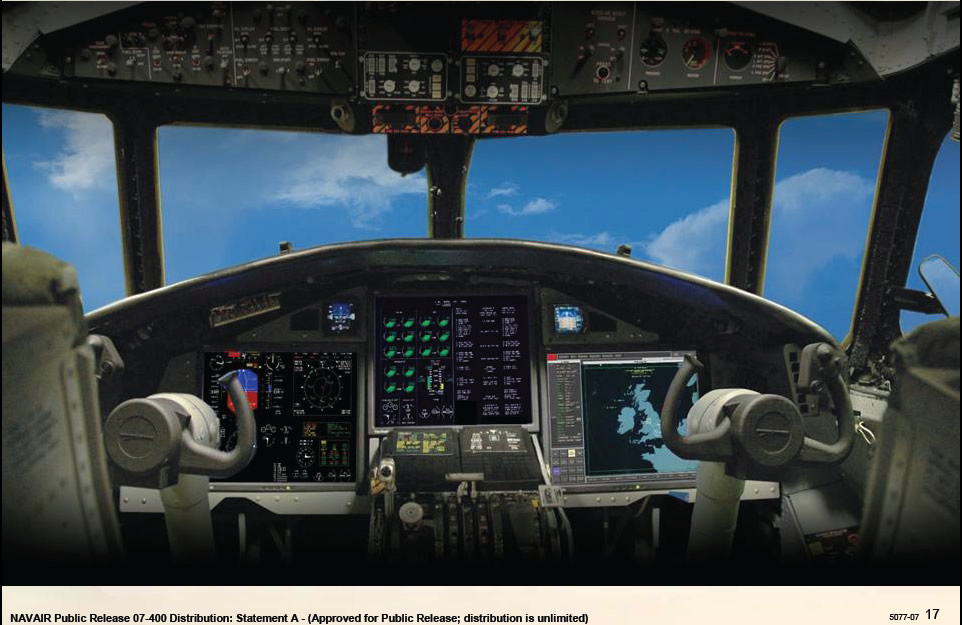
(click to view full)
Sept 26/08: Pilot production. A $10.7 million modification to a previously awarded cost plus incentive fee contract for procurement of Aircraft Change Directives in support of the E-2D Advanced Hawkeye (AHE) Pilot Production Aircraft, under the E-2D AHE System Development and Demonstration Program. Work will be performed in Bethpage, NY (71.2%); and St. Augustine, FL, (28.8%) and is expected to be completed in June 2009. Contract funds will not expire at the end of the current fiscal year (N00019-03-C-0057).
Sept 23/08: Support. A $6.2 million modification to a previously awarded cost plus incentive fee contract (N00019-03-C-0057) covers support equipment for the 3 Lot 1 E-2D Advanced Hawkeye Pilot Production Aircraft.
Work will be performed in Bethpage, NY (69.1%); Menlo Park, CA (5.7%); New Port Richey, FL (5.3%) Islip, NY (3.2%); Dover, NJ (3.1%); Holbrook, NY (2.2%); and other various locations within the United States (11.4%), and is expected to be complete in June 2011.
Sept 22/08: Engines. A $12 million modification to a previously awarded cost-plus incentive fee contract for engineering efforts associated with the manufacture and initial fitting of the Lot 1 E-2D Hawkeyes’ T-56-A-427A engines. Work will be performed in Indianapolis, IN (87%) and Bethpage, NY (13%), and is expected to be complete in Sept 2010 (N00019-03-C-0057).
Sept 10/08: The US Senate Defense Appropriations Subcommittee Approves the FY 2009 Defense Appropriations Bill. Their release and summary includes “Funds procurement of 2 E-2D aircraft, a deferral of 1 aircraft.” The aircraft’s radar testing issues are cited as the reason. That approach is accepted in the final, reconciled House/Senate budget.
July 30/08: SDD. Northrop Grumman Technical Services Sector in Herndon, VA received a sole-source $6.3 million cost-plus-fixed-fee, firm-fixed-price contract for approximately 89,886 hours of engineering and logistics services in support of E-2C, C-2A test and E-2D System Design and Development (SDD) aircraft located at the Air Test and Evaluation Squadron TWO ZERO (VX-20) in Patuxent River, MD.
Services to be provided include modification and preparation of the aircraft for test operations, correct safety of flight discrepancies, quality control inspections, engineering investigations, and logistics and parts support. Work will be performed in Patuxent River, MD and the contract will end in July 2009. The Naval Air Warfare Center Aircraft Division in Patuxent River, MD issued the contract (N00421-08-C-0065).
July 2008: Radar flight testing resumes for the E-2D, with no subsequent problems reported.
June 27/08: Pilot production engines. A $36.3 million modification to a previously awarded cost-plus-incentive-fee contract for T-56-A-427A engines and spares in support of the 3 E-2D Advanced Hawkeye Pilot Production Aircraft. For 3 aircraft, that’s 6 engines. NGC is listed as the contractor, even though they’re Rolls Royce engines, because NGC is the prime contractor and hence responsible for integration etc.
Work will be performed in Indianapolis, IN (82%) and Bethpage, NY (18%), and is expected to be complete in September 2010 (N00019-03-C-0057).
June 25/08: Spares. A $20.5 million modification to a previously awarded cost-plus-incentive-fee contract (N00019-03-C-0057) covering spare parts for the 3 E-2D Advanced Hawkeye Pilot Production Aircraft of Lot 1.
Work will be performed in Syracuse, NY (52.02%); Bethpage, NY (19.49%); Woodlawn, CA (5.82%); Greenlawn, NY (5.60%); Springville, UT (2.90%); Cincinnati, OH (2.14%); Ronkonkoma, NY (2.06%); and at various locations within the United States (9.97%), and is expected to be complete in Sep. 2010.
June 24/08: Pilot production. A $9.4 million modification to a previously awarded cost-plus-incentive-fee contract (N00019-03-C-0057) for non-recurring engineering efforts involved in the production of required subsystems and components for the Lot 1 E-2D Advanced Hawkeye Pilot production Aircraft.
Work will be performed in Bethpage, NY (28.23%); Torrance, CA (14.47%); Dallas, TX (10.80%); Pomezia, Italy (8.74%); Cleveland, OH (8.36%); New Port Richey, FL (8.13%), Owega, NY (6.71%); Freeport, NY (3. 20%) and various locations within the USA (11.54%), and is expected to be complete in Sep. 2010.
June 4/08: Pilot production. A $9.1 million modification to a previously awarded cost-plus-incentive-fee contract (N00019-03-C-0057) for Electro Magnetic Interference Reduction System Process Hardware for E-2D Advanced Hawkeye Pilot Production Aircraft; 1 Lot (3 subsystems). Work will be performed in Syracuse, N.Y. (90.9%) and Bethpage, N.Y. (9.10%), and is expected to be completed in April 2010.
As noted above, “improved clutter & interference cancellation offers significant improvement in tracking small land and sea targets, as well as better performance against electronic jamming.” It’s also very helpful if an aircraft wishes to collect enemy signals while operating a powerful radar.
April 10/08: SDD. An $11.7 million modification to a previously awarded cost-plus-award-fee contract for one-time engineering efforts centered around replacing the E-2D’s halon system. Halon is an inert gas used to put out fires by depriving them of burnable atmosphere. Work will be performed in Bethpage, NY, (87.3%) and St. Augustine, FL (12.7%) and is expected to be complete in Sept 2011 (N00019-03-C-0057).
March 2008: Radar issues. The E-2D program experiences issues as a result of the new radar’s high power requirements. The “high power circulators” that transfer power from the radar amplifiers to the rotodome antenna were initially unable to handle the power levels required by the new radar.
Design changes, and material changes that changed the insulating material in the antenna, are made. General flight testing continues throughout, but radar flight testing is suspended.
Feb 6/08: SDD. A $12 million modification to a previously awarded cost-plus-award-fee contract (N00019-03-C-0057) for recently-specified changes to the E-2D Advanced Hawkeye design during the Development and Demonstration Program. Work will be performed in Bethpage, NY (79.6%) and St. Augustine, FL (20.4%) and is expected to be complete in June 2008.
Dec 26/07: LRIP-1 lead-in. A $50.4 million not-to-exceed advance acquisition contract for long lead material and support for 3 E-2D Advanced Hawkeye low rate initial production (LRIP) Lot 1 aircraft.
Work will be performed in Syracuse, NY (32.6%), various locations within the United States (23.7%); Bethpage, NY (15.5%); Dallas, TX (12.4%); Menlo Park, CA (9.8%); and Woodland Hills, CA (6%), and is expected to be complete in August 2011. Contract funds will not expire at the end of the current fiscal year. This contract was not competitively procured. The Naval Air Systems Command, Patuxent River, Md. is the contracting activity (N00019-08-C-0027).
Dec 19/07: CEC. A $22.4 million modification to a previously awarded cost-plus-award-fee contract (N00019-03-C-0057) for cooperative engagement capability developmental efforts in support of the E-2D Advanced Hawkeye System Development and Demonstration Program. Work will be performed in Bethpage, N.Y., (92.6%) and St. Augustine, FL (7.4%) and is expected to be completed in July 2009.
CEC allows the Hawkeye to share both a joint battle picture and targeting data with fleet ships, other surveillance aircraft, and even land-based missile units. Like the CEC-equipped E-2C Hawkeye 2000, the E-2D will have targeting capability, and becomes a potential node for ballistic missile defense.
Dec 17/07: India. According to a report in the forthcoming issue of India Strategic defense magazine, the Indian Navy had issued an request for information for the E-2D Hawkeye to the U.S. government. The report said Washington has confirmed India’s interest and said that “as and when a formal request is received from New Delhi, the answer should be positive.” Note also DID’s February 2006 report that Northrop Grumman was working to integrate HAL into its E-2 Hawkeye AWACS program supply chain by way of sourcing aircraft assemblies and components, digitization and other related services
The Indian Navy reportedly wanted their aircraft to be capable of staying in the air for 8 hours instead of 6, and modifications such as “wet” (fuel carrying) wings and the plane’s existing aerial refueling capability are reportedly set to address this. India Today.
Nov 29/07: Testing. Delta Two, the 2nd E-2D Advanced Hawkeye development aircraft, completes its first flight from NGC’s St. Augustine, FL manufacturing and flight test center in just over 2 hours, followed by a second flight on Dec 4/07. During the flights, the team conducted a series of air vehicle tests to evaluate airplane flying qualities, engine response, and cockpit instruments. Chief test pilot Mike Holton later said in Northrop Grumman’s release that:
“Our go-forward plan is to fly another flight to check out engine air start capability, and high angle of attack flying qualities, and then we will complete the installation of the weapon system. Once the weapon system is in, we will fly approximately 200 flights to evaluate the new radar. And just like Delta One, which flew its first flight on Aug. 3, Delta Two flew just like an E-2C.”
FY 2007
Rollout, 1st flight.
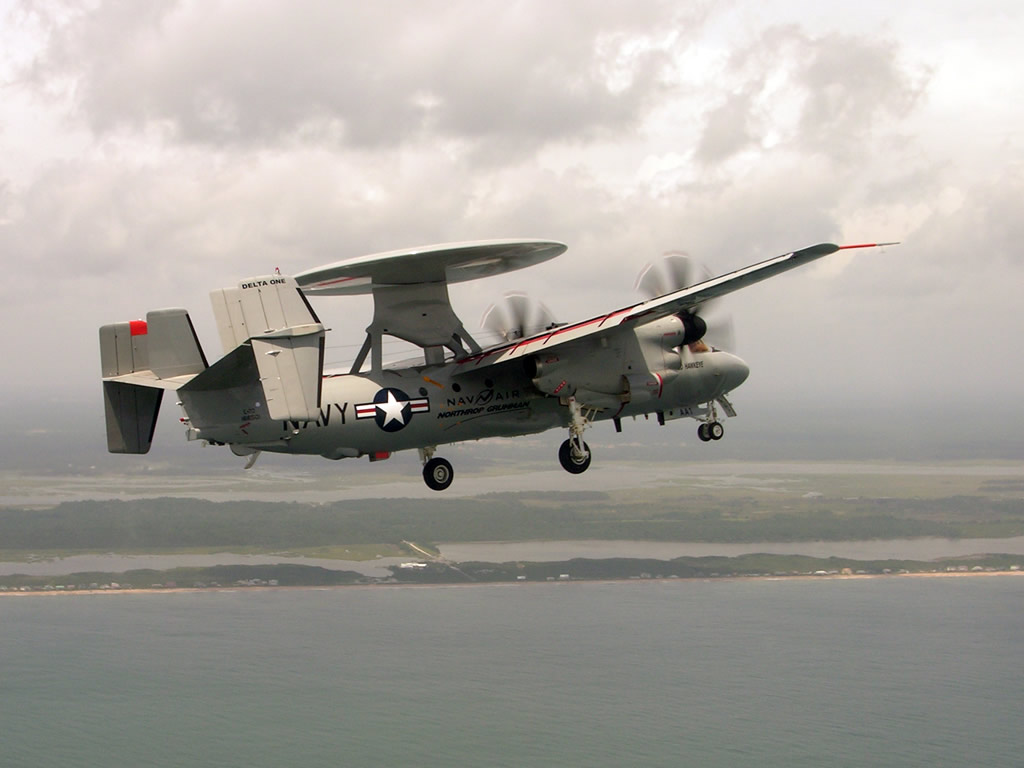
(click to view full)
Sept 26/07: Industrial. A $14.5 million cost-plus-incentive-fee modification to a previously awarded cost-plus-award-fee contract for non-recurring efforts to prepare for E-2D Advanced Hawkeye production at NGC and its suppliers. Work will be performed in Syracuse, NY (56.42%); Menlo Park, CA (23.25%); various locations across the United States, (11.23%); and Bethpage, NY (9.1%) and is expected to be complete in December 2008 (N00019-03-C-0057).
Sept 26/07: Training. A $10 million cost-plus-incentive-fee modification to a previously awarded cost-plus-award-fee contract for the procurement of E-2D Advanced Hawkeye Prime Mission Equipment for E-2D Trainer requirements.
Work will be performed in Marlborough, MA (39%); Woodland Hills, CA (36.7%); Owego, NY (12%); Bethpage, NY (9.7%); Baltimore, MD (1.6%); and Sylmar, CA (1%) and is expected to be complete in July 2009 (N00019-03-C-0057).
Aug 3/07: 1st Dev Flight. The first E-2D Advanced Hawkeye development aircraft, known as Delta One, completes its first flight at St. Augustine, FL. Northrop Grumman Flight Test Pilot Tom Boutin and U.S. Navy Flight Test Pilot Lt. Drew Ballinger along with Northrop Grumman Flight Test Lead Weapon Systems Operator Zyad Hajo lifted off shortly before 11 a.m. and flew for approximately 1.3 hours. NGC release.
1st flight
July 9/07: A $408 million modification to a previously awarded cost-plus-award-fee contract (N00019-03-C-0057) for 3 E-2D Advanced Hawkeye pilot production aircraft, under the SDD phase.
Work will be performed in Bethpage, NY (26.5%); at various locations across the United States (25.88%); Syracuse, NY (23.57%); St. Augustine, FL (18.63%); and Menlo Park, CA (5.42%) and is expected to be complete in August 2010. See also Northrop Grumman release.
Pilot production: 3 E-2Ds
April 30/07: Rollout. The first E-2D Advanced Hawkeye makes its first public appearance at a rollout ceremony in St. Augustine, FL. NGC release.
Rollout
April 9/07: The Pentagon’s periodic Selective Acquisition Report updates us re: cost growth in the E-2D program. Full weapons program costs increased from $15,721.5 million to $17,487.0 million (up $1.76 billion/ 11.2%), due primarily to higher Mission Electronics, general procurement, and mission systems pricing (+$653.7 million), buying fewer aircraft per year over a longer period from FY 2009-2020 (+$374.8 million), and additional pilot production funding (+$169.0 million). There were also increases for the addition of the automatic identification system, dual transit satellite communication, and in-flight refueling requirements (+$137.1 million), a revised estimate to reflect new pricing for the system development and demonstration contract (+$234.3 million), and increases in initial spares, peculiar support equipment and training, and other production support costs (+$159.1 million).
At this estimate, each E-2D aircraft will cost $233.1 million when all R&D, pilot production, equipment, and initial support funds are factored in and amortized.
SAR – baseline
Nov 13-15/06: Northrop Grumman Corporation hosts the 5th annual International Hawkeye Users Conference at its manufacturing center in St. Augustine, FL. Every year, the company brings together members of the air forces and navies of Egypt, France, Japan, Mexico, Taiwan, Singapore and the United States to share lessons-learned and to learn about new capabilities and improvements planned for the world’s E-2 fleet. The NGC release adds that “together, these nations operate over 100 E-2C Hawkeyes…”
FY 2006 and Earlier
Development; CDR.
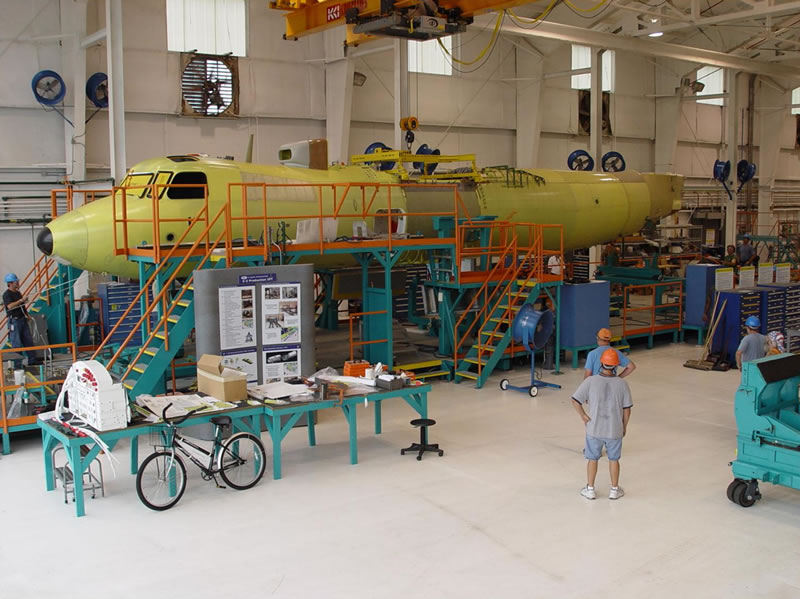
(click to view full)
July 17/06: Northrop Grumman announces that it has mated the major sub-assemblies of the first E-2D Advanced Hawkeye test aircraft into a single fuselage structure at its St. Augustine, FL manufacturing center. NGC release.
Nov 17/05: CDR. Northrop Grumman Corporation and the U.S. Navy announce a successful E-2D critical design review (CDR). All the team’s basic designs, including the new radar, mission computer and workstations had been improved and vetted, and Northrop Grumman can now complete production of the 2 test aircraft to fulfill the SDD phase requirements. NGC release.
CDR
July 20/05: SDD add-on. A $22.6 million modification to a previously awarded cost-plus-award-fee contract (N00019-03-C-0057) to design, develop, fabricate, assemble, integrate, furnish, manage, test and evaluate an On-Board Oxygen Generating System for the E-2D Advanced Hawkeye aircraft. Work will be performed in Bethpage, N.Y. (93.8%) and Davenport, Iowa, (6.2%), and is expected to be completed in December 2012.
March 29/04: SDD add-on. A $63.7 million modification to a previously awarded cost-plus-award-fee contract (N00019-03-C-0057) exercises an option for a Propulsion System Control Monitoring and Maintenance System (PSCMMS) for the E-2 Advanced Hawkeye (AHE). Specifically, the contractor will design, develop, fabricate, assemble, integrate, furnish, manage, test, evaluate and support a PSCMMS as part of the E-2 AHE System Development and Demonstration (SD&D) effort.
Work will be performed in Indianapolis, IN (52.61%); Bethpage, N.Y. (41.08%); Windsor Locks, CT (3.92%); and Irvine, CA (2.39%), and is expected to be completed in May 2011.
Aug 11/03: SDD contract. A $1.932 billion cost-plus-fixed-fee contract for the E-2 Advanced Hawkeye (AHE) system development and demonstration (SDD) phase, which will consist of modifying two E-2 Hawkeye 2000 aircraft to the E-2 AHE configuration. The contractor will design, develop, fabricate, assemble, integrate, furnish, manage, test, evaluate and support the software, hardware and engineering associated with the SDD phase.
Work will be performed in Bethpage, N.Y. (55.39%); at various locations across the United States (20.75%); Syracuse, N.Y. (13.91%); Baltimore, MD (4.98%); Menlo Park, CA (3.22%); and El Segundo, CA (1.75%), and is expected to be complete in December 2012. This contract was not competitively procured (N00019-03-C-0057).
E-2D development
Additional Readings
* Northrop Grumman – E-2D Advanced Hawkeye.
* Northrop Grumman – E-2C Hawkeye 2000.
* Naval Technology – E-2C/D Hawkeye, United States of America.
* Northrop Grumman – Protect the E-2D Advanced Hawkeye. Lobbying site designed to restore $200 million in advance funding.
* Defense News (July 31/12) – Navy: Iraq Experience Validates New E-2 Radar. They’re referring to the E-2C’s overland command and control role, which was tempered by its difficulty picking up targets amid land clutter. The E-2D is significantly better at that task.
* NDIA National Defense Magazine, via WayBack (July 2009) – Navy Awaits Arrival of Powerful New Radar-Equipped Aircraft.
* Smithsonian Air & Space, via WayBack (July 2008) – Detect and Direct: The Navy’s newest Hawkeye gets closer to the fight.