


(click to view full)
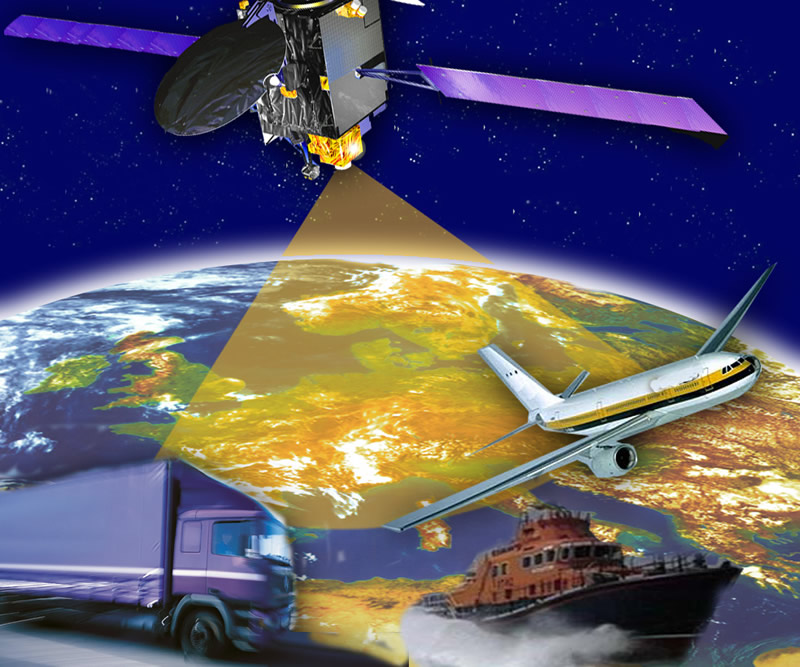
The USA’s Global Positioning System service remains free, but the European Union is spending billions to create an alternative under their own control. In addition to civilian GPS (the Open Service), services to be offered include a Safety of Life Service (SoL) for civil aviation and search and rescue, a paid Commercial Service with accuracy greater than 1 meter, plus a Public Regulated Service (PRS) for use by security authorities and governments. PRS/SoL aims to offer Open Service quality, with added robustness against jamming and the reliable detection of problems within 10 seconds.
Organizational issues and shortfalls in expected progress pushed the “Galileo” project back from its originally intended operational date of 2007 to 2014/15. After a public-private partnership model failed, the EU gained initial-stage approval for its plan to finance the program with tax dollars instead of the expected private investments. Political issues were overcome in 2007 by raiding other EU accounts for the billions required, but by 2011, it became clear that requests for billions more in public funds were on the way. Meanwhile, doubts persist in several quarters about Galileo’s touted economic model. Security concerns regarding China’s early involvement, and its potential Beidou-2/Compass projects, have been equally persistent, and there is good reason to expect that the constellation has a military purpose. On a European political and contractual level, however, Galileo is now irreversible.
This article offers background, players, developments, contracts, and in-depth research links for Galileo, as well as linked EU programs like GIOVE and EGNOS.
The Galileo Program
The EU is hoping Galileo will provide an alternative to the Pentagon-controlled Global Positioning System (GPS), and also tap a growing worldwide demand for satellite communications that Galileo’s advocates claim could be worth as much as EUR 300 billion by 2020. Many outside analysts are dubious about the commercial potential, but security and national services have helped the EU recruit other countries to join the list of Galileo partners. International signatories so far include: China (2003, now also a competitor), India (2005), Israel (2004), Morocco (2005), Norway (2009, in ESA but not an EU member), Saudi Arabia (2005), South Korea (2006), and the Ukraine (2005).
The Galileo System
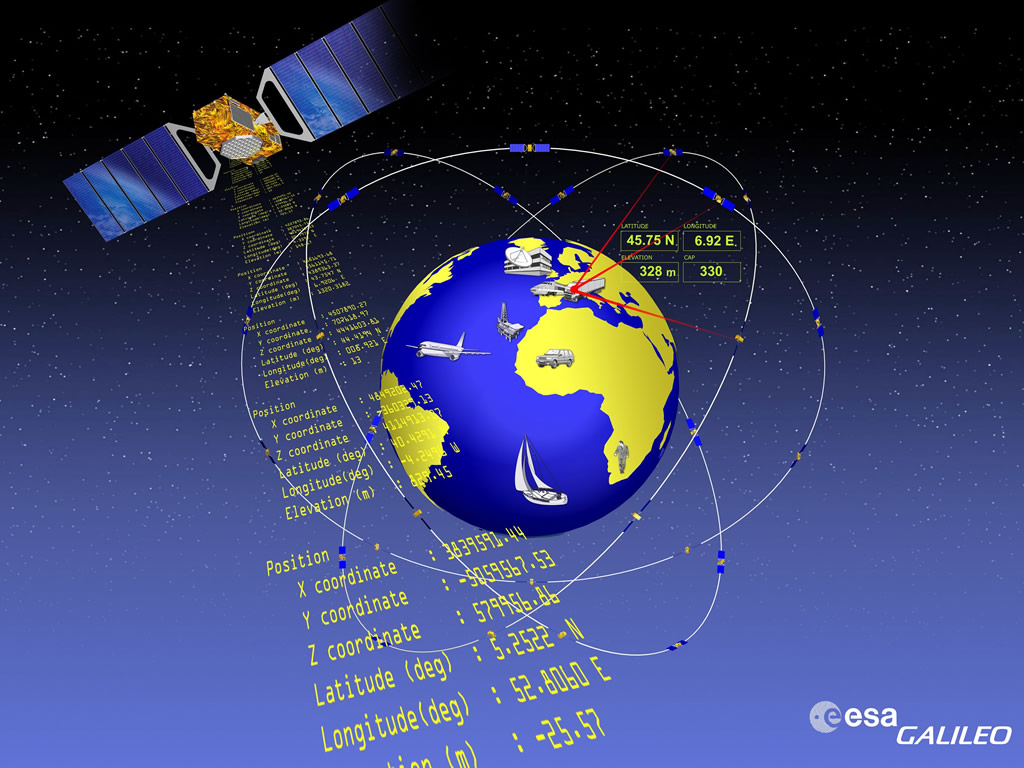
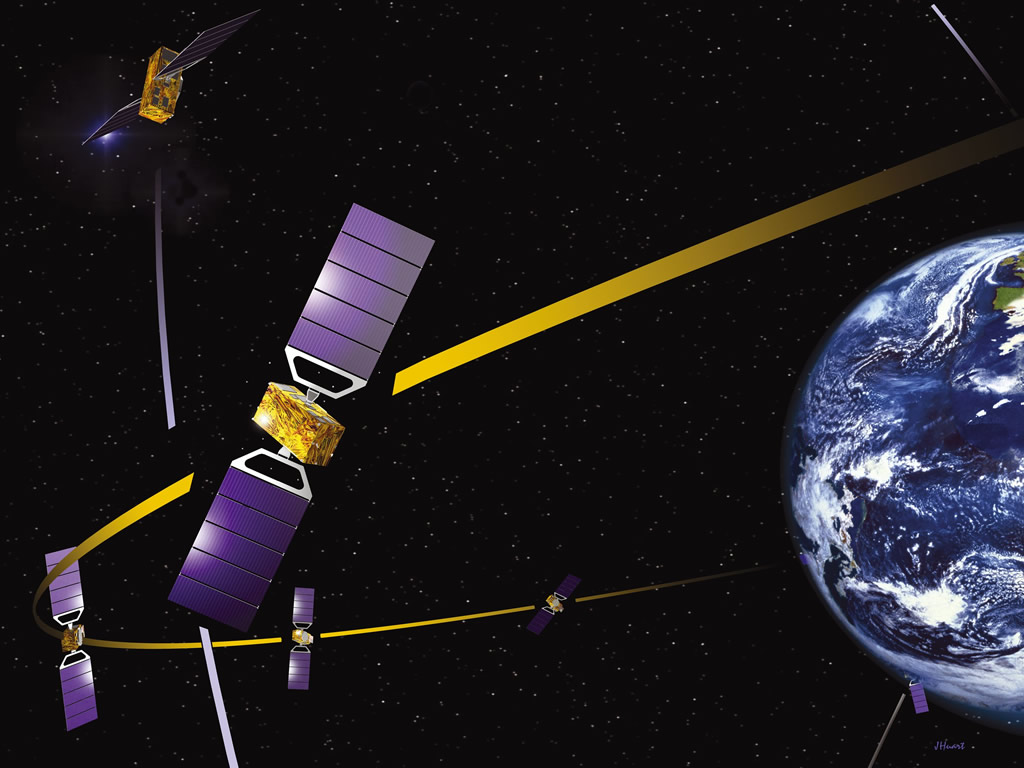
 Galileo concept
(click to view full)
(click to view full)
Global coverage requires a minimum of 24 satellites, and the USAF prefers at least 27, in order to maintain proper coverage around the globe from Medium Earth Orbit. In 2008, for instance, the USAF had 31 total NAVSTAR GPS satellites deployed.
The Galileo constellation was originally envisaged as up to 28 satellites plus the last 2 Galileo In-Orbit Validation (IOV) satellites, for a total of 30, but appears to be headed for a constellation of 26: 22 Galileo satellites, plus all 4 IOVs. The ESA’s December 2009 multi-award contract arrangement actually has options for up to 32 satellites, but the initial constellation for service launch in 2014/15 will be just 22: 4 IOV and 18 Galileo.
Each Galileo satellite will broadcast 10 different navigation signals, making it possible for Galileo to offer the open (OS), safety-of-life (SOL), commercial (CS) and public regulated services (PRS). At this point, Galileo is scheduled to provide 3 early services in 2015:
1. An initial free Open Service, using the L1 signal broadcast at 1575.42 MHz, and the new L5 open signal (1164-1215 MHz: E5a, E5b), in any combination. The new open signal specification will be shared with the USA’s GPS-IIF and GPS-III, which could create an explosion of competitive, cheap, and highly accurate receivers. OS also includes 3 data-less channels, and pilot tone ranging codes.
2. An initial “Safety-of-Life” service, for applications like search and rescue, or civil aircraft navigation. SOL services are like a data channel within the open signals, based on open signal measurements and integrity data carried in special OS messages. The L5 standard is often referred to as a “safety of life” standard.
3. An initial Public Regulated Service, which uses 2 encrypted signals (1575.42 MHz E2-L1-E1 band and 1278.75 MHz E6 band), with controlled encrypted access for specific users like governments.
The follow-on Commercial Service, with under 1-meter accuracy, will combine 2 encrypted E6 signals in the 1278.75 MHz band, for improved accuracy and data throughput rates, plus the ability to include commercial data within the open signals.
Galileo Elements
(click to view full)
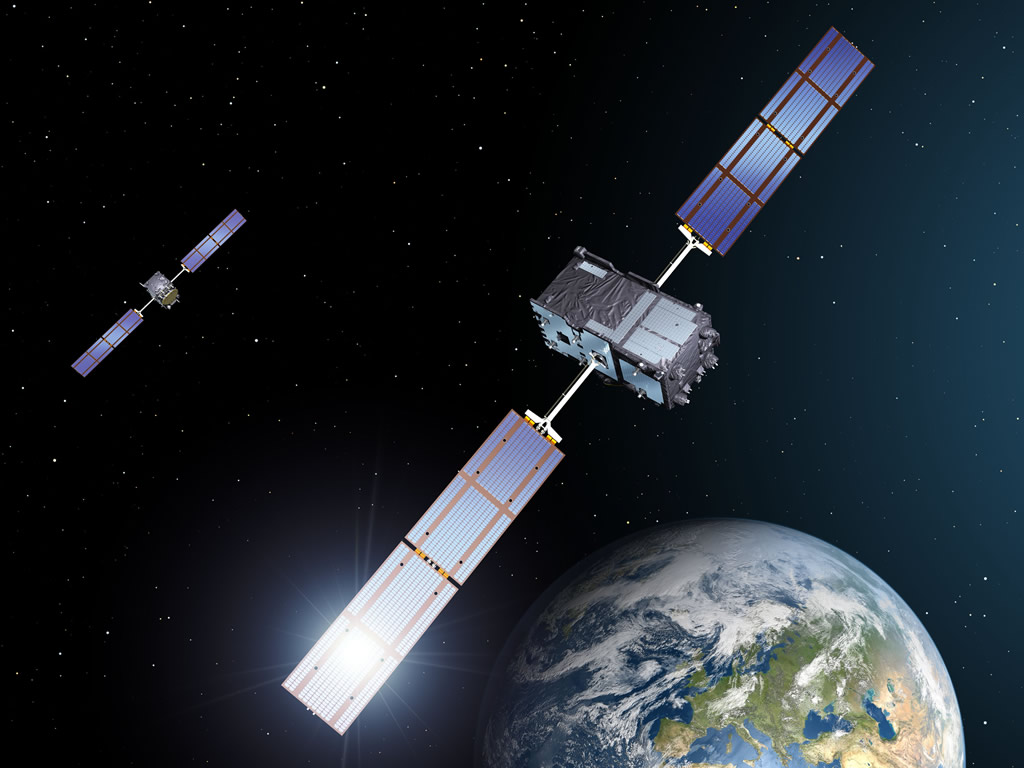
Initial GIOVE-A and GIOVE-B technology demonstration and test satellites were launched in 2005 and 2008. GIOVE-A has now completed testing and been “parked” in a higher orbit, while GIOVE-B has remained active far beyond its anticipated 2-year life cycle.
The first 2 operational Galileo IOV (In-Orbit Validation) satellites were Galileo PFM (Protoflight Model) and FM2 (Flight Model 2). They were launched together on Oct 21/11, aboard the 1st Soyuz rocket launch from Arianespace’s facility in Kourou, French Guiana. The 2 follow-on Galileo IOVs were launched on schedule in October 2012, and another 18 Full Operational Capability satellites are now under contract. The first 2 Galileo FOCs were launched in August 2014, but the launch failed.
The satellites have limited propulsion capabilities, which means they must be launched correctly in order to work as designed. To get the satellites into space, the ESA will be relying on Arianespace’s launch facility in Kourou, French Guiana. The fleet workhorse, however, will be made up of Russian Soyuz rockets. Jean-Jacques Dordain, Director General of ESA referred to it as “the legendary Russian launcher that was used for Sputnik and Yuri Gagarin.” That’s something of a backhanded compliment, but it does underscore the Soyuz medium rocket’s long history and proven design. Before Galileo, the Soyuz had only been launched from Russian sites in Baikonur, Kazakhstan or Plesetsk, Russia, with a maximum payload of 1.7 tonnes. French Guiana is much closer to the equator, which boosts the rockets’ payload to 3 tonnes. Each Soyuz rocket carries a French Fregat-T upper stage for extended range and precise placement, and can launch 2 Galileo satellites into orbit.
Toward the end of the project, Galileo satellites may fly on the French Ariane 5 heavy rocket. The program initially planned to fit up to 6 satellites on this rocket, but they’ve had to scale back to an Ariane 5 ES Galileo variant, whose special dispenser will carry just 4 satellites into their target orbits. The new launcher variant is expected to be re-qualified and ready by the second half of 2014, just in time for the initial constellation’s final launches.
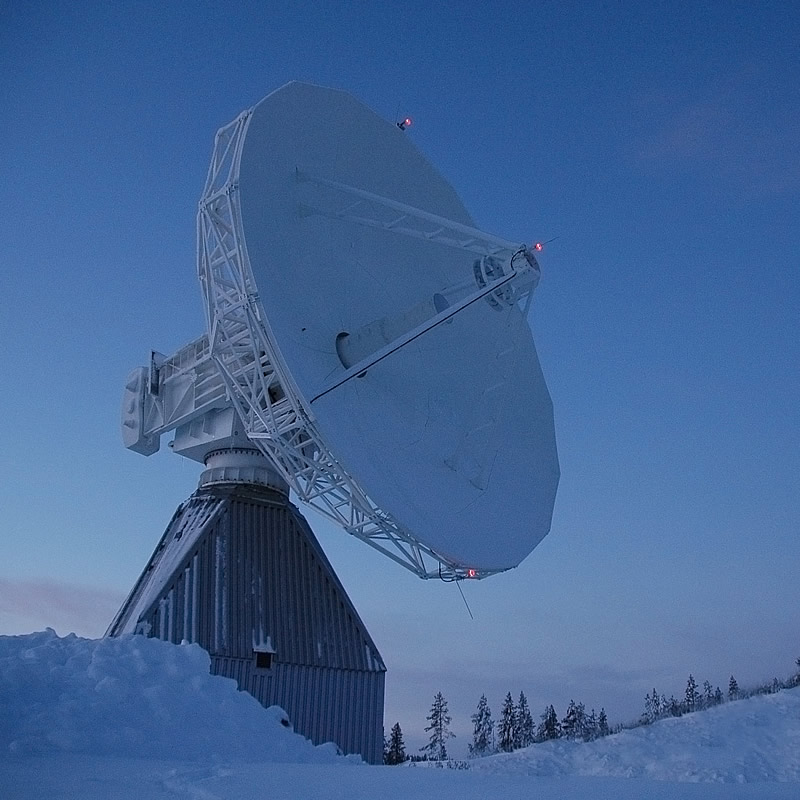
On the ground, the Galileo constellation will rely on 2 Ground Control Centres (GCC) at Oberpfaffenhofen, Germany and Fucino, Italy. They’ll be supported by 4 Telemetry, Tracking and Command (TTC) stations on Kiruna, Sweden in Europe; Kourou, French Guiana in South America; Noumea, New Caledonia in the South Pacific; and St Denis, Reunion Island, in the Indian Ocean near Madagascar.
The other support elements are the Galileo Security Facility (GSF), responsible for managing access to Galileo’s encrypted services, and the Galileo Mission Segment (GMS). GMS is a global network of 16 Galileo Sensor Stations (GSS) to monitor the signals from the satellites, a chain of 5 Up-Link Stations (ULS) around the globe to uplink navigation data to the satellites, parallel communications networks, and a complex sequence of processing elements that include the 2 main GCCs.
Galileo: Structure & Costs
(click to view full)
Galileo’s assets are owned by the European GNSS Supervisory Authority (GSA), a public body that is a EU community agency. The European Global Navigation Satellite System encompasses Galileo, as well as the European Geostationary Navigation Overlay Service (EGNOS), which overlays on top of GPS and GLONASS to improve their accuracy from about 20m to 2m. When Galileo is complete, GNSS would expand its operating reach, to provide a worldwide positioning and timing infrastructure.
The private Galileo Operating Company (GOC) is a management vehicle. Galileo was originally envisaged as a commercial venture, and 2/3 of its cost was originally expected to be covered by private financing. As the EU dithered and kept changing the terms for competitors, cooperation and planning broke down entirely. In response, the EC shifted to 100% public financing, as part of a new structure and model intended to get the project moving again.
The financial commitment required is unclear, because the exact extent of public involvement throughout the project remains unclear. As the UK’s Parliamentary Transport Committee’s November 2007 report put it, with classic British understatement: “The current estimated costs for the Galileo programme in its entirety are less transparent than might be wished for.” That’s still true. Based on credible reports, and EC requests to date, it’s safe to place the minimum cost to European taxpayers at EUR 21.2 billion for the constellation, required ground systems, and 20 years of operation: EUR 3.7 billion (1.3 + 2.4) allotted for the initial phase, another 7 billion requested to finish Galileo and operate the system for 6 years (vid. Nov 30/11 entry), plus EUR 10.5 billion for 14 more years, at the EUR 750 million per year cost cited in a German government report (vid. Oct 7/10 entry).
Since the EC now wants to transfer Galileo’s ongoing operation to the public sector, those operating costs may rise. If that scenario comes to pass, the constellation expands beyond 22 satellites, or satellite issues crop up, Galileo’s cost will grow. Meanwhile, the all-public sector model that the EC is pushing for is unlikely to raise significant revenues, unless other EU branches use their regulatory power to impose fees and force Galileo usage, instead of relying on free GPS signals. Which would constitute a tax by any other name.
The 7 key contract segments issued by the ESA for the Galileo system, and their costs to date, have included:
* Feb. 2012: EUR 310 million. 8 more satellites from OHB System (Germany/UK), Ariane 5 modifications by EADS Astrium, and a launch option from Arianespace (France).
* June 2011: Galileo Mission Segment, Galileo Security Facility – EUR 281 million to Thales Alenia Space (France/ Italy).
* June 2011: Full Operational Capability Ground Control Segment – EUR 74.3 million to EADS Astrium (UK).
* Oct. 2010: Galileo Operations – EUR 194 million to SpaceOpal JV (Germany/Italy). For work to 2014.
* Jan. 2010: Satellite launches – EUR 397+ million to Arianespace (France). 5 Soyuz launches, + options for 2 Soyuz launches or 1 Ariane-5 launch.
* Jan. 2010: System Support Services for integration and validation – EUR 85 million to Thales Alenia Space (France/ Italy)
* Dec. 2009: Up to 32 Galileo Satellites – Must be bid by OHB System AG (Germany/UK) and EADS-Astrium GmbH (Germany). OHB won an initial EUR 566 million, 14-satellite contract in Jan. 2010.
Galileo: Timeline
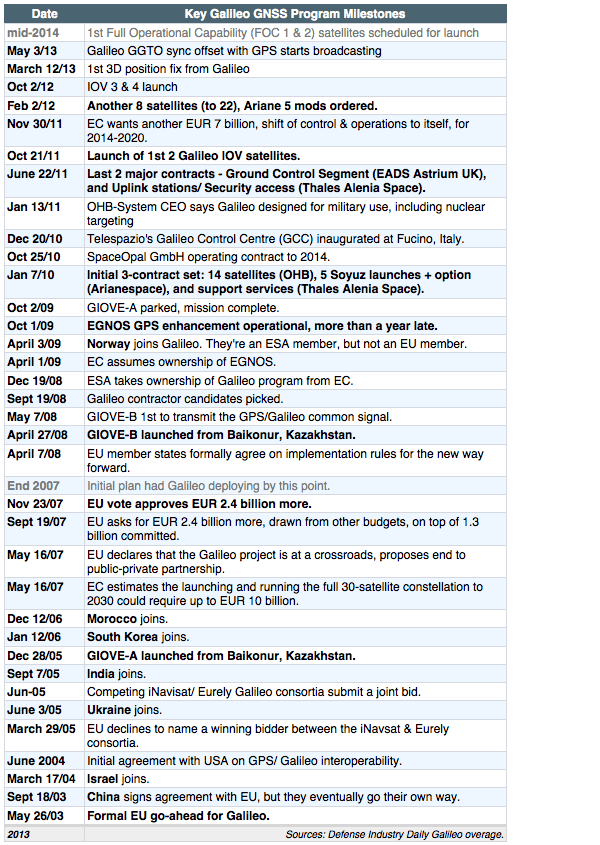
If Galileo’s services begin in 2015, they will be almost 8 years late based on the initial plan, 2 years late based on the July 2008 reboot as an EU-funded public project, and a bit more than a year late based on the January 2010 initial contracts.
Galileo: A Military Dimension

(click to view full)
As far back as 2007, a Deutsche Welle report had stated that:
“The system will remain under civilian control but it is possible that the military, security sector or police will be able to use it, bringing in more money.”
The program has always has a police/public dimension; shifting the project’s emphasis in that direction, and adding a military dimension, is a likely first resort once billions have been spent, but revenues fall embarrassingly short. Whether Europeans would be sanguine about, for instance, Chinese police in Tibet relying on Galileo is an open question. Yet this may well be the inevitable result of the present agreement.
On the international front, there are lingering concerns in the USA, Japan, et. al. that some partners intend to use Galileo as the backbone for GPS-targeted weapons. The 2009 comments by OHB-System’s CEO that the French intended to use it as a component of nuclear targeting could only fan those concerns, notwithstanding the Gallileo contractor’s subsequent denials, and their firing of the CEO who made those remarks.

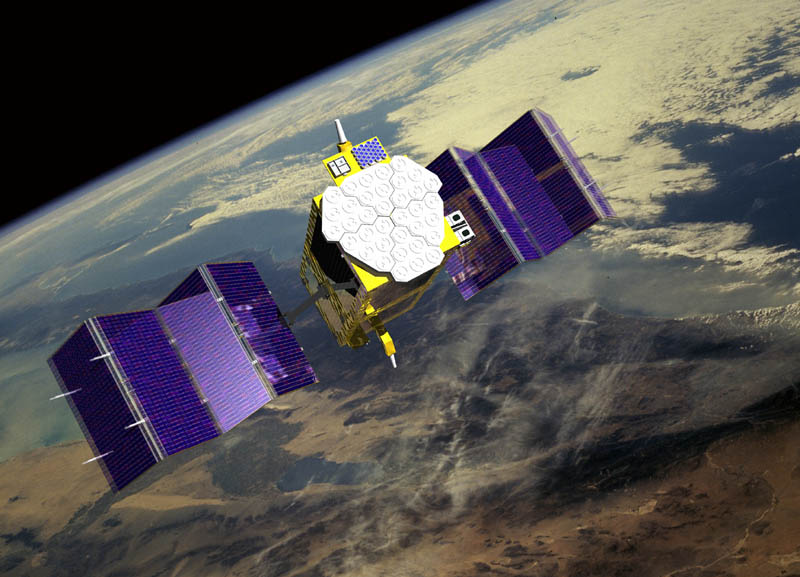
GPS Block IIA, IIR/M, IIF
(click to view full)
The other concern, expressed both within and beyond Europe, is that players like China may simply appropriate Galileo’s technical signals profile, using the knowledge gained from their early involvement and other sources. China’s Compass-Beidou already uses the same spectrum as Galileo’s encrypted Public Regulated Service, making the Galileo system a collateral damage hostage if an adversary blocks Chinese MILSAT signals.
The original US-EU disagreement over Galileo concerned the threat that Galileo might do this very thing to the Navstar GPS “M-Code”. An agreement between the USA and EU has averted this possibility, but Galileo remains wide open to similar 3rd party mischief. See the Additional Readings section, below, for more details and developments in this area.
Contracts and Key Events
2014
Sept 9/14: Military use. Rockwell Collins in Cedar Rapids, IA, USA confirms that a new Secure Software Defined Radio Global Navigation Satellite System (S-SDR GNSS) receiver developed for secure military use under a $2 million USAF research contract has successfully received and tracked a Galileo satellite signal.
The theory has always been that GNSS satellites from other constellations could be used to improve a receiver’s reception and triangulation precision, even if the added signal doesn’t itself have M-code accuracy. Indeed, Boeing had an R&D contract that aimed to demonstrate this by adding Iridium communications satellites with “perfect” atomic time. The challenge was the cost, complexity, and weight/space demands involved. Software-defined receivers add the kind of flexibility that can accomplish this kind of task without costing a lot of extra weight and space. GPS is a complete GNSS constellation on its own, but extra accuracy without a lot of cost is always attractive, and the ability to do things like this means that even successful enemy attacks on the NAVSTAR GPS constellation could leave the US with slightly-degraded but still effective GPS-guidance for planes, vehicles, weapons, etc. We aren’t there yet, but this is an important step. Sources: Rockwell Collins, “Rockwell Collins Successfully Tracks Galileo Satellite Signal Using Newly Developed Secure Software Defined Receiver”.
Aug 28/14: Launch failure. Both satellites are stable and are generating electricity from deployed solar arrays. ESA continues to assess scenarios for making the best use of the satellites in a sub-par situation, and “different scenarios will then be assessed before decisions are taken for a recovery mission.” Sources: ESA, “Update on Galileo Launch Injection Anomaly”.
Aug 22-23/14: Launch failure. The VS09 launch on a Soyuz MT booster goes well, but NPO Lavochkin’s Fregat upper stage fails to place the 1st Full Operational Capability satellites in the correct orbit:
“The targeted orbit was circular, inclined at 55 degrees with a semi major axis of 29,900 kilometers. The satellites are now in an elliptical orbit, with excentricity of 0.23, a semi major axis of 26,200 km and inclined at 49.8 degrees.”
Which is to say, lower and elliptical instead of higher and circular. Satellites like the USA’s AEHF-1 hardened comsat have been able to correct placement failures, but Galileo’s “limited propulsion capabilities” don’t create the same options. Instead, “the teams are investigating the possibilities to exploit the satellites to their best despite the non-nominal injection orbit”…. Stephane Israel, Chairman and CEO of Arianespace, said:
“Our aim is of course to fully understand this anomaly. Everybody at Arianespace is totally focused on meeting this objective. Starting Monday, Arianespace, in association with ESA and the European Commission, will designate an independent inquiry board to determine the exact causes of this anomaly and to draw conclusions and develop corrective actions that will allow us to resume launches of Soyuz from the Guiana Space Center (CSG) in complete safety and as quickly as possible.”
Former ESA Inspector General Peter Dubock will chair the investigative board, and Roscosmos will have a liaison via Deputy Director General of TsNIImash Alexander Daniliuk. Sources: Arianespace, “Galileo satellites experience orbital injection anomaly on Soyuz launch: Initial report” | ESA, “Soyuz Galileo launch: injection anomaly” | Spaceflight Now, “Inquiry into Galileo launch anomaly to focus on Fregat” | Arianespace, “VS09 flight: Arianespace names independent inquiry commission” | ESA, “Update on Galileo Launch Injection Anomaly: Galileo FOC Satellite”.
FOC Launch fails
Aug 20/14: Ariane 5 contracts. The European Space Agency (ESA) signs a contract with Arianespace for 3 Ariane-5 ES heavy rocket launches, each of which will send 4 Galileo FOC satellites into orbit. That’s double the capacity of the Soyuz launcher, and those 12 satellites should help get the constellation up and running more quickly. The initial launch is supposed to take place in 2015. Sources: Arianespace, “Arianespace serves the Galileo constellation and Europe’s ambitions in space with the signature of three new launch services using Ariane 5 ES”.
3 Ariane launches
Aug 13/14: FOCs joined. Arianespace joins Europe’s first 2 Galileo FOC (Full Operational Capability) satellites on a 2-sided dispenser system. The next step is mating to their Soyuz Fregat upper stage, followed by encapsulation in their composite fairing. The 730 kg birds “Doresa” and “Milena” are named for children who were among those winning a 2011 painting competition, and the platforms will be orbited by Arianespace during the VS09 mission on Aug 21/14. Sources: Arianespace, “Europe’s initial operational Galileo navigation satellites are integrated for their Arianespace Soyuz launch”.
2012 – 2013
(click to view full)
Dec 2/13: FOC 1 & 2. The first Full Operational Capability Galileo satellite has completed thermal vacuum testing at ESA’s ESTEC Test Centre in Noordwijk, the Netherlands. Thermal–vacuum testing on the 2nd Galileo FOC model will begin early in 2014, and the 2 are scheduled to launch together in mid-2014 to join the existing 4 IOV satellites in orbit. Sources: ESA, “ESA’s new breed of Galileo endures weeks of simulated space”.
July 3/13: SBAS. The Satellite-Based Augmentation Systems (SBAS) Interoperability Working Group agrees a common SBAS message standard, based on dual-frequency multiconstellation (DFMC) signals from up to 4 constellations post-2020: US GPS, EU Galileo, Russia’s Glonass, and China’s Compass/Beidou-2. That would help to create more precise and reliable GPS references, without having to use the military M-Code. The ESA’s “Experts agree satellite augmentation standard to gird globe” says that:
“Two solutions have been studied in parallel, one by ESA and one by the US Federal Aviation Authority (FAA). Both have been compared, with a final single definition to be made before the end of this year.”
May 3/13: Sync me. The 4 Galileo IOV satellites have begun broadcasting the 50 nanosecond offset (GGTO) between the Galileo and GPS constellations. That would create up to 15m of error, unless the time offset is known by the receiver itself, which can then align all observations to a single time scale.
The determination methods and interface design were agreed on a preliminary basis between the Galileo Project and the US Naval Observatory back in 2003. Source: ESA, “Galileo and GPS ‘synchronise watches’: new time offset helps working together”.
GGTO sync with GPS
March 12/13: The ESA:
“Europe’s new age of satellite navigation has passed a historic milestone – the very first determination of a ground location using the four Galileo satellites currently in orbit together with their ground facilities.
This fundamental step confirms the Galileo system works as planned.”
The constellation needed 4 satellites to make a position fix in 3 dimensions. At present, however, accuracy was only 10m – 15m. Sources: “Galileo fixes Europe’s position in history”.
1st 3D position fix
Jan 25/13: SBAS. More than 50 of the specialists overseeing the world’s 5 regional satnav augmentation systems (EU’s EGNOS, India’s GAGAN, Japan’s MSAS, Russia’s SDCM, USA’s WAAS/CWASS) met at Toulouse, France for the latest meeting of the Satellite-Based Augmentation Systems Interoperability Working Group (SBAS IWG). Source: ESA, “Russia and India join global satnav augmentation meeting”.
Nov 5/12: Delays. The project will be delayed several months, while the contractors work to harmonize the software on OHB AG’s new Galileo FOC satellites with that on board the initial 4 Galileo IOV satellites that are already in orbit. Those were made by a consortium of EADS Astrium and ThalesAleniaSpace, which explains the need for ThalesAleniaSpace engineers to reinforce the project (q.v. Oct 29/12). It also explains the reason for 2015 as the beginning of service.
Meanwhile, China has launched 12 GNSS satellites, without resolving their dispute over spectrum clashes with Galileo PRS (q.v. Sept 20/12). Sources: Space News, “Software Harmonization Issues Could Delay Galileo Deployment”.
Oct 29/12: Forced payment. EC VP Antonio Tajani discussed blame for the delays in Europe’s Galileo, and said that OHB AG would face financial penalties per the contract. Even a full penalty payment won’t finance the year-long delay, however, esp. since 10-15 ThalesAleniaSpace engineers were sent to OHB by the ESA as reinforcements. With respect to the collapse of Galileo’s obviously flawed economic model, the EU’s 1st resort is hardly a surprise:
“Tajani also said he has asked his staff to study options favoring the use of Galileo in Europe, “including a regulatory option that would require the use of Galileo, based on the example of [the automotive emergency service] eCall. The results of the study should be known in early 2014 and the commission will then make its decision.”
He adds that early services might not be available until 2015. ESA Director-General Jean-Jacques Dordain has promised to deliver an updated Galileo schedule with 3 launches in 2014, but there aren’t going to be any launches in 2013. That would create a constellation of 10 satellites: 4 IOV and 6 FOC. Unfortunately, Galileo needs 18 to begin. Sources: Space News, “European Space Agency, OHB Blamed for Galileo Delays; Financial Penalties Forthcoming”.
Oct 12/12: IOV 3 & 4 launch. A Soyuz ST-B launcher operated by Arianespace lofts IOV-3 and IOV-4 into orbit from Europe’s Spaceport in French Guiana. Sources: ESA, “Deployment of Europe’s Galileo constellation continues”.
IOV 3 & 4 launch
Sept 20/12: China Syndrome. During a summit in Brussels, Belgium, China and the EU agree to take their spectrum dispute over Beidou-Compass and Galileo PRS to the International Telecommunication Union (ITU). Which has no power to impose a regulatory ruling, because their sharing of the spectrum doesn’t create an outright conflict.
Even if it could regulate, China has 11 satellites in orbit already, and is launching more quickly. Galileo will have 4 IOV satellites in space already, with 6 full satellites slated to launch in 2013, and at least 4 four more to follow by the end of 2014. By the time any ITU ruling is issued, this probably won’t be fixable. Sources: Space News, “China and Europe Taking Their Navigation Dispute to ITU”.
EU-China spectrum dispute to ITU. Won’t help.
Aug 17/12: IOV 3 & 4. Arianespace says that work to prepare for the launch of the 3rd and 4th validation satellites is underway, has the two sats have been delivered in French Guiana. The dual launch is currently scheduled for Oct 8/12.
Meanwhile the Air Force is pondering whether to use dual or triple launches for its GPS III satellites, envious of the cost-effectiveness enjoyed by their European and Chinese competitors.
June 14/12: Sub-contractors. Orolia Group’s Swiss Spectratime division of Switzerland announces that it will build atomic clocks for the 8 Galileo FOC follow-on satellite orders, under a contract valued at EUR 14 million euros ($18 million). It’s a follow-on to their EUR 20 million contract in 2011, for the first 14 satellites, and their work on the 4 IOV satellites as part of ThalesAleniaSpace’s team.
Immediate work is just an authorization to proceed but that the final contract will be completed and signed in a few weeks.
They’re a very experienced provider in this area, and have also provided less-sophisticated atomic clocks for China’s Beidou-Compass GNSS constellation. Sources: Space News, “Spectratime To Build More Atomic Clocks for Galileo”.
April 26/12: IOV fit for duty. Astrium confirms that the first 2 IOV sats have successfully passed tests and have begun full in-orbit operations.
Feb 2/12: Tranche 2 orders. The ESA signs a series of Galileo-related contracts, worth EUR 310 million. They accelerate the Galileo program slightly, and set the beginning of service to 2014, if all contracts are completed on time. That’s a lot later than the original 2007 plan, but earlier than the 2016 or so that was feared just a couple years ago.
A EUR 250 million order to the OHB consortium will build another 8 Galileo satellites. EADS Astrium is the losing bidder, but its subsidiary Surrey Satellite Technology Ltd (SSTL) in Guildford, UK is building the navigation payloads. When added to the Jan 7/10 order, this places 22 satellites under contract with OHB: 4 Galileo IOV satellites, and 18 standard Galileo satellites. That’s enough for the initial constellation.
ESA also signed 2 contracts with France’s EADS Astrium. The EUR 30 million in contracts pays them to modify the more powerful Ariane 5 ES rocket to an Ariane 5 ES Galileo variant. Its special dispenser will carry 4 satellites into their target orbits, instead of launching just 2 aboard the Soyuz medium-lift rockets. The new launcher variant is expected to be requalified and ready by the second half of 2014.
The 3rd contract set involves an initial EUR 30 million launch option with Arianespace, who operates the rockets. ESA | EC | SSTL.
8 more satellites, Rocket mods, Launch option
Jan 25/12: Industrial. EADS Astrium subsidiary Surrey Satellite Technology Ltd (SSTL) in Guildford, Surrey, UK hosts a ceremony to open its new Kepler Building manufacturing facility, based beside the company’s headquarters. SSTL is responsible for Galileo’s navigation payloads. SSTL | ESA.
2010 – 2011
(click to view full)
Nov 30/11: New Framework, More Money. The European Commission proposes a new financing and governance framework for the Galileo and EGNOS programs, from 2014-2020. The EC proposes to earmark EUR 7.0 billion (currently about $9.4 billion) to guarantee the programs’ completion, and run the space and terrestrial infrastructures, the necessary replenishment/ replacement activities, certification procedures, and provision of services until 2020.
The proposal would also delegate system management to the European GNSS Agency (GSA), while delegating deployment management to the European Space Agency. This would replace the Oct 25/10 operating contract with the Finmeccanica/ Thales/ DLR SpaceOpal joint venture, which runs until 2014.
A cynic might say that this was the program opponents warned about (vid. the Nov 12/07 British report), and the EC denied, when the program needed member approval in 2007. Galileo has shifted from a public-private partnership that wasn’t supposed to support itself via business revenues, deployed by 2007, to a cut-down EUR 10+ billion, taxpayer-financed project, with government assuming management risk, deployed by 2014 at the earliest. At the same time, sunk commitments, and the EC’s structure, make it nearly impossible to cancel the project, or to deny new requests. EC | GSA view.
More money needed
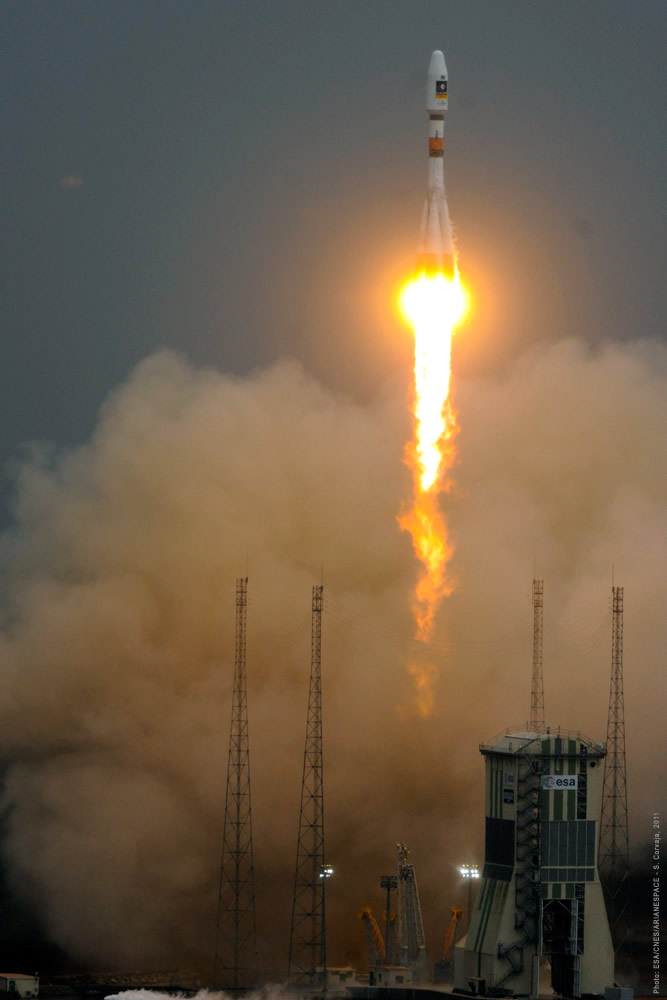
Oct 21/11: 1st Launch! The first pair of Galileo In-Orbit Validation satellites are successfully lofted into their 23,222 km orbit, by the first Russian Soyuz vehicle ever launched from Europe’s Spaceport in French Guiana. The satellites being controlled by a joint ESA and CNES French space agency team in Toulouse, France in preparation for handover to the DLR/Telespazio SpaceOpal joint venture.
The Soyuz VS01 flight with its Fregat-MT upper stage is operated by Arianespace. The Soyuz used by Arianespace at the Spaceport adds a new digital control system, which also enables the use of an enlarged ST-type payload fairing. Its new site near the equator nearly doubles its payload capacity to 3 tonnes, relative to its 1.7 tonne capacity from its usual sites in Baikonur, Kazakhstan or Plesetsk, Russia.
The next 2 Galileo satellites are scheduled for a (slightly delayed) fall 2012 launch, to complete the IOV quartet. ESA | EC | Arianespace.
IOV 1 & 2 launched
Sept 12/11: The first Galileo navigation satellite lands at Cayenne Rochambeau Airport in French Guiana, packed within a protective, air-conditioned container aboard an AN-124 transport aircraft. The launch is scheduled for Oct 30/11. ESA.
June 22/11: Ground services contracts. The European Space Agency issues the last 2 major Galileo contracts.
EADS Astrium is the prime contractor for Galileo’s Full Operational Capability Ground Control Segment (GCS). The contract value is EUR 73.5 million, and Astrium’s UK facility will lead the effort. They’ll supervise expansion and full equipping of the existing Ground Control Centres at Oberpfaffenhofen, Germany; and Fucino, Italy; and the addition of 2 more Telemetry, Tracking and Command (TTC) stations on Noumea, New Caledonia in the South Pacific; and St Denis, Reunion Island, in the Indian Ocean near Madagascar. The TTCs are joining the existing stations at Kiruna, Sweden in Europe; and Kourou, French Guiana in South America.
The Fucino GCC will also function as a temporary backup option for the 4 forthcoming Galileo In-Orbit Validation operational satellites, which begin launching in August 2011. Astrium already has experience as the initial GIOVE-B test satellite’s GCS provider, and that satellite remains on orbit following its April 2008 launch. Once the other Galileo satellites join the next 4 GIOVEs in space, Astrium UK will be responsible for their on-orbit validation “housekeeping,” including correct positioning and maintenance of the satellites’ orbits.
The other major “WP” contract is a 4-year EUR 281 million contract with Thales Alenia Space in France, to handle Galileo’s ground-based Galileo Mission Segment (GMS) and the Galileo Security Facility (GSF), and ensure the formatting of navigation information for broadcast by the satellites.
As its name implies, the Galileo Security Facility (GSF) will be responsible for managing user access to Galileo’s encrypted Public Regulated Service (PRS). The GMS is a global network of 16 Galileo Sensor Stations (GSS) to monitor the signals from the satellites, a chain of 5 Up-Link Stations (ULS) around the globe to uplink navigation data to the satellites, parallel communications networks, and a complex sequence of processing elements that include the 2 Galileo Control Centers (GCC) in Fucino and Oberpfaffenhoffen. EC | ESA | EADS Astrium | Thales Alenia Space.
Ground Services contracts
June 18/11: A pair of Soyuz ST-B launchers from Samara, Russia, and their accompanying Fregat-MT upper stages from the factory in Moscow, arrive at Kourou harbour in French Guiana, after shipping from St. Petersburg on June 3/11 aboard MN Colibri. The next step for the launch vehicles will be the Launcher Flight Readiness Review on July 21/11. Success would authorize rocket assembly, and launcher deployment.
Because of the launch facility’s location near the equator, the system’s geostationary launch capacity rises from a standard 1.7 tons at Baikonur, Kazakhstan or Plesetsk, Russia, up to 3 tons. Each launcher will hold 2 satellites, allowing these rockets to deploy the first 4 Galileo In-Orbit Validation spacecraft. ESA.
May 23/11: The ESA, Arianespace, and the European Commission announce that the launch of the first 2 Galileo GIOVE satellites is planned for Oct 20/11, from Arianespace’s spaceport in Kourou, French Guiana. They’ll ride aboard a Russian Soyuz launcher, marking the inaugural Soyuz flight from its new launch facilities there. ESA.
April 21/11: EGNOS upgrade. Thales Alenia Space signs a EUR 54.5 million (about $80 million) contract with the European Space Agency to upgrade the ground systems for the EGNOS (European Geostationary Navigation Overlay System) GPS overlay. The 28-month hardware and software contract will upgrade critical ground subsystems where spare parts have become hard to find, and provide upgrades to the current network.
The next-generation EGNOS platforms will be hosted on SES’ commercial satellites, which would have trouble working with the current ground system. So the hardware and software is getting an advance update, before the existing payloads are retired around 2014. Thales also touts this upgrade as a step toward a larger goal: the Galileo ground segment contract, which is expected in a few months. Thales Alenia Space | Space News.
EGNOS GS upgrade
EGNOS has been deployed since 2005, in order to improve GPS accuracy and signal acquisition. The system consists of 38 reference stations, a data processing center, 6 uplink stations to send data to 3 geostationary satellites, and a control-command station. Its “Safety of Life” service was formally declared available in March 2011, and EGNOS can now be used by civilian aircraft during the landing phase, without ground guiding equipment.
April 4/11: Politics. The European Commission issues a statement concerning its initial vision of an “integrated Space Policy to be developed with the new legal basis provided by [Article 189 of] the Lisbon Treaty.” Galileo and EGNOS are the 1st items mentioned, but it also discusses a European Space Industrial Policy, the European Earth Monitoring Programme (GMES), and a European Space Situation Awareness monitoring system. EU | Aviation Week.
Jan 18/11: EC progress report. The European Commission releases its progress report on Galileo, per Article 22 of Regulation (EC) No 683/2008. So far, the EU contribution to the Galileo and EGNOS programs for 2007-2013 amounts to EUR 3.4 billion, plus a contribution from Norway. That funds EUR 600 million for completion of Galileo development, about EUR 2.4 billion for the deployment phase, and about EUR 400 million for the operation of Galileo’s EGNOS predecessor. The program expects to issue ground infrastructure, and additional equipment & facilities contracts in 2011, to complement the 4 major contracts already issued.
The EC’s release is breezily cheerful about the program, but the full report [PDF] itself is frank. Security issues involving China re not settled, delays of up to 4 years must be expected, and there is a funding shortfall of about EUR 1.9 billion under current arrangements. Excerpts below:
“With regard to China, the question of the overlay of frequencies is a major problem for the security of the EU and the Member States; despite the commitment of the Member States and the Commission it has not yet been resolved, and a solution will not be found without political support from those players and from the European Parliament.
“…The additional cost of the development phase amounts to some [EUR] 500 million in total. At the request of the Member States the Commission has agreed to bear this cost… The price of launch services, for example, has entailed an additional cost of more than [EUR] 500 million by comparison with the original budget [due to lack of competition]… Moreover, the requirements of Galileo’s SoL(Safety of Life) service are having an impact on the programme’s funding needs, particularly with regard to the ground infrastructure. Studies to redefine this service are under way in order to adapt it to the new needs of users and new technological developments. The system also needs to be simplified, its risks and costs need to be reduced and its GPS compatibility needs to be improved. The decisions on these issues will have to be taken over the next few years.
… Taking into account the cost overruns arising in the development and deployment phases (see 1.2.2. above), the Commission considers that additional funding of [EUR] 1.9 billion is needed to complete the infrastructure (see 2.2.1. below). The estimated average annual operating costs are around [EUR] 0.8 billion (see 2.2.2. below). Appropriate financing mechanisms should therefore be established… the Commission7 has not so far proposed the allocation of additional funding for the programmes under the current financial framework. This will entail probable delays of four years in completing the full infrastructure of the Galileo programme, and also additional costs.
In the absence of additional funding before 2014, the deployment strategy for the programmes must be redefined, incorporating the trade-offs between service performance and the associated costs on the one hand, and the need to provide a service of sufficient quality to maintain a place on the market on the other.”
Sources: EC release | EC full report [PDF] | Agence France Presse | BBC.
EC Report
Jan 13/11: The Norwegian paper Aftenposten is poring over the WikiLeaks archive of US diplomatic cables, and discovers a 2009 incident wherein OHB-System CEO Barry Smutty told American diplomats that in his opinion Galileo was “a waste of EU taxpayers’ money championed by French interests” – mostly French military interests. Despite its promotion as a civilian project, Galileo’s encrypted government-users-only “public regulated navigation” signal will allow French nuclear missiles and smart bombs to strike accurately, even if the USA withholds GPS constellation support. He also reportedly discussed the massive scale of the French government’s industrial espionage, which is well known in global security circles.
This is all rather embarrassing to the firm, even if true, or perhaps because it is true. OHB-System won the contract to build the first 14 operational Galileo satellites (vid. Jan 7/10). Step 1 was a release distancing themselves from the reports, on Jan 14/11:
“Immediately after the Wikileaks documents were published, I therefore asked Mr. Smutny on the basis of the provisions of his service contract if there was any truth in the statements attributed to him. Mr. Smutny declared in a statutory oath that he did not make the statements attributed to him. I have no knowledge causing me to question this declaration. The OHB Group expressly repudiates all the statements attributed to Mr. Smutny in the WikiLeaks documents and affirms its full and complete commitment to “Galileo” as the European Union’s first major space technology infrastructure product.”
On Jan 17/11, however, the company’s board decided to remove Smutny from his post, “with immediate effect”:
“The General Assembly and the Supervisory Board saw no alternative to this decision in order to effectively avert any further damage to the company on the part of customers, political representatives and the public at large. Marco R. Fuchs, the CEO of the parent company OHB Technology AG, will additionally be assuming the position of CEO of OHB-System AG until further notice and will share the duties of Mr. Smutny with the Members of the Management Board, Dr. Fritz Merkle and Frank Negretti… thanked Mr. Smutny for the work that he had performed over the past 18 months, particularly stressing the fact that last year had been the most successful in the company’s history.”
See also: Aftenposten || Agence France Presse | Deutsche Welle | NY Times | The Register | Wall Street Journal.
WikiLeaks gets OHB CEO fired
Dec 20/10: Infrastructure. Telespazio’ inaugurates a 5,000 square meter Galileo Control Centre (GCC) at its Fucino Space Centre, which already handles the in-orbit operation of GIOVE-B. The new GCC build-out is part-financed by Italy’s Abruzzo region, and will eventually host more than 100 specialist operators and engineers. Telespazio [PDF].
Oct 25/10: Operating contract. The ESA signs a EUR 194 million contract with SpaceOpal GmbH, to operate the Galileo system until 2014. SpaceoOpal is a joint undertaking between Telespazio, itself a 67% Finmeccanica/ 33% Thales JV, and Germany’s Gesellschaft fur Raumfahrtanwendungen (GfR) mbH, which was set up by the German Aerospace Center (DLR). Other industrial partners will include CNES, ESA/ESOC, RSS, SES, Astrium (ASV), T-Systems and Vitrociset.
This contract covers all operations up to the launch of the constellation’s first 18 satellites. SpaceOpal will be responsible for supplying in-orbit (IOT) services, the operational and logistics services necessary to manage and control the Galileo constellation and mission, and the launch and early orbit phase (LEOP) services, from the initial In-orbit validation (IOV) phase until the system reaches “Full Operational Capability” (FOC).
These services will be provided through the 2 Galileo Control Centres (GCCs): in Italy, at Telespazio’s Control Centre in Fucino, and in Germany, at the Space Centre of the DLR in Oberpfaffenhofen near Munich. ESA | Finmeccanica’s Telespazio [PDF].
Interim operations contract
Oct 7/10: Costs up. Germany’s Der Spiegel:
“According to a report by the German government, which has been seen by the Financial Times Deutschland, Brussels now calculates that the project will face further delays and cost [EUR 1.5 -1.7 billion]… extra… “All in all, it is assumed, based on the currently available estimates, that the operating costs will exceed direct revenues, even in the long term,” reads the government report, according to the newspaper. Even when the expected annual revenues of [EUR] 100 million ($139 million) are taken into account, the EU would still need to subsidize the project to the tune of [EUR] 750 million per year. The annual operating costs for the system had up to now been assessed at [EUR] 250 million.”
New cost estimates
March 24/10: Testing. Eurocopter and Funkwerk Avionics have successfully completed a helicopter test flight with an EC145 in the Galileo test bed GATE in Berchtesgaden, Southern Germany. The test flight was observed by IFEN GmbH, the operator of the GATE test bed. The test marked the first time that signals from the future European satellite navigation system Galileo were used for navigation in a helicopter. In the Galileo Test and Development Environment (GATE), transmission antennas on six mountain peaks simulate the Galileo signals. In recent months, these pseudolites had been upgraded to the current Galileo signal definition. EADS release.
March 12/10: China syndrome. The EC is reportedly about to remove the Galileo IOV satellites’ Chinese-built search-and-rescue payloads. A similar technology-independence policy will also prevent them from buying search-and-rescue terminals from Canada’s Com Dev, despite Canada’s status as an associate ESA member and Com Dev’s strong market position. As one might imagine, IOV launch dates are slipping.
China’s disinvitation once the EU changed Galileo into an in-house project led a Chinese official at the March 10/10 Munich Satellite Navigation Summit to ask when China’s cash investment in Galileo would be returned. The answer? Basically never. Which is also China’s answer to European insistence that China move Compass-Beidou off of the same spectrum frequencies as Galileo’s encrypted Public Regulated Service. China says “I’m sorry, Davido, I can’t do that,” and has already begun deploying their planned system of 35 satellites, with full deployment expected by 2020. Sources: Space News, “European Officials Poised To Remove Chinese Payloads From Galileo Sats”.
Jan 7/10: Initial contracts. The European Commission awards 3 of the 6 contracts for Galileo’s initial operational capability. The contracts are expected to be signed in the next few weeks between the chosen companies and the European Space Agency, on behalf of the European Commission, and the remaining 3 contracts (Ground mission infrastructure, Ground control infrastructure and Operations) should be awarded by mid-2010. Contracts 5 & 6 would actually take until mid-2011.
Germany’s OHB System AG wins the first EUR 566 million order for 14 Galileo satellites, under the multi-award framework where it competes with Germany’s EADS Astrium GmbH. The first satellite is expected in July 2012, followed by 1 satellite every 1.5 months until March 2014.
Arianespace wins a EUR 397 million contract to cover 5 Soyuz launches, each carrying 2 satellites. The first launch is scheduled for October 2012 from Kourou, French Guiana, and will be followed by 4-5 launches per year. The contract also contains options for either 2 additional Soyuz launches (carrying 2 satellites each) or 1 Ariane 5 launch (carrying 4 satellites).
Italy’s ThalesAleniaSpace wins an EUR 85 million contract for system support services, and they will support the European Space Agency in its the integration and the validation of the Galileo system. The framework contract runs from 2010 – 2016, but this 1st work order runs from 2010 – 2014. It includes system, performance, signal-in-space, security, and ground segment engineering; system assembly and integration, and product assurance work.
The EC also sets the timing for the provision of the different Galileo services: the Open Service, the Public Regulated Service and the Search And Rescue Service are targeted for early 2014. The Safety-of-Life Service and the Commercial Service will be tested as of 2014, and will be provided at an indefinite date “as Galileo reaches full operational capability with a constellation of 30 satellites.” EC announcement | Deutsche Welle.
Initial contracts: 14 satellites, 5+ launches, initial support
2008 – 2009
(click to view full)
December 2009: Competition change. A framework contract is signed with both OHB System AG and EADS-Astrium GmbH, for the eventual provision of a maximum of 32 Galileo satellites. This is a multi-award/ double-souring contract, in which satellite orders will be put up for bid, and awarded to the best value of the 2. The EC chose the double sourcing to lower risks, particularly in terms of delivery timings, and to increase their flexibility. Source.
Oct 28/09: Aviation Week reports that European Union agencies and the European Space Agency are looking to to help create a less fragmented set of civil and military space programs, via an ESA/EDA/EC body called the Structured Dialogue on Space and Security:
“…a road map should be drawn up to survey user requirements for space-based security missions, identify existing dual-use capabilities that could meet these requirements, and determine gaps that need to be addressed. The process could lead to definition of a single system, encompassing nearly all of Europe’s security capabilities except signals intelligence, early warning and other pure-defense systems… efforts to deploy the Galileo satellite navigation system’s encrypted Public Regulated Signal have been stymied by opposition from some countries to using the civilian system for military purpose… the [Gianus] European Space Responsiveness System, seeks to [link] navigation, satellite communications, Earth observation and other capabilities (existing and new) into a single, coherent, user-driven system.”
Oct 22/09: Just 22? The Galileo satellite navigation system could be forced to operate with just 26 satellites. The EC says that it’s just ordering the satellites in 2 batches of 22 and 6, but it does not give a date for the planned second stage buy. The commission has also asked both bidders to quote prices for 8 and 16 satellites, in case it decides to divide the work. Space News | Flight International | GPS World | Aviation Week.
Oct 9/09: Delays. The ESA confirms that Galileo in-orbit validation (IOV) satellites scheduled to launch in 2010 have missed their first pad date, due to delays in both the satellites and the introduction of Russian Soyuz rockets at the Guiana Space Center in French Guiana. The 4 satellites are now scheduled for 2 launches, in November 2010 and early 2011. The initial launch date was later moved again, to October 2011. GPS World.
Both launches had been set for earlier in 2010, but ESA has encountered difficulties with the satellites, built by a consortium led by Astrium Satellites and Thales Alenia Space. Introduction of Russia’s Soyuz rocket at Europe’s Guiana Space Center in French Guiana, on the north coast of South America, has also been repeatedly delayed.
Oct 2/09: Competition. The European Commission asks EADS Astrium and OHB System for their “best of final offers,” which must be submitted by Nov 13/09. The procurement decision is expected by the end of the year. The solicitation involves just 22 satellites instead of 28, however, which would be added to the 4 GIOVE validation satellites to create a 26-satellite constellation. As Flight International reports on Oct 22/09:
“OHB chief operating officer Fritz Merkle told Flightglobal that the operational constellation would now be the 22, the first four satellites launched in 2010 and the two Galileo In-Orbit Validation Element (GIOVE) test satellites already in orbit. The original plan had been to have 30 in orbit, not counting GIOVE A and B. The Commission did not comment on whether the reduced spacecraft numbers is an attempt to stave off potential cost increases for Galileo, which has had an unchanged [EUR] 3.4 billion ($5 billion) price tag for years. However, according to the Commission: “We are ordering in two batches. The first batch will contain 22 and the second one, six. Total 28 [with] two on the ground [as spares]. A decision still needs to be taken when we will order the second batch.”
Oct 2/09: GIOVE-A parked. GIOVE-A, the first Galileo test satellite, completes its mission and is repositioned to a parking orbit 113 km/ 70 miles above the Galileo constellation’s planned orbit. Built by Surrey Satellite Technology Ltd. and launched in December 2005, GIOVE-A was designed for a 2-year lifespan of securing international frequency filings, collecting data to characterize Galileo’s medium Earth orbit, and demonstrating atomic clocks and other key system technologies. It remains operational, and will continue broadcasting test signals from its new position.
With respect to Galileo more broadly, the first 4 “In-Orbit Validation satellites” are under construction, and are set for 2 launches in 2010 and 2 in 2011. System, satellite and launch awards for the other 26 Full Operating Capability satellites are expected by the end of 2009, if the project’s 2013 operational deadline is to remain intact. Contract awards for satellite and mission control and operations are expected in 2010. MundoGeo | Aviaiton Week.
GIOVE-A done and parked
Oct 1/09: EGNOS up. The European Commission declares that EGNOS’ freely available satellite navigation signal is operationally ready as an open and free service, improving the accuracy of GPS to within 1-2 meters instead of 17 meters, with over 99% availability within its European footprint. See also Space News.
EGNOS operational
June 26/09: EC progress report. The European Commission releases a short report on the state of the program and next steps: “Report from the Commission to the European Parliament and the Council on the implementation of the GNSS programmes and on future challenges pursuant to Article 22 of Regulation (EC) No 683/2008.” One of its passages notes that:
“The cooperation with China will undergo a major test at the next steering committee, jointly set as a key milestone to assess the progress made in the 2008/2009 timeframe on the critical issue of COMPASS/Galileo compatibility. The European side expects positive reactions on the proposals made by the experts. If the problem is not solved promptly, it cannot be excluded that the cooperation with China will get a major reshaping.”
June 18/09: Competition. EADS Astrium CEO Evert Dudok says that a split-buy between EADS Astrium and Germany’s OHB System could increase satellite costs by as much as 40%, due to lower volumes. One possibility being floated is a split plan where each manufacturer would be asked for 8 satellites, with the remaining 12 awarded to one firm based on performance. The cost of the satellites is expected to total EUR 840 million, and the ESA has issued long-lead contracts of EUR 10 million to OHB System and just 6 million to EADS Astrium. That award set surprised Astrium, which is asking for an explanation.
Dudok is quoted as saying that he expects a procurement decision in December 2009, after the September tender deadline. Flight International.
June 15/09: Contract. OHB System announces that the bidder consortium led by OHB-System AG and Surrey Satellite Technology Ltd. (SSTL) have signed a EUR 10 million Galileo contract for sourcing long-lead time items. Note that payload integrator SSTL is a subsidiary of EADS Astrium, the leader of OMB System’s competing consortium.
April 3/09: Norway joins Galileo, and commits EUR 68.9 million (about $92.5 million) toward the project. Norway is not a member of EU, but it is a member of the European Space Agency. GPS Daily.
Norway MoU
April 1/09: EGNOS is ours. The European Commission announces that it has assumed ownership of the European Geostationary Navigation Overlay Service (EGNOS) infrastructure, and entrusted the company ESSP SaS with the operation of the system. ESSP SaS, based in Toulouse, France, was founded by 7 air navigation service providers: Aena (Spain), DFS (Germany), DSNA (France), ENAV (Italy), NATS (UK), NAV Portugal, and Skyguide (Switzerland). The European Space Agency will maintain the role of design and procurement agent through a Delegation Agreement.
The EUR 600 million, 12-year EGNOS project complements the existing American GPS system, and is seen as Galileo predecessor. It is currently composed of 3 transponders installed in geostationary satellites, coupled with an interconnected ground network of about 40 positioning stations and 4 control centers. EGNOS disseminates integrity signals in real-time, and its correction data improves the accuracy of the current GPS services from about 10 meters to about 2 meters. Its coverage area includes most European states and has the built-in capability to be extended to other regions within the potential coverage areas of the 3 geostationary EGNOS satellites.
The EGNOs concept has wider applications, of course, and could be pursued by a variety of players. Boeing has an interesting parallel research project of its own, for instance, which would use Iridium satellites to offer military-class improvements to M-code.
Feb 9/09: China Syndrome. The Space Review reports that the Chinese are refusing to change the frequencies they plan to use for their new and improved Beidou (Compass) satellite navigation system:
“Reports from the recent International Committee on Global Navigation Satellite Systems (ICG) meeting, held in December 2008 in Pasadena, indicate that while the US was able to reach an agreement with China on a few minor issues, Europe was unable to get China to change its plans to use a frequency that will render the Galileo Public Regulated Service (PRS) signals pretty much useless for military purposes unless China first gives permission. This is the so-called frequency overlay issue.”
China signed an agreement in 2003, but appears to have gone its own way since.
Jan 13/09: Astrium buys SSTL. EADS Astrium buys most of the University of Surrey’s 88% stake in Surrey Satellite Technology Limited, which started out as a university spin-out in 1985. The deal took a while; serious discussions were reported back in April 2008.
SSTL built the first Galileo test satellite, GIOVE-A, while Astrium led the construction of GIOVE-B. SSTL will remain part of the OHB team (vid. Nov 28/07 entry), however, which is competing against EADS Astrium for the wider Galileo satellite contract. Beyond Galileo, the move also gives EADS Astrium better positioning in the market for smaller satellites, which is SSTL’s specialty. EADS Astrium | BBC.
(click to view full)
Dec 19/08: Handoff to ESA. The European Commission and the European Space Agency (ESA) sign a delegation agreement covering Galileo’s deployment phase. Since July 25/08, the European Commission has been responsible for the management of the EGNOS and Galileo programs. By delegating implementation of the budget to the ESA, they can to manage the technical programs, while retaining the EC’s power of audit. EU release.
ESA takes the reins
Sept 19/08: RFP. The ESA and EU select prime candidates for both the Galileo FOC Space Segment and Ground Control Segment, and invite Expressions of Interest from suppliers for Space Segment and Ground Control Segment Elements. During the first phase of the procedure, interested parties submitted a “Request to participate,” and candidates were short-listed on the basis of pre-defined selection and exclusion criteria. The next step of the procurement procedure will be organized and managed by the European Space Agency as the delegated procurement agent The 11 pre-selected candidates are:
* Space segment: EADS Astrium (GER), OHB System (GER)
* Ground Control System: EADS Astrium (UK), G-Nav grouping represented by Lockheed Martin IS&S (UK)
* System Support: ThalesAleniaSpace (IT), Logica (NL)
* Ground Mission System: ThalesAleniaSpace (FR), Logica (UK)
* Launch Services: Arianespace (FR) – no mention of Russia’s Starsem and its Soyuz
* Operations: Nav-up grouping represented by Inmarsat (UK), DLR (GER) and Telespazio (IT)
Originally planned for a 2007 deployment through a public private partnership, the EC and ESA now aim to follow with contract awards during Q1-Q3 2009, for a 2013 roll-out. See: EC announcement | EADS Astrium release | Flight International.
July 1/08: Go-ahead. The European Commission – with the support of ESA – is launching the procurement of Galileo, with an overall objective of providing 5 main services by 2013: the Open Service, the Safety of Life Service, the Commercial Service, the Public Regulated Service, and the Search and Rescue Service. ESA release | EC release [PDF].
Revised plan, qualified firm & RFPs
May 7/08: GIOVE-B – Common Signal. GIOVE-B begins transmitting navigation signals, following a successful launch on April 27/09 from the Baikonur cosmodrome in Kazakhstan, on board one of Starsem’s Soyuz/Fregat rockets. The satellite is under the control of Telespazio’s spacecraft operations centre in Fucino, Italy. GIOVE-A was launched in 2005, but GIOVE-B was delayed for almost a year due to a short-circuit problem in final testing.
The 500 kg GIOVE-B was built by a European industrial team led by EADS Astrium GmbH, with Thales Alenia Space performing integration and testing in Rome. It’s the first to transmit the GPS-III/Galileo common signal using the optimized MBOC (multiplexed binary offset carrier) waveform, in accordance with the July 2007 agreement between the EU and USA.
Like GIOVE-A, GIOVE-B carries 2 redundant rubidium atomic clocks with a stability of 10 nanoseconds per day, and a Passive Hydrogen Maser clock whose stability is better than 1 nanosecond per day. GIOVE-B’s PHM is currently the most stable clock operating in earth orbit, and operational Galileo satellites will carry 2 of each atomic clock type. GIOVE-B also incorporates a radiation-monitoring payload to gather data at the Galileo constellation’s planned altitude, a laser retroreflector for high-accuracy laser ranging; and signal generation units that will provide representative Galileo signals on 3 separate frequencies, via an L-band phase array antenna. ESA launch release | ESA signal release | EADS Astrium | China’s Xinhua agency.
GIOVE-B launch
April 8/08: Standards. The European GNSS Supervisory Authority (GSA) releases a new version of the provisional Galileo Open Service Signal-In-Space Interface Control Document (SIS ICD), designed to help developers to create products and applications that employ the Galileo system and signals. The new document is open for public consultation until May 2008. Inside GNSS report.
April 8/08: China Syndrome. In its brief “China’s Space Ambitions,” the right-wing American Enterprise Institute think tank specifically mentions Galileo as a key technology transfer with military implications:
“An additional opportunity for Chinese acquisition of sensitive dual-use technology has arisen from Beijing’s participation in the European Union’s global navigation satellite system project, Galileo… Beijing likely hopes that access to the Galileo architecture will help it resolve the principal weakness in the Beidou system, a lack of accurate positioning. The Beidou system has been dogged by weaknesses in its timing technology, a crucial failing that limits its positioning accuracy to approximately 10 meters. In contrast, Galileo’s target of 1-meter accuracy will involve developing the precise technologies that China seeks. The difference in such degrees of accuracy could be significant for the military applications of a highly accurate global navigation satellite system… “
While the brief recommends renewed diplomatic initiatives with both China and Europe, it also offers blunt conclusions with wider implications for transatlantic defense cooperation:
“…American attempts to frustrate China’s growing military space capabilities have reached a critical point of failure. This dilemma has no easy solution. A combination of European arms manufacturers and aerospace firms appear to have decided to provide China with arms and dual-use technology so long as they can avoid providing Beijing with the lethal tip of its military hardware… If European arms manufacturers and aerospace companies continue to sell weapons systems and permit the transfer of sensitive space technology to China, the day may come when Washington recognizes that the shared strategic vision underlying U.S.-European defense-industrial cooperation has passed. The only rational consequence to such a development will be for the U.S. to reassess its defense-industrial relationship with Europe, accept that we can no longer afford to subsidize the arming of an adversary, and accept that the transatlantic partnership has reached the end of its natural life.”
April 7/08: Formal EU agreement. EU member states agree on implementation rules outlining a timetable and industrial tendering plan as well as a clear division of roles and responsibilities. The new general approach sets out the legal basis for the implementation of the EUR 3.4 billion budget for the programme development and deployment phase (2007-2013), and a new management structure for the project. The European Parliament’s plenary vote on the matter is expected to take place by end of April 2008.
The ‘Galileo Interinstitutional Panel’ (GIP) will include representatives of the European Council, EU Parliament and the European Commission. It will manage and set the annual work program, and handle overall governance and political control. The European Commission will act as the program manager, while the Galileo Surveillance Authority (GSA) EC agency is responsible for security accreditation, operation of the Galileo security center, and commercialization preparations.
The process of picking technology companies to build the satellites and ground stations is expected to begin in the next 2 months. Construction and launch of the first satellites and the establishment of the first ground-based infrastructure is now slated to begin in 2008 and end in 2013. The procurement and industrial tendering of the infrastructure will be split into 6 main work packages: system engineering support, ground mission infrastructure completion, ground control infrastructure completion, satellites, launchers and operations. Additional work packages may be added. European Parliament | EurActiv | GPS World | PC World
Revised EU agreement
2003 – 2007
Dec 3/07: Politics. Galileo receives an important go-ahead [PDF] from the European Commission’s Transport Council:
“After long discussions with the Member States over the last 3 months, the Transport Council reached historical conclusions at its session of 29/30 November 2007 on the future developments of Galileo, more specifically on the procurement and governance aspects. Together with the ECOFIN Council and European Parliament decision of 23 November 2007 on the financing of the programme, the European Commission has now the basis to implement the next phase of the European GNSS programmes. As proposed by the Commission on 19 September, this next phase – the deployment of Galileo – will be carried out and financed by the Community.
The next phase includes the operational availability of EGNOS1 within the next 1-2 years as well as the procurement of Galileo and leading to a Galileo operational system by 2013.”
Nov 28/07: Surrey Satellite Technology Ltd., who built the GIOVE-A demonstrator satellite, has joined Germany’s OHB-System to bid on building the Galileo satellites. BBC.
Nov 23/07: Politics. Germany is the only EU member state to vote against the EU’s proposal to contribute an additional EUR 2.4 billion (about $3.56 billion) to the Galileo project. Germany had advocated that the funds come from cuts to other EU research projects, and initially had the support of Britain, the Netherlands, Spain and Sweden. The EU changed course and agreed to draw EUR 600 million from other scientific endeavors in the bloc, plus EUR 1.6 billion from the unused agriculture budget as a “one time move”. At which point Germany became the only “no” vote, with Spain abstaining.
Deutsche Welle reports that the EU plans to advertise for private bids in at least six different sectors, with no single company receiving a contract in more than two sectors. This approach is intended to alleviate German fears that French companies would win control of the project’s essential elements, leaving Germany as a major financier and minor industrial beneficiary.
Vote adds more EU money
Nov 15/07: R&D. The European Global Navigation Satellite System (GNSS) Supervisory Authority (GSA) has issued a call for proposals under the Transport (including aeronautics) part of the Seventh Framework Program (FP7). Topics covered by this call include: innovative GNSS-based road applications; innovative GNSS-based mobile location-based services (LBS) applications; GSA support; accelerating EGNOS adoption in aviation; mass-market GNSS applications and mass-market receivers. The budget is EUR 25 million. EU Business report.
Nov 12/07: Critical British report. The British Parliamentary Transport Committee unveils a report that is extremely critical of the Galileo project, and holds forth the idea of downsizing or scrapping the project, given its likely costs to British taxpayers. The question is whether the UK Parliament – or even the UK as a whole – will have any say in the matter. [Release: “Galileo: Recent Developments” | Full report | Committee membership]. Key excerpts:
“The estimated and outturn costs of the Galileo programme have increased at every stage of its history. We have no reason to believe that even the very substantial costs now estimated… bear any significant relationship to the likely outturn…” “Flawed governance or procurement strategies could be a source of further, disastrous delays and cost over-runs…” “Comprehensive, rigorous and realistic information is in short supply across many crucial aspects of the Galileo programme…” “There is an alarming absence of rigorous and unprejudiced appraisal of the costs and benefits of different options for Galileo. Cost-benefit analyses undertaken years ago, based on assumptions which no longer hold true, cannot be relied upon…” “In our view, the benefit projections put forward by the European Commission throughout the life-time of the Galileo project appear fanciful…” “An atmosphere that does not allow the continued rationale for the full Galileo programme to be questioned appears to have enveloped Brussels.”
“We are deeply concerned that the consequences of the five-year delay… the market context is likely to be very different and much more competitive than the one on which current revenue projections seem to be based…” “Building and running Galileo over 25 years is estimated to cost almost £10 billion… British tax-payers could end up paying 17% of these costs…”
“Budgetary priorities agreed unanimously in the European Council should not subsequently be re-visited through a qualified majority… This is a slippery slope that must be avoided at all costs… vital that elementary and important principles of budget discipline are not wantonly abandoned in a scramble to save this one flagship project…”
“The Galileo project is at a crossroads. The option of reducing its scope or dropping the project altogether cannot and should not be ruled out unless a balanced and comprehensive cost-benefit analysis, which includes an assessment of the marginal benefit of Galileo over GPS III, is on the table… new cost-benefit analysis should include a comparative evaluation of the “zero-option” of scrapping the project altogether…”
UK Parliament report is very critical
Sept 19/07: EU wants 2.4 billion more. The EU unveils its financing proposal to cover the additional EUR 2.4 billion they believe will be required for Galileo. Mindful of the potential collection issues and political blowback inherent in raising their contribution requests, they have decided to raid other areas of the 2007-2013 “multi-annual financial framework” instead:
“Of the amount required, EUR 220 million will be transferred from the margin available in 2007 and 2008 under the heading “Administration”, which covers the running costs of the European institutions; EUR 2.189 billion will be transferred from the margin available in 2007 and 2008 under heading 2 “Preservation and Management of Natural Resources” which won’t be needed and which leave anyway a margin of EUR 2 billion under the ceiling in 2008; EUR 0.3 billion which are available within the transport related research programmes dedicated to Galileo under the 7th Research Framework Programme… The transfers mentioned above imply that the total financial commitments agreed upon by the European Parliament, the Council and the Commission in 2006 will not be increased. The IIA provides that, in the event of unforeseen circumstances, the Commission may propose the revision of the framework.
The discussions between the two arms of the Budgetary Authority and the Commission will take place in so-called Trilogue meetings before the Commission proposal will be formally submitted for adoption to the European Parliament and the Council. The provisions of the IIA apply. Since the amount at stake for the revision is far below 0,03% of the EU GNI, the decision to revise the financial framework can be adopted by a qualified majority in the Council and a majority of the members of the EP with three fifth of the votes cast.”
June 8/07: Changed terms. EU Transportation ministers met and unanimously approved the EU’s plan to make Galileo’s build-out a publicly-financed project, which will require an initial outlay of EUR 2.4 billion ($3.2 billion), on top of the EUR 1.3 billion total that various national governments have already committed. Deutsche Welle report.
Note that plan approval does not translate into budgeted dollars until the various member states agree on and approve their individual contributions.
End of public-private approach
Dec 12/06: Morocco joins. The EU and Morocco sign an agreement regarding that country’s participation in Galileo. EU release.
Morocco MoU
Jan 12/06: ROK on. The EU reaches agreement with South Korea regarding their participation in Galileo. The agreement is signed on Sept 11/06. EU release.
Korea MoU
Dec 28/05: GIOVE-A launch. The 600 kg GIOVE-A test satellite successfully lifts off from Baikonur, Kazakhstan, aboard a Soyuz rocket.
GIOVE-A carries 2 small, redundant rubidium atomic clocks, with a stability of 10 nanoseconds per day. A pair of signal generation units are used to generate a simple Galileo signal, and a more representative Galileo signal. ESA | BBC.
GIOVE-A launch
Sept 7/05: India in. The EU signs an agreement with India at an EU-India Summit in New Delhi. The EU release says that:
“India is the fourth country joining the GALILEO programme, after the signature of agreements with China, Israel and Ukraine. Discussions are also under way with Argentina, Brazil, Morocco, Mexico, Norway, Chile, South Korea, Malaysia, Canada and Australia.”
India MoU
June 3/05: Ukraine joins. The EU signs an agreement with the Ukraine in Kiev, which Ukraine provides for co-operative activities on satellite navigation in a wide range of sectors, particularly in science and technology, industrial manufacturing, service and market development, as well as standardisation, frequency and certification. It also represents the first step towards the extension of EGNOS (European Geostationary Navigation Overlay Service) to Ukraine, and the participation of the country in the programme through a stake in the GALILEO Joint Undertaking.
Ukraine already has experience with space programs and GNSS (Global Navigation Satellite System) technologies, from its role in Soviet-era projects. EU release.
Ukraine MoU
March 29/05: No decision for you. The Galileo Joint Undertaking (GJU) decides to continue negotiating with both consortia competing for the Galileo concession contract, rather than naming a primary bidder as expected. Both consortia are surprised. GPS World reports that both the iNavsat and Eurely consortia met the EU’s goal of 2/3 private sector participation, and reported speculation that the European Commission (EC) had intervened in hopes of proposal combining elements of the two teams’ proposals and balancing the geographic membership. The GJU is coy:
“We have received two great offers,” Rainer Grohe, GJU executive director, said of the bids by iNavsat (a team led by EADS, Thales, and Inmarsat) and Eurely (led by Alcatel, and the Italian group Finmeccanica, along with Spain’s Aena and Hispasat). “Both are so great that they deserved a serious negotiation.”
The Galileo concessionaire will be responsible for completing the Galileo constellation and ground segment, now being built under the auspices of the European Space Agency (ESA), and for running the system over the next 20 years. The European Union (EU) has set a goal that two-thirds of the investment in Galileo will come from the private sector, which both teams’ bids have reportedly met. Representatives of both consortia expressed surprise at the decision, and said they believed that their team’s bids had been preferred by the GJU.
No decision
March 17/04: The EU signs an agreement with Israel, laying the basis for Israel’s active participation in the program. The agreement will be submitted to the next EU Transport Council meeting on June 2004 for formal approval by the EU Member States, and provides for co-operative activities on satellite navigation and timing in a wide range of sectors, notably science and technology, industrial manufacturing, service and market development, as well as standardisation, frequencies and certification. It also paves the way for Israel to take part financially through a stake in the GALILEO Joint Undertaking. EU release | Agreement text [PDF].
Israel MoU
Sept 19/03: China. The China-Europe Global Navigation Satellite System Technical Training and Co-operation Centre (CENC) is inaugurated in Beijing’s Zhongguancun Hi-Tech Zone. The Centre will serve as a focal point for all activities on GALILEO. EU release.
Sept 18/03: Chinese agreement. The Chinese government signs an agreement with the EU, after talks began in March 2003. China will reportedly invest about $259 million equivalent in the European navigation system in return for a stake in the project and access to the technological architecture of the navigation system. This agreement provides for co-operative activities on satellite navigation and timing in a wide range of sectors, notably science and technology, industrial manufacturing, service and market development that reportedly involves a responsibility to build Galileo ground stations in China, as well as standardisation, frequency and certification. It also opens the way for China to take a substantial financial part in the programme through a stakeholding in the GALILEO Joint Undertaking.
The draft agreement will be submitted to the next EU Transport Council meeting on Oct 29/03 for formal approval by the EU Member States, and must also be approved by China’s State Council. The text will subsequently be submitted for signature at the forthcoming EU-China Summit on Oct 30/03. EU release.
Note that China eventually moved ahead with its own program, and isn’t a player in Galileo, but they have created some issues for the constellation.
China MoU
Appendix A: Gallileo – How Do You Solve a Problem like the EU?
Initial Momentum
Large space projects with long lead times can be politically perilous. The USA’s Transformation Satellite Network (TSAT) aimed to create a system that can deliver fiber cable class bandwidth to or from any point on the globe, using lasers as the space transmission backbone. Funding and technical progress issues pushed the project back from its originally intended date of 2008-2009 to 2015+, and eventually killed it.
The original Galileo project also faced a tough funding environment, given constrained national budgets. The key change came in the wake of the September 11, 2001 attacks on the United States. In the aftermath of that attack, the US voiced security fears, and also made trade reservations felt. As the State Department’s March 2/02 letter stated:
“…the U.S. delegation has raised potential concerns about various aspects of the Galileo project as it has been described by Europe. These potential concerns fall into three broad categories: trade-related, technical, and security.”
This request, and related US pressure, helped solidify a shift within the EU’s member countries – toward funding the Galileo program.
The Galileo program got its formal go-ahead on May 26/03, and June 2004 saw the signing of an agreement with the United States that appeared to smooth over some of the technical and security concerns.
Consortium Confusion
The path beyond that agreement was expected to be smooth. It wasn’t. What it was, was consistent: away from private sector involvement, and toward a 100% public sector model, with denials at every stage that this was happening.
A combination of political jockeying, and difficulties in reaching a solid agreement, delayed the critical choice of which industrial consortium would be selected to build the system: iNavsat (EADS SPACE Services, Inmarsat, and Thales), or Eurely (Aena, Alcatel, Finmeccanica SpA, and Hispasat). The EU stumbled through more than one decision date, and received quite a bit of grumbling from industry regarding its negotiating approach. Finally, both consortia appeared to take matters into their own hands – by submitting a single, joint bid to the EU in June of 2005. Deutsche Telekom and the German Aerospace Center (DLR) were also part of the ‘final’ Galileo consortium.
This seemed to break the impasse, and get the project moving. Then the EU’s May 16/07 statement laid the project’s deep divisions open for the public to see. EU Transport Commissioner Jacques Barrot complained that there was no single company structure to regroup the partners, nor any negotiator to speak with the Galileo Supervisory Authority who is supposed to oversee the project. News reports said that consortium unity in the proposal stage had been replaced by arguments over how to divide the workload between the 2 coalitions’ members, and the situation eventually deteriorated to the point that consortium finalization negotiations among the firms had been suspended.
Meanwhile, other reports indicated that the firms involved had reached agreement on one subject – they wanted more time, additional funds, and stronger public guarantees for the project.
In this situation, it’s no surprise that the expected final agreement on a 20-year services and satellite contract was considered very doubtful. The EU’s response?
“The lack of progress in the negotiations on the concession contract, which provided for the deployment and management of the infrastructure by the private sector, is posing a serious threat to the completion of the project. The Council (Transport Ministers) which met on 22 March 2007 therefore asked the Commission to let it have, before its next meeting in June, a detailed report setting out the progress made in the negotiations with the consortium applying for the concession and alternative scenarios for the rapid deployment of the space infrastructure. The Commission’s conclusion is that the present roadmap, which provides for the involvement of the private sector at an early stage, will not enable the project to be completed within the desired timeframe and that this is likely to lead to considerable extra costs for the private sector.”
The EU’s alternative proposal was straightforward, but politically perilous. The original project had been sold to cash-strapped governments on the basis that the private sector would make heavy investments, limiting their funding exposure to 1/3 of the project. After the EC’s own failure to make decisions had played a large role in torpedoing that model, its September 2007 proposal changed course 270 degrees:
“The Commission shows that the most beneficial, the most realistic and, in the long term, the most economic option will be for all the initial infrastructure to be put in place while being piloted and financed by the public sector. In contrast, the operation of the system will be entrusted to a private concession holder.
The Commission calls on the EU Member States to take the necessary decisions in terms of policy, finance and programme management to enable the project to be completed as soon as possible and to meet the needs of satellite navigation market users.”
By 2011, the EU had backtracked on even that commitment, and wanted Galileo to be operated by the public sector as well. Of course, by then, a lot more money had been committed, contracts were in place for 14 satellites, and the project could not really be canceled.
Funny Money

(click to view full)
The question being asked in some quarters is whether this was the real intention all along, which had to be masked until commitment traps had ensured the necessary funds. As the UK Parliament Transport Committee’s November 2007 report put it, in classic British understatement: “The current estimated costs for the Galileo programme in its entirety are less transparent than might be wished for.”
European governments face very high fixed social spending costs and little fiscal maneuverability – which is further reduced by EU membership directives. Even assuming that required financial commitments can be secured, each country who does step up with funding is likely to ask for a greater share of the investments and benefits in return for its financing. This is likely to add further complications to the project’s organization and governance. Which translates, in turn, into additional challenges securing final agreement, amidst an environment in which launch timing matters.
Given the likely commitment trap inherent in even a “lesser” funding plan, it’s significant that a May 2007 Deutsche Welle report placed the final program commitment total much higher than the totals used to sell the program, or the EC’s 2007 funding plan:
“Brussels estimates that it could require up to 10 billion euros ($13.6 billion) all tolled in public funds until 2030 – which includes the 20-year period during which industry will manage the system.”
The UK Parliament set the bar even higher, at EUR 14 billion. Its multi-party transportation committee’s Nov 12/07 report put forth the most complete and honest estimate at that time:
* Definition, Phase 1: Complete. Cost an est. EUR 133 million, an overrun of 66% from original estimates.
* Development and validation, Phase 2: In progress. Cost an est. EUR 1.5 billion, an overrun of 37% so far.
* Deployment, Phase 3: Not begun, EU was holding firm to 30 satellites (since slipped to 26). Est. cost 3.4 billion, an overrun of 62% to date.
* EGNOS (European Geostationary Navigation Overlay Service), 2 satellites enhance US GPS & Russian GLONASS: Deployed, in testing and early use. Cost to date EUR 520 million.
* Galileo related research through Framework programs. Est. cost EUR 480 million
This gives 2007 estimated total build and launch costs, excluding post-launch running costs, of EUR 6.04 billion. Then we have:
* Operations, Phase 4: Not begun. Est. cost over 20 years (2014-2034) is EUR 7.96 billion, for a total commitment of EUR 14 billion. Or 13.48 billion, if one strikes the precursor EGNOS project from the list.
All of this was a substantial jump from initially-touted totals. From the committee’s report:
“When we produced our last report on Galileo in 2004, the total cost of Phase 3 was estimated to be [EUR] 2.1 billion, of which the PPP concessionaire was supposed to pay [EUR] 1.4 billion and the European Union would have paid [EUR] 700m.[27] The current cost estimate for phase 3 is [EUR] 3.4 billion – an increase of some 60% in three years. Apart from the increase in overall costs, the collapse of the PPP means that European tax payers are likely to end up financing the project in its entirety, facing an effective cost increase of 385% to the taxpayer.[28] This means an increased commitment from the public purse of at least [EUR] 2.4 billion[29] from now on, just to get the system into orbit. To this should be added an estimated [GBP] 5.5 billion over 20 years to operate the Galileo system – an estimated [GBP] 275 million per year.”
A 2010 Deutsche Welle report said that the EU’s own reports had shifted to an estimated total of EUR 750 million per year in operating costs, or EUR 15 billion over 20 years. This was followed by news in November 2011 that the EC planned to ask for another EUR 7 billion, to fund Galileo deployment and operating costs for 6 years. Which would be undertaken by public sector agencies, not private sector operators under contract.
Which brings us to Galileo’s second challenge: its business model. Competition against free systems is inherently difficult, unless backed by regulations that force ‘customers’ into that system, while operating within Europe. Which had been the core of the USA’s major trade concerns concerning the Galileo project.
Commissioner Barrot projected offsetting Galileo revenues of EUR 8 billion to offset the EUR 10 billion price tag cited by sources like Deutsche Well. Those projections are also in question, to put it mildly. First, there’s the issue of timing. Deutsche Welle, again:
“Experts fears that a delay in the launch of Galileo could hurt its future, with competition from Russia and China and a high-performance GPS III system which could to go into operation from 2013. “If Galileo would only come in 2014 or 2015, we would not need it anymore,” Galileo expert Carsten Rolle from the German Industry Federation (BDI) told DW-WORLD.DE. “At that point, it would be hard to find a market for it.” “
2014 is now seen as an optimistic date for the beginning of the Galileo service. Next, there’s the issue of basic demand for paid services. A May 2007 UK Financial Times article said that:
“An executive close to Galileo confirmed that, despite forming a joint company in March, the consortium had no intention of signing a contract to require it to finance two-thirds of the project.
“The market is just not there. We were too optimistic. GPS is fine for most purposes. Besides, who gets the money from satellite navigation services? Usually the maker of the device, not the satellite operator.”
The UK Parliament’s transport committee had expressed similar reservations, and openly called the EU’s promises of economic benefits “fanciful.”
Additional Readings
Background: Galileo Basics
* EU Directorate-General, Energy & Transport – Galileo (English version). See also Galileo: Satellite launches.
* European Commission (Jan 18/11) – Communication From The Commission To The European Parliament And The Council: Mid-term review of the European satellite radio navigation programmes [PDF]. Mid-term program report.
* EU (June 26/09) – Report from the [European] Commission to the European Parliament and the Council on the implementation of the GNSS programmes and on future challenges
* EADS Astrium – Galileo. There’s also a 2nd page [dead link], which set out more background, as well as the composition of Galileo Industries: EADS Astrium (38%), Alenia Spazio (Italy, 19%), Alcatel Space (France, 19%), Galileo Sistemas y Servicios (Spain, 12%) and Thales (France, 12%). The consortium’s headquarters was in Munich.
* University FAF Munich – GALILEO & GNSS-2: Galileo Signal Structure
* GPS World (April 29/09) – The System: L5 Arrives
Background: Galileo Precursors and Ancillaries
* European Space Agency – What is EGNOS? Short answer: a regional augmentation system.
* European Space Agency – GIOVE: Galileo In-Orbit Validation Element. 2012 snapshot offers history and added information.
* European Space Agency – Ariane 5 Generic. A modified variant will eventually become a launch vehicle.
* The United States Mission to the European Union (2008) – Galileo & GPS. 2008 snapshot includes major statement, agreements, etc.
PNT/GNSS Alternatives
* DID – The GPS Constellation: Now and Future
* DID – The USA’s GPS-III Satellites
* DID (June 29/08) – Boeing Wins R&D Contract for High Integrity GPS. The EGNOS model, taken one step farther, and paired with a commercial service.
* Russian Federal Space Agency – GLONASS
* Absolute Astronomy – GLONASS
* Wikipedia – Beidou navigation system. Also called COMPASS. Placed in geostationary orbit.
* Chinese government – Beidou [in Chinese]. China is still technically a Galileo partner, and Chinese media report over 10 cooperation projects by April 2006. By 2008 however, other Chinese reports were suggesting that China intended to compete with Galileo in Asia.
* GPS World (Dec 1/10) – Expert Advice: The Strategic Significance of Compass
News and Views
* Dep Spiegel (Oct 21/11) – Expensive Autonomy: Europe’s Overpriced Navi System Heads for Space
* European Commission’s Enterprise & Industry magazine (Dec 15/11) – Galileo Takes Off
* EU (April 4/11) – A new space policy for Europe: Independence, competitiveness and citizen’s quality of life
* GPS World (Jan 18/11) – 2011: The Year for Galileo
* Der Spiegel (Oct 7/10) – Europe’s Sat Nav Albatross: EU Expects Galileo Project Costs to Explode
* GPS World (June 2/10) – What’s Going to Happen When High-Accuracy GPS is Cheap? The sea-change is being driven by the new open specification L5 signal, which will be used by both new American GPS and European Galileo satellites. Open spec = competition = cheap, high accuracy GPS receivers.
* Flight International (June 6/09) – Galileo still bedevilled despite progress
* GNSS World (Fall 2007) – Galileo: Redirecting a Stuttering Program
* Deutsche Welle (May 18/07) – EU Says Public Funding Needed to Rescue Galileo From Delays
* UK Financial Times, Editorial (May 16/07) – Galileo Off Course [subscription only]. Criticizes the business and governance models as relics of the 1970s.
* EU (May 16/07) – Galileo at the crossroads: implementing the European satellite radio navigation programmes
* Associated Press, via CNN (May 8/07) – EU: Galileo project in deep ‘crisis’
* UK Financial Times (May 4/07) – Brussels set to bail out struggling Galileo [subscription-only]
* The Space Review (April 9/07) – Galileo to Europe’s taxpayers: I will survive! Takes a hard look at some aspects of the Galileo business case, and argues for parallels with Motorola’s Iridium project.
* Deutsche Welle (March 18/07) – EU Warns Against Further Delays to Galileo System
* DID (May 30/06) – Lockheed & EADS to Ensure Navstar/ Galileo GPS Compatibility
* DID (June 27/05) – Galileo Groups Get Together As Germany Gags. Eurely and iNavSat consortia deliver a joint proposal for the Galileo Concession – but now the project’s #1 financier is unhappy.
* DID (March 2/05) – EU Renders Non-Decision on Galileo Bids
The Security Dimension
* China Galileo Industries. Still active in “interoperability” projects and studies.
* Space News (Oct 8/12) – China and Europe Taking Their Navigation Dispute to ITU. Galileo PRS and Compass-Beidou’s Authorized Service share the same spectrum, so you can’t jam 1 without jamming both. This won’t be fixed.
* The New Federalist (April 24/10) – Galileo, the UK and China – the wrong trio for the EU?. This is a European e-zine.
* Space News (March 12/10) – European Officials Poised To Remove Chinese Payloads From Galileo Sats. They did. China’s participation essentially ended once the EU made it a publicly-funded project.
* The Space Review (Feb 9/09) – Galileo and the Chinese: one thing after another.
* Space News International (Jan 12/09) – China’s Satnav Progress Stokes Concerns About Galileo Overlap [PDF, dead link]
* The Space Review (Aug 21/06) – China and Galileo, continued
* DefenseTech (Aug 4/06) – Could Compass put the US (and Europe) in a jam? “In yesterday’s article I referenced the peculiar number of Compass satellites registered with the ITU. Naturally, such registrations also include the frequencies to be used. Things get very interesting when you compare Compass’ registrations to the GPS and Galileo allocations…”
* DefenseTech (Aug 3/06) – Compass – Chinese SatNav or Galileo Bluff? “What is Europe to do? The economic returns on Galileo must be protected if the project is to succeed. China could be given rights under the Supervisory Authority, minimizing its need for Compass. However, this would probably allow Chinese companies to build Galileo ground receivers, a potentially lucrative market that Europe would like to keep for itself. It would also give China access to the encrypted, and sensitive, public-safety signals. The stakes are high, but can Europe afford to call China’s bluff?”
* The Space Review (June 19/06) – Will China Compel the Development of GPS 4? “This will mean that the current GPS 3 program will have to be curtailed or modified beyond recognition. The generation after next of GPS satellites will have to include much more robust methods for overcoming or avoiding enemy interference… In the long term this could create some interesting opportunities for the Transformational Satellite (T-Sat) communications program to work with the designers of the future GPS system.”
* DefenseTech (June 15/06) – China’s GPS: Military Threat? “But there’s more: the Chinese are apparently ‘threatening’ to use an encrypted signal for military ops that would actually overlay and maybe interfere with ‘M-Code,’ the Pentagon’s GPS broadcast. That’s the signal that keeps everything from precision bombs to flying drones on track. You might remember that the Pentagon had a right royal hissy fit when the Europeans proposed to overlay Galileo’s encrypted signal on the M-code, because under those circumstances the U.S. military wouldn’t be able to jam Galileo during any hostilities without blocking its own ability to access the GPS signal…”
* Asia Times (Feb 9/06) – Galileo: Why the US is unhappy with China. “It’s simply useless to deny it: access to Galileo’s cutting-edge satellite-navigation technology will increase Beijing’s military power, despite the fact that the European positioning system is under totally civilian, non-military control.”