

(click to view full)
As the US Navy continues to build its new CVN-21 Gerald R. Ford Class carriers, few technologies are as important to their success as the next-generation EMALS (Electro-MAgnetic Launch System) catapult. The question is whether that technology will be ready in time, in order to avoid either costly delays to the program – or an even more costly redesign of the first ship of class.
Current steam catapult technology is very entertaining when it launches cars more than 100 feet off of a ship, or gives naval fighters the extra boost they need to achieve flight speed within a launch footprint of a few hundred feet. It’s also stressful for the aircraft involved, very maintenance intensive, and not really compatible with modern gas turbine propulsion systems. At present, however, steam is the only option for launching supersonic jet fighters from carrier decks. EMALS aims to leap beyond steam’s limitations, delivering significant efficiency savings, a more survivable system, and improved effectiveness. This free-to-view spotlight article covers the technology, the program, and its progress to date.
From Steam to Magnets: EMALS vs. Current Approaches
(click to view full)
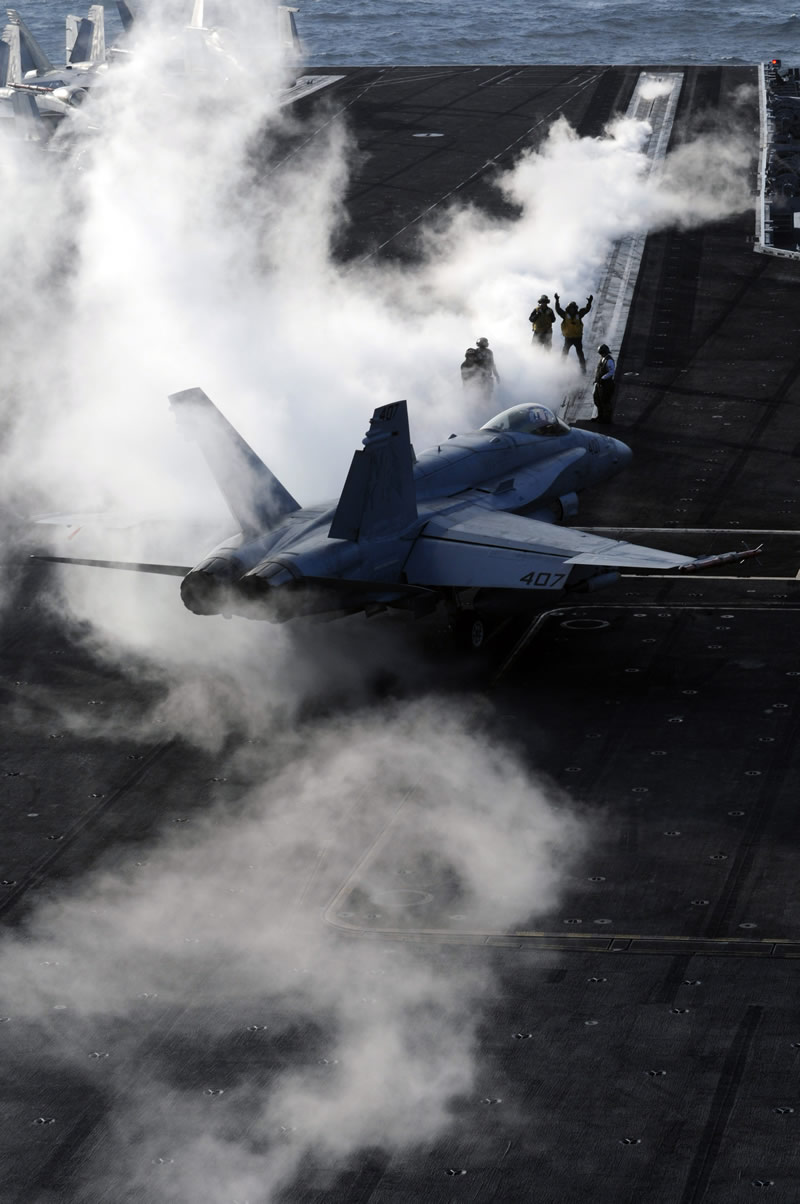
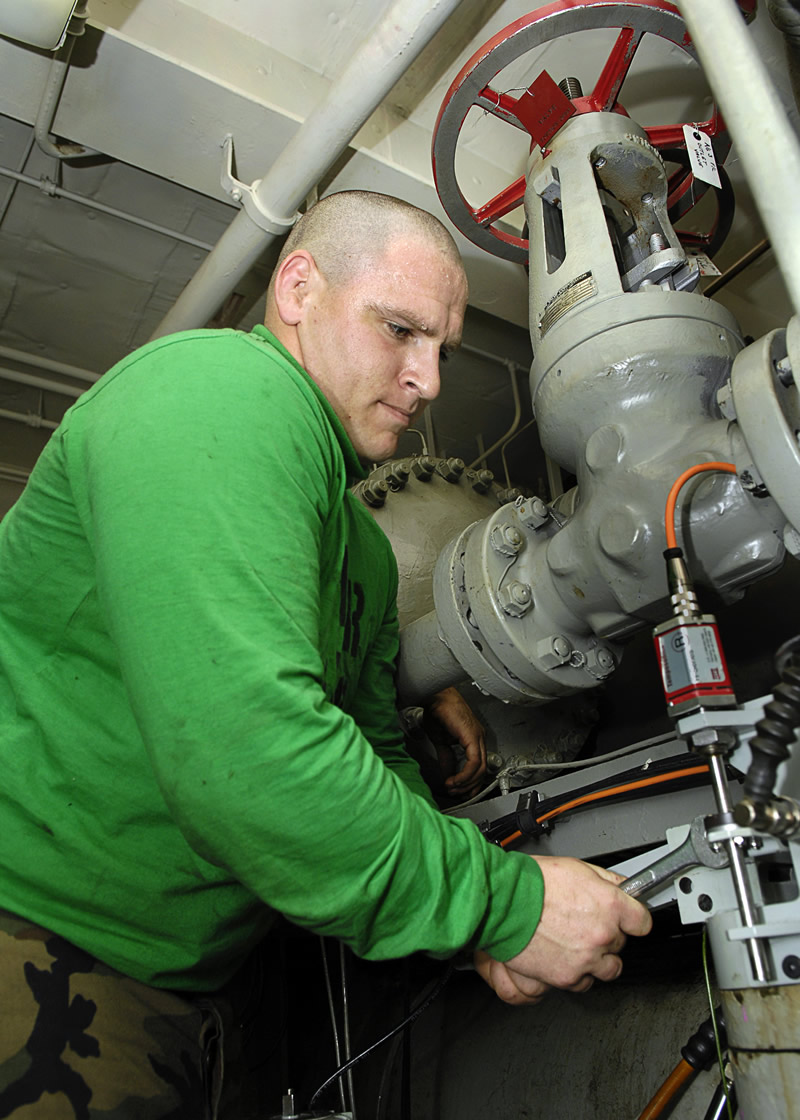
Current steam catapults use about 615 kg/ 1,350 pounds of steam for each aircraft launch, which is usually delivered by piping it from the nuclear reactor. Now add the required hydraulics and oils, the water required to brake the catapult, and associated pumps, motors, and control systems. The result is a large, heavy, maintenance-intensive system that operates without feedback control; and its sudden shocks shorten airframe lifespans for carrier-based aircraft.
To date, it has been the only option available. Hence its use on all full-size carriers.
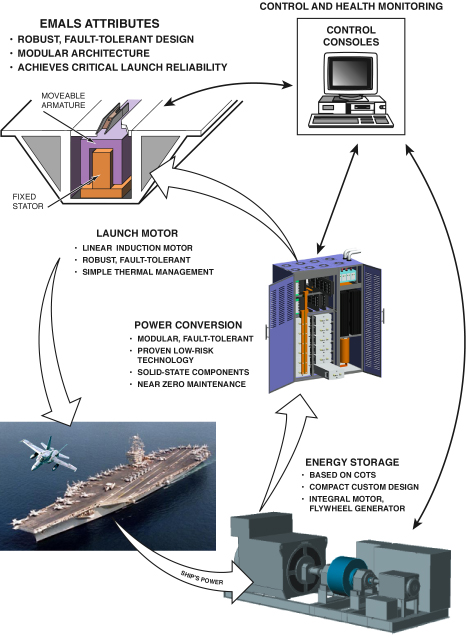
EMALS (Electro-Magnetic Aircraft Launch System) uses an approach analogous to an electro-magnetic rail gun, in order to accelerate the shuttle that holds the aircraft. That approach provides a smoother launch, while offering up to 30% more launch energy potential to cope with heavier fighters. It also has far lower space and maintenance requirements, because it dispenses with most of the steam catapult’s piping, pumps, motors, control systems, etc. Ancillary benefits include the ability to embed diagnostic systems, for ease of maintenance with fewer personnel on board.
EMALS’ problem is that it has become a potential bottleneck to the USA’s new carrier class. It opportunity is that it may become the savior of Britain’s new carrier class.
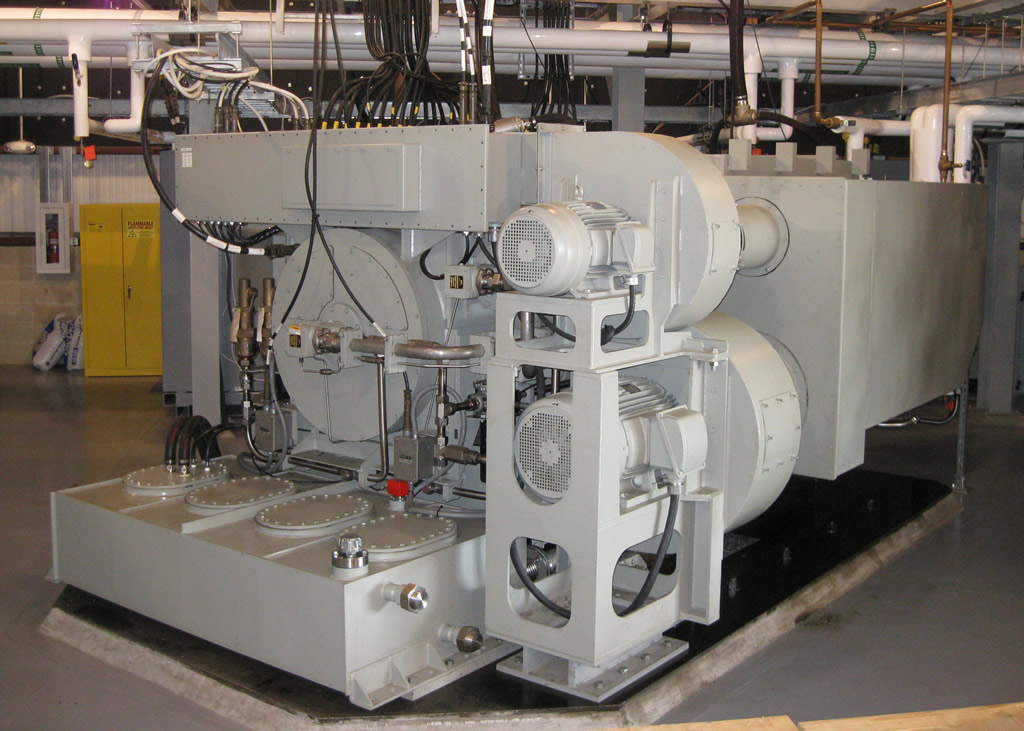
The challenge is scaling a relatively new technology to handle the required weights and power. EMALS motor generator weighs over 80,000 pounds, and is 13.5 feet long, almost 11 feet wide and almost 7 feet tall. It’s designed to deliver up to 60 megajoules of electricity, and 60 megawatts at its peak. In the 3 seconds it takes to launch a Navy aircraft, that amount of power could handle 12,000 homes. This motor generator is part of a suite of equipment called the Energy Storage Subsystem, which includes the motor generator, the generator control tower and the stored energy exciter power supply. The new Gerald R. Ford Class carriers will require 12 of each.

(click to view full)
Because it’s such a big change, it’s a critical technology if the US Navy wishes to deliver its new carrier class on-time and on-budget, and fulfill the CVN-21 program’s cost-saving promises. If EMALS cannot deliver on time, or perform as advertised, the extensive redesign and additional costs involved in adding steam catapult equipment throughout the ship could easily rise to hundreds of millions of dollars.
Launches have begun, and the 2nd phase of EMALS aircraft compatibility testing is scheduled to begin in 2012. Engineers will continue reliability testing through 2013, then perform installation, checkout, and shipboard testing, with the goal of shipboard certification in 2015.
The related Advanced Arresting Gear (AAG) sub-program will replace the current Mk 7 hydraulic system used to provide the requisite combination of plane-slowing firmness and necessary flexibility to the carriers’ arresting wires. The winning AAG design replaces the mechanical hydraulic ram with rotary engines, using energy-absorbing water turbines and a large induction motor to provide fine control of the arresting forces. AAG is intended to allow successful landings with heavier aircraft, reduce manning and maintenance, and add capabilities like self-diagnosis and maintenance alerts. It will eventually be fitted to all existing Nimitz class aircraft carriers, as well as the new Gerald R. Ford class.

(click to view full)
EMALS was also set to play a pivotal role in the British CVF Queen Elizabeth Class, until the window of opportunity shut in 2012. The F-35B’s ability to take off and land with full air-to-air armament was already a matter of some concern in Britain before the 2010 strategic defense review, which moved the heavier F-35C from “Plan B” for British naval aviation, to the Royal Navy’s preferred choice.
An F-35C requires catapults, but the Queen Elizabeth Class carrier’s CODAG (COmbined Diesel And Gas) propulsion doesn’t produce steam as a byproduct, the way nuclear-powered carriers do. Instead, it produces a lot of electricity. Adding steam would require a huge redesign in the middle of construction, and raise costs to a point that would sink the program entirely. Instead, after commissioning some research of their own with British firms, they placed a formal request to buy EMALS.
By 2012, however, the Royal Navy had discovered that adding catapults to its new carrier design was much more difficult and expensive than BAE had led them to believe. In an embarrassing climb-down, the government retreated back to the F-35B STOVL (short Take-Off, Vertical Landing) fighter, and ended efforts to add catapults to its carriers.
Program Teams
[youtube:http://www.youtube.com/watch?v=QGfoH-UCwhA]
The program is managed by US NAVAIR’s PMA-251, under the Aircraft Launch and Recovery Equipment (ALRE) program manager. General Atomics’ EMALS team includes:
* GA’s Electromagnetic Systems Division – Electromagnetic System Design and Fabrication, System; Integration, Power Electronics and Controls, Software, and Logistics;
* Alion Science and Technology – Specialty Engineering;
* Kato Engineering – Energy Storage Systems Manufacture;
* L3 Communications’ Applied Technologies Pulse Sciences – Power Electronics;
* QinetiQ’s Foster Miller, Inc. – Control Systems, System Health Monitoring;
* STV, Inc. – Test Site Design/Integration, Naval System Logistics;
* University of Texas at Austin Center for Electromechanics – Energy Storage Systems Design and Analysis.
General Atomics’ related Advanced Arresting Gear team, which is part of the larger ALRE program and can be ordered under EMALS contracts, includes:
* GA’s Electromagnetic Systems Division – Systems Integration, Cable Drum and Cable Shock Absorber, Power Electronics/ Controls/ Software, Arresting Controls Software, System Health Monitoring, Test Site Design and Integration;
* Alion Science and Technology – Shipboard Integration, Thermal Systems, Electric Power;
* Curtiss-Wright Electro-Mechanical Corporation – Electric Motor;
* ESCO Corporation – Water Twister and Mechanical Brake Systems
* ITT Corporation – Naval System Logistics
* QinetiQ’s Foster Miller, Inc. – Control Workstations
Contracts and Key Events
FY 2013 – 2020
Tests expanding to all carrier-launched manned aircraft.

(click to view full)
December 30/21: CVN 81 General Atomics won a $69.9 million deal that provides non-recurring engineering and program management services in support of the Electromagnetic Aircraft Launch System (EMALS) and Advanced Arresting Gear (AAG) system for the CVN 81 aircraft carrier, minus energy storage subsystem. The deal provides for the evaluation, production, manufacture, assembly, integration and test of engineering changes to product hardware, software, technical data, and logistics products throughout the configuration management process associated with the EMALS and AAG system for the CVN 81 aircraft carrier, minus the energy storage subsystem. Work will take place in California. Estimated completion will be in December 2023.
October 5/18: ARB General Atomics Electromagnetic Systems successfully completes testing of its Advanced Arresting Gear (AAG) in support of a US Navy propeller Aircraft Recovery Bulletin (ARB). The tests included the C-2A Greyhound, E-2C+ Hawkeye and the E-2D Advanced Hawkeye aircraft. The Advanced Arresting Gear is part of the Navy’s EMALS system developed for the new Gerald R. Ford-class aircraft carriers. The AAG sub-program will replace the current Mk 7 hydraulic system used to provide the requisite combination of plane-slowing firmness and necessary flexibility to the carriers’ arresting wires. AAG is intended to allow successful landings with heavier aircraft, reduce manning and maintenance, and add capabilities like self-diagnosis and maintenance alerts.
July 6/18: Russia to develop own EMALS Russia’s United Shipbuilding Corporation is reportedly developing a new aircraft launch system to be deployed on aircraft carriers. The company did yet not specify the characteristics of these systems or the timeframe of their development. Russia currently has one Soviet-era aircraft carrier that is equipped with a ski-jump ramp. An aircraft launch system aboard an aircraft carrier is needed to accelerate radar surveillance aircraft or planes whose thrust/weight ratio is insufficient for taking via a ski-jump ramp. Current steam catapult technology is very stressful for the aircraft involved, very maintenance intensive, and not really compatible with modern gas turbine propulsion systems. It is quite likely that the system to be developed will be an electromagnetic aircraft launch system. EMALS aims to leap beyond steam’s limitations, delivering significant efficiency savings, a more survivable system, and improved effectiveness. An electromagnetic catapult is a mechanism, which accelerates an aircraft by linear induction motors instead of steam shuttles. This principle is used on monorail railroads.
July 28/17: The US Navy has validated a software fix to the service’s Electromagnetic Aircraft Launch System (EMALS) after it was found during testing that the next-generation catapult generates excessive vibration to the aircraft when external fuel tanks are attached. However, final testing involving launches with an instrumented aircraft have been postponed for an additional year, with the service citing competing testing priorities as the reason for the delay. EMALS is one of many new technologies planned for the Navy’s Ford-class aircraft carrier fleet and is already installed on the Gerald R. Ford (CVN-78). The Ford is expected to receive the software update in 2019, following the ship’s Post Shakedown Availability.
June 28/17: Acting Secretary of the US Navy (USN) Sean Stackley has revealed that there are issues concerning the General Atomics-built Electromagnetic Aircraft Launch System (EMALS) when launching F/A-18 aircraft that are loaded with fuel tanks. Stakley told a congressional hearing on June 16 that vibrations were detected when fuel tanks were attached to Super Hornets, “so now what they’re doing is going back through the software and adjusting the system to remove that vibration.” Installed onboard the USS Gerald R. Ford aircraft carrier, EMALS is intended to enable a higher degree of computer control, more accurate end-speed control, and smoother acceleration when launching carrier-based fixed-wing aircraft, and is also intended to adapt to future carrier air-wing platforms, such as lightweight unmanned systems or future heavy strike aircraft.
January 26/17: Developments on the new Advanced Arresting Gear (AAG) have been given the thumbs up from the US Navy and will be installed on board the next USS John F. Kennedy. Designed to stop carrier-borne aircraft, the decision was made following a thorough review by an AAG Resource Requirements Review Board (R3B) last November. The 350th trap of an F/A-18E Super Hornet fighter was completed in December and the AAG team continues multisite test operations with the next type/model/series and the E-2/C-2 platform.
June 14/16: A report by the US Armed Services Committee on the 2017 National Defense Authorization Act has revealed that the Navy is having second thoughts on whether to stick to the Advanced Arresting Gear (AAG) on the Ford-class carrier or revert back to the current version. The committee says the service is reviewing the installation of the AAG on CVN-79 and CVN-80, however, since the AAG has been ordered for CVN-79, it is unlikely to switch to the arresting gear from the Nimitz-class.
July 20/15: Details have emerged regarding the technical specifications of India’s second indigenous aircraft carrier. The Indian Navy has reportedly sent requests to four shipyards to begin a design dialogue. These include Lockheed Martin, BAE Systems, DCNS and Rosoboronexport. The new design will differ significantly from the first indigenous carrier, INS Vikrant, currently under construction at Cochin; instead of a ski-jump used to launch aircraft, the new carrier will use a catapult system. The US has offered to sell the Northrop Grumman EMALS/AAG system to India under the Defense Trade and Technology Initiative, with the two sides recently establishing terms of reference for such a potential sale, as well as a joint working group.
June 15/15: The Navy awarded a $737 million contract on Friday for one Advanced Arresting Gear and Electromagnetic Aircraft Launch System shipset in support of CVN-79 (the future USS John F. Kennedy). Testing of the EMALS system aboard CVN-78 (Pre-Commissioning Unit Gerald R. Ford) has been underway for several weeks, with dead-load testing taking place last week. Manufacturer Huntington Ingalls was awarded a $3.35 billion fixed-price contract earlier in June for the construction of CVN-79. The Ford-class of carriers has recently been criticized for being overly expensive, with a Congressional cost-cap of $11.5 billion.
Apr 6/15: Export possibilities. The US would be willing to sell aircraft carrier-related technologies to India, DoD procurement chief Frank Kendall said Friday, including the EMALS catapult system. India’s aircraft carrier – the INS Vikramaditya – is not equipped with an aircraft catapult system. A joint working group has now been established to move things forward.
Aug 11/14: Testing. EMALS deck testing begin aboard CVN 78, Gerald R. Ford. The Launch Control Subsystem is the 1st below-deck testing assessment, which will try to get a handle on how all of the sub-systems work together on board. Fortunately, EMALS has personnel on hand like EMALS integrated product team lead George Sulich, who has been with the program since its inception in 1999.
The EMALS top deck components for the catapult trough are still arriving, as the last 6% of equipment to be delivered. Dead-load launches from the ship are scheduled to begin in late 2015, with manned aircraft launches to follow CVN 78’s scheduled delivery in spring 2016. Sources: US NAVAIR, “Navy’s brand new aircraft launch system embarks on below-deck testing”.
July 23/14: Recognition. PMA-251 program manager Capt. James Donnelly presents NAVAIR’s Affordability Championship Award (ACA) and Letters of Appreciation to the Advanced Arresting Gear (AAG) Thermal Management Fluid Working Group at Joint Base McGuire-Dix-Lakehurst in Lakehurst, NJ.
The AAG Thermal Management Fluid Working Group was stood up in response to failures of the AAG water twister. The cross-organizational team consisted of representatives from the Research and Engineering Office (AIR 4.0), PMA-251, the Future Aircraft Program Carrier Office (PMS-378) and the Naval Systems Engineering Directorate (SEA 05) to identify an acceptable fluid substitute that could take the heat. The group identified NALCOOL 2000 for its unique physical and chemical properties, and NAVAIR has estimated the savings as being over $1 million. Sources: US NAVAIR, “NAVAIR team members receive recognition for improved affordability work”.
July 15/14: CVN 78. General Atomics in San Diego, CA receives a $10.3 million firm-fixed-price contract modification for CVN 78 EMALS shipboard software and support. All funds are committed immediately, using FY 2011 US Navy shipbuilding budgets.
Work will be performed in San Diego, CA (79%), and Waltham, MA (21%), and is expected to be complete in October 2015. Fiscal 2011 shipbuilding and conversion (Navy) funds in the amount of $10, 267,000 are being obligated at time of award, none of which will expire at the end of the current fiscal year. The Naval Air Warfare Center Aircraft Division, Lakehurst, New Jersey, is the contracting activity (N68335-09-C-0573).
May 8/14: CVN 79. General Atomics in San Diego, CA receives a maximum unfinalized contract for $26.6 million, to buy Electromagnetic Aircraft Launch System and Advanced Arresting Gear long-lead time materials for CVN 79. $15.4 million in FY 2013 US Navy shipbuilding budgets is committed immediately.
CVN 79 is scheduled to be delivered to the U.S. Navy in 2023, so the main award doesn’t need to happen before January 2017.
GA Electromagnetic Systems Group will manufacture EMALS and AAG components at its state-of-the-art 367,000 square foot manufacturing facility in Tupelo, MS. Work will also be performed in San Diego, CA (47%); Mankato, MN (35%); Spring Grove, IL (16%), and Detroit, MI (2%), and is expected to be complete in January 2017. This contract was not competitively procured pursuant to FAR 6.302-1, by US NAVAIR in Patuxent River, MD, (N00019-14-C-0037). See also: GA, “General Atomics Awarded Initial Contract for Launch & Recovery Systems for Future John F. Kennedy Aircraft Carrier”.
March 31/14: GAO Report. The US GAO tables its “Assessments of Selected Weapon Programs“. Which is actually a review for 2013, plus time to compile and publish. There’s some added information re: EMALS/ AAG:
“Deficiencies affecting water twister components—used to absorb energy when arresting aircraft—of the advanced arresting gear (AAG) technology continue to disrupt the system’s development. Recent water twister redesign proved unsuccessful in testing last year. The Navy resolved problems with the redesign and is planning for concurrent testing. Despite these steps, the Navy forecasts AAG land-based testing to be complete in August 2016 – a new delay of nearly two years—and after the Navy has accepted CVN 78 delivery…. Land based testing for EMALS and DBR has progressed enough that program officials do not anticipate significant redesign.”
March 4-11/14: FY15 Budget. The US military slowly files its budget documents, detailing planned spending from FY 2014 – 2019. For EMALS and AAG, unit costs are listed as FY08$ 762.9 million (614.7 + 148.2) for CVN 78, and FY13$ 883.1 million (713.7 + 169.4) for CVN 79.
Jan 28/14: DOT&E Testing Report. The Pentagon releases the FY 2013 Annual Report from its Office of the Director, Operational Test & Evaluation (DOT&E). EMALS is included, as part of the CVN-78 assessment, and EMALS/AAG remain 2 of the 4 key risks for the carrier. Both are far below expected reliability levels at this stage
“Aircraft compatibility testing continued in 2013. Approximately 400 aircraft launches are being conducted using EA-18G, F/A-18E, F/A-18C, E-2D, T-45, and C-2 aircraft. The Navy has also conducted an additional 1,200 dead-load launches (non-aircraft, weight equivalent, simulated launches). Approximately 55 percent of the EMALS government furnished equipment (GFE) has been delivered to the shipyard.
At the Lakehurst, New Jersey, test site, over 1,967 launches have been conducted and 201 chargeable failures…. approximately 240 Mean Cycles Between Critical Failure… where a cycle represents the launch of one aircraft. Based on expected reliability growth, the failure rate is presently five times higher than should be expected.
….Testing to date has demonstrated that AAG should be able to recover aircraft planned for the CVN-78 air wing, but as with EMALS, AAG’s reliability is uncertain. At the Lakehurst, New Jersey test site, 71 arrestments were conducted earlier this year and 9 chargeable failures occurred. The Program Office estimates that AAG has approximately 20 Mean Cycles Between Operational Mission Failure…. 248 times higher than should be expected.”
Sept 5/13: GAO Report. EMALS and AAG delays and cost increases have hit a point where they’re creating problems for the new Ford Class carriers, driving up costs to $12.8 billion for the 1st ship, adding risk, and impairing initial capabilities.
Costs: Since 2008, EMALS-related costs for the first-of-class Gerald R. Ford [CVN 78] have risen by 133.7%, from $317.7 – $742.6 million. AAG costs have also spiked, though its 124.8% jump is only from $75 – $168.6 million. This is so despite the Navy’s 2010 firm fixed-price contracts to produce these systems for CVN 78. Even with cost caps, however, late delivery and testing means that changes have to be made to a partially-complete ship. EMALS configuration changes have already forced electrical, wiring, and other changes within the ship; and instead of just being hoisted into place, the Advanced Arresting Gear will now have to be installed in pieces via a hole cut in the flight deck. AAG continues to undergo redesigns, most recently to its energy-absorbing “water twister,” and limited EMALS testing with the delayed F-35C risks forcing further changes after the ship has been built. The Navy says that all future changes will take place within the components’ allotted space and weight, but GAO doesn’t think they can possibly know that.
Risk: Beyond redesign risks, the Navy needs to confront larger ship delivery risks. At present, EMALS isn’t scheduled for TRL 7 level maturity until FY 2014, with AAG to follow in FY 2015. The ship is due for delivery in FY 2016. Systems are already maturing so late that comprehensive testing must wait until the ship is at sea, so further schedule delays have nowhere else to go. Launch delays would mean delays to post-launch test programs, which are closely synced with ship delivery.
Once CVN 78 is built, EMALS and AAG’s reliability will continue to hamper operations. As of March 2013, both systems are far below where they’re supposed to be, with critical failures every 2-3 cycles. Since Initial Operational Test & Evaluation requires certain reliability levels between critical failures (MTBCF), continued problems could endanger the ship’s entry into service. GAO points out that the Navy’s “Duane” model for reliability growth doesn’t match their long-standing data, and even under optimistic planned growth levels, AAG isn’t supposed to hit the ~100 cycle MTBCF minimums before 2027. EMALS will take even longer, to 2032.
Unless and until they succeed, they’ll destroy the new carriers’ key 2007 promise of generating 25% more aircraft sorties per ship than the Nimitz Class. As things stand, even meeting the USS Enterprise’s OEF wartime record of 2,970 combat missions and a 99.1% sortie completion rate seems unlikely. Sources: GAO Report #GAO-13-396 | Virginian-Pilot, “The costs and doubts keep growing for carrier Ford”.
June 25/13 Testing. NAVAIR successfully launched an EA-18G Growler for the 1st time. This starts the 2nd phase of their manned aircraft launch tests, as they intend to proceed with more than 300 launches this year to test all aircraft currently launched from carrier catapults, save for E-2C Hawkeyes. They have already launched each of the Navy’s newest planes at least once. This ramp-up comes at about the same time railguns are also seeing more tests.
April 15/13: Budget. The FY 2014 Presidential Budget adds funding and/or reprogramming to FY12 and FY14 to properly reflect pricing. At $43 million, FY14 is the final year with significant spending built over the FYDP, as FY15/16 see about $2.5 million each, and there’s nothing for FY17/18. This accelerates slightly the spending plan from the FY13 president budget. Cost to completion is now seen reaching $834.7 million.
In parallel the Navy is working on demonstrating “an automation control environment for carrier shipboard equipment,” in order to reduce manpower requirements and ongoing costs. They won’t elaborate, but EMALS System Development and Demonstration (SDD) continues to be scheduled for completion by Q2 2015. To get there, the Navy intends to conduct full system and risk mitigation testing at the System Functional Demonstration (SFD) site by completing repeated cycles with deadload testing and gap variation tests. They aim to reach 4,000 deadload launches to assess reliability. Sources: US Navy PE 0603512 [PDF].
(click to view full)
March 14/13: Testing. US Navy PMA-251, the Aircraft Launch and Recovery Equipment Program Office, completes shared generator testing for EMALS at Joint Base McGuire-Dix-Lakehurst, NJ. Launches to date have involved just 1 aircraft, but the real system will have to drive up to 4 launchers. The motor generator stores the system’s energy in the inertia of its rotor, and releases that energy for aircraft launch. Hence “shared generator” testing for multiple catapults, which was completed ahead of schedule. That should make OT&E happy.
The team also used General Atomics’ CVN 78 ship-representative controls lab in Rancho Bernardo, CA, to conduct extensive modeling and simulation of the 4-catapult system. That ensured that the software and launch controls were set up correctly, before they began experiments with weighted sleds at Lakehurst on the East Coast. Sources: US NAVAIR.
Jan 17/13: DOT&E Report. The Pentagon releases the FY 2012 Annual Report from its Office of the Director, Operational Test & Evaluation (DOT&E). EMALS is included parenthetically, as OT&E addresses the next-generation aircraft carrier program. They remind that “EMALS, AAG, DBR, and Integrated Warfare Systems remain pacing items for successful delivery of the ship,” and add:
“DOT&E holds moderate concern regarding the performance risk generated by the inability to test the full four-catapult electrical distribution system prior to initial trials aboard ship.”
FY 2011 – 2012
1st ever electro-magnetic aircraft launch is an F/A-18E; Other aircraft follow. UK adopts then abandons EMALS.
[youtube:http://www.youtube.com/watch?v=CSZr58hH_cI]
(click for video)
Aug 15/12: Support. General Atomics in San Diego, CA receives a $44.5 million cost-plus-fixed-fee order for maintenance planning related to the Gerald R. Ford’s EMALS system. They’ll develop supportability analysis, repair level analysis, maintenance plans, a logistics management information database, maintenance guidance that make reliability the top priority, and create associated technical manuals and training.
Work will be performed in San Diego, CA (90%), and Lakehurst, NJ (10%), and is expected to be complete in April 2016 (N68335-11-G-0003).
May 10/12: Britain. Britain’s government confirms long-standing rumors that it would abandon the F-35C and its associated catapult modifications to 1 carrier, returning to the ski-jump deck and F-35B STOVL variant.
A DSTL report has explained some of the capabilities Britain would lose by abandoning the F-35C, but the government justifies their decision by saying that the F-35C’s improved capabilities and compatibility with American and French carriers would come at too steep a cost. Staying with the F-35C, they say, would delay Britain’s return to carrier capability from 2020 – 2023 or later, cost nearly GBP 2 billion to modify 1 of their 2 carriers, and leave the Royal Navy with no carrier capability if their converted ship needs maintenance. In contrast, the F-35B will be compatible with the US Marines and with Italy, and gives Britain the option of taking its 2nd CVF carrier out of strategic reserve when the primary carrier is out of service for long refits or maintenance dockings. UK MoD.
No EMALS for Britain
Dec 21/11: UK. General Atomics in San Diego, CA receives $17.4 million cost-plus-fixed-fee contract modification to provide engineering support for the development of EMALS and Advanced Arresting Gear configurations for Britain’s Queen Elizabeth Class Aircraft Carrier Program. One of Britain’s 2 new carriers is slated to receive the combination, and operate F-35C fighters.
Work will be performed in San Diego, CA, and is expected to be complete in June 2012. US Naval Air Systems Command in Patuxent River, MD manages the contract (N00019-11-C-0057).
Initial contract for Britain’s CVF
Nov 18/11: F-35C launches. The land-based EMALS at Lakehurst, NJ launches an F-35C Lightning II fighter for the 1st time. The EMALS launch of test aircraft CF-3 follows more than 50 steam catapult launches, and “also provided information for the United Kingdom’s Ministry of Defence as the UK proceeds with including EMALS in the Queen Elizabeth-class aircraft carrier.”
Both EMALS and the F-35C are currently in test and evaluation, but the F-35C is especially important to the new catapult. The heavy fighter will be EMALS most significant technology companion over their life cycle together, and its 70,000 pound/ 31,800 kg maximum takeoff weight places it very close to the F-14D Tomcat. EMALS and the F-35C need to demonstrate that they can help each other with maintenance costs, or the real price of EMALS will escalate significantly. US NAVAIR.
Nov 15/11: The US DSCA announces [PDF] Britain’s official request for Electromagnetic Aircraft Launch System/Advanced Arresting Gear (EMALS/AAG) long lead sub-assemblies. EMALS long-lead items include the Energy Storage System, Power Conditioning System, and Launch Control System. AAG long-lead items include Power Conditioning, Energy Absorption Subsystems, Shock Absorbers, and Drive Fairleads. The request would also cover Aircraft Launch and Recovery Equipment, spare and repair parts, support equipment, personnel training and training equipment, publications and technical documentation, software support, and other forms of U.S. Government and contractor support.
The estimated cost is up to $200 million, and the prime contractor will be General Atomics in Rancho Bernardo, CA. This is still just a potential sale, but the nature and specificity of the request strongly suggests that Britain has decided to abandon its own electro-magnetic catapult research. Now that EMALS is launching real aircraft, they can certainly reduce technical uncertainties and costs by buying it to equip one of their forthcoming Queen Elizabeth Class carriers.
British request
Sept 27/11: E-2D launches. The EMALS test site at Lakehurst launches an E-2D Advanced Hawkeye, one of the new aircraft that will accompany it onto its new carriers. EMALS has already launched an F/A-18E Super Hornet, a T-45 Goshawk jet trainer, and the Hawkeye’s C-2A Greyhound cargo cousin.
About 63 – 65 launches are planned for each aircraft type, and the 2nd phase of aircraft compatibility testing is scheduled to begin in 2012. Engineers will continue reliability testing through 2013, then perform installation, checkout, and shipboard testing, with the goal of shipboard certification in 2015. US Navy.
June 8-9/11: C-2A launches. EMALS performs 18 launches of a VX-20 Sqn. C-2A Greyhound cargo delivery aircraft, over a wide range of aircraft weights. The C-2 is also the E-2 Hawkeye AWACS plane’s base airframe. US NAVAIR.
June 1-2/11: T-45 launches. EMALS takes a new step by launching a T-45C Goshawk jet from the NAVAIR Lakehurst, NJ test site. VX-23 Sqn. made 12 successful launches with the Goshawk over this period, as part of on-going aircraft compatibility testing. US NAVAIR.
May 9/11: Delivery. General Atomics delivers the 1st set of EMALS production components to US NAVAIR, for installation in the Gerald R. Ford. NAVAIR will convey the items on to Huntington Ingalls Industries, Inc., in Newport News, VA. General Atomics.
March 9/11: Testing. Gannett’s Navy Times reports that EMALS testing has been put on hold since its 1st aircraft launch. The problem involves a gap in the handoff between linear motors, as the aircraft is accelerating. General Atomics has reportedly been working on the system’s software to cure the problem, and a system functional demonstration is planned for later in March 2011.
The information emerged during a House Armed Services Seapower & Expeditionary Forces subcommittee hearing, in response to question from Rep. Todd Akin [R-MO]. Earlier testimony indicated that the CVN 78 Gerald R. Ford is 20% complete and on schedule for September 2015 delivery, which intensifies the pressure on EMALs to deliver in time. As the publication notes: “Further EMALS delays, one source said, could begin to impact the carrier’s building schedule and threaten cost increases.” See also full HASC hearing.
(click to view full)
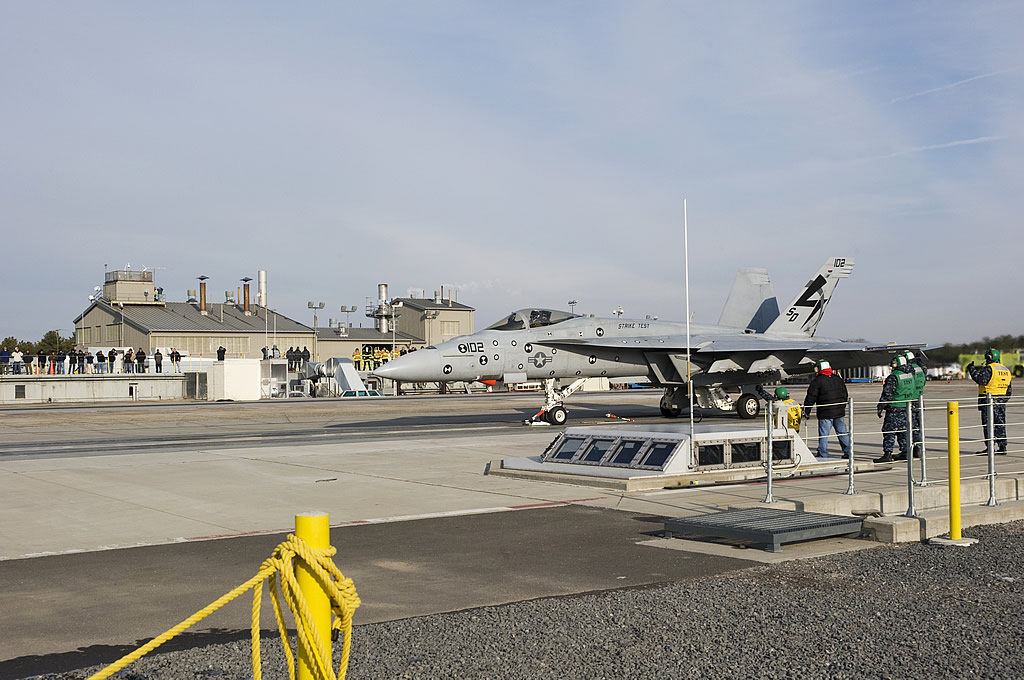
Dec 18/10: Launch! The EMALS test catapult at Naval Air Systems Command in Lakehurst, NJ successfully performs the 1st electro-magnetic aircraft catapult launch in history.
The F/A-18E Super Hornet from Air Test and Evaluation Squadron 23 (VX-23) was piloted by Lt. Daniel Radocaj. Chief Petty Officer Brandon Barr of NAWCAD’s Test Department was the “shooter,” assisted by Petty Officers 1st Class Hunsaker and Robinson, and Petty Officers 2nd Class Williams, Wong, and Simmons.
Engineers will continue system functional demonstration testing at NAVAIR Lakehurst, with test launches set to expand to C-2 Greyhound cargo aircraft and T-45 Goshawk trainers in 2011. The ALRE program manager at this time is Capt. James Donnelly, and Cmdr. Russ McCormack of PMA-251 is deputy program manager for future systems. US NAVAIR | USN Photo release | Gannett’s Navy Times.
1st EMALS Launch
Nov 8/10: UK. Babcock Deputy Chairman Lord Hesketh tells London’s Telegraph newspaper that:
“Britain could afford to run both ships – and put aircraft on them from the start – were it not for the “vested interest” of BAE Systems, the prime contractor. “We are paying twice as much as we should to get half the capability,”… said the [GBP] 5.2 billion project was a “Loony Tunes” operation that was “about to turn into a classic British disaster”… the F35 will not be ready until 2020, and plans for a jump-jet version have been scrapped – meaning an electric catapult to launch the aircraft will have to be developed at extra cost. Lord Hesketh said a far quicker and cheaper solution was to adapt the RAF’s existing Typhoons for work at sea. But he said this was less remunerative for BAE than buying dozens of new F35s.”
Note the bit about “an electric catapult.”
Oct 29/10: UK. In an interview with BBC Scotland during a visit to the Govan shipyard, Defence Secretary Liam Fox said that estimates for the addition of catapults to the Queen Elizabeth Class ranged “upwards from GBP 500m,” with studies on going to pick a catapult system and determine likely costs.
Meanwhile, Minister for Defence Equipment, Support and Technology Peter Luff confirmed that the government had not yet been decided whether one or both carriers would be converted, what type of catapult system to use, procurement approach, or delivery dates, though the SDSR would give a planned 2020 in-service date for Britain’s lone operational carrier. Defence Management.
FY 2009 – 2010
Initial orders; Cost jumps & concurrency concerns; EMALS survives review; Testing; UK becomes interested in EM launch.
legacy system?
(click to view full)
Sept 23/10: US NAVAIR announces that EMALS has completed catapult commissioning testing for its system functional demonstration (SFD), with no-load and dead-load launches in all areas of the required performance envelope, including a 154-knot dead-load launch equivalent to the weight of an F/A-18E Super Hornet.
Cmdr. Russ McCormack, PMA-251 deputy program manager for future systems, notes that EMALS hardware production is occurring independently from the SFD, “as component operation was previously proven in the High Cycle Testing and Highly Accelerated Life Testing phases of the program.”
Moving into SFD as of Sept 12/10 marks the opening of the test program window for the F/A-18E launch and future launches. The F/A-18E is currently being instrumented and test data is being analyzed in order to obtain flight clearances and launch approval for later in 2010.
Aug 23/10: Leadership. NAVAIR PMA-251, The Aircraft Launch and Recovery Equipment (ALRE) Program Office gets a new program manager, as Rear Adm. Randy Mahr leaves PMA-251 to become NAWCAD(Naval Air Warfare Center Aircraft Division) Commander. He is replaced by his deputy, Capt. Jim Donnelly, who became the deputy program manager for future systems – EMALS and the Advanced Arresting Gear (AAG) in April 2008. Donnelly is a 1986 U.S. Naval Academy graduate and naval aviator, whose previous stints include piloting EC-130Q Hercules and E-6A/B Mercury national command aircraft, Catapult and arresting gear officer and assistant air officer on the USS Theodore Roosevelt (CVN-71), Executive officer and commanding officer of the VQ-3 Ironmen squadron, and Program Executive Officer for NAVAIR Tactical Aircraft Programs. NAVAIR’s release adds that:
“The future Electromagnetic Aircraft Launch System (EMALS) full-scale test catapult went operational for the first time at NAVAIR Lakehurst, N.J., and has since demonstrated max speed of 180 knots, or 207 miles per hour. The program is scheduled to launch its first test aircraft later this year.”
July 20/10: UK. Jane’s reports that the UK Ministry of Defence (MoD) is funding development of an electromagnetic catapult system for the Royal Navy’s Queen Elizabeth-class aircraft carriers, in case the F-35B STOVL is abandoned. Rather than go through the involved process of joining America’s EMALS program, however, they appear to have contracted with Converteam, who was already developing an electro-magnetc launch systems for UAVs under an April 2006 EMKIT(Electro Magnetic Kinetic Integrated Technology) contract.
A GBP 650,000 (about $1 million) EMCAT (electro-magnetic catapult) contract was reportedly awarded in July 2009, as a follow-on effort to continue the design, development and demonstration of high-power electrical systems for its EMCAT system. In October 2009, a smaller-scale demonstration of both controlled acceleration and braking was performed using electromagnetic linear motors. This could lead to the same core systems being used for launch and recovery. New Low Voltage linear motors with reduced end effect coils were delivered in early 2010, paving the way for the design of medium voltage linear motors which will help Converteam scale up their design. Jane’s Naval Intelligence | Converteam project page.
May 5/10: Testing Problem. The Newport News Daily Press reports that in January 2010, a software glitch caused one of the EMALS shuttles to reverse course and slam into other equipment during one of the initial full-scale land-based tests. It caused $52,000 worth of damage, set back the testing program by about 3 months, and set back the overall EMALS program by 7 months.
“Despite the problems, the Navy’s program manager for the launch system, Capt. Randy Mahr, said the delay would not affect the delivery of the Ford… scheduled to enter the fleet in 2015. The Navy and General Atomics had planned to begin launching aircraft from the land-based system this summer, but that’s now been delayed until later this fall, Mahr said… The things that are delaying me right now are software integration issues, which can be fine-tuned after the equipment is installed in the ship.”
That particular software problem has since been fixed, and more than 750 no-load test runs of the equipment have been done, with about 250 at full speed. Dead loads with weighted sleds are the next step, aircraft trials are expected in fall 2010, and the first pieces of EMALS equipment are now scheduled to begin arriving in Newport News for installation in May and June 2011.
April 1/10: SAR. EMALS is cited in the Pentagon’s April 2010 Selected Acquisitions Report for major cost increases. The Pentagon’s own decisions are causing even larger cost increases in the carrier program, but EMALS’ contribution is still quite substantial at almost $1.3 billion in additional costs:
“Program costs [for the next-generation aircraft carrier] increased $5,426.4 million (+15.5%) from $35,119.1 million to $40,545.5 million, due primarily to the shift from a four-year to five-year build cycle (+$4,131.2 million), which placed the program on a more fiscally sustainable path while continuing to support a minimum of 11 aircraft carriers through fiscal 2040. Additional increases resulted from revised cost estimates for the Electromagnetic Aircraft Launch System (EMALS) (+$1,292.6 million)…”
See also Newport News Daily Press.
SAR increase
March 30/10: GAO Report. The US GAO audit office delivers its 8th annual “Defense Acquisitions: Assessments of Selected Weapon Programs report. For the EMALs and Advanced Arresting Gear projects:
“While CVN 21 program officials stated that the EMALS program is on schedule to deliver material to the shipyard when it is needed for construction, concurrent EMALS testing and ship construction continue to present cost and schedule risks to the program… As a result of the [2009 EMALS] tests, the program identified design changes that are necessary to improve the performance of EMALS, but add cost and schedule risk to the program… The Navy plans to test EMALS with actual aircraft in summer 2010. The Navy awarded a not-to-exceed fixed-price production contract to General Atomics for EMALS and the advanced arresting gear in 2009. At the time of award, the contract price had not been finalized. The Navy expects to finalize the price of this contract in March 2010.”
“The advanced arresting gear includes seven major subsystems. Programs officials expect that six of the subsystems will be mature after analyzing data from a recent reliability test. The remaining subsystem – control system software – will remain immature until integrated [AAR] land-based testing with actual aircraft occurs in fiscal year 2012. This testing will overlap with the first arresting gear deliveries to the shipyard.”
March 25/10: Testing. Federal Business Opportunities issues pre-solicitation #N00019-10-R-0060, “Corrosion Resistant Study Reports & Test Equipment.” Excerpt:
“NAVAIR Hwadquarters, Patuxent River, MD intends to enter into a sole source contract with McGee Industries, Inc. for one simulated Electromagnetic Aircraft Launch System (EMALS) simulated Trough Exposure Test Rig and engineering reports on environmental effects on fatigue and fracture mechanical properties of EMALS materials. The Government intends to procure these reports and test equipment under the authority of 10 USC 2304( c)(1) as implemented by the Federal Acquisition Regulation Section 6.302-1. Award to an alternate source would result in a substantial duplication of costs that could not be recovered through competition. McGee Industries has performed start-up studies using techniques that are not commercially available at standard testing labs, and is the only source possessing the requisite background knowledge and technical data necessary to provide the required support without substantial re-work at additional program costs. Firms that believe they can satisfy this requirement are encouraged to identify themselves…”
Nov 12/09: Ready. NAVAIR’s Aircraft Launch and Recovery Equipment Program Office (PMA-251) hosts a ribbon-cutting ceremony for the EMALS full-scale catapult test site at Joint Base McGuire-Fort Dix-Lakehurst, NJ. In an interesting twist, the EMALS armature is used to cut the ribbon.
Engineers at JBMDL will begin dead-load testing this fall with the first aircraft launch scheduled for summer 2010 with an F/A-18 Hornet. US NAVAIR.
Lakehurst ready
Nov 9/09: CVN 78. General Atomics in San Diego, CA receives a $102.2 million modification to the unfinalized EMALS Ship-set contract to provide for the production of 1 counterpart advanced arresting gear system ship-set for CVN-78. While EMALS will serve as the Ford’s launch technology, the Advanced Arresting Gear will offer related improvements around carrier landings, using a system based on electric motors rather than the Mk7 hydraulic system used with current arrester wires. Unlike EMALS, AAG is also slated for refits to existing Nimitz class carriers.
Work will be performed in San Diego, CA (35%); Mt. Pleasant, PA (28%); Tupelo, MS (15%); Waltham, MA (12%); and Aston, PA (10%), and is expected to be complete in September 2015. The Naval Air Warfare Center Aircraft Division in Lakehurst, NJ manages the contract (N68335-09-C-0573).
CVN 78 AAG
Oct 20/09: AAG testing. General Atomics Electromagnetic Systems Division (GA-EMS) announces the end of 1st phase Extended Reliability Testing (ERT) of the Advanced Arresting Gear (AAG) at its Rancho Bernardo, CA facility. Phase 1 cycled the AAG hardware through more than 5,400 shipboard-representative “arrestments” to obtain reliability growth data, and to prove out the real-time control software.
Future dead-load arrestment testing will begin in spring 2010, followed by aircraft arrestment testing scheduled for late 2010. ERT Phase 2 will begin February 2011 in GA’s Tupelo, MS manufacturing and test facility, and will test the equipment over an additional 104,000 cycles. GA-EMS believes that the transfer will help reduce program costs.
Sept 28/09: Testing. US Navy NAVAIR announces that EMALS has completed Phase 1 of Highly Accelerated Life Testing (HALT) and the 2nd phase of System Functional Demonstration (SFD) commissioning.
HALT tests look at the system’s launch motor will perform under at-sea conditions, and provides data to verify peak performance, even in extreme conditions. SFD testing replicates full-scale launching capabilities, and SFD commissioning ensures that the system is ready for upcoming test launches of dead-loads (weighted, steel-framed sleds) and aircraft.
Phase 2 of SFD commissioning integrated and tested all power components of the system with the launch controller. The upcoming 3rd phase will integrate the remainder of the system, and test the basic ability to convert electrical power to mechanical force. The testing culminates with the launch of dead-load weights and non-operational test aircraft at Naval Air Engineering Station Lakehurst, NJ; commissioning with dead loads is scheduled to begin during fall 2009.
Aug 17/09: SDD. Inside the Navy reports that:
“The Navy has added another $24 million to the budget for a revamped research, development, test and evaluation (RDT&E) effort for the Electromagnetic Aircraft Launch System aboard the new Gerald R. Ford class of aircraft carriers bringing FY-09 spending on developing the troubled program to more than $168 million.”
June 30/09: CVN 78. General Atomics in San Diego, CA received an unfinalized $573 million ceiling-priced contract to build the EMALS shipset for the Gerald R. Ford [CVN 78]. This is added to a $43 million long-lead contract (q.v. March 27/09), creating a total of $613 million.
Work will be performed in San Diego, CA (49%); Tupelo, MS (19%); Mankato, MN (12%); Waltham, MA (4%); and various locations across the United States (16%), and is expected to be complete in September 2015. This contract was not competitively procured, pursuant to FAR 602-1. The Naval Air Warfare Center Aircraft Division in Lakehurst, NJ manages this contract (N68335-09-C-0573).
CVN 78 main
April 15/09: Review. Reuters reports that the U.S. Navy has completed a major review of EMALS that weighed possible technical, costs, and schedule risks. The Navy has decided to proceed, on the grounds that EMALS is the best option for keeping the program on schedule, vs. redesigning and building the ship for steam. The system’s potential cost savings are also listed as a factor by US Navy spokesman Lt. Cdr. Victor Chen.
The Navy is reportedly starting detailed, fixed-price contract negotiations with General Atomics. If that becomes the basis for a renegotiated contract, it would shift the risk of delays or additional work onto the contractor.
EMALS survives
April 3/09: Naval site Information Dissemination runs an article assessing EMALS’ current state, and the Navy’s contention that the system poses no schedule risks. The title: “Wal-Mart Called, They Want Their Yellow Smiley Face Back.”
Despite the title, the background is valuable, and the discussion is substantive. Is EMALS a technology too far? Or is it just a complex technology with more issues than expected, each of which is being dealt with but at a rate that creates some schedule concerns? What, if anything, does a realistic Plan B look like? Delay construction until EMALS is ready, given its promised operations costs savings? Extensively redesign CVN 78 for steam catapults? Buy another CVN 77 design ship instead, and store the pieces that have already been made?
March 31/09: Review. The Daily Press of Virginia reports:
“We’re still conducting a review to assess and mitigate risks in the program cost, schedule and performance of EMALS,” said Lt. Cmdr. Victor Chen, a Navy spokesman. “At this point, EMALS is still the launching system of record for (the Ford).
…If EMALS is scrapped for the Ford, the shipyard would have to re-engineer the carrier to support the old steam-driven catapults used on previous ships. That process, which includes running thousands of feet of new pipe to and from the Ford’s propulsion system, could extend the construction schedule by up to a year and is expected to cost several hundred million dollars.”
“At this point…” is perhaps not the ringing endorsement one had hoped for.
March 30/09: GAO report. The US government’s GAO audit office issues GAO-09-326SP: “Defense Acquisitions: Assessments of Selected Weapon Programs.” With respect to EMALS and the CVN-21 program, it says that 10/14 technologies are either fully mature, including the nuclear propulsion and electrical plant, or approaching maturity. Of the remaining 4 immature technologies:
“…the development and design of the electromagnetic aircraft launch system (EMALS), the advanced arresting gear, and the dual band radar (composed of the volume search and multifunction radars) present the greatest risk to the ship’s cost and schedule.”
Ominously, it adds:
“A February 2008 program assessment recommended a number of changes to the EMALS program to improve performance. The Navy re-planned the test program and changed the management approach. The CVN 21 program office is now responsible for overseeing EMALS production and ship integration, rather than the Naval Air Systems Command. In addition, EMALS will no longer be provided as government-purchased equipment. Instead, the shipbuilder will purchase EMALS, giving it a more direct role in managing the integration on CVN 78. The cost impact of this change has not been finalized.”
There are also schedule concerns:
“Problems during EMALS development have already resulted in cost growth and schedule delays. In order to meet CVN 78’s delivery date, the Navy adopted a strategy that will test, produce, and ultimately install EMALS with a high degree of concurrency. In September 2008, the contractor completed the first round of high- cycle testing, gaining confidence in the performance of the generator–a source of past problems. Contractor-led integrated land-based system testing will not be complete until the end of fiscal year 2011–2-years later than estimated in December 2007. Assuming no further delays, EMALS will not demonstrate full performance of a shipboard ready system until at least 7 months after installation on CVN 78 has begun…”
March 27/09: CVN 78. Northrop Grumman Shipbuilding, Inc. in Newport News, VA received $43 million, unfinalized modification to a previously awarded contract (N00024-08-C-2110). The contract covers long lead-time materials that must be ordered early, in order to ensure timely production of Gerald R. Ford’s [CVN 78] EMALS catapults. Materials bought will include Energy Storage Subsystem (ESS) Induction Motor Stator Assemblies, ESS Induction Motor Rotor Assemblies, ESS Exciter Stator Assemblies, ESS Exciter Rotor Assembly, ESS Rectifier Assemblies, ESS Main Rotor Assemblies and Power Conversion Subsystem Rectifier material components.
Work will be performed in North Mankato, MN (74%); Mt. Pleasant, PA (17%); and San Diego, CA (9%), and is expected to be complete by November 2012. The US The Naval Sea Systems Command in Washington Navy Yard, D.C. manages this contract.
March 19/09: Testing. NAVAIR’s EMALS developers have given a green light to engineers at General Atomics in Tupelo, MS to engage in full power train testing of EMALS motor components.
This second phase of High Cycle Testing (HCT-2) will involve full power train testing, and will give a specific prediction of EMALS operations. HCT-2 will also perform environmental qualification testing, which is used to confirm the adequacy of the equipment design and safety under normal, abnormal, design basis event, post design basis event and in-service test conditions. US NAVAIR.
Dec 23/08: Infrastructure. Sauer, Incorporated in Jacksonville, FL wins an $8.3 million firm-fixed-price task order to design and build an Electromagnetic Launch RDT&E(Research, Development, Test, and Evaluation) facility at Naval Support Activity South Potomac in Dahlgren, VA (N62477-04-D-0036, #008).
Work is expected to be complete by May 2010. The Naval Facilities Engineering Command, Washington in Washington, DC received 5 proposals under an existing multiple-award construction contract.
FY 2004 – 2008
From development contract to Preliminary Design Review; Considerable worry that EMALS will be ready in time.
(click to view full)
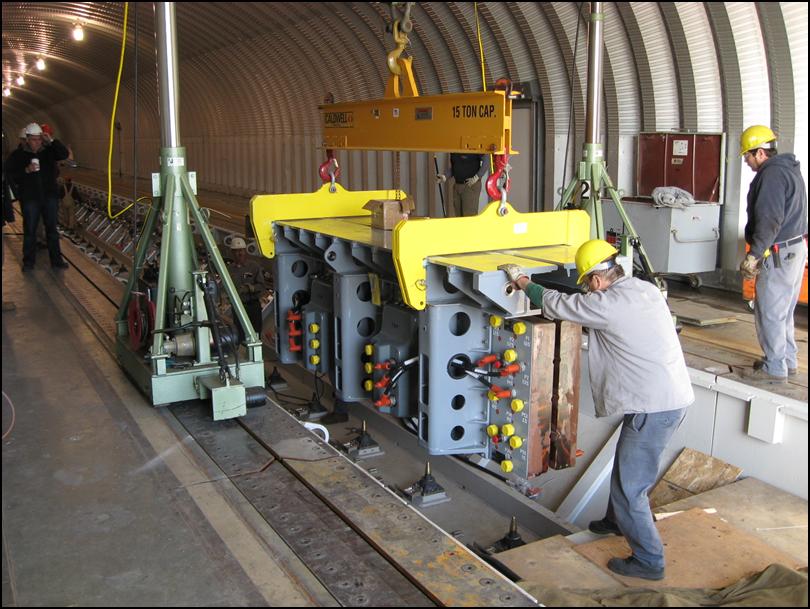
Sept 3/08: Testing. EMALS reaches the 10,000 High Cycle Testing, phase 1 (HCT-1) milestone at the General Atomics test facility in Tupelo, MS. HCT-1 was conducted in order to verify the performance capabilities of EMALS’ electrical and thermal power equipment, and the shipboard cycling rate of the energy storage subsystem. Those tests reduce the risk of structural failure, strengthen confidence in EMALS’ reliability, and help to validate both system life predictions and electromagnetic interference predictions.
EMALS is scheduled to begin its second phase of HCT in winter 2009. US NAVAIR.
March 14/08: During US House Armed Services Seapower and Expeditionary Forces Subcommittee hearings about the proposed the FY 2009 budget, chairman Gene Taylor [D-MS] discusses the state of the program:
“Another very risky program is the new aircraft carrier. Not that the Navy and Newport News Shipyard don’t know how to build aircraft carriers, they do. However, one of the major new technologies, the electro-magnetic launch system, or EMALS, has not even been tested in a shipboard configuration and the ship is already under construction. Just this last week the Navy requested an additional $40 million dollars for continued development of EMALS because, and I quote, ‘the contractor underestimated design and production cost.’ The cynic in me would say the contractor purposefully low-balled the bid to get the contract knowing full well the Navy would be forced to pay whatever the true costs of the system turned out to be. Perhaps we should have built another Nimitz class carrier until the research and design for EMALS was complete.”
Read “US Navy’s 313-Ship Plan Under Fire in Congress” for more.
April 17/08: The first full size test motor generator for the Navy’s Electromagnetic Aircraft Launch System (EMALS) has now been assembled, and finished its 30 days of factory acceptance testing at Kato Engineering’s plant in Mankato, MN on April 11/08.
The motor generator weighs over 80,000 pounds, and is 13.5 feet long, almost 11 feet wide and almost 7 feet tall. It’s designed to deliver up to 60 megajoules of electricity and 60 megawatts at its peak. In the 3 seconds it takes to launch a Navy aircraft, that amount of power could handle 12,000 homes. This motor generator is part of a suite of equipment called the Energy Storage Subsystem, which includes the motor generator, the generator control tower and the stored energy exciter power supply. The new Gerald R. Ford Class will require 12 of each, and 5 of each are currently being manufactured under General Atomics’ Systems Development & Demonstration contract. One is slated for component level testing, and 4 will be installed and used for system level testing at the Lakehurst, NJ, EMALS catapult site. NAVAIR release.
Nov 28/07: General Atomics’ Electromagnetic Aircraft Launch System (EMALS) catapult recently passed its final critical design review (CDR), led by Mr. Dave Cohen of NAVAIR’s Systems Engineering competency. The team spent a week thoroughly reviewing the entire EMALS program, and determined that the design is technically compliant with requirements and properly documented, although “a few open action items remain.” As noted above, EMALS is one of the new technologies that will be critical to the CVN-21 Class’ ability to fulfil its cost-saving promises and enter service on time.
Capt. Stephen Rorke, Aircraft Launch & Recovery Equipment program manager thanked the team for open and honest dialog during the months leading up to the CDR as evidenced by the fact “the team knew about all open issues prior to the review and that no issues of major significance surfaced during the CDR.”
The next step in the process is to begin installing the full size, ship representative EMALS equipment in the recently completed EMALS test facilities at Naval Engineering Station Lakehurst, NJ. The EMALS equipment installation is scheduled to begin in mid 2008, with actual testing to begin in early 2009 and continue throughout 2009. The first components of the EMALS equipment is scheduled to be delivered to Northrop-Grumman Newport News Shipbuilding in Norfolk, VA for installation in the Gerald R. Ford [CVN-78] in 2011. The USS Gerald R. Ford is scheduled to be delivered to the US Navy in 2015. NAVAIR release.
CDR
Nov 27/07: Infrastructure. Officials at the Lakehurst Naval Base hold a ribbon-cutting ceremony to acknowledge the completion of the base’s new Electromagnetic Aircraft Launch System (EMALS) facility. General Atomics will have the system’s equipment installed at the Lakehurst base in the beginning of March 2008, with the strong intent of beginning testing in February 2009. Manchester Times story.
March 17/06: SDD. General Atomics’ team receives $6 million for engineering changes to the EMALS catapult system.
April 2/04: General Atomics is awarded an SDD $145 million contract to design, build, integrate test and support a full scale, full length, shipboard representative Electromagnetic Aircraft Launch System (EMALS) for NAVAIR Lakehurst, at the Naval Air Engineering Station Lakehurst, NJ. The contract is the final step in a multi-phase research and development acquisition program to replace the current steam catapults used on aircraft carriers. According to the Navy release, “General Atomics, based in San Diego, will have its equipment installed at Lakehurst by 2006 and conduct testing in 2007-2008.”
The EMALS land based support facility is to be built by Hensel Phelps Construction Co., of Aurora, CO under a $20.5 million contract, and is expected to be complete by December 2005 [DID: the ribbon cutting would actually take place in November 2007, and construction will last to late 2008]. It will include building the infrastructure, supporting buildings and related utilities for the EMALS program. US Navy | General Atomics.
EMALS base SDD
Background: EMALS & AAG
* NAVAIR, via WayBack – Aircraft Launch & Recovery Equipment (ALRE).
* NAVAIR – Electromagnetic Aircraft Launch System (EMALS).
* General Atomics – Electromagnetic Aircraft Launch System (EMALS).
* GlobalSecurity.org – Electromagnetic Aircraft Launch System – EMALS
* NAVAIR PMA-251 – Advanced Arresting Gear Program.
* General Atomics – Advanced Arresting Gear.
* QinetiQ North America – Advanced Naval Control Systems (ANCS). Includes EMALS/AAG work.
* Smithsonian Air & Space Magazine, via WayBack (Dec 2007 – Jan 2008) – How Things Work: Electro-Magnetic Catapults.
* American Heritage Magazine, via WayBack (Spring 2006) – Shot Into the Air. A very good look at the use of naval catapults from their earliest days to the forthcoming EMALS. Includes a fine conceptual schematic of the modern steam catapult.
* Electronics Design News (April 11/02) – Electronics poised to replace steam-powered aircraft launch. See esp. the references and linked diagrams.
Official Reports
* US GAO (Sept 5/13, #GAO-13-396) – Ford-Class Carriers: Lead Ship Testing and Reliability Shortfalls Will Limit Initial Fleet Capabilities. EMALS and AAG are big contributors to this situation.
News & Views
* Aviation Week (July 13/07) – Risk Areas In CVN 21 Cost, Development [dead link]
* Defense Tech, via WayBack (April 5-7/07) – EMALS: Next-Generation Catapult and Building a New Ford. Latter includes some interesting background re: EMALS integration challenges and solutions.
Background: The Carriers
* DID FOCUS Article – Design & Preparations Continue for the USA’s New CVN-21 Super-Carrier.
* DID (Dec 19/05) – Costing the CVN-21: A DID Primer. Sets the record straight on the CVN-21 Class’ cost per ship, and also goes into detail re: the lifetime operating cost savings expected as a result of design and technology innovations.
* DID FOCUS Article – Design & Preparations Continue for Britain’s New CVF Future Carrier (updated). At one point, EMALS was slated for use in this class as well.