

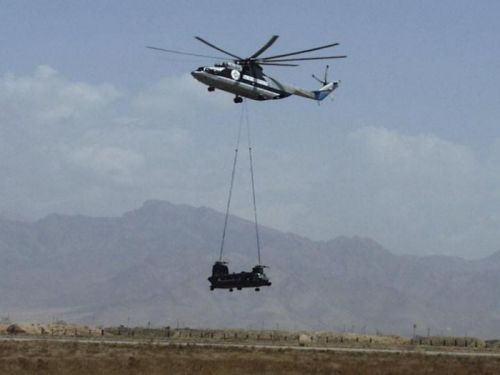
Chinook, Afghanistan
(click to view full)
As the 2007 Paris Air Show drew to a close, France and Germany confirmed the rumors and signed a joint declaration of intent to set up a heavy-lift helicopter program. The French DGA procurement agency’s announcement lists an intended in-service date of around 2020. The new machines would be designed to carry personnel, light armored vehicles, and/or cargo, with good performance under a wide range of conditions including hot weather and high altitudes (both of which reduce helicopter performance due to thinner air). The project is known as Helicoptère de Transport Lourd (HTL) in France, and Future Transport Helicopter (same FTH in Deutsch) in Germany.
In terms of future force structure, these helicopters would replace Germany’s aging CH-53G Mittlerer Transporthubschrauber, and offer France a heavy-lift helicopter option for its future force that would sit above its planned NH90s and/or AS 532 Cougars. Both countries would rely on the forthcoming Airbus A400M tactical cargo plane and its 35-tonne capacity for larger loads or longer distances.
Note that some reports have stated that the new helicopter would be “capable of carrying a 30-tonne load.” Unless they’re planning to use gyrodyne technology or something similarly revolutionary, this is very, very doubtful. Meanwhile, the program may be morphing into an off-the-shelf competition, complete with international contenders:
Carry That Weight: The Specifications

Note that 30 tonnes = 30,000 kilograms, or 66,138 pounds. The world’s largest helicopter by far is Russia’s Mi-26 “Halo”; at 56 tonnes/ over 120,000 pounds, it has almost twice the maximum takeoff weight of the USA’s heavy-lift CH-47 Chinook, and can carry 20 tonnes (44,000 pounds) while chug-a-lugging aviation fuel at an astonishing rate. It is far, far more likely that the new helicopter’s planned capacity is 30,000 pounds. This would be about the capacity planned for the US Marines’ new CH-53K heavy-lift helicopter under ideal conditions, and a bit more than Boeing’s new CH-47F Chinook.
Articles like Eurocopter’s submission to European ROTOR & RESCUE Journal in Spring 2006 offer better glimpses of the proposed specifications. Earlier HTL/FTH specifications had also specified a 36 tonne helicopter – but that was maximum takeoff weight, including the weight of the helicopter itself. Other requirements reportedly include a 10-13t payload (22,000 – 28,600 pounds) at 500km range, transport of up to 70 soldiers, and state of the art technology to improve capabilities and maintenance costs. Another important specification is the reported requirement to transport new armored vehicles like the mine-protected Dingo, or the Fennek reconnaissance vehicle, inside the helicopter’s cabin.
A Sept 4/07 Defense Aerospace report added these details:
“In terms of operational requirements, France wants the new helicopter to be able to transport two VBL light armored vehicles and, possibly, a VAB 13-tonne vehicle as slung cargo. It wants to be able to fly two tactical missions of up to 600 km each without refueling, Mestre said, which implies a maximum range of 1,000-1,500 km. In-flight refueling is a possibility, but is not essential.”
(click to view full)
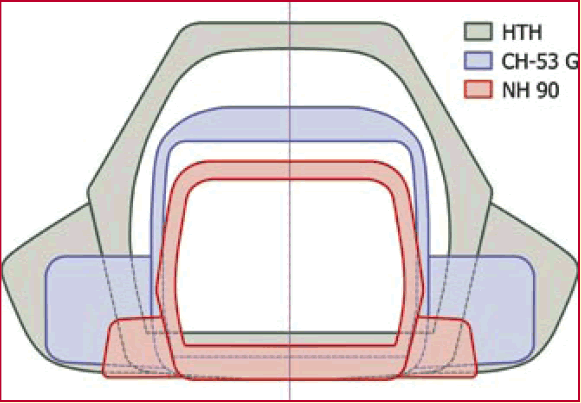
Earlier reports in European publications had set the cargo weights at around 10t-13t, and designing a transport helicopter to the specifications of the vehicles one wishes to carry is smart. Specification have yet to be finalized; still, examining the above statement, and noting the corresponding German vehicles named in other reports, may help bring the project’s dimensions and cargo capacities into focus.
Since the helicopter is very unlikely to have a cargo space 4.1 m wide, 2 VBLs inside take up at least 8.75m/ 315 inches in length (3.87m each + 1m space). Widths of the Fennek, Dingo, and VAB are all about 2.5 meters/ 98 inches, while the VBL is just 2.02m/ 80 inches wide; if internal carriage of either the Fennek or Dingo is desired, that creates a width requirement around 2.7m/ 106 inches. The helicopter can get away with about 2.3m/ 91 inches of cargo space height if the Dingo can be carried externally; otherwise, the requirement rises to at least 2.5m/ 98 inches and could well be higher. Comparisons based on a notional Eurocopter comparative diagram featured in European ROTOR & RESCUE Journal suggest a close set of figures: 2.8m wide at the floor, rising to 3.2m at the widest point; and 2.9m high.

(click to view full)
With respect to weights, a VBL’s (Vehicule Blinde Leger) combat weight lists as 3,590 kg, so 2 would weigh 7.2t/ 15,850 pounds. Germany’s Fennek reconnaissance vehicle, in contrast, has a combat weight of 9.7t/ 21,500 pounds. The VAB (Vehicule de l’Avant Blindé) is a standard of the French armed forces and Foreign Legion; its maximum unladen weight for the 6×6 version is 10,500 kg/ 22,600 pounds, and maximum combat weight with all options ranges from 13,600 kg/ 29,920 pounds (4×4) to 14,800 kg/ 32,560 pounds (6×6). It is not a “13t vehicle,” however, which usually denotes a carrying capacity of 13 tonnes. Germany’s Dingo 2, which has been mentioned as a possible cargo load, has an unladen “curb weight” of 25,300 pounds/ 11.5t.
Here are internal dimensions and loads for some currently serving reference platforms; for the CH-47F and CH-53K, assume similar dimensions and slightly higher carrying capacity, with higher improvements planned for the CH-53K. Note that loads are usually calculated at maximums that assume near-sea level flight, normal temperatures, and little range required; carried weight decreases with longer desired ranges, or in hot weather and/or high altitudes[1]:
* HTL-min?: 9m/ 354 in length; 2.7m/ 106 in width; 2.5m/ 98 in height; 10.5t/ 23.1k lbs internal; 15t/ 33.1k lbs external.
* CH-47D: 9.3m/ 366 in length; 2.29m/ 90 in width; 1.98m/ 78 in height; Boeing says only 24k lbs overall “useful load”.
* CH-53E: 9.14m/ 360 in length, 2.29m/ 90 in width, 1.98m/ 78 in height, 13.6t/ 30k lbs internal; 14.5t/ 32k lbs external.
* EH-101: 6.5m/ 256 in length; 2.25m/ 89 in width; 1.8m/ 71 in height; 3.05t/ 6.7k lbs internal, 5.44t/ 12k lbs external.
* Mi-26T: 12.1m/ 476 in length; 3.29m/ 130 in width; 3.17m/ 125 in height; 20t/ 44.1k lbs internal; same external.
* NH90: 4.8m/ 189 in length; 2m/ 79 in width; 1.58m/ 62 in height; 2.5t/5.5k lbs cargo
 |
See DID’s full vehicle & helicopter table – contributions welcome. |
Hello, Goodbye: Off the Shelf Contenders

(click to view full)
France and Germany also intend to open this potential project to other European partner nations under the framework of the European Defence Agency (EDA), and to consider other non-EDA partner offers. As one might imagine, the EDA is very enthusiastic about that aspect, but many European countries already have future helicopter options in place – either EH101s or CH-47Fs. As of September 2007, the offer has stirred little apparent interest.
More participants would certainly help loosen one looming constraint: available R&D funds. Indeed, the Sept 4/07 Defense Aerospace report suggested that the HTL/FTH project might not have much of a research & development component at all. Francois Mestre, the official in charge of the program at the French DGA procurement agency, told them that:
“It is not obvious that we will have to develop a new helicopter: we hope to adapt what is available on the market… We anticipate finalizing a common requirement by 2009 followed by a two-year risk reduction phase, with an additional year to complete contract specifications. A procurement contract could be signed in 2012 with initial deliveries to follow in 2017.”
Three helicopters are being evaluated in the initial phase: the Boeing CH-47F Chinook, the Sikorsky CH-53K project and Mil’s Mi-26T. Rumors are flying regarding the eventual winner. What is fairly certain is that whoever wins, EADS Eurocopter will be the prime contractor for the program.
Sikorsky’s June 2007 release re: its European strategy says that it is still in discussions with both France and Germany, offering a helicopter that is either based on or uses many technologies from the USA’s CH-53K heavy-lift helicopter program. Sikorsky has already conducted a successful cooperation program with Germany for its current heavy helicopter, the CH-53G. A CH-53K variant would offer France naval deployment options the other 2 contenders can’t match, and France’s Mistral Class LHD amphibious assault ships confirmed full CH-53E compatibility during 2008 exercises off of Virginia Beach. Sikorsky has a strong funding story, as the USA would be funding most of the research and development involved, and their presence in Poland offers a source of cheaper but skilled European labor.
That funding story would change if significant airframe modifications were necessary in order to enlarge the helicopter’s internal cargo area. Other negatives include the fact that it’s an American design, and therefore (a) not a “European” project, since EADS Europcopter initially declined to participate; and (b) potentially subject to American export controls. A CH-53HTL/FTH would be a potential export competitor to the CH-53K, and a number of European countries believe, with some cause, that the controls process would be used against them in competitive situations. Finally, the USA’s decision to push the CH-53K program back by 2-3 years, despite smooth development to date, could create timing issues for a European HLR – unless the Europeans want to invest R&D dollars of their own CH-53X variant.

(click to view full)
In 2007, Defense Aerospace said that: “The CH-47F was declared combat-ready by the US Army in August, so it is probably too late to incorporate any modifications needed by France and Germany.” In reality, the one has nothing to do with the other; Dutch CH-47Fs will receive a different avionics suite, and an August 2007 Jane’s International Defence Review reported that Boeing continues to fund research into the possibility of a “growth Chinook” beyond the CH-47F. A CH-47F choice would offer by far the best commonality with allied fleets, and by far the fastest in-service date. Negatives include inability to deploy on French navy ships, slightly low existing capacity given requirements, inability to increase its cargo dimensions without a major redesign due to its tandem rotor configuration, the high operating costs for the type, its American origins, and a CH-47HTL/FTH’s vulnerability to American export controls.
There’s also the intangible negative associated with nearby European countries like Britain, Italy and the Netherlands opting for CH-47Fs. Choosing that platform, after embarking on a separate Franco-German project, will look like a climbdown.
(click to view full)
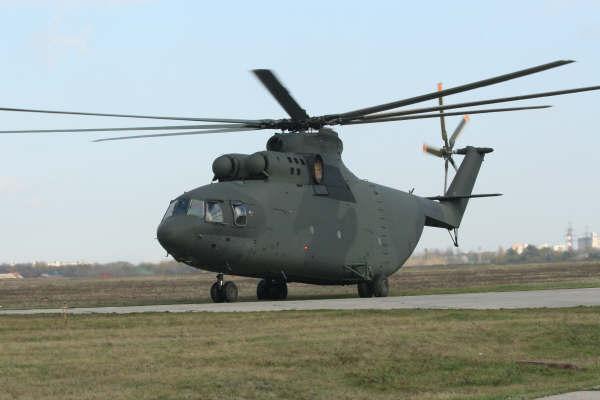
Russia’s giant Mi-26 will be evaluated by the French Army in November 2007, under an agreement signed in December 2006 with Russia’s Rosoboronexport export agency. The Mi-26 offers no restrictions on exports abroad, and the most potential for customization and growth, but the expense involved makes that a two-edged sword given France & Germany’s defense budget crunches. It would need to update its engine and avionics, shrink the crew from 5 to 3, and obtain western certifications which would be expensive. So would operational costs. New European engines might lower those costs a bit, and may also improve its range, which lists as 800 km with maximum internal fuel at maximum takeoff weight with reserves, and 1,920 km with 4 auxiliary fuel tanks.
An Mi-26T option is thus more expensive than the American designs in terms of development costs, though it would still be less expensive that a complete R&D program to design a new helicopter from the ground up. Even with European engines and electronics, however, the Mi-26 would be the most expensive option to operate, especially if fuel prices remain high.
The Key Competitive Variable?
(click to view full)
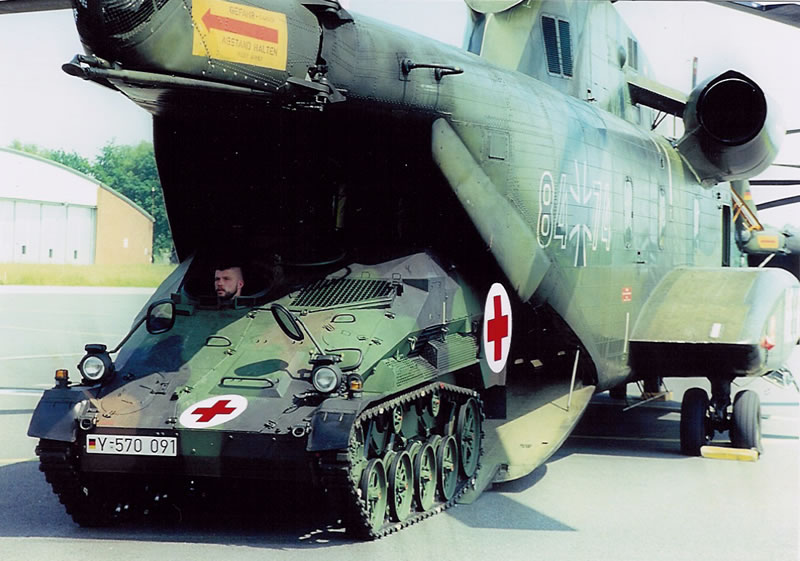
Given the set of comparisons performed in the “Carry That Weight” section, the determining factor in any off the shelf buy, and even buy vs. build decisions, appears to be France & Germany’s level of insistence on internal carriage of vehicles larger than the VBL.
If France and Germany stand firm on the need to transport vehicles like the Fennek, Dingo 2, and a wider range of mine-resistant vehicles with v-hulls, in order to create fuller tactical mobility while boosting range and delivery speeds, the American designs will have a difficult row to hoe. In that scenario, expected development costs rise, and likely winners change. The Russian Mi-26T, or even a full Eurocopter design & development program, would be the betting choices.
If, on the other hand, the French DGA & German BWB procurement agencies decide that larger vehicles will be carried as slung loads and internal carriage can be restricted to VBLs, Wiesels, et. al., the American entries gain a strong cost advantage due to American pre-investment in R&D.
Political currents will also play a large role, of course, and may decisively change the specifications – or even the competitive landscape – before all is said and done.
Contracts and Key Events

Even if that’s true, Eurocopter has a card to play. Eurocopter CEO Lutz Bertling said that talks over the proposed contract changes would begin in mid-December 2011, with the goal of an agreement in principle by March 2012. The implication is that Eurocopter would forego some or all cancellation fees on existing EC665 Tiger UHT and NH90-TTH contracts, if Germany agreed to buy the NH90-NFH instead of competitors like Sikorsky’s H-92/CH-148 or MH-60R/S, or AgustaWestland’s EH101 or AW159 Wildcat. Another possibility involves agreement to fund development of a joint FTH heavy-lift helicopter with France and/or the USA, in which Eurocopter would likely partner with Boeing or Sikorsky.
June 13/10: As ILA 2010 closes in Berlin, reports indicate that Boeing and EADS Eurocopter have partnered to offer a modified helicopter based on CH-47 Chinook technology, but with greater use of composite construction, a pair of 4-bladed rotors, and a larger cabin to accommodate the internal load sizes that Germany wants. Maximum payload size would be 13t/ 28,660 pounds, but a more normal full payload would be 8t/ 17,636 pounds with 1,000 km/ 620 mile range.
Details of the deal remain a matter for negotiation, but its reported that EADS would be the lead for European sales, while Boeing would take the lead on American sales. Boeing director for rotorcraft strategy, David L. Jones, sees cabin size as key, and told Aviation Week that their design would be comparable in cabin size to a C-130, and sees the Rolls Royce AE1107C engine that powers American V-22 tilt-rotors as a possibility for the new helicopter. He added that any technologies used needed to be at technology-readiness? Level 6, where they have been demonstrated in a lab. Eurocopter CEO Lutz Bertling said that workshare would be allocated by capability as the priority, rather than apportioned by set company share with capability secondary.
This design is only slightly beyond the concept stage, and key elements like engines aren’t finalized yet. While the companies involved are keen to stress its design maturity, unless they invest significant additional dollars to produce a tested aircraft, this offering would be a development program, with European participants on the hook for all of the attendant technology, timetable, and cost risks. The CH-53K is also a developmental helicopter; in exchange for a design blueprint based on less internal space, its cost and technology risks fall upon the US military. Avio News | Aviation Week | Flight International.
May 10/10: Flight International reports that even thought the CH-53E is delayed, GE remains committed to delivering the 7,500 shp class GE38-1 engine on schedule. The firm sees re-engining opportunities and related sales beyond the CH-53K, so they’ve begun delivering GE38s for ground tests years before airframes become available for flight test.
As of 1Feb 15/10, GE had recorded 176 engine starts and 177 operating hours, with sustained power of 7,760 shp and peak power of 8,300 shp. April 2010 saw delivery of a 2nd engine for ground tests.
The article is less positive about the CH-53K’s odds of winning the German/French heavy-lift helicopter award. Apparently, Germany wants a helicopter that will fit key vehicles internally, not underslung. Ultimately, the question will be whether Germany can afford to develop what it wants, can find it elsewhere, or is forced to remove some requirements.
April 29/10: DefenseTech reports that the USMC has pushed back the initial flight date of the CH-53K by 2 years to FY 2013, and Initial Operational Capability by 3 years to FY 2018, “with little concrete justification beyond an ‘overly aggressive initial program schedule’ “, and while stressing that the program has not run into technical problems. Craig Hooper writes:
“The CH-53K was an unsung showpiece for those preaching the virtues of incremental development, and, as a result, appetite for the platform has grown by about 30 percent, with the program of record expected to increase from156 aircraft to 200. But, in the process, the CH-53K has become something of a MV-22-killer. Is this the problem?… In late 2009, the Marine Corps decided to go with the CH-53Ks to replace their 40-year old CH-53D fleet (MV-22 Ospreys were originally slated to replace the CH-53D). At about the same time, Israel decided to forego the Osprey for the CH-53K, killing the Osprey’s best hope of snaring an international buyer. And with the Osprey 65% availability and the MV-22s high operating costs of about $11,000 dollars an hour… worse, studies from the Pentagon demonstrated that a CH-53K-equipped big-deck amphib provided a lot more logistical support for embarked Marines than the MV-22… Slowing CH-53K development will… prevent real-data comparisons between platforms… [until] a second multi-year MV-22 contract gets signed in FY 2013. Even worse, slowing the CH-53K schedule raised the program price by at least $1.1 billion dollars, raising the per-unit price… Why slow a program that stands to be a high-demand showpiece with potential markets in Israel, Germany, France, Turkey, Singapore and Taiwan?”
Asked for a response, US MARCORSYSCOM said that US NAVAIR was the only agency that could respond; NAVAIR did not respond to DID’s simultaneous inquiry.
March 30/09: The US GAO audit office delivers its 7th annual “Defense Acquisitions: Assessments of Selected Weapon Programs report, which looks at 47 programs including the CH-53K HLR. The CH-53K stands out, as one of the few programs to show lower R&D projections (from $4.23 billion to $4.17 billion) and estimated delivery time (2 months early) since its 2005 baseline.
Jan 20/09: Defense News reports from Eurocopter press conference discussing the state of the firm. CEO Lutz Bertling said that the firm is in early talks with Boeing and Sikorsky. Eurocopter executive vice president for customer relations added that the talk were still at an early stage, consisting of design discussions.
The HTL/FTH project is reported to be one of the top priorities of the European Defence Agency’s head Alexander Weis, who was appointed in May 2007.
See also Eurocopter 2009 press conference release for more information regarding the state of the firm, which continues to perform well but faces the same pressures as other industry players in the corporate and luxury markets.
FOOTNOTES:
fn1. As an example, Sikorsky’s CH-53K brochure [PDF format, 1.15 MB] states that the improved CH-53K will have a maximum external load of 16.3t/ 36k lbs. Realistically, in an operation that carries an external load from sea level to a point 3,000 feet above sea level, with a total range there and back of 220 nautical miles/ 407 km, and 30 minute loiter at the landing zone… that same brochure gives its maximum mission load as 12.25t/ 27k lbs. It should be noted that external payloads create more drag than internal loads, and reduce range. [return to comparison]
Additional Readings & Sources
* Defense Aerospace (Sept 4/07) – France, Germany Lean Towards Russian Mi-26T for Heavy Transport Requirement. That’s their opinion at this point. It’s possible, but it isn’t supported by statements from their sources.
* European Defence Agency (June 21/07) – EDA Welcomes Franco-German Initiative for Future Transport Helicopter Joint Effort
* France’s DGA (June 20/07) – La France et l’Allemagne veulent coopérer sur un helicoptère de transport futur [en Francais]
* Sikorsky Aircraft, via Aviation Today (June 20/07) – Sikorsky Aircraft Maps Its Plans for Europe. See also PR Newswire version.
* AFX News Ltd, via Forbes (June 18/07) – PARIS AIR SHOW France, Germany to announce helicopter tie-up
* European ROTOR & RESCUE Journal (Issue #2, 2006) – Future Heavy Transport Helicopter (HTH)
Eurocopter Program Update: ILA HeliCenter May 2006 [PDF format]. See esp. pp 6-7. At the 2006 Berlin Air Show, Boeing (CH-47F), USMC Col. P. Croisetiere (CH-53K), Eurocopter, and AgustaWestland (EH101, licensed production of CH-47) all offered HLH-related presentations at the ILA HeliCenter. Hat tip to reader Pedro Lucio for the pointer.
* Flight International (March 21/06) – Franco-German joint request bolsters Eurocopter’s hopes for a new heavylift helicopter
* Flight International (May 18/04) – USA cool on Eurocopter replacement for CH-53
* Flug Revue – Eurocopter HTH
* Rostvertol – Mi-26t Transport Helicopter
* Global Security – Mi-26 HALO
* DID FOCUS Article – USMC CH-53K HLR Helicopter
* DID FOCUS Article – US Army in Flight on Production of (Re)New H-47 Chinooks – updated