


(click to view full)
The U.S. Marines have a problem. They rely on their CH-53E Super Stallion medium-heavy lift helicopters to move troops, vehicles, and supplies off of their ships. But the helicopters are wearing out. Fast. The pace demanded by the Global War on Terror is relentless, and usage rates are 3 times normal. Attrition is taking its toll. Over the past few years, CH-53s have been recalled from “boneyard” storage at Davis-Monthan AFB in Tucson, AZ, in order to maintain fleet numbers in the face of recent losses and forced retirements. Now, there are no flyable spares left.
Enter the Heavy Lift Replacement (HLR) program, now known as the CH-53K. It aims to offer notable performance improvements over the CH-53E, in a similar airframe. The question is whether its service entry delay to 2018-2019 will come too late to offset a serious decline in Marine aviation.
The HLR Program Lifts Off
[youtube:v=k_pAe8Gvua8]
The $25.5 billion, 200-helicopter CH-53K program will define the long-term future of the US Marine Corps’ medium-heavy lift capabilities – and may be needed to save Marine aviation in the medium term.

On average, existing CH-53E aircraft are more than 15 years old, have over 3,000 flight hours under tough conditions, and are becoming more and more of a maintenance challenge with a 44:1 maintenance man-hours:flight hours ratio. Not to mention the resulting $20,000 per flight-hour cost ratio. According to Jane’s Defense Weekly, a 1999 analysis showed that the existing fleet has a service life of 6,120 flight hours, based on fatigue at the weakest point where the tail folds. The USMC expected that the existing fleet would start to reach this point in 2011, at a rate of 15 aircraft per year. The funding profile below suggests a problem for the Corps:


The Marine Corps itself is the source of the disconnect. The HLR program initially called for 156 new-build helicopters derived from the CH-53E Super Stallion design, with initial flight tests in 2010-2011, and initial operating capability (IOC) in 2014-2015. IOC was defined as a detachment of 4 aircraft, with combat ready crews, and prepared to deploy with all required equipment and spares.
In 2010, however, the Marines grew the program plan to 200 helicopters, even as they pushed its initial flight back to FY 2013, and IOC back to FY 2018. The program wasn’t experiencing problems, and no reasons were given, beyond statements concerning the program’s aggressive schedule. Further slippage has occurred since. Here’s the full timeline:


(click to view full)
The current schedule creates a number of risks for the Marine Corps. There’s no question that pushing the CH-53K program back will leave the Marines with a dwindling heavy-lift helicopter fleet, whose size, capability, and safety are governed by mechanical realities rather than political diktat. In April 2010, the US military ran out of stored CH-53D/E airframes to refurbish and return to the front lines. In February 2011, the USMC retired its CH-53D fleet altogether.
The other risk is political. On the one hand, the CH-53K is a large program, and the farther the Marines push it away, the easier it is to cut amidst budget crises. With its heavy-lift fleet dwindling, that could be disastrous for the force. On the other hand, budgetary crises also look for programs that are late or experiencing problems, and the CH-53K is big enough to earn a lot of attention if it’s seen as screwing up. That fact that the original schedule was overly aggressive wouldn’t be remembered.
Was the move to push the CH-53K back an act of political negligence, to protect less critical programs like the V-22? Or was it an act of supreme prudence, which will lead to a strong program that survives precisely because it goes out and meets its targets? Opinions vary. Time will tell.
Current Status

(click to view full)
US Navy PMA-261 is responsible for the CH-53K program. Sikorsky is currently working under a $3.5 – 4 billion System Development and Demonstration (SDD) contract, to include 4 SDD flight test helicopters, 1 ground test airframe, and associated program management and test support. As the development timeline stretched out, 6 System Development Test Aircraft were added to to that mix. To date, Sikorsky’s industrial partners include:

The CH-53X / CH-53K

(click to view full)
The CH-53K’s maximum gross weight (MGW) will increase to 88,000 pounds with external loads, versus 73,500 pounds for the CH-53E. MGW with internal loads will be 74,000 pounds, compared to 69,750 pounds for the CH-53E. It’s being designed to carry a cargo load of 27,000 pounds (13.5 tons) 110 nautical miles, operating at an altitude of 3,000 feet and an ambient temperature of 91.5 degrees Fahrenheit. This is nearly double the capacity of the current CH-53E Super Stallions, all in a helicopter that’s roughly the same size.
Those altitude and temperature qualifications matter, too, because “hot and high” conditions lower aircraft load carrying capabilities and combat radius – especially for helicopters. This reduced performance has recently been a factor during operations in Afghanistan and relief efforts in Pakistan, for instance, and has been a factor with earlier models of the C-130 Hercules as well. Figures for the CH-53K operating entirely around sea level and in cooler temperatures would be higher, but would not be double that of existing CH-53Es.
As an example of these variables at work, Sikorsky’s CH-53K brochure states that the improved CH-53K will have a maximum external load of 16.3t/ 36,000 lbs. On the other hand, an operation that carries an externally-slung load from sea level to a point 3,000 feet above sea level, with a total range there and back of 220 nautical miles/ 407 km, and 30 minute loiter at the landing zone, would have a maximum mission load of only 12.25t/ 27,000 lbs.
(click to view story)
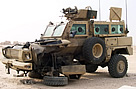
Even at sea level, however, increased lift capacity will be important. As the Hummer’s fundamental lack of survivability began to marginalize it on the battlefield, the Marines led the charge to field “MRAP” blast-resistant vehicle designs instead. While an up-armored HMMWV weighs about 9,100 pounds empty, the lightest Category 1 MRAP patrol vehicles check in at weights ranging from 16,000 – 31,000 pounds, and even the “light” JLTVs that will replace a large segment of the HMMWV fleet are expected to weigh 14,000 – 20,000 pounds.
Those weights mean that tactical operations to airlift mobile forces ashore beyond the beach, or within the zone of operations, will have only one helicopter available that can get the job done: the CH-53.
If the Marines think their CH-53 fleet is seeing heavy use now, just wait.
New Technologies

(click to view full)
In order to meet those requirements, the CH-53K will be depending on a number of new technologies. No one technology constitutes a big stretch, which is good news for the program. Instead, a host of technologies that have been developed since the CH-53E program will be refined, and used in inter-related areas. For the basic outlines of many low-risk CH-53X/CH-53K improvements, read “An Affordable Solution To Heavy Lift” [PDF] by Lt. Col. James C. Garman, an H-53 family pilot and Senior Preliminary Design Engineer in Sikorsky’s New Product Definition Group. See also this interview with former HLR program manager Col. Paul Croisetiere.
The most important new addition to the CH-53K will be its 7,500shp class GE38 / T408 engines, which have already hit 8,300 shp in ground tests. The military is hoping for 18% better specific fuel consumption than the similarly sized T64 engine, even though the engine would produce 57% more power. To improve maintenance and reliability, the GE38 is also expected to have 63% fewer parts.
Other technologies slated for the CH-53K include a “glass” [digital] cockpit that has high commonality and interoperability with existing Army and Navy helicopters, high-efficiency rotor blades with anhedral tips that have 12% (main) and 15% (tail) more surface area, plus different construction to handle higher loads; a composite cuff attachment that attaches the main blades directly to an elastomerically-articulated titanium rotor head, without the need for specialized tools or multiple redundant fasteners; a cargo rail locking system; external cargo improvements, survivability enhancements, and enhancements designed to extend service life.
Changes will be made as the program progresses, and engineers get a better sense of which technologies are ready, and which would create risks to the program. For example, the CH-53K was going to use a “viscoelastic lag damper” for the rotors, in order to minimize vibration and stress. It was removed in order to speed up deployment, and a modified version of standard linear hydraulic dampers will be used instead. The Navy hopes to achieve 2x reliability compared to the existing CH-53Es, but gave up the potential for 4x reliability, in exchange for less development risk.
[youtube:v=NQoFdW6OLeI]
Given the CH-53E’s large maintenance ratio, reliability will matter. As former HLR program manager Col. Paul Croisetiere put it in a NAVAIR release:
“Given the CH-53E’s operational costs and maintenance demands, heavy lift has built its reputation for excellence on the backs of our maintainers… We are going to take our maintainers somewhere they’ve rarely been before. Home for dinner.”
Several decades of weapon program history suggest that the odds of meeting this goal are low. Instead, the trend is that these promises are made, but more advanced and complex weapons wind up having more points of failure, and require even more maintenance. If the CH-53K program can break that cycle, it would represent a landmark success in Pentagon weapons acquisition.
Contracts & Key Events
Unless otherwise noted, all contracts are issued by US Naval Air Systems Command in Patuxent River, MD.
FY 2014 – 2025

(click to view full)
September 24/24: Sikorsky won a $72 million delivery order for the procurement of 98 rotary blades in support of the CH-53 K aircrafts. The delivery order does not include an option period. All work will be performed in Stratford, Connecticut. Work is expected to be completed by December 2028. This announcement involves Foreign Military Sales (FMS) from Israel. Naval Supply Systems Command Weapon Systems Support, Philadelphia, Pennsylvania, is the contracting activity.
September 19/24: Sikorsky won a $13 million deal for the procurement of nine input module gearboxes in support of the CH-53K aircrafts. All work will be performed in Stratford, Connecticut. This contract contains no options, and work is expected to be completed by December 2028. This announcement involves Foreign Military Sales (FMS) from Israel. Naval Supply Systems Command Weapon Systems Support, Philadelphia, Pennsylvania, is the contracting activity.
September 2/24: Sikorsky won a $11 million deal for the procurement of 30 main generators, 54 stators, 58 rotors, 31 power distribution panels, and five generators in support of the CH-53K aircrafts. All work will be performed in Stratford, Connecticut. There are no options, and work will be completed by March 2027. Naval Supply Systems Command Weapon Systems Support, Philadelphia, Pennsylvania, is the contracting activity.
July 31/24: Sikorsky Aircraft won a $120 million modification, which adds scope to procure additional long-lead time materials to support 21 full rate production, Lot Nine, CH-53K King Stallion aircraft. Work will be performed in Stratford, Connecticut, and is expected to be completed in March 2025. Naval Air Systems Command, Patuxent River, Maryland, is the contracting activity.
January 10/24: Sikorsky won an $18,4 million modification, which definitizes a previously awarded change order modification (P00009) and adds scope to provide logistics and airworthiness support for CH-53K Heavy Lift aircraft configuration changes for the government of Israel. Work will be performed in Stratford, Connecticut, and is expected to be completed in February 2026. Naval Air Systems Command, Patuxent River, Maryland, is the contracting activity.
December 21/23: Sikorsky won a $29.4 million modification, which exercises an option to provide logistics support analysis, logistics products and product data, technical publications resulting from production engineering changes, diminishing manufacturing sources, material shortages in support of CH-53K King Stallion aircraft production, and fielding for the Marine Corps. Work will be performed in Stratford, Connecticut; Bohemia, New York; various locations within the continental US (CONUS); and various locations outside the CONUS, and is expected to be completed in December 2024.
December 8/23: TBFDS Robertson Fuel Systems won a $9.2 million deal, which provides for the manufacturing and delivery of seven Delta Install kits, seven Tactical Bulk Fuel Delivery System (TBFDS) Forward Area Refueling Equipment kit inserts/Portable Fire Extinguisher kits and one TBFDS B-Kit, as well as associated non-recurring engineering, in support of the CH-53K King Stallion helicopter for the Marine Corps. Work will be performed in Tempe, Arizona and is expected to be completed in April 2025.
November 27/23: Support RENK Systems won a $49 million deal, which is for the design, development, fabrication, and testing of three test stands to include: one for testing the main gearbox assembly, one for testing the tail/intermediate gearbox assemblies, and one for testing the nose gearbox assemblies, as well as associated logistics, calibration, maintenance, and sustainment support; equipment and installation of equipment; end item spares; technical and operational manuals; and associated data in support of the CH-53K King Stallion helicopter for the Navy and Marine Corps. Work will be performed in Augsburg, Germany, and is expected to be completed in November 2025.
November 4/22: Training System Sikorsky won a $21.4 million modification, which exercises options to procure one CH53K containerized flight training device (2F243-3), as well as associated technical data based on low-rate initial production Lot 4 configuration in support of CH-53K phase II training system efforts. Work will be performed in Chantilly, Virginia; Stratford, Connecticut; and Orlando, Florida, and is expected to be completed in February 2025.
November 2/22: Lot 8 Sikorsky won a $280.4 million modification, which exercises an option to procure long lead items in support of full rate production Lot 8, CH-53K aircraft. CH-53K King Stallion is a next-generation heavy-lift cargo helicopter. Work will take place in Connecticut. Expected completion will be in December 2023.
October 6/22: Defensive Electronic Countermeasure System Replacement Phase III ARC-210 Sikorsky Aircraft won a $27 million contract modification, which adds scope for the initial and final technical directive to install the data transfer unit and Defensive Electronic Countermeasure System Replacement Phase III ARC-210 components into the CH-53K aircraft, support flight planning and testing of the components and supportability products for the US Navy. Work will take place in Connecticut, Maryland and New York. Estimated completion will be in April 2025.
September 30/22:Engine Fuel Firewall Shutoff Valve Sikorsky won a $17.2 million order, which provides non-recurring engineering in support of incorporating a one-second or less Engine Fuel Firewall Shutoff Valve into the CH-53K aircraft. The CH-53K is the United States Marine Corps’ (USMC) heavy lift replacement for the CH-53E. The most powerful helicopter in the Department of Defense, the CH-53K is a new-build helicopter that will expand the fleet’s ability to move more material, more rapidly throughout the area of responsibility using proven and mature technologies. Work will take place in Connecticut, England and Maryland. Expected completion will be in April 2027.
September 1/22: Repairs Sikorsky won a $36.4 million order, which procures spare parts and provides repair and maintenance support for the Lot 6 CH-53K low rate initial production configuration aircraft. Work will take place in Connecticut, Canada, Washington, Iowa, Illinois, North Carolina, Florida, Arizona, Missouri, New York, Massachusetts, New Jersey, West Virginia and California. Expected completion will be in December 2025.
July 12/22: Flight Training Device Sikorsky Aircraft won a $32.6 million order, which procures one CH-53K containerized flight training device based on low-rate initial production Lot 4 configuration in support of CH-53K phase II training system efforts. The CH-53K King Stallion is a new-build helicopter that will expand the fleet’s ability to move more material, more rapidly throughout the area of responsibility using proven and mature technologies. There are four System Development Test Article CH-53K with Marine Operational Test and Evaluation Squadron One (VMX-1). The squadron completed Initial Operational Test and Evaluation of the aircraft in 2022. There are 46 aircraft on contract, including four heavy lift helicopters for the government of Israel. Designed to lift nearly 14 tons (27,000 lbs/12,247 kg) at a mission radius of 110 nautical miles (203 km), in Navy high/hot environments, the CH-53K is capable of lifting almost triple the baseline CH-53E lift capability. Work will take place in Virginia, Connecticut and Florida. Estimated completion will be in December 2024.
May 23/22: Israel Sikorsky Aircraft won a $23.8 million order, which provides non-recurring engineering in support of the development of an exportable variant to the Marine Corps baseline CH-53K aircraft for the government of Israel. Foreign Military Sales funds in the amount of $11,431,029 will be obligated at the time of award, none of which will expire at the end of the current fiscal year. Work will take pace in Connecticut and various places within and outside the continental US. Expected completion date is in October 2023.
May 10/22: Program Management Support Sikorsky Aircraft won a $12.3 million modification, which exercises an option to provide production system engineering and program management support in support of CH-53K low-rate initial production. Work will take place in Connecticut. Expected completion will be in May 2023. The Naval Air Systems Command, Patuxent River, Maryland, is the contracting activity.
April 18/22: Maintenance Sikorsky won a $40.4 million modification, which increases maintenance of the CH-53K low rate initial production configuration aircraft. The Sikorsky CH-53K Super Stallion heavy-lift helicopter is being developed by Sikorsky Aircraft to replace the CH-53E helicopter of the US Marine Corps (USMC). Work will take place in California, Connecticut and various locations within the continental US. Estimated completion is in December 2026.
March 29/22: New Units Sikorsky won a $25.6 million order, which provides non-recurring engineering efforts to integrate, test, and qualify re-designed data concentrator and blade fold distributor units that will mitigate component obsolescence and outdated test equipment used for the CH-53K aircraft. The CH-53K is the United States Marine Corps’ heavy lift replacement for the CH-53E. It can be fielded from amphibious assault ships for the transportation of personnel and equipment. It will also be used to carry external cargo loads. The aircraft can be operated from austere and remote forward operating bases. Work will take place in California, Connecticut, Texas and New York. Estimated completion will be in June 2023.
March 21/22: Israel Sikorsky won a $52.5 million contract modification, which adds scope to procure long lead items in support of full rate production, Lot 7, CH-53K aircraft for the government of Israel. In February 2021, the Israel Ministry of Defense announced that it chose CH-53K as its next heavy-lift helicopter, over Boeing’s CH-47 Chinook. The new chopper will replace the country’s five decades-old CH-53D Sea Stallion Yasur helicopter. Work under the modification will take place in Connecticut. Estimated completion date is in December 2022.
February 22/22: Spare Parts Sikorsky won a $37.7 million modification, which adds scope to procure 1,026 various spare parts for the CH-53K low rate initial production configuration aircraft. The CH-53K is the United States Marine Corps’ (USMC) heavy lift replacement for the CH-53E. The CH-53K comes with 63% fewer parts than its predecessor, ideally making it easier to maintain in austere conditions. Work will take place in California, Connecticut, Canada and Missouri. Estimated completion will be in December 2026.
February 17/22: Israel Sikorsky won a $372 million contract modification, which exercises an option for the production and delivery of four low-rate initial production, Lot 6, CH-53K Heavy Lift aircraft, as well as associated aircraft programmatic and logistical support for the government of Israel. In July 2021, the US State Department approved the sale of 18 CH-53K King Stallion helicopters worth $3.4 billion to Israel. Israel announced last February that it would purchase one squadron of CH-53K over Boeing’s CH-47 to replace its fleet of Yasur helicopters at Tel Nof Air Base. Work will take place in Connecticut, Kansas, Utah, Missouri, West Virginia, Washington, Canada, Wisconsin, the UK, Florida, New York, France and Florida. Estimated completion will be in November 2025.
February 16/22: Engine Reliability Program General Electric won a $39.2 million contract modification, which exercises an option to procure 19 T-64 engine cores for the CH-53E aircraft in support of the T-64 Engine Reliability Improvement Program. The GE T64 is a turboshaft engine used in both fixed-wing aircraft and in helicopters, for which it was originally developed. Work will take place in Massachusetts, Vermont, North Carolina, Kentucky and Ohio. Estimated completion date is in January 2024.
February 7/22: Nine Sikorsky, a Lockheed Martin company, said it is building nine additional CH-53K aircraft for the US Marine Corps. The CH-53K will support the military in its mission to conduct expeditionary heavy-lift assault transport of armored vehicles, equipment and personnel to support distributed operations deep inland from a sea-based center of operations, critical in the Indo-Pacific region.
December 31/21: Spare Parts Sikorsky won a $30.7 million contract modification by the US Navy, which increases the scope to procure 681 spare parts for the CH-53K low-rate initial production configuration aircraft. The CH-53K King Stallion is a large cargo helicopter designed to replace the Marine Corps fleet of CH-53E heavy-lift helicopters to help move Marines and their equipment from ships offshore onto attack beaches. The CH-53K is a general redesign of the CH-53E. Work will take place in Connecticut, France, Washington, Canada, Florida, West Virginia, Kentucky, Massachusetts, North Carolina and Georgia. Estimated completion date will be in December 2026.
December 24/21: Production And Fielding Sikorsky won a $29.5, which procures logistics support analysis and products resulting from production engineering changes and diminishing manufacturing sources and material shortages to include technical publications, logistics support analysis and logistics product data in support of CH-53K aircraft production and fielding. The Super Stallion can be fielded from amphibious assault ships for the transportation of personnel and equipment. Estimated completion date is in December 2022. Work will be performed in Connecticut and the US.
December 8/21: Lot 7 Sikorsky won a $35.3 million deal to procure long lead items for full-rate production, Lot 7, CH-53K aircraft. The Ch-53K Super Stallion can be fielded from amphibious assault ships for the transportation of personnel and equipment. It can be operated from austere and remote forward operating bases. Estimated completion is in December 2022. Work will take place in Connecticut.
November 26/21: Data Transfer Unit Sikorsky won a $31.2 million modification, which exercises an option to provide non-recurring engineering to include, investigation, systems engineering support, risk analysis and integration development in support of the Data Transfer Unit and Defensive Electronic Countermeasure System replacement within the CH-53K Super Stallion production aircraft. The Super Stallion can be fielded from amphibious assault ships for the transportation of personnel and equipment. It will also be used to carry external cargo loads. The aircraft can be operated from austere and remote forward operating bases. Work will take place in Connecticut, Maryland, Iowa, Texas, Florida and Vermont. Estimated completion will be in March 2025.
November 23/21: Maintenance Sikorsky Aircraft won a $21.2 million contract modification, which increases scope and provides aircraft maintenance in support of the CH-53K data transfer unit and defensive electronic countermeasure system replacement phase three flight test. The CH-53K will replace the CH-53E, and its job with the Marines will include moving heavy equipment and supplies from ship-to-shore in support of amphibious assault and subsequent operations ashore, as well as lifting troops. Work will take place in Maryland, Florida and Virginia. Estimated completion is in June 2022.
November 17/21: Tooling Sikorsky won an $8 million deal, which exercises an option to provide for the production and delivery of CH-53K tooling and supplier rate tooling, as well as management through final acceptance, ensuring the program can meet aircraft production rate, based on lead-time and production ramp rates. The CH-53K Super Stallion is a heavy-lift helicopter that can be fielded from amphibious assault ships for the transportation of personnel and equipment. It will also be used to carry external cargo loads. The aircraft can be operated from austere and remote forward operating bases.
October 22/21: Engineering Support Sikorsky won a $14.1 million contract modification to procure four retrofit kits and associated system engineering support for the incorporation of 34 deployable configuration changes into CH-53K System Demonstration Test Article 1-4 Aircraft. The CH-53K is the United States Marine Corps’ (USMC) heavy lift replacement for the CH-53E. Work will take place in Connecticut and Florida. Estimated completion is in November 2023.
September 9/21: Data Transfer Unit Sikorsky Aircraft won an $11.9 million contract modification, which provides non-recurring engineering to include investigations, systems engineering support, risk analysis and integration development in support of the CH-53K Data Transfer Unit and Defensive Electronic Countermeasure System Replacement Phase III, to replace existing subsystems within the CH-53K production aircraft. The CH-53K is the United States Marine Corps’ (USMC) heavy lift replacement for the CH-53E. Work will take place in Maryland, Connecticut, Iowa, Texas and Vermont. Expected completion date is in June 2024.
September 2/21: Low Rate Initial Production Sikorsky won a $48 million deal, which procures eight spare part and management and delivery of parts in support of the CH-53K low rate initial production configuration aircraft. The CH-53K can be fielded from amphibious assault ships for the transportation of personnel and equipment. Work will take place in Connecticut, Massachusetts, Washington, UK, Canada, California and North Carolina. Estimated completion will be in December, 2026.
August 18/21: Fuel Tanks Integral Aerospace won a $10 million contract for the repair of two parts associated with the 650 gallon fuel tanks in support of the CH-53 aircraft. All work will be performed in Santa Ana, California, and the ordering period is expected to be completed by August 2026. The CH-52 Super Stallion is a heavy-lift helicopter. The marine corps uses the Super Stallion in the amphibious assault role and for transporting heavy equipment. The US Navy also use the Super Stallion for vertical delivery and recovery of damaged aircraft on aircraft carriers.
June 28/21: Lot 5 Sikorsky won a $735.9 million modification, which increases the scope for nine Lot Five low rate initial production CH-53K heavy-lift aircraft and associated aircraft, programmatic and logistical support. The Lot 5 contract contains an option for Lot 6 award for another nine helicopters. While each helicopter cost $97.6 million under the Lot 5 contract, the price will decrease to $94.7 under Lot 6. Work will take place in Connecticut, Kansas, Utah, Missouri, West Virginia, Washington, Canada, the UK, Wisconsin and Florida. Estimated completion date will be in December 2024.
June 23/21: Spare Parts Sikorsky won a $73.2 million modification, which adds scope to procure 362 spare parts and support required for the repair and maintenance of the CH-53K low rate initial production configuration aircraft. The CH-53K is the United States Marine Corps’ (USMC) heavy lift replacement for the CH-53E. The Super Stallion can be fielded from amphibious assault ships for the transportation of personnel and equipment. It will also be used to carry external cargo loads. Work will take place in Connecticut, Canada, Washington, Pennsylvania, the UK, Mississippi, Wisconsin, Iowa, Texas and Massachusetts. Estimated completion date will be in December 2026.
June 15/21: Program Management Sikorsky won a $9.5 million order, which provides systems engineering and program management services in support of CH-53K low rate initial production Lots 5 and 6 aircraft rate tooling. The CH-53K is the United States Marine Corps’ (USMC) heavy lift replacement for the CH-53E. It is a new-build helicopter that will expand the fleet’s ability to move more material, more rapidly throughout the area of responsibility using proven and mature technologies. Work will take place in the UK, Washington, Connecticut and Spain. Estimated completion is in December 2024.
May 13/21: Engineering and Program Management Support Sikorsky won a $17.3 million contract modification, that adds scope to provide production system engineering and program management support in support of CH-53K aircraft low-rate initial production. The CH-53K is the United States Marine Corps’ (USMC) heavy lift replacement for the CH-53E. The CH-53K is a new-build helicopter that will expand the fleet’s ability to move more material, more rapidly throughout the area of responsibility using proven and mature technologies. Work will take place in Stratford, Connecticut and is expected to be finished in June 2022.
April 2/21: Engine Cores General Electric Aviation won a $21.6 million deal, which provides for 10 T-64 engine cores for the CH-53E aircraft as part of the T-64 Engine Reliability Improvement Program. The T64 is a turboshaft engine with a maximum power of 3,229 kW (T64-100) for applications on medium-size transport helicopters, such as the Sikorsky CH-53. Work will take place in Massachusetts, Vermont, North Carolina, Kentucky and Ohio. Estimated completion will be in December 2022.
December 13/18: Provisioning The Naval Air Systems Command is ordering a provisioning parts database of technical information from Sikorsky. The cost-plus-fixed-fee delivery order is priced at $38 million and supports the initial operational capability of the Navy’s CH-53K King Stallion helicopter. The database will include 2D drawings that support all organizational, intermediate and depot levels in support of the helicopter. The provisioning database will determine the range and quantity of repair parts, and support and test equipment required to operate and maintain the King Stallion for its initial period of service. Provisioning is an integral part of supply chain management. The delivery order is partially funded ($8.6 million) through FY 2019 research, development, test and evaluation funds. Work will be performed at Sikorsky’s facility in Stratford, Connecticut and is scheduled for completion in November 2023.
October 26/18: Maintenance Sikorsky Aircraft, a subsidiary of Lockheed Martin, is being contracted to help stem the maintenance burden of the Marine Corps’ CH-53 Super Stallion. The contract is priced at $717.4 million and covers logistics and repair support for 98 components of the CH-53 and MH-53 platforms. H-53 aircraft include the CH-53E Super Stallion medium-heavy transport helicopter that can transport up to 55 troops or 15 tons of cargo, as well as the MH-53E Sea Dragon minesweeper and the MH-53M Pave Low IV CSAR and SOF helicopter. The helicopters have on average a 44:1 maintenance : flying hours ratio. Work will be performed in Cherry Point, North Carolina and Stratford, Connecticut, and is expected to be completed by December 2022.
August 27/18: Keep’em sweeping The Navy is contracting Technical Systems Integration for the provision of necessary overhaul and modification work on the USMC’s Mk-105 minesweeping system. The firm-fixed-price, indefinite-delivery/indefinite-quantity contract has a value of $10.5 million, but also includes options, which if exercises, would bring the face value to roughly $54 million. The Mk-105 Magnetic Influence Minesweeping System is a catamaran hydrofoil which is towed behind the MH-53E Sea Dragon helicopter. It is used to detect mines that use magnetic sensors to target the metallic hulls of ships before detonating. The twin magnetic tails, consisting of open-electrode magnetic sweeps, are towed behind the sled, detonating mines to clear the water for safe shipping. Work will be performed in Panama City, Florida, and is expected to be completed by August 2019.
May 01/18: IOC delays Bloomberg reports that the Sikorsky CH-53K King Stallion helicopter program may be falling behind schedule, as Pentagon officials have found that a significant number of components require redesign and re-qualification. While a spokesperson from Sikorsky’s parent-company Lockheed Martin said that most of these items are already “fixed and proven or are in process,” initial operational capability—originally scheduled for December 2019—could be delayed by as much as eight months. According to a Pentagon review prepared in February, four helicopters currently in the flight test program were operating at 69 percent effectiveness as of late last year, “well below” the 75 percent to 90 percent benchmark needed. 200 King Stallions have been ordered by the US Marin Corps in a $31 billion heavy-lift program with Lockheed chasing exports to potential operators such as Germany.
April 20/18: German Heavy-Lift-Industrialization plan Sikorsky, Lockheed Martin’s helicopter subsidiary, revealed on Wednesday its industrialization plan for competing in the German Air Force “Schwerer Transporthubschrauber” (STH) Program, or effort to buy new heavy-lift helicopters. Offering its CH-53K King Stallion, Sikorsky has already teamed up with German defense giant Rheinmetall Group—who will take care of in-service support if Berlin chooses the King Stallion—and the Sikorsky CH-53K team plans to host German companies in an industry chalet during the ILA Berlin Airshow April 25-29, where it will showcase plans for the long-term sustainment of the CH-53K by German aerospace industry. Companies expected alongside Rheinmetall include MTU, ZF Luftfahrttechnik GmbH, Autoflug, HYDRO Systems KG, Rockwell Collins Germany, Jenoptik, Hensoldt, Liebherr, and Rohde & Schwarz. Germany is looking to replace its legacy fleet of CH-53G, some of which have been in service since the mid-1960s, with a new capability. Facing off against the CH-53K is Boeing’s CH-47F Chinook.
March 6/18: Potential Sales-Partnerships Sikorsky has selected German engine manufacturer MTU to be its engine maintenance partner as the US helicopter firm builds up local partners to help its bid to supply CH-53K heavy-lift helicopter to the German Air Force. The agreement tasks MTU with providing maintenance, repair and overhaul services for the helicopter’s GE Aviation T408-GE-400 engines should Berlin order the King Stallion as the replacement for its ageing fleet of CH-53G/GA/GS helicopters. At present, MTU already have an 18 percent share of the T408’s engine program, producing its power turbine, exhaust casing and output shaft. Also included on the team for Sikorsky’s German bid is Rheinmetall.
February 16/18: Initial Production Orders The Pentagon awarded Tuesday, February 13, a $126.5 million US Navy contract modification to Sikorsky for initial production of CH-53K King Stallion helicopters. Under the terms of the deal, the Lockheed Martin subsidiary will secure “long lead items in support of the low rate initial production of seven Lot III CH-53K aircraft.” Work will take place at Stratford, Connecticut, with work running until January 2019. The US Marine Corps is scheduled to receive 200 King Stallions, replacing the service’s older E variants for its heavy-lift mission. The first units are expected to become operational by 2019.
February 8/18: German Heavy Lift-Partnership Lockheed Martin subsidiary Sikorsky has signed a strategic teaming agreement with German defense giant Rheinmetall, to offer Sikorsky’s CH-53K King Stallion helicopter to Germany’s upcoming heavy-lift competition. A Lockheed Martin press release stated that further German teammates will be announced in the coming weeks and “will leverage and build upon the deep knowledge and expertise of the German defense industry.” The statement added that the King Stallion “provides the German Armed Forces with a proven heavy lift helicopter that can be entered into service seamlessly without need for upgrades for the next several decades.” Facing the Sikorsky-Rheinmetall team will be Boeing’s CH-47 Chinook, whose MG-47 variant is the only model thus far capable of Germany’s fleet-wide aerial refueling capability requirement.
November 21/17: Contracts-Spares General Electric Aviation (GEA) has been awarded a $143.4 million US Navy contract to provide 22 low-rate initial production Lot 1 and 2 T408-GE-400 turboshaft engines for the CH-53K King Stallion helicopter. In additional to the engines, the sale will also include associated engine and programmatic support, logistics support, peculiar support equipment, and spares. Work will take place in Lynn, Massachusetts, and is expected to be completed in July 2021.
November 17/17: Airshow Debut Lockheed Martin’s CH-53K Super Stallion will make its international debut at the Berlin Airshow next April, sources close to the program told Reuters. Built for the US Marine Corps by Lockheed subsidiary Sikorsky under the Heavy Lift Replacement (HLR) program, the heavy-lift helicopter is being touted as a possible solution to Germany’s CH-53G replacement program, which will see the King Stallion face off against the smaller Boeing CH-47F Chinook in a $4.7 billion competition for about 40 units. However, an official start to the program—along with a formal structure to the competition—is unlikely to be unveiled until Chancellor Angela Merkel’s conservatives manages to negotiate a ruling coalition with the pro-business Free Democrats and the Greens—horse-trading that could take until the end of the year. Israel is also reported to be interested in the King Stallion, adding a potential 20 units to Lockheed’s order book.
September 04/17: Lockheed Martin subsidiary Sikorsky has been awarded a Low Rate Initial Production (LRIP) Lot 1 contract to deliver two CH-53K King Stallion heavy-lift helicopters to the US Marine Corps (USMC). Valued at $304 million, the firm will deliver the models by 2021 in addition to spares and support, with work to be carried out in Stratford, Connecticut. The US Department of Defense’s Program of Record remains at 200 CH-53K aircraft, with the USMC intending to stand up eight active duty squadrons, one training squadron, and one reserve squadron to support operational requirements. Designed to lift three times as much weight as its predecessor, the CH-53E Super Stallion, its increased payload capacity can internally load 463L cargo pallets, High Mobility Multipurpose Wheeled Vehicles (HMMWV) or a European Fenneck armored personnel carrier while still leaving the troop seats installed.
July 11/17: With CH-53K King Stallion helicopters recently completing their first long-range flight test from West Palm Beach, Florida to NAS Patuxent River, Maryland, where it will continue flight testing, manufacturer Sikorsky has begun courting German industry in an effort to line up orders for the new heavy-lift helicopter from Berlin. The two day event, held in West Palm Beach, saw the delegates told that if the King Stallion is selected, German suppliers would be responsible for the majority of the work when it comes to platform sustainment. Germany is expected to issue a request for proposals for the replacement of its fleet of 81 CH-53GA/GS helicopters, originally delivered in the 1970s, in mid-2018, with deliveries to commence in 2023. Boeing is also likely to pitch its CH-47 Chinook as the “proven” helicopter.
May 24/17: Sikorsky has been awarded a $55 million contract modification to a previously awarded contract for the long-lead support of low-rate production of four Lot II CH-53K King Stallion helicopters. An upgrade of the Sea Stallion heavy-lift helicopter, work on the King Stallion contract will be conducted at the Sikorsky plant in Stratford, Conn and is expected to be completed by March 2022. The helicopter is capable carrying up of 27,000 pounds of external sling load. It can carry artillery pieces and Humvee utility vehicles and it’s cabin is capable of carrying 463 pallets for cargo transportation.
April 6/17: Lockheed Martin subsidiary Sikorsky will proceed with low-rate production of the CH-53K King Stallion since the helicopter has received a Milestone C status by a US Defense Acquisition Board review. A total of 200 CH-53Ks are to be acquired by the US Marine Corps. The first six aircraft are under contract and are expected to be delivered starting next year. Long-lead procurement of parts and materials for the first two low-rate initial production helicopters is underway. The King Stallion is capable of lifting three times as much as its predecessor, the CH-53E, and can carry as many as three external loads at the same time.
March 29/17: The US Department of Defense is expected to award Lockheed Martin a multi-billion contract to start production of 200 new heavy cargo helicopters for the US Marines Corp by the end of the week. Colonel Hank Vanderborght, head of the Pentagon’s CH-53K King Stallion program, stated that each unit will cost $87 million on average and $105 million including spare parts and certain service contracts. The total value of the program is $27 billion. Developed by Lockheed’s helicopter subsidy Sikorsky, the CH-53K can lift 36,000 pounds and would replace the CH-53E Super Stallion, which has operated as the backbone of field logistics for the USMC since the mid-1980s.
October 24/16: The CH-53K King Stallion helicopter has completed its initial operational testing. A two-week trial period, known as the OT-B1, took place at Sikorsky’s Development Flight Center in West Palm Beach, Florida. Requirements asked of the helicopter included multiple external lift scenarios of 27,000 lb. (12,200 kg), in-hover, and 12,000 lb. (5,422 kg) 110 nautical mile radius missions.
June 29/16: Sikorsky has achieved a key USMC requirement with the CH-53K King Stallion by successfully flying 100ft above the ground with a 12,250kg (27,000lb) payload. Due to replace the CH-53E Super Stallion, the new helicopter promises better range and triple the E model’s payload in hot weather conditions, as well as flight-by-wire flight controls designed to reduce pilot workload in degraded visual environments. While successful testing has the CH-53K currently on track, it hasn’t always been plain sailing with gearbox trouble delaying its first flight for a year.
May 18/16: Pricing and availability for the Sikorsky CH-53K King Stallion helicopters is being sought by Germany to meet its heavy vertical lift requirement. Other options include Boeing’s CH-47 Chinook, however the US Marine Corps is keen to take advantage of the better pricing that could be achieved by adding a sizable King Stallion order at the front-end of the production ramp. The latest K-model has twice the max gross take-off weight of the legacy CH-53G operated by the Luftwaffe at 40t (88,000lb) with external loads compared to 19t (42,000lb).
April 22/16: A USMC test has seen a Sikorsky CH-53K complete its first external load flight test, lifting a 12,000 pound external load in a hover. The April 12 test will see further loads tried with external payloads of 12,000 pounds flown first in hover, then incrementally increasing speeds up to 120 knots, followed by 20,000 and 27,000 pound external payloads. The system features an electrical load release capability from the cockpit and cabin, and a mechanical load release capability at each of the pendant locations. An auto-jettison system is incorporated to protect the aircraft in the event of a load attachment point failure.
March 17/16: The second prototype of the CH-53K helicopter made its maiden flight in January according to Lockheed company Sikorsky. In addition, the first aircraft into the test program has achieved flight envelope expansion to 120 knots for the USMC’s CH-53K King Stallion heavy lift helicopter program. The two are the most heavily instrumented of the Engineering Development Models (EDM) and will focus on structural flight loads and envelope expansion. Two more will join the flight line later this year and will focus on performance, propulsion, and avionics flight qualification.
January 5/16: The USMC seems to have given the seal of approval to the latest CH-53 after the first marine pilot to test the helicopter commended its abilities. Lt. Col. Jonathan Morel tested the CH-53K King Stallion which is set to become the largest and heaviest helicopter in the US military. Two hundred of the rotorcraft will be procured by the USMC in a deal worth $25.5 billion.
October 29/15: The Sikorsky CH-53K King Stallion helicopter has flown for the first time, eleven months behind schedule. The new helicopter is intended to replace the Marine Corps’ fleet of CH-53E Super Stallion heavy lift helicopters, with the new design boasting three times the lift capability of the older model. The first CH-53K, known as Engineering Development Model-1 (EMD-1) will be joined by an additional three aircraft to undergo 2,000 flight hours of testing.
July 31/14: Engines. General Electric in Lynn, A receives a $68.6 million firm-fixed-price contract modification for 16 GE38-1B engines, closure kits, tooling, and associated systems engineering and program management in support of the CH-53K helicopter program’s Operational Evaluation phase. This is on top of the July 17/13 contract for “time critical parts”, and the $84.3 million total represents the first engine buy beyond the 20 covered by the System Development & Demonstration contract. $22.5 million in FY 2013 – 2014 US Navy RDT&E budgets are committed immediately.
Note that each CH-53K is equipped with 3 engines. Work will be performed in Lynn, MA, and is expected to be complete in January 2017 (N00019-13-C-0132). See also GE, “U.S. Navy Awards GE38 Engine Production Contract”.
June 9/14: Leadership. PMA-261 Program Manager U.S. Marine Corps Col. Robert Pridgen turns over command to Col. Henry Vanderborght, a long-time CH-53E pilot, former John Glenn Test Pilot of the Year, and former Light/Attack Helicopters (PMA-276) platform team lead for UH-1Y production and the UH-1N’s sundown. Vanderbought wasn’t actually a full Colonel until he was promoted on the morning of the change-of-command ceremony.
Pridgen will become the program manager for the Presidential Helicopters Program (PMA-274) in July 2014. Sources: US NAVAIR, “Heavy-lift helicopters program welcomes new program manager”.
May 5/14: Naming. Sikorsky officially unveils their CH-53K flight test helicopter EDM-2, and the USMC officially names the type “King Stallion”.
One can see the natural extension from the CH53A/D Sea Stallion and CH-53E Super Stallion, but there comes a point where one can push the boundaries in unintended directions. Maybe they were thinking of the 1942 movie with Chief Thundercloud. In the modern era, people are more likely to think that somewhere, an adult entertainer wants his name back. Sources, Sikorsky, “Sikorsky Unveils CH-53K Helicopter; U.S. Marine Corps Reveals Aircraft Name” | South Florida Sun-Sentinel, “Sikorsky introduces new ‘King Stallion’ helicopter” | Stamford Advocate, “Sikorsky unveils its new King Stallion heavy lift helicopter”.
“King Stallion”
May 1/14: Testing. Sikorsky announces that full testing is finally moving ahead with the non-flying GTV, including powered “light-off” with all 7 main rotor blades and 4 tail rotor blades spinning, and powered by its three 7,500 horsepower class GE engines. This begins a rigorous 2-year test program of the rotor blades, transmission, engines, and all subsystems using the GTV. Sources: Sikorsky, “Sikorsky Begins Powered Ground Tests of CH-53K Helicopter with Rotor Blades”.
March 31/14: GAO Report. The US GAO tables its “Assessments of Selected Weapon Programs“. Which is actually a review for 2013, plus time to compile and publish. With respect to the CH-53K, their top concern is that the USMC is scheduled to begin ordering helicopters before testing is done. Beyond that concurrency worry:
Nearly 9 years later the program’s two critical technologies – the main rotor blade and main gearbox – are approaching maturity. The program expects these technologies to be demonstrated in a realistic environment by its planned February 2016 production decision, a delay in 6 months over last year’s schedule. Program officials reported that they conducted a three-blade whirl test that produced results that exceeded required outcomes. Flight testing is expected to begin in late 2014.
March 4-11/14: FY15 Budget. The US military slowly files its budget documents, detailing planned spending from FY 2014 – 2019. The current Navy plan will begin buying production CH-53Ks with an order for 2 in FY 2017, followed by 4 in FY 2018 and 7 in FY 2019. That means production has been pushed back by about a year, because:
“Late delivery of components into qualification, and subsequent qualification challenges, have delayed Ground Test Vehicle (GTV) delivery, Flight Readiness Reviews (FRR – GTV & 1st Flight), Engineering Development Models (EDM) delivery and CH-53K 1st Flight, and have moved Milestone C (MSC) and other associated events to 3Q 2016. Budgetary constraints delayed start of the Aircraft Procurement (APN) program by one year. As such, Advanced Acquisition Contracts (AAC) and LRIP awards have been adjusted accordingly. In order to procure aircraft that effectively demonstrate manufacturing processes are both mature and under control, two (2) additional RDT&E,N-funded System Demonstration Test Articles (SDTAs) in FY15 with delivery in 4Q 2018 and 1Q 2019 were added to the program.”
Sources: USN, PB15 Press Briefing [PDF] and detailed budget documents.
Oct 31/13: Rotors. Sikorsky has completed initial tests of the CH-53Ks new rotor blades, including fatigue tests and whirl-tower balance tests. Additional blade qualification testing will continue for several years, in order to validate aspects like aerodynamic stability, tip deflection, and rotational twist. The next steps involve installation and testing on the stationary CH-53K GTV.
There’s a lot to test, because the rotors are new technology. The 35 foot span, 7-bladed main rotor has blade of almost 3 foot chord width, with new airfoil designs, twist, and taper to handle the engines’ 71% power increase. The new blade tips are designed to improve hover performance, and a composite cuff attachment allows attachment of each blade to the elastomerically-articulated titanium rotor head, without tools or redundant fasteners. The rotor hub itself is almost 9 feet in diameter, and the blade radius will be 39.5 feet when assembled, with 12% more total surface area than the CH-35E.
The 4-blade tail rotors are also new, with 10 foot blades and 15% more surface area compared to the CH-53E. Sikorsky says that the CH-53K tail rotor produce as much thrust as the main rotor blades on Sikorsky’s 5.5 ton S-76 medium helicopter, which is used in the offshore oil industry. Source: Sikorsky via PR Newswire, “Sikorsky Completes Initial Tests of First Rotor Blades for CH-53K Helicopter”.
Oct 11/13: EVM penalty. Bloomberg News:
“Sikorsky was notified Sept. 6 of three deficiencies on a contract for the Navy’s CH-53K heavy-lift helicopter related to guidelines for the recording of direct costs and material accounting, Navy Commander William Urban, a Pentagon spokesman, said in an e-mailed statement. A corrective action plan is expected from the company by Oct. 21, he said.”
While Bloomberg doesn’t say so, the issue in question relates to a quantitative approach to project tracking called Earned Value Management. Until they’re satisfied, the Pentagon is withholding the maximum 5% on payments. Sikorsky responds that 2 of the 3 issues are already resolved, and they don’t expect this to affect the program. Sources: For Dummies.com, “Earned Value Management Terms and Formulas for Project Managers” | Bloomberg, “Pentagon Withholds Sikorsky Payments for Business System Flaws”.
Oct 1/13: Sub-contractors. Kratos Defense & Security announces that an $8.5 million contract from Sikorsky to design and develop CH-53K maintenance trainers. The full-fidelity Maintenance Training Device Suite (MTDS) is meant to provide a true-to-life environment for maintenance training; as well as remove-and-replace training for avionics systems, electrical systems, hydraulic systems and many other mechanical subsystems.
The Helicopter Emulation Maintenance Trainer (HEMT) uses a 3D virtual environment to support maintenance training scenarios: functional tests, fault isolation, troubleshooting, and remove and installation for 27 subsystems. Sources: Kratos Oct 1/13 release.
FY 2013
SAR shows program cost increases; Ground Test Vehicle delivered; Flight test helicopters ordered.

(click to view full)
Sept 27/13: Sensors etc. Raytheon in El Segundo, CA receives a $20 million firm-fixed-price delivery order for:
CH-53K, using FY 2013 USN RDT&E budget…
* 5 AAQ-29 day/night surveillance turrets
* 2 Memory Loader Verifier System cables
* Software update, system integration, and test support
USAF HH-60 search & rescue helicopters, using FY 2011 procurement budget…
* 25 AAQ-29 day/night surveillance turrets
* 25 L2G multifunction control units and 35 L2G system control units
* 1 technical data package
* 1 repair of repairables analysis
All funds are committed immediately, and $16.2 million expires on Sept 30/13. Work will be performed in McKinney, TX (92%) and El Segundo, CA, (8%), and is expected to be complete in September 2015. US Naval Air Systems Command in Patuxent River, MD manages the contract (N00019-10-G-0018).
Sept 23/13: IG OK. The Pentagon’s Inspector General submits a non-public report concerning the CH-53K program. Their public statement: the program has been managed appropriately, but it may not meet its February 2016 Milestone C decision date, or its revised costs.
The Acquisition Program Baseline was updated on April 24/13, to address cost growth and schedule delays. Contractor manufacturing delays and component testing failures, hence the risk of not being ready in time for the low-rate production decision, and not meeting even its revised costs. The Office of the Under Secretary of Defense for Acquisition, Technology, and Logistics is aware of these issues. Sources: OIG, “CH-53K Program Management Is Satisfactory, but Risks Remain (Project No. D2013-D000CD-0095.000)”.
July 17/13: Engines. General Electric Co. in Lynn, MA receives a $15.7 million cost-plus-fixed-fee contract to buy “time critical parts” for incorporation into the CH-53K’s T408-GE-400 gas turbine engine. All funds are committed immediately by the US Navy.
Work will be performed in Lynn, MA, and is expected to be complete in December 2016. This contract was not competitively procured pursuant to FAR 6.302-2-1(a)(1) by US Naval Air Systems Command in Patuxent River, MD (N00019-13-C-0132).
June 27/13: Sub-contractors. Boeing spinoff Spirit Aerosystems announces a $60 million sub-contract, as a result of the #435 million order for 4 System Demonstration Test Article helicopters (q.v. May 30/13). Spirit makes the base cockpit and cabin, essentially the body of the helicopter.
Spirit will begin work during 2013 at its Wichita, KS facility, with deliveries to Sikorsky’s CH-53K prototype assembly line in West Palm Beach, FL to begin in 2014. When the helicopters are finished, they’ll enter Operational Evaluation in 2017, to verify that their performance meets projections. The contract follows over $150 million in work on 7 structures, for the first 5 prototype test helicopters and the 2 ground test frames.
Spirit recently announced work with Spintech Ventures, of Xenia, OH on a set of trademarked products called Inflexion/ Smart Tooling. The technology uses re-formable, reusable mandrels that can change states through the layup and cure phases. That helps form complex, highly integrated composite structures into large and/or unusual shapes and configurations – like full integration of skins, stringers, and frames or ribs in one step. Spirit | Wichita Eagle | Spirit re: Inflexion.
May 31/13: Hostile IG Report. The Pentagon’s Inspector General issues a report under Audit Project No. D2012-D000CD-0037.000, telling the USMC that the CH-53K’s program increase to 200 helicopters isn’t justified. The Marines politely tell the IG to stick it where Chesty can’t find it.
The Inspector General’s statement that “the Marine Corps risks spending $22.2 billion in procurement and operating and support funding for 44 additional aircraft” is a blatant error – that’s the entire 2011 program cost for 200, plus R&D. Beyond that, they complain that the USMC:
* did not follow the Joint Capabilities Integration and Development System Instruction and obtain Joint Requirements Oversight Council [DID: JROC] approval for the increase;
* did not have requirement studies prepared to determine a procurement quantity in consideration of program affordability;
* incorrectly relied on a 2008 memorandum from the Deputy Commandant for Aviation directing the increase of the procurement quantity to 200 aircraft, without support;
* incorrectly used the 2010-2011 Force Structure Review’s war-gaming scenarios as justification for the quantity increase; and
* did not justify or appropriately consider the impact of the Marine Corps personnel reductions effect on Heavy Lift quantity requirements.
In response, the USMC Deputy Commandant says the existing analyses do justify it, and JROC approved the 200. Then the Milestone Decision Authority approves the Marine Corps’ request to rebaseline the program with a 54% procurement cost increase over the 2005 baseline (a jump from Dec 2011 figures, if true) and formally push the Milestone C decision from December 2012 to February 2016 (later than the current August 2015). The IG wants additional comments re: the re-baselining. Which is fine, as far as it goes, but the whole process seems like an ad for the Lexington Institute’s Daniel Goure, who argues that the Pentagon’s procurement processes are an out of control overhead burden. It’s all about paper, rather than the soundness of the conclusion. And you can’t use what you learn in war games to change procurement decisions? What idiot thinks that’s a good idea? Pentagon IG Report.
May 30/13: Sikorsky Aircraft Corp. in Stratford, CT receives a $435.3 million cost-plus-incentive-fee contract modification, to buy 4 CH-53K System Demonstration Test Article helicopters. The April 5/06 System Development & Demonstration contract already included 4 test helicopters, and US NAVAIR and Sikorsky subsequently confirm that these 4 SDTA helicopters are a different set that the Marines will test during operational evaluation. The buy is structured as an additional line item under the 2006 contract, and initial funding will use $48.1 million in FY 2013 RDT&E budgets.
Sikorsky CH-53K Program VP Dr. Michael Torok says the SDTA helos will be based on the configuration of the 4th and final flight test aircraft from the 2006 contract, which is currently being assembled on the prototype production line. To date, Sikorsky has delivered 2 non-flying SDD CH-53Ks: the Ground Test Vehicle and the Static Test Article. That leaves the 4 flight test prototypes, 1 stationary Fatigue Test CH-53K, and now the 4 SDTA helicopters. First flight of a CH-53K prototype is now expected in “late 2014” instead of Spring 2014, and this contract requires 1st SDTA delivery by September 2016. Final delivery is scheduled by the time OpEval begins in March 2017, with incentives for early delivery.
Work will be performed in Stratford, CT (17%); West Palm Beach, FL (17%); Wichita, KS (15%); Salt Lake City, UT (10%); St. Louis, MO (4%); Bridgeport, WVA (3%); Windsor Locks, CT (3%); Ft. Walton Beach, FL (2%); Redmond, WA (2%); Forest, OH (2%); Jackson, MS (2%); Cudahy, WI (2%); Irvine, CA (2%); Kent, WA (1.2%); Bristol, United Kingdom (1%); Phoenix, AZ (1%); Chesterfield, MO (1%); Los Angeles, CA (1%); Rochester, United Kingdom (1%); Buckinhamshire, United Kingdom (1%); Longueil, Quebec, Canada (1%); Cedar Rapids, IA (0.8%); Twinsburg, OH (0.8%); St. Clair, PA (0.5%), and various other locations (8.7%) (N00019-06-C-0081). See also US NAVAIR | Sikorsky
4 flight test helos
May 24/12: SAR. The Pentagon finally releases its Dec 31/12 Selected Acquisitions Report [PDF].
“CH-53K Heavy Lift Replacement Helicopter – Program costs increased $1,897.6 million (+7.1%) from $26,626.8 million to $28,524.4 million, due primarily to changing the cost estimating methodology from analogy-based to supplier bottom-up (+$1,796.6 million), use of commercial indices for materiel escalation costs (+$948.9 million), revised escalation indices (+$539.4 million), an increase in the production line shutdown estimate (+$120.7 million), and an increase in support equipment, repair of repairables, and spares costs (+$64.9 million). These increases were partially offset by decreases in other support costs (-$664.0 million), initial spares requirements (-$589.0 million), and the application of new inflation indices (-$385.3 million).”
To put the estimating into English, the program had estimated costs based on similar programs, but now they’ve gone through the chosen suppliers and built an estimate using actual costs for components and materials, plus commercial figures for raw materials etc. The result adds almost $2.85 billion to the program, and other cost jumps bring the total increase to $3.47 billion. The downward revisions to spares and support, and to inflation, prevent costs from rising over 13%.
Are the changes reasonable? We won’t know until flight testing is well underway and time has revealed real inflation costs, but there’s reason to be skeptical. It could be a case of “paper cuts now, then cost increases once production is underway and jobs in Congressional districts are committed.” We’ll have to talk to the program to even begin to judge.
SAR: program cost increases – questionable cuts?
May 17/13: General Electric in Lynn, MA receives a $7.6 million firm-fixed-price delivery order to buy critical hard tooling required to support the manufacture of the CH-53K’s GE38-1B engines. The current order involves GE38s for the CH-53K System Demonstration Test Article (SDTA) helicopters, and they’re the engine’s inaugural platform.
Work will be performed in Lynn, MA (20%); Morristown, TN (20%); Groton, CT (20%); Hooksett, NH (10%); Fort Wayne, IN (10%); North Clarendon, VT (10%); and Albany, OR (10%); and is expected to be complete in November 2014. All funds are committed immediately, using FY 2013 RDT&E budgets (N00019-10-G-0007).
March 28/13: GAO Report. The US GAO tables its “Assessments of Selected Weapon Programs“. Which is actually a review for 2012, plus time to compile and publish. Overall, expected costs have risen (q.v. March 30/12 entry), though the added cost per helicopter is only 5.6% above the baseline. The “ground test vehicle” non-flying model has been delivered, but issues with a test stand are delaying progress.
GAO points out that the design is released, but not necessarily finished. The big break in the program remains the April 2011 shift from a cost-plus award fee to cost-plus incentive fee contract, tied to specific cost and schedule goals, and associated with a much-delayed schedule. The next big event will be the beginning of system-level prototype testing in 2013.
Dec 4/12: Testing. Sikorsky delivers the 1st CH-53K Ground Test Vehicle (GTV) prototype. It won’t fly, just help test the performance of the rotor blades, transmission, and engines. The 4 follow-on flight test helicopters aren’t expected to fly until 2014-2015. Sikorsky.
GTV delivered
FY 2012
GAO report says development will need more $; Last CH-53D retired.
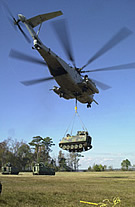
May 6/12: Sikorsky Aircraft Corp. in Stratford, CT receives a $7.8 million cost-plus-award-fee contract modification to incorporate CH-53K live fire test and evaluation. This is exactly what it sounds like – the Navy will shoot lots of holes in test platforms, and assess damage resistance.
Work will be performed at Naval Air Warfare Center Weapons Division, China Lake, CA (80%), and Stratford, CT (20%). Work is expected to be complete in December 2018 (N00019-06-C-0081).
April 12/12: Sikorsky Aircraft Corp. in Stratford, CT receives a $25.7 million cost-plus-incentive-fee contract modification, to provide detailed maintenance plans in support of the CH-53K helicopter program. Work will be performed in Stratford, CT, and is expected to be complete in December 2015 (N00019-06-C-0081).
March 30/12: GAO report. The US GAO tables its “Assessments of Selected Weapon Programs” for 2012. With respect to the CH-53K:
“Program officials reported that in July 2011, the contract’s estimated cost was increased by $724 million to $3.4 billion. According to Defense Contract Management Agency officials, the estimated contract costs increased because of several factors including the need for additional flight test hours and spare parts, increased material costs, and design complexity. The contract was also changed from cost-plus award fee to cost-plus incentive fee for the remaining period of performance. The incentive fees are tied to specific cost and schedule goals… According to Marine Corps officials, a force structure review has been conducted to assess the required quantity of aircraft and that review determined that the requirement for 200 aircraft is still valid despite the proposed manpower reduction.”
Feb 28/12: Avionics. Northrop Grumman announces a $5.6 million Phase II contract from US NAVAIR to modify existing software for the CH-53K’s LN-251 embedded GPS/fiber-optic inertial navigation system (INS). Northrop Grumman’s Navigation Systems Division will provide updated software and engineering support for platform integration and flight tests, to both NAVAIR and Sikorsky Aircraft.
Feb 24/12: Sikorsky Aircraft Corp. in Stratford, CT receives a $15.5 million cost-plus-incentive-fee CH-53K contract modification. The program needs a condition-based maintenance plus software toolset (almost certainly ISS – vid. Oct 26/11), to integrate the helicopter’s onboard prognostics and the Navy’s fleet common operating environment maintenance computers. The contract includes installation, operation, and recurring data analysis.
Funds and work will be assigned if and as needed, and work will be performed in Lexington Park, MD (90%), and Stratford, CT (10%). The contract is expected to run until February 2018. US Naval Air Systems Command in Patuxent River, MD manages the contract (N00019-06-C-0081).
Feb 10/12: USMC retires CH-53D. The USMC holds a “sundown ceremony” to retire its CH-53D Sea Stallion fleet, leaving only CH-53E Super Stallions. See also Aug 16/10 entry. US NAVAIR explains that the retirement isn’t immediate, but it is imminent:
“The Sea Stallion’s last mission is currently underway with Marine Heavy Helicopter Squadron 363 supporting Operation Enduring Freedom in Afghanistan. The helicopter will be flown from Marine Corps Air Station Kaneohe Bay to its final destination at the Pacific Aviation Museum, where it will be displayed.”
CH-53D retired
Dec 19/11: Sub-contractors. Northrop Grumman announces a follow-on contract from US NAVAIR in Patuxent River, MD to define system requirements for the integration of its LN-251 embedded global positioning system (GPS)/fiber-optic inertial navigation system (INS) on the new CH-53K.
The firm touts the LN-251 system as “the world’s smallest, lightest navigation-grade embedded GPS/INS unit in its class… [whose] modular, open architecture supports additional applications and evolving requirements.”
Oct 26/11: Recognition. The CH-53K Helicopter Systems Engineering Team wins a Department of Defense Systems Engineering Top 5 Programs Award, at the annual NDIA Systems Engineering Conference Award Luncheon in San Diego, CA. US NAVAIR.
Oct 26/11: ISS Patent. Sikorsky Aerospace Services’ Integrated Support System (ISS) aftermarket software suite has received a patent. ISS integrates onboard diagnostics (vid. Sept 26/08 HUMS entry) and usage data with ground-based troubleshooting and service information. This technology is part of Sikorsky’s efforts to move toward proactive diagnostics, and ISS platforms for the Sikorsky CH-53K and S70i are under development. Future plans include expansion to other aircraft types. Sikorsky.
Oct 11/11: Sub-contractors. Thermoplastic composites firm Fiberforge announces the addition of Njord A. Rota as its CH-53K Program Manager. They explain that the Lockheed Martin veteran will lead all management aspects of Fiberforge’s work for DRS Technologies Inc. Their work includes the design, development and production of the carbon fiber composite components within the CH-53K’s Internal Cargo Handling System. Helihub.
FY 2011
GE delivers 1st engine, sees GE38 civil and military market potential as $4+ billion; Sikorsky unveils virtual reality center, FAFO experimental assembly line.
August 2011: Re-baselined. The CH-53K program undergoes a major time shift. Delivery dates for engineering development models are moved, 1st flight is pushed back to 2014, and Initial Operational Capability is moved from 2015 to 2018 (later 2019). Source: GAO.
Contract rebaselined

(click to view full)
Aug 4/11: Engine. GE has delivered the 1st GE38 engine, for use on the Sikorsky CH-53K Ground Test Vehicle. After 2 years of testing, GE touts 57% more power and 18% lower specific fuel consumption than the CH-53E’s similarly-sized GE T64, while using 63% fewer parts.
In addition to the CH-53K SDD program’s 20 flight engines, the GE38 testing program includes 5 factory-test engines that will accumulate more than 5,000 engine test hours by 2013. GE is pushing ahead on its engine despite CH-53K delays, and expects it to have applications in the fixed wing and naval markets, alongside its helicopter potential. They see a total civil and military market potential of $4+ billion. GE.
June 21/11: Industrial. Sikorsky announces that they’ve begun assembly of the CH-53K Ground Test Vehicle (GTV), which is currently in position 4 on the line. It’s the 1st of 5 prototype CH-53Ks to be assembled at the Sikorsky Florida Assembly and Flight Operations (FAFO) facility in West Palm Beach, FL, which opened in March 2011.
Another 2 GTVs will be assembled at Sikorsky’s main manufacturing plant in Stratford, CT, making 3 ground test and 4 flight test helicopters. CH-53K ground testing is scheduled to begin in early 2012, and flight testing during FY 2014. To give one a sense of the CH-53K, its rotor hub and transmission alone weigh 15,000 pounds – about the empty weight of a UH-60 Black Hawk.
April 2011: Restructuring. The CH-53K program undergoes a major shift. The SDD contract is changed from a cost-plus award fee structure to cost-plus incentive fee contract, which is tied to specific cost and schedule goals. Source: GAO.
Contract restructured
March 22/11: Industrial. Sikorsky officially opens its new 60,000 square foot Florida Assembly and Flight Operations (FAFO) campus, establishing experimental assembly line operations for the new CH-53K heavy lift helicopter. The FAFO line introduces a set of new manufacturing technologies. It’s equipped with wireless data connections to all operator plasma data screens, uses digital operation sheets, and is outfitted with overhead power and air dropdowns, new aircraft work stands, and overhead cranes. Sikorsky, incl. video.
Feb 16/11: Sub-contractors. Donaldson provides an update regarding its Engine Air Particle Protection System, which is a critical piece of equipment in desert or dusty environments. They received the contract in September 2007:
“We built the first full-scale EAPPS in just three months following the CDR, [DID: which was August 2010]” said Sheila Peyraud, General Manager, Aerospace and Defense at Donaldson. “Developmental testing began in November 2010 to support testing of the helicopter’s GE38-1B engine in 2011. We are pleased that initial results in this phase of the program are exceeding expectations originally set during the conceptual design phase. Qualification testing will begin in May 2011.”
Jan 14/11: Industrial. Sikorsky unveils a state-of-the-art virtual reality center for the CH-53K heavy lift helicopter program, attempting to help identify production and maintenance issues before the initial build takes place by using a 3-dimensional digital environment.
Located within the engineering labs at Sikorsky’s main manufacturing facility in Stratford, CT, the virtual reality center uses sophisticated software, along with 12 cameras, a head-mounted display headset, gloves, and a gripping tool. All devices are linked to 3 computers, which comprise the “command center” for operating the system.
Nov 19/10: Sub-contractors. ITT Corporation (formerly EDO) announces that after nearly 3 years of advanced design, development, testing and manufacturing, they’ve delivered the first pair of CH-53K sponsons to Sikorsky. Each sponson is 25 feet long by 4 feet wide and 5 feet high, and fits on the helicopter’s side to house landing gear, fuel, and other mechanical and electrical assemblies.
ITT used composite materials instead of traditional sheet metal for the sponsons, and hopes they’ll provide benefits in weight, corrosion resistance, and in-flight stress tolerance. To make that work, ITT has to use advanced manufacturing technologies like electronic model control, laser-ply projection, 5-axis computer numerically controlled machining, automated trimming and drilling, and laser and ultrasonic inspection of all subassemblies. The CH-53K parts will be built at ITT’s Electronic Systems facility in Salt Lake City, UT.
FY 2010
Why was the CH-53K program pushed back 2 years?; SAR raises plans to 200; Critical Design Review passed; AAQ-29 surveillance turrets for CH-53K; No more “boneyard” CH-53D/Es left.
[youtube:v=YxGNC9LNUw8]
(click for video)
Sept 6/10: Sub-contractors. GKN Aerospace delivers the first major CH-53K structural assembly to Sikorsky – an aft transition fuselage section that measures approximately 20′ x 9′ x 9′, built of an advanced hybrid composite, aluminum and titanium structure covered with external composite skins.
GKN Aerospace was accorded full design authority and manufacturing responsibility for the CH-53K helicopter aft transition fuselage section, cargo ramp, and overhead door structural assemblies in 2007. Structural design is carried out by the GKN Aerospace Engineering Development Center in Nashville, TN, and manufacturing of over 1,000 separate components takes place at the Company’s plant in St. Louis, MO. GKN Aerospace is employing manufacturing technologies including automated fibre placement (AFP), automated trim and drill, and digital inspection. GKN Aerospace.
Aug 16/10: CH-35D plans. DoD Buzz looks at the shifting plans to replace the USMC’s 30 CH-53D Sea Stallions. The original plan was to replace them with MV-22s. At some point in 2007/08, the Marine Corps formally decided replace their aging CH-53Ds with CH-53Ks. But now USMC Lt. General Trautman is saying that he wants an east coast and a west coast MV-22 squadron to replace the CH-53Ds in Afghanistan, and “When I can do that, that’ll be the start of getting CH-53 Delta out of the way.”
Exactly what “out of the way” means is ambiguous. If it means out of service, DoD Buzz correctly notes that this raises questions about the USMC’s support for the CH-53K, and would seem to be better news for the MV-22. If it means “shifted back to Hawaii while MV-22s serve in Afghanistan,” that would be something else. The exact meaning isn’t 100% clear in the article.
Aug 3/10: CDR. Sikorsky announces a successful Critical Design Review for its CH-53K, following a week-long meeting in late July that included representatives from the military, Sikorsky, and 21 industrial partners. At the review, the CH-53K team had to demonstrate that their design meets NAVAIR’s system requirements. System-level performance projections indicate that all 7 Key Performance Parameters (KPPs) will be achieved with adequate risk mitigation margin built-in. Over 93% of the design has been released for manufacturing, and the final design definition concludes, the next step involves initial prototypes and testing.
The overall program CDR follows previous efforts including a System Requirements Review (SRR), System Functional Review (SFR), System Preliminary Design Review (PDR), 77 supplier-level CDRs, 64 supplier and internal software reviews, and 16 sub-system CDRs. Sikorsky VP and CH-53K Chief Engineer Mike Torok offers an update of other preparations:
“Parts are being made throughout the supply base and at our new Precision Component Technology Center; test facilities are being fabricated and prepped for installation in our recently opened ground test facility; the integrated simulation facility is marching toward a late 2010 opening, already having received the first increment of software for the aircraft; and the final assembly facility in West Palm Beach is being prepared to start building the ground and flight vehicles early next year. It’s time now to prove out our design and show that this helicopter system will indeed meet the war fighting requirements of the USMC…”
CDR
June 28/10: Sub-contractors. Raytheon Co. in El Segundo, CA received a $26.5 million firm-fixed-price delivery order for 50 forward looking infrared devices that will be fitted to CH-53E (42) and CH-53K (8) helicopters. Discussions with corporate representatives confirm that these will be AN/AAQ-29 turrets, using a 480 x 640 element, 3-5 micron wavelength indium antimonite infrared detector, and a 2 field of view telescope on a 12-inch diameter turret.
This is a follow-on to a previous order. Work under this basic ordering agreement will be performed in El Segundo, CA, and is expected to be complete in June 2012. $530,000 will expire at the end of the current fiscal year, on Sept 30/10 (N00019-10-G-0018).
June 4/10: No more CH-53D/Es. US NAVAIR announces that it has delivered the last available CH-53s from storage at AMARG in Tucson, AZ. The last H-53E to come out of desert retirement was delivered to Marine Helicopter Training Squadron 302 on May 7/10, while the last CH-53D was delivered April 16/10.
Since the start of the program in August 2005, FRC East H-53 artisans have inducted and completed 10 of the heavy-lift helicopters. The team delivered 8 CH-53Es and 2 CH-53Ds, some of which had been idle for as many as 11 years, ahead of schedule and under budget. Each helicopter still took about 25,000 total work hours for all testing, modifications, and maintenance. Sikorsky ended CH-53 production in 1999, so AMARG was the last remaining source of airframes.
Boneyard out of CH-53s
May 10/10: Engine. Flight International reports that even though the CH-53E is delayed, GE remains committed to delivering the 7,500 shp class GE38-1 engine on schedule. The firm sees re-engining opportunities and related sales beyond the CH-53K, so they’ve begun delivering GE38s for ground tests years before airframes become available for flight test.
As of Feb 15/10, GE had recorded 176 engine starts and 177 operating hours, with sustained power of 7,760 shp and peak power of 8,300 shp. April 2010 saw delivery of a 2nd engine for ground tests.
The article is less positive about the CH-53K’s odds of winning the German/French heavy-lift helicopter program. Apparently, Germany wants a helicopter that will fit key vehicles internally, not underslung. Ultimately, the question will be whether Germany can afford to develop what it wants, can find it elsewhere, or is forced to remove some requirements.
April 29/10: Why the delay? DefenseTech reports that the USMC has pushed back the initial flight date of the CH-53K by 2 years to FY 2013, and Initial Operational Capability by 3 years to FY 2018, “with little concrete justification beyond an ‘overly aggressive initial program schedule’ “, and while stressing that the program has not run into technical problems. Craig Hooper writes:
“The CH-53K was an unsung showpiece for those preaching the virtues of incremental development, and, as a result, appetite for the platform has grown by about 30 percent, with the program of record expected to increase from 156 aircraft to 200. But, in the process, the CH-53K has become something of a MV-22-killer. Is this the problem?… In late 2009, the Marine Corps decided to go with the CH-53Ks to replace their 40-year old CH-53D fleet (MV-22 Ospreys were originally slated to replace the CH-53D). At about the same time, Israel decided to forego the Osprey for the CH-53K, killing the Osprey’s best hope of snaring an international buyer. And with the Osprey 65% availability and the MV-22s high operating costs of about $11,000 dollars an hour… worse, studies from the Pentagon demonstrated that a CH-53K-equipped big-deck amphib provided a lot more logistical support for embarked Marines than the MV-22… Slowing CH-53K development will… prevent real-data comparisons between platforms… [until] a second multi-year MV-22 contract gets signed in FY 2013. Even worse, slowing the CH-53K schedule raised the program price by at least $1.1 billion dollars, raising the per-unit price… Why slow a program that stands to be a high-demand showpiece with potential markets in Israel, Germany, France, Turkey, Singapore and Taiwan?”
Asked for a response, US MARCORSYSCOM said that US NAVAIR was the only agency that could respond; NAVAIR did not respond to DID’s simultaneous inquiry.
April 1/10: SAR – Program grows. The Pentagon releases its April 2010 Selected Acquisitions Report, covering major program changes up to December 2009. The CH-53K is included, because the Marines want more of them – but there’s a self-imposed catch:
“CH-53K – Program costs increased $6,817.8 million (+36.4%) from $18,708.3 million to $25,526.1 million, due primarily to a quantity increase of 44 aircraft from 156 to 200 aircraft (+$3,108.9 million), and increases in other support costs (+$749.7 million) and initial spares (+$456.2 million) associated with the quantity increase. Costs also increased due to a three-year delay in the procurement profile shifting initial purchases from fiscal 2013 to fiscal 2016 (+$1,148.4 million), schedule growth attributable to funding constraints (+$669.6 million), and an increase in the cost estimate for the development contract (+$611.2 million).”
Feb 22/10: Sub-contractors. Cobham announces [PDF] a sub-contract from Sikorsky to manufacture all leading and trailing edge details and precisely locate and bond the details onto the CH-53K’s main rotor blade spar.
The work will be done by its Antenna Systems unit, which has consolidated all composites-related operations within the company. Depending on how many CH-53K helicopters are eventually built by Sikorsky for the US Marine Corps, the contract could be worth up to $25 million.
Jan 22/10: Industrial. Sikorsky formally opens its new $20 million Precision Components Technology Center, as part of United Technologies Corp.’s $130 million investment the CH-53K program.
The center currently employs 8 people, and was designed to allow the development of new product lines with “zero setup time” and quick changeover from one component to another. The center will produce major dynamic components of the CH-53K helicopter such as rotating and stationary swashplates, main and tail rotor hubs, and main rotor sleeves. The equipment in the center has the capability to produce any precision rotor and drive system dynamic component, including earlier-model configurations, and forgings machined there can be up to double the size of previous on-site limits. Sikorsky release.
Jan 7/10: IDR. Sikorsky announces the wrap-up of its Integration Design Review for the CH-53K, in preparation for the Critical Design Review coming in 2010. The event included industrial team members , and personnel from US NAVAIR and the Office of the Secretary of Defense. Risk reduction initiatives on the critical split torque main gear box and the advanced main rotor blade are done, and 2010 will also hold a Technology Readiness Assessment. Initial Operational Capability is currently slated for early 2016.
Established features of the CH-53K helicopter currently include a joint-interoperable glass (digital screens) cockpit; fly-by-wire flight controls; 4th generation rotor blades with anhedral tips; a low-maintenance elastomeric rotor head; upgraded engines; a locking cargo rail system; external cargo handling improvements; survivability enhancements; and design for reduced operation and support costs. Sikorsky release.
FY 2009
CH-53s flying at 3x planned usage; 1st GE38 engine test; VELD removed from the design; Sub-contractors picked.

(click to view full)
July 28/09: Engine. The GE38 team holds a ceremony at General Electric in Lynn, MA, celebrating the completion of the first full GE38 engine test. This first engine test, which began June 24/09, focused on basic engine checkout and risk reduction. All engine test parameters were within predicted values.
SDD phase testing will include 5 ground-test engines that will accumulate more than 5,000 engine test hours, plus production of 20 flight-test engines for the CH-53K development helicopters (each helicopter carries 3 engines). NAVAIR release.
May 7/09: Sub-contractors. Curtiss-Wright Corporation announces a contract from Sikorsky to develop and supply data concentrator units for the CH-53K. Curtiss-Wright’s system consists of 2 data concentrator units (DCUs) that will receive and provide various avionic and air vehicle discrete, digital and analog inputs for monitoring, processing data and controlling various CH-53K subsystem components.
Curtiss-Wright’s Motion Control segment will develop and manufacture the DCU systems at its newly-opened City of Industry, CA, facility. The initial contract runs through 2011 with the production phase starting in 2013. The contract has a total potential value of $22 million when development and all aircraft production options and phases are completed.
April 21/09: Sub-contractors. Curtiss-Wright Controls Inc., announces a contract from United Technologies subsidiary Claverham Ltd. (a Hamilton Sundstrand Flight Systems business unit) to provide multi-channel linear variable displacement transducers (LVDTs) for the fly-by-wire (FBW) systems controlling the main rotor and tail rotor on the Sikorsky UH-60M Upgrade and CH-53K helicopters.
The LVDTs are special pressure sealed linear displacement transducers that are embedded in Claverham’s Primary Flight Control Actuators. The transducers provide electrical signals that are proportional to the position of the hydraulic actuator rod, and the actuators change pitch angles on the main and tail rotors in response to the pilot’s commands.
These two programs have a potential contract value in excess of $20 million over a 15-year period, with shipments expected to begin in 2009. The company will supply these products from its Christchurch, UK operation.
March 30/09: GAO. The US GAO audit office delivers its 7th annual “Defense Acquisitions: Assessments of Selected Weapon Programs report, which looks at 47 programs including the CH-53K HLR. The CH-53K stands out, as one of the few programs to show lower R&D projections (from $4.23 billion to $4.17 billion) and estimated delivery time (2 months early) since its 2005 baseline. The truth is, the Marines have little choice. The time crunch has already begun:
“According to program officials, all available decommissioned CH-53E helicopters have been reclaimed… Currently deployed CH-53E aircraft are flying at three times the planned utilization rate… The program intends to manufacture up to 29 of the 156 total [CH-53K] helicopters (19 percent) during low-rate initial production at the same time that it is conducting initial operational testing. While concurrent testing and production may help to field the systems sooner, it could also result in greater retrofit cost…”
That’s likely, since a number of requirements and systems have been shelved, in order to deliver the helicopter on time:
“Both of the CH-53K’s current critical technologies, the main rotor blade and the main gearbox, are immature and are expected to be fully mature following the low-rate initial production decision in 2013. The program replaced a third technology, the viscoelastic lag damper, with a modified version of an existing [linear hydraulic damper] technology. During preparations for the preliminary design review, it was discovered that maturing system engineering tasks would potentially require additional cost and time. As a result, the program eliminated noncritical requirements to contain costs and delayed the preliminary and critical design reviews and low-rate initial production decision.”
Feb 8/09: Sub-contractors. BAE Systems announces contracts from Sikorsky Aircraft for development and initial deliveries of CH-53K Cockpit Seats and Cabin Armor Systems, and for integration of the CH-53K’s fly-by-wire flight controls. BAE Systems efforts will include design, development, testing, qualification, and delivery of initial systems to support the flight test and ground test aircraft. Follow-on contracts would be placed for production orders and spares.
The seats will be based on BAE Security & Survivability Systems S7000 armored, crashworthy seats, and first deliveries of both seats and cabin armor are scheduled for 2010. The total value of the programs is estimated at approximately $90 million through 2022, if 156 CH-53K aircraft are built.
FY 2008
PDR successful; Sub-contractors picked.

(click to view full)
September 2008: PDR. The CH-53K program conducts a successful Preliminary Design Review. Source.
PDR
Sept 26/08: Sub-contractors – HUMS. Goodrich announces that it has been picked to supply its IVHMS Health Usage and Monitoring Systems (HUMS) for the CH-53K. HUMS are embedded sensors within the aircraft’s key components, like engines. They monitor these systems, and can often tell if things are beginning to wrong inside before something actually breaks.
Avoiding breakdowns, and helping to pinpoint problems faster if something does break, saves money. Further savings can be had by using HUMS in conjunction with advanced maintenance and fleet management software. Once a baseline of good data is available, it becomes possible to switch from “do it just in case” maintenance and overhaul checklists, to “condition-based maintenance” that’s performed only when necessary, based on a combination of HUMS readings and predictive software.
Goodrich has carved out a strong market position in this area, supplying HUMS systems of varying complexity for a number of US military helicopters. IVHMS will supposedly build on earlier IMDS systems implanted in the CH-53E, but will be broader in nature, monitoring “the CH-53K helicopter’s entire mechanical drive train from the engines to the rotor system, and hundreds of aircraft systems.”
Sept 2/08: Sub-contractors. Breeze-Eastern Corporation announces that Sikorsky has picked them to provide the CH-53K’s Internal Cargo Winch System. The initial contract requires the delivery of 5 units for the System Design and Development phase.
Breeze-Eastern has worked with Sikorsky in this area to supply the S-92, and to retrofit USMC CH-53Ds. Bloomberg.
May 30/08: Camber Corp. in Huntsville, AL received an $8.6 million cost-plus-fixed-fee contract for program management, acquisition management, and engineering and technical services in support of the CH-53D, CH-53E, MH-53E, and CH-53K.
Work will be performed in Patuxent River, MD and is expected to be complete in November 2008. This contract was not competitively procured by the Naval Air Warfare Center Aircraft Division, Patuxent River, MD (N000421-08-C-0044).
Feb 18/08: Sub-contractors. Northrop Grumman Corporation announces that U.S. Naval Aviation Systems Command has picked their APR-39BvX radar warning receiver (RWR) integration program for the Navy’s CH-53K helicopter fleet. The APR-39 BvX upgrade, scheduled for completion and flight testing in late 2009 or early 2010, builds on the recently completed AvX program and includes new, faster processors and “massive” memory expansion.
Under the terms of the $17 million phase Phase 2 contract, Northrop Grumman will incorporate all electronic warfare (EW) integration capabilities of the APR-39Av2 and APR-39Bv2 versions, which are variants of the same system tailored to the kind of aircraft computer and cockpit interfaces in Navy/USMC aircraft. The APR-39BvX program will create one interoperable version for the forthcoming CH-53K fleet. This phase 2 program will include electronic warfare controller and integration interfaces to multiple missile and laser warning sensors, and also tie the APR-39 into Northrop Grumman’s Directional Infrared Countermeasures (DIRCM) systems onboard each of the helicopters. The intended result is a system providing warning and protection against electro-optical, infrared, and radar guided missiles, and electronic warfare threats. NGC release.
Nov 6/07: Sub-contractors. Sikorsky has selected fellow United Technologies Corporation subsidiary Eaton Corporation to design, develop and supply the CH-53K’s integrated fuel system. This is in addition to the contract for the helicopter’s hydraulic power generation system and fluid conveyance package awarded to Eaton in July 2007.
During the development phase of the program, which runs through 2014, Eaton will provide the integrated fuel system support hardware for 5 helicopter shipsets in addition to a number of system development test sets. “Based on expected production of more than 156 helicopters for the U.S. Marine Corps, the contract value is approximately $96 million and, when combined with anticipated foreign military sales, is expected to exceed $160 million over the approximate 12-year life of the program.” Eaton release.
FY 2007
Sub-contractors picked; Sikorsky opens CH-53K development center.

2 HMMWVs, to shore
(click to view full)
Sept 25/07: Sub-contractors. Donaldson Company announces that Sikorsky has picked them to provide the CH-53K’s engine air particle protection system (EAPPS), which helps keep blown sand and other contaminants from gumming up the helicopter’s engines.
Sept 17/07: Sub-contractors. Fellow United Technologies’ subsidiary Hamilton Sundstrand announces that they’ve been selected to supply integrated secondary power systems for the CH-53K, consisting of the environmental control system, auxiliary power unit and main engine start system. The environmental control system (flight deck and avionics air conditioning, cabin ventilation and heating, engine bleed system, and supply air for the onboard inert gas generation system) and main engine start system will be built at Hamilton Sundstrand’s Windsor Locks, CT facility. The Auxiliary Power Unit will be built at the company’s San Diego, CA facility.
The contract includes design, development and production work; design and development will begin immediately with first hardware deliveries scheduled for 2009. Hamilton Sundstrand says that this agreement has a potential value of more than $400 million. The firm already holds contracts to supply the CH-53K’s fly-by-wire flight control computers, and primary main and tail rotor actuators. Hamilton Sundstrand release.
Sept 4/07: Sub-contractors. Sikorsky Aircraft Corporation has selected Goodrich Corporation to act as integrator for the CH-53K’s input and tail drive shaft system, as well as supplying the electrical power generation and distribution system (q.v. June 17/07).
July 12/07: Sub-contractors. Sikorsky Selects fellow UTC subsidiary Eaton to supply the CH-53K’s Hydraulic Power Generation System and Fluid Conveyance Package. During the development phase of the program, which runs through 2014, Eaton will provide support hardware for 10 aircraft shipsets. Based on expected production of more than 156 aircraft for the U.S. Marine Corps, as well as anticipated foreign military sales, the potential value of the contract over the life of the program is expected to exceed $200 million. Eaton release.
June 20/07: European HTL. France & Germany confirm their heavy-lift helicopter program, known as HTL in France and FHT in Germany. A full set of specifications have not been created yet, and the countries involved are still trying to decide whether to pay the price of a full R&D program to get exactly what they want, or base their helicopter on an existing design. Possible contenders include the CH-53K, Boeing’s CH-47F, and Rosvertol’s super-giant Mi-26T helicopter.
June 18/07: Sub-contractors. Canadian aerospace manufacturer Heroux-Devtek Inc.’s Landing Gear Division received a contract from Sikorsky to design, develop, fabricate, assemble, test and deliver the CH-53K’s landing gears and tail bumper during the SDD phase, which includes the production of landing gears and tail bumper assemblies for 8 systems. Total revenue for the SDD and the Production Phase, which will be awarded in a separate contract, is expected to exceed C$ 95 million (about $89 million). Rotor News.
June 17/07: Sub-contractors. Sikorsky Aircraft Corporation has selected Fortune 500 firm Goodrich Corporation to supply the electrical power generation and distribution system for the CH-53K program. Goodrich’s Pitstone Green, UK and Twinsburg, OH facilities will be involved in the development and delivery of a complete electrical power system for the aircraft, consisting of generators and controls; primary power distribution; AC/DC converters; battery; and external power controls.
Goodrich currently supplies power generation for the Sikorsky S-92/H-92 Superhawk, and has recently been selected to supply the DC power generation for the Sikorsky’s upgraded S-76D civil helicopter. Rotor News | Goodrich press kit release incl. pictures
May 9/07: Sub-contractors. Sikorsky Aircraft announces its selection of 4 subcontractors to design and fabricate the CH-53K’s major fuselage sections, “following an extensive solicitation and evaluation of multiple bids over a 12-month competition”: They include Aurora Flight Sciences in Manassas, VA; Bridgeport, WVA; and Columbus, MS; R&D in Cambridge, MA (main rotor pylon). EDO Corp. composites in Salt Lake City, UT; select resin transfer molding parts from Walpole, MA; and final assembly in North Amityville, NY (tail rotor pylon & side sponsons). GKN Aerospace in Nashville, TN & St. Louis, MO (aft transition). Spirit AeroSystems in Wichita, KS (cockpit and cabin).
Design will be conducted in a collaborative environment between supplier sites and Sikorsky’s Heavy Lift Development Center using model management systems linked to Sikorsky IT and data systems. Composite and titanium materials are being employed extensively to provide superior fatigue and corrosion durability at minimum weight, and state-of-the-art manufacturing processes such as co-curing, automated part fabrication, super high speed machining, and determinant assembly are being pressed into service to keep costs down. Sikorsky release.
Assemblies will initially be built for 7 test and certification aircraft (4 Engineering Development Models, 1 Ground Test Vehicle, 1 Static Test Article and 1 Fatigue Test Article.) The CH-53K SDD program schedule runs through the end of September 2015.
ADDENDA: GKN Aerospace’s release says that they’re contracted to deliver their 7 development ship sets to Sikorsky between 2009 – 2012, and estimates that this deal could be worth up to $70 million to them. Aurora Flight Sciences’ release clarifies that the Main Rotor Pylon (MRP) is one of 6 major fuselage sections; it is mostly made of composite materials, and houses the CH-53K’s Main Rotor Head, the No. 2 engine and other aircraft subsystems. EDO Release [PDF]
Feb 12/07: Manufacturing. Sikorsky Opens the CH-53K Development Center. The CH-53K program’s new Heavy Lift Development Center is a 106,000-square-foot office building in Stratford, CT, about 5 miles from Sikorsky’s main facility. It houses the CH-53K Program and Engineering staff, co-locating 500 team members consisting of Sikorsky, Naval Air Systems Command, Defense Contracting Management Agency personnel and subcontractors. These members work in Integrated Product Teams to design, develop, test and manufacture major systems and subsystems within the CH-53K.
Dec 22/06: Engine picked. Sikorsky Aircraft has selected General Electric Aviation to provide the new CH-53K heavy lift helicopter’s main engines. The GE38-1B engine planned for the CH-53K is a derivative of the CFE738 commercial turbofan engine used in the Falcon 200 business jet; the CFE738 was in turn derived from the T407 turboprop intended to power the US Navy’s updated P-7 Orion (that program was canceled and a competition restarted that left the 737-derived P-8A MMA as the winner). See also GE’s Feb 7/07 release.
According to this Flight International article, GE’s engine beat out Pratt & Whitney’s PW150 and a derivative of Rolls Royce’s AE1107 that powers the V-22 Osprey.
Oct 30/06: Rotor. Sikorsky Aircraft has submitted test results for its 4th Generation(TM) rotor blade, which builds on the work done for the Growth Rotor Blade(TM) (GRB) currently used on their new UH-60M and S/H-92 helicopters, using anhedral tips. The CH-53K model wind tunnel testing performed late in the summer of 2006 has reportedly shown a significant improvement in forward flight efficiency over the GRB. Earlier in the year, similar model rotor hover testing indicated large gains in hover efficiency. Read Sikorsky’s release.
FY 2004 – 2006
Program OK and $3 billion development contract; European HTL opportunity?

(click to view full)
July 19/06: European HTL. Jane’s reports that EADS Eurocopter is seeking partners for a “super lift” helicopter to be fielded around 2020 with the French & German militaries, and confirms that talks have been held with Sikorsky regarding a modified CH-53K with European avionics and a larger cabin.
The Germans apparently want to replace their CH-53Gs (actually modified CH-53Ds) around 2020, and will look for upgrade programs to bridge the gap. The French currently lack heavy-lift helicopters in the CH-53 or CH-47 class, though the supergiant Russian Mi-26 was evaluated recently. Eurocopter and Sikorsky recently partnered on the successful $3 billion LUH program, but the firm has said it is keeping all its options open and is making no commitments.
UPDATE: Germany is updating their CH-53Gs, and the 2 countries are also going ahead with the heavy lift helicopter program. The CH-53K is still a competitor. Where does it stand? Read “The European Heavy Lift Helicopter Program?”
April 5/06: SDD contract. Sikorsky Aircraft Corp. in Stratford, CT receives a $3.04 billion modification to a previously awarded cost-plus-award-fee contract (N00019-06-C-0081) for the System Development and Demonstration (SDD) of the CH-53K aircraft, to include 4 SDD aircraft, 1 ground test vehicle, and associated program management and test support.
Work will be performed in Stratford, CT and is expected to be complete in December 2015. See also NAVAIR release.
SDD contract
Dec 22/05: Green light. A formal decision by the Honorable Kenneth R. Krieg, US Undersecretary of Defense for Acquisition, Technology and Logistics, gives the estimated $4.4 billion HLR program the green light to proceed to the System Definition and Development (SDD) phase.
(click to view full)
August 25/05: Sikorsky Aircraft Corp. in Stratford, CT received a $43.3 million cost-plus-fixed-fee delivery order against a previous basic ordering agreement to perform requirements definition and engineering studies in support of the Marine Corps’ Heavy Lift Replacement (HLR) Program. Work on the requirements definition and engineering studies will be performed in Stratford, CT and is expected to be complete in April 2006.
Jan 6/05: Sikorsky Aircraft Corp. in Stratford, CT received an $8.4 million cost-plus-fixed-fee contract for preliminary design work in support of HLR, as part of the initial system development and demonstration of the Marine Corps’ CH-53X Heavy Lift Replacement (HLR) program. Work on the preliminary design contract (N00019-06-C-0081) will be performed in Stratford, CT and is expected to be complete in January 2008 (N00019-03-G-0003).
Dec 23/04: A $34 million time and materials delivery order, issued against basic ordering agreement N00019-03-G-0003, to perform requirements definition and engineering studies in support of the Marine Corps’ Heavy Lift Replacement Program. Work was performed in Stratford, CT, and was expected to be complete in May 2005.
This contract number is not exclusive to the CH-53K. Other awards under this particular contract covered the Presidential Helicopter program (Sikorsky lost) and other helicopter engineering.
Appendix A: Flying Between Scylla and Charbydis: Navigating the Political Shoals

(click to view full)
DID’s coverage of the HLR program has also included a report about HLR’s potential merger with the US Army’s futuristic JHL program. The Joint Heavy Lifter (JHL) is imagined as an aircraft with cargo capacity that approaches a C-130 Hercules transport (about 20 tons), but with the ability to take off and land like a helicopter. No current US military helicopter platform even comes close. JHL’s competitors are deploying some radical and different technologies in their attempt to achieve these goals – from quad tilt-rotors to coaxial skycranes and even compound helicopters.
Marine Corps acquisition officials also weighed the option of participating in JHL. While Congress could always step in to force the issue – and may still do so – the Marine Corps note that this would be deeply unwise for a number of reasons:
“The Army’s proposed heavy lift requirement to transport the Future Combat System greatly exceeds our requirement,” said program manager, Col. Paul Croisetiere. “The actual aircraft hasn’t been designed yet, but initial analysis suggests the joint heavy lifter will be too large to operate from current and programmed amphibious shipping. We may have a use for it, but in more of a logistical role as a possible KC-130J [air tanker] replacement – we still need the CH-53K for tactical heavy lift.”
Joint Heavy Lifters may not be available any sooner than 2025, according to Croisetiere, which is more than 10 years after the Marine Corps will be forced to start retiring its current CH-53E fleet. Even if the Marines could use it, Croisetiere pointed out that as currently envisioned, JHL will be too big to operate from the Marines’ amphibious ships.

This is a logical argument. However this rationale might sell better if the USMC hadn’t spent the last decade describing tilt-rotor technology as the necessary wave of the future that would make helicopters obsolete, in its quest to sell the $100 million per plane V-22 Osprey.
When budgets are also being squeezed hard by multiple cost overruns on a wide swath of programs, programs that appear to be similar to each other will become big targets for Congressional cuts and pressure to merge. The US Marines have been the leading service advocates of tilt-rotor technology as a transformational necessity. Having invested so much of their prestige and credibility in the V-22, some people on Capitol Hill seem inclined to view the Marines’ rejection of a program that includes similar Quad Tilt Rotor and OSTR (Optimum Speed Tilt-Rotor) options as inconsistent, and hence mere territoriality. If this view spreads, it will not bode well for the HLR Program’s political survival.
It certainly wouldn’t be the first time in US military procurement history that the promise of the shiny new thing has found itself in the way of fulfilling military necessities with cheaper, proven options.

(click to view alt.)
The natural response to such pressures would be twofold. One track would emphasize the comparatively speculative nature of the JHL Program’s technologies and their uncertain development timelines. The other track would tout the value of cheaper builds of proven helicopters, in order to meet immediate needs and an uncompromising timeline for fleet airframe life. This is exactly what Col. Paul Croisetiere has done.
Making that argument, however, flies in the face of almost everything the USMC said when some in Congress pushed for immediately available conventional helicopter options to replace the Marines’ extremely aged Vietnam-era CH-46 Sea Knights. Options that would also have cost about half the price per aircraft. If the CH-46s could be patched together via life extension programs and extensive maintenance while the V-22s sorted out their difficulties and eventually reached production many years late, why not the CH-53Es? Especially if pursuing a similar tilt-rotor technology like the JHL’s QTR would reduce the V-22’s per-aircraft costs while increasing overall interoperability, and therefore easing long-term maintenance and logistics costs as well?
These arguments may or may not be considered valid. Nevertheless, they should absolutely be expected as the Global War on Terror, unexpected future contingencies, and a looming demographic shift put increasing pressure on US defense budgets. The US Marine Corps has certainly prepared the ground well.
The HLR program may have an eventful political journey ahead of it.
Appendix B: Interesting Ideas: The CH-53X Skycrane Concept

(click for details)
As a point of interest, this is one of the more innovative suggestions we’ve seen re: the next-generation CH-53X. It proposes turning the CH-53 into a “Skycrane” variant, and using it in conjunction with the trend toward “battle box” containerized forces, plus underslung light armor & vehicles.
The idea is that this would improve both the CH-53E’s capabilities (via reducing aircraft weight but not power) and the USA’s transformational deployability (via faster and more versatile load and ship that would also improve tactical surprise).
Additional Readings & Sources
* Sikorsky – CH-53K.
* GlobalSecurity.org – Heavy Lift Replacement [CH-53X].
* SLD (Oct 16/10) – Adding a Core USMC Capability: The CH-53K As A Logistical Force Multiplier. An Interview with Major Jeff “Kingpin” Davis.
* Sikorsky Frontlines, via WayBack (Q3 2009) – CH-53K Update [PDF].
* American Helicopter Society’s Vertifile Magazine, via WayBack (Spring 2002) – An Affordable Solution To Heavy Lift [PDF] by Lt. Col. James C. Garman, MH-53E pilot in HMH-772 and a Senior Preliminary Design Engineer in the New Product Definition Group, Sikorsky Aircraft Corporation. It describes the basic outlines of many low-risk CH-53X improvements.
* Naval Technology – CH-53E Super Stallion – Heavy-Lift Helicopter, USA.
* GE Aviation – GE38. CH-53K’s Engine, designated T408-GE-400 by the US Navy.
* MTU – GE38. The firms are partnering to develop it, with the German firm having an 18% stake; MTU will be licensed to offer it for any European FTH helicopter program.
* DID – Incoming & Hostile: The USN’s JATAS Aircraft Warning System. ATK picked, will be used on the CH-53K.
News & Views
* Flight International, via WayBack (May 10/10) – CH-53K delay will not hold up GE38 engine programme. Its potential uses go beyond helicopters, to include things like hovercraft, and GE sees its market potential as $4+ billion.
* Flight International, via WayBack (June 25/08) – GE plots GE38 engine’s future in emerging heavylift market. Offers further details re: the CH-53K’s planned engine.
* US DoD DefenseLINK: Transformation, via WayBack (Jan 9/06) – New Heavy Lift Helicopter Starts Development.
* US Navy NAVAIR, via WayBack (April 5/06) – $3B CH-53K contract awarded to Sikorsky.
* Jane’s Defense Weekly, via WayBack (Feb 24/06) – US heavy-lift aircraft will stretch state of the art. Full subscriber’s article includes JHL Program coverage as well.
* DID (Jan 9/06) – CH-53X (HLR) Program Moves Into SDD, Preliminary Design. An $8.6 million preliminary design contract is issued to Sikorsky, beginning the SDD phase. The CH-53X program is also redesignated CH-53K. Has the HLR program dodged the bullet?
* DID (Sept 27/05) – CH-53X HLR & JHL: Future Heli Programs on Collision Course? The shiny new (expensive, uncertain) thing may become the enemy of the necessary, proven thing in the US military’s procurement culture. Again.
* DID (Sept 21/05) – CSAR-X: And Boeing Makes 3…. The HLR program may be affected by the choices Sikorsky makes in the CSAR-X competition.
* DID (Aug 29/05) – HLR (CH-53X) Helicopter Program Moves Toward Milestone B Approval.
* Aviation Today, via WayBack (July 1/05) – Future Heavy Lift for the Marine Corps. An interview with Col. Paul Croisetiere, program manager for the U.S. Naval Air Systems Command H-53 Heavy Lift Helicopters Program PMA 261.
* Hill News, via WayBack (June 1/05) – House language could create friction over chopper programs.
* USMC, Leatherneck Magazine, via WayBack (May/05) – Heavy Lift Replacement: A Vital Marine Corps Program.
* American Helicopter Society’s Vertifile Magazine, via WayBack (Spring 2002) – From The Past To The Future Of Heavy Lift Part Three: Heavy Lift Helicopters [PDF].