


(click to view full)
The U.S. Marine Corps sees the 120mm Expeditionary Fire Support System (EFSS) mortar as the 3rd leg of its expeditionary fire support triad. EFSS will be the short-range but easily transportable counterpart to the reduced-weight M777 155mm towed howitzer, and the truck-mounted M142 HIMARS rocket system.
Accompanying Marine Air Ground Task Forces (MAGTFs) in expeditionary operations, EFSS will be the heliborne Ship-To-Objective Maneuver (STOM) force’s primary fire support, before the larger and longer range systems can move into position. As such, the EFSS launcher, its Internally Transportable Vehicle (ITV) carrier, a portion of the basic load of ammunition, and a portion of its crew, must all be transportable by a single CH-53E Super Stallion or future CH-53K heavy lift helicopter, and/or a single MV-22 Osprey tilt-rotor aircraft. The program’s path has not been smooth, and its vehicle choice in particular has come in for criticism, as it heads toward full-rate production.
EFSS and ITV
General Dynamics Ordnance and Tactical Systems will play the prime contractor role for the EFSS program. They are cooperating with General Dynamics Canada for the EFSS ballistic fire control computers, Tec-Masters for integrated and contractor logistics support, and the Thales-EADS Deutschland joint venture TDA Armaments SAS for their RT 120 Rifled Mortar System and ammunition. The November 2004 contract includes options for initial production and fielding that potentially could raise its value to approximately $300 million.
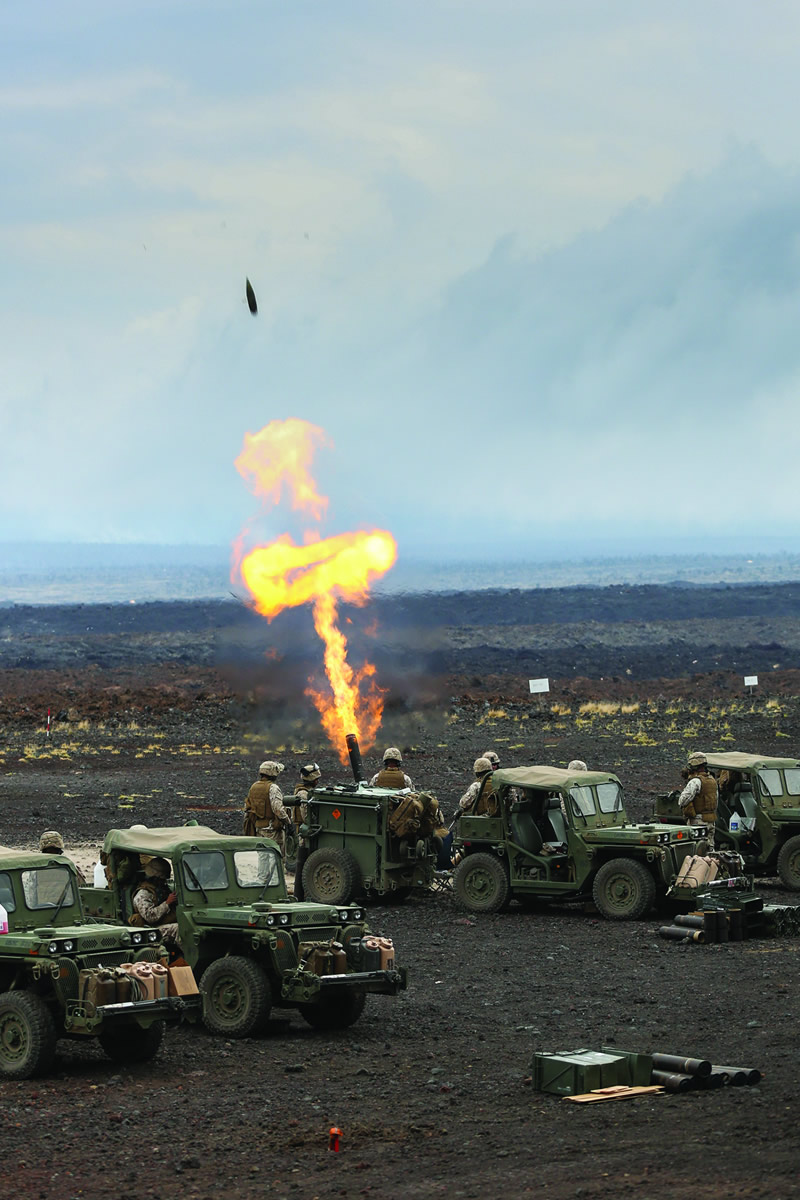
The EFSS weapon system will consist of 2 tow vehicles, the RT 120/ M327 “Dragon Fire” rifled mortar, an ammunition trailer, and fire control equipment. One vehicle will tow the RT 120 mortar, and the 2nd vehicle will tow an ammunition trailer which holds up 36 mortar rounds in factory-recyclable steel containers.
The 1,798 pound RT 120 is a French-designed 120 mm mortar that can fire smoothbore or rifled ammunition. It has a range of 8.2 km/ 5 miles, or 17 km/ 10 miles with rocket assisted projectiles currently under development. The MO 120 RT is currently in service with the French Army and other 23 armies worldwide, including 3 NATO countries.
The new PERM (Precision Extended Range Munition) 120mm rifled mortar round aims to give the EFSS a reach of 17 km/ miles, with CEP accuracy of 20m at full range. That requires a guidance system of some sort, unspecified in documents, though the US Army’s parallel APMI effort to field GPS-guided 120mm mortars is worthy of note. As a Navy weapon, the PERM round must also be qualified by the Naval Ordnance Security and Safety Activity (NOSSA) for transport aboard ship, and must meet US Navy insensitive munition and WSESRB requirements. In order to meet those requirements, GD-OTS modified TDA’s base ammunition to obtain the required certifications before Q2 2009.
(click to view video)
The ITV jeeps are manufactured by American Growler, Inc. of Robbins, North Carolina. The company moved its 40-employee facility from Ocala, Florida to North Carolina in early 2007 to begin building test vehicles for the program. The ITV will fill light strike and utility roles in support of the Ship-To-Objective Maneuver force. It is replacing the USMC’s Interim Fast Attack Vehicles (IFAVs, the Mercedes G-Wagen), providing EFSS towing services and some ground mobility to heliborne elements of the MAGTF. The 4,000 pound vehicles are intended to have 2,000 pounds of carrying capacity.
The ITV is not cheap, and one reason is a sophisticated suspension system that drops the chassis low to the ground for more convenient transport, then jacks it up more than a foot at the flick of a switch. V-22s have 5’6″ ceilings that are low in comparison to many helicopters, and this change was necessary in order to fit. The ITV “Growler” vehicles also added automatic transmission, power steering, and power brakes, a heavier engine, and the ability to switch to rear-wheel drive to help maneuver them within a V-22. The wheel base is narrow, which helps on narrow pathways, but also makes the vehicle “tippy” on turns.
Despite all this costly technology, the ITV’s level of mobility in off-road situations that feature very muddy or swampy ground, broken terrain like Afghanistan etc., remains to be proven. In contrast, air-transportable tracked vehicles like Rheinmetall’s Wiesel, or BAE Hagglunds’ widely-deployed Bv206, have done very well in those circumstances.

(click to view full)
Mobility has not been raised as a prominent issue for the ITV, but it has come in for sharp criticism on 2 other fronts.
One is protection – ITVs have almost none, and their design is completely vulnerable to the IED land mines that have become such a frequent feature of modern warfare. Carriage inside an MV-22 is a useful feature. The question is whether, as was the case with the now-canceled EFV, the Marines went too far in trading a certain kind of mobility for a lack of basic protection.
The other big issue with the ITV is cost. The original Growler was made partly from salvaged M151 jeep parts – a vehicle that is reportedly available in several versions for as little as $7,500 in kit form, or $14,500 for an upgraded “tactical dune buggy.” In contrast, the ITVs will now cost over $209,000 each, which is itself over 80% higher than the original, much-criticized, contract.
Is the Corps really getting its money’s worth? Or did it end up paying vast sums, and offering little protection, because they were hemmed in by the MV-22 Osprey’s limitations?
Contracts and Key Events

(click to view larger)
Unless otherwise noted, the EFSS/ITV contracts are awarded to General Dynamics – Ordnance and Tactical Systems (GD-OTS) in St. Petersburg, FL by the Marine Corps Systems Command in Quantico, VA.
FY 2012 – 2013
PERM guided round goes to full development.
click for video
Sept 26/12: PERM – Raytheon/IMI. Raytheon announces that they’ve completed the first 2 Guide to Hit (GTH) tests of their GPS-guided Precision Extended Range Munition (PERM) mortar shell under the August 2012 EMD contract. This was just the basics. Do the canards and fins deploy correctly after firing? Does it fly correctly? Does it fulfill promises re: range and impact angle?
The team passed their Preliminary Design Review before the live-fire, and plans call for live fire testing in early 2014. Sources: Raytheon release, Sept 26/13.
Aug 30/12: PERM EMD. US Marine Corps System Command, Quantico, VA issues a pair of 24-month Engineering & Manufacturing Development contracts for the PERM precision-guided 120mm mortar. PERM is designed to work with the EFSS, offering both range and accuracy improvements over existing 120mm mortar rounds. The basic contract will require the delivery of 42 PERM demonstration rounds, 2 projectile interface devices, 2 extractor tools and test support.
Alliant Techsystems Operations in Plymouth, MN wins a $14.4 million cost-plus- fixed-fee contract. The contract grants initial funding of $10 million, and funds in the amount of $4.3 million will expire at the end of the current fiscal year, on Sept 30/12. ATK offers its expertise with low-cost screw-in GPS guidance for artillery, and they’re teamed with initial PERM technology development contract holder General Dynamics Ordnance and Tactical Systems (GD-OTS). Work will be performed in Saint Petersburg, FL (50.4%), and Plymouth, MN (49.6%), and runs until August 2014 (M67854-12-C-6014). See also ATK release.
Raytheon Missile Systems in Tucson, AZ wins a $17 million cost-fixed-fee contract. The contract grants initial funding of $10 million, and funds in the amount of $4.3 million will expire at the end of the current fiscal year, on Sept 30/12. Work will be performed in Tel Aviv, Israel (61.1%), and Tucson, AZ (38.9%), and is expected to be complete August 2014 (M67854-12-C-6013). See also Raytheon’s January 2013 release. They’ve since confirmed to DID that they’re building on IMI’s 120GM DAGGER GPS-guided mortar, in order to create a new round that matches American requirements.
This approach is a shift away from the previous approach to PERM, which had GD-OTS as the sole-source contractor (q.v. May 11/10). Instead, this contract was competitively procured through full and open competition via Navy Electronic Commerce Online, with 4 offers received.
PERM Ammo EMD Phase
Oct 19/11: ITVs. General Dynamics – Ordnance and Tactical Systems in Saint Petersburg, FL receives an $18.1 million firm-fixed-price, indefinite-delivery/ indefinite-quantity contract modification, exercising the final option for 75 full rate production ITVs, together with their corresponding basic issue item kits and additional authorization hardware.
Work will be performed in Robbins, NC (39%); Forest, VA (37%); Columbus, OH (14%); and Reno, NV (10%). Work is expected to be complete by December 2012. The Marine Corps Systems Command, Quantico, VA manages the contract (M67854-05-D-6014, #0033).
FY 2010 – 2011
Full Rate Production approved; ITV mini-jeep cost soars even higher, as EFSS/ITV contracts continue; PERM precision-guided mortar round continues preliminary work; 1st combat use of EFSS.
(click to view full)
April 25/11: EFSS & ITV Lot 4. A $14.25 million contract modification (M67854-05-D-6014) for the Production Lot 4 procurement of 24 prime movers (ITVs) and 12 M327 rifled towed mortars, together with their corresponding basic issue item kits, additional authorization list hardware, and initial mortar spares for the EFSS.
Work will be performed in St. Aubin, France (74%); Forest, VA (14%); and Robbins, NC (12%), and is expected to be completed by June 30/13.
Feb 5/11: Combat. EFSS is used in combat for the 1st time, fired by Marines at at Combat Outpost Ouellette, Helmand province, Afghanistan.
Battery F, Company I, Battalion Landing Team 3/8, 26th Marine Expeditionary Unit, Regimental Combat Team 2, fired their 1st mission in support of Marine snipers. Sources: Marine Gazette, “EFSS Goes To War, Fires First Combat Rounds”.
Combat debut
Jan 31/11: Ammo. A $198.7 million firm-fixed-price, indefinite-delivery/ indefinite-quantity contract for 120mm mortar ammunition for the USMC EFSS.
Work will be performed in La Ferté-Saint Aubin, France (50%); St. Petersburg, FL (22%); Camden, AR (18%); and Lexington, KY (10%); and is expected to be completed by January 2016. Contract funds will not expire at the end of the current fiscal year. This contract was not competitively procured, under FAR 6.302-1a2 (M67854-11-D-1011). Thales later announces a $50 million sub-contract from General Dynamics Ordnance and Tactical Systems.
Major rifled ammo buy
May 11/10: PERM Ammo. A $9.7 million cost reimbursement contract modification for continuation of the 120mm precision extended range munition (PERM) Phase III technology demonstration, as part of the EFSS/ITV program. This continues a previous 2005 contract for “Extended Very Long Range Mortar ammunition” development efforts (J&A 11,402), which had a funding ceiling of $21 million and used about $8 million. This new contract covers completion of that effort, and was pursued as a new contract because of the amount of time since J&A 11,402 was signed.
It was pursued as a sole-source contract under FAR 6.302-1a2: “Only One Responsible Source and No Other Supplies or Services Will Satisfy Agency Requirements.” A review found that TDA is the only manufacturer making rifled 120mm mortar ammunition (most mortars and ammo aren’t rifled), the required projectile body and propellants are TDA designs, and GD-OTS/ TDA own the rights to the technical design package. MARSYSCOM estimated that a full and open competition would have taken 24 months, and cost $20 million. More to the point, a USMC order for 66 mortar shells is too small, and so TDA’s economies of scale in producing 120mm rifled mortars for all of its worldwide customers was seen as far more efficient in the long run.
Work under this award will be performed in Redmond, Wash. (23%); Minneapolis, MN (23%); Valencia, CA (18%); Red Lion, PA (18%); St. Petersburg, FL (10%); and Mesa, AZ (8%), and is expected to be completed by August 2011 (M67854-05-D-6014). See also FedBizOpps announcement.
PERM Ammo TD
March 25/10: Support. EG&G Technical Services, Inc. in Germantown, MD receives a task order for $6.5 million, in order to provide on-going technical, program, and logistics support for MARSYSCOM’s Armor and Fire Support Systems, Fire Support Systems (FSS) program office.
Current FSS programs include the expeditionary fire support system (EFSS); the precision extended range munitions for EFSS; the M142 HIMARS; the common laser rangefinder; the True North module; the Portable Lightweight Designator Rangefinder; the thermal laser spot imager; the modeled meteorological information manager; the ground counter fire sensor; and several other legacy systems. The scope of requirements includes providing support to the FSS program management office, as well as supporting the 3 FSS sub-teams (weapons team, target acquisition team, and the program support team) and supporting the Internally Transportable Vehicle program’s fielding efforts.
Work will be performed in Marine Corps Command organizations at Quantico, Va., and is expected to be complete in April 2011. $3,185,000 will expire at the end of the current fiscal year, on Sept 30/10 (M67854-02-A-9011, #0092).
March 22/10: EFSS Lot 3. A $20 million delivery order under previously awarded firm-fixed-price contract (M67854-05-D-6014) for the Production Lot 3 (PL3) procurement of 20 full-rate production EFSS systems, together with their corresponding basic issue item kits, and additional authorization list hardware.
GD-OTS will perform the work in St. Aubin, France (63%), Robbins, NC (20%), and Forest, VA (17%), and expects to complete it by April 22/12.
Feb 12/10: ITV. DoD Buzz reports that:
“Marine Corps Commandant Gen. James Conway has made no bones… he intends to slim down the Corps’ battle fleet… The Marines want to pay General Dynamics $37 million to buy somewhere around 140 Internally Transportable Vehicles (ITV), what it calls “a highly mobile, weapons-capable, light strike vehicle platform that is transportable in CH-53E and MV-22 aircraft.”
Feb 2/10: ITV costs. Defense Tech reports:
“According to the budget submission, the Corps wants to pay General Dynamics of St. Petersburg, Fla., $28 million to purchase 73 ITVs in the Light Attack Vehicle configurations — in other words, not the 120mm towing version.
Funds will support procurement of 73 ITV Light Strike Vehicles (LSV). The vehicles will be fielded to support upcoming Marine Expeditionary Unit (MEU) deployments to OEF [DID: Afghanistan]. The procurement will also support production line activities used for the Expeditionary Fire Support System (EFSS). The combined procurement of the ITV and EFSS prime mover platforms will allow production line operations to continue until the EFSS needs are fully satisfied. The unit costs for the ITV variants are impacted based on quantity differences and the negotiated prices derived from the negotiations.
I know there’s a lot of caveats here, but that comes out to around $380K per vehicle. Some of the money is being used for spares and other support costs, but if I’m reading the documents right (page 285) it looks as if the base cost for each ITV is around $273,000. That’s a lot of jack for an unarmored max-4-man minijeep.”
Jan 5/10: Mighty Mite SNAFU. SNAFU observes that the TV is not the first time the USMC has tried something similar, The last time did not end well. The M422 Mighty Mite was developed with a similar requirement. From Wikipedia:
“At over US$5,000 per unit, it was relatively expensive [5], and by the time the ‘Mite’ went into full production, the military’s helicopters had become so much more powerful, that the vehicle quickly became obsolete. The Marine Corps’ Sikorsky H-19 with its 2,650-pound (1,200 kg) cargo limit (including crew and fuel), for which the M422 had been developed, was being superseded by the Vietnam era UH-1 “Huey”, that could carry more than 1½ times that load. These factors may account for the small production total, as well as the short production time period.”
Dec 30/09: Support. A $6.1 million contract modification for EFSS/ITV calendar year 2010 contractor logistics support. An option also exists for an additional increment of 12 months, to cover fielding and associated training requirements for EFSS-ITV systems.
Work will be performed in Huntsville, Ala. (60 percent), and St. Petersburg, Fla. (40 percent). Work is expected to be complete by December 2010 (M67854-05-D-6014).
FY 2008 – 2009
Orders begin; Fielding begins; DoD Inspector General says the contracting process was unfair, but won’t order a redo; GAO says EFSS has improved, but becomes a liability if used beyond its specific concept.

(click to view full)
July 10/09: ITVs. A $10.4 million modification to previously awarded contract (M67854-05-D-6014) for an additional 40 full rate production ITVs together with their corresponding basic issue item kits and additional authorization list hardware. Work will be performed in Robbins, NC (42%, vehicle assembly); Forest, VA (30%, fabrication-unibodies, etc.); Columbus, OH (17%, armor and blast attenuation seats); and St Petersburg, FL (11%, powerpack integration), and work is expected to be completed by Nov 30/10.
July 10/09: EFSS Lot 2. A $20.8 million delivery order to make 20 EFSS and supporting equipment, part of a previously awarded contract (M67854-05-D-6014). GD-OTS will supply 20 full-rate production EFSS together with their corresponding basic issue item kits, additional authorization list hardware and mortar weapon spares.
The GD-OTS subcontractor on the program is TDA Armements (THALES Group) in La Ferté-Saint Aubin, France. GD-OTS will perform the work under this task order at St. Aubin, France (63%); Robbins, NC (22%); and Forest, VA (15%), and expects to complete it by Dec. 30/10.
May 22/09: ITVs. A $18.6 million delivery order under a previously awarded contract (M67854-05-D-6014) for 70 full rate production ITVs together with their corresponding basic issue item kits and additional authorization list hardware. Work will be performed in Forest, VA (19%); Robbins, NC (26%); Columbus, OH (11%); and St. Petersburg, FL (7%), and work is expected to be completed by May 21/10.
March 23/09: Fielded. GD-OTS announces that it successfully fielded EFSS with USMC Bravo Battery, 1st Battalion, 10th Marine Artillery Regiment located at Camp Lejeune, North Carolina. Each battalion in the 10th Marine Regiment received 6 EFSS systems comprising a pair of prime mover vehicles, a 120mm M327 mortar weapon, ammunition family and trailer.
Fielding
Feb 3/09: A Washington Post report offers details regarding the overall program, and its status. The first 6 mortar and ammunition systems have been sent to Marine units, as have about 20 ITVs. At this point, there are reportedly 81 ITVs under contract, and they’re awaiting bids on 70 more; there are 12 mortar and ammunition trailer systems under contract and 20 more out for bids. It also quotes USMC program manager John Garner as saying that:
“…you can’t run it up the highway in an urban area such as Iraq. But it could accompany foot-mobile Marine infantry in a not-built-up area such as Afghanistan.”
That’s unfortunate, because urban warfare, and urban transits, are expected to remain a growing aspect of all future wars, even for the Marines.

(click to view larger)
Jan 14/09: Inspector General. The US DoD’s Inspector General issues [PDF] an audit on the EFSS/ITV contract that was awarded to GD-OTS in November 2004, at the request of the Senate Armed Services Committee (vid. Sept 20/07). The audit concludes that the contract competition did not conform to US federal regulations:
“The MCSC did not award the EFSS and ITV contract in accordance with the FAR. MCSC source selection personnel did not adequately document and disclose all technical evaluation criteria in the solicitation and did not prepare a price negotiation memorandum. Training is needed to ensure source selection personnel comply with source selection procedures in the FAR to achieve fair treatment for offerors. As a result, the MCSC’s award of the EFSS and ITV contract to GDOTS did not meet FAR tests of fairness, impartiality, and equitable treatment.”
It did rule against the complainant in a number of areas, and its overall response was to recommended that the Marine Corps Systems Command tighten its internal contracting and acquisition controls – rather than recommending a redo of the competition. The Marines disagree with several aspects of this audit, and the back-and-forth is documented in Appendix D.
The Inspector General also said that the average cost of a single Growler has risen 120%, from about $94,000 when the contract was awarded in 2004, to $209,000 in 2008 – far past the bids of either finalist. The unit cost for the EFSS had grown 86% in the same period, from $579,000 to $1,078,000 for limited production units. Meanwhile, Initial Operational Capability had slipped from June/September 2006 to January 2009.
As of July 30/08, the USMC had ordered 19 EFSS systems: 4 for System Development & Demonstration, 6 under Low-Rate Initial Production, and 6 under Limited Production. It has also ordered 85 ITV Growler jeeps: 4 for System Development & Demonstration, 15 under Low-Rate Initial Production, and 66 under Limited Production.
Inspector General report
Nov 18/08: GAO Report. The Us GAO releases report #GAO-09-189R, “Defense Acquisitions: Status of the Safety, Performance, and Reliability of the Expeditionary Fire Support System.” Excerpts:
“Based on the May 2008 independent test report, most of the EFSS’ safety, performance, reliability, and mechanical issues we reported in 2007 have been addressed through a combination of design changes and increased training… EFSS vehicles are still not capable of securely carrying all required equipment, but Marine Corps officials attributed this problem to the space constraints imposed by the need to fit the system inside the V-22 Osprey, rather than to a design problem… MCOTEA reiterated in its 2008 test report that the EFSS is a survivable platform provided it is used within its concept of employment and that employing the EFSS outside of the concept of employment would present a significant survivability liability to the operators given its limited protection.”
July 2008: Full Rate Production. The Pentagon’s Milestone Decision Authority approves the full-rate production and fielding decision for the ITV Program.
Note that the original EFSS and ITV program schedules called for an Initial Operational Capability date of June 2006 for the EFSS, and September 2006 for the ITV. As of this date, neither platform is there yet. Source: US DoD IG.
FRP
June 2008: ITV Passes. A MCOTEA (Marine Corps Operational Test and Evaluation Activity) report concludes that the ITV is operationally effective and operationally suitable. Source: US DoD IG.
May 2008: An unannounced Low-Rate Initial Production states that a number of design changes had affected the major subsystems of the EFSS and ITV since LRIP began. The design changes included suspension, rear steering, transmission, power steering, and power brakes. Source: US DoD IG.
May 16/08: EFSS Passes. A MCOTEA follow-on report concludes that EFSS is now both operationally effective and operationally suitable, after a follow-on operational test and evaluation that ran from February through March 2008. Source: US DoD IG.
Jan 8/08: Plans. Gannet’s Marine Corps Times reports that:
“By September, the Corps plans to begin fielding about 15 ITVs for each battalion, at a rate of about one battalion a month. The first shipments will go to units using Ospreys and battalions slated for deployment with a Marine Expeditionary Unit. Long-term plans call for a total of 694 Growlers, but that timeframe will hinge on annual funding levels.”
Dec 21/07: GAO Report. The US GAO releases report GAO-08-331R: “Defense Acquisitions: Status of the Safety, Performance, and Reliability of the Expeditionary Fire Support System.” Among its findings, it mentions that:
“As a result of the introduction of design changes onto refurbished development vehicles, the operational test vehicles had different physical configurations. According to program officials, the first production vehicles were delivered in mid-November 2007, 4 months after operational testing ended… Recently the Marine Corps authorized additional limited production before reaching agreement on the scope and price–an arrangement that can make it more difficult to control costs…”
FY 2004 – 2007
RFP issued; Milestone B passed; Initial buys approved; Competition improprieties alleged;

(click to view larger)
Sept 21/07: 1 battery approved. The US Marines approve procurement of 6 production EFSS, or 1 battery. This effort does not commit the government to additional units. The Low Rate Initial Production units are delivered from October – November 2007. Source: US GAO.
Sept 20/07: Audit Requested. Sen. Carl Levin [D-MI], Chairman of the Senate Committee on Armed Services, requested that the DoD IG initiate an audit of alleged improprieties in the competition of the U.S. Marine Corps’ EFSS and ITV programs. Senator Levin noted that the request was made on behalf of a constituent, Rae-Beck Automotive, LLC, a Michigan company that was a subcontractor to one of the losing offerors. Source: US DoD IG.
Sept 20/07: Effective “With Limitations”. A MCOTEA operational test report concludes the EFSS is “operationally effective with limitations” and “operationally suitable with limitations.” In sun, it said that the system met many effectiveness and suitability requirements, but did not meet other requirements, had reliability issues, and warranted further testing. The report recommends that all development testing be completed before fielding.
The system met its vertical-transport, maximum-range, and accuracy key performance parameters, and overall met 13 of 14 critical requirements. It did not meet the critical requirement related to maximum rate of fire. The system also did not meet some noncritical requirements for timed events, which involve rate of fire, first round response, shift out of traverse, and emplacement and displacement. In addition, the test activity found that the EFSS vehicles were capable of carrying all required equipment, but not securely, and identified other safety, performance, and reliability/mechanical issues. Source: Us DoD IG/ GAO.
June 2007: Problems. A Low-Rate Initial Production contract modification acknowledges development problems, stating that many major subsystems still require continuous monitoring and critical analysis; and that EFSS and ITV subsystem design changes posed significant challenges because of minimum size, weight, and center of gravity constraints required to transport them in the MV-22 Osprey.
This contract modification was not formally announced on DefenseLINK. Source: US DoD IG.
March 22/07: An $8.2 million delivery order under a previously awarded cost-plus-fixed-fee contract (M67854-05-D-6014) to prepare low-rate initial production and full-rate production for the EFSS/ITV. Work will be performed in St. Petersburg, FL (75%); Ocala, FL (10%); and Robbins, NC (15%), and is expected to be completed by May 2007.
June 14/05: The Pentagon’s Milestone Decision Authority approves the entrance of the EFSS and ITV programs into the Production and Deployment (Milestone C) Phase. Source: US DoD IG.
Programs entering this phase are supposed to have integrated subsystems, completed detailed design, reduced system-level risk, and demonstrated ability to operate within the approved Key Performance Parameters. The DoD Inspector General concluded that EFSS and ITV detailed design was not complete, nor had the programs demonstrated acceptable performance in developmental test and evaluation.
In addition, no developmental test reports were issued prior to the June 2005 Milestone C approval. The Naval Surface Warfare Center performed EFSS developmental testing in March 2006 and May 2007, well after the Milestone C decision. Source: US DoD IG.
Milestone C
Nov 10/04: The MCSC Commanding General, who was also the Milestone Decision Authority, approves the entrance of the EFSS and ITV programs into the System Development and Demonstration Phase (Milestone B), and designates both the EFSS and the ITV as Acquisition Category III programs. ACAT III programs have an estimated total dollar value less than $140 million in research, development, test and evaluation (RDT&E) funds and less than $660 million in procurement funds in FY 2000 constant dollars.
It’s accompanied by an initial $12.1 million indefinite-delivery/ indefinite-quantity contract to General Dynamics Ordnance and Tactical Systems to supply EFSS and ITVs. At this point, the total potential contract is valued at $296 million for the base year and up to 6 option years, ordering up to 66 EFSS and up to 650 ITVs – at an EFSS average unit cost of $578,782 and an ITV average unit cost of $94,770.
Thales estimated that the total value of TDA’s share could be EUR 80 million, if all EFSS contract options are exercised (M67854-05-D-6014). General Dynamics OTS | Thales.
Milestone B & Main Production contract
Nov 7/04: The EFSS/ITV Source Selection Authority (SSA) and the Source Selection Advisory Council (SSAC) are briefed on the 3rd evaluation of proposals. The SSAC minutes noted that the ratings for each offeror would stand and that the analysis of the cost figures was limited to the evaluated costs without the ammunition adjustments. The SSAC felt that GDOTS ammunition certification would cost the Government more, but there was no way to accurately quantify the cost.
Following open discussions of the evaluation results, the SSA announced that GDOTS was his best-value determination. The Nov 7/04, chart showing technical factor ratings for the GD-OTS external vertical transportability concept notes that it failed to meet threshold requirements, but the Marines say that using a double-slung load should be considered acceptable. Source: US DoD IG.
Oct 14/04: The EFSS/ITV Source Selection Authority (SSA) and the Source Selection Advisory Council (SSAC) are briefed on the 2nd evaluation of proposals. The SSAC recommended that Offeror A and GD-OTS be considered equal on all evaluation factors except cost. There is some dispute regarding whether this was true, or whether some of the items GD-OTS had to add later were in its competitor’s bid. Offeror A submitted a proposal price of $300.1 million, of which $113.6 million was for the ITV. GD-OTS submitted a proposal price of $279.4 million, of which $61.6 million was for the ITV (a $52 million difference for the ITV, which subsequently surpassed both costs).
The SSA did not accept the recommendation, and directed the contracting officer to modify the solicitation by removing the Light Armored Vehicle-Mortar option because it was unsuccessful in the Program Objective Memorandum process and reopen discussions with Offerors A and B to address remaining weaknesses. Source: US DoD IG.
Aug 19/04: The EFSS/ITV Source Selection Authority (SSA) and the Source Selection Advisory Council (SSAC) are briefed on the RFP ratings. The SSAC minutes noted that the SSAC recommended Offeror A, but SSA did not accept the recommendation.
It directed the contracting officer to establish a competitive range including Offeror A and Offeror B (GD-OTS), which had the most highly rated proposals, and reopen discussion to address significant weaknesses. The SSA also asked for further physical validation regarding GD-OTS’ ability to meet MV-22 transportability requirements. Source: US DoD IG.
July 2004: The US Naval Surface Warfare Center states in the EFSS Source Selection Demonstration Evaluation Report that none of the offerors’ proposed vehicles met the MV-22 Osprey transportability requirements. Source: US DoD IG.
Feb 27/04: MARCRSYSCOM releases a request for proposals (M67854-04-R-6014) to produce 66 EFSS mortar systems and up to 650 ITVs. They receive 3 proposals. Source: US DoD IG.
EFSS RFP
March 28/03: MARCORSYSCOM issues contract M67854-99-D-3011, task order 0073 to Jacob Sverdrup Technology, Inc., to perform an ITV requirements verification study. It was valued at $1.04 million through final modification.
The objective of the study was to analyze the ITV requirements and see if commercial, off-the-shelf utility vehicles might meet the USMC’s needs. The approach used 3 screening criteria: whether a vehicle was internally transportable in the MV-22 Osprey, whether it was diesel powered, and whether it was commercially available or a non-developmental item. The resulting study stated that 33 vendors had responded to the request for information, and 2 would meet the criteria upon availability of a diesel option. The report also stated the American Growler vehicle was too wide, and so failed the MV-22 requirements. A later DoD Inspector General sport states that:
“MCSC (Marine Corps Systems Command, MARCOSYSCOM) officials could not provide detailed documentation on the specifics of the Jacobs-Sverdrup testing and were unable to explain why the American Growler vehicle was selected for the limited vehicle testing when the American Growler vehicle did not meet the screening criteria stated in the requirements analysis.”
Additional Readings
* US Marines, via WayBack (2008) – Expeditionary Fire Support System [PDF]. 2012 snapshot.
* Global Security – Expeditionary Fire Support System (EFSS)
* Thales Land & Joint Systems, via WayBack – Expeditionary Fire Support System [PDF format], 2006 snapshot.
* Deagel.com – MO 120 RT
* Global Security – Internally Transportable Vehicle (ITV) High Mobility Weapons Platform
Official Reports
* US DoD Inspector General (Jan 14/09) – Expeditionary Fire Support System and Internally Transportable Vehicle Programs [PDF]
* US GAO (Nov 18/08, #GAO-09-189R) – Defense Acquisitions: Status of the Safety, Performance, and Reliability of the Expeditionary Fire Support System
* US GAO (Dec 21/07, #GAO-08-331R) – Defense Acquisitions: Status of the Expeditionary Fire Support System
News and Views
* Marine Corps Gazette, via WayBack (2010?) – Expeditionary Fire Support System: Version Two. Maj Brian P. Duplessis’ Chase Prize winning essay. Recommends that the M327 mortar be scrapped, given its limitation and Army experiences in Afghanistan. He favors a disassemblable 105mm pack howitzer, with an APU for short-range survivability moves, and points at the Oto Melara Type 56 as one example of a similar concept.
* Marine Corps Gazette, via WayBack (Feb 14/11) – EFSS Goes To War, Fires First Combat Rounds
* Marines TV, via YouTube – Marines use new artillery system in Afghan fight. Fox Battery, 2nd Battalion, 12th Marine Regiment.
* Defense Media Network, via WayBack (Nov 18/10) – Triple Threat: The Ground Fires Triad Strategy
* SNAFU (Jan 5/10) – ITV! Its Already Been in USMC Service! As a very similar, and ill-fated, Vietnam-era project.
* Washington Post (Feb 2/09) – Marines’ New Ride Rolls Out Years Late
* USA Today, via WayBack (Dec 28/05) – Corps pays $100K for retooled jeep. Far, far more than its predecessor cost.
* DID – US Army Wants 120mm Guided Mortars for the Front Lines (APMI). This clip-on kit is an ATK project, and represents a potential competitor to PERM.
* DID (March 12/07) – Lots Riding on V-22 Osprey. A number of USMC systems have had to fit within its limitations.