

(click to view full)
Australia’s A$ 10+ billion Super Hornet program began life in a storm. Australia’s involvement in the F-35 Lightning II program have been mired in controversy, amid criticisms that the F-35A will (1) be unable to compete with proliferating SU-30 family fighters in the region, (2) lack the range or response time that Australia requires, and (3) be both late and very expensive during early production years.
The accelerated retirement of Australia’s 22 long-range F-111s in 2010 sharpened the timing debate, by creating a serious gap between the F-111’s retirement and the F-35’s likely arrival. Further delays to the F-35 program have created new worries that even the upgraded F/A-18AM/BM Hornet fleet won’t last long enough to allow smooth replacement.
The Super Hornets survived potential cancellation, and the “surprise” stopgap buy has steadily morphed into a mainstay of the future RAAF, with a new and unique set of electronic warfare capabilities thrown into the mix. This DID Spotlight article describes the models chosen, links to coverage of the key controversies, and offers a history of contracts and key events from the program’s first official requests to the present day.
RAAF Super Hornets: Variants and Variances
In December 2006, Liberal Party Defence Minister Brendan Nelson was discussing an A$ 3 billion (about $2.36 billion) purchase of 24 F/A-18F Block II Super Hornet aircraft to fill the fighter gap. The move was described as “a surprise to senior defence officials on Russell Hill,” but hurried requests and contracts quickly made it an official purchase. Australia’s subsequent Labor government decided to keep them rather than pay cancellation fees, but added an interesting option to convert 12 into EA-18G electronic warfare planes. Now more of the fighters and electronic warfare aircraft may be on the way.
The F/A-18F Block II

The 2-seat F/A-18F sacrifices some range, carrying only 13,350 pounds of fuel – 900 fewer pounds than the F/A-18E. In exchange, it adds a second crewman with an advanced attack station cockpit to assist in strike roles. The F/A-18F Block II adds a number of enhancements, but all are electronic rather than aerodynamic. The most significant improvement is its AN/APG-79 AESA radar; Australia will be the first country outside the United States to receive it, and only the 3rd country (UAE APG-80 in F-16 Block 60, Singapore APG-63v3 in F-15SGs) to receive AESA fighter radars in a US sale.
After the failure of Australia’s own “ALR 2002” electronic countermeasures program, some of its early-model Hornets and all of its F/A-18F Super Hornets will mount Raytheon’s AN/ALR-67v3 instead. This is a radar warning receiver that provides visual and audio alerts to F/A-18 aircrew when it detects ground-based, ship-based, or airborne radar emissions hitting the aircraft. It is the modern self-protection standard for F/A-18 E/F Super Hornet aircraft, and has also been incorporated into a number of earlier model Hornets flown around the world.
Other items bought specifically for the F/A-18F fleet include Raytheon’s AN/ASQ-228 ATFLIR surveillance and targeting pods, and AIM-9X short range air-to-air missiles. Australia’s Hornet fleet uses LITENING III pods and AIM-132 ASRAAMs instead, but ATFLIR and AIM-9X are the only fully qualified counterparts for the Super Hornet.
This kind of unique equipment drives up the long-term cost of the Super Hornet fleet by creating additional training, inventory, and maintenance requirements. On the other hand, there’s a flexibility bonus as well as a cost penalty. The Super Hornets are qualified with a number of other weapons that wouldn’t be available to Australia’s Hornets or its initial F-35As, such as AGM-84K sea and land attack missiles, AGM-88E AARGM advanced radar-killing missiles, etc.
Electronic Attack: EA-18G

(click to view full)
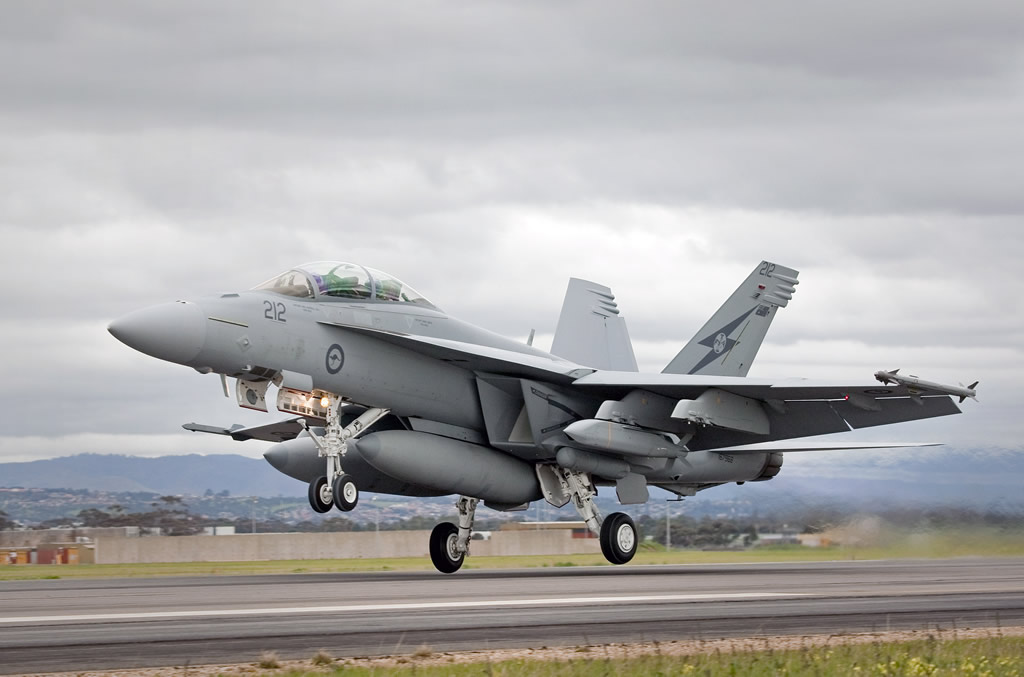
For operators who need much greater electronic defense and even offensive capabilities, the EA-18G Growler electronic warfare version is a derivative of the F/A-18F Block II that removes the internal gun, adds electronics within the aircraft to help it detect and jam enemy radars, and mounts 4 specialized ECM (Electronic CounterMeasures) pods under the wings.
In the US Navy, EA-18Gs will replace the EA-6B Prowler, which is based on a Vietnam-era airframe and has become the only Western electronic warfare aircraft capable of accompanying fighters into combat.
Australia’s EA-18G buy has made them the first export customer for an American electronic warfare fighter, and will give the RAAF an historically novel range of capabilities. As of February 2009, 12 of Australia’s 24 F/A-18Fs were slated to receive the additional wiring required to allow future EA-18 conversions. They were delivered that way, and as of December 2012, orders for the associated equipment, jamming pods, and remaining conversion work have begun, and a 2014 contract will add 12 new-build EA-18Gs to carry them.
If Australia eventually wants to expand to 24 EA-18Gs, they could do so in future by paying conversion costs for 12 of their F/A-18Fs, and buying the required jammers.
Training & Infrastructure

(click to view full)
The Australian order will include training simulators, which come in 3 key variants of their own.
Tactical Operation Flight Trainers (TOFTs) are for advanced pilot tactical training. Each one is a Boeing/ L-3 Link collaboration including L-3 Link’s 360-degree SimuSphere visual display, SimuView image generator, and Boeing Training Systems & Services’ mission computer emulation; simulated radar, electronic countermeasures, and Joint Helmet Mounted Cueing System; and high-fidelity crew station controls.
The Boeing-built Low Cost Trainers (LCT) run a mission computer emulation, and provide pilot and air combat officer training for navigation, weapons, radar, and electronic countermeasures.
The Integrated Visual Environment Maintenance Trainer (IVEMT) is a maintenance trainer that includes an interactive 3-D model environment, test/support equipment and realistic aircraft responses for more than 500 routine troubleshooting procedures.
The Future of the Fleet
(click to view full)
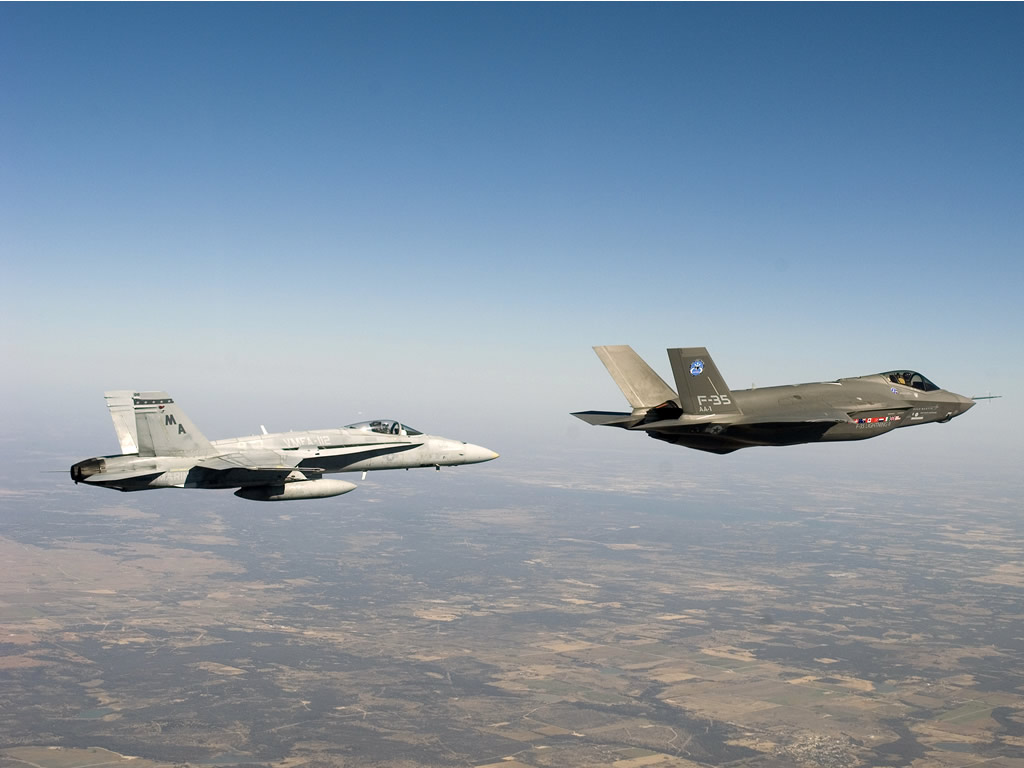
The RAAF can be expected to hang on to its Super Hornets for many years. Its F/A-18A/B Hornets entered service in 1987, and the last aircraft in that 71-plane fleet will retire in 2022 thanks to upgrades and life extension overhauls. A similar career for the Super Hornets would see them serve beyond 2040, and the EA-18G’s usefulness could give them an even longer career.
There had been talk of retiring the F/A-18F fleet well before 2040, and having an all-F-35 fleet. Instead, growing orders made it likely the Super Hornets and Growlers would end up subtracting F-35s from Australia’s planned 100-fighter fleet. The May 2013 White Paper dropped planned F-35A orders to 72 planes, with the ability to raise that to 90 planes if Australia wants to replace its Super Hornet family around 2030. Give the F-35’s higher operating costs, and Australian demographics, it remains to be seen whether Australia will be able to afford that 4th squadron.
Meanwhile, the late arrival of Australia’s F-35As pushed Australia toward a second bridge buy, in order to keep up fighter numbers as older F/A-18AM/BM Hornets are retired. Once the 12 planned EA-18G Growler electronic warfare planes are under contract, the odds of early retirement for the Super Hornet fleet will drop to almost zero, and the government is beginning to acknowledge this publicly.
Contracts & Key Events
Even though these are Australian planes, readers will notice that American military departments manage the contracts. This is the normal procedure for purchases designated as US Foreign Military Sales, vs. a Direct Commercial Sale that would let Australia manage its buys directly.
2014 – 2016
12 EA-18Gs bought; F-35 approval rises to 72.
(click to view full)
July 10/17: Australia now operates a full fleet of 12 Boeing EA-18G Growler electronic attack aircraft, after the first two units arrived in February. The aircraft will be based at Royal Australian Air Force Base Amberley. Minister for Defense Marise Payne said that the Growlers “will work with Army and Navy to deliver a networked joint force able to maneuver and fight in the electromagnetic spectrum.” Australia is the only country outside of the US to operate the Growler, and has already conducted successful weapon firings and integration flights with RAAF F/A-18F Super Hornets and US Navy EA-18G Growlers as part of Operational Test and Evaluation.
December 8/2016: Australia has been cleared to purchase AEA-18G Growler Aircraft Electronic Warfare Range Systems in a $115 million foreign military sale. The deal includes two systems, personnel training, integration testing, and other supporting equipment. Alongside the US, Australia is the main customer of EA-18G Growler aircraft.
Oct 9/14: Training. L-3 Communications Corp. in Arlington, TX receives a $12.1 million firm-fixed-price delivery order for 2 EA-18G Tactical Operational Flight Trainers (TOFT), 1 brief/debrief Station, 2 F/A-18 retrofit kits, spares, and associated technical documentation for the government of Australia under the foreign military sales program.
Work will be performed in Arlington, Texas, and is expected to be completed in November 2015. Foreign military sales funds in the amount of $12,086,117 will be obligated at time of award, none of which will expire at the end of the current fiscal year. The Naval Air Warfare Center Training Systems Division, Orlando, FL, is the contracting activity (N61340-12-G-0001, PO 0004).
Oct 8/14: Support & deployment. A $7.5 million delivery order for peculiar support equipment and spares, to outfit emerging squadron stand-ups for extended Australian deployment of F/A-18F and EA-18G aircraft. In addition, this order includes a support equipment integrated logistics support package. All funds are committed immediately.
Australian F/A-18Fs are currently based at Al Minhad AB in the UAE, where they are conducting strikes in Iraq against The Islamic State.
Work will be performed in St. Louis, MO, and is expected to be complete in October 2016. US Navy Naval Air Systems Command in Lakehurst, NJ acts as Australia’s FMS agent (N68335-10-G-0012, DO 0057).
Aug 28/14: HARM computers. Raytheon in Tucson, AZ receives $24.6 million for a firm-fixed-price delivery order to provide 158 High Speed Anti-Radiation Command Launch Computers for the U.S. Navy (121) and the government of Australia (37) for F/A-18 E/F and EA-18G aircraft. These CLCs work with AGM-88 HARM and AARGM missiles, which are designed to destroy enemy air defense radars. All funds are committed immediately, using FY 2012 – 2013 US Navy ($20.5M / 83.5%) and Australian ($4.1M / 16.5%) budgets.
Work will be performed in Tucson, AZ, and is expected to be complete in February 2018. US NAVAIR in Patuxent River, MD manages the contract (N00019-10-G-0006, DO 0060).
Aug 18/14: EA-18s. General Dynamics Advanced Information Systems in Minneapolis, MN receives a $16.3 million firm-fixed-price contract for the full-rate Lot 38 production of 60 Advanced Mission Computer Type 3s for EA-18Gs ordered by the US Navy (48 AMCs / $9.8 million / 60%) and the government of Australia (12 AMCs / $6.5 million / 40%). All funds are committed immediately, using FY 2014 US Navy aircraft budgets and Australian FMS funds.
Work will be performed in Bloomington, MN and is expected to be complete in August 2016. This contract was not competitively procured pursuant to 10 USC 2304 (c)(1) by US Naval Air Systems Command in Patuxent River, MD (N00019-14-C-0068).
Aug 11/14: EA-18s. General Electric Co. in Lynn, MA receives a $311.5 million firm-fixed-price contract modification for 75 F414-GE-400 engines and associated devices: 48 production installs for the US Navy ($194.9 million / 63% / all production installs), and 27 for Australia ($116.6 million / 37% / 24 EA-18G production installs and 3 spares), under Production Lot 14. In addition, this modification provides for spare after burner modules, fan modules, high pressure combustor modules, combustor modules, and high and low pressure turbine modules for the US Navy and the government of Australia. All funds are committed immediately, using FY 2013-14 US Navy aircraft budgets, and Australian funds.
Work will be performed in Lynn, MA (59%); Hooksett, NH (18%); Rutland, VT (12%); and Madisonville, KY (11%), and is expected to be complete in September 2016. US Naval Air Systems Command in Patuxent River, MD manages the contracts (N00019-11-C-0045).
July 30/14: Weapons. The RAAF has tested their AGM-154C Joint Standoff Weapon glide bomb against a hardened wall target at the RAAF Woomera Test Range. That’s a difficult target for an active seeker, though it’s easy enough to get in range using the GPS. Sources: Raythgeon, “Royal Australian Air Force scores direct hit with JSOW C”.
July 14/14: Boeing in St. Louis, MO receives a $6.9 million firm-fixed-price contract modification to a previously awarded for aircraft armament equipment items: SUU-789A/A centerline pylons for the US Navy (35) and Royal Australian Government (15); and ALE-50 towed decoy well covers for the U.S. Navy (11). All funds are committed immediately.
Work will be performed in El Segundo, CA (95%); Irvine, CA (4%); and St. Louis, MO (1%), and is expected to be complete in May 2017. This contract combines purchase for the U.S. Navy ($4.9 million / 70%) and the government of Australia ($2 million / 30%) under the Foreign Military Sales Program (N00019-14-C-0032).
July 3/14: Support. Boeing in St. Louis, MO receives $20.8 million for non-recurring engineering and associated program management, logistics and spares for Australia’s “AEA-18G aircraft” under the Foreign Military Sales Program.
All funds are committed immediately. Work will be performed in St. Louis, MO (79%); El Segundo, CA (11%); Palm Bay, FL (3%); and other locations within the continental United States (7%), and is expected to be completed in September 2017. US Naval Air Systems Command, Patuxent River, Maryland, is the contracting activity (N00019-11-G-0001, DO 0201).
June 30/14: EA-18Gs. Boeing in St. Louis, MO receives a $1.939 billion fixed-price-incentive-fee contract for full rate production of 11 Lot 38 F/A-18E aircraft for the US Navy, and 33 EA-18G aircraft for the US Navy (21) and the government of Australia (12 for $533.4 million, which is 27.3% of the total). These are standard Block II aircraft rather than Advanced Super Hornet configuration, and Australia will have to pair its airframes with their expensive jamming equipment in order to field operational EA-18G jammers.
$1.406 billion in USN FY 2013 and 2014 aircraft budgets is committed immediately. Work will be performed in El Segundo, CA (46%); St. Louis, MO (30%); Fort Worth, TX (2%); East Aurora, NY (1.5%); Irvine, CA (1percent); Ajax, Ontario, Canada (1%), and various locations within the United States (18.5%), and is expected to be complete in December 2016. This contract was not competitively procured pursuant to 10 USC. 2304(c)(1). US NAVAIR in Patuxent River, MD manages the contracts for the US Navy, and acts as Australia’s agent (N00019-14-C-0032).
12 EA-18Gs
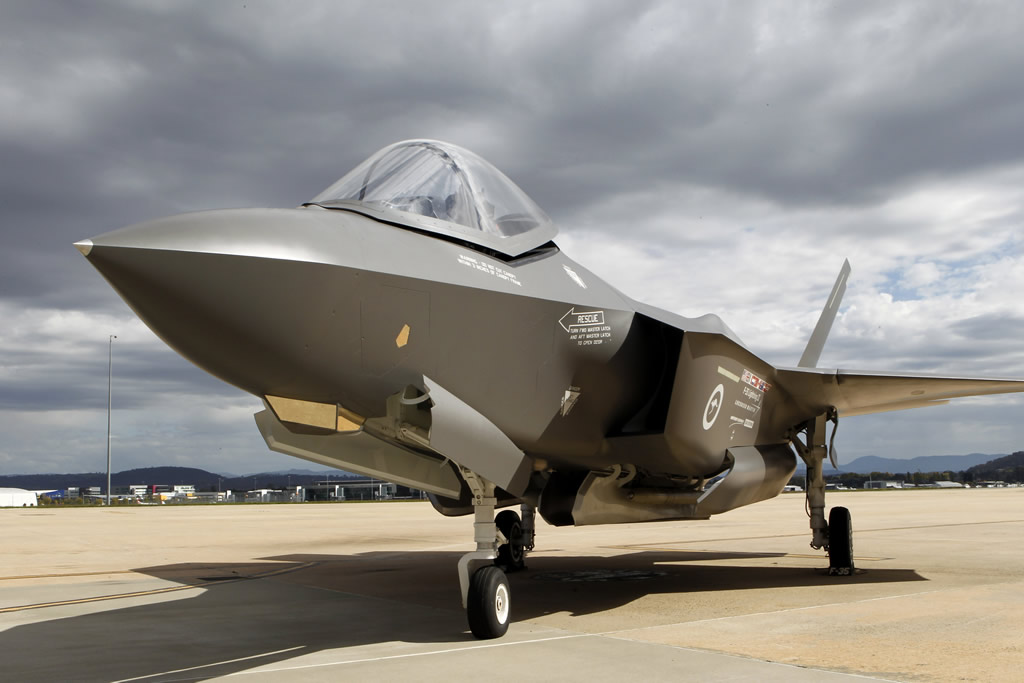
April 23/14: F-35s. Australia’s new Liberal Party government announces that they’ll buy up to 58 F-35s, which would raise the fleet size to the 72 aircraft mentioned in the Labor Party’s May 2013 White Paper (q.v. May 3/13). This isn’t a contract yet, and the budget is supposedly fixed. If F-35 costs remain high until 2020, and rework is expensive, it will lead to cuts in Australian orders. Even so, it’s a clear sign that the Super Hornet fleet won’t be growing past 36 planes. Read “Australia Raises their F-35 Commitment” for full coverage.
2013
Request for more; ANAO Report.
(click to view full)
Dec 17/13: ANAO Report. Australia’s National Audit Office releases their 2012-13 Major Projects Report, which includes some interesting notes concerning the JSOW-C1/ Block III. Australia to place an interim buy of AGM-154Cs in time for the F/A-18F’s planned December 2010 Initial Operating Capability, and they did. But the AGM-154C-1s which can also be used against ships and moving targets won’t be done until at least February 2016, because software integration issues forced the US Navy to delay JSOW-C1 integration until the next core software release. They also canceled the planned September 2014 tests. Other issues and notes:
“The Super Hornet is meeting its capability objectives. Identified anomalies, limitations and improvements of the USN common aircraft software, radar, electronic warfare, mission planning, and training devices are being fed back into the USN spiral development program as part of Super Hornet sustainment, and RAAF/DMO are accessing opportunities to influence USN decision makers on the priority for addressing these areas under a RAAF/USN common paradigm.
….Spares availability has been affected by late delivery of spares because of Original Equipment Manufacturer delays and USN delays in award of Supplier contracts leading to an impact on performance, supportability and schedule.
….There is a possibility that the Forward Looking Infra Red performance will be degraded. This was identified as an emergent risk in the 2011-12 MPR and has now been realised. Engineering Change Proposal No 35 will introduce an Electronic Image Stabilisation Card. This issue has been transferred to Air Combat and Electronic Attack Systems Program Office Risk and Issues Log for management.”
Sept 25/13: Weapons. ATK Defense Electronic Systems in Woodland Hills, CA receives a $102.4 million firm-fixed-price contract for AARGM Full Rate Production Lot II, which includes the conversion of 8 AGM-88B HARM missiles to AGM-88E AARGM CATM no-rocket training missiles ($9.3M/ 9% of order) for the Government of Australia (N00019-13-C-0162).
May 31/13: Weapons. The US Navy signs an agreement with the Australian Government to provide training related to Raytheon’s AGM-88 HARM (High Speed Anti-Radiation Missile) and ATK’s AGM-88E AARGM (Advanced Anti-Radiation Guided Missile), as part of the RAAF’s EA-18G Growler buy. Both weapons will be integrated with the Growler, so they’ll be able to support whichever missile the RAAF chooses.
While it’s just a training capability, its the 1st Foreign Military Sales agreement with any country regarding AARGM. Italy is already a customer, but as a co-development partner not an FMS customer. Subsequent contracts begin to buy AGM-88E CAT training missiles. Sources: US NAVAIR, June 18/13 release.
May 3/13: White Paper. Australia’s Labor government releases its 2013 Defence White Paper. Australia’s plans for their Super Hornet fleet have changed:
“…the Government has decided to retain the current 24 F/A-18F Super Hornets (one operational squadron) in their current air combat and strike capability configuration. The Government has also decided to acquire 12 new-build EA-18G Growler electronic attack aircraft instead of converting 12 of Australia’s existing F/A-18F Super Hornet aircraft into the Growler configuration.”
Australia’s Feb 28/13 export request already covers the EA-18Gs, while their May 22/12 export request covers the added electronics for 12 planes. The plan also commits Australia to 3 F-35 squadrons (72 planes), which is pretty meaningless from a government that will be long gone before those larger buys become reality. It is a good way of spending less now by promising more later, knowing all the while that the promise isn’t likely to be kept. The Labor government adds that any decision on a 4th F-35 squadron to replace the Super Hornet fleets won’t be made until “around 2030.” Given budgetary entitlements and demographic realities, we wouldn’t bet on that, either. Australia DoD.
Feb 28/13: More. The US DSCA announces [PDF] Australia’s official request for another 24 Super Hornet family planes and associated equipment, which could be worth up to USD $3.7 billion. The split includes 12 more EA-18Gs, but its special equipment is missing from the request: AN/ALQ-99F-V and ALQ-218 jamming pods, CN-1717/A INCANS to prevent the plane from jamming itself, and equipment associated with radar-killing HARMN/AARGM missiles.
Without those things, Australia has essentially asked to buy another 12 pre-wired F/A-18Fs, though they can always share the items bought under the May 22/12 special equipment DSCA request throughout the fleet. This request could be negotiated into contracts for up to:
Aircraft & Stores
* 12 F/A-18 E/F Super Hornet aircraft
* 12 “EA-18G Growler” aircraft
* 54 F414-GE-402 engines (48 + 6 spares)
* 35 AN/APG-79 AESA radar systems (24 + 9 spares – a lot for an AESA)
* 15 M61A2 Vulcan Cannons (Super Hornets only, 12 + 3 spares)
* 72 LAU-127 Guided Missile Launchers
* 2 engine inlet devices
* 30 AN/AYK-29(V) Distributed Targeting Systems (DTS)
* 24 AN/ASQ-228 Advance Targeting Forward Looking Infrared (ATFLIR) Pods
Defensive
* 40 AN/ALQ-214 Integrated Countermeasures Systems
* 24 AN/ALR-67(V)3 Electronic Warfare Countermeasures Receiving Sets
* 24 AN/ALE-47 Electronic Warfare Countermeasures Systems
* 400 AN/ALE-55 Fiber Optic Towed Decoys
Avionics
* 80 Joint Helmet Mounted Cueing Systems (JHMCS)
* 32AN/AVS-9 Night Vision Goggles or Night Vision Cueing Device System
* 70 AN/USQ-140 MIDS-LVT Link-16 or RT-1957(C)/USQ-190(V) Joint Tactical Radio Systems
* 4 AN/PYQ-21 DTS Mission Planning Transit Cases
* 100 Digital Management Devices with KG-60s
* 36 Accurate Navigation Systems
* 40 AN/APX-111 Combined IFF Interrogator Transponders
* 80 AN/ARC-210/RT-1990A(C) Communication Systems
* 40 AN/PYQ-10 Simple Key Loaders (SKL)
* 80 KIV-78 Mode 4/5 Module
* 48 COMSEC Management Workstations (CMWS)
The contractors will also provide system integration and testing, tools and test equipment, support equipment, spare and repair parts, publications and technical documents, personnel training and training equipment, aircraft ferry and refueling support, and other forms of U.S. Government and contractor technical assistance. Implementation of this proposed sale may require the assignment of additional U.S. Government or contractor representatives to Australia, but that remains to be negotiated.
The prime contractors will be Boeing in St. Louis, MO; General Electric Aircraft Engines in Lynn, MA; Data Link Solutions in Chesterfield, MO; BAE Systems in Rockville, MD; Northrop Grumman Corporation in Falls Church, VA; Raytheon Corporation in Waltham, MA; and Visions Systems International in San Jose, CA.
Request: 12 more F/A-18Fs, 12 more EA-18Gs
Feb 21/13: Here to stay. Australia’s government is beginning to confirm what many have surmised: the Super Hornets are here to stay, and the fleet could rise to 48 planes. Minister for Defence Stephen Smith, to Australian Broadcasting Corp. News:
“We have committed ourselves contractually to two Joint Strike Fighters. We’ll receive those in 2014 in the United States for training purposes. We’ve announced that we will take another 12, effectively our first squadron, but we have not made a judgment as to when we will place the orders for those…. at the end of last year, we placed a letter of request with the United States authorities to enable us to investigate the potential purchase of up to 24 more Super Hornets.
We’ve now got a fleet of 24 Super Hornets, 12 of those can be wired up for the electronic warfare capability Growler, and we’ve got about 70 Classic Hornets…. [The F-35] has been subject to very serious scheduling delays and that’s what’s causing us to risk a gap in capability…. we’re now looking not just to the Super Hornets [covering a] gap in capability, but whether into the longer term it makes sense for Australia to have a mixed fleet, a mixed fleet of Super Hornets, Growler and Joint Strike Fighters, which is what you essentially see the United States Navy and Air Force now embarking upon.”
Jan 28/13: F-35 delays. The Sydney Morning Herald reports that:
“According to a leaked draft of the 2013 defence white paper, Australia will take delivery of just two Lockheed Martin JSFs by 2020, indicating the government will need to buy a batch of rival Boeing F/A-18F Super Hornets…. The white paper states the government “remains committed” to acquiring the JSF but makes no mention of the next batch of 12 planes, which were expected around 2020.”
Given that time frame, a buy of 12-24 more Super Hornets seems very likely.
2012
$1.5B order for 12 Growler conversions.

F/A-18F behind
(click to view full)
Dec 20/12: EA-18G Boeing in St. Louis, MO receives a $164 million firm-fixed-price contract, exercising an option to begin procurement of 12 Airborne Electronic Attack Group B-Kits and 4 Equivalent Ship-sets of spares for the Royal Australian Air Force.
Work will be performed in Baltimore, MD (41.1%); St. Louis, MO (36.3%); Bethpage, NY (19%); and Fort Wayne, Ind. (3.6%), and is expected to be complete in March 2015. All contract funds are committed immediately. US Naval Air Systems Command in Patuxent River, MD manage the contract on behalf of its Foreign Military Sale client (N00019-09-C-0086). Note that the entire conversion of 12 aircraft is expected to cost about $1.5 billion (vid. Aug 23/12).
EA-18G orders begin
Dec 18/12: Raytheon Technical Services Co. LLC in Indianapolis, IN receives a $17.3 million firm-fixed-price delivery order for 102 LAU-115B/A missile launchers to equip US Navy F/A-18E/F and EA-18G aircraft (86, $15.1M), and Australian F/A-18Fs (16, $2.2M). These launchers are used with various adapters for air-to-air missiles: short range AIM-9 Sidewinder/ AIM-132 ASRAAM, or medium range AIM-7 Sparrow/ AIM-120 AMRAAM missiles.
Work will be performed in Indianapolis, IN in and is expected to be complete in October 2015. All contract funds are committed (N00019-10-G-0006).
Aug 23/12: EA-18G. Minister for Defence Stephen Smith and Minister for Defence Materiel Jason Clare announce their decision to proceed with the conversion of 12 Super Hornets into Growlers for about $1.5 billion, with availability expected for 2018.
EA-18G conversion OK
Aug 7/12: EA-18G. Australia’s Canberra Times gets some clarification on the difference between the Australian government’s A$ 300 million estimate to convert 12 F/A-18Fs into EA-18Gs, and the USD 1.7 billion mentioned in the May 22/12 DSCA request. Short answer: The difference is the $1.4 billion cost of the 34 AN/ALQ-99 jamming pods, if they are bought outright:
“Australia wasn’t planning to buy the ALQ-99 electronic warfare pods, just the systems and hardware to allow them to be fitted on an “as required” basis… a Defence spokesman has explained. “The initial proposal that underpinned the 2009 cost estimate would have provided a lesser capability than Defence now proposes to acquire”. The pods would have had to be obtained from the United States Navy whenever Australia wanted them, a source said.”
The key tradeoffs here are money, risk, and time. An “obtain as needed” approach might work reasonably well in coalition operations, and if Australia sees a low risk of high intensity regional conflict over the next decade. In exchange for some risk that the pods wouldn’t be available in all situations, Australia would save money, and buy time for the USA to field a more reliable “Next Generation Jammer” system around 2020. If NGJ succeeds, Australia could either be approved for the new technology and then invest large sums, or seek to buy older ALQ-99 pods at a discount. On the flip side, paying for the ALQ-99 pods now ensures that Australia has a jamming capability now, which isn’t dependent on either US political whims, or on the NGJ’s ability to overcome its technical challenges and Navy budget crunches.
June 27/12: Radars. Raytheon in El Segundo, CA receives a $6.7 million cost-plus-fixed-fee delivery order, for upgrades that will let the F/A-18 AN/APG-79 AESA radar commercial depot diagnose and validate repairs of RAAF APG-79s under the Foreign Military Sales Program.
Work will be performed in El Segundo, CA (70%), and Forest, MS (30%), and is expected to be complete in August 2014. US Naval Air Systems Command in Patuxent River, MD manages the contract (N00019-10-G-0006).
May 22/12: EA-18G request. The US DSCA announces [PDF] Australia’s formal request for 12 EA-18G Modification Kits. They include:
* 34 AN/ALQ-99F-V Tactical Jamming System Pods, 2 per operational aircraft, plus 10 spares. These are known to have serviceability issues.
* 22 CN-1717/A Interference Cancellation Systems (INCANS), which prevent the plane from jamming itself.
* 22 R-2674C/A Joint Tactical Terminal Receiver (JTTR) Systems
* 30 LAU-118 Guided Missile Launcher pylons, for AGM-88 HARM/AARGM anti-radar missiles
* A Command Launch Computer (CLC) for HARM/AARGM missiles
* Plus support and test equipment, publications and technical documentation, personnel training and training equipment, spare and repair parts, and other forms of U.S. Government and contractor support.
Implementation of this proposed sale may require the assignment of additional U.S. Government or contractor representatives to Australia; that will be determined in negotiations. The estimated cost is up to $1.7 billion, and the prime contractor will of course be Boeing in St. Louis, MO.
EA-18G kits request
May 10/12: Need a HUG? In the wake of budget plans that would slash defense spending, and move further F-35A buys back 2 years due to delays in the program, Australia is considering its bridging options. Minister for Defence Stephen Smith:
“The Budget effect of [our F-35A delay] is that it takes out of the forward estimates for this year’s budget about $1.6 billion… In the meantime, I will not allow, and the Government will not allow, a gap in our air combat capability… Government will also consider whether any alternative options need to be implemented to supplement and ensure our air combat capability in the light of Joint Strike Fighter delays.
An obvious option is the [F/A-18F]… However, other alternatives will be examined before any decision is taken. This includes considering the life of our existing 71 ‘classic’ F/A-18 Hornets [via the HUG program].”
March 30/12: EA-18G initial buy. Australia announces an A$ 19 million buy of long-lead time items, which would be used to convert RAAF F/A-18Fs into EA-18G Growler electronic attack aircraft. This is on top of the A$ 35 million spent to ensure that 12 new-build F/A-18Fs came with some of the necessary systems already built-in, which is much cheaper that cutting the planes open to retrofit them later. At the same, all concerned stress that no final decision has been taken regarding that conversion. Minister for Defence Stephen Smith:
“Growler was used very effectively by the US Navy in the recent Libya conflict… Whether we proceed down the track to adopt and acquire the Growler capability is a very substantial and significant decision… The Government has always been attracted to this capability, which is why on two occasions in 2009 and now, for the expenditure of a modest capital sum, we have kept ourselves in the game in this respect… [Further] judgments and decisions will be made in the course of this year… The formal process in terms of acquiring the long-lead items is what’s described as a Letter of Request and we’ve received every indication from the United States system, including the United States Air Force, that our Letter of Request will be accepted… So we are absolutely confident that if we determine to pick up the capability that our United States colleagues will respond positively. We’ve been working very closely with them in that respect.”
See: Australian DoD press conference transcript.
March 30/12: Boeing in Saint Louis, MO receives a firm-fixed-price, sole-source contract with a maximum $12.9 million to support RAAF F/A-18F Super Hornets from FY 2012 through June 2015, as a Foreign Military Sale transaction. The US Defense Logistics Agency Aviation in Philadelphia, PA acts as the RAAF’s agent (SPM4A1-09-G-0004).
March 23/12: Boeing in St Louis, MO receives a $7.2 million firm-fixed-price delivery order for RAAF Super Hornet operational test program sets, support equipment, and spares. Work will be performed in St. Louis, MO, and is expected to be complete in November 2013. The Naval Air Warfare Center Aircraft Division in Lakehurst, NJ manages the contract, on behalf of their Foreign Military Sale client (N68335-10-G-0012).
Feb 22/12: EA-18s. Adelaide’s The Advertiser reports that March 2012 will feature Defence Minister Stephen Smith announcing an A$ 200-300 million decision to upgrade 12 of Australia’s Super Hornets to EA-18 electronic warfare planes.
“News Limited understands that the first [EA-18] aircraft will be converted at the Boeing factory in St Louis and the remainder at Amberley RAAF base near Brisbane.”
It also reports that the Minister favors a September 2012 decision to buy another 12 F/A-18Fs, in order to make up for the F-35A’s expected lateness. The RAAF is reportedly against this, given expected defense reductions this year, and worries that the cost will eventually be paid for by fewer future F-35s. Which may be true. On the other hand, Australia needs to keep its fleet combat-capable while it waits.
Feb 14/12: Top Guns. Cubic Defense Applications has received a new $11+ million contract valued at more than $11 million to provide the RAAF’s Super Hornets with the P5 Tactical Combat Training System (P5TCTS). The system isn’t a simulator, it’s a set of tracking and debriefing equipment used for monitoring live-flight exercises, including simulated aerial combat. The RAAF’s new P5TCTS will be very similar to the current U.S. Navy TCTS system, and will include airborne instrumentation pods built by DRS, transportable ground systems with live monitoring, and portable ground subsystems, which includes Cubic’s Individual Combat Aircrew Display System (ICADS) software for debriefing.
Australia is an existing Cubic customer, and has installed their 4th-generation system at RAAFB Williamstown. The P5TCTS will be located at the Super Hornets’ base instead, which is RAAFB Amberley, and delivery is expected in late 2012. Cubic is also contracted to make sure these 2 systems can merge data, allowing for training between Hornet and Super Hornet aircraft. Australia’s future F-35As will come with P5TCTS already installed internally. Defense Update.
2011
All Super Hornets delivered; Ground trainers arrive in Australia; AMRAAM request; EA-18 and F-35 questions.
(click for whole photo)
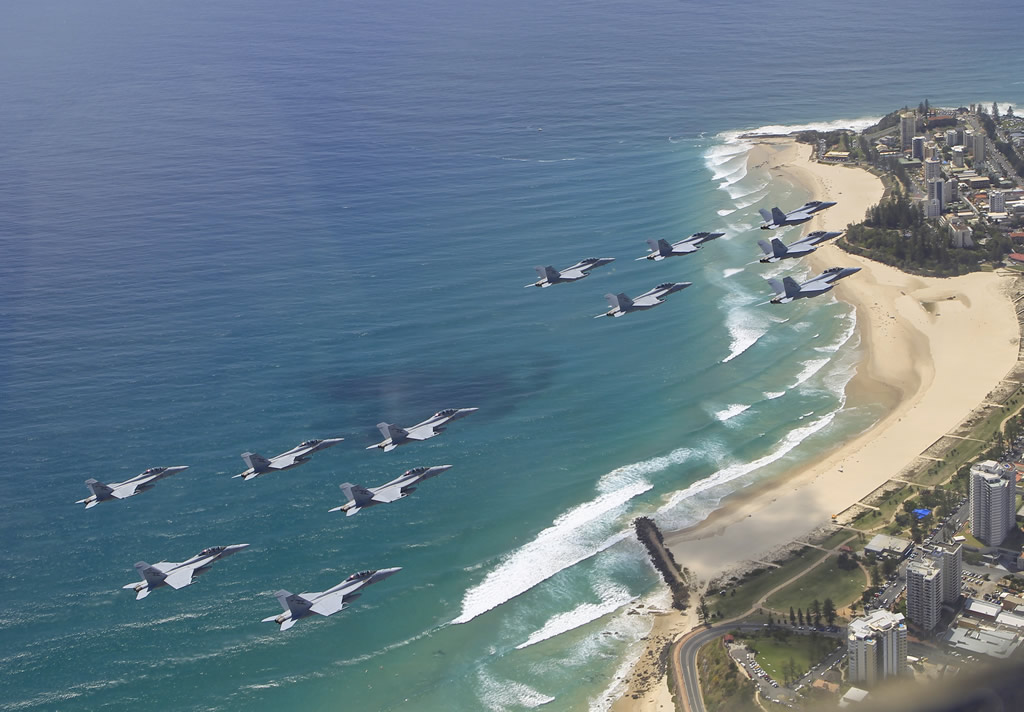
Oct 21/11: All 24 arrived. The last 4 of 24 Super Hornets arrive at RAAF Base Amberley.
The occasion is marked by celebration flights of 16-20 Super Hornets in formation over parts of northern New South Wales and SE Queensland. Australia’s DoD says that they have been delivered on schedule and under budget. Minister for Defence Materiel speech | Australia DoD | Boeing | US NAVAIR.
All 24 in Australia
Oct 19/11: EA-18s. During an interview with Australia Broadcasting Corporation Radio, Labor government defense minister Stephen Smith discusses the possibility of turning 12 of Australia’s Super Hornets into EA-18G Growler electronic warfare fighters, whose conversion price tag is described by the interviewer as “upwards of A$ 300 million.” The EA-18G recently saw their its combat use over Libya, and:
“We’ve just started the process of making a judgment about whether acquiring [them] would be in our national interest or our national security interest… we took the sensible precaution of wiring up half of our Super Hornets for this potential. But it is a very expensive capability. We’re just going through the process… this possibility would come as no surprise to our friends and neighbours in the region. It’s been on the public record before and part of the [2009 Defence] White Paper.”
The minister does not contradict the price figure, and in a related ABC TV interview, he mentions costs of “hundreds of millions.” The minister also implied that further delays or issues with the F-35A could make an EA-18 conversion more likely, as a way to strengthen Australia’s air capability in the interim. ABC radio transcript | ABC24 TV news transcript | Reuters.
Sept 12/11: More F/A-18Fs? During a joint press conference with Canada’s defense minister Peter MacKay, Australian Minister for Defence Stephen Smith says that they might buy more Super Hornets – but no decision has been taken. The window is closing, however, unless the USA extends F/A-18 production beyond MYP-III. So:
“Our position on Joint Strike Fighters I’ll restate. We’ve committed ourselves to 14. The White Paper or the Defence Capability Plan talks in terms of ultimately a number up to or around 100, but we’ve committed to 14… we’ll do an exhaustive risk assessment in the course of next year and make a judgment next year about whether we need any transition capability… The last thing I will allow will be a gap in our capability for our air combat capability. And if I am concerned or worried or not persuaded there won’t be a gap in terms of delivery of the Joint Strike Fighters, then an obvious option for us is more Super Hornets. We’ve made no decision to that effect.”
July 15/11: 3 more. Australia’s DoD:
“The Minister for Defence Materiel Jason Clare today welcomed three new F/A-18F Super Hornets worth more than [$A]175 million to RAAF Base Amberley in Queensland… This is the fourth batch of Super Hornets the RAAF has received, bringing the current Australian fleet to eighteen. A further six aircraft will be delivered by the end of the year.”
The photo archive blurbs add:
“The Super Hornets participated in their first overseas exercise in May for Bersama Shield in Malaysia, which brought the project another step closer to declaring Final Operational Capability anticipated in 2012… The Super Hornet transition project remains on budget and on time.”
July 12/11: Former USAF F-16 pilot Mike Gerzanics pens “Testing the new-generation Super Hornet“, documenting his experience flying an F/A-18F Block II simulator. Overall, he was impressed by the radar and liked the aircraft, but said:
“My overall feel for the pilot/vehicle interface, while it is effective and combat proven, was that it lags newer aircraft. Tactical information, for the most part, is presented on separate displays, forcing the pilot to do much of the fusion. This federated arrangement is no different from what I experienced when I flew a Block 60 F-16 simulator… [In contrast,] The F-35’s level of integration and sensor fusion was a generation ahead of what I experienced in the Block II Super Hornet and Block 60 F-16 simulator sessions… A next-generation [Super Hornet] cockpit is also under development and has a very large 19in x 11in touch-sensitive display. I was able to fly a cockpit built around this display and can confirm that it provides an ideal palette to display fused tactical information.”
June 2/11: AMRAAMs for Super Hornets. The US DSCA announces [PDF] Australia’s formal request to buy up to 110 AIM-120C-7 AMRAAMs, 10 AIM-120C-7 Air Vehicle-Instrumented (tracking telemetry replaces warhead), 16 AIM-120C-7 CATMs (has seeker, no motor), plus containers, weapon system support equipment, support and test equipment, site survey, transportation, repair and return, warranties, spare and repair parts, publications and technical data, maintenance, personnel training and training equipment, and other forms of support. The DSCA specifically notes that:
“The proposed sale will allow the Australian Defense Force to complete Australia’s F/A-18 program under their Project AIR 5349. Phase I allowed acquisition of F/A-18 Block II aircraft and Phase II is for the acquisition of weapons.”
The estimated cost is $202 million, with Raytheon Missile Systems in Tucson, AZ as the contractor. Actual costs will, of course, depend on the terms of any eventual contract. Australia already uses AMRAAMs on its older F/A-18A/B Hornets, but its F-111s did not. A larger AMRAAM-capable fleet means a need for a few more missiles. This proposed sale wouldn’t require any additional U.S. Government or contractor representatives in Australia.
AMRAAM missile request
May 9/11: Trainers. Boeing announces that it has delivered 6 F/A-18E/F Super Hornet aircrew and maintenance trainers to RAAF Base Amberley in Queensland: 2 Tactical Operation Flight Trainers (TOFT), 2 Low Cost Trainers (LCT), and 2 Integrated Visual Environment Maintenance Trainers (IVEMT); plus 1 conversion of a VEMT to full IVEMT capability. They are the first Super Hornet training devices for a Foreign Military Sale customer.
See the “Variants and Variances” section, above, for full details re: each type of flight trainer. The short explanation is that TOFTs are for full simulation, LCTs for key cockpit processes like navigation and weapons use, and IVEMT for maintenance training.
Trainers & sims in.
March 25/11: Boeing receives a $10.6 million firm-fixed-price delivery order for 741 Honeywell model GG1320 ring laser gyros, to be installed in F/A-18E/F and EA-18G aircraft for the U.S. Navy (714) and the government of Australia (27 spares).
Work will be performed in Clearwater, FL (87%), and St. Louis, MO (13%), and is expected to be complete in April 2013. US Naval Air Systems Command in Patuxent River, MD manages the contract (N00019-11-G-0001).
March 4/11: Martin-Baker Aircraft Co., Ltd. in Middlesex, England receives an $18.3 million firm-fixed price contract modification, exercising an option for 65 Navy Aircrew Common Ejection Seats (NACES). They will equip F/A-18 A+/C+ Hornets and F/A-18E/F Super Hornet and EA-18G Growler aircraft flown by the U.S. Navy ($18.2M/ 99.4%), and the air forces of Australia (F/A-18A+ and F/A-18F; $51,920/ 0.27%) and Kuwait (F/A-18C+; $61,730; 0.33%). This option also buys associated hardware, equipment, technical data, and production support services.
Work will be performed in Johnstown, PA (60%), and Middlesex, England (40%), and is expected to be complete in December 2012. Contract funds will not expire at the end of the current fiscal year. US Naval Air Systems Command in Patuxent River, MD manages the contract (N00019-07-C-0011).
2010
F-111s retired; 1st F/A-18F lands in Australia, with help from Omega; 15/24 delivered by year end; ROVER kits.

(click to view full)
Dec 8/10: 4 more. Another 4 planes arrive at RAAFB Amberley, making 15, and Australia’s 1st squadron of F/A-18F Super Hornet fighter jets is declared operational and ready for duty. The current fleet includes the first 3 of Australia’s EA-18 compatible Super Hornets.
“The fleet of Super Hornets has reached initial operational capability on time and on budget… The four newly arrived aircraft departed from the Boeing facility in St. Louis USA, and over a number of days transited to RAAF Base Amberley via Travis Air Force Base California, Hickam Air Force Base in Hawaii and Guam.”
See Australia DoD release & photo gallery | Boeing.
Dec 3/10: F-111s retired. Australia formally retires its F-111 fleet. Australia DoD event photos.
Nov 15/10: Trainers. US NAVAIR announces that its Naval Aviation Training Systems program office (PMA-205) delivered 2 Super Hornet Integrated Visual Environment Maintenance Trainers (IVEMT) to Amberley Air Force Base, Ipswich, Australia in October 2010.
“The IVEMT is a 3-D visual trainer which allows military personnel to virtually navigate through multiple aircraft systems. It provides maintainers training on ground operation, maintenance, and testing. It also offers troubleshooting procedures for the F/A-18 Super Hornet aircraft including avionics, environmental control, electrical, flight control, fuel, engines, landing gear, and hydraulic systems… [It] is the first Super Hornet maintenance trainer to be delivered to a foreign military. The design is an upgraded version of the U.S. Navy’s Visual Environment Maintenance Trainer (VEMT)… built by Boeing, St. Louis, Mo., and DiSTI, Orlando, Fla.”
Sept 23/10 Boeing announces that the 1st RAAF F/A-18F Super Hornet with EA-18 pre-wiring has completed production. That fighter took its first test flight on Aug 12/10. Boeing is pre-wiring the RAAF’s second lot of 12 Super Hornets for potential electronic attack capability conversion, giving them a new capability dimension while eliminating high retrofit costs later.
As of this announcement, the RAAF has 11 Super Hornets operating at RAAF Base Amberley in Queensland, all of which were delivered ahead of schedule and on budget. Boeing is scheduled to deliver Australia’s 24th Super Hornet in 2011.
July 26/10: ROVER. Boeing in St. Louis, MO receives an $11.5 million firm-fixed-price order against a previously issued basic ordering agreement (N00019-05-G-0026) for 889 Rover data link kits, in support of engineering change proposal #6342 for the F/A-18E/F Super Hornet’s ATFLIR surveillance and targeting pod. Orders will be divided between the US Navy (837 kits, $9.76 million, 85%) and the Royal Australian Air Force (52 kits, $1.7 million, 15%).
The ATFLIR pod is actually a Raytheon product, but Boeing is the Super Hornet’s system integrator and manufacturer. Work will be performed in St. Louis, MO (70.5%); Spring Valley, CA (17.5%); Wallingford, CT (6.5%); Murphy, NC. (3.5%); and Van Nuys, CA (2%). Work is expected to be completed in July 2011. The Naval Air Systems Command in Patuxent River, MD manages this contract.
July 20/10: Trainer IOC. L-3 Link Simulation & Training (L-3 Link) announced today that the first F/A-18F Tactical Operational Flight Trainer (TOFT) has achieved initial training capability status, including a fully integrated mission briefing and debriefing system. L-3 Link is under contract from Boeing Training Systems and Services to support the delivery of 2 F/A-18F TOFTs to RAAF Base Amberley. See also Feb 19/10 entry.
Each F/A-18F TOFT consists of independent cockpits and visual display systems for both the pilot and weapons sensor officer. They use L-3 Link’s 360-degree SimuSphere visual display and SimuView image generator, along with Boeing’s advanced avionics simulations and simulated JHMCS helmet display. The second F/A-18F TOFT, which will include a new Australian visual system database, will be delivered with an additional mission briefing and debriefing system in late 2010. That 2nd delivery will be accompanied by a parallel upgrade to the current simulator. L-3 Communications LST.
July 5/10: 6 more. Another 6 F/A-18F Block II Super Hornets arrive at RAAF Base Amberley in Queensland, after a 4-day journey from Naval Air Station Lemoore in California. Omega Aerial Refueling provided assistance.
That makes 11 Super Hornets in Australia now, while the first Super Hornet delivered [A44-201], remains in the United States conducting advanced software development trials. A44-201 is expected to finish its trials this year, and arrive in Australia in December 2010. Australian DoD release | Image gallery.
June 25/10: Australia’s DoD announces that RAAF is planning to transit 6 more F/A-18F Super Hornets from NAS Lemoore in the USA to RAAF Amberley, in early July 2010. A detachment of RAAF aircrew and maintenance personnel from No 1 Squadron is currently conducting work-ups with the new aircraft at NAS Lemoore, CA, which includes up to 96 hours of test and evaluation flying and 2 weeks of Electronic Warfare flight trials.
“Another key task involves working with an air-to-air tanker conducting day and night refuelling flights to ensure we are ready for the flight to Australia.”
June 21/10: Aerial refueling. Omega Aerial Refueling Services, Inc. receives a $6.8 million modification to a previously awarded firm-fixed-price, indefinite-delivery/ indefinite-quantity contract (N00421-10-D-0009) to provide air-to-air refueling services in support of RAAF F/A-18s under the Foreign Military Sales Program. Omega already performs contracted aerial refueling work for the US government, and for Australia since 2008.
Work will be performed at Naval Air Station, Lemoore, CA (50%), and at the Royal Australian Air Force Base, Williamstown, Australia (50%), and is expected to be complete in February 2011. Contract funds will not expire at the end of the current fiscal year. US Naval Air Systems Command in Patuxent River, MD (N00421-10-D-0009).
March 22/10: Fly-in. Australia’s first F/A-18F Block II Super Hornets begin their flight to Australia. By March 26/10, the first 5 RAAF Super Hornets arrive at RAAF Amberley. Australian DoD image gallery | US NAVAIR | Boeing release.
Feb 23/10: 1st 2. Australia’s DoD informs us that F/A-18F Super Hornets A44-204 and A44-202 (see Sept 30/09 entry) were formally transferred to Australia’s DMO on this day, at NAS Lemoore.
Feb 19/10: Raytheon Australia wins an A$ 21.5 million Training Support Services Contract at RAAF Base Amberley. The firm will provide maintenance, logistics, and training services to support the Super Hornet flight simulators, visual environment maintenance trainers and electronic classrooms for Australia’s Super Hornets. Minister’s announcement | Raytheon Australia [PDF].
Feb 18/10: Formal transfer. The first Australian F/A-18F Super Hornet, aircraft #A44-203, is formally transferred from the USA’s Defense Contract Management Agency to Australia’s Defence Materiel Organisation, in a contract signing and ceremony at Naval Air Station Lemoore, CA, USA. Australian DoD gallery.
1st hand-over
2009
1st Australian F/A-18F unveiled; Pre-wiring for EA-18 upgrade gets OK; ALE-55 decoys; 3-year sustainment contract; Maintenance training can begin in Australia now.

(click to view full)
Dec 16/09: Sustainment deal. Minister for Defence Personnel, Materiel and Science Greg Combet announces a Super Hornet Aircraft Sustainment Contract for Boeing, worth approximately A$ 20 million per year for 3 years, and provides for about 74 jobs at RAAF Base Amberley.
Under the contract, Boeing will provide engineering, supply chain management and maintenance services. The first 4 F/A-18Fs are scheduled to be at RAAF Base Amberley in March/April 2010, with the remaining 20 aircraft arriving through 2010-2011.
Dec 8/09: Trainers. Minister for Defence Personnel, Materiel and Science Greg Combet announces the introduction of a Visual Environment Maintenance Trainer to RAAF Base Amberley. This will allow RAAF Super Hornet maintenance training to move out of the United States and back to Australia, beginning in January 2010.
The VEMT system consists of a mock Super Hornet cockpit with touch screens that allows RAAF maintenance students to perform diagnostic and system functional checks, without actually being in a real aircraft. As is usual for such simulators, they can be monitored by an instructor who can bring up teaching points as the student works toward finding a fault, and can quickly be reprogrammed to simulate new faults.
Dec 1/09: Raytheon in Fort Wayne, IN receives a $12.7 million delivery order against a previously issued basic order agreement (N00019-05-G-0008) for 30 electronic modules. This contract for the RAAF F/A-18F aircraft will be performed in Fort Wayne, and is expected to be complete in August 2013. The US Naval Air Systems Command in Patuxent River, MD manages this contract.
Sept 30/09: 3rd delivered. Boeing delivers the 3rd RAAF F/A-18F Block II Super Hornet, 3 months ahead of schedule. Each of the 3 completed aircraft has now been delivered 3 months ahead of schedule, and the remaining 21 planes will be delivered through 2011. Note that “delivery” happens in the USA.Boeing release.
Sept 22/09: Raytheon in Goleta, CA received a $6.7 million firm-fixed-price contract to retrofit 603 integrated multi-platform launch controllers (IMPLCs) on F/A-18 aircraft for the US Navy (576 for $5.9 million, 89%) and the government of Australia (27 for $764,613, 11%). The IMPLC is the launch controller component of the AN/ALE-50 and AN/ALE-55.
Work will be performed in Goleta, CA (99%) and Fullerton, CA (1%), and is expected to be complete in April 2013. This contract was not competitively procured, pursuant to the FAR 6.302-1. The Naval Air Systems Command in Patuxent River, MD issued the contract (N00019-09-C-0036).
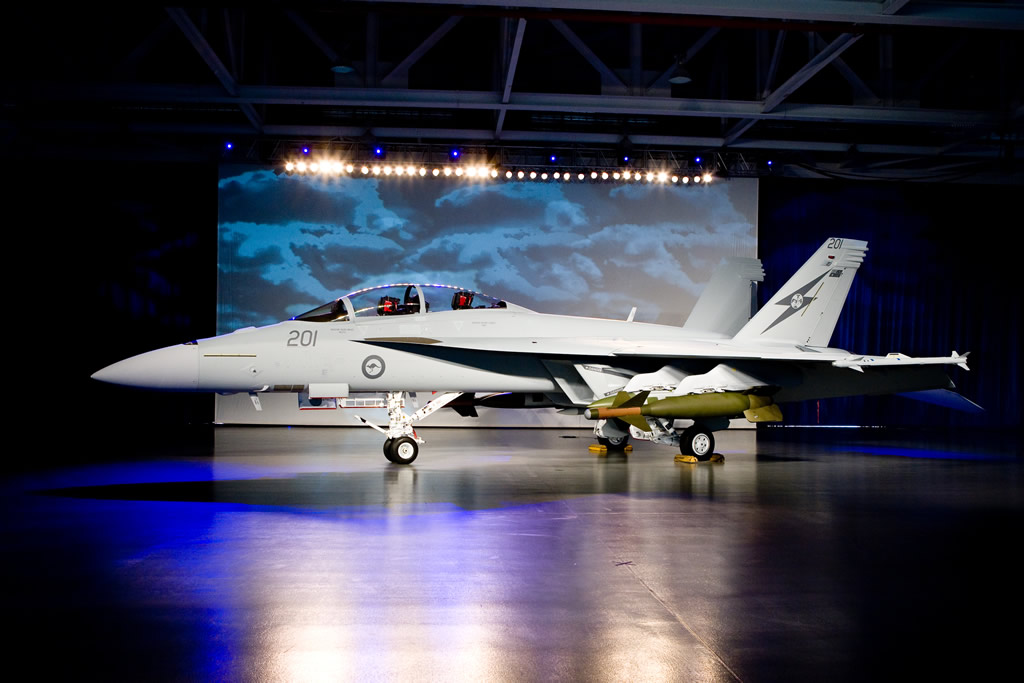
July 8/09: Unveiling. Boeing unveils the 1st complete RAAF F/A-18F Block II Super Hornet during a ceremony at Boeing Integrated Defense Systems’ production facilities in St. Louis, MO. The program is on budget to date, and the aircraft will be delivered later in July 2009, 3 months ahead of schedule. It is scheduled to arrive at RAAFB Amberley in March-April 2010.
The remaining 23 Super Hornets, each equipped with the Raytheon-built AN/APG-79 radar, will be delivered to the RAAF throughout 2010 and 2011. Australian DoD release | Australian DoD image gallery | Boeing release | US NAVAIR release.
July 1/09: Honeywell International, Inc., Defense and Space Electronic Systems in Albuquerque, N.M receives a $26.3 million modification to a previously awarded firm-fixed price contract (N00019-07-C-0014). It exercises an option for the full-rate production of 498 Advanced Multi-Purpose Displays (AMPD) for Lot 33 F/A-18F and EA-18G aircraft, and retrofit of Lot 26-28 F/A-18E/F and E/A-18G aircraft. Work will be performed in Albuquerque, NM and is expected to be complete in December 2010. The Naval Air Systems Command in Patuxent River, MD is managing the contract.
Customers include the US Navy (422 for $21.8 million, 82.8%) and the Government of Australia (76 for $4.5 million, 17.2%). Australia is ordering 30 of the 5″x5″ forward; 30 of the 5″x5″ aft; and 16 of the 8″x10″ AMPDs.
The U.S. Navy is ordering 167 of the 5″x5″ forward, 134 of the 5″x5″ aft, and 64 of the 8″x10″ AMPDs, along with 57 8″x10″ AMPD High Resolution Recorder Interface kits to upgrade legacy displays with higher-resolution capability. The USN’s Lot 26-28 F/A-18 Super Hornets are currently receiving a number of upgrades, including a swap-out of their mechanically-scanned AN/APG-73 radars for the more powerful and advanced AN/APG-79 AESA (Active Electronically Scanned Array) used in Australia’s F/A-18F Block IIs.
April 17/09: Decoys. The AN/ALE-55 (V) consists of an electronic frequency converter (EFC) and a fiber optic towed decoy. It works together with an aircraft’s onboard electronic warfare (EW) equipment, throughout the ECM cycle of Suppression (harder to acquire or track), Deception (active jamming techniques aimed at launchers); and Seduction (active jamming aimed at missile, and decoy target).
BAE Systems Information and Electronic Systems in Nashua, NH received a $33.7 million modification to a previously awarded firm-fixed-price contract (N00019-08-C-0044) for the Low Rate Initial Production Lot V of the Integrated Defensive Electronic Countermeasures (IDECM) AN/ALE-55 (V) Subsystems and associated technical support and non-recurring engineering for the U.S. Navy (70 EFCs, 251 decoys, $27.5 million, 81.57%) and Royal Australian Air Force (12 EFCs, 72 decoys, $6.2 million, 18.43%) F/A-18E/F Super Hornet aircraft.
Work will be performed in Nashua, NH (92%) and Mountain View, CA (8%), and is expected to be complete in August 2011. The US Naval Air Systems Command in Patuxent River, MD manages this contract. See also “ALE-55 Towed Fighter Decoys for US Navy, Australia.”
March 3/09: Engines. General Electric Aircraft Engines in Lynn, MA receives a $438.1 million modification to a firm-fixed-price contract, exercising an option for FY 2009 full rate production of 116 F414-GE-400 engines and 114 F414-GE-400 device kits. This contract combines purchases for the U.S. Navy (90 engines, 90 kits; $343.7M; 78.4%) and the Royal Australian Air Force (26 engines, 24 kits; $94.4M; 21.6%). Note that 26 engines covers only 13 planes, but see also Sept 8/08 entry, which makes 56 engines in total.
Work will be performed in Lynn, MA (50%); Madisonville, KY (22%); Hooksett, NH (13%); Albuquerque, NM (6%); Rutland, VT (5%); Dayton, OH (2%); Evandale, OH (1%); and Bromont, Quebec, Canada, (1%), and is expected to be complete in April 2011 (N00019-06-C-0088).
Minister’s press conference
(click to view full)
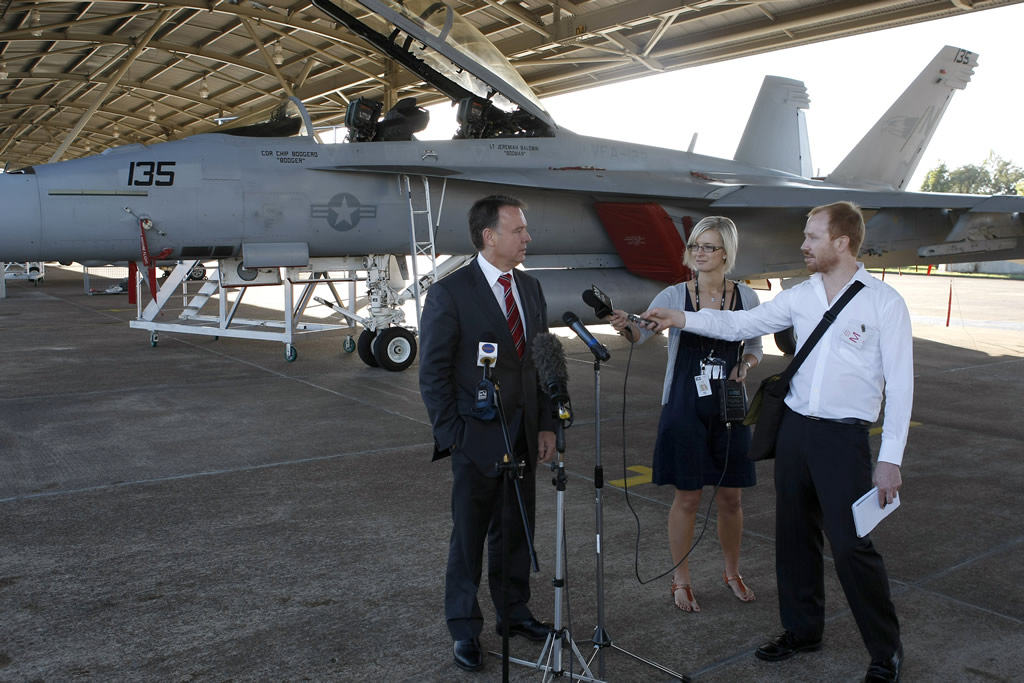
Feb 27/09: In an important procurement shift, Minister for Defence Joel Fitzgibbon announces that Australia is pre-wiring 12 of its planned 24 F/A-18F Super Hornets, in order to allow future conversions to EA-18 Lite electronic warfare aircraft. The additional cost for the pre-wiring on the production line is cited as A$ 35 million, out of a total order now cited as A$ 6.6 billion. Completing that fit out to “Growler Lite” status is expected to involve an additional A$ 300 million, with the go/no-go decision set for 2012.
Characteristically, the new Labor Party government’s release ends with a shot at the procurement policies of the previous Liberal Party government:
“If the Howard Government had taken a more prudent approach in making the Super Hornet decision rather than rushing to fill their impending air combat capability gap, they may have realised that this was a more effective approach to take.”
EA-18G pre-wired
Feb 27/09: Boeing subsidiary McDonnell Douglas Corp., in St. Louis, MO received a not to exceed $26.5 million (A$ 40.75 million at that day’s exchange rates) modification to a previously-awarded firm fixed price contract (N00019-04-C-0014) for “non-recurring engineering and recurring effort associated with Engineering Change Proposal 6359 in support of Australian F/A-18 aircraft.”
Work will be performed in St. Louis, MO (40%); El Segundo, CA (30%); Bethpage, NY (25%); and Mesa, AZ (5%) and is expected to be complete in August 2011. The Naval Air Systems Command in Patuxent River, MD manages this Foreign military Sale contract.
Feb 27/09: Raytheon Co., Electronic Warfare Operations in Goleta, CA received a $9.9 million cost plus fixed fee contract for products and engineering services in support of the AN/ALR-67v3 operational flight programs for US Navy F/A-18E/F Super Hornets ($5.4 million, 55%) and the F/A-18 A-D and E/F aircraft owned by the Governments of Canada ($1.5 million, 15%), Australia ($1.5 million, 15%), and Switzerland ($1.5 million, 15%). The estimated level of effort for this contract is 57,686 man-hours.
Work will be performed Goleta, CA (80%) and Point Mugu, CA (10%); and China Lake, CA (10%), and is expected to be complete in February 2011. Contract funds in the amount of $1.15 million will expire at the end of the current fiscal year. This contract was not competitively procured by the Naval Air Warfare Center Weapons Division in China Lake, CA (N68936-09-C-0029).
2008
Australia to keep the Super Hornet after review; Engines and ancillaries bought; ATFLIR pods bought; Support request.

(click to view full)
Dec 19/08: Raytheon Technical Services Co. LLC in Indianapolis, IN received a $26.2 million firm-fixed-price modification to a previously-issued basic order agreement. The order exercises an option for 65 LAU-115D/A Launchers and 140 LAU-116B/A launchers, split between the U.S. Navy (38 LAU-115, 126 LAU-116; $20.3 million, 80.3%) and the Royal Australian Air Force (27 LAU-115, 14 LAU-116; $5.2 million, 19.7%).
The LAU-115 is an underwing pylon for Hornet family fighters that can be fitted with LAU-7 launchers or LAU-127 launchers on the sides, in order to carry short range AIM-9/ASRAAM or AIM-120 AMRAAM air-to-air missiles. The LAU-116’s are the 2 ejection launchers placed in the Hornet family’s semi-recessed slots along the fuselage, under the engine intakes. They carry AIM-7 Sparrow and/or AIM-120 AMRAAM medium range air-to-air missiles.
Work will be performed in Indianapolis, IN, and is expected to be complete in April 2011. Contract funds in the amount of $5.2 million will expire at the end of the current fiscal year (N00019-05-G-0008).
Dec 19/08: General Dynamics Advanced Information Systems, Bloomington, Minn., is being awarded a $45.4 million modification to a previously awarded firm-fixed-price contract for full rate production of 195 Type 3 Advanced Mission Computers for the US Navy (166, $38.5 million, 85%) and Australia (29, $6.9% million, 15%). The computers will be installed in F/A-18E/F Super Hornet and E/A-18G Growler aircraft.
Work will be performed in Bloomington, MN and is expected to be completed in Dec. 2010. Contract funds in the amount of $1.2 million will expire at the end of the current fiscal year (N00019-07-C-0030).
Nov 6/08: Boeing in St. Louis, MO received a $14 million ceiling-priced delivery order against a previously issued Basic Ordering Agreement (N68335-06-G-0024) for 72 varieties of “peculiar support equipment items” for the RAAF’s F/A-18F fleet.
Work will be performed in St. Louis, MO and is expected to be complete in December 2009. Contract funds will not expire at the end of the current fiscal year. The Naval Air Warfare Center Aircraft Division in Lakehurst, NJ manages this contract.
Sept 24/08: Boeing in St. Louis, MO received an $8.8 million not-to-exceed modification to a previously awarded firm fixed price delivery order contract (N00383-06-D-001J) for in-service engineering and logistics services in support of the Royal Australian Air Force F/A-18F aircraft. In addition, this modification provides for the design, development, fabrication, qualification, and delivery of the Logistics Support Analysis Records (LSAR) and the Automated Maintenance Environment (AME) systems.
Work will be performed in St. Louis, MO (75%); Amberley, Australia (10%); Brisbane, Australia (10%); and Patuxent River, MD (5%), and is expected to be complete in September 2010.
Sept 19/08: ITT Industries Avionics Div. in Clifton, NJ received a $55.7 million modification to a previously awarded firm fixed price contract (N00019-05-C-0054), exercising an option for 32 AN/ALQ-214 On-Board Jammer Systems for F/A-18 E/F aircraft operated by the U.S. Navy (13, $22.6 million, 41%) and the Government of Australia, (19, $3.1 million, 59%).
Work is expected to be complete in December 2011. The US Naval Air Systems Command in Patuxent River, MD manages the contract.
Sept 8/08: General Electric Aircraft Engines Business Group in Lynn, MA received a $120.2 million modification to a previously awarded firm-fixed-price contract (N00019-06-C-0088) for the FY 2008 Full Rate Production of 30 F414 GE-400 jet engines, 24 device kits; and 19 various modules in support of the Royal Australian Air Force under the Foreign Military Sales Program.
Work will be performed in Lynn, MA (50%); Madisonville, KY (22%); Hooksett, NH (13%); Albuquerque, NM (6%); Rutland, VT (5%); Dayton, OH (2%); Evandale, OH (1%); and Bromont, Quebec, Canada, (1%), and is expected to be complete in January 2010. Note that Australia buys its engines under the same firm-fixed-price contract used by the US Navy. That’s an advantage offered to prospective sales by the US government, allowing them to leverage the pricing for America’s much larger orders.
Aug 1/08: The US Defense Security Cooperation Agency announces [PDF] Australia’s formal request for follow-on support for its pending F/A-18F Super Hornet purchase, as well as associated equipment and services. The total value, if all options are exercised, could be as high as $1.5 billion.
The exact request includes avionics software, engine component improvement and spare parts, technical ground support equipment, spare and repair parts, supply support, publications and technical data, engineering change proposals, personnel training and training equipment, U.S. Government and contractor technical and logistics personnel services, and other related elements of program support. It also adds:
* Up to 4 AIM-9X Sidewinder Captive Air Training air-air missiles, which have seeker heads but no rocket motor
* 10 of BAE’s AN/ALE-47 Electronic Warfare Countermeasure Systems
* 8 of ITT’s AN/ALQ-214 Radio Frequency Countermeasure Systems
* 10 of Raytheon’s AN/ALR-67v3 Electronic Warfare Countermeasure Receiving Sets.
The principal contractors will be: Boeing Company of St. Louis, MO (F/A-18F), Raytheon Missile Systems of Tucson, AZ (AIM-9X); Raytheon EW Systems of Goleta, CA (ALR-67), ITT EW Systems of Clifton, NJ (ALQ-214), and Symetrics Industries of Melbourne, FL. Implementation of this proposed sale will not require the assignment of any U.S. Government or contractor representatives to Australia.
Weapons & gear request
May 23/08: ATFLIR pods. Raytheon in El Segundo, CA received a $51.6 million modification to a previously awarded firm-fixed-price contract (N00019-06-C-0310) for 19 Full Rate Production Lot 6 Advanced Targeting Forward Looking Infrared (ATFLIR) pods. These ATFLIR pods will equip the Government of Australia (18, confirmed for the new F/A-18F Bock IIs, $35.6 million; 69%) and also buys 1 ATFLIR pod and long lead time items for the Government of Switzerland ($5.4 million; 10.6%), plus Units Under Test and one Electro-Optical Sensory Unit for the U.S. Navy ($10.5 million; 20.4%).
Work will be performed in El Segundo, CA (60%) and McKinney, TX (40%), and is expected to be complete in November 2010. The Naval Air Systems Command in Patuxent River, MD administers the contract.
Australia uses Northrop Grumman’s LITENING AT pods on its F/A-18A Hornets, but Raytheon’s ATFLIR is currently the only pod qualified with the Super Hornet. Faced with the choice of buying a different pod off the shelf, or paying the integration costs and having a common fleet resource, Australia apparently decided that buying off the shelf was the better decision.
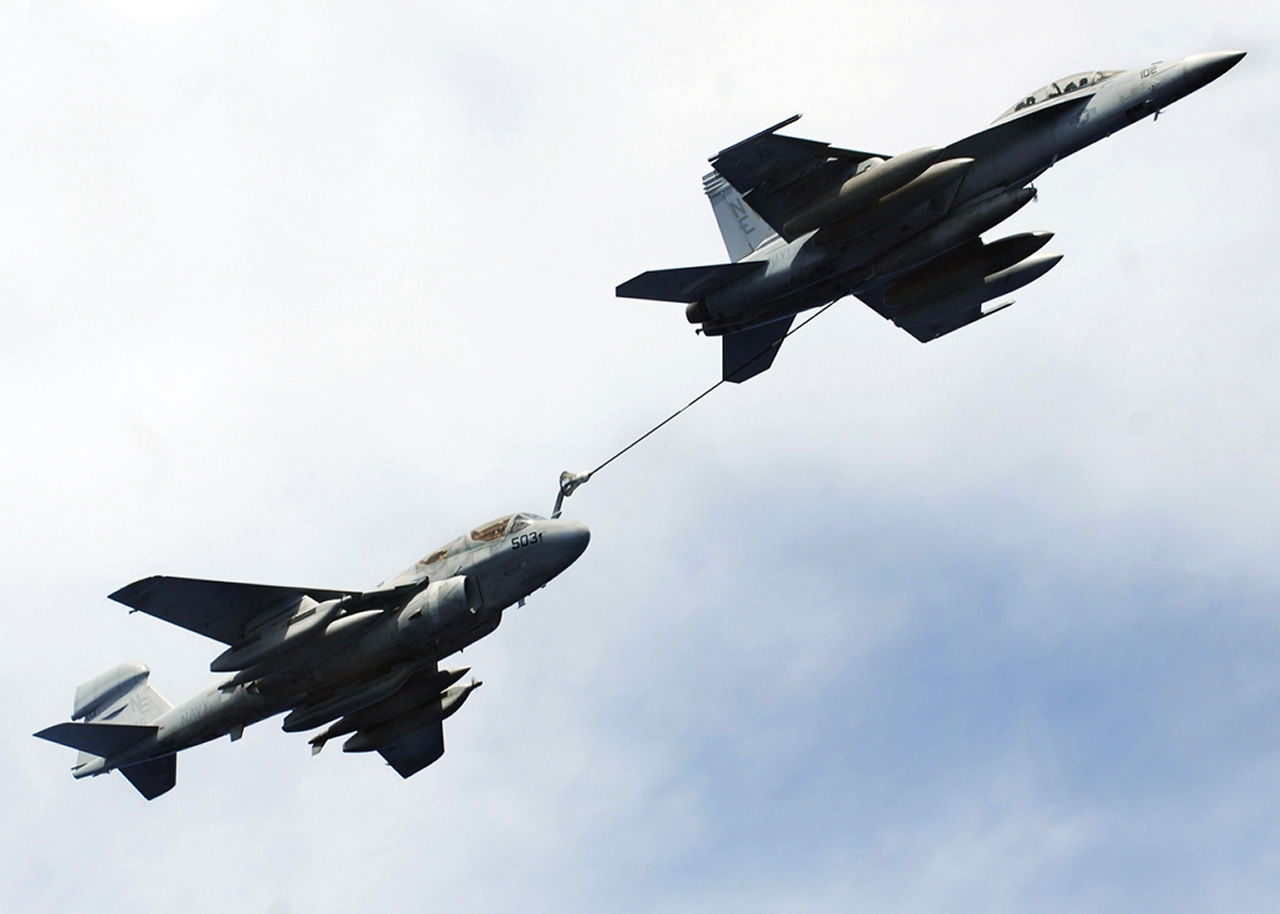
May 20/08: Training. Boeing subsidiary McDonnell Douglas Corp. in St. Louis, MO received a $139 million ceiling-priced indefinite-delivery/ indefinite-quantity contract for F/A-18F aircrew and maintainer systems, computer-based training systems and support for the Royal Australian Air Force under the Foreign Military Sales Program. Initial requirements include: 2 Tactical Operation Flight Trainers, 2 Low Cost Trainers, 2 Integrated Virtual Environment Maintenance Trainers, and related courseware.
Work will be performed in St. Louis, MO and is expected to be complete in May 2014. This contract was not competitively procured by the Naval Air Warfare Center Training Systems Division in Orlando, FL (N61339-08-D-0006).
(click to view full)
March 17/08: Australia to keep the Super Hornet. Australia’s new defence minister announces several decisions in the wake of Part A of Australia’s Air Combat Capability Review. One is that the decision to retire the F-111 by 2010 was made in haste, but is now irreversible. Another is that an air capability gap will exist due to the F-111s’ retirement, and the decision to pursue the F-35. Meanwhile, “No other suitable aircraft could be produced to meet the 2010 deadline the former Government had set.”
In interviews, the Minister cites data from classified briefings he has received when he vouches for the planes’ ability to handle any threats in the region. His release adds that:
“The analysis also highlighted additional capabilities such as specialist electronic warfare variants (the F/A-18G) [sic – it’s the EA-18G] that will be considered as part of the Super Hornet acquisition. These additional capabilities will be more fully considered under the second stage of the Air Combat Capability Review.”
Sources: Australian DoD | Opposition Liberal Party release | ABC news [with video of the announcement and an interview] | The Age | News Australia | Sydney Morning Herald | Aviation Week | Defense News | Flight International.
F/A-18Fs survive
Feb 27/08: A report in Australia’s The Age newspaper cites Dr Stephen Gumley, the head of Australia’s Defence Materiel Organisation, as saying that “it would cost about $400 million to cancel the [F/A-18F] contract with penalties accruing at the rate of $80-100 million a month.”
Feb 27/08: The Australian Liberal Party, now the loyal opposition in Parliament, vigorously disputes a Labor Party argument that the government paid too much under the contract. Liberal Party release:
“The fact is Australia will pay the best possible price for the Super Hornet. In Senate Estimates, 20 February 2008, Dr Stephen Gumley CEO, Defence Materiel Organisation said “We get the same unit prices as the US government. I know no way of getting better prices than the US government, particularly in the home market; therefore I am confident that the price we are paying for the aircraft is as good as Australia is going to get.”
This is true. Of course, if one believes the Super Hornet is the wrong aircraft; $1 is too much. The Liberal Party alludes to this in their Feb 26/08 release, which states that: “Labor set up an Air Capability Review presumably as a pretext to scrap the Super Hornet contract.”
Feb 26/08: In an Australia Broadcasting Corporation interview, Defence Minister Joel Fitzgibbon offers an outwardly confusing statement re: the F/A-18F purchase, which he has opposed to date. The key is to strip away the statements re: ‘want’, since a politician can always say that circumstances force something unwanted. Note, instead, what they say they will do, and under what conditions. Full quote, as reported by news.com.au:
“I will follow the advice of the experts who are doing the capability review. If they come to the conclusion or recommend that the Super Hornet isn’t up to the job, I will have no hesitation in cancelling it… I’m really hoping that the air combat review recommends that we retain the Super Hornet. It’s a pretty rude, if you like, thing for us to do now to move in and cancel the project and I’ll be very, very happy if we don’t have to.”
Feb 18/08: Australia’s new government formally announces its Air Combat Capability Review. Extension of the F-111s’ lives, re-evaluation the F-35 and F-18F buys, and the desirability of the F-22 Raptor will be discussed in light of regional air power trends to 2045.
Feb 11/08: Smiths Aerospace Mechanical Systems – Santa Ana, Inc. in Santa Ana, CA received a $13.6 million modification to a previously awarded firm-fixed-price contract (N00421-00-C-0433), for a total of 420 of its 480-gallon external fuel tanks. The firm will deliver 210 tanks to the US Navy ($7.8 million; 57%), and another 210 to Australia under the Foreign Military Sales Program ($5.8 million, 43%), for use on their F/A-18E/F Super Hornet aircraft. The Naval Air Warfare Center Aircraft Division in Patuxent River, MD issued the contract.
Feb 5/08: Despite the new Australian government’s review of their Super Hornet purchase, GKN Aerospace-Monitor begins machining the first wing bulkhead for a RAAF Super Hornet, one of 3 titanium bulkheads that hold the F/A-18 wings in place.
The wing bulkheads will be shipped to Northrop Grumman’s production facility in El Segundo, CA, where the company produces the F/A-18E/F’s center/aft fuselage section and twin vertical tails and integrates all associated subsystems. Northrop Grumman is Boeing’s main sub-contractor for the F/A-18 Super Hornet program, and expects to begin assembling the first Super Hornet fuselage shipset for Australia in late March 2008. Northrop Grumman release.
2007 and earlier
Initial DSCA request and contract; Australian DoD was surprised by the deal; Change of government; Cancellation rumored; Weapons requested.

(click to view full)
Dec 31/07: The Sydney Morning Herald: “Axe set to fall on Nelson’s fighters.” Maybe – despite the likely $300 million price tag of canceling the Super Hornet buy:
“The Herald understands that Department of Defence planners have been asked to present an analysis on all the fighter jet options to the Federal Government and how they stack up against likely adversaries, the first time such a study has been done for at least five years. All projects in the $30 billion program will be scrutinized “with fresh eyes”. That includes what aircraft are to be bought, how many, when and at what price. “Absolutely everything is on the table,” a Government source said.”
Dec 3/07: Change of government. In the aftermath of the Nov 24/07 election, John Howard’s Liberal Party coalition loses its majority in Parliament, and Labor gains one. In a Parliamentary system, this means that Labor Party leader Kevin Rudd automatically becomes Prime Minister, and the Labor party forms a majority government – albeit one that can have legislation blocked by the Liberal Party majority in the Upper House: ABC summary results. Some counting is still ongoing in certain ridings, but the overall margin (80-86 seats, 76 required for a majority) means that Rudd is sworn in as Prime Minister on Dec 3/07. Former defence minister Dr. Brendan Nelson is now serving as leader of Howard’s center-right Liberal Party, in the wake of ex-Prime Minister Howard’s resignation as party leader.
Oct 4/07: The US DSCA announces Australia’s formal request for weapons and equipment to be integrated on its 24 F/A-18F Super Hornet aircraft, as well as associated equipment and services. The total value, if all options are exercised, could be as high as $617 million. The announcement was revised on Oct 11/07 to correct inaccuracies.
The principal contractors will be Boeing in St. Louis, MO (JHMCS, overall F/A-18F integrator); Raytheon Missiles Systems in Tucson, AZ (AIM-9X, AGM-154, ATFLIR); and General Electric Aircraft Engines in Lynn, MA (support?). Implementation of this sale will require approximately 8 contractor representatives to provide technical and logistics support in Australia for 2 years. U.S. Government and contractor representatives will also participate in program management and technical reviews for 1-week intervals twice annually. Specific items requested include:
* 47 AIM-9X Sidewinder air-air missiles, America’s most advanced short-range AAMs. This is a bit of a surprise, because Australia’s Hornets generally carry MBDA’s competing ASRAAM missile, which won Australia’s ‘Within Visual Range missile’ competition in 1998.
* 20 Captive Air Training Missiles (CATMs), 16 Special Air Training Missiles (NATMs), 4 Tactical WGU-51/B Guidance Units, 8 CATM-9X WGU-51/B Guidance Units. CATMs are missiles with a guidance system and link, but no warhead or motor. They’re used for training pilots on the new Sidewinders.
* 50 AGM-154 Joint Standoff Weapon (JSOW) glide bombs
* 18 AN/ASQ-228 (V2) Advanced Targeting Forward-Looking Infrared (ATFLIR) Pods
* 24 AN/ALQ-214 Radio Frequency Countermeasures sets (BAE/ITT product, integrated by Boeing)
* 90 Joint Helmet Mounted Cueing Systems (JHMCS helmet mounted display, Boeing/VSI)
* 32 AN/PVS-9 Night Vision Goggles
* 16 MIDS-LVT Link 16 Terminals
* System integration and testing, software development/ integration, test sets and support equipment, spare and repair parts, publications and technical documents, U.S. Government and contractor technical assistance, and other related elements of logistics and program support.
Weapons & gear request

(click to view full)
Sept 26/07: F/A-18F initial order. Boeing subsidiary McDonnell Douglas Corp. received a USD $1.32 billion not-to-exceed modification to a previously awarded firm-fixed-price contract (N00019-04-C-0014) for 24 F/A-18Fs and Alternate Mission Equipment (AME) for the Government of Australia, under the Foreign Military Sales Program.
Work will be performed in St. Louis, Mo. (28.7%); El Segundo, Calif. (25%); Goleta, Calif. (8.6%); Clearwater, Fla. (2.3%); Greenlawn, N.Y. (2.1%); Burnsville, Minn. (2.1%); Johnson City, N.Y. (2.1%); Brooklyn Heights, Ohio (2%); Vandalia, Ohio (2%); Grand Rapids, Mich. (2%); South Bend, Ind. (2%); Mesa, Ariz. (1.8%); Fort Worth, Texas (1.8%); and at various locations across the United States (17.5%), and is expected to be complete in July 2011. The Naval Air Systems Command, Patuxent River, Md., is the official contracting agency.
Aug 9/07: Just how surprised was Australia’s DoD? Australian Senator John Faulkner rises to make a speech that highlights the minister – department relationship, and the decision process behind Australia’s Super Hornet purchase. He says [full speech, MS Word]:
“Evidence provided during Senate Estimates Hearings in February this year confirmed that there had been no specific Defence recommendation to the Minister on the Super Hornets – so without doubt, both the CDF and the then Secretary to the Department of Defence Mr Rick Smith, must have been stunned at the Minister’s actions at that NSC meeting.
There is much we do not know about what happened at that strange meeting, but it was clearly a remarkable – possibly unique – occasion. The NSC decided to buy a new fighter without advice from Defence or the RAAF. I have been told by very reliable sources that neither the Secretary nor CDF even knew the issue was on the agenda, let alone what their Minister was going to propose…”
July 11/07: Raytheon Electronics Systems in Goleta, CA received a $24.4 million modification to a previously awarded firm-fixed-price contract (N00019-04-C-0123), exercising an option for 24 Full-Rate Production Lot 10 AN/ALR-67(V)3 Radar Warning Receiver (RWR) systems for the Royal Australian Air Force under the Foreign Military Sales Program. Raytheon’s Aug 2/07 release confirms that the order is for Australia’s F/A-18F Super Hornets.
Work will be performed in El Segundo, Calif. (27%); Goleta, CA (23%); Lansdale, PA (23%); Forest, MS (21%); Portland, OR (3%), and McKinney, TX (3%), and is expected to be complete in September 2010. Contract funds will not expire at the end of the current fiscal year. The Naval Air Systems Command in Patuxent River, MD issued the contract.
(click to view full)
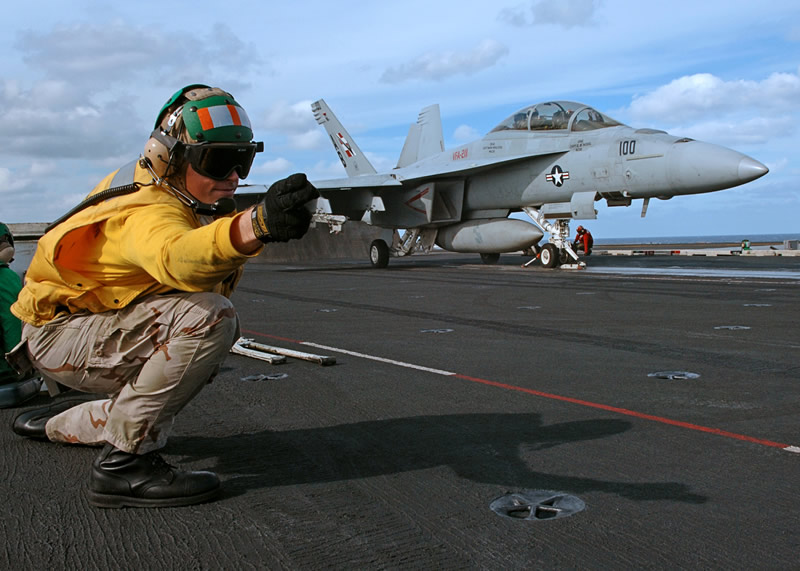
May 5/07: Australia’s DoD announces the signing of its 1st contract for the new F/A-18F Block II Super Hornet fleet, valued at approximately A$ 2.9 billion (currently about US$ 2.39 billion), for 24 aircraft and associated support systems. Additional contracts will be established later in 2007 for weapons acquisition and sustainment.
The aircraft will be based at RAAF Amberley, which currently houses Australia’s long-range strike fleet of F-111 fighter/bombers. The government will be focusing on local Industry participation as part of the through life support concept, in order to maintain the extensive support infrastructure that has grown up around the F-11 fleet. Australian personnel are scheduled begin Super Hornet training in the United States in 2009, and the current government plans to retire its F-111s in 2010 instead of 2020 as originally forecast.
F/A-18F initial contract
March 6/07: Defence Minister Nelson officially announces the F/A-18F Block II purchase in his release: “$6 Billion to Maintain Australia’s Regional Air Superiority.” A$ 6 billion is the estimated total cost for purchase, training, and maintenance over 10 years.
The Australian Super Hornet program plans to use local contractor owned and operated intermediate maintenance and training for aircrew and support personnel. Additionally, the supply chain infrastructure, warehousing and operation will be manned locally in support of both Australian and US Navy Super Hornets in the region.
Note, however, that the Minister’s quoted Aviation Week reference to the aircraft’s 5th generation capability “similar to that of the F-22A Raptor…” refers to the Super Hornet Block II’s APG-79 radar, which is an AESA radar like the F-22A’s larger, more powerful, frequency-agile APG-77. It does not refer to the entire aircraft, as the selective excerpt might lead one to believe.
Feb 6/07: Australia has submitted a formal request. The US DSCA has announced the $3.1 billion request and its details. In addition to the 24 F-18Fs, Australia has requested:
* 48 installed and 6 spare F414 engines
* 24 AN/APG-79 AESA radar systems
* 24 AN/USQ-140 Multifunctional Informational Distribution System Low Volume Terminals (MIDS-LVT Link 16)
* 30 AN/ALR-67(V)3 Electric Warfare Countermeasures Receiving Sets, the same kind that will also equip Australia’s other Hornets after the ALR 2002 project’s failure.
* Integration of the AN/ALE-47 Electronic Warfare Countermeasures Systems
* 145 LAU-127 Guided Missile Launchers. These wingtip launchers allow the plane to launch AIM-9 Sidewinders or medium-range AIM-120 AMRAAM air-air missiles.
* 30 AN/PVS-9 night vision goggles
* 12 Joint Mission Planning Systems
* AN/ALE-55 Fiber Optic Towed Decoys
* System integration and testing, software development/integration, test sets and support equipment, spare and repair parts, maintenance and pilot training, software support, publications and technical documents.
Australia falls under the same provisions as NATO for Foreign military Sales announcements, in that it only takes 15 days for DSCA requests to be considered approved, as long as Congress doesn’t specifically block it. Negotiations regarding the next step, a contract, can then begin.
F/A-18F request
Dec 20/06: The Australian reports that:
“Defence Minister Brendan Nelson intends to ram through a $3 billion purchase of 24 F/A-18F Super Hornet aircraft, amid concerns Australia may lack a fully deployable air combat capability early next decade… His swift action came as a surprise to senior defence officials on Russell Hill. The decision to buy an expensive interim fighter will generate a major rethink of the 2006-16 defence capability plan…”
Appendix A: RAAF Super Hornet Controversies
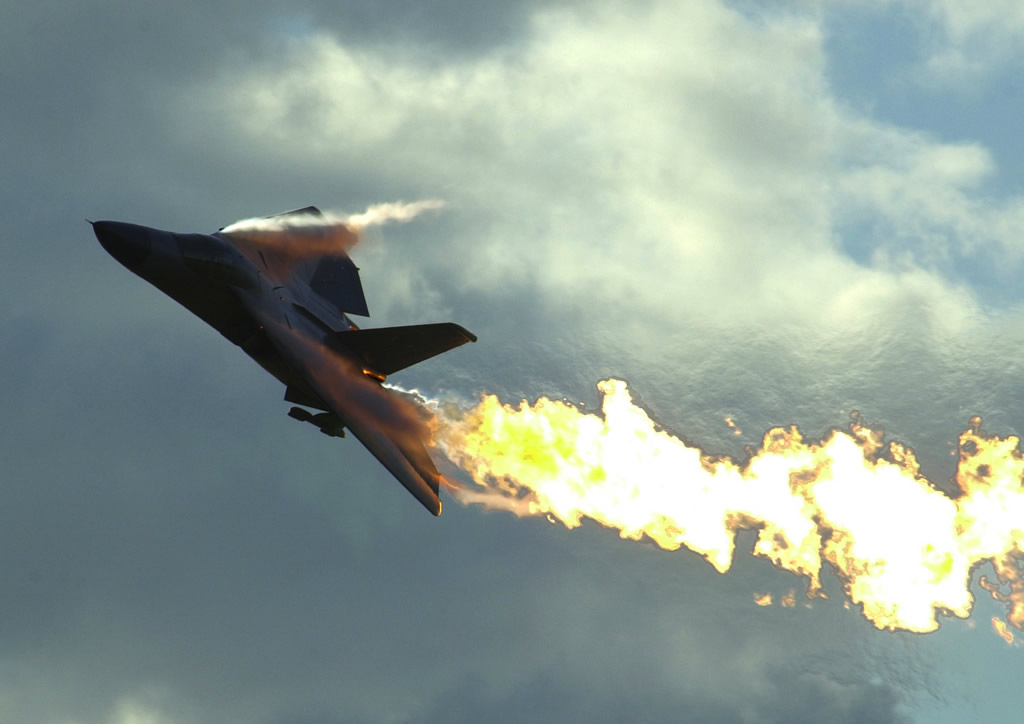
(click to view full)
Liberal Party defense minister Dr. Nelson reportedly decided to opt for the Super Hornet without a detailed study of alternative aircraft types, such as the longer-range F-15E Strike Eagle, advanced air superiority options like the Eurofighter Typhoon, or even an export version of the USA’s F-22 Raptor. Despite its name, the Super Hornet is a larger aircraft that offers only 25-30% commonality with the Australian air force’s existing F/A-18A/B Hornets. What is does share, is the same support structure.
Justifications advanced for this buy include service as a gap-filler to the F-35A Lightning II Joint Strike Fighter after the F-111’s retirement in 2010, and also the ability to boost aircraft numbers while existing F/A-18A Hornets rotate through year-long center section replacements, designed to lengthen their service fatigue life. The Super Hornet buy had significant impacts on the 2006-2016 Defence Capability Plan, and reportedly cut the number of F/A-18A Hornets undergoing the A$ 1+ billion HUG mid-life upgrade program to 42. It may also result in cuts to other programs, unless additional funding is provided to cover the interim fighter purchase.

(click to view full)
For a detailed account of the Super Hornet’s origins and its specific differences vs. the earlier model F/A-18 A-D Hornets, plus an in-depth first-person flight report, see “Flying the F/A-18F Super Hornet,” originally published in the May/June, 2001 issue of Australian Aviation.
Whether these attributes will be enough to deal with present and future SU-30 family aircraft on even terms remains a matter of controversy.
For a more detailed account of the ongoing controversy around Australia’s F-35 Lightning II/ F/A-18F Block II purchases, as well as links that shed more light on the F-111 program at RAAF Amberley, see DID’s Spotlight article “The Australian Debate: Abandon F-35, Buy F-22s?, especially the updates and readings sections which include Super Hornet related news. See also DID’s follow-up: “Australian Air Power Controversy: F-35 and Super Hornets Under Fire,” which has been updated to reflect subsequent DoD speeches and defenses of their purchase, as well as follow-ups by those who believe that the F/A-18F is the wrong aircraft for Australia.
Those controversies may be of historical interest, but the issue has become moot. Large signed contracts turned the buy into a fait accompli. After a review of the aircraft and the likely costs of canceling the contract, the new Labor Party government decided to continue with the buy. The last plane from that order arrived in October 2011.
Additional Readings
Background: Super Hornet
* Australia’s RAAF – F/A-18F Super Hornet.
* Boeing – F/A-18E/F Super Hornet.
* Flight International (March 13/07) – Ultra Hornet. Describes the updates to create the Hornet Block 30/Block II+. The performance enhancements are all electronic rather than aerodynamic. Interestingly, future Flightplan enhancements may include a limited electronic attack function for all APG-79 AESA radars.
* Aerospace Web – Boeing F/A-18E/F Super Hornet Multi-Role Fighter.
Official Reports
* Australian Parliamentary Joint Standing Committee On Foreign Affairs, Defence And Trade (Sept 12/07) – Inquiry into Australian Defence Force Regional Air Superiority.
* Australian Parliamentary Joint Standing Committee On Foreign Affairs, Defence And Trade Defence Subcommittee: Australian Defence Force Regional Air Superiority panel Q&A (July 5/06) – Ipswich session, near RAAF Amberley: Group Capt. Morrison; Group Capt. Davies; Mr Webb; Mr Harling; Mr Duff; Mr Sanderson; Mr Macklin. A very interesting look at the elements required to maintain aging aircraft (the F-111) whose original suppliers are no longer making those parts – an issue that’s highly relevant around the world as global military aircraft fleets age.
News & Views
* ASPI (March 2014) – Taking wing: Time to decide on the F-35 Joint Strike Fighter [PDF].
* Sydney Morning Herald (Jan 26/13) – Defence is headed for its own crisis. A budget crisis.
* ASPI (Oct 4/12) – Air combat capability: the good news and the bad news. Includes expected full costs for the Super Hornet family fleet, and the history and plans for F/A-18 Hornet spending as well.
* Flight International (July 12/11) – Testing the new-generation Super Hornet. An F/A-18F Block II simulator, to be precise.