


(click to view larger)
The Viper Strike began life as the BAT – a canceled munition option for ground-fired ATACMS missiles. After USAF Predator UAVs armed with Hellfire missiles began to show promise in the Global War on Terror, however, US Army planners began to examine their options. Could they place a similar capability in the hands of Army ground commanders? In July 2002, these examinations led to the award of a 90-day contract to demonstrate the possibility of BAT deployment on a modified U.S. Army RQ-5 Hunter UAV.
Those tests went well, and Viper Strikes are currently carried by MQ-5B Hunter UAVs – see this video [MPG, 13.2 MB] of a Viper Strike in testing. The weapon’s small size (3 feet long, 44 pounds) and special advantages in urban fights, mountainous terrain, etc. give it a chance of spreading to other platforms. Special Operations Command has shown interest, but front-line deployment has been limited. Is the Viper Strike a case of “the right weapon at the right time”? Or a case of “caught betwixt and between”? That’s now an important question for Europe’s MBDA, who bought the weapon and manufacturing from Northrop Grumman.
Viper Strike: Weapon, Platforms & Positioning
(click to view full)
Northrop Grumman’s developed the GBU-44 Viper Strike as a small, precision attack munition with guide/ glide fins and a 4 pound HEAT (High Explosive Anti Tank) warhead. It used a semi-active laser seeker for the final attack phase. After the bomb is released, it glides to the target’s vicinity, and its seeker then looks for the laser spot from Hunter’s laser target designator and makes final adjustments to its flight. A new GPS VS/ Viper Strike II variant adds GPS/INS guidance capability, and new software improves the dual-guidance weapon’s capability against moving targets.
Since it functions as a top attack weapon, Viper Strike’s compact profile and the small HEAT(High Explosive Anti-Tank) warhead make it especially useful in urban situations, minimizing collateral damage to people and buildings while still allowing it to kill armored vehicles through their weakest point. Viper Strike uses a self-destruct mechanism to eliminate post-strike hazards in urban areas, and the final version of Viper Strike could have options for optional blast fragmentation or thermobaric (fuel-air explosive) warheads.
The weapon’s size and precision can make larger tactical UAVs much more dangerous. While any unarmed UAV could use geo-location to call in precision artillery against fixed targets, engaging moving targets requires either an armed aircraft on station, or an integral weapon. As the USMC has found, many targets get away precisely because there is no armed aircraft on station, and no integral weapon on its UAVs. Using its electro-optical or infrared sensors, a tactical UAV can locate a moving enemy vehicle, have the operator report its location to the ground commander, receive operator permission to engage, fire the weapon, and guide the weapon with its laser targeting system. After weapon impact, it would transmit a battle damage assessment.
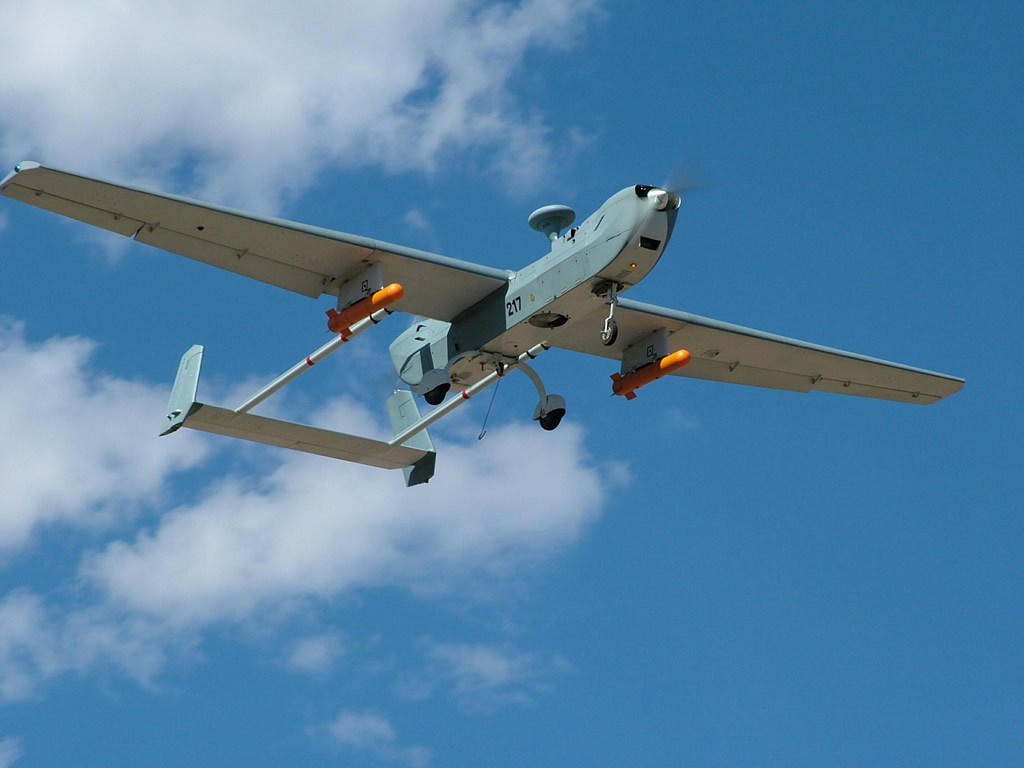
At present, the Viper Strike is known to be compatible with Northrop Grumman’s Q-5 Hunter tactical UAVs. The latest model is the upgraded MQ-5B, which features a pair of 58 hp heavy fuel engines, bigger wings with additional fuel storage, hard points for pylons/weapons like the Viper Strike, control via the multi-UAV model AAI One System ground control station, and an updated avionics suite. The MQ-5B Hunter first flew in July 2005, and deployed to the front lines a year later. Just under 30 UAVs of this type are in service, but they continue to rack up significant flying hours. By June 2007, the MQ-5A/B Hunter fleet had passed 50,000 total flying hours, half of which were spent on combat missions.

What the Hunter fleet isn’t, is large. In order to generate significant Viper Strike sales, that platform roster needs to expand.
The larger question for MBDA is one of positioning. The GBU-44 Viper Strike has a number of remarkable characteristics. The question is whether this will be enough to make it a success. Many tactical UAVs like the US Army’s RQ-7 Shadows will find it difficult carry even a weapon as small as Viper Strike, which is leading to a number of very small precision guided weapons like Raytheon’s STM, NAWCAD/DRS’ Spike missile, etc. Above the RQ-5 Hunter, Predator family UAVs like the SkyWarrior, MQ-1 Predator, and MQ-9 Reaper use Hellfire missiles instead.
The GBU-44 could end up in the dreaded product trap of being positioned between 2 distinct market segments, unable to fully satisfy either one. If it’s to enter fuller production, it will need to find a key platform and application.
MBDA’s acquisition may introduce new opportunities with European countries, who are looking to arm their UAVs with precision strike options, while watching the bottom line. The 2011 Libyan war in particular highlighted the need for less expensive aerial platforms, delivering less expensive weapons.
One approach for MBDA might be to offer both cheaper weapons per firing and more overall capability, by creating a launch system that offers a tradeoff for smaller medium UAVs between 4-8 Viper Strikes, or 2 Hellfire/Brimstone missiles. That may even work for light manned airplanes: Iraq’s light “Bird Dog” Cessnas and “King Air ISR” surveillance aircraft highlight a potential trend in the developing world, and MBDA has tested Viper Strikes from a Cessna Caravan.
The challenge will involve competing against a growing array of laser-guided 70mm rockets, which can offer the same numbers tradeoff, and MBDA/Thales’ own Light Modular Missile for helicopters and tactical UAVs. Viper Strike VS’ GPS option, and top attack profile, will have to be key differentiators.
Another opportunity, which has already come to fruition in the USA, involves arming C-130 Hercules medium transport aircraft flown by the US Marines. The KC-130J “Harvest Hawk’s” Viper Strikes are dropped out of tube launchers inside the plane, but there’s no reason that Viper Strikes couldn’t be mounted on outside pylons as well. With lighter European aircraft like EADS CN-235 being converted into gunship roles by foreign customers, Viper Strikes may have a natural fit.
SOCOM’s Solution: Viper Strikes for AC-130s?

(click to view full)
US Special Operations Command believes that its AC-130 fleet of AC-130H “Spectre” and AC-130U “Spooky” Hercules variants, whose mission is the delivery of massive, accurate firepower into land battles where enemy air defenses are weak, offer an excellent potential platform for Viper Strike. At present, 13 AC-130U Gunships are flown by the 4th Special Operations Squadron (SOS) and 8 AC-130H Gunships are flown by the 16th SOS. Both squadrons are located at Hurlburt Field, FL.
While the AC-130s’ 105mm howitzers, 30mm chain guns, and other weapons are very useful against infantry and light vehicles, Viper Strike offers longer-range precision attack capabilities, plus an anti-armor punch that can make a big difference to pinned special forces units.
John Miller, director of the Viper Strike program for Northrop Grumman’s Land Combat Systems in Huntsville, AL put it this way:
“Right now, the AC-130 uses the 105 mm howitzer, and they wind up flying left hand circles at altitudes between 15,000 to 18,000 feet… That puts them in harm’s way. They would really like to be able to fly at higher altitudes with more survivability, more standoff and also to stay pressurized. We believe that if we take Viper Strike, mount them in a rack, and shoot them through the floor, that we can give them that capability. And not only that, but we can give them the capability to shoot multiple targets types [sic].”

(click to view full)
The first phase of this effort will demonstrate the use of the SOPGM (Special Operations Precision Guided Munition) Viper Strike from the gunship and begin development of operations concepts, as well as launcher and battle-management systems to optimize use of the Viper Strike/ AC-130 combination. The second phase will demonstrate and assess the military utility of the weapon system on the AC-130, along with the idea of adding a datalink for 2-way communications between the aircraft and the weapon.
As of 2009, the Viper Strike was still “under consideration” for the AC-130 fleet, and details since have been scarce. The weapon made definite progress on another front, however: as part of initial fielding for the US Marines’ KC-130J “Harvest Hawk” program, which aims to give Marines the option of clipping surveillance gear and weapons onto any of their aerial tankers. US Navy NAVAIR is sharing information with SOCOM, who may wish to buy the same modular technology for its ordered MC-130Js and MC-130Ws.
Contracts & Key Events

(click to view full)
Industrial partners may change, in the wake of MBDA’s December 2011 acquisition. Elbit Systems of America currently manufactures some of the guidance equipment, but MBDA may wish to move that in-house.
Unless otherwise specified, contracts are awarded by the U.S. Army Aviation and Missile Command in Redstone Arsenal, AL, USA.
Nov 18/13: MC-27J. Italy becomes the 1st customer for Alenia’s MC-27JK Praetorian light gunship, signing a contract during the Dubai 2013 air show to convert up to 6 of their 12 C-27Js to the MC-27J “Praetorian” configuration. The aircraft will be used to the Italian Comando Operativo Forze Speciali (COFS).
The GBU-44E is one of the Praetorian’s chosen weapons, but it will only be integrated into ATK’s mission systems during Phase 3, which is a couple of years away.
Sept 9/12: Cessna test. MBDA announces that its GBU-44/E Viper Strike successfully hit eight vehicles travelling at extremely high speeds in varying realistic scenarios, after being dropped from a Cessna 208B Caravan test aircraft at White Sands Missile Range, NM.
The chosen platform is as important as the results. Iraq has already created AC-208 Combat Caravans that fire more expensive Hellfire missiles, and the ability to arm small planes like the Caravan adds a whole new dimension to Viper Strike’s potential usefulness, and widens its potential customer base.
April 16/12: KC-130J test. MBDA announces that its GBU-44/E Viper Strike with dual-mode GPS/laser guidance scored “multiple direct hits”, after being launched from the KC-130J Harvest HAWK’s new “Derringer Door” during developmental testing at China Lake, CA. Viper Strike also proved out its new fast attack software load, designed to improve performance against time sensitive targets.
Jan 17/12: A $6.9 million firm-fixed-price contract modification for “Viper rounds, parts and engineering services.” MBDA is now the contractor, though the announcement hews to the name in the contract, which is Northrop Grumman Systems Corp. in Huntsville, AL.
Work will be performed by MBDA in Huntsville, Ala., with an estimated completion date of Aug 31/12. One bid was solicited, with one bid received (W31P4Q-07-C-0268).
Dec 12/11: European missile giant MBDA announces that it has bought Northrop Grumman’s Huntsville, AL Viper Strike facility, and the weapon.
MBDA sees it as a proven option for armed UAVs, to complement products like their LMM mini-missile, which is currently in development. Viper Strike’s ability to arm transport aircraft, helicopters, and other platforms may also offer an opportunity for MBDA. After tallying their expenses over Libya, European militaries may well look to European firms for precision weapons and deployment systems, that cost less than the standard solution of high-end fighters dropping laser-guided bombs. MBDA.
Bought by MBDA
Aug 22/11: Northrop Grumman announces an unspecified additional contract to deliver “multiple” GBU-44 Viper Strikes beginning to the Joint Attack Munition Systems (JAMS) Project Office at Redstone Arsenal, AL, beginning in 2011, for eventual integration onto the KC-130J Harvest Hawk. See also June 2/10 entry.
All the Viper Strike munitions on Harvest Hawk will now carry the latest software load, which greatly enhances the weapon’s effectiveness against moving targets. In recent testing at China Lake, CA, Viper Strike scored multiple hits against moving vehicles in various scenarios.
Aug 19/11: Aviation Week reports on 2 key milestones for the program. One is the addition of the MQ-8C/ Fire-X. The other is weapons approval for the MQ-8B, beginning with the APKWS-II laser-guided 70mm rocket that’s already cleared for use from Navy ships. Raytheon’s laser-guided short-range Griffin mini-missile is slated for a demonstration before the end of August 2011, and will be the platform’s next weapon, as opposed to Northrop Grumman’s own GBU-44 Viper Strike.
June 2/10: Northrop Grumman announces a contract, to deliver 65 Viper Strike munitions to the Joint Attack Munition Systems (JAMS) Project Office, within the Program Executive Office Missiles and Space at Redstone Arsenal, AL. The Viper Strikes will be delivered in 2010, for eventual integration onto the KC-130J Harvest Hawk platform.
April 10/10: The KC-130J Harvest Hawk roll-on/roll-off gunship kit completes Phase 1 testing at Pax River, MD, and leaves for required maintenance and continued testing at NAVAIR’s China Lake, CA range. NAVAIR now says that it is working a complimentary effort to test and deploy the Standoff Precision Guided Munition (SOPGM, aka. “Viper Strike”) as a stand alone capability for Harvest HAWK’s initial fielding, and that the first aircraft is scheduled to deploy by summer 2010 equipped with the AN/AQS-30 TSS, Hellfire missiles, and SOPGM. NAVAIR release.
FY 2005 – 2009
Sept 1/09: Northrop Grumman announces that its MQ-5B Hunter UAV has successfully completed testing of the new GPS-guided Viper Strike (GPS VS) at White Sands Missile Range, NM, and that these weapons “will soon deploy to theater on board Hunter in support of contingency operations.”
The announcement is a breakthrough for the Viper Strike, on two fronts. One front is the addition of GPS-based guidance. The other is the fact that Viper Strike had not been deployed to the front lines due to inter-service disagreements, and does not appear to have been been brought to fruition on US Special Operations Command’s AC-130s either. See also StrategyPage.
April 2/09: Northrop Grumman Systems Corp. in Huntsville, AL won an $11.3 million firm-fixed-price contract with cost plus fixed fee, line items contract for Viper Strike Munitions and engineering services. Work is to be performed at Huntsville, AL, with an estimated completion date of April 30/10. One bid was solicited and one bid received (W31P4Q-07-C-0268).
The Viper Strike program has been restructured, consolidating the laser-guided Direct Attack and the new GPS-guided variant into a single version, and changing the Army’s order totals. Instead of 137 Direct Attack munitions, The US Army is ordering 49 of the new GPS-enabled version, plus 15 additional direct attack kits, 3 Hunter integration kits, and MQ-5B Hunter integration, testing, and eventual fielding. US SOCOM is also switching its order to the new GPS-enabled version.
Sept 26/07: Northrop Grumman Systems Corp. in Huntsville, Ala. received a $16.1 million modification to a cost-plus-fixed-fee and firm-fixed-price contract for Viper Strike Munitions and engineering services. Work will be performed in Huntsville, AL and is expected to be complete by Dec 31/08. This was a sole source contract initiated on Sept. 5, 2007 (W31P4Q-07-C-0268).
March 12/07: AC-130. Northrop Grumman of Linthcum, MD received a $7.4 million contract modification for the demonstration of their Viper Strike munition on the AC-130 gunship as a ranged precision-guided munition. This modification action adds the requirement for the contractor to support an extended user evaluation of the munitions on the AC-130, and brings the current total maximum estimated cost of this contract to $29.4 million (H92222-05-C-0020, Modification P00012).
Work will be performed out of Huntsville, AL, and is incrementally funded based on performance. The initial proof of concept work is to be complete by October 2007.
Feb. 28/07: Northrop Grumman announces that a successful round of RQ-5A Hunter and Viper Strike testing was conducted at White Sands Missile Range, NM in January 2007 against moving and stationary targets. The weapons tests were conducted under the auspices of the U.S. Army’s Program Executive Office (PEO) for Aviation and the PEO for Missiles and Space.
Aug 4/05: Northrop Grumman of Linthcum, MD received a sole-source $22 million cost-plus incentive-fee Advanced Concept of Technology Demonstration contract (H92222-05-C-0020) for the demonstration of their Viper Strike munition as a Stand-off Precision Guided Munition on the AC-130 Specter gunship.
Work on this contract will be performed out of Huntsville, AL and is being incrementally funded based on performance. The initial increment of work was expected to be complete in December 2005, and all Initial Proof of Concept work was expected to be complete by December 2006. The $22-million contract is an Advanced Concept Technology Demonstration program with a potential full value of $48.6 million.
Additional Readings
* Defense Update – Viper Strike – Laser Guided Weapon for UAVs
* Special Operations Technology (Aug 18/04) – Viper Strike
* Designation Systems – Northrop Grumman BAT / GBU-44/B Viper Strike
* AUSA 2009 – Joint Attack Munition Systems Overview: Col. Michael Cavalier, Project Manager. Includes Viper Strike and Griffin, also details related Harvest Hawk efforts.
* Armada International (Feb-March 2006) – Unmanned, But Now Armed. Covers UAVs and UCAVs generally; includes Viper Strike coverage.
* USAF (Oct 10/05) – The AC-130U Gunship program explores viper strike capability
* Northrop Grumman (June 15/05) – Northrop Grumman Demonstrates Viper Strike Precision Munition Enhanced with GPS
* Northrop Grumman (Aug 27/03) – Northrop Grumman’s Viper Strike Precision Munition Achieves Perfect Score in U.S. Army UAV Tests
Competitors and Related Developments
* DID – Raytheon’s Griffin Mini-Missiles.
* Lockheed Martin – Scorpion. Small precision glide weapon.
* Designation Systems – NAWC/DRS Spike. Very short range (around 2 miles) powered missile with a 1 kg warhead, weighs only 5 pounds.
* DID- The Right to Bear Arms: Gunship Kits for America’s C-130s. Already includes Griffin.
* DID – The USA’s New Littoral Combat Ships (LCS). Griffin-B may replace the canceled NLOS-LS PAM missile.
* DID – Arming RQ-7 UAVs: The Shadow Knows…. Even Griffin may be too heavy for the RQ-7, though…
* National Defense Magazine (April 2005) – Army Developing Tactics for Armed Robotic Aircraft.