


(click to view full)
Canada’s Maritime Helicopter Replacement Program has been a textbook military procurement program over its long history. Unfortunately, it has been a textbook example of what not to do. While Canada’s 50-year old Sea King fleet aged and deteriorated to potentially dangerous levels, political pettiness and lack of concern turned a straightforward off-the-shelf buy into a 25+ year long odyssey of cancellations, lawsuits, rebids, and more. Eventually, the Canadian military settled on Sikorsky’s H-92 Superhawk as the basis of its new CH-148 Cyclone Maritime Helicopter, which will serve from the decks of Canada’s naval ships and bases.
The civilian S-92 has gone on to some commercial success. To date, however, Canada has been the H-92’s only military customer – with all of the associated systems integration and naval conversion burdens that one would expect. After a long series of badly missed milestones and delivery delays, there are also deeper questions being raised concerning both the machines’ fitness, and DND’s conduct of the program as a whole. This article covers the rationale for, history of, and developments within Canada’s Maritime Helicopter Program.
CH-148 MHP: Systems & Program

(click to view full)
The 5-bladed EH101 had been the New Shipboard Aircraft Program’s initial winner in July 1992, and serves in a naval and anti-submarine helicopter role with the British and Italian navies. A civilian version currently serves Canada in a search-and-rescue role as the CH-149 Cormorant, but they were bought long after the naval helicopter contract was canceled for political reasons. Reliability and readiness issues with the Canadian CH-149s have added further strains to Canada’s relationship with AgustaWestland.
Canada chose a different naval helicopter platform when they restarted the Maritime Helicopter Replacement Program, but the ride has been rough and the delays have been long. Many of those delays arose because a project touted as an off-the-shelf buy became nothing less than the development of a new helicopter platform for the global military market, with specifications that no existing off-the-shelf machine could meet.
The MH-92/ CH-148 Naval Helicopter

(click to view full)
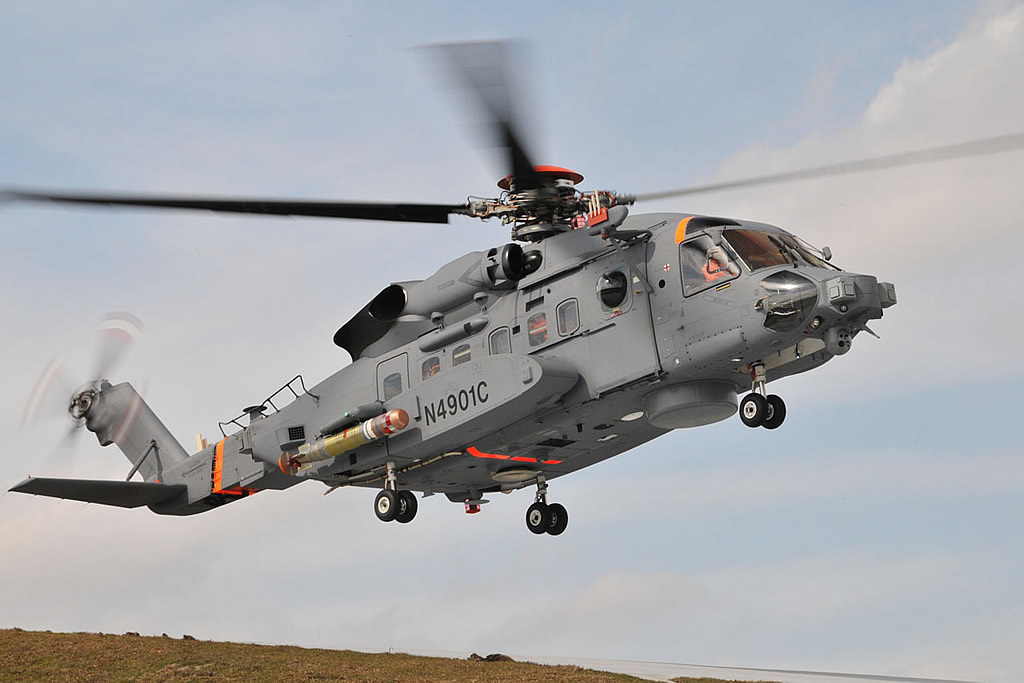
The H-92 Superhawk platform Canada chose for its “CH-148 Cyclone” maritime helicopters is a larger derivative of the ubiquitous H-60 family that comprise most of the US Navy’s current fleet. it makes heavier use of rust-proof composite materials, and also sports uprated engines, a rear ramp, and other features that place it in a similar class to Europe’s delayed NH90 NFH model, whose schedule has also slipped until it is also expected to become fully operational around 2013.
Initial Cyclone specifications called for GE’s 3,000 hp class CT7-8C engines, but helicopter weight growth will force another engine upgrade before the final design is ready. Standard self-sealing fuel tanks can carry up to 3,030 kg of fuel, and an in-flight refuelling probe allows in-air refueling for extended range flights.
The 17 cubic meter cabin is fitted with a cargo handling system with a centerline 1,814 kg/ 4,000 pound capacity cargo winch, floor rollers, and cargo tie-down points. A 6 foot-wide aft ramp allows easy and fast loading and unloading of cargo and troops. A 272 kg/ 600 pound capacity hydraulic rescue hoist can reportedly be added to the helicopter if necessary.
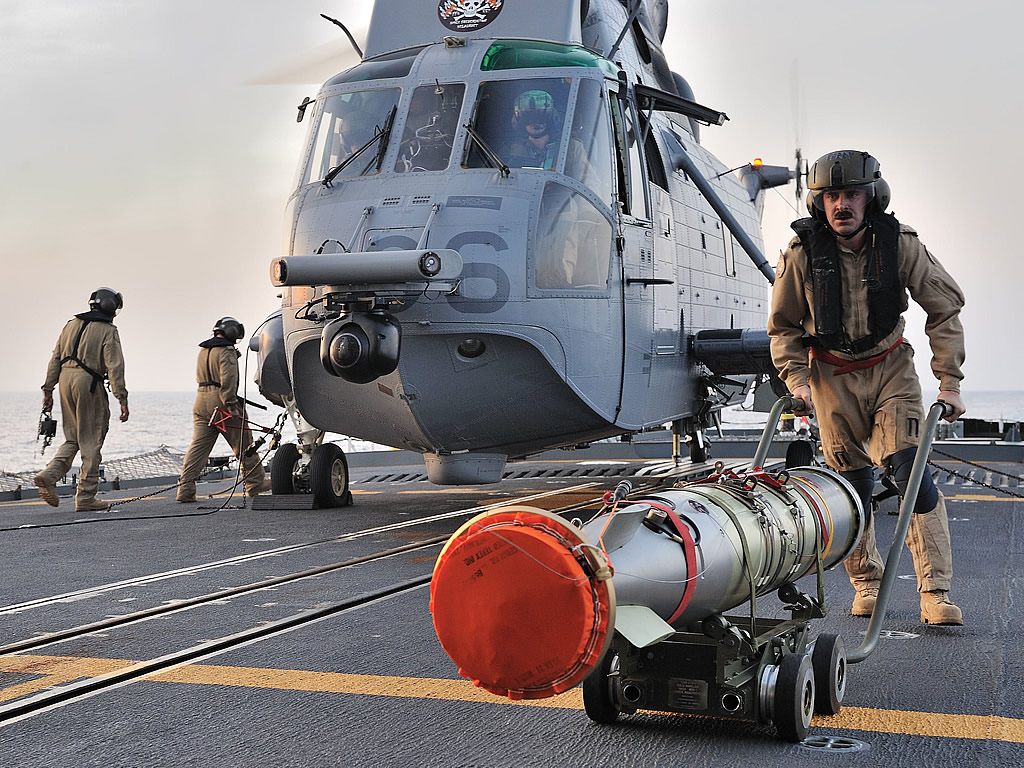
A Telephonics APS-143B radar, a HELRAS active dipping sonar system supplemented with launched sonobuoys, and a Star SAFIRE-III day/night surveillance turret, offer a good mid-level sensor set by the standards of new western naval helicopters.
(click to view full)
Armament has not been discussed. Other naval helicopters generally hold 2-4 mounting points for some combination of lightweight torpedoes, depth charges, and light anti-ship missiles. Some, such as the Cyclone’s smaller MH-60 cousins, can also mount machine guns, rockets, or short-range anti-armor missiles on their wing stubs. Canada’s history suggests that a minimalist approach is likely, involving only Canada’s Mk46 torpedoes. On the other hand, enough re-use of existing MH-60 family systems could leave the Cyclones fitted “for, but not with” a wider variety of weapons. Sikorsky is known to be eyeing potential exports, and would benefit from having a wide range of available weapon options.
Survivability will be handled using the helicopter’s AN/ALQ-210 radar warning and locator system, linked to the AN/ALQ-144Av5 countermeasures suite. The nature of their missions, however, means that these helicopters’ most dangerous enemy is likely to be… nature. This is also true for their crews. If the worst should come to pass, Canada’s frigid waters challenge sailors to survive long enough to be rescued. To address that, the CH-148 includes emergency flotation systems under the cockpit and in the tailboom; they’re deployed automatically, and are expected to work up to Sea State 5 conditions. If they fail, or aren’t practical, a 15-man life raft is installed in each side wheel sponson.
A number of CH-148s won’t be fielded to this standard, at least initially.
Program delays eventually pushed Canada’s DND to accept “interim” helicopters that could be used for some training, but weren’t ready for service. Overall, the CH-148 interim helicopters will be deficient in 4 areas:
1. Mission system software which controls all weapons and sensors won’t be ready.
2. Messaging functionality/ tactical data exchange capability (automated data-link exchanges of tactical data between designated units, including the ships and aircraft) won’t be fully installed.
3. Mission flight endurance will be 21 minutes less than the contracted requirements.
4. The ability to operate on a single engine, even at high temperatures that cost helicopters their lift.
The first 2 issues will be solved with software and electronics upgrades. The latter 2 issues are expected to be solved by uprated turboshaft engines. All of these upgrades will, of course, require extensive testing of their own.
The CH-148 Program

(click to view full)
In 2000, Canadian program costs for 28 maritime helicopters were estimated at C$ 2.8 billion. That escalated to C$ 3.1 billion in 2003. By 2010, the program had hit C$ 6.2 billion, including purchase costs, 20 years of in-service support, training, and extra spending in order to keep the CH-124 Sea King fleet operational during project delays.
Those delays have also been substantial. Initial CH-148 delivery was originally scheduled for November 2008, but that was pushed back twice, and the new December 2010 milestone would be for “interim” helicopters that were missing key capabilities. Those standards were relaxed even further to eliminate night or over-water flights, but Sikorsky still missed the delivery date.
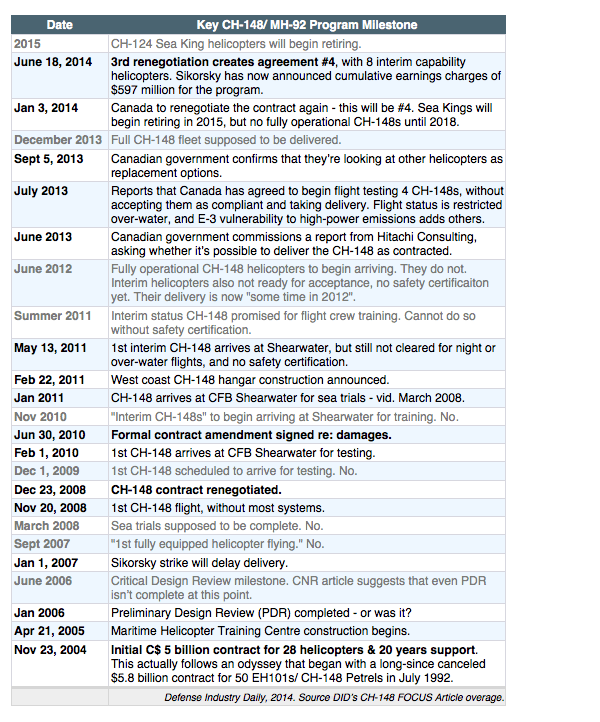
In the wake of a very vague announcement about contract renegotiation and further program delays, observers began questioning whether the program’s initial dates were ever realistic, and whether even the revised dates could be depended upon. As of September 2013, the program hasn’t even had a single interim helicopter accepted. It has missed every milestone so far, and shows no signs of changing that record. The timeline below captures most of the program’s shifting dates and promises, along with its progress to date:
Meanwhile, the H-92 seems likely to become the base helicopter for the USA’s new Presidential helicopter fleet, but hasn’t been able to secure other military sales. If Canada collapses as a customer, the USA’s VXX program could still go ahead, because the civil S-92 is already the base machine for several heads of state. Its military future beyond that would become very tenuous, however, and the S-92 would likely join the S-76 as proposed military machines that became reasonably successful civil-only platforms.
Plan B: Other Options
(click to view full)
In September 2013, Canada’s government confirmed that they were seriously considering other helicopters for their naval needs, in conjunction with cancellation of the CH-148 contract. By January 2014, they decided to renegotiate the CH-148 contract one more time. While sunk costs should be discounted, all alternatives to the H-92/CH-148 would have involved some type of cancellation fee, even if Canada terminates for breach of contract. Beyond that, each model had its own strengths and drawbacks.
AW101. AgustaWestland’s AW101 naval serves in a full anti-submarine role with Britain and Italy. The British are upgrading their fleet to a stable Merlin Mk2 configuration, and the helicopter is more advanced and proven than it was when the S-92 beat the AW101 in 2004.
The flip side is that Canada’s AW101/ CH-149 search and rescue machines have had consistent issues with reliability and demand for spare parts, and Britain’s figures indicate that the problem isn’t limited to Canada. The Mk.2 hopes to improve that situation, but there isn’t enough operational data yet to know how much improvement has actually been delivered. AW101s would also require an associated weapons buy, or a sub-project to integrate the helicopter with American weapons in Canada’s stocks.
AW159 Lynx Wildcat. If Canada is willing to consider a significantly smaller helicopter, the new AW159 variant of the globally popular Lynx family offers them more versatility for shipboard deployment, without major structural upgrades.
The new AW159s are very capable anti-submarine helicopters, but won’t have the same utility helicopter versatility as Sea Kings, S-92s, or other large counterparts. They also wouldn’t have space for Canada’s extra TACCO (tactical control officer) in back to monitor the sensors and make tactical decisions. Their purchase cost would be lower, but like the AW101, they’d require added weapons integration or purchases, as well as an investigation of flotation options.
EC725 Super Cougar. Eurocopter’s machine lacks a folding tail boom for storage aboard navy ships, and would need to integrate naval equipment (radar, dipping sonar, sonobuoys, weapons). Canada has been there and done that with the S-92, and they’re deeply unlikely to do it again.

Bermuda
(click to view full)
MH-60R Seahawk. Sikorsky’s smaller but proven MH-60R has been in service with the US Navy for several years, and Australia won’t be its last export customer. It offers great interoperability, compatibility with Canada’s existing weapons is assured, and deliveries would take place quickly from a full-rate production line.
MH-60Rs could be an option if Canada decides to negotiate them as part of a broader settlement with Sikorsky. Its problem is that it won’t qualify unless Canada scraps the flotation requirements, which exist because Canadian crews have to fly over a lot of lethally cold water. Canada also wouldn’t have space to include their extra TACCO (tactical control officer) in back, to monitor the sensors and make tactical decisions.
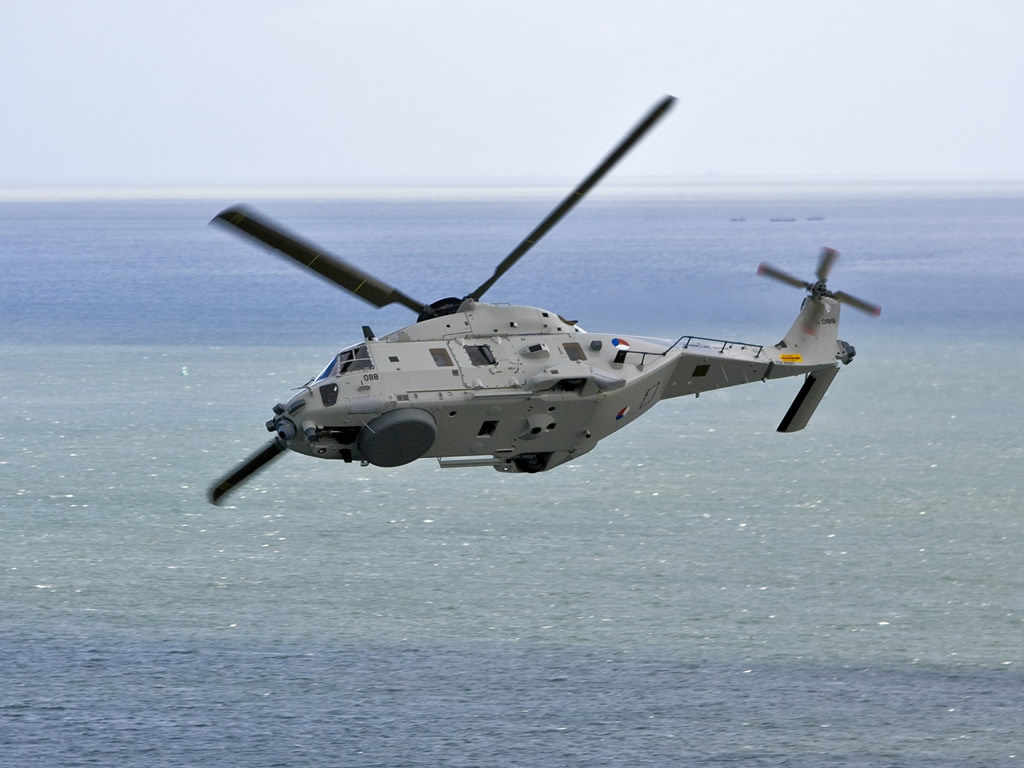
NH90 NFH. The European NHI consortium’s helicopter has an strong installed base within NATO, and offers Canada the advantage of ongoing modernization investments from multiple partner countries. The NH90 NFH variant was very developmental in 2004, but as of 2013, the naval version is finally being delivered in its operational configuration. NHI is publicly unclear re: integrated weapons options, and so Canada would need to investigate that.
The NH90’s problem has been late, late delivery, and the company remains backlogged. Given cutbacks in orders from their core customers, they’d certainly welcome the business. The questions are: Can NHI deliver? And how much stock can Canada place in a helicopter that doesn’t have much operational history in its operational configuration?
CH-148 Industrial Partnerships
The basic S-92 helicopter is assembled in Stratford, CT, but key parts are made elsewhere. It is used in industries like offshore oil & gas, and has carved out a niche as a government VIP helicopter. Industrial partners for the S-92 civil helicopter and CH-148 maritime patrol helicopter include:

CH-148 MHP: Contracts & Key Events
2016-2021
[youtube:v=vUpExOTu_5c]
December 7/21: Canadian Cracks Cracks have been found on the tails of Canada’s CH-148 fleet, the problem affects 19 out of the 23 helicopters. The issue surfaced on November 26 when one of the helicopter underwent scheduled maintenance and the cracks were discovered. Subsequent checks on three more rotorcraft also found cracks on those aircraft. So far only two were unaffected and two more are yet to be inspected.
June 28/21: Return To Target Crash A Canadian board of inquiry has released its report into the crash of a CH-148 off Greece in April 2020. Six onboard the helicopter died. The pilot was performing a turning maneuver called “return to target” when the helicopter’s autopilot took control of the aircraft at the end of the turn. The pilot realized too late that the autopilot was flying the aircraft into the sea and pulled back the cyclic. He had overridden the autopilot for an extended period of time while executing the maneuver. The board of inquiry found that the autopilot software accumulates commands when it is not turn off. This could reduce pilot’s control of the helicopter in special cases. During the certification of the CH-148, this scenario whereby the autopilot was overridden for extended time was not tested.
June 6/18: Cormorant modernization The Canadian government has reaffirmed its intention to proceed with Leonardo Helicopters-led modernization of its AW101 Cormorant search and rescue rotorcraft, and to potentially increase its fleet size from 14 to 21 examples. Canada and Leonardo are currently during the final finalization stages of outlining the requirements for the CH-149 Cormorant Mid-Life Upgrade program, including fleet augmentation, simulation and training. The Cormorant is a medium-lift helicopter used in both military and civil applications. It is based on AugustaWestland’s AW-101. The potential deal provides for new avionics equipment, electro-optical and infrared sensors, as well as the integration of Leonardo’s Osprey active electronically scanned array radar. Canada has operated the AW101 as its primary rotary-wing search and rescue capability since 2002. Canada aims to extending the lifetime of its CH-149 fleet to 2040 and beyond.
May 23/18: New Deal? The Royal Canadian Air Force is looking to modernize its fleet of search and rescue helicopters. Canada’s Air Force currently has 14 Cormorant helicopters in its inventory and recently started to introduce Cyclone maritime helicopters into its service. The Cormorant, a variant of the EH-101, is built by the Italian defense contractor Leonardo. The Cyclone is the military variant of Sikorsky’s S-92. Canada has had a very rocky procurement history regarding its SAR helicopter fleet. It has been a textbook example of what not to do. While Canada’s 50-year old Sea King fleet aged and deteriorated to potentially dangerous levels, political pettiness and lack of concern turned a straightforward off-the-shelf buy into a 25+ year-long odyssey of cancellations, lawsuits, rebids, and more. The Air Force is now working on a project to modernize its search and rescue fleet, but it has yet to decide whether to buy new aircraft or upgrade the Cormorants. Depending on its decision, the cost of the project would range from $391 million to $1.2 billion.
March 9/18: Rectified issues An issue with the Block I versions of Canada’s new CH-148 Cyclone naval helicopters has resulted in them unable to land on warships with its sonar attached safely. Information provided by the Royal Canadian Air Force said the service determined that the Cyclone’s sonar might strike the ship mounted assisted recovery system on a warship during high sea state condition as it cannot be fully retracted into the fuselage after deployment. The issue has already been resolved for the Block IIs already delivered and the affected Bock Is have already been sent back to manufacturer Sikorsky for modifications.
November 7/16: A Canadian CH-148 Cyclone has conducted its first anti-submarine warfare testing with the HMCS Windsor off the coast of Nova Scotia. The Sikorsky-made naval helicopter was tested as part of its Operational Test and Evaluation (OT&E) carried out by the Helicopter Test and Evaluation Facility (HOTEF). Crews onboard the CH-148 employed Expendable Mobile ASW Training Targets (EMATTs) to simulate submarine movements and noise patterns, which allowed HOTEF crews to further develop those tactical procedures that will be used by operational crews following CH148 Release to Service.
2014
June 23/14: Concessions. What trade-offs did Canada’s government make, in order to get a CH-148 helicopter that could be built and accepted? CBC News reports that they traded away:
* The ability to secure the helicopter’s ramp in various positions during flight.
* Crew comfort systems that could handle extreme temperature operations, as in Afghanistan or Libya.
* Unobstructed hand and foot holds for technicians to conduct maintenance.
* The ability to self start in very cold weather.
* Cockpit ergonomics factors.
* A system to automatically deploy personnel life rafts in emergency situations.
That last concession could be an issue in Canada’s lethally cold oceans, but the biggest concession is that the Canadian military will default to FAA civilian standards under “FAR Part 29,” instead of insisting on on 30-minute “run dry” capability if the main gearbox loses all of its oil. That’s exactly what happened in the S-92 crash off of Newfoundland (q.v. March 11/09), causing Canada’s Transportation Safety Board to recommend that the FAA do away with FAR Part 29’s “extremely remote” loophole. Other competitors, like the AW101, have proven this capability. Sources: CBC News, “Sea King replacements: $7.6B Cyclone maritime helicopters lack key safety requirement”.
June 18/14: Agreement #4. Sikorsky parent firm United Technologies:
“United Technologies Corp. (NYSE: UTX) today announced Sikorsky Aircraft Corp.’s signing of a contract amendment with the Government of Canada on the Canadian Maritime Helicopter Program, pursuant to the previously disclosed Principles of Agreement [q.v. April 15/14]. The amended contract enables Canada’s Department of National Defense to take delivery of operationally relevant CH148 Cyclone helicopters and facilitates retirement of the Sea King fleet starting in 2015.
As a result of the amended agreement, Sikorsky will record sales of approximately $850 million and a charge of $440 million in the second quarter of 2014 reflecting the cumulative effect of progress to date toward completion of the program, as modified [see also $157 million charge taken Jan 23/13].”
It has been a good quarter for the S-92, as Sikorsky received an $1.245 billion contract on May 7/14 to develop the S-92 into the next US Presidential helicopter. Sources: UTC, “United Technologies Announces Agreement With Government of Canada for the Maritime Helicopter Program; Reaffirms 2014 EPS Expectations of $6.65 to $6.85 Per Share”.
April 15/14: Agreement #4. Canada and Sikorsky have reportedly reached an agreement regarding the CH-148 program, but it isn’t public yet. Anonymous sources are telling CP that Canada won’t pay more money, will accept up to 8 interim capability helicopters, and will pay only for “the delivery of capable aircraft.” The catch is that Canada had to be realistic about what that meant, and distinguish between capabilities they needed to have, vs. capabilities they wanted to have. It’s amazing that this hadn’t been done during previous contract amendments, but there you have it. CP adds:
“Documents obtained under the Access to Information Act show that in addition to a report by consultants, officials also conducted an independent analysis of the financial implications of the existing program on the country’s defence industry. [Competitors] were also asked what they might be able to provide…. Internal documents showed last January that more than $1.7 billion has already been spent in preparing to receive the troubled choppers.”
Sources: The Canadian Press, “Ottawa and Sikorsky agree on new terms for Cyclone choppers: sources”.
3rd contract amendment
April 14/14: FAA on S-92. The FAA issues a warning that may have some bearing on the CH-148 program:
“The FAA has issued a Special Airworthiness Information Bulletin… [re:] the possibility of salt encrustation and engine performance degradation while operating the Sikorsky Aircraft Corp. S-92A in a heavy salt spray environment. At this time, the airworthiness concern is not an unsafe condition…. For operations that take place in a heavy salt spray environment, the pilot should monitor turbine gas temperature (TGT) relative to engine torque. Any abrupt rise in TGT might indicate salt encrustation and possible engine power degradation or imminent compressor stall. If a rise in TGT is observed while maintaining constant engine torque, the pilot should give priority to exiting the heavy salt spray environment. Flight through precipitation may help to reduce salt encrustation on engine components.”
Sources: HAI Rotor News, “Sikorsky S-92A: Heavy Salt Spray Environment”.
Jan 3/14: 4th time lucky? Canada will negotiate a 4th contract with Sikorsky to deliver the CH-148:
“Today, the Government of Canada and Sikorsky Aircraft Corporation announced that a Principles of Agreement (POA), which will form the basis of formal contract negotiations…. Canada will see delivery of helicopters with operational capability sufficient to begin retirement of Sea Kings in 2015, and a program to enhance those capabilities culminating in a fully capable CH 148 Cyclone Maritime Helicopter in 2018…. Sikorsky has committed to deliver the needed helicopter capability at no additional cost to Canada… the Government of Canada will only issue further payment to Sikorsky upon capability delivery…. Sikorsky has agreed to pay Canada $88.6 million in liquidated damages for non-delivery.”
Shifting risk to Sikorsky makes for an attractive offer, under circumstances where other options would either have great difficulty delivering anything earlier, or create significant integration problems on their own. The question was whether the CH-148’s remaining problems could be solved, without jettisoning important operational and safety features. Hitachi seems to think so (q.v. Sept 4/13), but that has yet to be proven. Initial training and testing will continue in Shearwater, and Hitachi Consulting will retain some role in the project. Sources: Public Works Canada, “Government of Canada to continue with Maritime Helicopter Project and begin retiring Sea Kings in 2015” | Halifax Chronicle-Herald, “Ottawa won’t scrap Cyclone purchase, Sea Kings retirement starts next year”.
2013
Initial delivery not until 2015 now – if it ever happens, with Canada looking elsewhere; Serious tech issues with CH-148 detailed; Sikorsky takes financial hit, losing money on each initial helicopter; CCPA-Rideau report; Procurement a general problem within Canada.
(click to view full)
Dec 13/13: The Canadian Press reports that Canada is back in talks with Sikorsky to salvage the CH-148 program, which remains their primary option:
“[UTC CEO] Louis Chenevert… told analysts in a conference call on Thursday that the company is having “productive discussions with the Canadian government” on the Cyclone program and that the talks are in the “advanced stages.” Public Works Minister Diane Finley conceded the government “is in discussions” with Sikorsky to see if they can put together a plan to go forward.”
Oct 4/13: Other Options. The Canadian Press reports that the the Canadian government is actively putting together a “Plan B” for the maritime helicopter program.
“The attempt to chart a new course for the long-delayed Sea King replacement program took place in Ottawa on Thursday at an unusual meeting that involved not only government officials and executives of AgustaWestland and NH Industries, but also Cyclone manufacturer Sikorsky.”
Helicopters of interest reportedly involve the AW101 Merlin, NH90 NFH, and MH-60R Seahawk. Source: Global Post, “Official met with Cyclone rivals as Tories consider ditching chopper program”.
Nov 8/13: Tech issues. The Official Opposition’s defence critic Jack Harris [NDP, St. John’s East] formally asks Conservative Party Defence Minister Rob Nicholson to confirm that (a) the MHP still has a requirement to run for 30 minutes with no lubrication; and (b) that the CH-148 either has this capability, or will have it when Sikorsky delivers its helicopters.
Harris specifically references an S-92’s fatal 2009 crash off of Newfoundland (q.v. March 11/09), which was blamed in part on the helicopter’s failure to run after a mechanical failure drained its oil.
The government, and Sikorsky, both refuse to answer his questions. CBC News, “Sea King helicopter replacement standard questioned by NDP”.
Oct 17/13: Small is complicated. While DND is supposedly considering smaller machines like the MH-60R or AW159 as CH-148 alternatives, Canada would either have to change the way it uses helicopters, or place a difficult upgrade aboard its ships.
The biggest problem is Canada’s habit of using a TACCO (tactical control officer) in back to monitor the sensors and make tactical decisions, up to and including firing weapons. The MH-60R and AW159 wouldn’t have space for one. Canada could then do 1 of 2 things. It could rely on modern electronics to eliminate the TACCO, and let the pilot team handle that. Or, it could try to retrofit a TACCO space and equipment into the operations rooms of its current and future ships. Sources: CBC, “Smaller Sea King replacements would mean big changes to navy”.
Sept 12/13: Tech issues. The CBC reports that current CH-148’s engines and cockpit are at risk because of certified “E-3” vulnerabilities to powerful electromagnetic waves (q.v. July 2013). Their source is “defence sources with intimate knowledge of the troubled program”, and E-3 fixes could be a real problem:
“The aircraft was not designed from the ground up with this kind of shielding in mind,” said the source. “Military aircraft, the skin of military aircraft, are sometimes embedded with a fine copper screen or mesh to prevent the intrusion of electromagnetic interference.” One solution could involve retroactively installing screens around sensitive electronics, but that could add as much as 136 kilograms to the weight of the helicopter. That worries engineers who have long been concerned whether the Cyclone’s engine is powerful enough to comfortably lift its existing weight.”
The article also claims that the CH-148’s flight limitations over water stem from “separate, unresolved concerns about the flotation system”. Sources: CBC News, “New Cyclone choppers beset with technical snags”.
Sept 5-6/13: Other Options. June 2013 statements by Public Works Minister Rona Ambrose seemed to hint that Canada was looking for a way out of the contract. That’s no longer just a hint. Public Works spokesperson Amber Irwin says that the report from Hitachi Consulting “is not yet finalized,” but she does confirm that:
“We are conducting an analysis of price and availability of other aircrafts manufactured by other vendors….” …sources inside National Defence said the effort is “quite serious” and more than just a warning to Sikorsky…”
Canada has reportedly sent a team to Britain to look at their AW101 Merlin naval helicopter, which is a militarized counterpart to the CH-149 search and rescue helicopters that Canada already operates. It was also the naval helicopter that Canada originally ordered in the 1980s, at the beginning of this whole sorry saga. An AgustaWestland spokesperson says that they’ve conducted an internal analysis, and believe the AW101 is “more compliant today than we were at the time of bidding.” Other potential options, including Sikorsky’s smaller MH-60R Seahawk, Europe’s NH90 NFH, and AgustaWestland’s AW159 Lynx Wildcat, also have their pros and cons discussed in the “CH-148 Program” section. Sources: CDFAI, “Canadian Cyclone Maritime Chopper Never to Rotate in Service?” | Canadian Manufacturing, “Timing of acquisition unclear if Ottawa changes course on maritime helicopter” | CBC News, “‘Other options’ sought for Sea King helicopter replacements” | Global News, “Harper government now evaluating helicopters ‘other’ than troubled Cyclones”.
Sept 4/13: Report. Hitachi Consulting delivers its CH-148 Program Report to the Canadian government. They say that there is a “reasonable expectation” that the project is salvageable, but only if the government treats it like the developmental project it is, and reorganizes how the project is managed within 3 months. Most of all, the government needs to let go of a specification set that couldn’t be met by any existing naval helicopters, and create the authority for “trade space” that will give up some of those specifications in return for cost, space, and time improvements. That, says Hitachi, has been the project’s fundamental flaw from Day 1. The 3-month period would see the governance model changed, and the specification trades negotiated with Sikorsky and the RCAF. Sources: Hitachi Report PPT summary | CBC, “Cyclone helicopter contract revisions urged by report”.
Aug 4/13: The Canadian Naval Review delivers a hard body-check to recent Canadian defense reporting, on the dubious occasion of the CH-124 Sea King’s 50th anniversary in service. CNR:
“It is highly likely that the movement on the Cyclone file came from developments in the United States, not in Canada, and particularly relate to the renewed competition for the presidential helicopter. According to a report in the New York Times, “Few Suitors to Build a New Marine One” by Christopher Drew (28 July), Sikorsky will be the sole bidder for the contract to replace the presidential Sea Kings. This contract, along with a potential order for the USAF Combat SAR helicopter, both using the Cyclone airframe/engine combination, has effectively created a “critical mass” which makes the prospect of the resolution of whatever technical (as opposed to legal) issues affect the Cyclone more attractive to Sikorsky.”
July 2013: E-3 XX. DND’s directorate of air worthiness gives the interim CH-148s a restricted flight certificate, and imposed restrictions on the helicopter’s operations because of electromagnetic compatibility, electromagnetic vulnerability and electromagnetic interference (E-3 concerns). Civilian helicopters aren’t designed to take the full brunt of emissions from a high-power naval radar or similar source, while military machines design resistance in from the outset. Sources: CBC News, “New Cyclone choppers beset with technical snags”.
July 28/13: Deal, v4.0? Sikorsky has reportedly reached agreement with the Canadian government to begin fight testing with the 4 helicopters it has delivered as of early August 2013, without having Canada formally accept them as meeting requirements.
They’re also proposing a deal that would retire the 50-year old Sea Kings sooner, in return for CH-148s that would be below previously-agreed standards, then phase them into full service over time using software upgrades. Sources: CTV News, “Sea King choppers could retire sooner under U.S. aircraft-maker’s proposal”
July 15-20/13: Sea Kings. Canada’s Sea King helicopter fleet is grounded, after a CH-124 accident at CFB Shearwater near Halifax. It had landed after a 5-hour training mission and taxied to a hangar, then stopped and tipped forward while the rotors were still spinning. The blade fragments dented walls and broke glass on surrounding buildings, but didn’t hurt anyone. The helicopter sustained extensive damage, and the operational fleet may shrink to 22 machines.
Canada rules out mechanical failure as an issue, and the fleet begins flying again while investigations continue. Winnipeg Free Press |QMI, via Sun Media.
June 25/13: What’s Canada preparing for? As maintenance of Canada’s CH-124 Sea King fleet continues to get harder, CBC News reports that Public Works Minister Rona Ambrose has hired an outside consultant to study Sikorsky’s work, and Canada’s contract. The question? Whether it’s even possible to deliver the aircraft Canada ordered. Minister Ambrose:
“I have employed the services of an independent consultant and contractor to undertake a review of the ability of this company to deliver this to the government…. I am very disappointed in Sikorsky…. They have not met their contractual obligations to date. They have missed every deadline and every timeline…”
Which is partly because Canada kept changing the specifications, a fact that places Canada in a weaker legal position than it might otherwise enjoy. Ambrose adds that the 4 / 6 interim helicopters delivered to date don’t even meet minimum interim specifications, and offered that gap as an explanation for her department’s refusal to allow Canadian Forces personnel to train with them. That’s astonishingly bad defense policy, but refusing to take any delivery does make sense if you’re thinking of escaping the contract altogether. Come to think of it, so does removing the planned deck strengthening for some frigate updates, and hiring an independent consultant to examine what amounts to a question of contractor default. CBC News.
Feb 21/13: 2015? RCAF head Lt.-Gen. Yvan Blondin tells a Postmedia interview that: “In the short term, the Sea King can fly.” The report adds that:
“That flexibility will likely be needed amid recent reports that the air force won’t receive the first of its planned Sea King replacements, U.S. aerospace giant Sikorsky’s Cyclone maritime helicopters, until 2015 – seven years later than scheduled.”
Feb 17/13: Why so long? A DND analysis obtained by Postmedia says that as of 2011, it takes an average of 199 months/ 16.5 years for military acquisitions over 55 sampled projects. This has been a long term problem. the average was 190 months in 1998, but assistant deputy minister Alan Williams at the Defence Department implemented initiatives that dropped it to 89 months under Liberal prime ministers Jean Chrétien and Paul Martin. Does the report offer an explanation? No:
“It is impossible to pinpoint what is delaying the cycle time, further in-depth analysis needs to be conducted to review the whole acquisition process. Progress has not been made in reducing the overall acquisition cycle time.”
Williams, who left the public service in 2005, offers a fairly simple explanation: sole-source procurements give the upper hand to the vendor, so contract negotiations drag on indefinitely. That probably part of it, but Canada’s balkanized responsibilities, consistent insistence om specifications not met by anything in the marketplace, and an unaccountable public service culture which has included deceiving Parliament, must also be considered as factors. Ottawa Citizen.
Feb 11/13: CCPA & Rideau. The left-wing CCPA and Rideau Institute issue a joint paper about the CH-148 program, which borrows its title from minister MacKay’s July 2012 comments. “The Worst Procurement in the History of Canada” chronicles Canada’s maritime helicopter replacement efforts since 1990, and notes the recent 50th anniversary of CH-124 Sea King operations. With respect to those Sea Kings:
“Sea King operations suffer because of a lack of spare parts, increasing maintenance hours, and concerns resulting from accidents. Between 1995 and 1998, the Auditor General found the Mission Capable Rate (MCR) of Sea Kings fell from 42% to 29%.18 The number of “aborts” increased substantially — to more than 60 aborts per 1,000 flight-hours — between 1990 and 2000.19 By the year 2000 an average of 30 hours of maintenance was required per flight-hour.20”
Another 12 years hasn’t helped matters. Meanwhile, the CH-148 has become a Mexican standoff. As CCPA explains:
“One reason for the lack of collection [on late delivery fees] seems to be that DND and Public Works introduced new requirements for the helicopter after the contract was signed. Sikorsky therefore might have a basis for legal action against the government if they are fined. This may also explain why Public Works reduced the penalty from $250,000 per day in the original Request for Proposal to $100,000 a day, and why it capped that penalty at one year.94 Canada thus finds has itself between a rock and a hard place, unable to secure new helicopters without pressuring Sikorsky, and unable to pressure Sikorsky for fear of being sued.”
CCPA recommends that Canada explore alternatives to the CH-148s, including AgustaWestland’s AW101 naval, Eurocopter’s EC725 Super Cougar, Europe’s NH90 NFH, or Sikorsky’s smaller but proven MH-60R. Unfortunately, as noted above, every one of these options is problematic. With that said, CCPA is correct in pointing out that looking elsewhere would strengthen their recommendation to toughen negotiations with Sikorsky, who won’t want the S-92’s only military customer to ditch it.
They’re on more fanciful ground with their 1st recommendation, for “full transparency on the Maritime Helicopter Project, so that the public can judge the appropriateness of any approach to dealing with the crisis.” Not going to happen – certainly not from this government, and probably not from any other party’s government, either. The culture of denial and coverup in Canada’s public service is too established and too deep, and none of the 3 major parties shows any signs of challenging it. See also Epoch Times | National Post | Reuters.
CCPA report
Jan 23/13: Sikorsky Finance & Forecast. Parent firm UTC holds its Q4 2012 conference call for investors, which includes references to the Canadian Maritime Helicopter program. The company is taking a USD $157 million charge related to costs associated by expected program delays, or about $5.6 million per helicopter.
They’re maintaining their projection of 8 helicopters delivered in 2013, which would make 12 total at Shearwater, but don’t offer any definitive forecast regarding requirements compliance and acceptance. What they do say is that they’ll lose $14 million on each CH-148 delivered in 2013. Sikrosky IR – Webcasts.
2012
Late fees an issue now for “worst procurement in Canadian history”; Helicopters at Shearwater, but no formal delivery as milestones missed; is 2017 the real delivery date?

(click to view full)
Sept 25/12: #4 in. Technically, it could be argued that MH-806 was #1, since it first arrived in May 2011. It left that same month, however, and has just returned after a round of modifications at Sikorsky’s West Palm Beach facility. Source.
Aug 3/12: #3 in. A new CH-148, MH-807, arrives at CFB Shearwater. That makes 3 helicopters on site, but the government still hasn’t taken delivery. Sikorsky still operates and maintains the machines.
Training for CH-148 technicians also begins this month. Source.
July 12/12: Worst. Procurement. Ever. That’s the opinion of… Defence Minister Peter MacKay. His exact words:
“Unlike shipbuilding, that was a brand new design that was put in place through negotiations by a prior government. We inherited this contract. This is an example of how procurement can go badly wrong. This is the worst procurement in the history of Canada, including the $500-million cancellation costs that are attached to the Maritime helicopter program [cancellation by the Liberal Chretien government in the 1990s] and then the costs of further maintenance to fly 50-year-old helicopters…. I saw a Sea King aboard the Charlottetown when we were in the [Persian] Gulf and that aircraft has been replaced piece by piece, almost in its entirety, so there is urgency to get the Maritime helicopter program on track…”
July 4/12: 2017? CBC News reports:
“Canada’s long-promised fleet of new Sikorsky naval helicopters… likely won’t be delivered and ready for combat for up to another five years, informed industry sources tell CBC News…. industry insiders familiar with the Sikorsky project say the Cyclone helicopters being built for Canada are a new design with a lot of sophisticated electronics and military mission systems that aren’t yet even installed, all of which will take years to integrate and become combat-ready.
….Public Works Minister Rona Ambrose, whose department is responsible for enforcing deadlines in the contract with Sikorsky, tells CBC she wouldn’t even guess when the company might deliver the entire fleet. “They haven’t given us a date…. As we know, their dates – the promises they have made to us – have shifted numerous times.” “
July 2/12: Nothing, Still. Canada’s Globe and Mail reports that the deadline to begin delivering fully operational helicopters has now passed, without even interim helicopters that have been accepted for service.
“Sikorsky and the federal government are remaining vague about the problems with the Cyclone program, but it is clear the company is struggling to obtain the “airworthiness certification” that is mandatory for the helicopters to fly off on military missions. In addition, the company is still working to ensure the helicopters have the necessary engine power to meet the government’s mandatory endurance requirements… Public Works and National Defence are stating that they expect the delivery of the interim helicopters to occur “later this year.” This suggests the delivery of the fully compliant helicopters – initially scheduled for 2008 – will not happen until 2013.”
June 16/12: #2 in. A new CH-148, MH-808, arrives at CFB Shearwater. That makes 2 helicopters on site, but the government still hasn’t taken delivery. Source.
June 7/12: #1 in. A new CH-148, MH-805, arrives at CFB Shearwater to replace MH-806 in the initial training role. We’re calling it #1, because it’s the first one that’s staying. Source.
May 17/12: CH-148 out. The Navy’s lone CH-148 training helicopter, MH-806, leaves CFB Shearwater and flies to Palm Beach, FL, for modifications. Source.
Jan 27/12: More delays, more penalties. The Winnipeg Free Press reports that things are about to become more difficult for the CH-148 program. The CH-148 safety certification process, and other delays, make it very unlikely that Sikorsky can begin delivering fully capable CH-148s with all mission software, for acceptance by June 2012.
Instead, an unnamed defense source says they’re only committed to 5 interim training helicopters in 2012. That would trigger another C$ 80 million in contract penalties, on top of the C$ 8 million levied for not delivering the interim helicopters on schedule.
“But senior defence officials said that penalty and the anticipated additional $80 million be deducted… out of reduced [maintenance] payments and in-service support over time… said the senior official. “If you beat them up now, you disincentive the company from giving you completed aircraft. If you take it out of in-service support costs, it’s easier for them to manage and it lowers our operating costs.”
Jan 3/12: Late fees. The Ottawa Citizen reports that Public Works and Government Services Canada still intends to get the much-reduced $8 million in late fee damages from Sikorsky, but has no timeline for when. That mirrors the helicopter itself, which still has no interim status CH-148 flying, even though they were supposed to have begun flying in summer 2011:
“In its attempts to help Sikorsky along, DND officials reduced the criteria for the interim aircraft to receive a military airworthiness certification… [that] would have allowed for safe flying of the aircraft but the helicopter would have been restricted in what it could do. It would not have been allowed to fly over water or at night… Sikorsky has sent an interim helicopter to Shearwater, NS but DND has not accepted delivery of that aircraft. “The CF (Canadian Forces) will take formal delivery and assume ownership of the helicopter once a Canadian military airworthiness clearance is granted and once initial aircrew flight training is conducted,” DND noted in an email. DND will not say when that first interim helicopter will be accepted but noted that Sikorsky has maintained that it plans to deliver maritime helicopters to Canada sometime in 2012.”
2011
1st interim CH-148 arrives, but not fit for flight training; Infrastructure investments; Flight testing.
(click to view full)
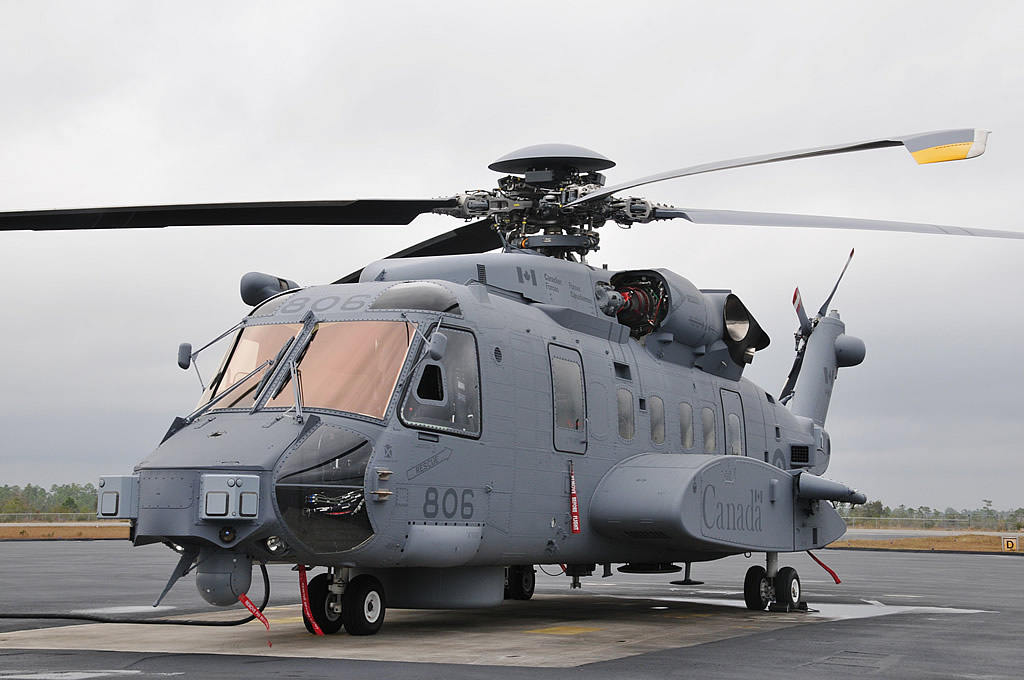
Nov 28/11: No flight training. The Canadian Press reports that the helicopter flown to Shearwater AB in Halifax earlier is still being used to train ground crew. Despite defense minister MacKay’s promises of an operational flight training helicopter by summer 2011, DND spokeswoman Tracy Poirier says they don’t have it yet:
“Critical work remains outstanding before the Defence Department can take official delivery and assume ownership of the interim helicopter in accordance with the contract”… the federal government will only accept the helicopter when it receives a Canadian military air worthiness certificate.
A spokesman for the federal Department of Public Works said in an email that Ottawa has assessed $8 million in penalties against Sikorsky for delays with the Cyclone procurement program — the maximum that can be applied. But Sebastien Bois declined to say whether the fines have been paid.”
May 12/11: Interim CH-148 Arrives. The first interim CH-148 Cyclone model, MH-806, arrives at 12 Wing Shearwater in Nova Scotia. It will be used to support ground-based training of Canadian Forces (CF) aircrew and technicians, and will remain under Sikorsky ownership and control for now.
The Canadian Forces will take formal delivery, and assume ownership of the helicopter, once a Canadian military airworthiness certificate is granted, and once initial aircrew flight training is conducted. That formal delivery is expected before the end of summer 2011 – but that isn’t what happens. Canada DND | CASR.
“Interim” CH-148 arrives
March 7/11: Rotorhub reports from Heli-Expo in Orlando, FL, where Sikorsky CEO Jeff Pinto says that despite yet another delay (vid. Jan 7/11 entry), the firm is “weeks rather than months away” from finally delivering the first interim CH-148. That delivery was scheduled for November 2010, under a June 2010 agreement that ratified long-standing delays and set out a new baseline. Key milestones completed so far include 750 flight hours, and finalized certification. The publication adds:
“Pino said although the delays in delivery had resulted in penalty payments, these could be ‘rationalised’ [DID: written off in stages] over the life of the programme. ‘This is a very interesting and lucrative contract where the Canadians want to pay to fly and leave the rest to the OEM,’ Pino said. The company was working with the Canadian government on the possibility of a bigger transmission for the CH-148, although it may take six months for the final configuration to be determined.”
In the wake of the Cougar Helicopters crash (vid. March 11/09 entry), the Transportation Safety Board of Canada (TSB) had raised issues with the certification of the civilian S-92’s gearbox. Pino said that no S-92 changes were planned in response to that incident, however, adding that the new transmission mount is unrelated. For the military version, a bigger transmission would be a likely follow-on from engine power upgrades the Canadians are requesting. The civilian S-92 changes are focused on weight, reliability, and operating cost improvements, plus electronics upgrades, and an internal auxiliary fuel certification for the SAR configuration.
Feb 22/11: Infrastructure. The government of Canada announces a C$ 155 million project to replace a 60-year-old hangar near Victoria International Airport on Canada’s west coast, with a 20,000-square-meter merged operations and support facility at Canadian Forces Base Esquimalt, British Colombia. Given the requirement for more space, and the need for an appropriate fire-suppression system, it was cost effective to build a new facility, rather than renovate the current 60-year-old hangar.
CFB Esquimalt is the home of Canada’s Pacific Fleet. The facility will be ready by 2014, in order to house 443 Squadron’s 9 new CH-148 helicopters. The project includes the hangar, an exterior aircraft parking apron for up to 5 CH-148s; a taxiway linking this apron to the runway; a re-fuelling and wash area; parking for up to 300 vehicles; and a guard house with security barriers and a perimeter security fence. At least one existing building will be demolished during the project, and the new facility is expected to accommodate 350 people. No contractors have been picked yet. Prime Minister’s Office | Postmedia | Rotorhub.
Jan 31/11: Testing. Canada’s DND announces that a CH-148 Cyclone, which arrived at Shearwater base on Jan 6/11, will be undergoing several weeks of testing on board the frigate HMCS Montreal, under the direction of Sikorsky International Operations Inc.
The tests will revolve around its operational limits in ship-borne use, and “the vessel has undergone considerable modification so that the tests may be conducted in optimal fashion.” Since the modifications were made, HMCS Montréal has successfully completed Air Work-Ups, which tested the abilities of the crew to conduct routine flying operations, respond to in-flight emergencies and to a helicopter crash, and combat shipboard fires.
Jan 7/11: Sikorsky:
“We have notified the Canadian government that there will be a short delay in delivery of the first aircraft due to an issue outside of our control. Our contract contains provisions for such events, and we are now in discussions with the Crown in keeping with those provisions.”
2010
Auditor General report faults DND for evading rules, not being honest with Parliament; 2nd contract renegotiation involves “interim” helicopters now; CH-148 prototype arrives for SHOL testing.

Oct 28/10: OAG Report. Canada’s Office of the Auditor General (OAG) releases its 2010 Fall report. The report’s main focus is on Canada’s C$ 61 billion economic stimulus program, which rates an unusual verdict of being well managed. Canada’s CH-148 program, on the other hand, rates a far more negative verdict. The biggest issues involve huge cost and time inflation, but the 2008 contract amendment also comes in for criticism because the original procurement strategy was based on a lowest price bid, giving no credit to bids offering more capability. OAG points out that by signing a contract to upgrade the S-92’s engines in 2008 (q.v. Dec 23/08 entry), DND effectively acknowledged that its contracting strategy had misled bidders on 2 key counts: the importance of an off-the-shelf platform, and the requirements themselves. Key excerpts:
“In 2000, total indicative costs of the 28 maritime helicopters were estimated at $2.8 billion and revised to $3.1 billion in 2003, exclusive of the cost of providing in-service support. The cost of purchasing and providing in-service support for the helicopters, and of training personnel, is currently estimated to be $5.7 billion over 20 years. This estimate does not include costs related to contracted Sea King support, new infrastructure, Canadian Forces personnel, and ongoing operating costs [which raise the program to C$ 6.2 billion for 28 helicopters]. In addition, the project has experienced delays. Delivery of the first fully capable Cyclone, initially expected in 2005, was delayed to 2008 and is now expected to occur in 2012.
“We found that National Defence has been slow to assess the full life-cycle costs, and some elements of these costs have still not been completely determined. As early as 2000, information provided to National Defence’s Program Management Board for preliminary project approval described the proposed acquisition project as non-developmental… [but] The project specifications included nearly 3,000 technical requirements. The winning bid by Sikorsky was to convert an existing commercial helicopter (the S-92) to military service, adapt it for marine use, and integrate numerous individual existing mission components and new technologies. According to National Defence officials, this will result in a state-of-the-art helicopter that has never existed before. The initial acquisition contract reflects this complexity in that it included $612 million for one-time engineering costs… The developmental nature of the Cyclone helicopter, along with its novel features, also has implications for certifying its airworthiness.
“…the full life-cycle costs were not–and some still have not been–presented to decision makers at key decision points… Moreover, without sufficient funds, National Defence may have to curtail planned training and operations… On the basis of the bid received from Sikorsky, $2.3 billion in estimated costs for contracted in-service support for 16 years (based on flying 10,000 hours annually) was presented for effective project approval in 2004. By this time, National Defence realized that personnel, operations, and maintenance costs would exceed those associated with the Sea King by $1.1 billion over 20 years. This is significant because National Defence did not seek additional funding for the in-service support provisions, so these incremental costs will need to be covered by its existing operations and maintenance budget… National Defence initially assumed that, despite known deficiencies, the hangars and other facilities used for the Sea King helicopters could be used for the new helicopters… In 2005, however, National Defence determined that there was a need for significant investment in new infrastructure. It has since initiated approximately $340 million in projects for maintenance, spare parts warehousing, training, and squadron facilities… There was also a need to extend the life of the Sea King helicopters longer than originally anticipated… An option to extend the period was exercised in November 2007 for an additional $168 million to cover the period up to 2014. The extension coincided with the notification that the delivery of the Cyclone helicopters would be delayed.”
See: Canadian OAG Release re: military helicopters | Media Statement | Full report || Parliamentary Hansard transcript re: defense questions | Canadian Press | CBC | Global News timeline | National Post | National Post op-ed | Toronto Sun | Vancouver Sun || Agence France Presse | China’s Xinhua || Defense News.
Key Report: Canada’s OAG
July 26/10: New deal. Canada’s Department of National Defence clarifies the new arrangements with Sikorsky, and the state of the program.
The first 4 phases of Ship/Helicopter Operating Limitations (SHOL) trials (vid. April 19/10 entry) successfully tested and validated the design of hangar and flight deck modifications aboard Canadian ships, maintenance support, developed standard operating procedures for ship and flight crew personnel, and defined safe flight parameters. Subsequent SHOL trials will be conducted in extreme weather conditions to define those parameters.
Mission software development has become an issue for the program, and Sikorsky’s inability to meet contract requirements forced a contract amendment, so the Navy could take delivery of interim CH-148s with partially-functional mission systems.
The interim helicopters will not be deployed on operations, Instead, they’ll be used for initial cadre training of aircrew and maintenance personnel, and initial operational testing and evaluation (IOT&E) to develop procedures for the Cyclone’s flight and operations, and to develop support systems like supply chains for spare parts, and maintenance processes and procedures. Once delivery of the fully compliant CH-148s begins in 2012, the interim helicopters will be retrofitted and returned by December 2013.
June 30/10: The Canadian government and Sikorsky sign an agreement to amend their CH-148 contract. In return for changes to acceptance criteria for the initial helicopter set, to the overall delivery schedule, and to milestone payments and liquidated damages provisions, Sikorsky will:
* Withdraw an existing arbitration claim against the government;
* Invest another C$ 80 million in contracts/ R&D work with Canadian firms;
* Offer payments for any future MH-92 maritime helicopter sales that could amount to more than US$ 30 million;
* Charge reduced interim helicopter in-service support rates until acceptance of the fully compliant helicopters in June 2012.
Liquidated damages requirements will now be triggered only by failure to deliver interim helicopters starting in November 2010, and for failure to deliver the fully compliant helicopters beginning in June 2012. The C$ 3.2 billion 20-year in-service support contract will run until March 2028. Source.
2nd contract amendment
(click to view full)
June 8/10: From late to later. Sikorsky will deliver its CH-148s to the Canadian Armed Forces late, even by the revised schedule. Borrowing a leaf from the NH90 NFH’s playbook, Sikorsky will begin delivering only “interim helicopters” for testing and training by the renegotiated date of November 2010. Then, instead of delivering at a rate of one per month, Sikorsky will deliver only 6 helicopters by June 2012.
The remaining 22 helicopters will be fully operational versions, including upgraded engines. They are promised as of June 2012, and as they arrive, the initial 6 helicopters will be pulled back for engine retrofits and any other required modifications. Recall that the original contract’s initial delivery date for the CH-148 was November 2008. Halifax Chronicle-Herald | CTV.
June 7/10: German exports? Canada may not wind up alone. Germany is the NH90 TTH’s biggest customer, but the helicopters have had problems, and it has delayed any NH90 NFH anti-submarine helicopter buy. Now Sikorsky is looking to pursue a 30-helicopter bid to replace Germany’s H-3 Sea Kings with their MH-92 Cyclone instead of Eurocopter’s NH90 NFH. They also want to compete with the H-92 for an 8-19 helicopter Combat Search And Rescue (CSAR) opportunity to replace German UH-1Ds. A German decision is expected in late 2010, if proposed budget cuts don’t derail the programs.
At the ILA 2010 airshow in Berlin, Sikorsky signed a Memorandum of Understanding “to explore opportunities” in aftermarket support involves their long-standing partner ZF Luftfahrttechnik GmbH (ZF Aviation Technology), while the other involves Switzerland’s RUAG, and will explore “Maintenance and Repair Operation as well as integrated logistics support and completion capabilities.” Rheinmetall and MTU are also reputed to be involved in discussions.
The H-92 might be operational in a maritime role before the NH90 NFH, and the firm has some H-92 CSAR design experience from its participation in the aborted American CSAR-X competition. Their bid remains something of a long shot, but Sikorsky representatives are quoted as saying that the partnerships and experience will stand them in good stead to bid the future CH-53K heavy-lift helicopter for the Franco-German HTH program. Sikorsky has reportedly secured American export approval for the Cyclone, and would conduct final assembly in Germany. Aviation Week | Flight International | Shephard Group.
April 16/10: Testing. The CH-148s have begun SHOL (Ship Helicopter Operational Limitations) testing off of Nova Scotia. Testing started shortly after the test helicopter arrived in Feb 19/10 and is taking place in 4 phases:
Phase 1 tests confirmed that the prototype aircraft’s flight test instrumentation systems could operate in close proximity to the electromagnetic emitters of the ship.
Phase 2 evaluated how the test helicopter and the Canadian Recovery, Assist, Securing and Traversing (C-RAST) work together. The C-RAST moves the helicopter in and out of the hanger, and locks the helicopter in place on the ship so it doesn’t slide off.
The 3rd phase was completed earlier in April and involved take-offs, departures, landings and utility evolutions conducted during the day, in order to establish the standard operating procedures for the aircraft.
The 4th and final phase is expected to be complete by the end of April. These tests will be conducted at sea in the North Atlantic under increasingly challenging weather conditions and sea states, in order to determine a safe envelope for the helicopter to operate from the Halifax class ship with medium winds and deck motions. Further testing is planned later in the program to test the full capabilities of the aircraft at high winds and high deck motions.
Feb 19/10: Testing arrival. Sikorsky’s prototype CH-148 Cyclone maritime helicopter arrives at CFB Shearwater, Nova Scotia, for several weeks of “ship helicopter operational limits” trials with the Halifax-class frigate HMCS Montreal. “Aircraft 801” reportedly first flew in November 2008. Canadian Navy | Aviation Week Ares.
2009
Pattern of government dishonesty begins to surface; Civil S-92 crash off Newfoundland has implication for CH-148.

(click to view full)
Nov 8/09: The Ottawa Citizen’s David Pugliese reports on the CH-148’s slow progress. While the first helicopter is scheduled to arrive at CFB Shearwater in December 2009, actual sea trials aren’t scheduled until February 2010 or later, and even when those are done, other steps are required before Canadian pilot training can begin:
“…sources say while the first helicopter is expected to arrive in early December from Sikorsky, it is not being actually accepted by the Canadian Forces… The first Cyclone (MH02) has just finished being painted at West Palm Beach in Canadian Forces colors… The sea trials should have been completed almost 20 months ago according to the delivery schedule contracted with Sikorsky in 2004.
Successful completion of the sea trials, followed by development and approval of the ship-helicopter operating limitations (SHOL) for the new helicopter, which will require several months at least, are a MHP contractual obligation that must be met long before Canada accepts delivery of the first aircraft and can begin training its own pilots on the Cyclone…”
(click to view full)
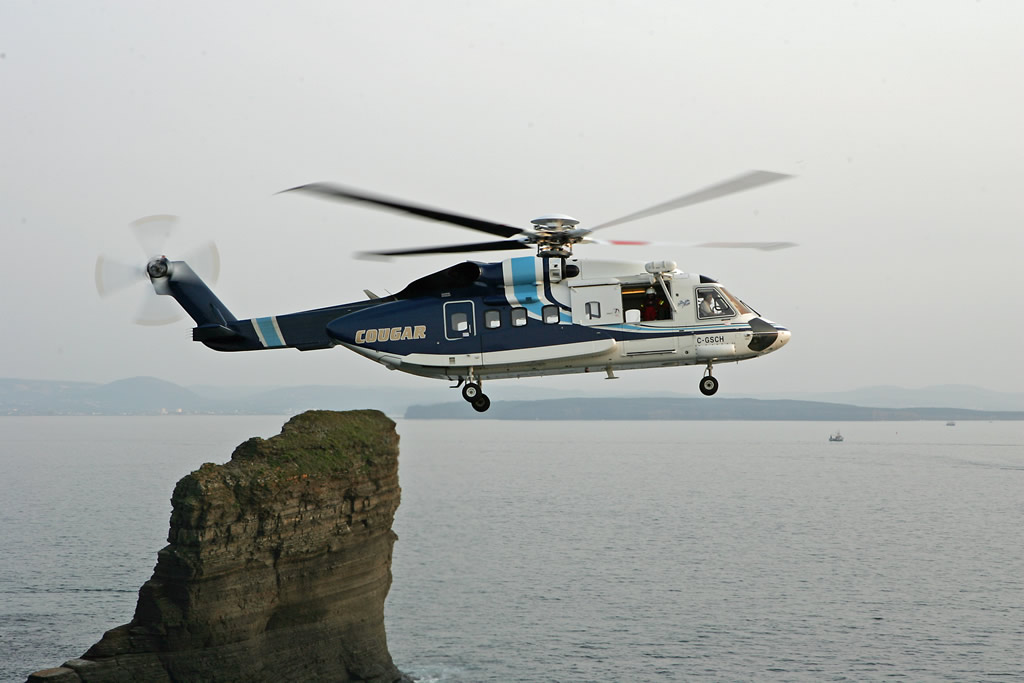
March 11/09: S-92 accident. An S-92 operated by Cougar Helicopters goes down in the sea off of Newfoundland, Canada with 18 people aboard, while ferrying workers to one of the offshore oil rigs. In the end, only 1 of the 18 passengers survives. Standard procedures give all passengers immersion suits, but winds were running between 25-35 knots, with a 3m/ 9-10 foot swell, and water temperatures near freezing.
The problem ends up involving shearing in some of the helicopter’s titanium studs, which caused the loss of all oil. The helicopter crashed about 10 minutes after that, which calls the 30-minute “run dry” requirement into serious question. The Globe and Mail | See also CBC and Flight International report & photos re: later Canadian TSB findings.
Feb 20/09: The Ottawa Citizen’s David Pugliese continues to investigate the specifics behind the December 2008 announcement of a contract settlement with Sikorsky. In “New Engnes for the Troubled Cyclone Helicopter?” he quotes Canada’s DND:
“Sikorsky is making a number of improvements to the current design of the helicopter to meet the performance requirements specified in the current contract. An improvement being made that was not in the original contract will provide the helicopter with growth potential for the engine and main transmission.”
Pugliese points out that this is a problem, for 2 reasons:
“The weight growth requirement was actually stated in the MH Statement of Operational Requirement (SOR) and was initially included in the RFP Requirements Specification but was later removed at Sikorky’s request… [however,] In order to use a [Lowest Cost Compliant ] selection methodology, PWGSC and DND both had to assure the Auditor General in 2003 that the MH performance and equipment requirements (as stated in the RFP) would be finite and that no extra funds would ever have to be allocated for additional capability over the entire life of the aircraft, otherwise a Best Value selection methodology whereby additional capability could be acquired at minimal additional cost was mandated.”
DND responses add that they are also looking at technological improvements that will become available as a spin-off from Sikorsky’s R&D. They include “an enhanced rotor blade design, larger tail rotor and a new 5-bladed rotor hub”, which could add another 500-600 pounds of payload capacity. Aerospace analysts contacted by Pugliese respond that:
“The new rotor design that the response refers to is the one being considered for Sikorsky’s bid for the USAF’s CSAR helicopter. It involves very significant structural changes to the aircraft including a substantial increase in the aircraft’s overall length both with rotors turning and when folded which would raise major issues for ship compatibility. Since DND and PWGSC are inexplicably avoiding the engine question, we suggest you dig further.”
Winter 2009: SNAFU. Plain Talk: The Process of (Not) Acquiring Maritime Helicopters [PDF format] is published in the Canadian Naval Review by Jane’s Canadian correspondent Sharon Hobson. Hobson reports that Sikorsky was exempted from key performance requirements during the bidding phase, unlike its competitors NIH Industries (NH90) and Lockheed Martin/ AgustaWestland (EH101). Additionally:
“…In order to speed things up during the bidding process, the project office only required that the bidders provide proof of compliance for 475 [mandatory technical requirements]. The bidders were allowed merely to state that they would comply with the other 1,000. When things started to go wrong – and they started to go wrong fairly quickly – the project office went into crisis management mode.
When I interviewed the project manager in February 2006, he told me that the preliminary design review (PDR) had been completed in January, and that the critical design review (CDR) would be completed by the first week of June. However, in September 2006, the same official conceded to another reporter that the PDR was not yet complete. The project office does not appear to have given a media interview since then. Moreover, it turns out that because Sikorsky was unable to complete fully each milestone within the PDR and CDR, the project office subdivided the milestones so that the payments would continue to flow…
2007 – 2008
Reports of impossible schedule prove true – contract renegotiated; RWR & ESM picked.

(click to view larger)
Dec 23/08: Contract failure, change. Canada’s government announces that they have renegotiated the contract with Sikorsky. DND will now begin receiving helicopters by November 2010, allowing necessary operational testing and training to begin prior to the delivery of mission-ready helicopters beginning in 2012, and all helicopters by 2013.
The effect of these changes is to delay operational use of the helicopters for 2 years. The original contract had penalty clauses for late delivery, but those clauses appear to have been waived in exchange for these contract amendments. The government release also took pains to state that it “…has determined that the delays experienced were largely outside the control of the Contractor.”
Most of the contract modifications appear to concern “upgrades.” These have not been specified, except to say that they have an estimated value of $77 million for the 28 helicopters, and $40 million for the 20 years of In-Service Support contract, based on the Canada/ US currency exchange rate of December 2008. The release adds that contract amendments will be funded from within the original project budget. Canadian government announcement | CBC report.
Contract renegotiated
Nov 20/08: Dev flight. A CH-148 Cyclone makes its first flight at the Sikorsky Flight Development Center in Florida. Source.
1st flight
Nov 5/08: The Ottawa Citizen’s defense reporter David Pugliese publishes some comments from his sources, suggesting the program’s schedule was never realistic, that further delays to 2012 or even 2014 are possible, and that vague statements from Sikorsky and Canada’s DND are omitting important pieces of information. One key excerpt:
“Your blog notes that Sikorsky is now claiming the first article will fly “before the end of the year”. Rumors in the industry suggest that any such flight will be without the mission system, which is still not in formal lab testing. Compare this to Sikorsky’s original (public) promise to fly a fully equipped first article by September 2007.”
January 2008: Sikorsky formally advises the Canadian government of delays in the original schedule.
April 18/07: RWR/ESM. Lockheed Martin announces a $59.4 million U.S. Navy Foreign Military Sales contract to provide the helicopters with Radar Warning Receiver (RWR)/Electronic Support Measure (ESM) systems derived from its AN/ALQ-210 system, which will also be deployed on the US Navy’s new MH-60R multi-mission naval helicopters.
The ALQ-210 passively detects, identifies and geo-locates hostile radar transmitters. The systems provided to Canada’s Department of National Defence will also feature new functionality designed to meet specific Canadian Forces requirements. Honorary Col. Rick Mercer of 423 Maritime Helicopter Sqn will be relieved, we’re sure.
Jan 23/07: Strike! The Globe and Mail reports that CH-148 delivery will be at least 5 1/2 weeks late because of a strike at Sikorsky’s factory. Canada’s federal government deems the delay to be reasonable, and they are reportedly foregoing the late penalty provisions in the contract. Those terms could allow Canada to charge up to $100,000 a day for late delivery, to a maximum of $36 million.
2004 – 2006
Contract for 28; Radar & surveillance turret picked.

(click to view full)
Dec 6/05: Sikorsky Aircraft opens the company’s new MH-92 helicopter fly-by-wire system integration lab with a ribbon cutting ceremony in Stratford, CT. The new lab will develop, integrate and test the fly-by-wire and avionic systems for the MH-92, and the CH-148 Cyclone will be the system’s inaugural customer.
BAE Systems will be Sikorsky’s team-mate on this sub-project, which is expected to lead to companion fly-by-wire integration labs for Sikorsky’s H-60, CH-53K, and X2 aircraft.
Fly-by-wire differs from traditional helicopter flight control systems by replacing the mechanical linkages to the cockpit controllers with a redundant, purely electrical system that is more responsive, more survivable if hit, saves weight, and reduces maintenance costs. Europe’s competing NH90 already has fly-by-wire built in, so Sikorsky is playing catch-up in this area. Sikorsky release.
Fly-by-wire lab open
June 14/05: FLIR. FLIR Systems, Inc. announces a “competitively awarded” subcontract from General Dynamics Canada of Ottawa, Ontario, for its popular Star SAFIRE III airborne multi-sensor imaging systems with multi-year in-service support. The total subcontract value, including potential option awards, is in excess of $20 million (USD). Deliveries will commence within 9 months of contract award, and continue until 2009.
FLIR’s Star SAFIRE III is used on a wide variety of systems, and has options to include laser rangefinding and targeting features.
June 5/05: Radar. Griffon Corp. subsidiary Telephonics announces a subcontract award from General Dynamics Canada. They will supply 31 ship sets of their APS-143Bv3 multi-mode imaging Maritime Surveillance Radar, fully integrated with their Mark XIIA Identification Friend or Foe (IFF) interrogator sub-system hardware. The contract also contains options for initial spares and 20 years of in-service support for the Canadian Maritime Helicopter Project (MHP), and could exceed $50 million in value if all options are exercised.
The internal, fully integrated Mark XIIA IFF interrogator has been designed to be compatible with the IFF interrogators being supplied for the US Navy’s MH-60R LAMPS helicopter, the Canadian CP-140 Aurora upgrade program, and the US and International Air Force’s AWACS platforms.
This program will be managed from Telephonics’ facilities in Farmingdale, NY, with a portion of the work being performed in Canada as defined in the Industrial Regional Benefit plan included in Telephonics proposal. The first test aircraft system is scheduled for delivery in July 2007.
April 21/05: Infrastructure. L-3 Communications MAS launches the construction of a new $45-million Maritime Helicopter Training Centre for the Canadian Forces in Shearwater, Nova Scotia. L-3 MAS has lead responsibility for the Cyclone’s in-service support, which includes provision of the training facility and training.
The actual construction is subcontracted to PCL Constructors Canada Inc., and the center is expected to be operational in April 2008. It is expected that over 160 new jobs will be created directly and indirectly during construction of the 3-storey facility, which will be LEED(Leadership in Energy and Environment Design) Silver Certificate certified. The building will include flight and mission simulators, and serve as the home for 406 Squadron. Sikorsky release.
April 12/05: Project office open. Sikorsky Aircraft Corp. and Canadian government officials today formally inaugurate a new Canadian Maritime Helicopter Project (MHP) office located here in the company’s main manufacturing facility in Stratford, CT.
The newly renovated 25,000 square-foot space includes a 5,000 square-foot secure area to accommodate a detachment of 17 Canadian government employees overseeing the project. The remainder of the space houses Sikorsky Aircraft, General Dynamics Canada and L-3 MAS Canada personnel assigned to the MHP. Sikorsky release.
Project office
Nov 23/04: Deal signed. The Government of Canada signed contracts with Sikorsky International Operations Inc. for the Maritime Helicopter Project, to provide 28 helicopters (C$ 1.8 billion), as well as 20 years of in-service support and a training facility (C$ 3.2 billion), including construction of a training facility and a simulation and training suite.
Sikorsky had joined with L-3 MAS (in-service support) and General Dynamics Canada (systems integration) to form The Maritime Helicopter Team. CBC report.
28 CH-148s
Additional Readings
* Canada DND – Maritime Helicopter Project: Status
* General Dynamics Canada – CH148 Cyclone – Maritime Helicopter Project
* Canadian Office of the Auditor General (Oct 26/10) – 2010 Fall Report of the Auditor General of Canada: Chapter 6 – Acquisition of Military Helicopters
Background: Helicopters
* Canadian DND – CH-148 Cyclone
* Sikorsky – H-92 Helicopter. Military version of the S-92 civil helicopter, which is used by customers like the global offshore oil & gas industry.
* Naval Technology – [AW101] Merlin – ASW / Transport Helicopter, United Kingdom. Also serves with or has been ordered in a naval role by Italy, Denmark, Japan, and Portugal.
* DID – AW159 Wildcat: The Future Lynx Helicopter Program
* Eurocopter – Cougar EC725. Note that it doesn’t have a naval/ anti-submarine version with a naval radar, that can carry sonobuoys, dipping sonar, and naval weapons.
* DID FOCUS – MH-60R/S: The USA’s New Naval Workhorse Helicopters
* DID FOCUS – NH90: Europe’s Medium Helicopter Contender
Background and Views
* CASR, via WayBack – Politics, Procurement Practices, and Procrastination: the CH-124 Sea King Helicopter Replacement Saga
* DID – Ring My Bell: New Helicopters for Canada’s Coast Guard. S-92/CH-148 helicopters could be an option for the new polar icebreaker entering service around 2017. But Sikorsky is running out of time to be competitive.
* Epoch Times (Feb 13/13) – Scandals the Norm in Military Buys: Military procurements an uphill battle. Begins to explain why, something that’s missing from many other analyses.
* Canadian Centre for Policy Alternatives (Feb 11/13) – “The Worst Procurement in the History of Canada”: Solving the Maritime Helicopter Crisis. Prepared with the equally left-wing Rideau Institute.
* Defence Watch, via WayBack (Jan 27/10) – Canada’s Maritime Helicopter Saga Laid Out in a New Book, The Politics of Procurement. By UBC Press. Covers the entire saga, from the CH-124 replacement competition to the EH101 cancellation, CH-149 Cormorant (EH101) SAR buy, and the CH-148 Cyclone.
* Canadian Naval Review (Winter 2009, Vol.4 #4) – Plain Talk: The Process of (Not) Acquiring Maritime Helicopters [PDF]. Characterizes the procurement process as dishonest in several respects.