

(click to view full)
The MiG-21 is reaching the end of its service life, but it can still be effective for a little while. India’s refurbished MiG-21 ‘Bisons’ combined Russian, Indian and Israeli technology to excellent effect in the COPE India 2004 and 2005 exercises with the USAF, and there’s even a Russian-Israeli MiG-21 2000 variant that exists for general sale. Israeli companies have made something of a specialty of refurbishing both Western and Soviet fighters with modern radars, avionics, and Israeli weapons like the Python air-air missile, giving the systems new life. An all-Israeli effort was undertaken for Romania, in order to create Romania’s MiG-21 ‘Lancers’ via upgrade.
The question is what comes next. In 2005, rumor had it that the success of those efforts had led to a more ambitious fighter deal between Israel and Romania for upgraded Cheyl Ha’Avir F-16A/Bs – but that deal appears to have fizzled for unknown reasons. Other firms entered the mix, including Saab with its JAS-39 Gripen and, surprisingly, EADS’ Eurofighter. Then the USA appeared to have flown away with the fighter replacement deal – but, not so fast.
Romania, Romania, Romania: Drivers and Options

“Digital Thunder” camo
(click to view full)
Romania faced 3 big questions in deciding on its fighter purchase. They involved capability, finances, and foreign approvals. To those 3, add a pair of elements that are almost always present in fighter purchases: politics, and vanity.
Capability is always a concern, and Russia’s 2008 invasion of Georgia has only heightened regional concerns. While the Russian Air force is a shadow of its former self, so are the air forces of its former Warsaw Pact satraps. Unfortunately, modern NATO-compatible fighters are very costly, and East Bloc countries in particular feel the lack of any fielded low-budget options to fill the niche once occupied by planes like the MiG-21 and F-5. The natural response is to adopt NATO’s classic approach, and attempt to compete on quality.
Given the presence of upgraded SU-27 family fighters in the Russian fleet, competing on quality isn’t easy. Purchases from Russia itself, such as modern MiG-29/35 aircraft, offer another option. If the most likely future threat is seen as coming from Russia, however, that isn’t a viable option.
The Czech Republic and Hungary’s choice of 10-year leases for 14 fourth-generation JAS-39 Gripen aircraft illustrate one possible solution.
In 2005, reports in the Israeli press indicated that Romania might go another route, and spend $150 million to purchase “dozens” of used F-16A Netz (Hebrew for “Falcon”) aircraft from Israel. Israeli contractor Elbit Systems would be the lead contractor for an Israeli deal, overseeing their refurbishment and upgrade with newer Israeli electronics.
The one potential downside to the F-16 was the necessity of US approval for technology transfer or sale. Israel would be transferring the weapons themselves, not just maintaining them with Israeli technology. Formal American approval has always been required for any transfer of US equipment to 3rd countries. Fortunately, sales to a new NATO member like Romania were unlikely to attract any vetoes from the USA. Indeed, rumors in 2005 said that Romania had been given a provisional green light by the American government and by Lockheed Martin.
That approach seemed to be a good deal for both parties, and became a template for Romania’s search: buy a used version of the most widely-adopted fighter in NATO, with electronics that would be interoperable with NATO standards.
Evaluation & Options

(click to view full)
In 2005, the talk centered on an Israeli deal. The reports noted that the Israeli Air force (“Cheyl Ha’Avir”) planned to phase out at least some of its 75 older F-16A/B planes as it introduces 102 new F-16I Soufa (Storm) jets, which incorporate all of the F-16 Block 52 advancements plus Israeli electronics and weapons. Reports claimed that a special committee had been set up to coordinate the various stages of what seemed to be a complicated deal.
So, what did the Romanians have to say?
The Romanian Ministry of Defense admitted that they were undertaking “an evaluation of the feasible alternatives for the replacement of the MIG-21 Lancer aircraft,” with a decision scheduled for 2006-2007 and a target date of 2010-2012 for initial operational capability. Thy also noted, however, that they were evaluating more than one type of plane. Defense Minister Atanasiu said that Romania needed at least 24 new aircraft, and added that a leasing system, auctions, or even participation in the F-35 Joint Strike Fighter (JSF) program were all under consideration.

(click to view full)
Suggestions concerning the F-35 were probably just vanity talking. Romania has a proud cultural history, but its economy hasn’t yet caught up to the $70-100 million per plane cost of the F-35 JSF. The truth has always been that leases or used aircraft from other countries were Romania’s only realistic options. Its possible choices also tend to narrow down to the lightweight medium fighter segment, in order to achieve even the 24 modern fighters desired, in return for the kind of money the country had chosen to spend.
That left a small set of options:
* Used F-16 Falcons, from Israel or from other NATO countries, including the USA (chosen).
* Mirage 2000s, possibly used, from France.
* Leased JAS-39 Gripens from Sweden. These may be more expensive than used aircraft, but they are far more capable, may offer maintenance cost improvements, and come with industrial offsets and leasing options.
* Russian aircraft with upgraded Western avionics etc., much as Israel did for their Lancers. The MiG-29 is the only modern Russian fighter in Romania’s likely cost profile. Downsides include less NATO interoperability during operations outside of Romania, and extra costs per plane due to the required refits.
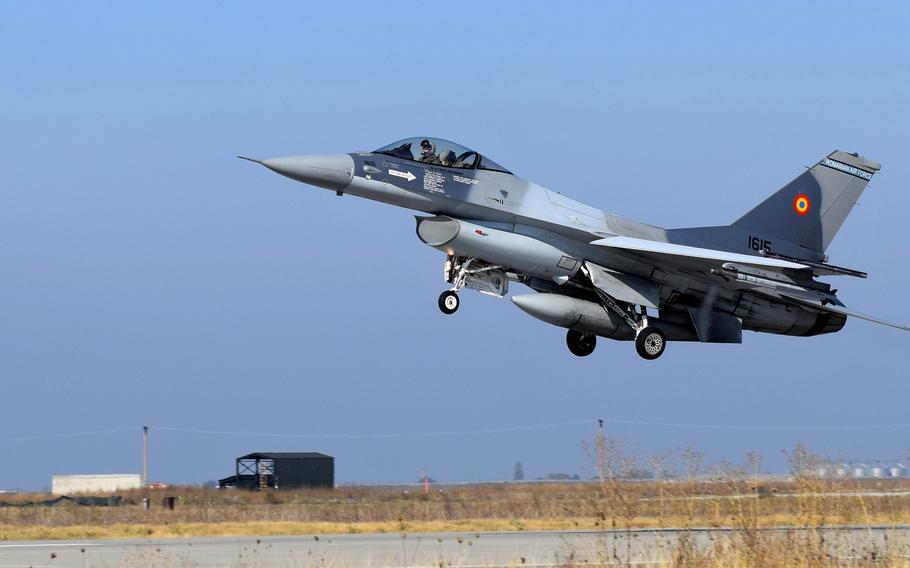
Within this group, the F-16 was always the most probable choice, barring a really excellent deal from Saab. After canvassing the Israelis, the Dutch, and even the Americans for offers, Romania finally settled on F-16s from Portugal in September 2012. The delays in getting to that point meant that the planes wouldn’t enter service until 2016.
Contracts & Key Events
2011 – 2024
Slow deal with Portugal.

(click to view full)
March 30/21: Last One The final Lockheed Martin F-16 Fighting Falcon combat aircraft acquired by Romania from Portugal was delivered to the eastern European nation on March 25. NATO’s Allied Air Command announced that the 17th aircraft was delivered to Borcea Air Base. This completed an order that commenced in 2016 when Romania acquired 12 F?16AM/BM Block 15 fighters (nine single-seat and three twin-seat), with a further five F-16s (four single-seat and one twin-seat) following for a final tally of 17.
November 4/20: 3 And 4 The Romanian Air Force took delivery of two more F-16 fighters from Portugal. This is the third and fourth aircraft from a batch of five jets bought from Portugal. The last aircraft is expected to be delivered the first quarter of 2021. Once all aircraft are in the country. All 17 jets will be getting the M6XR modifications.
January 30/20: Officially Signed! Portugal and Romania has officially signed an agreement for the sale of five F-16s to Romania. The official ceremony took place at Monte Real Air Base on January 27. The fighters will be updated by OGMA and the first two will arrive in Romania in June. This will be followed by two jets in October and the last one will reach Romania in 2021. The sales package is worth $142 million. The deal includes, in addition to the F-16 fighters, technical conversion to Romanian specifications and the work of the Portuguese Air Force in Romania for information transmission and maintenance.
December 2/19: Approved! Romania’s Supreme Council for the Country’s Defence approved the purchase of five F-16s. Earlier it was reported that Romania wants to buy another five F-16s from Portugal. The procurement deals in excess of $110.2 million must be endorsed by lawmakers, president Klaus Iohannis explained. The president also informed about the Government’s commitment to stick with the 2 percent-of-GDP budget earmarked for defense spending. The number of military troops approved for missions abroad was also increased by 200 to 2,100, under a CSAT decision. Romania will buy another five F16 jet fighters with the same configuration as the 12 already purchased, former defense minister Gabriel Les announced on July 3.
April 26/19: Five more from Portugal Romania decided to buy five more F-16 aircraft from Portugal. Romania Insider has reported on April 19 that Romania bought 12 F-16 multirole aircraft from Portugal in 2013 and will buy five more to have a complete squadron of 17 fighters. It was reported in July 2018, that Romania intended to buy more F-16s to increase its fleet strength. The last deal with Portugal was worth $734 million and included nine F-16AM single-seaters and three F-16 BM two-seaters. In the longer term, Romania hopes to procure a fifth-generation fighter, which would then serve as a replacement for the F-16s.
July 20/18: More fighters needed Romania intends to buy more F-16s to further increase its fleet strength. In 2016 the country became the latest operator of the F-16 following delivery of the first six from a total of twelve from Portugal for a price of $734 million. The deal included nine F-16AM single-seaters and three F-16BM two-seaters as well as an overhaul of engines and a number of services. Romania now plans to buy five more F-16 fighter jets from Portugal, four single seaters and one dual seater, by the end of this year. It also intends to purchase 36 more such aircraft in the future from other NATO countries like the US and Greece, but also Israel is an option.
September 30/16: Romania has become the latest operator of the F-16 following delivery of the first six from a total of twelve from Portugal. The $203 million deal includes nine F-16AM single-seaters and three F-16BM two-seaters as well as an overhaul of engines; initial logistics support; training of up to nine pilots, 75 technicians, and four mission planers; two years of on-site support; and updating the fleet to operational flight program (OFP) development software M5.2R standard, with support from Lockheed Martin. More F-16s from another NATO member are being sought by Romania who currently operate a fleet of MiG- 21 LanceR aircraft.
February 24/16: The Romanian Ministry of Defense has announced plans to purchase 12 more second-hand F-16 fighters in 2017. The procurement will the follow the delivery of F-16s from Portugal in September, which cost the government $695 million and included training and upgrades of systems from Lockheed Martin. The ministry has requested information from NATO allies (including the US and five European members) of available supplies with plans to purchase the fleet by auction.
Nov 8/13: Ancillaries. The US DSCA announces Romania’s official request to clear an initial transfer of key weapons and electronics that “will be procured through a third party transfer from Portugal,” as part of their F-16 MLU re-sale. Articles and services would include:
* 30 AIM-120C Advanced Medium Range Air-to-Air Missiles (AMRAAM). Variant not mentioned, most current export variant is the C7.
* 5 AIM-120C Captive Air Training Missiles (CATMs)
* 60 AIM-9M Sidewinder Missiles. The most widely-fielded version, but less advanced than the AIM-9X, which would have required digital upgrades to the F-16s.
* 4 AIM-9M CATMs
* 48 LAU-129 Launchers
* 10 GBU-12 Enhanced Guided Bomb Units
* 18 AGM-65H/KB Maverick Missiles
* 4 AGM-65 CATMs
* 15 MIDS-LVT boxes for Link 16 connectivity
* 2 MIDS Ground Support Systems
* 13 Embedded Global Positioning Systems/Inertial Navigation Systems (EGPS/INS) with GPS Security Devices, Airborne
* 3 AN/ALQ-131 Electronic Countermeasure Pods
* Plus spare and repair parts, support equipment, tanker support, ferry services, repair and return services, software development/integration, test and equipment, supply support, personnel training and training equipment, publications and technical data, and other forms of support. The estimated cost is up to $457 million.
That’s more than a bit thin on associated weapons. Romania won’t have any existing stocks of these items from its upgraded, NATO-compatible Lancer fleet, either, but they may be able to transfer some of their existing RAFAEL Python 3 missiles and LITENING pods. Within the DSCA’s set, implementation won’t require any additional US government or contractor representatives in Romania. The principal contractors will be:
* Elbit Systems of America in Fort Worth, TX
* Pratt and Whitney in East Hartford, CT (Engine support)
* BAE Systems Inc. in Arlington, VA
* Lockheed Martin Corp. in Fort Worth, TX (F-16 OEM)
* Northrup Grumman Aerospace Systems in Redondo Beach, CA (ALQ-131)
* ViaSat Inc. in Carlsbad, CA (MIDS/ Link-16)
* Data Link Solutions LLC in Cedar Rapids, IA (MIDS/ Link-16)
* Snap-On Inc. in Kenosha, WI (Support equipment)
* Booz Allen Hamilton Engineering Services, LLC in McLean, VA (Support)
Raytheon, who makes the AIM-9, AIM-120, and AGM-65 missiles, wasn’t mentioned. Source: US DSCA #13-59.
DSCA: F-16 ancillaries and weapons
Oct 11/13: Contract. Romania’s government announces a signed contract with Portugal, and an initial EUR 100 million payment of of the EUR 600 million total. According to Defense Minister Mircea Dusa, the first modernized F-16s will reach Romania in 2015, and the full squadron will be on hand for full MiG-21 Lancer replacement by 2017. Meanwhile, Romania will send 80 people to Portugal for flight and maintenance training. Source: actmedia, “Defense Ministry signs contract for F-16 aircraft purchase”.
Contract
June 19/13: OK. The Romanian government approves the bill for the F-16 purchase. Source: actmedia, “Defense Ministry signs contract for F-16 aircraft purchase”.
April 22/13: Slooow. Reports indicate that negotiations with Portugal will take until May 2013 (the deadline is June), but that dealing with the American bureaucracy will take until September 2013 – a year after Romania accepted Portugal’s bid.
Romania may also be interested in another 9 planes, which would bring their replacement fighters to 21. They currently operate 40 MiG-21 Lancers. China MoD News Channel.
Sept 24/12: From Portugal. Romania apparently outbids Bulgaria for 12 PoAF F-16s, offering EUR 600 million over 5 years for the jets (EUR 125 million) and associated training and maintenance (EUR 475 million). The planes will arrive in 2016, by which time Romania’s pilots will also be fully trained.
The fighters are described as “multirole,” but this is a bit of a stretch for the F-16 Block 15 OCUs. They can use AIM-120 AMRAAM air-to-air missiles, but their previous-generation AN/APG-66 radars have limited ground capabilities, and the fighters’ main precision strike weapon is the short-range AGM-65 Maverick missile. On the other hand, the price for 12 was pretty good. Other offers had been tabled by Saab and by the USAF for 24 fighters at about double the cost, but as the weighting of this deal shows, shrinking the fighters by half does not halve the total cost.
Meanwhile, an actmedia report quotes National Defence Minister Corneliu Dobritoiu, who spends his time touting the fact that Romania observed all of the EU’s bureaucratic requirements to the letter. The EU had wanted an open competition, instead of a government-to-government deal, and sent a warning letter in early September. Dobritoiu points out that government-to-government deals are allowed. Romania’s actmedia | Balkans.com | Bloomberg | Bulgaria’s Focus news agency | Romania’s Stirile Pro TV [in Romanian, with video].
Deal with Portugal for 12 F-16s
Aug 23/12: Portugal? actmedia reports that the Romanian defense ministry has sent experts to inspect some of Portugal’s 45 F-16s, which were found to be in excellent condition. The PoAF is likely to be selling some of 201 Squadron’s Block 15OCU models, not 301 Squadron’s 20 upgraded F-16MLUs. On paper, that sounds an attractive solution for both parties, given Portugal’s dire fiscal position, and the fact the Dutch option is apparently no longer available.
This news item does not seem to have been confirmed in the Portuguese press yet, and online rumors that up to 12 Portuguese F-16s were available for sale have floated for years without substantiation. That latest statement is not available on Agerpres’ website – the national news agency cited by actmedia – though an earlier article from June does mention the Netherlands and Portugal as 2 potential sources for used F-16s. Romania’s actmedia re: rumors and inspections | Agerpres [in Romanian] | F-16.net re: Portugal.
June 21/12: Dutch deal? Radio Netherlands reports that:
“Romania is interested in buying 15 surplus F-16s from the Dutch airforce… On Thursday, the Defence Ministry confirmed reports that it is looking to sell equipment in order to raise funds… [as it] must shave a billion euros from its budget. The ministry is also in preliminary discussions with an undisclosed number of potential buyers, including Chile, which are interested in eight Cougar helicopters. Today, parliament will discuss the potential sale of 80 Leopard tanks to Indonesia. The ministries of defence and foreign affairs are in favour of the sale but a majority in parliament is against the transaction.”
Sept 19/11: All we can afford. Romanian President Traian Basescu tells Pro TV that Romania cannot afford to buy F16 fighters without a long-term financing solution, as they can only pay up to $300 million per year for the next 5-6 years. From Romania’s actmedia:
“As a NATO member, Romania must have 48 fighters compatible with the North Atlantic Alliance’s equipment. Whether they are F16 planes, Rafale or SAAB, what matter is to find a financing solution,” said Basescu.He added the United States proposed a regional project whereby several NATO members, such as Bulgaria, Croatia, possibly Hungary, would create a pool to support the purchase of F16 planes.”
Bulgaria has reportedly been offered US financing for a buy of 8-12 F-16 fighters, though terms were not revealed or confirmed. U.S. Ambassador Mark Gitenstein added that the regional pool option would involve new planes, extending Lockheed Martin’s production line. That’s certainly in America’s interest, as it would extend the F-16 production line, but it’s also likely to make the planes more expensive.
2009 – 2010

(click to view full)
May 11/10: Eurofighter. The Eurofighter consortium and member firm Alenia Aeronautica chime in with an offer of their own: 24 used Italian Tranche 1 Eurofighters, plus up to 5,000 skilled jobs created by 100% industrial offsets and local technology transfer. The price, including logistics support and training, would be EUR 1 billion (about $1.3 billion), matching the price tag for used F-16s. Deliveries would take place between 2011-2012.
Italian Tranche 1 Eurofighters differ sharply from the other competitors in one crucial respect. Barring additional upgrades and equipment, they lack precision attack capabilities. In contrast, both the F-16 Block 25+ and the JAS-39 Gripen are full multirole fighters, able to target invading land forces, support Romanian troops on the ground, or conduct precision strikes against key enemy targets.
That same day, the Romanian Senate’s Defense Commission calls in representatives of rivals Eurofighter and Sweden’s Saab, stating that it wished to hear from Lockheed’s competitors. The decision to buy any fighter requires Parliamentary approval. Defense News.
April 15/10: Gripen. Agence France Presse quotes Jerry Lindbergh, a Swedish government official in charge of defense exports, who says that Sweden could provide 24 new “fully NATO interoperable Gripen C/D fighters, including training, support, logistics and 100 percent offset for the amount of one billion euros ($1.3 billion),” paid off over 15 years with low interest rates.
In essence, they’re offering newer and better fighters for the same price as very-used F-16s. The following quote from the Defense News report is difficult to take seriously in terms of future orders, but it does illustrate one of the political factors in play:
“Bucharest is also considering buying 24 new F-16 jets and later 24 F-35 jets, the defense ministry said, stressing this was part of the Romanian-U.S. “strategic partnership.”
March 23/10: Nothing new. At a Supreme Council of National Defense meeting, Minister of National Defense Gabriel Oprea presents a report, saying that Romania does not have the financial resources necessary for the acquisition of multirole aircraft. As such, the ministry proposes to buy 24 used F-16s, in order to replace Romania’s upgraded MiG-21 Lancers and their rising operations and maintenance costs.
Lockheed Martin personnel in Romania have reportedly confirmed that the aircraft with be F-16 C/D fighters, without mentioning the production year or their number of flight hours. The US DSCA request noted AN/APG-69v1 radars and PW F100-220 IPE engines as expected equipment, however. This strongly suggests F-16 C/D Block 25 aircraft, delivered between 1984-1986, and currently operational with American Air National Guard units.
Romanian sources say that the planes will be free, but there will still be costs of about $400 million for personnel training in the USA, $500 million for refurbishment and infrastructure improvements, and money to equip the planes with weapons. The total sum is estimated to be about $1.2 billion. The final draft of the agreement will reportedly be signed by the Romanian and American governments. Romanian Presidency release | Google translation of same || Mediafax Romania [in Romanian] | Hotnews.RO | Radio Free Europe | Reuters.
2005 – 2008

(click to view larger)
Sept 24/08: No decision. A Curierul National interview quotes Romania’s Defence Minister Teodor Melescanu as saying that no decision has been made yet regarding Romania’s fighter replacement. Key quotes include:
“…we do not have this money… ready to spend it when necessary. However, the executive has given us the possibility, by Emergency Ordinance no. 111/2006, which allows ministries to contract loans on the international banking market, we can employ such loans up to the limit of 2.38% of GDP… in a predictable financing line for the period 2009-2013. We also consider achieving these acquisitions with the participation of internationally prestigious companies, which we would attract in the modernisation and privatisation process of the defence industry.”
Indeed, the MiG 21s will deplete their flight resource by 2010-2011 and therefore we must absolutely start the programme of purchasing a multi-role plane… The issue is the purchase of 48 planes, the budget effort exceeding 3.5 billion lei… financed by foreign loans, using the mechanisms of Emergency Ordinance no. 111/2006… As there appeared some information about the purchase of second-hand planes, too, I want to emphasize that, personally, I think we are too poor to buy cheap, used things. I do not think that the solution of second hand devices is the best option and therefore I feel inclined to the purchase of new aircraft. And I insist on the human resource. We have valuable pilots and we cannot waste this value we have… As I have said, there are five models of multirole planes that meet the technical-operational requirements set up by the specialists of the Romanian Air Force. We are considering the F-16 plane… the JAS-39 Gripen… the Eurofighter Typhoon… the F18… and the Rafale [The F-35 was eliminated, since only operational aircraft were considered].
…To take a decision based on real and as complete as possible data, the Ministry of Defense has conducted information activities during the recent years… As a result of these activities the 5 types of airplanes I mentioned above were identified. But no decision has been taken yet.”

over Iraq
(click to view full)
May 19/08: USA The US Defense Security Cooperation Agency announces [PDF] Romania’s formal request for 48 F-16C/D Block 50/52 Aircraft, in a surprisingly rich deal that could run as high as $4.5 billion if all options are exercised. There are no known industrial offset agreements in connection with this proposed sale, and implementation will require multiple trips to Romania involving U.S. Government and contractor representatives for technical reviews/support, program management, and training over a period of 15 years.
The full request involves a number of contractors, and a few contracts whose equipment choices are still competitive. Note that even this announcement is not necessarily determinative. A March 19/02 DSCA announcement [PDF] covered a $1.7 billion offer to Austria of 30 updated and refurbished F-16s, but that country ended up buying EADS’ Eurofighter instead. These competitions are never truly over until a contract is signed.
* The first component of the proposed Romanian deal involves 24 refurbished and upgraded USAF F-16C/D Block 25 aircraft, with Pratt & Whitney’s F100-PW-220 Increased Performance Engines (IPE) and Northrop Grumman APG-68v1 radars.
* The second component of the deal involves 24 new-build F-16C/D Block 50/52 aircraft. Romania can choose either the Pratt & Whitney F100-PW-229 engine, or General Electric’s F110-GE-129 Increased Performance Engine (IPE). These F-16s will all be equipped with Northrop Grumman’s APG-68v9 radar – a much more advanced radar than the APG-68v1, especially with respect to its ground surveillance and ground attack capabilities.
The proposed order would also include up to:
* 24 Conformal Fuel Tanks (pairs) for the Block 50/52s
* 5 F100-PW-220 IPE spare engines for the Block 25s
* 4 F100-PW-229 or F110-GE-129 IPE spare engines for the Block 50/52s
* 4 APG-68v9 spare radar sets;
* 6 Joint Helmet Mounted Cueing System helmet-mounted displays
* 4 Link-16 Multifunctional Information Distribution System-Low Volume Terminals;
* 2 Link-16 Ground Stations;
* 60 LAU-129/A launchers, which can fire both AIM-9 Sidewinder and AIM-120 AMRAAM missiles;
* 30 LAU-117 launchers;
* 4 AN/ARC-238 Single Channel Ground and Airbo
e Radio Systems (SINCGARS) with HAVE QUICK I/II;
* 4 Global Positioning Systems (GPS) and Embedded GPS/ Inertial Navigation Systems (INS);
* 12 AN/AAQ-33 Sniper or AN/AAQ-28 Litening Targeting Pods;
* 4 Tactical Air Reconnaissance Systems or DB-110 Reconnaissance Pods (RECCE);
* 4 AN/APX-113 Advanced Identification Friend or Foe (AIFF) Systems;
* 28 AN/ALQ-213 Electronic Warfare Management Systems;
* 28 of ITT’s AN/ALQ- 211 Advanced Integrated Defensive Electronic Warfare Suite (AIDEWS); or Raytheon’s AN/ALQ-187 Advanced Countermeasures Electronic Systems (ACES), or BAE’s AN/ALQ-178 Self-Protection Electronic Warfare Suites (SPEWS).
The principal contractors, and some of the items they are responsible for, include:
* BAE Advanced Systems in Greenlawn, NY (APX-113 AIFF, ALQ-178)
* Boeing Corporation in Seattle, WA
* Boeing Integrated Defense Systems: St Louis, MO; Long Beach, CA; San Diego, CA (JHMCS)
* Raytheon Company: Lexington, MA; Goleta, CA (ALQ-187)
* Raytheon Missile Systems in Tucson, AZ
* Lockheed Martin Aeronautics Company in Fort Worth, TX (F-16s)
* Lockheed Martin Missile and Fire Control in Dallas, TX (Sniper pods)
* Northrop-Grumman Electro-Optical Systems in Garland, TX (LITENING pods)
* Northrop-Grumman Electronic Systems in Baltimore, MD (APG-68 radars, ALQ-213 with Terma)
* Pratt & Whitney United Technology Company in East Hartford, CT (engines)
* General Electric Aircraft Engines in Cincinnati, OH (engines)
* Goodrich ISR Systems in Danbury, CT (DB-110 REECE pods)
* L3 Communications in Arlington, TX.
The deal would also include support equipment, software development/integration, tanker support, ferry services, CAD/PAD, repair and return, modification kits, spares and repair parts, publications and technical documentation, personnel training and training equipment, U.S. Government and contractor technical, engineering, and logistics support services, and other related elements of logistics support. This list suggests an extensive range of support that is unique to the USAF.
DSCA: used & new F-16s requested
Oct 19/07: Eurofighter. China’s government-controlled Xinhua agency quotes Eurofighter’s program director for Romania Giuseppe Paoletti as saying that that Eurofighter is making Romania an offer of 24 Typhoon aircraft, with the first operational squadron provided for 2010 and the rest delivered in the 2010-2014 period. He also reportedly said that Finnmecanica of Italy was interested in buying the local Craiova-based Aircraft Factory, which may offer technical support and maintenance for the Typhoon warplane. The statements reportedly came at a press conference organized within the EXPOMIL 2007 show in Bucharest. Xinhua story.
At over $100 million per aircraft, the Eurofighter was not expected to be a major contender given its cost.
Oct 19/07: Gripen. Gripen International is also attending the EXPOMIL 2007 show in Bucharest, and meeting with senior government officials [release is in Romana].
2006: Gripen. Gripen International (Saab & BAE) introduces a Romanian language web site promoting the JAS-39 Gripen as Romania’s best choice.
Nov 25/05: Israel. DID’s article covering an Israeli RFI for new trainer aircraft notes another area of significant Israeli-Romanian cooperation: Romanian IAR-99C trainer aircraft with Israeli avionics that include embedded training capability. This could create an interesting barter angle to any potential F-16 Netz deal.
Oct 31/05: Nothing but Netz. Reports surface that Romania is discussing a $150 million buy of F-16A/B Netz (Heb. “falcon”) aircraft with Israel for “dozens” of aircraft. The Israelis could conceivably sell the used F-16s quite cheap, knowing that the refurbishment contracts would be lucrative. F-16.NET | Avianews.
Feb 4/05: Belgium? Romania is reportedly asking about used Belgian F-16s. F-16.NET report.