


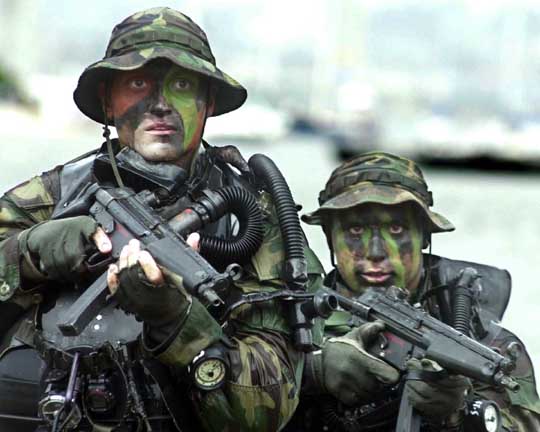
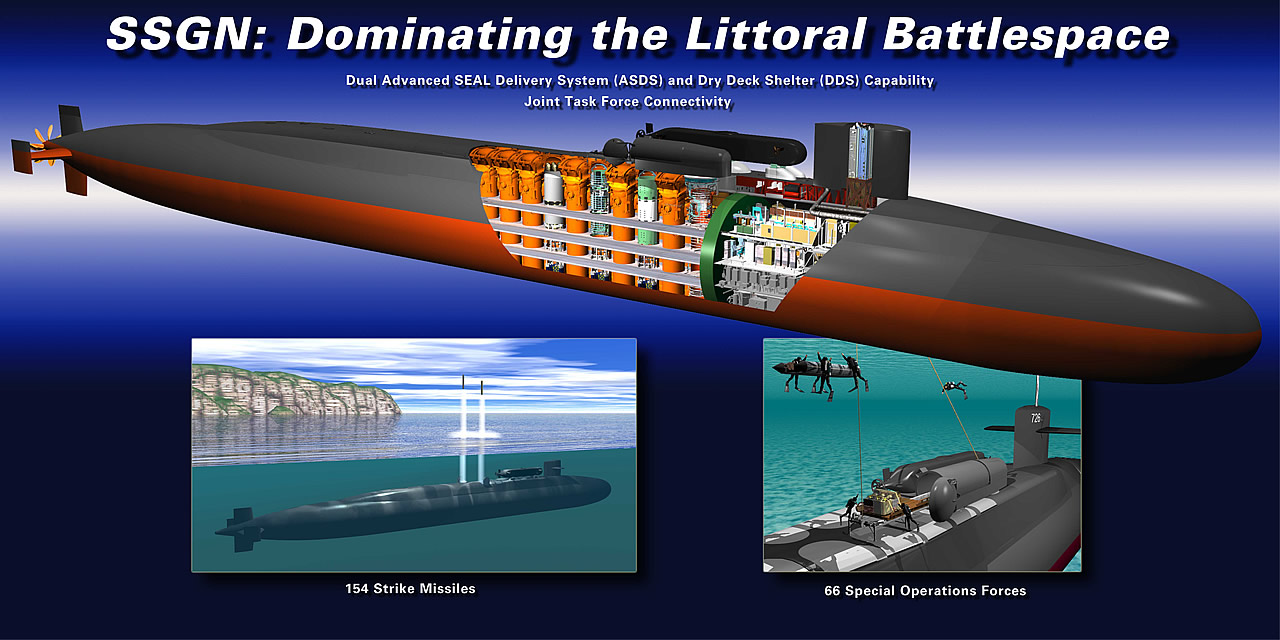
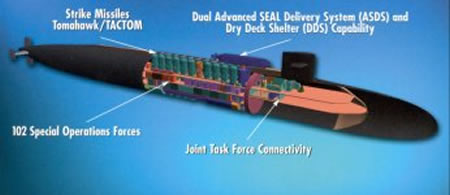
In the aftermath of the START-II arms control treaty, some of the USA’s nuclear-powered Ohio Class SSBN nuclear missile submarines were converted to become long range conventional strike and special operations SSGN “Tactical Tridents.” Four ultra-stealthy Ohio-class SSBNs had their 24 Trident II D-5 nuclear ballistic missiles removed. They were replaced with up to 154 Tomahawk cruise missiles, plus space in the sub for 66-102 special forces troops, special attachments for new Advanced SEAL Delivery System (ASDS) or older Seal Delivery Vehicle (SDV) “mini-subs,” and a mission control center. Unmanned Underwater Vehicles, and even UAVs for aerial operations, are expected to become equally important options over the SSGN fleet’s career.
(click to view full)
These modifications provide the USA with an impressive and impressively flexible set of conventional firepower, in a survivable and virtually undetectable platform, which can remain on station for very long periods of time. As surveillance-strike complexes make the near-shore more and more hazardous for conventional ships, and the potential dangers posed by small groups continue to rise, America’s converted SSGN submarines will become more and more valuable. This updated, free-to-view article covers their origins and timeline, the key technologies involved, contracts from the program’s inception to the present day, with all 4 submarines back in service.
The US Navy’s New SSGN Platform
(click to view full)
These SSBN to SSGN conversions were originally sparked by the 1992 START II Strategic Arms Reduction Treaty, which limited the number of strategic missile submarines to 14 as of the year 2002. Rather than decommissioning the USS Ohio [SSBN 726], USS Michigan [SSBN 727], USS Florida [SSBN 728] and USS Georgia [SSBN 729] Ohio Class submarines, why not change ther mission, and modify them to the “Tactical Trident” Configuration described above? Strong support for this idea was quickly forthcoming from Senators Dodd [D-CT], Inouye [D-HI], Lieberman [D-CT], and Pell [D-RI].
These submarines’ obvious usefulness in the Global War on Terror, and the program’s previous bipartisan popularity, were potent political assets. The US Senate mandated and funded conversion of all 4 Tactical Trident SSGNs in the FY 2002 defense appropriation bill, even though President Bush had requested only enough money to convert 2 subs.

(click to view full)
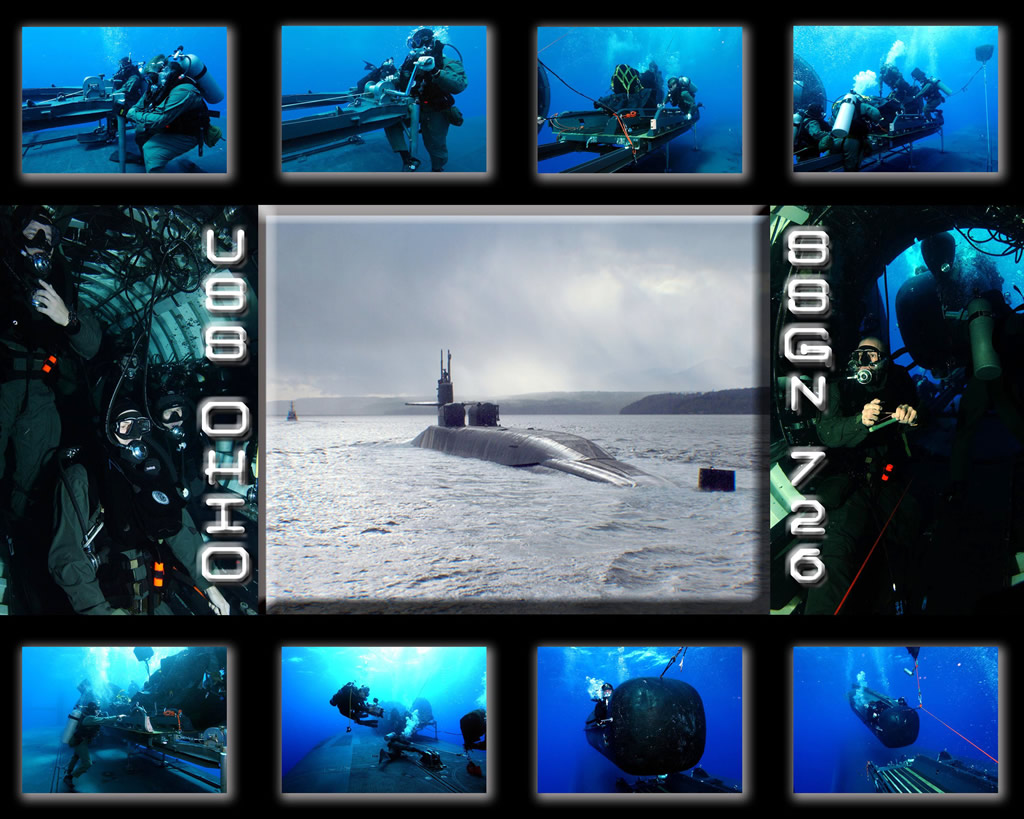
To create a Tactical Trident submarine, 2 of the Ohio Class SSBNs’ 24 large vertical missile launch tubes are converted to lockout chambers, enabling underwater exits from the hull without sinking the submarine. Dedicated accommodations and facilities exist for 66 Special Operations personnel, generally Navy SEALS – though some sources note an upper limit of 102 troops in emergencies.
It was hoped that Advanced SEAL Delivery System (ASDS) mini-subs could also be attached to the top of the SSGN, in order to deliver SEALs or MARSOC members inshore in a dry environment, reducing fatigue. Unfortunately, the ASDS program suffered from serious development problems, and was eventually canceled. ASDS-1 was used until it was destroyed in a shore fire. Unless an alternate system is developed and deployed, existing Seal Delivery Vehicles (SDVs) will remain the mainstay.
(click to view full)
Like the new Virginia Class submarines (SSN-744) whose estimated costs range from $1.7-$2.3 billion billion each, these 4 converted SSGNs will extend US special forces’ underwater insertion capability. The decommissioning of the 1960s-vintage Benjamin Franklin Class [SSBN 640] submarines USS James K. Polk [SSN/SSBN 645] in 1999, and USS Kamehameha [SSN/SSBN 642] in 2002, was offset by the subsequent modification of the SSN-688I improved Los Angeles Class subs Charlotte [SSN 766] and Greeneville [SSN 772], and by the capabilities of each Virginia Class submarine. Even so, the sheer number of SSGN troop berths and dedicated facilities will give the new Tactical Trident subs a level of SOF capability and flexibility that will set it apart. Given the new global environment, the lead role that has been assigned to SOCOM for prosecuting the Global War on Terror, and the USA’s increased emphasis on threats and warfare in shallow water and near-shore littoral zones, the SSGNs bring an extremely important capability to the table.
The havoc that 102 Navy SEALs and/or MARSOC Marines can create is not to be underestimated. Nevertheless, the converted subs’ most powerful strike capability still lies in their missiles. That’s where the submarine’s other 22 vertical launch tubes come in to play, thanks to rotary launchers that let each tube fire up to 7 Tomahawk cruise missiles.

BGM-109 Tomahawk missiles have played major roles in U.S. military operations, from Desert Storm through current operations in Iraq and Afghanistan. Flying close to the ground at just under the speed of sound, they can deliver a 1,000 lb. conventional explosive warhead with pinpoint accuracy via GPS/INS and terrain matching navigation. A datalink even allows them to be reprogrammed among any of 15 pre-programmed alternate targets, while still in the air. In the first day of Operation Iraqi Freedom alone, U.S. forces in the Persian Gulf, Red Sea and Mediterranean Sea launched 320 Tomahawks.
JINSA notes that the majority of Tomahawk cruise missiles are currently launched by Navy surface vessels, such as the Ticonderoga Class (CG-47) cruisers and Arleigh Burke Class (DDG-51) destroyers. The later series of Los Angeles Class (SSN-688I) and the newest Virginia Class (SSN-744) attack submarines are armed with 12 dedicated Tomahawk launch tubes each, while earlier Los Angeles boats and the newest Seawolf Class (SSN-21) have to sacrifice some of their stored torpedoes to carry and launch Tomahawks through their torpedo tubes.
(click to view larger)
Again, numbers matter. The ability to arrive unnoticed with up to 154 long-range land-attack missiles, launch Tomahawks, and then slip away silently beneath the waves, will make the new Tactical Trident SSGNs the US Navy’s premier future strike platform next to its carrier fleet. This Special Forces/Strike Mission flexibility, and the new SSGNs extreme underwater stealth, may even make them more important and useful in a number of future conflict scenarios. Indeed, if anti-shipping missile technologies and related systems continue to advance faster than defensive improvements, the SSGN fleet’s survivability may vault them into the #1 position as America’s primary strike platform, with special emphasis near a number of key global choke points like the Straits of Hormuz, Straits of Malacca, etc.
The last mission of the SSGN fleet will be one of innovation. An August 2003 Seapower article also suggested that these vessels will perform as seagoing test beds for the submarine fleet, trying out new technologies and testing new tactics for other classes of submarines. sub-launched UAVs, UUVs, and other new equipment are likely to see their first testing and live-use trials aboard these ships.
In the past, when trouble struck in a global hotspot, it has been said that one of the first questions an American President asks has been “Where are the carriers?” In future, that question may often change to “Where are the Tactical Tridents?”
SSGN Coversion: Timelines & Program Contractors
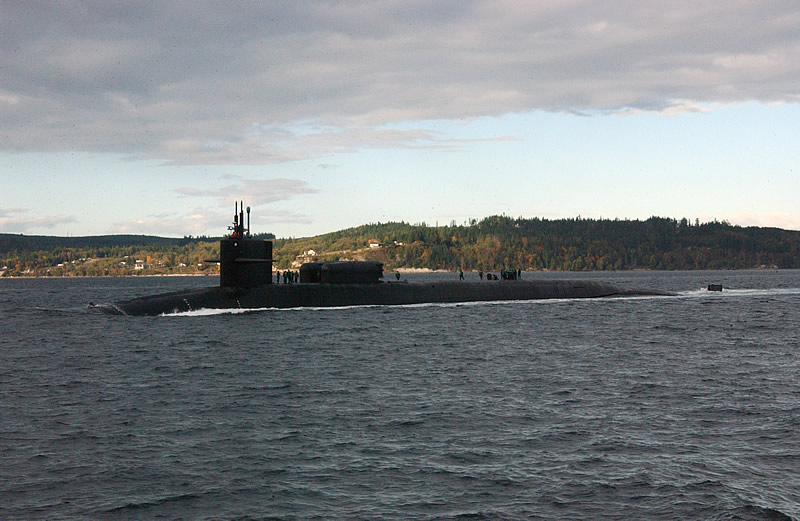
(click to view full)
An Oct 17/05 General Dynamics press release noted that If all options are exercised and funded, the overall SSGN conversion contract would be worth a total of $1.4 billion. They were.
Naval Technology reported that USS Ohio [SSGN 726] began conversion in November 2002, and would rejoin the fleet in November 2005. Conversion was declared complete on Jan 9/06, and the submarine spent 2006 and part of 2007 in testing and training. Ohio deployed to the Pacific on active operations in 2007, and Jan 11/08 saw the first active crew swap take place in Guam.
USS Florida [SSGN 727] began SSGN conversion in July 2003, and was expected to rejoin the fleet in April 2006. She left the shipyard at Norfolk in April 2007, and participated in at-sea testing before being sent on active missions. She was the 1st Ohio Class SSGN to fire cruise missiles in combat, during 2011 hostilities over Libya.
USS Michigan [SSGN 728] arrived for conversion in February 2004. The contract noted December 2006 as the expected end of construction and beginning of renewed sea trials; a Return to Service ceremony was hosted on June 12/07.
USS Georgia’s [SSBN 729] plan stipulated September 2007 as the expected end of construction and beginning of renewed sea trials, but a May 2007 NAVSEA release would say only “late 2007.” That date, too, appears to have slipped. In the end, the submarine was returned to service on March 28/08.
A passing operational evaluation (OPEVAL) grade appears to have been granted to the new class, leading to full certification for combat operations, and the beginning of a potent new weapon for American seapower.
With respect to key contractors:
* General Dynamics Electric Boat Corp. was the shipbuilding contractor, and is the default contract recipient in the lists below unless otherwise specified.
* General Dynamics Advanced Information Systems modified the Trident nuclear missile fire control system to systems designed to control Tomahawk cruise missiles etc.
* Northrop Grumman Electronic Systems adapted the ballistic missile missile launch tubes, developing a Multiple All Up Round Canister (MAC) to store and launch of up to 7 TLAM C-E non-nuclear Tomahawk missiles from each of the submarine’s 22 remaining active missile tubes.
* Raytheon builds the Composite Capsule Launching System that helps turn the submarines’ ballistic missile launching tubes into multiple-shot cruise missile launchers. They are also responsible for the submarines’ AN/BYG-1 combat system.
* Northrop Grumman Oceanic and Naval Systems tried to build the attached ASDS “Advanced SEAL delivery System” mini-subs, the successors to the existing SDVs (SEAL Delivery Vehicle). The ASDS aimed to deliver up to 16 Navy SEALs or MARSOC members. Unfortunately the program was not successful.
SSGN Tactical Trident: Contracts and Key Events
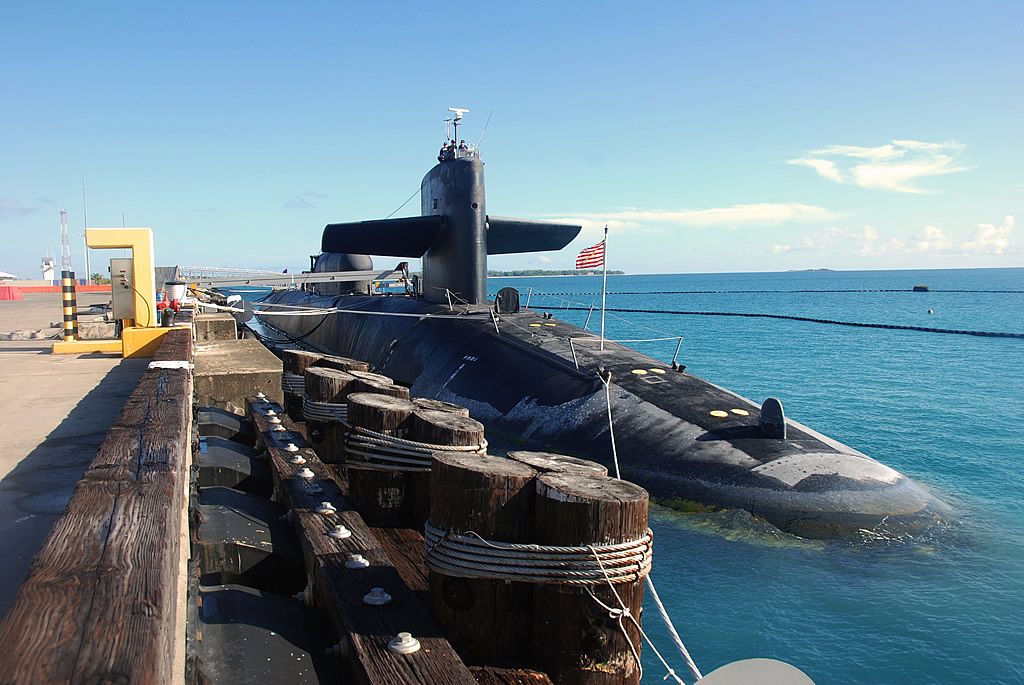
in Diego Garcia
(click to view full)
Unless otherwise specified, contracts are awarded to General Dynamics Electric Boat Corp. in Groton, CT, by the Naval Sea Systems Command in Washington, DC.
July 2/19: Preservation and Repairs International Marine and Industrial Applicators LLC was tapped with $8.5 million for the accomplishment of preservation and non-SUBSAFE structural repairs and maintenance on USS Michigan or SSGN 727. The deal will provide preservation, structural repairs, anode removal and safety track repair requirements and include all necessary management, material support services, labor, supplies and equipment deemed necessary to perform this work. Non-SUBSAFE means the structural repairs and maintenance are not part of the Submarine Safety Program, a quality assurance program of the US Navy designed to maintain the safety of the submarine fleet. The USS Michigan is the second sub of the Ohio Class of ballistic missile submarines and guided missile submarines. The Michigan was launched on April 26, 1980. It was built to carry the Navy’s third generation submarine-launched ballistic missile (SLBM), the Trident C-4. Work under the contract will take place in Bremerton, Washington and is scheduled to be complete by June next year.
February 28/19: CPGS Strategic Systems Programs contracted Lockheed Martin with a $846 million modification for large diameter rocket motors, associated missile body flight articles and related support equipment for the Navy Intermediate Range Conventional Prompt Strike Weapon System flight test demonstrations. The modification includes design, development, construction and integration. The system allows the US to strike targets anywhere within an hour. The CPGS weapons are not substitutes for nuclear weapons, but supplement US conventional capabilities and serve as an effort at deterrence. The Navy conducted the first test of the system in 2017 on the Ohio-class submarines. They are nuclear-powered submarines and form the sole class of ballistic missile submarines currently in service with the US Navy. Four Ohio-class underwater crafts have been converted to guided-missile submarines to carry conventional weapons by modifying missile tubes. Work under the contract modification will take place in Littleton, Colorado and is expected to be finished on January 1, 2024.
Oct 18/11: Reports surface that the US Navy is investigating Virginia Class submarines as a potential successor to the SSGN fleet, which still has about 15 years of service left.
The Virginia Class Block III bow already uses 2 large “six-shooter” rotating tubes, for storing BGM-109 Tomahawk cruise missiles and compatible payloads. Their system is derived from the Ohio SSGNs, but the tubes are a bit shallower and narrower, due to the SSN’s smaller size. The new Virginia design they’re investigating would add a 94-foot section behind the sail, hosting 4 full Trident size “7-shooter” tubes, and bringing the submarines up to 40 cruise missiles each. That’s much smaller than the SSGNs’ 154 launcher maximum, but a fleet of 10 or so boats could be in many more places than a fleet of 4. The Virginia Class can already launch special forces, and can be fitted with adapters to mount underwater special forces vehicles. AOL Defence | Aviation Week | StrategyPage.
March 19/11: Combat Debut. The USS Florida [SSGN 727] fires most of Operation Odyssey Dawn’s initial wave of Tomahawk missiles, as combat over Libya begins. It represents the 1st combat firing of tomahawks by an Ohio Class SSGN – though it may or may not have been the first time an SSGN was used in a combat operation. King’s Bay Periscope.
July 8/10: The US Navy almost never publicizes the activities or locations of its SSBN nuclear missile submarines, beyond the occasional at-sea or home port photo. Now that the converted SSGNs aren’t carrying enough nuclear warheads to end a civilization, however, American naval diplomacy has some additional options in this area. South Korea’s Chosun Ilbo takes notice of publicly-released US Navy pictures of the USS Michigan, docked at South Korea’s Busan naval base over the last week following joint exercises with the ROK Navy. The move comes after China’s proxy North Korea sank the South Korean corvette Cheonan with a submarine-fired torpedo. The paper adds:
“Hong Kong’s South China Morning Post on Sunday said the nuclear-powered [SSGN] submarines Michigan, Ohio and Florida surfaced in Busan, Subic Bay in the Philippines and Diego Garcia in the Indian Ocean around the same time… The sub can also carry South Korean special forces troops for infiltration operations into North Korea in the event that a regime collapse in the North heightens the chances of nuclear weapons and missile theft or a full-blown war. The submarine apparently took part in joint military exercises with South Korea in the past carrying the South’s special forces units.”
See: Chosun Ilbo | US Navy photo.
June 9 – June 28/10: USS Florida [SSGN 728] makes a scheduled port visit to Diego Garcia in the central Indian Ocean, to undergo routine maintenance and make a scheduled crew swap. The submarine conducted a fast checkout cruise in Diego Garcia after the crew exchange, then left following the 1st voyage repair period of her 2nd deployment. US Navy arrival | departure.
June 24/10: The US Navy releases a photo of USS Ohio Gold Crew commander Capt. Dixon Hicks, explaining basic operations of the Dry Dock Shelter and Seal Delivery Vehicles to visiting Filipino security officials during a routine port visit to Subic Bay.
Subic Bay was once an American naval station, but is now simply a foreign port. Even so, it’s more than just a waypoint. The Philippines have a long-running Islamist insurgency in their southern islands, which has been a focus for a lot of work by American special forces in recent years.
March 9/10: USS Florida [SSGN 728] arrives for a routine port visit to the island of Crete, in the eastern Mediterranean Sea. US Navy.

(click to view full)
Aug 29/09: USS Ohio [SSGN 726] arrives at Fleet Activities Yokosuka in Japan for a routine port visit. The visit to Yokosuka marks the beginning of a one-year deployment to U.S. 7th Fleet for Ohio. US Navy.
Aug 5/09: A US Navy photo and caption offer a glimpse into the SSGNs’ work:
“The guided-missile submarine USS Georgia (SSGN 729) transits the St. Marys River on her first operational deployment as a converted Guided-missile submarine. Georgia will deploy for approximately one year to the 5th and 6th Fleet areas of responsibility before returning to homeport at Naval Submarine Base Kings Bay, Ga.”
Follow-on photos show USS Georgia on the surface with an attached SDV, arriving in Souda Bay, Crete, passing by Italy’s Mount Vesuvius and leaving after a port visit to Naples.
Oct 27/08: Information Dissemination relays a Defense Daily report quoting The Director of the new US Navy Irregular Warfare Office, Rear Adm. (sel.) Mark Kenny. He apparently told the Submarine Naval League Symposium in Virginia:
“The first two deployments, the Ohio and Florida, were groundbreaking deployments… The ships work as advertised, brought home the bacon. And I wish I could give you the briefs in detail, because they are eye-watering… These ships are the Navy’s premiere counter-terrorism tool, no doubt about it.”
March 28/08: USS Georgia returns to service in a ceremony at Kings Bay Naval Submarine Base, GA. CBS News 4 | Navy News Service.
Feb 22/08: StrategyPage reports that “The U.S. Navy has completed the conversion of the last of four Ohio class ballistic missile submarines (SSBNs), to cruise missile submarines (SSGN).”
Jan 10/08: The US military no longer sails its ships home every time it needs to swap crews – instead, it brings new crews to the ships. USS Ohio [SSGN 726] is completing the first underway period of a 1 year deployment to 7th Fleet, and is spending its time in the Western Pacific. On this day, the submarine arrived in Guam. Its original “Blue Crew” was relieved on Jan 11/08 by the follow-on “Gold Crew,” but will remain for about 3 weeks to put the sub in tip-top shape before they fully turn it over and fly home.
Ohio will treat Guam as its home base until have 3 crew swaps have passed; then it will return to its official home port in Bangor, WA. US Navy release.
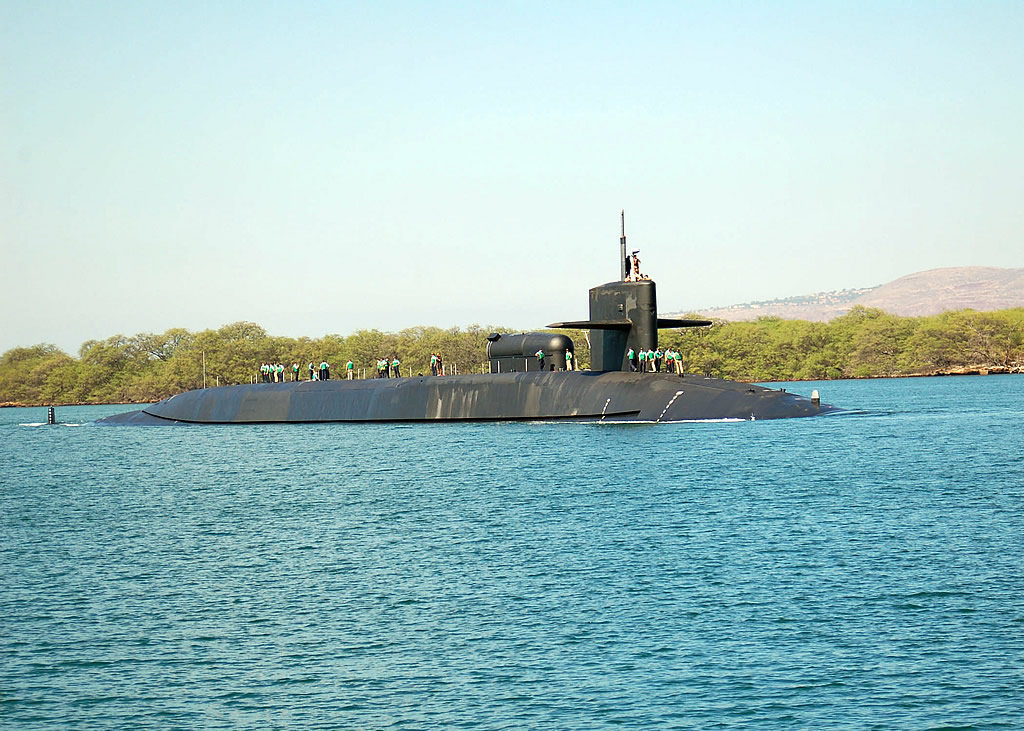
(click to view full)
Oct 22/07: USS Ohio [SSGN 726] arrives at Naval Station Pearl Harbor to take on supplies before continuing on their maiden deployment to the Western Pacific. US Navy Photo & caption.
June 12/07: USS Michigan [now SSGN 727] holds her return to service ceremony at Bremerton Delta Pier, WA. US Navy release.
May 17/07: FY 2007 strike trials underway. NAVAIR announces that 4 US Navy Tomahawk Cruise Missiles (2 Block III, 2 Block IV) were launched from the USS Florida [SSGN-728] while underway in the Gulf of Mexico recently. The tests were the first Tomahawk launches from the new SSGN Class submarine as part of the SSGN’s strike operational evaluation (OPEVAL). All tests were successful. NAVAIR release | NAVSEA release.
Jan 11/07: Oceaneering International Incorporated’s Marine Services Division (OII-MSD), Chesapeake, VA received a $10.9 million firm-fixed-price contract to furnish materials, tools, equipment and required support to perform manufacture and installation of Special Operation Forces walking flats and canisters on SSGN Class hulls. OII-MSD shall provide the necessary personnel and equipment to support multiple simultaneous manufacture and installation of units.
Work will be performed in Chesapeake, VA and is expected to be complete by February 2009. The contract was competitively procured and advertised via the Internet, with 2 proposals received by the Naval Surface Warfare Center, Carderock Division in Philadelphia, PA (N65540-07-C-0005).
Nov 20/06: USS Ohio [SSGN 726] moors at Naval Station Pearl Harbor, marking the first SSGN visit to the port. The boat is conducting training exercises and work-ups in the Hawaiian islands in preparation for its maiden deployment as an SSGN in 2007. US Navy Newsstand release.
Oct 6/06: USS Ohio [SSGN 726] returns to her homeport in the Hood Canal portion of Puget Sound, WA after becoming the first Ohio-class submarine to complete sea and hydrodynamic trials with recently installed dual drydeck shelters (DDS) for Special Operations Forces. US Navy Hi-Res photo.

(click to view full)
May 25/06: USS Florida [now SSGN 728] officially rejoins the fleet, marked by a Return to Service ceremony at Naval Base Mayport, FL. GDEB release | US Navy.
April 8/06: The USS Florida departs Norfolk Naval Shipyard, VA, where her conversion to an SSGN was performed, en-route her new homeport of Naval Submarine Base King’s Bay, GA. US Navy Newsstand hi-res photos.
Feb 7/06: USS Ohio (now SSGN 726), the first of four SSGNs, rejoins the fleet in a return to service ceremony at Naval Base Kitsap-Bangor, WA. See US Navy release.
Jan 9/06: General Dynamics Electric Boat completes its conversion of USS Ohio [SSBN 726], the first of four Ohio-class submarines to be reconfigured. EB President John Casey noted that the conversion – comprising design, manufacturing, installation and at-sea testing – was completed only three years after the Navy decided to move forward with the program (DID: 3 years for the sub from Dec. 18/03, but it’s 4 for the program). “That’s a remarkable achievement,” he said.
He also said that USS Florida is on track to follow the lead-ship sea trial by only 3 months, which would result in delivery of the 2nd SSGN over a shorter-than-normal timeframe, and at a conversion cost lower than the lead ship’s. Read the GDEB corporate release.
Dec 19/05: The USS Ohio takes a significant step towards rejoining the fleet when it arrived at Puget Sound Naval Shipyard and Intermediate Maintenance Facility, Bremerton, WA with a broom atop its sail – signifying a clean sweep of its initial sea trials. US Navy photo.

(click to view full)
Oct 14/05: A $162.4 million modification to previously awarded contract (N00024-02-C-2901) for conversion of the USS Georgia from Ohio Class ballistic missile submarine SSBN 729 to Ohio Class guided missile submarine SSGN 729. The conversion will be conducted concurrently with the ship’s engineered refueling overhaul being performed at Norfolk Naval Shipyard, and work is expected to complete by September 2007.
May 19/05: A $14.7 million Cost-Plus-Fixed-Fee contract modification to previously awarded contract for the Procurement of Long Lead Time Material for the Conversion of Ohio Class SSBN Submarines to Ohio Class SSGN Submarines (N00024-02-C-2901). DID covers it.
Feb 1/05: Fleet ballistic missile submarine USS Georgia [SSBN 729] passes downtown Norfolk, VA, as it heads to Norfolk Naval Shipyard in Portsmouth, VA for its conversion. Georgia is the 4th and final Ohio Class submarine to undergo conversion, and will join USS Florida [SSGN 728] at Norfolk Naval Shipyard. US Navy.
January 28/05: A $150 million cost-reimbursement modification under contract N00024-02-C-2901 for the conversion of USS Michigan [SSBN 727] to SSGN 727. The USS Michigan’s conversion will be conducted concurrently with the ship’s engineered refueling overhaul being performed at Puget Sound Naval Shipyard. Work is expected to be complete by December 2006.
January 10/05: An $8.7 million cost-plus-fixed-fee material order under a previously awarded contract (N00024-04-C-2100) for procurement of SSGN 727 and SSGN 728 long lead time material (LLTM, in this case ships’ service turbine generator sets). Work will take place in Groton, CT and is expected to be complete by May 2007.
(click to view full)
May 5/04: A $5.9 million cost-plus-fixed-fee material order under a previously awarded contract (N00024-04-C-2100) for procurement of SSGN 727 and SSGN 728 long lead time material (LLTM, in this case ships’ service turbine generator sets). The Supervisor of Shipbuilding, Conversion and Repair, USN in Groton, CT issued the contract modification.
March 3/04: A $149.4 million cost-reimbursement modification under contract N00024-02-C-2901 for the conversion of USS Florida [SSBN 728] to SSGN 728; and conversion installation planning for the conversion of USS Georgia [SSBN 729] to SSGN 729. Both conversions will be conducted concurrently with the ships’ engineered refueling overhaul being done at Norfolk Naval Shipyard, and work is expected to be complete by September 2007.
Feb 6/04: A $15.6 million cost-plus-fixed-fee modification under previously awarded contract (N00024-02-C-2901) for procurement of long lead-time material for the conversion of Ohio Class SSBN submarines to SSGN submarines.
Feb 2/04: USS Michigan [SSGN 727] arrives at Puget Sound, to begin its conversion. US Navy.
Dec 18/03: A $221.8 million cost-reimbursement modification under contract N00024-02-C-2901 for FY 04 conversion of SSBN 726 (USS Ohio) to SSGN 726, and long lead time material and conversion installation planning for conversion of USS Michigan [SSBN 727] and USS Georgia [SSBN 729] to SSGN 727 and SSGN 729.
Dec 11/03: A $30.1 million cost-plus-fixed-fee modification to exercise an option under previously awarded contract N00024-02-C-2901 for installation planning and manufacturing of long lead time material for conversion of Ohio Class SSBN submarines to SSGN submarines.
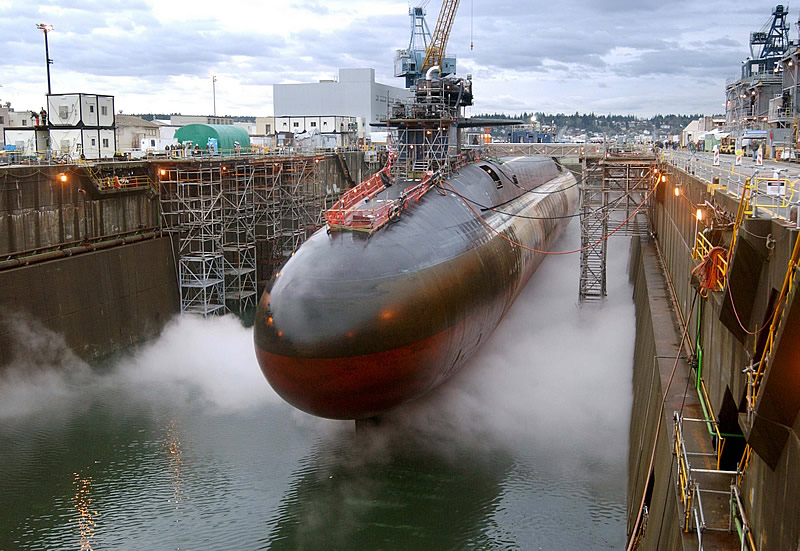
(click to view full)
Sept 16/03: A $33.9 million cost-plus-fixed-fee modification under contract N00024-02-C-2901 for conversion installation planning re: conversion of Ohio Class SSBN submarines to SSGN submarines.
May 23/03: A $24.1 million cost-plus-fixed-fee modification under contract N00024-02-C-2901 for the procurement and manufacturing of long lead-time material for conversion of Ohio Class SSBN submarines to SSGN submarines.
Dec 20/02: A $54.6 million cost-plus-fixed-fee modification under contract N00024-02-C-2901 for the procurement of long lead time material (LLTM) for the conversion of Ohio Class SSBN submarines to Ohio Class SSGN submarines. LLTM includes material acquisition, vendor oversight, manufacturing, inspections, test, storage, preservation and vendor assistance in troubleshooting and resolving operational problems. Work will be performed in Groton, CT and is to be complete by September 2007.
Dec 13/02: A $38.3 million cost-plus-fixed-fee modification under contract N00024-02-C-2901 to exercise an option for the procurement and manufacturing of long lead time material for conversion of Ohio Class SSBN submarines to SSGN submarines.
Sept 26/02: US Naval Sea Systems Command awards a $442.9 million cost-plus-fixed-fee contract (N00024-02-C-2901) to General Dynamics Electric Boat Corp. to provide a complete, accurate, and producible ship detail design for the conversion of up to 4 Ohio-class SSBN submarines to Ohio-class SSGN submarines.
Work will cover detail design, procurement and manufacturing of Long Lead Time Material (LLTM), and associated LLTM tasks including material acquisition, vendor oversight, manufacturing, inspections, test, storage, preservation, and vendor assistance in troubleshooting and resolving operational problems. Work will be performed in Groton, CT; and in Quonset and Newport, RI; with completion expected by September 2007. See also NAVSEA release.
SSGN Tactical Trident: Ancillary Program Contracts and Timelines
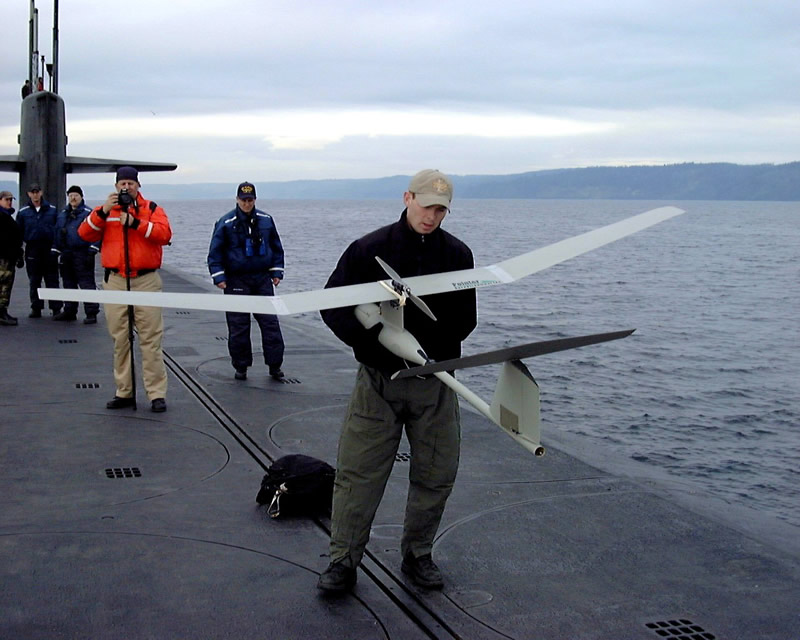
(click to view full)
There’s a lot that goes into a program like this, including ancillary contracts that aren’t directly part of the program, but which are required for effective operation. Finding and keeping track of these contracts is difficult, but DID will present and add as many as we can find. Tips from readers are always appreciated (tips@ourdomain…).
Dec 9/11: BAE Systems in Rockville, MD receives a $58.3 million cost-plus-fixed-fee, cost-plus-incentive-fee contract to provide Systems Engineering Integration support for the TRIDENT II D5 Strategic Weapon System (SWS) Program, the SSGN Attack Weapon System (AWS) Program, and the Common Missile Compartment (CMC) Program. Options could bring the contract’s total value to $123.3 million.
Work will be performed in Rockville, MD (70%); Washington, DC (20%); St. Mary’s, GA (5%); Bangor, WA (4%); and Barrow-in-Furness, Cumbria, United Kingdom (1%), and is expected to be completed Sept 30/12, or Sept 30/13 if the options are exercised. $38.3 million will expire at the end of the current fiscal year, on Sept 30/12. This contract was not competitively procured (N00012-C-0009).
Dec 2/11: Northrop Grumman Electronic Systems – Marine Systems in Sunnyvale, CA, received an $83.2 million firm-fixed-price, cost-plus-incentive-fee, cost-plus-fixed-fee contract to provide FY 2012 support for the TRIDENT II D-5 launchers, submarines, and next-generation development efforts. This contract contains options, which could bring its total value to $123.1 million.
Northrop Grumman will provide services to help with existing SSBN/SSGN Underwater Launcher Systems; Engineering Refueling Overhaul shipyard support; spares procurement; United States and United Kingdom launcher trainer support; Vertical Support Group E-mount and shim procurement; TRIDENT II D-5 missile tube closure production; Launcher Initiation System (LIS) Critical Design Review and Nuclear Weapons Safety and Security Review; TRIDENT II D-5 missile hoist overhauls; underwater launch technology support; U.S. and U.K. Strategic Systems Programs alterations and non-compliance report projects; gas generator refurbishment and case hardware production; LIS Trainer Shipboard Systems Integration Increment 11 conversion; and ancillary hardware and spares.
Technical engineering services and container production restart efforts for the New Strategic Arms Reduction Treaty will also be included, as will technical engineering services to support the Advanced Launcher Development Program and Common Missile Compartment concept development and prototyping efforts for the U.S. and U.K.
Work will be performed in Sunnyvale, CA (80%); Bangor, WA (10%); and Kings Bay, GA (10%); and will end with the fiscal year on Sept 30/12, whereupon $45.3 million of these funds will expire; or it will end on Sept 30/14 if all options are exercised. The contract was not competitively procured (N00030-12-C-0015).
Nov 25/11: General Dynamics Advanced Information Systems, Inc. in Pittsfield, MA receives a $96 million cost-plus-incentive-fee, cost-plus-fixed-fee, fixed-price incentive contract to provide FY 2012 and FY 2013 engineering support to United States and United Kingdom Trident II SSBN Fire Control Subsystems, Ohio Class SSGN Attack Weapons Control Subsystem, and the Common Missile Compartment for the USA and UK’s next-generation nuclear missile submarines. This contract contains options which could bring its total value to $225 million over almost 4.5 years.
Work will be performed in Pittsfield, MA, and could run to April 14/16 with all options exercised. $35.1 million will expire at the end of the current fiscal year, on Sept 30/12. This contract was not competitively procured by the US Strategic Systems Programs in Washington, DC (N00030-12-C-0006).
Jan 28/11: Lockheed Martin Maritime Systems and Sensors in Manassas, VA receives an $11.3 million option to manufacture Acoustic Rapid Commercial-Off-The-Shelf Insertion (ARCI) hardware, supplying a System Improvement and Integration Program for the USS Ohio and USS Georgia SSGNs; and for the Virginia Class SSN 781 fast attack boat, which will become the USS California around 2013. Work will be performed in Manassas, VA (70%) and Clearwater, FL (30%), and is expected to be complete by April 2014. Contract funds will not expire at the end of the current fiscal year.
The A-RCI program improves existing sonar systems by upgrading processors and back-end electronics, allowing significant improvements without having to replace the expensive sonar arrays.
Dec 1/09: Lockheed Martin Space Systems Co. in Sunnyvale, CA receives a $720.1 million modification to a cost-plus-incentive-fee, cost-plus-fixed-fee contract to provide TRIDENT II (D5) and TRIDENT I (C4) missile subsystems. In addition to a long list of TRIDENT II (D5), and TRIDENT I (C4) missile subsystem requirements, they will also perform some SSGN-related efforts, including:
* Provide storage and maintenance for the Tomahawk Land Attack Missile, Nuclear (TLAM-N) at the Strategic Weapons Facilities;
* Perform processing and provide technical services in support of the SSGN Attack Weapon System (AWS) at SWFLANT.
Work will be performed in California (42%); Georgia (11%); Utah (16%); Florida (9%); Washington (8%); Virginia (3%); Tennessee (2%); New Jersey (1%); Massachusetts (1%); Illinois (1%); Maryland (1%); other (5%), and is expected to be complete in September 2012. $285.5 million will expire at the end of the current fiscal year, on Sept 30/09 (N00030-08-C-0100, PZ0001). See also March 26/08 entry.
Nov 19/08: General Dynamics Advanced Information Systems in Pittsfield, MA received a $52.3 million contract modification for FY09-FY11 U.S. and U.K. TRIDENT II (D5) fire control system (FCS) work, and to a much lesser extent, U.S. SSGN attack weapon control system (AWCS) support.
Work will be performed in Pittsfield, MA, and is expected to be complete on April 1/11. $25.8 million will expire at the end of current fiscal year, on Sept 30/09 (N00030-08-C-0041, P00013).
Sept 28/09: General Dynamics Advanced Information Systems in Pittsfield, MA receives a $152.8 million cost-plus-incentive fee contract, with 2 parts to it. General Dynamics will perform the work in Pittsfield, MA, and expects to complete it by December 2012. The US Navy’s Strategic Systems Programs in Arlington, VA manages the contract (N00030-10-C-0005).
One part provides for FY 2010 and FY 2011 production and deployed systems support for the US and UK SSBN fire control system (FCS) and the SSGN Attack Weapon Control System (AWCS). GD AIS will provide annual and other periodic procurements of support equipment and SSP alterations (SPALTs) necessary to sustain the SSBN FCS and the SSGN AWCS, including engineering support, performance evaluation, logistics, fleet documentation, reliability maintenance, engineering services, and training.
In addition, this contract includes the FY 2010 and FY 2011 US and UK Sea Based Strategic Deterrent (SBSD) Strategic Weapons System (SWS) fire control subsystem efforts necessary for the concept development, prototyping, and initial design efforts for a common missile compartment (CMC), prior to and following, the initiation of a ACAT 1D class program to replace the SSBN Ohio class.
Jan 11/08: A ribbon-cutting ceremony marks the completion of upgrades to Bravo Wharf at Naval Base Guam, providing the capability to host the Navy’s new SSGN submarines. The $50.7 million military construction (MILCON) project was awarded to Black Construction Corp. in 2006, and entailed dredging of the channel and turn basin at inner Apra Harbor, strengthening of existing wharf foundations, extending the wharf to accommodate SSGNs, as well as upgrading the fire protection, lighting, anchoring and water distribution systems. The newly improved wharf can also accommodate ships as large as a CG-47 Ticonderoga class cruisers.
The capability to host and provide a complete range of shore services to the SSGN on Guam allows for longer-term submarine presence, as well as a more robust range of sub-surface mission packages available in the Pacific theater of operations. The project was executed and managed in Guam by NAVFAC Marianas, under former submarine officer Cmdr. Matt Suess.
A complimentary Alpha Wharf improvement adjacent to Bravo Wharf is scheduled to be completed in summer 2008. US Navy release.
Nov 16/07: General Dynamics Advanced Information Systems of Pittsfield, MA received a $91.3 million Cost Plus Incentive Fee Strategic Systems Programs (SSP) Contract (incentives on Cost, Performance, and Schedule) based on a sole source acquisition under N00030-08-C-0041. They will provide the FY 2008 through FY 2009 U.S. and U.K. Fire Control System, and the U.S. SSGN Attack Weapon Control System (AWCS). Specific efforts include U.S. and U.K. operational support, repair, installation, and checkout; Mod 6/7 development and production; Mod 8/9 development; Engineered Refueling Overhaul Support; Training Unique Development; AWCS; Auxiliary Systems Tech Refresh; AWCS Mod 0 updates; Conventional TRIDENT Modification (CTM) development; and Mk 6 Life Extension development.
The period of performance is Oct 1/07 – April 2/11, and the place of performance (100%) is General Dynamics Advanced Information Systems in Pittsfield, MA. The funding profile is as follows: $3 million FY2007 UK (3.3%), $35.6 million FY2007 OPN (39.0%), $2.3 million FY2008 SCN (2.5%), $27.9 million FY2008 O&M,N (30.5%), $10 million FY2008 UK (10.9%), $9 million FY2008 OPN (10.0%), $3.5 million FY2008 WPN (3.8%). The award contains $27.9 million of FY2008 O&M,N funding which would expire at the end of the current fiscal year (FY2008). Strategic Systems Programs in Arlington, VA is isued the contract.
Aug 21/07: From a Raytheon release:
“The U.S. Navy has recommended Raytheon Company’s (NYSE: RTN) advanced submarine combat control system, AN/BYG-1, for fleet introduction on the SSGN Ohio Class and SSN-21 Seawolf Class attack submarines after favorable tests and evaluations. The recent Follow-on Operational Test & Evaluation reports highlighted several performance enhancements and confirmed the operational effectiveness and suitability of the AN/BYG-1[V]6 and [V]7 for the SSN-21 and SSGN platforms.
AN/BYG-1 exploits the power of sonar, electronic support measures, radar, navigation, periscopes, communication, command and weapons to provide a fully integrated submarine combat system. The system was designed using commercial off the shelf (COTS) equipment and open standards that provide interoperability, portability, scalability and supplier independence for all hardware and software components. The AN/BYG-1 system allows for rapid COTS insertion to accommodate and integrate additional functionality, sensors and/or weapons.”
March 30/07: DGM21 LLC in Montrose, CO received a $31.9 million firm-fixed-price contract for the FY 2007 consolidated construction projects for U.S. Naval Support Facility, Diego Garcia, British Indian Ocean Territories. This is a design-build project is for wharf improvements and Shore Support Facilities related to the new SSGN submarines, with performance and prescriptive requirements provided by the Government. See DID coverage, with map.
Work will be performed in Diego Garcia, British Indian Ocean Territories, and is expected to be complete April 2009. This contract was competitively procured with 17 solicitation packages distributed and 1 proposal received by the Naval Facilities Engineering Command, Pacific, Construction Contracts Branch (N62742-07-C-1313).
Dec 5/06: BAE Systems Applied Technologies Inc. in Rockville, MD received a $71.8 million cost-plus-incentive-fee/ cost-plus-fixed-fee contract to provide systems integration support for TRIDENT II (D5) Fleet Ballistic Missile (FBM) Program and the SSGN Attack Weapon System Program. This contract contains options, which if exercised, would bring the total contract value to $77.9 million.
Work will be performed in Rockville, MD (89%); Kings Bay, GA (7%); Mechanicsburg, PA (3%); and Bangor, WA (1%), and is expected to be complete September 2009 (September 2010 with options). Contract funds in the amount of $55.9 million will expire at the end of the current fiscal year. This contract was awarded based on a sole source acquisition by the Strategic Systems Programs in Arlington, VA (N00030-07-C-0009).
June 12/06: Kollmorgen Corp. Electro-Optical Division in Northampton, MA received a $17.2 million fixed-price incentive and firm-fixed price modification under previously awarded contract N00024-05-C-6241, exercisinge an option for production of 7 integrated submarine imaging systems (ISIS), including associated on-board repair parts and installation-checkout spares for the SSN 688 class submarine; and 1 ISIS SSGN class production system, including associated on-board repair parts and installation and check-out spares. Work will be performed in Northampton, MA (70%); Waterford CT (15%); Manassas, VA (12%); and Brattaboro, VT (3%), and is expected to be complete by December 2008. The Naval Sea Systems Command in Washington, DC issued the contract.
The integrated submarine imaging system will provide mission critical, all weather, visual and electronic search, digital image management, indication, warning, and platform architecture interface capabilities for SSN 688 Los Angeles Class, SSN 21 Seawolf Class, and SSGN class submarines.
Dec 22/05: Raytheon Co. in Tucson, AZ received an $8.8 million ceiling-priced modification to a previously awarded firm-fixed-price contract (N00019-04-C-0569) for the manufacture of 135 B Kits and assembly of the SSGN modification kit for the Composite Capsule Launching System (CCLS) capsule. The CCLS is for the Tomahawk cruise missiles specifically, and is compatible with the SSGN submarine Multiple AUR Canister (MAC) noted in the January 29, 2002 contract. The B Kits provide the components that complete the umbilical cable and aft end for the CCLS. Work will be performed in Joplin, MO (33.3%); Huntsville, AL (33%); Tucson, AZ (23.3%); and Camden, AR (10%), and is expected to be complete in July 2007. The Naval Air Systems Command in Patuxent River, MD issued the contract.
Dec 19/05: International Marine and Industrial Applicators, LLC in Irvington, AL won a $42 million firm-fixed-price, indefinite-delivery/ indefinite-quantity contract for the painting and preservation of the USA’s Ohio Class SSBN nuclear missile subs and SSGN special ops & strike submarines. DID’s “Painting Ohio” has the remaining details.
Feb 21/05: Systems Planning and Analysis (SPA) Inc. in Alexandria, VA receives a $7.15 million cost-plus-fixed-fee contract to provide systems engineering and program support for Nuclear Weapons Security (NWS) Program and SSBN Superstructure Modification. SPA will examine alternative approaches for SSBN security to the baseline SSBN superstructure modification program and will work to insure total system integration of all elements on SSBN and SSGN related programs required to perform technical, operational, and programmatic tradeoffs. Work will be performed in Alexandria, VA, and is expected to be complete in November 2005. This contract was not competitively procured by the Navy’s Strategic Systems Programs in Washington, DC (N00030-05-C-0015).
Dec 16/02: General Dynamics Advanced Information Systems in Pittsfield, MA receives a $90 million cost-plus-incentive-fee, cost-plus-fixed-fee contract for the FY03 Fire Control Omnibus Contract, which includes FBM Fire Control Production, Operational Support, Field Engineering Services, Repair and Return effort, and Development and SSGN Attack Weapons Control System (AWCS) design and production (N00030-03-C-0008)
Feb 21/02: General Dynamics Defense Systems in Pittsfield, MA receives a $5.6 million cost-plus-fixed-fee contract to provide for the fiscal year 2002 Nuclear Powered Cruise Missile Submarine (SSGN) Attack Weapons Control System (AWCS). The effort includes management and engineering services to develop the preliminary proof of concept system design for AWCS, proof of concept system architecture design review and development of preliminary planning for fleet documentation. Work will be performed in Pittsfield, MA, and is expected to be complete by December 2002. This contract was not competitively procured (N00030-02-C-0017). It is followed by other contracts which include this component as part of their total.
Jan 29/02: Northrop Grumman Marine Systems in Sunnyvale, CA receives $16.6 million to exercise an option contained in previously awarded cost-plus-award-fee contract (N00030-01-C-0071) to provide for Ship, Submersible Guided Missile Nuclear (SSGN) Multiple-All-Up-Round Canister (MAC) Subsystem demonstration and validation (DEMVAL). The MAC allows 7 Tomahawk cruise missiles to be carried in and launched from each Trident misile tube. This contract represents a win for NGMS against a competitor, after 2 initial contracts were awarded in May 2001. Work will be performed in Sunnyvale, CA, and is expected to be complete by July 2003.
Oct 26/01: BAE Systems Applied Technologies Inc. in Rockville, MD received $58 million cost-plus-fixed-fee and cost-plus-award-fee contract to provide fiscal year 2002 fleet ballistic missile (FBM) system integration and logistics support for the U.S. and United Kingdom Trident Programs. While not part of the SSGN program per se, the effort also includes Tomahawk land attack missile (TLAM) and SSGN systems integration, and advanced systems studies, as part of its scope (N00030-02-C-0019). This is followed by other contracts which include this component as part of their total.
Additional Readings
* See all US DoD contract announcements related to contract #N00024-02-C-2901.
* JINSA – Navy Embarks on Key Submarine Conversion: Four Former Missile Subs to Provide Tactical Missile, Special Ops Support. Very good article.
* Military.com: The Passdown (Jan 17/06) – SSGN: Payload Unlimited. Sub tender? Super anti-shipping attack sub? Sub with pop-up deck gun? Joe Buff suggests adding another 4 SSGNs to the force – and giving them some additional roles. Not so sure about that last one…
* Undersea Warfare Magazine (Summer 2004) – SSGN Conversions: Embodying the Sea Power 21 Vision.
* US Navy Newsstand (Feb 7/03) – SSGN Provides Powerful Tool for Navy SEALs
* Undersea Warfare Magazine (Winter/Spring 2002) – ASDS: The future of Submarine-based Special Operations. Illustrated some of the training and qualification processes associated with ASDS, including what it takes for a submariner to qualify as an ASDS pilot.
* Undersea Warfare Magazine (Fall 2001) – SSGN: A Transformational Force for the U.S. Navy
* Undersea Warfare Magazine (Winter 1999) – SSGN: A “Second Career” for the Boomer Force
* DID Spotlight – Building MARSOC: Infrastructure for SOCOM’s New Players. Includes MARSOC-related bacground and details. Navy SEALs and MARSOC are the most likely embarked complements for the SSGN fleet.
Unconventional Enemies?
* Business 2.0 – The Technology Secrets of Cocaine, Inc. US Navy SEALs aren’t the only ones using mini-subs these days. The cocaine barons rely on surface ships instead of converted SSBNs to transport them, and use less sophisticated vessels; nevertheless, it’s an interesting indicator of the current global trend toward dangerous non-state actors with state-level resources. Note that US and British special forces have been used in the past to target the cocaine cartels’ operations.
* David Pugliese’s Defence Watch (Aug 28/10) – The Return of the Drug Subs. The latest actually was a submarine.
* StrategyPage (Jan 6/10) – Everyone With Sneaky Needs Does It. “In the last four years, U.S., and other navy and coast guard ships off the coast between Mexico and Colombia, have detected over 150 of these subs. Between 2000 and 2007, only 23 of these boats were spotted. But last year, over 70 were detected or captured… Many of the captures are the result of intelligence information at the source, not air and naval patrols… It’s estimated that about 75 of these subs are being built in northwest Colombia each year, and sent on one way trips north. Each of these boats carries a four man crew and about seven tons of cocaine (worth nearly $200 million on the street).”
* The Economist (May 1/08) – Waving, not drowning. Documents the growth of mini-submersibles in maritime smuggling.
* WIRED Danger Room (Nov 12/07) – Colombia’s Cocaine Subs. They’re built by FARC, and they’re becoming increasingly sophisticated. LA Times: “Over the last two years, Colombian authorities and the U.S. Coast Guard and Navy have seized 13 submarine-like vessels outfitted for drug running.”