

(click to view full)
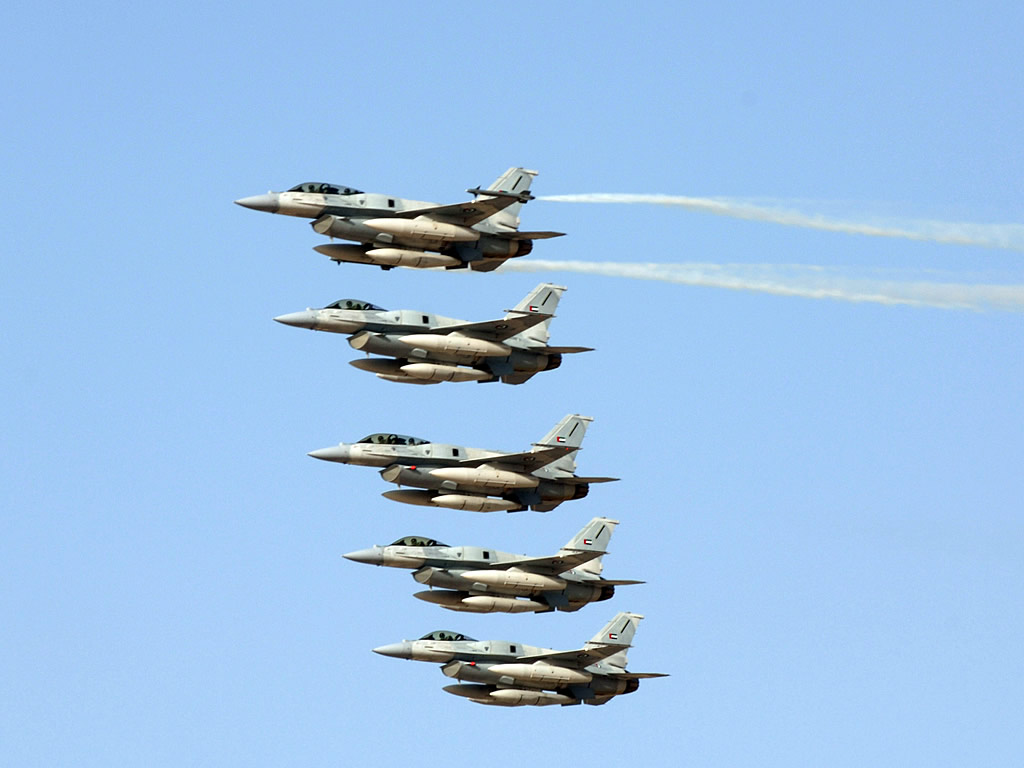
The most advanced F-16s in the world aren’t American. That distinction belongs to the UAE, whose F-16 E/F Block 60s are a half-generation ahead of the F-16 C/D Block 50/52+ aircraft that form the backbone of the US Air Force, and of many other fleets around the world. The Block 60 has been described as a lower-budget alternative to the F-35A Joint Strike Fighter, and there’s a solid argument to be made that their performance figures and broad sensor array will even keep them ahead of pending F-16 modernizations in countries like Taiwan, South Korea, and Singapore.
The UAE invested in the “Desert Falcon’s” development, and the contract reportedly includes royalty fees if other countries buy it. Investment doesn’t end when the fighters are delivered, either. Money is still needed for ongoing training, fielding, and equipment needs – and the UAE has decided that they need more planes, too. This DID article showcases the F-16 Block 60/61, and offers a window into its associated costs and life cycle, including dedicated equipment purchases for this fighter fleet.
The F-16E/F “Desert Falcon”

(click to view full)
The F-16 has become what its designers intended it to be: a worthy successor to the legendary P-51 Mustang whose principles of visibility, agility, and pilot-friendliness informed the Falcon’s original design. The planes have been produced in several countries around the world, thanks to licensing agreements, and upgrades have kept F-16s popular. It’s no exaggeration to call the F-16 the defining fighter of its age, the plane that many people around the world think of when they think “fighter.” They remain the American defense industry’s greatest export success story of the last 40 years, but the aircraft’s ability to handle future adversaries like the thrust-vectoring MiG-29OVT/35 and advanced surface-air missile systems is now in question.
The F-16 has now undergone 6 major block changes since its inception in the late 1970s, incorporating 4 generations of core avionics, 5 engine versions divided between 2 basic models (P&W F100 and GE F110), 5 radar versions, 5 electronic warfare suites, and 2 generations of most other subsystems. Moore’s Law applies as well, albeit more slowly: the latest F-16’s core computer suite has over 2,000 times the memory, and over 260 times the throughput, of the original production F-16.
Block 60: Technical
(click to view full)
Each new iteration of the fighter costs money to develop, integrate, and test. The UAE invested almost $3 billion into research and development for the F-16 E/F Block 60 Desert Falcon. First flight took place in December 2003, and flight testing by Lockheed Martin began in early 2004. UAE pilot training on the F-16E/F began at Tucson Air National Guard Base, AZ in September 2004, and the first group of pilots completed their training in April 2005. The first Desert Falcons arrived in the UAE in May 2005.
All of the initial 60 aircraft have been delivered, and all training now takes place in the UAE. Versions of this aircraft have been entered in a number of international export competitions as well, including Brazil’s F-X2 (eliminated) and India’s MMRCA (eliminated), but it hasn’t found any buyers yet. Production will restart soon anyway, thanks to the UAE’s impending add-on buy 30 F-16 E/F Block 61s with minor component upgrades.
The Desert Falcon’s unique features include…
Design & Powerplant

(click to view full)
The aircraft’s conformal fuel tanks (CFTs) let them carry more fuel, with less drag than underwing drop tanks. All that fuel feeds GE’s new F110-GE-132 engine, which produces up to 32,500 pounds of thrust to offset the plane’s increased weight. The -132 is a derivative of the proven F110-GE-129, a 29,000-pound thrust class engine that powers the majority of F-16 C/D fighters worldwide. Even with a bigger engine and more weight from added sensors, CFTs, etc., Block 60 fighters offer a mission radius of 1,025 miles – a 40% range increase over F-16s without CFTs.
Conformal tanks aren’t exclusive to the Block 60. They’re options for many F-16 variants, and can be removed before missions, but that may not be a great idea for the UAE’s fleet. It’s a classic give/take scenario, in which more capability (q.v. electronics) means more weight, which requires a larger engine, which shortens range without more fuel. The conformal tanks more than make up that difference, creating a formidable strike fighter, but they exact their own aerodynamic cost in acceleration and handling. That tradeoff hurt attempts to export the fighter to India’s IAF, which prioritized maneuvering performance and left the Desert Falcon off of their shortlist.
Electronics
(click to view full)
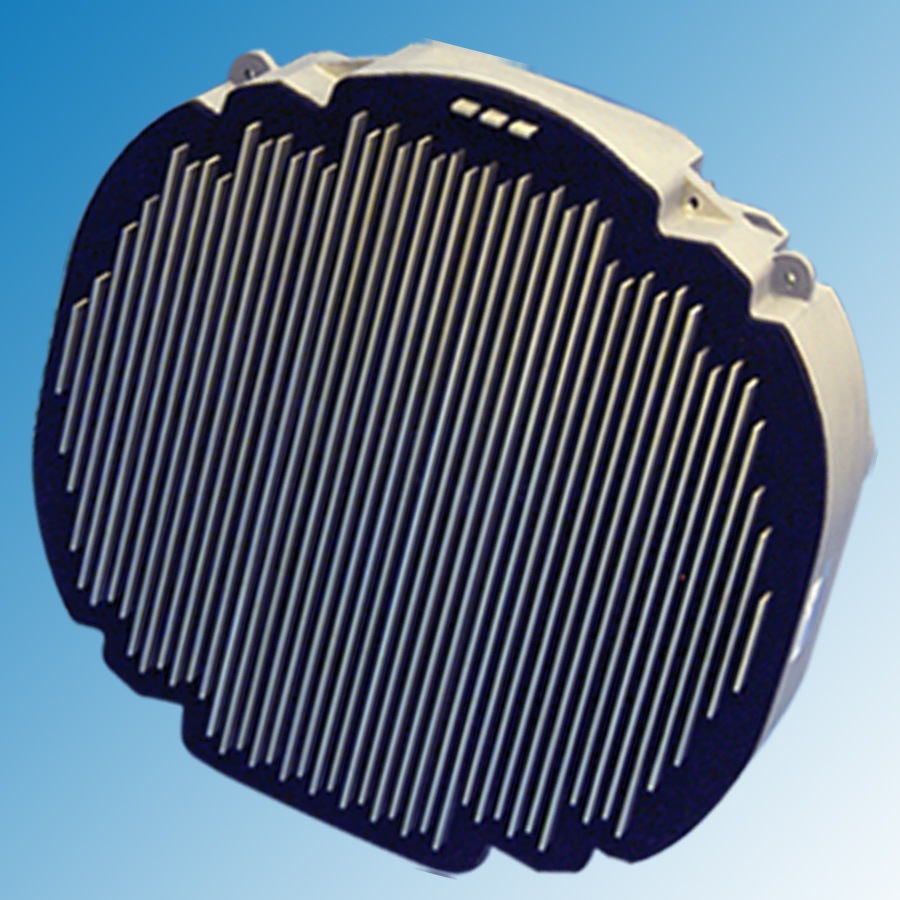
The Desert Falcons’ most significant changes are electronic. Northrop Grumman’s AN/APG-80 AESA radar is the most significant advance, and made the UAE the first fighter force in the world to field this revolutionary new radar technology outside of the USA. Compared to mechanically-scanned arrays like the AN/APG-68v9s that equip advanced American and foreign F-16s, AESA radars like the APG-80 have more power, better range, less sidelobe “leakage,” near-100% combat availability, and more potential add-on capabilities via software improvements. Unlike the APG-68s, the APG-80 can perform simultaneous ground and air scan, track, and targeting, and it adds an “agile beam” that reduces the odds of detection by opposing aircraft when the radar is on.
This last feature is important. Seeing the enemy first remains every bit as significant as it was in Boelcke’s day, but the inverse square law for propagation means that turning on older radar design is like activating a flashlight in a large and dark building. It can be seen much farther away than it can illuminate. An agile-beam AESA radar largely negates that disadvantage, while illuminating enemies who may not have their own radars on.
The Desert Falcons also take a step beyond the standard ground surveillance and targeting pod systems fielded on other F-16s, by incorporating them into the aircraft itself. Northrop Grumman’s AN/ASQ-32 IFTS is derived from its work on the AN/AQS-28 LITENING AT, but internal carriage reduces drag and radar signature, and frees up a weapons pylon. The ASQ-32 can even be used to find aerial targets, allowing passive targeting, and offering a tracking option that radar stealth won’t evade.
A JHMCS helmet mounted display provides parity with the fighter’s most modern counterparts, and displays information from the aircraft’s radar and sensors wherever the pilot looks. Its real advantage is that it creates a much larger targeting zone, which can be fully exploited by the newest air-to-air missiles like the AIM-9X. Avionics improvements round out the enhancements via an advanced mission computer to enhance sensor and weapon integration, a trio of 5″x7″ color displays in the cockpit, etc.
Various advanced electronic countermeasures systems make up the Falcon Edge Integrated Electronic Warfare System (IEWS), which provides both advance warning capabilities and automatic countermeasures release.
Weapons
(click to view full)
F-16s have an extremely wide range of integrated weapons, but Mideast politics has kept some American weapons from the UAE’s hands. Their Desert Falcons won’t carry the same stealthy AGM-158 JASSM long-range, stealthy cruise missiles found on American F-16s, for instance. Nor can they carry the similar “Black Shahine” MBDA Storm Shadow derivatives that equip the UAE’s Mirage 2000 fleet.
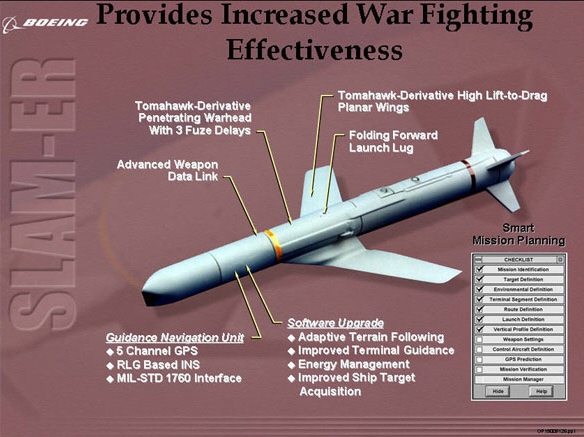
On the other hand, the Desert Falcons’ array of integrated weapons will include medium range, GPS/IIR-guided AGM-84H SLAM-ER cruise missiles that can deliver accurate hits on ships and land targets up to 250 km away. At shorter ranges, stealthy AGM-154C JSOW glide bombs and GBU-39 Small Diameter Bombs give them wide-ranging one-pass attack capabilities against hard targets. In the air, AIM-9X Block II Sidewinder short-range missiles give them over-the-shoulder kill capability, and a combat option that many of the UAE’s neighbors haven’t fielded yet.
Block 60: Political Issues
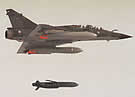
In the course of development, 2 key issues came up with respect to the F-16 Block 60. One was the familiar issue of source code control for key avionics and electronic warfare systems. The other was weapons carriage.
As a rule, the software source codes that program the electronic-warfare, radar, and data buses on US fighters are too sensitive for export. Instead, the USA sent the UAE “object codes” (similar to APIs), which allow them to add to the F-16’s threat library on their own.
The other issue concerned the Black Shahine derivative of MBDA’s Storm Shadow stealth cruise missile. The Missile Technology Control Regime (MTCR) defines 300 km as the current limit for cruise missiles, and the terms of the sale allow the United States to regulate which weapons the F-16s can carry. Since the Black Shahine was deemed to have a range of over 300 km, the US State Department refused to let Lockheed Martin change the data bus to permit the F-16E/Fs to carry the missile.
The Mirage 2000-9 upgrades that the UAE developed with France addressed this issue, giving the UAE a platform capable of handling their new acquisition. As of 2013, UAE F-16E/F fighters will finally receive the SLAM-ER precision attack missile, giving them the shorter-range but very accurate strike capabilities.
Contracts and Key Events
2012 – 2020

July 19/18: Raytheon supports HUD BAE Systems is partnering with Raytheon to support the development of BAE’s Digital Light Engine (DLE) Head-Up Display (HUD). The new digital hub will be integrated on the United Arab Emirates’ fleet of F-16s. Raytheon will design, develop and manufacture the projector for the HUD. HUDs are located immediately in front of the pilot’s line of sight and combine real-time mission critical information with the outside world view. The UAE flies the Block 60 variant of the F-16 which has been described as a lower-budget alternative to the F-35A Joint Strike Fighter. The initial order covers design, flight test and certification of the new computers, with a follow-on production order of 100 systems expected in 2020 and 2021. BAE expects a total of up to 315 units to be ordered through 2028.
February 12/18: Upgrades-HUD Lockheed Martin has selected BAE Systems to modernize the head-up displays on F-16s operated by the United Arab Emirates (UAE). A press release issued by the British aerospace giant said work will see the aircraft’s analogue systems with advanced digital systems by using “cutting-edge Digital Light Engine (DLE) technology to implement a HUD upgrade that integrates seamlessly into the F-16’s existing HUD space, requiring no changes to the aircraft, cabling, or computing. The advancement will remove the outdated cathode ray tube image source and replace it with a digital projector.” DLE technology has already been selected to modernize the F-22 Raptor HUD for the US Air Force. BAE estimates it will reduce life-cycle costs by 20 percent and has four times the reliability of legacy analog systems. Last November, the UAE announced that Lockheed Martin would lead the overhaul of 80 F-16s as part of a $1.63 billion upgrade package.
November 13/17: Upgrades Speaking at the Dubai Airshow, Major General Abdullah Al Sayed Al Hashemi, Chief of the Military Committee and spokesman for the UAE Armed Forces, announced that it will upgrade its 80 F-16 jet fighters as part of a $1.63 billion program agreed with Lockheed Martin. The ministry also announced other deals, including $17.9 million to US-based OTNA INC for Blu-109 ammunition and a $9.5 million agreement with Thales Communications and Security SAS to secure defense communications. Al Hashemi added that the UAE is also interested in procuring the fifth-generation F-35, calling it “an excellent jet,” but did not comment on discussions ongoing with Washington over such a purchase. Fourth generation jets also being looked at by the Emirates include the Sukhoi Su-35, Eurofighter Typhoon, and Dassault Rafale, however, no deals have ever reached completion.
Jan 24/14: 30 more. The US DSCA announces the United Arab Emirates’s official export request for “equipment in support of a Direct Commercial Sale of F-16 Block 61 Aircraft and associated equipment, parts, [and] support….” The DCS purchase doesn’t have to be announced, but this Foreign Military Sale process confirms that they will buy up to 30 F-16 E/F “Block 61” aircraft. The new block number appears to involve a set of small component upgrades over the existing Block 60s, which will be upgraded to the same standard. The UAE’s request includes:
* 40 20mm M61A Guns
* 40 Embedded GPS Inertial Navigation Systems
* Identification Friend or Foe Equipment
* Unspecified “night vision devices”
* Joint Mission Planning System
* Cartridge Activated Device/Propellant Activated Devices, generally used in association with armament hard points and defensive decoys.
* Unspecified “Weapons Integration”
* F110-GE-132 International Engine Management Program-Component Improvement Program
* Site surveys, necessary for the required facilities expansions
* Ferry maintenance and services, incl. aerial refueling support
* Plus spare and repair parts; tools and test equipment; personnel training and training equipment; publications and technical documentation; and other forms of US Government and contractor support.
The estimated cost for these items is up to $270 million, but of course it is only a fraction of the total sale, which has a likely floor price of around $2 billion. Lockheed Martin Aeronautics in Ft. Worth, TX remains the primary contractor for these items, even though several of them aren’t made by the F-16’s builder. Implementation of this sale will require the assignment of additional US Government or contractor representatives, but that will be negotiated after the initial contract is signed. Sources: DSCA #13-60.
DSCA: accessories for 30 more F-16 ‘Block 61s’
Nov 19/13: More coming? Lockheed Martin is professing “near term” optimism concerning an order for 25-30 more F-16s (25 F-16E, 5 F-16F), but it’s clear there won’t be any kind of announcement at Dubai’s air show. American military sales efforts in the region are being complicated by “Smart Diplomacy’s” habit of alienating allies, but a country’s base of installed equipment has to be a major factor in its procurement decisions. We’ll have to see how all of this plays itself out in the UAE. Sources: UAE’s The National, “Lockheed Martin hoping for F-16 fighter jet deal with UAE” and “Challenges in the Middle East for US defence companies”.
Oct 15/13: Weapons. The US DSCA announces the UAE’s formal export request for a variety of new precision strike weapons to equip its F-16E/F Block 60 fighters. The orders could be worth up to $4 billion, and include…
* 300 AGM-84H SLAM-ER cruise missiles. This Harpoon variant adds IIR terminal guidance to GPS navigation, and extended-range wings that let it hit land and sea targets 250 km away. South Korea’s F-15Ks already deploy it, and the US Navy uses its AGM-88K successor, which they consider to be their most accurate strike weapon.
* 40 CATM-84H Captive Air Training Missiles (CATM), with seekers but no motor.
* 20 ATM-84H SLAM-ER Telemetry Missiles for test shots.
* 4 Dummy Air Training Missiles. Sometimes you just need similar weight & form factor.
* 30 AWW-13 Data Link pods. Pilots can receive text, data, and photos from various sources, and can also use it to communicate with the SLAM-ER in mid-flight.
* 1,200 AGM-154C Joint Stand Off Weapons (JSOW). This stealthy 2,000 pound glide bomb uses GPS for navigation and IIR guidance for terminal guidance.
* 10 JSOW CATM.
* 5,000 GBU-39/B Small Diameter Bombs (SDB). These 250 pound JDAM variants can be carried 4 to a rack. GPS guidance and pop-out wings give them decent range and accuracy, and their design makes them more effective against hard targets than their weight would suggest.
* 16 SDB Captive Flight and Load Build trainers.
* 8 SDB Guided Test Vehicles for aircraft integration testing.
* Containers, mission planning, integration support and testing, munitions storage security and training, weapon operational flight program software development, transportation, tools and test equipment, spare and repair parts, publications and technical documentation, personnel training and training equipment, and other forms of U.S. Government and contractor support.
The principal contractors will be Boeing in St. Louis, MO (SLAM-ER, SDB); and Raytheon in Indianapolis, IN; and Raytheon in Tucson, AZ (JSOW). If contracts are negotiated, they’ll need to negotiate the addition of approximately 2-4 additional U.S. Government or contractor representatives to the UAE. Sources: US DSCA 13-48, Oct 15/13 | US DoD, “Hagel, UAE Crown Prince Discuss Regional Security Issues”.
DSCA: Precision strike weapons request
April 21/13: More coming? During visits to the Middle East, Secretary of Defense Chuck Hagel announces a wide range of approved arms buys for Israel, Saudi Arabia, and the UAE. The UAE’s portion includes 25 more F-16E/F fighters, and unspecified “standoff weapons” that are very likely to be Lockheed Martin’s AGM-158 JASSM cruise missiles. Recall that refusal to provide such missiles is what pushed the UAE to create the Mirage 2000-9, and equip it with the Black Shahine derivative of MBDA’s stealthy Storm Shadow competitor.
The potential weapons buy has to be turned into an official request from the UAE, and approved by the US State Department’s DSCA, before they can even begin negotiating a contract. What we can say is that the price will be a lot lower than the “$425 billion” attributed to an unnamed official in the Pentagon’s own release. Dr. Evil, is that you? US DoD.
2007 – 2011

Nov 30/11: The US DSCA announces [PDF] the UAE’s official request to buy 4,900 JDAM bombs for up to $304 million, which breaks out as:
* 304 GBU-54 Laser JDAM kits for 500 pound bombs, with 304 DSU-40 Laser Sensors as well as the GPS/INS tail kit
* 3,000 GBU-38v1 JDAM GPS/INS kits and BLU-111 500 pound bombs
* 1,000 GBU-31v1 JDAM GPS/INS kits and BLU-117 2,000 pound bombs
* 600 GBU-31v3 JDAM GPS/INS kits and BLU-109 2,000 pound Hard Target Penetrator bombs
* 4 BDU-50C inert bombs
* Plus fuzes, weapons integration, munitions trainers, personnel training and training equipment, spare and repair parts, support equipment, and other US government and contractor support.
The weapons are explicitly slated for the UAE’s F-16E/F Block 60 fleet, and are designed to
“help the UAE AF&AD become one of the most capable air forces in the region, thereby serving U.S. interests by deterring regional aggression. These munitions will be used to complement the normal war-readiness reserve stockpile of munitions and provide munitions for routine training requirements.”
DSCA: Weapons
Nov 16/11: What’s up in the UAE? The UAE is either engaged in the mother of all hardball negotiations, or the potential Rafale sale is crashing. Meanwhile, the UAE may be about to cut its planned new jet order and buy more F-16E/F Block 60s, regardless of what happens next. Read “Derailed Denouement in Dubai: What’s Up With the UAE’s Fighter Deal?” for a snapshot.
Sept 22/11: The US DSCA announces [PDF] the UAE’s official request to buy 107 MIDS-LVT/ LINK 16 terminals and associated equipment, parts, training and support. The compact MIDS-LVT assemblies would be installed on its F-16E/F fleet, as well as ground command and control sites, giving its air force a Link-16 network that would help UAE fighters share what they see with each other, and with related forces like American and Saudi AWACS aircraft, similarly-equipped allied fighters, etc.
If a contract is negotiated, it would include the systems, engineering/ integration services, aircraft modification and installation, testing, spare and repair parts, support equipment, repair and return support, personnel training, interface with ground command and control centers and ground repeater sites, and other related elements of program support. The estimated cost is up to $401 million.
The prime contractor is not set; this will be a competition between Data Link Solutions and ViaSat. Implementation of this proposed sale will require the assignment of additional U.S. Government and contractor representatives to the UAE, which will be negotiated if a contract is signed and the program proceeds.
DSCA: MIDS/ Link-16
May 25/11: The US DSCA announces [PDF] a formal request from the UAE to buy support and maintenance for both classified and unclassified F-16E/F aircraft systems and munitions, plus spare and repair parts, publications and technical documentation, support equipment, personnel training and training equipment, ground support, communications equipment, and related forms of U.S. Government and contractor support. The estimated cost is up to $100 million, but the exact price will depend on a contract.
Implementation of this proposed sale may require the assignment of additional U.S. Government or contractor representatives to the UAE. The number and duration will be determined in joint negotiations as the program proceeds through the development, production, and equipment installation phases.
DSCA: Support
April 27/11: Out in India. With existing bids set to expire on April 28/11, India’s MoD reportedly sent letters to Eurofighter GmbH and Dassault, extending the validity of their bids. The net effect of this is that bids from the other 4 contenders will expire on the 28th, removing Lockheed Martin’s F-16IN Block 70, Boeing’s F/A-18E/F, Russia’s MiG-35, and Saab’s JAS-39NG from the competition.
This is significant for the UAE, because they maintain close relations with India, and would have received royalties if the Block 60 derived F-16IN had won a contract. Subsequent analysis indicates that the UAE’s optimization for long-range strike hampered the maneuverability and dogfighting performance that the IAF made its top priority, and there were also concerns about the platform’s ability to continue improving. Read “India’s M-MRCA Fighter Competition” for full coverage.
Loss in India
April 19/11: The US Defense Security Cooperation Agency announces [PDF] the UAE’s formal request to buy 218 AIM-9X Block II Sidewinder short-range air-to-air missiles, another 18 AIM-9X-2 WGU-51/B Tactical Guidance Units, 40 CATM-9X-2 Captive Air Training Missiles (CATMs) without rocket motors, another 8 CATM-9X-2 WGU-51/B Guidance Units, 8 Dummy Air Training Missiles for loading practice and such, plus containers, support and test equipment, spare and repair parts, publications and technical documentation, personnel training and training equipment, and other forms of U.S. Government and contractor engineering and logistics support.
The AIM-9X isn’t a fit for the Hawks or Mirages, so the F-16E/F fleet is their sole realistic deployment option. The UAE already fits earlier-model Sidewinders to its F-16 fleet, and the DSCA doesn’t believe that they’ll have any difficulty absorbing these newer-model missiles. The estimated cost is up to $251 million, but exact amounts must wait until/if a contract is negotiated with Raytheon Missiles Systems in Tucson, AZ.
DSCA: AIM-9X-2 missiles
Feb 22/11: DB-110. At IDEX 2011, the UAE announces a series of contracts, including an AED 297.3 million (about $81 million) order of DB-110 reconnaissance pods from Goodrich, beating competition from BAE Systems.
DB-110s equip a number of F-16 operators around the world. In the UAE’s neighborhood, they have been ordered by Egypt, Morocco, and Pakistan, and Oman and Saudi Arabia have made formal DSCA requests for them. Janes.
Oct 20/10: Goodbye, Tucson. After roughly a decade of F-16 flight and maintenance training with the Arizona Air National Guard, the UAE wraps up their formal training relationship, and flies 5 of its F-16s home. The other 8 fighters on base are scheduled to fly to the UAE in December, along with the squadron’s UAE-owned support equipment. The UAE will now train its personnel in-country, with its own cadre of instructors.
On the American side, Dutch pilots are due to take the UAE’s place, flying F-16 MLU fighters in a much less crowded and restrictive environment than they would face at home. Code One Magazine.
Emirati and American Airmen gathered on the flightline to bid farewell to five UAE-owned F-16E/F Block 60 Desert Falcons as they took off for home. Eight remaining fighters and additional support equipment are scheduled to depart by December.
Dec 28/09: Supporting a fighter extends far beyond delivery, or even maintenance. The US Defense Security Cooperation Agency announces [PDF] the UAE’s request to buy enhanced guided bombs to support “the prior sale of the Block 60 F-16s to the UAE.” The request involves Raytheon’s dual-mode “Enhanced Paveway” bomb conversion kits, which can use GPS and laser guidance. This allows them to bomb through sandstorms, fog, and other obscurants that might obstruct a laser, while retaining the option of improved laser accuracy and the ability to hit moving targets once conditions are favorable. Specific order quantities include:
* 400 BLU-109/Bs: 2,000 pound bombs with penetrator warheads
* 400 GBU-24V 12/B Enhanced PAVEWAY III kits. Paired with BLU-109/B.
* 800 MK-84s: 2000 pound bombs.
* 400 GBU-24V 11/B Enhanced PAVEWAY III kits. Paired with Mk 84 bombs.
* 400 GBU-50V 1/B Enhanced PAVEWAY II kits. Paired with Mk 84 bombs, also referred to as EGBU-10 sometimes.
* 400 MK-82s: 500 pound bombs.
* 400 GBU-49V 3/B Enhanced PAVEWAY II kits. Paired with Mk 82s; 3/B variant uses non-NATO laser guidance codes.
The estimated cost is $290 million, and the principal contractors are the Raytheon Corporation of Waltham, MA, and McAlester Army Ammunition Plant of McAlester, OK. If Congress doesn’t block the sale, and a contract is signed later, the deal could also include containers, bomb components, mission planning software, spare and repair parts, publications and technical documentation, personnel training and training equipment, and U.S. Government and contractor support. Implementation of this proposed sale will require the assignment of additional U.S. Government or contractor representatives to the UAE. The number of U.S. Government and contractor representatives required in UAE to support the program will be determined in joint negotiations as the program proceeds through the development, production, and equipment installation phase.
DSCA: weapons
Aug 22/09: Training. UAE pilots and maintainers begin their first-ever trip to the multinational Red Flag exercise at Nellis Air Force Base, NV, which lasts until Sept 5/09. They will be flying F-16E/F Block 60 fighters from the Arizona Air National Guard’s 162nd Fighter Wing, 148th Fighter Squadron, at Tucson International Airport.
The 148th trains Emirati pilots, which is why some of the UAE’s Desert Falcons are based there. They currently have 9 future pilots in their course. USAF release.
March 10/09: Radar. Aviation Week’s “AESA Radars Are A Highlight of Aero-India” discusses the AN/APG-80 radar’s performance to date with the UAE:
“The proposed F-16IN for India is similar to the E/F and can accept the APG-80, which needs more power and cooling than RACR or SABR, and is lower risk. Northrop Grumman says no APG-80 antennas have had to be repaired, in normal use, since tests started over four years ago. “The antenna will outlast the airframe,” the company says. “A few modules might fail over its lifetime, but they won’t affect performance enough to make it worth unsealing the radome and replacing them.”
Feb 22/09: A Raytheon official confirms that the UAE and the U.S. government have executed a letter of offer and acceptance for 224 AIM-120C7 AMRAAM missiles, to equip the UAE’s F-16E/Fs.
Terms were not disclosed, but the number matches the DSCA sale request of Jan 3/08. Reuters
Oct 1/08: Brazil has decided on the 3 finalists for its F-X2 fighter competition: Boeing’s F/A-18E/F Super Hornet, Dassault Aviation’s Rafale, and Saab/BAE’s JAS-39 Gripen. EADS’ Eurofighter, Lockheed Martin’s F-16BR Block 60+, and Sukhoi’s SU-35 all failed to make the cut. Brazilian FAB release [Portuguese] | Reuters | Boeing release | Gripen International release.
Loss in Brazil
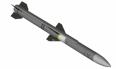
Jan 3/08: Weapons. The US DSCA announces [PDF] the UAE’s official request for a variety of weapons to equip its F-16 E/F Block 60 Desert Falcon fleet, as well as associated equipment and services. The total value, if all options are exercised, could be as high as $326 million.
The principal contractors are the Raytheon Corporation in Waltham, MA (AIM-120, Paveways); Boeing Corporation in St Louis, MO (JDAMs); and McAlester Army Ammunition Plant in McAlester, OK. Equipment requested includes:
* 224 AIM-120C-7 Advanced Medium Range Air-to-Air Missiles (AMRAAM). The C7 is the most recent version in production, but the AIM-120D model just entering service is more advanced.
* 224 Mk84 2,000 pound General-Purpose Bombs
* 200 GBU-31 tail kits for JDAM GPS-guided bombs. These will fit on the Mk84s.
* 450 GBU-24 PAVEWAY III dual laser/GPS guidance kits on Mk84 2,000 pound bombs
* 488 GBU-12 PAVEWAY II laser guidance kits on Mk82 500 pound bombs
* 1 M61A 20mm Vulcan Cannon with Ammunition Handling System
* Plus containers, bomb components, spare/repair parts, publications, documentation, personnel training, training equipment, contractor technical and logistics personnel services, and other related support elements.
Normally, General Dynamics ATP would also be included as a contractor, given the requests for Mk84s and the M61A cannon. The DSCA did not include them, but did say this:
“This proposed sale supports the prior sale of the Block 60 F-16s to the UAE… Several U.S. Air Force pilots and maintenance Extended Training Service Specialists already in the UAE are expected to remain for the next five years and will be able to support this potential sale.”
DSCA: Weapons
1998 – 2007

(click to view full)
June 19/07: Support MoU. Lockheed Martin and Mubadala Development Company (MDC) of the Government of Abu Dhabi signed a memorandum of understanding today to expand their strategic relationship and jointly explore opportunities for military aircraft sustainment, maintenance, repair and overhaul, engineering and technical support in the UAE. Together, Mubadala and Lockheed Martin have identified various military aircraft airframes and engines as a part of a joint MRO business agreement.
A regional support center will be established, and Lockheed Martin will also explore participating with Mubadala in its other aerospace development activity with particular attention to research and development. Mubadala Development Company is a wholly owned investment vehicle of the Government of Abu Dhabi, one of the 7 Emirates in the UAE and the home of most of the country’s fighter fleet. MDC’s mandate is to generate sustainable economic benefits through the development of business ventures related to a wide range of sectors including aerospace and aviation in partnership with local, regional and international investors. Lockheed Martin release.
June 18/07: The US DSCA announces the UAE’s request for:
“United States pilot proficiency training programs and munitions, services and support for F-16 aircraft which includes: 105,000 20mm cartridges, aircraft modifications kits, maintenance, participation in joint training Continental United States (CONUS) pilot proficiency training program, Introduction to Fighter Fundamentals training, F-5B transition and continuation training, fighter follow-on preparation training, participation in joint training exercises, fuel and fueling services, supply support, flight training, spare/repair parts, support equipment, program support, publications, documentation, personnel training, training equipment, contractor technical and logistics personnel services and other related program requirements necessary to sustain a long-term CONUS (CONtinental US) training program.”
Training would take place at Alliance International Airport in Fort Worth, Texas, with the Alliance Aviation Center of Excellence at Fort Worth, TX and Lockheed Martin Simulation, Training and Support also at Fort Worth, TX as the main contractors. If all options are exercised, the agreement could be worth up to $201 million. The Netherlands and Singapore have moved to set up their F-16 pilot training programs in the USA, which offers a lot more space to fly in and combat-seasoned pilots as trainers; this would represent a similar service. This course will go from fighter fundamentals training to a “capstone” course that takes experienced pilots and significantly improves their tactical proficiency.
Introduction to Fighter Fundamentals in Texas is a precursor to F-16 Block 60-transition training, which UAE pilots will receive in Tucson, AZ.
DSCA: Training
July 18/06: A good “slice of life” release for the F-16 program generally can be found in this Lockheed Martin release:
“Most recently – in April – Lockheed Martin achieved a significant production milestone with the delivery of its 4,300th F-16 aircraft that is now in service for Oman, which purchased 12 Advanced Block 50 F-16s in the Peace A’sama A’safiyah (Clear Skies) Program. Clear Skies is a U.S. Government Foreign Military Sales program. The Omani F-16s are just one of six F-16 aircraft programs now in production at the Fort Worth facility. Lockheed Martin is currently producing F-16 aircraft for Chile, Israel, Oman, Poland and the UAE. Greece has also recently placed an order for 30 F-16 aircraft planned for delivery in 2009.”
May 3/05: Delivery. The UAE celebrates the arrival of its first Lockheed Martin F-16E/F aircraft. The first “Desert Falcon” F-16s to be based in the UAE were received by the Crown Prince, His Highness General Sheikh Mohammed bin Zayed Al Nahyan, Deputy Supreme Commander of the UAE Armed Forces. Lockheed Martin release.
1st delivery
Dec 6/03: 1st flight. The F-16F Block 60 completes its first flight successfully.
Aug 27/03: Radar. Northrop Grumman Corporation’s Electronic Systems sector announces delivery of the first AN/APG-80 agile beam AESA radar to Lockheed Martin Corporation for the new F-16 block 60.
Following formal radar acceptance tests in mid-July 2003, the radar was delivered to Lockheed Martin’s Aeronautics Company facility in Fort Worth, TX. The radar will be installed in the first F-16 Block 60 airframe by the end of September. First flight of this aircraft is scheduled for late November 2003. Testing of additional software modes will continue into 2004, using test radars on board the company’s BAC 1-11 test bed aircraft in Baltimore.
July 18/2000: Training. Lockheed Martin Naval Electronics & Surveillance Systems in Akron, OH announces an award from the UAE for an F-16 Block 60 Training System valued at $50 million over 7 years. The WST will serve as the primary training device for the combat-ready pilot to achieve front seat training goals and the ULT shall be the primary training device at the squadron level. This group also produces the U.S. Air Force’s F-16 Mission Training Center, and the Israeli Air Force’s F-15I/AUP Flight and System Trainer.
The UAE’s F-16 Training System, which will include Unit Level and Weapon Systems Trainers, will incorporate many features of the U.S. Air Force F-16 Mission Training Center, also in development by Lockheed Martin in Akron. A demonstration of the Brief/Debrief Station (B/DS) and its unique mission-recording feature was a key element in the win. Weapon Systems Trainers will include a dome-type visual system and the Unit Level Trainers will each have a 150-by-40-degree out-the-window visual system. The Training System’s components will interface via local and long-haul networks, and will interface with UAE’s existing Mirage 2000-9 training systems.
Lockheed Martin NE&SS-Akron will supply a mission observation center, support integration between the F-16 and UAE’s Mirage 2000-9 training systems, and provide performance evaluation, mission scenario engagement, post-mission review and accounting, and a training management information system. Lockheed Martin Information Systems in Orlando, FL, Lockheed Martin Systems Support & Training Services in Cherry Hill, NJ, and French visual system supplier SOGITEC Industries SA will join Lockheed Martin NE&SS-Akron on the 7-year program under subcontract to Lockheed Martin Aeronautics Company in Fort Worth, TX.
March 5/2000: Officials of the UAE and Lockheed Martin announce contractual agreements for 80 F-16 E/F aircraft and associated equipment for an estimated $6.4 billion. The aircraft will be produced by Lockheed Martin Aeronautics Company of Fort Worth, TX. The firm’s release states that:
“The contract solidifies the U.A.E.’s May 1998 selection of the F-16 after a long and thorough process in which the Block 60 aircraft was evaluated against other advanced fighters including the Eurofighter Typhoon, France’s Rafale and Boeing’s F-15E.”
80 F-16E/F Block-60s
Nov 29/98: FlugRevue:
“Matra BAe Dynamics has signed a major contract to supply Mica air-to-air missiles and Black Shahine air-to-ground missiles to the UAE, the Lagardère group said on November 24. The contract was estimated to be worth 12 billion francs ($2.09 billion). Confirmation of the missiles purchase follows last week’s signing of a contract for 30 new Mirage 2000-9 built by Dassault Aviation. The UAE purchase marks the first export sale of the infra-red model of the Mica, which complements an electromagnetic version which Abu Dhabi is also buying. The long-range strike missile, known by its Arabic name Black Shahine, is based on the Apache and Scalp EG stand-off weapon being built for France and the Storm Shadow which will equip Britain’s Royal Air Force.”
The USA’s refusal to let the UAE mount these missiles on F-16E/F fighters would become a source of controversy.
Additional Readings
Background: F-16E/F Desert Falcon & Ancillaries
* F-16.NET – F-16E/F Block 60
* Lockheed Martin – F-16 Fighting Falcon
* Lockheed Martin Code One Magazine, via WayBack (Q3 2003) – UAE Air Force/F-16 Block 60
* Lockheed Martin, via WayBack – F-16 UAE Training System. See also July 18/2000 entry, above.
* Maxwell AFB Air Chronicles PIREP by Capt Gilles Van Nederveen USAF, via WayBack (Fall 2000) – The F-16 Block 60: A High-Tech Aircraft for a Volatile Region
* GE – Model F110-GE-132 Enhanced Fighter Engine
* Northrop Grumman – AN/APG-80 (F-16)
* Northrop Grumman – AN/AAQ-32 Internal FLIR Targeting System (IFTS)
* Northrop Grumman – Falcon Edge Integrated Electronic Warfare Suite (IEWS)
* DID – New Options: Denel & Tawazun’s Precision Weapons Partnership. The Al-Tariq GPS-guided glide bomb. It has been integrated with the Mirage 2000-9 so far, but it’s unlikely to stop there.
News & Views
* UAE’s The National, via WayBack (Sept 29/09) – UAE wants its fighters its own way. In this case, Rafales with uprated engines to 20,000 pounds thrust each, an AESA radar, and integration with MBDA’s Meteor long-range missile. The article also reveals the licensing-for-exports deals associated with the UAE’s funded modifications to the Mirage 2000 and F-16 platforms, which made several hundred million dollars in the Mirage’s case. The deal would pay out if other countries buy a version of the F-16E/F, but Lockheed Martin’s 2012 introduction of a different F-16V upgrade design makes F-16E/F royalties less likely.
* Flight International, via WayBack (Nov 11/07) – Dubai 2007: UAE shows off its most advanced Falcons
* Lockheed Martin Code One Magazine, via WayBack (Q2 2000) – UAE Signs Agreement For Block 60 F-16 Desert Falcon
* Lockheed Martin – F-16IN Super Viper. F-16E/F derivative, competing for India’s order against the Boeing F/A-18 E/F Super Hornet, Dassault’s Rafale, EADS Eurofighter, Russia’s MiG-35, and Saab’s JAS-39 Gripen NG. They eventually introduced the F-16V as a global offering, which may have enough changes in it to sidestep the UAE deal’s provisions re: export royalties.