
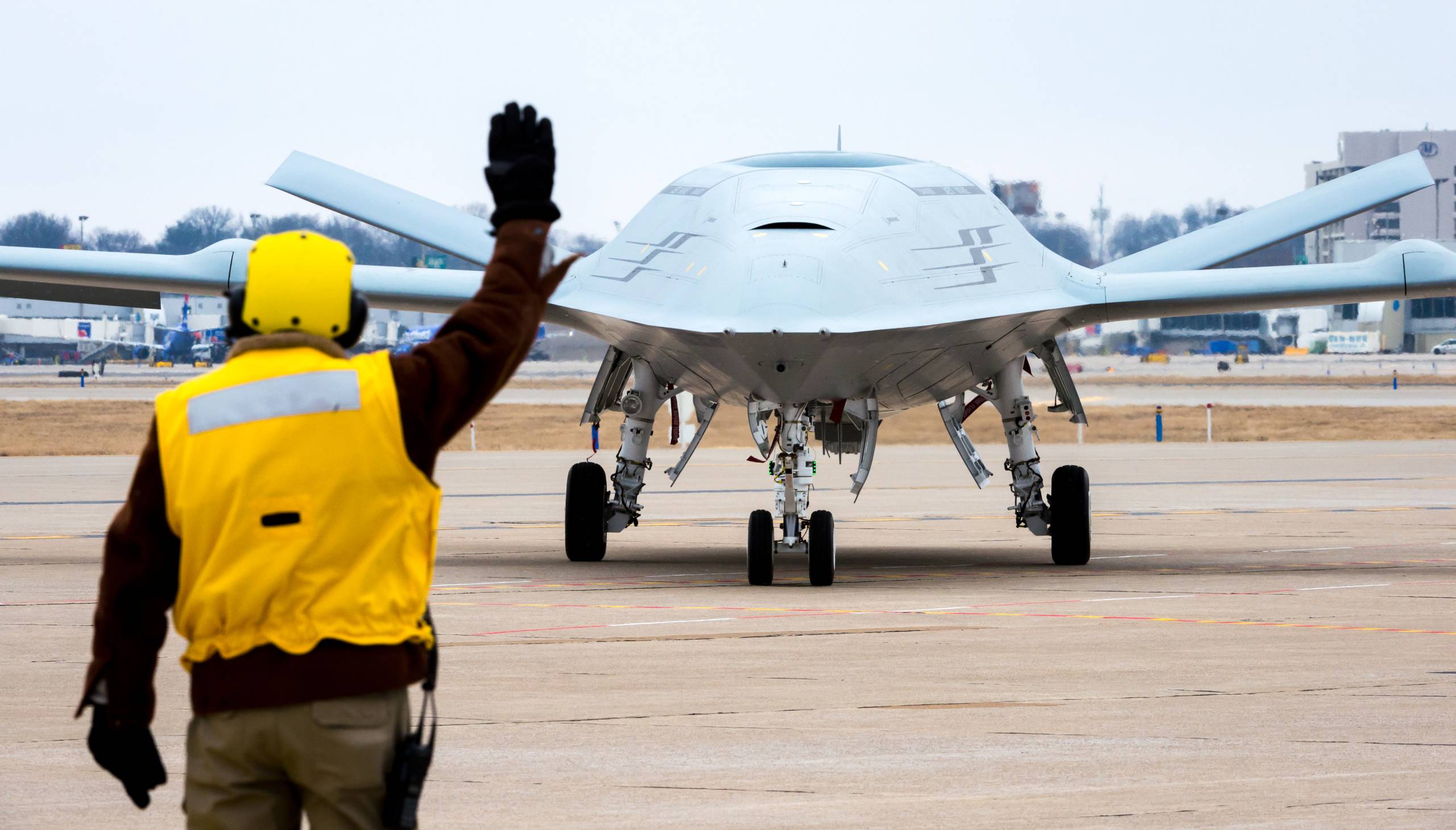

(click to view full)
The idea of UAVs with full stealth and combat capabilities has come a long way, quickly. Air forces around the world are pursuing R&D programs, but in the USA, progress is being led by the US Navy.
Their interest is well-founded. A May 2007 non-partisan report discussed the lengthening reach of ship-killers. Meanwhile, the US Navy’s carrier fleet sees its strike range shrinking to 1950s distances, and prepares for a future with fewer carrier air wings than operational carriers. Could UCAV/UCAS vehicles with longer ranges, and indefinite flight time limits via aerial refueling, solve these problems? Some people in the Navy seem to think that they might. Hence UCAS-D/ N-UCAS, which received a major push in the FY 2010 defense review. Now, Northrop Grumman is improving its X-47 UCAS-D under contract, even as emerging privately-developed options expand the Navy’s future choices as it works on its new RFP.
N-UCAS: Programs & Potential
(click to view full)
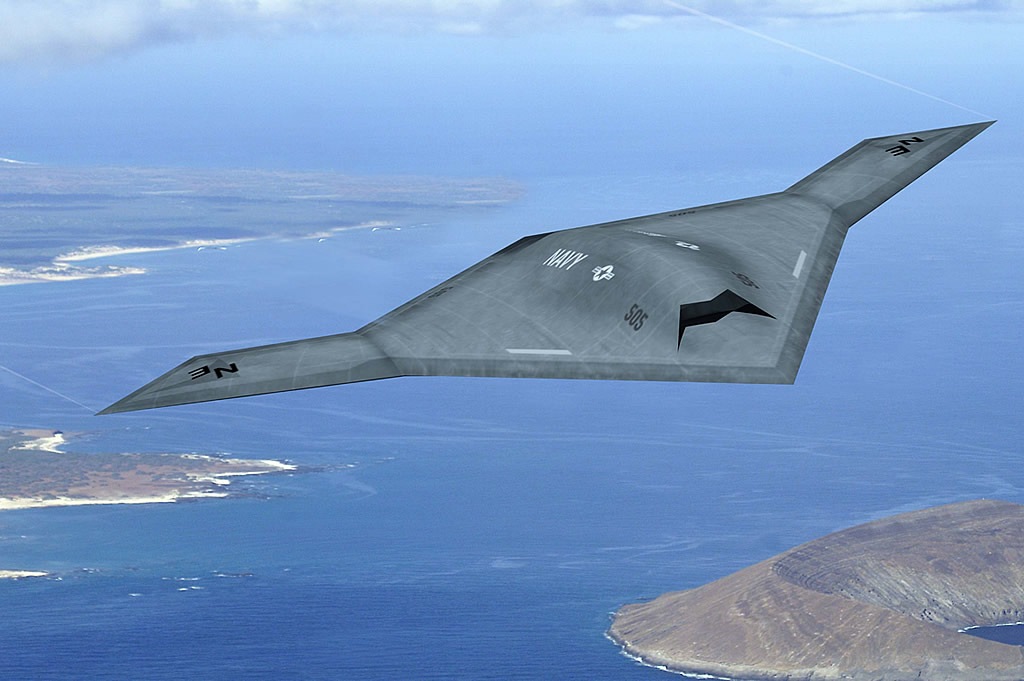
In early 2006 the future of DARPA’s J-UCAS program seemed uncertain. It aimed to create Unmanned Combat Aerial Vehicles (UCAV) for the USAF and Navy that could approach the capabilities of an F-117 stealth fighter. Boeing’s X-45C was set to face off against Northrop Grumman’s X-47B Pegasus, the program had demonstrated successful tests that included dropping bombs, and aerial refueling tests were envisioned. J-UCAS was eventually canceled when the services failed to take it up, but the technologies have survived, and the US Navy remained interested.
Like the F-117, a UCAV’s self-defense would involve remaining undetected. While UCAVs can theoretically be built to execute maneuvers no human pilot could handle, the pilot’s awareness of surrounding events would be quite limited. The X-47B isn’t being designed to do what the type inherently does poorly, but to do what the type does inherently well: be stealthier than manned aircraft, and fly reliably on station for days using aerial refueling support.
If Northrop Grumman or emerging competitors can overcome their technical and operational challenges, and if UCAV reliability lets them match the 2-3 day long mission profiles of Northrop Grumman’s RQ-4 Global Hawks, the US Navy would receive the equivalent of a carrier-borne F-117 stealth fighter, with improved stealth and no pilot fatigue limits. That would open up entirely new possibilities for American carriers.
If aerial refueling support is present behind the front lines, an N-UCAS wing could easily sally forth to hit targets thousands miles from their host carrier, while pilots inside the ship fly in shifts. The X-47s would fly a much shorter distance back to aerial tankers as needed, and only return to the steaming carrier several days later, or when their weapons had been used up. As a concrete example, in an emergency a carrier could launch UCAVs as it left Gibraltar at the gate of the Mediterranean, then fly them to the Persian Gulf and keep them on patrol using USAF aerial refueling tankers, all the while steaming to catch up. As the carrier got closer to the Arabian Sea off of Oman, the UCAVs would get more and more loiter time over their target area, and the “chainsaw” would get shorter and shorter.
First Step: UCAS-D / X-47B

(click to view full)
N-UCAS (Naval Unmanned Combat Air System) is the US Navy’s broader umbrella initiative to define/develop/produce a fleet of unmanned, carrier based strike and surveillance aircraft. The UCAS-D demonstration program is a subset of that initiative. If the demonstrations go well, the Navy may progress to an Unmanned Carrier-Launched Airborne Surveillance and Strike (UCLASS) program.
In July 2007, Northrop Grumman’s X-47B Pegasus beat Boeing’s X-45C to win the UCAS-D development contract. Northrop Grumman’s Aug 3/07 release describes their mission as:
“The UCAS-D effort will mature critical technologies, reduce unmanned air system carrier integration risks and provide information necessary to support a potential follow-on acquisition milestone.”
Translation: show us that this can work, and demonstrate carrier-based launches and recoveries of a tailless, autonomous, “LO-relevant” aircraft. “Low Observable relevant” means that its outer shape must reflect stealth requirements, but without any of the operational stealth coatings and other expensive measures. That makes sense, since UCAS-D is only about aerodynamics and control. Eventually, follow on programs like UCLASS will have to test stealth as well, but UCAS-D will be about the basics.
UCAS-D has 2 big technical challenges. One is safe, reliable flight and landings in carrier-controlled airspace, for a stealth aircraft that may not always be visible on radar. Testing appears to be working, and combined manned/ unmanned evolutions have begun. The other big challenge is successful and safe aerial refueling.
Next Step: UCLASS
[youtube:v=fSY3VxdSz5s]
Northrop Grumman’s UCAS-D team hopes that by completing the UCAS-D funded demonstration phase, they’ll be able to offer an inherently conservative service a proven UCAV option, with a more complete set of advanced capabilities than privately-developed or late-moving competitors.
The USA’s Naval Aviation Master Plan currently includes provisions for a Navy UCAS (N-UCAS) around 2025. If UCAS-D work goes very well, and the US Navy follows through on its shift toward an X-47B-class UCAV that can be used for limited missions, pressure will build for much earlier deployment. There are already indications of pressure along those lines, and the UCLASS RFI sets a goal of fielding a limited capability UCAV on board American carriers by 2018 or so.
Barring continued and substantial pressure from above, however, the level of cultural shift required by the naval aviation community is likely to slow down any deployment of advanced UCAVs on board ships. That is already happening to UCLASS, which has seen its strike role shrink while the Navy publicly talks about making surveillance its main mission. That would be less threatening to future manned aircraft programs, but it may not be the best use of UCAV technology, and the Navy is already finding itself at odds with Congress on this score. A priority on surveillance also shrinks the need for stealth, which would give General Atomics’ conventional airframe design a big advantage over its 3 tailless flying wing competitors.
[youtube:v=v0dHKWjXn-E]
click for video
If and when the US Navy proceeds with a full Unmanned Combat Air Vehicle deployment program, the X-47 will have competitors. The 3 additional recipients of initial UCLASS study contracts include:
General Atomics. They were the first competitor out of the gate, expanding their jet-powered Predator C “Avenger” research program to include a carrier-capable “Sea Avenger” as well.
Boeing. Boeing already makes F/A-18 Super Hornet naval fighters, and their privately-developed X-45 Phantom Ray UCAV stems from the same DARPA J-UCAS program that produced the X-47B UCAS-D. Northrop Grumman designed their X-47B for carrier operations from the outset, but Boeing developed their X-45C without those compromises, so carrier operations will require added work.
[youtube:v=9Em14UbNUeA]
click for video
Lockheed Martin. This concept comes out of their famed Skunk Works facility, which produced planes like the F-117 Nighthawk stealth fighter. Their work also builds on internal efforts like Polecat UAV, and classified programs like the RQ-170 UAV. They also seem to be making a push to leverage their strength in back-end command and control systems as a selling point, while partnering with control system specialist DreamHammer.
UCAS-D: Program & Team
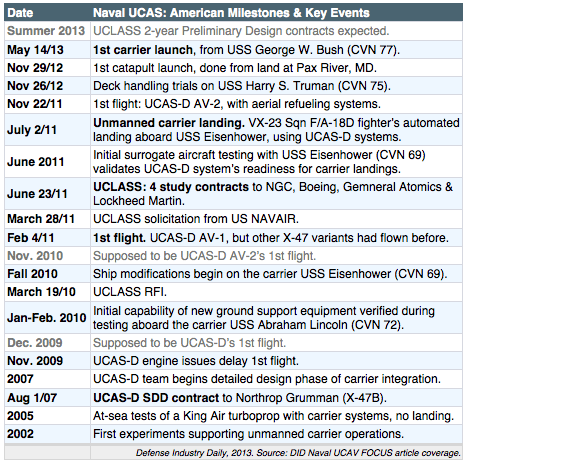
The first X-47B Pegasus UCAS-D (AV-1) was scheduled to fly in December 2009, but that was pushed back to Q1 of CY 2010, and finally ended up taking place in February 2011. It conducted series of detailed flight envelope and land-based carrier integration and qualification events at Edwards AFB, CA, then returned to NAS Patuxent River, MD to begin land-based carrier landing trials.
AV-2, which is equipped with full refueling systems, was expected to make its first flight in November 2010, and begin testing autonomous aerial refueling (AAR). Early 2011 saw the AV-2 airframe pass static and dynamic load tests, but AV-2’s flights were delayed until AV-1 finishes its own tests, in late 2011, and didn’t take off until November 2011. It began carrier-related testing in 2012, and launched for the 1st time in May 2013. Full launch and landing circuits, and aerial refueling tests, are still on the horizon.
Its first landing was initially set for late 2011, but the firm now talks about some time in 2013. Once autonomous aerial refueling demonstrations begin, the Navy intends to achieve both probe & drogue (USN style) and boom/receptacle (USAF style) refuelings.
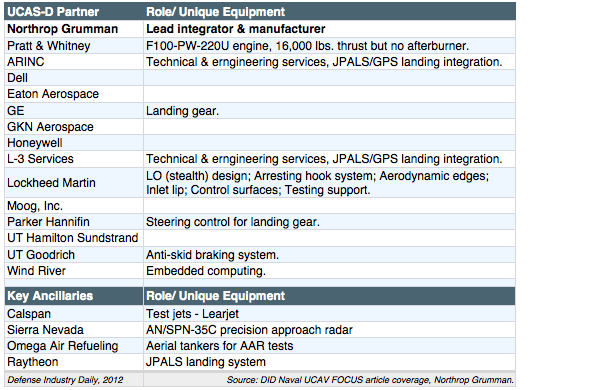
Northrop Grumman’s facility in Palmdale, CA is the final assembly site for the X-47B, and the industrial team also includes:
UCAS-D: Northrop Grumman’s X-47B
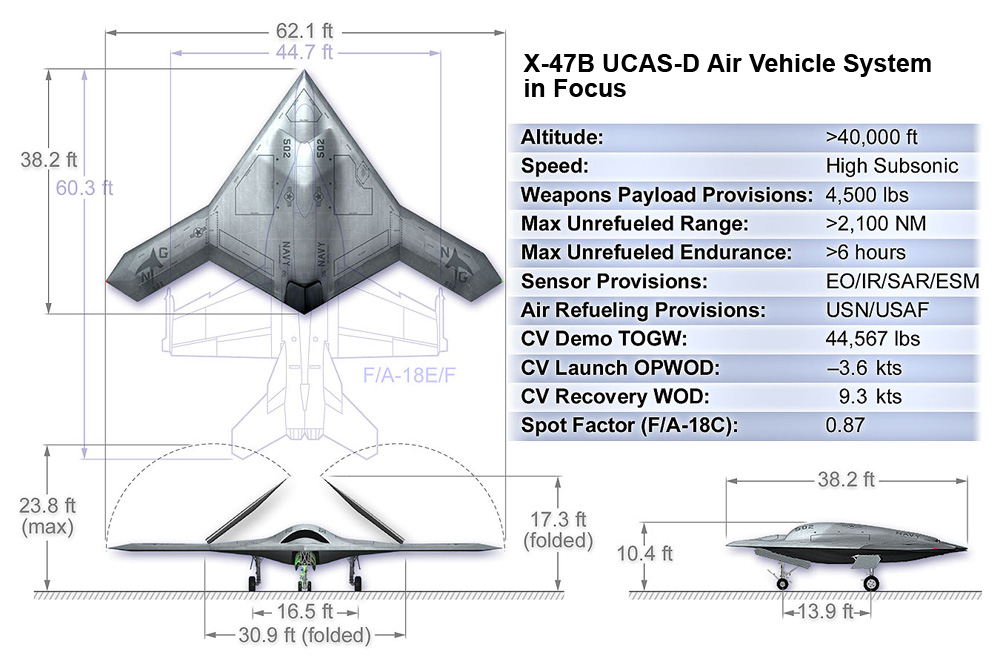
(click to view full)
UCAVs currently have no real situational awareness of the airspace around them, which makes them sitting ducks for any attack that doesn’t use radar guidance, and isn’t picked up by their radar warning receivers. Even an alerted UCAV currently has few options but to try and change course. That may work against ground threats, but mobile aerial opponents will simply follow and kill them. Their best defense is not to be found. Their best option if found is to make it hard to keep a radar track on them, or to vector in enemy aircraft. This may be why high-end strike UCAVs like the Boeing X-45 Phantom Ray, European nEUROn, British Taranis, and Russian MiG SKAT all use the maximum stealth configuration of tailless subsonic blended wing bodies with shielded air intakes, and attenuated exhausts.
The X-47B’s modified flying wing design and top-mounted air intake reflect this orientation. By removing the pilot and opting for sub-sonic speeds, Northrop Grumman is able to field a design that looks like a more advanced version of its B-2 bomber. Instead of a straight flying wing like Boeing’s competing X-45C, however, their engineers opted for a cranked wing that improves landing characteristics on carrier decks, and makes it easy to use carrier-borne aircrafts’ classic “folding wing” design for improved storage in tight spaces.
This UCAV may be a short plane, but it’s not a small one. The X-47B’s 62.1 foot wingspan rivals the Navy’s old F-14s, and is wider than a Navy F/A-18 Hornet or even a larger Super Hornet. Because of its foreshortened length, however, its storage “spot factor” relative to an F/A-18C Hornet (“1.0”) is just 0.87.

(click to view full)
Pratt & Whitney Canada JT15D-5C turbofan engine powered previous X-47 models, but the UCAS-D will adopt Pratt & Whitney’s F100-PW-220U, a modified variant of the engine that powers American F-16 and F-15 fighters. Subsonic requirements and carrier-based employment changed the engine’s imperatives: it will produce less thrust than its F100 counterparts (just 16,000 pounds), in exchange for efficiency improvements and better protection against the corrosive salt-water environment.
Efficiency matters to this platform. Unrefueled X-47B range is expected to be between 1,500 – 2,100 nautical miles, with a maximum payload of 4,500 pounds. The standard payload is expected to be a pair of 2,000 pound JDAMs, but the weapon bay’s ultimate size and shape will determine its ability to carry other options like strike missiles, JSOW glide bombs, a pair of 4-bomb racks for the GPS-guided Small Diameter Bomb, the forthcoming Joint Air-Ground Missile, etc.
Sensors are currently to be determined, as they aren’t really the point of UCAS-D. Any Navy strike platform is expected to have an advanced SAR radar with Ground Moving Target Indicator (SAR/GMTI), conformal electro-optic day/night cameras, and ESM (Electronic Support Measures) equipment that helps it pinpoint and trace back incoming electromagnetic signals. Given the X-47B’s design’s inherent strengths of stealth and long endurance, additional modules or payloads for tasks like signals collection must surely be expected.
Naval UCAVs: Contracts and Key Events
See also “Boeing to Advance UAV Aerial Refueling” for background and updates regarding unmanned aerial refueling test programs in the US military – which now include UCAS-D/ N-UCAS.
Unless otherwise indicated, The Naval Air Systems Command Patuxent River, MD manages these contracts.
FY 2016 – Today
February 15/24: BAE Systems has inked a deal with Boeing to equip the US Navy’s MQ-25 Stingray aerial refueling drone with a new vehicle management system computer (VMSC). The upgrade will see quad-core processors installed onto the aircraft, optimizing its size, weight, and power footprint and allowing for future capability growth and reduced operational costs.
November 22/23: Design Review Boeing won a $36 million modification, which adds scope to provide non-recurring engineering for the preliminary design review of six sub-systems to mitigate component obsolescence in support of MQ-25 Stingray low-rate initial production for the Navy. The MQ-25 Stingray is an unmanned aircraft designed for aerial refueling. The MQ-25 Stingray is developed to support and enhance the capabilities of military aviation, allowing aircraft to operate for longer durations and cover larger distances without needing to land for refueling. Work will be performed in Endicott, New York; Saint Louis, Missouri; Cedar Rapids, Iowa; Clearwater, Florida, San Diego, California; and Melbourne, Florida and is expected to be completed in April 2024.
August 1/22: Navy Boeing won a $57.7 million order, which provides for the procurement of various initial spares and repair equipment in support of the MQ-25A Stingray air vehicle for the Navy. Work will take place in Missouri and Indiana. Expected completion is in July 2025.
June 23/22: Export Jane’s reports that Boeing sees foreign partners as potential customers for its updated MQ-25A Stingray drones. The MQ-25 UAV is designed to refuel carrier-based aircraft. The UK, France, and Italy are among allies with aircraft carriers. However, the UK’s Queen Elizabeth-class carrier uses a ski-jump capability, which the MQ-25 design does not support.
December 22/21: Carrier Test The US Navy and Boeing have successfully maneuvered the T1 test asset on an aircraft carrier for the first time – an early step forward in ensuring the MQ-25 unmanned aerial refueler will seamlessly integrate into carrier operations. During a demonstration aboard the USS George H.W. Bush (CVN 77), Navy flight deck directors used standard hand signals to direct T1 just like any other carrier-based aircraft. Instead of a pilot receiving the commands, however, it was a Boeing MQ-25 Deck Handling Operator (DHO) who commanded the aircraft using a new handheld deck control device.
November 25/21: Ground Testing The MQ-25 has been undergoing ground testing at Naval Station Norfolk as the unmanned aircraft prepares to embark on board an aircraft carrier next month. The MQ-25 Stingray introduces unmanned aerial refueling and intelligence, surveillance and reconnaissance capabilities to the air wing that will extend the range, operational capacity and lethality of the Carrier Air Wing and Carrier Strike Group.
October 28/21: DCD SECO has successfully tested a new deck control device (DCD) to be used for controlling the MQ-25 on aircraft carrier flight decks. The device was successfully tested earlier this month during a multi-day demonstration featuring Navy and Boeing personnel simulating carrier-based operations at MidAmerica St. Louis Airport.
June 15/21: Drone Refuels Aircraft The American MQ-25 programme has successfully conducted the first ever aerial refueling operations between a crewed receiver aircraft and an uncrewed tanker. According to the US Navy, the successful flight “demonstrated that the MQ-25 Stingray can fulfill its tanker mission using the Navy’s standard probe-and-drogue aerial refueling method”.
December 31/20: Ground Control Boeing won a $198 million contract modification, which provides for the integration of a ground control station that provides command and control capability in support of the MQ-25 air vehicle for the Navy. The Boeing MQ-25 Stingray is an aerial refueling drone. In early December Boeing has flown its MQ-25A test asset (T1) with an aerial refuelling store under its wing for the first time. Earlier this year the US Navy exercised an option to acquire three additional MQ-25 air vehicles, bringing the total aircraft Boeing is initially producing to seven. The Navy intends to procure more than 70 aircraft, which will assume the tanking role currently performed by F/A-18s, allowing for better use of the combat strike fighters. Work will take place in Missouri and various locations within the continental US. Expected completion will be in August 2024.
November 3/20: Environmental Assessment The US Navy prepared a draft environmental assessment for home-basing of the MQ-25A Stingray carrier-based unmanned air system at Naval Base Ventura County in Point Mugu, California. The Stingray is an aerial refueling drone. It will serve as a tanker capable of refueling aircraft in flight. The Stingray will also be capable of conducting intelligence, surveillance, and reconnaissance operations. The drone first flew on September 19, 2019. Boeing is developing the MQ-25. According to the company, will „provide the needed robust refueling capability thereby extending the combat range of deployed Boeing F/A-18 Super Hornet, Boeing EA-18G Growler, and Lockheed Martin F-35C fighters“. According to the draft released by the USN, the Stingray will fly approximately 960 flights annually at Point Mugu. The home basing will bring 730 personnel and their family members to the base. A new hangar will be constructed northeast of the base with two taxiways to link to the existing Taxiway B.
July 4/19: MD-5A Frequentis Defense won an $8.5 million firm-fixed-price contract for the MD-5A Unmanned Carrier Aviation Mission Control System, which will support the MQ-25 Stingray drone. The deal provides non-recurring engineering and logistics for the design, development, test, manufacture and repair of the system. The integrated computer system will transport voice communications from carrier-based air vehicle operators to local audio switches, local radio terminals and remote radio terminals. The MQ-25 is the Defense Department’s first aircraft carrier-based unmanned air vehicle. Frequentis will perform work in Columbia, Maryland, and is expected to be finished by March 2021.
June 18/19: Vehicle Management Boeing decided on BAE Systems to supply vehicle management systems for its MQ-25 unmanned aerial aircraft. BAE Systems said in a press release on Monday, that its „Vehicle Management Control System will control all flight surfaces and perform overall vehicle management duties for the MQ-25 unmanned aerial vehicle“. Boeing is developing the MQ-25 Stingray unmanned tanker for the US Navy. It is the Navy’s first operational carrier-based unmanned aircraft and will provide a necessary refueling capability. The USN wants MQ-25 to have initial operational capability by 2026. A MQ-25A prototype, known as a T-1 or Stingray, is expected to take its first test flight later this year. The drones will be based on the Boeing F/A-18 Super Hornets, Boeing EA-18G Growlers and Lockheed Martin F-35C fighters.
December 21/18: Stingray development Boeing is receiving additional funding to continue research on the MQ-25 Stingray. The contract modification is valued at $90.4 million and is expected to be completed in August 2024. Under the contract, Boeing will perform a number of studies and analysis related to the engineering, manufacturing and development phase of the MQ-25 Stingray. The Stingray will be the Navy’s next ‘Group 5’ aircraft. With its implementation the US Navy seeks to close the gap with between UAS and manned aircraft by adding a system that is designed from the outset to operate within meters or less of large manned aircraft. The UAV will have the capacity to carry 15,000 pounds of fuel and will be used to refuel the F/A-18 Super Hornet, EA-18G Growler, and F-35C fighter jets, extending their range and time in the air significantly. Work will be performed at Boeing’s factory in St. Louis, Missouri.
April 18/18: GA unveils deck handling controls Images and video posted by General Atomics have shown a demonstration of the aircraft carrier deck-handling controls for its MQ-25 Stingray unmanned tanker bid by using a pair of motion-sensing director wands and an Avenger unmanned aerial vehicle as a stand-in for its yet-to-be-built prototype. According to the firm, the specially designed director wands are the same size, shape and weight as those used on aircraft carrier decks to direct manned aircraft, such as the F/A-18 Super Hornet. According to Flight Global, General Atomics’ wands use proprietary gesture recognition algorithms to identify standard hand movements, as designated by Naval Air Training and Operating Procedures, and then translates and sends those commands to the MQ-25 air vehicle. They allow directors to fully control aircraft taxi operations on deck using the wand, including lowering and raising the launch bar, spreading and folding the wings, and raising the arresting hook. Rival MQ-25 bidders Lockheed Martin and Boeing have yet to reveal their respective deck handling control tech.
April 11/18 Lockheed drops its industry team Lockheed Martin has unveiled its industry team that, if selected by the US Navy, would develop the MQ-25 Stingray unmanned aerial tanker, company execs released Monday. Suppliers of equipment intended to be used include General Electric’s F404 turbofan engine—used on the F/A-18 Super Hornet—United Technologies—who supply the landing gear found on the F-35C—while Triumph Aerostructures will manufacture the internal structure of the drone. While Lockheed seems to be relying on equipment used on legacy airframes, it may have taken the most risk in its design, putting out a tanker drone concept that doesn’t look much like its competitors. When the Navy rejigged its requirements from a drone that could take on the ISR and strike missions to that of just an unmanned mission tanker, Lockheed threw out is previous design while competitors such as General Atomics and Boeing heavily reused theirs. Furthermore, since Northrop’s retirement from the competition last year, Lockheed is also the only competitor offering a flying wing aircraft as both General Atomics and Boeing have notably put forward wing-body-tail aircraft. The Navy plans to pick an MQ-25 vendor this summer, and will award a contract for the four engineering and manufacturing development aircraft, with an option for three more test assets.
March 12/18: Boeing talks to Aviation Week In an exclusive interview with Aviation Week, Boeing Phantom Works’ MQ-25 Stingray team has spilled some beans on the firm’s effort for the US Navy’s unmanned aerial tanker and its plans to win the contract. Dubbed the T-1 by the firm, the aircraft had been rolled out as early as 2014 but had been kept out of view until December 2017’s teaser reveal on Twitter. The mission tanker contract for which Boeing, Lockheed Martin and General Atomics are all competing for is a fixed-priced award for the development and construction of the first four aircraft. The Navy hopes to purchase up to 72 operational models for carrier deployment and achieve initial operational capability, expected by 2026.
February 15/18: GA’s Industry Partners—Navy talks FY2019 funding The US Navy has pushed initial operational capability (IOC) of the MQ-25 Stingray unmanned aerial tanker into 2026, rather than the rapid acquisition initially planned for 2020. Service officials told a Fiscal Year 2019 budget briefing on Monday that they plan to spend $719 million on research and development for the MQ-25A and now anticipates purchasing the first four aircraft in 2023. Meanwhile, Boeing has been listed by General Atomics Aeronautical System (GA-ASI) as part of its industry team of suppliers entering the Stingray program. The announcement comes after Boeing’s Phantom Works unit revealed before Christmas, its own fully assembled MQ-25 ground test vehicle at its St Louis facility, and the firm maintained that acting as both a prime bidder and a member of the General Atomics team “is good for our customer and reflects our focus on doing what’s necessary to compete, win and grow.” Other suppliers listed by GA-ASI include: Pratt & Whitney for its engines; UTC to design and build the landing gear; L3 Technologies for communications; BAE Systems for software capabilities, mission planning, and cybersecurity; Rockwell Collins for advanced navigation technologies, a new generation of the TruNet ARC-210 networked communications airborne radio and a comprehensive simulation framework; and GKN Aerospace’s Fokker for landing gear technologies.
January 9/18: Boeing Prototype—FAA Registration The Federal Aviation Administration (FAA) has awarded Boeing’s MQ-25 Stingray demonstrator a US aircraft registration, the firm has told Flight Global. The unmanned carrier-based mission tanker prototype, dubbed T1, was unveiled by Boeing on Twitter onDecember 16, and received the registration number, N234MQ, from the FAA on December 26. However, several details usually included, such as the model of the turbofan engine that powers the aircraft, were omitted from the registration. The deadline for bids to the MQ-25 Stingray program were due on January 3, with General Atomics and Lockheed Martin joining Boeing in the competition. While Boeing have been dripping information on their prototype, Lockheed Martin has released only a fragment of its MQ-25 concept aircraft, showing only part of the underside of a wing and a refueling pod.
December 21/17: Prototype Unveiling After a week of teasing its release, Boeing’s Phantom Works unit revealed Tuesday its prototype that will be entered into the US Navy’s MQ-25 Stingray unmanned aerial tanker program. A photograph of the aircraft facing the camera released by the firm shows that Boeing have incorporated a wing-body-tail design, diverting from the original flying wing design it considered putting forward to the precursor of the MQ-25 program—when the Navy prioritized strike and ISR capabilities over mission-tanking for its first carrier-based drone. Engine runs will be conducted before the end of the year, with deck handling demonstrations to follow in the new year. During the demo, prototype operators will taxi the aircraft via remote control and move it within the confines of the deck, as well as validating that the aircraft will engage the launch bar of a catapult. Boeing said first flight will take place when the engineering and manufacturing development contract is awarded.
October 30/17: Northrop Grumman has pulled out of the US Navy’s MQ-25 Stingray unmanned refueler competition. Despite being the company who developed the test platform that proved a UAV could take off and land from an aircraft carrier, CEO Wes Bush cited the Navy’s requirements in the request for proposal issued earlier this month as the reason for the firm’s forfeiture from the race, noting “if you can’t really execute on it and deliver on it to your customer and your shareholders, then you’ve done the wrong thing.” That leaves Boeing, Lockheed Martin and General Atomics still in the race.
October 12/17: US Naval Air Systems Command has released the final request for proposals (RFP) to industry for the unmanned MQ-25 Stingray unmanned aerial tanker. Lockheed Martin, Boeing, Northrop Grumman and General Atomics were all issued the RFP to compete for the air segment of what will be the Navy’s first operational carrier-based unmanned aerial vehicle ahead of an anticipated contract award by September of next year. Basic requirements will have the Stingray deliver about 15,000 pounds of fuel 500 nautical miles from the carrier, with a mission of alleviating the strain on the existing F/A-18E/F Super Hornets that are burning through flight hours while serving as a refueling tanker for other aircraft attempting to land on an aircraft carrier.
September 04/17: The US Navy has said that the inclusion of the MQ-25 Stingray unmanned tanker on its aircraft carriers will extend the range of its carrier-borne fighters by 300 to 400 nautical miles. It is expected to be able to carry 15,000 pounds of fuel at 500 nautical miles from the carrier to the air wing’s strike fighters and capable of refueling between four and six aircraft at range. Navy brass expect the first MQ-25 to be flying mission tanking operations as early at 2019.
July 24/17: A new draft request for proposals released by the US Navy has revealed that the service’s plans for the MQ-25 Stingray will be primarily that of a mission tanker. The draft, published on July 19, made no mention on the unmanned platform’s intelligence, surveillance and reconnaissance (ISR) capabilities, instead outlining the two key performance parameters (KPP) required for the aircraft’s airframes as having both carrier suitability and mission tanker capacity. As a result, the four competitors – Northrop Grumman, Lockheed Martin, Boeing and General Atomics – will only have to prove that their aircraft can take-off and land back on a carrier and do mission tanking.
June 15/17: US Navy aircraft carriers, the USS Dwight D. Eisenhower (CVN 69) and USS George H.W. Bush (CVN 77), will be the first vessels to carry the MQ-25A Stingray, the service’s upcoming unmanned aerial refueling tanker. Both carriers will receive upgrades to include the control stations and data links needed to control the tanker, and while no date for the upgrades have been set, it is believed that Chief of Naval Operations Adm. John Richardson intends to accelerate the deployment of the Stingray and get it on carrier decks as early as 2019. News of the first carriers set for the MQ-25A introduction comes as the Navy decided to reprogram $26.7 million for control systems and data link installation the MQ-25A will need to operate from an aircraft carrier, taking that money from the USS George Washington (CVN-73) during its four-year midlife refueling and complex overhaul (RCOH) in the Fiscal Year 2017 budget.
May 31/17: The US Naval Air Systems (NAVAIR) Command will soon issue a solicitation for engineering, manufacturing and development (EMD) to Boeing, General Atomics, Lockheed Martin and Northrop Grumman. NAVAIR also intends to release a solicitation to those companies for an accompanying contract for studies and analysis supporting the MQ-25 Stingray EMD program. The concepts coming out of the EMD phase are expected to take a stark departure from the preliminary designs, which industry created to support the navy’s original requirement for a stealthy, carrier-launched surveillance and strike aircraft (UCLASS). Such changes include dropping the initial requirement for strike capabilities but will retain surveillance capabilities with the inclusion of a 19-23in-diameter forward looking infrared sensor turret.
March 23/17: The US Navy’s MQ-25A Stingray unmanned aerial tanker is likely to have a wing-body-tail design after Lockheed Martin’s Skunk Work division found that a flying wing design is not the best aerodynamic shape for the service’s latest requirements. While the Navy had initially intended a surveillance and possible strike capability for the aircraft, the current requirements suggest a strong emphasis on a tanking role and less on ISR. As a result, competing firms Lockheed Martin, Northrop Grumman, General Atomics and Boeing are likely to redesign their bids for the competition.
October 24/16: Four companies have been awarded contracts by the US Navy to conduct risk reduction work on their designs for the MQ-25 Stingray. Boeing, General Atomics Aeronautical Systems and Lockheed Martin received contracts for $43 million each while Northrop Grumman received $35.8 million. The risk reduction work will see the companies alter previous designs of the MQ-25 as an unmanned strike bomber to fit its new role as an aerial tanker under the carrier-based air refueling system (CBARS) program.
September 27/16: Contracts worth $43 million each have been doled out to Lockheed Martin and Boeing in order “to conduct risk reduction activities in support of the MQ-25 unmanned carrier aviation air system.” Both companies are expected to complete their work on the UAV by October 2017. Now known as the Stingray program, the UAV integrates the first operational, carrier-based, catapult-launched drone and will provide long-endurance ISR and organic refueling capabilities for the carrier air wing.
August 22/16: Contractors aiming to secure deals in relation to the Navy’s MQ-25A program have been given vague hints at what the service is expecting. Hopefuls looking to secure a slice of the action have been told they need to get that “sweet spot” between supporting mission tanking and intelligence, surveillance and reconnaissance (ISR) missions. Born out of the scrapped Carrier-Based Aerial Refueling System (CBARS) program, the MQ-25 Stingray looks to include higher endurance for ISR capabilities in addition to just refueling. A lot of food for thought for those looking to get involved, but at least the initial “stealth tanker” concept has been shelved, for now.
July 19/16: While speculation over its name has been floated for some time, the US Navy’s first carrier unmanned aerial vehicle has been officially named. Known as the Carrier Based Aerial Refueling System (CBARS) program, the service’s Material Command has now designated the aircraft MQ-25A with the name “Stingray.” Initially conceived as a low observable lethal, and deep penetrating strike platform, the MQ-25A will now focus on refueling with some ISR capabilities and followed up with later weapons installation.
May 4/16: The US Navy is expected to release a risk-reduction request for proposals (RFP) for its MQ-25 Stingray program this summer. This will help set out the timeline in which the service can realistically expect the tanker system to be deployed on-board its carrier fleet. It is expected that this will be followed by an engineering, manufacturing and design RFP in early FY2017. Boeing, General Atomics Aeronautical Systems, Lockheed Martin, and Northrop Grumman all have designs they were going to pitch for UCLASS, and are expected to modify them for the Stingray’s new role.
March 30/16: The US Government Accountability Office (GAO) has published its annual report on the the Navy’s Unmanned Carrier-Launched Airborne Surveillance and Strike (UCLASS) program, as authorized by the National Defense Authorization Act for Fiscal Year 2014. By analyzing the DOD budget for FY 2017 and speaking to program officials, the GAO found that the U.S. Navy has begun to develop modifications to existing shipboard systems to support the UCLASS’ latest iteration – Carrier Based Aerial Refueling System (CBARS). As with the UCLASS program, CBARS will include an air system segment, an aircraft carrier segment, and a control system and connectivity segment.
March 16/16: The US Navy has announced plans to “descope” the stealth requirement from the development carrier-based aerial system (CBARS). This will allow the tanker to be capable of firing missiles and dropping munitions. Dubbed the MQ-25 Stingray, the descoping marks yet another alteration to the program which had initially started out as the Unmanned Carrier Launched Airborne Surveillance and Strike (UCLASS) program before a drastic U-turn took it away from ISR activities to that of refueling role. However, according to Vice Adm Joseph Mulloy, deputy chief of naval operations for integration of capabilities and resources, the addition of greater weapons capabilities will not see the Stingray spying, with destroying targets and refueling remaining its main mission.
March 7/16: The decision to convert the Unmanned Carrier Launched Airborne Surveillance and Strike (UCLASS) program to an aerial refueling tanker under the Carrier Based Aerial Refueling System (CBARS) may require a new competition. Michael Novak, the Deputy Director of the Unmanned Maritime Systems Office under the office of the Chief of Naval Operations said that higher ups in the Pentagon were considering the change to allow all four companies that participated in the earlier UCLASS competition to be able to refine their proposals and “hit the mark for the CBARS.” The decision rests with the Office of the Secretary of Defense (OSD) on what the next step for the tanker will be.
February 2/16: Initial plans to have the US Navy’s latest unmanned jet weaponized seems less likely, as plans seem to have shifted towards a tanker role. The long deferred Unmanned Carrier-Launched Airborne Surveillance and Strike (UCLASS) program was recently provided enthusiastically with $350 million by Congress. However, this was given on the understanding that the jet would be developed for full integration into carrier air wing operations – including strike operations – and possess the range, payload, and survivability attributes as necessary to complement such integration. No mention had been made about the need for unmanned aerial tanking capability. Instead the jet could be developed under the little known Carrier-Based Aerial-Refueling System (CBARS) aimed at producing an unmanned carrier-based aerial tanker, able to refuel other planes low on gas without risking a pilot. Strike capabilities would feature in a future variant of the aircraft.
October 1/15: Both House and Senate armed forces committees have agreed to fund the development of UCLASS unmanned aircraft in the draft FY2016 NDAA bill, in addition to more Tomahawk cruise missiles, F-35B Joint Strike Fighters for the Marines and F/A-18E/F Super Hornets for the Navy. The draft bill also includes for the provision of a fourth MQ-4C Triton UAV.
FY 2015
April 20/15:
The X-47B UCAV currently being developed by Northrop Grumman, has conducted successful aerial refueling from a KC-707, the first time the demonstrator has completed this difficult test set. Additionally, the US Office of Naval Research recently successfully tested the ability of UAVs to “swarm”, sharing information in flight with some autonomy, as part of its LOCUST program.
Feb 4/15: FY 2016 budge shelves UCLASS until 2023.
Even (theoretically) busting through sequestration, the 2016 Administration budget for the Navy opts to push UCLASS off to 2023.
The new schedule has an RFP released in FY 2016, with an award in Q2 2017 and first flight milestone in Q3 2020. Initial capability wouldn’t arrive until 2023. Where UCLASS was to originally get $669 million in FY 2016, the final document allowed it only $135 million.
FY 2014
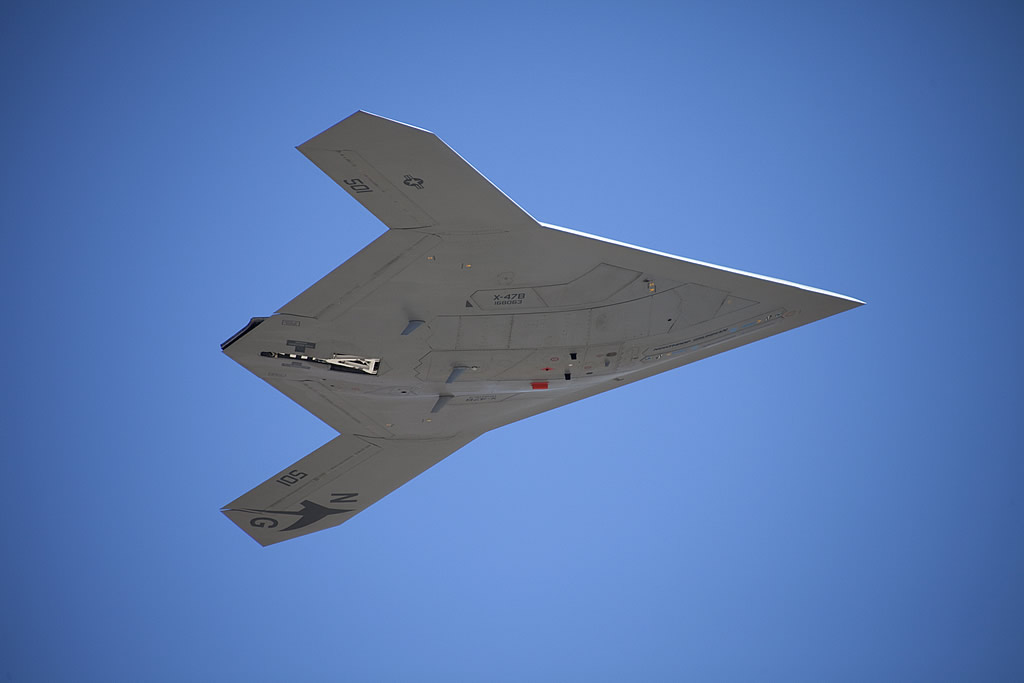
(click to view full)
Sept 10/14: UCLASS. The UCLASS team has integrated the latest iteration of Common Control System (CCS) software, which is the 1st to use the latest Navy Interoperability Profile (NIOP). This iteration forms the baseline for all future UCLASS control software, and Cmdr. Wade Harris is the Control System and Connectivity (CS&C) lead. They’re currently testing this software with an air vehicle simulator based on the MQ-4C Triton.
Ron La France is the UCLASS integration lead, and system-level testing of the control station and connectivity segment, carrier segment, and air system segment in the lab is next. That’s hard enough. Meanwhile, the program team is working with 72 programs of record, 22 program offices, 6 program executive offices and 3 systems commands. No wonder this stuff is slow and expensive; in fairness, a carrier deck can’t afford screwups, and there are a lot of moving parts to consider. Sources: US Navy NAVAIR, “Navy integrates ‘common’ software into next-generation unmanned carrier-based system”.
Aug 29/14: UCLASS. So much for that Sept 10/14 DAB meeting. US Navy Cmdr. Thurraya S. Kent now says that:
“Defense officials will be including [Unmanned Carrier Launched Airborne Surveillance and Strike (UCLASS)] in its ISR portfolio review to be conducted in conjunction with the normal budget review process this fall… Determination regarding the release of the UCLASS RFP will be made based on the results of this review.”
It appears that the Navy itself is divided between its initial view of UCLASS as an ISR asset with secondary aerial tanker and low-threat light strike capabilities, vs. a stealthy and refuelable high-threat strike platform that’s designed to radically extend the carrier’s offensive reach. Sources: USNI, “UCLASS RFP Delayed Again Following Pentagon Meeting”.
Aug 27/14: Testing. X-47B testing aboard USS Theodore Roosevelt [CVN 71] draws to a close. The UCAV flew with manned aircraft for the first time (q.v. Aug 17/14), continued flying and landing tests, performed a night time shipboard flight deck handling evaluation to see how the sailors dealt with that, and collected flying quality and recovery wind condition data to evaluate how the aircraft responds to wake turbulence during approach and landing. Sources: US Navy NAVAIR, “X-47B achieves new set of firsts aboard USS Theodore Roosevelt”.
Aug 19/14: UCLASS. USNI reports that US NAVAIR is about to release their UCLASS RFP at long last, with a final signoff expected on Sept 10/14 by the Defense Acquisition Board. The specifications are still secret this time, so it’s hard to have an intelligent public discussion beyond the public data of 14 hours ISR endurance, 1,000 pound payload, or 2,000 mile strike mission with 500 pounds payload.
It is interesting that many American sorties over Iraq these days are surveillance missions, though using Navy fighters for that is a fiscally stupid thing to do. Sources: USNI, “NAVAIR ‘On the Precipice’ of Releasing UCLASS RFP, Pentagon Review Set For Sept. 10” | USNI, “Navy: Most Carrier Sorties Over Iraq Are Surveillance Missions”.
[youtube:v=n56_H9KN7eI]
Aug 17/14: UCAS-D & F/A-18F. The Navy continues taking next steps, operating an X-47B alongside manned F/A-18C and F/A-18F fighters from the same carrier at the same time:
“The first series of manned/unmanned operations began this morning when the ship launched an F/A-18 and an X-47B. After an eight-minute flight, the X-47B executed an arrested landing, folded its wings and taxied out of the landing area. The deck-based operator used newly developed deck handling control to manually move the aircraft out of the way of other aircraft, allowing the F/A-18 to touch down close behind the X-47B’s recovery.”
This seems easy, but “de-confliction” is really dangerous. Sources: US Navy, “USS Theodore Roosevelt Conducts Combined Manned, Unmanned Operations” | Foxtrot Alpha, “Video Of X-47B & F/A-18 Carrier Ops Shows The Future Of Naval Aviation” | Washington Times, “Navy’s X-47B drone completes ‘key’ carrier tests alongside F/A-18 Hornet”.
July 31/14: UCLASS. USNI reports that the shift in UCLASS requirements wasn’t budget-driven, it was politically driven based on a program that doesn’t exist yet:
“In particular, the change in UCLASS from a deep strike stealthy penetrator into the current lightly armed intelligence, surveillance and reconnaissance (ISR) focused aircraft was – in large part – to preserve a manned version of the F/A-XX replacement for the Boeing F/A-18E/F Super Hornet, several Navy, Pentagon and industry sources confirmed to USNI News.”
It wouldn’t be the first time something like this has happened. The usual outcome is the elimination of a useful capability now, without really protecting the future program. Another trap could snap shut if the Washington Business Journal turns out to be correct, and the Navy decides to keep the specifications poorly defined, in order to give themselves more flexibility. What that usually gives you, is more cost. Sources: USNI, “UCLASS Requirements Shifted To Preserve Navy’s Next Generation Fighter” | The Guardian, “Carrier-based drone offers way forward for US navy – subject to squabbling” | Washington Business Journal, “Could UCLASS end up as the Pentagon’s next runaway program?”.
June 26/14: N-UCAS Phase II. Northrop Grumman Systems Corp. in San Diego, CA receives a $63.1 million to a previously awarded cost-plus-fixed-fee contract modification for Phase II of N-UCAS post-demonstration activities. $45.9 million is committed immediately, using US Navy FY 2013 and 2014 RDT&E budgets.
Phase II activities will include continued flights, test bed and flight test support at both shore-based locations and associated carrier detachments, continued development of Fleet Concepts of Operations, X-47B maintenance support, lab and test bed operational support and continued flight test opportunities.
Work will be performed in San Diego, CA (70%) and Patuxent River, MD (30%), and is expected to be complete in March 2015. US Naval Air Systems Command, Patuxent River, MD, is the contracting activity (N00019-07-C-0055).
N-UCAS Phase II
May 6/14: Politics. House Armed Services Committee (HASC) chair Buck McKeon [R-CA] is proposing to add $450 million to fund 5 EA-18Gs and their equipment in the FY 2015 budget, instead of the 22 on the unfunded priorities list. The committee’s proposed changes would also preserve all F-35 funding, while cutting the Navy’s unmanned UCLASS R&D budget in half to $200 million. Sources: Flightglobal, “House bill promotes EA-18G and U-2S, but hits UCLASS” | Reuters, “Boeing, backers to fight for funding for 22 Boeing jets”.
May 4/14: RFP leak? Shawn Brimley of the center-left Center for a New American Security discusses the recent classified UCLASS RFP. Something must have leaked:
“But last month the Navy instead reportedly issued classified requirements for UCLASS to deliver intelligence, surveillance and reconnaissance. Instead of creating a drone that can carry missiles or other strike power into enemy airspace, defense contractors have been told to submit proposals for an aircraft designed to fly around the aircraft carrier for 12 to 14 hours delivering persistent surveillance over uncontested airspace, with a light strike capability to eliminate targets of opportunity.”
Within the known set of contenders, this RFP would give General Atomics a significant advantage, but it would also remove most of the UCAV’s ability to operate in contested environments. Stealth at a level required for contested environments isn’t a bolt-on, it’s a fundamental design choice that affects most other choices. There’s a set of trade-offs between various capabilities and reasonable cost (q.v. Feb 13 – April 2/14), but one can legitimately wonder why the job description Brimley describes requires a new program of any kind. The MQ-4C Triton and RQ-4B Block 40 Global Hawks will already perform that reconnaissance role, and if light strike is also required, the MQ-9 Reaper could just be navalized. Sources: Defense One, “Congress’s Chance to Fix Aircraft Carrier Drones”.
April 30/14: Politics. The House Subcommittee On Seapower And Projection Forces discusses H.R. 4435, the FY 2015 National Defense Authorization Bill. Title II addresses UCLASS directly, and prohibits UCLASS contracts until the Pentagon has produced a review of the report that examines the carrier wing’s capabilities against surveillance-strike complexes by 2025-2035, including both manned and unmanned components. That actually misses one of a UCAV’s biggest benefits, which is the strike range they offer with aerial refueling. The report may not change much, but the committee does say that:
“The committee believes that current UCLASS Air System Segment requirements will not address the emerging anti-access/area-denial (A2/AD) challenges to U.S. power projection that originally motivated creation of the Navy Unmanned Combat Air System (N-UCAS) program during the 2006 Quadrennial Defense Review (QDR), and which were reaffirmed in both the 2010 QDR and 2012 Defense Strategic Guidance. In particular, the disproportionate emphasis in the requirements on unrefueled endurance to enable continuous intelligence, surveillance, and reconnaissance (ISR) support to the Carrier Strike Group (CSG), a capability need presumably satisfied by the planned acquisition of 68 MQ-4C Tritons…. appears unsupportive of the 2012 Defense Strategic Guidance for the United States to “maintain its ability to project power in areas in which our access and freedom to operate are challenged.”
….Finally, the committee is concerned with multiple aspects of the proposed UCLASS acquisition strategy, including: insufficient time and funding for contractors to mature their designs in support of a full-scope Preliminary Design Review, due in part to late-developing and still-evolving air system performance requirements; the additional risk to the program associated with the Navy’s decision to abandon the precision landing system developed and successfully tested during the UCAS-D effort; and the potential risk associated with NAVAIR developing the UCLASS Mission Control System internally.”
April 17/14: RFP. Secretary of the Navy Ray Mabus signed-off on the draft RFP during an April 16/14 briefing, and the US Navy Navy released a draft UCLASS RFP direct to their existing contractors: Boeing, General Atomics, Lockheed Martin & Northrop Grumman. It’s classified, as expected, and the final RFP is due late this year. Sources: USNI, “Navy Issues Restricted UCLASS Draft Request for Proposal”.
UCLASS RFP
April 10/14: UCAS-D Testing. The X-47B conducts its 1st night flight. Sources: US NAVAIR, “Photo Release: X-47B completes night flights”.
April 10/14: UCLASS GA. General Atomics’ modified Sea Avenger UAV appears to have grown larger since initial designs were released, with an internal bay and 4 wing hardpoints, including an option for buddy refueling tanks. The key question for the company will be the UCLASS stealth requirements. If they’re focused on ISR and strike missions in defended airspace, requiring good stealth scores in the C, X, and Ku bands, the Sea Avenger probably can’t compete. If the requirements focus on missions in relatively unthreatened airspace, inherent efficiencies in the Sea Avenger’s design sharply improve its chances. Sources: USNI, “General Atomics Shows Off Company’s UCLASS Option”.
April 9/14: UCAS-D Recognition. The X-47B program is awarded the aerospace industry’s annual Robert Collier trophy for 2013. Sources: US NAVAIR, “Navy’s X-47B program receives aviation honor”.
April 8/14: UCLASS. Speaking at the Sea, Air and Space 2014 expo, NAVAIR PEO unmanned aviation and strike weapons Adm. Mat Winter says that the US Navy expects to release a classified UCLASS draft RFP before the end of April. Sources: USNI, “Classified UCLASS Draft Request for Proposal Due at End of April”.
Feb 13 – April 2/14: UCLASS. Nailing down the UCLASS requirements has been the Navy’s biggest headache throughout, and even at this late date, competing visions are still problematic enough to delay the RFP. One is reminded of legendary Skunk Works chief Kelly Johnson:
“Starve before doing business with the damned Navy. They don’t know what the hell they want and will drive you up a wall before they break either your heart or a more exposed part of your anatomy.”
The core design issues are straightforward. One, more payload = more size = more cost. Two, different UCAV sizes force a choice of specific marinized jet engines, which will have specific fuel consumptions. If gal/nmi isn’t good enough, that means more fuel, which means more payload, and see #1. Engine choice also affects stealth and size directly, since efficient high-bypass turbofans have large diameters, and you have to design around that. Finally, stealth itself costs money, and creates airframe designs that are difficult to change later.
The Navy’s requirements (q.v. June 26/13) effectively impose a $75 million per UCAV cost cap, but “we want it all” letters from House ASC Seapower subcommittee chair Randy Forbes are likely to force costs to $100+ million if its recommendations are adopted. In-air refueling capability is critical for any UCAV, but adding maximum stealth and payload to the request is what breaks the deal. This may be one of those cases where a limited program with a less expensive platform is what’s really called for, in order to allow the Navy to figure out how they can best use the technology first. Sources: Scribd, Rep. Randy Forbes UCLASS Letter || USNI, “Cost Will Drive UCLASS Designs” | “Requirements Debate Continues to Delay UCLASS RFP”.
April 1/14: UCLASS. The Navy has been discussing the potential use of UCLASS as an aerial tanker platform for some time now. They aren’t talking about forward use during strikes. Rather, they’re focused on orbits around the carrier that can top off planes in the landing circle.
The Navy currently uses F/A-18E/F Super Hornets for that job, configured with buddy refueling tanks. Those missions eat up fully 20% of the fighters’ missions, consuming limited airframe flight hours for an expensive asset. All because the Navy foolishly retired its S-3 Vikings when they still had more remaining airframe life than a new Super Hornet. The coming COD carrier cargo aircraft competition may provide a different solution to this problem, via an upgraded C-3 Viking or the V-22’s roll-on refueling pallet. That’s good, because there probably won’t be enough UCLASS drones to do this job and perform their own missions. Sources: USNI, “UCLASS Could Be Used as Tanker for Carrier Air Wing”.
March 31/14: GAO Report. The US GAO tables its “Assessments of Selected Weapon Programs“. Which is actually a review for 2013, plus time to compile and publish. They peg the UCLASS program at $3.7 billion, and express concern about using a “technology development” program as a procurement program, which would bypass formal systems development requirements and move directly into production in 2020. A development contract is expected in FY 2014, but:
“UCLASS is critically dependent on the development and fielding of the Joint Precision Approach and Landing System (JPALS), a global positioning system that guides aircraft onto an aircraft carrier. Navy officials expect UCLASS to hold a preliminary design review – including the air vehicle, carrier, and control segments – in May 2014 based on JPALS test progress. However, the Navy still considers JPALS one of its top risks for UCLASS.”
March 4-11/14: FY15 Budget. The US military slowly files its budget documents, detailing planned spending from FY 2014 – 2019. The future UCLASS program is slated to consume $2.937 billion through FY 2019, all of which will be R&D money due to the program’s structure.
Feb 13/14: UCLASS Air-to-Air? The Navy is thinking broadly about UCLASS, which is good as long as it doesn’t screw up the specifications. Director of air warfare Rear Adm. Mike Manazir talks about the potential to use the UCLASS’ payload bay as a missile magazine. It wouldn’t have independent targeting capability, but datalinks with fighters like the missile-limited F-35C would allow remote firing, with guidance provided thereafter by manned fighters.
It’s the right kind of thinking, but unlikely to see much use for 3 reasons. One is that the UCLASS will be subsonic, with very limited ability to avoid enemy fighters. That’s a nice way of saying that they’d be expensive sitting ducks if enemy aircraft can get a firing solution on them, even as the number of missiles on board makes them a priority target. Another potential issue is that asking internal launchers to handle a wider variety of weapons (q.v. Nov 21/13) generally drives up costs, and may compromise optimal weapon configurations for the strike role. On a less likely but more catastrophic level, one hopes there’s no software exploit that might allow others to issue those kinds of firing commands. Sources: USNI, “Navy’s UCLASS Could Be Air to Air Fighter”.
Feb 4/14: UCLASS. The FY 2014 defense budget bill added some new demands on the UCLASS program, but they won’t stop the Navy from running it as a technology demonstration project that goes straight into operational production.
Programmatic updates, and annual GAO review of the program, are normal. What will change is the number of UAVs bought during the TD Phase, which is capped at 6 instead of the planned 24. The Navy says that they can handle Milestone B approval with 6, which was never really in doubt. What does change is the ability to field what’s effectively an operational capability straight out of the TD phase. Sources: USNI, “Navy: Congressional Oversight Will Not Slow UCLASS Program”.
Nov 21/13: UCLASS. The UCLASS weapons debate isn’t solved yet, though the Navy seems to be leaning strongly toward a primary surveillance and targeting role, since that would be a new addition to the carrier air wing. UCLASS/UCAS-D requirements officer Cmdr. Pete Yelle says that:
“Weapons requirements will be defined in the final proposals. It is up to the vendors to come back with proposals and leverage what is available”…. The UCLASS will be able to work operations over land and water using EO/IR, or electro-optical/infrared sensors, FMV or full-motion video and eventually a fifth-generation AESA radar, Yelle said.”
Full Motion Video is part of most EO/IR systems these days. As for the AESA radar, that can mean a wide array of solutions, and a significant range of expense. The question is how far one wants to go. Just surface scans? Surface scans plus periscope detection capabilities, to partially replace the retired S-3 Viking’s role? Or a full fighter radar for air and ground surveillance, with specialized capabilities added as software? Each choice leads to different cost ranges, and potential commonalities or divergences with other fleet assets.
On the weapons front, some capability for persistent surveillance and strike seems like an obvious addition. What’s available includes Paveway laser-guidance, JDAM and Small Diameter Bomb GPS, and DAMTC dual-mode laser/GPS bombs. Depending on a given UAV’s internal mechanics, compact anti-ship missiles and even AIM-9X air defense weapons could also become an option, but that tends to add complexity and cost to the system. Sources: Defense Tech, “Navy Plans to Arm UCLASS with JDAMs”.
Nov 10/13: Flying again. The X-47B is back at sea, flying from the decks of the USS Theodore Roosevelt [CVN 71]. US Navy, “X-47B Operates Aboard Theodore Roosevelt”:
“The aircraft performed precise touch and go maneuvers on the ship to generate data that characterizes the environment in close proximity of the carrier flight deck. In addition, the aircraft took part in flight deck handling drills, completed arrested landings and catapult launches. Mission operators monitored the aircraft’s autonomous flight from a portable command and control unit from Theodore Roosevelt’s flight deck during each of its 45-minute flights.”
FY 2013
In-depth carrier ops testing; UCAS-D deck handling, catapult launch, and arrested landing tests; Despite cuts, UCLASS plans are still on.
[youtube:v=Rc2k6G8LuqY]
click for video
Aug 28 – Sept 6/13: AAR. A Calspan Learjet has been modified with a non-functioning aerial refueling probe, and X-47B UCAV hardware and software for navigation, command and control, and vision processing. Its challenge? To fly behind an Omega K-707 tanker, and demonstrate its ability to hold correct positions and operate with the installed systems. Testing went well.
The next step will using the kind of digital messaging and navigation processes that were demonstrated by the UCAV’s recent carrier landings, with Rockwell Collins TTNT datalink, and Precision Relative GPS (PGPS) algorithms. The final goal? A complete autonomous rendezvous, approach, plug, and safe separation. No fuel will be transferred to the Learjet, which isn’t equipped to receive it anyway, but the ability to fly that kind of evolution is enough challenge all by itself. People in the military overuse the phrase “game changer,” but a technology that could allow continuous 72+ hour missions and trans-ocean control from a carrier would indeed justify that description. Sources: US NAVAIR, “Navy autonomous aerial refueling tests underway”.
Aug 14/13: UCLASS. US Naval Air Systems Command in Patuxent River, MD offers each of the UCLASS study participants another $15 million firm-fixed-price contract for their preliminary design review assessment work. Each firm has $4.75 million committed to it immediately, and work is extended until June 2014. Too bad the core requirements are still in flux. The winners include:
* Northrop Grumman Systems Corp. in El Segundo, CA (N00019-13-C-0140).
* Lockheed Martin Corp. in Palmdale, CA (N00019-13-C-0141).
* Boeing in St. Louis, MO (N00019-13-C-0142).
* General Atomics Aeronautical Systems, Inc. in Poway, CA (N00019-13-C-0143).
Aug 12/13: UCLASS. Aviation Week reports that the US Navy is having a hard time with the specifications for their UCLASS program RFP, which will be delayed into September 2013.
The biggest question is how much stealth the drone requires. Despite recent manufacturing advances, like the radar-absorbing materials baked right into the F-35’s composite skin, more stealth tends to make planes more expensive to buy and to maintain, while dropping their endurance and payload. On the other hand, current drones would have a very short life expectancy against advanced air defense systems, which creates a gap outside of the military’s unknown “black” programs.
Aviation Week reports that Northrop Grumman and Lockheed Martin are emphasizing stealth, while General Atomics and Boeing are willing to raise the radar cross-section somewhat in exchange for payload and endurance. General Atomics’ Sea Avenger, with its winged body and tail, does seem to fit this description. On the other hand, Boeing’s X-45 Phantom Ray is a tailless flying wing design, just like its NGC and Lockheed competitors. If Boeing is really prioritizing range and payload, it means they’re changing their base platform. Aviation Week: “Uclass: How Much LO is Enough?”
Aug 7/13: UCAS-D: Keep flying. It seems that the X-47Bs aren’t done flying yet. Instead of mothballing them as planned, the US Navy wants to keep them flying into 2015, and deploy to carriers 3 more times. Up to 3 more carriers will be fitted with compatible equipment, and Congress may get its wish to have the aerial refueling tests restored and completed by October 2014. The most important test will involve full integration with a 70-plane carrier air wing for several weeks, which would create a different level of comfort within the Navy for unmanned aircraft.
Despite past weapon drops under the J-UCAS program, The Us Navy doesn’t expect to conduct any of those with the X-47 UCAS-D. NAVAIR’s Capt. Jaime Engdahl repeated that refusal a couple of times a week later, at the AUVSI conference.
Continued flying will also give Northrop Grumman additional opportunities to work on its UCLASS design, and ensure that the Navy gets comfortable with its evolution. David Axe correctly points out that the last situation similar to this one involve Lockheed Martin’s X-35 design, which was chosen to become the F-35. DoD Buzz: “Navy: X-47B Drone Won’t Be a Killer” | USNI News: “NAVAIR: X-47B to Fly Again” | War Is Boring: “Navy’s Big Surprise: Carrier Drone to Make a Comeback”.
July 10/13: X-47B “Salty Dog 502” leaves NAS Pax River, MD and flies to USS George H.W. Bush [CVN 77], off the coast of Virginia. The UCAV successfully lands on the aircraft carrier and traps the #3 wire, marking a huge milestone in naval aviation. It then takes off from the carrier and lands again. On the 3rd approach, the drone reported that one of its 3 navigational computers failed. Rear Adm. Mat Winter decides that they had done enough for 1 day, and orders the drone back to Wallops Island, VA to land. Even with that minor glitch, the Secretary of the Navy had an appropriate quote when he said that:
“It isn’t very often you get a glimpse of the future. Today, those of us aboard USS George H.W. Bush got that chance…”
Actually, glimpses of the future are common. What he meant to say was that glimpses of a future that promises big changes in naval warfare are rare. This event is indeed in that class – closer to Billy Mitchell’s sinking of the Ostfriesland than it is to the 1st carrier jet launch. The Navy still needs to demonstrate UCAS aerial refueling in order to complete an airpower revolution, but this is a very big step forward. US Navy | Northrop Grumman | Wind River | Defense Tech | DoD Live.
Carrier landing at sea!
July 2/13: UCLASS. Lockheed Martin touts a recent UCLASS demonstration at NAVAIR, but their focus is on back-end and Common Control systems, rather than the UCAV itself. Lockheed Martin:
“Using an open architecture framework integrated with DreamHammer’s Ballista [DID: link added] drone control software and Navy compliant software protocols, a single operator managed multiple UAS platforms [including Lockheed Martin’s UCLASS concept] simultaneously. The team also used the new Navy Cloud capability to demonstrate control of the ISR sensors and fully integrate the data into one complete mission picture. The team then used this picture to rapidly re-task and re-route the UAS assets. In addition to using DreamHammer’s Ballista drone control software in this UCLASS demonstration, Lockheed Martin is teamed with DreamHammer Government Solutions in pursuit of the upcoming Navy Common Control System contract.”
June 28/13: JPALS/N-UCAS. Engility Corp. in Mount Laurel, NJ receives a $12.5 million cost-plus-fixed-fee contract, exercising an option for engineering services in support of the Joint Precision Approach and Landing Systems (JPALS) and the Navy Unmanned Combat Aerial Systems programs. JPALS is a ground or ship-based system that adds extra precision to GPS, and is used to help land aircraft. It’s a critical enabler for naval UAVs like UCAS-D, UCLASS, etc.
$4 million in FY 2013 RDT&E funds are committed immediately. Services to be provided include requirements definition and analysis; prototyping; test and evaluation; technical assistance; system analysis; engineering; software development, integration and maintenance; test data acquisition; reduction and analysis; technical logistic support; configuration management; training support; and program and project management.
Work will be performed in St. Inigoes, MD (95%); Providence, RI (3%); and Chicago, IL (2%); and is expected to be complete by in January 2014 (N00421-12-C-0048).
June 26/13: UCLASS. “The Navy has outlined the specifications for the Unmanned Carrier Launched Surveillance and Strike (UCLASS) in a requirements document obtained by USNI News.” the key numbers are:
* Carrier and JALN-M network compatible, with take-off and landing in Sea State 3 (4′ waves) minimum, and SS7 (29′ waves) maximum.
* Able to conduct a strike mission at 2,000 nmi.
* Able to conduct 2 surveillance orbits at 600 nmi radius around the carrier, or 1 at 1,200 nmi radius.
* 3,000 pound payload, including day/night optical surveillance comparable to an MQ-9, plus a surface scanning radar including GMTI moving object tracking.
* At least 1,000 pounds of that payload can be existing carrier weapons.
* Enough stealth for surveillance missions in lightly contested areas.
Those requirements will be difficult to meet already. Now add a number of added requirement being floated at present, and ongoing disputes about how much stealth etc. is necessary. Sources: USNI, “UCLASS By the Numbers”.
May 17/13: Touch and Go. The X-47B UCAS-D follows its catapult launch with a touch-and-go landing on USS George W. Bush [CVN 77], which tests its ability to fly precision approaches to a moving target.
A touch-and-go doesn’t trap the wire, but throttles the engine to full and takes off again. Carrier-based planes have to be able to do that if they miss the wire and pull a “bolter,” which is a guaranteed way to get harassed by your fellow pilots. Not sure what you do to a UAV. Perhaps the Navy can offer a rotating pool of drone software programmers, available for friendly abuse via secure video conference. US NAVAIR | US Navy.
[youtube:v=dZ_XTt-O8gE]
click for video
May 14/13: Carrier launch. An X-47B UCAS-D is maneuvered into position on deck, and launched from USS George W. Bush [CVN 77]. The US Navy, Northrop Grumman et. al. hail it as a revolutionary milestone. We’ll grant that launching amidst the busy, complicated, and dangerous goings-on of a carrier deck is unlike any land-based challenge. It’s a difficult task for humans, and a difficult task for computers to do with human help.
Having said that, this isn’t the complete circuit. It’s the next logical step after on-ship deck tests (vid. Nov. 26/12) and land-based catapult launch (vid. Nov 29/12). We’ve said before that they won’t have a revolution on their hands until they can do the complete circuit: maneuver, launch, fly a circuit, and land. The next revolution after that will involve aerial refueling. When they do these things, we’ll join the chorus. US NAVAIR | Northrop Grumman.
May 6/13: Trap. The X-47B UCAS-D demonstrator successfully traps the wire as it lands at NAS Patuxent River, MD’s shore-based catapult and arresting gear complex. Northrop Grumman.
April 12/13: Support. FBO.gov:
“This synopsis provides notice of the Government’s intent to solicit a proposal on a sole source basis from Sierra Nevada Corporation, 444 Salomon Circle, Sparks, NV for work providing support in troubleshooting, problem resolution, and anomaly investigation associated with the Precision Global Positioning System (PGPS) as part of the existing Unmanned Combat Air System-Demonstration (UCAS-D) Program. This request for proposal will be issued in accordance with the terms and conditions of Basic Ordering Agreement (BOA) N00421-10-G-0001.
This acquisition is being pursued on a sole source basis under the statutory authority 10 U.S.C. 2304(c)(1), as implemented by Federal Acquisition Regulation Part 6.302-1, only one responsible source and no other supplies or services will satisfy agency requirements.”
April 7/13: UCLASS. Lockheed Martin finally unveils their Skunk Works’ UCLASS design, which combines elements of their RQ-170 Sentinel stealth reconnaissance UAV with technologies from the F-35C for carrier operations, weapons use, etc. Overall, the design looks quite a bit like Boeing’s X-45C Phantom Ray. LMCO UCLASS Page | YouTube video.
March 26/13: UCLASS. NAVAIR indicates through a presolicitation that it plans to go ahead with follow-on Preliminary Design contracts to all 4 UCLASS study contract vendors (Boeing, General Atomics, Lockheed Martin, Northrop Grumman – vid. June 23/11), and continue the Unmanned Carrier Launched Airborne Surveillance and Strike program.
The contracts are expected by the summer of 2013, supporting up to 2 years of work on the UAVs, datalinks for communications and control, and the carrier operations segment. They’re expected to carry each design to the Preliminary Design Review by Q3 2014, and support post-PDR design maturation and follow-on engineering. The next step after that will be the selection of 1 winner, and UCLASS initial operational capability within 3-6 years. FBO | Defense Update.
Dec 21/12: Aerial Refueling. Northrop Grumman Systems Corp. in San Diego, CA receives a $9.7 million cost-plus-incentive-fee contract modification for Autonomous Aerial Refueling (AAR) demonstration activities in support of the N-UCAS program. Services will include completion of Delta Critical Design Review (DCDR), surrogate testing with manned aircraft, preparation for the X-47B demonstration, travel, and support technical data for the AAR demonstration activities.
Work will be performed in Manhattan Beach, CA (70%) and Patuxent River, MD (30%), and is expected to be complete in December 2013. All contract funds are committed immediately (N00019-07-C-0055).
Nov 29/12: Testing. An X-47B is launched using a land-based naval steam catapult, at NAS Patuxent River, MD. The releases are full of words like “historic,” but DID just doesn’t see it. Lots of UAVs have been launched by non-steam catapults, steam catapult technology isn’t new, and this isn’t a launch from an actual ship. It’s just a test to verify that the X-47B’s landing gear, body structure, and software, which were designed from the outset to handle the rigors of a steam catapult launch, can indeed do so. A milestone, yes, but a minor one.
When an X-47B is launched from an actual ship, and recovered aboard, that will be historic. Ditto for successful aerial refueling. US NAVAIR | Northrop Grumman.
[youtube:v=bdY-V0uqaHQ]
click for video
Nov 26/12: Testing. An X-47B air vehicle arrives by barge from Naval Air Station Patuxent River, MD, and is craned aboard the USS Harry S. Truman [CVN 75] for deck handling tests aboard the ship.
One suspects that civil airspace certification for high-end drones can’t happen soon enough for NAVAIR and the US military. US NAVAIR.
Nov 15/12: Testing. Northrop Grumman announces that its UCAS-D team has successfully completed initial onshore trials of the Control Display Unit (CDU), a new wireless, handheld controller used for carrier-deck maneuvering. Tests were basic: control engine thrust; roll forward, brake and stop; nose wheel steering; and maneuver the aircraft efficiently into a catapult or out of the landing area following a mock carrier landing.
On-ship deck trials are next.
Nov 6/12: NASIF Testing. US NAVAIR discusses testing at the “N-UCAS Aviation/Ship Integration Facility.” If NASIF didn’t exist, the Navy would have to use an aircraft carrier for this sort of testing, and it can’t afford that. Hence the NASIF building, stocked with Primary Flight Control (PriFly), Landing Signals Officer (LSO), Carrier Air Traffic Control Center (CATCC) and Mission Control Element (MCE) equipment.
The UCAS-D program uses the facility for system integration of new equipment, and UAV/manned surrogate demonstration events. Events like final Human Systems Integration (HSI) modeling and simulation testing for sailors from USS Carl Vinson and USS Abraham Lincoln.
Instead of using the current method of controlling multiple aircraft with radar displays and voice radio, the event tested their ability to send and receive digital instructions to and from aircraft, in addition to using voice instructions. This capability is absolutely required for UAV, but it will also help manned fighters, whose 60-second landing spread includes a final 20 seconds of enforced controller silence. If the controllers can communicate with everyone else by text while a pilot lands, that’s a big step forward.
The controller teams showed they could handle it over about 20 test scenarios, which progressed from relaying UAV commands to a UAV mission operator for entry, to direct communication with the simulated UAV and more automated systems.
FY 2012
Aerial refueling expands to include both boom and drogue; How can it be a UFO, if it’s on a truck?

(click to view full)
Aug 20/12: UCLASS. NAVAIR awards a small $440,315 firm-fixed-price delivery order to Rockwell Collins, for Phase II of the ARC-210 UCLASS feasibility study with JPALS.
ARC-210 radios are used to communicate with UAVs over UHF, and their software may need fine-tuning to work with UCLASS for all of the Navy’s requirements (N00019-08-G-0016-0076). Contract: FBO.gov.
Aug 13/12: UCLASS. Naval Air Systems Command releases a Request for
Information to evaluate the Draft Mission Effectiveness Analysis (MEA) Tool developed by the UCLASS Program Office. In practice this is a spreadsheet fed with warfare analysis models, where the user can input UAV parameters for comparative assessment (N00019-12-P7-ZD235).
The RFP should come in the fall with a down-select to a single design in 2016 aiming for IOC in 2020. The spreadsheet is classified SECRET/NOFORN. FBO.gov | Flight International.
Early July 2012: Testing. Members from the UCAS-D carrier integration team engage in extensive software testing aboard USS Harry S. Truman [CVN 75], talking to fleet air-traffic controllers and air-department personnel about the usability of the new software, and lessons learned. Land-based X-47B tests will continue at Patuxent River, MD, and the goal is a carrier landing in about a year. US NAVAIR.
June 14/12: UFO-G. US NAVAIR indirectly confirms that the wrapped object spotted on a truck in Kansas was UCAS-D AV-2 (vid. June 6/12 entry), being trucked across the country from Edwards AFB, CA to NAS Patuxent River, MD for the next phase of flight tests. Easier than getting the civil flight waivers, I guess.
June 8/12: JPALS. L-3 Service, Inc. in Mount Laurel, NJ receives a $12.5 million cost-plus-fixed-fee contract for engineering services in support of the precision GPS Joint Precision Approach and Landing System, and the Navy’s UCAS-D program. The 2 are highly connected, of course, since UCAVs will need to depend on precision GPS, in order to land on carriers (vid. the July 2/11 test). JPALS will also help manned fighters.
Services to be provided include requirements definition and analysis, prototyping, test and evaluation, technical assistance, system analysis, engineering, software work, test data acquisition, reduction and analysis, technical logistic support, configuration management, training support, and program and project management. Work will be performed in St. Inigoes, MD (95%); Providence, RI (3%); and Chicago, IL (2%). Work is expected to be complete in October 2012. This contract was not competitively procured, pursuant to the FAR 6.302-1, by the US Naval Air Warfare Center Aircraft Division in Patuxent River, MD (N00421-12-C-0048).
June 6/12: UFO-G. From the Augusta (KS) Gazette:
“This morning several Butler County Sheriff officers and KDOT personnel escorted a flatbed trailer entering Augusta from the south on US Highway 77 and headed east out of town on US Highway 54. Traffic was backed up coming in and going out of town. At first glance the strange-shaped cargo cloaked in industrial-strength shrink wrap appeared to be a saucer, but an unidentified KDOT worker advised it was an X-47B Combat Drone coming from Texas and en route to an unknown destination.”
Operating unmanned jets in US civil air space is a bit of a problem, which may help to explain the decision to ship it by road. Kansas is a rather roundabout route from Texas to Patuxent River, MD, but it is more of a straight line from California.
Jan 21/12: Testing. NAVAIR/AFRL’s AAR program completes a series of ground and flight tests that began in November 2011, using a Calspan Learjet surrogate with X-47B hardware and software, and a Omega Air Refueling K-707 aerial tanker. The tests included simulated flight demonstrations of both boom/receptacle (USAF) and probe-and-drogue (Navy & European) aerial refueling techniques, but no fuel was actually transferred, and Calspan’s Learjet wasn’t equipped for that anyway. The tests were all about correct positioning and coordination, beginning at a position 1 nautical mile from the K-707, and allowing autonomous guidance to move the Learjet into the 3 air-air refueling positions: observation, contact, and re-form.
Navy UCAS program manager Capt. Jaime Engdahl says that the next big step will involve using the actual X-47B. The team plans to conduct 2 more surrogate test periods before a planned refueling demonstration with the X-47B in 2014. NAVAIR | Northrop Grumman.
Nov 22/11: AV-2 flies. The fully-equipped UCAS-D demonstrator #AV-2 takes off for the 1st time at Edwards AFB, CA. That’s about a year late, but AV-1’s issues had to be ironed out first.
With 2 flying UCAVs, the program is expected to move AV-2 to NAS Patuxent River, MD by the end of 2011, and begin testing carrier landing technologies in 2012. That will include GPS-guided precision approaches to the carrier, arrested landings and “roll-out” catapult launches at land-based test facilities; and flight testing of new precision navigation computers and guidance/ navigation/ control software recently installed on both aircraft. The new suite of hardware and software is designed to let the X-47B land safely on a moving aircraft carrier deck. AV-1 will continue testing at Edwards AFB, with a focus on finding its flight limits. Northrop Grumman.
Nov 7/11: Aerial refueling. Inside the Navy reports [subscription] that the US Navy will be expanding the X-47B’s planned aerial refueling capability, to autonomously refuel while in flight with both USAF Air Force and USN aerial tankers.
The USAF uses KC-135s and KC-10s, but many of the KC-135s need to place an attachment on the refueling boom, in order to refuel probe-carrying aircraft. The US Navy has KC-130 Hercules aerial tankers, and its F/A-18E/F Super Hornets can become “buddy refuelers” with special wing tanks.
FY 2011
1st UCAS-D flight; 1st carrier landing using a surrogate plane; UCLASS study contracts.
(click to view full)
July 18/11: Northrop Grumman Systems in San Diego, CA receives a $25 million cost-plus-incentive-fee contract modification for UCAS-D autonomous aerial refueling technology maturation and demonstration activities. They’ll provide “air systems, air vehicle segment, and mission management segment requirements definition; integration planning and verification planning; and definition of certification requirements and approach.”
Work will be performed in San Diego, CA, and is expected to be complete in December 2012. US Naval Air Systems Command in Patuxent River, MD manages the contract (N00019-07-C-0055).
July 2/11: Testing. A contractor/government team lands an F/A-18D test aircraft from Navy squadron VX-23 on the USS Eisenhower in the western Atlantic Ocean, using hardware and software developed for the X-47B UCAS-D. This Hornet had a pilot on board as a safety precaution, but the system landed the plane. A King Air 300 twin-prop plane from Air-Tec, Inc. was also used as a surrogate to test mission management, command and control, communications, air traffic control and navigation, without executing an actual landing. Participating organizations included USN PEO Carriers, NAVSEA PMA-268, and the crew of the USS Dwight D. Eisenhower; plus industry partners Northrop Grumman, Rockwell Collins, Honeywell, L-3 Communications, SAIC, ARINC and Sierra Nevada Corporation.
It’s a big step forward for the UCAS-D program, and came after a series of interim steps detailed in the accompanying releases. It could also change the way Navy pilots land manned aircraft. Right now, carrier landings are very manual, and visual. All air traffic control instructions are by voice, and even a good portion of navigation data has to be read out over the air, while visual signals cement the final approach.
Supporting a UAV, and possibly retrofitted manned fighters, in future operations, required some important ship modifications. Eisenhower’s Landing Signal Officer (LSO) equipment was altered to communicate directly with the VX-23 F/A-18D through a digital network, and so were the ship’s primary flight control (“tower”) and Carrier Air Traffic Control Center (CATCC). The UAS operator’s equipment, installed in one of the carrier’s ready rooms, was the other key network node. Precision Global Positioning System (PGPS) capabilities with sub-1 meter accuracy were then added into the ship and the aircraft, to provide constant position awareness. US NAVSEA | Northrop Grumman.
Unmanned carrier landing!
June 23/11: UCLASS US NAVAIR awards a set of UCLASS study contracts to 4 vendors. Boeing publicly touted its own 8-month, $480,000 study contract, which includes developing of a concept of operations, an analysis of alternatives, and an investigation of notional solutions for various components of the Navy’s UCLASS program, which could be fielded for ISR and strike operations by 2018. Boeing’s option would include the X-45C Phantom Ray UCAV, but similar contracts for about $500,000 each were issued to Northrop Grumman (X-47B/ UCAS-D), General Atomics (Sea Avenger, also new EMALS/AAG carrier launch/recovery systems), and Lockheed Martin (unknown, has previously discussed the possibility of an unmanned F-35).
The UCLASS system will consist of an air segment (the UCAV), a connectivity and control segment, a launch and recovery segment, and a systems support segment. FBO.gov announcement | Boeing. See also March 28/11, March 19/10 entries.
UCLASS Studies
May 16/11: Northrop Grumman announces that it has picked up awards from the USAF Flight Test Center at Edwards AFB, CA, including Flight Test Team of the Quarter (above candidates like the F-35) for its X-47B/UCAS-D aircraft.
April 25/11: Sub-contractors. ARINC Engineering Services, LLC in Annapolis, MD receives a $9.7 million cost-plus-fixed-fee contract for technical and engineering services in support of the Joint Precision Approach and Landing Systems (JPALS) and Navy Unmanned Combat Aerial Systems (N-UCAS) programs. The 2 are related, as JPALS precision GPS-driven approach is a natural fit with the landing needs of a carrier-borne UCAV.
Work will be performed in Lexington Park, MD (80%), and St. Inigoes, MD (20%), and is expected to be complete in October 2011. This contract was not competitively procured by the US Naval Air Warfare Center Aircraft Division in Patuxent River, MD (N00421-11-C-0034).
March 28/11: UCLASS. US NAVAIR issues a Broad Agency Announcement regarding UCLASS, in solicitation #N00019-11-R-0031:
“The Naval Air Systems Command seeks proposals which conceptually demonstrate that a UCLASS system can provide a persistent Carrier Vessel-Nuclear (CVN) based Intelligence, Surveillance, and Reconnaissance (ISR) and strike capability supporting carrier air wing operations in the 2018 timeframe. In order to identify and explore available trade space… The program anticipates leveraging existing, deployed Department of Defense (DoD) systems to launch, recover, and control the air vehicle, transfer data in support of time critical strike operations, and conduct persistence ISR operations. The ongoing Unmanned Combat Air System-Demonstration program will inform UCLASS development and provide technology risk reduction for Unmanned Aircraft (UA) integration into carrier environments.”
March 14/11: Testing. A US Navy/Northrop Grumman Corporation test team issues a report stating that 5 weeks of dynamic load testing on X-47B air vehicle 2 (AV-2) demonstrated its ability to handle the stresses, strains and dynamic loads associated with carrier catapult launches and arrested landings, and air-to-air refueling. AV-2 is the X-47B airframe that will be equipped for air-to-air refueling tests.
The tests themselves finished on Jan 24/11, a week ahead of schedule. NGC AV-2 manager says they included 8 design conditions, including a 3-G symmetrical pull up, a 2.4G rolling pullout, and turbulence during aerial refueling; and 5 conditions expected to occur on the ground, including takeoff and landing tests involving the nose gear and tail hook. To conduct the tests, engineers bonded pads to 200 points on the airframe surface, and then pushed and pulled on those pads using hydraulic jacks to simulate various static and dynamic load conditions. Northrop Grumman.
March 1-4/11: Testing. The X-47B UCAS-D makes its 2nd and 3rd of 49 planned flights at Edwards AFB, CA. Testers are working to expand the flight test envelope in terms of air speeds, altitudes and operating weights, while testing key systems. Major concerns at this point include its flight control system’s ability to handle unpredictable crosswinds and turbulence at all speeds, the accuracy of its flush-mounted air data testing instruments, and engine performance. NGC.
Feb 15/11: UCLASS. General Atomics Aeronautical Systems, Inc. announces success in wind-tunnel tests of its Sea Avenger model, intended to validate its new wing’s low-speed handling characteristics. a key wind tunnel test on a model of its jet-powered Sea Avenger Predator C variant. The new wing is also designed to increase aircraft dash speeds, which is an interesting engineering combination.
GA-ASI President Frank W. Pace touts the 90-hour, 8-day test at the San Diego Air & Space Technology Center, as a classic example of his firm’ push to invest in early development, ahead of customer requirements for a UCLASS type system. The firm’s past history with the MQ-1 Predator and MQ-9 Reaper backs up his boast.
Feb 7/11: Sub-contractors. Lockheed Martin touts their own involvement in the X-47B program, which mostly revolves around low observable (stealth) design and aspects of aerodynamic edges, inlet lip and control surfaces, and an all new arresting hook system. Al Romig is the current VP of Advanced Development Programs for Lockheed Martin Aeronautics, and the firm completed delivery of its UCAS-D hardware in December 2009. Lockheed Martin will continue to support further UCAS-D flight testing, as well as carrier flight operations.
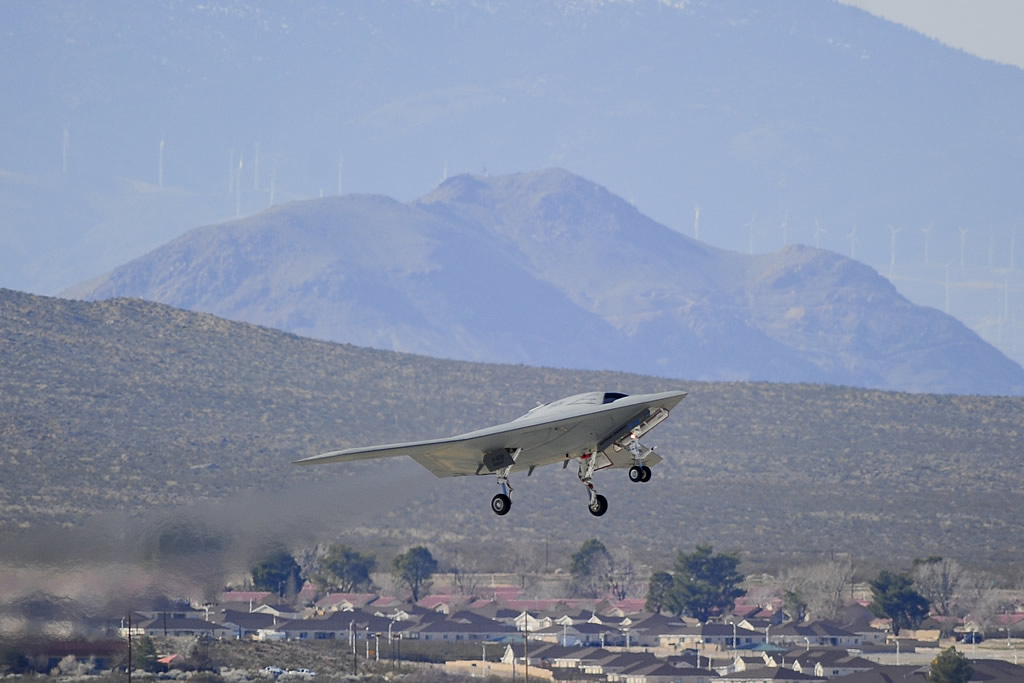
(click to view full)
Feb 4/11: First UCAS-D flight. The flight took off at 14:09 PST (GMT -0800) at Edwards AFB, and lasted 29 minutes, flying between 180 – 240 kt and climbing to 5,000 feet with landing gear down at all times, while executing racetrack patterns. It provided test data to verify and validate system software for guidance and navigation, and aerodynamic control of the tailless design. The flight follows airframe proof load tests, propulsion system accelerated mission tests, software maturity and reliability simulations, full system taxi tests, and numerous other system test activities that happen before any 1st flight.
Eugene Fly had made the first landing on a stationary ship on Jan 18/1911, but a 100th anniversary flight for X-47B #AV-1 wasn’t possible. Some of items that delayed this flight from original expectations in late 2009 included propulsion acoustic and engine-start sequencing issues, an asymmetric braking issue uncovered during taxi tests, and a last-minute maintenance issue with an auxiliary power generation system.
Testing continues. Aircraft AV-1 will remain at Edwards AFB for flight envelope expansion before transitioning to Naval Air Station Patuxent River, MD, later in 2011, where they will validate its readiness to begin testing in the maritime and carrier environment. Meanwhile, the refueling-ready AV-2 has completed its design limit load tests up to 130% with no test anomalies, showing that it’s able to withstand g-loads encountered during aerial refueling. It won’t begin its own tests until AV-1’s initial tests are done, which is currently planned for late 2011. The program is currently preparing the X-47B for carrier trials in 2013. US Navy | NGC release | Bullet points, images & video | Aviation Week.
1st flight
Feb 2/11: USAF opportunity? Defense news quotes Col. James Gear, director of the USAF’s Remotely Piloted Aircraft Task Force, on the future of its UAV fleet. Despite a big commitment to the MQ-1 Predator, the MQ-9 Reaper caused a major mid-stream shift in plans. Col. Gear cites some existing issues with the MQ-9, which could leave it open to a similar shift.
The Reaper does not fare well in icing conditions, and is also not considered survivable against anti-aircraft systems. The issue of jam and snoop-proof data links, and trace-back and verification of signal origins, has also been a live question during the MQ-1 and MQ-9’s tenure. The “MQ-X” that replaces it will have to do better on all 3 counts, and the USAF also wants it to be easily upgradeable via switch-out modules. The Colonel believes the resulting UAV will end up being common with the US Navy’s carrier-based UCLASS requirement, as the 2 services are cooperating closely. That could give Northrop Grumman’s funded X-47B N-UCAS an edge over Boeing’s privately developed X-45 Phantom Ray. It could also offer a boost to General Atomics’ Predator C/ Sea Avenger.
FY 2010
UCAS-D testing; UCLASS RFI and Navy plans; Does GA’s Predator C have a customer?
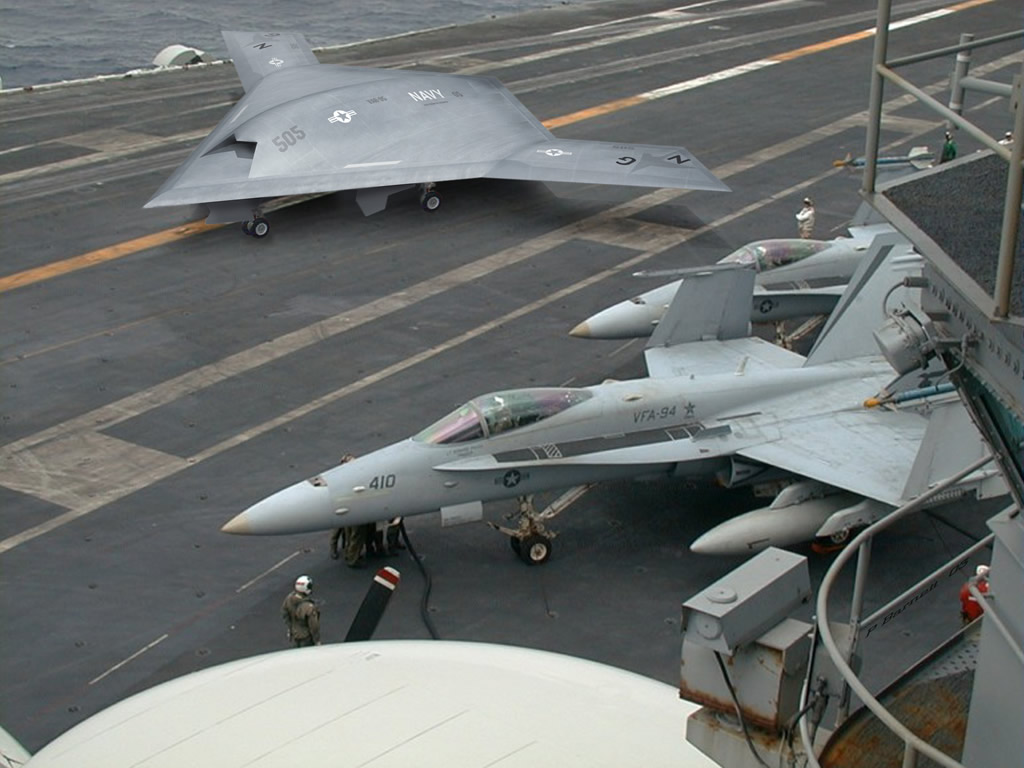
(click to view full)
July 19/10: UCLASS. General Atomics Aeronautical Systems, Inc. touts its jet-powered Predator C Avenger UAS as “ready for deployment” under programs like the British RAF’s SCAVENGER, or as the MQ-X successor to the USAF’s MQ-9 Reapers. The Avenger family’s avionics are based upon the Predator B/MQ-9 Reaper, and the plane features both radar and optical sensor options, plus a variety of internal weapons loads up to 2,000 pound Joint Direct Attack Munitions (JDAM).
Ready for deployment” is stretching things a bit. The Predator C series first flew in April 2009, “tail one” is currently averaging 2-3 flights a week, and flight tests were recently transferred from GA-ASI’s Gray Butte Flight Operations Facility in Palmdale, CA, to Naval Air Station (NAS) China Lake, CA. GA-ASI Aircraft Systems Group President Frank Pace does describe some results as “exceeding our expectations,” including excellent agreement between advance engineering and flight tests, and fuel burn rates up to 10% better than predicted models. The UAV reportedly uses a Pratt & Whitney Canada PW545B engine, which also powers the Cessna Citation XLS business jet.
May 3/10: UCLASS. General Atomics announces that it has submitted its “Sea Avenger” as a potential candidate for UCLASS airborne surveillance and strike requirement. Their UCAV is based on their jet-powered, 44-foot long and 66-foot wingspan “Predator C Avenger,” which can fly at 400 knots for up to 20 hours, and operate up to 50,000 feet. Design changes include a highly fuel-efficient engine and inlet design, a Lynx SAR ground-looking radar, retractable electro-optical/infrared (EO/IR) sensors and a 3,000 pound capacity internal weapons bay, and folding wings. The structure can accommodate carrier suitable landing gear, tail hook, drag devices, and other provisions for carrier operations.
Developed on company funds for near-term military use, the base Predator C Avenger is continuing through its planned test program, with a 2nd aircraft currently under development and expected to be complete by the end of 2010. General Atomics.
March 19/10: UCLASS RFI. The US Navy issues a Request for Information for a (UCLASS). The RFI indicates that the Navy is looking to move ahead with full unmanned combat aircraft earlier than its original plans.
“The Navy is interested in information on carrier based, low observable (LO) Unmanned Air Systems (UAS) concepts optimized for Irregular and Hybrid Warfare scenarios, capable of integrating with manned platforms as part of the Carrier Air Wing (CVW) by the end of 2018 to support limited operations in contested scenarios. The UAS should enhance situational awareness and shorten the time it takes to find, fix, track, target, engage, and assess time sensitive targets. This RFI is intended to determine the existence of sources that can provide a limited inventory of systems capable of being operated by fleet Sailors and performing the above mentioned Navy UAS mission.”
The UCLASS concept involves 4-6 UAVs that could perform both intelligence/ surveillance/ reconnaissance (ISR) and strike missions in contested airspace, that are able to fly for 11-14 hours without refuelling. Industry reportedly expected the navy to release a UCLASS RFP in early 2011, and interested parties beyond Northrop Grumman include General Atomics (Sea Avenger), and reportedly Boeing (X-45 Phantom Ray) as well. See: FedBizOpps RFI | Flight International | Jane’s.
March 17/10: Leadership. Janis Pamiljans, previously vice president and program manager of Northrop’s KC-30 aerial refueling tanker bid for the USAF, takes over from Scott Winship as vice president of N-UCAS related efforts. Pamiljans also has worked as a program manager on the F/A-18 and F-35 strike fighter programs.
Aviation Week points out that this is just one of several corporate moves, which seem to be aimed at freeing people up to participate in “black” (classified) programs, and develop a next-generation stealth aircraft for reconnaissance and long-range strike. Aviation Week | Defense News.
March 2/10: Leadership. Capt. Jeff Penfield takes over the Navy’s X-47B program office, replacing Capt. Martin Deppe. Source.
Feb 18/10: Predator C. Don Bolling, a Lockheed Martin senior business development manager, hints that General Atomics’ Predator C has a customer, and isn’t just a privately funded effort. He tells a media source that General Atomics Aeronautical Systems is interested in “Global Hawk-like” payloads for high altitude surveillance on its jet-powered Predator-C Avenger UAV, putting efforts to install the F-35 fighter’s Sniper pod-derived electro-optical targeting system (EOTS) on hold.
The shift was reportedly at the request of a customer, which made the report news because the Predator C wasn’t known to have a customer. The USAF already flies Global Hawks, and export approvals for the EOTS and Predator C would be an involved process. The most likely guess as to the customer would be the CIA, which does operate UAVs of its own, or US Special Operations Command. Flight International.
Feb 13/10: Testing. The US Navy announces that N-UCAS team members are underway with USS Abraham Lincoln [CVN 72] to test the integration of existing ship systems with new systems that will support the X-47B in carrier-controlled airspace. The team is testing X-47B software integration by using a King Air turbo prop “surrogate” aircraft taking off and landing from shore, but approaching the carrier and performing the various procedures associated with systems like Prifly, CATCC, LSO, etc. The digital messages from shipboard controllers receive “wilco” (ACK) responses to verify receipt.
Additional developmental testing later this year, will involve testing the software integration using an F/A-18 surrogate aircraft, to more closely emulate the X-47B’s flight.
Feb 4/10: Navy plans. Defense News reports that the N-UCAS program is slated to receive a $2 billion boost over the next 5 years, and seems set to follow the RQ-4 Global Hawk procurement model, rather than remaining a demonstration aircraft.
The RQ-4 Global Hawk was an advanced development program that was moved to the front lines after the 9/11 attacks, and became a fully operational platform. The 2010 Quadrennial Defense Review featured a tilt away from technology demonstrator status, and toward an X-47 UCAV that can perform surveillance and/or strike roles. That would let the Navy field operational UCAVs much sooner, and allow them to field a capability that could be similar but superior to the USAF’s current RQ-170 Sentinel/”Beast of Kandahar” stealth UAV. Those exact capabilities remain a matter for discussion, however, as Navy Undersecretary and UCAV advocate Bob Work points out:
“There is a lively debate over whether or not the N-UCAS demonstrator should result in a penetrating, ISR strike bird, or be more of a strike fighter… That debate has not quite been resolved. Having this extra $2 billion added to the budget is going to help us resolve that debate.”
Jan 26/10: Aerial refueling. Northrop Grumman Integrated Systems Sector in San Diego, CA received an $11 million not-to-exceed modification to a previously awarded cost-plus-incentive-fee contract for autonomous aerial refueling technology maturation and demonstration activities in support of the Navy UCAS-D.
Work will be performed in El Segundo, CA (60%) and Rancho Bernardo, CA (40%), and is expected to be complete in November 2010 (N00019-07-C-0055).
Jan 17/10: Testing. First low-speed taxi test of an X-47 N-UCAS. Source.
Dec 22/10: Delay. Trouble with engine start sequencing and propulsion acoustics will now reportedly delay the X-47B’s December 2009 flight to sometime in the first 3 months of 2010. Gannett’s Navy Times | Defense Update.
Nov 25/09: Aviation Week reports that the X-47 UCAS-D system demonstrator is experiencing “propulsion acoustic and engine-start sequencing” issues, which will require additional testing and push its 1st flight to 2010.
The US Navy reportedly says UCAS-D is still on track for sea trials in 2012, but Northrop Grumman has placed a “moratorium” on press interviews for UCAS-D – never a good sign.
Nov 2/09: Navy plans. The Brookings Institute’s 21st Century Defense Initiative hosts Chief of Naval Operations Admiral Gary Roughead, who discusses the U.S. Navy’s use of new technologies, and its development and integration of unmanned systems. Excerpts:
“I would say that where we can make some significant breakthroughs us just in the organizing principles and in the way that we approach the unmanned systems. The idea of being able to disembark or embark long-range unmanned air systems for example changes the nature in which we can run flight decks, changes the nature of the carrier air wing configurations as we move into the future.
…I would also say that I am often struck that as we talk about unmanned systems we’ve really become enamored with the vehicle itself and there has been very, very little discussion and arguably little work on something that makes it all work together and that’s the network and the architecture of the network, how the information will be moved, what are the redundancies that you would have in place, and what are the common protocols that are going to be required as we move into the future.”
See WIRED Danger Room | Brookings Institute and full transcript [PDF]
Oct 6/09: Sub-contractors. GE Aviation announces that it has delivered the first fully-dressed X-47B UCAS-D landing gear to Northrop Grumman Corporation. “Fully-dressed” landing gear is designed to meet or exceed all U.S. Navy carrier landing requirements for a fully loaded UCAS-D aircraft. GE Aviation says that its combined systems make it the largest non-partner equipment supplier to the X-47B, but the landing gear effort had partners of its own:
“Due to the demanding mission profiles required for this advanced carrier platform, the landing gear system incorporates the latest technology advancements in steering control from Parker Hannifin as well as anti-skid braking systems from Goodrich Corporation.”
FY 2008 – 2009
Aerial refueling will be part of the program; Load testing.
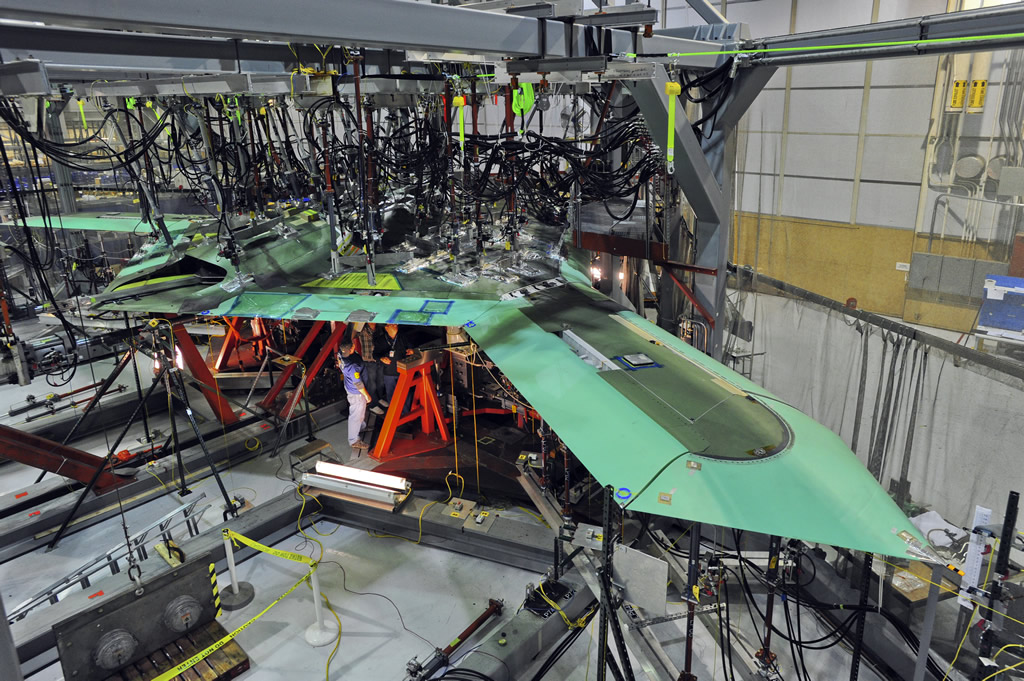
(click to view full)
Aug 11/09: Updates. AUVSI 2009 event reports indicate progress on several fronts from the UCAS-D program.
Flight International reports that an F/A-18D Hornet test plane with be modified to carry X-47B avionics and software, then used as a test bed to develop a fully integrated aircraft/carrier auto-landing system. The Navy is hoping to perform manned but “hands-off” approaches and landings on an aircraft carrier within 2 years, though that aspect remains to be decided.
Meanwhile, Shephard reports that number of USAF personnel will begin arriving at NAS Patuxent River as observers to PMA-268, the Navy UCAS Program Office. The planned air-air refueling demonstration was apparently the catalyst for USAF interest, and the second test aircraft (AV-2) is being built with full internal refueling systems on board.
July 29/09: Load testing. Northrop Grumman announces a successful series of static and dynamic proof load tests, designed to ensure that the UCAV will be able to stand up to aircraft carrier launches, recoveries, and other associated stresses. For these torture tests, over 200 electro-hydraulic assemblies were attached to the major components of the X-47B, whereupon pressure was applied to simulate desired conditions. The 2-month effort included progressive structural, functional proof and calibration tests to verify the integrity of all flight control surfaces, major structural load paths, main landing gear structure, and the tailhook assembly.
The 2nd aircraft is currently being assembled, and will begin proof load tests later in 2009. UCAS-D aircraft will also undergo parallel engine integration and taxi tests through fall 2009, in preparation for first flight and aircraft carrier trials. Northrop Grumman Aerospace Systems VP and UCAS-D program manager, Scott Winship, cited that unforgiving environment, then promised that:
“The X-47B was built for these conditions, and as the results of the rigorous proof test show, the design of the aircraft is structurally sound for all aspects of carrier operations.”
Jan 12/09: Aerial refueling. Jane’s confirms that the X-47 UCAS-D program will begin aerial refueling tests performed in 2010, using surrogate aircraft.
Dec 9/08: Aerial refueling. Aviation Week quotes UCAS program manager Scott Winship, as part of a report that that Northrop Grumman will modify the second X-47B UCAS-D to allow autonomous aerial refueling (AAR) using both U.S. Navy probe-and-drogue and U.S. Air Force boom-and-receptacle methods. The U.S. Navy has announced plans to award the company a sole-source contract to support the demonstration of AAR capability by 2013, under UCAS-D’s parallel technology-maturation phase.
Boeing is currently leading a team including X-47B partners Northrop Grumman and Lockheed Martin for the 4-year second phase of a parallel Air Force Research Laboratory program. Winship says the X-47B could be used to provide a “graduation exercise” for the AAR effort.
Nov 19/08: Aerial Refueling. Boeing in St Louis, MO received a $49 million cost plus fixed fee contract as the automated aerial refueling Phase II integrator. At this point, $1.2 million has been obligated. The Air Force Research Laboratory at Wright-Patterson AFB, OH manages this contract (FA8650-09-C-3902). Read “$49M for Boeing to Advance UAV Aerial Refueling” for an explanation of the importance to the UCAS-D and similar programs.
July 14/08: Sub-contractors. Pratt & Whitney announces a $54 million contract from Northrop Grumman to develop and integrate the X-47 UCAS-D’s engine and exhaust system. The Pratt & Whitney F100-PW-220U engine will power the UCAS-D, providing up to 16,000 pounds of thrust while operating in a maritime environment, including carrier deck operations.
FY 2005 – 2007
UCAS-D award; Carrier simulation exercise.
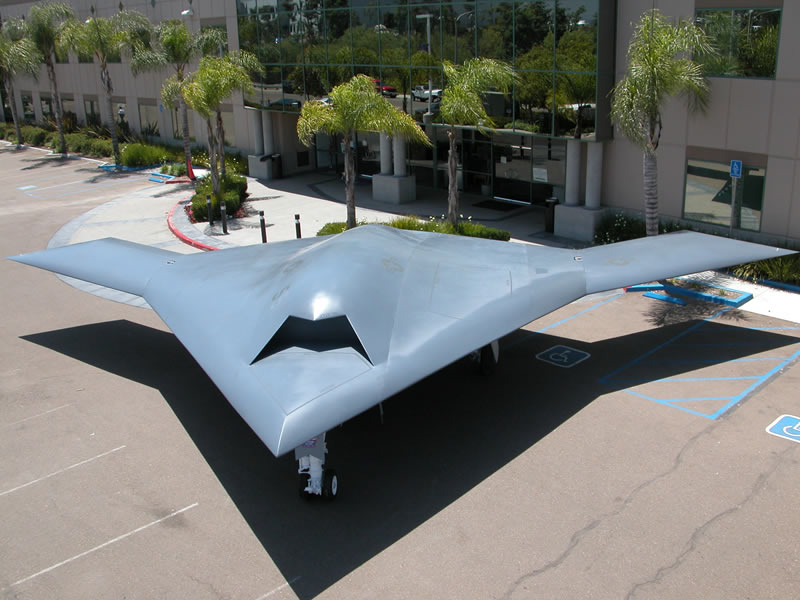
at the office…
(click to view full)
August 1/07: UCAS-D. Northrop Grumman Integrated Systems – Western Region in San Diego, CA received a $635.9 million cost-plus-incentive-fee contract for the Unmanned Combat Air System CV Demonstration Program (UCAS-D). Work will be performed in Rancho Bernardo, CA (38%); El Segundo, CA (29%); Palmdale, CA (13%); East Hartford, CT (7%); Jupiter, FL (2%); Nashville, TN (2%); Hazelwood, MO (1%), and various locations within the United States (8%), and is expected to be complete in September 2013.
The purpose of the UCAS-D is to demonstrate critical CV suitability technologies for a stealthy air vehicle in a relevant environment [DID: i.e naval/ aircraft carriers]. Expected deliverables include trade studies, analyses, software, reports and flight test data. This contract was competitively procured through a request for proposals; 2 firms were solicited [DID: that would be Boeing and NGC] and 2 offers were received (N00019-07-C-0055). See also Northrop Grumman’s Aug 3/07 release.
UCAS-D contract.
Sept 28/05: As part of DARPA’s J-UCAS program, Northrop Grumman Corporation’s X-47B conducted a successful simulated exercise at the Naval Air Warfare Center Weapons Division in China Lake, CA. It demonstrated the simultaneous control of 4 of its X-47B unmanned aerial vehicles (UAVs) during U.S. Navy aircraft carrier operations. See Dec 9/05 NGC release.
Using a surrogate aircraft which represented one X-47B, 3 additional simulated X-47B aircraft were successfully controlled during several flights using advanced mission-management software and air traffic control procedures currently used by Navy aircraft carriers. The air traffic controller provided standard commands to a single mission operator, who in turn ensured all four aircraft safely operated within the simulated carrier’s airspace. The controller had to demonstrate the ability to guide all 4 aircraft through approach, wave-off and traffic pattern procedures, while accomplishing proper spacing and air traffic de-confliction. The mission operator had to be able to monitor the entire process to ensure proper command response, and advise the controller on aircraft response or performance limitations.
This was one of many tests undertaken as part of J-UCAS. It is reproduced here for its ongoing relevance to the UCAS-D program.
Additional UCAV Readings
UCAS-D/ N-UCAS
* Air Force Technology – X-47 Pegasus Naval Unmanned Combat Air Vehicle (UCAV-N), USA.
* Northrop Grumman – X-47B UCAS.
* Northrop Grumman Review Online (2007) – The United States Navy’s Unmanned Combat Air System Demonstration (UCAS-D) Program.
* Rockwell Collins, via SLDINFO – Tactical Targeting Network Technology and Connectivity [PDF]. TTNT’s very low latency, join on the fly networking is important for UCAV safety-of-flight, especially around carrier decks.
* DID – Game-Changer: USA Developing UAV Aerial Refueling. Automated Aerial Refueling is the key to unlocking the UCAV’s full potential.
* Center for Strategic & Budgetary Assessments (June 18/08) – Range, Persistence, Stealth, and Networking: The Case for a Carrier-Based Unmanned Combat Air System [PDF].
News & Views
* USNI (Aug 21/14) – Essay: The Legal and Moral Problems of Autonomous Strike Aircraft. Technically, the UCLASS is not autonomous, its human operator has to trigger the attack. The question is whether that’s ultimately feasible in an anti-access, high-jamming environment.
* Washington Business Journal (Aug 19/14) – Could UCLASS end up as the Pentagon’s next runaway program?
* Breaking Defense (Aug 5/14) – Crunch Time For UCLASS: USD Kendall, Rep. Forbes, & The Requirements Fight.
* James Hasik (Dec 3/13) – Manning the Unmanned: Cultural Experimentation for the Coming Drone Fleet.
* James Hasik (Aug 15/13) – Range and payload: further thoughts on the US Navy’s approach to the UCLASS program.
* James Hasik (Aug 13/13) – Just how ambitious should be the requirements for the US Navy’s new drone?.
* NDIA National Defense (July 2013) – Fight Begins Over Navy’s Armed Drone Program .
* WIRED Danger Room (April 11/11) – Navy Wants Its Drone to Land on a Carrier With a Mouse Click.
* Military.com (Aug 14/07) – Will Drones Work on Carriers? Describes the process of launching and landing UCAVs on a carrier. You may be surprised to learn how much of this is already automated in America’s manned fighters.
* Center for Strategic & Budgetary Assessments (CSBA) Backgrounder (May 10/07) – The Unmanned Combat Air System Carrier Demonstration Program: A New Dawn For Naval Aviation? [PDF].
* AFA Air Force Magazine (November 2005) – Will We Have an Unmanned Armada.
* AFA Air Force Magazine (June 2005) – Toward an Unmanned Bomber.
UCAV Programs
* DID FOCUS Article – nEUROn UCAV Project Rolling Down the Runway (updated). nEUROn is a 6-nation European project that aims to create a UCAV with capabilities that resemble J-UCAS, but do not currently include carrier operations. It has moved into Phase 2.
* Air Force Technology – Taranis Unmanned Combat Air Vehicle (UCAV) Demonstrator, United Kingdom. Not tackling carrier operations at this point.
* DARPA – J-UCAS program. J-UCAS died shortly after being transferred to the Air Force and Navy.
* Air Force Technology – X-45 J-UCAV Joint Unmanned Combat Air System, USA. The X-47B’s competitor for the UCAS-D follow-on program, and fellow J-UCAS participant.
* DID – Ride on the Ray: Boeing’s X-45 UCAVs. Boeing has restarted it with corporate funding.
* AIN (May 17/13) – China’s ‘Sharp Sword’ UCAV is Spotted Taxiing .
* Northrop Grumman Analysis Center, presentation to the 3rd Joint-Industry Forum (Feb 16/05) – Joint Unmanned Combat Air System and US Military Transformation shows [PDF].